Showing posts with label horror. Show all posts

Sunday, February 9, 2025

Last Days by Brian Evenson

How do you know the moment when you cease to be human? Is it the moment when you decide to carry a head before you by its hair, extended before you like a lantern, as if you are Diogenes in search of one just man? Or is it the moment when reality, previously a smooth surface one slides one's way along, begins to come in waves, for a moment altogether too much and then utterly absent? Or is it the moment when you begin opening doors, showing each man behind each door the head of his spiritual leader before killing him with the cleaver tucked into your belt? Or is it the moment when all the dead begin to talk to you in a dull, rumbling murmur? Or is it the moment when these same voices suddenly fade away and stop talking together, leaving you utterly alone?

Kline, an ex-cop, goes through a shocking ordeal: an intruder cuts his hand off with a cleaver, and he is forced to cauterize his own stump with a hot plate--before shooting the intruder in the eye. Somehow, this is the beginning of his troubles. When it makes the news, the story of Kline's self-cauterization catches the eye of a cult of "mutilates" who believe that the more body parts you lop off, the closer you are to God. They kidnap Kline, ostensibly to help solve the murder of their leader (although how you can tell a guy with no legs, arms, eyes, genitals, or tongue is alive is a central question). Kline resists as far as he can, but the mutilates see him as one of their own--which mean they want to "honor" him by mutilating him further--while the cult's second-in-command seems to have a secret intention of his own.

It must be said, the premise of this book is bonkers. Evenson has a skill for taking a single image--the lopping off of a limb, with its suggestions of violation and loss, of the diminishment of the self--and extending to the point of logical and imagistic extreme. It borrows from the body horror-genre, of course, but Last Days seems actually to have more in common stylistically with noir: Kline is hard-boiled, terse, and the novel is framed, though suspiciously, by the need to get to the bottom of a crime. That these two genres don't end up together more often seems like a real oversight that Evenson intends here to fill.

Evenson ratchets up the intensity when Kline, realizing that he's being set up, makes his escape. The mutilates vow to follow and kill him, and they try their best, but he's saved at the last second by another group of amputees, all calling themselves Paul and missing their right hand--like Kline. As it turns out, the Pauls are the original group, and the mutilates are a splinter group that decided to take the Pauls' logic to a more extreme conclusion. Kline finds himself caught between these two groups, and the Pauls perhaps are worse, because they see in Kline a kind of Christ figure, reasoning that he seems to be immune to being killed. It also means they plan to crucify him (because that's what you do to a Christ figure, I guess). Kline ends up going on a killing spree that makes him confront the nature of his own humanity.

This is where the book lost me a little. The scene of a man drenched in the blood of others, asking himself how far he goes before he becomes human no longer, perhaps even to the point of embracing the ubermensch fantasies about himself--it's a little edgelord, isn't it? A little Deviant Art? There's a great parallel between Kline's growing sense of himself and the literal loss of his limbs, the physical shrinking, but in the end I'm not sure it was enough to overcome a feeling of melodrama that kept the book from totally working for me. Brent recommended some of Evenson's short fiction, and I think if I try again, I'd like to try something like that, because Last Days struck me as a book that sort of stumbled under its own need to keep the horror growing until the last bloody scenes.

Friday, July 28, 2023

Jawbone by Monica Ojeda

I'll try to explain it better: for me, the fear of the white age came on as my body was changing. First a rancid smell. Then nipples that rose up like hematomas, painful to the touch. Then the vaginal discharge, like fresh, whitish snot. The wiry hair. The stretch marks. The blood. That incompleteness and indefinition that disgusts about us is just as repulsive to me. Childhood ends with the creation of a monster that crawls around at night: an unpleasant body that cannot be trained. Puberty makes us werewolves, or hyenas, or reptiles, and when the moon is full, we can see how we lose ourselves (whatever it is that we are).

Fernanda, a young Ecuadorian teenager, wakes up to find herself chained to a wall. Her captor is her English teacher, Miss Clara. Miss Clara hunts and butchers a rabbit in front of Fernanda, who begins to fear that she is the next on the butcher's block. How did she end up here? A missing third explains it: Annelise, Fernanda's former best friend, who has convinced the Miss Clara that Fernanda has been hurting her, and that Miss Clara--already unstable from the death of her tyrannical mother and a previous experience being tied up by a pair of resentful high school girls--is the next victim.

Annelise, it turns out, is a skilled storyteller. She and her "group," including Fernanda and a trio of other girls, have been gathering for years at an abandoned building to tell spooky stories for years. Annelise is inspired by the "creepypastas" she reads on the internet--you know, Slenderman stuff. Such stories seem juvenile and silly, but in Annelise's hands they become truly frightening; she has spun an entire mythos about a "white age" controlled by a destroying "White God" whose symbols are the white alligator in the swamp and the disembodied jawbone that Annelise wears like a crown. These stories can only be told inside a windowless room painted, of course, white. But Annelise isn't just a storyteller; she yearns for the destruction embodied in the stories to become true, compelling Fernanda into quasi-sexual sessions of biting and choking. It' the bruises and scars from such sessions that allow Annelise to convince Miss Clara that her former best friend is a danger.

Jawbone is one of those rare masterpieces: a book that really shouldn't work at all, but succeeds in spite of that--or perhaps, because of its sheer bravado. You might think it would be cringe-inducing to write a book about creepypastas, but Ojeda reminds us--as Annelise reminds Miss Clara--that two young girls in the U.S. really did kill a classmate because they believed Slenderman demanded it. Jawbone really ought to feel like it's doing too much: throwing in not only the captivity narrative but Fernanda's conversations with her therapist, as well as an essay Annelise writes for Miss Clara that basically lays out the themes of the novel. Miss Clara's previous kidnapping ought to seem like too gratuitous a detail, not to mention the mysterious years-ago death of Fernanda's little brother. But, ultimately, these details contribute to the sense that Jawbone is audacious and unreserved, like the best horror books and movies. (Annelise insists that there is a difference between writing about horror and writing horror, but Jawbone is a testament to the way that horror can bleed through the margins we set for it.)

For Annelise, the White God and the white age are representations of the fundamental horror of living, and especially living as a woman. The white age encompasses the horribly bodily changes of puberty (see the quoted paragraph at top) but also the frightening cycle of creation and destruction that are motherhood and daughterhood. Annelise's group are spoiled upper-class Ecuadorian girls who have come to resent their mothers, who fear them; Miss Clara is so tortured by her mother's resentment that she dons her mother's clothes after her death and tries to become her. I was also fascinated by Jawbone's depiction of teaching: Miss Clara, perhaps because her students are kinds of surrogate daughters to her, is deeply and physically afraid of her students. So it is, by the tortured logic of horror, that by torturing Fernanda, Miss Clara revenges herself on her mother--and herself. The end of the book, though its final violence is only implied and not depicted, is one of the most unsettling conclusions to anything I think I've ever read.

Sunday, January 15, 2023

White Horse by Erika T. Wurth

Until now, I'd never thought about the other world except as something on the silver screen or the page, though I had to admit, horror had always been my favorite, which had to say something. I didn't believe in an afterlife, had never let Aunt Sandy drag me to church, even when I was a little girl. Though Jesus she'd tried, hard. And though some of my best friends growing up were more tradish Natives, from NAC to old school Dine lifeways, I wasn't interested in their stuff either. Whenever we'd be walking off in the woods, trying to find a place to get high, and a coyote would cross our paths and they'd shudder, tell me we had to turn around, I'd tell them to go right ahead. I was going to move forward and get baked.

Kari James is an "urban Indian," an Apache living in Denver. She spends her days haunting bars, especially her beloved White Horse, but she in turn is haunted by twin tragedies: the car crash that has destroyed her father's brain, and the overdose death of her teenage friend Jaime. Another tragedy, the mysterious death of her mother, has had little conscious impact on her, because Kari barely remembers her. But when her friend Debby discovers a copper bracelet that her mother used to own, Kari finds herself literally haunted: by touching it, she seems to have unloosed her mother's ghost, who follows Kari with blood pouring out of her mouth. Her mother, it seems, wants her to solve the mystery of her death, which has something to do with both a vicious Apache monster named the Lofa and Kari's own never-before-met grandparents.

Native horror is having sort of a moment. It makes a lot of sense, as a genre, as it often emerges from an inversion of well-worn horror tropes. As Kari notes on a tour of Colorado's Stanley Hotel, which inspired Stephen King's The Shining, and provided the setting for the movie, "it's all Indian burial grounds." Horror has mined vague apprehensions about Native spirituality for hundreds of years, and Native writers like Stephen Graham Jones and Cherie Dimaline, and Wurth, have upended it by seizing the perspective for themselves.

But man, I just don't think this genre--written by Native authors or otherwise--is for me. I've read all three of those authors and not one has worked for me. I think one of the central problems is that modern horror novels tend to draw not from the long tradition of Gothic literature, but from movies. It's why Kari ends up in the Stanley Hotel in the first place, driven by her mother's spirit, and though she claims to be a King superfan, it's easy to tell that it's the movie that provides most of this section's touchstones. Like the Jones and Dimaline books, White Horse has no idea of how supernatural images, or even moments of intense fear, might be expressed stylistically: each time Kari's mom shows up, it's written in the same bland prose as the moment before it, where Kari is sitting at a bar drinking or shopping in a record store. Which is OK for a movie script, but you need someone who knows how to put on the fisheye lens or add in the special effects.

White Horse makes a few feints toward a larger story about Indigenous issues: Kari begins to suspect that her mother was targeted because she was active in the American Indian Movement, of which she knows little. When Kari touches the bracelet, or other items associated with her mother, she's transported into her mother's consciousness, watching Russell Means speak or attending a protest; a similar thing happens when she takes hold of an Apache "war club" and briefly occupies the mind of Geronimo. But the newfound information that gets dumped into Kari's mind in these moments sits awkwardly in the narrative, and Wurth is never really able to connect them to anything else. You could read White Horse and not really know anything about what Means was trying to accomplish, or who exactly Geronimo was fighting, and where or when. There is a general gesture toward a deeper engagement with the urban Indian community, as with the AIM center that Kari discovers her mom frequented, and suspicious types are always discouraging Kari from doing so. But these things are treated quite superficially: the life choice that is really meant to represent Kari's growth is the choice to buy and manage the bar herself.

Saturday, January 22, 2022

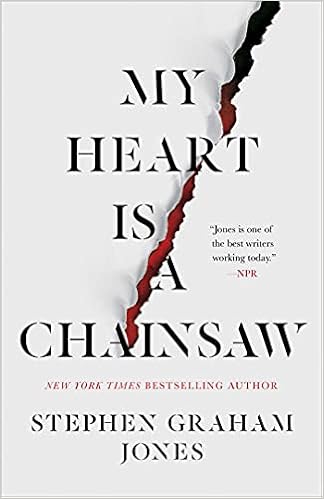
My Heart is a Chainsaw by Stephen Graham Jones

At some point this final girl has to realize that this is all about her, don't you think? That her friends and family and pets would all still be alive if this slasher had only STARTED with her instead of cutting his way closer and closer to her. So she feels guilty like maybe she's sort of the killer herself, like this bodycount is maybe HER bodycount.

What I'm saying here, sir, is that she's been groomed to become her secret and best self.

Jade Daniels is the biggest horror movie fan in all of Proofrock, Idaho. She's seen them all, from classics to modern takes to the obscure stuff you find in the bargain bin at the mall. She talks about nothing else, and that might be one of the reasons she doesn't have any friends. When unexplained killings begin to occur in Proofrock--first, a bunch of elk, and then a pair of Dutch tourists in the local lake--she decides that a "slasher" has begun, and it's her knowledge of the genre that makes her the only one who can see it.

At first, it seems like My Heart is a Chainsaw is about a traumatized girl who relies on a worldview derived from movies to keep the world sensible. There is a kind of poignancy to that idea: These movies have narratives of vengeance, of moral cause and effect, which promise that abusers--like Jade's neglectful father, perhaps--receive a taste of their own medicine tenfold. And they offer easily categorized labels of identity: the "Crazy Ralph" whom no one believes, the "final girl" who survives and defeats the slasher because she is the purest of heart. But in the end--spoiler alert--Jade's intuition proves to be correct; there is an evil force at work in Proofrock, and it's soon racking up a tremendous bodycount.

But Jade is mistaken about her role in the slasher to come. She latches onto a beautiful new student, Letha Mondragon, whose father is a tech mogul remaking the other side of the lake into a resort for millionaires. Letha's beauty and compassion convince Jade that she is the "final girl," and she devises a plan to train her for the coming onslaught by educating her in the patterns of horror movies. (That Letha is black, and horror movies are notoriously stingy about keeping black characters alive, seems to be a pattern that doesn't interest Jade or the novel in any serious way.) But when the climax of the movie/novel comes, it's of course Jade--not pure, not virginal, not popular or well-loved--who must "become her secret and best self."

I read Stephen Graham Jones' Ledfeather a couple years ago, a novel that I felt had a lot of quality writing and great ideas, but which was a little muddied and imbalanced. I had been looking forward to reading another of his books, hoping that the qualities that I admired so much would remain, and not the flaws, but I think the reverse is true: I actually feel bad about how much I disliked this book. For one, I didn't really like the slangy movie-teen voice, which works in the small doses of the interstitial "extra credit" papers Jade writes for her beloved history teacher about her slasher theories, but which is incredibly grating over 400 pages of third-person narrative. (One quick example: watching someone slide down a roof, she describes them as "Jesse Pinkmaning" down it. Blech.)

But mostly, the whole thing was just incredibly convoluted. From the beginning, we're told that Proofrock has three or four different creepy legends, including a "Lake Witch," a town that was drowned when the lake was dammed, and an old-time preacher who, I don't know, haunts them or something? Add to that several instances of remote trauma, like the murder of the sheriff's daughter before Jade was born. I couldn't keep any of it straight. There are maybe three dozen characters, most of them questionably necessary. The final 100 pages, in which Jade's premonition that Proofrock's July 4th celebration will be the slasher's bloody climax, are so intricately plotted I could not begin to summarize them.

If My Heart is a Chainsaw were a movie, it might have worked. We would have had visual cues that led us across the scene, from Jade's perspective in the water, to her father in a boat, to her love interest selflessly saving some children, to the suspected slasher creeping up with a machete, to Letha in a swan boat, to the ignorant townspeople about to get their jaws ripped off. But a book is not a movie. And that really explains much of why this book falls flat: it badly wants to be the kind of movie that Jade loves. But the jump scares don't jump or scare; the rush of escape leaves the reader behind; and Jade's constant interpolation, by which she filters everything that happens through her compendious slasher knowledge, totally deflects the kinds of emotions a real movie might inspire, like shock or fear. It doesn't work; it's just a mess. If you want to watch a slasher movie that's meta about its own structures, just go watch Scream instead.

Saturday, January 30, 2021

Empire of Wild by Cherie Dimaline

And then the creature dipped its head, tucking its narrow snout into its chest. In a moment its legs unfolded, covered in dark fur and bent like a dog's, but much too long. It stood up on its rear paws, which were the size of an adult's splayed hand, revealing a torso that was sleek and wrapped in fur but without the barrel of protruding canine ribs. This chest was flatter and wider, muscled like a man's. The face was dominated by glint and wet--bright yellow eyes rimmed with a pink third lid, and a mouth rammed with splintery teeth, too many to comprehend.

Joan's husband Victor has been gone for over a year, but she hasn't given up searching. Her family suspects he has left her, but her grandmother and her friend, a foul-mouthed elder named Ajean, know there are dangers in the northern Ontario woods where their Metis community is located. Joan grew up hearing stories of the rogarou, the fearsome werewolf-like creature that possesses a man, wearing his skin like a suit, making him forget he was a man. When Joan discovers Victor has become a traveling preacher under the name Eugene Wolff (get it), she realizes that he has been possessed by the malevolent rogarou--but is it Victor who is the rogarou, or the sinister German man bankrolling the Reverend Wolff's tent revival?

The rogarou, in Cherie Dimaline's Empire of the Wild, is a representation of all the malicious forces that drive the Metis, the descendants of Cree and French voyageurs, off of their traditional homes. Just before his disappearance, Joan and Victor argued about his desire to sell a tract of valuable lakefront property to white developers--a lucrative deal, to be sure, but one that would leave the Metis pushed back once again into the depths of the woods. When Joan confronts Heiser, the sinister German, he confesses that the tent revival is the perfect thing to distract "Indians" from the pipeline being built in their backyard, pipelines which will make him even richer.

There's an interesting distinction the novel make between revival-style evangelical Christianity, which is a lie and a distraction, and the traditional Catholicism of Joan's Metis family, which, like the traditional beliefs that help ward off the rogarou, are potent and communitarian. Heiser, for his part, turns out to be a Wolffsegner, which--I'm only guessing here--is a figure of Germanic legend who control wolves, including rogarous. It's Victor who is the rogarou, the betrayer figure who is taken in, like possession, by the insane idea to give away the land. Heiser is the white European all to ready to make use of those who would betray the Metis community from the inside.

I suspected as much going into it, but despite the interesting First Nations cultural gloss, Empire of Wild struck me as a standard pulp thriller, the kind of book with obscene grandmas and plucky teen sidekicks, and where people say things like, "I knew it was you, you son of a bitch!" There's something all-too cinematic about it, as if the book itself exists to be turned into a film or a television show, where the horror and suspense can be buoyed by special effect and swelling strings. As a book, though, it wasn't for me.

Sunday, June 3, 2018

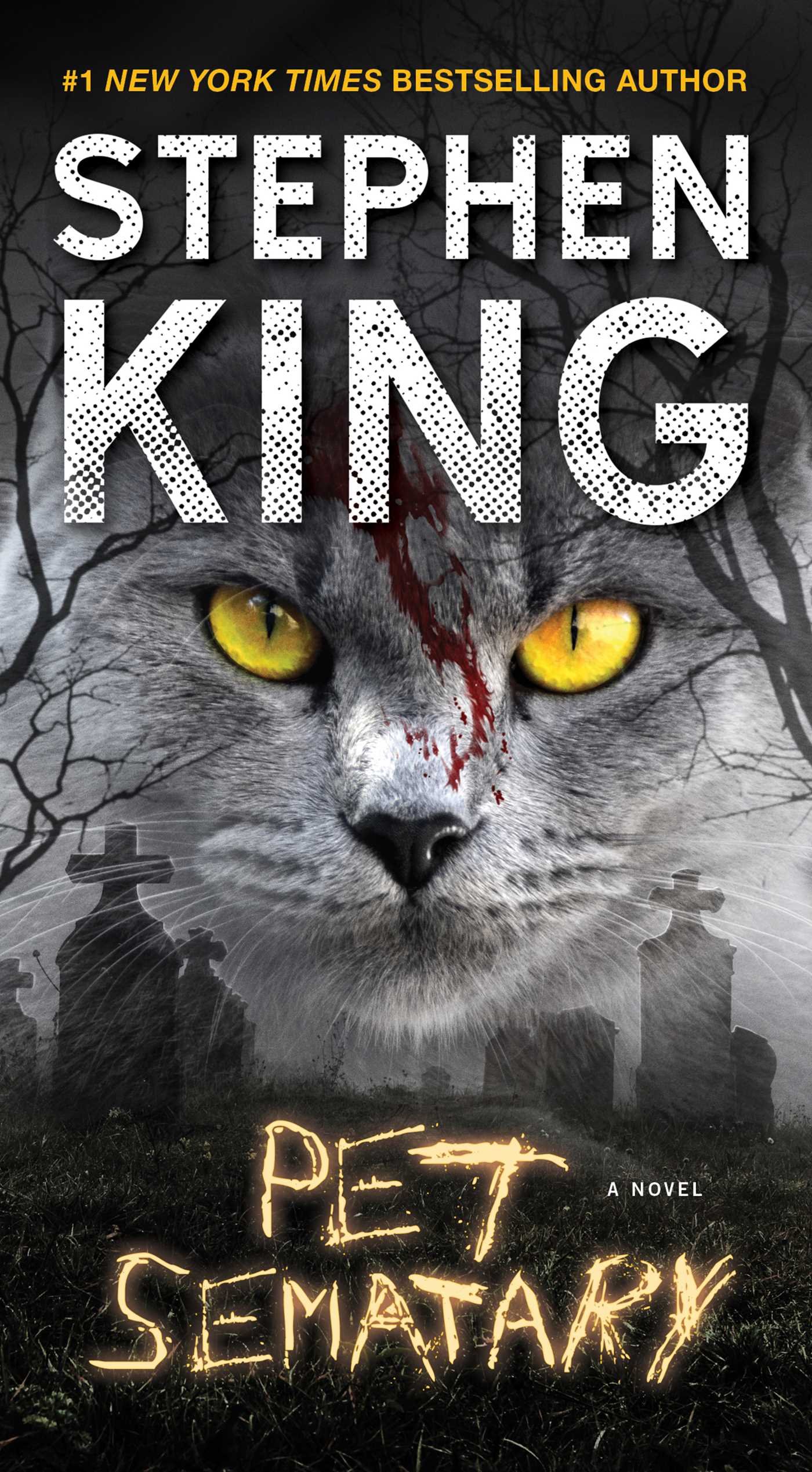
Pet Sematary by Stephen King

Louis and Gage knew him; they had met him and faced him down in New England.  He was waiting to choke you on a marble, to smother you with a dry-cleaning bag, to sizzle you in eternity with a fast and lethal boggie of electricity--Available at Your Nearest Switchplate or Vacant Light Socket Right Now.  There was death in a quarter bag of peanuts, an aspirate piece of steak, the next pack of cigarettes.  He was around all the time, he monitored all the checkpoints between the mortal and the eternal.  Dirty needles, poison beetles, downed live wires, forest fires.  Whirling roller skates that shot nurdy little kids into busy intersections.

(Spoiler alert, folks--if, like me, you've somehow avoided becoming familiar with King's books until now, you might want to turn back.)

The same painful image lies at the heart of Pet Sematary as Lincoln at the Bardo: a father lifting up the body of his deceased son, cradling it, unable to move past profound grief.  For the spirits in Saunders' novel, it's a symbol of shocking compassion and intimacy, a physical embrace past the point where such things can reasonably be expected.  In Pet Sematary, when the bereaved doctor Louis Creed steals his young son's body from the graveyard, the pathos runs the other way.  It's so grotesque that it borders on squeamish black comedy:

Somehow, panting, his stomach spasming from the smell and from the boneless loose feel of his son's miserably smashed body, Louis wrestled the body out of the coffin.  At last he sat on the verge of the grave with the body in his lap, his feet dangling in the hole, his face a horrible livid color, his eyes black holes, his mouth drawn down in a trembling bow of horror and pity and sorrow.

"Gage," he said and began to rock the boy in his arms.  Gage's hair lay against Louis's wrist, as lifeless as wire.  "Gage, it will be all right, I swear, Gage, it will be all right, this will end, this is just the night, please, Gage, I love you, Daddy loves you."

Louis rocked his son.

Louis' plan is to bury his son in the titular pet cemetery, an ancient Micmac burial ground that has the power to bring things back to life.  The scenes in the burial ground are effectively eerie, filled with fog and unidentifiable noises and the great black shape of the Wendigo moving through the mud.  Early in the novel he does the same thing with his daughter's cat Church, guided by an old Mainer who knows the supernatural history of the place.  Distraught folks have been burying their pets there for years--and maybe a few people, too.  Church comes back all wrong: torpid, bloodthirsty, without any kind of feline grace, and with an indelible stench of death.  Chances are Louis's son Gage, hit by a truck in their front yard, will come back changed, too.  But all the rational deliberation in the world can't overcome the depth of Louis' grief, and he goes through with the macabre plan despite knowing that.

Pet Sematary is a about 500 pages of meditation on the way death intrudes upon the banality of life, and another fifty pages of blood-soaked freakout horror.  King paints the life of Louis, his wife Rachel, and his children Ellie and Gage, in painstaking detail.  At times, too much detail--I'm not sure why we need to know, for instance, that "Rachel developed a mild infatuation with the blond bag boy at the A&P in Brewer and rhapsodized to Louis at night about how packed his jeans looked."  But death, like it does, breaks in on the Creeds' life again and again: in the form of a young man hit by a car on Louis' first day of work at the student clinic at the University of Maine, in the form of their elderly nextdoor neighbor, in memories about Rachel's sick and resentful sister, who died as a child.  Gage gets sick again and again, teasing you, almost, with the possibility of his death many times before it really happens.  As a doctor, Louis knows all about death, about the fragility of the body, but against grief such rationalism is powerless.

I was amazed by how painstakingly King builds up the life of this family, and then destroys it breezily and mercilessly.  The end, in which--hey, I meant that spoiler alert above--the toddler Gage comes back possessed by the murderous Wendigo and dispatches his own mother with a scalpel, was a real shock to me.  I guess I had underestimated how much ice runs in King's veins.  The message, I guess, is this: you'd better make friends with death, because you're just going to make it worse if you don't.  In a way, it's not so different from Lincoln in the Bardo, which also tells us that there is a danger in holding on to grief for too long, but with a gentler spirit. 

Sunday, October 29, 2017

Count Magnus and Other Stories by M. R. James

So he put his hand into the well-known nook under the pillow: only, it did not get so far.  What he touched was, according to his account, a mouth, with teeth, and with hair about it, and he declares, not the mouth of a human being.

M. R. James was a well-regarded Classical scholar who also happened to dabble in ghost stories. His stories are often described as "antiquarian," and they read exactly like the kind of story you might expect a Classical scholar to write.  The ghosts, ghouls, and monsters are often relics of a past age, accessed through a spooky artifact like an illuminated manuscript.  In one of the best stories, "The Mezzotint," the supernatural object is actually just a lithograph print depicting a country house, but the collector who acquires it notices that every time he looks at it a frightening shrouded figure has moved to a new spot in the picture, until he's made his way into the house and carried out an unsuspecting little boy.  They also take place against the backdrop of the stuffy world of Oxbridge; another story, "Casting the Runes," is all about a devious alchemist who uses his black magic to seek revenge on the scholar who refused to publish his monograph.  In another standout, "A School Story," a murdered man communicates with his murderer through his students' Latin exercises.

The best thing, I think, about James' stories, is how frightening and particular the various monsters are.  There's the mouth under the pillow above, but I also liked the monster from "Canon Alberic's Scrap Book," which has "[p]ale, dusky skin, covering nothing but bones and tendons of appalling strength; coarse black hairs, longer than ever grew on a human hand; nails rising from the ends of the fingers and curving sharply down and forward, grey, horny and wrinkled."  These disheveled ghouls are a perfect contrast to the gentility and decorum of James' professors and barristers and classicists.

My favorites are: "Number 13," in which the title hotel room appears at night and disappears during the day, housing a man who once made a deal with the devil to escape the hangman's noose, and the title story, "Count Magnus," about a medieval count who continues to hang out with demons long after his death.  Count Magnus is hardly ever seen, but the story is a masterwork of suspense.  Like most of the stories here, it's reported through several layers of hearsay, but that fails to dilute this image: "Also Anders Bjornsen was there, but he was dead.  And I tell you this about Anders Bjornsen, that he was once a beautiful man, but now his face was not there, because the flesh of it was sucked away from his bones."  Nice.  Happy Halloween, everyone!

Saturday, May 20, 2017

Don't Look Now by Daphne du Maurier

As he jumped the stile he heard the whirr of wings.  A black-backed gull dived down at him from the sky, missed, swerved in flight, and rose to dive again.  In a moment it was joined by others, six, seven, a dozen, black-backed and herring mixed.  Nat dropped his hoe.  The hoe was useless.  Covering his head with his arms he ran towards the cottage.  They kept coming at him from the air, silent save for the beating wings.  The terrible, fluttering wings.  He could feel the blood on his hands, his wrists, his neck.  Each stab of a swooping beak tore his flesh.  If only he could keep them from his eyes.  They had not learnt yet how to cling to a shoulder, how to strip clothing, how to dive in mass upon the head, upon the body.  But with each dive, with each attack, they became bolder.  And they had no thought for themselves.  When they dived low and missed, they crashed, bruised and broken, on the ground.  As Nat ran he stumbled, kicking their spent bodies in front of him.

I picked up the new NYRB collection of Daphne du Maurier's stories, Don't Look Now, because Brent had enjoyed it so much when he read it.  As it turns out, except for the title story, the collections are almost completely different.  Oh well.  That story, at least, is pretty good: a man and a woman vacationing in Italy after the loss of their daughter are approached by a set of older female twins, one of which claims to be able to see their dead daughter alongside them.  The woman is grateful and the man is skeptical.  And yet--while in the back alleys of Venice he sees a mysterious young girl hopping between the boats on the canal.  It's the kind of story where the details, like that one, suggest to you one ending, but the actual direction the story heads is completely unexpected.

Not so with "The Birds," which is far and away the best story here, and du Maurier's most famous, thanks to Hitchcock.  The premise is simple: one day, all the world's birds seem to declare war on the world's humans, and begin to attack.  There's no twists here, because it's a fight in which we're hopelessly outmatched--there's only one possible outcome, really.  The protagonist is a hardscrabble farmhand named Nat who is dedicated to protecting his family, boarding up the windows, scavenging his employers' house for good.  He's meant to contrast his gleeful boss, who heads out, foolhardy, with a gun, to see how many birds he can bag.

But he also contrasts the institutions of human society, which prove unable to meet the challenge of the birds.  In a modern film (one without Hitchcock's deftness, though even that is hardly the same as du Maurier's story) you'd have an obligatory scene in the president's war room, where they shout at each other about how their efforts are failing, but here, there's only the uncomfortable silence of the BBC Home channel on the radio in Nat's house.  Nat's wife asks why the planes they hear outside are dropping bombs, but Nat knows that what they're really hearing is the crashing of the planes.  It's chilling because it's not a personal or a private horror, but one that encompasses the whole world--yet it's deftly imagined through the lens of a single family.

Not all the stories are so successful.  I was underwhelmed by "Escort," which is like a hastily sketched version of the X-Files episode "Triangle."  "La Saint-Vierge" is essentially a dirty joke dressed up as a horror story.  I did like "Blue Lenses," in which a woman recovers from eye surgery to find that everyone's heads have been replaced by those of the animals that match their personality.  That story, which sounds so much like an episode of The Twilight Zone, has some of the same chilling absurdity of "The Birds."  I also liked the long final story, "Monte Verita," in which a mountain climbing-enthusiast loses his wife to a monastic community of women living in seclusion on a remote mountaintop, who are rumored to have discovered immortality.  Like "Don't Look Now," "Monte Verita" takes a good premise and adds a final, unexpected screw-turn that elevates the story and turns our expectations on their heads.  Du Maurier was an expert at that--just think about Rebecca--because the twists always seem to recontextualize the story and make it more awful, rather than a kind of cheap curtain-pulling.

Saturday, November 19, 2016

The Other by Thomas Tryon

Do you know about the well?  That dark and secret place where the accident happened--one of the accidents, I should say.  The hanging.  No, not that kind, but in its way nearly as horrible.  Can oyu hear it, the noisy grating of the pulley as the rope travels through, spinning the rusty wheel, dropping its burden down, down into the blackness?  The savage cries; terrible, shocked, outraged cries of fury, of horror.  No.  I said it was not that sort of hanging, not one of those state executions--well, yes, execution of sorts, but only because Holland didn't like cats.  Hated them, in fact.  Yes, it was a cat; didn't I mention that?  Trouble, the old woman's animal, her pet.  Got this rope around Trouble's neck--he could make a noose with ease--dragged it through the drive and hanged the cat in the well.  For spite.  The trouble was--excuse the pun--he darn near hanged himself.  Poor Holland.

Holland and Niles Perry are twins, living in the quiet Connecticut town of Pequot Landing.  Niles is the quiet one, the sensitive one.  Holland is the one that murders cats.  Early on in Tom Tryon's The Other, Holland moves from petty cruelties toward animals to straight-up murderousness, leaving a sharp pitchfork hidden in the hayloft where his annoying cousin, Russell, likes to dive into the hay.  Niles struggles to understand his brother with the compulsive attachment of the twin, but Holland is increasingly distant and prone toward evil.

The beginning of The Other is intriguing and mysterious, and the end--spoiler alert--is terrific.  It's not so much the realization that Holland has really been dead for nearly a year (he drowned himself killing the cat), and that Niles has been trying to keep his brother alive by committing horrible deeds in his stead, but the power of a single, final image: Niles' sister's infant child, having disappeared, found finally floating in a cask of wine.  A certain kind of book (or film, which The Other became--Tryon was a middlingly successful actor and turning it into a movie was probably always the goal) might have shied away from that last bit, saving the child at the last minute, but The Other doesn't want to pull that punch.

The middle of The Other, though, is quite a slog.  It's over-stuffed with symbols: a ring, a severed finger, the wine cask, a mysterious cellar, a Chinese magic trick, a pin shaped like a moon, a lamp, a hat, a doll--all of them imported from the tropes and vocabulary of the small town with a dark secret.  It's over-stuffed, too, with characters: a neverending troupe of aunts and uncles and townspeople who are meant to give the novel a sense of life but mostly provide tedium.  Tryon's method is to write long interstitial scenes of Niles' life at home, and to forecast moments of horror, only to pull away at the last minute and let the truly interesting parts happen "off-screen."  In a film, a sense of foreboding might make these scenes work, but I was too frustrated with The Other to really appreciate the pulpy nastiness of the way it ended.

Thursday, January 6, 2011

We Have Always Lived in the Castle by Shirley Jackson


Merricat, said Connie, would you like a cup of tea?
Oh no, said Merricat, you’ll poison me.
Merricat, said Connie, would you like to go to sleep?
Down in the bone yard ten feet deep.

I am not much for horror—Steven King and his counterparts have never appealed to me. There’s something different about Shirley Jackson’s work, though. In high school, she caught my attention with The Lottery. It was a while before I read anything else by her, but I read plenty about her—drawn in to the private life of a neurotic woman prone to staying shut in her house who didn’t like to bring attention to herself with interviews and the like. I knew that anyone able to chill me as well as she had, that could write as eerily as she did, had to either have a wonderful imagination or be just a bit disturbed. Who doesn’t love an eccentric author?

Spoilers. Kind of.

Like most young people, Merricat, the main character of We Have Always Lived in the Caste, is prone to making deals with the universe. If she nails a book to a tree a certain way, her family will be protected from the townspeople who don’t like them. If she walks along the sideway just a certain way, no one will harass her on her bi-weekly trips to and from the town to bring her remaining family members books and food. I say remaining family members because most of her family is dead—killed six years prior with arsenic. Only Merricat, her older sister Catherine, and her senile Uncle Julian remain living in their home, holed away with the money the locals know they horde. Constance was accused of being the one to poison her family and was let off the hook—though everyone still believes she’s guilty because she had always been the one in charge of the meals. In the beginning, the reader can’t be sure whether or not she’s guilty, though we do know she believed her parents and the others deserved to die. Both girls seem strangely removed from the event, and don’t discuss it between themselves with the exception of a brief exchange at the end of the book. Julian, on the other hand, is utterly obsessed with reliving the day of the poisoning from start to finish, because he was one of the intended victims and barely survived. While the sisters have disregard for the dead, they seem to harbor some kind of feelings for Julian:

Once I brought Uncle Julian a new leaf from the chestnut tree and put it on his window sill. I stood outside in the sunlight and looked in at him lying still in the dark room and tried to think of ways I might be kinder.

This is coming from the girl he won’t acknowledge, who he swears to Charles is dead and not in the house at all, that is not allowed to touch his things. In particular, his collection of writing on what they refer to as The Last Day, that he has dedicated his days and nights to finishing, when he can get out of bed at all.

On occasion, a gossipy old woman will come to call on the girls for tea, but the rest of the time, the Blackwoods keep to themselves. Until a cousin with questionable intentions shows up for an extended visit, putting a wrench in the system that the sisters have carefully set up for themselves in order to maintain some sense of a family life and happiness. Merricat has always taken care of her timid older sister and shielded her from the public eye and then this man comes in, making Constance feel guilty for the lack of guidance she’s provided for her fierce but out-of-touch-with-reality younger sister, whose strange behavior is suddenly not so acceptable anymore now that someone else is paying attention and there’s a more suitable caretaker to run the errands and tend to things. The tension comes to a head when Merricat decides that she has to do something to push Charles out of the picture in order to protect her relationship with her sister, who seems to be bending to Charles' logic (and manipulation). First, she tries her magic:

It was important to choose the exact device to drive Charles away. An imperfect magic, or one incorrectly used, might only bring more disaster upon our house. I thought of my mother’s jewels, since this was a day of sparkling things, but they might not be strong on a dull day, and Constance would be angry if I took them out of the box…

When she tires of waiting for the results of her attempts to cast out her “demon” cousin with magic, Merricat takes things a bit too far and in the process, a large section of their house burns down. Just as the firemen come to their rescue (?) so do the people of the town, using the opportunity to tear the place to pieces and wreck everything the fire didn’t damage. From there, we have what seemed to me to be a haunting version of Grey Gardens where the two girls make due the best they can in a deteriorating disaster of a place, refusing visitors and putting up barriers to keep the curious out. They escape mentally, talking about how happy they are “on the moon” even though their uncle has not survived their second round of disaster and have only former tablecloths to wear for clothes and their world seems to revolve around keeping the kitchen, their one unblemished room, perfectly clean so they can take their tea like ladies in their only two remaining cups with handles.

The whodunit plot twist isn’t much of a plot twist, but I don’t think that was ever Jackson’s intention. The horror isn’t so horrifying. But there’s something strange about the love the sisters have for one another despite a horrendous crime and their inability to love anyone else that kept me reading until the last page… and somehow also kept me strangely sympathetic. I think I also had to hang on to see any of Merricat’s magic was going to work. I could argue the answer to that particular question either way.

Tuesday, May 25, 2010

Something Wicked This Way Comes by Ray Bradbury

“Beware the autumn people...For some, autumn comes early, stays late, through life, where October follows September and November touches October and then instead of December and Christ’s birth there is no Bethlehem Star, no rejoicing, but September comes again and old October and so on down the years, with no winter, spring or revivifying summer. For these beings, fall is the only normal season, the only weather, there be no choice beyond.”

Somehow, I missed Something Wicked This Way Comes while I was scouring the children’s section of the library, and it’s probably a good thing. It’s hard to imagine how an avid Goosebumps reader would have dealt with a scary book that’s actually scary and substantial, not just for the grotesque images or the shocking twists, but for the themes it carries. There are spoilers in this review, mostly from the first third of the book.

The book opens on its dual protagonists, Jim Nightshade and Will Holloway. Both thirteen years old, they are inseparable sides of the same coin. Jim is rash and impetuous, always on the lookout for a thrill or an adventure; Will is more careful, although, as he says in the book, is often dragged into adventure by Jim whether he wants to be or not. The books opens in Autumn with the arrival of a mysterious carnival, populated by a diverse array of freaks and run by the Illustrated Man, Mr. Dark, a mysterious entity who exercises control over his freaks with his vast array of tattoos. The centerpiece of the carnival is broken down Carousel that nevertheless comes alive at night. It can spin either way, making its riders either older or younger. Soon after the carnival opens, Jim and Will see the carousel in action and make an enemy of Mr. Dark who, of course, spends the rest of the book trying to turn them into a couple of his freaks.

In addition to the boys, there’s a third, equally important character: Charles Holloway, Will’s 54 year old father. Married to a beautiful woman 20 years his junior, he struggles with feeling too old for her and too old to properly relate to his son.

Something Wicked
is surprisingly dense, and there are a lot of things I could talk about, but I’d like to focus on what seemed like the overriding themes: the elders’ fear of aging and death and the youth’s desire to speed the process along. The Carousel stands at the center of the novel, towering over even Mr. Dark in its sway over the protagonists. So let’s start with a laundry list: Will fears that, with time, he and Jim will grow apart. Jim fears that he will never grow up at all, and Charles fears that he’s already too old to relate to the people he cares most about. The thing is aging or de-aging on the carousel is no good. It rushes things, so young men end up with old men’s minds and old men are still children inside. It is the ultimate relationship breaker, because it makes relation with other people of your own age impossible—who wants to hang out with the 30 year old who still wants to play marbles, or the 16 year old who has all the worries in the world?

I don’t want to talk much more about the plot, but I will say that there are some very disturbing images, not so much because they’re graphic, but because being turned into a wax dummy is kind of terrifying. Anyway, this review is all over the place, but if you missed this as a child, it’s well worth reading. And I hear the film is pretty scary.

Saturday, January 23, 2010

Under the Dome by Stephen King

Since Jim just wrote a very good and mostly spoiler free review of Under the Dome a week or so ago, I'm going to refer you to his review for the normal things like a plot summary. Most of this review is going to be taken up with my thoughts on the themes brought out in the story, there will be spoilers.

Under the Dome is, I believe, King's longest single novel, beating out The Stand by just a few pages, and it was solid. Fast-moving, exciting, even a little touching at times. If you've read King before, the things you love and hate about his writing are all here: heroic children, religious overtones, lots of folksy dialectical dialog, a large cast of idiosyncratic characters, a psychic child or two, and people getting killed in awful ways. It's a good book, but the most interesting things occur below the surface.

I SPOIL THE ENTIRE ENDING BELOW. HOVER OVER THE TEXT TO SEE IT.

After all human efforts fail to raise or destroy the dome, it's discovered that the force that created it is--drum roll--not of this world. That might not not be so strange on its face, since King has explored extraterrestrial life before, but in this case, the creatures wreaking the havoc don't appear to be extraterrestrial so much as supernatural. The antagonists--vague eyeless, leathery creatures--have more in common with Lovecraft's elder gods than with aliens or with the concept of an Old Testamental Abrahamic God, as King seems to indicate in his other novels. The creatures as described in terms of children massacring an anthill, incapable of feeling guilt or sorrow for what they do. Their ways are inexplicable and unexplained: the dome itself, in the end, appears to have been nothing more than some deistic prank, a giant lens placed over a town full of ants. It's interesting that King never attempts to answer the questions that would seem to be the thematic core of the work, except to say that there are no answers. Sometimes, the book leans toward God working in mysterious ways, but ultimately it goes a step further: the alien children, in this universe, are God, and nothing we do can induce guilt. We can only hope for pity.

As a result, I thought the story was a little bit of a downer. It's not really humanistic--nearly everyone in Chester's Mill is dead by the end of the book, and those that are saved are saved mostly by sheer luck, nor is it optimistic about any sort of supernatural intervention. The only ones who care about us are us, and there's nothing we can really do.

Wednesday, July 8, 2009

From a Buick 8 by Stephen King

I don't have a whole lot to say about From a Buick 8. The book opens in the present day, but the story really begins years earlier, when a Buick is abandoned at a little gas station in the middle of nowhere, owing to the driver going to the bathroom and never coming back. It looks, in most ways, like a normal car, but there are a few things off about it. One side has more windows than the other, and somehow it's completely spotless. It doesn't even appear to have an engine. The police, including Ennis Rafferty who narrates most of the book, tow the car back to the station and put it in storage. Strange things start happening almost immediately: eerie midday lightshows, unidentifiable objects and creatures emerging from the trunk, and so on. Eventually, it becomes evident that the Buick isn't really a car at all, but some sort of dimensional gateway.


Eventually people start dying, of course, but that's where Buick gets interesting. Although Rafferty implies most of the officers believe that the various tragedies visited on the station are because of the car, the story never ties things up so neatly. Nothing really occurs, besides possibly the final scene, that couldn't have happened in the exact same way minus the car. An officer disappears, one is hit and killed by a semi, one's marriage begins dissolving. In the heat of things, it seems reasonable to assume that these things came with the title of the “car”, but it's also defensible that the car serves as a MacGuffin, a plot device to allow King to tell the story he really wants to, one about people. People with misplaced priorities, people who can't live in the present, people who make bad decisions. The various narrators mostly sound like people who've been through life and learned nothing from it. They take turns blaming the car for every bad thing that's happened in the last twenty years, none them considering that the real problem might lie not with the car, but with them.


In that sense, Buick actually has more in common with King's non-supernatural stories like The Body than with Christine. Human wickedness is all we conclusively see. The supernatural evil, such as it is, is never explained. No one ever steps through to the other dimension and confronts the makers of the Buick. There are no otherworldly messengers warning of imminent doom. Even the climax is understated, with victory arriving more by the passage of time than by any particular move on the part of the officers. That said, Buick is interesting and thought-provoking without being particularly good. If you like King, especially late-era rambly King, you'll probably like this. If you're not a fan or you've never read anything of his, start somewhere else.

Saturday, December 13, 2008

Pet Sematary by Stephen King

Sometimes dead is better.

Severe Spoilers.


I'd say I'm a fan of Stephen King. I've read 23 of his books, including On Writing and Danse Macabre, his only non-fiction as far as I know. Of the books I've read, I think I've enjoyed almost all of them, although King has a tendency (especially nowdays) to stretch a 30 page story into a 300 page one. I said that to say this, though: I've never been scared by one of King's books or short stories until I read Pet Sematary.


The plot is very simple, which is probably why it's so effective: Louis Creed to the town of Ludlow with his wife Rachael, his son Gage, and their pet cat, Winston Churchill. Soon after arriving, Winston Churchill is struck by a truck and killed, and Louis' old neighbor, Jud Crandall, tells Louis a secret. Behind their house, there's a cemetery. Animals buried in it come back to life. Louis buries Winston who does indeed come back, but something isn't quite right. One day while playing, Gage is hit by a truck and killed. You can connect the dots here.


The real horror of Pet Sematary doesn't really come from the plot, which is as old as the art of scary stories themselves. Be careful what you wish for. Don't tamper with cemeteries. Sometimes dead is better. It's the atmosphere, which is considerable and completely unrelenting, and in the realistic depiction of the Creed family as they struggle to deal with the death of their son. The book's climax, the resurrection of Gage, is both its centerpiece and, somehow, beside the point. Next to the horror of seeing your baby son run down, what's a zombie or two?


Pet Sematary is completely unmerciful. It never cuts its characters or its readers a break. Something about it is fundamentally disturbing in a way most of King's work (and most horror in general) isn't. It's nihilistic and hopeless, and that's why it works.

Sunday, June 8, 2008

Dracula by Bram Stoker

Brent Waggoner's Journals

Wednesday, June 4th
Another day in Frankfort. The weather is quite hot, so I've retired to the indoors. I've decided to post on Dracula, ironic since the Fifty Books Project has been dead this weeks. But oh, never mind. I'm sure it will pick up at any time, and at any rate, this review will help.

Thursday, June 5th
I've decided to writ a bit more today. Dracula is, of course, the narrative of the most famous vampire of all time. It is told in the form of journal entires from its five principle characters: Dr. Seward, Professor Van Helsing, Lucy Westerna, Mina Harker, Jonathan Harker, and assorted news articles describing events for which the party was not present. I was rather surprised to find how little I knew of the actual Dracula story. I would like to write more, but I fear my time is growing short; the battery light is blinking.

Saturday, June 7th
Completing this review has taken on a strange urgency, although I hardly know what to say. I will try to record my reactions as faithfully as possible so that those reading this in the future will not think me insane. The story is surprisingly dark and creepy, particularly for the first half. The second half gets bogged down for a bit in some procedural crime drama involving shipping lanes and weather patterns, but rebounds nicely for a somewhat anticlimatic but fitting ending. Notable themes in the book include Victorian fears of female sexuality, a study in gender roles, modernity vs. superstition, and, of course, good vs. evil. I read this on the recommendation of Lady Elizabeth, whose gentle spirit embodies all that is good about her gender. She spoke to me in a voice like a song while in the kitchen preparing my meal, suggesting, not vulgarly, that I peruse this volume. And that is enough for now.

Sunday, June 8th
I fear some strange madness has come over me. I cannot eat or sleep, and my skin is as pale as alabaster. Oh, Lord, save me from this dread curse, this twisting of my soul, do not let me turn, not now!

Later
My illness has passed. Turns out it was a bad bit of beet.

Thursday, May 29, 2008

The Secret Bedroom by R. L. Stine

This was a young adult thriller about a girl who discovers that her attic is being haunted by the ghost of a girl who killed her parents. The ghost possesses the protagonist (we'll call her Dana) multiple times until the protagonist finally musters up the willpower to force that ghost right back to Hell. Or something.

It was still a lot better than Anthem.

Wednesday, April 23, 2008

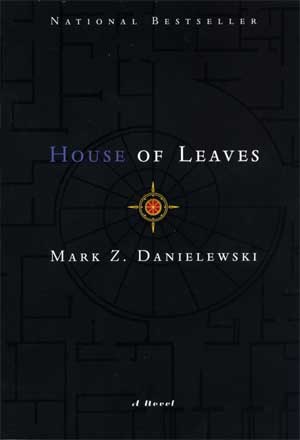
House of Leaves by Mark Z. Danielewski

Flashlight and camera skitter across ceiling and floor in loose harmony, stabbing into small rooms, alcoves, or spaces reminiscent of closets, though no shirts hang there. Still, no matter how far Navidson proceeds down this particular passageway, his light never comes close to touching the punctuation point promised by the converging perspective lines, sliding on and on and on, spawning one space after another, a constant stream of corners and walls, all of them unreadable and perfectly smooth.

Finally Navidson stops in front of an entrance much larger than the rest. It arcs high above his head and yawns into an undisturbed blackness. His flashlight finds the floor but no walls and, for the first time, no ceiling.

Only now do we begin to see how big Navidson's house really is.

Here is my attempt at explaining what happens in House of Leaves, moving from the outermost onion-skin of reality to the innermost:

1.) A down-and-out pleb named Johnny Truant who works at a tattoo parlor is invited by his friend Lude to the apartment of an old blind man named Zampano who has recently died. Johnny finds in Zampano's apartment a tattered, deranged-looking manuscript for

2.) House of Leaves, an academic study that Zampano has been writing about

3.) The Navidson Record, a fictional (even within the framework of Johnny Truant's reality) documentary film about a famous photographer named Will Navidson who buys a new house with his family in Virginia. The events of this film form the core of Danielewski's novel: While doing some idle measurements, Navidson discovers that his house is three quarters of an inch longer on the inside than the outside. After a couple weeks of inviting people over to investigate this strange issue, one morning Navidson and his wife wake up to find a door that wasn't there before.

This door leads, not to the outside of the house as it should, but into a dark phantom hallway. What the fuck. Investigating against the wishes of his wife, Navidson discovers that this hallway leads into a large room, which in turn leads into a larger room--so large he cannot explore it by flashlight. Further explorations reveal further spaces, each larger, and each inconstant--spaces shrink and grow, doors move, etc. Eventually Navidson hires a team of explorers to investigate, but their journey--which takes over a week--causes them to approach madness. There is a truly terrifying scene in which Navidson is at the bottom of a long spiral staircase--which took the exploration team days to descend, but which has taken Navidson only hours--and by radio he instructs his friend at the top of the stairs to drop quarters down the shaft to see how long they take to fall. Suddenly the staircase begins to stretch, and Navidson is abandoned at the bottom. Fifty minutes later the quarter finally hits--which, according to the math, suggests a depth greater than the circumference of the earth at the equator.

In the meanwhile, we get two sets of footnotes: one is Truant interjecting his story as he compiles the manuscript into a typed copy; it recounts his slow descent into fear and madness as Zampano's book begins to take a toll on him psychologically. The others are meticulously compiled academic footnotes. Many are references to fictional books, but some border on the absurd: for instance, during a chapter in which Zampano discusses photography, there is a footnote that says, "also see," and then lists hundreds upon hundreds of photographers--probably every photographer you've ever heard of and eight hundred more. On top of this, Danielewski plays liberally with the format of the book, making great use of oddly oriented text, large black and white spaces, color coding, and concrete prose.

What's the deal, here? Steven Poole has called House of Leaves "a satire of academic criticism," which seems accurate. The ridiculous footnoting is compounded by long discursive and digressive passages on the nature of things like photography and the concept of echo, or the story of Jacob and Esau or the Minotaur. These discourses usually go nowhere and end up coming off as unfailingly dry.

But at the heart of House of Leaves is a genuinely terrifying tale. The story of Navidson, lost in the strange, mythical labyrinth of his own house is as psychologically terrifying as anything I can think of in horror films. The academic criticism bits tend to suck the air out of the entire narrative, overanalyzing everything but illuminating very little. Of course, to that you might say, "Well, that is the point--House of Leaves satirizes academic criticism by showing its power to crush art and make it impotent." If that is the case, it often does quite well, but is this a worthwhile goal? Is a book that pokes fun at academic criticism as worthwhile as a book that is truly horrifying, as the Navidson sections of this book are? Would it have been stronger without Zampano's overly analytical musings?

And then, of course, there's Johnny's story. Zampano's book seems to take a real physical and psychological toll on Johnny, who begins to feel as if he is being shadowed by a horrible monster. If Zampano's book is meant to show the way in which criticism destroys art, what are we to make of the way it still has such a palpable effect on Johnny--or, for that matter, the way that it has an effect on us when Zampano is removed from the immediate picture?

Ultimately, House of Leaves is a book that delights in leaving more questions than answers, a puzzle instead of a solution. I think that Danielewski would be pleased that I was having trouble pinning the book down, because it is a book that purposefully avoids being pinned down, and in that case it's quite successful.