Showing posts with label daphne du maurier. Show all posts

Wednesday, November 30, 2022

The Scapegoat by Daphne du Maurier

This person who walked around wearing another's clothes, parading his features, colouring and manners, was guiltless, he was merely a covering, a facade, as remote from its original as a violin case from the instrument it protects. Emotion should have no part in this. I had never for one moment been so blind as to imagine that any show of warmth coming from these people was due to qualities of my own, springing suddenly to the surface and finding a response: they came alight for him and him only, however misplaced hte glow. What was happening, then, was that I wanted to preserve Jean de Gue from degradation. I could not bear to see him shamed. This man, who was not worth the saving, must be spared. Why? Because he looked like me?

John is an Englishman, a professor of French history, who longs for a life of human connection. He has no wife, no family or friends; he spends most of the time he's not teaching wandering through French towns and gazing wistfully at lighted windows there, yearning to be a part of what he passes. In Le Mans one day he encounters a shocking site: a man who looks exactly like himself. John's doppelganger, a Frenchman named Jean de Gue, draws him into a night of debauchery, and when John awakes from it he finds that de Gue has swapped all of their clothes and possessions. Well, what is he to do but to follow the address he finds on de Gue's effects, and take up residence with his family, pretending to be his own double?

The life John/Jean takes up is a troubled one: de Gue, it turns out, is a provincial Comte who owns a struggling glass foundry, which is managed by his envious brother, Paul. The Comte de Gue has been having an affair with Paul's wife, Renee, while his own wife Francoise suffers from a difficult pregnancy. His mother, Maman, is addicted to morphine, and his daughter Marie-Noel is obsessed with the idea of becoming a saint, and suffering for the satisfaction of God. In this pursuit she is tutored by the Comte's religious sister, Blanche, who has not spoken to him in many years. As John insinuates himself into the family, he begins to piece together the Comte de Gue's dark secrets, including his part in the murder of the foundry's former manager, who may or may not have collaborated during the Nazi occupation of France. Except they aren't secrets: everyone knows all about the Comte's past, it seems, though it isn't spoken about openly. John, in the role of the Comte, is the only one who doesn't know the truth about himself.

The elegant concept of The Scapegoat really seems like something only du Maurier could invent. There's no big secret here a la Rebecca, but John's inherent ignorance, and the impenetrability of his disguise, make for gripping reading. Like John, you long to find out the truth about the de Gue family. Why are they so resentful toward one another, so recriminating? It doesn't matter how scandalous the answer is, because the knowledge seems just beyond the limit of investigation: there's no one, and no way, to ask. But the interest of The Scapegoat lies in the characters as well as the premise, characters who, like in other du Maurier books, seem to have been lifted from the Gothic novels of a hundred years prior: bitter Blanche, imperious Maman, pious Marie-Noel. John, too, becomes drawn into their lives. What seems at first like a lark, a chance to live another man's life without consequences, without being touched, becomes a tangle, like a trap. John finds himself caring for the broken family, eager to fix what the Comte--by all accounts a selfish person--has led to ruin.

Rebecca is du Maurier's masterpiece, but I think The Scapegoat might be my new personal favorite. I really couldn't put it down. Like all good novels about doubling and imitation, the lines become quickly blurred. When John inserts himself into the Comte's life, looking and acting like the Comte, who's to say he is not the Comte? If Marie-Noel breaks her mother's porcelain figurine, what does it matter if she receives a replacement, rather than the original, mended? Is it possible to borrow a man's identity, but not his history? These are interesting questions the novel asks, that give it heft and weight, but they're almost beside the point when it's so gripping.

Sunday, November 1, 2020

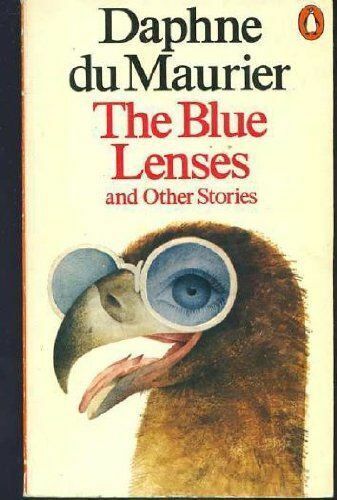
The Blue Lenses and Other Stories by Daphne du Maurier

Marda West continued walking down the street. She turned right, and left, and right again, and in the distance she saw the lights of Oxford Street. She began to hurry. The friendly traffic drew her like a magnet, the distant lights, the distant men and women. When she came to Oxford Street se paused, wondering of a sudden where she should go, whom she could ask for refuge. And it came to her once again that there was no one, no one at all; because the couple passing her now, a toad's head on a short black body clutching a panther's arm, could give her no protection, and the policeman standing at the corner was a baboon, the woman talking to him a little prinked-up pig. No one was human, no one was safe, the man a pace or two behind her was like Jim, another vulture. There were vultures on the pavement opposite. Coming towards her, laughing, was a jackal.

I could have sworn Daphne du Maurier's story "The Blue Lenses" was the basis for an episode of Twilight Zone, but that doesn't actually seem to be true. It's a shame, because it would have been perfect: a woman undergoes surgery to save her sight, leaving blind in the hospital for weeks. When eventually the gauze is removed and she is fitted with the special new glasses she'll need to see, she discovers that everyone in the hospital has an animal's head. Her doctor is a terrier, her nurse a cow. Like the greatest episodes of that show, the protagonist of "The Blue Lenses" endures a series of slow stages of increasing horror: first, she assumes it must be a tasteless practical joke. Once she can no longer deny the truth, the hammer falls: her fiance appears at her bedside with a vulture's head.

"The Blue Lenses" works so perfectly because it draws on a fear we have all experienced: the fear that, despite what they say, the people in our life do not care about us. The protagonist Marda and her fiance Jim have arranged for one of the hospital's nurses, Nurse Ansel, to spend a week at their home as a private caregiver during Marda's convalescence, but Nurse Ansel proves to have a snake's head. Without saying so explicitly--which, honestly, is one of the sharpest things about this story--Du Maurier insinuates to the reader that Jim and Ansel have conspired behind Marda's back to steal her money and run off together. Marda can turn nowhere to assuage this betrayal because the entire world is secretly a zoo; anyone on the street might be a vulture or a jackal looking to steal and kill. Marda sees once and for all what we all may have suspected, that the world is a hostile place and we are alone in it.

The title story excepted, the two strongest stories in this collection avoid the supernatural: In "The Alibi," a man decides to choose a house at random and murder whoever answers the door. He pretends to be an artist looking for a spare room, and takes the alibi so far--buying canvases and paints--that he actually does become invested in the art he is making, only to find himself accused of the murder he'd forgotten to commit when the tenant kills herself. In "Ganymede," a classical scholar falls for a 15-year old waiter in Venice, sublimating his pedophilia, transforming it into a fantasy that the young boy is the title cupbearer to Zeus. The boy's uncle sees his desire and insinuates himself into the man's life--with deadly results!

It's hard not to ruin those stories because they rely on third-act twists, both of which imagine what happens when our darkest impulses are allowed to escape our control and set loose in the world. For Du Maurier these dark desires are both uncontrollable and self-defeating; we really can't help destroying ourselves.

The other stories in the collection are a mixed bag of genre experiments. Stories like "The Pool," about a girl who imagines (?) a utopian world inside a garden pool at her grandmother's, and "The Chamois," about a woman whose husband is obsessed with hunting a rare species of European mountain goat, seemed to rely more on atmosphere and vague insinuations than the sharp insights of Du Maurier's best work. "The Menace" is a pretty pointless tale about what might happen if you could record emotional intensity on film, and how an old actor's career might be threatened if he had to be rather than act.

The worst of these, though, is "The Archduchess," a story I found morally and politically dubious as well as narratively flat. "The Archduchess" tells the story of the country of Ronda, a tiny European principality run by a succession of Archdukes who control the secret of permanent youth. The Rondese are entirely satisfied until a pair of agitators--a factory owner and a newspaperman--stir up rebellious sentiment with their propaganda, provoking the Rondese to storm the palace gates and kill the Archduke. When Ronda is just another democracy among the democracies of Europe, its mystique is punctured and the Rondese become as disillusioned as the rest of the modern peoples of the world.

I would say I don't understand this story, but I'm afraid I do: it's a bit of anti-democratic agitprop as delusional as anything published by the evil newspaperman. Industry (fair enough) and the media (uh-oh) are the enemy and monarchy the ideal state. The grievance that the Archduke had been keeping the secret of permanent youth to himself (which is true!) is a manufactured one, and the Rondese open themselves to suffering when they are hoodwinked by ideas of egalitarianism. Does that sound like a shitty bit of royalist politics? Well, it's also very boring!

It's tempting to make a connection between "The Archduchess" and the title story: do the blue lenses show the truth about a world that is so hostile and dangerous only a benevolent monarch can keep order? Is Du Maurier's outlook, with its fear of human nature, essentially a conservative one? I don't really know anything about Du Maurier's politics outside of her fiction, but I think it's possible that the best horror fiction is essentially reactionary, and Du Maurier may fit neatly into that. Regardless, "The Blue Lenses" is one of her best, and it was a great Halloween read for me this year.

Saturday, May 20, 2017

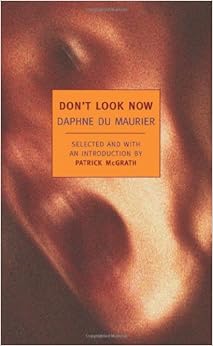
Don't Look Now by Daphne du Maurier

As he jumped the stile he heard the whirr of wings.  A black-backed gull dived down at him from the sky, missed, swerved in flight, and rose to dive again.  In a moment it was joined by others, six, seven, a dozen, black-backed and herring mixed.  Nat dropped his hoe.  The hoe was useless.  Covering his head with his arms he ran towards the cottage.  They kept coming at him from the air, silent save for the beating wings.  The terrible, fluttering wings.  He could feel the blood on his hands, his wrists, his neck.  Each stab of a swooping beak tore his flesh.  If only he could keep them from his eyes.  They had not learnt yet how to cling to a shoulder, how to strip clothing, how to dive in mass upon the head, upon the body.  But with each dive, with each attack, they became bolder.  And they had no thought for themselves.  When they dived low and missed, they crashed, bruised and broken, on the ground.  As Nat ran he stumbled, kicking their spent bodies in front of him.

I picked up the new NYRB collection of Daphne du Maurier's stories, Don't Look Now, because Brent had enjoyed it so much when he read it.  As it turns out, except for the title story, the collections are almost completely different.  Oh well.  That story, at least, is pretty good: a man and a woman vacationing in Italy after the loss of their daughter are approached by a set of older female twins, one of which claims to be able to see their dead daughter alongside them.  The woman is grateful and the man is skeptical.  And yet--while in the back alleys of Venice he sees a mysterious young girl hopping between the boats on the canal.  It's the kind of story where the details, like that one, suggest to you one ending, but the actual direction the story heads is completely unexpected.

Not so with "The Birds," which is far and away the best story here, and du Maurier's most famous, thanks to Hitchcock.  The premise is simple: one day, all the world's birds seem to declare war on the world's humans, and begin to attack.  There's no twists here, because it's a fight in which we're hopelessly outmatched--there's only one possible outcome, really.  The protagonist is a hardscrabble farmhand named Nat who is dedicated to protecting his family, boarding up the windows, scavenging his employers' house for good.  He's meant to contrast his gleeful boss, who heads out, foolhardy, with a gun, to see how many birds he can bag.

But he also contrasts the institutions of human society, which prove unable to meet the challenge of the birds.  In a modern film (one without Hitchcock's deftness, though even that is hardly the same as du Maurier's story) you'd have an obligatory scene in the president's war room, where they shout at each other about how their efforts are failing, but here, there's only the uncomfortable silence of the BBC Home channel on the radio in Nat's house.  Nat's wife asks why the planes they hear outside are dropping bombs, but Nat knows that what they're really hearing is the crashing of the planes.  It's chilling because it's not a personal or a private horror, but one that encompasses the whole world--yet it's deftly imagined through the lens of a single family.

Not all the stories are so successful.  I was underwhelmed by "Escort," which is like a hastily sketched version of the X-Files episode "Triangle."  "La Saint-Vierge" is essentially a dirty joke dressed up as a horror story.  I did like "Blue Lenses," in which a woman recovers from eye surgery to find that everyone's heads have been replaced by those of the animals that match their personality.  That story, which sounds so much like an episode of The Twilight Zone, has some of the same chilling absurdity of "The Birds."  I also liked the long final story, "Monte Verita," in which a mountain climbing-enthusiast loses his wife to a monastic community of women living in seclusion on a remote mountaintop, who are rumored to have discovered immortality.  Like "Don't Look Now," "Monte Verita" takes a good premise and adds a final, unexpected screw-turn that elevates the story and turns our expectations on their heads.  Du Maurier was an expert at that--just think about Rebecca--because the twists always seem to recontextualize the story and make it more awful, rather than a kind of cheap curtain-pulling.

Tuesday, December 8, 2015

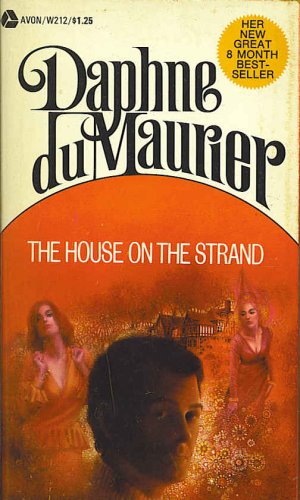
The House on the Strand by Daphne du Maurier

We found ourselves in the stableyard, a huddle of ponies and men, and I knew I must go too, for Roger was mounting his pony beside Bodrugan, and wherever he went I was compelled to follow.  The clouds were racing across the sky, the wind was blowing, and the stamping of ponies and the jingle of harness rang in my ear.  Never before, neither in my own world nor on the previous occasions when I had strayed into the other, had I felt such a sense of unity.  I was one of them, and they did not know it.  I belonged amongst them, and they did not know it.  This, I think, was the essence of what it meant to me.  To be bound, yet free; to be alone, yet in their company; to be born in my own time yet living, unknown, in theirs.

Dick Young is staying at the country home of his good friend, the Professor Magnus Lane, called Kilmarth, in Cornwall, Britain's southwestern arm.  He is alone, waiting for his wife Vita and her two sons to join him, and in the meantime, Magnus, back in London, entreats his help in a scientific experiment he's been working on: in the house's laboratory there is a drug which, while leaving Dick's body in the present, will transport him back to the Cornwall of the fourteenth century.

It's such a clever twist on the time travel narrative, it's hard to believe it hasn't been recycled since du Maurier published The House on the Strand in 1969.  The risk is almost ludicrous; wherever Dick goes in the past, he goes in the present also, wandering blind around modern Cornwall, with its vastly modified terrain and its automobiles.  Nor can Dick voluntarily confine himself to a single room, since he seems to be bound inexplicably to a squire named Roger, and can only move as he moves.  In the company of Roger, who cannot see him, Dick observes an intense drama over the course of many "trips" and many decades: the machinations of the Otto Bodrugan against the crown, his secret love affair with the beautiful lady Isolda, and his death just off the Cornish shore at the hands of his brother-in-law Oliver's men.

Honestly, the medieval narrative is pretty boring.  There's no incentive to care about Otto or Isolda, who must have lived much more largely in du Maurier's imagination than they do on the page.  But what is captivating is Dick's captivation: his smoldering love for Isolda, dead for five hundred years, and his increasing need for the drug, which is borrowed from the language of real-life drug addiction.  Dick is willing to undertake the ludicrous risks because he begins to feel his life in the present inherently lacking.  When his wife and stepsons arrive, he schemes again and again to evade them so he might travel back in time, and these minor schemes, and Vita's increasingly exasperated reactions to them, are infinitely more fun than the historical drama.

When Dick talks about the drug, he sounds like Timothy Leary talking about LSD:

...There was no past, no present, no future.  Everything living is part of the whole.  We are all bound, one to the other, through time and eternity, and, our senses once opened, as mine had been opened by the drug, to a new understanding of his world and mine, fusion would take place, there would be no separation, there would be no death... This would be the ultimate meaning of the experiment, surely, that by moving about in time death was destroyed.

But like Leary and, I guess, every other unrehabilitated addict, Dick only sees life because his addiction blinds him to the real possibility of death.  His imagined "fusion" with Roger is not, and cannot be reciprocated, though his marriage crumbles.  He flees not from death, but life--which du Maurier hammers home by giving his wife the name "Vita."  This dynamic is underscored when Magnus, coming to Kilmarth at last, takes the drug upon arrival and ends up flattened by a moving train.  By this point, Dick is too far gone, too enveloped by his own addiction.  The historical drama resolves as it begins, blandly, but the drama of a man tearing his life apart piece by piece for a lonely glimpse into a world far gone is what really makes this a gripping story.

Sunday, February 20, 2011

Rebecca by Daphne du Maurier

Last night I dreamt I went to Manderley again.

Rebecca is a great example of a novel that's far, far better than it has any right to be. Reading a plot summary makes it sound like hundreds of other Gothic novels: a young girl marries a rich, older man and moves to his beautiful but unnerving estate. Once there, she comes into contact with various strange and mysterious characters and eventually uncovers a terrible secret, one that changes our perspective on everything that came before. Boilerplate, right?

But such a summary misses two vitally important elements that set Rebecca apart from other genre exercises: first, Mme. du Maurier's sparkling but never--or at least rarely--melodramatic prose. If you've read much in the Gothic genre, you know how rare that is; she knows how to underplay the watershed moments for dramatic effect, and when to ramp up her description of the mundane until it becomes almost unbearably tense.

Secondly, du Maurier is a master plotter. Chris mentioned this in his review, but Rebecca isn't a genre exercise built around a twist; rather, it's winding narrative that maintains, and maybe even increases, its power once you know exactly how everything plays out. If I were to add a third element, I'd say the characters are remarkably well-drawn, but to say much more on that, or any, point might be to spoil the novel for those of you who haven't read it.

Rebecca seems to me, in some ways, the perfect novel of its type: engrossing and easily readable without sacrificing depth or beauty. There's more here than a simple mystery or romance--Du Maurier's musings about time and loss--always organic to the narrative--are moving and powerful, but don't get in the way of the story. If you haven't, you should read Rebecca.

Also, the line quoted above: one of the greatest opening lines of all time, right?

Monday, November 23, 2009

Rebecca by Daphne du Maurier

Last night I dreamt I went to Manderley again.

I find that suspense is a thing difficult to find done well. All too often suspense, whether it be on books, in film, or worst of all on television, seems formulaic and hollow. In how many episodes of Monk or CSI are you able to guess the killer within the episode's first fifteen minutes? If you assumed that House's patients all had a rare parasite, wouldn't you be right, like, ninety percent of the time? Are you ever really shocked or surprised?

All of which makes Rebecca all the more awesome--it actually has its "holy shit" moments, including one that takes everything you thought about the novel and flips it on its head. Everything you thought you knew about Rebecca, after its first two acts, turns out to be wrong, and yet everything leading up to the reveal makes perfect sense--like The Sixth Sense. You know, where Bruce Willis turns out to be a man. I might be thinking of The Crying Game, come to think of it. And then, Rebecca flips everything again, and then a third time. None of these big reveals are expected, and yet all of them make perfect sense.

The story begins with an young, unnamed girl working as a companion--a sort of half-friend half-secretary--for an older American woman in Monte Carlo, where they meet Maxim de Winter, a handsome aristocrat who has recently lost his wife in a drowning accident. Maxim and the girl fall quickly in love, and are as quickly married, and the girl becomes the mistress of Maxim's famous family mansion, Manderley. But she finds that, as she feared, she is unprepared to preside over such a household, and finds that she cannot fill the shoes of Maxim's late wife.

The wife, of course, is Rebecca--a brilliant touch, of course, refusing to even give the girl the title of her own book. There was no one like Rebecca: accomplished, independent, in control, and beautiful--"the most beautiful creature I ever saw in my life"--one character remarks. The girl, by contrast, is kind-hearted but meek and eternally out of place; she resides not at Manderley but in her own mind. She is constantly imagining would-be encounters or the unheard conversations of others, in all of which she is compared unfavorably to Rebecca. Of course, she has justification, particularly from Mrs. Danvers, the chief house servant who was devoted to Rebecca and, despite her outward deference, the girl suspects of plotting against her out of fealty to her former mistress. Even Maxim's senile grandmother seems to want Rebecca back, driving the girl to abject misery:

He did not belong to me at all, he belonged to Rebecca. He still thought about Rebecca. She was in the hosue s till, as Mrs Danvers had said; she was in that room in the west wing, she was in the library, in the morning-room, in the gallery above the hall. Even in the little flower-room, where her mackintosh still hung... Rebecca was still mistress of Manderley. Rebecca was still Mrs de Winter. I had no business here at all. I had come blundering like a poor fool on ground that was preserved. "Where is Rebecca?" Maxim's grandmother had cried. "I want Rebecca. What have you done with Rebecca?"


If the girl struggling with the expectations of Rebecca's legacy comprised the entire book, it would have been good, an excellent character study or psychological novel. But I'm happy to say it's actually much better than that.

In many ways, Rebecca is something of a potboiler--or perhaps that's too negative? It has a pulp quality, a sensationalism that made it a bestseller when it was published in 1938. It's plot-heavy, and teasing larger thematic observations from it isn't fruitless, but neither is it the best way to appreciate it. But it's surprisingly intense and suspenseful, and well-plotted. There is a reason that most bestsellers are quickly forgotten--they suck--but Rebecca is still fairly popular, and deservedly so.