Showing posts with label Cornwall. Show all posts

Monday, August 7, 2023

Crewe Train by Rose Macaulay

In thinking of Arnold she forgot the Catholic Church, and slipped into an ecstasy of love. Oh, yes, she would be a Mohammedan if Arnold wished it. For Arnold she would be a Roman Catholic, learn to talk, read books, be intelligent, sociable, and like other people. She would eat off as many plates as he liked--hundreds and thousands of plates, and a fresh knife and fork with each of them. She would have meals cooked and laid in courses, and not snatch things out of the larder when hungry. She would, in brief, fully embrace the higher life, and, if to join Arnold's church were part of this, Arnold's church she would join. She would be ready to accept whatever the Church taught as belonging to the deposit of faith. She would learn, if necessary, to answer all those foolish questions in the Catechism. She would even undress modestly, thinking about death.

Denham Dobie is a loner. Living in the high mountains of Andorra, she prefers the solitude of nature to people, long walks to long talks. When her father dies, she's whisked to London by her aunt Evelyn, who ushers her into a world she can barely understand, full of dinners, gossip, and the restrictions of social convention. She falls for a publisher named Arnold Chapel, and they marry, but it doesn't take long for their incompatibility to be revealed: Arnold is a creature of London, attached to the pleasures of people and society, all the things which are, for Denham, sheer torture.

There's something of the "holy fool" about Denham: her ignorance of social convention makes her a powerful critic of it. She's constantly questioning why one "must" wear this instead of that, or have their servants "turn out" a different room each day, or eat six-course meals instead of eating simple food from the pantry whenever they are hungry. But Macaulay takes Denham's character farther than this, past social satire and into something more extreme and perhaps less palatable than a simple introvert. Except for Arnold, she really has no interest in people whatsoever. When she discovers a small cottage on the Cornish coast with a secret cave and passage to the sea, Arnold buys it, thinking that perhaps they will spend a holiday or two there, but Denham means to live there forever, away from London, away from all people, hidden in her cave.

Macaulay never quite suggests that Arnold and Denham's marriage is a mistake, though their incompatibility ultimately drives them to separate lives. What is more disturbing, actually, is that the love they share is sincere and ineradicable: "Love was the great taming emotion; perhaps the only taming emotion." Denham is right, of course, when she doesn't understand why people must change for others, when each can just go on living as they prefer. But of course, it doesn't work that way; love drives people into bargains they might otherwise never have made. It transforms, and not always in ways we would otherwise choose.

One of the more interesting satirical aspects of Crewe Train is the way it deals with writing and the publishing world. Both Arnold and Denham's uncle are publishers as well as writers. Arnold writes a book called Lone Jane, a piece of modernist nonsense that's clearly meant to be an attempt to get inside Denham's head. ("A woodpecker, that's a woodpecker, because the woodpecker would peck her, why did the lobster blush, because it saw the salad dressing, no, because the table had cedar legs; can't remember the questions, only the answers...") Denham, not recognizing the attempt, remarks that Jane "was a little queer in the head." Later, Denham's aunt Evelyn also tries to put Denham on paper, writing a salacious romance that drives the Arnold character into the arms of a character modeled on her own daughter Audrey. It's nonsense, but the story spreads, as Evelyn spread the story of the secret passage beneath the cottage, and in the same way ruins everything: the friendship between Arnold and Audrey, and very nearly the marriage of Arnold and Denham, for whom Evelyn has invented a Cornish fisherman lover. Macaulay seems to be suggesting here that literature is merely a kind of fancy gossip, and she may not be too far off there.

Tuesday, December 8, 2015

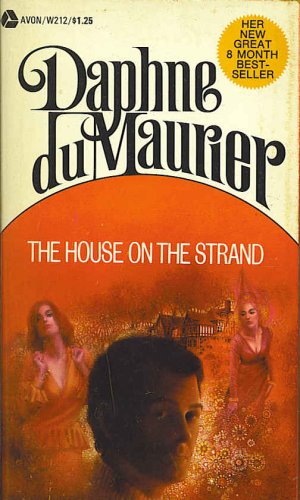
The House on the Strand by Daphne du Maurier

We found ourselves in the stableyard, a huddle of ponies and men, and I knew I must go too, for Roger was mounting his pony beside Bodrugan, and wherever he went I was compelled to follow.  The clouds were racing across the sky, the wind was blowing, and the stamping of ponies and the jingle of harness rang in my ear.  Never before, neither in my own world nor on the previous occasions when I had strayed into the other, had I felt such a sense of unity.  I was one of them, and they did not know it.  I belonged amongst them, and they did not know it.  This, I think, was the essence of what it meant to me.  To be bound, yet free; to be alone, yet in their company; to be born in my own time yet living, unknown, in theirs.

Dick Young is staying at the country home of his good friend, the Professor Magnus Lane, called Kilmarth, in Cornwall, Britain's southwestern arm.  He is alone, waiting for his wife Vita and her two sons to join him, and in the meantime, Magnus, back in London, entreats his help in a scientific experiment he's been working on: in the house's laboratory there is a drug which, while leaving Dick's body in the present, will transport him back to the Cornwall of the fourteenth century.

It's such a clever twist on the time travel narrative, it's hard to believe it hasn't been recycled since du Maurier published The House on the Strand in 1969.  The risk is almost ludicrous; wherever Dick goes in the past, he goes in the present also, wandering blind around modern Cornwall, with its vastly modified terrain and its automobiles.  Nor can Dick voluntarily confine himself to a single room, since he seems to be bound inexplicably to a squire named Roger, and can only move as he moves.  In the company of Roger, who cannot see him, Dick observes an intense drama over the course of many "trips" and many decades: the machinations of the Otto Bodrugan against the crown, his secret love affair with the beautiful lady Isolda, and his death just off the Cornish shore at the hands of his brother-in-law Oliver's men.

Honestly, the medieval narrative is pretty boring.  There's no incentive to care about Otto or Isolda, who must have lived much more largely in du Maurier's imagination than they do on the page.  But what is captivating is Dick's captivation: his smoldering love for Isolda, dead for five hundred years, and his increasing need for the drug, which is borrowed from the language of real-life drug addiction.  Dick is willing to undertake the ludicrous risks because he begins to feel his life in the present inherently lacking.  When his wife and stepsons arrive, he schemes again and again to evade them so he might travel back in time, and these minor schemes, and Vita's increasingly exasperated reactions to them, are infinitely more fun than the historical drama.

When Dick talks about the drug, he sounds like Timothy Leary talking about LSD:

...There was no past, no present, no future.  Everything living is part of the whole.  We are all bound, one to the other, through time and eternity, and, our senses once opened, as mine had been opened by the drug, to a new understanding of his world and mine, fusion would take place, there would be no separation, there would be no death... This would be the ultimate meaning of the experiment, surely, that by moving about in time death was destroyed.

But like Leary and, I guess, every other unrehabilitated addict, Dick only sees life because his addiction blinds him to the real possibility of death.  His imagined "fusion" with Roger is not, and cannot be reciprocated, though his marriage crumbles.  He flees not from death, but life--which du Maurier hammers home by giving his wife the name "Vita."  This dynamic is underscored when Magnus, coming to Kilmarth at last, takes the drug upon arrival and ends up flattened by a moving train.  By this point, Dick is too far gone, too enveloped by his own addiction.  The historical drama resolves as it begins, blandly, but the drama of a man tearing his life apart piece by piece for a lonely glimpse into a world far gone is what really makes this a gripping story.