Showing posts with label historical fiction. Show all posts

Thursday, November 6, 2025

Baltasar and Blimunda by Jose Saramago

Every man follows his own path in search of grace, whatever that grace may be, a simple landscape with the sky overhead, a certain hour of the day or night, two trees, three if they are painted by Rembrandt, a sigh, without our knowing whether this closes or finally opens the path or where the path my lead us, whether to some other landscape, hour, tree, or sigh, behold this priest who is about to cast out one God and replace him with another, without knowing whether this new allegiance will do him any good in the end, behold this musician who would find it impossible to compose any other kind of music and who will no longer be alive a hundred years from now to hear that first symphony, which is mistakenly referred to as the Ninth, behold this one-handed soldier who has ironically become a manufacturer of wings, though he has never risen to being more than a common foot soldier, man rarely knows what to expect from life, this man least of all, behold this woman with those extraordinary eyes, who was born to perceive wills...

Medieval Portugal. Baltasar is a former soldier who has lost his hand in Portugal's wars, replacing it with a spike or a hook, whichever is most useful. Blimunda is the daughter of a woman exiled by the Inquisition, and she has her own secret that it would be best that the Inquisitors not discover: she can see into people. When she looks into a person--which she must be fasting to do, therefore she eats a crust of bread every morning before opening her eyes so she will not pry into Baltasar--she sees mostly guts, but also a black cloud that is the human will. These two unlikely people find each other and fall in love.

This romance is set against the construction of a great cathedral in Baltasar's hometown of Mafra, to celebrate the birth of the princess of Portugal. It's a process that takes years and a lot of labor; one of the best scenes--if something as long as the Saramagian single-sentence gauntlets can be called a "scene"--is when Baltasar is put in charge of moving a giant stone miles and miles from the quarry to the cathedral, a task that crushes a man to death and maims others. Much of the historical background is drawn from life, including the figure of Dominic Scarlatti, the famous musician who spent time at Portugal's court, and Bartolomeu Lourenço de Gusmão, a Brazil-born priest who invented a primitive flying machine called the Passarola. Baltasar and Blimunda become Father Lourenço's accomplices, and they alone know how the machine really works: with the upward thrust of the wills that Blimunda has collected from the dying.

The Passarola flies only a couple of times, partly because it seems to be impossible to steer, or land. But long after it's crashed in the woods outside of Mafra and the Father Lourenço disappeared, Baltasar and Blimunda continue to tend to it, repairing it and restoring it. For what? Perhaps its power is mostly symbolic: it represents a kind of dream kept in reserve, the power of the will to help one rise above the station of the common person, who is so pushed around by the powerful, as Baltasar is with his heavy stone, or Blimunda, with her mother in exile. For these themes, I found Baltasar and Blimunda very moving, and I enjoyed the richness of its evocation of medieval Portugal, though Saramago is not an easy read, and the circuitous, comma-packed sentences keeps one at a remove from the immediacy of the story. Still, it's hard to emerge from Baltasar and Blimunda without feeling as if you've been invested in something both impossibly clever and impossibly rich, and the ending, I felt, was remarkably affecting and sad.

Monday, May 5, 2025

The Giant Joshua by Maurine Whipple

A shiver of terror pierced her heart like an icicle. She had not meant to love him, but they had been in the clutch of something bigger than themselves. Some winged power over which they had no control had swept them from the earth to the sky. She had said to him: 'All that counts is doing out jobs. We'll keep our love secret, where it won't hurt a soul in the world.' But words won't dout a flame. And she had not been able to stop loving him, no matter how hard she tried. Even after Kissy came, she could not destroy this burning essence that was the central core of her being. How was it wrong? It had seemed that a passion diffusing so much light and warmth could not be wrong. Where had been the first misstep? Over and over she recounted each pebble that had gone to make the avalanche.

Clorinda--Clory--is one of a wagon train of Mormon settlers sent forth from Salt Lake to build a new city in the desert of Utah's "Dixie Country." She's just sixteen, but recently married to a much older man, a Scot named Abijah McIntyre, who has two wives already. Clory becomes close with the meek second wife, Willie, but Abijah's first wife, Bathsheba, polices his attentions with a will of iron. The marriage is undertaken at the insistence of Brigham Young himself, but it's a difficult thing for a young woman to be saddled with a husband for whom she will never feel the kind of ardor he feels for her, and to live in the shadow of two other women as well. On top of this, Clory falls quickly for a tempestuous younger man named Freeborn, who just happens to be Abijah and Bathsheba's son. She gives into temptations, and then to doubts, but at other times she takes these events as tests of her piety, and like certain hardy flowers her spirit blooms in the desert.

It's funny, the Mormon pioneers of the 19th century are so very American. They left the East escaping religious persecution; they built civilizations out of the Wild West; they thrived by sheer willpower and resourcefulness. Other pioneers of the Wild West occupy our national imagination as part of our shared patrimony, but the Mormon pioneers retain a kind of otherness that prevents Americans at large from embracing them in the same way. The Giant Joshua is an epic for Mormon America, and I do mean epic--I started reading it on the plane to Utah three weeks ago, and I just finished it yesterday. There's a great deal of mythmaking in it, sometimes speciously so: it's strange to read how disappointed and disapproving Brigham Young is in the perpetrators of the Mountain Meadows Massacre, in which a group of Mormons attacked a train of non-Mormon settlers; many historians now think it happened with his complicity. But in Clory there is a kind of ambivalence that makes the novel worth reading. She believes wholeheartedly in the community that grows up around her, and in God, but the rewards of "plural marriage" remain dubious and out of reach for her.

One book I was reminded of, very discordantly, was Norman Rush's Mating. From time to time it seemed to me that Brigham Young occupies the Nelson Deneen role in the planned community of Utah's Dixie, pushing pieces around with a heavy hand in order to create a centrally-planned utopia. Young tells the pioneers what crops to plant, what trades to take up, where and how to sell, and even where to build their first temple. He's depicted as kindly and compassionate, with a genuine interest in all the settlers of Dixie--he knows them each by name--but his machinations are heavy-handed, and they don't always work. He moves Clory together with Abijah as surely as he he commands the villagers to plant cotton instead of wheat, but when a marriage falters--or a crop--he's up and gone, back to Salt Lake, and the consequences never fall on him. If the village functions, it's not really Young that earns the credit, but the collective action of the pioneers who, through trial and error, tame the Virgin River, make peace with local tribes, and build a city from scratch.

The Giant Joshua can be quite brutal. Clory settles down quickly to have a family for Abijah, but one by one, her three beloved children are picked off by disease. Her secret lover, Free, dies in a reprisal raid on a group of Native horse thieves. She reconciles herself to Abijah, who is a competent and capable husband, but he has too much passion for her and too little love. One of the cruelest scenes comes toward the end when Clory, in her forties now, still beautiful, pregnant again with a child of Abijah's, discovers him in flagrante flirto with a young flibbertigibbet who becomes his newest wife. That's the thing about plural marriage: in a way, you can be discarded even more easily. The end of the novel, too, is cruel to Clory, in a way I'll keep to myself. But for all that, the author Whipple (who I think was Mormon?) shows an abiding admiration and respect for what pioneers like Clory and Abijah, for all their faults, were able to wring from the harsh desert landscape.

Sunday, April 27, 2025

North Sun, or The Voyage of the Whaleship Esther by Ethan Rutherford

For none in their business can separate from the sea. And it is better to act than to be acted upon. It is possible that a terrible fate awaits each and every one of then, but the voyage has begun and it will be done. Goodnight, she thinks. Above her, the ceiling gives way to sky. Goodnight. To the whale in the deep, and the ship crushed by ice. To the gulls on the quay, her child somewhere in sleep. To the waves crashing the shore, and a hard wind a lee, to the long wait and winter, all of it, goodnight.

In New Bedford, Captain Arnold Lovejoy is approached by the wealthy Ashley family with a job: he will sail their ship, the Esther, to the Chukchi Sea, where he will bring back another captain, one of their agents and the husband of the family heiress, who has abandoned his ship to the ice and decided not to come back. The Esther will harvest whales as it goes, but it's a hard time for whalers; overfishing has sent the whale populations plummeting. A mysterious representative of the Ashleys, named Thule, joins Lovejoy on board; he seems to understand that there is more to their mission than Lovejoy has been told. There is the usual gaggle of seaman, steerers, and cooks, as well as a pair of ships' boys, brothers, who remain nameless. None of them, of course, has read Heart of Darkness, and they don't know that a ship sent after a madman is doomed to find only madness.

The ships' boys are repeatedly raped by a sinister deckhand named Eastman. Unable to defend themselves, they find their own defender in a mysterious figure who they discover swimming toward the ship one day in the middle of the ocean. This figure, who calls himself Old Sorrel, is completely naked, and has the head of a bird, complete with an enormous, snapping beak. Old Sorrel, we learn, is a kind of counterpart to the mysterious Thule. Thule needs the Esther to make it to the Chukchi Sea, to recover a valuable and magical artifact belonging to the Ashleys. But Old Sorrel's modus operandi is sinking ships, puncturing them with his enormous beak. It's suggested, perhaps, that he is the one who sank the previous ship, and is a manifestation of the Other, the sea-madness that claimed the last captain. But he also serves as the boys' only friend on the ship, and ultimately defeats the sinister rapist who pursues them.

North Sun is half realism, half fantasy, drawn from scrupulous research about whaleship journeys in the late 19th century. The crew battles the familiar, though no less frightening, hardships of the whaling life: massive, recalcitrant whales; marauding sharks; pack ice that threatens to close on the Esther and doom it to overwintering in the arctic; terrible disease and starvation. Perhaps the elements of the fantastic, like Thule and Old Sorrel, and the slithering shipworms that seem to be at Old Sorrel's beck and call, are only representations of those real-world hardships. In confronting them, perhaps the crew of the Esther are only confronting themselves, in the way that the isolation of the ship and the far north force men to confront their most immediate and unvarnished selves, desires. Lovejoy and the crew confront their own helplessness aboard the Esther: one of the most mysterious, and effective, scenes actually occurs back in the Ashleys' parlor, where we learn that the ship's benefactors have a model ship in which the crew can be seen, magically and in miniature, about their business. The forces that control the ship's journey are not always clear, but whatever they are, the crew themselves have no agency, and can only go where they're carried, toward destiny or doom.

Sunday, April 6, 2025

The Way of Florida by Russell Persson

We visit our life just once. It could rain down or it could sun a string of days or an unended ease could be what days you live in but I come to believe we visit our life just once this only one time in which we live, the string of days entire from one until the end. Inside this now I live with my body underneath the stars there I would bet the stars up there in measure of what we do an pourn down from the moon is my revital. I'm as wracked as any man here and I toil more and eat less and my charge demands that I lift us to the next day and so it is I underneath the moon the other men have fallen upon each other in what could be close to giving in as a body spells its coming day and sapped to the utmost lands where it might and I the moon addresses and it is I the moon floods up with sand for what's upcoming so that I may guide in some way these rafted men who pell-mell upon each other like blown twigs I like here standed to that task our Lord I become the one who gathers them in to proceed us all into the.

In 1527, the Spanish explorer Panfilo de Narvaez made the decision to split his party in two. Half would go by boat along the coast of Florida, and the other would go over land. The two parties would never meet again. The land party traversed not only Florida but across the southern and southwestern United States and into Florida, becoming the first non-Native Americans to see these parts of the New World. We know this because the journals of one such explorer, Cabeza de Vaca, survive, recounting the story of how the party nearly starved to death again and again, encountering friendly and not-so-friendly Indians, and eventually, when there were only four left, became famous as a band of traveling medicine men and healers. As Brian Evenson notes in his prologue, Russell Persson's The Way of Florida is in one way a translation of Cabeza de Vaca's account, hewing closely to it, though in idiosyncratic English.

I got to hear Persson read from The Way of Florida at the Association of Writers and Publishers' conference last weekend. I was struck by the section he chose, in which one of the explorers rides his horse into a river and is drowned. The stark, denuded language, the collective "we" that makes it seem as if some piece of the entire body is being peeled off. And of course, the decision to eat the unfortunate horse, a decision that presages the group's future need to resort to cannibalism. The story, such as it is, is one of increasing alienation and desperation, moving deeper into the unknown world. Cabeza de Vaca and his fellow explorers get farther and farther away from the familiar, and they grow farther and farther away from themselves. Their clothes become ragged, then fall away, leaving them entirely naked. The pious Cabeza de Vaca meditates constantly on God's will; he reasons that they have been cast out safety in punishment for their sins. What to make, then, of the way the final survivors are built up again, and transformed to a kind of prestige? Other transformations are here, and I found myself wondering if the same were recorded in Cabeza de Vaca's true journal, as when one of his fellow Spaniards chooses to stay with his new companion, a Native man who lives as a woman, over another push to return to civilization.

It's the language, though, that animates The Way of Florida. If the novel is a translation from the Spanish, it's a translation that doesn't quite arrive in English, or if it does, an English that is wholly new and unfamiliar. Persson writes long stretches without periods or breaks, with few commas, or perhaps none. Verbs, nouns, and adjectives switch places; often I found him using the "right" word but not quite the "right" form, as in "the moon is my revital" above. The experimental language slows the speed of the journey, and perhaps makes it as painstaking for us as for Cabeza de Vaca. More importantly, it has an alienating effect, and captures the strange and uncanny experience of confronting a new world. If you're like me, The Way of Florida will remind you of William T. Vollmann's novels about European-Indigenous encounter. Like Vollmann, and perhaps moreso, Persson recognizes that really seeing these exchanges for what they were requires a language that presents them to us as new and strange as they must have been.

Saturday, September 7, 2024

Rabbit Boss by Thomas Sanchez

I know of your Ancestors. The blood of your blood saw the Whites eat of their own flesh on yonder lake, Donner. Captain Rex gambled the money of the people away and lost his way in a blizzard, he came into a cabin and slept, when he awoke white bodies were lying dead all around him with the blood they had coughed up splattered on their clothes. he took their White death back to the people, that was the year all the Washo were burned to the ground at Elephant Head, one was saved, Ayas, the Antelope, who was sent into the valley of clouds to warm his sightless grandmother who wove flowing streams into her baskets... I can see into all the days past. I can see into all the days coming. Along the Big Lake of the Sky your son shall walk in a new Rabbit robe. Sparling his image on the quiet waters. The forest shall grow thick and free. The Birds return. The fences fall. In their shadow the openness will find its home once more.

Thomas Sanchez's Rabbit Boss begins with Gayabuc, a member of the Washo tribe of Nevada and Northern California, looking down at the infamous Donner Party. He watches them attack and eat each other, and he knows immediately that something evil has arrived in their lands. Rabbit Boss traces the history of this evil over four generations, beginning with Gayabuc, and continuing on with his son, Captain Rex, a gambler and petty criminal who makes money by recruiting other Indians to pick pigweed along the side of the transcontinental railroad. Captain Rex's son, a preacher named Hallelujah Bob, grows up among whites after all the other Washo are decimated by tuberculosis, and then burned in their huts by whites who fear the spread of the disease. Bob grows up knowing little about his background until he is taken to an Indian School (a real place in Carson City where, somewhat coincidentally, we were able to tour a small museum last week) and learns about his true identity. Hallelujah Bob's son is Joe Birdsong, who ekes out a proud but simple existence as a rabbit-hunter for large ranches during the Depression.

In Sanchez's telling, the Washo have always been a small tribe. They identify with the rabbit, whose medicine, or power, is small, but who gets by through tenacity and cleverness. They are few in comparison with the Shoshone or the Paiutes. Leaders of the Washo are said to wear the "Rabbit robe," and despite the designs that white settlers have on the land, it's exactly this identity and power that is passed down, perhaps unknowingly, to Birdsong. The stories of the four men resemble each other in certain important ways: the latter three are all, at times, hunted by white forces who want to destroy them or drive them out. For Captain Rex, it's marshals and bounty hunters that pursue him, in scenes that often provide the novel some of its blackest humor, as when the representatives of the federal and territorial government bicker over just who it is that's going to hang him, or when they realize they can't hang him, because the Nevada desert is short on trees. For Birdsong, it's a shadowy land company that has begun to make inquiries with all the landowners in the Lake Tahoe region. They begin by offering enormous sums, but when Birdsong refuses, they move against him with legal force, claiming that because Hallelujah Bob was not a U.S. citizen when he purchased the land (Native Americans were made citizens in the 1920s), his claim is null and void. They seize upon a murder and frame him for it, and Birdsong ends the novel like his grandfather: on the run.

As far as I know, the author, Thomas Sanchez, is not Native American, and I have to say, outside of perhaps Vollmann, I don't think I've ever read a fictional account of Indigenous history by a non-Indigenous writer that seems so scrupulously researched or knowledgeable. It was really something to be able to visit the actual residential school where Hallelujah Bob ends up, and where Birdsong must travel to search for the documents that prove his ownership of the land--I hadn't imagined such verisimilitude was necessary. It's especially impressive, I think, because the story is about the Washo, a small tribe whose history is not so popularly known as the Lakota or Cherokee, or even the larger local tribes like the Shoshone.

At the climax of his story, Hallelujah Bob has a vision of the Ghost Dance leader Wovoka (a member of the Paiutes, another Nevada tribe) who recognizes him as Ayas, the personification of the Antelope. Wovoka helpfully summarizes the novel for anyone who has missed it--Guyabuc has witnessed the arrival of a great evil, and Captain Rex has carried it along by unwittingly spreading the disease among his people, but Bob and his son Joe will oversee a rebirth of the Washo and the return of trees and animals. I found myself wondering, how does this novel think about the real-life prophecies of Wovoka? To me, it seems like there's a bitter irony here: Joe Birdsong ends up on the run just like his grandfather and his father did, hunted and dispossessed again. But then again there is the resilience of the rabbit power within Joe, and even when he is chased away by the predatory speculators, he ends up having a vision of ambiguous power on the shores of Lake Tahoe, the "Big Lake in the Sky." Is Joe the culmination of the rebirth of the Washo, as Bob hears from Wovoka--the one who wears the "Rabbit robe?" What does it mean to write such a book in the 1980s, and stop short of the next 50 years of the American Indian and environmental movements? I found Rabbit Boss troubling and ambiguous, but often very moving, even funny, and powerful.

Monday, August 26, 2024

The Case of Cem by Vera Mutafchieva

A song about homeland and exile, that's what I wanted to write--I who thought I did not have a homeland and that my home was the world; I who thought exile was simply a journey, a change in place. For the price of thirteen years, I have paid for one piece of wisdom, which I would like to leave to my people. I want to tell them--and to warn them. The world is not only large, I shall sing, it is also hostile. Hide away from it in a single homeland, a single city, a single home; fence off a small part of that big world so you can master it and warm it; find yourself one trade, one sipahi commander, one line of work; have your own children. Cling to something amidst the boundless current of time, amidst the boundlessness of the universe. Choose one truth as your own.

By his virtues, Cem should be the heir of Mehmed the Conqueror, who took Istanbul for the Ottoman Empire: he is handsome, courageous, creative; a leader, a poet, a warrior. But when Mehmed dies, his brother Bayezid moves swiftly to consolidate his power over the sultanate, and Cem is forced to flee. He schemes to reconcile with his brother, and failing that, to raise an army of his own, but when he crosses over to the island of Rhodes, he finds himself suddenly the prisoner of the Knights Hospitaller, who recognize the strategic value of holding onto Cem. Along with his friend--and, it is strongly implied, his lover--the poet Saadi, Cem becomes a bargaining chip, shuffled around the powers of Europe for thirteen years. His jailers pretend to be his hosts; they provide luxurious quarters and food, even hashish, and they tell Cem that he cannot leave for his own safety.

The Case of Cem is, supposedly, a classic of Bulgarian literature, and newly translated into English by Angela Rodel. The Bulgarian Mutafchieva, perhaps, found in the historical figure of Cem a powerful metaphor of the clash between the East and West. Mehmed's acquisition of Istanbul, after all, set off centuries of conflict between Christendom and the Islamic world. Not knowing all that much about the particulars, I found The Case of Cem often very confusing, but the larger story comes through quite clearly: it's in the best interests of all sides to maintain a kind of status quo, and Cem gives up his life to provide it. He moves from Rhodes to Nice to Rome, but everywhere he goes, the situation remains the same. Outside the walls of the various castles where he is trapped, they begin to sing songs about him; tragic songs about the poet-warrior who was betrayed and imprisoned.

The Case of Cem is organized into a series of first-hand accounts by historical figures involved in Cem's "case," all of whom are speaking in the authorial present from within the grave. The most common narrator is Saadi, the poet and lover of Cem, who knows his master best and who is affected the most when, throughout his long exile, Cem begins to wither away and lose all of his natural virtues. This is the most touching aspect, I think, of Cem's story, the way he becomes listless and fat, addicted to hashish and half-mad. It's all the more powerful because what is dissolved is not just Cem himself, but the pure love that Saadi bears for him. It's this love, in the end, that is difficult to watch curdle and die. When Saadi decides, after many years, to do what he said he would never do--abandon Cem and escape on his own--is it a betrayal? Or does the man he abandons contain so little of Cem himself that there is no one left to betray? Only Cem is unable to speak for himself in the novel (a trait that reminded me of John Williams' Augustus), and the effect is that we feel that Cem's dissolution has moved him into some place farther away than death. If Cem speaks, it's only with the voice of the songs that spring up about his ordeal, and even then those voices are less Cem's own than imagined substitutions.

Saturday, August 3, 2024

Shadows on the Rock by Willa Cather

"Get on the sled and I will pull you up. See, there's the evening star--how near it looks! Jacques, don't you love winter?" She put the sled-rope under his arms, gave her weight to it, and began to climb. A feeling came over her that there would never be anything better in the world for her than this; to be pulling Jacques on her sled, with the tender, burning sky before her, and on each side, in the dusk, the kindly lights from the neighbours' houses. If the Count should go back with the ships next summer, and her father with him, how could she bear it, she wondered. On a foreign shore, in a foreign city (yes, for her a foreign shore), would not her heart break just for this? For this rock and this winter, this feeling of being in one's own place, for the soft content of pulling Jacques up Holy Family Hill into paler and paler levels of blue air, like a diver coming up from the sea.

I spent a day last week in Quebec City. If you've ever been there, you know it's not for the easily winded: it's built upon a huge rock called Cap Diamant, and the lower town, at the rock's bottom, and the upper town, on its peak, are linked by stairs so precipitous they have names like Escalier Casse-Cou, the break-neck stairs. It's in the middle of one of these climbs that Euclide Auclair, the apothecary at the heart of Willa Cather's Shadows on the Rock lives. Symbolically, it shows something about Euclide's character. Though brought to Quebec from France in the service of the governing Count de Frontenac, Euclide serves the common people also, with steadfast prudence. And perhaps, more even than others, it demonstrates the way that the apothecary clings to the rock, like a sea bird in its nest, an isolated refuge in the midst of a large and wild place. Most of the novel takes place over the village's long winter, from the moment that the last boats leave for their treacherous journey back to France to the time they return along the St. Lawrence River. During that time, the colonists are truly cut off from France. Perhaps this is when they not only must fend for themselves but when they are most themselves.

Euclide, a widower, has a daughter named Cecile. Cecile is the light of the village; as Euclide is steadfast, she is virtuous and pure. It's Cecile who entreats the Count to provide shoes for her friend Jacques, the son of a base prostitute. Cecile, too, is a natural Canadian; though born in France, she has no memory of the place, and to her, the thought of being recalled to France is a frightening one. Cather, who was ever interested in the mythology of nation-making, is trying to pinpoint the moment, I think, that refugees from one place become the residents of another. Cecile is a real Canadian, not just a Frenchwoman clinging to the rock for fear of being swept out to sea. She boasts all the virtues of French civilization, including a devout Catholic piety, though in her they are transformed into something distinctly French Canadian. One can imagine this book might have been influential among the French Canadians, who insist politically and culturally on calling themselves a nation, if only it had avoided the original sin of being written in English.

It's difficult to read Shadows on the Rock without thinking about Death Comes for the Archbishop, which Cather had published four years earlier. Both books are about European, even French, exiles in the new world. Euclide is a humble apothecary, but he, and Cecile especially, seem hardly less the representatives of the faith than Bishop Latour. Both books suggest that the transposition to the New World enliven that faith and make it stronger; in Shadows of the Rock, we are treated to a long story about a devout Montreal anchorite whose devotion to solitude harkens back to a medieval piety no longer possible in Europe. Shadows on the Rock even provides a Bishop Latour-like figure, the Bishop Laval, a real figure whose tomb I saw in the basilica at Quebec. This figure--genial, wise, and forgotten by Europe--even gets a death scene at the end, a "good death" that mimics Latour's.

The comparison does Shadows on the Rock little favor. The mystery and ambivalence of Archbishop are largely supplanted here by a conservative devotion to the myth of missionary goodness. Euclide's steadfastness, Cecile's virtue, will not permit a scene like that in Archbishop in which Latour is brought to a secret cave where he hears the howling sound of ancient gods, nor will they permit a vision, like Latour has, of the Holy Family as part-Indigenous mestizos. The Indigenous, in fact, are kept largely off-screen, lurking as frightful threats and agents in the martyrdom of Jesuit missionaries like Jean Brebeuf. (It would be interesting to compare this vision to Vollmann's Fathers and Crows, a novel that casts the Jesuit missionary work among the Hurons and Haudenosaunee in a more contemporary, and cynical, light.) I really enjoyed Cather's rich image of colonial life, and of course, the writing is as lovely as ever. (Don't you love the "paler and paler levels of blue air, like a diver coming up from the sea?") But I couldn't shake the feeling that the novel clings, like the colonists in Quebec, to a rock-like certitude.

Saturday, July 20, 2024

In the Time Before Light by Ian MacMillan

I described for him first the size of the world, and the size of the islands in the world, the distances. He listened to this intently, and then asked me what the haoles were like, how their world was different from ours. "It is very different," I said, "and in ways very similar. The world of the haoles is made up like our own in this way: there are two kinds of people--ali'i and common people, and the common people do the bidding of the haole ali'i. Those haoles I knew were all, at one time or another, victims of these ali'i, and in various ways escaped them as I escaped Kahimoku. I went on to try to make clear to him why so many heads were chopped off in China, and why two boys were burned to death in King Philip's Land. As I descriebd these things, I thoguht of Muapo's story, and understood how this pattern seemed to repeat itself, both in the things I had seen and in the stories I had heard. The world, it seemed, was made tis way.

One of the more interesting things I saw on my trip to Hawaii was the Pu'ukohola Heiau, a great temple built by Kamehameha I, the warrior-king who was the first to unite all the islands. Kamehameha was told by a kahuna, a priest, that he would be victorious against his enemies if he built a temple at what was known as Whale Hill; he did, and he was. What remains today is the great base of the temple, an enormous edifice of lava rocks that is all the more impressive for being made with no mortar: the rocks are simply chosen and positioned so that they bear each others' weight, and so clever were the Hawaiians at this that the temple remains intact today. Pono, the protagonist of Ian MacMillan's novel In the Time Before Light, is conscripted along with his family by a great ali'i, a chief, to build just such a temple. Pono, who belongs to the lowest, outcast class of Hawaiian society, having been ousted from his home by a neighboring band, works under the eye of the sadistic kahuna Kahimoku, who likes to select the weakest among his workers and kill them as a show of strength. When Pono finally is chosen for death, he is saved at the last moment by Roger Beckwith, an English pirate whose crew is made up of those whom, like Pono, he's saved from execution at the hands of authority.

Aboard Beckwith's ship, Pono proves to be a quick learner. He picks up English immediately (though MacMillan never addresses how easy it would be for a Hawaiian, whose language contains neither an F nor a T, to utter the first word "foot") and voraciously devours Beckwith's encyclopedia. Pono becomes a valued crewmate, and alongside his new mates he travels as far as the Philippines, China, New Zealand, and even the western American coast. Though he longs to return and search for the wife and children from whom he's been separated, Pono is one of the first Hawaiians after contact with Europeans to be ushered into the now much wider world, and what he finds is that that world is not so different from his own. As the excerpt above describes, his principal discovery is that everywhere, the big people exploit the little people. This is an interesting viewpoint, I think, for a white writer to take when writing about Indigenous people; similar arguments have been made to dismiss the depredations of colonialism: Well, they weren't so peaceful before we got there, you know. And yet it's hard to deny the truth of the matter; when I looked at Kamehameha's temple on Whale Hill, I thought of MacMillan's novel and the nameless, unremembered labor that must have occurred at the king's request.

What makes the book work, I think, is the frame story, in which an aged Pono tells his story to a British sailor in Honolulu with an interest in publishing his account. The Hawaii the sailor sees, as Pono illustrates, is a different one from the one he left behind when he was rescued by the pirates. For one, the warfare that turned Pono into an outcast is no longer, thanks to Kamehameha (who I think remains unnamed, a silent force), and white traders have descended en masse, bringing with them new ways of life--and new, devastating diseases. Perhaps it's true that everywhere the ali'i exploit the common people, but it's true also that Pono's new world is one that comes with new and frightening kinds of exploitation. As Pono tells his story, a rumor arrives that a Hawaiian Christian convert is due to arrive at Honolulu, one with the same name that Pono gave his long-lost son. The reunion is a failure; the son rejects the father because he has found another father. It seems like the final nail in the coffin for the Hawaii that Pono once knew, replaced by something that is perhaps no worse but certainly no better. And yet, this scene gives some hope, too: Pono's wife is still living somewhere near Hilo. When he sets off at the end of the novel to find her, MacMillan suggests that restitution and repair are possible even in a world that has slipped out from under one's feet.

Thursday, May 2, 2024

Texas: The Great Theft by Carmen Boullosa

It's high noon in Bruneville. Not a cloud in the sky. The sun beats down, piercing the veil of shimmering dust. Eyes droop from the heat. In the Market Square, in front of Cafe Ronsard, Sheriff Shears spits five words at Don Nepomuceno:

"Shut up, you dirty greaser."

He says the words in English.

Last week I spent a few days in Brownsville, a city on the Rio Grande where Texas borders Mexico. Brownsville is one of the most heavily Latino cities in the United States, and it still has a distinctly Mexican feel to it. Across the border lies the city of Matamoros, Brownsville's Mexican "twin." Though we never saw it, we did overlook the border many times, looking for birds. It's hard to stand there and not feel underwhelmed; is this narrow, sluggish, brown river really such a meaningful boundary that it preoccupies our national imagination? A kindly local suggested we try birding at a former golf course on the river "where the illegals cross," though he hastened to add that nothing bad would happen there. Nearby, on an anonymous and scrubby patch of grassland, is where the opening shots of the Mexican-American war rang out. You feel the history, perhaps, but the feeling of the border, the boundary, is elusive.

Mexican writer Carmen Boullosa's book Texas: The Great Theft begins on the American side of the river, in Bruneville, a fictionalized version of Brownsville, in the 1850s. A white sheriff is picking on a Mexican drunk in the town square. When Don Nepomuceno, a wealthy Tejano rancher, objects, the sheriff insults him, calling him a "greaser," a word which will reverberate for miles and miles on both sides of the Rio Grande, and which will ultimately lead to a war between Nepomuceno's forces and the white settlers who resent the claims that the Mexicans, Tejanos, and Indians have on the land. The first quarter or so of the novel follows the news of the sheriff's insult as it passes from mouth to mouth, a process by which it takes in all of the novel's frankly enormous cast of characters: ranchers, vaqueros, gamblers, the bargeman, the innkeeper, the doctor, the mayors of Bruneville and its twin Matasanchez, journalists, spies, bandits, enslaved men, freedmen, Seminoles, Comanches, Germans, children, the keeper of the messenger pigeons, fishermen, and more. Texas has maybe the largest cast of characters per page of any book I've ever read; Boullosa pointedly gives us as wide a view as possible. The sheriff's insult, then, ripples like a stone dropped in the river.

Texas is a highly fictionalized version of a true story; Nepomuceno is a version of the Tejano rancher Juan Nepomuceno Cortina, who lead bands of raiders against the white ranchers in south Texas. I recognized many of the ranchers' names, like Kenedy and Kleberg, who gave their names to south Texas counties, and King, whose namesake ranch is still the largest in the United States, and who inspired the cattle barons of Edna Ferber's novel Giant. Like the Rio Grande, the border between fiction and history is permeable, and who belongs to which is not always discernable. The sheer number of characters gives the novel a kind of breakneck pace, and steers it away from modes that emphasize the interiority or psychology of historical figures. Instead, it gives the history a kind of fable-like quality, a colorful flatness that emphasizes breadth over depth.

It's a story not just about Nepomuceno but all of south Texas, and it's a story about racial violence that comes down squarely on the side of the Mexicans and Tejanos. For them, the border is a boundary placed down to delineate and permit violence and deprivation. The sheriff's insult sets off the war, but the larger context is the white ranchers who have eaten away by subterfuge the lands belonging to Nepumoceno's mother Dona Estefania, and who exert control over Mexicans (and Black people and Indians) by a regime of dispossession and disrespect. Boullosa captures the way that Brownsville/Bruneville, having been founded to mark and watch over the border, represents a kind of diminished and degraded mirror image of its sister city across the border. And I thought it was interesting how Nepomuceno, having been roped into the United States by the machinations of the Anglo ranchers, cannily insists on his claim to American citizenship--though the two cities are emblems of opposition, they exist in a kind of symbiosis that cannot be fully pulled apart or cleanly separated.

Wednesday, April 17, 2024

The Which Way Tree by Elizabeth Crook

The question come to us then as to whether we was tracking the panther or if, by some unknown hand we was dealt, the panther might be tracking us. I am uneasy to wonder at it even now, and I was sure uneasy at that time. I had seen the size of that panther twice. I had beat its hind end as it gone up the tree after Sam on the night it done in Juda. I had seen the lantern light in its yellow eyes in the goat pen. But the thought of them eyes being on me whilst I slept, and watching me in the dark unawares, was a worse thing to think about than meeting face-on with the creature. It give me a frosty feeling in my soul.

Benjamin Shreve is a young boy living in the Hill Country of Texas during the Civil War. His half-sister, Samantha, is the daughter of his father and his new wife, a formerly enslaved woman named Juda. One day, when Benjamin's father is away, a panther attacks Samantha, leaving her scarred--"cat-marked," as one character later calls it--and kills Juda, who leaps into defend her daughter. Samantha becomes obsessed with tracking and killing the panther, and when it returns years later, she ushers herself and Benjamin into an adventure that will encompass a genteel Mexican horse thief, a kindly preacher, a ragged old panther-hunting dog, and a two-bit criminal named Clarence Hanlin.

The jacket copy of The Which Way Tree compares it to Clinton Portis' picaresques like Dog of the South. I don't know about that, but I'll let you know soon enough. What it reminded me most of, actually, was Huck Finn. The Which Way Tree is narrated by Benjamin as a series of letters to a Texas court judge, who is intent on trying Hanlin in absentia for the murder and robbery of a traveling party. Benjamin knows Hanlin is guilty, and was the last one to see Hanlin alive, and the whole story, which Benjamin tells over the course of several long missives, is, ostensibly, a way to help the judge understand what happened to Hanlin and how. Benjamin's voice is one of the best aspects of the novel. It has a rustic quality, like Huck's, and like Huck an insight belied by the voice's obvious youth. The simplified language of a young teen, steeped in backcountry ways, without a need or capacity for flights of prose, makes the novel brisk and readable.

Benjamin makes allusions to a book he's picked up somewhere called The Whale, one of the few he's ever owned or read, but he claims to have read it cover to cover more than once. The parallels are so obvious, you don't really mind when Crook spells them out: Benjamin's sister Sam is like Ahab, obsessed with bringing down the panther, whom we learn is a legendary mankiller called Demonio de Dos Dedos--the demon of the two toes, an allusion to the bits of the cat that Juda chopped off with her cleaver in saving her daughter's life. The adventure itself could be a little cinematic for my tastes--too much action, too little clarity and insight--but time and again, both Sam and Benjamin must confront the tension between a desire for vengeance and other human needs, like family, kindness, and belonging. Benjamin accuses Sam of being so caught up in bloodlust that she is blind to the way that he has taken care of her since their parents' deaths, and he's right. It's the essential goodness in Benjamin that the judge recognizes over the course of their apparently long correspondence. But vengeance is a hard thing to break free from, and the closer they get to the panther, the more intensely it burns.

Sunday, September 17, 2023

The Abyss by Marguerite Yourcenar

For nearly half a century Zeno had used his mind, wedge-like, to enlarge, as best he could, the breaks in the wall which on all sides confine us. The cracks were widening, or rather, it seemed that the wall was slowly losing its solidity, though it still remained opaque, as if it were a wall of smoke and not of stone. Objects no longer played their part merely as useful accessories; like a mattress from which the hair stuffing protrudes, they were beginning to reveal their substance. A forest was filling the room: the stool, its height measured by the distance that separates a seated man's rump from the ground, this table which serves for eating or writing, the door connecting one cube of air, surrounded by partitions, with another, neighboring cube of air, are were losing those reasons for existing which an artisan had given them, to be again only trunks or branches stripped of their bark, like the Saint Bartholomews, stripped of their skin, in church paintings, here and there the carpenter's plane had left lumps where the sap had bled. The corpses of trees were laden with ghostly leaves and invisible birds, and still creaked from tempests long since gone by. This blanket and those old clothes hanging on a nail smelled of animal fat, of milk, of blood. These shoes gaping open beside the bed had once moved in rhythm with the breathing of an ox at rest on the grass; and a pig, bled to death, was still squealing in that lard with which the cobbler had greased them.

Zeno, a young man from a wealthy family in 16th century Belgium, leaves home to pursue a life of the mind. Stories of his exploits trickle back to his hometown of Bruges: he has become a renowned physician, treating those dying of plague, and his writings about philosophy and alchemy have been condemned by the church and burned. Later in his life, an aged Zeno decides to return to Bruges under the assumed name of Dr. Sebastian Theus, settling down to contemplate at last the nature of things. But Zeno/Dr. Theus is threatened by the raging fires of the Reformation; as splinter religions proliferate, the Church is all the more eager to punish those it suspects of heresy, atheism, and sexual deviancy.

What The Abyss captures, I think, is a sense of what we call The Enlightenment: the collapse of old structures and the rise of new ways of thinking, epitomized in Great Thinkers like Zeno, who is cobbled together from real-life figures like Paracelsus and Erasmus. This period produced some of the greatest advances in knowledge in all of human history, but it also produced a lot of battiness and violence: Zeno's estranged mother, for instance, gets caught up in the millenarian cult of the Anabaptists in Munster, led by the Christ-figure John of Leiden, and is killed when the cult is violently crushed. For his part, Zeno is one of those figures whose specific title or field--physician--belies an interest in the totality of the natural world, and a viewpoint that sees all fields as intrinsically connected.

The French title of The Abyss, L'Oeuvre au Noir, means "The Black Work" or "The Black Phase," referring to the phase of alchemical transition in which the substance of things is unmade so that it can be remade. (If you ask me, they should have stuck with The Black Phase as a title in English, too.) In a way, the black phase is what Europe itself is going through, and Zeno himself goes through a black phase when he returns to Bruges, captured in the section I quoted above: the nature of things begins to dissolve and return to its origins, and so the structures of Zeno's mind themselves begin to dissolve. In contrast to the wanderings of Zeno's life, it seems that the black phase is something you have to do on your own, alone in a room, and points toward the importance of Zeno's work as a physician, searching for truth not in the cosmos but deep within the human body itself.

I thought this "black phase" was the most compelling part of a book which, though really tremendously written, often felt elusive to me. I loved Yourcenar's Memoirs of Hadrian, a book which, according to her postscript, is similar in conception and in history--both books were put away for decades before being complete, and both of course are scrupulously researched accounts of history. It may be that I just don't have as clear a mental picture of the Holy Roman Empire as I do the Roman Empire of Hadrian's time; I often found myself meekly retreating to Wikipedia to remind myself who is who and what is going on. But the strangeness and richness of The Abyss is part of its appeal, and its depiction of a world that is different from our own simply because such great philosophical upheavals no longer seem possible.

Thursday, March 16, 2023

The Voyage of the Narwhal by Andrea Barrett

Surrounded by that ice and snow, Erasmus dreamed of home--less and less often, though, as the brig passed down Lancaster Sound. Around him were breeding gulls and terns, snow geese and murres, eiders and dovekies; the water thick with whales and seals and scattered plates of floe ice; a sky from which birds dropped like arrows, piercing the water's skin. Sometimes narwhals tusked through the skin from the other side, as if sniffing the solitary ship. They hadn't seen another ship since passing a few whalers at Pond's Bay, yet Erasmus was far from lonely. Dazzled, he looked at the cliffs, and knew Dr. Boerhaave shared his dazzlement.

I love the Arctic. I'll probably never go there. Few people do. But I like reading about it, probably because it is so improbable: remote, harsh, difficult to access and inimical to comfort, the Arctic retains something of the feeling of the old frontier. No wonder that, in the 19th century, once the world had been more or less mapped, those who had explorers' hearts and minds turned to the Arctic; and for once they were pretty roundly defeated. Some of the Arctic's mystique, actually, comes from the fact that there are people who make it their home, and live lives of remarkable resilience there, not just against harsh conditions, but against the predations of people who think they know better. So it's a joy to read about, whether in The Rifles by William T. Vollmann, who was defeated by the Arctic like his alter ego John Franklin, or in Arctic Dreams by Barry Lopez, a guy who knows more about the Arctic and its residents because he affords them a bit of basic respect.

Andrea Barrett's The Voyage of the Narwhal is a fiction book about an Arctic voyage gone, as all of them go, wrong. Its protagonist is Erasmus Wells, a middle-aged naturalist who signs on under Zeke Voorhees, a younger man and Erasmus' old friend. Zeke turns out to be a bad captain: he cares more about his own ambitions than the safety of his crew, and this ambition, mixed with a mercurial temper and plain poor judgment, leads to the Narwhal becoming stuck in pack ice. Like, they suspect--and we now know--the doomed Franklin expedition, of which the Narwhal is searching for evidence. Zeke's heedlessness kills, perhaps indirectly, several members of the voyage, and when the crew refuses to go on an ill-advised sledge excursion, Zeke goes by himself. When he fails to return, Erasmus takes the only opportunity to get out of the pack ice--lest they be frozen in for another year--leaving Zeke for dead.

That's all all right. I wouldn't say that Barrett has the knack for describing these alien landscapes like Vollmann and Lopez. Far more interesting, I thought, was what happens when Erasmus returns to Philadelphia. As it turns out, Elisha Kent Kane's Arctic voyage returned just before the crew of the Narwhal, having mapped first every bit of coastline the Narwhal thought they'd discovered. Erasmus returns basically empty-handed, and while Kane tours the country with tales of his exploits, Erasmus is either forgotten or loathed for having abandoned Zeke.

All this gets worse when, as any reader surely expects, Zeke shows up again, this time with an Greenlandic woman and her son in tow. According to Zeke's rendition, the pair have accompanied him voluntarily, but Erasmus suspects that there has been some coercion involved; that Zeke knew his only chance at notoriety was to bring back real life "Esquimaux." I wonder if Barrett was thinking of the Inuit woman and her son that caused such a stir in London. Like that real-life pair, Zeke's Greenlanders--Annie and Tom--grow quickly sick in the unfamiliar climate, and Zeke treats them shabbily, as curios to be shuffled onto the stage and then crammed in a drawer when not in use. Annie dies. Erasmus, working doggedly on a natural history of the Arctic--a book that lies in contrast to the dazzling half-truths of Kane and Zeke--decides that he must right Zeke's wrongs, and steals away on one final voyage to the Arctic, to return Tom to his family.

So there's a whiff of white saviorism to Erasmus' noble deed. But there's also a powerful critique of the way that natural philosophy has been practiced, of the cruel tools used to expand human knowledge. Zeke's methods are inhuman, murdering and despoiling the very places and people he claims as the field of his exploration. On the other hand, Erasmus represents another kind of scientist: humble, cautious, empathetic, and more interested in pursuing what is true and good than becoming celebrated. The book never tells us whether his natural history of the Arctic finds success; if it does, it probably still pales in comparison to the fame that the real-life Kent and the fictional Zeke claim. But the Arctic doesn't suffer fools, and perhaps like Franklin, they too will meet the ill consequences of their own recklessness.

Sunday, October 9, 2022

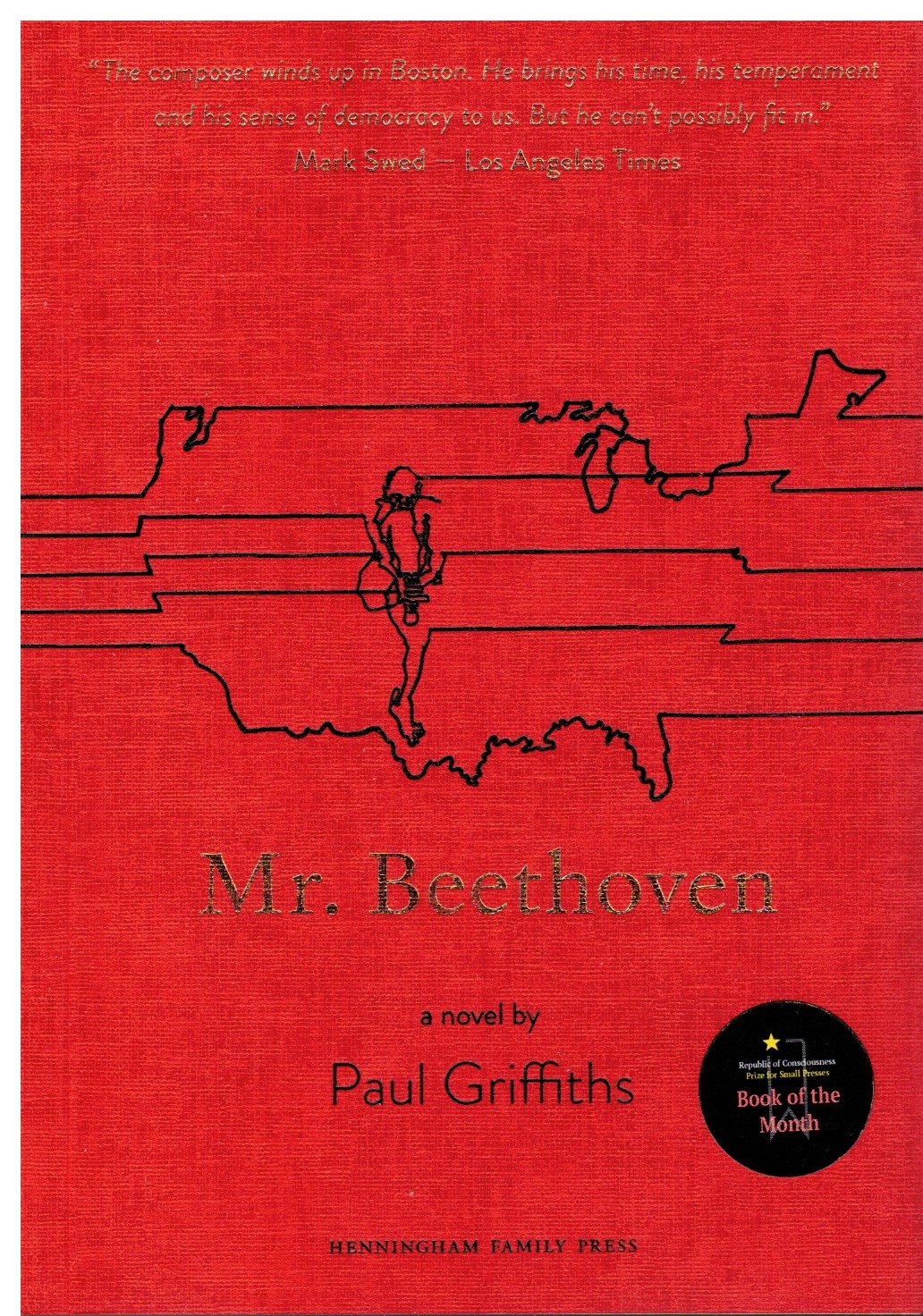
Mr. Beethoven by Paul Griffiths

We have come this far largely in silence. We have played the game. We have done our part. But we cannot go on keeping quiet when you continue to withhold what we most want to know, which is not the facts of the matter but the fiction. Is Beethoven really stalling? If so, why? Or has he in fact (as it were) almost finished the score? Or has he hit a block? Most of all, what is the supposed subject of this supposed oratorio? You must know. We have been patient long enough. Over to you. Get on with it.

Suppose that Beethoven did not die in 1827 but lived a few more years. And suppose that he came to the United States, where he spent six months in the vicinity of Boston, writing a brand new oratorio at the bequest of the Haydn and Handel Choral Society. Unable to speak with his benefactors--he's deaf, after all, in this timeline, too--he is introduced to a woman named Thankful, who teaches him the style of sign language that emerged in the 19th century on Martha's Vineyard. This is the story of Paul Griffiths' Mr. Beethoven, another of those novels that enters upon the life of a real historical person (feels like I've read a million of these this year, because I love them) but one that does it with more self-consciousness than most. Griffiths makes the artifice as much the subject of the novel as Beethoven himself, laying out the sources he draws from, building up scenes and then revising them, fretting over whether questions of what might really have been.

One of the book's central ironies, I think, is this: Mr. Beethoven is a novel about interpolation, the transmutation of historical fact into historical fiction. Griffiths, or the narrator who takes his place, broadcasts certain scruples about precision and accuracy. All of Beethoven's dialogue, for example, is taken directly from his real-life letters. But after introducing Thankful, who literally interpolates Beethoven's language by reporting his words in English, she becomes hidden, occluded: watch Beethoven, for example, carry on a flirtatious conversation with a widow. The dialogue looks like dialogue, and we forget that it's all really Thankful, expressing in sign language what Ms. Hill says to Beethoven, and in English (funnily, a language Beethoven does not speak) what Beethoven says to Ms. Hill. In this way, Mr. Beethoven is sort of a funny meditation on the mediating forces, sometimes visible and sometimes not, that lie between fact and interpretation.

All that is very interesting. But often I felt, as the imagined reader feels in the quoted passage above, that I wanted to know "not the facts of the matter but the fiction." The novel opens with incredible slowness, futzing around for a while with questions of sourcing and historical accuracy, while Beethoven the character does little more than sit in empty rooms, not writing an oratorio. Much more interesting, I thought, was the later novel, which has its metafictional tricks--a chapter made up of a single long sentence, for example--but which has a better story, the story of the composition and performance of the fictional oratorio, which is based on the Biblical story of Job.

I especially liked a scene, apparently based on a real life event, in which a Massachusett Indian elder is invited to observe the rehearsals for Beethoven's oratorio, but shows an interest only in the pipe organ, which she takes, quite correctly, to be a holy object in which spirits, after a fashion, live. I also liked the way that Griffiths fashions a very literal artistic lineage between the old world classicism of Beethoven and the art of the new world: an interview of Beethoven by a young Walt Whitman is very funny, and it is suggested that a young Emily Dickinson is in attendance for the oratorio's premiere, and that perhaps she even takes from its simple, honed language inspiration for her adult poetry. (The oratorio itself, printed in full, might be the novel's most inspired production.)

In the end, I thought Mr. Beethoven was more interesting than engaging. Maybe I'm just one of those impatient readers who wants the fiction, and not to be reminded of the facts.

Monday, September 19, 2022

Awake by Harald Voetmann

Nature begets monsters, fire-breathing bulls with lion's teeth who imitate human speech and call our names to lure us from our tents and cabins. She created man solely so he could suffer, the only animal who cries, the only animal who knows death and understands the scope of its suffering. The only animal who understands that it is made to suffer for nature's amusement. He who believes himself meant for better things is the unknowing victim of nature's game, hardly better than an animal. My suggestion: We must learn to enjoy the cruel game, and so be it that it is at our own expense.

There are four voices in Danish classicist and novelist Harald Voetmann's Awake: First, the voice of Pliny the Elder, as recorded in his Historia Naturalis, a first century AD attempt at taxonomizing the natural world. Then, a second voice of Pliny, elaborating inwardly on his Historia, embellishing it with details from his childhood on the hard margins of the Roman Empire, which are perhaps meant to represent the final dictations to his slave Diocletes, whose is the third voice. The fourth voice is Pliny's nephew, Pliny the Younger, commenting on his uncle's final works after his death at the hands of Mt. Vesuvius.

Pliny, as he writes his final additions to the Historia, is an aging and miserable wreck, mostly unable to rise from his bed and covered in various excretions: first piss, then blood--he's prone to nosebleeds--then vomit. (There's a grim irony in our knowledge that it's a volcano, not these ailments, that do old Pliny in.) The elder Pliny, it seems, seeks to finish his categorization of nature because he fears and disdains it; as he sees it, death and misery are the ultimate ends of the natural world, and to know nature better is to have a map of the enemy's forces. In this attempt he makes suppositions of a grand and imaginative nature, which the Younger Pliny--more of a poet, but more of a skeptic, too--punctuates dismissively. When the elder Pliny, for example, records that he has seen stars descend on a ship and "hop like birds from place to place," his nephew notes: "He is confusing stars with fireflies or something."

I'm just a sucker for these fictionalized versions of real historical figures. Awake couldn't be less like The Organs of Sense in tone, style, and method, but it, too, is about the ambitious quest for scientific knowledge. Pliny worked with fewer tools than Liebniz or the astronomer of that book, and, relying only on the pieces of the Historia Naturalis replicated here, wrong about every single thing, but for him, too, the desire to know the universe bordered on a kind of madness. Unlike The Organs of Sense, Awake is deeply unsatisfying, even intentionally unsettling: Pliny the Elder claims to have paid a man to have sex with his daughter, who was born without any orifices whatsoever. Later, he sentences his own slave and scribe Diocletes to a horrible death by crucifixion, as if intent on participating in the very cruelty of nature he's set out to document. Awake is, like the life of Pliny (and us all) short, difficult, beset with lust and misery, and full of gross physical ailments.

Friday, September 9, 2022

The Organs of Sense by Adam Ehrlich Sachs

In an account sent to the Philosophical Transactions but for some reason never published there, or anywhere else, a young G. W. Leibniz, who throughout his life was an assiduous inquirer into miracles and other aberrations of nature, related the odd and troubling encounter he had with a certain astronomer who'd predicted that at noon on the last day of July 1666, the brightest time of day at nearly the brightest time of year, the Moon would pass very briefly, but very precisely, between the Sun and the Earth, casting all of Europe for one instant in absolute darkness, "a darkness without equal in our history, but lasting no longer than four seconds," the astronomer in Europe was predicting, according to Leibniz, an eclipse that no other astronomer in Europe was predicting, and which, Leibniz explained, drew his notice in part because the astronomer in question, whose observations of the planets and the fixed stars were supposedly among the most accurate and the most precise ever made, superior to Tycho's, was blind, and "not merely completely blind," Leibniz wrote (in my translation from the Latin), "but in fact entirely without eyes."

When Leibniz, the mathematician and philosopher probably most famous for A.) being one of two people to invent calculus, and B.) getting his ass handed to him by Voltaire, goes to visit the blind astronomer who claims to have predicted an eclipse without the use of his eyes, he is drawn into questions of sanity and madness as much as questions of astronomy. Leibniz arrives on the day of the supposed eclipse, knowing that if the eclipse doesn't happen, the astronomer will be proven insane (though if it does, he won't necessarily be proven sane--I think I'm getting that right), and while he waits, the astronomer tells him a remarkable shaggy dog story, ostensibly about how his eyes got torn out.

The story of how he got his eyes torn out, the astronomer explains, is the story of his life, and so he starts from the beginning: as the son of the former sculptor to the Holy Roman Emperor, who hopes to get his job back by creating a totally lifelike but mechanical human head. The son overshadows his father by inventing the telescope on the spot, allowing the Emperor to see a new star that has recently appeared in the European sky, and becomes the Empire's official astronomer. In this position he's drawn into the intrigue of the Emperor's family, including the heir to the throne, a dangerous murderer who himself may or may not be sane. A perilous success in the palace grants him total freedom--and unlimited telescopes--to map the heavens from his lonely observatory, where Leibniz has met him. This story unfolds over the course of three hours, moving toward its climax--the moment of the eye-obliterating--at the exact moment of the supposed eclipse.

What The Organs of Sense captures so well, I think, is a moment in the history of science at which knowledge about the cosmos was blooming at the same time that doubts began to fester about our ability to see and understand the world. At the same time that Kepler and other astronomers, like the one in the novel, were mapping stars and explaining the motions of the planets, philosophers like Descartes were wondering if the mind can ever really know anything but itself. Leibniz is obsessed with questions of madness because a world in which no one can really see outside of themselves is one that does away with distinctions like sane and insane; to understand the cosmos above one's head must also be to understand the cosmos within one's head. But Cartesian dualism shakes the core of this: consider the "insane" Prince, who has come to believe that only he exists, and that everyone else in the world is a mechanical automaton who speaks his own thoughts back to him. And what should Leibniz make of the blind astronomer, without access to the world, who yet claims to predict its movements?

I expected The Organs of Sense to be something like Labatut's scientific-historical fiction book When We Cease to Understand the World, perhaps not least because there is a kind of historical rhyming in the destabilizing effects of Cartesian dualism and that of twentieth century quantum mechanics. But Sachs' novel is something more like Borges or Calvino; a fable, or a picaresque, colored with humor. The layered narrators--the astronomer, Leibniz, the unnamed translator--give the whole thing a kind of specious hearsay quality that strengthens the themes. And most importantly, The Organs of Sense sticks the landing. I don't know if I've just been reading a bunch of books that fumble the ending or what, but the way the whole thing comes together--and especially the resolution to the question Leibniz waits hours for, how does he see the cosmos without eyes--is tremendously satisfying.

Monday, September 6, 2021

American Meteor by Norman Lock

I've always said that a man made his own bed. But now that I'm dying--there's no point in arguing the fact--now that I am, I realize the futility of struggling against fate. Our bed is made for us: We do as we are obliged. Leastways, enough to humble us. That's a bitter pill to swallow late in the day. While we're alive, we're like the man who steps in horseshit on his way to church. Only when he's home again and has cleaned his shoes can he smile at his humiliation and--more to the point--his helplessness before what lies in wait and is beyond his power to prevent. Here's what I think: Behind every gunman stands another gunman, in a concatenation of death and destruction, difficult to break.

Stephen Moran is only sixteen when he loses his eye in the Civil War. While languishing in his hospital bed, he looks up and sees a familiar face, friendly and long-bearded: a man Stephen used to see throwing rocks into the sea many miles away in Coney Island. The face belongs to Walt Whitman, who really did volunteer as Civil War nurse, and who shares with Stephen a copy of his new poetry book Leaves of Grass. When Stephen invents a story of heroism to explain his lost eye, Whitman shares it with the military brass, who pin a medal on Stephen and make him the official bugler on Lincoln's funeral train.

American Meteor is something like a Forrest Gump for the 19th century: though a mostly ordinary person himself, Moran's destiny intersects with Whitman, Lincoln, Grant, Union Pacific railroad magnate Thomas Durant, Western photographer William Henry Jackson, Custer, and Crazy Horse. Part of its appeal is the sheer madcap joy of recognizing these figures, like Leonardo DiCaprio pointing at the television set. As Stephen says, if nothing else, his story is a "hell of a yarn." But it's also a fascinating meditation on the tumultuous 19th century--the century in which the United States concretized, reabsorbing the south and expanding all the way to the Pacific, a territory bought with much blood--and the nature of destiny. The title symbol of the meteor evokes ancient omens of both fortune and disaster, but it also represents something evanescent: "I might as well be a meteor as a man," Stephen says, "for all the difference I've made on earth."

American Meteor is also a love letter to the West. I brought it with me on a trip to Utah, where we drove out to the spot north of the Great Salt Lake where the Union Pacific and Central Pacific railroad lines were finally joined by a golden spike, a moment witnessed by Stephen. In that remote and wide open space it's easy to appreciate how momentous it was to have the west opened by the railroad, but Stephen also talks about it as the moment the West began to disappear, flooded by capitalists, frozen by photographers. (It reminded me of Willa Cather's A Lost Lady, which has much the same thesis, though American Meteor turns a much more skeptical eye toward the myth of the wild West in the first place.) At several points in the book, Stephen exhibits the power to look into the future--a dubious power we learn was granted him by Crazy Horse--and see the continued bloodshed and conquest of the 20th century, as if reminding us that the turmoils of the 19th century are not long past but resonating still today.

American Meteor is, for a book clearly enamored with the great figures of the American West, remarkably cynical about Western expansion. All the worst qualities of manifest destiny are collected in Custer, a vain braggart and genocidal maniac for whom Stephen acts as an official photographer. Stephen decides to kill Custer, the apotheosis of all that is poisonous about the 19th century--and does! This part of the book was the weakest, I thought: its brisk pace--American Meteor gives a crash course of westward expansion pages--doesn't allow Lock to develop the moral choice to kill Custer in a sufficient way, but the logical sense of the choice is obvious.

American Meteor, which was published in 2015, really seems like a book of its moment. It's a book for the statue-toppling era of American cultural memory: how do treasure the vision and boldness of the 19th century, which made the America of today, while excising the bloodlust and greed? Even Whitman and Lincoln are not exempt from the contradictions: "In my opinion," Stephen writes, "Lincoln was a good man." But the next sentence disquiets: "If a man can be good."

Saturday, August 14, 2021

The Dying Grass by William T. Vollmann

It must be here that the loneliness of the Indian country of which we have merely commenced to take possession, and at that so nominally that nothing but violence will save our claims from being laughed away, begins to march along with us, very quick and correct in its movements, although uncouth in the gaze and teeth it turns upon us, proposing to nibble us up before we notice, our desire consequently being to ride away from here , but now as long as we continue forward, everywhere we go will be again here in the dying golden grass of what is not yet America even though it will certainly become so, which is why we pursue Joseph as far as we must, our Springfields ready with a round in the chamber and our faces fixed as we seek earth stained by his sign, riding east now toward our dear United States, the general watching us without imparting anything but affable trivialities; we will carry Joseph to the gallows, and if that isn't good enough, we will kick him down to Hell.

The Nez Perce, like so many of the indigenous tribal nations of the 19th century in the land that is now the United States, were "good Indians" until they weren't. They cooperated with the U.S. government and the Army, they were friendly with settlers--even intermarrying with them--and signed a treaty agreeing to a large reservation in the land that now lies at the intersection of Washington, Idaho, and Oregon. But of course there isn't a single Indian treaty that the United States didn't break, and the thief treaty was the same: the Nez Perce saw their reservation chiseled away to a tiny fraction of what it had been. Many Christianized Nez Perce stuck to the reservation, took English names, and began the process of assimilation, but several bands totaling about 750 people decided to refuse the terms of the treaty, touching off a war of attrition that lasted from June to October of 1877. The Nez Perce led the Army on a strategic retreat through Idaho, Wyoming, and Montana, before finally being routed just a few miles south of the Canadian border.

William T. Vollmann's novel The Dying Grass tells the story of the Nez Perce War from beginning to end, from both the perspective of the Nez Perce, and the Department of the Columbia that pursued them. It is the longest of Vollmann's five written Seven Dreams novels about conflict between settlers and Native Americans--at 1200 pages it is almost certainly, by page count at least, the longest book I have ever read--but also the most stylistically adventurous. When a perspective shifts--perhaps from one character to another, or from what someone is saying to what they are really thinking, or just from the action to a description of its natural surroundings--Vollmann indents that section or set of lines. The result looks and often reads like poetry, but it also reminded me of the "stacks" of computer code (sorry Brent that's probably not right). The result is that The Dying Grass seems uniquely polyphonic, woven from hundreds of different voices. More than any of the other Seven Dreams books, The Dying Grass captures the sheer breadth of the conflict and its many actors.

On the white side, Vollmann's main character is the General Oliver Otis Howard, known by his detractors as "Uh Oh Howard" for his defeat at the Battle of Chancellorville. Many of Howard's soldiers also call him "General Prayer Book" because of his piousness, and rankle under his proscription of alcohol and his friendliness toward Indians and blacks. Howard's virtues are indeed very virtuous: his sincere concern for black Americans--something that could not be said for many other Union generals--led him to found Howard University and steer the Freedman's Bureau. His attitude toward the Nez Perce is similar: when he says he had counted them friends and is aggrieved by their rebellion, we believe him, but he is blind to the limits of his own paternalism. He wants for the Nez Perce what he wanted for the Negroes--a little bit of land and assimilation into the social order of the United States--but cannot see how such largesse entails the destruction of the nation's cultural history and way of life. 

Only one of the soldiers, Howard's aide-de-camp Erskine Wood, slowly comes to believe that the Army's pursuit of the Nez Perce is a moral outrage; Vollmann's depiction of him is second only to Howard in its richness and sensitivity. And yet even Wood's protest remains in his heart only; his creeping doubt does not spur him to reject his Army commission or aid the Nez Perce (though we find, in a true and fascinating fact, that later in life Wood sent his son to learn "how to be an Indian" from the captured Nez Perce Chief Joseph). Wood's foil might be Ad Chapman, the volunteer interpreter who knows how to speak Nimipuutimt from his marriage to a Nez Perce woman. Crude, mercenary, and untrustworthy, it might be said that the whole war is Chapman's fault because he fires first on the Nez Perce, and yet his position between two worlds makes him indispensable. In a touch that is both meaningful and historically true, it's Wood and Chapman, dissident and bigot, who pen the famous translation of Chief Joseph's surrender speech: "From where the sun now stands I will fight no more forever."

Howard's counterpart on the Nez Perce side is Chief Joseph himself, called by his true name, Heinmot Tooyalakekt. The Nez Perce's strategic retreat bestows upon Joseph the title of the Red Napoleon, but this relies on a grave misunderstanding: Joseph is the chief of his own small band of Nez Perce, but he's never made war chief, a role given to Looking-Glass (named for the shard of mirror he keeps around his neck) or Lean Elk. Jane Smiley's review of The Dying Grass suggests that Vollmann is so sympathetic to the Nez Perce that it verges on "noble savage" ideology, but not only is this a poor moral judgment--a kind of bothsidesism projected onto the past--I'm not sure how she could have read about the great disagreements between the restrained Joseph and the more militant members of the Nez Perce party, like the "Three Red Blankets" or the bloodthirsty Toohoolhoolsote, and came away with that conclusion. One thing Vollmann, who wrote an 800-page treatise on the nature of violence, does well is to show the way violence cycles out of control, no less among the Nez Perce than the Army: their rebellion against the "Bostons" becomes all too easily an excuse to raid and murder uninvolved white settlers.

For his part, Joseph always advocates for surrender and peace, though his stature is not such that he's often heeded. But among the many disputing chiefs Joseph emerges as the most virtuous because he unerringly thinks of the welfare of his people, and women and children especially, before abstract concerns like honor. The Dying Grass suggests that the American press might have it right when they imagine Joseph to be supreme among the Nez Perce:

now his heart begins too late to understand

--although many other best men dispute this, preferring White Bird, who planned our victory a Sparse-Snowed Place and led us across the Medicine Line--

that our greatest chief was Heinmot Tooyalakekt,
he who never had hope,

desiring only to help our women, children, and old ones:

Yet The Dying Grass echoes an idea that first came to me by way of Dee Brown's history of the Indian Wars, Bury Me at Wounded Knee: in the end, the various responses to removal mattered very little. The Bannocks and Cheyennes who help the "Bluecoats" stomp out the Nez Perce will find themselves at the barrel of their guns within a year, and even the disputation between the various Nez Perce chiefs seems, in the end, meaningless: "The prudent and trusting submission of Looking-Glass," Volmann writes, "the violent resistance of the Three Red Blankets, the flight of White Bird and the restraint of Chief Joseph all produced the same result. So did General Howard's kindheartedness and General Sherman's pitiless fury." It is interesting to think of Howard and Sherman--and Wood and Chapman, perhaps--in the same boat, one which rises on the tide of history but which can barely be guided or steered. Did the rush of settlement in the latter half of the 19th century mean that the cruelty of the Indian Wars and the reservation system were foregone conclusions? In Fathers and Crows, Vollmann wrote of the Jesuit conversion of the Haudenosaunee, "If it had to be done, it could have been done differently." Is that true here, too? Or is Howard right when he tells Wood that there's no other way?

Either way, The Dying Grass is a tremendous panorama of those caught in the rush of history. Beyond Howard, Wood, Chapman, Joseph, Looking-Glass, and Toohoolhoolsote there are dozens and dozens of individual characters whose interior lives are thoughtfully imagined and evoked by the unusual structural choices of the novel. It's a novel as big and breathtaking as the mixed-grass prairie, or the mountain valley, or the camas meadows over which that history moves.

Sunday, July 25, 2021

How Much of These Hills is Gold by C. Pam Zhang

There is claiming the land, which Ba wanted to do, which Sam refused--and then there is being claimed by it. The quiet way. A kind of gift in never knowing how much of these hills might be gold. Because maybe if you only went far enough, waited long enough, held enough sadness pooled in your veins, soon you might come upon a path you knew, the shapes of rocks would look like familiar faces, the trees would greet you, buds and birdsong lilting up, and because this land has gouged in you an animal's kind of claiming, senseless to words and laws--dry grass drawing blood, a tiger's mark in a ruined leg, ticks and torn blisters, wind-coarsened hair, sun burned in patterns to leave skin striped or spotted--then, if you ran, you might hear on the wind, or welling up in your own parched mouth, something like and unlike an echo, coming from before or behind, the sound of a voice you've always known calling your name--

Lucy is a young Chinese-American girl living in the gold rush region of the American West in the nineteenth century. Since the death of her mother, her little sister Samantha has cut her hair short and taken to calling herself Sam, posing as a boy. When Lucy and Sam's father--known as "Ba"--dies suddenly in the night, the pair end up alone in this frontier land, and without a way to stay in their house, they set out into the wilderness to find a place to bury Ba's putrefying body.

How Much of These Hills is Gold wrenches the reader through several chronological shifts: no sooner is Ba's body buried than Zhang winds back the clock several years to illuminate the kind of hardscrabble life the family lived before the death of Ma and Ba. Ba, it turns out, was one of the very first to discover gold in the California hills, a secret he has been keeping--and mining--for years, but when the secret gets out, it's only a matter of time until white men find a way to use his race to lock him out of the munificence of the gold rush.

There's even an As I Lay Dying-style section written from the point of view of Ba's corpse as he rides on back of Lucy and Sam's horse, written as a farewell to Lucy in which he fills in the history of his own relationship with their mother and his first experiences in what the Chinese called, appropriately enough, Gold Mountain. This section, I thought, was one of the most successful of the novel--despite its fancifulness, Ba's voice grounds the narrative; I found the third-person present-tense mode of the rest of the novel to be a little too precious at times.

From there, the novel zooms forward again five years, when Lucy and Sam meet again for the first time after splitting up in the wilderness. Lucy has found safety and comfort in a frontier town, attaching herself to a vain, rich white girl; Sam has been an adventurer in the hills, in the spirit of long-dead Ba. The two are foils in many ways: civilized and wild, assimilating and proudly Chinese, feminine and masculine, Ma and Ba. Against the backdrop of the Wild West, Zhang explores these themes of race, gender, and identity with a great deal of subtlety and complexity. But the story never quite recovers from the time jump, I thought, and tries to fill in too much. Still, How Much of These Hills is Gold offers a new and welcome perspective on the familiar myths of the West.

Wednesday, March 18, 2020

Memoirs of Hadrian by Marguerite Yourcenar

Different persons have ruled me in turn, though none of them for long; each fallen tyrant was quick to regain power.  Thus have I played host successively to the meticulous officer, fanatic in discipline, but gaily sharing with his men the privations of war; to the melancholy dreamer intent on the gods; the lover ready to risk all for a moment's rapture; the haughty young lieutenant retiring to his tent to study his maps by lamplight, making clear to his friends his disdain for the way the world goes; and finally the future statesman.  But let us not forget, either, the base opportunist who in fear of displeasing succumbed to drunkenness at the emperor's table; the young fellow pronouncing upon all questions with ridiculous assurance; the frivolous wit, ready to lose a friend for the sake of a bright remark; the soldier exercising with mechanical precision his vile gladiatorial trade.  And we should include also that vacant figure, nameless and unplaced in history, though as much myself as all the others, the simple toy of circumstance, no more and no less than a body, lying on a camp bed, distracted by an aroma, aroused by a breath of wind, vaguely attentive to some eternal hum of a bee.

Machiavelli called Hadrian one of the "Five Good Emperors": a stretch of Roman emperors also including Nerva, Trajan, Antoninus Pius, and Marcus Aurelius, each of whom used power effectively and wisely, and who were distinguished from those who came before and after them by adopting a successor they thought deserving of leadership, rather than letting the role fall to their biological heirs.  Hadrian, if he's remembered at all today, is probably remembered for Hadrian's Wall, the defensive battlement that stretches across the narrowest part of Britain, and which still stands.  That's  a pretty good monument for Hadrian, who was a builder above all else, and who wisely fortified the edges of the empire.  Marguerite Yourcenar's novel Memors of Hadrian imagines the emperor toward the end of his life, crippled by disease, reflecting on his achievements and missteps in a long missive to the emperor-to-be Marcus Aurelius.

The obvious analog to Memoirs of Hadrian is John Williams' terrific novel AugustusBoth mine the last days of the emperor's life, and the approach of terminal illness, for incredible pathos.  But Williams was interested in the way that myths and legends accrete around a person, and how the subject beneath them remains true to is own human weakness.  For that reason, Williams keeps Augustus from speaking on his own behalf until the end of the novel; it becomes the pulling away of a veil.

Hadrian is no Augustus: his achievements, while far-reaching, are hardly the stuff of legend.  He discards many of the territorial gains under his predecessor Trajan, knowing that they only make the empire more vulnerable to attack.  He builds cities and public works projects: temples, aqueducts, stadia, defensive battlements.  He spends much of his time away from Rome, visiting the far-flung places that Rome has conquered, seeking ways to incorporate these strange new lands into the body politic.  These achievements are not flashy, and they gain Hadrian little support in the Senate or fame in Rome, and yet they are more permanent than any of the bloodthirsty conquest perpetrated by Hadrian.  Hadrian's greatest gift is his far-reaching sense of time; he seeks a Rome that will endure for centuries, even while he's aware that nothing can endure forever.  This is a difficult wisdom that, in his last days, he applies to the realization of his own mortality.

Yourcenar imagines this mindset with great subtlety and generosity; the 20th century never filters through ironically.  It's not hard to imagine, with some concession to the language itself, that you're really reading the private thoughts of a 2nd century emperor.  Even privately, Hadrian can be wonkish and aloof, but from time to time the emperor lets great emotions bubble up.  The most convincing and tragic part of the book is when Hadrian's young lover Antinous has himself killed in a ritual sacrifice for Hadrian's good fortune without the emperor realizing it:

I descended the slippery steps; he was lying at the bottom, already sunk in the river's mud.  With Chabrias' aid I managed to lift the body, which had suddenly taken on the weight of stone.  Chabrias hailed some boatmen who improvised a stretcher from sail cloth.  Hermogenes, called in haste, could only pronounce him dead.  That body, once so responsive, refused to be warmed again or revived.  We took him aboard.  Everything gave way; everything seem extinguished.  The Olympian Zeus, Master of All, Saviour of the World--all toppled together, and there was only a man with greying hair sobbing on the deck of a boat.

I'd never heard this story, and I was affected by it here.  Yourcenar is able to do something extraordinary here: she bridges a gap of 1800 years to allow us to feel the pain of someone who would ordinarily seem impossibly remote.  In her afterword, Yourcenar emphasizes that the expanse of time is not as great as we think: "Some five and twenty aged men, their withered hands interlinked to form a chain, would be enough  to establish an unbroken contact between Hadrian and ourselves."  In this--the ability to compress the immensity of time, and make it seem not so immense--Yourcenar shares a gift with Hadrian himself.