Showing posts with label canada. Show all posts

Monday, January 12, 2026

Sanaaq by Mitiarjuk Nappaaluk

Qalingu, now in the thick of the blizzard, was fast losing hope. His face was encrusted with snow and he could not make out the slightest thing. Nonetheless, he plodded on into the wind. His cheeks were freezing and his entire body was feeling the cold. With night falling, he decided to take shelter on the side of the hill away from the wind, while there was still some daylight. Without even a snow knife, he began digging a hole for himself in the snow, all the while afraid of being smothered by the blizzard.

Sanaaq is billed not only as "An Inuit Novel" but "The First Inuit Novel," or at least, the first novel written in the language Inuktitut. Author Mitiarjuk Nappaaluk, it seems, was tasked by missionaries with helping to prepare educational materials in Inuktitut. But the project soon took on a creative bent, and Nappaaluk, seeking at first to show the use of the words in context, I suppose, wrote this novel, about the widow Sanaaq and her life among the nomadic people of far northern Quebec.

Above all else, Sanaaq is a portrait of what life was, or perhaps is, among the Inuit. Much of the novel is taken up by the ordinary tasks of life: sewing bags and mittens, building and deconstructing igloos, fishing and hunting--both of which, it seems, often must take place at a moment's notice, when the fish begun to run or the polar bear appears (or the fox, or the ptarmigan, or the seal, etc., etc.). But it's a life, too, that's close to death, and in Nappaaluk's simple prose, moments of intense disaster and loss take on tremendous meaning. I was really struck by one scene in which a character, splashed by boiling water, loses his eye, which is so melted it falls literally on the ground. Another scene, in which a hunter slips beneath a floe of pack ice and is lost forever, underscores just how fragile life must be at the top of the world, and how present the possibility of death and disaster. Among these moments of quotidian and not-so-quotidian life, Nappaaluk sketches a number of compelling characters: the headstrong widow and her impetuous daughter Qumaq among them.

One of the most interesting things about Sanaaq is that Naapaaluk captures the arrival and slow integration of Europeans into the life of the Inuit: the arrival of the first boat, the first airplane, the missionaries, the doctors and nurses. These watersheds are compacted in time, so that Sanaaq's life, simple as it is, seems to span centuries. At the beginning of the novel, Sanaaq and her family are terrified by the plane that roars for the first time overhead; by the end, Sanaaq's husband himself boards  a plane to join a work program for the Inuit. Disruption and change are inextricable from the arrival of Europeans and European-Canadians: at one point Sanaaq runs away with her injured daughter because she is afraid she will be taken from her to bring her to medical care. Sanaaq's husband reacts violently, and it is Sanaaq herself that ends up being sent away to the southern hospital, and the outside authorities, the priests and the police, visit her husband to reassert their authority. At the same time, it's clear that Sanaaq is the work of a pious Catholic; Sanaaq's own conversion--from Anglicanism!--is meant to serve as the novel's resolution. Sanaaq is an interesting artifact in that its attitude toward colonial presence is not quite what we would expect in the 21st century. Beyond that, it's a hell of a story.

Sunday, March 23, 2025

The View from Castle Rock by Alice Munro

Such frights will come and go.

Then there'll be one that won't. One that won't go.

But for now, the corn in tassel, the height of summer passing, time opening out with room again for tiffs and trivialities. No more hard edges on the days, no sense of fate buzzing around in your veins like a swarm of tiny and relentless insects. Back to where no great change seems to be promised beyond the change of seasons. Some raggedness, carelessness, even casual possibility of boredom again in the reaches of earth and sky.

And Alice wept, for there were no more worlds to conquer. In "What Do You Want to Know For?," the narrator--here, clearly a stand-in for Munro herself--undergoes a mammogram that reveals a lump in her breast. She prepares for the biopsy, and perhaps worse, but it's postponed twice, until the doctor responsible tells her that the lump has always been there, on every mammogram she's received, and it hasn't grown or changed. It's not worth cutting out. Routine accretes again around her life, which was briefly opened up into frightening possibilities, but as she writes, one day there will be a fright that doesn't go away. They're sobering words, one year after Munro's death, after the fright that did not go. And of course they are made more complicated by the revelation of Munro's complicity with the ongoing sexual abuse of her daughter. but not, I think, invalidated. Munro seems to have lied for a long time about her life, but in her stories, what she wrote had a way of being deeply true. So it's with a mix of sadness and relief that I can say there are no more Alice Munro stories left for me to read.

The View from Castle Rock may be Munro's most personal collection, even moreso than the autobiographical "Finale" that closes out Dear Life. The long first section, titled "No Advantages," is a history of Munro's Scottish family, which emigrated to Canada and the United States after the Highland Clearances in the 18th century. The title image of the book comes from one of those ancestors, who, as a little kid, was taken up a prominent hill in Edinburgh and jokingly told by his father that the body of water across the bay--really, Firth--was America. It must have seemed so close, so full of promise and threat, and it must have felt a little like fate, too, because that ancestor did become an emigrant, to the real America. These stories are fascinating and rich, although I had trouble keeping the different Williams and Andrews apart, and drawn from life as they are, they resist a kind of completeness that Munro's stories do, I think, typically possess. They are more ragged, diffuse. I loved the moment when a young boy, walking from Canada to the United States, sneaks his baby sister away from his mother and hides her in a shed, then blames the disappearance on an Indian servant they left back in Canada. (Suspicions of Indian magic make this a persuasive accusation.) The little girl is found, and the boy is never blamed, and so there is no hammer fall of the kind that Munro usually doesn't shy away from. Instead, the moment is another thread in a tapestry of immigrant life, the fabric from which the writer herself is woven.

From there, the stories move down the generations. Familiar images come back again. There's Munro's father, with his silver fox farm. There's her mother, who falls prey to a debilitating disease. We've heard these stories before, in The Lives of Girls and Women and elsewhere. But Munro had such a knack for making the same story seem new each time. She changes the name of the Ontario town--here, it's Blyth--and somehow, that's all it takes, for the story to be revived and refreshed. And of course, we get aspects of these lives we've never seen before, like the introduction of her father's new wife, a foolish and insensitive woman with the improbably name of Irlma. To what extent do the old stories develop and explain the new? Is it about historical contingency only, the obvious fact that, had these people not emigrated to Canada, there would be no Alice Munro? Or is it something else, about the way the old Laidlaws (Munro's maiden name) carved out a new home for themselves so far from Scotland, something we must always do for ourselves, no matter how far from our parents' doorstep we get? There is no permanence, of course. The lump in the breast reminds us of that. We fashion home for ourselves out of what's at hand, and even then, it's only for a little while.

I'll really miss reading a Munro story for the first time. At this moment, it's a hard thing to talk about her writing as writing. It might be nice to take a break from her for a year or two. But I can't imagine never returning to these stories again, and I do plan to come back to them someday. They'll be tinged with a double sadness--dismay or disgust on top of the lack of newness--but they are too much of home for me, too, to be left totally behind.

Saturday, August 3, 2024

Shadows on the Rock by Willa Cather

"Get on the sled and I will pull you up. See, there's the evening star--how near it looks! Jacques, don't you love winter?" She put the sled-rope under his arms, gave her weight to it, and began to climb. A feeling came over her that there would never be anything better in the world for her than this; to be pulling Jacques on her sled, with the tender, burning sky before her, and on each side, in the dusk, the kindly lights from the neighbours' houses. If the Count should go back with the ships next summer, and her father with him, how could she bear it, she wondered. On a foreign shore, in a foreign city (yes, for her a foreign shore), would not her heart break just for this? For this rock and this winter, this feeling of being in one's own place, for the soft content of pulling Jacques up Holy Family Hill into paler and paler levels of blue air, like a diver coming up from the sea.

I spent a day last week in Quebec City. If you've ever been there, you know it's not for the easily winded: it's built upon a huge rock called Cap Diamant, and the lower town, at the rock's bottom, and the upper town, on its peak, are linked by stairs so precipitous they have names like Escalier Casse-Cou, the break-neck stairs. It's in the middle of one of these climbs that Euclide Auclair, the apothecary at the heart of Willa Cather's Shadows on the Rock lives. Symbolically, it shows something about Euclide's character. Though brought to Quebec from France in the service of the governing Count de Frontenac, Euclide serves the common people also, with steadfast prudence. And perhaps, more even than others, it demonstrates the way that the apothecary clings to the rock, like a sea bird in its nest, an isolated refuge in the midst of a large and wild place. Most of the novel takes place over the village's long winter, from the moment that the last boats leave for their treacherous journey back to France to the time they return along the St. Lawrence River. During that time, the colonists are truly cut off from France. Perhaps this is when they not only must fend for themselves but when they are most themselves.

Euclide, a widower, has a daughter named Cecile. Cecile is the light of the village; as Euclide is steadfast, she is virtuous and pure. It's Cecile who entreats the Count to provide shoes for her friend Jacques, the son of a base prostitute. Cecile, too, is a natural Canadian; though born in France, she has no memory of the place, and to her, the thought of being recalled to France is a frightening one. Cather, who was ever interested in the mythology of nation-making, is trying to pinpoint the moment, I think, that refugees from one place become the residents of another. Cecile is a real Canadian, not just a Frenchwoman clinging to the rock for fear of being swept out to sea. She boasts all the virtues of French civilization, including a devout Catholic piety, though in her they are transformed into something distinctly French Canadian. One can imagine this book might have been influential among the French Canadians, who insist politically and culturally on calling themselves a nation, if only it had avoided the original sin of being written in English.

It's difficult to read Shadows on the Rock without thinking about Death Comes for the Archbishop, which Cather had published four years earlier. Both books are about European, even French, exiles in the new world. Euclide is a humble apothecary, but he, and Cecile especially, seem hardly less the representatives of the faith than Bishop Latour. Both books suggest that the transposition to the New World enliven that faith and make it stronger; in Shadows of the Rock, we are treated to a long story about a devout Montreal anchorite whose devotion to solitude harkens back to a medieval piety no longer possible in Europe. Shadows on the Rock even provides a Bishop Latour-like figure, the Bishop Laval, a real figure whose tomb I saw in the basilica at Quebec. This figure--genial, wise, and forgotten by Europe--even gets a death scene at the end, a "good death" that mimics Latour's.

The comparison does Shadows on the Rock little favor. The mystery and ambivalence of Archbishop are largely supplanted here by a conservative devotion to the myth of missionary goodness. Euclide's steadfastness, Cecile's virtue, will not permit a scene like that in Archbishop in which Latour is brought to a secret cave where he hears the howling sound of ancient gods, nor will they permit a vision, like Latour has, of the Holy Family as part-Indigenous mestizos. The Indigenous, in fact, are kept largely off-screen, lurking as frightful threats and agents in the martyrdom of Jesuit missionaries like Jean Brebeuf. (It would be interesting to compare this vision to Vollmann's Fathers and Crows, a novel that casts the Jesuit missionary work among the Hurons and Haudenosaunee in a more contemporary, and cynical, light.) I really enjoyed Cather's rich image of colonial life, and of course, the writing is as lovely as ever. (Don't you love the "paler and paler levels of blue air, like a diver coming up from the sea?") But I couldn't shake the feeling that the novel clings, like the colonists in Quebec, to a rock-like certitude.

Thursday, February 8, 2024

The Incomparable Atuk by Mordecai Richler

'Old One.' Atuk loathed addressing him like that, but ever since his father had figured in that prize-winning National Film Board short he had insisted on it. 'Old One,' Atuk continued, 'I have found the girl I want to marry.'

'Is she a nice Eskimo girl?'

Atuk scratched the back of his neck.

'Speak no more. Atuk, my son, I remember when your eyes were deep and true as the blue spring sea. I recall when your soul was pure and white as the noon iceberg. This is no more. Today--'

'For Christ's sake, will you cut out that crazy talk. You sound like you were auditioning for Disney again or something.'

Atuk, an Inuit from Baffin Bay, hits it big with a collection of poetry. He's brought down to Toronto for an award, and he decides to stay. A lot of people are invested in Atuk's success: the big businessmen who bankroll his publications, the professors who pontificate on his cultural significance, the journalists who write about his dalliance with Bette Dolan, a pin-up and Canadian icon who recently swam the length of Lake Ontario. To these people, Atuk plays the naive Native, speaking in simple language and writing about polar bears and icebergs, but deep down, he's a shrewd operator who knows how to manipulate those who think they're manipulating him.

Richler's Canadian satire is most famous today for its ill-fated movie adaptations, which supposedly killed several leading men who were attached to it: John Belushi, John Candy, Chris Farley. I don't think that movie's ever going to be made--it's hard to imagine the broad racial comedy of The Incomparable Atuk translating in our day and age. And there's plenty in the depiction of the Inuit--the book, of course, uses the outdated-to-offensive "Eskimo"--that seems cringeworthy today. But ultimately, it works, because the satire is pointed back at Canadian society. Atuk's "Nativeness" is all a sham, a kind of performance meant to satisfy white Canadian expectations. Atuk's exploitation of these expectations is intense and complete: he keeps his family, including several brothers and a father known only as "Old One," locked up in a Toronto apartment building mass-producing cheap Inuit sculptures. At first, Atuk's family seems like they might be as pure and uncorrupted as he pretends to be--he convinces them that the television is a charmed box, where Humphrey Bogart appears by way of incantation--but soon they wise up to his schemes and start agitating for their own share of the cash.

Richler has his sights set on Canadian identity. People believe in Atuk because he's a symbol of Canada, like the Maple Leafs. Much of this identity, Richler observes, is founded on being different from the United States, that foul country to the south that wants to punish Atuk for eating a wayward Army pilot (come on now), even while it has adopted American attitudes toward money and self-interest wholesale. Richler saves a special sharpness for Canadian Jews, who adopt Protestant affectations and attitudes to get ahead. One conversation between Atuk and his benefactor Rory Peel (ne Panofsky) even takes aim at Zionism, underlining the comparison toward the end with a thick black line:

'How amusing. You come back after thousands of years and would like me and my family to move out. Your people sound very aggressive to me.'

'With reason, but. Conditions--'

'One persecution does not excuse another. Just because your people have suffered--'

'It's more than that. The land was promised to us by our gods.'

'Pardon me while I laugh.'

'We have a book. It's all written out there.'

'Look, everybody has a book. This is our country. You can't drive us out like--like Arabs. We're Canadians.'

'To us, you're all Arabs.'

Imagine putting that in a movie in the year 2024.

Richler's best books, I think, manage to combine his particular brand of satire with a deep pathos. Atuk is an amoral schemer; there's nothing in him that resembles the striver resentment of Duddy Kravitz or the aging guilt of Barney Panofsky. He's a cartoon, and perhaps there's no room in this little book to make him real. The satire wheels from black to bright colors, often funny but always superficial, marked by silly gags, like the dalliance between an FBI agent and an undercover journalist who fall in love with each other while crossdressing--like a rejected plotline from Shakespeare. But the sheer brazenness of Atuk--and the novel--are well worth their brief span.

Tuesday, December 19, 2023

Wild Geese by Martha Ostenso

As she jogged along in the cart, her eyes idled across the flat, unsurprising earth that went on and on into the north with scarcely a perceptible undulation. Here was the bush land, without magnificence, without primitive redundance of growth, here was the prairie, spare as an empty platter -- no, there was the solitary figure of a man upon it, like a meagre offering of earth to heaven. Here were the little wood trails and prairie trails that a few men had made on lonely journeyings, and here the crossings where they had met to exchange a word or two. The sky above it all was blue and tremendous, a vast country for proud birds that were ever on the wing, seeking, seeking. And a little delicate wind that was like a woman, Jude thought to herself, but could in a moment become a male giant violating the earth.
The prairies of Manitoba: Lind Archer, having recently taken a job as a village schoolteacher, arrives to live with the Gare family. She finds them all--sons Martin and Charlie, daughters Ellen and Judith, wife Amelia--cowering under the thumb of the malicious Caleb Gare, a man who cares about nothing beyond his farm. Caleb has no intention of allowing any of his family to leave the farm; he wages a kind of psychological warfare against each one to keep them tied to the land, to enrich himself by holding onto their labor. For his wife Amelia, it means threatening to reveal that she is really the mother of the dashing young caretaker Mark Jordan, who believes he is the son of deceased gentlefolk. For daughter Ellen, it means keeping her away from her beau, Malcolm. Ellen submits meekly, but Judith has no intention of being like her sister: she, at least, fights her father at every turn.

Wild Geese, as I understand it, is a classic of "Can-Con." It won some kind of prize for its portrayal of the small farming villages of northern Manitoba, filled with Anglo farmers like the Gares, but also Hungarians, and Icelanders. At its best, it its reminiscent of Willa Cather's version of the American prairie, another remote outpost that turns out to be, in its own strange way, a crossroads of the world. In fact, Wild Geese seems to ask the question of what kind of place the Manitoba prairie will become: is it a land where Catholic Hungarians, Nordics, English settlers, and Cree Indians come together to create villages, governed by shared law and custom? Or is it a place where the law of the small stakeholder rules, where Caleb Gares go to exert their will on their dependents as much as the land, remote from the eye of the church and the law? (Wild Geese is actually a muddled book in this regard, as evidenced by Caleb's rather unbelievable assertion that he will have Judith tried in Winnipeg for tossing an axe at his head--though it rings true that the devilish Caleb would use law for his own ends, when possible.)

Wild Geese is reminiscent of Cather, but it hardly comes near Cather's Nebraska novels in quality. It resembles a lot of early 20th century fiction--including some novels of Cather's, to be fair--in its love of sheer melodrama. (Edna Ferber might be an even better American analogue.) Wicked Caleb is the book's most interesting and enduring creation, and the headstrong Judith is second, but the whole novel balances on an implausible secret of questionable import. Even allowing for the customs of a different time, it's hard to imagine the secret that Caleb hangs over the head of Amelia--that Mark Jordan, having recently attached himself to the beautiful schoolteacher Lind, was born out of wedlock--mattering all that much in the end. In fact, this "secret" seemed so weak that I kept waiting for some other secret to emerge, thinking that it couldn't be the entire story. The best part of the whole thing is probably when Judith throws that axe at Caleb's head, but such moments are few and far between. The ending, in which--spoiler alert--Caleb dies in a fire, sucked into his own precious mud, trying to save his flax, works more on a symbolic level than a practical one. 

Sunday, December 3, 2023

The Lyre of Orpheus by Robertson Davies

"Oh, somebody in a book! All you people like Nilla and the Cornishes and that man Darcourt seem to live out of books. As if everything was in books!"

"Well, Schnak, just about everything is in books. No, that's wrong. We recognize in books what we've met in life. But if you'd read a few books you wouldn't have to meet everything as if it had never happened before, and take every blow right on the chin. You'd see a few things coming. About love, for instance."

The Lyre of Orpheus, the third book in Robertson Davies' "Cornish Trilogy," brings the story back to the characters of the first novel, The Rebel Angels. In the latter, a bunch of professorial types and arts patrons, including are trying to figure out how to deal with the estate of the late art critic Francis Cornish. The trilogy's middle book, What's Bred in the Bone, serves as a biography of Cornish, who turned out to be a successful faker of Renaissance art. Here, the patrons are back, and they've decided to spend some of their money on a young doctoral student named Hulda Schnakenburg, who wants to complete an unfinished opera about King Arthur by E. T. A. Hoffmann.

The third in a trilogy of trilogies: though Davies wrote a couple other, largely unheralded, toward the end of his life, it's tempting to see The Lyre of Orpheus as the rounding of a career. If that's so, I think I'm glad to put Davies away for a little while, though one day I might go and read those ancillary novels. The Lyre of Orpheus is just too Davies; all the magic and the tricks here are reduced, I felt, to their most recognizable forms. As with The Rebel Angels, the professors and the patrons are all exhaustingly alike, even though Davies takes care to sketch them with different temperaments: they all finish each other's quotations from Hoffmann, or Sir Walter Scott, or Keats, or wherever. Even the new characters, like the demanding lesbian doctoral adviser Dr. Gunilla Dahl-Soot, arrive on the scene knowing just how to play these literary games. The effect, after nine novels, is of an especially well-read man talking to himself. This is easy enough to ignore, even enjoy, when the novels provide real drama, but a novel about the staging of an opera is a hard ask. (It's also, I observe, strangely similar to the plot of A Mixture of Frailties, where another group of patrons pays for the education of a lower-class singer.)

Davies' novels all suggest the same relationship between life and art. In each book, there is a central work or story, and the events of the work exert some kind of explanatory power on the events of the novel. It's Jungian, maybe, or it's just what the Welsh actor Geraint Powell says to the beleaguered "Schnak," quoted above: "If you'd read a few books you wouldn't have to meet everything as if it hadn't happened before." Here, it's the story of King Arthur that becomes manifested in the life of the characters, like an ur-myth emerging into life: Maria-slash-Guinevere allows herself to be briefly seduced by Geraint-slash-Lancelot, and ends up pregnant. They are both forgiven by Arthur-slash-Arthur, who is, like the Arthur in the play, the "magnanimous cuckold" whose generosity of spirit ennoble them all. (Never mind that this affair is out of character for Maria, and one of the falsest moments in all of Davies' books.) Davies loves to add a little spectral flourish, too. In What's Bred in the Bone, it's the pair of angels who bicker over Francis' soul; here, it's the spirit of E. T. A. Hoffmann, who looks down on the completion of his opera with excitement and trepidation.

The "Cornish Trilogy" is without a doubt the weakest of the three trilogies that Davies wrote. Yet, its middle book, with its exploration of art forgery and its traddy insistence that sometimes old forms are the best ones available to explore types of human feeling and experience we no longer pay attention to, is among Davies' best standalone novels. It's no coincidence, I think, that the most interesting parts of The Lyre of Orpheus have to do with Darcourt's discovery that the masterwork The Marriage at Cana is an original painting by Francis, and not from the 16th century, and his work revealing Francis' genius to the world at last. It made me wish The Lyre of Orpheus had a little bit more of Francis' spirit, and ability to find real truths in the falsehoods.

Sunday, May 7, 2023

Friend of My Youth by Alice Munro

Trouble began, perhaps, as soon as they said that they loved each other. Why did they do that--defining, inflating, obscuring whatever it was they did feel? It seemed to be demanded, that was all--just the way changes, variations, elaborations in the lovemaking itself might be demanded. It was a way of going further. So they said it, and that night Georgia couldn't sleep. She did not regret what had been said or think that it was a lie, though she knew it was absurd. She thought of the way Miles sought to have her look into his eyes during lovemaking--something Ben expressly did not do--and she thought of how his eyes, at first bright and challenging, became cloudy and calm and sombre. That way she trusted him--it was the only way. She thought of being launched out on a gray, deep, baleful, magnificent sea. Love.

In "Oranges and Apples," a story in Alice Munro's collection Friend of My Youth, a man named Murray comes home to see his wife suntanning by the pool, and Victor, his friend who has been staying in the pool house after a rough split with his wife, watching her through binoculars. Something in her body language makes Murray certain Barbara is aware of Victor, even arranging herself for him to sea. Murray spins this moment into a rage-inducing fantasy of betrayal, even going so far as to arrange for Victor and Barbara to be alone together, as if to confirm his own nightmare by forcing it to become true. In "Goodness and Mercy," young Averill listens to the captain of a passenger ship tell a story of an elderly woman who once died on board, and whom he buried at sea. Averill becomes convinced he is talking about her; after all, she is on board with her elderly and terminal mother, both of whom suspect she may expire before journey's end. Somehow, without even uttering a word, Averill comes to believe she is collaborating with the captain in a fantasy in which, her mother having been discarded, she is free to be seduced by him.

Friend of My Youth is probably the most subdued of all the collections of Munro's I've ever read. Some disasters remain--a drowning, a boy blinded by a rake, and any number of tawdry affairs--but they are somehow less real than the things that do not happen; the lives that people live in their own head, simply because the ones they really do lead are too narrow, or because everyone really wishes they could lead more than a single life at a time. This is the impulse that leads to the cuckold fantasy of "Oranges and Apples," and the dead-mom-sex-with-the-boat-captain fantasy of "Goodness and Mercy." "Differently" is another version of "Oranges and Apples" in which Georgia abandons her closest friend because of a notion--not even a belief or a conviction, it doesn't even quite get that far; it doesn't need to--that she has bedded Georgia's lover. In "Hold Me Fast, Don't Let Me Pass," a woman travels at last to the small town in Scotland where her now-dead husband spent the happy years of his deployment, only to discover that no one remembers him and he probably invented the relationships he had with every one of them.

Perhaps it's this impulse that leads Munro's characters, especially women, to pursue affairs with men they know are unattractive, and don't really like.  Perhaps this impulse leads to the many lies that are told. In one of my favorites in the collection, "Pictures of the Ice," an elderly minister goes around showing his parishioners a photo of the woman in Hawaii he plans on marrying, and describing the life he'll live out there in retirement. Meanwhile, his true intentions are to take a position exactly like the one he has now, in an even more frigid and remote part of Ontario. Or maybe he's the inverse of all the others: the man who loves his single life so much he wants to live a version of it forever, and must pretend to have dreams for the sake of others.

Fantasies, lies, telling stories. Many of the stories are really about telling stories. The narrator of the title story hears second-hand, from her mother, a story about a woman who gives up her fiancé when he impregnates her own sister. In the mother's version, the woman is saintly, self-sacrificial; but the narrator wants to write the version wherein the woman is proud and controlling, all too happy to have her sister and former lover under her roof to arrange their lives according to a logic of guilt and shame: "a Presbyterian witch." Of course, we never are to know who the "real" Flora was; such questions are barely worth mentioning. What the story is really about is the writing of the story--though it is also about her mother, and about mothers. In "Meneseteung," an unnamed narrator tells the story of an underappreciated Ontario writer who lived a life of spinsterhood; though the details are drawn from the writer's journals, we are keenly aware that the gaps are filled with supposition and invention. There's no other way. Even stories that don't seem to be about stories are: Georgia of "Differently" is told by a creative writing instructor, in a nice Munrovian touch, that her stories contain "Too many things": "The instructor said that she expected too much, of herself and of the process, and that she was wearing him out."

Sometimes Munro's stories are set in Vancouver or Victoria or Toronto, but they're most often set in small-town Ontario, and those that are always feel as if they are set in the very same place. Maybe they are. In Lives of Girls and Women, the town is called Jubilee; in Friend of My Youth, it's Walley. One of the secondary themes of all the stories is that way that Walley has changed, the way that towns change, and the way the 1950's housewife world has passed into something different--and not necessarily better. People return to Walley and see its changes, as they make note of the changes in their old friends, and in themselves. I think you have to squint a little, dig a little deeper, to find the richness and drama in Friend of My Youth, like you do with a town like Walley. When I think back on Munro's stories, I don't know that any of the ones from this collection will be on the forefront of my mind. Small towns are like that, too: sometimes they blend together, and sometimes you forget them altogether. But they are still out there, full of life and living.

Thursday, March 16, 2023

The Voyage of the Narwhal by Andrea Barrett

Surrounded by that ice and snow, Erasmus dreamed of home--less and less often, though, as the brig passed down Lancaster Sound. Around him were breeding gulls and terns, snow geese and murres, eiders and dovekies; the water thick with whales and seals and scattered plates of floe ice; a sky from which birds dropped like arrows, piercing the water's skin. Sometimes narwhals tusked through the skin from the other side, as if sniffing the solitary ship. They hadn't seen another ship since passing a few whalers at Pond's Bay, yet Erasmus was far from lonely. Dazzled, he looked at the cliffs, and knew Dr. Boerhaave shared his dazzlement.

I love the Arctic. I'll probably never go there. Few people do. But I like reading about it, probably because it is so improbable: remote, harsh, difficult to access and inimical to comfort, the Arctic retains something of the feeling of the old frontier. No wonder that, in the 19th century, once the world had been more or less mapped, those who had explorers' hearts and minds turned to the Arctic; and for once they were pretty roundly defeated. Some of the Arctic's mystique, actually, comes from the fact that there are people who make it their home, and live lives of remarkable resilience there, not just against harsh conditions, but against the predations of people who think they know better. So it's a joy to read about, whether in The Rifles by William T. Vollmann, who was defeated by the Arctic like his alter ego John Franklin, or in Arctic Dreams by Barry Lopez, a guy who knows more about the Arctic and its residents because he affords them a bit of basic respect.

Andrea Barrett's The Voyage of the Narwhal is a fiction book about an Arctic voyage gone, as all of them go, wrong. Its protagonist is Erasmus Wells, a middle-aged naturalist who signs on under Zeke Voorhees, a younger man and Erasmus' old friend. Zeke turns out to be a bad captain: he cares more about his own ambitions than the safety of his crew, and this ambition, mixed with a mercurial temper and plain poor judgment, leads to the Narwhal becoming stuck in pack ice. Like, they suspect--and we now know--the doomed Franklin expedition, of which the Narwhal is searching for evidence. Zeke's heedlessness kills, perhaps indirectly, several members of the voyage, and when the crew refuses to go on an ill-advised sledge excursion, Zeke goes by himself. When he fails to return, Erasmus takes the only opportunity to get out of the pack ice--lest they be frozen in for another year--leaving Zeke for dead.

That's all all right. I wouldn't say that Barrett has the knack for describing these alien landscapes like Vollmann and Lopez. Far more interesting, I thought, was what happens when Erasmus returns to Philadelphia. As it turns out, Elisha Kent Kane's Arctic voyage returned just before the crew of the Narwhal, having mapped first every bit of coastline the Narwhal thought they'd discovered. Erasmus returns basically empty-handed, and while Kane tours the country with tales of his exploits, Erasmus is either forgotten or loathed for having abandoned Zeke.

All this gets worse when, as any reader surely expects, Zeke shows up again, this time with an Greenlandic woman and her son in tow. According to Zeke's rendition, the pair have accompanied him voluntarily, but Erasmus suspects that there has been some coercion involved; that Zeke knew his only chance at notoriety was to bring back real life "Esquimaux." I wonder if Barrett was thinking of the Inuit woman and her son that caused such a stir in London. Like that real-life pair, Zeke's Greenlanders--Annie and Tom--grow quickly sick in the unfamiliar climate, and Zeke treats them shabbily, as curios to be shuffled onto the stage and then crammed in a drawer when not in use. Annie dies. Erasmus, working doggedly on a natural history of the Arctic--a book that lies in contrast to the dazzling half-truths of Kane and Zeke--decides that he must right Zeke's wrongs, and steals away on one final voyage to the Arctic, to return Tom to his family.

So there's a whiff of white saviorism to Erasmus' noble deed. But there's also a powerful critique of the way that natural philosophy has been practiced, of the cruel tools used to expand human knowledge. Zeke's methods are inhuman, murdering and despoiling the very places and people he claims as the field of his exploration. On the other hand, Erasmus represents another kind of scientist: humble, cautious, empathetic, and more interested in pursuing what is true and good than becoming celebrated. The book never tells us whether his natural history of the Arctic finds success; if it does, it probably still pales in comparison to the fame that the real-life Kent and the fictional Zeke claim. But the Arctic doesn't suffer fools, and perhaps like Franklin, they too will meet the ill consequences of their own recklessness.

Sunday, February 19, 2023

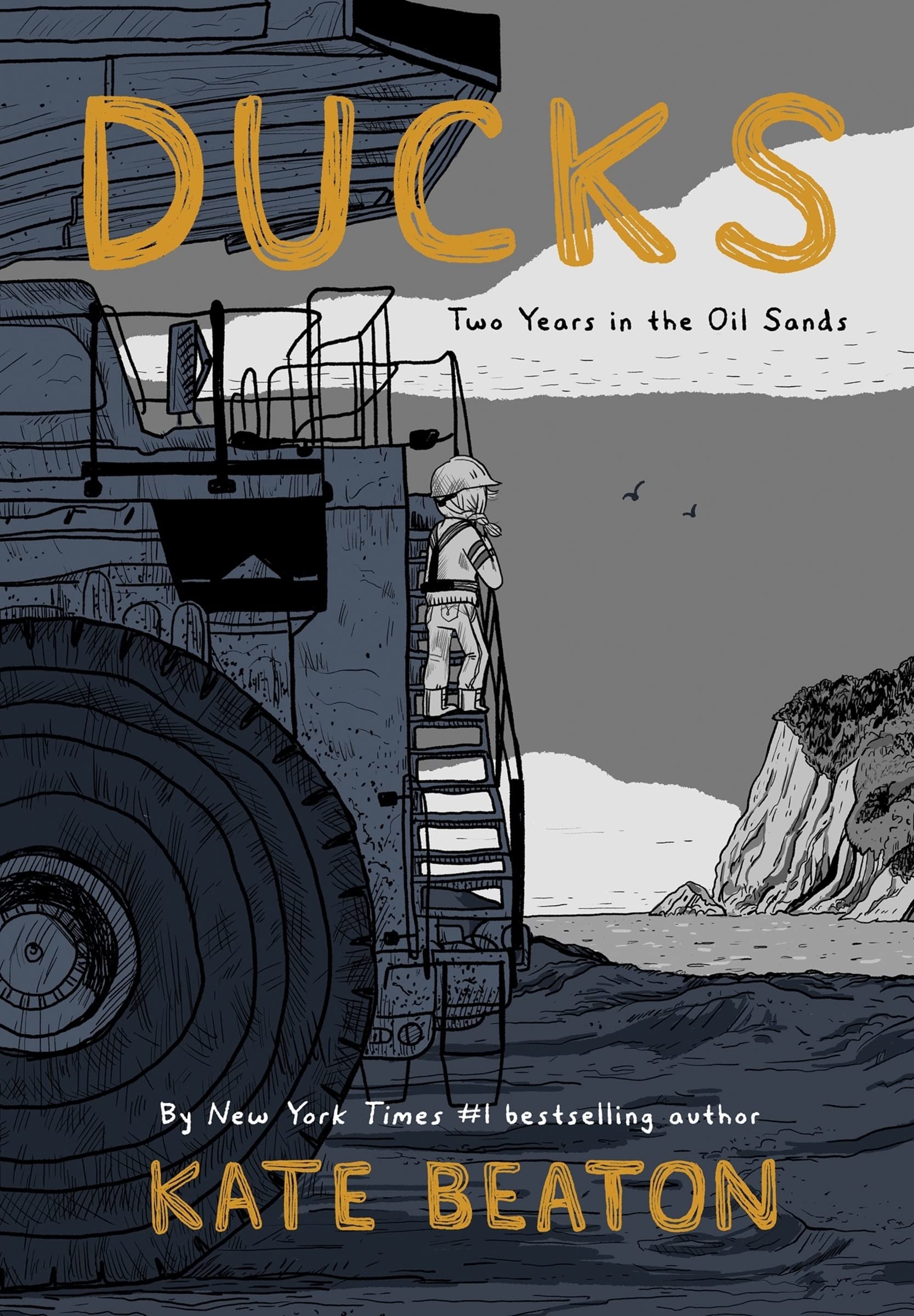
Ducks by Kate Beaton

I’ve waited too long to review Ducks, one of my favorite books of the year. I know this because I’ve already returned it to the library so I don’t have it on hand to consult. In my defense, Chris’s review is so good, I didn’t feel like I had much to add. But in the interest of reviewing everything this year, and not wanting to leave something that will likely make my year end list without a review, here goes.

Ducks is a graphic memoir, recounting the two years cartoonist and writer Kate Beaton spent working in the oil sands of Alberta, Canada. This is, I learned, a common rite of passage for young Canadians, and so, in spite of her family’s concerns, the book opens with Kate at the airport with her mother, about to leave her hometown of Cape Breton for the wild North.

The story is structured around the various camps at which Kate works plus one brief period at a museum in Victoria, and, within those sections, the story is broken up into a series of moments, interactions, and small scale events. The larger narrative emerges as the characters recur throughout various vignettes in different settings, as do the larger thematic concerns, most of which revolve around what it’s like to be one of the only women surrounded by hundreds of men who have largely been freed from the constraints of society.

And it must be said, the picture that emerges of the men here is not flattering. From her first moments in the sands, Kate finds herself being stared at, accosted, insulted, treated as inferior or, worse, as a prize, by seemingly every man she encounters. There are a few exceptions, characters whose names I can’t look up because I don’t have the book handy, and to Beaton’s credit, the portraits that emerge of the men are nuanced and complex--what are we to make of the men who are here working for their families, who gushingly share photos of wives and daughters and then make gross advances? Or of Kate’s boss who makes constant sexist remarks but also acts protectively? Or the hundreds of men with whom she never interacts, the silent majority, perhaps, who keep their heads down, make their money and go home? Beaton confronts this question head on, in a great conversation she has with her sister late in the narrative, but even there, no answers are forthcoming. Something about the isolation, the freedom from censure, the loneliness, the constant stress, causes breakdowns both internal and external, and, like the Safety Pyramid from the repetitive introductory seminars at each camp, these small disintegrations lead to larger disintegrations. Kate asks explicitly the question that the #NotAllMen contingent presumes the answer to: if our dad, our brother, our cousin were here, would they be any different?

The threat of sexual violence hangs heavy over the narrative; even before its explicitly mentioned we, the readers, can feel the looming threat, simply from the ratio of men to women. Later, it’s made more explicit, particularly when Kate visits a strip club with some of the men and learns about the practice of heating a quarter and tossing it at the dancer, with the intent that it hit and burn her genital area. Kate doesn’t know what to say to this; neither do I. But the darkest and boldest moment in the book comes when Kate, drunk at a party after being plied all night with drinks is taken to a back room and raped. And then, mere pages later, it happens again. The second time, Beaton illustrates her dissociation in a way that could exist only here, in the realm of graphic art, as she leaves her body, lets it happen, then tries to forget.

Beaton’s uncanny skill for capturing faces and expression with a few scratchy strokes pays big dividends as the cast grows. Her environments reflect the sameness and repetition of life on the sands, lulling the reading into the same cyclical rhythms without ever becoming visually boring. And the large illustrations, used sparingly, are both beautiful and imbued with meaning: the aurora borealis, the final group photo.

She leaves the sands only twice. Once to work at the aforementioned museum in Victoria, where we witness the birth of Beaton’s famous horse and, implicitly, Hark a Vagrant, her most famous work. And, at the end, when she returns from the sands and reunites with her family. In town, still with her family, she’s seen by a man she worked with on the sands, who says hello then tells her that, while she was stationed at his site, the men had a bet going about who would sleep with her first. She laughs it off, to the shock of her family, who ask why. And, like this book, she doesn’t offer them any answers.

Saturday, January 28, 2023

Ducks by Kate Beaton

I loved Kate Beaton's webcomic series, Hark! A Vagrant. It was erudite without being smug or obscure, consisting of rapid-fire riffs on literature and history, drawn in a charismatic pen-line style. It's funny to learn, from Beaton's graphic memoir Ducks, that the series began while she was toiling in the remote Alberta oil sands, a place where men--almost entirely men--come to pad their bank accounts by working under hard conditions, far away from home. For Beaton, the oil sands were a way to quickly pay down student debt, a brief but difficult experience meant to allow her to pursue her dream of being a cartoonist, as opposed, perhaps, to taking a job as a teacher or in a museum, where she might be more comfortable but never get out from under the debt, or follow her dreams.

For Beaton, the worst thing about the oil sands turns out not to be how remote they are, nor the spartan conditions of "camp" living, nor even the brutal physical ugliness of the tailing ponds. It's the men. The oil sands, like North Dakota's oil towns here in the U.S., are overwhelmingly masculine places, and they are difficult for women. Beaton immediately finds herself the object of unwanted attention: stares and leers, crude jokes, sexual propositions and harassment. Ducks shows well just how wearisome such a life can be, how it can wear one down. Each joke or crude suggestion in and of itself can be written off as men being men, or not a big deal, but they never stop, and they come from every man, even the "nice" ones. These crudities culminate in rape--twice. Writing such a thing into your own memoir, especially when you must actually draw it, and not just write about it, seems to me an act of remarkable authorial bravery. The rapes, we come to understand, are like the "safety pyramid" that illustrates how fatalities and injuries are the consequences of thousands of small negligences: they are inextricable from the larger culture of sexism and unaccountability that pervades the oil sands.

There's an interesting resonance, I thought, between Ducks and Alistair MacLeod's No Great Mischief, which I recently read. Both Beaton and MacLeod are Nova Scotians, Cape Bretoners, and both write about the way western resource extraction peels Atlantic Canadians, many of whom live in generational poverty, away from their homes. For MacLeod, it's the coal mines of western Ontario; as someone explains to Beaton in Ducks, those opportunities have all dried up and Nova Scotians and Newfoundlanders have had to move west, to the oil sands. But both depict the pain and uncertainty of leaving home, and the physically and mentally demanding conditions of this unlovely work. The ducks of the title are those who land in the oil sands' tailing ponds and become stuck in the oil, drowning and being poisoned. In a literal sense, the ducks awaken Beaton to a new understanding the environmental and social catastrophe that the oil sands represent--amplified by watching a local First Nations leader on YouTube--but in another sense, they are a symbol for the Canadians who are drawn to the oil sands' beguiling economic promise.

Beaton's style isn't much changed from the Hark! A Vagrant days: she still has a knack for creating charismatic expressions with a few simple lines only. The workers in the oil sands are cartoonish but wholly human. I liked especially how Beaton uses a simple three-by-three grid, reminiscent of the stacked "episodes" of the old webcomic, which every know and then opens up into a full page scene of massive scope: the Northern Lights over a frozen field, or a "photo" taken from a crane of all the workers at the camp. The oil sands are somehow both immense and confining, a vast landscape and a cramped cage.

Tuesday, January 17, 2023

No Great Mischief by Alistair MacLeod

I think of my grandparents a great deal, and, as in the manner of the remembered Gaelic songs, I do not do so consciously. I do not awake in the morning and say, as soon as my feet hit the floor, "Today I must remember Grandma and Grandpa. I will devote ten whole minutes to their memory" -- as if I were anticipating isometric exercises or a self-imposed number of push-ups to be done on the floor beside my bed. It does not work that way at all. But they drift into my mind in the midst of the quiet affluence of my office, where there is never supposed to be any pain but only the creation of a hopeful beauty. And they drift into the quiet affluence of my home, with its sunken living room and its luxuriously understated furniture. And they are there too on Grand Cayman or in Montego Bay or Sarasota or Tenerife or any of those other places to which we go, trying to pretend that, for us, there really is no winter. They drift in like the fine snow in the old Calum Ruaidh house in which my brothers used to live; sifting in and around the window casings or under the doors, driven by the insistent and unseen wind, so that in spite of primitive weather stripping or the stuffing with old rags, it continued to persist, forming lines of quiet whiteness to be greeted with surprise.

A man drives from Halifax to Toronto to visit his older brother, and buy him a couple cases of the liquor he can no longer do without. Nearly three hundred years earlier, a Scotsman of the clan MacDonald sets out for the New World, having buried one wife already and burying another while at sea. The point of land in Cape Breton where he lands will bear his name forever: Calum Ruaidh Point. Between these two lifetimes stretches a long history of poor but hardy Highlanders who scraped a living out of the Cape Breton landscape, as fishermen and lighthouse keepers, parted from their ancestral homeland. To some extent they live as aliens in Canada, visitors from a country most of them have never seen, but their attachment to Cape Breton, somehow, only seems to become clear when they, the clan MacDonald, dissipate into a further diaspora across Canada and the United States.

The dentist who drives to Toronto is Alexander MacDonald, the narrator. His life, told as a kind of thread that is woven with the lives of parents, grandparents, siblings, and cousins, is punctuated by several significant deaths. The first is the death of his parents, who disappear into a hole in the ice on a winter's day and are never found. "I went to my grandparents' for the night," he describes, "and I never left." It is impossible to imagine him living with his three older brothers, who share their ancestral house in a kind of primeval masculine state, using a bucket for a toilet and sleeping in their clothes. From an early age, it's understood that Alexander--typically identified as gille bhig ruaidh, the little red boy--will be different; he will go to school, become a dentist. But when his cousin, also named Alexander MacDonald, is killed in a mining accident alongside the same brothers in Ontario, the narrator is conscripted to make up the number, and spends a formative summer in the mines himself:

I was also aware of a certain guilt concerning the death of the red-haired Alexander MacDonald, though I was not sure if the guilt really was or should have been mine. But there was a vague uneasiness associated with the circumstances and the timing of it all. I told myself that he had gone into the mine after high school because he was not academically inclined. But I knew also that he had done so, at least in part, to help the members of his family who had been haunted, through no fault of their own, by the echoes of a kind of regional, generational poverty which whispered and sighed with the insistence of the unseen wind. I realized that Alexander MacDonald had partially paid for the car which ferried me home from my splendid graduation, and I realized that the opportunity to thank him and make amends was now no longer there. I had often recreated the scene in which he had called me "lucky" because my parents had lost their lives, and the feeling of the callouses on his small, determined, hard-working hands seemed permanently bonded to the rising hair on the back of my neck. The touch of his small hands, it seemed, would now and forever be mine, although I told myself that his passing had affected others much more profoundly, and I had best not consider myself so precious.

The men of the mines are proud Highlanders, doubly estranged from home, and locked in enmity with their French Canadian counterparts. Among his brothers in the mines, narrator Alexander reflects on the way that history, the story of the generations, comes to bear on men, and how its burdens can lead to strange violence. In a turn both grim and funny, a third Alexander MacDonald appears: an American cousin fleeing the Vietnam War who wears that history lightly, and whose flippant ignorance of it leads to another, final murder. Two Alexander MacDonalds, I'd wager, is symbolic enough, but three begins to look downright silly, and yet the wistful plainspokenness of MacLeod's language, like a Maritime Willa Cather, makes it work.

One small thing I appreciated about No Great Mischief is the way the narrator, as he drives across Ontario, watches the itinerant farmers, from Mexico and Guatemala and other places, at work in Canadian fields. He imagines their lives, their hard work, the refuge of a nightly beer or two, the boredom of their children. The point, as I read it, is that the story of the clann Calum Ruaidh is one repeated the world over by people making a home far from home. Without MacLeod's light touch it might seem heavy handed, but here it's perfect and subtle. Like his story collection Island, No Great Mischief evokes the rocky, hardscrabble environment of Nova Scotia in a way few novels have ever really been able to evoke a place, but it also manages to find something universal about family, about history, about what is owed to our ancestors--and their descendants.

Tuesday, January 10, 2023

Noopiming: The Cure for White Ladies by Leanne Betasamosake Simpson

Know this: After two years, the best parts of me are still frozen in the lake--my limbic system; its best friend, the prefrontal cortex; and the hollow, pumping organ in which I keep benevolence. The only one that regularly comes to visit it Akiwenzii. In the winter they park their truck on the ice, drill a hole with the auger in the ice and fish until the cold makes their bones crack. As soon as the ice is off the lake, Akiwenzii is back in their boat, with a torch and a sort of pitchfork for spearing pickerel. In the dead of summer, Akiwenzii sneaks back before first light in their canoe, before the cottagers and their jet skis are out. In the fall, they sprinkle tobacco around me and sing.

A figure named Mashkawaji lies frozen in a lake. Immobile, waiting, they watch their friends go about their lives. Each of these friends is also a representation of a part of Mashkawaji: the old man Akiwenzii is their will, the old woman Mindimooyenh their conscience, the maple tree Ninaatig their lungs, giant Sabe their marrow, Adik the caribou their nerves, and a pair of humans named Asin and Lucy, their brain. All these figures, who live in more-or-less contemporary urban Toronto, are described as "they," as Mashkawaji is, even when their gender is clear. They are all, in many ways, fluid, and the borders between their identities are porous. They are individuals, but also part of a whole, and Mashkawaji, perhaps, represents a way of being that binds them, one that is frozen, but waiting for a future in which the wholeness can be truly whole again.

Noopiming is what one might call "experimental" fiction. That describes the characters and their relationships--don't think too hard, for instance, about how a maple tree climbs aboard a boat, or goes shopping. But it also extends to the printed page: many of the pages of Noopiming are a single sentence long, oriented at the top of a long, blank page. This captures Mashkawaji's plodding, patient perspective, but I imagine it must have spurred some cost-benefit analysis at the University of Minnesota Press. The reader is forced to slow down, to take each idea as it comes, and not get caught up, perhaps, in the bustling urban life that surrounds the characters. It sits sometimes in pleasant tension with the novel's contemporary language, and sometimes exposes it as clunky or silly. And sometimes one turns the page to find pure cringe, as when we learn the old woman Mindimooyenh as her "notifications turned on for Palestine." OK.

Noopiming didn't quite work for me. I liked best the character Asin, who spends his days at Tommy Thompson Park on Toronto's Lake Erie Shore, birding. Asin is not interested in expanding his life list (to each their own), but they must rely on eBird like the other birders; they, unlike Akiwenzii and Mindimooyenh, have lost the natural connection to the cycles of the earth that would tell them when the birds will arrive and when they will depart. As the book expands, it takes on additional consciouses, like that of Esiban the porcupine. I liked the long(-ish) discussion by a group of Canada Geese planning for their migration. Though it's not said, we are perhaps asked to imagine that these, too, are manifestations of Mashkawaji, parts of the frozen whole.

Friday, November 25, 2022

What's Bred in the Bone by Robertson Davies

So you stood by him to the end, brother, said the Lesser Zadkiel.

--The end is not yet. Though he sometimes defied me, I obey my orders still, said the Daimon Maimas.

--Your orders were to make him a great, or at least a remarkable man?

--Yes, and posthumously he will be seen as both great and remarkable. Oh, he was a great man, my Francis. He didn't die stupid.

--You had your work cut out for you.

--It is always so. People are such muddlers and meddlers. Father Devlin and Aunt Mary-Ben with their drippings of holy water, and their single-barrelled compassion. Victoria Cameron with her terrible stoicism masked as religion. the Doctor with his shallow science. All ignorant people determined that their notions were absolutes.

--Yet I suppose you would say they were bred in the bone.

--They! How can you talk so, brother? Of course, we know it was all metaphor, you and I. Indeed, we are metaphors ourselves. But the metaphors that shaped the life of Francis Cornish were Saturn, the resolute, and Mercury, the maker, the humorist, the trickster. It was my task to see that these, the Great Ones, were bred in the bone, and came out in the flesh. And my task is not yet finished.

What's Bred in the Bone is the second in Robertson Davies' "Cornish Trilogy," coming after The Rebel Angels, which deals with the aftermath of the death of Francis Cornish, a wealthy patron of the arts, and his estate. Rebel Angels always seemed a bit funny, the way it establishes a central character who never appears; What's Bred in the Bone is the novel that fills in Cornish's life: how he went from an upper-crust but provincial childhood in the small Ontario town of Blairlogie to become a world-renowned art expert, as well as--something no one in The Rebel Angels seems to know--a British spy.

Young Francis is a tormented child: tormented by the moralistic pictures that dominate his childhood bedroom, tormented by his peers, who see him as weak and strange (and what's worse, rich), tormented by the surprising revelation that his older brother, a mentally disabled boy also named Francis, has been kept secreted away in the attic for many years, while a nearby grave lets the world believe that he's dead. Francis learns to draw from a book, and his early talent is given room to practice when he's allowed to accompany the local mortician and sketch the bodies. After an Oxford education and a disastrous marriage to a reckless but sexy cousin (!), Francis becomes the assistant to Tancred Saraceni, a world-famous art restorer who recruits Francis into a scheme to fake old German paintings so they might be traded to the Nazis for legitimate world treasures. Saraceni's education is technical--and in true Davies style, the art of a restorer and forger is intimately and convincingly detailed--but also spiritual, and as a final project for his master, Francis produces an original painting in the style of the German masters that is so convincing it becomes the talk of the art world. Funnily, it's this painting that destroys Francis' ambition to be a painter: to paint in this style, the only style he really can, would be to out himself as the forger.

As the title suggests, the big theme of What's Bred in the Bone is how one becomes the person they are meant to be. Davies intersperses scenes from Francis' life with a conversation between his guardian angel and the animating "daimon" who guided Francis' development. The daimon explains to the angel how the qualities that already existed in Francis had to be brought out by the external influences in his life: his luckless brother, the kindly mortician, the wily forger. Like Dunstan Ramsay of The Fifth Business, who makes a cameo appearance here, Francis must be content with being something other than great, or great in a way that is different than how he conceives it. Francis can never be a painter, never an old master, but in his capacities as a forger, a restorer, a critic, a benefactor, he can become something else. If that something else is not quite what one dreams of, still it is something the world needs, and which represents the fulfillment of his capabilities. (Of course, self-actualization takes a lot of money, something that Davies never seems to want to interrogate that closely.)

What stands out to me, though, is the way that Francis is presented as something of an old soul: he might have been one of those German masters, if he had been born in the right time and place. Nearly all of Davies' protagonists are anachronisms, people who live by moral and aesthetic codes that have been sent to the rubbish bin by modern life. Davies has this kind of quality, too, I think, but his models aren't really Renaissance painters, or even the pre-Raphaelites that Francis loves, or even the medieval thinkers that preoccupy Dunstan Ramsay. Instead, they strike me as callbacks to a kind of early 20th century Oxford don: fussy, cloistered, small-c conservative. Like Francis, Davies is an old soul working in a modern medium, searching for greatness in a genre that no longer allows for it.

Wednesday, July 27, 2022

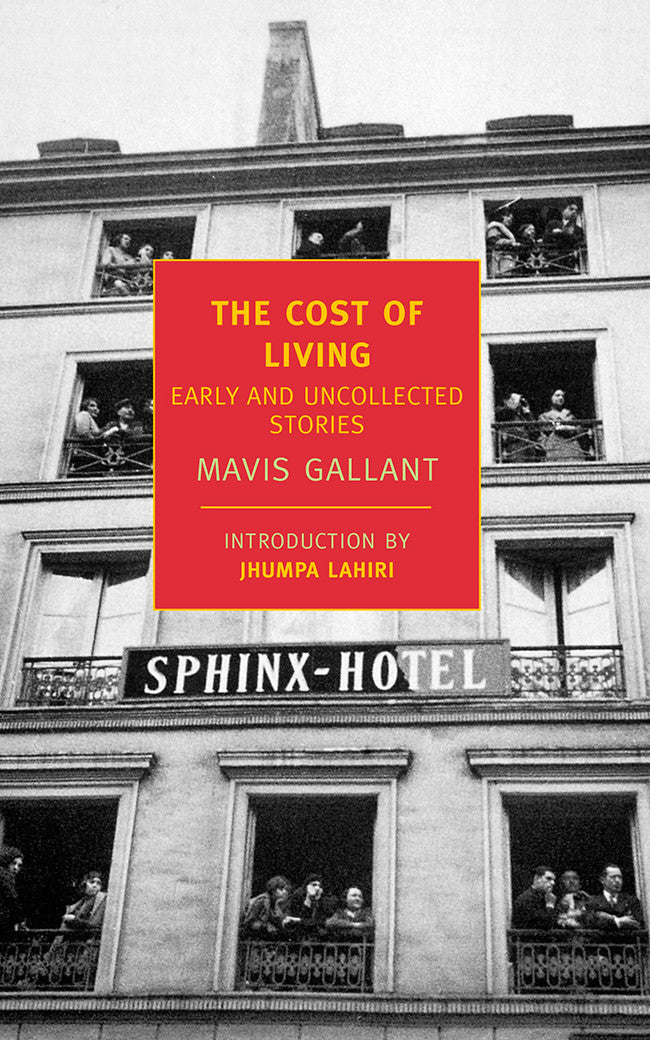
The Cost of Living by Mavis Gallant

Malcolm is convinced he will never have an idea about Bea until he understands her idea of herself. Of course Bea has an idea; what woman hasn't? In her mind's eye she is always advancing, she is walking between lanes of trees on a June day. She is small and slight in her dreams, as she is in life. She advances toward herself, as if half of her were a mirror. In the vision she carries Ruth, her prettiest baby, newly born, or a glass goblet, or a bunch of roses. Whatever she holds must be untouched, fresh, scarcely breathed on.

There's something nice about odds-and-sods collections like this one, which is that the hand of the author is totally absent. There's no thematic arrangement, no meddling in the order of the stories, nor do they capture a particular moment in the author's life: what you get in a collection like The Cost of Living is a snapshot of an author's career from beginning to finish. The collection opens with "Madeline's Birthday," which became, in 1951, Gallant's first published story. Madeline is a New York teenager abandoned by a selfish mother at the home of her sister in Connecticut, where she languishes alongside a German boarder named Paul and her aunt's little girl Allie. Paul wants Madeline to read over his English homework; Allie wants her to braid her hair. For her own part, Madeline is miserable, and dreams of getting away from the cloistered house, where she feels stifled and unwanted. It's not a very good story. Nothing really happens, the larger and deeper conflicts are only gestured at. A careful existence is constructed for the characters beyond the snapshot of the story, but it's hard to believe in that existence. You read "Madeline's Birthday" and think, "Is that it?"

But much of the things that make Gallant's fiction so beguiling are already there, in nascent form. Compare "Madeline's Birthday" to a later masterwork like "Malcolm and Bea" or "The Burgundy Weekend." Both are stories about marriages between people of varying degrees of social toxicity. Practical Malcolm has married Bea, maniacal and headstrong. In "The Burgundy Weekend," Lucie has married Jerome: clever, lazy, proud, flirting shamelessly with the young daughter of his old flame, who they are visiting in the French countryside. But the characters are remarkably rich, so rich, in fact, that the adjectives I've used to describe them hardly seem to capture who they are. Who they are, actually, is a mystery that keeps unfolding, and which may seem different the next time I read the story; not in the sense that they are underdeveloped or vague, but in the way that your initial impressions of real people never tend to be permanent.

What these stories do is have people collide. Some of them, like the married couples, have been colliding for years, sanding each other's edges until neither is fit for any other kind of society, but there are always outsiders, too, whose vantage points make it impossible for them to see inside the relationship. This is especially true in "The Burgundy Weekend," as Lucie's cousin Gilles--a rigid and professionally satisfied doctor who drops them off and picks them up in Burgundy--strains to see what Lucie sees in Jerome, unable to comprehend that Jerome's rudeness is, in Lucie's eyes, a victory for Jerome, who is often too withdrawn to bother. In the stories themselves, nothing much happens: Jerome doesn't sleep with Nadine; the old flame barely registers on the page; there are no murders or flat tires or moments that change everything. But unlike "Madeline's Birthday," you get the sense of whole lives coming to bear on single moments; they are scenes of great pressure in which nothing, in the end, bursts or breaks.

"Every marriage is about something," Malcolm thinks in "Malcom and Bea." "It must have a plot. Sometimes it has a puzzling or incoherent plot. If you saw it acted out, it would bore you. 'Turn it off,' you would say. 'No one I know lives that way.' It has a mood, a setting, a vocabulary, bone structure, a climate.'" Malcolm thinks his way into something true, but the original thought ("Every marriage is about something") is surely incorrect. I don't think you can properly say that any of Gallant's mature stories are about anything. Themes lurk under the surface, including the social inferiority complex of Canadians abroad (one fun detail in "The Burgundy Weekend" is that Lucie is a firm believer in the coming sovereignty of a free Quebec) but the stories aren't really about these things, partially because none of the characters, like most people, can barely agree on what matters at any given moment. This distinguishes Gallant's stories from Alice Munro, her fellow Canadian. While Munro's stories, like Gallant's, are small moments that reveal entire human histories, things happen in them, they are undeniably about something.

All of this makes Gallant's later work sort of spiky and unsatisfying. They resist the kind of pleasing roundness, the sense of a whole story told in short order, for which we often look to short stories. But The Cost of Living is interesting because you can see this quality of Gallant's grow and develop. Halfway between "Madeline's Birthday" and "The Burgundy Weekend" is a story like "Going Ashore," about a young girl on a Mediterranean cruise who yearns to see the fascinating new world she's being offered, but who must deal with her depressive mother, who only booked their passage to meet men. It's "Going Ashore" that might be the most pleasing story in the collection, because it features Gallant at a point where her talent has matured but the story has remained more conventional. By contrast, it's hard to figure out what to do with a story like "The Rejection," a strange, strange conversation between a father and his six year old (who talks like an adult), who decide they don't like each other and don't want to live together. Halfway through the conversation, which takes place in car, we're told that the girl has made a pet of some unidentified reptile, which is sitting at her feet. The story, actually, reminds me of the protagonist of the story "The Cost of Living," who is forced to listen to her actor roommates practicing Beckett plays on the other side of her bedroom wall. "The Rejection" is like Beckett, heard through a wall.

I don't think the stories collected here are as strong as the ones in the actual collections of Gallant's I've read. These kinds of "early and uncollected" compilations rarely are. A few of the later stories probably stand with her best, but a lot of them seem slight, like experiments that got halted halfway through for unsatisfactory results. But I loved getting to see the way one of the most original short fiction writers of the 20th century developed and grew over the course of her career.

Friday, July 22, 2022

Northland by Porter Fox

At sunset, the sky turned dark blue. I tried to remember the color of the stones, the cool air, the auburn sunlight touching my forehead. I thought about the first day of the trip at West Quoddy Head in Maine and tried to memorize the dark spires, rounded massifs, and marshmallow flanks of Mount Baker's glaciers. I thought about all the parts of the northland--oceans, rivers, lakes, plains, cities, reservations, towns--and how they linked from east to west. It was indeed its own territory: a forgotten belt of wild, old America delineated by iron monuments, rock piles, and clear-cuts.

We ended our trip through the Pacific Northwest last week at the Peace Arch, a monument that stands on the border between the towns of Blaine, Washington and Douglas, British Columbia. A tall white arch stands in the middle of a green park that stretches between both countries, with the entry lines on either side of it, the Canadian to the left, the American to the right. The monument is supposed to be a monument to peace between the two countries; in the middle, there is a ceremonial gate attached to the wall below a sign that reads MAY THESE GATES NEVER BE CLOSED. Just beyond the arch, a sign on the Canadian side reads, "Park Closed."

We saw a woman enter idly from the Canadian side and walk to the American, where she was collected by an official looking man who might have been from either country and directed toward a booth, presumably to be sent off to a black site. A few feet away the park becomes a stretch of carefully tended flowers and picnic benches (and the Peace Arch Park Snack Shack) on the American side. On the Canadian side, the border follows a street where a row of houses look out in to America, their residents only needing to make a few steps out of their door to enter another country. These houses made the stern theater of the border crossing stations seem performative and silly.

Porter Fox ended his journey along all 4,000+ miles of the USA-Canadian border at the Peace Arch, too. By then, the peculiar logic that exists at the Peace Arch has appeared many times: the world's longest peaceful border has, since 9/11, become hardened in ways that have sundered communities and put an end to the free travel that was once common between the two countries. The "Park Closed" signs we saw were, no doubt, the vestiges of Canadian COVID-19 policy, which has hardened the border even more--in many places, trains still can't pass through it. But even a few years ago, when Fox took up the project of canoeing, hiking, boating, and driving from the border's eastern terminus in Maine to its western one in Washington, the border was increasingly contentious.

The thesis of Fox's book is that the area around the border has its own particular identity and existence, as a region he calls "The Northland." He wants to explore the Northland, a region that is, with some exceptions, remarkably rural and remote, and understand how the border has shaped this identity. He begins in Maine, canoeing along the St Croix river, then hitches a ride on a Great Lakes tanker that takes him all the way from Lake Erie to Lake Superior. From there, he drives across the oil-rich boomlands of North Dakota, making a quick and timely sojourn into the protest camps at Standing Rock, which are not really near the border--though the oil in the pipeline is. His journey continues along the "Medicine Line," as the Native Americans who were pushed across it in the 19th century call it, stopping in at the Blackfeet Reservation and through Glacier National Park. In the North Cascades, he sleeps in a fire tower, as Jack Kerouac once did, during one of his most prolific periods.

The book is part travelogue, part social commentary, part history. As Fox travels, he recounts the history of the border, which has always been a contentious one. The 18th and 19th century politicians who negotiated the border really had no idea about the geography of the land they were dividing, and time and time again, created impossible borders that would lead to more contention, and more need for tenacious explorers and surveyors. The creation of Minnesota's Northwest Angle, for instance, the little chopped-off bit on the other side of the Lake of the Woods, exists because the agreed border point--the headwaters of the Mississippi--is a hundred miles south of where the negotiators thought it was. Fox adds to this history a sympathetic portrait of Angle Inlet, the Angle's only community, where schools and businesses have closed over the last few decades because of the stubborn and increasing difficulty of crossing the border--twice. And similar stories are told in Maine and along the Great Lakes.

I appreciated Fox's focus on Native Americans, for whom the border takes on a special relevance. Fox's sojourn to Standing Rock fits uncomfortably with the book's overall thesis (I mean, Google it, it's mostly in South Dakota) but along with his stop at the Blackfeet Nation, it gives an effective portrait of the way the border was placed over the existence of tribal nations, and which has profoundly shaped their existence. Even before the Indian Wars of the 19th century, the border was an indigenous problem, as Fox explains in his recounting of the alliance between Jesuit explorer Champlain and the Hurons against the Iroquois.

We crossed the border four times on our trip: twice by airplane, once by boat, and once on the road. But we experienced only one small part of its four thousand miles. I loved reading Northland while on this trip because it gave me a sense of exploring something larger; not merely of stepping over an imaginary line but passing through a real place on which history works its considerable, sometimes transformative, sometimes brutal efficacy.

Thursday, July 21, 2022

Too Much Happiness by Alice Munro

All his life--he had difficulty saying this, as he admitted, being always too wary of too much enthusiasm--all his life he had been waiting for such a student to come into this room. A student who would challenge him completely, who was not only capable of following the strivings of his own mind but perhaps of flying beyond them. He had to be careful about saying what he really believed--that there must be something like intuition in a first-rate mathematician's mind, some lightning flare to uncover what has been there all along. Rigorous, meticulous, one must be, but so must the great poet.

When he finally brought himself to say all this to Sophia, he also said that there were those who would bridle at the very word, "poet," in connection with mathematical science. And others, he said, who would leap at the notion all too readily, to defend a muddle and laxity in their own thinking.

With all respect to Anton Chekhov, Alice Munro is the best to ever do it. She gets called "our Chekhov"--the Chekhov of the English language--with some regularity, but I don't think even Chekhov, as much a playwright as a short story writer, even approached the short story with the ferocity and genius that Alice Munro does. It's a gift, I think, to be living in the era of Alice, even if she has given up the writing of stories in her old age.

But all of that makes the title story of the collection Too Much Happiness, the most self-consciously Chekhovian thing Munro has ever written, all the more interesting. "Too Much Happiness" is the real-life story of Sophia Kovalevsky, the Russian mathematician who was, before Marie Curie, perhaps the best known female scientist in Europe. It's story that's strange for Munro in several ways: first, because it's a fictionalized rendition of a true story, second, because it's set in the nineteenth century, and third, because it's set in Europe, rather than Canada. And yet Kovalevsky's story resounds with the themes that Munro takes up all the time: the dignity of common lives, the transformative power of illness, the persistent oppression and marginalization of women.

Sophia is a brilliant mathematician who soon overtakes her own tutor, the German Weierstrass, and the story opens as she receives Europe's most prestigious mathematics prize, but she still requires the string-pulling of her male benefactors to get a job offer, and even then only in frigid Sweden, which she hates. Sophia's life has touched upon great things: her brother-in-law was a leader of the Paris Commune, and her sister gave her life to be attached to his kind of adventuresome bravado. And yet Sophia herself finds herself drawn not to a man like Jaclard but the spinster sisters of her tutor Weierstrass, who toil, not unhappily, to make the home in which his great work is done. She seesaws between the feverishness of her mathematical work and a deep satisfaction in a life of domestic and social pleasures; in the present of the story she is anticipating a happy marriage to another clever and larger-than-life Russian. "She was learning," Munro writes, "quite late, what many people around her appeared to have known since childhood--that life can be perfectly satisfying without major achievements. It  could be brimful of occupations which did not weary you to the bone." Yet neither Weierstrass, nor Jaclard, nor her fiance Maksim, nor her friend the mathematician Poincare, seem to think of such lives as opposed to one another.

The other stories are more standard Munrovian fare, and a few of them are among her best work. Especially powerful are those which are concerned with shocking violence, which, despite the domestic surface of Munro's stories, is something that lurks not far below the surface. In "Free Radicals," a sickly widow is briefly trapped in her home by a stranger who confesses that he has just murdered his family, including his mentally disabled sister, who he considered a drain on his own independence. This story finds frightening echoes in "Child's Play," one of the darkest stories Munro has ever written, about (spoiler alert) a woman who, as a child, and with an accomplice she has only recently met at summer camp, drowns another mentally disabled child. This act of momentary compulsion has transformed the life of the narrator, who has become an academic studying cultural ideas about mental disability, but who seems unable to deal with her own deed in any direct way. As disturbing as "Free Radicals" is, it's "Child's Play" that takes the darker route, as if putting us in the viewpoint not of the trapped widow but the killer. Once inside that head we are shocked to find no sadist, but only a very normal person, driven to a horrible act by the most recognizable of feelings: disgust, shame, and a need to be liked.

The story I think will stick with me most, though, is the opener "Dimensions," about a woman whose husband kills their three children. The husband, remanded by the court to a mental hospital, writes to the narrator, explaining that he has seen their children in another dimension, a place where they still exist, and the narrator, despite herself, finds this to be comforting. The rambling and esoteric voice of the letters the husband writes to the narrator have a kind of voice you might never know Munro was capable of writing, and captures something true about our willingness to step outside the bounds of logic and reasoning--with no contempt for those who must--in order to face the most difficult truths in life. And though there's no real violence to it, I loved the undercurrent of masculine viciousness in "Wenlock Edge," about a college student whose roommate convinces her to have dinner with her--I don't know what to call it but a sugar daddy--who instructs her to take off her clothes. Though she complies out of compulsive fascination, the narrator expects to be assaulted, only to be given a pleasant meal and a conversation about Greek philosophy.

Even one of the weaker stories, "Deep-Holes," provides a key to understanding Munro's stories: while hiking with his family, a boy falls into a deep glaciated hole and breaks both his legs. He grows up to be a kind of sour hippie who cuts ties with his mother, except when he wants money for his commune, and we are left to wonder whether this has something to do with the experience of falling into the hole as a child. Munro would never be so crude as to suggest that there's a causal line between the two--more likely they are both representations of the character's contemptuousness for boundaries and carefulness--but the image of the deep hole, lurking under the brush of life, ready to swallow you and break your bones, is one that rings true.

Saturday, December 18, 2021

Arctic Dreams by Barry Lopez

It is as though the land slowly works its way into the man and by virtue of its character eclipses these motives. The land becomes large, alive like an animal; it humbles him in a way he cannot pronounce. It is not that the land is simply beautiful but that it is powerful. Its power derives from the tension between its obvious beauty and its capacity to take life. Its power flows into the mind from a realization of how darkness and light are bound together within it, and the feeling that this is the floor of creation.

One of the coolest places I have ever been is called Burnt Cape on the island of Newfoundland. It is a high hump of grey gravel and white cliffs, dotted with little orange flowers that grow close to the ground to protect themselves from cold temperatures and high winds; they grow nowhere else in the world. Burnt Cape is described as a piece of the Arctic emerging fifteen degrees of latitude below the arctic circle; there are signs that warn travelers that, in rare circumstances, polar bears travel here on spring ice floes. It's a tiny spot, relative to the real Arctic, but it impressed upon me how so stark and enigmatic a landscape can capture the imagination, and become the stuff of dreams.

Barry Lopez's book Arctic Dreams is about the Arctic landscape as it is, and how it is imagined. Lopez, whose extensive experiences with Arctic researchers from Baffin Bay in Alaska to the eastern reaches of Greenland shows through impressively, begins his book with chapters on the region's animal life: the musk ox, the polar bear, the narwhal. Though we have only lately come to pay close attention to these animals through scientific research, Lopez argues, we still know very little about them, and they continue to surprise us. Is it true, as the indigenous people of the Arctic claim, that you should leap from a polar bear's attack to its left, because they are all left-pawed? From there, Lopez moves onto chapters about ice and the landscape, and only at the end of the book, to people: the indigenous people who have lived there for millennia, and the latecomer Europeans who let their dreams run away them and largely shipwrecked into disaster. That's the way it should be, it seems--the people last, and the Europeans last of all.

A relatively educated contemporary reader might cringe at Lopez's use of the word "Eskimo," which is largely thought of these days as a slur (see the CFL team's recent name change to the Edmonton Elk). But that might obscure the tremendous sensitivity Lopez has toward the indigenous people of the Arctic, whose long tenure on the land has produced a knowledge of it that no European can reproduce. He makes a really simple, but somehow not obvious, point about about the difference between Western science and indigenous knowledge: Western science, with its emphasis on controlled experimentation, simply cannot reproduce the number of hours of observation that indigenous communities have devoted to the land in which they live. He gives a remarkably sober and thoughtful treatment of the various benefits and drawbacks of the two kinds of thinking, explaining, for instance, how Western science is better equipped to describe the migrations and entire life cycles of Arctic animals, whom the Inuit or Yupik only encounter during certain seasons. But compare this to the map drawn, by memory, of Cumberland Sound, by an indigenous man, with its many hundreds of tiny inlets.

The first Arctic explorers, Lopez describes, paid insufficient attention to the indigenous people of the Arctic, as they paid insufficient attention to the land itself. The doomed James Franklin of the HMS Terror might have wondered, for instance, why the Inuit are nomadic, or why they travel in small groups, when loading up his ship with hundreds of men and planning to overwinter in the Arctic when trapped in ice. The Arctic has always been a place of men's dreams, Lopez describes, and those who have lived there the best are those who are patient and observant enough to dare the impossible task of taking it on its own terms.

I don't read a lot of non-fiction, so the sample size is small, but I think Arctic Dreams may be the best nature book I've ever read. Lopez certainly has a fiction writer's knack for description, and has a way of making the Arctic landscape, which seems to so many alienating and monotonous, come alive with color and light. He faithfully describes how "the winter face of a muskox, its unperturbed eye glistening in a halo of snow-encrusted hair, looks at you over a cataract of time, an image that has endured all the pulsations of ice," and how "at certain hours the land has the resolution of a polished diamond." I'm reminded of the tremendous descriptions in William Vollmann's The Rifles, but even then I'd have to admit that Lopez's Arctic makes Vollmann's seem drab and bereft.

Arctic Dreams was published in 1986; it sadly has the doomed quality of a letter written by someone who doesn't know it's their last. In the era of climate change, it can seem both incredibly prescient and bleakly quaint. Of all the breathtaking descriptions of stalking polar bears and immense ice fields, it is sobering to think that perhaps the description that has changed the least is that of the dreary corporate wasteland that is Alaska's Prudhoe Bay complex, a place where lonely men come to suck oil out of the sea and try very hard not to look around while they do it. Books like Arctic Dreams are a reminder of what happens to the land, and to us, when we fail to look closely at it.