Showing posts with label nobel prize. Show all posts

Thursday, February 5, 2026

The White Bear by Henrik Pontoppidan

It is true that there would be times when his wild surges of blood subsided for a moment, when he, as it were, came to observe his own face--and looked away. He would then become almost afraid of himself... the sight of his own hand, still bloody from helping with the flaying of seals. Or his uncut, unkempt beard. The suddenly alien sound of his deep voice. Unbidden, visions of his grandfather's terrifying aura would visit him. And the mute silence the name of this "ogre" invoked. The petrified stare in his mother's anxious eyes on the only occasion she had allowed his grandfather's name to pass her lips.

The titular bear of Danish Nobel winner Henrik Pontoppidan's The White Bear is Thorkild Muller, a priest who has spent the bulk of his life preaching to indigenous Greenlanders. As a young man in Denmark, Thorkild is a wayward rascal who offers his services to the Danish in Greenland, thinking he'll basically fuck up his schooling so bad they'll never actually put him in a parish, but as it turns out, he's underestimated the inevitability of bureaucracy. He's a poor and talentless priest, but there comes a moment when he decides to toss away the proprieties of Danish civilization to live among, and like, the Greenlanders, even taking a wife among them. When he returns, as an old man, to Denmark, he has gained fervor and intellect, and even becomes popular among regular parishioners. But he's too wild for the Danish church, who essentially chase him back to Greenland. It's a slim, almost parable-like story, that pokes fun at a buttoned-up Danish culture and suggests that what the Danes perceive as Indigenous "wildness" may represent a truer and more genuine religion.

I'm a sucker for stories about the Arctic, and about Indigenous peoples, but I actually preferred the other novella in this small duo. Titled "The Rearguard," it focuses on a recently married Danish couple living in Rome, Jorgen and Ursula. Jorgen is a notorious painter working in the school of social realism, and Ursula is drawn to him because she admires both his talent and his passion, though she herself is the daughter of an bureaucrat who represents nearly everything that Jorgen despises. Like the young Thorkild of "The White Bear," Jorgen's red hair represents his fiery idiosyncrasy, and the reader has some sympathy with Jorgen's enthusiasm for tearing down the pieties of civil society in favor of a socialist utopia. But, like many would-be revolutionaries, Jorgen turns out to be a total boor. He can't go anywhere without making a scene; he chews out his fellow painters for their violations of his own orthodoxies. Ursula, too, often bears the brunt of his overflow of passion and vitriol; also like many would-be revolutionaries, he makes few distinctions among his targets, and the young marriage founders as it's just beginning. I found this the stronger of the two novellas because Jorgen is a really well-done character--Pontoppidan captures his proud, irascible voice in a way that made it more memorable.

OK, so I'm going to start keeping track of the Nobel Prize winners I've read. With the addition of Pontoppidan, I've read 59/122, so not quite half. I probably won't read them all, but maybe it'll be a nice way of discovering some new things.

Saturday, December 13, 2025

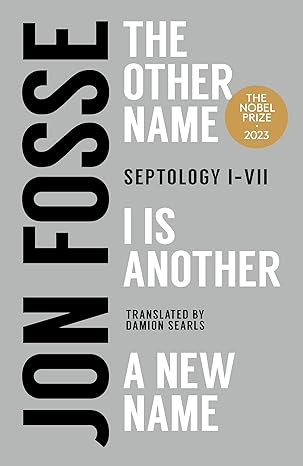
A New Name by Jon Fosse

And I see myself standing there looking at the two lines that cross in the middle, one brown and one purple, and I see that I've painted the lines slowly, with a lot of thick oil paint, and the paint has run, and where the brown and purple lines cross the colours have blended beautifully and I think that I can't look at this picture anymore, it's been sitting on the easel for a long time now, a couple of weeks maybe, so now I have to either paint over it in white or else put it up in the attic, in the crates where I keep the pictures I don't want to sell, but I've already thought that thought day after day, I think and then I take hold of the stretcher and let go of it again and I realize that I, who have spent my whole life painting, oil paint on canvas, yes, ever since I was a boy, I don't want to paint anymore, ever, all the pleasure I used to take in painting is gone...

A New Name closes out Jon Fosse's Septology, a work that is either one book or seven or, in this case, and probably the least reasonably, three. It continues the present story, in which the painter Asle prepares to visit his friend's sister for Christmas day and struggles with a numinous painting, and the story of the past, which comes in memories that overwhelm Asle: meeting his wife Ales, who later died young, becoming a painter, as well as memories that recount the life of his friend and namesake, another painter named Asle, who is currently languishing in a hospital to which our Asle has ferried him. How does Asle know all this stuff about the other Asle? He might be thinking through what he's been told, of course, but there's a strong suggestion, too, that the men have somehow overlapping identities, and that our Asle draws from a store of memory that belongs to him as well.

Many of the memories in A New Name are lovely, happy memories. We hear how Asle met Ales one day by pure chance, and how they became almost immediately joined at the hip. The same day that Asle meets Ales, he goes to rent a room in Bjorgving where he'll be attending art school. The landlady, an aged beauty named Herdis, is suspicious of Ales, and refuses to let her in the house. Later on, Asle paints the stern landlady's portrait in exchange for free rent he will end up not needing, as he moves in with Ales almost immediately. This old lady is, I thought, one of the novel's best characters: an image of the way that people seem to shrink into themselves, their homes, with age, and I enjoyed her mix of affection of possessiveness.

But A New Name ends up being quite a sad ending, I thought. Spoiler alert--the namesake Asle dies, and we find out bloodlessly, through a nurse at the hospital. Fosse piles it on, too, with the unexpected death of Guro, a woman who had been flirting with Asle in the previous novels (and who, as one of the novel's many doubles, resembles the sister whose house Asle is meant to head to for Christmas day), in a terrible fire, no less. The book ends with Asle rebuffing the advances of said sister and then, perhaps dying himself as a "ball of blue light" shoots into his forehead. The Lord's prayers, then, that end each of the novel's seven sections, and which underpin its thematic interest in the presence of God and the possibility of knowing God, take on the sense of prayers for the dead, in which the protagonist finally includes himself.

Saturday, December 14, 2024

I is Another by Jon Fosse

...I go into the main room and over there on the easel I see the bad painting with the two lines that cross in the middle, no, I can't look at it, I can't even take the picture down from the easel and put it in the pile with the other paintings I'm not totally done with yet, that I'm not totally satisfied with, I just can't, I think and I look at the easel and I think that when I look at the easel now, isn't it like, the thought comes into my head, like God is looking out at me from the easel? I think, and now I just have to not go crazy, I think, because it's like God is looking at me from every single thing, I think and look around and it's like God is in everything around me, I think, and like he's looking at me from every single thing, I think and I think isn't the round table clearly saying with its silence that God is nearby? and the two chairs? and the one Ales always sat in, especially clearly, God is so clearly looking at me from that chair, I think, and I think that it's when I'm most alone, in my darkness, my loneliness, because it really is lonely, to tell the truth, and when I'm quiet as I can be, that God is closest, in his distance...

The second part of Jon Fosse's Septology picks up where the first has left off: the narrator, Asle, has dropped his friend, also named Asle, off at a hospital in Bjorgvin where his addictions are close to claiming his life. He has gone home with the other Asle's dog, to confront there the loneliness of the Christmas season without his wife Ales, who has died, and his friend Asleik, who is demanding one of Asle's best paintings this year as a gift for his sister. The stark, wintery landscape of Norway's fjords is full of memory for the narrator Asle, about Ales and about his childhood, his experience getting into Norwegian art school and leaving his family. We finally see the moment where the two Asles meet, introduced by a mutual friend, both as prospective art students. The other Asle is called here "The Namesake."

Is it sloppy reading on my part, or an essential trick on Fosse's part, that the Asle I thought he was talking about for 200 pages was the Asle in the hospital, and not himself? I think the latter, though perhaps an eagle-eyed reader might have figured it out all before. The narrator's memories come sudden and swift, introduced with a simple transition like "I see Asle..." I see Asle with his sister, who died young; I see Asle, having a panic attack over the thought of reading in class; I see Asle, moving away from his parents for the first time to pursue his dreams of art school; I see Asle, giving up on the kind of realistic paintings of Norwegian domestic landscapes that made him popular, etc., etc. And all the time I was trying to find an answer to that essential question--if these Asles are the same, even perhaps to the point of being the same person, or avatars of one another, where do they diverge? Why is one Asle a success and the other a failure? I thought I was finding it, perhaps, in the death of his sister. But with one quick movement, Fosse reminds us that this is the narrator Asle remembering his own life.

Ultimately, I don't think Septology has an idea of why people end up the way they do. On the question of nature vs. nurture, it's agnostic to the point of disinterest. It sets up for the reader a kind of fool's game, forces you to search for the differences and divergences, when really the thrust seems to be that human personality remains a kind of inexplicable mystery. The elision between the two Asles is maybe the most bravura thing about Septology, a project of great skill and subtlety that justifies and illuminates the pale featurelessness of the story and the prose.

And reading this time, I was struck by the novel's interest in grief and the possibility of the divine: the narrator Asle has painted this painting of two lines crossing, one purple, one brown, that he alternately considers the worst painting he's ever done and the best. But the painting is where God enters the scene, and in studying it--pointedly, a cross--Asle begins to see the presence of God everywhere. Perhaps, I began to think while reading I is Another, God is another name for that power of chance or providence that turns a life in one direction and another in another, just as God is the name for what takes away one's wife before her time.


Sunday, October 20, 2024

Human Acts by Han Kang

Twenty years lie between that summer and now. Red bitches, we're going to exterminate the lot of you. But you've turned your back on all that. On spat curses, the abrupt smack of water against skin. The door leading back to that summer has been slummed shut; you've made sure of that. But that means the way is also closed that might have led back to the time before. There is no way back to the world before the torture. No way back to the world before the massacre.

In 1980, the South Korean military brutally put down a student protest at Chonnam University in the city of Gwangju. Han Kang's novel Human Acts focuses on the victims of what's now known as the "Gwangju Massacre," centering on the killing of a middle school-aged boy named Dong-ho. The novel is arranged as a series of discrete stories loosely related to Dong-ho's killing, arranged chronologically so that they move bit-by-bit from the moment of the massacre to its aftermath and the possibilities of its memory; they include an editor facing the censorship of a new translation, a woman struggling with whether to tell the story of her rape and brutalization to an academic, and even Dong-ho's mother, who struggles decades after to make sense of her son's death.

Some of these stories are better than others. My favorite was actually the second chapter, which is narrated by the ghost of Dong-ho's friend, Jeong-mi, as he follows his body as it is disposed of by the military authorities. (Jeong-mi, one might think, would dispute the characterization of Human Acts that it begins with Dong-ho's death; the fact that Dong-ho faces the death of his friend before his own only emphasizes the persistence of the brutality that Han describes here.) Han describes Jeong-mi as only dimly aware of the other ghosts that cling to other bodies, and not able to interact with them; in death he is isolated and alienated, the possibility of solidarity rent asunder, as the military no doubt intends when they move to commit violence against a group of children and youths. Jeong-mi's chapter follows the first, which is set in a large warehouse where volunteers arrange the bodies of those killed so that they might be identified by their family. This, too, Han tells us, is a "human act," this regime of courage and care, as much as the atrocities.

Han keeps her focus tightly on the victims of those atrocities. The brutalizers in the military remain as faceless and nameless as movie stormtroopers, and Han isn't interested in contextualizing their deeds or giving their perspectives. There's a moral logic to that, but it left me wondering how such brutality was sanctioned in South Korean society; left unexplored, for example, is the way the massacre was justified with a familiar kind of red-baiting that associated the students with communist North Korea. In the place of dramatizing these dynamics, I felt that Human Acts lurched into a kind of history-book exposition that isn't entirely redeemed by authorial smoothing ("Through the newspapers, you witnessed the seemingly inexorable rise of Chun Doo-hwan, the young general who had been the former president's favorite...") Han is too skilled and too careful to veer into a sentimentalism about the power of the human spirit, or the importance of social memory, but my lasting impressions of Human Acts remained rather circular: brutality, in the end, is brutal. Oh, and I really hated the second person point-of-view that most of the book uses.

Saturday, February 3, 2024

Two Books About the Aztecs: Fifth Sun by Camilla Townsend and The Mexican Dream by J. M. G. LeClezio

Many years later, it would become an accepted fact that the indigenous people of Mexico believed Hernando Cortes to be a god, arriving in their land in the year 1519 to satisfy an ancient prophecy. It was understood that Moctezuma, at heart a coward, trembled in his sandals and quickly despaired of victory. He immediately asked to turn his kingdom over to the divine newcomers, and naturally, the Spaniards happily acquiesced. Eventually, this story was repeated so many times, in so many reputable sources, that the whole world came to believe it. Moctezuma was not known for his cheerful disposition. Even he, however, had he known what people would someday say, would certainly have laughed, albeit with some bitterness, for the story was, in fact, preposterous.

The word "advanced," like the word "primitive," is a word that's slung around too often without being questioned. Yet, by any metric, the Aztec civilizations that the Spanish conquerors encountered were the most "advanced" of North American peoples. They planned and lived in great urban cities; they had complex systems of trade and technology; they had spectator sports and libraries. In many ways, they are more recognizable to us as "modern" than, say, the nomadic tribes of the U.S. plains. And yet, they found themselves quickly subdued by a small group of Spaniards. Why? Answers to this question have often relied on the Aztecs' religion. I remember learning in school that the Aztecs believed that the Spaniard and the horse were a single, frightening creature, and that they saw in Cortes the return of the god Quetzacoatl. Camilla Townsend's award-winning history of the Aztecs, Fifth Sun, calls bullshit.

The problem with these accounts, as Townsend describes it, is that they rely too heavily on Spanish language accounts of the conquest. This, despite the fact that several accounts written in the indigenous Nahautl language survive, and present a very different story. Townsend's history--she implies, and I'm ready to believe--is the first account of the Aztecs to prioritize indigenous sources. And what those sources, like several "annals"--basically Aztec accounts of what happened each year--and the history of the Indigenous historian Don Domingo Chimalpahin, tell is a different story. In this story, the Aztecs quickly understood the military superiority of the Spanish, predicated on "the Spaniards' use of metal, and their extraordinary communication apparatus." "What is striking," Townsend writes about the Aztec reaction to the Spaniards' military advantages, was not that they interpreted them as divine, but "how quickly they realized that these issues were at the heart of the matter." The choices made by Moctezuma and his allies, as well as those who allied with the Spaniards like the Maya woman historically known as Malinche, begin to make sense as pragmatic and political acts. 

Townsend's history is split basically into thirds: Aztec life before the conquest, the conquest, and the aftermath. I really enjoyed reading the first part, about the Aztec world pre-Cortes, which is something about which I knew very little. I was especially eager to hear what Townsend had to say about human sacrifice, which, if you've ever had the misfortune of interacting with a Twitter racist, you might know is used to justify the brutal colonial practices of not just the Spanish but all European colonizers of the new world. Townsend notes that the scale of human sacrifice is, first and foremost, much smaller than formerly assumed--she estimates it at perhaps two thousand sacrifices over a hundred year period. For the Aztecs, sacrifice was connected to stories in which a god allowed themselves to be destroyed so that a new world might be born; they themselves believed the universe had exploded four times and they were living in the "fifth sun."

But Townsend makes it clear that, during the rise of the Mexica Empire centered on Tenochtitlan, sacrifice took on a practical and military aspect as well, punishing cities that refused to pay homage and allegiance. Fascinatingly, the Mexica engaged in "Flower Wars" with their most entrenched enemies like the city of Tlaxcala: a type of ritualized, less lethal warfare, which maintained the status quo between rivals who would otherwise attack one another. The Spaniards, who attacked and then allied with the Tlaxcala against their Mexica rivals, actually managed to explode a stable political detente into the violence that had long been avoided.

The "after," too, is fascinating for its glimpse into the processes which transformed a nation of conqueror and conquered into the Mexico of today: the beginning of the encomienda system, which supplanted and extended the Aztec system of imperial tribute, the brutality of forced labor, the subsummation of Aztec identity into a Spanish identity that evolved into the mestizaje ideology of Mexican "mixedness," etc. I was surprised to hear that much of the instability of early colonial Mexico fell not just on the Indigenous but on Black slaves imported from Africa. It's in the midst of this world that writers like Don Chimalpahin wrote their own accounts of the conquest in their own language, and knowing the circumstances they were writing under makes their resolve in recording their story for future generations all the more impressive.


Thus began the True Story, with that meeting of two dreams. There was the Spanish dream of gold, a devouring, pitiless dream, which sometimes reached the heights of cruelty; it was an absolute dream, as if there were something at stake entirely different from the acquisition of wealth and power; a regeneration in violence and blood to live the myth of Eldorado, when everything would be eternally new.

On the other side was the ancient dream of the Mexicans, a long-awaited dream, when from the east, from the other side of the ocean, those bearded men guided by the Feathered Serpent Quetzalcoatl would come to rule over them once again. Thus, when the two dreams and the two peoples met, the one demanded gold and riches, where as the other wanted only a helmet to show the high priests and the king of Mexico, since, as the Indians said, it resembled those once worn by their ancestors, before they disappeared.

After reading Towsend's history, it's hard to turn to Nobel winner J. M. G. LeClezio's account of the Spanish Conquest of Mexico and not think bullshit, bullshit, bullshit. All the myths Townsend identifies are here: the single creature made of horse and rider, the reincarnation of Quetzalcoatl in the form of Cortes. The Aztecs' fall to the Spanish can be explained, for LeClezio, by the intensity of their apocalyptic religious beliefs, by the power of prophecy and visions that foretold the coming of the conquerors. It's no surprise that LeClezio, writing in the mid-60s, draws entirely on the True History of Spanish evangelist Bernardino de Sagahun that Townsend identifies as the source of many of these self-serving stories.

To his credit, LeClezio seems to really know a great deal about Indigenous Mexican religion, not just that of the Mexica and other Aztecs, but the Maya and the Purepecha, who were and are centered in the western region of Michoacan. I have no way of knowing how accurate he is--I have a general sense that Indigenous Mexican religion is often misread, that some figures are falsely conflated and figures who really are avatars of one another are often missed--but LeClezio's account of the three main religious systems in rich and detailed. For LeClezio, these are "barbarian" religions, a term used more with admiration than disgust: he believes that the immanence of their religion made them closer to both nature and the divine, which is supposedly in contrast to European Christianity, which is less an animating force for the Spaniards than a quasi-religious "dream" of riches and gold. LeClezio's interlude about Antonin Artaud, who went to Mexico in search of a pre-European way of being only to come back a mental and physical wreck, make the stakes of The Mexican Dream clear: LeClezio is less interested in understanding Aztec religion than he is in using it as a kind of mirror held up to European degradation.

In this one respect, I do agree with LeClezio: the conquest of Indigenous America interrupted a process of historical development that might have served us better than the European colonial project did. LeClezio asks: "How might those civilizations, those religions have evolved? What philosophy might have developed in the New World if the destruction of the Conquest had not taken place?" In one way, this is a silly question; Indigenous civilizations did not disappear; they're still with us, and they have evolved. Mexico is home to two million Nahuatl speakers. But in another way, I think LeClezio is plainly right. He writes about an Indigenous belief in that "equilibrium was the very expression of divine creation," that we have a divine mandate to live in reciprocal relationships with places and resources. I often wonder what our world would be like today if it were this ideology that had taken root around the world, rather than one predicated on resource extraction and economic development at all costs. When LeClezio writes that Western man has "put himself in a position of disequilibrium, because he has let himself be carried away by his own violence," it's hard to disagree.

Sunday, December 17, 2023

The Other Name by Jon Fosse

...it's true probably the only thing I could have ended up doing was painting pictures, and if I wanted to make a living I need to paint, and that's both good and also wrong, but that's what I did and kept doing, I painted picture after picture, I did that at least, and when I wasn't painting I often spent hour after hour just sitting and staring into space, yes, I can sit for a long time and just stare into empty space, at nothing, and it's sort of like something can come form the empty nothingness, like something real can come out of the nothingness, something that says a lot, and what it says can turn into a picture, either that or I can stay sitting there staring into empty space and become completely empty myself, completely still, and it's in that empty stillness that I like to say my deepest truest prayers, yes, that's when God is closest, because it's in the silence that God can be heard, and it's in the invisible that He can be seen, of course I know my Pater Noster and I pray with it every day...

Jon Fosse's Septology is three books, divided further into seven volumes. It's hard to say whether it's one thing or three things or seven things, and each volume itself is one run-on sentence without periods, slipping from one day in the life of the painter Asle into the next, bleeding across volumes. Since the first two of the seven were published as a single volume--and since I'm trying to surpass my book total for last year--we're going to go ahead and call this volume a book, though certainly others will say the Septology's propulsive, fluid, and unceasing nature demands that one read until the end.

Asle, the narrator, is a painter living on the coast of Norway. He's a widower, with few friends, except for his neighbor Asleik and the owner of the gallery where he sells his paintings. And, of course, the other Asle, who lives in town and who--we quickly pick up--is a kind of doppelganger of the narrator, if not something even more intimate and overlapping than that. Another version of himself, perhaps, branching off at some undefined point. Whereas our Asle is a teetotaler, having been convinced to stop drinking by his late wife Ales, the other Asle is a hopeless and miserable drunk. Much of The Other Name is devoted to the narrator Asle's attempts to get the other Asle, whom he's found cataleptic in the snow, into a clinic where he can be treated for his severe addiction. This becomes a kind of shaggy dog story, literally: the narrator Asle realizes too late that he must find and take care of drunk Asle's dog Bragi, and this is made all the more difficult by a snow storm that keeps him from driving back to the coast.

How did Asle become Asle and Asle become Asle? Can it really be as simple as the suggestion, toward the volume's end, that the drunk Asle was set off on his path by the trauma of being molested as a child? Such an answer would be easy, too easy--perhaps it was the mollifying influence of Asle's wife Ales, now gone. Or perhaps there is no accounting for why our lives take the paths they do. This is complicated by a sneaking suspicion that there is something in the names of the other characters--Asle, Asleik--that suggests that there are more than just these two doppelgangers, and that we are meant to see them as many variations on the same Asle. The slippage becomes comical when narrator Asle keeps running into a woman, Silje, who insists they've met before, even slept together. What's obvious to us--she knows the drunk Asle, ensconced now in the clinic--is totally lost on our aloof narrator.

The ceaseless sentence of each volume lulls you, like a drug or a dream; it's easy to feel, carried on the endless flow of it, that you have been severed from realism, if not from reality. The style is a variation on stream-of-consciousness, and not, I would say, especially innovative, but it works really well here because it works to justify the novel's slight otherworldliness, its other strange slippages, like that between Asle and Asle. We don't question the vision of two lovers playing in a sandbox, which may be a memory of Asle about himself and Ales, or which may be two real people. We don't question the way the narrative perspective breaks as the narrator's consciousness enters into the consciousness of the other Asle. Is "our" Asle simply remembering the story that the other Asle told of his formative encounter with the predatory "Bald Man," or imagining it? Or has the narrative somehow slipped away from him, and really entered into the other man? Of course, it's both somehow, and the narrative's current, which refuses to recognize the epistemological barrier of the sentence, reflects it.

One thing I enjoyed a lot about The Other Name is the way it imagines narrator Asle's art. In the two days that make up the two chapters, he has recently begun--and perhaps--finished a painting made up of only two lines crossing, a brown and a purple one. His neighbor Asleik jokes that the painting should be called "St. Andrew's Cross," and there is something religious about the experience of painting for our Asle, a way of accessing the quiet and empty place where God lives, and where creation is possible. (Among other things, our Asle is a recent convert to Catholicism, and can be seen praying his Pater Nosters with the dedication of a convert.) My favorite bits might be when our Asle describes the glow he searches for in his paintings, a glow that comes out of sheer darkness, made layer by layer on the canvas; he tells us that he only knows when a work is finished if, when he turns the light out, the glow remains. A Glow in the Darkness might be another, more florid name for the first volume of the Septology.

I'm still searching, I think, for what people love about these novels, and what the Nobel committee saw in them (and Fosse's work more generally) when they awarded him the Nobel Prize in Literature earlier this year. I will say that it took a little bit of self-sacrifice to stop with the first volume, when the narrative works so hard to carry you, like the tidal fjord, into the next one. But it took a little bit of self-interestedness, too.

Saturday, January 21, 2023

The Years by Annie Ernaux

The year 2000 was on the horizon. We could not believe our luck in being there to see it alive. What a shame, we thought, when someone died in the weeks before. There were rumors of a Y2K computer bug, a planetary malfunction, some kind of black hole portending the end of the world and a return to the savagery of instinct. The twentieth century closed behind us in a pitiless succession of end-of-millennium reviews. Everything was listed, classified, and assessed, from works of art and literature to wars and ideologies, as if the twenty-first century could only be entered with our memories wiped clean. It was a solemn and accusatory time (we had everything to answer for). It hung darkly overhead and removed personal memories of what for us had never been an entity called "the century" but only a slipping-by of years that stood out (or didn't) depending on the changes they had brought to our lives. In the coming century, parents, grandparents, and people we'd known in childhood would be dead for good.

The Nobel Prize Committee, in awarding its 2022 prize to French writer Annie Ernaux, described "the courage and clinical acuity with which she uncovers the roots, estrangements and collective restraints of personal memory." The Years is a book that highlights the tension between the "collective" and "personal" aspects of that sentence: it's a memoir, ostensibly, of Ernaux's life, but one in which the personal is subsumed in the collective. It begins in the post-war boom of France in the late 1940's and ends after the arrival of the new millennium and, shortly after, September 11th. It covers these seven-odd decades, vacillating between two modes. The first is a first person collective "we" that is a kind of memoir of an entire generation ("The speeches said we represented the future"). The second is an estranged third person linked to photos of Ernaux herself, minutely described and imagined ("The raked-back hair, drooping shoulders, and shapeless dress, in spite of her smile, indicate fatigue and the absence of a desire to please").

The effect is one of estrangement, estrangement from one's self, estrangement from the specific, and a flight toward notions of a collective experience. This experience, the collective experience of Ernaux's generation, is defined by political attitudes and rituals of consumption; Ernaux compiles lists of novels, magazines, television shows, films, cosmetics and consumables; these things have as much weight as the protests of 1968 or an increasing disillusionment toward Mitterand. History, such as it's defined, barely touches them; events in Algeria or Vietnam have no reality, or as little reality as anything else. And all of these things, once they become memory, are at risk of total loss: "Everything will be lost in a second," Ernaux writes at the memoir's beginning. As the memoir goes on, details pile up, but so does an increasing awareness of those details' ephemeral nature. What will be left, Ernaux wonders, when the person is gone, and their memory gone with them?

I think The Years might have been more effective for me if I had been French, and had a better idea of what the cultural touchstones of the memoir are. I have a passing familiarity with Charlie Hebdo and "ye-ye" music, but I don't know who Coluche is, or les Guignols. Still, I was fascinated by the general arc of social history The Years presents, beginning with the affluence of the post-war years, moving through the furor of the 1960's, into a late 20th century in which attitudes become soured and ripe for the kind of reactionary politics of Le Pen. The "we" of The Years acts as a reminder, at times, that one is never entirely apart from society's churning; it doesn't matter much whether the Ernaux of the photographs is taken in by Le Pen or not, if her generation is. I got the sense, reading The Years, of history as a kind of ocean that carries one along on its tides

Thursday, July 21, 2022

Too Much Happiness by Alice Munro

All his life--he had difficulty saying this, as he admitted, being always too wary of too much enthusiasm--all his life he had been waiting for such a student to come into this room. A student who would challenge him completely, who was not only capable of following the strivings of his own mind but perhaps of flying beyond them. He had to be careful about saying what he really believed--that there must be something like intuition in a first-rate mathematician's mind, some lightning flare to uncover what has been there all along. Rigorous, meticulous, one must be, but so must the great poet.

When he finally brought himself to say all this to Sophia, he also said that there were those who would bridle at the very word, "poet," in connection with mathematical science. And others, he said, who would leap at the notion all too readily, to defend a muddle and laxity in their own thinking.

With all respect to Anton Chekhov, Alice Munro is the best to ever do it. She gets called "our Chekhov"--the Chekhov of the English language--with some regularity, but I don't think even Chekhov, as much a playwright as a short story writer, even approached the short story with the ferocity and genius that Alice Munro does. It's a gift, I think, to be living in the era of Alice, even if she has given up the writing of stories in her old age.

But all of that makes the title story of the collection Too Much Happiness, the most self-consciously Chekhovian thing Munro has ever written, all the more interesting. "Too Much Happiness" is the real-life story of Sophia Kovalevsky, the Russian mathematician who was, before Marie Curie, perhaps the best known female scientist in Europe. It's story that's strange for Munro in several ways: first, because it's a fictionalized rendition of a true story, second, because it's set in the nineteenth century, and third, because it's set in Europe, rather than Canada. And yet Kovalevsky's story resounds with the themes that Munro takes up all the time: the dignity of common lives, the transformative power of illness, the persistent oppression and marginalization of women.

Sophia is a brilliant mathematician who soon overtakes her own tutor, the German Weierstrass, and the story opens as she receives Europe's most prestigious mathematics prize, but she still requires the string-pulling of her male benefactors to get a job offer, and even then only in frigid Sweden, which she hates. Sophia's life has touched upon great things: her brother-in-law was a leader of the Paris Commune, and her sister gave her life to be attached to his kind of adventuresome bravado. And yet Sophia herself finds herself drawn not to a man like Jaclard but the spinster sisters of her tutor Weierstrass, who toil, not unhappily, to make the home in which his great work is done. She seesaws between the feverishness of her mathematical work and a deep satisfaction in a life of domestic and social pleasures; in the present of the story she is anticipating a happy marriage to another clever and larger-than-life Russian. "She was learning," Munro writes, "quite late, what many people around her appeared to have known since childhood--that life can be perfectly satisfying without major achievements. It  could be brimful of occupations which did not weary you to the bone." Yet neither Weierstrass, nor Jaclard, nor her fiance Maksim, nor her friend the mathematician Poincare, seem to think of such lives as opposed to one another.

The other stories are more standard Munrovian fare, and a few of them are among her best work. Especially powerful are those which are concerned with shocking violence, which, despite the domestic surface of Munro's stories, is something that lurks not far below the surface. In "Free Radicals," a sickly widow is briefly trapped in her home by a stranger who confesses that he has just murdered his family, including his mentally disabled sister, who he considered a drain on his own independence. This story finds frightening echoes in "Child's Play," one of the darkest stories Munro has ever written, about (spoiler alert) a woman who, as a child, and with an accomplice she has only recently met at summer camp, drowns another mentally disabled child. This act of momentary compulsion has transformed the life of the narrator, who has become an academic studying cultural ideas about mental disability, but who seems unable to deal with her own deed in any direct way. As disturbing as "Free Radicals" is, it's "Child's Play" that takes the darker route, as if putting us in the viewpoint not of the trapped widow but the killer. Once inside that head we are shocked to find no sadist, but only a very normal person, driven to a horrible act by the most recognizable of feelings: disgust, shame, and a need to be liked.

The story I think will stick with me most, though, is the opener "Dimensions," about a woman whose husband kills their three children. The husband, remanded by the court to a mental hospital, writes to the narrator, explaining that he has seen their children in another dimension, a place where they still exist, and the narrator, despite herself, finds this to be comforting. The rambling and esoteric voice of the letters the husband writes to the narrator have a kind of voice you might never know Munro was capable of writing, and captures something true about our willingness to step outside the bounds of logic and reasoning--with no contempt for those who must--in order to face the most difficult truths in life. And though there's no real violence to it, I loved the undercurrent of masculine viciousness in "Wenlock Edge," about a college student whose roommate convinces her to have dinner with her--I don't know what to call it but a sugar daddy--who instructs her to take off her clothes. Though she complies out of compulsive fascination, the narrator expects to be assaulted, only to be given a pleasant meal and a conversation about Greek philosophy.

Even one of the weaker stories, "Deep-Holes," provides a key to understanding Munro's stories: while hiking with his family, a boy falls into a deep glaciated hole and breaks both his legs. He grows up to be a kind of sour hippie who cuts ties with his mother, except when he wants money for his commune, and we are left to wonder whether this has something to do with the experience of falling into the hole as a child. Munro would never be so crude as to suggest that there's a causal line between the two--more likely they are both representations of the character's contemptuousness for boundaries and carefulness--but the image of the deep hole, lurking under the brush of life, ready to swallow you and break your bones, is one that rings true.

Saturday, March 19, 2022

Paradise by Abdulrazak Gurnah

He would go away, there was nothing simpler. Somewhere where he could escape the oppressive claims everything made on him. But he knew that a hard lump of loneliness had long ago formed in his displaced heart, that wherever he went it would be with him, to diminish and disperse any plot he could hatch for small fulfilment. He could go to the mountain town, where Hamid could torture him with self-righteous questions and Kalasinga could divert him with fantasies. Or join Hussein in his mountain retreat. He could find small enough fulfilment there. Or go to Chatu, to become the court clown of his ramshackle fiefdom. Or to Witu, to find Mohamed the hashish smoker's mother and the sweet land he had lost by his transgressions. And everywhere he would be asked about his father and his mother, and his sister and his brother, and what he had brought and would he hoped to take away. To none of the questions would he have anything but evasive answers. The seyyid could travel deep into strange lands in a cloud of perfume, armed only with bags of trinkets and a sure knowledge of his superiority. The white man in the forest feared nothing as he sat under his flag, ringed by armed soldiers. But Yusuf had neither a flag nor righteous knowledge with which to claim superior honour, and he thought he understood that the small world he knew was the only one available to him.

Yusuf is only a child when he is sold by his parents to the merchant he knows only as "Uncle Aziz." Aziz takes Yusuf from his home to his shop in a town by the coast, where he is put to work alongside his older "brother," Kahlil, who has grown up amid similar arrangements. But Aziz has more in mind for Yusuf than being a stockboy: once he has grown a little, he enlists him on one of his arduous trading journeys into the heart of Tanzania's bush land, where silk and textiles can be traded for ivory and rhino horn. The trip is a difficult one: there are animals--a man's face is eaten off in the middle of the night by hyena--and people who mean to do them harm, including the chieftains of isolated villages who operate according to superstitions that Aziz and his Swahili and Arab associates find frightening and strange. (And that's not even to mention the menacing safari guide who has sexual designs on the beautiful young Yusuf.) Yusuf grows up on the journey, becoming perhaps stronger and wiser in the face of such dangers.

One of the things that fascinated me about Abdulrazak Gurnah's Paradise was how neatly it resembled some of the classic European novels about Africa, like Heart of Darkness. Like Conrad's Marlowe, Yusuf travels into an African interior that becomes increasingly strange, violent, and terrifying; like Marlowe this journey mirrors one into the interior of the self where Yusuf must determine who he is and of what he is made. (He has premonition-like dreams that grow in intensity as they go further in, dreams in which he sees "his cowardice glimmering in the moonlight, covered in the slime of its afterbirth.") But how fascinating is it to see this narrative from an African perspective? Unlike Heart of Darkness, Paradise depicts an Africa where conflicts between civilization and its opposites, or whatever you want to call it, are already kindling before the European imagination can turn it into a single idea, with the "heart of darkness" at its center. Marlowe and Kurtz are simply far from home; Yusuf is searching for one. Everywhere "oppressive claims" are made on him, but he has no place of his own to claim.

The Europeans do loom over Paradise, which is set on the eve of German conquest of Tanzania. It may have already happened, in fact; German soldiers troop through towns and across villages, planting flags and making decrees, but for many the fact of German invasion is a strange notion with no real bearing on their day-to-day existence. When Aziz and Yusuf are captured by a hostile chieftain named Chatu on their safari, it is the fortuitous arrival of a German lieutenant that saves them, much to the surprise of Chatu, who seems neither to have seen nor heard of Europeans at all. The Germans save the merchant's life, but they also herald the arrival of a changing world, in which the old ways of trade will be disrupted and perhaps obliterated. There is a profound ambiguity to Yusuf's coming of age: though he observes sharply the merchant's methods and his attitudes, there seems to be little chance of a world in which these lessons can be used.

I really enjoyed this book. Something about it feels classic; there's a nineteenth century-ness to the coming of age narrative, and its adventure elements, that is stronger than just its setting. The characters are rich and the language is mutedly powerful, and it captures a time and place that are utterly unfamiliar to me in a way in a way that is recognizable. Somebody ought to give this man a Nobel Prize.

With the addition of Tanzania, my "countries read" list is up to 61!

Monday, September 20, 2021

The Bridge on the Drina by Ivo Andric

The life and existence of every great, beautiful and useful building, as well as its relation to the place where it has been built, often bears within itself complex and mysterious drama and history. However, one thing is clear; that between the life of the townsmen and that bridge, there existed a centuries-old bond. Their fates were so intertwined that they could not be imagined separately and could not be told separately. Therefore the story of the foundation and destiny of the bridge is at the same time the story of the life of the town and its people, from generation to generation, even as through all the tales about the town stretches the line of the stone bridge with its eleven arches and the kapia in the middle, like a crown.

A stone bridge passes over the Drina River at the town of Visegrad, in Bosnia. The bridge was built in the 16th century by the order of Mehmed Pasha, an Ottoman Vizier who had spent part of his childhood in Visegrad. Ivo Andric's novel The Bridge on the Drina tells a fictionalized version of the story of the bridge, and of the town of Visegrad, which like many others found itself at the mercy of the great historical forces that rocked the Balkan Peninsula over many hundreds of years. The novel begins with the construction of the bridge in 1577, detailing the lives of the townspeople who cross it, and who make it the center of town life, up until the outbreak of World War I and the partial destruction of the bridge by Austrian forces. As Andric--Bosnia's only Nobel Prize winner in Literature--describes above, the story of the bridge is in many ways identical to the story of the town, and the town itself is a representation of Bosnia in miniature.

The best stories about the bridge are often the most tragic, death-tainted ones: the story of Radisav, for example, the enslaved builder who dares to rebel in secret against the cruel Turkish administrator, and for his crime is impaled--carefully through the anus, making sure to slip past any vital organs to keep him alive--on a pike in the middle of the bridge. Or the story of Fata, a young woman caught between obeying her father's command to marry a man she does not love and her private vow never to step into the man's house, who finds a way out by marrying him and then throwing herself off the bridge to her death. Or Milan, a guard in the service of the Austrian occupiers who lets himself be fooled by a pretty Turkish girl intent on sneaking a renowned rebel through in the guise of her grandmother, complete with Muslim veil. But there are stories, too, in which the bridge serves as the meeting place for lovers or the backdrop for acts of great bravery.

For Andric, the bridge is a symbol of permanency in the midst of great upheaval. Though Ottoman power recedes and the Austrians take over, the bridge remains. The development of the railroad bypasses the bridge, depleting its significance as a link between the East and West, but still the bridge itself remains. It's for this reason that the final scene, against the backdrop of history's as-of-yet deadliest conflict, is so shocking. The bridge's destruction ultimately serves as an indictment, it seems to me, of the faddish revolutionary Marxism that spreads among the Serbian youth of Bosnia prior to the war. An ideology which has no respect for those things which have existed long enough to become intertwined with national identity and history, Andric saying, is one that presages the most horrible kinds of violence.

The Bridge on the Drina is part of my ongoing project to read a book from every country. With the addition of Bosnia, I've read 49 countries so far!

Tuesday, June 8, 2021

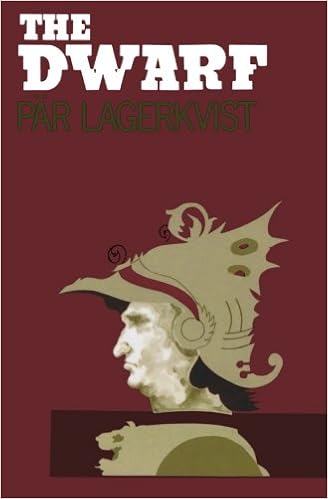
The Dwarf by Par Lagerkvist

I am twenty-six inches tall, shapely and well proportioned, my head perhaps a trifle too large. My hair is not black like the others', but reddish, very stiff and thick, drawn back from the temples and the broad but not especially lofty brow. My face is beardless, but otherwise just like that of other men. My eyebrows meet. My bodily strength is considerable, particularly if I am annoyed. When the wrestling match was arranged between Jehoshaphat and myself I forced him onto his back after twenty minutes and strangled him. Since then I have been the only dwarf at this court.

The dwarf Piccoline resides at the court of an Italian prince in the 14th century. His position there is nebulous: he is not a buffoon, he informs us, as some dwarfs are, and though he serves the Prince he does not seem to be a kind of servant. He is rather like an emanation of the Prince himself, a ghost or shadow: "Even the ignorant mob understands that the master's dwarf is really the master himself," he writes. What distinguishes Piccoline, in his eyes, is that, while others hide their monstrous nature with pomp, play, and pretend, he resembles himself. He says: "Only I am."

Piccoline's view of humanity is a jaundiced one. His position as dwarf--literally overlooked, you might say--enables him to see what others cannot or do not: the way the Princess carries on her affair with the knight Don Riccardo, for instance, or their daughter Angelica's secret love for the heir of the Prince's foreign enemy. He sees the way courtiers give themselves over to lust and gluttony, both of which nauseate him, and which he considers a kind of vanity.

And yet his cynicism keeps him from seeing everything that he might, or understanding everything. He does not understand, for instance, why the sage Bernardo dissects a corpse to learn about the composition of the human body, something he considers both disgusting and irrelevant. His bafflement and disgust at the divulgence of what's inside the human body mirrors his bafflement and disgust at human feeling: "I cannot understand the love that human beings feel for each other," he says. "It merely revolts me." Piccoline is the shadow self of the Prince, and the shadow self of all people, maybe: the small voice that speaks to us from within and tells us that life is worth so little.

I was really captivated by the steely, sour persona of Piccoline. The story he narrates is one of national advancement and decline, though what happens seems less important sometimes than the power of his point of view on these things: the Prince wages war on a foreign power, sieging their city, and then uses the pretext of a peace treaty to ambush the opposing lord. Later, the Prince finds himself sieged by his enemy's vengeful heirs, only to be ambushed by a much more powerful foe in the Black Plague. The Prince's astronomers look for a narrative in the stars, but Piccoline knows that fate is a force beyond understanding: "I sit at the dwarfs' window and gaze out into the night, exploring it as they do. I need no tubes or telescopes, for my gaze itself is deep enough. I too read in the book of night."

Early in the book, Piccoline is tasked by the Prince to lead a mass for dwarfs, a performance which he turns into a grotesque satire, and for which he is punished. "I eat my own splenetic flesh," he says, "I drink my own poisoned blood"--a religion of solipsism, you might say. But Lagervkist, who wrote of the way Christ uses even the most wretched and vile refusers in Barabbas does so also here: toward the end of the novel--spoiler alert--Piccoline whips the Princess in a fit of disgust over her philandering. Racked with guilt, it is something she has craved, but still it sends her into a coma, then killing her. After her death she begins to be revered as a saint, and Piccoline is sent to the dungeon, made to suffer for years--thus becoming the kind of Christ figure, enobling the Princess' soul through his own suffering, in which he does not believe. The Dwarf is a story of radical ecumenicism, a novel that believes even hatred can be turned to the power of divine transfiguration.

Tuesday, April 13, 2021

Happy Valley by Patrick White

All this was taking place in Happy Valley the same autumn, which was superficially the same as any other autumn, as far as its natural details were concerned. But as I have said before, one of the most noticeable features of Happy Valley was its apparent remoteness from the human element, or perhaps an ironical half-recognition, laying a trap in the shape of its own activities and then letting things slide. Autumn was a season of preliminary cold and suppressed winds. Nothing much appeared to happen besides, though a lot was really happening all the time. Because it was at this moment that Amy Quong felt those dormant and really frightening passions begin to stir, that Clem Hagan was coming into town of an afternoon and going to Moriarty's house, that Moriarty felt things closing in, all those eyes and faces at the school, and Sidney Furlow was trying to suppress the realization of her own desires. They each had their own problem, and nobody else had theirs, which is only natural perhaps, it is usually like that. And all the time Happy Valley was preparing for winter, and those that were afraid of winter had begun to be afraid, which those who have not experienced Happy Valley in winter-time will certainly not understand. If you have you will know, you will realize the extreme brutality to which man can be subjected, whatever you may have experienced of this, of brutality I mean, in winter at Happy Valley it seems to be epitomized.

Happy Valley is a remote sheep farming outpost in New South Wales, where the winters are particularly harsh and the people, it may not surprise you to find out, are not particularly happy. "I often think," says the debutante Sidney Furlow to her family's hired man Clem Hagan, "it'd be rather fun to blow out one's brains." Some of the people in Happy Valley, like the doctor's wife Hilda Halliday or the doctor's mistress Alys Browne, have convinced themselves that Happy Valley themselves is the source of their unhappiness, that perhaps they can leave their unhappiness behind if they can leave Happy Valley behind. They make plans to move to Queensland, or to California, but what ails them, White suggests, is simply what ails most people in the world: that all human beings are essentially alone. The doctor himself, Oliver Halliday, describes it this way:

I dare say most of us are afraid, he said. Not of the same things perhaps. We start off being afraid of the dark. Then your fear probably moves its centre to something more tangible. And most of it rises out of a feeling of being alone. Being alone is being afraid. perhaps one day we'll all wake up to the fact that we're all alone, that we're all afraid, and then it'll just be too damn silly to go on being afraid.

This is one of White's Big Themes: that life is really what goes on in people's heads, and that it is rare, perhaps even impossible, to make that life known outside of one's own skull. It's rare to see a character state the idea so plainly, and though Halliday's words seem rather wise to me, I wonder if White himself is so sanguine about the idea that we will one day "all wake up to the fact that we're all alone," and that this will be somehow meaningful.

The story of Happy Valley is the story of intersecting love affairs: Halliday and Alys Browne, the piano teacher; the rough jackaroo Clem Hagan and the teacher's wife Vic Moriarty; Clem Hagan and Sidney Furlow. I suppose you can throw in the relationship between Halliday's nine year old son Rodney and Margaret Quong, the thirteen year old daughter of the Chinese Grocer. (Interesting to see White depict Chinese characters, whom the Happy Valley bigots invariably call "Chows," but race hovers at the edges of a lot of White's work, as with the Aboriginal man and refugee Jew who make up two of the protagonists in Riders in the Chariot.) White is so skilled at depicting the passion of love, constructed from materials wholly within one's own psyche and which seems to have little to do with the beloved at all. All of these affairs are open secrets, more or less, and yet knowledge of each pales in comparison with the intensity of it as lived.

These separate affairs collide at the novel's end in a way that is both macabre and satisfying, though perhaps a little neat for the novelist that White would become. According to the jacket copy, White never allowed Happy Valley, his first novel, to be republished while he was alive. I wonder what about it evoked his displeasure; his uncanny style seems to emerge almost wholly intact to me, though I don't find the novel as engaging as some of his others. There is a reliance here on unpunctuated bursts stream-of-consciousness that reveals White's indebtedness to Joyce (Happy Valley isn't even two decades separated from Ulysses) but which he seems to have later abandoned. And there's little of the unnerving physicality of his later novels, the gross materiality, that anchors their psychic qualities and provides their essential irony. But already in Happy Valley one can see the sui generis style that White would produce for another fifty years.

Friday, November 29, 2019

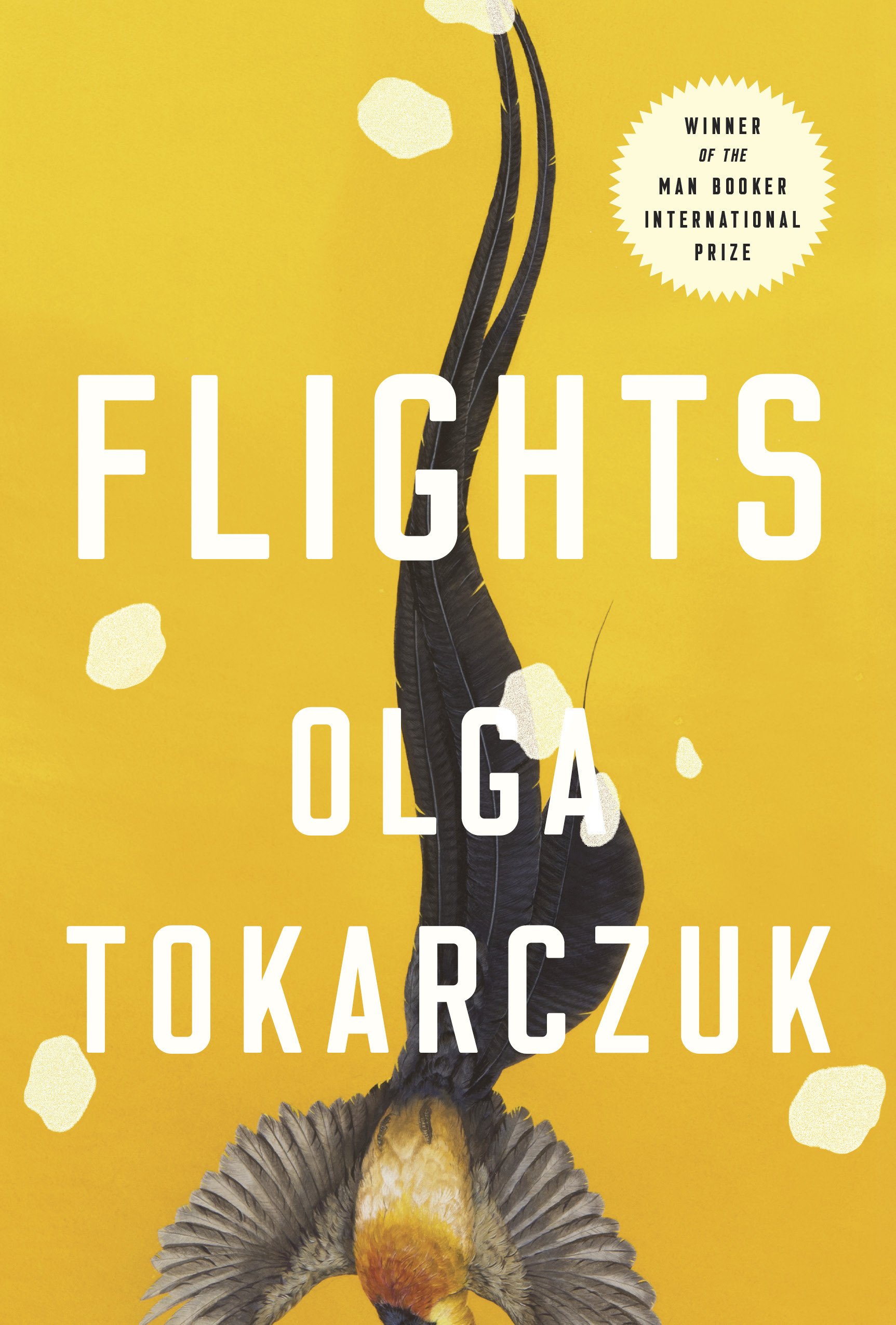
Flights by Olga Tokarczuk

Standing there on the embankment, staring into the current, I realized that--in spite of all the risks involved--a thing in motion will always be better than a thing at rest; that change will always be a nobler thing than permanence; that that which is static will degenerate and decay, turn to ash, while that which is in motion is able to last for all eternity.

The narrator of Flights, a novel by recent Nobel Prize winner Olga Tokarczuk, is a traveler by nature.  She spends her entire life flying from one place to another, supporting her travels by odd jobs, but it's the only life she can imagine: staying in one place is a kind of death; it's movement that means life.  The style of Flights, too, reinforces this idea, flitting--flying--from one narrative to another, or from vignette to vignette.  Scenes only hold her interest for so long: accounts of certain airplane flights, or certain passengers, a lecture series on "travel psychology" that takes place in airports, meditations on what airports look like from above and what it is like to have no home but hotels.

But the best parts of Flights are when the narrative, despite itself, settles down and tells a longer narrative.  There are probably seven or eight "major" stories in Flights, each one broken into pieces and scattered to appease the narrator's need for movement.  In one, titled "Kunicki," a Polish man traveling on a Croatian island searches for his wife and son after their sudden and unexplained disappearance.  Later, they return with an improbable story of falling ill and hiding in an abandoned home for days, but their disappearance has changed his life irrevocably; not only can he no longer trust her, the very sight of his home seems to have changed somehow.  Did she leave on a whim, abandoning him, only to return?  A counterpart is the unrelated story of Annushka, who leaves her distant husband and critically ill son to live underground in Moscow's metro system, choosing homelessness--movement--over safety and stillness.

The narratives in Flights are haunted by death and by the body.  Death, of course, is the ultimate kind of stillness, and the body the site at which it enters, or perhaps the natural state of motion leaves.  One strange motif in these narratives is plastination, the process by which human tissue is preserved after death, stasis imposed against the forces of decay, which are also a kind of motion.  In one longer narrative, a doctor desperately searches for a secret formula which will provide a superior form of plastination; in another, a man discovers the Achilles' tendon by operating on his own amputated leg, which has been preserved.  A collection of preserved organs nearly causes a mutiny on board a ship when the sailors discover they've been preserved in (gross) brandy.

Flights seems like that truly rare thing: a book that understands something critical about contemporary life.  The "Jet Age" may seem like an antiquated term, but the fact of widespread global travel is only a few decades old, and we are only now perhaps beginning to understand what that means for the human mind and spirit.  An extended meditation on Wikipedia--an attempt to encapsulate the whole of human knowledge, which must reckon with its need to reflect change and its capability to impose permanence--seems wise and true rather than forced, which is not something I think most writers could do.  Writing a novel is an inherently backward-looking exercise; Flights looks forward to what we might become.  In the future, will we all be like Tokarczuk's narrator, who dismisses the obligations of mortgages, of time zones?  And if so, is that tragedy or victory?

Saturday, January 26, 2019

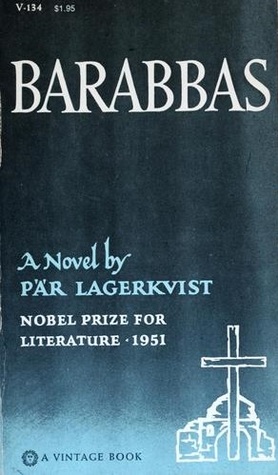
Barabbas by Par Lagerkvist

He had used his power in the most extraordinary way.  Used it by not using it, as it were; allowed others to decide exactly as they liked; refrained from interfering and yet had got his own way all the same: to be crucified instead of Barabbas.

They spoke of his having died for them.  That might be.  But he really had died for Barabbas, no one could deny it!  In actual fact, he was closer to him than they were, closer than anyone else, was bound up with him in quite another way.  Although they didn't want to have anything to do with him.  He was chosen, one might say, chosen to escape suffering, to be let off.  He was the real chosen one, acquitted instead of the son of God himself--at his command, because he wished it.  Though they suspected nothing.

In the Gospels, Barabbas is a "notorious prisoner" held by Pilate at the same time as Jesus.  Pilate asks the crowd which of the two they would like to see released as part of a Passover rite of pardon, and they choose Barabbas.  Par Lagerkvist's novel Barabbas imagines the life of Barabbas after his pardon, traveling up to Golgotha to see the man who is crucified in his stead, hanging around the empty tomb.  Barabbas is haunted by Jesus, a man he's never met, but who literalizes one of the core facets of Christianity by dying in his stead.

At first, Barabbas has a kind of didactic fable-like quality to it.  The contours of the novel seem pretty apparent: Barabbas, obsessed with this man who is linked to him by sacrifice, learns to become a Christian.  Lingering around the nascent Christian community of Jerusalem, he's told that their only ideology is "Love one another," and as hard as it is for the criminal and murderer to understand, it seems to us both simplistic and doctrinaire.  But the early Christians are not great at living this creed; they are suspicious of Barabbas, both for his connection to Jesus and his aloofness.  Is Barabbas lovable, even by the Son of Man?  It seems almost impossible, but such is the mystery of the crucifixion.

The book is best when it leaves Jerusalem, and the immediate context of Jesus' death, behind.  It flash forwards several decades: Barabbas, having returned to a life of crime, has been captured and enslaved in the copper mines of the East.  He's chained to a fellow criminal named Sahak, a Christian who has Jesus' name scrawled in Greek on the back of the golden medallion that identifies him as a slave.  One of the best things about Barabbas is its insistence that Christianity is essentially a slave religion, one that upturns traditional notions of power.  "I too have long been thinking of believing in this god," says their Roman overseer when he catches them talking about Jesus, "But how can I?  How can I believe anything so strange?  And I who am an overseer of slaves, how can I worship a crucified slave?"  We, for whom Christianity has been wedded to power for decades, if not centuries, forget that it is a slave religion at heart: disdainful of worldly power, predicated on its abnegation.  Jesus paradoxically uses his power "by not using it," as Barabbas notes.

When Sahak explains that the mark on his medallion professes Jesus as his true master, Barabbas has a realization: "Now Barabbas knew that he too was a Christian and that he was God's own slave."  But it's not the pat transformation the beginning of the book made me expect.  Sahak becomes God's slave of his own free will; Barabbas feels like Jesus' crucifixion in his stead has given him an involuntary claim over him.  When the Roman asks if, like Sahak, Barabbas is a Christian, he says no, and he doesn't lie.  He is not a believer, he doesn't want to "love one another"; his relationship to God is exactly as voluntary as his relationship to his slavers.  Barabbas lingers outside Christianity, drawn to it because of his pardon but never embracing it.  He is aloof from everything.  Can Jesus redeem such a man, Lagerkvist asks?  And if not, how do we make sense of the fact that Barabbas is the first man for whom Jesus sacrificed himself?  Is the Barabbas who claims not to be a Christian really the first one?

The novel ends with Barabbas being crucified for another crime.  Does this nullify his pardon?  Does it suggest that Barabbas, unwilling to accept his reprieve, has God's favor withdrawn from him?  At the last he speaks not to God, but to "the darkness" of death, saying, "To thee I deliver up my soul."  "Very negative ending," the former owner of my copy wrote in a very polite script.  But I'm not so sure.  Barabbas reminds me of nothing more than the whiskey priests and lapsed Catholics of Graham Greene, who somehow always find themselves loved and absolved despite their intransigence and apostasy.  Barabbas represents something of that central mystery.

Wednesday, April 26, 2017

Independent People by Halldor Laxness

Thus did he lose his last child as he stood deep in a ditch at that stage in his career when prosperity and full sovereignty were in sight, after the long struggle for independence that had cost him all his other children.  Let those go who wish to go, probably it's all for the best.  The strongest man is he who stands alone.  A man is born alone.  A man dies alone.  Then why shouldn't he live alone?  Is not the ability to stand alone the perfection of life, the goal?

Bjartur of Summerhouses is a crofter, a smallhold farmer on the north coast of Iceland who has finally put a down payment on a plot of his own.  He hates the man he purchased it from, the imperious Bailiff Jon of Myri, and his wife, who insists that the life of the peasant farmer animates the spirit of Iceland, while she lives in the lap of luxury.  But he's determined to pay off the farm as soon as possible, and become an independent man, the only true way to be.  He's so determined that he shakes off the stories of the evil spirit, Kolumkilli, who haunts the place, even as his wives and children die, disappear, and move to America.

Independent People, the masterwork of Iceland's Nobel prize winner, Halldor Laxness, is one of those decently heavy books whose intermingling of melodrama and social commentary puts Dickens and Tolstoy to mind.  But I was also reminded of Thomas Hardy, who also adored the pastoral life and who frequently stocked his books with choruses of simple farming folk who pepper the main narrative with comic interludes or plainspoken political discourse.

But even among such a rarified crowd Laxness' Bjartur stands out.  His stubborness and idealism make him a comic figure.  When his first wife dies in childbirth, he runs to the closest farm for help, only to hem and haw when someone asks him if Rosa is all right: "Hm, whether anything's happened to her is more than I can tell you... It all depends on how you look at it.  But she lives no longer on my earth, whatever follows it."  Or when he composes a poem--in the classic Icelandic style of his forebears, not the newfangled new kind--to send to his estranged daughter because he can't say straightforwardly how much he misses her.  But his drive for independence is also incredibly noble, hard-won and hard-lost.  He's made of finer stuff than the petty Bailiff or the rest of the homespun troop of local crofters.

It's the strength of Bjartur's character--and the finely wrought depictions of his children, too--that wrings so much pathos out of the novel.  His strength in the face of loss is bewildering, but also pitiable, because we sense that Bjartur knows no other way of dealing with loss than putting up an iron jaw.  His estrangement from his eldest daughter is somehow more moving because its toll on him is mostly unseen, moving beneath the surface of his manner like the silhouette of a great Icelandic whale.  And when he finally reunites with her, he gives her this advice, which seems as good as any:

"My opinion has always been this," he said, "that you ought never to give up as long as you live, even though they have stolen everything from you.  If nothing else, you can always call the air you breathe your own, or at any rate you can claim you have it on loan..."

Saturday, July 18, 2015

The Solid Mandala by Patrick White

In the first corner, as a prelude to all that he had to reveal, he danced the dance of himself.  Half clumsy, half electric.  He danced the gods dying on a field of crimson velvet, against the discords of human voices.  Even in the absence of gods, his life, or dance, was always prayerful.  Even though he hadn't been taught, like the grocer, to go down on his knees and stick his hands together.  Instead, offering his prayer to what he knew from light or silences.  He danced the sleep of people in a wooden house, groaning under the pressure of sleep, their secrets locked prudently up, safe, until their spoken thoughts, or farts, gave them away.  He danced the moon, anaesthetized by bottled cestrum.  He danced the disc of the orange sun above icebergs, which was in a sense his beginning, and should perhaps be his end.

The Solid Mandala begins by introducing its pair of protagonist twins, Arthur and Waldo Brown, when they are very old, and walking along the streets of their Sydney suburb hand in hand.  Those who see them from the bus think they are odd, and so they are:

Then Mrs Dun did resentfully noticed the two old men, stumping, trudging, you couldn't have said tottering -- or if so, it was only caused by their age and infirmities -- along what passed for pavement between Barranguli and Sarsparilla.  The strange part was the old gentlemen rose up, if only momentarily, blotting out the suburban landscape, filling the box of Mrs Dun's shuddering mind.  She was still shocked, of course, by Mrs Poulter's thoughtless alarm.  It could have been that.  But she almost smelled those old men.  The one in the stiff oilskin, the other in yellowed herringbone, in each case almost to the ankle.  And as they trudged, or tottered, they were holding each other by the hand.  It was difficult to decide which was leading and which was led.  But one was the leader, she could sense.  She sensed the scabs, the cracks which wet towels had opened in their old men's skin.

Ew!  White has a knack for turning the human body into a kind of gross poetry.  From there, the narrative bifurcates: one section detailing Waldo's life, followed by one detailing Arthur's, which pretty much covers the same narrative ground from another vantage point.  The brothers depend on each other all their lives, though they are very different: Waldo is insecure, a failed intellectual, who resents the burden he perceives his brother to be.  Arthur is unable to grasp the politics of the social world, but filled with a wisdom and a kind of mystical love.  When Waldo is working at a library, he discovers his brother in the reading room, perceived by others to be a kind of lurking creep, and so he shoos him away, but it is Arthur, we find out, who is reading and pondering the episode of the Grand Inquisitor from Dostoyevsky.  For all of Waldo's pretensions--he jealously guards the book he has been writing for seventy years--it is Arthur who has a kind of true understanding.

Arthur keeps a set of four marbles in his pocket.  He thinks of them as mandalas, the Buddhist symbol which represents the universe:

It was himself who was, and would remain, the keeper of mandalas, who must guess their final secret through touch and light.  As he went out of the room his lips were half-open to release an interpretation he had not yet succeeded in perfecting.  His body might topple, but only his bod,y as he submitted the marble in his pocket to his frenzy of discovery.

Arthur gives one of these to each person in the book he loves, including one to Waldo. They are a recognition that each person is a universe unto themselves, patterned the same way as existence itself and therefore harmonious with it.  Waldo, of course, cannot understand this.  Just as Mrs Dun cannot tell who is leading whom, but knows that one brother leads the other, so Waldo is unable to submit to his brother's wisdom because he remains convinced that he is doing the leading.

Arthur is a familiar kind of trope: a holy fool, a Shakespearean "natural," so called because they were perceived to be closer to the nature of things and uncorrupted by the pretensions of society.  But White is really good at this kind of mysticism, partly because of the intense obscurity of his style.  Though I liked the "Waldo" section--a long and detailed account of a very failed man--it was the shorter "Arthur" section that really made The Solid Mandala work for me.

Wednesday, January 2, 2013

The Appointment by Herta Muller

Now all I hear is the noise; I don't go to the window, and I don't look at the moon.  I remember that it looks like a goose egg, and that it leaves the city on one side of the sky while the sun comes up at the other.  Nothing's changed there; that's how it was even before I knew Paul, when I used to walk to the tram stop on foot.  On the way I thought:  How bizarre that something so beautiful could be up in the sky, with no law down here forbidding people to look at it.

What does it mean to love in authoritarian state?  When life is proscribed by a law that is exacting and absolute yet somehow arbitrary in its application, what areas of life does it not proscribe or threaten?

The Appointment is a novel about a woman living in Romania under Nicolae Ceausescu, supposedly the most repressive of dictators in the fringe of Soviet states.  Ceausescu himself is not mentioned except on the dust jacket; the narrator (who is nameless) battles with smaller authorities.  She is summoned, frequently and randomly, to appear in the office of Albu, a local magistrate.  The appointments are always at ten sharp, that sharp emphasizing the bureaucracy's menace as well as its exactitude.  The crime which Albu grills her about: sewing notes into clothes bound for Italy that read "marry me."  In his interrogations, which Muller only allows us to glimpse, he suggests that he suspects her of more vital communication with the West, but more than anything it seems that the narrator's crime is simply wanting to escape.  For this crime the authorities impress her neighbors into watching her movements; for this crime her husband is nearly run over on his motorcycle.

Albu can gain nothing from these interrogations; the narrator cannot escape them.  Yet the strength of the repression is predicated on this aimless urgency.  But the narrative of The Appointment revolves around one tram ride to Albu's office broken by the narrator's reminiscences, which recount her attempts to carve out a personal and human space:

Instead of these thoughts we're constantly mulling over, it would be better to have the actual things inside your head, so you could reach in and touch them.  People you want, or people you want to be rid of.  Objects you've held on to or lost.  There would be an order to things in my head: in the center would be Paul, but not clutching at him and running away from him and loving him all at the same time.  The sidewalks would run along my temples, as far as they like, and under my cheeks might be the shops with their glass display cases, though not my pointless destinations in the city.  Of course there's no escaping Albu's lackey, who's probably sitting out there in that red car to give me my summons--not deliver, it's never in writing, so that I'm always left to worry whether Paul or I might have misheard the date.  Albu's lackey would be lurking somewhere in the back of my head...


You can see how the narrator is half-resigned to her place in the world; she doesn't seek to banish Albu's lackey, only shuffle him around in the order of things.

The Appointment leaps dizzyingly from the present tram ride to a number of points in the narrator's past, chopped up and reshuffled so that the timeline is difficult to keep straight.  (Maybe this mental reshuffling, too, is an attempt to impose a personal order on a proscribed one?)  But each memory is wonderfully and uniquely realized, and together they form a rich picture of life: The narrator's marriage to Paul, who sells illegal television aerials that reach Western stations.  Her previous marriage to the son of a Communist operative who once lorded over her hometown and its bitter dissolution.  Her young, beautiful friend Lilli, shot dead trying to cross the border with an older soldier she had fallen in love with.

The Appointment, in fact, is full of relationships, prurient and not, between younger women and older men.  Muller makes the Electral connotations of this explicit by having her narrator remember walking in on her father with a girl her own age:

I'm better than that girl with her braid, I thought, why doesn't Papa take me.  She's dirty, her hands are green from all the vegetables.  What does he want with her, she has a good husband.


Lilli begins with her father-in-law, the first in a long string of older men who eventually lead her to a premature grave; the narrator recounts being hit on by her father-in-law, the Communist operative in addition to wishing to take the place of her father's lover.  Albu, with his unwelcome kiss of the hand at each appointment, is a kind of father, too.  Are we meant to read the state as a kind of father figure, demanding sexual satisfaction, prying abhorrently into places that ought to be closed to it?  And--SPOILER ALERT--what are we to make of the end?  In the present, the narrator misses her stop on the tram and is made late for her appointment.  But before she can make it, she sees her husband Paul with an older man she does not know:

Quite by accident, just out of boredom, the old man glances at the bush and bends down to Paul's ear.  Now Paul stands up and sees me.  Why is he buttoning up his shirt.


What am I supposed to make of this?  Is Muller suggesting a homosexual relationship between Paul and the old man, or is that reading too much into it?  Is her ambiguity incredibly bold or am I incredibly dense?  If that's the implication, is it a chilling notification that authority, personified in the watchful old man, pries even into those places you expect it least?

Other reviews of The Appointment:

The Ardent Reader
Erin Reads
Tim Gebhart at Blogcritics

Wednesday, May 11, 2011

Dr. Zhivago by Boris Pasternak

Oh, what a love it was, utterly free, unique, like nothing else on earth! Their thoughts were like other people's songs.

Dr. Zhivago is usually remembered as a love story. And it is that, to be sure, but so much more: It is an epic in the Russian style, with a massive cast of characters (who all seem to be running into each other improbably over the course of their lives, as if it were no big deal to stumble across your childhood friend from Moscow in the desolation of Siberia). It is a war novel, about the upheaval in Russia created by the Russian Revolution. Much like Parade's End, it is about the way that the world changed fundamentally in the early part of the 20th century, ravaged by war and forced to find its footing again.

And it is a love story. The titular Yuri Zhivago grows up in Moscow, only occasionally entering the orbit of Lara Guishar, who he will meet later as a field nurse and then will become his lover. By then both are married and have children, but war has separated them from their spouses: Zhivago having been captured and impressed into medical service by a roving band of Bolsheviks; Lara's husband having become the renowned Bolshevik commander Strelnikov. The war brings them together, but ultimately it must also drive them apart.

The ultimate verdict on the Revolution is decidedly mixed. It drives lovers apart; it drives them together. It does away with the poisonous old system, but what does it have to offer but violence and instability instead? Yuri regards it with something near awe:

He realized that he was a pygmy before the monstrous machine of the future; he was anxious about this future, and loved it and was secretly proud of it, and as though for the last time, as if in farewell, he avidly looked at the trees and clouds and the people walking in the streets, the great Russian city struggling through misfortune--and was ready to sacrifice himself for the general good, and could do nothing.


And yet, in the individual moment of human lives, the Revolution proves horrific:

They stood around a bleeding stump of a man lying on the ground. His right arm and left leg had been chopped off. It was inconceivable how, with his remaining arm and leg, he had crawled to the camp. The chopped-off arm and leg were tied in terrible bleeding chunks onto his back with a small wooden board attached to them; a long inscription on it said, with many words of abuse, that the atrocity was in reprisal for similar atrocities perpetrated by such and such a Red unit--a unit that has no connection with the Forest Brotherhood.


No wonder the book was suppressed by the Soviet Union; Dr. Zhivago is a vile account of its national mythology. Yuri and Lara's love prospers in spite of their terror and their grief, and perhaps is even enhanced by it. Yet they live a doomed love, with no future, because they live in a futureless world. The Russia that emerges is utterly foreign to Yuri, and though he is wise, kind, and upright he is unable to deal with the totality of her changes.

There is a moment when Yuri is in the Bolsheviks' service that he sees a young boy with a head wound trying dutifully to keep his hat on straight and exacerbating his wound meanwhile. His comrades try to help him, through their misbegotten and shallow vision of goodness; the only one who has the power to see the deeper goodness is the doctor, Zhivago. He plays this same role as a poet--a sort of physician of the soul--and tries desperately to preserve sanity in an increasingly maddened world. Like Tietjens, he is too good for it. Pasternak himself lived daily with the heritage of that madness, and Dr. Zhivago--like Yuri with his poems--is the record of that struggle.

Sunday, November 8, 2009

The Good Earth by Pearl S. Buck

As he had been healed of his sickness of heart when he came from the southern city and comforted by the bitterness he had endured there, so now again Wang Lung was healed of his sickness of love by the good dark earth of his fields and he felt the moist soil on his feet and he smelled the earthy fragrance rising up out of the furrows he turned for the wheat. He ordered his laborers hither and thither and they did a mighty day of labor, ploughing here and ploughing there, and Wang Lung stood first behind the oxen and cracked the ship over their backs and saw the deep curl of earth turning as the plow went into the soil, and then he called to Ching and gave him the ropes, and he himself took a hoe and broke up the soil into fine loamy stuff , soft as black sugar, and still dark with the wetness of the land upon it. This he did for the sheer joy he had in it and not for any necessity and when he was weary he lay down upon his land and he slept and the health of the earth spread into his flesh and he was healed of his sickness.

Next up after Tears of a Tiger is The Good Earth, a book with much more substance, but unfortunately, as dull as the dirt that gives it its title. Pearl Buck won the Nobel Prize in 1938 in part because of this book, which details the life of a Chinese farmer around the turn of the century and his steady rise into the ranks of the wealthy by his devotion to the land which he tills. Perhaps as a result of that, the back of the book is replete with critical interpretations suggesting that it is a shame that Buck was never accepted by the academic world into the cadre of great writers of the early twentieth century.

But you would have to be quite the revisionist, I think, to accept the premise that The Good Earth is in any way comparable to the work of Joyce or Fitzgerald, or even earlier stuff like Mark Twain, with which its realism has much more in common. Buck's book is just too straightforward, too dogmatic in its sensibilities--the farmer, Wang Lung, begins as a simple and honest man, and though he never abandons his simplicity and goodness, his moral compass slips only when he is separated from the "good earth" that nurtures him and his family. When he brings a prostitute named Lotus to live in his household (much to the chagrin of his homely but loyal wife) we cannot help but recognize it as the actions of a man who has been corrupted, if slightly, by material wealth. The book opens with Wang Lung traveling to the wealthy and arrogant House of Hwang to purchase a slave of theirs to become his wife; when at the end Wang Lung literally purchases and moves into the Hwang's abandoned palace it seems as if Buck is leaving little room for the reader to infer the parallels that exist. The Good Earth, no matter whether Buck won the Nobel Prize or not, is morally and thematically one-dimensional.

All this, of course, makes it a great text for freshmen, whose minds have difficulty handling ambiguity as it is.