Showing posts with label Norway. Show all posts

Saturday, December 13, 2025

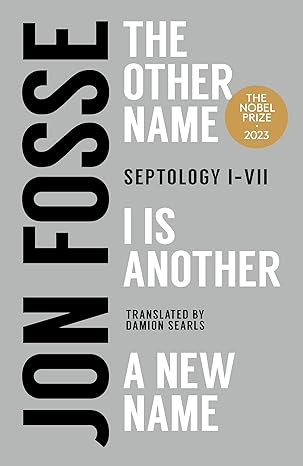
A New Name by Jon Fosse

And I see myself standing there looking at the two lines that cross in the middle, one brown and one purple, and I see that I've painted the lines slowly, with a lot of thick oil paint, and the paint has run, and where the brown and purple lines cross the colours have blended beautifully and I think that I can't look at this picture anymore, it's been sitting on the easel for a long time now, a couple of weeks maybe, so now I have to either paint over it in white or else put it up in the attic, in the crates where I keep the pictures I don't want to sell, but I've already thought that thought day after day, I think and then I take hold of the stretcher and let go of it again and I realize that I, who have spent my whole life painting, oil paint on canvas, yes, ever since I was a boy, I don't want to paint anymore, ever, all the pleasure I used to take in painting is gone...

A New Name closes out Jon Fosse's Septology, a work that is either one book or seven or, in this case, and probably the least reasonably, three. It continues the present story, in which the painter Asle prepares to visit his friend's sister for Christmas day and struggles with a numinous painting, and the story of the past, which comes in memories that overwhelm Asle: meeting his wife Ales, who later died young, becoming a painter, as well as memories that recount the life of his friend and namesake, another painter named Asle, who is currently languishing in a hospital to which our Asle has ferried him. How does Asle know all this stuff about the other Asle? He might be thinking through what he's been told, of course, but there's a strong suggestion, too, that the men have somehow overlapping identities, and that our Asle draws from a store of memory that belongs to him as well.

Many of the memories in A New Name are lovely, happy memories. We hear how Asle met Ales one day by pure chance, and how they became almost immediately joined at the hip. The same day that Asle meets Ales, he goes to rent a room in Bjorgving where he'll be attending art school. The landlady, an aged beauty named Herdis, is suspicious of Ales, and refuses to let her in the house. Later on, Asle paints the stern landlady's portrait in exchange for free rent he will end up not needing, as he moves in with Ales almost immediately. This old lady is, I thought, one of the novel's best characters: an image of the way that people seem to shrink into themselves, their homes, with age, and I enjoyed her mix of affection of possessiveness.

But A New Name ends up being quite a sad ending, I thought. Spoiler alert--the namesake Asle dies, and we find out bloodlessly, through a nurse at the hospital. Fosse piles it on, too, with the unexpected death of Guro, a woman who had been flirting with Asle in the previous novels (and who, as one of the novel's many doubles, resembles the sister whose house Asle is meant to head to for Christmas day), in a terrible fire, no less. The book ends with Asle rebuffing the advances of said sister and then, perhaps dying himself as a "ball of blue light" shoots into his forehead. The Lord's prayers, then, that end each of the novel's seven sections, and which underpin its thematic interest in the presence of God and the possibility of knowing God, take on the sense of prayers for the dead, in which the protagonist finally includes himself.

Sunday, December 7, 2025

Olav Audunsson: Crossroads by Sigrid Undset

Now, in a state of calm reflection, Olav listened to the only voice that spoke to him in a language he understood. Here, in this foreign land, all other voices shouted at him as if there were a wall between them and him. Yet the voice of the church was the same one he had listened to as a child and a youth and a grown man. He himself had changed in terms of goals and thought and speech as he moved through the stages of life, but the church had changed neither voice nor meaning. It spoke to him in the holy mass just as it had spoken to him as a little boy, when he understood very few of the words yet still understood much by observing--the way a child understands his mother by watching her expressions and gestures before he understands the spoken words. And Olav knew that if he traveled to the farthermost regions where Christian men lived, their language and customs and appearance might seem strange and incomprehensible to him. But wherever he happened upon a church and went inside, he would be embraced by the same voice that had spoken to him when he was a child.

When we last left Olav Audunsson, his wife Ingunn had just died after a long illness. Ingunn's death resolves what might have seemed like the central tension of Undset's tetralogy, the love between the man and woman that thrived in spite of all the machinations of their families to drive them apart. I admit I was surprised, but I had to remind myself that, as one learns in Kristin Lavransdatter, Undset is no believer in the primacy of romantic love when there is a higher love, and a higher law. But Ingunn's death leaves Olav in a strange place, having taken in Ingunn's love-child Eirik and raised him as his own, while his own bastard, a son named Bjorn with a woman named Torhild, is at a neighboring estate. It's Eirik that will inherit the manor Hestviken, despite Olav's dislike of him (and he is quite annoying, apart from being the son of another man), while Bjorn exists for Olav only as a reminder of lost possibilities.

The first part of Crossroads is taken up by a trip to London, where Olav does some merchant business. Olav, lonely and adrift, nearly enters into an adulterous relationship with the wife of a blind man, but runs away at the last minute, repelled by her strangeness and foreignness. The blind man's wife speaks in a language Olav can't understand, but during his trip he rekindles his love for the church, which, as described in the passage above, speaks in a universal language that can be understood no matter where Olav is. Olav decides, with only some misgivings, that he will never remarry, and devote the remainder of his life to the memory of Ingunn and to the church.

The novel's subtitle suggests that it captures Olav at a "crossroads," and the novel feels like a crossroads, too, a necessary transition between points of stronger dramatic tension. The conflict that's established between Olav and Eirik only festers. Though the two find a way to become somewhat closer, Eirik's anxiety that somehow his inheritance will be stolen from him--deep down, perhaps, he understands something that he cannot articulate about why his father is so alienated from him--make him especially anxious and unreliable. Ultimately, Eirik flees from the conflict, entering into a knight's service, and the last time we see him, he has grown at last into a man. Olav is left with his manor and his daughters, but more or less alone.

The novel ends with something I'd never seen from Undset before: an honest-to-god battle. When Olav hears that Norway has been invaded by a Swedish duke, he and his fellow knights are called into battle to repel the party of the invaders. In the melee, Olav is badly wounded and left facially disfigured. (Perhaps sealing the deal on that promise to never remarry.) This, it felt to me, was the point to which Crossroads has been leading our hero: ravaged, abandoned, and yet with a renewed sense of his own obligations to God and country, which perhaps will steel him in whatever crisis of inheritance and fatherhood is coming in the series' final installment--coming, for this reader, next December.

Saturday, December 14, 2024

I is Another by Jon Fosse

...I go into the main room and over there on the easel I see the bad painting with the two lines that cross in the middle, no, I can't look at it, I can't even take the picture down from the easel and put it in the pile with the other paintings I'm not totally done with yet, that I'm not totally satisfied with, I just can't, I think and I look at the easel and I think that when I look at the easel now, isn't it like, the thought comes into my head, like God is looking out at me from the easel? I think, and now I just have to not go crazy, I think, because it's like God is looking at me from every single thing, I think and look around and it's like God is in everything around me, I think, and like he's looking at me from every single thing, I think and I think isn't the round table clearly saying with its silence that God is nearby? and the two chairs? and the one Ales always sat in, especially clearly, God is so clearly looking at me from that chair, I think, and I think that it's when I'm most alone, in my darkness, my loneliness, because it really is lonely, to tell the truth, and when I'm quiet as I can be, that God is closest, in his distance...

The second part of Jon Fosse's Septology picks up where the first has left off: the narrator, Asle, has dropped his friend, also named Asle, off at a hospital in Bjorgvin where his addictions are close to claiming his life. He has gone home with the other Asle's dog, to confront there the loneliness of the Christmas season without his wife Ales, who has died, and his friend Asleik, who is demanding one of Asle's best paintings this year as a gift for his sister. The stark, wintery landscape of Norway's fjords is full of memory for the narrator Asle, about Ales and about his childhood, his experience getting into Norwegian art school and leaving his family. We finally see the moment where the two Asles meet, introduced by a mutual friend, both as prospective art students. The other Asle is called here "The Namesake."

Is it sloppy reading on my part, or an essential trick on Fosse's part, that the Asle I thought he was talking about for 200 pages was the Asle in the hospital, and not himself? I think the latter, though perhaps an eagle-eyed reader might have figured it out all before. The narrator's memories come sudden and swift, introduced with a simple transition like "I see Asle..." I see Asle with his sister, who died young; I see Asle, having a panic attack over the thought of reading in class; I see Asle, moving away from his parents for the first time to pursue his dreams of art school; I see Asle, giving up on the kind of realistic paintings of Norwegian domestic landscapes that made him popular, etc., etc. And all the time I was trying to find an answer to that essential question--if these Asles are the same, even perhaps to the point of being the same person, or avatars of one another, where do they diverge? Why is one Asle a success and the other a failure? I thought I was finding it, perhaps, in the death of his sister. But with one quick movement, Fosse reminds us that this is the narrator Asle remembering his own life.

Ultimately, I don't think Septology has an idea of why people end up the way they do. On the question of nature vs. nurture, it's agnostic to the point of disinterest. It sets up for the reader a kind of fool's game, forces you to search for the differences and divergences, when really the thrust seems to be that human personality remains a kind of inexplicable mystery. The elision between the two Asles is maybe the most bravura thing about Septology, a project of great skill and subtlety that justifies and illuminates the pale featurelessness of the story and the prose.

And reading this time, I was struck by the novel's interest in grief and the possibility of the divine: the narrator Asle has painted this painting of two lines crossing, one purple, one brown, that he alternately considers the worst painting he's ever done and the best. But the painting is where God enters the scene, and in studying it--pointedly, a cross--Asle begins to see the presence of God everywhere. Perhaps, I began to think while reading I is Another, God is another name for that power of chance or providence that turns a life in one direction and another in another, just as God is the name for what takes away one's wife before her time.


Sunday, December 8, 2024

Olav Audunsson: Providence by Sigrid Undset

But he couldn't escape from the childhood memories that arose--including the once secure knowledge that he and Ingunn belonged to each other and would always stay together. The very notion that something might come between them had never entered their minds, and for that reason being together had never stirred their hearts either to joy or astonishment. They had simply taken it for granted. That was how it would always be, precisely as it had been decided for them. Until the summer, that is, when, wrapped in each other's arms, they had tumbled out of their childhood and innocent state, frightened yet also giddy with joy at the new sweetness they had discovered in each other--regardless of whether it was right or wrong for them to surrender it. Even after Olav had roused himself to defy and fear everything and everyone who tried to intervene in their fate, he had been convinced that in the end they would win their case. Such memories would suddenly come upon Olav, and the pain burned like the stab of a knife.

Vows, the first book in Sigrid Undset's tetralogy about the live of Olav Audunsson, ends with Olav killing Teit, the Icelander who impregnated his wife Ingunn, and burning down the shack in which his body lay. I wrote that Olav had left his ornate ancestral axe within the shack, thinking that this would turn out to be the clue that led to Olav's downfall--but this turned out to be incorrect, as a kind reader pointed out: it was just an ordinary axe that Olav left. And I should have known better. This being Undset, author of the Kristin Lavransdatter trilogy, I should have understood that Olav's sin would not be revealed by simple detective work, that it would gnaw at Olav's heart until he was forced to reveal it himself.

In Providence, the second book in the series, Olav finds himself trapped by this secret. He vows to expiate his guilt by bringing Eirik, the child of Ingunn and Teit, back to his manor of Hestviken and pretend that he is his biological son. This presents several problems: for one, Eirik is really annoying. He turns out to be a very fanciful and imaginative child--we are reminded of the playful, reckless Teit--who has trouble distinguishing the real from fantasy. And he talks too much. Secondly, by raising Eirik to the heir of Hestviken, he has disinherited any legitimate son he might have with Ingunn. This is, perhaps, why Ingunn goes through several miscarriages; the one time she manages to birth a son, he withers and dies quickly. Ingunn withers, too; over the course of the novel she is struck by a terrible sickness that seems to emerge from her guilt and the frailty of her soul. It takes from her her sons, and then it takes her ability to walk. Olav keeps the secret for her sake, and yet keeping the secret gives the pair no happiness or joy.

Olav Audunsson, or the first two novels at least, is a much bleaker series than even Kristin Lavransdatter, which is also about living through the consequences of the choices of one's youth. Kristin is rewarded for her unfaithfulness to her father and her fiancee with a marriage to the romantic Erlend, and though it causes her much pain, and they even separate for a time, they are both rewarded with a kind of fiery love that is shared between them. When one reads about the chilly relationship between Olav and Ingunn, how they cling to one another out of duty and obligation but without joy or affection, one wonders, what was it all worth? When--spoiler alert--Ingunn dies at the novel's conclusion, we are left with the bitter sense that all the wreckage and faithlessness of their lives has had very little in the way of recompense.

Like Kristin Lavransdatter, Olav Audunsson is in some respect an apology for the Catholic model of confession and repentance. Olav knows that he would be doing his duty to God by confessing his sins and taking the appropriate consequences, but the possibility of cleansing is closed off to him. And for good reasons--his obligations toward Ingunn and toward Eirik, who is innocent of his own making--but these are worldly reasons, and not God's, and like Kristin, Olav suffers because he is too frail to trust in God's ideas of what constitute one's highest obligations. At the end of Part II, Olav finds himself without a wife and someone else's son. In a moment of weakness, he impregnates Torhild, the steadfast handmaiden of the household, and though he provides for her and her--his--son, it's not too hard to see that the next two parts of the tetralogy may set up a conflict between these two sons, innocent both of their circumstances, and yet neither of whom quite "deserves" to become the inheritor of Olav's estate. I'm looking forward to reading those, but it'll be next December, when another cold and chilly season rolls around--perfect for Undset's Norway, but also for the the themes of suffering and contrition that are at the heart of these incredible books.

Tuesday, July 9, 2024

Love by Hanne Orstavik

He sees the car's gone. Vibeke isn't in. Maybe something's happened. An accident. Vibeke doesn't like diriving in the winter. Here it's winter all the time. She's crashed and maybe now she's paralyzed and will have to sit in a wheelchair. Maybe no one's found her yet and she's bleeding to death. Or maybe the car's about to burst in flames and she's going to die from the pain. He tries to imagine how much it hurts when your skin's on fire... Then I'll have to have my birthday at the hospital, he thinks.

Vibeke, a middle aged divorcee, lives with her son, Jon, in a small town somewhere in Norway. They've moved recently, less than a year before the story begins. Their existence is spartan and somewhat sad--Vibeke spends most of her time reading (she may even outpace Chris since she's said to read 3-5 books a week) and thinking about herself. Jon spends his time ice skating at the sports club and dreaming about getting a train for his ninth birthday which, as it happens, is the day after the story in Love happens.

Vibeke is crushing on a man she saw at the library, and so decides to return her books early, only to find the library closed. As she walks to her car, she notices that a carnival has set up across the road, and walks over, not yet ready to return home to Jon. Jon, meanwhile, has left the house to sell raffle tickets for the sports club he's just joined, and in the course of things, meets an old man who invites him in to show him his handmade ice-skates, a girl who invites him to her room to listen to music, and a strange, androgynous person who offers him candy when they see him outside his locked house at midnight, Vibeke still being out at a bar some ways away with a man she met at the carnival.

Love is very widely acclaimed. It's won many awards, is frequently put forth as one of the greatest Nordic novels ever written, and is Hanne's defining work, and indeed, there's plenty to like here. The town, though we see it only in bits, feels realistic. a place where the library closes early on Wednesdays, the carnival doesn't have a Ferris wheel, and the closest late-night gas stations and bars are twenty kilometers away. The situations the characters find themselves in often have undertones of menace, but much like real life, nothing really awful ever happens; awkward and tense is the worst things get.

Love is, at heart, a story about people missing each other, in multitudinous ways. Jon and Vibeke's stories butt up against each other constantly. Though they really only share physical space in the first few pages, Vibeke is always on Jon's mind--sometimes her words must literally come out of his mouth, as when he tells the girl he met that she was divorced because "she couldn't be tied down". Jon, on the other hand, never crosses Vibeke's--she doesn't check to make sure he's in the house before she leaves for the library, nor when she returns at 4am or so. And even early on, when they're talking, she's not really there, as Jon tells her about some (horrific) photos he saw of men being tortured, she responds with platitudes and, we know, is thinking that she wants him to simply go away. The text itself also reflects the same tension, as the POV will change, sometimes mid-paragraph, often offering some ironic juxtaposition of their circumstances. And near the end of the book, the car carrying Jon and the truck carrying Vibeke nearly collide, though neither knows it and probably never will.

So why, ultimately, did Love not work for me? I've given it some consideration and I think the problem is twofold. First, the voice throughout felt, to me, rather monotone. Maybe a necessity given the way the text plays with the alternating narratives, but Jon's story tonally felt too similar to Vibeke's. There's a lot of noticing going on, where Jon or Vibeke think something like "X reminded them of Y. It was like Z. They noticed A and [several tiny details humans tend not to notice]". 

But more than that, I never really bought Jon or Vibeke as real characters. There are plenty of bad mothers out there, but how many of them would go a full 24 hours without even peeking into their 8 year old son's room? Similarly, there are a lot of precocious 8 year olds (I have one) but not many who would say things like "It just happens, that's all. In class, or something after school. I was in a role-playing club, but they only played historical games with Vikings and stuff. I'm more into science fiction" or repeatedly thinking about "titties". Ultimately, the interesting structure and clever parallels couldn't salvage a story about connection that I couldn't connect to.

Sunday, December 17, 2023

The Other Name by Jon Fosse

...it's true probably the only thing I could have ended up doing was painting pictures, and if I wanted to make a living I need to paint, and that's both good and also wrong, but that's what I did and kept doing, I painted picture after picture, I did that at least, and when I wasn't painting I often spent hour after hour just sitting and staring into space, yes, I can sit for a long time and just stare into empty space, at nothing, and it's sort of like something can come form the empty nothingness, like something real can come out of the nothingness, something that says a lot, and what it says can turn into a picture, either that or I can stay sitting there staring into empty space and become completely empty myself, completely still, and it's in that empty stillness that I like to say my deepest truest prayers, yes, that's when God is closest, because it's in the silence that God can be heard, and it's in the invisible that He can be seen, of course I know my Pater Noster and I pray with it every day...

Jon Fosse's Septology is three books, divided further into seven volumes. It's hard to say whether it's one thing or three things or seven things, and each volume itself is one run-on sentence without periods, slipping from one day in the life of the painter Asle into the next, bleeding across volumes. Since the first two of the seven were published as a single volume--and since I'm trying to surpass my book total for last year--we're going to go ahead and call this volume a book, though certainly others will say the Septology's propulsive, fluid, and unceasing nature demands that one read until the end.

Asle, the narrator, is a painter living on the coast of Norway. He's a widower, with few friends, except for his neighbor Asleik and the owner of the gallery where he sells his paintings. And, of course, the other Asle, who lives in town and who--we quickly pick up--is a kind of doppelganger of the narrator, if not something even more intimate and overlapping than that. Another version of himself, perhaps, branching off at some undefined point. Whereas our Asle is a teetotaler, having been convinced to stop drinking by his late wife Ales, the other Asle is a hopeless and miserable drunk. Much of The Other Name is devoted to the narrator Asle's attempts to get the other Asle, whom he's found cataleptic in the snow, into a clinic where he can be treated for his severe addiction. This becomes a kind of shaggy dog story, literally: the narrator Asle realizes too late that he must find and take care of drunk Asle's dog Bragi, and this is made all the more difficult by a snow storm that keeps him from driving back to the coast.

How did Asle become Asle and Asle become Asle? Can it really be as simple as the suggestion, toward the volume's end, that the drunk Asle was set off on his path by the trauma of being molested as a child? Such an answer would be easy, too easy--perhaps it was the mollifying influence of Asle's wife Ales, now gone. Or perhaps there is no accounting for why our lives take the paths they do. This is complicated by a sneaking suspicion that there is something in the names of the other characters--Asle, Asleik--that suggests that there are more than just these two doppelgangers, and that we are meant to see them as many variations on the same Asle. The slippage becomes comical when narrator Asle keeps running into a woman, Silje, who insists they've met before, even slept together. What's obvious to us--she knows the drunk Asle, ensconced now in the clinic--is totally lost on our aloof narrator.

The ceaseless sentence of each volume lulls you, like a drug or a dream; it's easy to feel, carried on the endless flow of it, that you have been severed from realism, if not from reality. The style is a variation on stream-of-consciousness, and not, I would say, especially innovative, but it works really well here because it works to justify the novel's slight otherworldliness, its other strange slippages, like that between Asle and Asle. We don't question the vision of two lovers playing in a sandbox, which may be a memory of Asle about himself and Ales, or which may be two real people. We don't question the way the narrative perspective breaks as the narrator's consciousness enters into the consciousness of the other Asle. Is "our" Asle simply remembering the story that the other Asle told of his formative encounter with the predatory "Bald Man," or imagining it? Or has the narrative somehow slipped away from him, and really entered into the other man? Of course, it's both somehow, and the narrative's current, which refuses to recognize the epistemological barrier of the sentence, reflects it.

One thing I enjoyed a lot about The Other Name is the way it imagines narrator Asle's art. In the two days that make up the two chapters, he has recently begun--and perhaps--finished a painting made up of only two lines crossing, a brown and a purple one. His neighbor Asleik jokes that the painting should be called "St. Andrew's Cross," and there is something religious about the experience of painting for our Asle, a way of accessing the quiet and empty place where God lives, and where creation is possible. (Among other things, our Asle is a recent convert to Catholicism, and can be seen praying his Pater Nosters with the dedication of a convert.) My favorite bits might be when our Asle describes the glow he searches for in his paintings, a glow that comes out of sheer darkness, made layer by layer on the canvas; he tells us that he only knows when a work is finished if, when he turns the light out, the glow remains. A Glow in the Darkness might be another, more florid name for the first volume of the Septology.

I'm still searching, I think, for what people love about these novels, and what the Nobel committee saw in them (and Fosse's work more generally) when they awarded him the Nobel Prize in Literature earlier this year. I will say that it took a little bit of self-sacrifice to stop with the first volume, when the narrative works so hard to carry you, like the tidal fjord, into the next one. But it took a little bit of self-interestedness, too.

Thursday, November 30, 2023

Olav Audunsson: Vows by Sigrid Undset

The unfathomable suffering and agony in her poor eyes--that was what drew his own naked soul up into the light. Gone was everything he had thought and intended and decided. He sensed that great and weighty things had now all but vanished from his mind; he was incapable of holding on to them. What remained was only the latest and deepest cruel certainty that she was the flesh of his flesh and life of his life, and no matter how mistreated and despoiled and broken she might be, it could never be otherwise. Their life's roots had been entwined from the first moment he could remember. And now he saw how death had seized hold of her with both hands, he felt as if he too had barely managed to escape from being torn apart. Then a longing came over him so forcefully that it shook him to his very core--a longing to pull her desperately close, to hide both her and himself.

For many years I have had a December tradition of reading one of Sigrid Undset's Kristin Lavransdatter novels. First, in the older, more archaic Charles Archer translation; then in Tiina Nunally's (superior) modern translation. This year, it felt like time to move on, not from the tradition, but to one of Undset's other books of medieval Norway. (I also read it at the end of November, not December, but it's pretty cold outside, and besides, I'm stuck at home with COVID and really needed something to seek my teeth into.) Vows, titled in other translations as The Axe, is the first of a series named either for its male protagonist Olav Audunsson, or for his title, The Master of Hestviken, and it follows Olav as he pursues the fulfillment of the promise of marriage his father made with that of his beloved, Ingun Steinfinnsdatter.

In many ways, Olav and Ingunn are like the anti-Kristin and anti-Erland. Whereas Kristin seeks to be released from her engagement to good-hearted Simon Darre so that she may marry the impetuous older man, Olav and Ingunn want nothing more than to fulfill the agreement their parents made: on his deathbed, Olav's father entrusted his son to Steinfinn, who would raise him as a son until he came of age, and then marry Ingunn. But plans change: Steinfinn and his wife Ingeborg are transformed by a cruel attack by Ingeborg's former betrothed, which leaves them both vengeful and withdrawn. Steinfinn has his vengeance, but receives a mortal wound in the process, and after his death, Ingunn's uncles are not so keen to fulfill a promise they know nothing about, and want to marry Ingunn to someone who will provide them a strong alliance. Olav and Ingunn force the uncles' hand by sleeping together, thus binding the marriage in the eyes of the local bishop, but theirs is a Norway in a state of constant change, and the power of the bishops is no guarantee. Olav only make things worse when he kills one of Ingunn's brothers in a fit of anger, and becomes an outlaw.

The story of Vows is one of patience and toil: Olav and Ingunn strive and wait for nearly a decade for their rights to be recognized, and for them to be permitted to live together at Olav's ancestral house at Hestviken. It must be said that neither character has the charisma of Kristin, with her preternatural loveliness and purity, or of outrageous Erland. Olav is sullen and sort of humorless, and Ingunn's principle character trait is her psychological fragility: after being separated from Olav, she becomes briefly psychosomatically paralyzed. But there's no doubt that they fit together, as they believe. Olav's single-minded insistence on claiming what's his by right, Ingunn's deep need for Olav's protection, these drive them together as much as any vow or legal status, and the social, political, and personal factors that drive them apart seem all the more horrible and cruel.

Like Kristin Lavransdatter, Vows only works to the extent that you are really willing to believe in the validity of Olav and Ingunn's marriage, which is cemented only by a promise and--forgive me--a penetration. Over and over again, people in the couple's lives try to convince them to settle for a different marriage, or an agreement to go their separate ways. In practice, this would actually be quite easy, it seems, but you have to believe, as Olav and Ingunn believe, that their marriage is something that exists between them and God, and that it cannot be abolished or supplanted. Undset's novel is clearly on the side of the Church in its skirmishes with powerful landholders like Ingunn's uncles, who resent the imposition of its laws over their feudal ones. And you must believe what a horrible violation it is when--spoiler alert--Ingunn allows herself to be seduced by a happy-go-lucky Icelander in Olav's long absence.

Olav and Ingunn battle heroically against the forces that would have them break their vow. But it is possible, perhaps, to go too far even in protecting one's marriage vows. Olav's killing of Ingunn's brother Einar, for which he ultimately is able to pay the acceptable murder-price, is one such moment. But another comes at the novel's climax, when Olav is approached by the Icelander, hoping that he will release his claim on Ingunn. Olav agrees to ski with the Icelander to the far estate of Olav's friend Arnvid, on the pretense of asking for his support. Then, in a woodland hut--and again, spoiler alert--he bashes the Icelander's head in with an axe. In the novel's final scene, Olav burns the hut down with the Icelander's body inside, realizing that he's left his treasured--and well-known--axe inside, and we are left to wonder if Olav hasn't finally committed a violation of God's law that is too cold, too cruel to come back from, one that will sunder him from Ingunn forever.

Friday, December 16, 2022

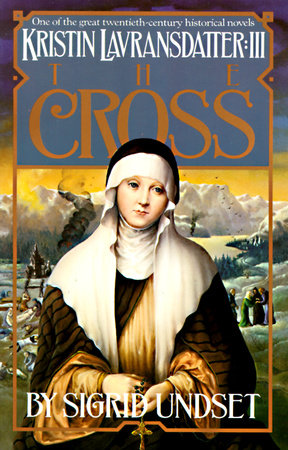
The Cross by Kristin Lavransdatter

Surely she had never asked God for anything except that He should let her have her will. And every time she had been granted what she had asked for--for the most part. Now here she sat with a contrite heart--not because she had sinned against God but because she was unhappy that she had been allowed to follow her will to the road's end.

She had not come to God with her wreath or with her sins and sorrows, not as long as the world still possessed a drop of sweetness to add to her goblet. But now she had come, after she had learned that the world is like an alehouse: The person who has no more to spend is thrown outside the door.

Kristin Lavransdatter should only be read at Christmastime, perhaps before a fireplace in an oak-trimmed room, with a fragrant wreath on the door and a steady snowfall at the window. It's been nothing but hideous rain here in New York for the past few days. But that's all right, I guess; The Cross, the third and final novel of Sigrid Undset's series about the life of the medieval Norse noblewoman, is all about disappointed expectations. It begins with Kristin and her husband Erlend having come down in the world as a result of Erlend's attempt to overthrow the king; he has been saved from execution but stripped of most of his lands. At their remaining estate, Kristin and Erlend are little-loved by their tenants and neighbors. There is hope in their seven sons--perhaps they will re-win the position Erlend has lost--but you know what God does when you make plans.

Beware, weary traveler: past this point are spoilers. What I know realize, having read The Cross twice--once in the original English translation, which enters the public domain later this year, and then in Tiina Nunnally's much improved one--is that the novel is structured around three principal deaths, each one swifter and more anticlimactic than the last: Simon's, then Erlend's, the Kristin's. Simon's, perhaps, has the most drama to it. When his wound becomes infected and he knows he is going to die, Simon plans to tell Kristin the truth, that he has always loved her, even after she broke their engagement, and after he married her sister Ramborg. But as he sits on his deathbed being tended by her, he finds he is unable to say the thing he thought he wanted to say, instead urging her to reconcile with Erlend, who has moved out of the house after a quarrel. Even before this, Simon has been the books' most selfless and upright character; and his final words to Kristin are an act of self-abnegation that surprise even himself.

Simon dies before he can think better of his silence; Erlend dies so quickly he's unable to hear confession. In a way, he dies for Kristin: after he hears that Kristin has been slandered by those who believe she has had an affair with their overseer Ulf, he returns to the estate and immediately picks a fight, in which he's mortally wounded. It seems at first like Undset has engineered a pretext for a final reconciliation, but no such luck. The speed with which Erlend, whose charisma and recklessness are the novels' catalyst, is carried off is almost shocking. When he's gone, both Kristin and the novel feel adrift. Slowly, Kristin's place at her estate is supplanted by her son Gaute and his new wife; the life she led, which had burnt so hot, fades strangely away.

What I find so interesting about Kristin's death is this: much is made in these novels about family. Kristin's original sin, for which she struggles her entire life to atone, is the betrayal of her father by breaking her engagement and sneaking off with Erlend. Simon urges her to be a more faithful wife, and she tries mightily to be a faithful mother to her sons. When she's displaced from her estate, she leaves to become a nun in the sister cloister to the monastery where her sons Naakve and Bjorgulf have become priests. But on the way she finds herself caring for a child that belongs to a pair of other pilgrims; when she contracts the Black Death it's not because she's caring for her sons, but because she is caring for strangers. Her last acts are to save an annoying little boy (who is about to be sacrificed to pagan gods to ward off the plague) and to bury the pestilential body of his mother. And the death is so quick--there's no final word like Simon's, or even Erlend's.

So what struck me this time is the subtle way that The Cross supplants the notion of family, which has been so crucial to the novels, with a different, broader understanding of family. A family that encompasses the beggar and the stranger. When Kristin hears, prior to her own death, that her monk sons have been carried off by the plague, she barely has time to grieve before she is back to her work as a carer. Kristin Lavransdatter is a deeply Christian book, and makes little sense if a reader's not willing to take its religion seriously. And here at the end perhaps you see echoes of the Christ who urged his followers to hate their mother and father.

Saturday, December 11, 2021

The Wife by Sigrid Undset

It was true that all this time she had remembered, year after year, every wound he had ever caused her--even though she had always known that he never wounded her the way a grown person intends harm to another, but rather the way a child strikes out playfully at his companion. Each time he offended her, she had tended to the memory the way one tends to a venomous sore. And with each humiliation he brought upon himself by acting on any impulse he might have--it struck her like the lash of a whip against her flesh, causing a suppurating wound. It wasn't true that she willfully or deliberately harbored ill feelings toward her husband; she knew she wasn't usually narrow-minded, but with him she was. If Erlend had a hand in it, she forgot nothing--and even the smallest scratch on her soul would continue to sting and bleed and swell and ache if he was the one to cause it.

About him she would never be wiser or stronger. She might strive to seem capable and earless, pious and strong in her marriage with him--but in truth, she wasn't. Always, always there was the yearning lament inside her: She wanted to be his Kristin from the wood of Gerdarud.

Hello again, Kristin old friend. For five years now it has been my December tradition to read (or re-read) one of the three novels from Sigrid Undset's Kristin Lavransdatter trilogy; this time I re-read the middle of the three novels, The Wife, in the newish translation by Tiina Nunnally. What makes The Wife so interesting is that it flies in the face of our traditional frameworks of rebellious love: The Wreath, like every book or film where a woman and a man come together in defiance of their parents and society, ends with the couple together at last, the essential conflict having been resolved. But The Wife asks, what will life actually be like for this couple? After the wedding over, and the hard work of loving and living begins?

Kristin and Erlend have carved out a difficult life for themselves: Kristin discovers that her husband Erlend has been a negligent steward of his great house, Husaby--a negligence that is inextricable from the dissolution and recklessness that made him such a poor match for her in the first place--and sets to whipping it into shape. In the world of medieval Norway, this means not just washing out the great hall and replacing the moldy hay, but extracting fair payments from the various smallholders who live on Erlend's lands. At the same time, Kristin becomes a mother, having seven sons (!!) in rapid succession. Her relationship with Erlend goes through periods of intense passion and intense enmity, not merely because of the deficiencies of his character, but because she--sin-obsessed and unable to expiate her own guilt--will not let him forget them.

While the newer translation is much more engaging and readable, it confirmed my suspicion that The Wife is the weakest of the three novels. My hope that the new translation would make the political machinations that Erlend gets mixed up in clearer was sadly dashed. Erlend spends much of The Wife at the height of his social and political life; acting as sheriff (whatever that entails) in the far north of Norway, but at the same time spearheading some kind of plan to remove the Norwegian king, who is also the Swedish king, from the throne. I couldn't really understand any of it. But I did understand that Erlend's recklessness nearly gets him put to death, and drives the broken couple back together when they are faced with the possibility of Erlend's execution.

One unsatisfying thing about The Wife is that Kristin herself is pretty annoying throughout. Erlend is right: she really can't let things go, and she's constantly throwing their transgressions back in his face. Kristin worries constantly about the consequences of her sin, fearing that her children were turn out to be armless, legless monsters. The truest moment, perhaps, in the book is when Erlend's monk brother Gunnulf reminds her that it is a kind of pride to assume that one's sins are so powerful that God's mercy cannot absolve them.

But Kristin's unsympathetic nature in The Wife leaves room for other characters, including Erlend, whose character is deepened and amplified, and especially Simon, Kristin's former betrothed who ends up marrying her sister, Ramborg, and who spends the latter third of the novel working desperately on Kristin's behalf to have Erlend freed. The best--and most frustrating--moment of the whole novel comes at the very end when, having succeeded in convincing the king to release him, Erlend makes an off-color joke about Simon marrying Kristin after his execution. Simon storms out, despite Erlend's pleas: the experience of being imprisoned and nearly executed may have chastened and aged Erlend, but it cannot change his essnetial nature

Thursday, February 4, 2021

Girls Against God by Jenny Hval

The girl slurps up more and more spaghetti. It turns out the body and head of this demon are made entirely of spaghetti, and it slowly begins to unravel. In the end, the cloak is the only thing left on the chair. The girl devours the last strand of pasta, and happily continues to eat what's left on her plate. As if the demonic spaghetti isn't real food, but satisfies some other need.

"I hate God," begins the narrator of experimental musician Jenny Hval's novel Girls Against God. What is the God that she hates? It's the stifling atmosphere (we are told) of southern Norway, its churches, its conformities, its cherished authors and artists, its whiteness--racial, yes, but also an aesthetic and essential whiteness that obliterates subversiveness. Hval's narrator hates God because to hate God is to hate hierarchy and paternalism. She describes, as a young girl, searching for a mode to express her hatred in the form of black metal music, but she's born too late; the metal scene has already come and gone, exhausted of its subversive potential, emptied out, already antiquated.

What can be done to subvert whiteness and God when black metal is no longer possible? The narrator forms a coven with two other witches, Therese and Venke, a pair of women she seems also to have invented on the page. The coven is also a band, and the band seems to sometimes play music, but it explores other kinds of subversion, too: the introduction, for example, of a horrible stench that no one in Oslo can identify or trace. A stench that is a hex and is also, somehow, a kind of music: this is the kind of surrealism that Girls Against God is made of.

One thing that interested me about Girls Against God is its embrace of the possibilities of modern technology. In one image, a group of high school girls fight each other for possession of the USB cords around their necks, which contain the whole of their identities. The language of the novel is both extremely physical and ethereal, as the internet is, as light is: vaginas shine with the otherworldly lights of laptops and tanning beds. The coven creates what they call the cosmic internet, a second internet that is summoned in the same way as a spell and which binds its users in both bodied and unbodied space: "We agree in the most extreme instances, you should be able to log on to the cosmic internet and exchange small pieces of flesh with other bodies out there in the hereafter, an then feel a leg or an arm snatched at, as your body comes into contact with the half-composted dimensions." For Hval, the internet is--metaphorically, at least--a subversive space, one in which the hierarchies represented by God are flattened, boundaries melted.

But the machine that interests Girls Against God most is the film camera. Hval's narrator frames everything in terms of a film being written--as when Terese and Venke are invented, as characters in a script. The final section of the book is titled "A Film," and follows the coven as they move through the woods, encountering a member of a metal band filming a music video. Eventually he melts into black goo and produces a mystical egg. Much of Girls Against God seems like an attempt to transfer the modes of surrealist and experimental film onto the page. At times it invites the question, why write a book at all? Why not just make a film? Perhaps because what Girls Against God captures is the creative process of writing the film, which is one of the many things that a film like the one Hval imagines cannot capture. It captures not just the idea of subversion but the generative process of thinking through what subversion is, what it looks like on the screen, on the page. Not just the hatred of God but the contemplation of the hatred of God.

Sunday, December 6, 2020

The Wreath by Sigrid Undset

Kristin felt that she was kneeling with Erlend on a cold stone. He knelt with the red, singed patches on his pale face. She knelt beneath the heavy bridal crown and felt the crushing, oppressive weight in her womb--the burden of the sin she was carrying. She had played and romped with her sin, measuring it out as if in a child's game. Holy Virgin--son it would be time for it to lie fully formed before her, looking at her with living eyes, revealing to her the brands of her sin, the hideous deformity of sin, striking hatefully with misshapen hands and his mother's breast. After she had borne her child, after she had seen the marks of in on him and loved him the way she had loved her sin, then the game would be played to the end.

For the last three years, I have had a December tradition of reading one of the books in Sigrid Undset's series about medieval Norway, Kristin Lavransdatter. Though the books span several years and thus, several seasons, there's something especially wintry in them; they match the cold weather and the cozy hearth. I thought this year I would begin reading Tiina Nunnally's newer translation, only to discover that I actually had read Nunnally's version of The Wreath, and the other two books in Charles Archer's older translation. Still, going from Archer's to Nunnally's emphasized the benefit of Nunnally's clear and modernizing language when compared to Archer's attempt at using medieval English vernacular. Kristin's desire to marry for love, rather than expectation or honor, is wholly recognizable, even when her social context seems foreign or strange, and Nunnally's translation produces an intimacy with the reader that Kristin and these novels deeply deserve.

Reading The Wreath again, I was struck by how well Undset anticipates The Cross, the final novel in the series. (Brent, you may want to skip this paragraph.) Kristin and her forbidden love, Erlend Nikulausson, meet while she is spending a year at the Nonneseter convent, which is something apparently that young women did before they became adults. If she cannot have Erlend, Kristin insists that she--having already given her virginity to him and thus being effectively married in the eyes of God--will go into the convent for good. This doesn't come to pass, but Kristin does end up in the convent in the end, after her husband has died and her children left home, giving her life at last to the service of God when it is most needed, during the Black Plague. Even Brother Edvin, Kristin's beloved priest and mentor, suggests that he dreamed she would choose the convent life. The scenes at Nonneseter in The Wreath, the second time through, are riddled with this irony, and they make me feel as if Kristin ends up in the right place in the end, after a long detour on which she is set by her "original sin." In a thousand other small ways--like the brief attention paid by Kristin's jilted fiancé Simon Andresson to her little sister Ramborg, who he will marry after being widowed in The Wife--I was impressed by how Undset seems to have the entire trilogy already fully mentally formed.

I know it's gauche to look at everything through the lens of television, but The Wreath had me wondering what an HBO-style Kristin Lavransdatter series would look like. I'm imagining a season for each novel where, like with The Crown, the main characters are recast as they age. The Wreath is punctuated by moments of sheer drama that would play well on the screen: the attempted rape by Bentein and the murder of Kristin's friend Arne (ingeniously set up by Undset as the "forbidden love" Erlend later becomes), the moment Erlend meets Kristin by saving her from a pack of thieves (and a escaped leopard!), the standoff over a cup of poison between Kristin and Erlend's former mistress Eline, the accident that cripples Kristin's sister Ulvhild, the church fire that brings Erlend and Kristin's father Lavrans inches closer to reconciliation.

The challenge, of course, would be convincing a modern audience that the morality of these novels deserves to be taken seriously. I don't think that sex before marriage is a big deal, but the Norway of Kristin Lavransdatter does, and for good reasons: marriage in this society, as in many, is not merely an act of personal love but a way of binding families and communities, and a sacrament jealously guarded by God. Only a skilled director and actors, I think, could sufficiently remind us, as Undset does, that marriage has meant something different to other cultures than ours. If you could get over that hurdle, Kristin Lavransdatter is riddled with moments of excruciating pathos. As when I first read it three years ago, I was deeply moved by the tense moment between Lavrans and his wife Ragnfrid at the end where she admits that she was not a virgin at their wedding, a moment which recontextualizes the entire novel that has come before it. And knowing that marriage is not the end for Erlend and Kristin--that the future holds further, deeper challenges--makes The Wreath even more heart-jerking.

Tuesday, December 24, 2019

Kristin Lavransdatter III: The Cross by Sigrid Undset

The changeless roar of the falls went quivering through her overwrought body and soul.  It minded and minded her of somewhat--of a time endlessly long since--even then she had known that she could not bear the lot she had chosen for herself.  She had laid open her shielded, tender girlhood's life to ravaging, fleshly love--in dread, in dread she had lived ever since, a bondswoman from the first hour of her motherhood.  To the world she had given herself up in her youth, and the more she struggled and fluttered in the world's snare, the more straitly she found herself bound and prisoned by the world.

I began the third book in Sigrid Undset's novels about medieval Norway, The Cross--my Christmas tradition for the past few years--utterly confused.  I did not remember at all who these people were.  Who is Gunnulf?  What is an Arngjerd?  It didn't help that Kristin Lavransdatter, in the second book, bore seven sons, several of which are given other characters' names.  But by the end of it, I was convinced that this is the best book of the three.

The Wreath tells the story of Kristin's youth and engagement to the impetuous Erlend Nikulausson; The Mistress of Husaby--called in more modern translations, simply, Housewife--the story of her troubled marriage and Erlend's eventual fall from political grace.  When that novel ends, the disgraced Erlend must move into Kristin's family estate, Jorundgaard, having sacrificed Husaby to the crown.  The Cross is the story of Kristin's middle age, struggling to raise her sons in obscurity and ignominy alongside the still-unreliable Erlend.

The Cross depicts a woman still living under the weight of her original sin: her dalliance with Erlend in disobedience of her father, who had arranged for her to marry the gentle, reliable Simon Andresson.  To modern American readers, Kristin Lavransdatter might seem tedious: isn't it time for everyone to just get over it?  But God doesn't "get over" things, and while the various priests who pop up in Kristin's life from time to time chastise her for her faithlessness in holding onto her sin quite so strongly, Undset seems to understand that our gravest misdeeds do have the power to reshape our lives in ways that do not vanish.  Though Erlend has given Kristin these sons, their marriage has led directly to a life on the margins of Norwegian society.  Both Erlend and Ramborg, Kristin's sister and Ramborg's now-husband, perceive that Simon is still desperately in love with Kristin, and so the novel opens with Kristin's alienation from one of the few friends who remained steadfast through Erlend's downfall.  Things only get worse when Erlend, aggrieved at Kristin's long-simmering feelings of regret, separates from her and goes to live on his own.

The Cross is full of moments of high drama, which I feel reluctant to spoil, but which are key to understanding why the book is so compelling, so consider yourself warned.  First, Simon dies tragically without ever having told Kristin how he feels.  Kristin goes to visit Erlend, and while their tryst fails to reunite them, it does lead Kristin to conceive another son, whom she names "Erlend" in despair.   It's a no-no to name a child after a living person, because it suggest one of the two will die, and sure enough, baby Erlend is a sickly child and dies quickly, leading to rumors around town that Kristin did not live the child because it was the product of an affair with her steward Ulf.  Whew!  If that's not enough, Erlend, coming to defend his and Kristin's honor, gets into a fight with a petty townie and is killed without making confession.

At the end of all this drama, Kristin finds herself increasingly sidelined in her own home.  Erlend is gone, Simon is gone; her children are mostly grown.  Two of her sons join a monastery; another marries, making Jorundgaard another woman's responsibility.  Ultimately she decides to run off and become a nun herself, just as the Black Plague arrives in Norway.  The crisis gives Kristin the opportunity to atone for the original sin of her life through a final act of self-sacrifice and deep grace.  Undset manages to find an ending to the trilogy that brings Kristin's story to a logical, meaningful resolution, but without feeling too circular or on-the-nose.  As with the other books, its power only remains if you're willing to believe that Kristin's regrets are truly meaningful ones, and that her feeling that she has betrayed God is sensible and sincere.

The Cross closes on a Norway with an uncertain future.  The death and tragedy that have stalked Kristin, in this book especially, seem now to have come for all of Norway.  In light of it, the deaths of Simon, Erlend, baby Erlend, even of her sister Ulvhild all the way back in the first book, seem to be only a little early.  But the three books of Kristin Lavransdatter seem to suggest that goodness on a human scale--something that the self-despising Kristin has always possessed, in spite of herself--will not and cannot perish, even in the face of great tragedy.

Saturday, December 22, 2018

Kristin Lavransdatter II: The Mistress of Husaby by Sigrid Undset

It seemed to her that when her weary body at last was rotting under a tombstone, her restless spirit would still be doomed to wander about somewhere near by, as an unhappy ghost wanders lamenting round the tumble-down houses of a ruined farm.  For in her soul sin still had its being, as the root tissue of the weeds is inwoven in the soil.  It flowered and flamed and scented the air no long, but 'twas still there in the soil, bleached, but strong and full of life.  In despite of all the tenderness that welled up in her heart when she saw her husband's despair, she had not will or strength to stifle the voice in her that cried out, in bitterness and anger: Can you speak thus to me?  Have you forgotten the time when I was your dearest love?  And yet she knew that as long as this voice questioned thus within her, so long would she speak to him as though she had forgotten.

The Mistress of Husaby, the sequel to The Wreath, the first book in Sigrid Undset's series about the medieval Norsewoman Kristin Lavransdatter, picks up as Kristin moves into her husband Erlend's ancestral home, Husaby.  Husaby is a wreck: it's filthy, poorly managed, largely neglected.  Kristin makes it her mission to whip the house and its servants into shape, and to turn it into a home as noble and warm as the one she's left behind.  (It's a fascinating glimpse into the strange domestic habits of the medieval Norse household, arranged, Beowulf-style, around a great hall, and where everyone sleeps together on benches for some reason.)  For Kristin, the remaking of Husaby offers a chance to make things right, to forge respect and harmony out of a tumultuous courtship and marriage.  Soon, the house is completed by the addition of six--six!--young boys that Kristin bears.

But Kristin has trouble leaving the past behind.  She continues to be haunted by the way she and Erlend got together: the initial affair, the loss of virginity, and the ultimate suicide of Erlend's first wife.  The marriage is largely an unhappy one, complicated by Erlend's recklessness and diffidence, but Kristin makes things worse by keeping the original sin of their marriage polished and ready, like a dagger, to wound both Erlend and herself.  Her brother-in-law, a priest named Gunnulf, chides her:  "Kristin... dare you think in your wicked pride that sin of yours can be so great that God's loving-kindness is not greater?"  While The Wreath seemed to me an honest and empathetic depiction of the complexity of living out a life of honest faith, Kristin's obsession with her sin in The Mistress of Husaby can be tedious and dour.  The Wreath showed that reconciliation and forgiveness are possible; The Mistress of Husaby suggests that they're never quite complete enough, and that moving past our own failures takes an almost impossible strength.

The political subtext of The Wreath gets amplified in Husaby.  It's easy to forget that these characters, whose lives seem so close to the earth compared to our own, are really a kind of nobility.  I hadn't remembered that Erlend is related to the queen regent, Ingebjorg.  He spends a lot of this novel away from Husaby, serving as a Warden on a distant island.  Symbolically, Erlend continues to spend a lot of time with men--his integration into his own home never quite seems complete.  But he's also embroiled in a lot of political intrigue that happens almost completely out of narrative vision, which is focused narrowly on Husaby.  The distance emphasizes how the political world pressures the domestic sphere without being totally seen or understood; Kristin is a victim of political turmoil she cannot see.  Erlend, apparently, gets implicated in a scheme to usurp the throne and redivide Norway and Sweden (a political crisis I never totally understood) and spends the last third of the book in prison, on trial for his life.

The possibility that Erlend will die seems very real.  It would be a fitting subversion of the fairytale narrative in which love overcomes everything: family, religion, and politics.  But it's family that saves the day, in the form of Simon Darre, the man once betrothed to Kristin and who has since married her sister Ramborg.  Darre puts his own life and reputation at risk to defend Erlend, a man he despises.  Just like The Wreath's last chapters are overtaken by the point-of-view of Kristin's parents, the last chapters of Husaby belong, surprisingly, to Simon Darre, his complex goodness, his feelings of obligation and revulsion.  These chapters are a glimpse into the life that Kristin might have had, and a reminder that there are more good things in the world than passion.  And like The Wreath, the addition of Simon's voice to a larger multitude of voices emphasizes the complex social fabric that Undset explores so well.  She doesn't let you forget that Kristin's life is not lived in a vacuum, that as tedious as her obsession with her sin can be, it reflects meaningful obligations to her family and her community.

In the end, Erlend is saved, but not changed.  The last thing he does is make a reckless joke about how, if he had died, Simon could swoop in and marry Kristin.  It's maddening: Erlend forgets that Simon is married to Ramborg; he misunderstands Simon's motivations; because he had become resigned to the prospect of losing his life he underestimates the pain and effort others have taken on his behalf.  It's an unsettling place to end the story, but there's a kind of steely-eyed realism to it.  Erlend won't change, and Simon is a better man, but the love between Erlend and Kristin is not nothing, and neither is Simon's effort on Erlend wasted.  It's enough, all of it, because it has to be.