Showing posts with label The Cross. Show all posts

Friday, December 16, 2022

The Cross by Kristin Lavransdatter

Surely she had never asked God for anything except that He should let her have her will. And every time she had been granted what she had asked for--for the most part. Now here she sat with a contrite heart--not because she had sinned against God but because she was unhappy that she had been allowed to follow her will to the road's end.

She had not come to God with her wreath or with her sins and sorrows, not as long as the world still possessed a drop of sweetness to add to her goblet. But now she had come, after she had learned that the world is like an alehouse: The person who has no more to spend is thrown outside the door.

Kristin Lavransdatter should only be read at Christmastime, perhaps before a fireplace in an oak-trimmed room, with a fragrant wreath on the door and a steady snowfall at the window. It's been nothing but hideous rain here in New York for the past few days. But that's all right, I guess; The Cross, the third and final novel of Sigrid Undset's series about the life of the medieval Norse noblewoman, is all about disappointed expectations. It begins with Kristin and her husband Erlend having come down in the world as a result of Erlend's attempt to overthrow the king; he has been saved from execution but stripped of most of his lands. At their remaining estate, Kristin and Erlend are little-loved by their tenants and neighbors. There is hope in their seven sons--perhaps they will re-win the position Erlend has lost--but you know what God does when you make plans.

Beware, weary traveler: past this point are spoilers. What I know realize, having read The Cross twice--once in the original English translation, which enters the public domain later this year, and then in Tiina Nunnally's much improved one--is that the novel is structured around three principal deaths, each one swifter and more anticlimactic than the last: Simon's, then Erlend's, the Kristin's. Simon's, perhaps, has the most drama to it. When his wound becomes infected and he knows he is going to die, Simon plans to tell Kristin the truth, that he has always loved her, even after she broke their engagement, and after he married her sister Ramborg. But as he sits on his deathbed being tended by her, he finds he is unable to say the thing he thought he wanted to say, instead urging her to reconcile with Erlend, who has moved out of the house after a quarrel. Even before this, Simon has been the books' most selfless and upright character; and his final words to Kristin are an act of self-abnegation that surprise even himself.

Simon dies before he can think better of his silence; Erlend dies so quickly he's unable to hear confession. In a way, he dies for Kristin: after he hears that Kristin has been slandered by those who believe she has had an affair with their overseer Ulf, he returns to the estate and immediately picks a fight, in which he's mortally wounded. It seems at first like Undset has engineered a pretext for a final reconciliation, but no such luck. The speed with which Erlend, whose charisma and recklessness are the novels' catalyst, is carried off is almost shocking. When he's gone, both Kristin and the novel feel adrift. Slowly, Kristin's place at her estate is supplanted by her son Gaute and his new wife; the life she led, which had burnt so hot, fades strangely away.

What I find so interesting about Kristin's death is this: much is made in these novels about family. Kristin's original sin, for which she struggles her entire life to atone, is the betrayal of her father by breaking her engagement and sneaking off with Erlend. Simon urges her to be a more faithful wife, and she tries mightily to be a faithful mother to her sons. When she's displaced from her estate, she leaves to become a nun in the sister cloister to the monastery where her sons Naakve and Bjorgulf have become priests. But on the way she finds herself caring for a child that belongs to a pair of other pilgrims; when she contracts the Black Death it's not because she's caring for her sons, but because she is caring for strangers. Her last acts are to save an annoying little boy (who is about to be sacrificed to pagan gods to ward off the plague) and to bury the pestilential body of his mother. And the death is so quick--there's no final word like Simon's, or even Erlend's.

So what struck me this time is the subtle way that The Cross supplants the notion of family, which has been so crucial to the novels, with a different, broader understanding of family. A family that encompasses the beggar and the stranger. When Kristin hears, prior to her own death, that her monk sons have been carried off by the plague, she barely has time to grieve before she is back to her work as a carer. Kristin Lavransdatter is a deeply Christian book, and makes little sense if a reader's not willing to take its religion seriously. And here at the end perhaps you see echoes of the Christ who urged his followers to hate their mother and father.

Tuesday, December 24, 2019

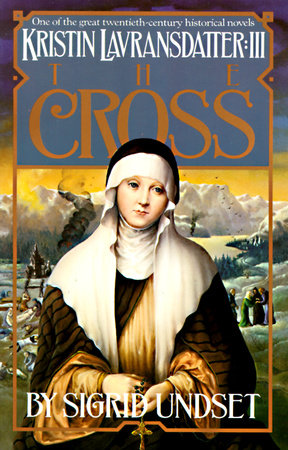
Kristin Lavransdatter III: The Cross by Sigrid Undset

The changeless roar of the falls went quivering through her overwrought body and soul.  It minded and minded her of somewhat--of a time endlessly long since--even then she had known that she could not bear the lot she had chosen for herself.  She had laid open her shielded, tender girlhood's life to ravaging, fleshly love--in dread, in dread she had lived ever since, a bondswoman from the first hour of her motherhood.  To the world she had given herself up in her youth, and the more she struggled and fluttered in the world's snare, the more straitly she found herself bound and prisoned by the world.

I began the third book in Sigrid Undset's novels about medieval Norway, The Cross--my Christmas tradition for the past few years--utterly confused.  I did not remember at all who these people were.  Who is Gunnulf?  What is an Arngjerd?  It didn't help that Kristin Lavransdatter, in the second book, bore seven sons, several of which are given other characters' names.  But by the end of it, I was convinced that this is the best book of the three.

The Wreath tells the story of Kristin's youth and engagement to the impetuous Erlend Nikulausson; The Mistress of Husaby--called in more modern translations, simply, Housewife--the story of her troubled marriage and Erlend's eventual fall from political grace.  When that novel ends, the disgraced Erlend must move into Kristin's family estate, Jorundgaard, having sacrificed Husaby to the crown.  The Cross is the story of Kristin's middle age, struggling to raise her sons in obscurity and ignominy alongside the still-unreliable Erlend.

The Cross depicts a woman still living under the weight of her original sin: her dalliance with Erlend in disobedience of her father, who had arranged for her to marry the gentle, reliable Simon Andresson.  To modern American readers, Kristin Lavransdatter might seem tedious: isn't it time for everyone to just get over it?  But God doesn't "get over" things, and while the various priests who pop up in Kristin's life from time to time chastise her for her faithlessness in holding onto her sin quite so strongly, Undset seems to understand that our gravest misdeeds do have the power to reshape our lives in ways that do not vanish.  Though Erlend has given Kristin these sons, their marriage has led directly to a life on the margins of Norwegian society.  Both Erlend and Ramborg, Kristin's sister and Ramborg's now-husband, perceive that Simon is still desperately in love with Kristin, and so the novel opens with Kristin's alienation from one of the few friends who remained steadfast through Erlend's downfall.  Things only get worse when Erlend, aggrieved at Kristin's long-simmering feelings of regret, separates from her and goes to live on his own.

The Cross is full of moments of high drama, which I feel reluctant to spoil, but which are key to understanding why the book is so compelling, so consider yourself warned.  First, Simon dies tragically without ever having told Kristin how he feels.  Kristin goes to visit Erlend, and while their tryst fails to reunite them, it does lead Kristin to conceive another son, whom she names "Erlend" in despair.   It's a no-no to name a child after a living person, because it suggest one of the two will die, and sure enough, baby Erlend is a sickly child and dies quickly, leading to rumors around town that Kristin did not live the child because it was the product of an affair with her steward Ulf.  Whew!  If that's not enough, Erlend, coming to defend his and Kristin's honor, gets into a fight with a petty townie and is killed without making confession.

At the end of all this drama, Kristin finds herself increasingly sidelined in her own home.  Erlend is gone, Simon is gone; her children are mostly grown.  Two of her sons join a monastery; another marries, making Jorundgaard another woman's responsibility.  Ultimately she decides to run off and become a nun herself, just as the Black Plague arrives in Norway.  The crisis gives Kristin the opportunity to atone for the original sin of her life through a final act of self-sacrifice and deep grace.  Undset manages to find an ending to the trilogy that brings Kristin's story to a logical, meaningful resolution, but without feeling too circular or on-the-nose.  As with the other books, its power only remains if you're willing to believe that Kristin's regrets are truly meaningful ones, and that her feeling that she has betrayed God is sensible and sincere.

The Cross closes on a Norway with an uncertain future.  The death and tragedy that have stalked Kristin, in this book especially, seem now to have come for all of Norway.  In light of it, the deaths of Simon, Erlend, baby Erlend, even of her sister Ulvhild all the way back in the first book, seem to be only a little early.  But the three books of Kristin Lavransdatter seem to suggest that goodness on a human scale--something that the self-despising Kristin has always possessed, in spite of herself--will not and cannot perish, even in the face of great tragedy.