Showing posts with label Kristin Lavransdatter. Show all posts

Friday, December 16, 2022

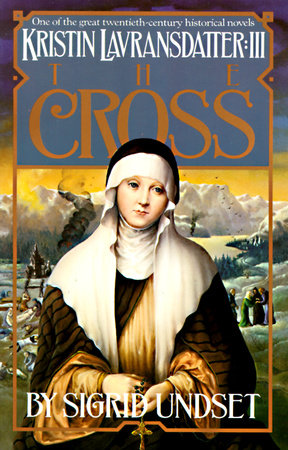
The Cross by Kristin Lavransdatter

Surely she had never asked God for anything except that He should let her have her will. And every time she had been granted what she had asked for--for the most part. Now here she sat with a contrite heart--not because she had sinned against God but because she was unhappy that she had been allowed to follow her will to the road's end.

She had not come to God with her wreath or with her sins and sorrows, not as long as the world still possessed a drop of sweetness to add to her goblet. But now she had come, after she had learned that the world is like an alehouse: The person who has no more to spend is thrown outside the door.

Kristin Lavransdatter should only be read at Christmastime, perhaps before a fireplace in an oak-trimmed room, with a fragrant wreath on the door and a steady snowfall at the window. It's been nothing but hideous rain here in New York for the past few days. But that's all right, I guess; The Cross, the third and final novel of Sigrid Undset's series about the life of the medieval Norse noblewoman, is all about disappointed expectations. It begins with Kristin and her husband Erlend having come down in the world as a result of Erlend's attempt to overthrow the king; he has been saved from execution but stripped of most of his lands. At their remaining estate, Kristin and Erlend are little-loved by their tenants and neighbors. There is hope in their seven sons--perhaps they will re-win the position Erlend has lost--but you know what God does when you make plans.

Beware, weary traveler: past this point are spoilers. What I know realize, having read The Cross twice--once in the original English translation, which enters the public domain later this year, and then in Tiina Nunnally's much improved one--is that the novel is structured around three principal deaths, each one swifter and more anticlimactic than the last: Simon's, then Erlend's, the Kristin's. Simon's, perhaps, has the most drama to it. When his wound becomes infected and he knows he is going to die, Simon plans to tell Kristin the truth, that he has always loved her, even after she broke their engagement, and after he married her sister Ramborg. But as he sits on his deathbed being tended by her, he finds he is unable to say the thing he thought he wanted to say, instead urging her to reconcile with Erlend, who has moved out of the house after a quarrel. Even before this, Simon has been the books' most selfless and upright character; and his final words to Kristin are an act of self-abnegation that surprise even himself.

Simon dies before he can think better of his silence; Erlend dies so quickly he's unable to hear confession. In a way, he dies for Kristin: after he hears that Kristin has been slandered by those who believe she has had an affair with their overseer Ulf, he returns to the estate and immediately picks a fight, in which he's mortally wounded. It seems at first like Undset has engineered a pretext for a final reconciliation, but no such luck. The speed with which Erlend, whose charisma and recklessness are the novels' catalyst, is carried off is almost shocking. When he's gone, both Kristin and the novel feel adrift. Slowly, Kristin's place at her estate is supplanted by her son Gaute and his new wife; the life she led, which had burnt so hot, fades strangely away.

What I find so interesting about Kristin's death is this: much is made in these novels about family. Kristin's original sin, for which she struggles her entire life to atone, is the betrayal of her father by breaking her engagement and sneaking off with Erlend. Simon urges her to be a more faithful wife, and she tries mightily to be a faithful mother to her sons. When she's displaced from her estate, she leaves to become a nun in the sister cloister to the monastery where her sons Naakve and Bjorgulf have become priests. But on the way she finds herself caring for a child that belongs to a pair of other pilgrims; when she contracts the Black Death it's not because she's caring for her sons, but because she is caring for strangers. Her last acts are to save an annoying little boy (who is about to be sacrificed to pagan gods to ward off the plague) and to bury the pestilential body of his mother. And the death is so quick--there's no final word like Simon's, or even Erlend's.

So what struck me this time is the subtle way that The Cross supplants the notion of family, which has been so crucial to the novels, with a different, broader understanding of family. A family that encompasses the beggar and the stranger. When Kristin hears, prior to her own death, that her monk sons have been carried off by the plague, she barely has time to grieve before she is back to her work as a carer. Kristin Lavransdatter is a deeply Christian book, and makes little sense if a reader's not willing to take its religion seriously. And here at the end perhaps you see echoes of the Christ who urged his followers to hate their mother and father.

Saturday, December 11, 2021

The Wife by Sigrid Undset

It was true that all this time she had remembered, year after year, every wound he had ever caused her--even though she had always known that he never wounded her the way a grown person intends harm to another, but rather the way a child strikes out playfully at his companion. Each time he offended her, she had tended to the memory the way one tends to a venomous sore. And with each humiliation he brought upon himself by acting on any impulse he might have--it struck her like the lash of a whip against her flesh, causing a suppurating wound. It wasn't true that she willfully or deliberately harbored ill feelings toward her husband; she knew she wasn't usually narrow-minded, but with him she was. If Erlend had a hand in it, she forgot nothing--and even the smallest scratch on her soul would continue to sting and bleed and swell and ache if he was the one to cause it.

About him she would never be wiser or stronger. She might strive to seem capable and earless, pious and strong in her marriage with him--but in truth, she wasn't. Always, always there was the yearning lament inside her: She wanted to be his Kristin from the wood of Gerdarud.

Hello again, Kristin old friend. For five years now it has been my December tradition to read (or re-read) one of the three novels from Sigrid Undset's Kristin Lavransdatter trilogy; this time I re-read the middle of the three novels, The Wife, in the newish translation by Tiina Nunnally. What makes The Wife so interesting is that it flies in the face of our traditional frameworks of rebellious love: The Wreath, like every book or film where a woman and a man come together in defiance of their parents and society, ends with the couple together at last, the essential conflict having been resolved. But The Wife asks, what will life actually be like for this couple? After the wedding over, and the hard work of loving and living begins?

Kristin and Erlend have carved out a difficult life for themselves: Kristin discovers that her husband Erlend has been a negligent steward of his great house, Husaby--a negligence that is inextricable from the dissolution and recklessness that made him such a poor match for her in the first place--and sets to whipping it into shape. In the world of medieval Norway, this means not just washing out the great hall and replacing the moldy hay, but extracting fair payments from the various smallholders who live on Erlend's lands. At the same time, Kristin becomes a mother, having seven sons (!!) in rapid succession. Her relationship with Erlend goes through periods of intense passion and intense enmity, not merely because of the deficiencies of his character, but because she--sin-obsessed and unable to expiate her own guilt--will not let him forget them.

While the newer translation is much more engaging and readable, it confirmed my suspicion that The Wife is the weakest of the three novels. My hope that the new translation would make the political machinations that Erlend gets mixed up in clearer was sadly dashed. Erlend spends much of The Wife at the height of his social and political life; acting as sheriff (whatever that entails) in the far north of Norway, but at the same time spearheading some kind of plan to remove the Norwegian king, who is also the Swedish king, from the throne. I couldn't really understand any of it. But I did understand that Erlend's recklessness nearly gets him put to death, and drives the broken couple back together when they are faced with the possibility of Erlend's execution.

One unsatisfying thing about The Wife is that Kristin herself is pretty annoying throughout. Erlend is right: she really can't let things go, and she's constantly throwing their transgressions back in his face. Kristin worries constantly about the consequences of her sin, fearing that her children were turn out to be armless, legless monsters. The truest moment, perhaps, in the book is when Erlend's monk brother Gunnulf reminds her that it is a kind of pride to assume that one's sins are so powerful that God's mercy cannot absolve them.

But Kristin's unsympathetic nature in The Wife leaves room for other characters, including Erlend, whose character is deepened and amplified, and especially Simon, Kristin's former betrothed who ends up marrying her sister, Ramborg, and who spends the latter third of the novel working desperately on Kristin's behalf to have Erlend freed. The best--and most frustrating--moment of the whole novel comes at the very end when, having succeeded in convincing the king to release him, Erlend makes an off-color joke about Simon marrying Kristin after his execution. Simon storms out, despite Erlend's pleas: the experience of being imprisoned and nearly executed may have chastened and aged Erlend, but it cannot change his essnetial nature

Sunday, December 6, 2020

The Wreath by Sigrid Undset

Kristin felt that she was kneeling with Erlend on a cold stone. He knelt with the red, singed patches on his pale face. She knelt beneath the heavy bridal crown and felt the crushing, oppressive weight in her womb--the burden of the sin she was carrying. She had played and romped with her sin, measuring it out as if in a child's game. Holy Virgin--son it would be time for it to lie fully formed before her, looking at her with living eyes, revealing to her the brands of her sin, the hideous deformity of sin, striking hatefully with misshapen hands and his mother's breast. After she had borne her child, after she had seen the marks of in on him and loved him the way she had loved her sin, then the game would be played to the end.

For the last three years, I have had a December tradition of reading one of the books in Sigrid Undset's series about medieval Norway, Kristin Lavransdatter. Though the books span several years and thus, several seasons, there's something especially wintry in them; they match the cold weather and the cozy hearth. I thought this year I would begin reading Tiina Nunnally's newer translation, only to discover that I actually had read Nunnally's version of The Wreath, and the other two books in Charles Archer's older translation. Still, going from Archer's to Nunnally's emphasized the benefit of Nunnally's clear and modernizing language when compared to Archer's attempt at using medieval English vernacular. Kristin's desire to marry for love, rather than expectation or honor, is wholly recognizable, even when her social context seems foreign or strange, and Nunnally's translation produces an intimacy with the reader that Kristin and these novels deeply deserve.

Reading The Wreath again, I was struck by how well Undset anticipates The Cross, the final novel in the series. (Brent, you may want to skip this paragraph.) Kristin and her forbidden love, Erlend Nikulausson, meet while she is spending a year at the Nonneseter convent, which is something apparently that young women did before they became adults. If she cannot have Erlend, Kristin insists that she--having already given her virginity to him and thus being effectively married in the eyes of God--will go into the convent for good. This doesn't come to pass, but Kristin does end up in the convent in the end, after her husband has died and her children left home, giving her life at last to the service of God when it is most needed, during the Black Plague. Even Brother Edvin, Kristin's beloved priest and mentor, suggests that he dreamed she would choose the convent life. The scenes at Nonneseter in The Wreath, the second time through, are riddled with this irony, and they make me feel as if Kristin ends up in the right place in the end, after a long detour on which she is set by her "original sin." In a thousand other small ways--like the brief attention paid by Kristin's jilted fiancé Simon Andresson to her little sister Ramborg, who he will marry after being widowed in The Wife--I was impressed by how Undset seems to have the entire trilogy already fully mentally formed.

I know it's gauche to look at everything through the lens of television, but The Wreath had me wondering what an HBO-style Kristin Lavransdatter series would look like. I'm imagining a season for each novel where, like with The Crown, the main characters are recast as they age. The Wreath is punctuated by moments of sheer drama that would play well on the screen: the attempted rape by Bentein and the murder of Kristin's friend Arne (ingeniously set up by Undset as the "forbidden love" Erlend later becomes), the moment Erlend meets Kristin by saving her from a pack of thieves (and a escaped leopard!), the standoff over a cup of poison between Kristin and Erlend's former mistress Eline, the accident that cripples Kristin's sister Ulvhild, the church fire that brings Erlend and Kristin's father Lavrans inches closer to reconciliation.

The challenge, of course, would be convincing a modern audience that the morality of these novels deserves to be taken seriously. I don't think that sex before marriage is a big deal, but the Norway of Kristin Lavransdatter does, and for good reasons: marriage in this society, as in many, is not merely an act of personal love but a way of binding families and communities, and a sacrament jealously guarded by God. Only a skilled director and actors, I think, could sufficiently remind us, as Undset does, that marriage has meant something different to other cultures than ours. If you could get over that hurdle, Kristin Lavransdatter is riddled with moments of excruciating pathos. As when I first read it three years ago, I was deeply moved by the tense moment between Lavrans and his wife Ragnfrid at the end where she admits that she was not a virgin at their wedding, a moment which recontextualizes the entire novel that has come before it. And knowing that marriage is not the end for Erlend and Kristin--that the future holds further, deeper challenges--makes The Wreath even more heart-jerking.

Tuesday, December 24, 2019

Kristin Lavransdatter III: The Cross by Sigrid Undset

The changeless roar of the falls went quivering through her overwrought body and soul.  It minded and minded her of somewhat--of a time endlessly long since--even then she had known that she could not bear the lot she had chosen for herself.  She had laid open her shielded, tender girlhood's life to ravaging, fleshly love--in dread, in dread she had lived ever since, a bondswoman from the first hour of her motherhood.  To the world she had given herself up in her youth, and the more she struggled and fluttered in the world's snare, the more straitly she found herself bound and prisoned by the world.

I began the third book in Sigrid Undset's novels about medieval Norway, The Cross--my Christmas tradition for the past few years--utterly confused.  I did not remember at all who these people were.  Who is Gunnulf?  What is an Arngjerd?  It didn't help that Kristin Lavransdatter, in the second book, bore seven sons, several of which are given other characters' names.  But by the end of it, I was convinced that this is the best book of the three.

The Wreath tells the story of Kristin's youth and engagement to the impetuous Erlend Nikulausson; The Mistress of Husaby--called in more modern translations, simply, Housewife--the story of her troubled marriage and Erlend's eventual fall from political grace.  When that novel ends, the disgraced Erlend must move into Kristin's family estate, Jorundgaard, having sacrificed Husaby to the crown.  The Cross is the story of Kristin's middle age, struggling to raise her sons in obscurity and ignominy alongside the still-unreliable Erlend.

The Cross depicts a woman still living under the weight of her original sin: her dalliance with Erlend in disobedience of her father, who had arranged for her to marry the gentle, reliable Simon Andresson.  To modern American readers, Kristin Lavransdatter might seem tedious: isn't it time for everyone to just get over it?  But God doesn't "get over" things, and while the various priests who pop up in Kristin's life from time to time chastise her for her faithlessness in holding onto her sin quite so strongly, Undset seems to understand that our gravest misdeeds do have the power to reshape our lives in ways that do not vanish.  Though Erlend has given Kristin these sons, their marriage has led directly to a life on the margins of Norwegian society.  Both Erlend and Ramborg, Kristin's sister and Ramborg's now-husband, perceive that Simon is still desperately in love with Kristin, and so the novel opens with Kristin's alienation from one of the few friends who remained steadfast through Erlend's downfall.  Things only get worse when Erlend, aggrieved at Kristin's long-simmering feelings of regret, separates from her and goes to live on his own.

The Cross is full of moments of high drama, which I feel reluctant to spoil, but which are key to understanding why the book is so compelling, so consider yourself warned.  First, Simon dies tragically without ever having told Kristin how he feels.  Kristin goes to visit Erlend, and while their tryst fails to reunite them, it does lead Kristin to conceive another son, whom she names "Erlend" in despair.   It's a no-no to name a child after a living person, because it suggest one of the two will die, and sure enough, baby Erlend is a sickly child and dies quickly, leading to rumors around town that Kristin did not live the child because it was the product of an affair with her steward Ulf.  Whew!  If that's not enough, Erlend, coming to defend his and Kristin's honor, gets into a fight with a petty townie and is killed without making confession.

At the end of all this drama, Kristin finds herself increasingly sidelined in her own home.  Erlend is gone, Simon is gone; her children are mostly grown.  Two of her sons join a monastery; another marries, making Jorundgaard another woman's responsibility.  Ultimately she decides to run off and become a nun herself, just as the Black Plague arrives in Norway.  The crisis gives Kristin the opportunity to atone for the original sin of her life through a final act of self-sacrifice and deep grace.  Undset manages to find an ending to the trilogy that brings Kristin's story to a logical, meaningful resolution, but without feeling too circular or on-the-nose.  As with the other books, its power only remains if you're willing to believe that Kristin's regrets are truly meaningful ones, and that her feeling that she has betrayed God is sensible and sincere.

The Cross closes on a Norway with an uncertain future.  The death and tragedy that have stalked Kristin, in this book especially, seem now to have come for all of Norway.  In light of it, the deaths of Simon, Erlend, baby Erlend, even of her sister Ulvhild all the way back in the first book, seem to be only a little early.  But the three books of Kristin Lavransdatter seem to suggest that goodness on a human scale--something that the self-despising Kristin has always possessed, in spite of herself--will not and cannot perish, even in the face of great tragedy.

Saturday, December 22, 2018

Kristin Lavransdatter II: The Mistress of Husaby by Sigrid Undset

It seemed to her that when her weary body at last was rotting under a tombstone, her restless spirit would still be doomed to wander about somewhere near by, as an unhappy ghost wanders lamenting round the tumble-down houses of a ruined farm.  For in her soul sin still had its being, as the root tissue of the weeds is inwoven in the soil.  It flowered and flamed and scented the air no long, but 'twas still there in the soil, bleached, but strong and full of life.  In despite of all the tenderness that welled up in her heart when she saw her husband's despair, she had not will or strength to stifle the voice in her that cried out, in bitterness and anger: Can you speak thus to me?  Have you forgotten the time when I was your dearest love?  And yet she knew that as long as this voice questioned thus within her, so long would she speak to him as though she had forgotten.

The Mistress of Husaby, the sequel to The Wreath, the first book in Sigrid Undset's series about the medieval Norsewoman Kristin Lavransdatter, picks up as Kristin moves into her husband Erlend's ancestral home, Husaby.  Husaby is a wreck: it's filthy, poorly managed, largely neglected.  Kristin makes it her mission to whip the house and its servants into shape, and to turn it into a home as noble and warm as the one she's left behind.  (It's a fascinating glimpse into the strange domestic habits of the medieval Norse household, arranged, Beowulf-style, around a great hall, and where everyone sleeps together on benches for some reason.)  For Kristin, the remaking of Husaby offers a chance to make things right, to forge respect and harmony out of a tumultuous courtship and marriage.  Soon, the house is completed by the addition of six--six!--young boys that Kristin bears.

But Kristin has trouble leaving the past behind.  She continues to be haunted by the way she and Erlend got together: the initial affair, the loss of virginity, and the ultimate suicide of Erlend's first wife.  The marriage is largely an unhappy one, complicated by Erlend's recklessness and diffidence, but Kristin makes things worse by keeping the original sin of their marriage polished and ready, like a dagger, to wound both Erlend and herself.  Her brother-in-law, a priest named Gunnulf, chides her:  "Kristin... dare you think in your wicked pride that sin of yours can be so great that God's loving-kindness is not greater?"  While The Wreath seemed to me an honest and empathetic depiction of the complexity of living out a life of honest faith, Kristin's obsession with her sin in The Mistress of Husaby can be tedious and dour.  The Wreath showed that reconciliation and forgiveness are possible; The Mistress of Husaby suggests that they're never quite complete enough, and that moving past our own failures takes an almost impossible strength.

The political subtext of The Wreath gets amplified in Husaby.  It's easy to forget that these characters, whose lives seem so close to the earth compared to our own, are really a kind of nobility.  I hadn't remembered that Erlend is related to the queen regent, Ingebjorg.  He spends a lot of this novel away from Husaby, serving as a Warden on a distant island.  Symbolically, Erlend continues to spend a lot of time with men--his integration into his own home never quite seems complete.  But he's also embroiled in a lot of political intrigue that happens almost completely out of narrative vision, which is focused narrowly on Husaby.  The distance emphasizes how the political world pressures the domestic sphere without being totally seen or understood; Kristin is a victim of political turmoil she cannot see.  Erlend, apparently, gets implicated in a scheme to usurp the throne and redivide Norway and Sweden (a political crisis I never totally understood) and spends the last third of the book in prison, on trial for his life.

The possibility that Erlend will die seems very real.  It would be a fitting subversion of the fairytale narrative in which love overcomes everything: family, religion, and politics.  But it's family that saves the day, in the form of Simon Darre, the man once betrothed to Kristin and who has since married her sister Ramborg.  Darre puts his own life and reputation at risk to defend Erlend, a man he despises.  Just like The Wreath's last chapters are overtaken by the point-of-view of Kristin's parents, the last chapters of Husaby belong, surprisingly, to Simon Darre, his complex goodness, his feelings of obligation and revulsion.  These chapters are a glimpse into the life that Kristin might have had, and a reminder that there are more good things in the world than passion.  And like The Wreath, the addition of Simon's voice to a larger multitude of voices emphasizes the complex social fabric that Undset explores so well.  She doesn't let you forget that Kristin's life is not lived in a vacuum, that as tedious as her obsession with her sin can be, it reflects meaningful obligations to her family and her community.

In the end, Erlend is saved, but not changed.  The last thing he does is make a reckless joke about how, if he had died, Simon could swoop in and marry Kristin.  It's maddening: Erlend forgets that Simon is married to Ramborg; he misunderstands Simon's motivations; because he had become resigned to the prospect of losing his life he underestimates the pain and effort others have taken on his behalf.  It's an unsettling place to end the story, but there's a kind of steely-eyed realism to it.  Erlend won't change, and Simon is a better man, but the love between Erlend and Kristin is not nothing, and neither is Simon's effort on Erlend wasted.  It's enough, all of it, because it has to be.