Showing posts with label Jon Fosse. Show all posts

Saturday, December 13, 2025

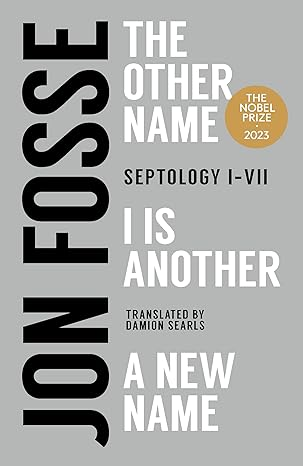
A New Name by Jon Fosse

And I see myself standing there looking at the two lines that cross in the middle, one brown and one purple, and I see that I've painted the lines slowly, with a lot of thick oil paint, and the paint has run, and where the brown and purple lines cross the colours have blended beautifully and I think that I can't look at this picture anymore, it's been sitting on the easel for a long time now, a couple of weeks maybe, so now I have to either paint over it in white or else put it up in the attic, in the crates where I keep the pictures I don't want to sell, but I've already thought that thought day after day, I think and then I take hold of the stretcher and let go of it again and I realize that I, who have spent my whole life painting, oil paint on canvas, yes, ever since I was a boy, I don't want to paint anymore, ever, all the pleasure I used to take in painting is gone...

A New Name closes out Jon Fosse's Septology, a work that is either one book or seven or, in this case, and probably the least reasonably, three. It continues the present story, in which the painter Asle prepares to visit his friend's sister for Christmas day and struggles with a numinous painting, and the story of the past, which comes in memories that overwhelm Asle: meeting his wife Ales, who later died young, becoming a painter, as well as memories that recount the life of his friend and namesake, another painter named Asle, who is currently languishing in a hospital to which our Asle has ferried him. How does Asle know all this stuff about the other Asle? He might be thinking through what he's been told, of course, but there's a strong suggestion, too, that the men have somehow overlapping identities, and that our Asle draws from a store of memory that belongs to him as well.

Many of the memories in A New Name are lovely, happy memories. We hear how Asle met Ales one day by pure chance, and how they became almost immediately joined at the hip. The same day that Asle meets Ales, he goes to rent a room in Bjorgving where he'll be attending art school. The landlady, an aged beauty named Herdis, is suspicious of Ales, and refuses to let her in the house. Later on, Asle paints the stern landlady's portrait in exchange for free rent he will end up not needing, as he moves in with Ales almost immediately. This old lady is, I thought, one of the novel's best characters: an image of the way that people seem to shrink into themselves, their homes, with age, and I enjoyed her mix of affection of possessiveness.

But A New Name ends up being quite a sad ending, I thought. Spoiler alert--the namesake Asle dies, and we find out bloodlessly, through a nurse at the hospital. Fosse piles it on, too, with the unexpected death of Guro, a woman who had been flirting with Asle in the previous novels (and who, as one of the novel's many doubles, resembles the sister whose house Asle is meant to head to for Christmas day), in a terrible fire, no less. The book ends with Asle rebuffing the advances of said sister and then, perhaps dying himself as a "ball of blue light" shoots into his forehead. The Lord's prayers, then, that end each of the novel's seven sections, and which underpin its thematic interest in the presence of God and the possibility of knowing God, take on the sense of prayers for the dead, in which the protagonist finally includes himself.

Saturday, December 14, 2024

I is Another by Jon Fosse

...I go into the main room and over there on the easel I see the bad painting with the two lines that cross in the middle, no, I can't look at it, I can't even take the picture down from the easel and put it in the pile with the other paintings I'm not totally done with yet, that I'm not totally satisfied with, I just can't, I think and I look at the easel and I think that when I look at the easel now, isn't it like, the thought comes into my head, like God is looking out at me from the easel? I think, and now I just have to not go crazy, I think, because it's like God is looking at me from every single thing, I think and look around and it's like God is in everything around me, I think, and like he's looking at me from every single thing, I think and I think isn't the round table clearly saying with its silence that God is nearby? and the two chairs? and the one Ales always sat in, especially clearly, God is so clearly looking at me from that chair, I think, and I think that it's when I'm most alone, in my darkness, my loneliness, because it really is lonely, to tell the truth, and when I'm quiet as I can be, that God is closest, in his distance...

The second part of Jon Fosse's Septology picks up where the first has left off: the narrator, Asle, has dropped his friend, also named Asle, off at a hospital in Bjorgvin where his addictions are close to claiming his life. He has gone home with the other Asle's dog, to confront there the loneliness of the Christmas season without his wife Ales, who has died, and his friend Asleik, who is demanding one of Asle's best paintings this year as a gift for his sister. The stark, wintery landscape of Norway's fjords is full of memory for the narrator Asle, about Ales and about his childhood, his experience getting into Norwegian art school and leaving his family. We finally see the moment where the two Asles meet, introduced by a mutual friend, both as prospective art students. The other Asle is called here "The Namesake."

Is it sloppy reading on my part, or an essential trick on Fosse's part, that the Asle I thought he was talking about for 200 pages was the Asle in the hospital, and not himself? I think the latter, though perhaps an eagle-eyed reader might have figured it out all before. The narrator's memories come sudden and swift, introduced with a simple transition like "I see Asle..." I see Asle with his sister, who died young; I see Asle, having a panic attack over the thought of reading in class; I see Asle, moving away from his parents for the first time to pursue his dreams of art school; I see Asle, giving up on the kind of realistic paintings of Norwegian domestic landscapes that made him popular, etc., etc. And all the time I was trying to find an answer to that essential question--if these Asles are the same, even perhaps to the point of being the same person, or avatars of one another, where do they diverge? Why is one Asle a success and the other a failure? I thought I was finding it, perhaps, in the death of his sister. But with one quick movement, Fosse reminds us that this is the narrator Asle remembering his own life.

Ultimately, I don't think Septology has an idea of why people end up the way they do. On the question of nature vs. nurture, it's agnostic to the point of disinterest. It sets up for the reader a kind of fool's game, forces you to search for the differences and divergences, when really the thrust seems to be that human personality remains a kind of inexplicable mystery. The elision between the two Asles is maybe the most bravura thing about Septology, a project of great skill and subtlety that justifies and illuminates the pale featurelessness of the story and the prose.

And reading this time, I was struck by the novel's interest in grief and the possibility of the divine: the narrator Asle has painted this painting of two lines crossing, one purple, one brown, that he alternately considers the worst painting he's ever done and the best. But the painting is where God enters the scene, and in studying it--pointedly, a cross--Asle begins to see the presence of God everywhere. Perhaps, I began to think while reading I is Another, God is another name for that power of chance or providence that turns a life in one direction and another in another, just as God is the name for what takes away one's wife before her time.


Sunday, December 17, 2023

The Other Name by Jon Fosse

...it's true probably the only thing I could have ended up doing was painting pictures, and if I wanted to make a living I need to paint, and that's both good and also wrong, but that's what I did and kept doing, I painted picture after picture, I did that at least, and when I wasn't painting I often spent hour after hour just sitting and staring into space, yes, I can sit for a long time and just stare into empty space, at nothing, and it's sort of like something can come form the empty nothingness, like something real can come out of the nothingness, something that says a lot, and what it says can turn into a picture, either that or I can stay sitting there staring into empty space and become completely empty myself, completely still, and it's in that empty stillness that I like to say my deepest truest prayers, yes, that's when God is closest, because it's in the silence that God can be heard, and it's in the invisible that He can be seen, of course I know my Pater Noster and I pray with it every day...

Jon Fosse's Septology is three books, divided further into seven volumes. It's hard to say whether it's one thing or three things or seven things, and each volume itself is one run-on sentence without periods, slipping from one day in the life of the painter Asle into the next, bleeding across volumes. Since the first two of the seven were published as a single volume--and since I'm trying to surpass my book total for last year--we're going to go ahead and call this volume a book, though certainly others will say the Septology's propulsive, fluid, and unceasing nature demands that one read until the end.

Asle, the narrator, is a painter living on the coast of Norway. He's a widower, with few friends, except for his neighbor Asleik and the owner of the gallery where he sells his paintings. And, of course, the other Asle, who lives in town and who--we quickly pick up--is a kind of doppelganger of the narrator, if not something even more intimate and overlapping than that. Another version of himself, perhaps, branching off at some undefined point. Whereas our Asle is a teetotaler, having been convinced to stop drinking by his late wife Ales, the other Asle is a hopeless and miserable drunk. Much of The Other Name is devoted to the narrator Asle's attempts to get the other Asle, whom he's found cataleptic in the snow, into a clinic where he can be treated for his severe addiction. This becomes a kind of shaggy dog story, literally: the narrator Asle realizes too late that he must find and take care of drunk Asle's dog Bragi, and this is made all the more difficult by a snow storm that keeps him from driving back to the coast.

How did Asle become Asle and Asle become Asle? Can it really be as simple as the suggestion, toward the volume's end, that the drunk Asle was set off on his path by the trauma of being molested as a child? Such an answer would be easy, too easy--perhaps it was the mollifying influence of Asle's wife Ales, now gone. Or perhaps there is no accounting for why our lives take the paths they do. This is complicated by a sneaking suspicion that there is something in the names of the other characters--Asle, Asleik--that suggests that there are more than just these two doppelgangers, and that we are meant to see them as many variations on the same Asle. The slippage becomes comical when narrator Asle keeps running into a woman, Silje, who insists they've met before, even slept together. What's obvious to us--she knows the drunk Asle, ensconced now in the clinic--is totally lost on our aloof narrator.

The ceaseless sentence of each volume lulls you, like a drug or a dream; it's easy to feel, carried on the endless flow of it, that you have been severed from realism, if not from reality. The style is a variation on stream-of-consciousness, and not, I would say, especially innovative, but it works really well here because it works to justify the novel's slight otherworldliness, its other strange slippages, like that between Asle and Asle. We don't question the vision of two lovers playing in a sandbox, which may be a memory of Asle about himself and Ales, or which may be two real people. We don't question the way the narrative perspective breaks as the narrator's consciousness enters into the consciousness of the other Asle. Is "our" Asle simply remembering the story that the other Asle told of his formative encounter with the predatory "Bald Man," or imagining it? Or has the narrative somehow slipped away from him, and really entered into the other man? Of course, it's both somehow, and the narrative's current, which refuses to recognize the epistemological barrier of the sentence, reflects it.

One thing I enjoyed a lot about The Other Name is the way it imagines narrator Asle's art. In the two days that make up the two chapters, he has recently begun--and perhaps--finished a painting made up of only two lines crossing, a brown and a purple one. His neighbor Asleik jokes that the painting should be called "St. Andrew's Cross," and there is something religious about the experience of painting for our Asle, a way of accessing the quiet and empty place where God lives, and where creation is possible. (Among other things, our Asle is a recent convert to Catholicism, and can be seen praying his Pater Nosters with the dedication of a convert.) My favorite bits might be when our Asle describes the glow he searches for in his paintings, a glow that comes out of sheer darkness, made layer by layer on the canvas; he tells us that he only knows when a work is finished if, when he turns the light out, the glow remains. A Glow in the Darkness might be another, more florid name for the first volume of the Septology.

I'm still searching, I think, for what people love about these novels, and what the Nobel committee saw in them (and Fosse's work more generally) when they awarded him the Nobel Prize in Literature earlier this year. I will say that it took a little bit of self-sacrifice to stop with the first volume, when the narrative works so hard to carry you, like the tidal fjord, into the next one. But it took a little bit of self-interestedness, too.