Showing posts with label china. Show all posts

Monday, October 2, 2023

Unrest by Yeng Pway Ngon

For a while, because the storyline of the male protagonist and me wouldn't move forward, the whole novel got stuck there, and the writer didn't know what to do next. But he sensed that this delay and blockage were caused by me. He was right, I deliberately escaped from his narrative, because I wasn't satisfied with his writing, nor the way he arranged my destiny. I felt this was a book about several men, with the women there to run circles around them--marry a chicken, lead a chicken's life. Why should I put up with a husband who considered himself a playboy? Why give up my individuality and freedom to live with such a man, just because that's the author's plan? Can't I decide my own destiny and future? Shouldn't my existence have some meaning apart from satisfying the possessive urges of men?

Once a revolutionary, always a revolutionary--in the eye of the regime, at least. In reality, rebellion is often the brief province of youth, though its consequences may resound through the years, determining the course of a life long after the revolution has died. The four Chinese characters at the heart of Singaporean Yeng Pway Ngon's novel Unrest find middle age to be as great a challenge, at least, as the political upheavals of their youth--and one they must face without the ardor of their early life.

Weikang and Guoliang grow up in Malaysia and attend a prep school in Singapore, where they become involved with communist student groups. From there, their paths diverge: Weikang, targeted by the regime of Lee Kwan Yew, emigrates to China, where he finds his idealism dashed by the brutal realities of the Cultural Revolution. Guoliang stays in Singapore, growing meek and purposeless under the eye of a mother he despises. Ziqin and Daming are a couple who, also intending to emigrate to China, never get past Hong Kong. Daming, the most radical of them all, becomes a capitalist and a womanizer whose infidelities torture Ziqin.

In the 1980s, the characters find themselves thrust together in various combinations for the first time in decades: Weikang and Guoliang meet for the first time since, as young men, a drunk Weikang took sexual advantage of his equally drunk friend. In another moment, Ziqin initiates an affair with Guoliang. Guoliang, still meek and abashed, is the opposite of the caddish Daming; though Ziqin is ambivalent about the affair at first, it is a first step toward agency and independence. Sex hangs over the novel as intensely as political violence--obviously, the secondary meaning of the title can hardly be ignored. Is it too late for sexual gratification, just as it seems too late to truly be a radical? Is Weikang's indiscretion with Guoliang something that can be left in the past, or will it follow as surely as his political baggage?

Yeng inserts himself ostentatiously into the narrative as the "author," arranging the plot of the book to his satisfaction. In Guoliang and Ziqin's narrative, they are identified at first only as the "male protagonist" and the "female protagonist." The female protagonist soon escapes the author's control, first disappearing, then refusing to follow Daming in emigration to Vancouver. When she's allowed to speak to herself, Ziqin asserts her right to an independent life, not just from Daming, but from authorial possessiveness; she's not required, she insists, to do what the author demands simply because his story demands it. These metafictional touches are probably the most interesting part of the book, though they don't feel exactly innovative or fresh. Still, in a novel whose characters are pushed around by the implacabilities of history, it's refreshing to see one stand up and say, No thanks--I'll live the life I want.

With the addition of Singapore, my "countries read" list is up to 83!

Sunday, March 12, 2023

White Sands by Geoff Dyer

Even now, after this spectacular renaissance, the Spiral Jetty is not always visible. If there is exceptionally heavy snowfall, then the thaw does for the lake what the globally heated polar ice pack threatens to do to the oceans. Once the snowmelt ends up in the lake, it can take months of drought and scorch to boil off the excess and leave the Jetty high and dry again. Was it worth traveling all this way to see something we might not be able to see? Well, pilgrims continued to turn up even during the long years when there was definitely nothing to see, so it seemed feeble not to give it a chance. (There is probably a sect of art-world extremists who maintain that the best time to have visited the Spiral Jetty was during the years of its invisible submergence, when the experience became a pure manifestation of faith.)

The first thing Geoff Dyer does when he arrives in Tahiti is lose his biography of Gauguin. This cataclysm comes to stand in for the whole excursion, which is defined for Dyer by its absences, the holes in the experience, as huge and gaping as the absence of Gauguin's massive Where Do We Come From?, which turns out not to be on display when Dyer arrives at the Louvre. Gauguin's Tahiti has become a Disneyland, expensive and crass, and though a fellow traveler encourages him, "Look out there... Look at that amazing sea," the view is lost on him. Traveling further to a remote island where Gauguin spent his days, Dyer writes, "[T]he question 'Where are we going?' was turning into its vexed opposite, 'Where are we not going?'--to which the answer was: all the places I really wanted to go. Other people thought Hiva Oa was paradise, but if this was the case it was a paradise from which I was becoming impatient to be expelled."

Is this working for you? Or do you feel, like I feel, supreme annoyance at the display of a guy traveling to somewhere I'll never be able to go, on a trip underwritten entirely by Tahiti's tourism board, telling me that it's not all it's cracked up to be? Dyer's disappointment is not any ordinary disappointment, it's a contemplative disappointment, that's supposed to tell us something about the gap between our mental scheme of a place and the actual experience of being there. Thank god for guys like this, who can go somewhere and tell us, and in such articulate language, that it's all so dull. Dyer's primary interest in Tahiti is the women, who are "total babes in a babelicious paradise of unashamed babedom," until "almost overnight, they get incredibly fat." (There are about two pages describing how fat Polynesian people get.) In the next essay, Dyer writes about how his lukewarm interest in Beijing's Forbidden City was supplanted by his interest in his female tour guide, and how he spent the rest of his trip hoping to bring her back to his hotel room.

Of course, it's not really Dyer in these essays. A note preceding the collection warns us that they are fictionalized, that the "I" is not really an "I." We are safe, then, to feel a little creeped out by the narrator's prurient interest in the women of Tahiti and China, or his lamentation for Polynesian obesity, because that's just a character. Presumably it's also a character who spends a trip to Svalbard in the middle of winter, hoping to see the Northern Lights, quibbling with his wife Jessica. The pair have a miserable time, but that's not really Dyer's wife. His wife isn't even Jessica; her real name is Rebecca. But it's hard to ignore the feeling that there's some sleight-of-hand going on, that Dyer really does think the Tahiti is a "babelicious paradise," and wants to say it without being perceived as truly having said it. Is there a Dyer underneath all this, somewhere, that had a pleasant morning in Tahiti, or enjoyed an afternoon in Svalbard? Or are the real Dyer and the fake Dyer in unison that travel often proves to be a joyless disappointment?

Let me be fair: it's not all like that. I was really grateful for Dyer's essay about traveling to Walter De Maria's The Lightning Field, an installation in the New Mexico desert made of hundreds of lightning rods. The Lightning Field seems primed to be a disappointment. Access is strictly controlled; you have to enter a lottery, and when you're given a date, you are picked up and driven to a remote cabin by the installation for a day and night. But lightning only strikes sixty or so days out of the year; most people who are lucky enough to visit The Lightning Field see no lightning. And Dyer doesn't. But he's captivated by the way the light unfolds on the installation itself--it's a work of time as much as art. "Part of the experience of coming here is the attempt to understand and articulate," Dyer writes, "one's responses to the experiences." So he has a sense of wonder after all.

Dyer is at his best writing about large-scale artworks like The Lightning Field. Another essay focuses on Spiral Jetty (which I too have seen), the seminal earthwork by Robert Smithson that has been at times invisible beneath the Great Salt Lake. (Though it was written only in 2016, it seems strange to write about Spiral Jetty without talking about the lake as a victim of climate change; someone who visits the jetty now will not have to entertain the possibility of not seeing it because the lake has shrunk well past the jetty and shows little sign of recovery.) Another essay about the Watts Towers of L.A., built single-handedly by an Italian immigrant named Simon Rodia, captures the sense of baffling human achievement that such works inspire. Dyer is at his best when he finds a way to care about these place--the Watts Towers are deeply connected to the world of jazz, and intersect in fascinating ways with another essay about exploring the L.A. of German emigres Theodore Adorno and Thomas Mann. If only Adorno or Ornette Colman had spent a few years in Tahiti or Svalbard.

Monday, August 2, 2021

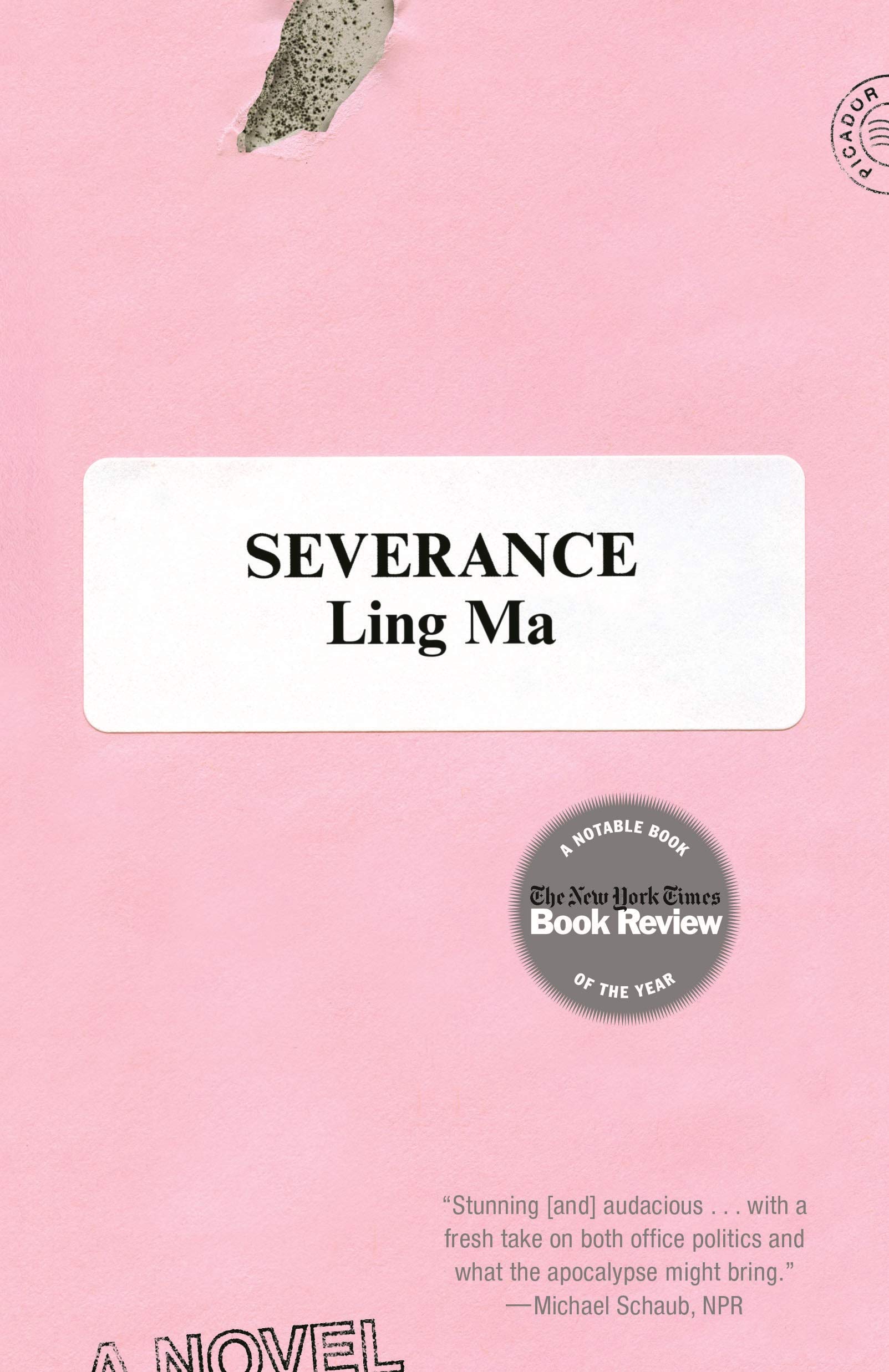
Severance by Ling Ma

Memories beget memories. Shen Fever being a disease of remembering, the fevered are trapped indefinitely in their memories. But what is the difference between the fevered and us? Because I remember, too, I remember perfectly. My memories replay, unprompted, on repeat. And our days, like theirs, continue in an infinite loop. We drive, we sleep, we drive some more.

A mysterious disease emerges from China. The U.S. border is shut down, but it's too late: the infection spreads uncontrollably. Things in China are even worse, we suspect, but the Chinese government keeps a tight lid on information coming out of the country. Americans try to protect themselves with mask, though not everyone believes they provide any protection at all. Basic services begin to fail; the supply chain buckles; people flee New York as it begins to collapse. Those who stay attempt to work from home, but without the interconnectedness of the modern world, things go quickly south.

In 2021, Ling Ma's Severance seems awfully prescient, doesn't it? What stands out the most is perhaps the ways in which Ma's imagination falls short of the real thing: the number of dead, for example, that provokes the U.S. to stop publishing statistics, is 280,000. (We're at 600,000 and counting.) The main character's employer offers a colossal sum to continue working from the office while everyone else transitions to remote work. This last bit seems particularly egregious, given how interested Severance is in the economic structures that seem both so fragile and so binding: of course, in the real world, many people have simply been forced into work. But these are not really criticisms, just grimly funny observations; in truth Severance seems to have gotten the shape and import of a 21st century global pandemic exactly right.

The protagonist, Candace Chen, is a Chinese-born American who, in her former life, works as a production director for a book publisher. Her job is in Bibles: sourcing the leather, the paper, the little gemstones attached to their most expensive product line. This work involves contracting Chinese companies; she travels between America and Shenzen and gives her a first-hand look at the realities of the global manufacturing economy. This job is exactly as fulfilling as you expect it might be, and she drifts through her New York existence in profound alienation: the second meaning of the word severance, and a state that the pandemic only intensifies. After the "Shen Fever" hits, she escapes the city, only to be captured by the megalomaniac leader of a group of travelers who sees her pregnancy as link to the future existence of humankind.

What I liked most about Severance is that it doesn't overexplain the connections between Candace's pre-pandemic profession and the reality of social collapse. Shen Fever, unlike Covid, is a fungal disease, and though it's not explicitly stated, one suspects that it travels around the world on the billions of products with MADE IN CHINA inscribed on them. Candace's own relationship to China, a country where all of her surviving family lives, but about which she remembers little, is a fraught one, circumscribed, like most Americans, by the logic of economics and production, rather than affection. "The future just wants more consumers," her boyfriend tells her, but Severance is a story about a future that consumes itself to death and is unable to stop. Sufferers of Shen Fever can often be discovered in zombie-like reenactments of what they loved most in life, and often this becomes acts of empty consumption: trying on clothes, walking around an abandoned mall. Severance describes a world in which production and consumption govern our most intimate and far-flung relationships, and suggests that the most frightening thing about those relationships somehow is the possibility of their collapse.

Saturday, October 17, 2020

Ultramarine by Malcolm Lowry

The sea! My God, what it may suggest to you! Perhaps you think of a deep grey sailing ship lying over in the seas, with the hail hurling over her: or a bluenose skipper who chewed glass so that he could spit blood, who could sew a man up alive in a sack and throw him overboard, still groaning! Well, those were the ancient violences, the old heroic days of holystones; and they have gone, you say. But the sea is none the less the sea. Man scatters ever father and farther the footsteps of exile. It is ever the path to some strange land, some magic land of faery, which has its extraordinary and unearthly reward for us after the storms of the ocean.

Dana Hilliot, the Norwegian-British sailor of Malcolm Lowry's Ultramarine, is not quite a sailor. He has shipped off on a yearlong voyage aboard the Oedipus Tyrannus for reasons that are obscure, both to the reader and himself: they have something to do with proving himself to his girl at home, Janet, and something to do with "gaining experience," and something to do with a cargo ship called the Oxenstjerna that he and Janet have seen appear and reappear on the horizon like a mystic vision. But as it turns out, sailing is hard work, and Hilliot is bad at it. He's widely hated by his fellow sailors and tortured by the temptations of shore, anxiously obsessed with keeping faithful to Janet, who has yet to send him a letter. He's two months into a yearlong voyage, and the remaining ten months look less like "experience" and more like purgatory.

The parent-rival on the Oedipus Tyrannus is the chinless cook, Andy, who is the ringleader of the anti-Dana sentiment on board. Hilliot seethes under Andy's contempt even as he craves, in a deep dark way, his approval. When Hilliot at last ventures to shore in China, he gets roaringly drunk and lets himself get entangled with a Russian prostitute named Olga, only to leave and return to find--as is obviously required by the Oedipal metaphor at work here--her deep in the arms of Andy. Experience, as always, is mixed up with sex, and Hilliot's virginity becomes a torture; his love for Janet requires him both to be a true, pure virgin and an experienced man.

Lowry is the only author I've ever read who comes close to what James Joyce does with stream-of-consciousness. As in Under the Volcano, the real story in Ultramarine is in the psychosexual drama that roils inside the protagonist. And as in Under the Volcano, the real movement of the mind is best captured when the protagonist is roaring drunk, when the mind is at its most honest and most disordered. I think Ultramarine was more successful, to me, because it's about half the length of Under the Volcano, which became at length cryptic and suffocating. In Ultramarine, the eddies of Hilliot's mental anguish are punctuated with the earthy voice of the other sailors, interrupting each other with anecdotes, and dashes of strange humor: the Oedipus Tyrannus, we discover, has been charged with carrying a whole circus of elephants, tigers, and other exotic animals from China. (It's almost like the novel shifts from an Oedipus story, about a man tortured by his own sexual inadequacy, to a Noah's ark story--perhaps one in which Dana really does get to start his new life on the tip of Mt. Ararat.)

Some of Ultramarine is inscrutable. People's minds really are sometimes, I guess, so it only makes sense. But there's enough of work, of dirt, enough of booze, of the sea, to balance out the maziness of the novel and make it worth reading.

Monday, October 2, 2017

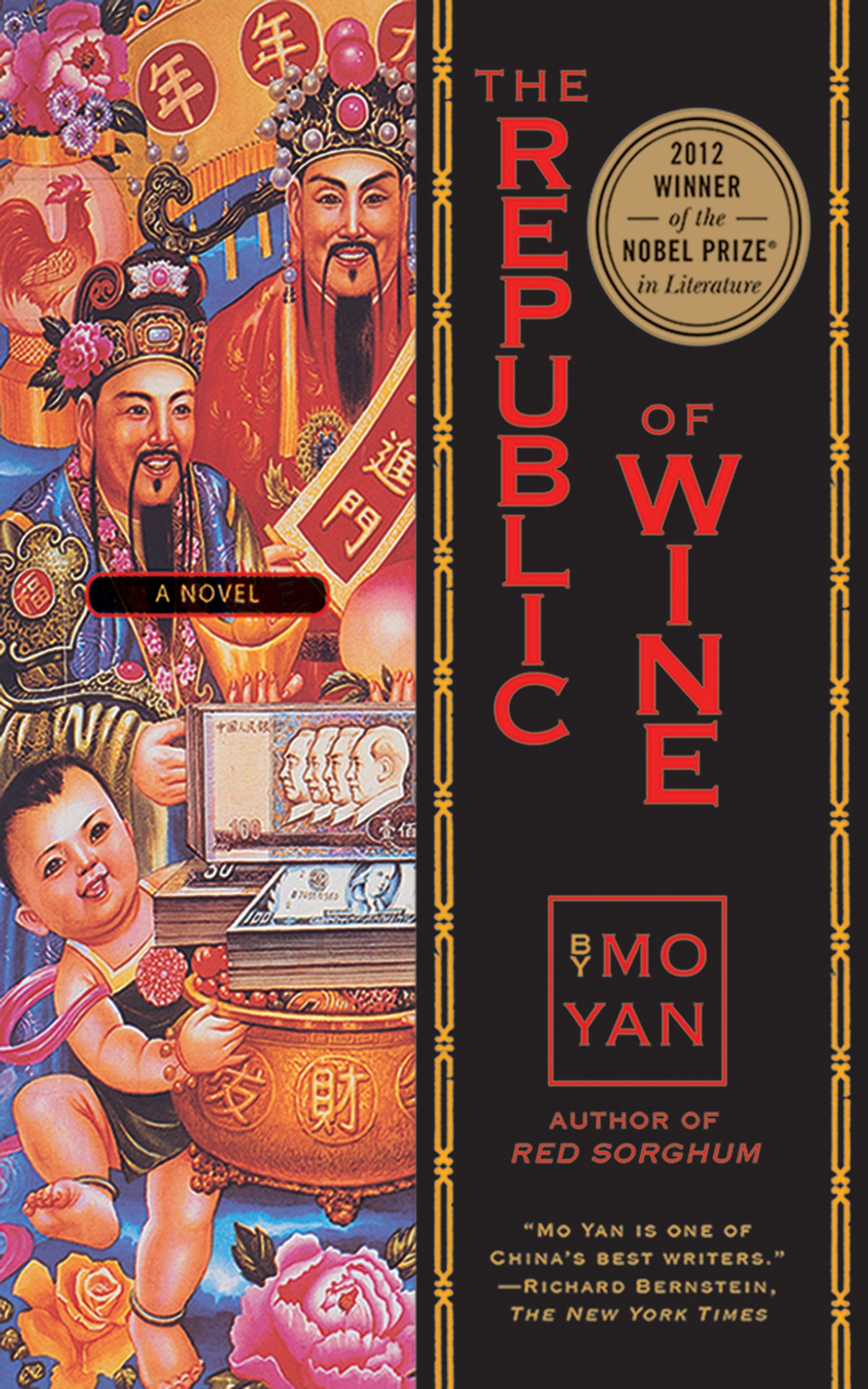
The Republic of Wine by Mo Yan

Ancient fairy tales sooner or later become reality, liquor is mankind's greatest discovery.  Without it there would be no Bible, there would be no Egyptian pyramids, there would be no Great Wall of China, no music, no fortresses, no scaling ladders to storm others' fortresses, no nuclear fission, no salmon in the Wusuli River, and no fish or bird migrations.  A fetus in its mother's womb can detect the smell of liquor; the scaly skin of an alligator makes first-rate liquor pouches.  Martial-arts novels have advanced the brewer's art.  What was the source of Qu Yuan's lament?  There was no liquor for him to drink.

Investigator Ding Gou'er is dispatched to the city of Liquorland (rendered in the title as The Republic of Wine) to investigate a horrible crime: the administrators of the Luo Mine in that city have been accused of cooking and eating children.  These "meat boys," as they're called, are part of Liquorland's famous tradition of gourmandizing: it produces the best, most exotic liquor and the best, most exotic food.  Is the braised infant that is brought to Ding on a tray real, or is it merely a clever fake, made of lotus root, as the administrators claim?

The Republic of Wine is somehow weirder than that description suggests.  There are apes that brew liquor in a secret mountain; there's a scaly child who wanders the streets seeking revenge against those who raise boys for their meat; there's an oily archvillain who can drink as much as he wants and never get drunk; there's a hideous dwarf who vows--and nearly makes good on his promise--to bed every attractive girl in the city.  Oh, and there's this sentence:  "He tripped over something, and discovered it was a string of frozen donkey vaginas."

Mo Yan won the Nobel Prize for works like this: often dreamlike, heavily biological, and pointedly satirical.  At least, I assume it's satirical, though what exactly is being satirized is probably lost on me.  I'm guessing it's about the luxurious tastes of the party classes in post-Mao China, and the way that decadence victimizes the powerless.  But the nuances of the satire are lost on me, knowing as little as I do about China, and the clunky translation doesn't really help.

The novel is interspersed with letters between Mo himself and a young admirer and would-be writer, Li Yidou.  Li lives in Liquorland, and his stories seem to provide Mo with a lot of the material he needs for The Republic of Wine; whether the stories are "true" seems to be a matter of not much consequence.  Li's stories and Mo's novel begin to converge, and the detective story that the novel presents at first becomes much more complex and troubling.  As both character and author get increasingly drunk, the semi-realist narrative is abandoned completely for an extended hallucination.  The final pages are a stream-of-consciousness riff in the demarcation between Ding and Mo is blurred, and in which Mo admits, "Damn some will say I'm obviously imitating the style of Ulysses in this section Who cares I'm drunk..."

The Republic of Wine isn't an easy read.  It's a little like reading the liner notes to a Captain Beefheart album.  But it'll reward those for whom weirdness is its own virtue, and its scatological sensibilities are pretty in tune with Joyce.  It made me want a drink.


Monday, August 25, 2014

The Woman Warrior by Maxine Hong Kingston

The round moon cakes and round doorways, the round tables of graduated sizes that fit one roundness inside another, round windows and rice bowls--these talismans had lost their power to warn this family of the law: a family must be whole, faithfully keeping the descent line by having sons to feed the old and the dead, who in turn look after the family.  The villagers came to show my aunt and her lover-in-hiding a broken house.  The villagers were speeding up the circling of events because she was too shortsighted to see that her infidelity had already harmed the village, that waves of consequences would return unpredictably, sometimes in disguises, as now, to hurt her.  This roundness had to be made coin-sized so that she would see its circumference: punish her at the birth of her baby.

Maxine Hong Kingston's The Woman Warrior is, like Tim O'Brien's The Things They Carried a set of interconnected stories, and also a book I'm supposed to teach in my eleventh-grade American Lit class this year.  They are similar, too, in the way that they say all plots are either "a fish out of water" or "a stranger comes to town."  That old canard is really too clever by half: whether you're the fish or the stranger depends on your perspective.  O'Brien's soldiers are all fish, in a world that they fear and cannot understand, but the characters of Kingston's memoir are strangers, grappling with the transition from China to America over many generations.

Kingston structures the stories in a way that is both chronological and relational: The first story, "No Name Woman," is about a Chinese aunt who committed suicide whom Kingston never met, the next about her mother and father, and so on until the final story, about Kingston's own experiences as a Chinese-American in California.  "No Name Woman" is the most famous, I think, because it's the only one I had read before.  It's a remarkable story, about a woman whose house is destroyed by her neighbors in a small Chinese town because she has become pregnant out of wedlock.  The baby is a product of rape, but no one knows this, and it wouldn't matter; the instability of the family and community that a fatherless child represents is, for the villagers, reason enough to enact a harsh punishment.  When the woman drowns herself and her baby, Kingston remains equivocal:

Carrying the baby to the well shows loving.  Otherwise abandon it.  Turn its face into the mud.  Mothers who love their children take them along.  It was probably a girl; there is some hope of forgiveness for boys.

What impresses me about Woman Warrior is its complexity.  We are horrified by the actions of the villagers in "No Name Woman," and Kingston doesn't ask us to excuse them, but she does ask us to understand them in a way that is difficult.  It also enables her to depict such an act of cruelty as deeply ingrained within rural Chinese culture, and at the same time write a story like "At the Western Palace," which depicts the tragic consequences when that culture is lost or abandoned.  In that story, Kingston's aunt (this time on her mother's side) comes to America after decades of separation from her husband, who immigrated long ago.  But her husband is married to another woman, and in California, the rights she would have as a "first wife" over her rival are not, cannot be honored.  There's some great humor in this story, mostly Kingston's mother's absurd encouragements to her sister--she imagines her walking in the husbands house, and declaring the children he had with his second wife to be her own, as would have been in the case, it seems in China--but the depiction of this aunt, for whom there really is no place in this new existence, is deeply sad.

About half of my students are East Asian, and most of these are Chinese-American, many from first-generation families.  I'm a little bit fearful to read this book with them--am I supposed to educate them on the finer points of Chinese culture?--but excited to see how they connect with these stories.

Thursday, May 22, 2014

The Painted Veil by W. Somerset Maugham

She was silent.  Vaguely, as when you are studying a foreign language and read a page which at first you can make nothing of, till a word or sentence gives you a clue; and on a sudden a suspicion, as it were, of the sense flashes across your troubled wits, vaguely she gained an inkling into the workings of Walter's mind.  It was like a dark and ominous landscape seen by a flash of lightning and in a moment hidden again by the night.  She shuddered at what she saw.

Kitty Fane is unhappily married to a bacteriologist working for the British government in Hong Kong.  She imagines that the Assistant Colonial Secretary with whom she has been carrying on an affair will marry her, if they can both procure divorces, but he seems content to keep on in secret.  When her husband Walter discovers her infidelity, however, he demands that she accompany him into a Chinese city beset by cholera.

It's an act of desperate, unimaginable cruelty.  Walter--brooding, unsociable, bookish--wants to kill Kitty, and his anger is such that his own life is acceptable collateral.  If you imagine that the cholera-stricken Chinese will offer Kitty an opportunity to recognize the shallow vanity of "society" and find redemption by caring for others, you are of course correct.  The cholera epidemic awakens Kitty to the reality of death, though this awakening also gives her valuable perspective on her infidelity:

After all they had gone through, when they were living amid these scenes of horror and desolation, it seemed inept to attach importance to the ridiculous act of fornication.  When death stood round the corner, taking lives like a gardener digging up potatoes, it was foolishness to  care what dirty things this person or that did with his body.

Redemption comes in the form of an order of kindly Catholic nuns that care for sick and orphaned children; Kitty's only consolation comes from joining them in their duty.  Much of The Painted Veil proceeds according to the progression of moral development you might expect; it defies expectation perhaps only in the sense that the marriage, and Walter, are irrevocably broken before their excursion and cannot wholly be saved in any sense.  Maugham is careful not to oversell Kitty's moral development; her new compassion and awareness leave her a better person but also more isolated than ever.

But ultimately The Painted Veil failed to retain my imagination after it ended.  Maugham traveled throughout Southeast Asia, but his China rarely seems anything but an Englishman's view, described as through the curtains of a sitting chair.  Perhaps this makes sense, given Kitty's perspective--she is sheltered, for the most part, from the Chinese and from the devastation of the cholera--but it makes it difficult, I find, to comprehend the causes of her growth.  I wonder what the novel would have been like if Kitty had been able to spend more time within the city walls.

Tuesday, January 11, 2011

Throne of Jade by Naomi Novik


Throne of Jade is the sequel to a book I read last summer, His Majesty's Dragon. The series is set during the Napoleonic wars, but with a twist: instead of a world in which dragons don't exist, these books take place in a world in which dragons do exist, are used as an air force, and are intelligent creatures. In particular we follow the adventures of Temeraire and his companion, Laurence. Throne of Jade picks up where His Majesty's Dragon left off; at the end of the first book, we learn that Temeraire is, in fact, a very rare and powerful dragon and his egg had been sent as a gift from the Emperor of China to Napoleon himself when Laurence (who had previously been the captain of a ship in the English Navy) captured it. Predictably, the Chinese are pissed and demand Temeraire be returned to China. Thus, this installment tells the story of Laurence and Temeraire's trip to China and Laurence's efforts to prevent his separation from the dragon.

The two things I liked most about His Majesty's Dragon were the action and the interactions between Laurence and Temeraire. Unfortunately, Throne of Jade was much lighter on both. Temeraire is an endearing character because of his innocence and his loyalty. He seem almost childlike, which can be very amusing, and his devotion to Laurence (and Laurence's devotion to Temeraire) make both characters more likable. But Throne of Jade focuses much more on the diplomacy and the Brits' attempts to persuade the Chinese to let Temeraire return to England. In the end, it was still enjoyable, but not quite as good as the first (though it finished strong).

There were a few other holes in the book that warrant mentioning. In England, dragons are treated almost like horses or dogs: their human companions are completely devoted to them, but they are used as tools of war and are not given nearly the same rights or freedoms as humans. In China, however, dragons are revered and are allowed to move freely through the cities and provide for themselves. Novik highlights this distinction when the transport carrying Temeraire and Laurence to China stops at a slave trading port and Temeraire begins to question the nature of human-dragon relations in England. However, instead of delving deeply into the subject, Novik just kind of puts it aside and returns to the plot of the story. On one hand, I thought that was kind of cheating, that she shouldn't bring it up if she's not going to tackle it (in all fairness, there was a little bit of foreshadowing that the topic will be addressed in the third book), but on the other I kind of wish she hadn't brought it up in the first place. It's not a requirement of actual social responsibility to call attention to the way dragons are treated in England because, you know, dragons don't actually exist (and I can't think of a situation that this was intended to be a metaphor for, unless Novik was just throwing it out there that slavery is bad) and it just kind of tainted what should be a light, enjoyable, action packed story. If I were looking for hard philosophical questions, a series of books about dragons in the Napoleonic wars is not where I would turn. Also, Novik is kind of racially and culturally insensitive. At one point she refers to a Chinese person as a "chinaman" (in a narrative description, not as a reflection of how the characters would speak at the time). Also, she says Temeraire's secret weapon is known as "the divine wind" by the Chinese, which I thought was interesting (seeing as how the word kamikaze means "divine wind" in Japanese). Maybe she was trying to be clever and missed or maybe she just didn't know the difference, but it seemed a little wonky to me.

Sorry for getting into a rant at the end; I actually did enjoy this book, even if not as much as the first one. Still up in the air whether I'll continue with the series. It'll depend on if I run out of things to read/how cheap the next one is on kindle.

Sunday, November 8, 2009

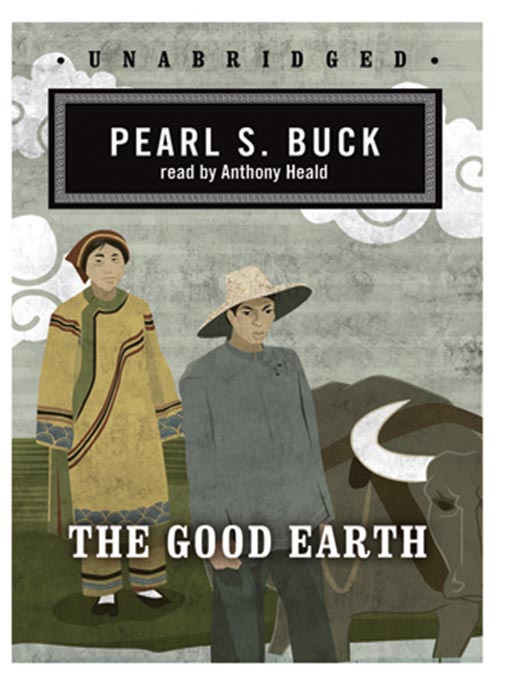
The Good Earth by Pearl S. Buck

As he had been healed of his sickness of heart when he came from the southern city and comforted by the bitterness he had endured there, so now again Wang Lung was healed of his sickness of love by the good dark earth of his fields and he felt the moist soil on his feet and he smelled the earthy fragrance rising up out of the furrows he turned for the wheat. He ordered his laborers hither and thither and they did a mighty day of labor, ploughing here and ploughing there, and Wang Lung stood first behind the oxen and cracked the ship over their backs and saw the deep curl of earth turning as the plow went into the soil, and then he called to Ching and gave him the ropes, and he himself took a hoe and broke up the soil into fine loamy stuff , soft as black sugar, and still dark with the wetness of the land upon it. This he did for the sheer joy he had in it and not for any necessity and when he was weary he lay down upon his land and he slept and the health of the earth spread into his flesh and he was healed of his sickness.

Next up after Tears of a Tiger is The Good Earth, a book with much more substance, but unfortunately, as dull as the dirt that gives it its title. Pearl Buck won the Nobel Prize in 1938 in part because of this book, which details the life of a Chinese farmer around the turn of the century and his steady rise into the ranks of the wealthy by his devotion to the land which he tills. Perhaps as a result of that, the back of the book is replete with critical interpretations suggesting that it is a shame that Buck was never accepted by the academic world into the cadre of great writers of the early twentieth century.

But you would have to be quite the revisionist, I think, to accept the premise that The Good Earth is in any way comparable to the work of Joyce or Fitzgerald, or even earlier stuff like Mark Twain, with which its realism has much more in common. Buck's book is just too straightforward, too dogmatic in its sensibilities--the farmer, Wang Lung, begins as a simple and honest man, and though he never abandons his simplicity and goodness, his moral compass slips only when he is separated from the "good earth" that nurtures him and his family. When he brings a prostitute named Lotus to live in his household (much to the chagrin of his homely but loyal wife) we cannot help but recognize it as the actions of a man who has been corrupted, if slightly, by material wealth. The book opens with Wang Lung traveling to the wealthy and arrogant House of Hwang to purchase a slave of theirs to become his wife; when at the end Wang Lung literally purchases and moves into the Hwang's abandoned palace it seems as if Buck is leaving little room for the reader to infer the parallels that exist. The Good Earth, no matter whether Buck won the Nobel Prize or not, is morally and thematically one-dimensional.

All this, of course, makes it a great text for freshmen, whose minds have difficulty handling ambiguity as it is.

Sunday, February 1, 2009

Dragonwings by Laurence Yep

I read about fifty pages of this book waiting for the freaking dragons to show up. When, around page 100, they finally did, it was one dragon in a dream sequence and it didn't breath fire on any villages or gobble up any damsels or anything like that, and didn't appear for the rest of the book. What.

Dragonwings is one of Yep's Golden Mountain series, a collection of books that follow the stories of a loosely related group of Chinese immigrants from the 19th century to modern times. As you would know if you were in my honors English class, "Golden Mountain" is a term that Chinese immigrants of the turn of the century used to denote America, which is either a serious mistake or a metaphor. This story in particular is about Moon Shadow, a young boy who is sent over to San Francisco from China to join his father, whom he has never really known.

His father, Windrider (ugh), confides in his son that he had a dream in which it was revealed to him that he used to be a dragon--in fact, the physician to the king of dragons--and that is why he's so skilled in repairing machines and why he has an insatiable desire to fly, if not in the dragon way than in the way of the Wright Brothers who have recently flown their first airplane.

I think the conflict is interesting enough--Windrider dreams of building a functional airplane, while facing rank prejudice and abject poverty--but the whole novel has an Afterschool Special vibe to it that's very off-putting. Windrider and Moon Shadow are wafer-thin as characters, and spend a lot of time learning Very Special Lessons about the world around them. The prose is blandly undescriptive and spends a lot of time over-explaining cultural phenomena, and as a result reads more like a textbook than a novel. I'm pretty sure that if I were twelve I would have put this book down long before I finished it. Unless, like I did at twenty-two, I read through the entire thing waiting for some more freaking dragons.

Side note: Statistically speaking, Laurence Yep is the second-most famous Asian person with an interjection for a surname, after Bond villain Dr. No.

Saturday, December 6, 2008

The Joy Luck Club by Amy Tan

Here it is, in the twilight of the year, and not only am I getting destroyed by Carlton, I am getting passed by Brent, and it looks as if fifty is a near impossibility. Even the books I read I pretty much read for work--case in point, this novel, The Joy Luck Club, which I am about to read with my tenth graders (and so had to quickly read myself).

I had gotten the impression somewhere that Amy Tan was a lightweight, and that The Joy Luck Club was a pretty Hallmarkish simp-fest about mothers and daughters rediscovering their relationship. I am please to report that while it does fall firmly in the stylistic arena of most pop-fiction, Tan's dissection of how families interact across cultural boundaries is pretty compelling.

The Joy Luck Club is split into 16 stories, many originally considered as separate stories not meant to tell a single narrative. There are four mothers who escaped China during the Sino-Japanese War of the 1940's and their four daughters who grew up in San Francisco's Chinatown. The one is exception is Jing-Mei Woo, who, just as she has replaced her mother in the womens' mah jongg circle--the titular club--tells four stories, assuming her mother's pair.

In Chinese, "joy luck" is one word, and its English equivalent not quite up to the task of translating it completely. In the same way, Tan explores the way that certain Chinese concepts fail to make the translation in the lives of their daughters, and the frustration of both sides who essentially live in separate cultures. To one of the daughters, it may seem that feng shui is an outmoded concept with no practical meaning, but she fails to see that the way her hastily constructed table falls apart is indicative of the weakness and fragility of her household and her marriage.

I am having trouble remembering specific episodes; for the most part, these characters are interchangeable. They are all, you get the impression, Amy Tan an Amy Tan's mother, and so there is very little cross-pollination between the stories. For the most part, each story tells about one pair of mothers and daughters, and the other characters appear only incidentally. As a result, The Joy Luck Club cannot cohere an struggles as a narrative. But the stories themselves are carefully contained and affective; I hope that this makes it easier to read for my kids.

Monday, October 20, 2008

Sounds of the River by Da Chen

Colors of the mountain will never leave our door
Sounds of the river will linger forever in our ears.

-- a couplet painted on the door of the old Chen house

I read Colors of the Mountain late last year. I liked it so much that I gave the book to my brother for Christmas, knowing that he too would enjoy it. I told him that the book was great but also informed him that when he came to the end, he would feel like the story was not over. (I ended my review of the book by stating much the same thing.) However, my brother is much smarter than I am. After he finished the book, he looked to see if Da Chen wrote another.

Sounds of the River literally picks up right where Colors of the Mountain left off. Da is getting ready to leave Yellow Stone to go to college in Beijing. This a dream come to for Da and his family. Little does he know that corrupt teachers, suicidal roommates, and poor living conditions await his arrival in Beijing. But the same dogged determination that got Da into college helps him to survive and even prevail. He become a voracious student of the English language, going from the bottom of his class to the very top. His knowledge of English lands him a sidejob as an interpreter for the Sports Ministry. A couple of chapters are devoted to the time Da spent as a translator and guide to a group of NBA stars touring China. Da's dealing with the NBA stars is hilarious, especially his interactions with Kareem Abdul Jabbar.

With Sounds of the River, Da Chen strikes the same balance as he did with his first book. He candidly describes his time in Beijing, with both poignance and humor. Da grapples with love, death, and religion, causing this book to strike a more mature tone than Colors of the Mountain. Sounds of the River ends with Da preparing to go to America, leaving me feeling much the same way that I did when I finished the first book. This time I checked, but unfortunately there is no third book. Hopefully Da is working on it.

Wednesday, December 12, 2007

Colors of the Mountain by Da Chen

I was in an airport bookstore and decided to purchase this book because it matched the outfit I was wearing, thinking that I would look cool carrying it around Terminal B. I bought it, flipped it open, stuck a bookmark between two random pages, and began strolling through the airport, confident in the look that I had carefully cultivated.

The book is written by Da Chen, who was born during Mao Zedong’s Cultural Revolution. His family was part of the landlord class, a class that was despised under the new communist regime. His father and grandfather were forced to perform strenuous physical labor, were often beaten, and nearly always ridiculed. Here is an excerpt regarding the rules that were to govern Grandpa’s conduct:

“Since the beginning of the Cultural Revolution, the commune cadre in charge of landlord reform had set the following rules: Grandpa could not visit his friends, he could not leave town without advance permission, and he was to write a detailed diary of his life every day. This was to be turned in every week. He wasn’t welcome in any public places, could not engage in any political discussions, and should look away if someone spit in his face. If they missed, he was to wipe the spit off the ground. There were more rules, but Grandpa forgot some when he came home to tell us about them.”

Chen befriends a group of hoodlums in his early teenage years, and he almost completely gives up on school, which was not that much of a surprise since intellectualism was a big “no no” during this time. This part of Chen’s life has elements of Oliver Twist, Huck Finn, and the countless other young, ragamuffin protagonists of English literature, the chief difference being that these “stories” are the real-life experiences of Chen.

Chen describes his early life and his hometown of Yellow Stone with simple prose. He manages to be clear and straight-forward while at the same time interesting and humorous. The book ends with Chen in his late teens, but it really feels like the story is just beginning, that there is still so much more. I wanted to know what transpired that enabled this young man in this small Chinese town to have his memoirs published by Random House. That is obviously not the story that Chen wanted to tell. But I think it too would have been an interesting one.