Showing posts with label New Mexico. Show all posts

Monday, July 6, 2026

House of Rain by Craig Childs

I turned off my light in the back of the cave. I closed my eyes. It felt as if all these centuries, these thousands of years, were contained here, their processions playing out again and again as drips strummed the pool beside me. The same routes are traveled repeatedly, the same meridians followed across horizons, over hundreds of years. Anasazi, I thought, was never a people. It was a rhythm, a form of motion stirred up from the land. People merely fell into step.

I got to return to Mesa Verde National Park last week and tour two more of the enormous cliff dwellings built nine hundred years ago directly into the rock. They are impressive places, made up of turrets and geometric stacks of rooms and huge circular underground kivas. It's hard not to think what the first white Americans, cattle ranchers, thought when they encountered them for the first time: how could somebody build something like this and then just abandon it? The "disappearance" of Ancestral Puebloans, previously known as the Anasazi, has been compelling narrative for a long time, a puzzle to be solved. Craig Childs, in House of Rain, travels through major and minor Puebloan sites throughout the southwest and Mexico, seeking an answer to just that question.

Among other things, House of Rain is a travelogue, and some of the most impressive passages involve Childs moving across the high, dry landscape of the Four Corners area on foot, sometimes with his wife and infant son in tow. He skillfully and poetically describes the beauty of this area, which is among my favorite places in the world. So in that sense it was like comfort food to me. And I appreciated hearing descriptions of some of these Puebloan sites I'll never see; tucked away in the corners of deep canyons, undisturbed in the way those first ranchers must have seen them. You can see how much more uncomfortable Childs is at, say, Aztec Ruins, a site run by the National Park Service in the backyard of a suburb of Farmington, New Mexico. Better to pass into these regions of quietude, where the intervening years can disappear and the past reappear in the form of a broken wall, a husk of corn, a potsherd.

So what happened to the Ancestral Puebloans? As Child notes, though a little begrudgingly, the mystery is not much of a mystery at all: they migrated, probably because of an intense drought in the high country of the Four Corners. Childs puts some specifics to this that I found highly interesting: his conclusion, based on the introduction of new kinds of polychromatic pottery in the lower regions of Arizona, is that the Puebloan culture migrated to the south, mingling with Hohokam and Mogollon cultures that were already there to create the culture now known by archaeologists as the Salado. It's Childs' contention, actually, that tensions between the new elements of this multicultural society resulted in the collapse of that society, leading the Pueblo peoples to splinter into the groups that now make up the two-dozen-odd Pueblos of the Rio Grande Valley, as well as the Hopi. But Childs throws his lot in with some more outre conclusions as well, like a revisionist theory that Puebloans migrated north from Chaco Canyon to Mesa Verde and then south again along the same meridian to a location in Mexico known as Paquime (or today as Casas Grandes), which other archeologists consider more closely related to the Aztec cultures of Mexico to the south. In any case, Childs favors a version of the Puebloans that emphasizes their grandeur, claiming for them a larger sphere of influence than many of his peers.

House of Rain is only twenty years old, but it wears its age. The term Anasazi, a rude exonym that comes from the Navajo, has been entirely supplanted by "Ancestral Puebloan." And while Childs undercuts the question Where did they go, my understanding is that nobody accepts this any longer as a framework from which to begin--something which perhaps Childs should be given credit for. But my biggest frustration with House of Rain is how it keeps modern Pueblo peoples at arm's length. They appear infrequently, and often in ways that stymie Childs' research, as with a council of elders that refuses to give Childs permission to conduct research. Childs paints this as a typical reservedness, but then again, he's the one who uses the word Anasazi around them, knowing it's offensive, but catching himself too late. Childs folds in some of the stories and legends of modern-day Puebloans that support the narrative of migration, but I noticed that these stories always tend to begin "a Hopi man once told me," while the researchers have names. At a dig, Childs notes the frustration of an archeologist who is forced to stop digging when human remains are found--a key stipulation of the Native American Grave Protection and Repatriation Act--and, in way that felt telling to me, lets that frustration pass by without comment.

All of these are minor missteps, perhaps, but they add up to a sense that Childs is most interested in the version of the Ancestral Puebloans that live in his imagination, and keeps the modern-day Puebloans and Hopi who might shine light on them at arm's length because they might complicate that imagination. Which is all just to say that I think House of Rain would be stronger if it had found a way to engage more deeply with them. That said, in the end, I really enjoyed deepening my understanding of the people of Mesa Verde this way, and I was persuaded by Childs' invitation to see them not as a static society that suddenly "collapsed," but a living, moving culture passing through several stages of development over centuries: a rhythm, a form of motion.

Saturday, January 24, 2026

The Names by N. Scott Momaday

The events of one's life take place, take place. How often have I used this expression, and how often have I stopped to think what it means? Events do take place; they have meaning in relation to the things around them. And a part of my life happened to take place at Jemez. I existed within that landscape, and then my existence was indivisible with it. I placed my shadow there in the hills, my voice in the wind that ran there, in those old mornings and afternoons and evenings. It may be that the old people there watch for me in the streets; it may be so.

When I visited Walatowa, the main settlement at the Jemez Pueblo in northern New Mexico, a couple summers ago, I told the guide at the visitor center that I was interested in the life of author N. Scott Momaday, who had grown up at Jemez. He took me into their small museum and showed me a huge photograph of Momaday's mother, Netachee, who had come with Momaday's father to teach at the Jemez Day School. A similar photograph, or perhaps even the same one, is printed in Momaday's memoir The Names, an illustration of the community that adopted Momaday and his family, inviting him into the place about which he writes, "My spirit was quiet there." As in House Made of Dawn, Momaday writes so beautifully about the landscape of Jemez, and it's clearer here than ever that it's a loving eye that produces such descriptions. It's the voice of a man writing about his home.

The Names begins with accounts of Momaday's ancestors, including his namesake Mammedaty, and Pohd-lohk, who gave Momaday his "Indian name," Tsoai-talee, which is derived from the name of Bear Lodge, or Devils Tower, in Wyoming. On his mother's side, Momaday describes a heritage that is part Cherokee but mostly white Kentuckians. His father's side is Kiowa, and here as in The Way to Rainy Mountain, Momaday writes with affection about his Kiowa family in Oklahoma. These places and heritages combine to make Momaday who he is, but not all equally; you can see that Momaday writes with respect and reverence for the Kiowa of Oklahoma, and with a mystic detachment about Bear Lodge, but much more ardently about Jemez. Between these there is a sojourn to Gallup, the colorful, largely Native city of western New Mexico, and Hobbs on the state's northeastern side, where Momaday's account of his life might be difficult to distinguish from any of the other children, whose big themes are school and sports, bullying and being bullied. This section contains a long section of stream-of-consciousness that captures the point-of-view of young Momaday, and is some of the memoir's most experimental and unusual writing.

What struck me when the novel turns to Jemez was the feeling that Momaday has of being an outsider. The hero of House Made of Dawn (and I did read much of The Names through the lens of this novel) is a native of Jemez, made an outsider by his alcoholism and the alienating experiences of war, but the novel is also interested in true outsiders, like the white woman Angela and the priest, Father Olguin. Here, as in the novel, Momaday writes of the Pecos Pueblo people who were given refuge at Jemez when their pueblo was destroyed. But only here in the memoir did I understand how much Momaday identifies with those people: refugees. The Names illuminates other parts of the novel, too. Here, for example, is an old and admired man named Francisco, who no doubt has become the Francisco of the book, and here is an account of the strange ritual where men try to pluck a buried chicken from the ground on horseback. Momaday describes it here as an ancient tradition that has degenerated, becoming a game for boorish young men; this really recontextualizes the scene in House where Abel kills the man who has embarrassed him at it.

More than anything, I thought The Names was beautiful. Momaday has a way of writing that feels utterly sincere. I guess it's not true that there's no room for irony here--Momaday's account of growing up in Hobbs makes great use of a child's narrow and self-involved worldview--but when Momaday grows up, or when he talks about Jemez, or the land, there's none of that, no detachment. I think of it as the prose of a writer who is deeply engaged with the world, and who speaks only when he has something to say. He really was remarkable.

Thursday, March 7, 2024

House Made of Dawn by N. Scott Momaday

Later, when the sheep had filled into the arroyo and from the bank he could see them all, he dropped a little bread for the snake-killer dog, but the dog had quivered and laid back its ears. Slowly it backed away and crouched, not looking at him, not looking at anything, but listening. Then he heard it, the thing itself. He knew even then that it was only the wind, but it was a stranger sound than any he had ever known. And at the same time he saw the hole in the rock where the wind dipped, struck, and rose. It was lager than a rabbit hole and partly concealed by the chokecherry which grew beside it. The moan of the wind grew loud, and it filled him with dread. For the rest of his life it would be for him the particular sound of anguish.

I don't usually re-read books before teaching them, especially if I've taught them more than once. But N. Scott Momaday's House Made of Dawn is an exception. Perhaps it's just because the book is too dense, too rich, to get away with "faking it." But maybe it's because I love it, and it feels to me like one of those books whose wonders never cease to unfold. This time around, it feels especially poignant, given that Momaday himself died earlier this year at age 89. This time around, it has the feeling of a great legacy--wisdom, maybe, from the next world.

I don't have much to say about it here because I'm sort of doing a running thread about it on Twitter. One thing that did stand out to me, that I hadn't really noticed before, is the passage above, where a young Abel is spooked by a hole in the rock through which the wind is moaning. This stood out to me for a few reasons. One, it reminded me of a similar moment in Death Comes for the Archbishop in which the bishop Latour is guided, in a snow storm, to a secret cave by an Indian guide, where he hears a great moaning coming from within its inaccessible recesses. It reminded me so much of it, actually, that I wondered if Momaday was pointedly referencing it: a moment of the Other, which in Cather is racialized and exotic. That it should strike Latour that way is no surprise, but Abel--always half an outsider because of his uncertain parentage--is, or ought to be, different.

It also brought to mind certain vague aspects of the Pueblo religion, which, like many Native American religions of the West, supposes a number of worlds laid one on the other. Many of these religions hold that humankind came up from another world through a hole like this one; some of them, like the Lakota, can even pinpoint the exact hole. The sipapu, the ceremonial hole in the sacred kiva of the Pueblo religion, represents this place of emergence. Perhaps what Tayo is hearing here--and what terrifies him so--is the sound of that other world: the unmediated touch of the real, which other characters (like Angela) long for, and seek to find in Indian country.

I loved re-reading House Made of Dawn this year. I don't know why, but it felt cleaner, simpler to me, more manageable and recognizable and familiar. Maybe having tackled some of its knottier aspects--its strange place-shifting, its many voices, its modernist structural tricks--what's left is the purity and simplicity of Momaday's language.

Monday, February 12, 2024

Sister Golden Calf by Colleen Burner

INVENTORY: one beautiful baby mutant calf preserved by the miracle of taxidermy, sans placards, sans glass case, sans roadside museum. A light mass covered in tawny hairs and full of a crumbling, dusty substance, possibly the product of animal becoming vegetable matter. The sweetest bulging brown eyes, which, objectively speaking, are crooked as hell and crusted with glue all the way around, yet they are naive and pleading without being pained. An outlaw, an outcast, qualified to live among the dead. This is my golden calf and I have no qualms. She practically glows. She smells like victory, like heaps of gold coins, salty sweat, and the quickest draw. Champion of bounties. Her presence feels almost too real to bear.

Gloria, the narrator of Colleen Burner's Sister Golden Calf, sets off with her sister to explore the back highways of New Mexico. Their car is filled with innumerable glass jars, one of which contains the ashes of their recently deceased mother Bonnie, who wishes to be dispersed to the landscape. The rest contain invisible, intangible things that the sisters have collected, as their mother taught them: emotions, moments, experiences, with labels like TARANTULA ACTION, DEAD LIGHT, BEGINNER'S LUCK, SOUL OF A JACKRABBIT. They trade these jars for a little gas money, to keep Bonnie's ashes on the wind, and their journey going. Gloria becomes obsessed with the taxidermied remains of a six-legged, two-headed calf, seen in a small town museum. She splits from her sister, who takes the car, while Gloria sets out to hitch--or walk--her way back to her beloved calf.

Sister Golden Calf is filled with holes. The jars are the prototype: receptacles which seem empty, but which contain something more than mere air, something ineffable. Another is the miraculous hole that Gloria's sister Kit sets off to find, the one in the church that heals people with its dirt, and which re-fills mysteriously each night. (I recognized this as a version of the sanctuary at Chimayo, which I visited over the summer--as far as I know the hole doesn't magically refill, but the description of crutches left behind by the lame, stacked up in their hundreds by the cured, rang true.) Another are the empty cavities of the horse Day-Mare, whose blindness killed the daughter of a woman who offers Gloria food and shelter. Day-Mare has lost her eyes, but Gloria holds a jar up to her face and bottles, as she believes, the final memory of the horse's sight.

All this sounds a little twee, maybe. It sounds like someone who's read a lot of Joy Williams--that six-legged calf sounds right out of the Joy playbook. But it works: the richness of the labels on the jars, and the dreamy logic that leads Gloria on through the desert, struck me as frequently lovely, and more importantly, entirely sincere. Sister Golden Calf is one of my SHORT KING FEBRUARY books, and it would probably wear out its welcome at any more than its 100-ish pages; it has the brevity and persuasiveness of a rich dream. In the calf, Burner offers a symbol of captive strangeness; who knows why Gloria is drawn to it, exactly, except that it seems to need to be freed. It seems as strangely present and tangible symbol, when the rest of the book is built so profoundly out of absences and invisibilities. Or perhaps the calf itself is a kind of jar, a vessel in which the real--a memory, a desire--is trapped. When, at the end, the reunited sisters burn the calf, releasing it and transforming the remains to ash, the analogy to their mother's ashes is difficult to ignore. Later, they open all their bottles, no longer clinging to their mysteries. Then they go home.

Wednesday, January 3, 2024

Death Comes for the Archbishop by Willa Cather

Ever afterward the Bishop remembered his first ride to Acoma as his introduction to the mesa country. One thing which struck him at once was that every mesa was duplicated by a cloud mesa, like a reflection, which lay motionless above it or moved slowly up from behind it. These cloud formations seemed to be always there, however hot and blue the sky. Sometimes they were flat terraces, ledges of vapour; sometimes they were dome-shaped, or fantastic, like the tops of the silvery pagodas, rising one above another, as if an oriental city lay directly behind the rock. The great tables of granite set down in an empty plain were inconceivable without their attendant clouds, which were a part of them, as the smoke is part of the censer, or the foam of the wave.

I'm excited to have a ticket to a dinner and seminar at the New York Historical Society next week about Willa Cather's Death Comes for the Archbishop. Only, what I thought was a seminar seems to be more of a discussion, and I'm actually supposed to have recently read the book. So, while starting the new year, with all its attendant slate-clearing and excitement, with a re-read is not ideal, there's few books that could better inaugurate the year.

The first time I read Death Comes for the Archbishop, I didn't get it. I kept waiting for the death, and I was stupid. The second time I read it, I saw the simple grandeur of Cather's prose for what it is, and having read more of her books since then, it's only grown higher in my estimation. So I thought I'd try something unusual and write a negative review of Death Comes for the Archbishop.

Let's start with the moral case against Cather's novel. Cather, it seems to me, has escaped critical censure for the small-c conservative and traditionalist aspects of her writing. In One of Ours, it's the glorification of World War I heroism and the sacrifice of young American lives for what I think we now see as little reward. In O! Pioneers and My Antonia, it's the myth-making around the long-gone days of the pioneer, which situates American identity in a past that never really existed. Similarly, Death Comes for the Archbishop is primarily about whitewashing the frontier and the "civilizing" of the American West. To see this, you need only to look at the Bishop Latour's praise for and friendship with Kit Carson, one of the premiere Indian fighters of his day, and whose depredations Latour only goes so far as to call "misguided." Or to Latour's nostalgia for the Spanish "martyrs" who were driven out centuries before by the Pueblo Revolt. The novel's central symbol is the cathedral that Latour builds from a hill of yellow rock he finds near the Pueblo of Acoma. The cathedral's design is European, French, but the rock is taken quite literally from the land, which Latour believes no one will miss, though he doesn't seem to have asked.

Cather goes out of her way to present Latour and his bosom friend, Father Vaillant, as friends of the Indians. On his deathbed, Latour rejoices that he has lived long enough to see the Navajo returned to their lands (no thanks to the "misguided" Kit Carson), and the novel's grandest villain is the gluttonous Fray Ramirez who abuses his parishioners at Acoma, and gets thrown off the cliff wall for it. But Death Comes for the Archbishop is invested, too, in a fundamental vision of Indian differentness, not simply rooted in the past but atavistic to the point of simplicity. Indians are both somehow manifestations of the land itself and an ancient prehistory. In some ways, this is meant to be a compliment: when one rebellious priest warns Latour not to try to change the old ways of the Indian religion, Latour remarks that ancientness is what he likes in the people of New Mexico--it is a quality shared with the Catholic church.

This might be the book's most significant elision: its insistence that the spread and maintenance of the Church in New Mexico is neither coercive nor particularly transformative. Latour and his fellow Catholics are consistently contrasted with "bad whites" like the murderous Buck Scales, who abuses his Mexican wife, or the town Protestants who love to violate sacred places and things. But this only serves to hide the ways in which the Church is one arm of European colonial transformation. Latour can build his cathedral because he believes that the Catholic church is catholic in that old sense of universal; it belongs everywhere. Contrary to the U.S. government, he is grateful that the Navajos have returned to "their land," but it does not occur to him, even as he digs up that yellow rock to build his cathedral, that the Church itself is a kind of invading force, using and possessing someone else's land.

Aesthetically, the novel reflects this project of elision. Unlike My Antonia or O! Pioneers, which have more conventional dramatic narratives--even as they, like Archbishop, each cover many years--Death Comes for the Archbishop feels strangely episodic and halting, without forward movement. It moves from anecdote to excursion: from a story that someone tells Father Latour (like that of the villainous priest at Acoma) to another trip out into the difficult desert. What happens at home in Santa Fe is hardly ever seen; the yellow rock is discovered, the cathedral is built. We know that the priests at Acoma force their charges to gather heavy pine trees from the distant mountains to build the church, but who builds the Cathedral of St. Francis, we're not permitted to know. I don't know either, of course, but it seems to me there's something intentionally obscured about the workings of the Church that's reflected in the book's subtly unconventional structure. Archbishop is a book with plenty of event, but no history, perhaps because it's unable to look at history with honesty.

Okay, I can't believe in any of that, even as I think there's some truth in it. Truly, I only appreciate Death Comes for the Archbishop more having seen this summer so many of the places it describes, like the cloud citadel of Acoma--which, of course, Cather describes perfectly. One thing I love about New Mexico, and the Southwest more broadly, is that the vast and striking landscape puts me in mind of eternity. It's a place for spiritual people, and I do actually think that Cather effectively imagines a profound similarity between Latour, Vaillant, and their parishioners: all are simple people, trying their best to keep their minds on the things that really matter. The anecdote about the waylaid traveler who is helped by a Mexican-Indigenous family, only to realize later that they were the Holy Family is one of the truest and most effecting parts of the novel. And the last thirty pages, in which the Archbishop--finally--dies remain among the greatest creations of American literature. I do think that Cather engages in more than her share of American mythmaking, which always requires a partly blind eye. But Death Comes for the Archbishop is about something greater than America.

Saturday, October 14, 2023

A Manual for Cleaning Women by Lucia Berlin

At first, when a voice on the intercom would say, "Nurse! Quick!" I'd ask, "What's the matter?" That took too much time; besides, nine times out of ten it's just that the color's off on the TV.

The only ones I pay attention to are the ones who can't talk. The light comes on and I push down the button. Silence. Obviously they have something to say. Usually something is the matter, like a full colostomy bag. That's one of the only other things I know for sure now. People are fascinated by their colostomy bags. Not just the demented or senile patients who actually play with them but everyone who has one is inevitable awed by the visibility of the process. What if our bodies were transparent, like a washing machine window? How wondrous to watch ourselves. Joggers would jog even harder, blood pumping away. Lovers would love more. God damn! Look at that old semen go! Diets would improve--kiwi fruit and strawberries, borscht and sour cream.

Must an incredible writer lead an incredible life? No, surely not, given how much of it takes place in a small room in front of a keyboard. But there are writers like Lucia Berlin who make you wonder otherwise: born in Alaska, having grown up in a series of mining camps from Idaho to Chile, working as a nurse or cleaning woman in El Paso or Mexico City, overcoming the ravages of alcoholism. These experiences make their way into the stories that make up the collection A Manual for Cleaning Women, though Berlin's stand-in is only sometimes labeled as Lucia--sometimes she is an analog named Carlotta--along with a number of repeating motifs that were surely drawn from real life: a sister, reconnected with only after her terminal cancer diagnosis, a sexy fling with a Mexican deep sea diver, a bitter, witty mother with her many "suicides." In the hands of Berlin the writer, these experiences are transmuted into vignettes that are blackly funny and deeply touching.

The comparisons are already there in the introduction: there's Grace Paley, whose stories of Jewish New York have a freewheeling, riotous nature that's mirrored in Berlin's. (It's a bad comparison, because it can only diminish Berlin a little, given that no American short story writer ever really reached the heights of Paley's best work.) I thought of Joy Williams, perhaps because I'm always thinking of Joy Williams, or maybe because Berlin's downtrodden but spirited desert dwellers seem as if they could come right out of Williams' Arizona

What sets Berlin's stories apart, I think is their structural boldness and looseness. Look close at the spaces between the paragraphs, which often have no connecting tissue whatsoever; they jump from idea to idea in a way that obscures the structural inventiveness and circuitousness of the stories. The title story might be the best example of this, which weaves together the narrator's descriptions of her clients with the route of a Berkeley bus, labeled by stop, and bits of guidance for other cleaning women. It's a story that seems like it's doing too much, but at length the story that binds the thread together emerges: grieving the death of a friend, the narrator is stockpiling sleeping pills from her clients with which to commit suicide. ("Ter," she addresses the dead toward the end, "I don't want to die at all, actually.")

A Manual for Cleaning Women collects over 40 of Berlin's stories. There's something a little unjust about putting so many in one place; inevitably, the awe wears off and the seams in some of the stories begin to show. I felt that the stories in which Berlin tries to take on the voice of a first person narrator who's not her own analog--as she does with the high-flying lawyer in "Let Me See You Smile"--were the weakest. But there are far fewer missteps than triumphs: the abortive Mexican abortion of "Tiger Bites," the hilarious account of a dowdy woman who sets off to have a post-menopausal affair in "A Love Affair," the joyous account of little Lucia's first child love with a mischievous mining camp boy in "Temps Perdu." A mad comic energy enlivens most of the collection's best stories, but Berlin's relentless focus on the poor and the working class, especially in the barrios of Mexico and around El Paso, means that some of the powerful are not funny at all: never again will I want to read "Mijito," the story of how poverty and neglect lead to the death of an infant child, despite the best intentions of the doctors and nurses at the free clinic. Elsewhere, Berlin describes the life of the true alcoholic, shaking with withdrawal, who wonders if they'll even be able to live before the first liquor store opens at five in the morning.

Berlin's endings are special: they always seem to flip the story on its head, or at least wrench it a little out of place. They do what's nearly impossible to do: seem both surprisingly and entirely logical. Sometimes they are little stories in themselves, moving from laughter to tears and back again:

Sally and I write rebuses to each other so she doesn't hurt her lung talking. Rebus is where you draw pictures instead of words or letters. Violence, for example, is a viola and some ants. Sucks in somebody drinking through a straw. We laugh, quietly, in her room, drawing. Actually, love is not a mystery for me anymore. Max calls and says hello. I tell him that my sister will be dead soon. How are you? he asks.

Sunday, July 9, 2023

Earth Keeper: Reflections on the American Land by N. Scott Momaday

We humans must revere the earth, for it is our well-being. Always the earth grants us what we need. If we treat the earth with kindness, it will treat us kindly. If we give our belief to the earth, it will believe in us. There is no better blessing than to be believed in. There are those who believe that the earth is dead. They are deceived. The earth is alive, and it is possessed of spirit. Consider the holy tree. It can be allowed to thirst. It can be cut down. Worst of all, it can be denied our faith in it, our belief. But if we speak to it, if we pray, it will thrive.

Last week I had the great fortune to be able to visit Walatowa, the main community of the Pueblo of Jemez. Walatowa is the setting of N. Scott Momaday's novel House Made of Dawn; I received a grant in order to visit this and other Pueblo sites in New Mexico. Walatowa is closed to visitors, but has a visitor center with a small museum; a very friendly man there guided me to a photograph of Momaday's mother on the wall, in an exhibit about the local school. She was a teacher, a Kiowa who took a job with the Indian school service, and who brought her son with her. The photo reaffirmed something that I'd been thinking about during my recent re-read of the novel: Momaday, though he too is a Native person, was a stranger at Walatowa, as much a stranger as I was, and House Made of Dawn is a book written by an outsider, who saw in the place a certain fundamental beauty that speaks to larger truths about the world. Here's what Momaday writes about his childhood at Walatowa:

At the pueblo of Walatowa I came to know a world that was remote in time and space. I was twelve years old when my parents and I moved there. In my day the life of the town had remained by and large unchanged for hundreds of years. The people grew corns and melons and chili; they hunted deer and bear in the mountains, they captured golden eagles for use in their ceremonies. Time was told on a solar calendar, according to the position of the sun on the horizon. There were ceremonial dances and feast days of marked activity and color. I fitted myself into the ancient rhythm of life there and came to know that country far and wide on the back of a horse. Then that world began to change with the return of young men form World War II. Many of them had been psychologically severed from the traditional earth. It was a time of loss.

Yet, Momaday too suffered a kind of loss in the move, or if not a loss, at least a fundamental change, in the separation from the Kiowa landscape of his mother, father, and ancestors. In Earth Keeper, a new short book of prose poetry from Momaday, he writes about an old Kiowa man named Dragonfly who teaches a respect and regard for the living world. The earth, Dragonfly instructs, relies on our belief in it: "He was told every day he must pray not only to witness the sun's appearance, but indeed to raise the sun, to see to it that the sun was borne into the sky ,that each day was made by the grade of Dragonfly's words." What a responsibility--to pray the sun into the sky! And yet, Dragonfly describes a burden that each of us must take up, to be an "earth keeper" and maintain the processes that keep the spirit of the earth alive.

But Momaday never met Dragonfly, who was an old man when his father was a boy. "This happened a long time ago," Momaday writes about Dragonfly's lesson. "I was not there. My father was there when he was a boy. He told me of it. And I was there." As in House Made of Dawn, which includes a fictionalized version of the Momaday's Kiowa grandmother's story that is repeated more pointedly in The Way to Rainy Mountain, Momaday suggests that storytelling and oral tradition are methods of maintaining a link to the earth even when a physical connection is absent. I was touched to think of the young Momaday, impressed by the longstanding ties between the Jemez people and the earth, thinking of his own connection to his Kiowa lands back home in Oklahoma.

Earth Keeper is interesting because it is a reminder of the way that the lessons of House Made of Dawn and Rainy Mountain remain relevant in the 21st century. "Ours is a damaged world," Momaday writes. "We humans have done the damage, and we must be held to account. We have suffered a poverty of imagination, a loss of innocence." It's a shock to see, among Momaday's plainspoken and old-seeming language, references to climate change: "But on the immediate side there is the exhaust of countless machines, toxic and unavoidable. The planet is warming , and the northern ice is melting." Can we think of climate change as the inevitable result of the loss of ancient wisdom? That we have failed, collectively, to live up to Dragonfly's instructions to be an "earth keeper?" Earth Keeper is a small book, and may seem slight and light on ideas, but this, I think, is a powerful message, and it makes the book an important and interesting context in which to read Momaday's other books.

Saturday, April 29, 2023

The Collected Works of Billy the Kid by Michael Ondaatje

Garrett's voice near me on the skin whats wrong billy whats wrong, couldnt see him but I turned to where I knew he was. I yelled so he could hear me through the skin. Ive been fucked. Ive been fucked Ive been fucked by Christ almighty god Ive been good and fucked by Christ. And I rolled off the horse's back like a soft shell-less egg wrapped in thin white silk and I splashed onto the dust blind and white but the chain held my legs to the horse and I was dragged picking up dust on my wet skin as I travelled in between his four trotting legs at last thank the fuckin christ, in the shade of his stomach.

I picked this book up years ago at a shop in Tucson, and I didn't think of it again until I was in Mesilla, New Mexico, the town where Billy the Kid was tried, sentenced to death and later escaped. Tucson, too, is a place that Billy fled, and in that part of the world you can follow Billy's footsteps across the desert: the Billy the Kid Scenic Byway, the Billy the Kid Gift Shop, the Billy the Kid Casino. Fleeing is part of Billy's legend, the thief and murderer, barely more than a child, who eluded the officials of the Old West until a single man, an obsessive sheriff and former friend of Billy's name Pat Garrett, finally brought him down. As is sometimes but not always the case with the figures of the old west, it's the outlaw who ends up myth, and the lawman ends up fairly suspect. That's certainly the case with Michael Ondaatje's The Collected Works of Billy the Kid, a pastiche of prose and poetry that captures Billy's flight and his last days.

Ondaatje's Billy is a charmer, well-dressed and well-liked, in opposition to the famous photograph of Billy looking rather ragged and buck-toothed. You can't say he's a reluctant criminal, but he's certainly an uncertain one; in one of my favorite prose passages Ondaatje imagines Billy hiding in an abandoned barn at peace with the animals there: "There were animals who did not move out and accepted me as a larger breed. I ate the old grain with them, drank from a constant puddle about twenty yards away from the barn. I saw no human and heard no human voice, learned to squat the best way when shitting, never ate flesh or touched another animal's flesh, never entered his boundary." But Billy's peaceable kingdom collapses when a group of flesh-hungry rats gets drunk on fermented grain and he's forced to take his shotgun to them. Billy's life is like that; he is compelled to the violence he commits. It is inevitable.

Pat Garrett, on the other hand, is depicted as a strange and untrustworthy figure who can "kill someone on the street and walk back and finish a joke." He keeps exotic birds but he is "frightened of flowers because they grew so slowly he couldnt tell what they planned to do." He is "[o]ne who had decided what was right and forgot all morals." His pursuit of Billy is not only a betrayal of an easy companionship they once shared at the home of a cattle rancher, but something strange and monomaniacal. Ondaatje's no McCarthy, but Garrett shares a little bit of DNA with the Judge from Blood Meridian, only this time under the self-righteous patina of law.

The poetry is... fine. Sometimes it works, and sometimes it doesn't. None of it, I'd say, rises to the level of the prose pieces, which are richly evocative and sometimes even a little grotesque. They are as poetic, perhaps, as the poetry, not least because they're not interesting in giving any real historical account of Billy the Kid's life as much as a series of impressions from it. The book works best if you know a little about Billy already, I think, or if you, as I did, pause in the middle of it and go read through the guy's Wikipedia page. There you might learn that Billy's life, like Ondaatje's book, was fairly short and full of troubles, but it produced a legend that lives on.

Sunday, March 12, 2023

White Sands by Geoff Dyer

Even now, after this spectacular renaissance, the Spiral Jetty is not always visible. If there is exceptionally heavy snowfall, then the thaw does for the lake what the globally heated polar ice pack threatens to do to the oceans. Once the snowmelt ends up in the lake, it can take months of drought and scorch to boil off the excess and leave the Jetty high and dry again. Was it worth traveling all this way to see something we might not be able to see? Well, pilgrims continued to turn up even during the long years when there was definitely nothing to see, so it seemed feeble not to give it a chance. (There is probably a sect of art-world extremists who maintain that the best time to have visited the Spiral Jetty was during the years of its invisible submergence, when the experience became a pure manifestation of faith.)

The first thing Geoff Dyer does when he arrives in Tahiti is lose his biography of Gauguin. This cataclysm comes to stand in for the whole excursion, which is defined for Dyer by its absences, the holes in the experience, as huge and gaping as the absence of Gauguin's massive Where Do We Come From?, which turns out not to be on display when Dyer arrives at the Louvre. Gauguin's Tahiti has become a Disneyland, expensive and crass, and though a fellow traveler encourages him, "Look out there... Look at that amazing sea," the view is lost on him. Traveling further to a remote island where Gauguin spent his days, Dyer writes, "[T]he question 'Where are we going?' was turning into its vexed opposite, 'Where are we not going?'--to which the answer was: all the places I really wanted to go. Other people thought Hiva Oa was paradise, but if this was the case it was a paradise from which I was becoming impatient to be expelled."

Is this working for you? Or do you feel, like I feel, supreme annoyance at the display of a guy traveling to somewhere I'll never be able to go, on a trip underwritten entirely by Tahiti's tourism board, telling me that it's not all it's cracked up to be? Dyer's disappointment is not any ordinary disappointment, it's a contemplative disappointment, that's supposed to tell us something about the gap between our mental scheme of a place and the actual experience of being there. Thank god for guys like this, who can go somewhere and tell us, and in such articulate language, that it's all so dull. Dyer's primary interest in Tahiti is the women, who are "total babes in a babelicious paradise of unashamed babedom," until "almost overnight, they get incredibly fat." (There are about two pages describing how fat Polynesian people get.) In the next essay, Dyer writes about how his lukewarm interest in Beijing's Forbidden City was supplanted by his interest in his female tour guide, and how he spent the rest of his trip hoping to bring her back to his hotel room.

Of course, it's not really Dyer in these essays. A note preceding the collection warns us that they are fictionalized, that the "I" is not really an "I." We are safe, then, to feel a little creeped out by the narrator's prurient interest in the women of Tahiti and China, or his lamentation for Polynesian obesity, because that's just a character. Presumably it's also a character who spends a trip to Svalbard in the middle of winter, hoping to see the Northern Lights, quibbling with his wife Jessica. The pair have a miserable time, but that's not really Dyer's wife. His wife isn't even Jessica; her real name is Rebecca. But it's hard to ignore the feeling that there's some sleight-of-hand going on, that Dyer really does think the Tahiti is a "babelicious paradise," and wants to say it without being perceived as truly having said it. Is there a Dyer underneath all this, somewhere, that had a pleasant morning in Tahiti, or enjoyed an afternoon in Svalbard? Or are the real Dyer and the fake Dyer in unison that travel often proves to be a joyless disappointment?

Let me be fair: it's not all like that. I was really grateful for Dyer's essay about traveling to Walter De Maria's The Lightning Field, an installation in the New Mexico desert made of hundreds of lightning rods. The Lightning Field seems primed to be a disappointment. Access is strictly controlled; you have to enter a lottery, and when you're given a date, you are picked up and driven to a remote cabin by the installation for a day and night. But lightning only strikes sixty or so days out of the year; most people who are lucky enough to visit The Lightning Field see no lightning. And Dyer doesn't. But he's captivated by the way the light unfolds on the installation itself--it's a work of time as much as art. "Part of the experience of coming here is the attempt to understand and articulate," Dyer writes, "one's responses to the experiences." So he has a sense of wonder after all.

Dyer is at his best writing about large-scale artworks like The Lightning Field. Another essay focuses on Spiral Jetty (which I too have seen), the seminal earthwork by Robert Smithson that has been at times invisible beneath the Great Salt Lake. (Though it was written only in 2016, it seems strange to write about Spiral Jetty without talking about the lake as a victim of climate change; someone who visits the jetty now will not have to entertain the possibility of not seeing it because the lake has shrunk well past the jetty and shows little sign of recovery.) Another essay about the Watts Towers of L.A., built single-handedly by an Italian immigrant named Simon Rodia, captures the sense of baffling human achievement that such works inspire. Dyer is at his best when he finds a way to care about these place--the Watts Towers are deeply connected to the world of jazz, and intersect in fascinating ways with another essay about exploring the L.A. of German emigres Theodore Adorno and Thomas Mann. If only Adorno or Ornette Colman had spent a few years in Tahiti or Svalbard.

Tuesday, April 12, 2022

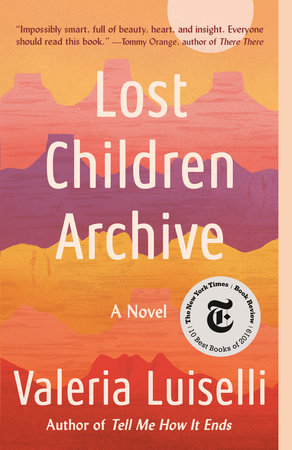
Lost Children Archive by Valeria Luiselli

Whenever the boy and girl talk about child refugees, I realize now, they call them "the lost children." I suppose the word "refugee" is more difficult to remember. And even if the term "lost" is not precise, in our intimate family lexicon, the refugees become known to us as "the lost children." And in a way, I guess, they are lost children. They are children who have lost the right to a childhood.

A family of four begins a cross-country road trip from New York City to Arizona. Mama is a documentarian who wants to record the stories of those affected by the separation of children at the U.S.-Mexico border; she has recently been working to help a friend locate her missing daughters, who have disappeared somewhere in those borderlands. Papa is a documentarist--as different, they say, as librarian from chemist--who wants to record natural soundscapes in the areas once occupied by Geronimo's Apaches, the last "free" people in revolt against the United States. In the backseat are his son, "the boy," and her daughter, "the girl," and together they are a somewhat makeshift, though precarious family: Mama, who narrates the first half of the book, isn't sure that what she and her husband are looking for on the trip is the same, and foresees that the end of the trip might also bring the dissolution of their marriage. But somewhere in the vicinity of the Chiricahua Mountains, the former stronghold of Geromino's Apaches, the boy, caught up in the stories his father and mother have told him about these many absent figures, takes his sister and runs away into the desert.

Who tells the story of the missing? How does one tell the story of the missing? For Papa, it's about recording emptiness: the natural sounds where people are not. It's also about imagination: the stories he tells the children about the Apache are obviously half-made up, a way of constructing a presence where non exists. (Papa, and the novel, perhaps pointedly and perhaps not, never seems to recognize that there are lots of living Apaches one might also record.) For Mama, the question is a fraught one over which she constantly agonizes. After hearing about it on the radio, they make their way for a rural New Mexico airport where a transport of children back to Mexico is taking place, and though they witness a small line of kids trooping from the hangar to the plane, most of what there is to see and document is stillness: a building, a plane. Even the boy becomes a documentarian/ist, with a Polaroid camera he's given for his tenth birthday. In this context, the fact that the children are undocumented takes on a special valence: Who will pay attention to them and how?

In Mama's section, this anxiety plays out through intertextuality, criss-crossed with a number of literary and journalistic sources that might help one make sense of the removal and disappearance of these children. Some are real books, fastidiously quoted and then indexed in interstitial lists of what's contained in the family's many moving boxes. I found this to be the least successful part of the novel, an attempt to write around a fundamental absence that left the narrative feeling overstuffed with ideas. Mama fixates especially on a fake book that tells a fable-like story of a group of children on a weeks-long train journey; it's pieces from this book--and others--that the boy adopts and reinterprets when the novel switches, halfway through, to his perspective. This section doesn't always work voice-wise, I thought, and even at ten his impulse to venture into the desert without his parents seems almost too thick-skulled to be believed. But it allows Lost Children Archive to escape some of the writerliness that makes the novel's first half seem sluggish.

In one cutesy detail, the kids each want to take their own empty moving box, to be filled with what they find on the trip. The girl ultimately fills hers with echoes: the sounds of people responding across a great distance, that turns out to be--for better or worse--the sound of us talking to ourselves. And yet, when the kids find themselves alone and lost in the Arizona desert, there is the chance that the echoes will turn out to be a real voice, searching for us as we are searching for it.

Saturday, January 8, 2022

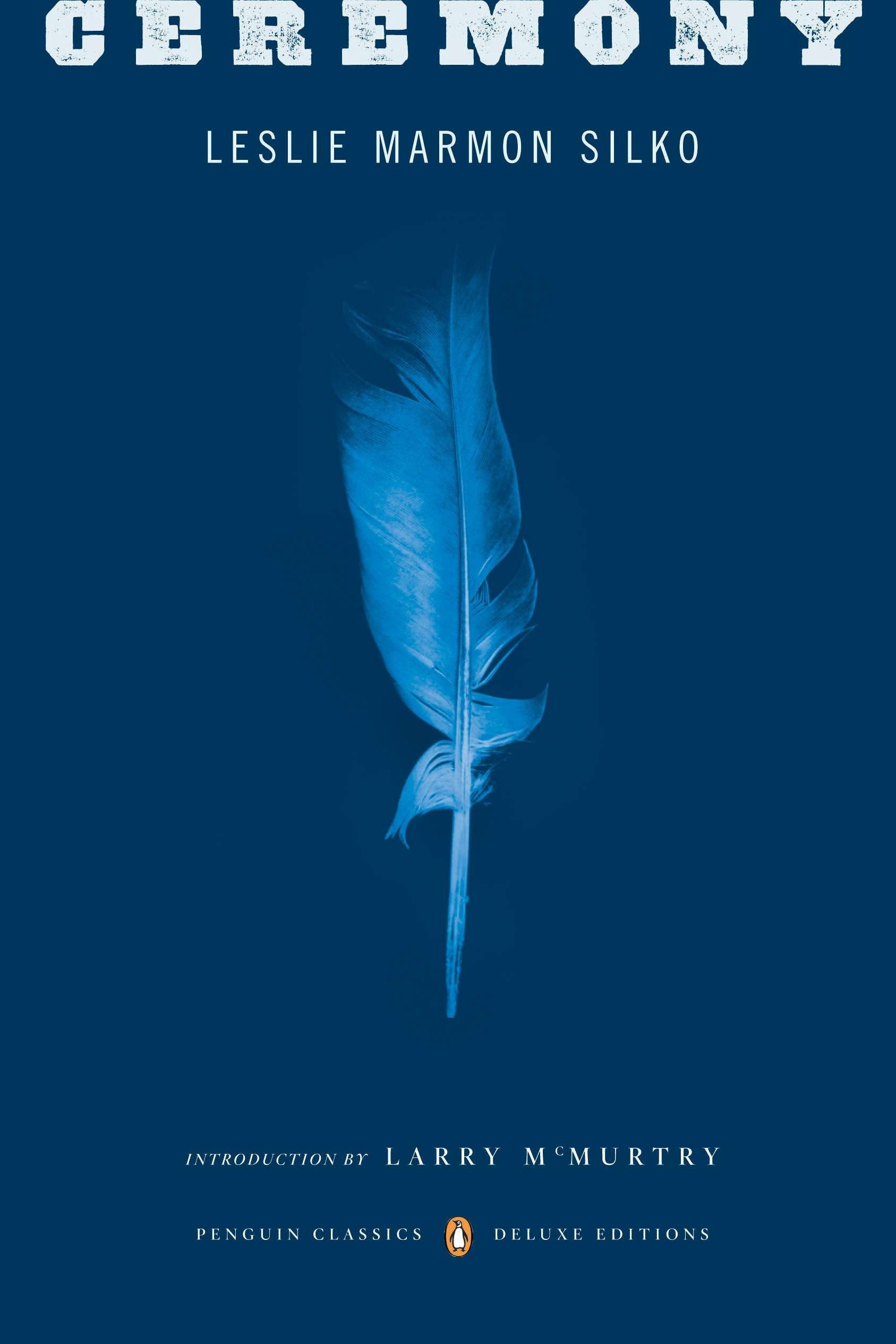
Ceremony by Leslie Marmon Silko

The dreams had been terror at loss, at something lost forever; but nothing was lost, all was retained between the sky and the earth, and within himself. He had lost nothing. The snow-covered mountain remained, without regard to titles of ownership or the white ranchers who thought they possessed it. They logged the trees, they killed the deer, bear, and mountain lions, they built their fences high; but the mountain was far greater than any or all of these things. The mountain outdistanced their destruction, just as love had outdistanced death. The mountain could not be lost to them, because it was in their bones; Josiah and Rocky were not far away. They were close; they had always been close.

I re-read Ceremony because, for the first time ever, I'm going to teach it in class this year. I'm looking forward to that but also I have a little trepidation; much of the time I spent re-reading it I spent trying to figure out what about the novel seems so difficult and enigmatic. The language is measured and plain, but the structure can be a little deceiving: it's the story of Tayo, a Laguna Pueblo man who has returned from World War II and the Baatan Death March with extreme PTSD, and who returns to mental and spiritual health by the aid of a ceremony rooted in Laguna and Navajo storytelling. The beginning is fractured, as is fitting for the narrative of Tayo's inability to move on from the horrors of war and death, but the process of healing, too, is strange, jumping from time to place and from person to person elliptically. Of course, perhaps it is a mistake to think that healing is a process that take something crooked and makes it straight.

I appreciated more, this time, the fine distinctions that Silko makes in her description of "witchery," an enigmatic evil force that is responsible for the creation of white people and European cultures. I can imagine this would be quite an unsafe book to teach in one of those states where anti-"CRT" bills have passed: ALABAMA TEACHER ASSIGNS BOOK THAT CALLS WHITE PEOPLE EVIL DEMONS, that sort of thing. But Silko is always quite clear that "witchery" victimizes indigenous and white people alike, and perhaps even that white people are in the most danger because they refuse to wake up and see it for what it is. "Witchery" is a destructive force; it loves death--it has something to do with capital in the Marxist sense, and the "love of money" in the Biblical sense, but Silko's formulation places it even further back, a black impulse in the human heart that is the root cause of these things. And a reactionary response might fail to see that it is actually invented by indigenous people, according to Silko's rendition of legend; in fact, this is the novel's central and strangest irony.

Once you see this, the outlines of the novel's racial and cultural outlook get both clearer and more complex: you see, for instance, how important to the novel it is that Tayo is of mixed race. Is his Aunt's resentment and neglect, so different than the love she heaped on his "purer" and now-dead cousin Rocky, a kind of witchery? Witchery's avatar in Ceremony is not a white person but an indigenous one: Emo, a sinister drunk who resents Tayo's white heritage as strongly as he yearns for the things that white people have. Silko shows sharply how tribalism and oppression are two sides of the same coin. You notice, too, what it means that Tayo's guide in his ceremony is a Navajo, and not a Pueblo man, despite suspicion on both sides; Ceremony manages to articulate the importance of returning to one's geographic and cultural roots while also showing the power of synthesis and syncretism. It's a subtle message and an unfamiliar one, but one I hope my students will welcome.

Ceremony is the first novel in what I'm calling "Indijanuary," despite it being nearly unpronounceable. I did this last year, too, reading eight books by indigenous North American authors in a row, and I'm excited to try it again.

Saturday, March 14, 2020

House Made of Dawn by N. Scott Momaday

Abel walked into the canyon.  His return to the town had been a failure, for all his looking forward.  He had tried in the days that followed to speak to his grandfather, but he could not say the things he wanted; he had tried to pray, to sing, to enter into the old rhythm of the tongue, but he was no longer attuned to it.  And yet it was still there, like memory, in the reach of his hearing, as if Francisco or his mother or Vidal had spoken out of the past and the words had taken hold of the moment and made it eternal.  Had he been able to say it, anything out of his own language--even the commonplace formula of greeting "Where are you going"--which had no being beyond sound, no visible substance, would one again have shown him whole to himself; but he was dumb.

This semester, I'm teaching a class on Native American literature for the first time.  I had planned on teaching four texts: Tommy Orange's There There, LeAnne Howe's Savage Conversations, Louise Erdrich's Future Home of the Living God, and this novel, N. Scott Momaday's House Made of Dawn.  Of course, the outbreak of the coronavirus pandemic has changed my plans.  I don't know if school will be happening this week or next, or if I'll be there even if it is.  If I have to cut a book from the curriculum, it's probably this one, important and vital as it is.  It's demanding, challenging--but I don't know if I'm in the right frame of mind for this kind of challenge right now, and I don't know if my students are either.

Anyway.  I did find that, reading it a second time, it wasn't as difficult a read as I had first found it.  It helps, of course, to know what happens; I spent the second time around not reading for the plot but for other things: the spareness of the language, for one, which is actually quite striking.  Some other things I discovered:

House Made of Dawn is a multiethnic and multicultural story.  On the surface, it's a story like Leslie Marmon Silko's Ceremony, in which a Native man, his spirit ravaged from war, returns to his tribal home only to find he no longer fits.  When he finds a way at last to reintegrate himself into the cultural and religious life of his community, his mental anguish disappears.  But for Silko, this means a rejection of white culture, which she associates with a malevolent force named "witchery," and complete reabsorption into the lifeways of the Laguna Pueblo.

In House Made of Dawn, on the other hand, Abel already begins as a kind of outsider: his mother is not Pueblo but Navajo.  His community, Walatowa, has opened their doors to a small group of refugee Navajo, whose ceremonies become part of Pueblo life.  The rites of the community are a mishmash of traditional Pueblo religion, Navajo religion, and Catholicism, which Momaday seems to respect.  And furthermore, my first reading of Abel's trist with the white woman Angela St. John (whose name is an Anglicization [Angela-cization?] of Walotawa's patron saint-figure Santiago, who may or may not be the St. John of of the Bible) as something nefarious now strikes me as a mistake.  Angela, after all, ends up helping to nurse Abel through his hospitalization in Los Angeles, when his hands are badly broken by a corrupt cop.  It seems hard to read House Made of Dawn as an embrace of a specific cultural tradition; after all, Abel's friend and narrator Ben Benally, who is Navajo, seems to be comfortable in Anglo-dominated L.A.

House Made of Dawn is structured around rituals and rites.  Part of what makes the book a challenge at first is that these rites are totally unfamiliar, and Momaday is not particularly forthcoming with explanations or justifications.  At Walatowa, there is ritual distance running and the Navajo practice of hunting and capturing eagles (!).  In L.A., there is the peyote ritual of the Native American church.  These rituals are what give order to life among the Native people of House Made of Dawn, and Abel's distress is clearest when he is unable to comprehend them.  During the festival of Santiago at Walatowa, Abel is bested in a strange ritual by an albino man named Juan Reyes, who rubs a bloody chicken in his face.  The first time around I read this as an act of gloating, but now it seems to me that it may be part of the ritual itself--who knows, honestly--which Abel misinterprets.  He kills Reyes in a fit of anger, perhaps because his mind remains on the field of battle, rather than the world of ritual.

House Made of Dawn is very good.  I'm sorry to think I won't get a chance to read it with my seniors, if that's really what's happening.  Doubtless some of them would breathe a sigh of relief if they knew they were being absolved of reading such a challenging text, but that's OK.  Maybe some of them will come back to it someday, like I did, and see how stunning it can be.

Saturday, October 19, 2019

Trinity by Louisa Hall

Then the earth under our feet lurched toward the mountains, and the mountains tilted a foot to the right, and the trees leaped off the sides of the mountains.

I grabbed for somebody's arm, and I saw that the women around me had turned into X-rays, and that my own arm was an X-ray as well, our bodies having become in an instant nothing more than revelations of the bone cages we'd lived our whole lives in.

Louisa Hall's Trinity, is, at least on the dustjacket, about Robert Oppenheimer, the scientist who spearheaded the development of the atomic bomb.  It takes a wide view of Oppenheimer's life, not just focusing on the narrow period of his work at Los Alamos, like Countrymen of Bones, another great fictionalized version of Oppenheimer, but before and after: in Berkeley, where he goes to meet his mistress who will eventually die by drowning herself in a bathtub; in Princeton, later in life, as he suffers through the slings and arrows of McCarthyism and agitates for nuclear control.  Oppenheimer had a fascinating life that often bordered on tragedy, with plenty of rich details.  (Hall repeats Countrymen of Bones' account that Oppenheimer played a corpse in a Los Alamos production of Arsenic and Old Lace, which I'm not sure I realized was a true detail.)

But in practice, Oppenheimer moves through the book like a shadow, or a background character, hardly ever seen face-on.  The novel comprises seven first-hand accounts of people of varying closeness to Oppenheimer: a friend, a secretary, a Secret Service investigator, even a college student whose only experience with Oppenheimer is seeing him speak in public.  Trinity shares a strategy with John Williams' Augustus: when a figure seems too broad, too loaded with stature to look at straight on, give as many different accounts as you can.  But unlike the Emperor Augustus, Oppenheimer never really gets a chance to speak for himself.

Trinity has exceedingly little to say about who Oppenheimer really was.  In some of these accounts, he's little more than a minor character who moves in the background of the narrator's immediate life.  The thesis of the novel, actually, is that it is difficult, if not impossible, to really know another human being.  The Secret Service investigator admits he has no way of knowing why people do the things they do--which seems like a weird thing for a detective to admit--and later sections extend that anxiety to their husbands, family, and friends.  Trinity is not just the name of the Los Alamos nuclear bomb test but a representation of the essential multiplicity of human character.  I absolutely knew we were going to get a paragraph like this one, which applies the Heisenberg Uncertainty Principle to human relations:

You never know, absolutely, what another person was feeling, just as we never know the velocity and the position of a particle at any moment, all knowledge being by nature incomplete, all studies missing an aspect at least of the object they study.

I'm not complaining.  When Trinity is at its best, it makes this anxiety seem freshly horrifying.  The novel is really kept up by three tentpole stories among the seven, each of which is narrated by a young woman in Oppenheimer's orbit.  The first is a Woman's Army Corps worker at Los Alamos who has recently been abandoned by her lover, a married scientist in Oppenheimer's orbit; the second is a secretary of Oppenheimer's whose eating disorder comes to symbolize, I think, the escalating rot in the 20th century social order; the third is a magazine writer who sees the offer to interview
Oppenheimer as an opportunity to pin down a great wrongdoer in the way she was never able to do for her cheating husband.  These woman are all victims of broken marriages, of husbands and men who pay too little attention to them.  Like Oppenheimer, who makes his secretary run back to get his copy of the Bhagavad Gita so he can get the quote just right, they use myth and literature to help them understand their own situations.  The first imagines herself as the murdered woman in Crime and Punishment, the second as Persephone in the summer.  How can they know other people?  They barely understand themselves.

The best of these may be the final section with the interviewer, because of all the stories in Trinity it does the most to really grapple with Oppenheimer's legacy, and to do more than throw up its hands at the impossibility of knowing anyone else.  Its attempts to bring the various threads of the novel together are fairly timid, but the narrator's brash inquisitiveness is an effective way to end the novel.  "Shouldn't we live all our lives," she says, "knowing it's our responsibility to account for ourselves with precision?"  If Oppenheimer can't give a reasonable accounting of a life that resulted in hundreds of thousands dead and more permanently mutilated, why should we bother with them?

The other four narratives range from entertaining to seemingly irrelevant.   I don't know what we're supposed to get out of the college student, for instance, whose insight into Oppenheimer is mostly watching him walk under a row of trees outside the lecture hall.  It can seem a little like padding, but I guess that's okay, because what it pads is so precious, and dangerously fragile.

Sunday, March 3, 2019

House Made of Dawn by N. Scott Momaday

Man came down the ladder to the plain a long time ago.  It was a slow migration, though he came only from the caves in the canyons and the tops of the mesas nearby.  There are low, broken walls on the tabletops and smoke-blackened caves in the cliffs, where still there are metates and broken bowls and ancient ears of corn, as if the prehistoric civilization had gone out among the hills for a little while and would return; and then everything would be restored to an older age, and time would have returned upon itself and a bad dream of invasion and change would have been dissolved in an hour before the dawn.  For man, too, has tenure in the land; he dwelt upon the land twenty-five thousand years ago, and his gods before him.

N. Scott Momaday's Pultizer Prize-winning novel House Made of Dawn is often credited for igniting a "Native American Renaissance" in literature, legitimizing the Native perspective as a valid and productive one and paving the way for later authors.  The premise mirrors Silko's Ceremony, another classic of Native American literature: a native man returns from World War II, broken and alienated, and must find a way to reconnect with his community and his history by embracing the culture of his people.

In this case, the man is Abel, who shows up one day in the town of Walatowa--better known to Anglo audiences maybe as the center of the Jemez Pueblo in New Mexico--on a bus and piss-drunk.  He stays with his grandfather Francisco, but Francisco is too absorbed with his own aging and lost youth to do much for Abel.  Through the local Catholic priest--a kind of updated, fallen version of Jean Latour--Abel gets a job cutting wood for a pregnant white woman who has taken a house nearby to take advantage of the local hot springs.  The woman, Angela St. John, seduces Abel, and the sex they have represents some kind of ultimate break, for Abel, from his community.

Angela sees in Abel the instantiation of a dream she has in which she approaches a wild animal, a badger or a bear:  "He was dark and massive above her, poised and tinged with pale blue light.  And in that split second she thought again of the badger at the water, and the great bear, blue-black and blowing."  She exemplifies way that white Americans can fetishize Native Americans, but Momaday allows for the possibility of a real connection between the two.  Years later, when Abel is lying badly beaten in a Los Angeles hospital bed, she comes to comfort him.  The relationship between Natives and whites in House Made of Dawn is never clear or straightforward.  What are we meant to do, for instance, with the albino man Juan Reyes, who humiliates Abel in a traditional horse race and whom Abel ends up stabbing to death?  His pale, terrible appearance suggests the Judge of Blood Meridian, but his ethnic identity--a Native man, of white appearance, with a Hispanic name--refuses to slip int symbolism.  Is Juan Reyes only a recognition of how endlessly complex our racial categories are in practice?

Abel goes to prison; he emerges into a grim and unforgiving Los Angeles.  He's unable to find or keep steady work; he finds friends and even a romantic relationship with a white social worker, but these things are unable to fill a deep and troubling void.  Among other things, this section of the novel presents a sharp and satirical portrayal of a preacher in the Native American Church, whose pet theory is that the Bible should have ended after six words:

You see, he had lived all his life waiting for that one moment, and it came, and it took him by surprise, and it was gone.  And he said, 'In the beginning was the Word...' And, man, right then and there he should have stopped.  There was nothing more to say, but he went on.  He had said all there was to say, everything, but he went on.  'In the beginning was the Word...'  Brothers and sisters, that was the Truth, the whole of it, the essential and eternal Truth, the bone and blood and muscle of the Truth.  But he went on, old John, because he was a preacher.  The perfect vision faded from his mind, and he went on.  The instant passed, and then he had nothing but a memory.  He was desperate and confused, and in the confusion he stumbled and went on.

Words are powerful, stories are powerful--is the preacher's insistence that everything else is "fat" a claim for the power of words or a way of reducing their power by denying so many of them?  The novel also includes what is supposed to be a pretty faithful rendition of a peyote ceremony.

House Made of Dawn is not an easy book.  The first couple of sections are incredibly difficult to parse.  The section at the Pueblos is intensely sensual, descriptive; it lingers for pages over the appearance of a coming rainstorm but withholds clarity in character and action.  The next section, detailing Abel's experiences in Los Angeles, are intentionally fractured, meant to mirror the perspective of Abel, who wakes up on the beach with both his hands broken.  The third section, which is written from the point-of-view of Abel's friend and roommate Ben are much more forgiving.  It's almost as if Momaday recognized the difficulty the narrative and wished to provide an more familiar and recognizable voice, one capable of filling in the details: Abel's hands are broken because he confronted a racist policeman who harassed them.  But Ben is also comfortable in the white Anglo world, his voice comforts a reader like me but it isn't necessarily the right voice to describe Walatowa or Abel's homecoming.

And he does come home: In the end, comforted by Angela and sent back on a train to New Mexico, Abel comes home to take care of his dying grandfather, Francisco.  Momaday suggests that Abel, broken but not done in, may find his place in his community again by taking care of those who came before him.  Man, too, he reminds us, has "tenure in the land": the connection is too old and too profound to be obliterated.

Sunday, November 18, 2018

Countrymen of Bones by Robert Olen Butler

The King was free.  He lay on his pedestal and his feet were tight together and angled like a diver's.  The earth around him was smoothed and leveled and Darrell could not cast off the impression that the King had not been reached by digging but, rather, had himself risen on the narrow platform through a corridor in the earth.  The cape of shells seemed only recently shrugged from the King's shoulders.  He'd come now when he was needed.  One King to succeed another.

New Mexico, 1945.  Two scientists are working in the desert.  One, Lloyd Coulter, is a high-ranking scientist in the Manhattan Project, responsible for creating the mechanism that focuses the energy inside the atomic bomb and causes it to detonate.  The other, Darrell Reeves, is an archaeologist at the University of Santa Fe excavating a burial mound that contains a breakthrough discovery: a king from the mound-building cultures of the Midwest, buried far away from the region where he might be expected.  The Trinity explosion will eradicate Reeves' burial site, and the Manhattan Project scientists are pressuring him to finish his work and remove the skeletons, and the conflict between them is amplified by Lloyd and Darrell's rival interest in Anna Brown, a young army officer who is assisting both projects.

At first, Lloyd and Darrell are difficult to distinguish.  Both are men of science, intensely obsessed with their own projects at the expense of all other things.  Darrell is a little older, once married, and his archaeological outlook on the world has failed to help him understand the world of living human beings.  When FDR dies, he imagines "Roosevelt's skeleton being unearthed--a long age from now--Roosevelt's bones being brushed clean, the pelvis measured, the signs of his paralysis visible in the joining of his bones."  He thinks back on how all his knowledge failed to save his marriage:

Once, he had come home and found her gone to the store.  He went into the subterranean stillness of their bedroom and he looked around, trying to read their life together.  He went to the dresser to see her artifacts.  One at a time he picked up the objects there; he turned them over in his hands, trying to read the clues.  Her hairbrush, the bristles worn and bent, black hair tangled there: how thrilling this would be in an excavation, how much he could deduce.  From the hair of the woman he could learn about the chemical balances of her body, her age, her health, perhaps her diet.  From the brush itself he could learn about the artisans of her society, her economic status, whether she was right-handed or left-handed.  But he could not say from this brush why his wife had married him or why she would soon leave him.  Perhaps if I could see her bones, she thought.  If I could touch her bones.  But he knew nothing and he put the brush down.

But soon differences between the two men become clear.  Darrell is single-minded and hapless, but in the service of bringing the dead back to life and telling their story; Lloyd projects onto the bomb his fantasies of control.  Darrell is sheepish and forthright with Anna; Lloyd stalks her and imagines that the successful test will usher in a new age in which he has the power to bend Anna to his will in the that he's bent the atom.  Butler loves the image of the circle: for Lloyd, the circle is two halves of a sphere of plutonium being forced together to make the bomb's powerful core.  For Darrell, it's the symbolic circle of the burial mound, meant to describe the whole universe for the King.  That circle is a mistake, the representation of the erroneous belief that everything can be known and understood.

Butler dives deep into the psychology of the two men.  Lloyd is always thinking about his father, who abused his mother, and the Freudian implications are that this relationship made Lloyd the way he is.  But the psychology has the ironic effect of flattening the men and subordinating them to the novel's Big Ideas, like the perpetuation of violence on cosmic and historic scales.  Much more interesting, I think, are characters like Anna, who exudes both confidence and uncertainty, a fundamental goodness that isn't impeded, as it might be in some novels, by naivete.  She professes to be in awe of the scientist's expertise, but has more wisdom than they do.  She's more interesting because Butler doesn't feel the need to psychologize her, only to let her exist.

Similarly, Countrymen of Bones presents a fascinating portrait of Robert Oppenheimer: an aloof genius, with a passage from the Bhagavad Gita always ready (much to the annoyance of everybody else).  In one particularly clever moment that expresses an ironic playfulness and a chilling self-awareness, he cameos as a corpse in the Los Alamos amateur theater production of Arsenic and Old Lace.  A rancher who, angered at the Manhattan Project for encroaching upon his land, projects that anger onto the archaeologist, also seems especially prescient.

The buried king from the Midwest is a member of a Death Cult, Darrell explains, inspired by reports of the brutality of Spanish conquest.  The King had no idea that as he traveled into the Southwest that he was running into the arms of the very violence that terrified his people.  And as Darrell unearths more and more of the mound, he finds more bodies, violently killed: trophies, women, that the King took along with him into the earth.  We may not have had tools like the atomic bomb, Butler argues, but we have always turned our fear of death into a tool of death.

Ultimately, Countrymen of Bones suffers under the weight of those Big Ideas.  It reaches out to try to incorporate Roosevelt, the end of the European war, the revelation of the Holocaust, in ways that feel perfunctory even as it seems like they must have been on the minds of people in 1945. And I don't think--spoiler alert--that it's necessary to have Lloyd rape Anna, or to present the act in detail from Lloy'ds perspective.  I don't think his last act, to save them from the atomic blast while sacrificing himself, is a meaningful atonement.  But it's a gripping story, and the way that Butler careens from one man's point of view to another's even in the same paragraph is remarkably subtle.  Countrymen of Bones has a sharp eye for the way that history, as a story of violence, is incarnated in the lives of individual men and women.

Thursday, October 4, 2018

Cities of the Plain by Cormac McCarthy

The wind outside and the cold in the room were like those winter nights on the north Texas plains when he was a child in his grandfathers house.  When the storms blew down from the north and the prairie land about the house stood white in the sudden lightning and the house shook in the thunderclaps.  On just such nights and just such morning in the year he'd gotten his first colt he'd wrap himself in his blanket and go out and cross to the barn, leaning into the wind, the first drops of rain slapping at him hard as pebbles, moving down the long barn bay like some shrouded refugee among the sudden slats of light that stood staccato out of the parted board walls, moving through those serried and electric prosceniums where they flared white and fugitive across the barn row on row until he reached the stall where the little horse stood waiting and unlatched the door and sat in the straw with his arms around its neck till it stopped trembling.

In the third book of Cormac McCarthy's "Border Trilogy," John Grady Cole, the protagonist of All the Pretty Horses, and Billy Parham, the protagonist of The Crossing, are working as cowboys at a ranch outside Alamogordo.  It's a crossover episode!  Both men, isolated and long-suffering as they are, like being cowboys.  But it's a life that might not be long for this world; the federal government wants to turn the land they graze on into a military installation (today's White Sands Missile Range, probably).  In the middle of the century, cowboys are a dying breed.  One character, I forget who, remarks that the war changed everything.

It's not clear how the war changed cowboying, but it does remind me of the terrific ending of--which?--I think The Crossing, with its reference to the Trinity nuclear bomb test.  And it aligns with McCarthy's notions of history, all of which he believes was written at the beginning of time, down to the life and death of a single man.  For McCarthy, the arc of history is the same as entropy, it bends toward destruction and chaos.

The end is hastened by John Grady's falling in love with a Mexican prostitute.  Their love poses its difficulties: she's fifteen, but that's nothing compared to the fact that she lives over the border in Juarez and is kept by a madman pimp who is also in love with her.  Oh, and she has epilepsy, but she hasn't told John Grady that.  It all unfolds in a recognizably violent fashion, remarkably recorded but with very few surprises.

At one point, Billy says:"I damn sure dont know what Mexico.  I think it's in your head.  Mexico."  Which of course, is true.  Both Billy and John Grady, despite fluent Spanish and extensive experience in the country to their south, understand Mexico as a kind of reflection of their own inner darkness.  That's because McCarthy thinks about it as a reflection of their own inner darkness as well.  Going to Mexico, especially in The Crossing, is something like the descent into hell in Greek epics.  It's easy to excuse the way McCarthy exoticizes Mexico because he does that to America too, in a different way.  After all, it's under a Texas overpass that the long epilogue takes place, in which an aged Billy meets a wise beggar who tells him about a mysterious dream.

I can accommodate that, but did I need another Mexican waif to fall in love with?  I certainly didn't need her to be fifteen years old.  Her age, her illness, all add up to extreme vulnerability and powerlessness, mark her for violence and death, make her the center of male rage, whether Eduardo's in keeping her or John Grady's in defending her.  Her relationship with John Grady seems borrowed from his love for Alejandra in All the Pretty Horses, but with more mythology and more blood.  In McCarthy's books, tragedy repeats itself as even darker tragedy.

The most well-wrought relationships in Cities of the Plain are between men.  Between John Grady and Billy, outcasts and pilgrims who end up finding each other, and the other cowboys, who are mostly of the same stock.  McCarthy has an ear for their language that sits in lovely tension alongside the mythopoetic gibberish he likes so much.  (I don't mean that as an insult--I like that stuff, even when it's gibberish.)  His belief in an irrevocable destiny, as violent as it is, ennobles these plainspoken cowboys.

Sunday, August 26, 2018

The Last Gentleman by Walker Percy

The South he had come home to was different from the South he had left.  It was happy, victorious, Christian, rich, patriotic and Republican.

The happiness and serenity of the South disconcerted him.  He had felt good in the North because everyone else felt so bad.  True, there was a happiness in the North.  That is to say, nearly everyone would have denied that he was unhappy.  And certainly the North was victorious.  It had never lost a war.  But Northerners had turned morose in their victory.  They were solitary and shut-off to themselves and he, the engineer, and got used to living among them.  Their cities, rich and busy as they were, nonetheless looked bombed out.  And his own happiness had come from being onto the unhappiness beneath their happiness.  It was possible for him to be home in the North because the North was homeless.  There are many things worse than being homeless in a homeless place--in fact, this is one condition of being at home, if you are yourself homeless.  For example, it is much worse to be homeless and then to go home where everyone is at home and then still be homeless.  The South was at home.  Therefore his homelessness was much worse in the South because he had expected to find himself at home there.

Will Barrett is a Southerner, by way of Louisiana and Alabama, living in New York City.  He is intelligent, kind, and diligent, but Percy tells us that "he looked better than he was" and that in him "something was missing."  He suffers from psychological maladies both specific and abstract: he suffers from amnesia and fugue states, sometimes forgetting who he is, and more general ennui.  He engages a psychiatrist, and does everything prescribed to him, but in years of therapy has made no progress.  Still he wants to know, why does he feel so bad when he ought to feel good?  Why do good environments make him feel bad and bad environments make him feel good?  A detail shows that he suffers from the same modernism that Binx Bolling does in Percy's The Moviegoer: he visits the Metropolitan Museum of Art, but the Velazquez looks dead and inert to him until a worker falls through a ceiling light.  Suddenly it is "glowing like a jewel"--proximity to tragedy elevates life, though momentarily.  For Binx it's the movies that make things real; for Will it's his telescope, that makes the bricks on the buildings across Central Park suddenly alive.  Both of them have the same problem: How is it possible, they ask, to live from one moment to the next?

Though existential angst must be universal, for Percy it's always tied to geography.  Will's self-imposed exile from the South is a kind of self-abegnation:

New York is full of people from small towns who are quite content to live obscure lives in some out-of-the-way corner of the city.  Here there is no one to keep track.  Though such a person might have come from a long line of old settlers and a neighborhood rich in memories, now he chooses to live in a flat on 231st Street, pick up the paper and milk on the doorstep every morning, and speak to the elevator man.  In Southern genealogies there is always a mention of a cousin who went to live in New York in 1922 and not another word.  One hears that people go to New York to seek their fortunes, but many go to seek just the opposite.

I don't feel that way--I feel quite at home in New York--but as an ex-pat Southerner I recognize some of the shape of Will's life.  Hell, I finished the novel on a plane this morning headed back to New York from visiting my own ancestral home.  The South is central to Will's identity; he embraces it, right down to college football and golf (Percy is the novelist of golf), but he runs from it because embracing it doesn't make him feel any better.  It makes him feel worse because the embrace of it does so little.

Will's return to the South happens this way: using his telescope, he spies a beautiful girl retrieving a secret message on a bench in Central Park.  He follows her to a hospital in Washington Heights (Columbia Medical School, where Percy himself once studied) to find her attending to her terminally ill teen brother, Jamie.  Will ingratiates himself into the family, who turn out to be old-school Alabamians, too, fellow aliens.  The family's patriarch, Chandler Vaught, employs Will to be a kind of caretaker for Jamie, and return to Alabama with them.  His daughter, Kitty, falls dutifully but difficultly in love with Will.  Added to these are Rita, a dutiful sister-in-law who manages Jamie's care and is suspicious of Will; Val a sister to Jamie and a sister of the cloth (she's a nun), and Sutter, a disgraced doctor and self-professed pornographer whose influence on Jamie is considered slightly less dangerous than his illness.

Left in New York by the family, Will hitches a ride with a John Howard Griffin-style photographer disguised as a black man.  Together they're ambushed in Levittown by a mob thinking they've come to "bust the block," meaning sell a house to a black man.  It's a weird and funny digression, meant to highlight, perhaps, the rottenness at the heart of the century of the American suburb (Levittown is America's first), and deflect the idea that racial tension is the property of the south.  There's a touch of real gallantry in Will when he snaps at his companion not to give in to the mob by showing them the remaining spot of Caucasian skin.  It's a nice moment, especially because Percy, like Will, often keeps his black characters at arm's length.

When Will is finally reunited with the Vaughts, the plot remains comic and frenzied, and sometimes borders on nonsense.  There's an inherent but understandable silliness in the way the family hinges on Jamie's wishes: when he wants to go to school, Jamie, Will, and Kitty all enroll at the University of Alabama; when he wants to jet off to New Mexico, Will's got withdraw from school and climb in the camper van.  Take a step back and you'll see how wild it is that this family invites this genial stranger into their life this way at all.  But perhaps they know, like Will, that in the proximity of danger and death everything changes, even as they uphold the banners of the rectitudinous country-club South.

Will's return to the South might have played like Milkman's in Song of Solomon: an expedition to an ancestral home that allows the protagonist to discover who they are.  And Will does go home: to his uncle's, who lives in a weird hermit state with his black servant, and to his childhood home, where his father once committed suicide.  But he doesn't see his aunts who still live there, he sneaks in and sleeps in the attic.  And it's his house--he owns it!  But there are no answers there, and the same old problems return.  Kitty becomes exactly the kind of old-fashioned southern sorority girl that he thinks he desires, and it repulses him.  Deracination--uprootedness--hurts more when the roots are deepest, as they are in the American south, Percy tells us.  The intensity of its myths and manners are no match for the modern condition.

The final section of the novel takes place outside Santa Fe, where Jamie has decamped to live out the last days of his life.  As a setting, New Mexico does strange work in this novel.  It means an abandonment of the dialectic of North and South, an escape to a place that has nothing to do with those old polarities.  It represents the possibility, perhaps, of a kind of transcendence, and a death for Jamie on his own terms.  My wife and I had our honeymoon in New Mexico.  We talk sometimes about moving there for good.  Our relationship to the place isn't very strong, or knowledgeable, but I understand how it functions as the idea of a place.  And it's strange, the way this novel seems to share a kind of mental map with me, and which made it meaningful to me in particular.  The ending, which centers on the question of whether a delirious Jamie will allow himself to be baptized by the hospital chaplain, resolves nothing, but it is funny, strange, ragged, and deeply sad.

The Last Gentleman is a novel I wish I could go on talking about.  What do you make, for instance, of the fact that Will is typically identified as "the engineer," though it refers to his title as a custodial engineer in the basement of Macy's, a job he gives up in the first 100 pages?  What's he making, what's he fixing?  Much of it seems like it ought to fail, but it hovers somewhere outside the realm of rational sense, and does so beautifully.  More than any of the other novels I've read of Percy's, it shares the kind of madcap logic and unexpected prose of The MoviegoerIt's a book that, when I was done with it, I wanted to turn it over and start it again, to prod it into some kind of structure and sense.  But to do that, to make a thesis statement of it, might rob it of the brilliance of its mystery.