Showing posts with label colorado. Show all posts

Wednesday, July 8, 2026

A Lady's Life in the Rocky Mountains by Isabella L. Bird

We forded the river, whose course is marked the whole way by a fringe of cotton-woods and aspens, and traveled hour after hour with nothing to see except some dog towns, with their quaint little sentinels; but the view in front was glorious. The Alps, from the Lombard Plains, are the finest mountain panorama I ever saw, but not equal to this; for not only do five high-peaked giants, each nearly the height of Mount Blanc, lift their dazzling summits above the lower ranges, but the expanse of mountains is so vast, and the whole lie in a transparent medium of the richest blue, not haze--something peculiar to the region.

Explorer Isabella L. Bird's A Lady's Life in the Rocky Mountains is an account of her 1873 travels throughout the Rockies, framed as a series of letters written to her sister. I put it on my Kindle on a whim for my trip to Colorado because I was struggling to find a book written by a woman--as you might know, I try to alternate--to go with Craig Child's travelogue about searching for Ancestral Puebloan sites on the western side of the state. Bird's book turned out to be delightful--a breezy, well-written account of life in Colorado in the late nineteenth century, accented by skillful descriptions of the land and droll accounts of the region's "characters."

Obviously, traveling in the Rocky Mountains in 1873 is not like the traveling I did there this week.  It takes an hour for the modern traveler to get from Denver to Estes Park, the gateway to Rocky Mountain National Park, but when Bird did it, it took several days of difficult travel by horse. And when she got there, Estes Park was not the town we know it today, but a true park, meaning a kind of valley or glad that might be home to a few houses. In this case, those houses belong to a pair of rival mountain guides, both of whom ingratiate themselves to Bird: Evans, with whom she typically boards, and the infamous desperado known as "Mountain Jim," whose bloodthirsty and frightening reputation is immediately belied by his chivalry toward Bird, with whom he strikes up an immediate friendship.

Birds account of Mountain Jim is, if I had to pick something, the most delightful thing about the book, and it's complicated by the numerous footnotes for publication revealing, little by little, that Jim met his end after the events of the book after being shot by Evans. We never get the whole story, which as I understand it is somewhat lost to history, but there's a bittersweetness to Bird's clear implication that it was Jim's reprobate ways, not Evans, that really brought his downfall. This knowledge brings a special irony to a late section where Jim, having guided Bird up a high winter pass, tearfully breaks down about his own "lost" nature.

But Jim is only one of a few fascinating characters who appear in Bird's travels, which include other trappers and guides, destitute farmers, and poor greenhorns who are in over their heads in the hardscrabble new territory. Bird notes that the thin mountain air has attracted many consumptives, and some of the saddest parts of the novel are depictions of tubercular patients who have arrived in the Rockies to live out the last moments of their lives. I also really liked her resentful account of a young boarder who eats everything, does no work, and loses the milk cow. But the most interesting character might be Bird herself, who despite some false modesty about her abilities, comes off as an intrepid and capable solo traveler. It's no wonder that, wherever she goes, the newspapers have announced the arrival of the remarkable "British lady." And part of that character is not just her ability to traverse the mountains, but really see them--her descriptions of the Rockies transcend the 150 years of stylistic difference, and I was particularly struck by her detailed account of climbing Longs Peak, a feat that challenges climbers even today.

Monday, July 6, 2026

House of Rain by Craig Childs

I turned off my light in the back of the cave. I closed my eyes. It felt as if all these centuries, these thousands of years, were contained here, their processions playing out again and again as drips strummed the pool beside me. The same routes are traveled repeatedly, the same meridians followed across horizons, over hundreds of years. Anasazi, I thought, was never a people. It was a rhythm, a form of motion stirred up from the land. People merely fell into step.

I got to return to Mesa Verde National Park last week and tour two more of the enormous cliff dwellings built nine hundred years ago directly into the rock. They are impressive places, made up of turrets and geometric stacks of rooms and huge circular underground kivas. It's hard not to think what the first white Americans, cattle ranchers, thought when they encountered them for the first time: how could somebody build something like this and then just abandon it? The "disappearance" of Ancestral Puebloans, previously known as the Anasazi, has been compelling narrative for a long time, a puzzle to be solved. Craig Childs, in House of Rain, travels through major and minor Puebloan sites throughout the southwest and Mexico, seeking an answer to just that question.

Among other things, House of Rain is a travelogue, and some of the most impressive passages involve Childs moving across the high, dry landscape of the Four Corners area on foot, sometimes with his wife and infant son in tow. He skillfully and poetically describes the beauty of this area, which is among my favorite places in the world. So in that sense it was like comfort food to me. And I appreciated hearing descriptions of some of these Puebloan sites I'll never see; tucked away in the corners of deep canyons, undisturbed in the way those first ranchers must have seen them. You can see how much more uncomfortable Childs is at, say, Aztec Ruins, a site run by the National Park Service in the backyard of a suburb of Farmington, New Mexico. Better to pass into these regions of quietude, where the intervening years can disappear and the past reappear in the form of a broken wall, a husk of corn, a potsherd.

So what happened to the Ancestral Puebloans? As Child notes, though a little begrudgingly, the mystery is not much of a mystery at all: they migrated, probably because of an intense drought in the high country of the Four Corners. Childs puts some specifics to this that I found highly interesting: his conclusion, based on the introduction of new kinds of polychromatic pottery in the lower regions of Arizona, is that the Puebloan culture migrated to the south, mingling with Hohokam and Mogollon cultures that were already there to create the culture now known by archaeologists as the Salado. It's Childs' contention, actually, that tensions between the new elements of this multicultural society resulted in the collapse of that society, leading the Pueblo peoples to splinter into the groups that now make up the two-dozen-odd Pueblos of the Rio Grande Valley, as well as the Hopi. But Childs throws his lot in with some more outre conclusions as well, like a revisionist theory that Puebloans migrated north from Chaco Canyon to Mesa Verde and then south again along the same meridian to a location in Mexico known as Paquime (or today as Casas Grandes), which other archeologists consider more closely related to the Aztec cultures of Mexico to the south. In any case, Childs favors a version of the Puebloans that emphasizes their grandeur, claiming for them a larger sphere of influence than many of his peers.

House of Rain is only twenty years old, but it wears its age. The term Anasazi, a rude exonym that comes from the Navajo, has been entirely supplanted by "Ancestral Puebloan." And while Childs undercuts the question Where did they go, my understanding is that nobody accepts this any longer as a framework from which to begin--something which perhaps Childs should be given credit for. But my biggest frustration with House of Rain is how it keeps modern Pueblo peoples at arm's length. They appear infrequently, and often in ways that stymie Childs' research, as with a council of elders that refuses to give Childs permission to conduct research. Childs paints this as a typical reservedness, but then again, he's the one who uses the word Anasazi around them, knowing it's offensive, but catching himself too late. Childs folds in some of the stories and legends of modern-day Puebloans that support the narrative of migration, but I noticed that these stories always tend to begin "a Hopi man once told me," while the researchers have names. At a dig, Childs notes the frustration of an archeologist who is forced to stop digging when human remains are found--a key stipulation of the Native American Grave Protection and Repatriation Act--and, in way that felt telling to me, lets that frustration pass by without comment.

All of these are minor missteps, perhaps, but they add up to a sense that Childs is most interested in the version of the Ancestral Puebloans that live in his imagination, and keeps the modern-day Puebloans and Hopi who might shine light on them at arm's length because they might complicate that imagination. Which is all just to say that I think House of Rain would be stronger if it had found a way to engage more deeply with them. That said, in the end, I really enjoyed deepening my understanding of the people of Mesa Verde this way, and I was persuaded by Childs' invitation to see them not as a static society that suddenly "collapsed," but a living, moving culture passing through several stages of development over centuries: a rhythm, a form of motion.

Thursday, August 14, 2025

Canoes by Maylis de Kerangal

When did I start placing myself in the fable? At first I kept my distance--and maybe a certain mocking grin had even settled into the corners of my lips, the smirk of someone who's not fooled and wants everyone to know it, someone who puts on airs--up until the day when I was at Folks (the renowned main-street store that was also mimicking something, for example the grocery and hardware store of a pioneer town, and smelled like floor wax, onions, and ground coffee) and a woman with her hair braided into a crown hands me a brochure, points to Kid and then up into the air: you should go up there with the little boy! On the ceiling, all I saw was a row of pinkish neon lights. Then I peered closer at the brochure while the woman looked on, probably impatient to see my reaction: Buffalo Bill is buried at the top of the mountain that overlooks the city, the summit of the panoramas, Lookout Mountain, he's right there. I didn't know Buffalo Bill was a real person and not just a fictional character, a figure of the Far West portrayed some fifty times over in the movies, nor did I know that in 1882, he'd created Buffalo Bill's Wild West show, a history of the "conquest" of the West under the Big Top, which toured in North America and Europe and was seen by more than seventy million spectators--the re-enactment depicted the version of the victors, focusing on the great mythical epic, the moustaches, gold nuggets and guns, using fictional pioneers in Stetsons, but real "natives," who played out their own attempted genocide while the federal army was massacring them in real life.

The protagonist of "Mustang," the novella that anchors French author Maylis de Kerangal's Canoes, is a French woman whose husband has relocated to Golden, Colorado, to work as an engineering professor. Her only task is to look after their young son and adjust the new American landscape, which is a demanding task indeed. She becomes obsessed with the minerals in the window at the rock shop (my God, what's more American than a rock shop?) and captivated by the mythologies of the Wild West, the cowboys and the Indians, at the same time she casts toward them a skeptical, European eye. Her husband buys a car, a green vintage Mustang, a good, garish American car, and learning to drive gives her a sense of limited freedom in this isolating place. In one very funny scene, she opens the driving instructor's glovebox to find a gun, which she then has to hide under her buttocks, and which then slips into her bag, taking it away with her because she's too embarrassed to admit to prying. That's America: the gun gets in your bag whether you like it or not.

This story got close to the magic of de Kerangal's novel Painting Time, with its liquid but precise sentences, its dogged but determined prose, that marches so unflappably through the inner workings of a mind. And I loved how, like de Tocqueville, "Mustang" gives a sense of America from an outsider's perspective, one characterized by fascination and revulsion, and the shock of being absorbed into a place that you're not sure you want to be absorbed into. America will assimilate you, whether you like it or not. The central image of the Mustang is a little on the nose, perhaps, as is the astounding crash-up that ends the story, but I was, as they say, very much along for the ride.

The other stories in Canoes are a very different sort. They're much shorter, naturally, but pointedly vignette-like, without much in the way of plot or dynamism. Sometimes they are only snapshots, some which work, and others which fall a little flat. I liked, for instance, the contrast between the recent high school graduate undertaking primal scream therapy with her friend group and her brother's halting stutter in "After," and the strange shiftiness of "Ontario," about a visit to Toronto on Decoration Day, although--or perhaps because--I'm not really sure what it's about. I was less interested in a story where a man agonizes over whether to delete his wife's voice from an answering machine, one of a few that felt very one-note. De Kerangal is deeply interested in voices and sounds: a narrator meets an old friend to discover that her voice has changed; a woman is tasked with reading Edgar Allen Poe's "The Raven" into a microphone and finds herself estranged from her own voice. Rooms are filled with other noises, and de Kerangal is especially sensitive to the ebb and flow of ambient noise, which either conceals or makes space for voices. 

Wednesday, March 29, 2023

Field Notes by Barry Lopez

That winter I dreamed four times about wolverine. I decided I was going to go up there when spring came, regardless. I've never been able to learn what I want to know about animals from books or looking at television. I have to walk around near them, be in places where they are. This was the heart of the trouble that I had in school. Many of the stories that should have been about animals, about how they live, their different ways, were never told. I don't know what the stories were, but when I walked in the woods or out on the prairie or in the mountains, I could feel the boundaries of those stories. I knew they were there, the way you know fish are in a river. This knowledge was what I wanted, and the only way I had gotten it was to go out and look for it. To be near animals until they showed you something you didn't imagine or you hadn't seen or heard.

The characters in Barry Lopez's story collection are often academics or researchers: the Arctic voyager of "Pearyland," the fossil expert working at the American Museum of Natural History in "The Open Lot," the anthropologist in "The Entreaty of the Wiideema." They are collectors of knowledge, in a way, but their methods have a way of foundering against unknowns, mysteries which require different methods of seeing and knowing. That anthropologist seeks out the Wiideema, an unstudied (and totally invented) indigenous group in Australia because he's seeking that kind of knowledge, and finds more than he bargained for: when a Wiideema woman speaks to him for the first time, he quickly understands that it's not English she's speaking but a kind of universal language that emerges from sheer being. He can communicate with her, and them, as long as he doesn't try too hard to understand, anthropologist-like, to figure out just how it is they are communicating in the first place. In this way, the Wiideema represent something like the wolverines of "Lessons from the Wolverine," who also have their own language for speaking. The lesson they teach is that real knowledge emerges from existence, from being among the immediacy of the earth, its places, its animals; it cannot be found in systems, schemata, or books.

Over and over again Lopez contrasts this kind of knowledge with the bookish kind: the fossil expert "sees" the fossil within the rock better than any of her peers, but she never advances because she refuses to systematize or generalize. The narrator of "The Negro in the Kitchen" is a fitness-obsessed retiree who finds--as the title suggests--a strange black man in his kitchen one day, having set a place at the table for them both. The man, it turns out, is walking across the United States from the East Coast to the Pacific, searching for an intimacy with his own country. In a telling moment, the narrator gets up to examine a bird at the window and check it off his life list--a solitary vireo. His guest, who has learned birdsong by the hundreds, corrects him: it was a ruby-crowned kinglet. The man is disappointed--he's already spotted a kinglet--and when his guest leaves, he goes not to the window but to his bird book to read. Despite his air of smug (white) paternalism, he's failed to learn the lesson the "Negro in the Kitchen" has borne to him.

Field Notes is best when Lopez zeroes in on the details of place; he has a Willa Cather-like skill at describing the simple features of a landscape in way that allows us to see it with freshness, ranging from the Arctic to the American desert to rocky creeks of Colorado. He's better at places than people, which is why the story "Conversation"--in which a conservationist begs her brother, the Secretary of the Interior or something, to place the ferruginous hawk on the endangered species list--such a wooden mistake. The introductory piece, "Within Birds' Hearing," towers over the rest of the collection: a strange and hallucinatory account of a man who leaves his home in the Mojave without a map or supplies, or a clear reason, walking toward a distant creek. The man's journey is so reckless I thought for several pages Lopez was describing the migration of a bird. But maybe that's the point; we have grown incapable of following a birdlike instinct, if we ever were--in the end it is a group of mourning doves who save him by siphoning water into his mouth when he is close to death.

Sunday, January 15, 2023

White Horse by Erika T. Wurth

Until now, I'd never thought about the other world except as something on the silver screen or the page, though I had to admit, horror had always been my favorite, which had to say something. I didn't believe in an afterlife, had never let Aunt Sandy drag me to church, even when I was a little girl. Though Jesus she'd tried, hard. And though some of my best friends growing up were more tradish Natives, from NAC to old school Dine lifeways, I wasn't interested in their stuff either. Whenever we'd be walking off in the woods, trying to find a place to get high, and a coyote would cross our paths and they'd shudder, tell me we had to turn around, I'd tell them to go right ahead. I was going to move forward and get baked.

Kari James is an "urban Indian," an Apache living in Denver. She spends her days haunting bars, especially her beloved White Horse, but she in turn is haunted by twin tragedies: the car crash that has destroyed her father's brain, and the overdose death of her teenage friend Jaime. Another tragedy, the mysterious death of her mother, has had little conscious impact on her, because Kari barely remembers her. But when her friend Debby discovers a copper bracelet that her mother used to own, Kari finds herself literally haunted: by touching it, she seems to have unloosed her mother's ghost, who follows Kari with blood pouring out of her mouth. Her mother, it seems, wants her to solve the mystery of her death, which has something to do with both a vicious Apache monster named the Lofa and Kari's own never-before-met grandparents.

Native horror is having sort of a moment. It makes a lot of sense, as a genre, as it often emerges from an inversion of well-worn horror tropes. As Kari notes on a tour of Colorado's Stanley Hotel, which inspired Stephen King's The Shining, and provided the setting for the movie, "it's all Indian burial grounds." Horror has mined vague apprehensions about Native spirituality for hundreds of years, and Native writers like Stephen Graham Jones and Cherie Dimaline, and Wurth, have upended it by seizing the perspective for themselves.

But man, I just don't think this genre--written by Native authors or otherwise--is for me. I've read all three of those authors and not one has worked for me. I think one of the central problems is that modern horror novels tend to draw not from the long tradition of Gothic literature, but from movies. It's why Kari ends up in the Stanley Hotel in the first place, driven by her mother's spirit, and though she claims to be a King superfan, it's easy to tell that it's the movie that provides most of this section's touchstones. Like the Jones and Dimaline books, White Horse has no idea of how supernatural images, or even moments of intense fear, might be expressed stylistically: each time Kari's mom shows up, it's written in the same bland prose as the moment before it, where Kari is sitting at a bar drinking or shopping in a record store. Which is OK for a movie script, but you need someone who knows how to put on the fisheye lens or add in the special effects.

White Horse makes a few feints toward a larger story about Indigenous issues: Kari begins to suspect that her mother was targeted because she was active in the American Indian Movement, of which she knows little. When Kari touches the bracelet, or other items associated with her mother, she's transported into her mother's consciousness, watching Russell Means speak or attending a protest; a similar thing happens when she takes hold of an Apache "war club" and briefly occupies the mind of Geronimo. But the newfound information that gets dumped into Kari's mind in these moments sits awkwardly in the narrative, and Wurth is never really able to connect them to anything else. You could read White Horse and not really know anything about what Means was trying to accomplish, or who exactly Geronimo was fighting, and where or when. There is a general gesture toward a deeper engagement with the urban Indian community, as with the AIM center that Kari discovers her mom frequented, and suspicious types are always discouraging Kari from doing so. But these things are treated quite superficially: the life choice that is really meant to represent Kari's growth is the choice to buy and manage the bar herself.

Wednesday, February 7, 2018

Butcher's Crossing by John Williams

A heavy rumble shook the earth; Andrews's horse started backwards, its ears flattened about the sides of its head.  For an instant Andrews searched the upper air about the southern mountains, thinking that he had heard the sound of thunder; but the rumbling persisted beneath him.  Directly in front of him, in the distance, a faint cloud of dust arose, and blew away as soon as it had arisen.  Then suddenly, out of the shadow, onto that part of the valley still flooded in sunlight, the buffalo emerged.  They ran with incredible swiftness, not in a straight line toward him, but in swift swerves and turns, as if they evaded invisible obstacles suddenly thrust before them; and they swerved and turned as if the entire herd of thirty or forty buffalo were one animal with one mind, a single will--no animal straggled or turned in a direction that was counter to the movement of the others.

William Andrews is the son of a Unitarian minister in Boston; he comes west with money in his pocket looking for a genuine experience with nature.  He ends up in Butcher's Crossing, Kansas, a tiny outpost flush with money from the buffalo hide industry.  He finds himself financing a hunting party to the Rocky Mountains, led by a hypermasculine tracker named Miller, and accompanied by a religious drunk, Charley Hoge, and a truculent skinner named Schneider.  Miller's promise of a secret valley laden with thousands of buffalo turns out to be true, and Miller slowly picks off every single one of the animals, already at this time starting to dwindle from its terrific population.  But his thirst for wiping out the herd presses the party to stay longer than is wise, and soon they're snowed in--not for six weeks, as they expected, but at least six months.

Butcher's Crossing is, among other things, a send-up of Emersonian Transcendentalism.  Like Emerson, Andrews comes out of a Boston Brahmin tradition looking for a real connection with the earth that will provide meaning and freedom from the strictures of civilization:

But whatever he spoke he knew would be but another name for the wildness that he sought.  It was a freedom and a goodness, a hope and a vigor that he perceived to underlie all the familiar things of his life, which were not free or good or hopeful or vigorous.  What he sought was the source and preserver of his world, a world which seemed to turn ever in fear away from its source, rather than search it out, as the prairie grass around him sent down its fibered roots into the rich dark dampness, the Wildness, and thereby renewed itself, year after year.

But what Andrews finds on the buffalo hunt is not freedom or hope but the existential indifference of the natural world, with its tendency to diminish the human ego.  The archetype of the "natural man" is not some enlightened Thoreau, but Miller, who kills buffalo not for money but for some deep and dark primeval need.  And Andrews changes, too, but not for the better; the experience manages to empty him in a way he cannot foresee, underscored by a scene in the midst of the snow-covered valley in which, stricken by snowblindness, he loses his sense of direction and his sense of self.  One of the party goes insane; one doesn't make it back at all.

Williams' novels are so different from each other: a western, a campus novel, a Roman historical novel.  But in each his style is indelible, even though it is a kind of unstyle marked by a preference for the most familiar word and few pyrotechnics.  Williams' descriptions of the Rocky Mountains are little more than an inversion of his descriptions of Kansas, "great" and "green" versus "low," "flat," "brown."  In Stoner the style reflects the plainspokenness of the protagonist; here it becomes both chilling and chilly, emphasizing the fundamental difference between Andrews and the natural world he hopes to access.  There is no vocabulary sufficient to describe it; it effaces vocabulary, as it does in the six months Andrews' party spends in the snow barely speaking to each other.

But perhaps the most chilling aspect of Butcher's Crossing is not the slaughter of the buffalo hunt, or the unceasing trauma of the Colorado winter, but what happens--spoiler alert, I guess--when the party returns to Butcher's Crossing.  The market for buffalo hides has bottomed out, and the thousands of hides which they have left stored for safekeeping in Colorado are worth an infinitesimal fraction of what they invested in the operation.  Butcher's Crossing itself is basically a ghost town.  Andrews doesn't need the money, really, but it underscores the futility of his Transcendental dream.  Not only has the experience isolated him, separated him somehow from human life, the failure of the buffalo market precludes the last hope of his successful reintegration into the civilization he didn't know he longed for.  The last image is, like every good cinema Western, of Andrews riding off into the sunset alone.

Wednesday, July 29, 2015

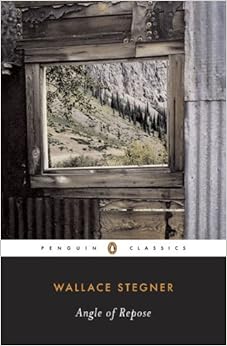
Angle of Repose by Wallace Stegner

Gone, and as painful now as the thought of a stillborn child.  Sentimental?  Of course.  Riddled with the Anglo-American mawkishness about home, quicksandy with assumptions about monogamy and Women's Highest Role, buttery with echoes of the household poets.  All that.  But I find that I don't mind her emotions and her sentiments.  Home is a notion that only the nations of the homeless fully appreciate and only the uprooted comprehend.  What else would one plant in a wilderness or on a frontier?  What loss would hurt more?

I'm a big fan of Idaho.  It's full of some of the most fascinating things I've ever had the luck to see: the towering Bruneau Dunes, the bizarre lavascape of Craters of the Moon National Park, the grand Shoshone Falls overlooking the Snake River Gorge.  Boise--an underrated city.  The isolated buttes on the way east from Wyoming, like stranded ships.

When I was heading out on my road trip to Oregon earlier this month, I wanted a book that took place in one of the places we would be passing through, and this novel came up on a list of "books set in Idaho."  The joke was on me--much as it was last year when we only passed through Iowa for five minutes when I tried to read Marilynne Robinson's Home--because we were well out of Idaho before I got to the part of Angle of Repose that was set there.  (In fact, I was back in New York before the book arrived in Boise Canyon.)

But worse, the Idaho of Angle of Repose isn't the sublime West that I like, but a real wilderness which proves an inescapable burden for Susan Burling Ward, the book's protagonist and the wife of Oliver Ward, an engineer who spends most of his life trying to find a project equal to his grand ambitions.  He and Susan go from New York to New Almaden, CA to Leadville, CO to Michoacan, Mexico, up to Boise Canyon over the course of decades.  Boise seems to finally offer Oliver the chance to build something meaningful--a set of ditches and canals that will irrigate the canyon--but the experience of living on the Western frontier proves difficult for Susan, a genteel New Yorker who is uprooted from any sense of civilization or society, and who worries about how her children will grow up amidst the savagery of Western isolation.  Boise Canyon is where those pressures finally come to break Susan and Oliver's relationship, causing a break that never seems to mend.

Telling this story is Susan's grandson, Lyman Ward, a former college professor suffering from a crippling bone disease which has left him confined to a wheelchair, as well as the dissolution of his marriage.  Lyman is bitter and recalcitrant in his insistence on being independent as possible, and writing about his grandmother is also a kind of self-finding:

Right there, I might say to Rodman, who doesn't believe in time, notice something: I started to establish the present and the present moved on.  What I established is already buried under layers of tape.  Before I can say I am, I was.  Heraclitus and I, prophets of flux, know that the flux is composed of parts that imitate and repeat each other.  Am or was, I am cumulative, too.  I am everything I ever was, whatever you and Leah may think.  I am much of what my parents and especially my grandparents were--inherited stature, coloring, brains, bones (that part unfortunate), plus transmitted prejudices, culture, scruples, likings, moralities, and moral errors that I defend as if they were personal and not familial.

Angle of Repose is in many ways a very conservative text.  Lyman frames his attempt to recover the story of his grandmother Susan as an alternative to the hippy-dippy notions of his caretaker Shelly, who has bought into the 60's counterculture optimism of creating a new society by breaking from what is old.  The strangest temporal experience of Angle of Repose, in fact, is not its demand that we sympathize with the Victorian Susan, but rather treating hippie utopianism as a contemporary idea--it's the latter, not the former, that really seems antiquated.  But the novel is also deeply critical of the way we trivialize or infantilize the past, something which I agree with very much:

What a hangup about bare skin!  What a hypocritical refusal to acknowledge the facts of life!  The Victorians were a race without biology.

Horsefeathers.  Grandmother grew up on a f arm and lived much of her life on crude frontiers.  She knew the animal facts of life as few of us are likely to again.  Without embarrassment she accepted the animal functions of, say, buggy horses that would bring giggles and hooraws from emancipated moderns... Death and life were everyday matters to Grandmother.  The breeding of horses, mules, cattle, the smug and polygamous fornications of chickens, raised no eyebrows.  When animals died, the family had to deal with their bodies; when people died, the family's women laid them out.  In the 1880s you suffered animal pain to a degree no modern would submit to.  You bore your children, more likely than not, without anesthetic.

We have only switched prohibitions and hypocrisies with them. We blink pain and death, they blinked nudity and human sex, or rather, talk about sex. 

Angle of Repose is based, not very loosely, on the life of Mary Hollock Foote, whose family gave Stegner permission to use not only the story but excerpts from Foote's actual letters within the novel.  Stegner, like Ward, fills in much of the blanks with fiction, piecing together what can be pieced with the help of conjecture.  The effort is seamless, though the choice hasn't been without controversy.

I love the American West.  Whenever I go out there, I'm struck by the scale of its landscape, and its vast near-emptiness.  But Angle of Repose reminds me that, in the end, I'm only zooming through on an interstate, and that I'll never love it--or loathe it--as strongly as those who worked on the frontier to make it a habitable place.

Wednesday, June 20, 2007

Perfect Enemies by John Gallagher and Chris Bull

I came across this book while doing research for a paper I was writing about the gay rights movement in Cincinnati. One of the chapters, entitled "Brushfires: Antigay outbreaks in Cincinnati, Georgia, and Texas," was particularly helpful. I hung onto the book, planning on reading the rest of it, lost it, and began accruing late fees from the UC library. Sweet. I found the book last night and figured I might as well finish it before returning it.

Written by two newspaper journalist, Perfect Enemies details the political battle over gay rights in the 1990s. While it is clear that the authors know more about those advocating for gay rights than they do about their conservative Christian opponents, both sides are presented and treated rather even-handedly.

The book is comprised of eight chapters, each of which started out as a newspaper article. Each chapter highlights a specific battle over gay rights: Colorado's Amendment 2, gays in the military, the 1992 presidential campaign, Cincinnati's anti-discrimination ordinance, etc. I found the book incredibly interesting.

What's that you say? This book's not pretentious enough for you? Well did I mention that the main character's name is Self, that it is really just one long poem, or that it was translated from the original Mandarin Chinese by a blind monk?