Showing posts with label Pulitzer Prize. Show all posts

Wednesday, July 29, 2015

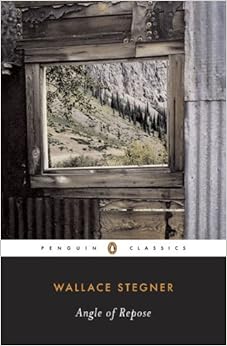
Angle of Repose by Wallace Stegner

Gone, and as painful now as the thought of a stillborn child.  Sentimental?  Of course.  Riddled with the Anglo-American mawkishness about home, quicksandy with assumptions about monogamy and Women's Highest Role, buttery with echoes of the household poets.  All that.  But I find that I don't mind her emotions and her sentiments.  Home is a notion that only the nations of the homeless fully appreciate and only the uprooted comprehend.  What else would one plant in a wilderness or on a frontier?  What loss would hurt more?

I'm a big fan of Idaho.  It's full of some of the most fascinating things I've ever had the luck to see: the towering Bruneau Dunes, the bizarre lavascape of Craters of the Moon National Park, the grand Shoshone Falls overlooking the Snake River Gorge.  Boise--an underrated city.  The isolated buttes on the way east from Wyoming, like stranded ships.

When I was heading out on my road trip to Oregon earlier this month, I wanted a book that took place in one of the places we would be passing through, and this novel came up on a list of "books set in Idaho."  The joke was on me--much as it was last year when we only passed through Iowa for five minutes when I tried to read Marilynne Robinson's Home--because we were well out of Idaho before I got to the part of Angle of Repose that was set there.  (In fact, I was back in New York before the book arrived in Boise Canyon.)

But worse, the Idaho of Angle of Repose isn't the sublime West that I like, but a real wilderness which proves an inescapable burden for Susan Burling Ward, the book's protagonist and the wife of Oliver Ward, an engineer who spends most of his life trying to find a project equal to his grand ambitions.  He and Susan go from New York to New Almaden, CA to Leadville, CO to Michoacan, Mexico, up to Boise Canyon over the course of decades.  Boise seems to finally offer Oliver the chance to build something meaningful--a set of ditches and canals that will irrigate the canyon--but the experience of living on the Western frontier proves difficult for Susan, a genteel New Yorker who is uprooted from any sense of civilization or society, and who worries about how her children will grow up amidst the savagery of Western isolation.  Boise Canyon is where those pressures finally come to break Susan and Oliver's relationship, causing a break that never seems to mend.

Telling this story is Susan's grandson, Lyman Ward, a former college professor suffering from a crippling bone disease which has left him confined to a wheelchair, as well as the dissolution of his marriage.  Lyman is bitter and recalcitrant in his insistence on being independent as possible, and writing about his grandmother is also a kind of self-finding:

Right there, I might say to Rodman, who doesn't believe in time, notice something: I started to establish the present and the present moved on.  What I established is already buried under layers of tape.  Before I can say I am, I was.  Heraclitus and I, prophets of flux, know that the flux is composed of parts that imitate and repeat each other.  Am or was, I am cumulative, too.  I am everything I ever was, whatever you and Leah may think.  I am much of what my parents and especially my grandparents were--inherited stature, coloring, brains, bones (that part unfortunate), plus transmitted prejudices, culture, scruples, likings, moralities, and moral errors that I defend as if they were personal and not familial.

Angle of Repose is in many ways a very conservative text.  Lyman frames his attempt to recover the story of his grandmother Susan as an alternative to the hippy-dippy notions of his caretaker Shelly, who has bought into the 60's counterculture optimism of creating a new society by breaking from what is old.  The strangest temporal experience of Angle of Repose, in fact, is not its demand that we sympathize with the Victorian Susan, but rather treating hippie utopianism as a contemporary idea--it's the latter, not the former, that really seems antiquated.  But the novel is also deeply critical of the way we trivialize or infantilize the past, something which I agree with very much:

What a hangup about bare skin!  What a hypocritical refusal to acknowledge the facts of life!  The Victorians were a race without biology.

Horsefeathers.  Grandmother grew up on a f arm and lived much of her life on crude frontiers.  She knew the animal facts of life as few of us are likely to again.  Without embarrassment she accepted the animal functions of, say, buggy horses that would bring giggles and hooraws from emancipated moderns... Death and life were everyday matters to Grandmother.  The breeding of horses, mules, cattle, the smug and polygamous fornications of chickens, raised no eyebrows.  When animals died, the family had to deal with their bodies; when people died, the family's women laid them out.  In the 1880s you suffered animal pain to a degree no modern would submit to.  You bore your children, more likely than not, without anesthetic.

We have only switched prohibitions and hypocrisies with them. We blink pain and death, they blinked nudity and human sex, or rather, talk about sex. 

Angle of Repose is based, not very loosely, on the life of Mary Hollock Foote, whose family gave Stegner permission to use not only the story but excerpts from Foote's actual letters within the novel.  Stegner, like Ward, fills in much of the blanks with fiction, piecing together what can be pieced with the help of conjecture.  The effort is seamless, though the choice hasn't been without controversy.

I love the American West.  Whenever I go out there, I'm struck by the scale of its landscape, and its vast near-emptiness.  But Angle of Repose reminds me that, in the end, I'm only zooming through on an interstate, and that I'll never love it--or loathe it--as strongly as those who worked on the frontier to make it a habitable place.

Tuesday, June 18, 2013

The Optimist's Daughter by Eudora Welty

What burdens we lay on the dying, Laurel thought, as she listened now to the accelerated rain on the roof: seeking to provide some little thing that we can keep to comfort us when they can no longer feel--something as incapable of being kept as of being proved: the lastingness of memory, vigilance against harm, self-reliance, good hope, trust in one another.

Laurel McKelva Hand accompanies her father, Judge McKelva, to New Orleans for an emergency eye procedure with his young new wife.  The operation is not as benign as the "optimist" Judge would have it, and soon afterward, he succumbs to a combination of surgical trauma and sheer age, leaving Laurel and Fay in uncomfortable rivalry over the possession of his property and legacy.

The Optimist's Daughter is a very concise book (I read it in a single sitting), but it manages to reinvent itself at least twice.  At first, it seems almost as if Welty is setting up a broad, Confederacy of Dunces-type comedy.  The character of Fay is comically narcissistic and cruel, incapable of sympathizing with anyone, even her own husband through his illness and operation.  She may even be implicated in his death, which occurs shortly after Laurel discovers Fay trying to "shock him into life" through force, while shouting: "This is my birthday!"

After the Judge's death, the scene shifts to the McKelvas' family home in Mount Salus, Mississippi, where a nearly innumerable parade of mourners comes to call on Laurel.  Fay crabbily refuses anyone's kindness--even her own interloping family, arrived from Texas--and makes unsubtle pronouncements about "whose house this is" now.  And yet it seems like a comedy where the punchline is perpetually deferred, and the cast of characters comes on too thick and too fast to cohere into a recognizable backstory for the Judge, while Laurel remains curiously aloof from the action and from the narrative.  The heartwarming resolution we expect between Laurel and Fay never arrives, because Welty denies us even the prerequisite blow-up.

And then, strangely, the mourners go away--Fay skips off to Texas at a whim--and The Optimist's Daughter becomes a different book entirely.  Wandering around the empty home which will shortly become Fay's, Laurel is drawn into a series of memories that fill in the story of her mother, from her childhood to her marriage to the Judge and final illness and death.  This third of the novel is remarkably through and detailed for being so compact; in fact, I feel as if I didn't read this section closely enough, fooled by the first two parts of the novel into reading quickly and breezily.  In fact, what this section brought to mind for me was Marilynne Robinson, who works through memory in a similar way:

The first time Laurel could remember arriving in West Virginia instead of just fiunding herself there, her mother and she had got down from the train in early morning and stood, after it had gone, by themselves on a steep rock, all of the world that they could see in the mist being their rock and its own iron bell on a apost with its rope hanging down.  Her mother gave the rope a pull and at its sound, almost at the moment of it, large and close to them appeared a gray boat with two of the boys at the oars.  At their very feet had been the river.  The boat came breasting out of the mist, and in they stepped.  All new things in life were meant to come like that.
Such a wonderful little passage, but--and I suppose it's hard to tell from this review--so without context, springing up as if from nowhere, as if from a different story all together.  That's the mode of the last part of the book, which provides a remarkably detailed narrative for being so compact, and yet always seems to be one detail shy of really providing an intimate look at Laurel's interior.  At the end, Fay returns for the blow-up we were expecting, but by that time, the stakes have changed, and Fay--bitter and petty to the end--is the only one who seems not to recognize that stories don't always end the way that they begin.

Sunday, June 16, 2013

Gilead by Marilynne Robinson


For me writing has always felt like praying, even when I wasn't writing prayers, as I was often enough.  You feel that you are with someone.  I feel I am with you now, whatever that can mean, considering that you're only a little fellow now and when you're a man you might find these letters of no interest.  Or they might never reach you, for any of a number of reasons.  Well, but how deeply I regret any sadness you suffered and how grateful I am in anticipation of any good you have enjoyed.  That is to say, I pray for you.  And there's an intimacy in it.  That's the truth.

I actually read Gilead a few months ago, but then my roommate stole it before I could post on it.  In his defense, it's a good book to steal; as lyrically accomplished as Robinson's Housekeeping and even more emotionally affecting--affecting, in fact, in a way that few books written in the last half century seem to me.

The narrator of Gilead is John Ames, a minister in Iowa who is, he knows, in the final stages of his life, writing a last series of letters to his young son, the product of a marriage to a much younger woman.  These letters become an exploration of ideas that Ames knows he won't live to share with his son, an exploration of the nature of God as well as of his own history, his relationship with his wife, and his relationship with his father and grandfather, tracing his family history all the way back to the Civil War.  Like in Housekeeping, Robinson's prose is really something to marvel at, but writing from Ames' perspective forces Robinson to curtail some of her more baroque tendencies.  Yet somehow, that limitation strengthens the writing by giving it a colloquial groundedness:

I feel sometimes as if I were a child who opens its eyes on the world once and sees amazing things it will never know any names for and then has to close its eyes again.  I know that this is all mere apparition compared to what awaits us, but it is only lovelier for that.  There is a human beauty in it.  And I can't believe that, when we have all been changed and put on incorruptibility, we will forget our fantastic condition of mortality and impermanence, the great bright dream of procreating and perishing that meant the whole world to us.  In eternity this world will be Troy, I believe, and all that has passed here will be the epic of the universe, the ballad they sing in the streets.  Because I don't imagine any reality putting this one in the shade entirely, and I think piety forbids me to try.

There is something beautiful and audacious about calling life "the great bright dream of procreating and perishing," yet those words seem as if they come from Ames, and not from Robinson speaking through him, and that's a really difficult tightrope to cross.

Ames' project becomes troubled when Jack Boughton, the black-sheep son of his closest friend, returns home after a long absence.  Robinson cannily keeps the sins which Boughton is guilty of under wraps for most of the novel, instead focusing on the anxiety that overcomes Ames when he sees how close Boughton is becoming with his wife and son.  But Ames needs Boughton; his return allows him to confront his own believes about forgiveness, family, and love:

There is no justice in love, no proportion in it, and there need not be, because in any specific instance it is only a glimpse or a parable of an embracing, incomprehensible reality.  It makes no sense at all because it is the eternal breaking in on the temporal.  So how could it subordinate itself to cause or consequence?

I wish that my thoughts on this book were a little bit fresher, because looking through the pages I've dog-eared, I see any number of really striking, heartfelt passages like the one above that I'd like to talk about in relation to the novel as a whole.  But what I recall about it the most is that it resounds with a real sense of humanity--one that Housekeeping, though fantastic, often lacked.