Showing posts with label Mississippi. Show all posts

Sunday, December 15, 2024

Delta Wedding by Eudora Welty

It seemed to Shelley all at once as if the whole room should protest, as if alarm and protest should be the nature of the body. Life was too easily holy, too easily not. It could change in a moment. Life was not ever inviolate. Dabney, poor sister and bride, shed tears this morning (though belatedly) because she had broken the Fairchild night light that the aunts had given her; it seemed so unavoidable to Dabney, that was why she cried, as if she had felt it was part of her being married that this cherished little bit of other peoples' lives should be shattered now. Dabney at the moment cutting a lemon for the aunts' tea brought the tears to Shelly's eyes; could the lemon feel the knife? Perhaps it suffered; not that vague vegetable pain lost in the generality and the pain of the world, but the pain of the very moment. Yet in the room no one said "Stop." They all lay back in flowered chairs and ate busily, and with a greedy delight anticipated what was ahead for Dabney...

I felt compelled to revisit Eudora Welty this month, one of my favorite authors who has been absent from my life for some time because I have finished everything she's written. In that she joins Muriel Spark, Penelope Fitzgerald, who live in the back of the mind like old friends you never see. I wanted to re-read Delta Wedding specifically because I remember it both as something incredible and as a kind of challenge, a book that drops you in a Jim Crow plantation world that's so rich, so intricately peopled, you can easily get lost. The titular wedding is between young Dabney Fairchild (of Fairchilds, Mississippi, if that tells you something) and the plantation overseer, Troy Flavin. The wedding has brought together dozens of Fairchilds and their spouses and children, who arrive at the plantation Shellmound and thicken the scene with their histories and characters.

What do I notice now, re-reading it? Well, despite the fact of the large cast and the whirlwind way that Welty jumps between points-of-view (look how effortlessly she skips from Shelley to Dabney and back again in the paragraph above--they're thinking similar things without knowing it!), there are actually only a small handful of characters whose perspective is explored in a sustained way. There's Laura, the little cousin who arrives at Shellmound having recently lost her mother; Dabney, the bride; Ellen, Dabney's mother; and for a little while, Robbie Reid, the outsider who has married George. The Fairchilds are brutal to outsiders, who have trouble penetrating the family's bonhomie. At the beginning of the book, Robbie has left George because of a convoluted scene in which he puts himself in front of a moving train to save Maureen, a mentally handicapped cousin. What Robbie really objects to, it seems, is the feeling that George would not do the same for her; that she is permanently on the outside. And yet, she's not the only one: Ellen is a Virginian who has had to bend and adapt to the ways of the Delta. And of course, there's Troy, who is of a different class than the Fairchilds, but seems too stupid to feel like an outsider. By contrast, those who are deepest inside are almost inaccessible, like the dreamy George, who is the most beloved of all the Fairchilds, or Denis, the long-dead cousin who was the most beloved before him. (The way George blends into Denis in the book is really fascinating.)

This time, I paid more attention to the Black characters of the book. Shellmound is populated by servants whose labor make the wedding possible. Many of these characters are well-drawn, and come alive through Welty's keen eye for the characters of the Mississippi world in which she grew up, characters like the loyal Partheny or Aunt Studney, who carries a sack on her back everywhere that no one knows what's inside, and whose name seems to come from her suspicious refrain: "Ain't studyin' you." But these characters are undoubtedly at the margin, and a modern reader, if they're like me, quickly becomes uncomfortable with just how marginal they really are. Is Welty as blind as her characters to this invisible labor?

There's a moment I'd forgotten about, though: Shelley comes upon Troy, in his capacity as overseer, pointing a gun at a couple of Black fieldhands. There seems to have been some kind of conflict; what it was, we never know, but we see Troy--who moments ago has been all idiot chuckling--shoot the fingers off one of them. Shelley, who is older than Dabney and has been jealous of her marrying, suddenly sees "the reason why Dabney's wedding should be prevented. Nobody could marry a man with blood on his door... But even as she saw the reason, Shelley knew it would not avail. She would jump as Troy told her, and never tell anybody, for what was going to happen was going to happen." Welty never possesses the undercurrent of rage possessed by McCullers, whose books look squarely at injustice as if to say, "Why isn't anyone doing anything about this?" But Welty is no fool, and this moment gives us, I think, a momentary glimpse into the dark machinery that keeps the charmed life of the Fairchilds going. How can we go back to the room of the flowered chairs, the wedding cake, the bridesmaids with their shepherd's crook staffs, after seeing this? Of course, like Shelley we know it's meaningless; everyone knows what happens in the fields and they choose not to see. This time around, I wondered what it meant to have someone like Troy incorporated whole into the body of the Fairchilds. Perhaps once they kept that kind of necessary violence at arm's length, but now they have brought it to their heart and embraced it.

I have a high opinion of Welty. I think she does things no one else could even attempt. There are times when reading Delta Wedding that I think she is among the two or three best writers the 20th century United States produced, and I mean that without hyperbole. Perhaps, as she recedes back into that "old friend" corner of my mind, I'll feel differently. But returning to these books leaves me with awe.

Tuesday, August 27, 2024

South and West by Joan Didion

At the center of this story there is a terrible secret, a kernel of cyanide, and the secret is that the story doesn't matter, doesn't make any difference, doesn't figure. The snow still falls in the Sierra. The Pacific still trembles in its bowl. The great tectonic plates strain against each other while we sleep and wake. Rattlers in the dry grass. Sharks beneath the Golden Gate. In the South they are convinced they have bloodied their place with history. In the West we do not believe that anything we do can bloody the land, or change it, or touch it.

How could it have come to this?

I am trying to place myself in history.

Joan Didion's South and West isn't really a book, or if it is, it's a failed book, the scaffolding to a book. Published in 2017, it was taken from her notes, and mostly about a trip that Didion took throughout the deep South in the 1970s, followed by a brief collection of memories of California occasioned by the abduction of Patty Hearst. Whether Didion meant to contrast the two, I have no idea, but the contrast is there from the beginning of her journey through the South, which she writes attracted her because it seemed to be "for America what people were still saying California was, and what California seemed to me not to be: the future, the secret source of malevolent and benevolent energy, the psychic center." It was also a kind of return for Didion, who spent a few turbid years in Durham, North Carolina. Never mind the vast difference between Durham and Birmingham; the South may be, for Didion, a kind of shadow life not lived.

It's clear enough to me why the manuscript of the "South" section of South and West, at least, waited years to be published: Didion has no idea what to do with the South. She applies her journalistic eye, her withering eye, everywhere, but what she sees lies only at the surface of things: signs, gravestones, the front porches of houses. The language that Didion uses to describe the South is the language of mystery; the kudzu and tropical greenery seem, at every vantage point, to conceal an essential impenetrability. Uncharacteristically, Didion seems to shrink from the South. She seems to spend much of the trip in hotel swimming pools. She even tells us that she finds these pools, with their familiar interchangeability, comforting.

The greatest insights of the South instead come from the mouths of the few people that Didion interviews--all of whom seem to be known acquaintances from the world of writing and the academy. Like the white southerners of V. S. Naipaul's A Turn in the South, they offer up a fear of change and integration dressed up in the language of moderation. One interviewee laments how he has been forced by integration to send his kids to private school, and somehow manages to make it sound like a tragedy for the Black kids, too. (Didion interviews no Black Southerners, though they linger at the margins of the scrupulously reported scenery.) Is this the dark heart that Didion gestures at? It seems to me that these cultural dynamics, while vile, are not particular difficult to understand, and do not amount to any kind of essential mystery. But Didion has no interest in probing further into this or anything else, and it seems to me that in the place of insight she offers a number of Gothic metaphors, chief among them that of the snake pit. The still brown waters of the Mississippi provides a "sense of water moccasins." An anecdote tells of dripping gasoline down a snake hole to make the snake emerge, "drunk" and easy to kill. Over and over again--in a way she might have toned down, I think, if she'd ever fashioned these notes into something more--she imagines snakes lurking in the greenery. No wonder she doesn't want to touch.

We get Didion's tremendous power of noticing, but no understanding. At a movie theater in Meridian--another fungible place and easy escape from the part of the world she supposedly wanted to discover--she describes the crowd as gazing at the screen "as if the movie were Czech." But how does a Mississippian watch a movie any differently than a Californian? And why should they understand it any less? It seems like a rich comment, to me, from someone so obviously stymied by her own choice of subject. Better to say that Joan Didion looked at the audience as if they were Czech.

The "West" part of South and West is even less polished, more partial. It's slapdash in a way that reveals the true nature of the book as "notes"; "South," by contrast, seems to have gone through at least some process of arrangement and shaping. And yet, it has a richness to it that "South" never manages, especially with regards to the effusive material culture of the Californian upper middle class: the "Lilly Dache and Mr. John hats, the vicuna coats, the hand-milled soap and the &60-an-ounce perfume." In these shop-items Didion gets deeper into the identity and culture of the Californian West than she ever allows herself to do in "South"--or, at least, that's how it seems to me as a Southerner. Maybe a Californian would feel differently. But I don't think so. "West" reads like a quickly abortive attempt by Didion to find her own place in the world, her "place in history," as she writes, and though she quickly hits a wall--it's not easy to write about yourself--it made me go back and think about "South" as an attempt to do the same thing by contrast, to discover the Californian Didion by discovering the Didion-that-was-not in the South. Perhaps it's not the South that Didion was shrinking away from in those hotel pools--maybe it was herself.

Thursday, June 6, 2024

The Gulf: Making of an American Sea by Jack E. Davis

The Gulf's history, as we shall see, is America's history; the energies of one are shared with the other. Our school books taught us that there were thirteen British colonies caught up in the war for American independence, yet in truth there were fifteen: the forgotten two were the Gulf colonies of East Florida and West Florida. The Gulf was on the frontier line that advanced from the original US states, delivered opportunities to Americans and immigrants searching for a better life, and nourished the nation's coming-of-age--doing so not in just western woodland, mountain, and river valley, but on the southern sea itself... With every new train line that reached the coast, every new hotel that opened ,and every new craving for a marketable resource, the region drew closer to the furious pace of change and consumption that possessed the rest of the nation--and then surpassed it. The Gulf had become America's sea.

I've traveled a lot in the United States, but to my mind, the Gulf of Mexico has seemed elusive and inaccessible: the first time I saw it was from the remote western edge of the Everglades, a part of the national park where few venture. Then, I saw it from a small fishing village that seemed intent on disappearing from the map of Louisiana. A third time, just recently, I saw it from Texas' beautiful Padre Island National Seashore. Three times might seem like many, but we're talking a big old gulf here--and many fewer encounters than I've had with the Atlantic or Pacific. The Gulf, Jack E. Davis contends, is rather forgotten, dimmer in the American imagination than either of the great oceans. And yet, it's the Gulf that's truly an "American sea"; though Mexico has nearly as much shoreline on it (and claims the name), the waters of the Gulf emerge almost entirely from the Mississippi, America's river. Its history, he says, is American history, from the birth of European colonization to the modern mega-business of tourism, commercial fishing, and, of course, oil.

What distinguishes The Gulf is the way that Davis brings together various genres and methods: it's a history book, but also a natural science book, and a work of cultural criticism. He begins by describing the arrival of Spanish colonizers and describing their interactions, typically fraught, with local tribes in Florida and Texas. Though the Gulf's shores were the first point of mainland contact for Europeans, the Gulf itself was long forgotten in the making of the American colonial experiment; only in the mid- to late-20th century, Davis says, did the prospect of fishing bring American attention. (Davis describes the Spanish sailors as unable or unwilling to eat the immense bounty of shrimp, oysters, and fish that provided sustenance to the Calusa and Karankawa, even as they ate their own horses and boot leather.) And even then, we learn, it's sport fishing--not commercial fishing--that makes the Gulf, where Americans first learned to hook the tarpon, a massive fish who had eluded anglers for a century.

In each section, Davis relies on the stories of individuals to tell the story of the Gulf. Some, like early settler Leonard Destin (namesake of Destin, Florida) and Key West resident Ernest Hemingway, are familiar, but others are more underheralded figures, like the environmental lawyer working to clear the Gulf of industrial pollution, or the reckless brothers who turned west Florida into a sinking morass of real estate grotesqueries. I was especially stuck by the story of Walter Anderson, an artist I'd never heard of, who basically abandoned his family to live on the remote islands of what are now the Gulf Islands National Seashore, and whose painted shack walls are preserved in a museum in Ocean Springs, Mississippi. Davis never wants the reader to forget that the story of the Gulf is the story not just of birds and sawgrass and oil but the story of people, too.

The Gulf isn't shy about its political and ecological agenda. Perhaps partly because it is so ignored in the American imagination, the Gulf of Mexico is uniquely endangered. The fish are overfished; the birds, even after the early 20th century push to preserve their habitats to keep them safe from plume hunters, are diminishing in number. Oil, of course, is the number one threat, but it's joined by the effects of heavily polluting factories and the effects of eliminating marshland in favor of landfill and sea wall. "We cannot destroy or control the sea," Davis notes, "but we can diminish its gifts, and when we do, we turn away from our providence and diminish ourselves."

Tuesday, May 30, 2023

A Turn in the South by V. S. Naipaul

Satan and God fighting for Paula's soul, Paula herself not responsible for the movements of her passion, helpless, capable only of choosing salvation and asking God to reveal his will: a medieval idea of chaos, and the solitude and helplessness of men, and the necessity of salvation. But this was not set in a medieval world of plague and disease and deprivation, the arbitrariness of the sovereign and the humility of the poor. We were in a town of the Research Triangle; and the theme of this culture was abundance and choice, the paramountcy of the individual (if only as consumer), with the beauty and luxury and sensual satisfactions as imminent possibilities for all.

In 1985, fifteen years before he won the Nobel Prize but nearly as many since the publication of A House for Mr. Biswas, V. S. Naipaul traveled through the American South. Though Naipaul is best remembered for his fiction now, he spent nearly as much time writing travelogues, first of the West Indies, then India, and then among Islamic states in Among the Believers. But the South presented a special challenge for Naipaul, who wrote that America "cannot be alien in the simple way an African country is alien. It is too well known, too photographed, too written about; and, being more organized and less informal, it is not so open to casual inspection." And yet, casually inspect, Naipaul does: in metropolitan Atlanta, genteel Charleston, deep swamps and bottomland in Tallahassee and Jackson, and in the up-and-coming cities of the New South, Nashville and Raleigh.

A Turn in the South made me rethink a lot of things, not least among them Naipaul himself. For someone with a reputation as a crank and a bully, Naipaul comes off in A Turn in the South as remarkably open and empathetic. He lets people talk and talk, guiding conversation in only the subtlest of ways, and though perhaps it is only thanks to the writerly tactic of hiding his own questions in narrative voice while faithfully recording the responses of his interlocutors, the effect is of someone reserving judgments: a listener. Sometimes this is frustrating, as when Naipaul interviews an archconservative pastor in Elizabeth City, NC who calls himself a "Jesse-crat" after notorious senatorial douchebag Jesse Holmes, or any number of old white folks who perform paternalistic sadness at the degradation of Black life post-segregation. But it's a gift to get people to say what they probably know they ought not to say, and there's no doubt that in doing so Naipaul really does reveal something at the heart of Southern life. He gets more out of "ordinary people" than he does the black politicos of Atlanta, who are too cagey to stray from their talking points, or Eudora Welty, who is summoned for two paragraphs to talk about the long-gone fad for fur hats.

Naipaul really does empathize with white "rednecks"--a word that's more or less new to him--and with the Black Southerners he meets. Fascinatingly, that empathy seems to emerge from Naipaul's own Caribbean identity, which colors everything he sees in the South. Naipaul makes careful and articulate distinctions between the two regions of the New World, noting, among other things, the crucial lack of a white laborer class after the collapse of slavery and colonialism in Trinidad. "The possibilities" for a Black American, he writes, "were far greater than those of a West Indian. But there could be no easy movement forward for the mass; they had lived through too much; the irrationality of slavery and the years after slavery had made many irrational and self-destructive." And yet, when he writes that the culture of the South is defined by loss and by grief, one hears the echoes of his novels, in which colonial subjects struggle to forge an identity unchained by the weight of history: "The grief was special and was like religion; it would last beyond the decline of the nineteenth century empires, beyond the idea of empire itself." I think that, as a Caribbean, Naipaul is able to understand the South in a way that's difficult for an American Northerner, like Paul Theroux.

But it was the last section, titled "Smoke," which really hit home--literally--for me. The last stop on Naipaul's journey is in the "Research Triangle" of North Carolina, where I grew up, and I perhaps have never heard as insightful or as accurate a description of the place as Naipaul's:

...poor North Carolina pineland landscaped into the discreetest kind of industrial garden, many modern technological names represented by new buildings, long low lines of brick or concrete and glass, giving an impression of spaciousness and order and elegance, the land of rural poverty remade to suit its new function, the South seemingly abolished here, as it had been abolished at the space-research town of Huntsville in Alabama.

Durham poet Jim Applewhite, descendant of tobacco planters, takes Naipaul on a tour of the dying industry: the golden-leafed farms that scan still be found growing between the fresh new medical and research facilities, the meticulous handicraft of the curing barns and the packing process. "[I]t is close to the paradox of civilization itself," Applewhite tells Naipaul, "That this essentially poisonous substance formed the basis of a way of life that had so many attractive aspects--a formalized, seasonal cycle to it, which left the land combed into its even furrows after the stalks had been cut in the autumn." There can be no mourning the death of tobacco, if tobacco is dying, and yet the transition from the "folk art" and "nonutilitarian" practice of the small tobacco farm to the sleek anywhere technologies of biomedicine leave the land and its people bereft of something.

Tobacco, Naipaul notes, comes from the name of Tobago, Trinidad's junior island. Though tobacco planting was quickly abandoned there for the more lucrative sugarcane, Naipaul feels a kind of historical link between himself and the tobacco poet. And I felt it, too. Roughly ten months after Naipaul passed through the tobacco fields of the Research Triangle, I was born there. And it strange to read the great writer writing about the place that I would shortly be ushered into, and which I  have not quite always understood. I started A Turn in the South pleased to know a little more about Naipaul; I was unsettled at the end to find Naipaul looking back. But if that's the feeling I got from A Turn in the South, it's because, in Naipaul's own words, we share something way, way back--but not all that far back--in our histories.

Friday, December 9, 2022

A Curtain of Green by Eudora Welty

It was December--a bright frozen day in the early morning. Far out in the country there was an old Negro woman with her head tied in a red rag, coming along a path through the pinewoods. Her name was Phoenix Jackson. She was very old and small and she walked slowly in the dark pine shadows, moving a little from side to side in her steps, with the balanced heaviness and lightness of a pendulum in a grandfather clock. She carried a thin, small cane made from an umbrella, and with this she kept tapping the frozen earth in front of her. This made a grave and persistent noise in the still air, that seemed meditative like the chirping of a solitary little bird.

Last weekend I had the opportunity to walk along a sunken portion of the original Natchez Trace. The Trace was once a heavily trafficked path running from Natchez, Mississippi to Nashville, Tennessee. It was blazed by Native Americans, and used by early pioneers. Before roads and railroads spread across the south, merchants took their goods to Natchez on steamboats along the south-running Mississippi, then walked back 400 miles along the Trace. Today, portions of the "sunken trace" remain, where the feet of thousands and thousands of travelers have worn a path twenty feet down in the soft earth. Walking along one of these portions is like walking along a shared history.

What a pleasure, then, it was to return to Eudora Welty's story "A Worn Path," about an elderly black woman walking along the trace to Natchez, where she is to pick up medicine for her grandson. The Trace, by the time of the story, is largely disused; in Natchez they call it the "old Trace," and few others use it. It's a difficult trip, that involves crawling under a barbed wire fence and over a creek, but she makes it, as she has every few months for years. The story is a well-loved one because it has a beautiful simplicity: Phoenix Jackson is an image of diligence, of courage and steadfastness. She's also wily: she pockets a nickel dropped by an unwitting hunter, and cajoles another one from the pharmacist in Natchez. But walking the sunken trace made me realize the extent to which she is also a symbol of a history that, as Welty wrote the story, was being abandoned and forgotten, a history literally written in the earth.

"A Worn Path" is one of two familiar masterpieces in A Curtain of Green, an early collection of Welty's; the other is "Why I Live at the P.O.," which is certainly a contender for the funniest short story ever written. I have always loved this story, with its escalating familial outrages, and its gaggle of comic Southerners, as colorful as something out of commedia dell'arte. It's a story I've always thought about teaching, but have avoided, partly because of the single casual n-word, and partly because it seems a shame to cut it up and analyze it, which might kill it. It's a story that should only be enjoyed, and maybe marveled at.

Most of the other stories in A Curtain of Green were disappointing. Many of them, like the title story, seem awfully slight, attempts at portraying a milieu or a mind, or even a vibe, rather than a story. Some of them struck me as being mainly experimental, attempts by a young and newish writer to feel out her craft. How different they are than, say, the linked stories of The Golden Apples that Welty wrote later in life. Some of them are Welty straining at the Southern Gothic, and not particularly succeeding: "Clytie," for example, about a trio of ghoulish rustic shut-ins who are left to fend for, and fight, one another after the death of their father, struck me as being grotesque for grotesque's sake, and its ending--the dim-witted Clytie drowns in a water-barrel after becoming captivated by her own face--like an unfunny joke. I enjoyed the comic narrator of "Mr. Marblehall," who can't stop being flabbergasted by the pathetic audacity of the title bigamist, but it's hard for anything to feel funny when it comes behind "Why I Live at the P.O." Several of the stories just seemed forgettable: what was "Flowers for Marjorie" about again?

But there are two stories that were new to me that I thought were, like "Why I Live at the P.O." and "A Worn Path," Welty at her best. The first is "The Hitch-hikers," about a traveling salesman who picks up a couple of vagrants on his way back into his hometown. One of the two hitchhikers murders the other, and the murderer is locked up in the hotel room across the hall from the salesman. The salesman goes out to a party while the police and the hospital deal with the aftermath of the killing; but of course the event weighs on him strangely. "The Hitch-hikers" is one of those stories that successfully gives the impression of a whole life, a whole world, beyond its margins. The violence does not interrupt a peaceful routine, but stands in, somehow, for the alienation the salesman feels from his own life.

The other masterpiece is "Powerhouse," about a black jazz musician playing in small Mississippi clubs. At first, I wondered a little about the way the narrator describes Powerhouse:

You can't tell what he is. "Nigger man"?--he looks more Asiatic, monkey, Jewish, Babylonian, Peruvian, fanatic, devil. He has pale gray eyes, heavy lids, maybe horny like a lizard's, but big glowing eyes when they're open. He has African feet of the greatest size, stomping, both together, on each side of the pedals. He's not coal black--beverage colored--looks like a preacher when his mouth shut, but then it opens--vast and obscene.

But as the story went on it seemed to me that the narrator (not Welty) is trying to label Powerhouse, to understand him by affixing these words to him, and failing. The narrator fails, because Powerhouse takes over the story, whipping up the crowd with an extended black comic story about the death of his wife, which he has just learned about in a telegram. He tells this story as he plays--interspersed with descriptions of the song that plays beneath it--and then, later in the bar, elaborates upon it. His wife, he says, fell out of the window while she was looking for him, her body discovered by the telegram sender, a man with the unlikely name of Uranus Knockwood:

"Why, he picks her up and carries her off!" he says.
"Ya! Ha!"
"Carries her back around the corner..."
"Oh, Powerhouse."
"You know him."
"Uranus Knockwood."
"Yeahhh!"
"He take our wives when we gone!"
"He come in when we goes out!"
"Uh-huh!"
"He go out when we comes in!"
"Yeahhh!"
"He standing behind the door!"
"Old Uranus Knockwood."
"You know him."
"Middle-size man."
"Wears a hat."
"That's him."

The charismatic Powerhouse has completely taken over the story, molding it into call-and-response jazz rhythms, wrested it, it almost seems, even from Welty herself. It's never clear how much of the outrageous story Powerhouse tells is true. "And who could ever remember any of the things he says?" Welty writes. "They are just inspired remarks that roll out of his mouth like smoke." There is real grief, real resentment, real outrage--you can figure out for yourself who it is, in the context of the Black South, that might always be "standing behind the door," coming in when they go out--but the story is a performance. Everything about Powerhouse is a performance. Like "A Worn Path," "Powerhouse" is a depiction of a Black person by a white writer, but where "A Worn Path" succeeds (in my opinion) through admiration and empathy, "Powerhouse" succeeds from something like intimidation and wonder. It's a story that seems channeled, not written. It's incredible.

Tuesday, December 6, 2022

Deep South by Paul Theroux

Reverend Lyles said he was proud of what had been done at the old Rosenwald school, how it had been fixed up and was now a well-attended community center. The Auburn Rural Studio was still building ingenious low-cost houses. It was not the town of Agee and Evans anymore. It was still struggling, but it was improving, and hopeful.

On a single visit I would not have seen this, but over the course of a year, in four seasons, the true condition of the town had become apparent. This was not a trip about my having had a good meal or a bad meal, or my laboring toward a destination in the old travel-book manner. It may have seemed to some people I met that I was headed somewhere, but I was still traveling in widening circles, happily, on back roads, meeting people, and revisiting friends.

Paul Theroux has traveled all over the world: India, Southeast Asia, Africa. But until he steps out of his door on Cape Cod in Massachusetts one morning and hops in his car, he has never been in the American South. He heads down the interstate, making brief stops in Virginia, North Carolina, South Carolina, Georgia, heading deeper and deeper into a land that is familiar but unfamiliar, recognizable but unrecognizable. His travels in Africa become a specific touchpoint: the poverty Theroux sees in Alabama, Mississippi, and Arkansas is not just a reminder of the third world, but an instantiation of it, right under the American nose. Deep South explores these forgotten places, which are not just unknown to Theroux, but to nearly every American, because they lie in the places that even the highways have passed by, where industry and work have vanished, and which the cultural and political leaders of the United States would just as soon turn a blind eye toward.

I'm a Southerner, though I have always thought of my home in North Carolina as quite different from the "deep south" of Mississippi and Alabama. It is interesting to read about yourself, or at least a region to which you are allied, from an anthropological perspective. At first, I felt a kind of bemusement at the Northerner who carries with him a set of bromides about the South, without wondering whether or not they are accurate or true. When Theroux writes that the church is the center of social life in a Southern town, and claims this is one way it differs from his native New England, I thought about how a few weeks ago, I visited Sandwich, Massachusetts--where Theroux literally lives--and ended up at a church festival where a bunch of elderly white Catholics were selling wreaths and dolls and chili hot dogs. Certainly for those folks, the church is at the center of social life in Sandwich. And what do we do with the increasing number of white Americans, southerners included, who no longer go to church but claim evangelical as an identifier? There's an awful lot of cant about the South, is all I'm saying, and it can be hard to set it aside and see the place clearly, especially if you carry your expectations with you.

This feeling was amplified, for me, by Theroux's pointed aversion toward urban life in the South. Charleston, Asheville, Natchez: Theroux passes these places by, stopping in them briefly, if only to tell us their charms have no interest for him. To Theroux, this is a way of side-stepping the tourist sheen of the South, of skirting the guidebooks. But it also presupposes a real South that lies in rural places. Of course you are going to find the South to be poor and rural if you define it from the beginning as rural and poor. But moreover, I found myself wondering if Theroux doesn't miss something crucial about the South by not interrogating the "New South," the cities where industry has fled, where investment in the tech sector, for instance, has created new opportunities for gentrification and dispossession. I'm not sure you can understand the depreciation of Greenville, Alabama, for instance, unless you understand the boom in Huntsville.

But anyway. Most of my reservations about Deep South came to little, because in the end, what makes Theroux seem reliable is the fact that he keeps coming back. Deep South is the story of not just a single trip, but four different trips, each in a different season. Theroux keeps coming back to the same locations over and over again, meeting with the same non-profit leaders, the same black farmers and unemployed whites, the same Indian motel owners. Out of this investment in time a real picture of a region emerges: a place rich in pride and cultural power, but torn inside out by the deprecations of global capitalism and political neglect. By the end of the book, Theroux is no longer ignoring the cities: he spends several chapters on his time in Hot Springs, Arkansas and the capital of Little Rock, integrating them into the larger story of the South as he sees it.

I brought this book with me on a trip to Mississippi last weekend. We didn't quite get up to the Delta, the poorest part of the state and where Theroux spends most of his time, but we did see much of what Theroux saw. For me, it was the sight of a roofless, wrecked building on the main street of Port Gibson, sitting next to a restaurant: someone's business and dream. Everywhere he goes, Theroux wonders why Africa gets so much aid from the USA while its own communities suffer. (I thought Theroux was a little silly in the way he would compare the money given to say, Ghana, population 31 million, to the federal aid provided to a town of 800, but still, point taken.) But among the neglect are people whose roots are deep, and who spend their lives trying to make those communities thrive.

Monday, August 15, 2022

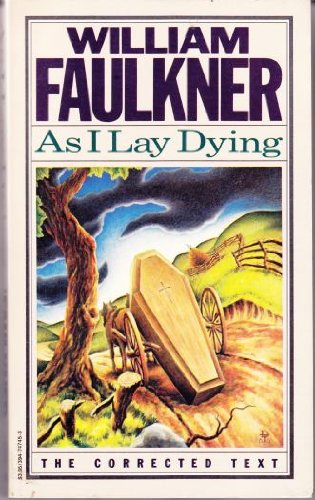
As I Lay Dying by William Faulkner

He did not know that he was dead, then. Sometimes I would lie by him in the dark, hearing the land that was now of my blood and flesh, and I would think: Anse. Why Anse. Why are you Anse. I would think about his name until after a while I could see the word as a shape, a vessel, and I would watch him liquify and flow into it like cold molasses flowing out of the darkness into the vessel, until the jar stood full and motionless: a significant shape profoundly without life like an empty door frame; and then I would find that I had forgotten the name of the jar.

I remember being totally bowled over by As I Lay Dying when I read it in high school. I had no idea literature could do the things this novel does. So when a few of my colleagues mentioned they were thinking of teaching it in their own classes, I was tempted. It would really be something, I think, to pass the experience of teaching this book onto a new set of kids. But I wonder, looking back, how other students reacted to the novel, which is so difficult and circuitous, and frankly, grim.

What are some ways you might teach As I Lay Dying? I think the book itself is metaphysical: its chief concerns are with dying and personhood, and the way the former threatens the latter. It's what Addie's thinking about when she reflects on the insufficiency of words in the night, and the way that the name "Anse" seems only like a vessel that, in some sense, obliterates the actual nature of her husband. In that same section, which she seems to be narrating from inside the coffin being carried to Jefferson, she contemplates the way that having children seemed to be a violation of her own personhood, the way they came from her, carrying part of her person with her. This is what frightens characters like Darl, who is so sensitive as to be nearly psychic, and who goes slowly insane over the course of the novel, and Vardaman, the young boy who associates his mother's death with the fish he's caught so strongly that he says, "My mother is a fish." They're confused, bewildered, but in their confusion, both Darl and Vardaman sense something essential and frightening about the slipperiness of the self, which can be parceled out, then obliterated by death.

I think one way I might teach it is by focusing on the stream-of-consciousness techniques. How do we think? In full sentences? Or in images, or feelings, or scraps of logic that are halted and interrupted? How does one imitate that kind of thinking on the page? This might be a way of mitigating what is hardest about As I Lay Dying, of encouraging students to think about its methods as trying diligently to capture the sense of interiority that gets flattened by more traditional narrative techniques.

I also think one way of bringing As I Lay Dying to a Gen Z audience is to focus on its more feminist elements. It might seem strange, but I think the novel is deeply interested in the experiences of women: first, there's Addie, whose experience of motherhood is what shapes her metaphysical understanding, even to the point of horror. Consider the way that Anse insists on carrying Addie's body to "her people" in the city of Jefferson, saying that this is what she had wanted, when really--as the novel's final scene, like a sour joke, shows--what he wants is to go to town to buy a set of new teeth. (Not only does he come back with a new set of teeth, but a new Mrs. Bundren!) Addie's loss of autonomy, bodily and otherwise, is echoed in the experiences of Dewey Dell, who needs an abortion she doesn't know how to ask for, and who finds herself exploited by the depredations of a sex pest pharmacist because of it. Now more than ever, those themes might seem to speak with a renewed voice to students.

But I don't know. It's awfully tricky, and though I think I can get students to reflect on the purpose of the novel's stranger narrative methods, I'm not sure I can get them to actually enjoy them, or tolerate them for four weeks. And I wonder, too, if the southern accents that made the characters' language recognizable, if strange, to me, might be further beyond my students' grasp. So we'll see.

Sunday, June 5, 2022

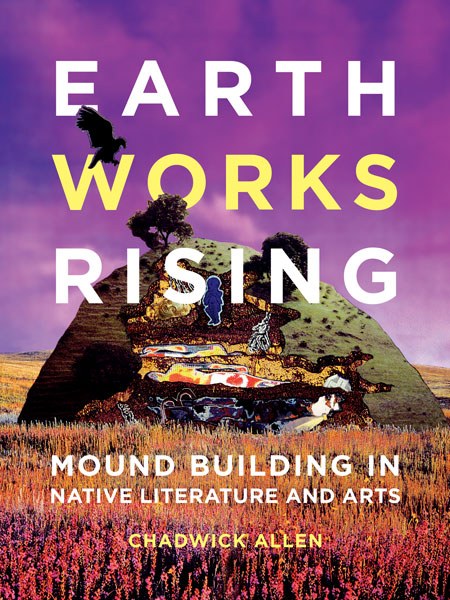
Earthworks Rising by Chadwick Allen and Shell Shaker by LeAnne Howe

For many who either seek or stumble upon them, burial mounds signal loss, herald doom: dead Indians, dead savage civilizations, dead pagan pasts ground to dust and now overgrown in brush, obscured by weeds and trees. And yet for others burial mounds announce regeneration, the possibilities of reclamation and renewal; they continue to connect and bloom. Native individuals, families, communities, and nations rise up against narratives of loss and doom to reclaim and repatriate, restore and reactivate. On their lived experiences and felt knowledges. On their abilities to dream intensely. But there are no easy divisions, no clear-cut binaries of Indigenous and settler in the twenty-first century (if there ever were), and there are no easy escape routes out of dominant ideologies and worldviews.

Two weeks ago, I got to visit Effigy Mounds National Monument in Iowa, a place I have long wanted to go: a green bluff overlooking the Mississippi, the monument is dotted with Indigenous earthwork mounds, some in the shapes of birds and bears, some perhaps over two thousand years old. In most cases they're no more than a few feet tall--you might miss them completely if they hadn't been cleared of trees and neatly mowed--but where else in what is now the United States can you see human architecture that old? To walk around them is to connect with a deeper past, and reform a present understanding of the land. Photographed from above, the bird and the bear appears, but on the ground, no effigy can be seen totally at once; you have to walk around and experience the shifting perspective of the earth to really "see."

Effigies like these have, from time to time, captured the imagination of modern writers and artists, both Indigenous and non-Indigenous. Chickasaw scholar Chadwick Allen's Earthworks Rising is a new critical work that examines some of the ways that Native American mounds and earthworks have been used in art and literature. His scope is vast, taking in non-Native works like Alice Walker's novel Meridian and 20th-century pulp novels like Mog the Mound Builder and The Horror From the Mound by Conan the Barbarian creator Robert Howard. In non-Native imaginations, earthworks tend to speak of vanished races, whose creation of the mounds is shrouded in irrecoverable mystery. No one knows why they were created, we are told, and no one knows what happened to those who made them. (Of course, we do know, because their descendants--Choctaws and Chickasaws and other Native nations--are still around.)

By contrast, the Indigenous works Allen explores offer interpretations of the earthworks that emphasize the possibility that they are still sites that produce meaning, for Native peoples and through Native epistemologies. Allen devotes chapters to the work of visual artists Jimmie Durham and Alyssa Hinton, whose brightly colored photo collages of burial mounds are contrasted with the kind of clinical cross-sections you might find in a museum gallery. Literary sources include Allison Hedge Coke's Blood Run, a poem cycle in which the Mounds themselves--and associated elements like the River and Trees--are allowed to "speak," not as mute or ghostly voices--like the Indian curse unleashed in The Horror from the Mound--but as interlocutors that connect the present to the past and the future both, and sit at the axis mundi between earth and sky. Allen's methods are a mix of recognizably academic cultural criticism and more Indigenous ways of knowing. I rolled my eyes a little at Allen's reliance on numerology to understand the structure of Blood Run, but an anecdote where Allen watches on as Choctaw scholar LeAnne Howe records a song she hears being sung by a "little girl" in a burial mound seems beyond my powers of judgment or evaluation.

Attention woman, listen to my remarks. The gravediggers are wrong. Not all the ancient burial mounds were stuffed with beloved leaders. Some contain bad people who were given everything in death that they had coveted in life. Shell beads, copper, axes, knives, pottery bowls, baskets, animal skins, blankets. There were times when good people followed the bad ones into the spirit world to care for them. Like the parent of a spoiled child, they were there to give things to the band ones. Make them comfortable so that they would not want to leave their resting place and harass the living. But when the mounds were opened by gravediggers, these flawed spirits escaped like flesh-eating flies. They passed through many changes. Always becoming predatory. Put your dead chief in a mound so he will be protected from escaping again. Give him everything in death he wanted in live. That way he will never leave it again.

Howe figures large in Allen's book, as a colleague who helps guide his thinking about the mounds themselves and their significance. On more than one occasion, Allen describes traveling to a significant earthwork site with Howe, walking around it, laying down upon it and feeling its physical presence. I'd read a couple of Howe's works--the excellent play Savage Conversations and the baseball novel Miko Kings--but not Shell Shaker, which Allen analyzes at length. Shell Shaker is a novel about two murders, which take place at different points in time but which are presented as analogs of one another: in the present, Choctaw vice chief Auda Billy's apparent murder of the chief Redford Macalester. In the past, the murder of Red Shoes, a Choctaw warrior who played the English and French off of each other and who ended up igniting a bloody war between the colonial powers, Choctaw factions, and neighboring tribes.

Redford, like Red Shoes before him, begins his career with noble ambitions that are corrupted by greed and violence. The casino he brought into the Choctaw Nation has brought economic prosperity, but also an alliance with the mafia, from whom he has been embezzling money in order to send to the Irish Republican Army (!). Like Red Shoes, he has become too much warrior and not enough peacemaker, and his belief that he can play one side of hostile forces off the other threatens to bring a lot of violence. Moreover, his ego has made him into a monster: when the book opens, we see him raping his longtime assistant and former lover Auda.

Auda, like Redford, has an analog in the past, named Anoleta. Like Auda, Anoleta is accused of Red Shoes' murder, and Auda's mother Susan--like Anoleta's mother Shakbatina--takes credit for the deed to spare her daughter's life. The parallels don't end there: Auda's two sisters each have an analog, as do her father, her uncle, her cousin. Howe gives us a sense not so much of the past repeating itself as a kind of mythical story that emanates in different temporal registers; past and present are brought together and made the same, thus rejecting traditional notions of Indigenous disappearance or disintegration. It was too much for me, frankly. Howe juggles the two time periods, and the numerous figures between them, with careful dexterity, but I found myself easily lost, wishing that the two stories had been simplified. The particulars of the Choctaw Civil War that Red Shoes ushers in were especially opaque to me. I had a much better time with the present narrative, whose magical realist elements and focus on generational ties reminded me of Louise Erdrich, and not merely, or even particularly, because of the novel's Indigenous themes.

In one memorable scene, which looms large in Allen's analysis of the novel, Auda's aunts are kneading dough in the kitchen when it turns into mud. And not just any mud: the rich black earth of the family's ancestral Choctaw homelands, in Mississippi. In visions they are instructed to take the dead chief Macalester's body to Mississippi and bury it in a mound for safekeeping, along with the embezzled cash. Far from being the burial of an honored person, the mound becomes a way to keep a troublesome spirit from making more trouble, and perhaps from reappearing in a different time, in a different guise, the way that Red Shoes reappears as Redford Macalester. There's some resonance here with the despised "curse" narrative of The Horror From the Mound that goes unremarked upon, but both Allen and Howe depict the act of burying Redford in a mound as a sort of kindness as well as a defense. By reintegrating Redford into the land, they are not merely imprisoning him, but bringing him back into the fold--bringing him home.

Along the railings at Effigy Mounds National Monument, you can see prayer ties, little scraps of cloth tied there, that mark it as a sacred site. Not a site of death or disappearance, of a vanished mystery, but a living place that still speaks to Indigenous people who visit it. I really got a kick of reading both Earthworks Rising and Shell Shaker, which helped me see these mounds a little more fully, a little more clearly.

Sunday, November 24, 2019

Light in August by William Faulkner

At last the noise and the alarms, the sound and the fury of the hunt, dies away, dies out of his hearing.  He was not in the cottonhouse when the man and the dogs passed, as the sheriff believed.  He paused there only long enough to lace up the brogans: the black shoes, the black shoes smelling of negro.  They looked like they had been chopped out of iron ore with a dull axe.  Looking down at the harsh, crude, clumsy shapelessness of them, he said "Hah" through his teeth.  It seemed to him that he could see himself being hunted by white men at last into the black abyss which had been waiting, trying, for thirty years to drown him and into which now and at last he had actually entered, bearing now upon his ankles the definite and ineradicable gauge of its upward moving.

Lena Grove, in the last stages of her pregnancy, has walked all the way to Jefferson, Mississippi from her home in Alabama, looking for the man who promised to marry her.  He's there, but he's using a fake name--presumably so Lena can't find him--and working as a bootlegger alongside another outsider named Joe Christmas.  A mild-mannered millworker named Byron Bunch falls for Lena, and enlists his friend, a disgraced preacher named Hightower, to help keep her safe and hunt down her husband-to-be.  But this directive mixes them up not just with Lena and her beau, but also Christmas, who is the true center of Light in August: Christmas, a man tortured by the secret knowledge that he's half black, has, on the same day that Lena arrives in town, murdered his lover.  His lover, Joanna Burden, is an abolitionist who's widely hated in town, but Christmas' uncertain parentage makes the crime not just violent but transgressive: a white woman has been murdered by a black man.

What does Light in August have to say about race?  Well, for one thing, it reveals just how flimsy the whole thing really is.  Christmas is white-passing, and it seems that no one would know his secret at all if he didn't keep divulging it as if it were something rotten at the heart of him.  Those who learn Christmas' secret seem suddenly to forget who he is--a loner at the mill, mostly respectful, keeps to himself, not well-known but generally liked--because he's no longer that person, but a "n-----r."  When he kills Joanna, it sets into motion the machine of lynching, the social engine that overpowers the narrow limits of policemen and judges, and which exists to respond to threats it considers not just dangerous but existentially so.

But no one is more in the grip of the pathology of race than Christmas himself.  Faulkner uncovers his life history with the dramatic flair of an early modern revenge tragedy; we learn that his biraciality is the reason that his grandfather cast him out to be adopted in the first place.  He leads a troubled life, brought up by a man who is severe, religious, and cruel; when he finally escapes he's fit only to live a life of itinerant work and petty criminality.  Christmas is a victim; his alienation comes from a life of maltreatment, but his own anxiety about his racial identity supplants an honest reckoning.  He believes the brokenness of his life and his character--he is increasingly violent and dissociative--can be traced to his secret blackness, like a virus.  When he kills Joanna, it's because she presses him to attend a Negro college and become a Negro lawyer.  It's not her pity that enrages him; he believes himself to be pitiful.  It's the way she zeroes in on his own secret shame that his blackness is the root of that pitifulness.

One character, speaking against the possibility of a lynching, says he wants to see Christmas "Decently hung by a Force, a principle; not burned or hacked or dragged dead by a Thing."  That's a striking statement, but it makes you wonder: the racism that structures Southern society, is it a Force or a Thing?  Is it something separate from the more respectable institutions, the police, the judges, the mill, a shadow that haunts them, or is it just another piston in the engine?

Light in August is a novel of serious and deep questions like these.  It's hard for me to shake the sense that it might have been more incisive if it expressed more interest in black characters, beyond a supporting cast of unnamed sharecroppers and shack-dwellers.  Christmas isn't really black; he's a white man who fears his own blackness, and while Faulkner tells us that he moves between white and black communities in a kind of oscillating uncertainty, the black communities remain mostly opaque to the narrative voice.  You really have to wonder, if Christmas does spend time in black households, with black women, does he ever have to face the question, what's so bad about being black?  But even Faulkner, who I think really intends Light in August to be a critique of racism, is unable to get too far outside of white subjectivity.

I think one thing I learned from reading Light in August is that I have a limited patience when it comes to Faulkner.  The ones I've enjoyed most all have several discrete narratives, like the many voices of As I Lay Dying or three-fold structure of The Sound and the Fury, and especially the several connected stories of The UnvanquishedBy comparison, Light in August, which runs nearly 600 pages, seemed unnecessarily bloated to me, and I got easily bored by it.  Faulkner's high emotional intensity, which really does seem straight out of the 19th century Gothic genre, is difficult to sustain over so many pages.  And after a while, you really start to notice Faulkner's particular tics: this book probably uses the word myriad 50 times and chiaroscuro about a dozen.  For me, Light in August is just too much, too long.

Sunday, October 15, 2017

Sanctuary by William Faulkner

The worst one of all said boys thought all girls were ugly except when they were dressed.  She said the Snake had been seeing Eve for several days and never noticed until Adam made her put on a fig leaf.  How do you know? they said, and she said because the Snake was there before Adam, because he was the first one thrown out of heaven; he was there all the time.  But that wasn't what they meant and they said, How do you know, and Temple thought of her kind of backed up against the dressing table and the rest of them in a circle around her with their combed hair and their shoulders smelling of scented soap and the light powder in the air and their eyes like knives until you could almost watch her flesh where the eyes were touching it, and her eyes in her ugly face courageous and frightened and daring, and they all saying, How do you know? until she told them and held up her hand and swore that she had.

Sanctuary is Faulkner's "potboiler," a novel that takes his familiar themes and characters and weird, poor Mississippi setting and uses them to frame a salacious and prurient story.  There's an element of pulpiness in it--check out the trashy cover in the image above--but Faulkner is too idiosyncratic and elliptical for Sanctuary to really be shocking or titillating.

The first of the novel's two main characters is Temple Drake, a Mississippi undergrad who gets mixed up with a jerkoff alcoholic frat boy who takes her against her will to a bootlegger's house where he abandons her.  There she's raped by a petty criminal named Popeye, who whisks her away to a brothel in Memphis where he stashes her away.  The second is Horace Benbow, a conflicted lawyer who has just left his wife (because of his sexual feelings for his stepdaughter--nice one, Faulkner) and who takes up the defense of the bootlegger who has been charged with a murder that Popeye committed.

Horace and Temple's stories only intersect briefly.  Horace's sympathies are oriented toward Ruby, the wife of the bootlegger Lee, and her infant child; in fact, the townspeople begin to assume that he and Ruby are carrying on an affair, explaining his pro-bono work on Lee's case.  Faulkner wants us to see that Temple is pretty much forgotten; the case hinges on a murder that has nothing to do with Temple, and though Horace tracks her down to find out what happened, his priorities are elsewhere.

Temple's character is frustrating.  We're asked to accept that her feelings toward Popeye are conflicted, and that she's not exactly his prisoner, but neither is she exactly free to leave.  A kind of Stockholm syndrome makes sense, but Faulkner wants us to believe that the rape takes away Temple's agency to a degree that makes her passiveness in the face of her imprisonment sensible.  There are hints of a retrograde notion of female hysteria.  I think we're supposed to read Temple as a cautionary tale about the teenage desire to be inducted into the world of adult sexuality, the darker side of which she and her fellow coeds are unprepared for.  But there's something about the way that's coded according to gender that makes Sanctuary seem like it's trafficking in cheap literary archetypes.

Mostly, Faulkner's elliptical style makes it difficult to really figure out what's going on.  We learn that Popeye hasn't been having sex with Temple himself; instead, he's recruited a gangster named Red to do it while he watches.  Temple has fallen for Red, in a way, making Popeye jealous, but Faulkner neglects to include any of this in the narrative.  By the time we learn about Red's existence, Popeye's already shot him, and we're expected to fill in the blanks.  Faulkner keeps the most salacious part of the ordeal close to the chest, choosing to reveal it only in the final courtroom scene: Popeye is impotent, and the initial rape is performed with a corncob.  Okay.  Honestly, the "shocking reveal" is what makes Sanctuary seem more like a pulp novel than anything else.

Still, Sanctuary has all the elements that make Faulkner worth reading: the currents of sex and death, the lack of sentimentality, the tension between the impoverished setting and the flights of decorated prose, the black humor.  The savageness of Faulkner's novels makes us underestimate how funny they can be, I think.  But it's hard not to feel that Faulkner's slumming it a little, searching for a bestseller that his style won't let him fully commit to.

Monday, January 2, 2017

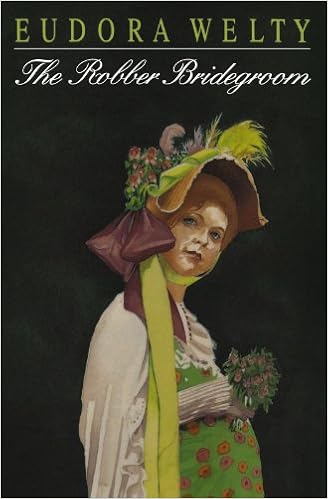
The Robber Bridegroom by Eudora Welty

"If being a bandit were his breadth and scope, I should find him and kill him for sure," said he. "But since in addition he loves my daughter, he must not be the one man, but two, and I should be afraid of killing the second. For all things are double, and this should keep us from taking liberties with the outside world, and acting too quickly to finish things off. All things are divided in half--night and day, the soul and body, and sorrow and joy and youth and age, and sometimes I wonder if even my own wife has not been the one person all the time, and I loved her beauty so well at the beginning that it is only now that the ugliness has struck through to beset me like a madness. And perhaps after the riding and robbing and burning and assault is over with this man you love, he will step out of it all like a beastly skin, and surprise you with his gentleness. For this reason, I will wait and see, but it breaks my heart not to have seen with my own eyes what door you are walking into and what your life has turned out to be."

Chloe's review of The Optimist's Daughter reminded me that I had a Eudora Welty book waiting for me: The Robber Bridegroom, her first novel.  Despite the strong themes that run through Welty's work--the singularity of families and the culture of the Mississippi Delta--she really never repeated herself, and The Robber Bridegroom is like nothing else she would ever write.  Welty borrows the folk tale of the Robber Bridegroom, in which a maiden unwittingly marries a savage highwayman, and melds it to 19th century Mississippi folklore.

The Robber Bridegroom is peopled with legendary Mississippi figures: Mike Fink, the braggart, brawler, and boatman, and the murderous Harp brothers (Little Harp keeps Big Harp's head in a trunk, where it keeps demanding to be let out).  To these it adds Welty's own sharp comic cast, including the young boy Goat, so called "because he could butt his way out the door when his mother left him locked in, and equally, because he could but this way in when she left him locked out," as well as an evil stepmother figure who dies of exhaustion doing an Indian dance meant to prove she is more powerful than the sun.

The protagonist, Rosamond, is the young daughter of a man named Clement Musgrove.  Clement's life is saved by a gentleman named Jamie Lockhart, who secretly robs travelers disguised with berry juice.  When Rosamond's clothes are stolen by a thief in the woods, Clement enlists Jamie's help to find the culprit, and in the kind of perfect mishap characteristic of fairytales, not Clement, Jamie, or Rosamond realizes that the culprit is really Jamie.

The Robber Bridegroom exhibits little of the sharp realist eye that Welty later developed, but a lot of the clear-eyed humor that characterizes The Ponder Heart and Losing BattlesThe characters hop from one fairytale-inspired crisis to the next, each one with its familiar contours: the innocent maiden, the evil stepmother, etc.  And when Clement believes he has lost Rosamond for good, Welty's elegiac power appears out of nowhere, if a little disorganizedly:

Like will-o'-the-wisps the little blazes burn on the rafts all night, unsteady beside the shore.  Where are they even as soon as tomorrow?  Massacre is hard to tell from the performance of other rites, in the great silence where the wanderer is coming.  Murder is as soundless as a spout of blood, as regular and rhythmic as sleep.  Many find a skull and a little branching of bones between two floors of leaves.  In the sky is the perpetual wheel of buzzards.

I read The Robber Bridegroom in a single breezy sitting--I'm on pace for 365 books this year!  But despite its lightness--both literal lightness and lightness of town--The Robber Bridegroom is as touching and thoughtful as the rest of Welty's work.


Sunday, March 15, 2015

Delta Wedding by Eudora Welty

The window invited her to see--her window.  She got out of bed (her filmy dress like a sleeping moth clung to the chair) and the whole leafy structure of the outside seemed agitated and rustled, the shadows darted like birds.  The gigantic sky radiant as water ran over the earth and around it.  The old moon in the west and the planets of morning streamed their light.  She wondered if she would ever know... the constellations... the birds all slept.  (The mourning dove that cried the latest must sleep the deepest of all.)  What could she know now?  But she could see a single leaf on a willow tree as far as the bayou's edge, such clarity as there was in everything.  The cotton like the rolling breath of sleep overflowed the fields.  Out into it, if she were married, she would walk now--her bare foot touch at the night's hour, firmly too, a woman's serious foot.  She would walk on the clear night--angels, though, did that--tread it with love not this lonely, never this lonely, for under her foot would offer the roof, the chimney, the window of her husband, the solid house.  Draw me in, she whispered, draw me in--open the window like my window, I am still only looking in where it is dark.

Delta Wedding opens with a train called the Yellow Dog moving slowly through the Mississippi countryside, traveling from the city of Jackson through rolling green hills into the flat, wide cotton fields of the region called the Delta.  On the train is young Laura McRaven, whose mother has just died, going to visit her cousins the Fairchilds, who are busy preparing for their daughter Dabney's wedding.  The Fairchilds are many and wealthy, and their roots go back to the plantation days of the antebellum south--so tightly connected to the Delta are they that the nearest town to their land is actually called Fairchilds.

But Welty also depicts them as generous and kind, though self-possessed, a small universe unto themselves.  She packs the narrative with numerous uncles, aunts, daughters, sons, cousins, as well as black servants and preachers and various hangers-on, most of them Fairchilds, passing from one point of view to another among nearly thirty distinctly drawn characters.  It is difficult, we see, for outsiders, like Laura McRaven, or George Fairchild's wife Robbie, or Troy, the overseer, who is to marry Dabney, to enter into the hermetic Fairchild world.  Like many real tightly-knit families, they share common understandings and a common language that Welty depicts as both beautiful and vital, but also isolating.  Their frenetic banter is intoxicating, and bewildering, and extremely real--Welty does as good a job with "world-building" with this patrician Southern family as any science fiction author.

Laura is particularly enamored of her Uncle George, who is sensitive and taciturn:

Perhaps the heart always was made of different stuff and had a different life from the rest of the body.  She saw Uncle George lying on his arm on a picnic, smiling to hear what someone was telling, with a butterfly going across his gaze, a way to make her imagine all at once that in that moment he erected an entire, complicated house for the butterfly inside his sleepy body.  It was very strange, but she had felt it.  She had then known something he knew all along, it seemed then--that when you felt, touched, heard, looked at things in the world, and found their fragrances, they themselves made a sort of house within you, which filled with life to hold them, filled with knowledge all by itself, and all else, the other ways to know, seemed calculation and tyranny.

I love the subtlety of this moment.  It is easy to forget that Laura is only imagining her uncle's perspective in this moment, and that he, as he remains throughout the novel, is essentially a mystery--we never have access to his perspective in the way we do for Laura, or Dabney, or several of the other uncles and aunts.  But the truth she intuits from watching her uncle is profound, and so enraptured is she by what she imagines he is seeing that she fails to recognize that she is enacting this very "way of knowing," that she has "made a sort of house" in her own heart for George to inhabit.

Welty is rapidly becoming one of my favorite authors.  Her prose is astonishing, and manages to capture the small mysteries and miracles of domestic life like no other author I have ever read.  The depth and complexity of feeling in Delta Wedding is nearly overwhelming; it's no wonder that with a later novel like The Optimist's Daughter, she chose to narrow the focus to something still profound but, in a way, more manageable.  Delta Wedding was Welty's first novel, and while it seems to lack some of the humor that she developed in The Optimist's Daughter and The Ponder Heart, the strength of its voice is the work of a mature author.  I'm going to Mississippi for the first time in a couple weeks, and I'm excited to bring another of her books with me.

Tuesday, June 18, 2013

The Optimist's Daughter by Eudora Welty

What burdens we lay on the dying, Laurel thought, as she listened now to the accelerated rain on the roof: seeking to provide some little thing that we can keep to comfort us when they can no longer feel--something as incapable of being kept as of being proved: the lastingness of memory, vigilance against harm, self-reliance, good hope, trust in one another.

Laurel McKelva Hand accompanies her father, Judge McKelva, to New Orleans for an emergency eye procedure with his young new wife.  The operation is not as benign as the "optimist" Judge would have it, and soon afterward, he succumbs to a combination of surgical trauma and sheer age, leaving Laurel and Fay in uncomfortable rivalry over the possession of his property and legacy.

The Optimist's Daughter is a very concise book (I read it in a single sitting), but it manages to reinvent itself at least twice.  At first, it seems almost as if Welty is setting up a broad, Confederacy of Dunces-type comedy.  The character of Fay is comically narcissistic and cruel, incapable of sympathizing with anyone, even her own husband through his illness and operation.  She may even be implicated in his death, which occurs shortly after Laurel discovers Fay trying to "shock him into life" through force, while shouting: "This is my birthday!"

After the Judge's death, the scene shifts to the McKelvas' family home in Mount Salus, Mississippi, where a nearly innumerable parade of mourners comes to call on Laurel.  Fay crabbily refuses anyone's kindness--even her own interloping family, arrived from Texas--and makes unsubtle pronouncements about "whose house this is" now.  And yet it seems like a comedy where the punchline is perpetually deferred, and the cast of characters comes on too thick and too fast to cohere into a recognizable backstory for the Judge, while Laurel remains curiously aloof from the action and from the narrative.  The heartwarming resolution we expect between Laurel and Fay never arrives, because Welty denies us even the prerequisite blow-up.

And then, strangely, the mourners go away--Fay skips off to Texas at a whim--and The Optimist's Daughter becomes a different book entirely.  Wandering around the empty home which will shortly become Fay's, Laurel is drawn into a series of memories that fill in the story of her mother, from her childhood to her marriage to the Judge and final illness and death.  This third of the novel is remarkably through and detailed for being so compact; in fact, I feel as if I didn't read this section closely enough, fooled by the first two parts of the novel into reading quickly and breezily.  In fact, what this section brought to mind for me was Marilynne Robinson, who works through memory in a similar way:

The first time Laurel could remember arriving in West Virginia instead of just fiunding herself there, her mother and she had got down from the train in early morning and stood, after it had gone, by themselves on a steep rock, all of the world that they could see in the mist being their rock and its own iron bell on a apost with its rope hanging down.  Her mother gave the rope a pull and at its sound, almost at the moment of it, large and close to them appeared a gray boat with two of the boys at the oars.  At their very feet had been the river.  The boat came breasting out of the mist, and in they stepped.  All new things in life were meant to come like that.
Such a wonderful little passage, but--and I suppose it's hard to tell from this review--so without context, springing up as if from nowhere, as if from a different story all together.  That's the mode of the last part of the book, which provides a remarkably detailed narrative for being so compact, and yet always seems to be one detail shy of really providing an intimate look at Laurel's interior.  At the end, Fay returns for the blow-up we were expecting, but by that time, the stakes have changed, and Fay--bitter and petty to the end--is the only one who seems not to recognize that stories don't always end the way that they begin.

Tuesday, October 30, 2007

The Chamber by John Grisham

Until two years ago, I had never read a Grisham novel. I obviously knew of his work through the various film adaptations of his books, films that I mostly enjoyed. I decided that I would read his books in order, since I have been told on more than one occasion that his earlier books are better than his later ones. While I liked A Time to Kill, I thought that the ending was a little lacking. I felt the same way about The Firm. I was beginning to wonder if Grisham was one of those writers who have trouble concluding their stories. The Pelican Brief and The Client were both improvements. Both were taut thrillers that came to a satisfying close.

Brent (a fellow 50 Booker) had recommended The Chamber to me a couple of times, telling me that it is one of his favorite Grisham novels, right up there with The Rainmaker – incidentally, that is the next of Grisham’s novels. The Chamber marked a slight departure from Grisham’s previous works. It was much slower paced, both the story and characters took a while to develop. But, any hack can write quick, spastic action (see Dan Brown’s bibliography). It is much more difficult to create a slow-moving story that is interesting and entertaining for the reader. With The Chamber, Grisham does exactly that.

The storyline of the book is rather simple. Sam Cayhall is on death row in Mississippi for a crime that he committed when he was much younger and a member of the Ku Klux Klan. He is in his sixties and a month away from the gas chamber, when his lawyer grandson – who had not previously met him – arrives to take up his case. Grisham describes the legal battles that take place in the ensuing weeks. Throughout this time, Adam Hall gets a lesson in his extended family history, often learning things that he wished he hadn’t. As with his two previous books, Grisham ends The Chamber well.

Although it is just a novel, I don’t know how someone could read this book and not give some serious thought to the death penalty.