Showing posts with label John Grisham. Show all posts

Wednesday, November 18, 2009

The Rainmaker by John Grisham

I took a little over a year off from John Grisham (Skipping Grisham?). No reason, in fact, The Chamber--last book of his that I read--was really quite good, and I had heard that The Rainmaker was good as well. I believe that it is Brent's favorite Grisham novel. So I was happy to come back to him (Grisham...not Brent).

I started reading this during the height of the health care "debate." You know: screaming about death panels; calling Obama a communist, fascist, baby-killing, euthanizer, and incorrectly stating that we have the best healthcare system in the world...and that was all just on Sarah Palin's Facebook page. I was surprised to see that the problems with our current healthcare system have were pretty much exactly the same back in 1995, when The Rainmaker was published.

The story is told from the perspective of Rudy Baylor, a law student on the verge of graduating and in desperate search of employment. He is managing only two clients, one of which is the older woman from whom he rents. She is trying to get her estate in order, largely at the behest of her greedy children. Rudy's other client is the Black family. Their adult son, Donnie Ray, was diagnosed with terminal leukemia. Medical intervention could have spared his life, but the Great Benefit Insurance Company denied their claim, preventing Donny Ray from getting a life-saving bone marrow transplant. Rudy and the Blacks decide to take Great Benefit to court and make public what they did.

What really comes across when reading this book is Grisham's disdain for insurance companies. Here is part of an exchange between Rudy and another lawyer regarding the way Great Benefit makes money:

"How many policies are out there?"
"Just under a hundred thousand. If you figure a claim rate of ten percent, that's ten thousand claims a year, about the average for the industry. Let's say they deny, just for the hell of it, half of the claims. Down to five thousand. The average claim is ten thousand dollars. Five thousand times ten thousand is fifty million bucks. And let's say they spend ten million, just a figure from the air, to settle the few lawsuits that pop up. They clear forty million with their little plot, then maybe the next year they start paying the legitimate claims again. Skip a year, go back to the denial routine. Cook up another scheme. They make so damned much money they can afford to screw anybody."

Grisham hinted at this with his Jake Brigance character in A Time to Kill, but it is nowhere close to the utter contempt he shows with The Rainmaker.

While this book is fiction, the story at is core is about as real as it can get. There is something horribly wrong about people making money off of people's illnesses, diseases, or lack thereof. It is worth noting that the dedication of this book reads "To American trial lawyers" not "To tort reform."

Sunday, July 19, 2009

The Associate by John Grisham

“Duquesne University. Five years ago. Drunk frat boys and a girl.”
Kyle’s body and mind had different reactions. His body conceded— a quick slump of the shoulders, a slight gasp, a noticeable jerk in the legs. But his mind fought back instantly. “That’s bullshit!” he said, then spat on the sidewalk. “I’ve already been through this. Nothing happened and you know it.”
There was a long pause as Ginyard continued to stare down the street while Plant watched their subject’s every move. Kyle’s mind was spinning. Why was the FBI involved in an alleged state crime? In second-year Criminal Procedure they had studied the new laws regarding FBI interrogation. It was now an indictable offense to simply lie to an agent in this very situation. Should he shut up? Should he call his father? No, under no circumstances would he call his father.
Ginyard turned, took three steps closer, clenched his jaw like a bad actor, and tried to hiss his tough- guy words. “Let’s cut to the chase, Mr. McAvoy, because I’m freezing. There’s an indictment out of Pittsburgh, okay. Rape. If you want to play the hard-ass smart-ass brilliant law student and run get a lawyer, or even call your old man, then the indictment comes down tomorrow and the life you have planned is pretty much shot to shit. However, if you give us ten minutes of your valuable time, right now, in the sandwich shop around the corner, then the indictment will be put on hold, if not forgotten altogether.”

This weekend, while visiting with family in Charlottesville, I picked up local author John Grisham's latest legal thriller off my grandma's shelf. Three-and-a-half hours later, I was done with my first ever Grisham novel. It was short and exciting, pretty much all I was expecting.

In The Associate, Kyle is a brilliant law student headed for a public-interest job when a secretive fellow named Bennie approaches him with a threat. Take a job at Scully, a prestigious firm defending a defense contracter in a top-secret case or face having a video leaked that connects Kyle to a possible rape that occurred five years ago. Kyle takes the job and becomes an associate at the largest law firm in the world, the fictional Scully, something and something. He is introduced to the world of Document Review and billable hours immediately, and also the world of billing a client for black cars, $2400 dinners, and 2500 hours a year (that's 50/week not counting non-billable time spent in the office and vacations). The young associates are told that the divorce rate for their "class" is 70% and that only ten percent will ever make partner. The rest would burn out way earlier or be asked to leave the firm.

In between sticking it to corporate clients and hating life, Kyle also has super fun biweekly meetings with Bennie in which the latter threatens Kyle with the video unless he ratchets up the sketchiness and starts getting B what he wants: top-secret shit. Meanwhile, Kyle's phone, car and home are all wire-tapped so he has to go out of his way to meet with old fraternity brothers also implicated in the video. One of them, fresh off rehab, feels so guilty about the issue that he tells Kyle he's going to apologize to the girl (who has a lawyer and is amping for a criminal or civil case) - only to wind up shot to death in an interstate restroom, victim of Bennie's associates who want him to be quiet (or their deal with Kyle is up).

Kyle, realizing how serious the situation is -blackmail, extortion, murder - contacts an attorney of his own, who hears his story and decides to involve the FBI to catch Bennie et. al. They set up an elaborate sting that involves Kyle going along with the plans to steal corporate secrets, and offering the girl from the video a hefty sum to drop the matter. With his incentive to work for Bennie gone, Kyle cooperates with the FBI to catch Bennie...but the plan fails and B escapes. The books ends when Kyle has quit the big firm and declined a position in the federal witness protection program, instead choosing to open a small-town law firm with his dad. Aw.

This book has been billed as a return to formula for John Grisham, the sort of tight legal thriller that made him famous (interesting tidbit: my grandma has lived in Charlottesville since forever and says of the Grishams, who moved there in the 1990s: "I have never heard anybody say anything ugly about that family. They are good people." So there's that too.) I have to say, I can definitely see why the formula works: this book was a great, quick summer read that had just enough substance to keep me interested.

Friday, July 3, 2009

The King of Torts by John Grisham

I'm getting tired of Grisham. I only read this one because I got it for 75 cents at the library. He must have had a bad experience at a big firm, because he is constantly writing the "young lawyer makes it big in corporate/personal injury law and then hubris sets in and he gets screwed" story. This one wasn't too bad; it was quick and accurately portrayed the settle first at almost any cost environment that pervades most civil suits these days. There were only a couple of places where I thought, "ok, that's completely ridiculous." and they were easy to get past, so I guess that's good. So yeah, I don't 100% agree with the guy who wrote "Of the 13 Grishams I've read so far this is the first one I didn't enjoy" in the front cover (for two reasons: I've read Grishams that I don't enjoy and because this one wasn't too bad, though that's probably because I have such low expectations for him at this point). If you ever find yourself with a day or two to kill and you're trying to pad your stats for some kind of book reading blog, then pick this one up. Otherwise you probably don't need to.

Saturday, May 30, 2009

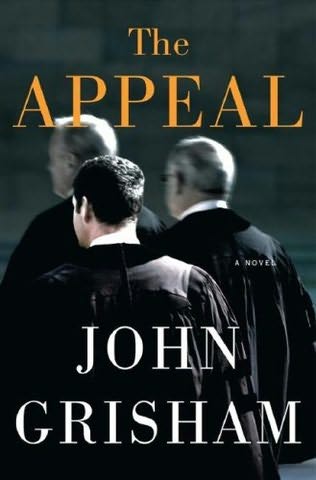
The Appeal by John Grisham

Usually Grisham can go either way for me. The only thing that I've read by him that I loved was The Innocent Man, but that was his one non-fiction book. The Street Lawyer is total crap, but some others are pretty good. This one was pretty good; it was overtly uncreative to anyone in the legal world, but it still offered up a few nuggets to think about.

The Appeal is about a toxic tort case involving a company that dumped a bunch of chemicals and gave the surrounding residents cancer (which is virtually identical to the real case that inspired A Civil Action, but with a different result) and the subsequent attempt by the big corporation to buy a seat on the Mississippi Supreme Court so that the appeal would go its way (which is exactly what happened in West Virginia within the last few years and was the impetus for the U.S. Supreme Court case that I saw the oral arguments for). So yeah, not very original. Grisham adds a twist of sorts at the end, and even though it isn't very surprising either, it still explores some very topical issues and gets you thinking.

One thing that was kinda weird about this book was that it wasn't very dramatic. There was no harrowing life or death breath taking moment or anything remotely like it that is usually a Grisham staple, but it was still entertaining. It was a very quick read and I enjoyed it, but it wasn't the best book I've ever read.

One other note: judicial elections are such egregious miscarriages of justice that it shocks and appalls me that we still have them. The idea is completely preposterous. It makes me furious. That is all I'll say about that.

Tuesday, October 30, 2007

The Chamber by John Grisham

Until two years ago, I had never read a Grisham novel. I obviously knew of his work through the various film adaptations of his books, films that I mostly enjoyed. I decided that I would read his books in order, since I have been told on more than one occasion that his earlier books are better than his later ones. While I liked A Time to Kill, I thought that the ending was a little lacking. I felt the same way about The Firm. I was beginning to wonder if Grisham was one of those writers who have trouble concluding their stories. The Pelican Brief and The Client were both improvements. Both were taut thrillers that came to a satisfying close.

Brent (a fellow 50 Booker) had recommended The Chamber to me a couple of times, telling me that it is one of his favorite Grisham novels, right up there with The Rainmaker – incidentally, that is the next of Grisham’s novels. The Chamber marked a slight departure from Grisham’s previous works. It was much slower paced, both the story and characters took a while to develop. But, any hack can write quick, spastic action (see Dan Brown’s bibliography). It is much more difficult to create a slow-moving story that is interesting and entertaining for the reader. With The Chamber, Grisham does exactly that.

The storyline of the book is rather simple. Sam Cayhall is on death row in Mississippi for a crime that he committed when he was much younger and a member of the Ku Klux Klan. He is in his sixties and a month away from the gas chamber, when his lawyer grandson – who had not previously met him – arrives to take up his case. Grisham describes the legal battles that take place in the ensuing weeks. Throughout this time, Adam Hall gets a lesson in his extended family history, often learning things that he wished he hadn’t. As with his two previous books, Grisham ends The Chamber well.

Although it is just a novel, I don’t know how someone could read this book and not give some serious thought to the death penalty.