Showing posts with label south carolina. Show all posts

Tuesday, May 30, 2023

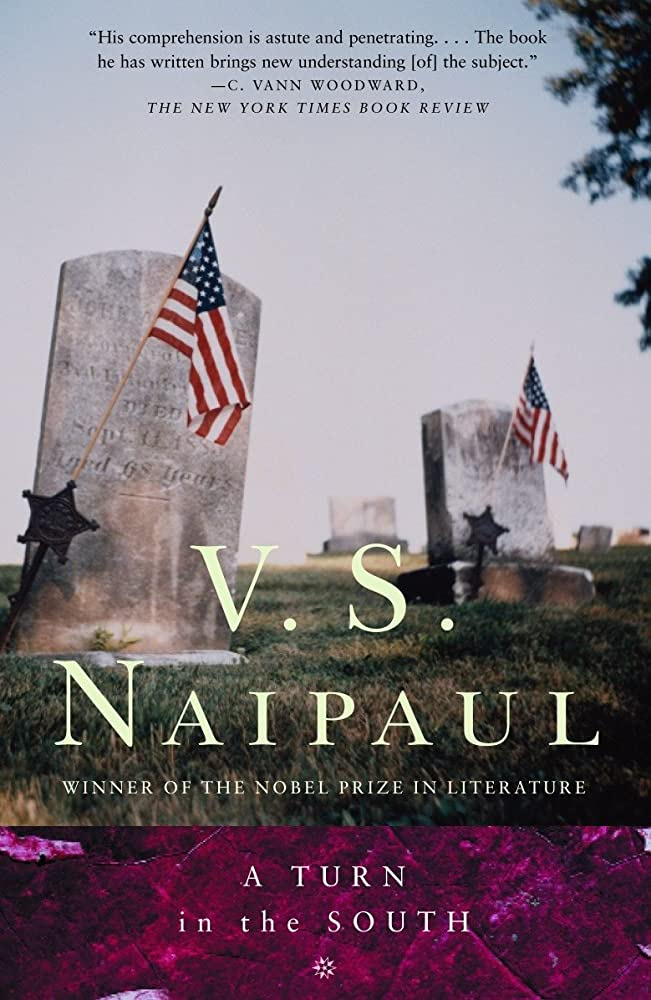
A Turn in the South by V. S. Naipaul

Satan and God fighting for Paula's soul, Paula herself not responsible for the movements of her passion, helpless, capable only of choosing salvation and asking God to reveal his will: a medieval idea of chaos, and the solitude and helplessness of men, and the necessity of salvation. But this was not set in a medieval world of plague and disease and deprivation, the arbitrariness of the sovereign and the humility of the poor. We were in a town of the Research Triangle; and the theme of this culture was abundance and choice, the paramountcy of the individual (if only as consumer), with the beauty and luxury and sensual satisfactions as imminent possibilities for all.

In 1985, fifteen years before he won the Nobel Prize but nearly as many since the publication of A House for Mr. Biswas, V. S. Naipaul traveled through the American South. Though Naipaul is best remembered for his fiction now, he spent nearly as much time writing travelogues, first of the West Indies, then India, and then among Islamic states in Among the Believers. But the South presented a special challenge for Naipaul, who wrote that America "cannot be alien in the simple way an African country is alien. It is too well known, too photographed, too written about; and, being more organized and less informal, it is not so open to casual inspection." And yet, casually inspect, Naipaul does: in metropolitan Atlanta, genteel Charleston, deep swamps and bottomland in Tallahassee and Jackson, and in the up-and-coming cities of the New South, Nashville and Raleigh.

A Turn in the South made me rethink a lot of things, not least among them Naipaul himself. For someone with a reputation as a crank and a bully, Naipaul comes off in A Turn in the South as remarkably open and empathetic. He lets people talk and talk, guiding conversation in only the subtlest of ways, and though perhaps it is only thanks to the writerly tactic of hiding his own questions in narrative voice while faithfully recording the responses of his interlocutors, the effect is of someone reserving judgments: a listener. Sometimes this is frustrating, as when Naipaul interviews an archconservative pastor in Elizabeth City, NC who calls himself a "Jesse-crat" after notorious senatorial douchebag Jesse Holmes, or any number of old white folks who perform paternalistic sadness at the degradation of Black life post-segregation. But it's a gift to get people to say what they probably know they ought not to say, and there's no doubt that in doing so Naipaul really does reveal something at the heart of Southern life. He gets more out of "ordinary people" than he does the black politicos of Atlanta, who are too cagey to stray from their talking points, or Eudora Welty, who is summoned for two paragraphs to talk about the long-gone fad for fur hats.

Naipaul really does empathize with white "rednecks"--a word that's more or less new to him--and with the Black Southerners he meets. Fascinatingly, that empathy seems to emerge from Naipaul's own Caribbean identity, which colors everything he sees in the South. Naipaul makes careful and articulate distinctions between the two regions of the New World, noting, among other things, the crucial lack of a white laborer class after the collapse of slavery and colonialism in Trinidad. "The possibilities" for a Black American, he writes, "were far greater than those of a West Indian. But there could be no easy movement forward for the mass; they had lived through too much; the irrationality of slavery and the years after slavery had made many irrational and self-destructive." And yet, when he writes that the culture of the South is defined by loss and by grief, one hears the echoes of his novels, in which colonial subjects struggle to forge an identity unchained by the weight of history: "The grief was special and was like religion; it would last beyond the decline of the nineteenth century empires, beyond the idea of empire itself." I think that, as a Caribbean, Naipaul is able to understand the South in a way that's difficult for an American Northerner, like Paul Theroux.

But it was the last section, titled "Smoke," which really hit home--literally--for me. The last stop on Naipaul's journey is in the "Research Triangle" of North Carolina, where I grew up, and I perhaps have never heard as insightful or as accurate a description of the place as Naipaul's:

...poor North Carolina pineland landscaped into the discreetest kind of industrial garden, many modern technological names represented by new buildings, long low lines of brick or concrete and glass, giving an impression of spaciousness and order and elegance, the land of rural poverty remade to suit its new function, the South seemingly abolished here, as it had been abolished at the space-research town of Huntsville in Alabama.

Durham poet Jim Applewhite, descendant of tobacco planters, takes Naipaul on a tour of the dying industry: the golden-leafed farms that scan still be found growing between the fresh new medical and research facilities, the meticulous handicraft of the curing barns and the packing process. "[I]t is close to the paradox of civilization itself," Applewhite tells Naipaul, "That this essentially poisonous substance formed the basis of a way of life that had so many attractive aspects--a formalized, seasonal cycle to it, which left the land combed into its even furrows after the stalks had been cut in the autumn." There can be no mourning the death of tobacco, if tobacco is dying, and yet the transition from the "folk art" and "nonutilitarian" practice of the small tobacco farm to the sleek anywhere technologies of biomedicine leave the land and its people bereft of something.

Tobacco, Naipaul notes, comes from the name of Tobago, Trinidad's junior island. Though tobacco planting was quickly abandoned there for the more lucrative sugarcane, Naipaul feels a kind of historical link between himself and the tobacco poet. And I felt it, too. Roughly ten months after Naipaul passed through the tobacco fields of the Research Triangle, I was born there. And it strange to read the great writer writing about the place that I would shortly be ushered into, and which I  have not quite always understood. I started A Turn in the South pleased to know a little more about Naipaul; I was unsettled at the end to find Naipaul looking back. But if that's the feeling I got from A Turn in the South, it's because, in Naipaul's own words, we share something way, way back--but not all that far back--in our histories.

Saturday, April 27, 2019

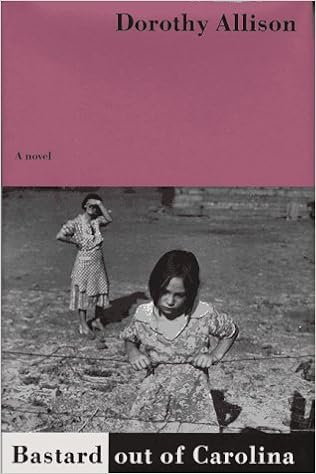
Bastard Out of Carolina by Dorothy Allison

I became even more afraid of Daddy Glen, the palms that slapped, the fingers that dug in and bruised, the knuckles he would sometimes press directly under my eyes, the hands that shook and gripped and lifted me up until his eyes would stare into mine.  My own hands were so small, my fingers thin and weak.  I wished they were bigger, wider, stronger.  I wished I was a boy so I could run faster, stay away more, or even hit him back.

Ruth Anne Boatwright--known as Bone--is officially a bastard.  The hospital where she's born, in Greenville, South Carolina, places a red sticker directly on her birth certificate signifying the fact.  Her mother goes to great lengths to change it, but the bureaucracy is impenetrable; some even believe she's behind the burning down of the courthouse with all of its records.  Is it love for Bone that compels her mother to have the birth certificate amended, or is it the feeling that Bone's bastardy reflects poorly on her?  Is it love for Bone and her sister that drives her into the arms of Glen, the man who ends up sexually and physically abusing Bone, or just pure romantic love?  The answer to both questions is somewhere between, of course, and these kinds of love are headed for conflict: when Daddy Glen's abuse becomes too much for Bone to bear, what will her mother choose?

I misjudged this book.  I thought at first it was going to be one of those slice-of-Southern-life deals, where the sweet tea is always loaded with sugar and family can overcome anything.  I was expecting Barbara Kingsolver.  But Bastard Out of Carolina is much darker and conflicted than I expected.  It's conflicted about the South; it's conflicted about family; it's conflicted about love.  It became clear that I had misjudged it when Daddy Glen abuses nine year-old Bone for the first time, touching her, and himself, in a car while her mother is away.  The abuse is explicitly depicted, and gets far worse, but Allison is careful not to make the book punishing by forefronting it all the time.  It lingers, or the threat of it, in the background all the time.  Fear of it makes Bone mean and resentful, and she comes to understand it as an aspect of her own poverty and marginalization as a girl:

Men could do anything, and everything they did, no matter how violent or mistaken, was viewed with humor and understanding.  The sheriff would lock them up for shooting out each other's windows, or racing their pickups down the railroad tracks, or punching out the bartender over at the Rhythm Ranch, and my aunts would shrug and make sure the children were all right at home.  What men did was just what men did.  Some days I would grind my teeth, wishing I had been born a boy.

Yes, when Bone's uncles find out about Daddy Glen's abuse, they beat the everloving crap out of him.  But such violence hardly makes them heroes, or affirms the importance of family; instead, it becomes part of the same dark male impulse that drives Daddy Glen.  Allison encourages us to see Bone's rage as a problem, a destabilizing force, but also an appropriate response to the forces, local and social, that traumatize her.  Allison is careful not to make her a victim only, which would deaden the narrative; she has dreams of becoming a gospel singer, and Allison's description of the small-town gospel circuit is detailed and convincing.  "I wanted, I wanted, I wanted something," Allison writes, "Jesus or God or orange-blossom scent or dark chocolate terror in my throat."

By the end of the novel, I really came to respect Allison's steel-eyed realism.  Bastard Out of Carolina really has no room for sentimentalism, or feel-good redemption stories.  It's got a sense of humor, but it's also deadly serious about the traumatic consequences of abuse.  In the end--spoiler alert, and, uh, trigger warning--Bone's mother walks in on Daddy Glen raping Bone.  She realizes, once and for all, that Glen and Bone can't be together.  But her love for Glen is so intense--and, Allison suggests, sincere on both sides--that she ends up abandoning Bone instead of Glen.  That's a sobering and unexpected choice on Allison's part.  In the end, Bastard rejects all the pat ways you might read the image of the birth certificate: Bone does not need a new father to un-bastardize her, and the attempt to give her one is destructive in the extreme, but neither does the novel glibly suggest that what she really needs is to become independent of her family.  Yes, her rage becomes wiser, transforms into determination, but who can leave their family behind?  The novel ends with her in the arms of her aunt, which is not enough, but sometimes what you get, Allison suggests, is not enough, not even close.

Tuesday, November 24, 2009

Another Brief Roundup


Happy Thanksgiving! This holiday season, I'm thankful for fluffy bestsellers that can be read in snippets and don't require much brainpower. Lets start with my favorite broad, Chelsea Handler. Are You There, Vodka? It's Me, Chelsea has been out for a bit, but I just recently picked it up for the first time. And can I just say that when I grow up, I want to be nothing like Ms. Handler. However, I do want her for a best friend. We could have slumber parties replete with vodka popsicles and manicures. We could lounge about while I listen, chin in hand, eyes dazzled, to Chelsea describe her latest hookup-gone-awry. I'd guffaw loudly, possibly spitting out my alcoholic beverage, but it would be okay; my bestie Chelsea would understand. She'd be my kids' Crazy Aunt Chelsea! We're probably the same size and she's kinda famous so I could borrow her designer outfits! She's always dragging friends around the world with her on book tours - I'm in, Chelsea! Give me a call! This book is a funny hyperbolic memoir of sorts. Word to the wise: it's kind of awkward to read on the Metro unless you're into laughing out loud, then stopping short to sketchily side-eye your seat mates in case they were looking at you first. Because you were laughing out loud like a crazy person. Chelsea details some funny hookups, trips, and even an arrest in this volume. It is a quick read, and quite hilarious - read it.

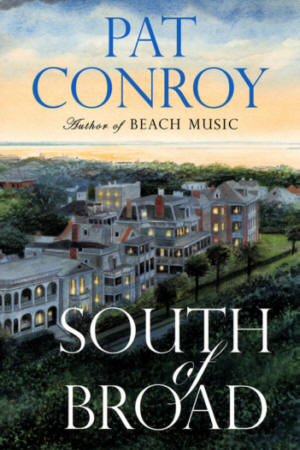
Recently, I also read Pat Conroy's much-anticipated new book, South of Broad. The plot developed painfully slowly, in signature Conroy style, with all the action crammed into the second half of the novel. If you don't have the patience for pages of Low Country description, or you don't like South Carolina, this book is not for you. This was only the second Conroy I have read; I loved Lords of Discipline but can never seem to get past the first few chapters of The Prince of Tides (which many of my friends claim is his best book by far). I may have to go back and give it another try. South of Broad is about a group of friends, and the book's plot focuses on both their senior year in 1969 and also on a period twenty years later, when they all come together to rescue one of their own who is dying alone from AIDS. With murders and murderers and a plot that follows the friends from Charleston to San Francisco and back, the book is pretty good. Honestly, my favorite part of the novel was towards the end, when Hurricane Hugo decimates Charleston, bringing the friends together and healing old rifts. I remember Hugo a teeny bit (we were evacuated from a beach vacation in NC for it), and I never realized how much damage the hurricane caused the old city. Charleston is just as prominent a character in Conroy's book as any of the people in it, so the hurricane's destruction is especially poignant.

I also just finished the new Dan Brown novel, The Lost Symbol. Another quick read, but after The Da Vinci Code (which I gobbled up, haters) this one left something to be desired. I don't think the "twist" was as compelling or written as believably as in The Da Vinci Code. I also thought the ending relied on a rather tired literary construct - the idea that everything you seek, you have already. Spoiler alert: the Ancient Wisdom referenced in book (several characters are hunting for it) turns out to be contained in the Bible. It speaks to man's ability to bend nature and reality to his will. When I got to the end of the book and found out that the goal all along was actually a Bible, I gotta say I felt a little let down. For this reason, I couldn't decide if Brown was throwing a bone to the critics of Da Vinci Code who protested that the book was vehemently anti-Christian, or if he was espousing a broader multi-religion world view (technically, Brown explains that the Ancient Wisdom is in every religious text world-wide - a kind of archetype. I live in the Washington DC area, so it was neat to read the novel and learn about landmarks and monuments in my town, especially their Masonic ties. I sit right next to a former president (is that the term?) of the DC-area Masons, and whenever RG saw me reading the book, he always asked what Masonic rituals were being described, but never commented on whether the book was true to life or not. Brown certainly took long enough between books to have researched and fact-checked diligently in anticipation of this novel's release so maybe parts of the book are based on fact.