Showing posts with label georgia. Show all posts

Tuesday, May 30, 2023

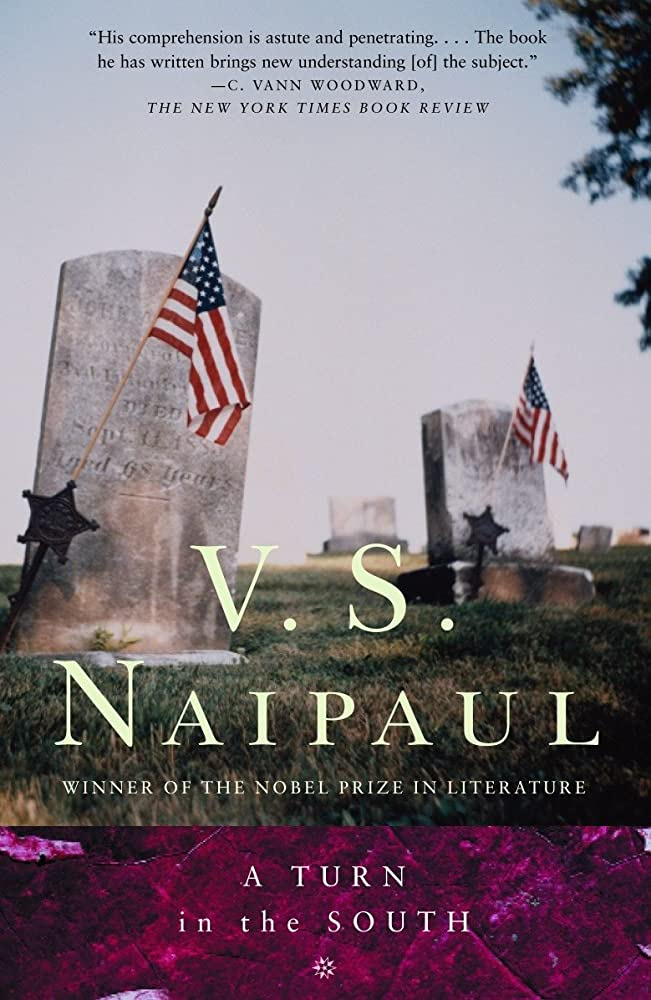
A Turn in the South by V. S. Naipaul

Satan and God fighting for Paula's soul, Paula herself not responsible for the movements of her passion, helpless, capable only of choosing salvation and asking God to reveal his will: a medieval idea of chaos, and the solitude and helplessness of men, and the necessity of salvation. But this was not set in a medieval world of plague and disease and deprivation, the arbitrariness of the sovereign and the humility of the poor. We were in a town of the Research Triangle; and the theme of this culture was abundance and choice, the paramountcy of the individual (if only as consumer), with the beauty and luxury and sensual satisfactions as imminent possibilities for all.

In 1985, fifteen years before he won the Nobel Prize but nearly as many since the publication of A House for Mr. Biswas, V. S. Naipaul traveled through the American South. Though Naipaul is best remembered for his fiction now, he spent nearly as much time writing travelogues, first of the West Indies, then India, and then among Islamic states in Among the Believers. But the South presented a special challenge for Naipaul, who wrote that America "cannot be alien in the simple way an African country is alien. It is too well known, too photographed, too written about; and, being more organized and less informal, it is not so open to casual inspection." And yet, casually inspect, Naipaul does: in metropolitan Atlanta, genteel Charleston, deep swamps and bottomland in Tallahassee and Jackson, and in the up-and-coming cities of the New South, Nashville and Raleigh.

A Turn in the South made me rethink a lot of things, not least among them Naipaul himself. For someone with a reputation as a crank and a bully, Naipaul comes off in A Turn in the South as remarkably open and empathetic. He lets people talk and talk, guiding conversation in only the subtlest of ways, and though perhaps it is only thanks to the writerly tactic of hiding his own questions in narrative voice while faithfully recording the responses of his interlocutors, the effect is of someone reserving judgments: a listener. Sometimes this is frustrating, as when Naipaul interviews an archconservative pastor in Elizabeth City, NC who calls himself a "Jesse-crat" after notorious senatorial douchebag Jesse Holmes, or any number of old white folks who perform paternalistic sadness at the degradation of Black life post-segregation. But it's a gift to get people to say what they probably know they ought not to say, and there's no doubt that in doing so Naipaul really does reveal something at the heart of Southern life. He gets more out of "ordinary people" than he does the black politicos of Atlanta, who are too cagey to stray from their talking points, or Eudora Welty, who is summoned for two paragraphs to talk about the long-gone fad for fur hats.

Naipaul really does empathize with white "rednecks"--a word that's more or less new to him--and with the Black Southerners he meets. Fascinatingly, that empathy seems to emerge from Naipaul's own Caribbean identity, which colors everything he sees in the South. Naipaul makes careful and articulate distinctions between the two regions of the New World, noting, among other things, the crucial lack of a white laborer class after the collapse of slavery and colonialism in Trinidad. "The possibilities" for a Black American, he writes, "were far greater than those of a West Indian. But there could be no easy movement forward for the mass; they had lived through too much; the irrationality of slavery and the years after slavery had made many irrational and self-destructive." And yet, when he writes that the culture of the South is defined by loss and by grief, one hears the echoes of his novels, in which colonial subjects struggle to forge an identity unchained by the weight of history: "The grief was special and was like religion; it would last beyond the decline of the nineteenth century empires, beyond the idea of empire itself." I think that, as a Caribbean, Naipaul is able to understand the South in a way that's difficult for an American Northerner, like Paul Theroux.

But it was the last section, titled "Smoke," which really hit home--literally--for me. The last stop on Naipaul's journey is in the "Research Triangle" of North Carolina, where I grew up, and I perhaps have never heard as insightful or as accurate a description of the place as Naipaul's:

...poor North Carolina pineland landscaped into the discreetest kind of industrial garden, many modern technological names represented by new buildings, long low lines of brick or concrete and glass, giving an impression of spaciousness and order and elegance, the land of rural poverty remade to suit its new function, the South seemingly abolished here, as it had been abolished at the space-research town of Huntsville in Alabama.

Durham poet Jim Applewhite, descendant of tobacco planters, takes Naipaul on a tour of the dying industry: the golden-leafed farms that scan still be found growing between the fresh new medical and research facilities, the meticulous handicraft of the curing barns and the packing process. "[I]t is close to the paradox of civilization itself," Applewhite tells Naipaul, "That this essentially poisonous substance formed the basis of a way of life that had so many attractive aspects--a formalized, seasonal cycle to it, which left the land combed into its even furrows after the stalks had been cut in the autumn." There can be no mourning the death of tobacco, if tobacco is dying, and yet the transition from the "folk art" and "nonutilitarian" practice of the small tobacco farm to the sleek anywhere technologies of biomedicine leave the land and its people bereft of something.

Tobacco, Naipaul notes, comes from the name of Tobago, Trinidad's junior island. Though tobacco planting was quickly abandoned there for the more lucrative sugarcane, Naipaul feels a kind of historical link between himself and the tobacco poet. And I felt it, too. Roughly ten months after Naipaul passed through the tobacco fields of the Research Triangle, I was born there. And it strange to read the great writer writing about the place that I would shortly be ushered into, and which I  have not quite always understood. I started A Turn in the South pleased to know a little more about Naipaul; I was unsettled at the end to find Naipaul looking back. But if that's the feeling I got from A Turn in the South, it's because, in Naipaul's own words, we share something way, way back--but not all that far back--in our histories.

Friday, May 26, 2023

The Color Purple by Alice Walker

You saying God vain? I ast.

Naw, she say. Not vain, just wanting to share a good thing. I think it pisses god off if you walk by the color purple in a field somewhere and don't notice it.

What do it do when it pissed off? I ast.

Oh, it make something else. People think pleasing God is all God care about. But any fool living in the world can see it always trying to please us back.

Yeah? I say.

Yeah? she say. It always making little surprises and springing them on us when us least expect.

Celie grows up learning to be used: raped and impregnated over and over by the man she believes to be her father, then married off to a man who really desires her sister, her sister who thinks better of the whole situation and runs off so as to not end up like Celie. Her new husband, called only Mr. ____, beats her regularly, and the unassuming Celie more or less assumes that this is the way of the world until Shug Avery appears in the house. Shug is a jazz singer, beautiful and fierce, who is the real object of Mr. ____'s affections. But when Shug falls ill, it's Celie that takes care of her, and soon the pair fall in love, and lust, with each other. It's Shug that teaches Celie to enjoy the pleasures her body demands, and to stick up for herself against the whims of men.

Famously, The Color Purple is written as a series of letters, some penned by Celie, and others by her sister Nettie, who has traveled with a pair of missionaries to Africa along with, for convoluted reasons, some of Celie's own children. The letters penned by Celie are written in a voice that is colloquial and spirited, full of rich vernacular that makes The Color Purple a pleasure to read. The Color Purple is perhaps the most prominent of a handful of books, like those by Toni Cade Bambara and J. California Cooper that came out in the 1980s that found in Black American dialect a rich voice worth exploring. Celie has such a powerful voice, but it takes the influence of Shug for her to realize it's worth using, and much of what I enjoyed most about the book was listening to Celie expand that voice with humor and withering judgment. The scene where she tells an incredulous Mr. ____ that she's leaving Georgia to travel with Shug to Memphis is one of the book's small masterpieces.

On the other hand, I felt that the narrative stops cold when it gets to Nettie's letters from Africa. In a way, Walker grasps at something sort of like the story of Homegoing, which explores the invisible links between Black American life and contemporary Africa. But I just couldn't make myself care about the made-up "tribe" that Nettie finds herself among, or their trials at the hands of roadbuilding, crop-destroying capitalists. And worse, Nettie--slightly more educated, more polished than her sister--has nothing like Celie's voice to make these sections more interesting. The whole Africa plotline seemed indicative of a messy convolutedness that can make the novel, at times, a chore.

Celie begins by addressing her "letters" to God; later, after she has learned of her sister's whereabouts, she addresses them to Nettie. This tracks with Shug's expression of a pantheism that takes in all of creation: if God won't reply, why not write to the God in Nettie? Shug's insistence that God wants us to stop and marvel at "the color purple in a field" verges on the sentimental and the faux-spiritual, but it works because we recognize the way that many women, like Celie, have been conditioned by a masculine world to believe that duty always comes before joy. Shug, who seems to be horny for everyone and everything, is a representation of this pantheist and pansexual principle. But Celie doesn't need to become like Shug: she only needs to learn, as Shug teaches her, to enjoy her own body, her own life, her own self.

Tuesday, April 28, 2020

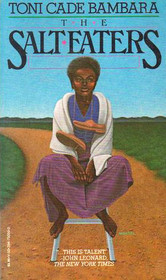
The Salt-Eaters by Toni Cade Bambara

One would run the back roads to the woods, not jogging in unpaid outfits, trampling shoots, not moving in with tents, dope, and bombed-out playmates mouthing off about "We're into nature," not hiding out in Wordsworth or Kerouac, excusing the self from social action, but running to the woods in hopes of an audience with the spirits long withdrawn from farms and gardens all withered and wasted, bringing eagle-bone whistles or gourd rattles or plaster saints or rakes and seeds or gifts of soap or sacks of cornmeal or sticks of licorice or cones, anything one had to place on a tree-stump altar or a turned-rock shrine to lure the saving spirits out to talk and be heeded finally. Stumbling through the thorns and briars, following the rada rada big booming of the drums or the weh weh wedo riff of reed flutes, running toward a clearing, toward a likely sanctuary of the saints, the loa, the dinns, the devas. And found, would open up and welcome one in before the end, welcome one in time to wrench time from its track so another script could play itself out.

Velma Henry sits in a room in the Southwest Infirmary in Claybourne, Georgia, being treated by a healer after slitting her wrists and putting her head in a gas oven. The healer, Miss Minnie, is arguing with her spirit guide, an old friend she calls Old Wife, while the loa--the spirits of Vodou--gather around. Outside in Clayborne, a Mardi Gras festival is going on, where the organization Velma has committed her life to, a social justice outfit called the Academy for the Seven Arts, may be planning an attack with a cache of stolen weapons on the insidious Transchemical plant where Velma has been working as a spy. A dozen or so other characters--members of the Academy, chemical engineers, bus drivers, and doctors--go on about their business, unaware of the way in which their lives are interwoven with Velma's as she fights--or doesn't--for life.

One of the remarkable things about The Salt-Eaters is that the entire novel takes place over a couple of hours at most; it seems to sit on the head of a pin. Bambara floats freely from one consciousness to another, hopping from Velma's brain to Miss Minnie's to all the others. It has the feeling of the quiet stillness before a storm, and a storm does come, a sudden outpouring of thunder and rain that's somehow associated with the loa, and which may usher in a new world, free of racism, capitalism, patriarchy, and ecological disaster. The Salt-Eaters, for all its experimental weirdness, is a book that's really about the drudgery and praxis of social change. It's factionalism, opportunism, and inefficacy in her movement that has driven Velma to despair; in her memories we see bus drives, petition drives, fights over parliamentary rules. Bambara seems to suggest that real change is possible in a world where social organization is married to spiritual awakening of some kind.

I'll tell you, I didn't expect this novel to be what it was. I like to teach some of Bambara's stories, including "The Lesson" and "Raymond's Run," which are typically about black children in urban environments. Those stories are persuasive bits of social realism, but The Salt-Eaters explodes all that in favor of shifting viewpoints, disorienting narratives, and disjointed time. It's sort of a glorious mess; I loved reading it though I'm not sure I understood half of it on a real literal level. A more conventional narrative might have helped me follow the track of what Bambara's saying about social change, but it probably would have made for a much more ordinary reading experience, and wouldn't have resounded with life, as Bambara's Claybourne does.

Thursday, May 2, 2019

Home by Toni Morrison

It was so bright, brighter than he remembered.  The sun, having sucked away the blue from the sky, loitered there in a white heaven, menacing Lotus, torturing its landscape. but failing, failing, constantly failing to silence it: children still laughed, ran, shouted their games; women sang in their backyards while pinning wet sheets on clotheslines; occasionally a soprano was joined by a neighboring alto or tenor just passing by.  "Take me to the water  Take me to the water.  Take me to the water.  To be baptized."  Frank had not been on this dirt road since 1949, nor had he stepped on the wooden planks covering the rain's washed-out places.  There were no sidewalks, but every front yard and backyard sported flowers protecting vegetables from disease and predators--marigolds, nasturtiums, dahlias.  Crimson, purple, pink, and China blue.  Had these trees always been this deep, deep green?

Out on the west coast, Korean War vet Frank Money gets a note saying that his sister Cee, still in their hometown of Lotus, Georgia, is in danger.  Frank swore that he would never go back to Lotus, but his love and concern for Cee draws him back, and he embarks on a cross-country train trip to save her from the ambiguous threat.  A dissociative outburst has placed him in a psych ward, and so he goes without money (or shoes), depending on the kindness of strangers and navigating the complexities of segregation.  Back in Lotus, Cee has taken a job with a eugenicist who is using her for grotesque uterine experiments.

Frank Money has a pretty Toni Morrisonesque name, and this is a pretty Toni Morrisonesque novel.  Like Milkman's journey to his ancestral Southern home in Song of Solomon, Frank's journey is a variation on The Odyssey, and the contours are clear from the jump: Frank will finally get home, but not without facing some real weirdness on the way, and his rescue of Cee will help him reintegrate into his home and perhaps heal himself where he's been scarred by the horrors of war.  But too often Home feels like the outline of a Toni Morrison that's never been fully developed.  Its 140 pages (with big font) are too tight to really give the impression that Frank's journey home is an undertaking, rather than a mere symbol, and Morrison's penchant for giving every minor character a turn in the narrative spotlight means the two protagonists get crowded quickly to the corners.  The classic elements of her other novels are all there, the weirdnesses--Frank's vision of the world draining of color, a mysterious apparation in a zoot suit--but they hang too heavily on the slight narrative.

The most interesting thing about Home are the interstitial chapters narrated by Frank himself.  Morrison loves to play around with point of view (The Bluest Eye, in particular, shifts between first and third person), but the sudden realization that Frank is writing to the author herself is a welcome and worthy surprise.  He admits to her that the story he's writing is not quite an accurate one, that the narrative she gives of his time in war--from where, or whom?--minimizes his own culpability in the atrocities there.  That's an inspired choice, and it makes me wish there had been a more effective novel shaped around it.

Saturday, February 9, 2019

Clock Without Hands by Carson McCullers

Looking downward from an altitude of two thousand feet, the earth assumes order.  A town, even Milan, is symmetrical, exact as a small gray honeycomb, complete.  The surrounding terrain seems designed by a law more just and mathematical than the laws of property and bigotry: a dark parallelogram of pine woods, square fields, rectangles of sward.  On this cloudless day the sky on all sides and above the plane is a kind of monotone of blue, impenetrable to the eye and the imagination.  But down below the earth is round.  The earth is finite.  From this height you do not see man and the details of his humiliation.  The earth from a great distance is perfect and whole.

...The whole earth from a great distance means less than one long look into a pair of human eyes.  Even the eyes of the enemy.

I picked up Carson McCullers' novel Clock Without Hands--the only work of narrative fiction I hadn't read of hers--at a used bookstore in Atlanta.  It was a lucky find, I thought; I love reading books set in the places of I'm traveling, and few people capture Georgia and the South in general as well as McCullers.  But McCullers' Georgia, even moreso here than in The Heart is a Lonely Hunter, is hardly picturesque--it's fetid, corrupt, swamplike.

The novel focuses on four men: J.T. Malone, a small-town pharmacist who learns he has terminal leukemia; Jester Clane, an idealistic teenager; Sherman Pew, an angry black teenager and orphan with blue eyes (paging Toni Morrison) whom Jester falls in love with; and Judge Fox Clane, a genteel old racist who employs Sherman as a servant.  It's the Judge that's really the central character here.  He's an icon of the old Southern guard: vociferously opposed to integration even as he gets on well with Sherman, and his other black servants, on a personal level.  His political ambitions center around a plan to recognize Confederate scrip money, which he just happens to have an enormous stash of in his attic.  He considers himself upright, objective; but we know that he has sent innocent black men to their death, telling himself "he, himself, was only an instrument of the law.  So, no matter how grave the miscarriage was, he could not pine forever."  We also know that he keeps the secret of Sherman's parentage to himself in an act of misguided paternalism.

His bigotry puts him at odds with his grandson, Jester, whose beliefs are newly developed and crude but passionate.  But Jester's nascent liberalism doesn't extend to his own homosexuality, which torments him: "If it turned out he was homosexual like men in the Kinsey Report, Jester had vowed that he would kill himself."  I was surprised, actually, how explicit Jester's sexuality is dealt with here: after meeting Sherman for the first time he races to a brothel, where he loses his virginity to a woman but while thinking about Sherman the whole time.  The relationship between the two young men is a bravura bit of character work: they clearly care deeply about each other, but the difference between their station in life transforms that care into endless petty sniping and one-upsmanship.  Jester tries to get Sherman to admit they are friends, but Sherman is too angry to admit such emotions into his life:

All Sherman's life he had thought that all white men were crazy, and the more prominent their positions the more lunatic their words and behavior.  In this matter, Sherman considered he had the sober ice-cold truth on his side.  The politicians, from governors to congressmen, down to sheriffs and wardens, were alike in their bigotry and violence.  Sherman brooded over every lynching, bombing, or indignity his race had suffered.  In this Sherman had the vulnerability and sensitivity of an adolescent.  Drawn to broodings and atrocities, he felt that every evil was reserved for him personally.  So he lived in a stasis of dread and suspense.  This attitude was supported by facts.

Sherman is a capable servant for the Judge, who lets him have free reign in the house.  But he refuses, when asked, to write letters for the Judge about segregation and the Confederate money.  While the Judge tries to soften the conversation, returning to old tired tropes about "happy peonage" and the faithful slave who stayed with his master after emancipation, it's refreshing to hear Sherman call literal bullshit: "Still, a n----- would rather be a lamppost in Harlem," he tells the Judge, "than the governor of Georgia."  In many ways, Sherman is a kind of substitute son for the Judge, who has lost his own son and is in the process of losing, metaphorically speaking, his grandson, but the Judge's rigid bigotry prevents him from really hearing Sherman.  And in the end their relationship crumbles, and the worst occurs: Sherman moves into a house in the white part of town, in a pique of indignation and--spoiler spoiler spoiler--the Judge leads a band of vigilantes in bombing his house.

It's the pharmacist, J. T. Malone, who draws the assignment, but he refuses.  Close to death, he realizes that the easy racism he has embraced his entire life is morally hazardous, and he doesn't want to endanger his immortal soul.  "What the fuck is an immortal soul?" someone asks, and Malone replies: "I don't know... But if I have one, I don't want to lose it."  Later, Jester, enraged at the loss of his friend, almost murders the eventual perpetrator, a poor white named Sammy Lank, but a flash of empathy even for Sammy, his poverty, his idiocy, makes him reconsider.

I found myself wondering: How is this book, which focuses on white men considering and reconsidering their own racism, different from something like Green Book or Driving Miss Daisy?  I think it's because those movies are meant to make white people feel better, and Clock Without Hands actually wants you to feel very bad.  And it did make me feel bad.  I can't remember the last time a book made me feel something so viscerally.  The racism that seems so violent and intractable in this novel remains so violent and intractable.  Even before Sherman's murder, there's a scene in which Jester, trying to chase down a young black man who has stolen a few dollars from another, causes the man's death at the hands of the police.  And while the narrative just kind of barrels past it, McCullers seems to say, look at the way we just barrel past deaths like these.  It seemed so horribly fresh, sadly current.  (And as an aside, I couldn't read this story without thinking about the plot in The Heart is a Lonely Hunter in which Willie loses both his legs because he gets frostbite in jail.)  Though Clock Without Hands ends with the news of federally mandated school integration, it's ultimately pessimistic about our national ability to root out and deal with the rot of racism.

McCullers is better than anyone else at finding the intersection between the political and the universal.  One of the book's big themes is grief: the Judge can't get over the deaths of his wife and son.  Sherman grieves for the mother he has never known, and J. T. experiences a kind of anticipatory grief as he faces his own death:

But now he dwelt on inexplicable deaths.  He thought of children, exact and delicate as jewels in their white satin coffins.  And that pretty singing teacher who swallowed a bone at a fish fry and died within the hour.  And Johnny Clane, and the Milan boys who died during the first world war and the last.  And how many others?  How?  Why?  He was aware of the knocking sound in the basement.  It was a rat--last week a rat had overturned a bottle of asafetida and for days the stench was so terrible that his porter refused to work in the basement.  There was no rhythm in death--only the rhythm of the rat, and the stench of corruption.  And the pretty singing teacher, the blond young flesh of Johnny Clane--the jewel-like children--all ended in the liquefying corpse and coffin stench.

Yikes!  But at the same time McCullers challenges us to interrogate whose deaths exactly we find inexplicable.  We're saddened by the death of children, and the "blond young flesh" of the Judge's son, but who takes time to mourn for Grown Boy, killed by the police, or Sherman, killed by a judge?  Or the many sentence to death by the Judge through entirely legal means?  Death is so very sad, and empathy is so necessary--that's what McCullers says over and over again, in every novel--but it is so easy to extend empathy only to those who look and think like us.  What would radical empathy look like?  How would it transform our communities, ourselves?  Clock Without Hands doesn't really seem to believe that it's possible, as necessary as it is.


Tuesday, May 8, 2012

The Heart is a Lonely Hunter by Carson McCullers

During the moonlit January nights Singer continued to walk about the streets of the town each evening when he was not engaged.  The rumors about him grew bolder.  An old Negro woman told hundreds of people that he knew the ways of the spirits come back from the dead.  A certain piece-worker claimed that he had worked with the mute at another mill somewhere else in the state--and the tales he told were unique.  The rich thought that he was rich and the poor considered him a poor man like themselves.  And as there was no way to disprove these rumors they grew marvelous and very real.  Each man described the mute as he wished him to be.

Why are we lonely?  There are more people in the world now than there have ever been.  If you really wanted to, most of us could meet a hundred people a day only a few miles from our homes, but does any of us suppose that we would find among them any really kindred soul, even if we tried for a hundred years?  The diversity of people is both our wonder and our tragedy; our personalities, our goals, our experiences are too different to really eradicate loneliness.  We want desperately to communicate, to share ourselves, but we talk past each other, wanting to be understood but not seeking to understand.

John Singer, the central character--I wouldn't say protagonist or main character, exactly--of Carson McCullers' The Heart is a Lonely Hunter is genial and kind, and also a deaf-mute.  He is talked at because he cannot talk back, and in him everyone sees a perfect companion.  He acts as a lightning rod for loneliness, attracting the most isolated souls in his small Georgia town: Biff, a restaurant owner whose wife has recently died; Mick, a young girl who dreams of a career in music; Jake, a manic revolutionary who rails about social injustice.

My favorite, though, is Doctor Copeland, a black doctor obsessed with what he calls his "strong, true purpose," the education and advancement of his race.  Except for Singer, Copeland is the novel's most achingly tragic character:


When he was seventeen years old they had sent him north with eighty dollars hidden in his shoe.  He had worked in a blacksmith's shop and as a waiter and as a bellboy in a hotel.  And all the while he studied and read and went to school.  His father died and his mother did not live long without him.  After ten years of struggle he was a doctor and he knew his mission and he came south again.

He married and made a home.  He went endlessly from house to house and spoke the mission and the truth.  The hopeless suffering of his people made in him a madness, a wild and evil feeling of destruction.  In his heart there was a savage violence, and once he grasped the poker from the hearth and struck down his wife.


Copeland feels acutely the suffering of his people, but he cannot connect with the suffering of individuals, not even his own family.  He cannot understand their religiosity or their refusal to take up the mantle of the "strong, true purpose" at the expense of their own lives.  When his son-in-law loses his legs from being abandoned in a freezing prison cell, he finds that his erudition and understanding have not equipped him to do anything, or even commiserate with his daughter.  He rants to Singer about justice and equality, but like the others he can only figure out how to communicate with himself.

Singer enjoys the company of these people but is baffled when, the four of them coming to visit him at once by sheer chance, they cannot get along together.  For his part, he cares most for his deaf-mute friend Antonapoulos, who has been shipped off to a mental ward.  What the others make of Singer, Singer makes of Antonapoulos, holding him dear even though he is clearly mad:


This was the friend to whom he told all that was in his heart.  This was the Antonapoulos who no one knew was wise but him.  And as the year passed his friend seemed to grow larger in his mind, and his face looked out in a very grave and subtle way from the darkness at night.  The memories of his friend changed in his mind so that he remembered nothing that was wrong or foolish--only the wise and good.


It is also the Antonapoulos who "got drunk and threw a bowl of macaroni in his face."  The Heart is a Lonely Hunter suggests that there is something fundamentally tragic about being human, that we are stuck in a cycle of projecting ourselves onto those around us and despairing to find that those projections are proven false.  Most horrifyingly it suggests that Singer is right when he suggests that Antonapoulos is wise, though not in the way that Singer believes: that true wisdom comes from throwing off the need for human companionship, which inexorably fails, and embracing the primitive joys of feeding, sleeping, and emotion without reason or language.

Would it be easier for the characters of The Heart is a Lonely Hunter if they could step outside of themselves and see the folly of this cycle?  The novel is conspicuously (appropriately?) mute on the subject.  The existence of the novel itself, though not the experience of the characters, suggests that it is possible, but on the other hand it does not alleviate the essential tragedy of watching it happen.

Wednesday, May 21, 2008

Deliverance by James Dickey

Can you hear the banjo music?

When people think of Deliverance, more than likely the movie comes to mind before the book and the gruesome rape scene comes to mind before the quality of writing does, if it ever does. What most people don’t seem to know is that before Dickey wrote this popular novel he was known for his poetry. His knack for poetic language flows over into his prose writing, where he uses descriptions and metaphors that other people wouldn’t think of. For instance, when Ed is struggling to climb up the cliff that will take him to the man who has killed his friend Drew, he’s described as making love to the cliff, using his hips in ways he never had with a woman.

I had a hard time reading Deliverance given the subject matter and some of the graphic descriptions, but I also had a hard time putting it down. Lewis is an Alpha male with a strange infatuation with the life that can only be found out in the hills where there’s music never before heard or recorded and the mountain people have resisted civilization. He has talked three of his friends into going on a weekend rafting trip out in BFE, Georgia, where even he finds himself ill-equipt to deal with the harsh realities of the area he was so excited about sharing with his friends.

At first, their only problems are the rapids in the river. Things escalate when they run into two locals who sodomize one of the men and attempt to sodomize another. A local is killed during the rape scene and the rest of the book deals with the revenge taken on the city dwellers by the local left alive. Bodies are buried, the living are injured, and the fight for life is met with questions, desperate struggle, and animal-like instinct.

Dickey also wrote the script for the film, so the book and the movie are more or less the same. Apparently, though, Dickey and the director had a squabble because Dickey was too demanding on set and made too many orders. He was asked not to return to the filming because of all his micromanaging.

I'd give Deliverance an eight out of ten.

Monday, January 21, 2008

Tobacco Road by Erskine Caldwell

Tobacco Road takes place in sharecropper country in rural Georgia in the bleakest times of the Great Depression, centering around the Lester family, a bunch of idiotic, amoral, and generally unlikeable bunch living hand-to-mouth. Foremost is the patriarch of the family, Jeeter Lester, who refuses to move to the city and get a job in a mill to feed his family. His wife Ada is a shrew and his ancient mother putters around the house essentially ignored, feeding off crumbs and such to survive. Most of his seventeen children are gone, married off, except for two: Dude (these names read like an episode of Hee Haw) who marries a woman preacher with a disfigured nose named Sister Bessie because she buys a new automobile, and Ellie May, who is a fair enough girl except for a hideous hairlip that makes her unmarriageable. Ellie May does however receive some interest from local Lov Bensey, who just isn't getting enough out of his marriage to Jeeter's twelve-year old daughter Pearl.

These are probably some of the most reprehensible people I have ever read about. The book opens as Lov comes to seek Jeeter's help about how to get Pearl to sleep with him--to which Jeeter responds by stealing Lov's sack of turnips and running into the woods to devour them alone. Jeeter spends the entire novel wondering where his next dollar is going to come from, and the family is always just at the edge of starvation. At the end, Dude and Bessie run over and kill Mother Lester in their automobile without so much as turning back, and then Jeeter accidentally sets his house on fire killing everyone inside including himself. These are truly disgusting people.

But why? What's the point? I'm not one to point fingers at unfair representations in literature, I think that too often that's myopic and short-sighted, but Tobacco Road plays only as a cruel parody. Caldwell gives a whopping zero redeeming traits to his characters; their exploits afford no insight to anything but their own idiocy and moral shortcoming. There is no urgency to be felt in the Lester family's closeness to starvation. In fact, if anything, I rooted for these characters to die and in horrible fashion. If this book is a drama, it lacks honesty; if it is a satire, it lacks wit. Worst of all, it is boring. Not recommended.