Showing posts with label north carolina. Show all posts

Sunday, May 4, 2025

Heading West by Doris Betts

In contrast with this gleaming vegetation, Mrs. Dover's Western photographs had shown no tender green, no leaf, no grass. If they drove until the Southwest turned to stone, Nancy would have her chance to see muted reds and blending golds in the layered cliffs, the color of light on implacable stone. A place like Grand Canyon, she thought, would give Sisyphus bad dreams.

Nancy Finch is traveling with her sister and her sister's husband on the Blue Ridge Parkway when they're attacked and robbed by a strange man. The attacker, who calls himself Dwight Andersen, takes Nancy as a hostage, and suddenly Nancy is barreling along the highway toward nowhere in particular. It's a mystery what animates Dwight, though he makes veiled allusions to a twin brother he may or may not have killed. He seems to have no plan, no intent, though Nancy extracts a promise that when they reach the state of Arizona and the Grand Canyon, he'll let her go. As insurance, Dwight takes another hostage, a disgraced judge named Harvey Jolley, though for a while Jolley fails to understand that he's a hostage, and not simply a hitchhiker. The three make an unlikely set, but fate has forced them together, and they are headed west, knit together by the threat of violence.

Nancy and Harvey make a few half-hearted attempts at escape, but it becomes clear over the course of the book that there is something they treasure, too, in the westward flight. For the judge, it's an escape from the death of his wife and the ignominy of his corruption. For Nancy, it's a chance to extricate herself from the selfish and provincial ties that bind her to her sister and her mother, a kind of secondary status as the unwed daughter. It's a strange dynamic: for Dwight, the kidnapper, the trip seems to mean nothing at all, nothing but constant motion; it's the other two who are thinking and feeling animals, and who begin to assign meaning to their flight. The Grand Canyon becomes a symbol of where they are headed, a vast and beautiful chasm where one might really fall into, or escape, and be lost, forever.

I always heard about Doris Betts growing up in North Carolina; her books end up in those "local" shelves you see in Raleigh and Charlotte bookstores, but I'd never read her before. The quality of the writing, the sentences themselves, is high: clever, forceful, funny. For the most part, I didn't buy the intricate backstories that Betts invents for the characters: the judge's orphaned childhood, Nancy's numerous lovers, none of these things seemed relevant or quite convincing. What I was convinced by, however, is the novel's central section, a bravura piece of writing in which Nancy, having escaped from somewhere in Arizona, travels to and descends into the Grand Canyon alone. (If you have ever seen the Grand Canyon, and the many, many signs at the Grand Canyon urging you to take seriously a hike to the bottom, you know why this is a suicidal thing to do.) Nancy never explains why she does this; it's mere compulsion, brought on perhaps by the site of the canyon--why climb down into it? Because it's there. She's halfway down, blistered and delirious from heatstroke, when she hears her name being called: Dwight has followed her into the canyon.

It beggars belief, but it's the kind bold and outrageous choice that the novel could have used more of. It seems right, and gripping, that the showdown between Nancy and Dwight happens in the canyon. Implacable, impersonable, rocky, wild--it seems like his territory. But after a scuffle [spoiler alert], Nancy pushes Dwight over a ledge; he falls and is killed. Funnily enough, this happens at more or less the halfway point in the book. The second half becomes a climb out, both literally and metaphorically: Nancy is rescued by the good samaritan who drove her to the canyon in the first place, and she just so happens to have a handsome, prickly, and available sun for the battered and sunburnt Nancy to fall in love with. This stuff is OK. I have to admit that Heading West felt to me like a tremendous novella packed between two chunks of protective styrofoam. But even Sisyphus has to roll the ball up the hill again.

Saturday, June 22, 2024

Cold Mountain by Charles Frazier

He talked to her of the great waste of years between then and now. A long tiem gone. And it was pointless, he said, to think how those years could have been put to better use, for he could hardly have put them to worse. There was no recovering them now. You could grieve endlessly for the loss of time and for the damage done therein. For the dead, and for your own lost self. But what the wisdom of the ages says is that we do well not to grieve on and on. And those old ones knew a thing or two and had some truth to tell, Inman said, for you can grieve your heart out and in the end you are still where you were. All your grief hasn't changed a thing. What you have lost will not be returned to you. It will always be lost. You're left with only your scars to mark the void. All you can choose to do is go on or not. But if you go on, it's knowing you carry your scars with you. Nevertheless, over all those wasted years, he had held in his mind the wish to kiss her there at the back of her neck, and now he had done it. There was a redemption of some kind, he believed, in such complete fulfillment of a desire so long deferred.

Inman, gravely injured at the Battle of Petersburg, walks out of a Confederate hospital in Raleigh, North Carolina. He's on his way back to his small town in the Blue Ridge Mountains, where his sweetheart Ada is. Though the war is in its death throes, violence is still the order of the day, and the road is a difficult one, beset by murderers and thieves, the worst of which are the Home Guard who go around pressing men into fighting a lost battle. Back in Cold Mountain, Ada is alone, having recently suffered the death of her father. She has no idea how to operate his farm, and comes close to starvation, before a local cornpone named Ruby comes to help her get things in working order. Together, they bring new life to the farm and a new way forward for Ada.

The obvious model for Cold Mountain is The Odyssey. Inman is the Odysseus figure, who vanquishes a series of enemies and monsters en route to his home and his Penelope. The moment when Inman, having crossed hundreds of miles on foot, is captured by the Home Guard and returned to the east, struck me as a pointed analog of the bag of Aeolian winds that drive Odysseus back in the direction that he came. Inman is capable, taciturn, even brave, but he has little of Odysseus' cleverness or grandiloquence; he's a small and private man who has become caught up with the great machine of war without his own choosing.

More interesting, actually, is thinking of Ada as Penelope. In The Odyssey, Penelope suffers at the hands of the suitors who devour all her food and resources. Ruby is a kind of anti-suitor, who arrives to make the estate multiply. Together, they build a kind of female utopia that would be unthinkable without the war and and the absence of men. Queer theorists might have much to say about the affection between Ada and Ruby; when Inman does return (as you know he will), Ruby tries to convince Ada that he's not needed, that they can thrive on their own. Ruby's love for Ada (if not Ada's for Ruby) approaches the romantic. The arrival of men, whether Inman, the Home Guard, or Ruby's rakish father Stobrod, is a threat to the utopia; Inman's return reinscribes Ada into a familiar kind of hetero union. (This is predictable enough; more disappointing is the post-script which does the same for Ruby.)

I was enthralled and impressed by Cold Mountain's version of the Confederate South, which manages to express the extent of ambivalence about the cause and purpose of the war without excusing or minimizing it. Inman is forced to shoot and kill a group of union soldiers, but his real enemies are the Home Guard--the real enemies, that is, are at Home--and Captain Teague, their sadistic leader, who shows up predictably to force the narrative conclusion. Among those Southerners Inman encounters on his odyssey are staunch true-believers and anti-Confederates, not to mention freed and enslaved Black people, but most white people he meets are somewhere in between, half-hearted in their pride and wearied by the length of a deadly and destructive war. This destruction, more than anything, is the central fact of the novel's landscape. Much of that destruction is self-inflicted--Frazier pointedly makes Ada the scion of Charleston elites, the kind of people one might say are the real drivers of the war--and we see ironically how the misguided defense of slavery has unraveled the precious social fabric that had been previously so rigid.

Frazier's writing is excellent, often lovely, only infrequently sentimental. The love story at the heart of the novel moves with the force of novelist predestination; even the spoilable moment where the novel ultimately diverges from the shape of The Odyssey seemed inevitable to me. I liked how the romance between Inman and Ada was made of small things--a handful of pre-war encounters, a single kiss--that are blown up to immense size during their long separation. I liked, too, the depth of the moment where they stumble upon each other once again--and, having changed so much, don't recognize the other.

Sunday, December 24, 2023

Lover Man by Alston Anderson

Lots of girls were leaning on the sills behind the screens in their windows. Some of them were smiling and others were just looking at us. I was about to help load the trash barrels on to the truck when I saw her. She had long, black hair curling down around her shoulders, but what with the screen and all I couldn't see her face properly. So I walked over and stood below her kitchen. As I stood there looking up at her it looked to me like she was saying 'yes' with her eyes. I didn't know yes what; just yes. I thought she was the prettiest girl I'd ever seen; even prettier than Maybelle, the first girl I ever loved. I just stood there, looking at her, much as a starving man would a ripe orange that's just out of his jumping reach.

'I'm going marry you,' I said.

She laughed as if she'd been goosed. 'You and who else?' she said.

The stories in Alston Anderson's Lover Man stretch from small-town Alabama to a residential school in eastern North Carolina to the streets of Harlem. Their heroes are a loosely connected gathering of Black men and women engaged in the petty business of small town life: courting, drinking and playing games, marrying and cheating, razzing one another in the slightly formalized fashion known as "the dozens," working, working, working, pining, dying. Their voices are marked by the off-kilter music of vernacular speech, which, for Anderson, is made of malapropisms made good: scrucial for crucial, innercent for innocent (and of course, doesn't that reflect something of the spiritual coin that innocence provides?). As the stories move northward, the vernacular is overlaid with the language and patterns of jazz, with man and kats and pad and mother-hubbers.

Lover Man, written in the late 50's, is published here by McNally Editions as a kind of lost text, and the afterword by Kinohi Nishikawa describes its falling out of favor as a consequence of its apolitical nature at a time when the pointedly political work of writers like James Baldwin and Richard Wright was in ascendance. But as they say, the personal is political, and all the great world-turning themes of class and race and sex boil just beneath the surface. Sexuality, in particular, sits just behind the narrative of a story like "North Carolina School Days," about Aaron (or "Lil One"), who, shortly after a tearful goodbye to his roommate, finds himself in bed with the girlfriend he idolizes, unable to perform. As an ending, it's--pardon me--anticlimactic, but perhaps only because Aaron must face it mutely, with a lack of understanding; he's no Baldwin character. As the reader, it's not lost on us--or it least it shouldn't be--that the roommates at this particular boarding school call each other "old gal" as a custom. Similarly, the protagonist of "Dance of the Infidels" does not, and likely cannot, explain why he gets on a train to travel hundreds of miles uninvited to the Harlem apartment of an acquaintance with whom he shared a passing love of jazz LPs.

The two characters that interest me most among these stories are the title character of "Old Man Maypeck" and the German Herr Schaub of "Comrade." The former is black, the latter white; yet, in a way, they share a worldview that makes them stand out among the "apolitical." Old Man Maypeck is the oldest man in town, and the only one who can remember slavery; he describes to a younger man (Lil One/Aaron again) the difference between "house n--ers and field n--ers": "Field n--ers walk like they ain't a care in the world, and house n--ers is right nervous and prissy-like, most like a white man. You is a house n--er. Eat up, son." It's meant to be a complement. Maypeck encourages Aaron, 
"Don't you be letting nobody put no race problem foolishness in your head up North; else you'll be just like Conscrucious"--a cautionary tale with a suspicious-sounding name--"The first thing you got to learn about the race problem is that there ain't no race problem. People ain't like cattle or hosses what you can breed and put labels on."

In "Comrade," the protagonist is stationed in Germany after the end of World War II, and helps nurse a stray dog to health before locating its owner, Herr Schaub, and returning it. Schaub is genial and appreciative, and invites the narrator into his home, but nearly provokes a fight by using the German word for "Black man," neger. Herr Schaub explains, and the narrator feels foolish, but he goes on to explain that the "N-word" itself is a Cockney corruption of German, and so it's not worth getting so upset about that either. The etymology is as dubious as the moral claim, but the narrator ends the story by saying, "But if Herr Schaub ever reads this I'd like him to know that Comrade is OK by me, and I hope we never have to fight one another no more."

What interests me about both Old Man Maypeck and Herr Schaub is that their moral outlooks are layered in irony, and not so easily dismissed. We turn away from Old Man Maypeck's toadyism, his love for the "Old Master," but we must admit that he's right that people "ain't like cattle or hosses," and the narrator's father's assertion that he's simply crazy doesn't sit right, either. Herr Schaub's wisdom curdles quickly with his bad etymology, but the narrator seems to understand that behind even this misguided claim there is a deep desire to show friendship and acceptance, to hope that fighting will end. In both figures there is a straining to understand, and find sympathy for, the "Why can't we all just get along" approach to racial reconciliation, even as it seems deeply misguided. Although, as the afterword notes, Anderson once wrote a letter in support of William F. Buckley's beliefs regarding civil rights, so what do I know? Maybe we're supposed to take Old Man Maypeck at his word.

But I don't think so. Irony is Anderson's bread and butter, and it appears throughout these stories as a kind of verbal trickery, even warfare. It's there in "The Dozens," about a boy who drowns in the middle of that teasing game that skirts the line between irony and truth, and the guilt that his friend must live with thereafter. It's there most often in the conversations between women and men, especially the Lover Men of the title, whose thickly layered irony is a ploy toward getting a woman into bed. One of the best stories is "A Sound of Screaming," about a man who takes his mistress for an abortion, and who must sit with her for the next several hours as the fetus is painfully passed. The conversation between them teeters on an ironic edge; in a moment of crisis they are simultaneously desperate for and despising one another. In "North Carolina School Days," Aaron's ironic capacity fails as surely as his libido; stuck one-on-one with Del he can think of nothing to say. By contrast, the muteness of the friendly jazz-lovers in "Dance of the Infidels" seems to suggest a total failure of irony in the face of a kind of relationship that, for the Alabamian at least, has no social governance because it's simply too unthinkable. The stories of Lover Man may seem at times quite simple. ("That's it? He couldn't get it up?") But I think those who pay close attention to the dialogue will see how multi-layered they are, and what's happening just beneath the surface.

Tuesday, May 30, 2023

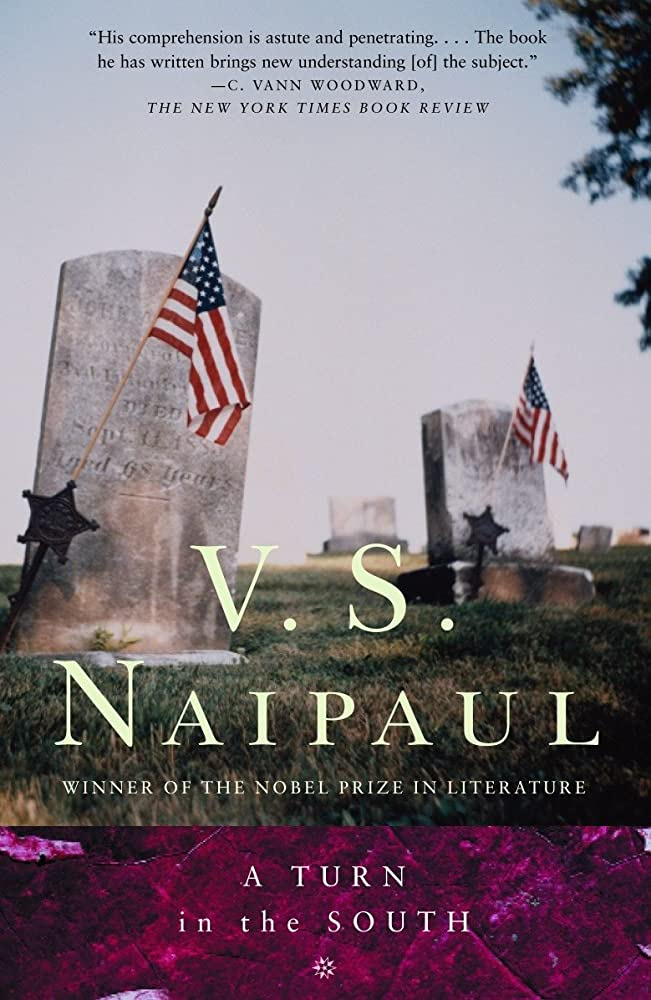
A Turn in the South by V. S. Naipaul

Satan and God fighting for Paula's soul, Paula herself not responsible for the movements of her passion, helpless, capable only of choosing salvation and asking God to reveal his will: a medieval idea of chaos, and the solitude and helplessness of men, and the necessity of salvation. But this was not set in a medieval world of plague and disease and deprivation, the arbitrariness of the sovereign and the humility of the poor. We were in a town of the Research Triangle; and the theme of this culture was abundance and choice, the paramountcy of the individual (if only as consumer), with the beauty and luxury and sensual satisfactions as imminent possibilities for all.

In 1985, fifteen years before he won the Nobel Prize but nearly as many since the publication of A House for Mr. Biswas, V. S. Naipaul traveled through the American South. Though Naipaul is best remembered for his fiction now, he spent nearly as much time writing travelogues, first of the West Indies, then India, and then among Islamic states in Among the Believers. But the South presented a special challenge for Naipaul, who wrote that America "cannot be alien in the simple way an African country is alien. It is too well known, too photographed, too written about; and, being more organized and less informal, it is not so open to casual inspection." And yet, casually inspect, Naipaul does: in metropolitan Atlanta, genteel Charleston, deep swamps and bottomland in Tallahassee and Jackson, and in the up-and-coming cities of the New South, Nashville and Raleigh.

A Turn in the South made me rethink a lot of things, not least among them Naipaul himself. For someone with a reputation as a crank and a bully, Naipaul comes off in A Turn in the South as remarkably open and empathetic. He lets people talk and talk, guiding conversation in only the subtlest of ways, and though perhaps it is only thanks to the writerly tactic of hiding his own questions in narrative voice while faithfully recording the responses of his interlocutors, the effect is of someone reserving judgments: a listener. Sometimes this is frustrating, as when Naipaul interviews an archconservative pastor in Elizabeth City, NC who calls himself a "Jesse-crat" after notorious senatorial douchebag Jesse Holmes, or any number of old white folks who perform paternalistic sadness at the degradation of Black life post-segregation. But it's a gift to get people to say what they probably know they ought not to say, and there's no doubt that in doing so Naipaul really does reveal something at the heart of Southern life. He gets more out of "ordinary people" than he does the black politicos of Atlanta, who are too cagey to stray from their talking points, or Eudora Welty, who is summoned for two paragraphs to talk about the long-gone fad for fur hats.

Naipaul really does empathize with white "rednecks"--a word that's more or less new to him--and with the Black Southerners he meets. Fascinatingly, that empathy seems to emerge from Naipaul's own Caribbean identity, which colors everything he sees in the South. Naipaul makes careful and articulate distinctions between the two regions of the New World, noting, among other things, the crucial lack of a white laborer class after the collapse of slavery and colonialism in Trinidad. "The possibilities" for a Black American, he writes, "were far greater than those of a West Indian. But there could be no easy movement forward for the mass; they had lived through too much; the irrationality of slavery and the years after slavery had made many irrational and self-destructive." And yet, when he writes that the culture of the South is defined by loss and by grief, one hears the echoes of his novels, in which colonial subjects struggle to forge an identity unchained by the weight of history: "The grief was special and was like religion; it would last beyond the decline of the nineteenth century empires, beyond the idea of empire itself." I think that, as a Caribbean, Naipaul is able to understand the South in a way that's difficult for an American Northerner, like Paul Theroux.

But it was the last section, titled "Smoke," which really hit home--literally--for me. The last stop on Naipaul's journey is in the "Research Triangle" of North Carolina, where I grew up, and I perhaps have never heard as insightful or as accurate a description of the place as Naipaul's:

...poor North Carolina pineland landscaped into the discreetest kind of industrial garden, many modern technological names represented by new buildings, long low lines of brick or concrete and glass, giving an impression of spaciousness and order and elegance, the land of rural poverty remade to suit its new function, the South seemingly abolished here, as it had been abolished at the space-research town of Huntsville in Alabama.

Durham poet Jim Applewhite, descendant of tobacco planters, takes Naipaul on a tour of the dying industry: the golden-leafed farms that scan still be found growing between the fresh new medical and research facilities, the meticulous handicraft of the curing barns and the packing process. "[I]t is close to the paradox of civilization itself," Applewhite tells Naipaul, "That this essentially poisonous substance formed the basis of a way of life that had so many attractive aspects--a formalized, seasonal cycle to it, which left the land combed into its even furrows after the stalks had been cut in the autumn." There can be no mourning the death of tobacco, if tobacco is dying, and yet the transition from the "folk art" and "nonutilitarian" practice of the small tobacco farm to the sleek anywhere technologies of biomedicine leave the land and its people bereft of something.

Tobacco, Naipaul notes, comes from the name of Tobago, Trinidad's junior island. Though tobacco planting was quickly abandoned there for the more lucrative sugarcane, Naipaul feels a kind of historical link between himself and the tobacco poet. And I felt it, too. Roughly ten months after Naipaul passed through the tobacco fields of the Research Triangle, I was born there. And it strange to read the great writer writing about the place that I would shortly be ushered into, and which I  have not quite always understood. I started A Turn in the South pleased to know a little more about Naipaul; I was unsettled at the end to find Naipaul looking back. But if that's the feeling I got from A Turn in the South, it's because, in Naipaul's own words, we share something way, way back--but not all that far back--in our histories.

Wednesday, March 22, 2023

A Visitation of Spirits by Randall Kenan

What does a young man replace the world with, when the world is denied him? True, the world was never his, but if the promise of the world, free of charge, is suddenly plopped in his lap and then revoked? If the rights and freedoms of patricians are handed to him and then snatched away? If he is given a taste of a shining city of no limits, and then told to go back to the woods?

Horace had no alternative but to retreat into a world of guilt and confusion, not understanding the reasons for his exile.

When we first meet Horace Cross, a Black teenager living in the small town of Tims Creek in Eastern North Carolina, he's planning on transforming himself into an animal. He considers his options carefully, and concludes that he'd like to be a bird; perusing the bird guide at the local library he chooses a red-tailed hawk. At midnight, he sneaks out of his grandfather's house to perform the rite he's discovered in reading, one which requires, among other things, the blood of an infant, for which he has substituted a kitten. But he fails to be transformed, and dejected in the rain, he takes up his grandfather's gun and begins to wander nude around Tims Creek. Though the rite hasn't worked, it's unleashed something: a host of demons that propel Horace forward, making him face the agonies of his life. Chief among these: being gay in a community where his desires constitute a mortal sin.

Horace's story is interspersed with sections narrated by his cousin, the reverend Jimmy Cross, who was the last person to see Horace on the night of the demons. We know, from Jimmy's narration, that Horace committed suicide that night, unable to bear his guilt. Horace's death is just one of the failures haunting Jimmy; his words of conciliation--"You're normal; you'll change"--having been worse than useless. Other failures include the death of his beautiful, radical wife, Anne, and his inability to reconcile two of his elderly relatives. (The plot, such as it is, of Jimmy's sections mostly involves taking his elderly aunt to see another relative, Asa, on his deathbed, and the bitter spitefulness that emerges from the woman's confrontation with death.) Jimmy longs to be a good pastor, to shepherd and to guide, but where is the wisdom that might have saved Horace? Is it in Tims Creek, or does one have to look elsewhere?

This weekend we visited the North Carolina Literary Hall of Fame, which is a single room lined with framed photographs in a genteel house in genteel Southern Pines. I was pleased to see there the face of Randall Kenan, who died rather young a few years back, along with the faces of a few other authors I have loved but who are not well known, like novelist John Ehle and poet A. R. Ammons. What struck me about Kenan's A Visitation of Spirits was how it emerges from the tradition of the Southern Gothic. It's got one foot in the ordinary rhythms of Black life in Eastern N.C., and another in the wizards and comic book heroes that make up Horace's reading material. The demons that haunt him include a pair of eyeless women and a bison wearing a dress. As Horace wanders through Tims Creek, they chip away at his sanity, and ultimately he loses himself, succumbing utterly to the grotesque visions that his guilt and shame bring forth.

On one level, A Visitation of Spirits is a loving evocation of a culture: the celebration of a hog being killed for barbecue, the simple country church, the binding of strong family ties. But it also poses hard questions about the difficulty of being gay, or out of any kind of ordinary, in small towns like Tims Creek. Kenan makes explicit connections to the Civil Rights movement; suggesting that the strong moral clarity that defeated Jim Crow has faltered in the case of men like Horace. I don't think it's a stretch to read the hapless Pastor Cross as an image of the Black church, diminished in its post-Civil Rights era, unable to provide guidance for those who need it most. "It is good to remember," the last lines of the novel read, "for too many forget."

Saturday, March 4, 2023

The Wright Brothers by David McCullough

It had taken four years. They had endured violent storms, accidents, one disappointment after another, public indifference or ridicule, and clouds of demon mosquitoes. To get to and from their remote sand dune testing ground they had made five round-trips from Dayton (counting Orville's return home to see about stronger propeller shafts), a total of seven thousand miles by train, all to fly little more than half a mile. No matter. They had done it.

Last year, on our way home from our annual trip to the Outer Banks, we stopped at the Wright Brothers National Memorial, where you can see a replica of the Flyer that made the first ever powered flight on December 3rd, 1902--and walk along the paths of its first flights. I really enjoyed the museum there, which made the achievement seem somehow even more impressive: did you know, for instance, that after arriving at Kitty Hawk, Orville and Wilbur discovered that all the data they were using, which had been collected by German aeronautist Otto Lilienthal, was basically garbage, and they had to start from scratch all on their own, using wind tunnels of their own design? So when we went back down this year, I took along historian David McCullough's The Wright Brothers, a biography of the two men and their achievement.

What I enjoyed most about The Wright Brothers is probably the historical sense it gives of Kitty Hawk in the early 1900's. The Outer Banks were barely inhabited at the time, save for "life-saving stations" that were stationed every six miles to save stranded or sinking boats. People lived with their families in the meagerest conditions, growing what they could in small garden plots of mostly sand. Wilbur and Orville stayed with a time with Kitty Hawk's postmaster, and the local life-saving crew provided critical support for the brothers during their stay on the remote beach, and were among the first people outside of the brothers themselves to witness human flight. Kitty Hawk today is all yogurt shops and escape rooms, but you really get a sense of that remoteness passing over some of the bridges further to the south; though many flight enthusiasts of the time were thought of as obsessives or cranks, you have to marvel at the commitment the brothers had toward the goal of flight. On his very first trip over, McCullough describes rough waters that nearly drowned poor Wilbur, who even had to reverse course and camp out for the night in a sheltered part of the sound.

Part of me wanted my experience reading The Wright Brothers to be more like my experience in the museum: to explain (or remind) the various technical achievements that made the Wrights the first to achieve human flight, while so many were making the same attempt. What was so genius about the wing-warping system the Wrights used? How did they perfect the propeller? But McCullough is a historian, not an engineer, and the book is written with an eye toward the human rather than the scientific.

What I really didn't know was what happened after the successful trials at Kitty Hawk. First, no one seems to have believed they'd done it. The first eyewitness account was written in a magazine called Gleanings in Bee Culture. The Wrights attempted over and over again to contact the U.S. government to sell them the Flyer, but the U.S gave them the cold shoulder every time, even after the Wrights had returned to Dayton and begun making regular flights at Huffman Prairie. But not every country was so dismissive--it was actually the French government that first expressed interest in the Wright's invention. France, as I did not know, seems to have been the real epicenter of research into human flight. It wasn't until Wilbur demonstrated the Flyer at Le Mans in 1908--five years after Kitty Hawk--that the momentousness of the achievement had really become clear. And it was the beginning of a period in which the brothers became European celebrities, which seems to have been bemusing and a bit troubling to them both, being rather American in the simplicity of their tastes and habits.

Though I liked the first part of the book best--the wind-swept dunes, the tireless tinkerers, all that stuff of legend was what I wanted to hear about again--but it was this second part, which told the part of the story I'd never heard, that was probably the most valuable.

Wednesday, February 1, 2023

On Savage Shores: How Indigenous Americans Discovered Europe by Caroline Dodds Pennock

Once the first shocks of invasion were past, the Native men (and occasionally women) who crossed the Atlantic for political purposes were ordinarily not isolated pioneers striking out into the unknown. They were sophisticated diplomats, aware of the nuances of what we would all international law (the foundations of which were being laid in this period, often in response to the challenges of indigenous diplomacy), and able to draw on the experience and support of previous travellers, legal advocates and colonial officials.

I'm looking forward to when, in a couple weeks, my friends and I return to Ocracoke Island in North Carolina, where we've been going every February for over a decade. The island is already rich with history--it was the favorite haunt of Blackbeard--but when I go this time, I'll be thinking of a story Caroline Dodds Pennock tells in her history On Savage Shores: Manteo and Wanchese, two Croatan men who had traveled to England in the late 16th century to meet Sir Walter Raleigh and Queen Elizabeth I, were on their way home when, off the shore of Ocracoke, then called Wococon, their ship ran aground and begun to sink. "We can only imagine the feelings of Manteo and Wanchese," Pennock writes, "after nearly a year away, fearing that they would die only metres from the soil of their homeland."

Today, Manteo and Wanchese are the names of the two towns on Roanoke island: Manteo "nicer" and Wanchese, perhaps, more "rustic." There's something in that that matches the separate paths of their lives; Manteo stayed loyal to the English and their interests in the New World, whereas Wanchese turned against the English and fomented resistance among the Croatan. What must have Wanchese seen in England that turned him against his former friends? Was it, like a Powhatan man who accompanied Matoaka (Pocahontas) on her journey, that he was shocked by the abundance of corn and wheat among the English who putatively had arrived in North America looking for resources? Or, as many other Indigenous sources report on their sojourns, was he aghast at the rampant inequality among Europeans? Or was he simply feeling jealous of the greater prestige given to Manteo who--as I did not know, despite having learned all about Manteo and Wanchese as a kid in North Carolina--helped to create the first Algonquin alphabet while in England?

As Pennock shows, we often think about the arrival of Europeans in the New World as a one-way endeavor: they arrived, took root, did some rather dirty deeds, and stayed. Our historical narratives, too, tend to face from west to east, looking through the eyes of the Europeans at a strange world full of resources and plunder. Rarely do we think about how Indigenous people looked back at Europe, or what they saw when they traveled there. As they did, apparently, in numbers that might seem to us surprising. Pennock splits these narratives up into six categories: "Slavery," which tells the stories of those who were forcibly removed from North America and whose labor was exploited in Europe; "Go-Betweens," for those who, like Manteo and Wanchese, acted as interpreters and envoys for European colonizers; "Kith and Kin," for those Indigenous people who married into European families and their children, who inherited lineages from two hemispheres; "The Stuff of Life," about the many resources, including tomatoes, potatoes, and tobacco, that crossed the Atlantic during the Columbian exchange and those who supplied them; "Diplomacy"--rather self-explanatory--; and "Spectacle and Curiosity," which tells stories like the tale of the Inuk man who wowed crowds by fishing in the Thames with a spear.

Just to consider the chapter titles is to understand how diverse the experiences of Indigenous people in Europe were. Some arrived in chains, but others arrived in full regalia, and were treated--after some prodding--as the kings they were. On Savage Shores recently attracted some negative attention from the kind of people who are devoted to coloring-book notions of European colonialism. Too bad they didn't really read it, because if they had, they might have noted that several stories in Pennock's book resist easy lefty narratives about colonial violence. Many Indigenous people were quite happy to ally themselves to European power for assistance in conquering their local enemies; others were simply politically def. For example, the city of Tlaxcala was pretty Machiavellian in the way it used Cortes and the Spanish to bring down its rival, Tenochtitlan; the Inca ensured some measure of survival by doing what European powers did, marrying into Spanish families. Which is not to say Pennock is anything but clear about the horrors of colonialism; one of the book's great challenges is to tease out stories and voices that were intentionally elided from the historical record. While factually scrupulous, Pennock engages in a necessary amount of supposition--What must Manteo and Wanchese have seen? Of course, what the book's malcontents really object to is the inclusion of Indigenous voices at all.

Here's one specific thing I didn't appreciate until reading On Savage Shores: not only did the Spanish really get to the Americas before the English and French, their approach to the Indigenous people they found there was totally different. They weren't any less brutal, really, but Indigenous people were assimilated into Spanish society more readily than that of their northern rivals. Sometimes that meant forced enslavement--I was shocked to read about how many Indigenous slaves there were in Spain, and how often they sued for their freedom by arguing that their enslavement was illegal, not to mention how often they succeeded--and sometimes it meant intermarriage. That alone goes a long way in explaining the contemporary differences between American and Canadian relationship to Indigenous people and Mexican or Latin American ones. I had often wondered why Mexican culture values the idea of mestizaje--a shared Indigenous heritage--in a way that's totally foreign to us up here.

The best thing I can say about On Savage Shores is this: it's one of those history books that seems so obviously needed, you wonder why nobody's written it before. Its simple reframing--what did Europe look like through Indigenous eyes?--turns so much of what we think we know about history on its head.

Monday, August 29, 2022

Even As We Breathe by Annette Saunooke Clapsaddle

I had certainly seen my fair share of animal bones, either happening upon them in the woods or excavating them from a fresh hunt. Something felt different about this one. I couldn't quite place it. Maybe it was because it was in Asheville, an environment I assumed was devoid of elemental remnants such as discarded bones, castoff feathers, and rock faces that scowl like relatives. There was brick and concrete and glass and steel in Asheville, for certain--anything else seemed misplaced. The bone, in such a tangible state, reminded me of home and what I loved about home--the simplicity of knowing what each day held and the certainty that people said what they meant and meant what they said. There were no flashy distractions, but there was strength, there was resolve, and they were foundational. I knew exactly where I stood and when to stand there. I had wanted so badly to fit into the shine of Asheville, but it never seemed to fit me.

The Qualla Boundary of the Eastern Band of Cherokee isn't really a reservation, which refers to a piece of land set aside by the government for Indians; it's a piece of land that was never truly ceded to the United States. The Cherokee who live there are living in a place where they can trace their lineage back dozens of generations, unlike those Cherokee who were forced to move to Oklahoma during the Trail of Tears, where there was no history, no roots. Cowney Sequoyah is a young Cherokee man who has taken a position as a groundskeeper at the Grove Park Inn in nearby Asheville during World War II. He travels there along with Essie, a Cherokee girl taking a position of maid, and with whom Cowney falls desperately in love. But at the hotel he faces fierce prejudice from his coworkers, and from the soldiers who are bivouacked there, guarding what has become an ad hoc jail for prisoners of war.

Even As We Breathe is made up of several strands: there's Cowney's mooning for Essie, who has spurned him for an Italian prisoner of war. There's a human bone that Cowney finds while groundskeeping, and a missing Japanese girl whose disappearance--when put beside the mysterious bone--puts Cowney at suspicion. The investigation into the girl's disappearance is what gives the book much of its energy, even though the situation is clearly and clumsily contrived: as Cowney points out, only stupidity--and bigotry--could draw a connection between a polished human bone and a recently missing girl. There's also a plot, which perhaps makes up the novel's true soul, about Cowney coming to understand his dead father's exploits in World War I, and the nature of his death, which is kept a secret by Cowney's cruel and bitter uncle, Bud.

There's rich material here, and a few lost opportunities. There's a connection drawn between the racism faced by Cowney in Asheville and a racism, not much discussed, that his father faced during his own wartime experiences. And Clapsaddle draws a contrast between the ritzy "jazz city" of Asheville (somewhat undermined by the hotel's use as a prison camp) and the deeper, more natural relationship Cowney has with the land of his forefathers. But the prisoners of war are narrative nonentities; the missing Japanese girl and Essie's Italian lover are more or less plot devices that never get a perspective, or even dialogue, of their own, and the possibility of further entanglements--for instance, Bud's suggestion that Cowney try to sell bear gallbladder (?) to the captured Japanese--never bear fruit.

I say this is a missed opportunity because there's an interesting parallel to be drawn between the otherness of Cowney and Essie and the foreign prisoners, who are called "guests" with a kind of grim irony. Clapsaddle plays the mystery of Cowney's father's death as a kind of personal awakening for Cowney, at the expense of any richer understanding of the role of Native Americans in the U.S. military. What does it mean, for instance, that Cowney, born with a lame foot, is overlooked by the military machine that drafted, then destroyed, his father? I thought the narrative's focus on overt acts of racism, like the ticket teller who refuses to admit Cowney to the movies, prevented it from exploring this history in richer detail, or at least in a less muddled way.

But I got a lot of pleasure out of the setting of the novel, which is an area I love and know well--from which I just got back, actually. I appreciated how Even As We Breathe allowed me to see these places from new angles, new perspectives, and to learn a bit of history--like the Grove Park's use as a prison camp--that I had never known before. I've really appreciated the way that reading fiction by indigenous Americans has helped me to see the country in a new way, but this might be the first time that I've really been challenged to see a place that is important to me personally in this way.

Wednesday, May 1, 2019

The Land Breakers by John Ehle

It was not that the family was making a machine that they could use; the family was the machine.  The family and the clearing and the crops and the stock and the tools were part of the same thing.  The family and the place were part of the same thing and could not be separated one from the other.  One could not understand the family without knowing about the land and their work on it and plans for it, and one could not know the land with any real understanding without knowing this family of people.  They were dusty with the land; the grit of the land was in them.  Their work, which was done together, was the chief meaning of their family lives.

I had been saving John Ehle's The Land Breakers for our recent trip to the Great Smoky Mountains.  There are old villages, long since emptied--not abandoned, really, since their inhabitants didn't leave voluntarily--in the coves between mountains there.  They are places of great beauty but also great isolation, a few cabins scattered at the edge of a clearing, separated from civilization by difficult mountain passes.  They seem impossibly historical, but they are more recent than the mountain settlement described in The Land Breakers.  When the protagonist, Mooney Wright, buys a small parcel of land in the North Carolina mountains, the year is 1779, and he's the first white man to make his home there.

Mooney arrives with his wife Imy, both Irish immigrants sold into indentured servitude for whom the mountains offer independence and self-sufficiency.  Imy quickly succumbs to an illness, and Mooney finds himself bereft and aimless in a new world that seems indifferent to him, if not hostile.  But that changes quickly when a rich Virginian, Tinkler Harrison, arrives with his wife in tow.  (She's also his niece, so, gross, but I guess you can get away with that kind of thing miles and miles from the nearest town.)  Tinkler brings with him several slaves and his daughter Lorry, as well as her two boys.  Soon his son-in-law Ernest Plover follows with his beguiling young daughter Pearlamina.  Others are soon to follow.

Mooney is instantly attracted to Mina, but comes to realize that she doesn't share his vision for settling the land.  Imagining a mill, a springhouse, a town, in the valley below, he asks, "Can't you see it, Mina?"  And she responds: "I don't see nothing... There's nothing down there 'cept trees."  It's the older Lorry who promises to be a better wife, and soon he takes her into his house.  Their "wedding," such as it is, comprises Mooney telling Lorry's sons to pack their things and bring them up to his house.  There is no ceremony here, because there is no society; any other kind of wedding would be essentially meaningless.  Here in the mountains it doesn't matter that Lorry is technically already married, her husband having disappeared somewhere in Kentucky.  (Do you think, perhaps, the novel might be setting it up so that the absconded husband appears suddenly and throws the fragile ecosystem of the settlement into chaos?)

Much of The Land Breakers is devoted to a thorough and loving depiction of the practices of early Appalachian settlers.  If you would like to know how they made shoes out of hog leather, or what sort of herbs they gathered and for what purposes, this is the book for you.  The passion of Ehle, a western North Carolina native, for the history of the region makes these slice-of-life details engaging more often than not.  But danger is always threatening the stability of the settlement.  An enormous black bear, for example, is raiding the stock.  The bear himself is a violent threat, of course, but the depredation of the stock, when survival is so precarious, is as frightening as his jaws and teeth.  A long bear hunt serves for the novel's climax.  But there are other dangers: in one particularly terrifying section, a pair of settlers wake up to find the floor of their cabin covered in writhing venomous snakes searching for warmth.

Mooney imagines the whole mountain, with its wolves and bears and panthers and diseases, as a kind of singular beast that stalks him and his family.  But he also has a vision for taming it, a vision that the hardworking Lorry shares.  They are the kind of ideal Jeffersonian yeoman farmers, breaking the land of the new nation at the moment of its birth.  Ehle clearly idolizes them, and contrasts them with plutocratic jerks like Tinkler and lazy romantics like Ernest.  And yet their hard work and vision is no assurance that everything will be all right.  The novel ends with a failed attempt to drive the settlers' stock into town.  All the animals, confused and frightened by the storm, leap to their deaths.  (This reminded me of Far From the Madding Crowd.)  The settlers must return empty-handed, close to starvation, and yet their determination remains.  This was, after all, the way they started in this place, and they will do it again.

Thursday, August 6, 2015

The Second Coming by Walker Percy

The present-day unbeliever is crazy because he finds himself born into a world of endless wonders, having no notion how he got here, a world in which he eats, sleeps, shits, fucks, works, grows old, gets sick, and dies, and is quite content to have it so.  Not once in his entire life does it cross his mind to say to himself that his situation is preposterous, that an explanation is due to him and to demand such an explanation and to refuse to play out another act of the farce until an explanation is forthcoming.  No, he takes his comfort and ease, plays along with the game, watches TV, drinks his drink, laughs, curses politicians, and now and again to relieve the boredom and the farce (of which he is dimly aware) goes off to war to shoot other people--for all the world as if his prostate were not growing cancerous, his arteries turning to chalk, his brain cells dying off by the millions, as if the worms were not going to have him in no time at all.

I started Walker Percy's The Second Coming not knowing it was set in the North Carolina mountains in the vicinity of Asheville.  It was a happy accident, I thought, since I was going to Asheville in a couple weeks, and I have a well-professed fondness for reading books set in the places I'm traveling.  Then I fractured some bones in my foot in a freak karaoke accident and had to cancel the trip.  An accident, but not a happy one.

But that's okay, I'm not quite unraveling to the extent that Will Barrett, the protagonist of The Second Coming, is.  Will, who also appeared in Percy's The Last Gentleman (I didn't know this was a sequel when I started it) is a millionaire.  He plays a lot of golf.  But his game has gone to seed, and he's started to have fainting spells, and he's obsessively revisiting the moment in his youth when his father shot him--maybe accidentally?--on a hunting trip.  He's also convinced that all the Jews have left North Carolina, and that this is a sign of the End of Days.  Will isn't sure if he believes in God, but he decides to put the question to a test: he will hide out in a nearby cave without food for weeks, and if he survives or is saved, he will believe:

Who else but a madman could sit in a pod of rock under a thousand feet of mountain and feel better than he had felt in years, so good that he smiled again and snapped hsi fingers as if he had made a discovery?  I've got you both, he said aloud, God-seekers and suicides, I've got you all, God, Jews, Christians, unbelievers, Romans, Jutes, Angles, Saxons, Yankes, rebs, blacks, tigers.  At last at last at last.  It took me a lifetime, but I've got you by the short hairs now.  One of you has to cough it up.  There is no way I cannot find out.

Even if the worst comes to worst, he thought with a smile, to suicide, it will turn out well.  My suicide will represent progress in the history of suicide.  Unlike my father's, it will be done in good faith, logically, neatly, and unobtrusively, unobtrusive even to the Prudential Insurance Company.

Will's experiment throws him into the care of Allison, a much younger woman who has recently escaped from a nearby sanitarium.  She's living in a greenhouse, and spending her time scheming how to hoist an old stove through the windows.

When he landed on the floor of her greenhouse, knocking himself out, he was a problem to be solved, like moving the stove.  Problems are for solving.  Alone.  After the first shock of the crash, which caught her on her hands and knees cleaning the floor, her only thought had been to make some sense of it, of him, a man lying on her floor smeared head to toe with a whitish grease like a channel swimmer.  As her mind cast about for who or what he might be--new kind of runner?  masquerader from country-club party?  Halloween trick-or-treater?--she realized she did not yet know the new world well enough to know what to be scared of.  Maybe the man falling into her house was one of teh things that happened, albeit rarely, like a wood duck flying down the chimney.

The Second Coming follows the same basic pattern as The MoviegoerWill and Allie, like Binx and Kate, find each other as a revelation, mental illness finding comfort and support in mental illness.  Allie's mental illness, which manifests as a strange rhyming speech pattern that only Will can understand, is not the same thing as Kate's manic-depression, but it's a degree of difference and not of kind.  Will, like Binx, undergoes a kind of cosmic search that is ever only nebulously defined, and the answers come not in the form of a mystical revelation, but in the flesh-and-blood arms of another person.

But Percy is the kind of novelist who can write the same book without it seeming like the same book.  The Second Coming is rich in detail and subtlety, and Will and Allie are distinctly drawn enough to feel like characters in a new story rather than a rehash of the old.  And while The Second Coming never matches the excellence of The Moviegoer, it struck a special chord in me because of its insights about my home state, about which Willie says he "lived in the most Christian nation in the world, the U.S.A., in the most Christian part of that nation, the South, in the most Christian state in the South, North Carolina, in the most Christian town in North Carolina."  I doubt that's true (more Christian than Alabama or Mississippi?) but I liked the way the novel explores the search for God in a place which presupposes the search is already over.

In a certain way, I identify with Percy's novels more than any others, between the religious and metaphysical subject matter and the regional specificity of the South.  I'd like to read the predecessor to this novel, The Last Gentleman, about Will's youth as a Southerner living in New York, but I'm afraid it'll be too much like looking in a mirror.

Wednesday, December 2, 2009

Along for the Ride by Sarah Dessen


The news was delivered by my mother, across the kitchen table as my dad leaned against a nearby counter, fiddling with his hands and looking tired. "Your father and I are separating," she informed me, with the same flat, businesslike tone I'd so often heard her use with students as she critiqued their work. "I'm sure you'll agree this is the best thing for all of us."
Hearing this, I wasn't sure what I felt. Not relief, not crushing disappointment, and again, it wasn't a surprise. What struck me, as we sat there, the three of us, in that room, was how little I felt. Small, like a child. Which was the weirdest thing. Like it took this huge moment for a sudden wave of childhood to wash over me, long overdue.

As a holdover from high school, I have a weird loyalty to Sarah Dessen. North Carolina has more than a few bestselling authors to its credit, but Dessen has been my favorite since a friend passed me a copy of "Someone Like You" in history class junior year. I've seen her speak at my favorite local bookshop in Raleigh, Quail Ridge Books. I've seen her speak at the Bulls Head in Chapel Hill. It was only my limited writing ability (and limited interest in creative writing) that kept me from taking her creative writing course at UNC. My love of Sarah Dessen is well-enough known that an my high school boyfriend's mom, who managed Quail Ridge, used to save the proof copies they received for me long after her son and I had broken up.

The last few Sarah Dessen books have been disappointing for me. I was beginning to think I had perhaps outgrown her as a writer. I probably have; all of Dessen's main characters are in high school, or have just graduated. The summer before college is one of her favorite motifs. Maybe I had been away from that point in life too long to appreciate a book written from the point of view of a high school girl.

That being said, I loved "Along for the Ride." This was the Sarah Dessen that I remembered. For some reason the story was more engaging and the characters were more likable than in the last few novels. The story begins when Auden, a perfectionist who spent her high school years studying rather than socializing, moves to the beach to live with her dad, stepmom and baby sister for the summer. Auden leaves her perfectionist professor mother at home, and in doing so opens herself up a world she has never allowed herself to see - a normal teenage summer.

In between her new job managing the accounting at her stepmother's store and helping out with the baby at home, Auden internalizes her father's selfish behavior towards his wife and baby, and blames herself for their resulting separation. But there is another, happier side to the summer: a boy. There is always a boy, isn't there? Auden meets Eli, manager of the local bicycle shop, who is battling his own demons after the death of a friend. The two, who both suffer from insomnia, set out on a nighttime quest to allow Auden the experiences she has missed in her cloistered upbringing: bowling, going to a dance club, food fights, etc. Along the way, predictably (but not disappointingly) they fall for one another.

I don't know what about this particular novel made it so much better in my opinion than the last few by this author, but I did get some insight from a video she posted on Amazon.com, http://www.amazon.com/Along-Ride-Sarah-Dessen/dp/0670011940. A new mom herself, Dessen hadn't planned on writing another novel so soon after her baby's birth but said this novel mostly wrote itself. She was happy while writing it and it didn't feel like work at all - so maybe that explains the difference.

Wednesday, January 21, 2009

The Last American Man by Elizabeth Gilbert

By the time Eustace Conway was seven years old, he could throw a knife accurately enough to nail a chipmunk to a tree. By the time he was ten, he could hit a running squirrel at fifty feet with a bow and arrow. When he turned twelve, he went out into the woods, alone and empty-handed, built himself a shelter, and survived off the land for a week. When he turned seventeen, he moved out of his family’s home altogether and headed into the mountains, where he lived in a teepee of his own design, made fire by rubbing two sticks together, bathed in icy streams, and dressed in the skins of the animals he had hunted and eaten. Thirty years after leaving his suburban existence to live in the wild, he's still there.
Elizabeth Gilbert’s The Last American Man is the biography of Eustace Conway, a North Carolina native, and possibly the last frontiersman in America. Gilbert links American masculinity to the wildness of the American frontier, citing descriptions of the American man by foreign visitors in the 18th and 19th centuries as a strong, noble, pure specimen. In contrast to the European tradition, where a young man moves from the country to the city to become a refined gentleman, the American man would strike out into the unknown from his comfortable city life, and come back a real, if less refined, man.

Conway is an entirely self-made man, sort of the American dream in reverse, since he goes from the suburbs to a teepee in the woods. As a child, he managed to teach himself to hunt, make fire, identify almost any plant, and tan hides all from library books. Having built a wilderness stronghold for himself using the skills he’s acquired, he believes that by introducing anyone to his way of life at Turtle Island (if you know where this comes from, I’ll give you the cookie that Jim never gave to me), his 1,200-acre, undisturbed valley west of Boone, North Carolina, he can give them the skills and drive necessary to create their own utopia. Unfortunately, his uncompromising demands for perfection out of others cause him to have flawed relationships with others that haunt him his entire life.

Eustace Conway is living a life that has become a metaphor for most of America. How many times have modern businessmen or politicians been compared to pioneers or trailblazers? But the problem in trying to convert modern Americans to archetypal, frontier Americans is that they don’t want to live the way Eustace does, they want him to exist as proof that it’s still possible, that they could if they wanted to. The biggest impediment to Conway’s plan to save humanity is his own pride and stubbornness. He swears that he’ll never treat anyone as horribly as his father treated him, but only ends up repeating the cycle, demanding of others the same level of inhuman perfection and commitment that he demands of himself, alienating his own disciples in the process. Over time, he’s forced to compromise his pure wilderness ideals at the cost of further spreading his message, which doesn’t take hold in nearly the tidal wave fashion he’d expected. In the end it’s hard to be sympathetic to someone who’s willing to sacrifice the happiness and comfort of so many to achieve his ultimate goal, even if that goal is to cure societal ills and prevent environmental degradation.

This was a very interesting biography of a fascinating, committed, wild life. Having entertained thoughts of living in the wild, this book is sort of a primer on the dedication it actually demands of you, and maybe a warning against what it can make of you. Elizabeth Gilbert’s writing is very casual and personal, but because of the depth of material and her proximity to the subject, it doesn’t come off as contrived, but rather very appealing. With this book as an introduction to Gilbert, I’m looking forward to reading her memoir, Eat, Pray, Love. This was a great book, but if you were bothered by the headstrong, independent nature of Christopher McCandless in Into the Wild, you’ll probably be annoyed with Eustace Conway in the same way, though his setting out isn’t nearly as severing of all ties as McCandless’s. Great book, but I don’t plan on setting out with a tepee and two bandannas as a loincloth any time soon, just gonna keep practicing nailing chipmunks to trees with throwing knives.

Monday, January 19, 2009

The Brooklyn Follies by Paul Auster

When Nathan Glass returns from the suburbs of New York City to the neighborhood of his birth in Brooklyn, he tells us that he's doing it to die quietly--his lung cancer is in remission but his life is in shambles, having been isolated by both his ex-wife and his daughter. Of course, any member of Oprah's Book Club will understand that this is only setup, and men like Nathan--weary, and ready to call it quits--are inevitably going to perk up through the rousing medicine of a good woman, a strong community, a loyal family, or a small child.

In the case of The Brooklyn Follies, it's pretty much all four. Nathan's renaissance begins when he discovers his once-promising nephew Tom slaving away miserably in a Park Slope bookstore. Tom's academic career has been derailed and his love life stalled indefinitely, and on top of that he hasn't heard from his sister Aurora since she asked him to walk her down the aisle months and months ago. Eventually, these two talkative sad sacks have their lives kickstarted by the appearance of Lucy, Aurora's daughter, who for some reason has decided to stop speaking.

And wouldn't you know it, the lovable scamp gives them a reason to survive? Nathan turns out to be a capable surrogate parent; no wonder, he seems to do very little wrong in this book which is ostensibly titled for his failures. Nathan is writing a book, in fact, that details his own follies as well as stories he has heard from life and history; yet Auster makes his character so sympathetic that surely his ex-wife and daughter must be terrible monsters for hating him.

What bothers me most about The Brooklyn Follies is its un-reflectiveness--it's a paean, a bucolic to a certain white-collar liberal lifestyle that treasures tolerance, diversity, and thoughtfulness. Of course, those are strong values, but I am not sure that Auster is aware of how self-congratulating his book seems. Take for instance, Aurora, whom Nathan eventually tracks down living with her husband in Winston-Salem, a religious fanatic and Christian cultist who has trapped her in her own room for months. It is impossible to receive Park Slope as the ur-Eden that Auster intends it without recognizing North Carolina its antithesis: As Nathan and Tom love their homosexual friends and jab incessantly at the religious right, so Aurora's husband and his community personify intolerance and oppression; Nathan prides himself in having "rescued her from North Carolina," but Auster makes it clear that North Carolina is a surrogate for particular worldviews and attitudes.

I am reminded of Noah Baumbach's movie The Squid and the Whale, which takes place in the same neighborhood as The Brooklyn Follies. I couldn't help but remember Jeff Daniels' character, a man who loves his family very much but can't help his own egotism and pomposity. Their attitudes and styles--even their addresses--are near identical, but only one of them seems to understand what it is to deal with folly. No, Nathan Glass is a white knight, and Park Slope is his kingdom.

It isn't that particular worldview I take objection to. It's that a novel that uses the same tactics with the area codes reversed--a novel about the preservation of simple country living, loving your neighbor, and Southern faithfulness at the expense of cosmopolitanism and liberalism--might make a best-seller but would be rightfully denounced by critics as smug and self-satisfied. (And let's admit, there are hundreds of those novels in print.) As a Brooklyner, I love Park Slope as much as the next man, but I'm not sure I've ever been to the idylls of Auster's novel.

And then there's the matter of the end:

It was eight o'clock when I stepped out onto the street, eight o'clock on the morning of September 11, 2001--just forty-six minutes before the first plane crashed into the North Tower of the World Trade Center. Just two hours after that, the smoke of three thousand incinerated bodies would drift over toward Brooklyn and come pouring down on us in a white cloud of ashes and death.

But for now it was still eight o'clock, and as I walked along the avenue under that brilliant blue sky, I was happy, my friends, as happy as any man who had ever lived.


What's the point? That Nathan's hard-earned happiness, his revitalization, is all about to come crashing down with the World Trade Center? That's too grim for such a saccharine novel, and without suggesting that Nathan knows someone in the tower, out of proportion. No, I think that Auster is suggesting here that September 11th dealt a serious blow to the Park Slope worldview he champions. After all, the book's backdrop is the contested election of 2000, and Auster and his characters frequently stop to note their grim displeasure with George W. Bush and the Republican machine. The Brooklyn Follies posits Nathan and his community as antithetical to ideas which Bush and the Christian cult in Winston-Salem embody; it seems likely that this puzzling ending is meant to represent an impending victory for the forces of intolerance.

But that's just my guess. The truth is, the ending defies anything but the slightest interpretation, and as a result actually seems more gratuitous. What right does this man have, whose idea of folly is so comic and self-assurance so unflinching, to stitch his own story to that one?