Showing posts with label NYRB. Show all posts

Sunday, May 3, 2026

Crazy Genie by Ines Cagnati

I told her about her, of what the grandfather had told me, that before she had me she would laugh and sing day and night, and that later, once she was expecting me, she never wanted to say who my father was, and the grandmother, who is a bad woman, had gone into a fury because she didn't wand bad things like that to happen in her family, which was the most respectable in the village. Then she had moved into the shack under the crazy willows that talk at night, and she had never gone back to her home, and she worked at people's houses to be fed, and they called her Crazy Genie because she never talked, but she wasn't crazy, she simply didn't talk and didn't laugh.

Marie's mother is known in her village as "Crazy Genie." Despite coming from a respected family, she takes on odd jobs to survive: milking cows, threshing wheat, husking corn. She's not really crazy--the word is a tool that the people of the village use to place her beyond their sympathy and understanding. If Genie has fallen in the world, it must be her own fault--as Marie's grandmother, still incensed about Genie's becoming pregnant out of wedlock, believes--or, more likely, there's just something wrong with her that can't be helped. Marie spends much of her childhood trying to make sense of this dynamic, while trying without success to become closer to her mother, whose material sacrifices we can see clearly are meant to protect and care for Marie, but who is extremely sparing with words or gestures of maternal love. The only things that Genie says to Marie for much of the book are commands: "Go home," "Don't bother me," etc., etc.

It's a dangerous world out there for girls, as Marie finds when the town mason, Ernest, is lying in wait for her en route from a job back to her home under the "crazy willows that talk at night." We learn later--spoiler alert--that this Ernest is Marie's father, and that he has raped his own daughter just as he raped Genie many years before. In this way, Crazy Genie becomes a book about the way that male cruelty can have resounding effects well past the moment of violence: Ernest's deeds ripple throughout Genie's life as well as Marie's, and his rape of her, which is presented rather elliptically in the text, is perhaps only a more severe manifestation of the general ruin he has brought upon her. And yet, Ernest is a distant figure from the narrative, appearing only a few times in the shadows. Men, of course, get to walk away. But there are others who collaborate in this violence and ruining: the grandmother, of course, and the townspeople, whose incurious nature prevents them from seeing the injustice that lies behind Genie's tough exterior.

It's easy to see what Crazy Genie has in common with Free Day, the Ines Cagnati book that NYRB translated and published a few years ago. Both are about young girls living in difficult circumstances in the French countryside, trying to scrabble out an existence in the face of disadvantageous circumstances. But they're incredibly different stylistically. Marie's language is much simpler, more systematic, as might fit a more rational and less emotional child who is trying to make sense of the world around her. The simplicity of the language emphasizes, too, the repetitiveness and routine of the life that Marie lives with Genie. It's a style that works, but it's not as good as Free Day, a book where anxiety and dread leak through the language in a much more interesting way. That said, Crazy Genie moves toward a climactic ending that is as difficult and tragic as anything in Free Day, and which elevated the book for me--because I always appreciate a real bummer.

Saturday, November 2, 2024

Woman Running in the Mountains by Yuko Tsushima

For an instance Takiko closed her eyes and pictured herself holding a baby lightly to her breast and running at top speed. This was the way she had gone on imagining herself, while her mother's crying and her father's shouting echoed around her, ever since her mother had found out she was pregnant. At school she hadn't actually liked running at all, yet now she couldn't stop seeing this image of herself. It was not that she was running away. She just wanted to be tough and free and to move. A state that knew no emotion. To be allowed to exist without knowing emotion.

Early one winter morning, Takiko rises and finds that her water has broken. She gets up and calls herself a cab to the maternity ward while her mother, father, and brother sleep. She is too young to have a child, they think, and the father--a married man with whom Takiko had a brief, passionless affair--has no idea that she got pregnant. Her father beats her; her mother implores her to have the child aborted. But Takiko yearns to have her child. For her, the birth of her son, Akira, is an entrance into a world of independence and freedom, in which perhaps she can become a caretaker rather than a subordinate, driftless and subject to the whims of others. She has vivid dreams of herself on a field of ice, or running through the mountains (hence the title), and yet, in these images of isolation and movement the child is always with her.

What I liked best about Woman Running in the Mountains is the way that author Yuko Tsushima recognized the inherent drama in the everyday experiences of a mother. Takiko is carefully and specifically drawn, unique, and yet her experiences are not so different than those of other Japanese mothers, the kind she often comes into contact with at the maternity ward or the cooperative daycare. Tsushima avoids reproducing certain conservative ideas about the way motherhood ennobles a woman, or gives them purpose, or depicting Takiko as a reluctant mother who must learn to embrace the maternal nature of femininity. Instead, the novel does something quietly powerful in recognizing the possibilities that motherhood provide in fostering independence: it's becoming a mother that ultimately gives Takiko the strength to turn away from her cruel father and overbearing mother. 

As a single mother without employment, Takiko faces a number of obstacles, both practical and cultural. (Apparently, as the notes describe, it's very rare for a Japanese child to be born "illegitimate.") She struggles to find a childcare placement for Takiko; she struggles to find a job. The jobs she do find demand more of her time than she, as a new mother, can afford. Akira turns out to have been born with a hernia, an issue requiring a surgery she can scarcely afford. Tsushima solves Takiko's problems by providing her a job at a nursery whose greenhouses are high in the mountains where her dreams take place. And yet, this job comes with its own obstacles: she falls deeply in love with a gruff older gardener who cannot return her affections. And yet, in the nursery, Takiko herself flowers. It's a job she's pushed toward by her motherhood, a process, Tsushima suggests, by which she becomes more herself.

Sunday, March 5, 2023

Free Day by Ines Cagnati

Me, I've never been able to love anything, because nobody wanted me. I know that my mother didn't have time to look after me, what with the field work, the livestock, my father, Maria and the other babies that never stopped coming, and after that, Aunt Gina's romance novels. I don't miss the caresses I never had. They horrify me. Even right now, if someone brought a damp mouth to me for a kiss I would slap them hard, I'd be so horrified. Except for my mother. She's my mother. And Fanny. She has smooth, freckled cheeks, like warm bread. She's so pretty. If I'd been loved, I'd be pretty, too. It would have been enough for me to be a puppy or any kind of domestic animal. My father and mother take good care of animals. As for me, when I was little, I would have liked to be a little calf. I would have been loved, like everybody.

Galla, the protagonist of Ines Cagnati's Free Day, takes an extra holiday off from boarding school to travel home on her loyal bicycle. But when she arrives, her father takes one look at her and tells her to go away. So begins the titular "free day": one in which Galla wanders around the outskirts of her home, waiting for her mother to come out, cuddling with her dog, Daisy, and exploring the familiar--but loathed--marshes around her house.

Galla's free day is an opportunity to reflect on her place in the world: the favorite of her always-pregnant mother, she is the oldest of her many sisters. Their land is poor, and they live in deep poverty, yet Galla has managed to convince her mother to send her to the high school in the city. She is despised by the other students, who look down on her for wearing the wrong color smock--she can't afford any other--and by her teachers, who consider her rude and a troublemaker. (Only Fanny, of the warm bread cheeks, is a beacon among them.) And though Galla seems to despise the inanity of school, and her mother deeply needs her at home to help look after the smallest children, including tiny blind Antonella, Galla insists on doing to school because she senses, it seems, that school is the way to get out of the foggy and noxious marshes, and the cycle of poverty in which her family is trapped.

Galla is ambitious, then, but she is also cynical and full of self-loathing. She spends much of her free day thinking about how she'd prefer to die: lost at sea, so that she might sink to the bottom and never be found. Violent fantasies are informed by a life punctuated with violence: at successive steps along the marsh, Galla is reminded of her how her father hangs their dogs, or the car crash she caused which caused a little girl to lose half her face, or the death of her beloved younger sister Cendrine, who was hooked by a cow and launched into a field (!). Does such violence ever touch the other girls at the high school? Or is it only the property of the poor? In her foreword, translator Liesl Schillinger describes how Free Day is inspired by Cagnati's experiences as the child of Italian immigrants brought into France for poor labor. It's a book about the experience--troubling, even dangerous--of being an outsider.

Galla's voice is what really makes Free Day so engaging from the very beginning. Simple, like a young girl's voice, but full of weary wisdom, and a strange mix of self-hatred and bold defiance. It works so well, is so endearing and so chilling, that it propels the book foreword even though, properly speaking, hardly anything happens: just a girl wandering around the marshes, thinking about her life.

Saturday, October 29, 2022

My Phantoms by Gwendoline Riley

I tried the same tack. I read out the dinner choices as Griff had done. I tried to use her newspaper, too, to talk to her. 'Isn't this dreadful?' I said, about a headline, or 'Do you know who that is?' about a picture of a soap star. I read out a Quick Crossword clue and she tried to answer. Or rather--as in a game of charades--she would communicate that she knew the answer, and then it was down to me to make suggestions, and for her to shake her head and frown, or nod and urge me on, until I guessed it right. If she let me know that she was drawing a blank then it was me who did the mimes and the gurning, until she said 'Oh! Oh!' to let me know she'd got it. There were some words she could say. She said 'yellow' for lemon and 'big doors' for wardrobe. She couldn't manage more than three or four words at a time.

Bridget and her mother Helen--Hen--have a relationship at arms' length. They see each other once a year, on Helen's birthday, going to the same ratty tavern, and though Hen seems to resent that she is not more included in her daughter's life, any attempt at change in a way that might bring them closer leads to more misunderstanding, more resentment. As Bridget's boyfriend John observes--when Hen finally meets him after years and years--Bridget's mother seems to have a preconceived notion about how any interaction ought to go, and the way it actually goes fails to reach her perception. In the meantime, she is desperately lonely, throwing herself into clubs and cruises and activities, searching for a man who will could become her third husband, but without the capacity for change or accommodation that such love would require.

My Phantoms is a book that's so small in conception, so confined to the everyday miseries of mothering and daughtering that you find yourself wondering if, despite the protagonist not sharing a name with author Gwendoline Riley, you're reading some of that autofiction you keep hearing is everywhere these days. But what it does, it does well: Riley captures exactly the feelings of stagnation and standoffishness that characterize only familial relationships. The way in which the need for change is glaringly obvious, but the person in front of you is too familiar for either of you to change--you know each other too well, which is why you don't know each other at all. At times I found it a little too small, feeling that, even though Hen is quite specifically evoked and alive-seeming, the familiarity of the narrative made it an odd subject for a novel.

In the novel's final movement, Hen develops a brain tumor. (This does provide a little melodrama, but then again, that's an ordinary kind of story, too: such medical ends are awaiting all of us.) In her diminished form, unable to speak coherently, Hen is not so different than she always was. What's different is that the possibility of change, of drawing closer or resolving the small barriers of family bitterness, has been precluded. Hen, spoiler alert, dies, but in a way her death is prefigured by the death of these possibilities. In the end, Bridget understands her mother, pities her, but never reaches her.

Thursday, December 23, 2021

An African in Greenland by Tete-Michel Kpomassie

As soon as they saw me, all talking stopped. So intense was the silence, you could have heard a gnat in flight. Then they started to smile again, the women with slightly lowered eyes. When I was standing before them on the wharf, they all raised their heads to look me full in the face. Some children clung to their mothers' coats, and others began to scream with fright or to weep. Others spoke the names of Toornaarsuk and Qvivttoq, spirits who live in the mountains... That's what I was for those children, and not an Inuk like themselves. Like children the world over, they spontaneously spoke their minds about me. Unfortunately, I can't say the same for the adults. Proud and secretive, they masked their feelings behind an unchanging smile, mild but enigmatic. Not one of them corrected the children, yet the mothers' calm gave some of the children confidence, and, as they saw me approaching, they too tried to smile--a hesitant, not very assuring smile.

When he was a child, Tete-Michel Kpomassie found a book about the Inuit of Greenland in his village in Togo. He was captivated by the vision of a cold world, one where children are respected and treasured, and no trees to hide in, indeed, no snakes. Having fallen out of a tree after an encounter with a deadly snake, Kpomassie's father promised him to the service of the mysterious python cult, in return for saving his life. As Kpomassie describes it in his memoir of his adventures getting to and traveling in Greenland, the Arctic was a way out of the strict Togolese hierarchies which left him out of control of his own life. Perhaps these rationales exist partly in hindsight--"Do people ever know their true reason for embarking on a long journey?" he asks--but for whatever reason, young Michel is determined: it takes him years, traveling up through West Africa to Europe, taking small jobs, through France and Denmark, until finally he makes the sailing to Greenland with nearly empty pockets.

The indigenous Greenlanders Kpomassie describes are taken aback by his height and appearance--there is some suggestion that he is the first African ever to revisit the remote and lightly populated island--but also welcoming. In every village, Kpomassie is put up by locals, who welcome him into their home, as seems to be the custom. In some cases, they welcome him into their beds, too: Kpomassie is repeatedly floored by the sexual openness of girls and women in Greenland, who seem to treat intimacy in startlingly casual ways. He makes the mistake early on, in southern Greenland, of assuming a relationship he has struck up with a Greenlandic girl is exclusive, and makes a fool of himself by showing jealousy. Even other men's wives offer themselves to him: later, in the even more remote north of Greenland, he watches a strange ceremony where men trade wives ceremonially, and comes to understand this is a method by which inter-family relationships cement themselves. If one man were to die out on the ice, there would be a family for his widow to join ready-made.

Over the course of two years, Kpomassie pushes northward, searching for a more and more remote version of the Greenland he dreamed about in Togo, one with fewer cinemas and blue jeans, more kayaks, anoraks, and seal hunts. As he travels, he sees the darker sides of Greenlandic life: the collapse of traditional life, accelerated by the Danish authorities' termination of small villages and pushing people into the capital at Nuuk (here called Godthab), the poverty and heavy drinking. Autumn, as he describes it, is the worst time to be a Greenlander, when a malaise sets in as the sun begins to vanish--far worse than the winter, when it actually never appears--and the listless state of the sea, which is too icy to be navigated by boat but which hasn't frozen over for dogsled travel. It's in the North that Kpomassie meets the first Greenlander, a powerful and petty village head, who calls him the n-word.

But Kpomassie keeps pushing on, and much of the memoir's charm emerges from his good humor and insatiable desire to make the country his own. He learns Greenlandic; he learns to drive a dogsled; he learns even to love the taste of frozen seal meat. He wants to push onto Thule, the northernmost town on the island, but sea ice keeps him stranded in Upernavik, many miles to the south (though still really, really far up). There he finds a makeshift home with an old man named Robert Mattaaq, who lives with his family in a traditional turf house whose walls are lined with magazine articles, which the well-read Mattaaq calls his "library." It's here, at the end of Kpomassie's journey, that he finds the closest thing to what he has been searching for: a family in a remote place, living according to traditions as old as--but very different from--those of the Togolese, and whose kindness and openness are as fundamental to their survival in this harsh place as their know-how. When at last he returns to Togo, he says that it is to become a "storyteller," who can share the story of people like Robert Mattaaq and the Greenlanders with those in Africa.

Considering this a book from Togo--not Greenland--An African in Greenland represents the 55th country I've read a book from. Cool!

Thursday, October 14, 2021

The Old Man and Me by Elaine Dundy

There is a time for asterisks and a time for speaking out. I don't know--will all this morbid introspection into my terrible itch for that randy old man reveal itself merely as an exercise in self-indulgence, a senseless waste of time? Or will it be that, having put down clearly and to my own satisfaction once and for all what it was like sleeping with foxy grampa, I may finally come to understand what was going on in me? Maybe not. We must hope for the best. But it's so hard. I write three words and at the fourth memory seizes me. I waste hours mooning over a situation that play it as I may could only have been resolved by disaster.

A young American turns up in one of London's seediest and hippest Soho bars. She is waiting for a man of minor renown named C.D. McKee, once a poet, then an academic, then a Brigadier General during World War II, and now one of those people who is mostly famous for being famous, and of course, independently wealthy. She tells people her name is Honey Flood, but this is a lie--we know because she's the narrator, and she tells us that she's nicked it off her old roommate back in the States, a roommate whose mental breakdown of which she may have been the cause. We get the sense that we are in the presence of a psychopath, or at least a determined young woman with ulterior motives, but it's not until well into the book that we learn the truth: McKee's money is inherited from his dead wife, who inherited it from her husband, who was "Honey Flood's" father. Believing McKee's money to be rightfully hers, she plans to extract it from via seduction, and possibly murder.

What The Old Man and Me has in common with Dundy's equally terrific novel The Dud Avocado is a riotous voice: though the narrator here is cunning and manipulative where Avocado was naive, they share a blazing verbal wit and the powerful fanfare of common speech. C.D.--she calls him Seedy--praises not-Honey for her mockingbird-like reproduction of the mannerisms of the stuffy English manor house set to which he subjects her, and the praise could just as well be directed at Dundy herself. The Old Man and Me is, among other things, a culture clash novel: the priggish Brit vs. the faddish American. It explores dense layers of snobbery, lying along axes of nationality, age, wealth and class, and all this is reflected in the freewheeling precision of language.

What happens is, well, what you might expect to happen: Despite her intentions, not-Honey begins to fall for the old man. She begins to feel parallel emotions, love and anger, attachment and revulsion, tenderness and spite. She wheels unpredictably between wanting to murder him in various extremely literal ways and desiring him intensely, and the instability of her feelings forces her to confront the instability of her identity:

I really love him, I thought. I really love this bad old man, though of course, I checked myself, remembering the money, I wish him dead as well. For there it was: C.D. stood in the way of my getting my money but--and here was the catch--my money stood eternally in the way of my getting C.D. For sooner or later he must find out who I was and then--And then what?

Dundy plays this really well; the problem is convincing because the character is so convincing. We even feel, as she feels, a growing empathy toward C.D., an irascible and essentially unhappy man whose better qualities have languished simply because they have not been lately requested. The pair are terrible for each other, needy and mendacious and injurious to the other's health, but it's not hard to see how they are perfect for each other, too. I have no doubt a male writer could never have pulled it off so well: distracted by the banal kind of attraction the C.D.s of the world have for the "Honeys," they could not have understood the attraction the "Honeys" have for the C.D.s. The novel, as the narrator says it must, hurtles toward a crisis that will put things to a kind of rights, but somehow it manages to wrest a sweet and happy conclusion, of a kind, from the wreckage.

Friday, August 13, 2021

Paris Stories by Mavis Gallant

The dark, the ghosts, the candlelight, her tears on the scarred bar--they were real. And still, whether she wanted to see it or not, the light of imagination danced all over the square. She did not dare to turn again to the mirror, lest she confuse the two and forget which light was real. A pure white awning on a cross street seemed to her to be of indestructible beauty. The window it sheltered was hollowed with sadness and shadow. She said with the same deep sadness, "I believe you." The wave of revulsion ceded, sucked back under another wave--a powerful adolescent craving for something simple, such as true love.

Mavis Gallant's Paris Stories are not all set in Paris, although as the editor of this collection, Michael Ondaatje points out, they were all likely written in Paris, where the Canadian ex-pat Gallant lived much of her life. Yet the title refers to a kind of Parisienne spirit: a city hollowed out by war, then filled with the cast-offs of Europe--the war-wounded, refugees from Eastern Europe where the war in a way never disappeared, the profiteers looking for a scheme by which to keep profiting, the writers and drifters. More than the other two collections of Gallant's I have read (all of which have overlapping contents), Paris Stories is about the aftermath of World War II, and the new Europe that unfolds itself over five decades. (The last of these stories was written, I think, in the 1990's, or perhaps even later, though Gallant's rich, dense style seems perpetually frozen in the 1950's, not unlike some of her protagonists.) The story that deals with the war most immediately is the striking "The Latehomecomer," about a German veteran belatedly released from captivity years after the war's end, trying to determine how he fits into the life of his mother, who has remarried:

Here, where it would not be necessary to wear a label, because "latehomecomer" was written all over me, I sensed that I was an embarraassment, too; my appearance, my survival, my bleeding gums and loose teeth, my chronic dysentery and anemia, my cravings for sweets, my reticence with strangers, the cast-off rags I had worn on arrival, all said "war" when everyone wanted peace, "captivity" when the word was "freedom," and "dry bread" when everyone was thinking "jam and butter."

"The Latehomecomer," with its powerful sense of an existence wrenched slightly and forever out of place, is one of the masterpieces of Paris Stories. I think I was most taken by the sumptuousness of "The Moslem Wife," a story about a hotelier and her husband who are driven together despite their essential differences, and then separated by the war. He goes to America--and even marries an American wife--while she remains behind as the hotel is turned into a bivouac for Italians. Like the title latehomecomer, husband and wife, meeting at last in the precarious safety of the post-war era, must determine what they once were to each other, how much was real and how much imagined, and how much of what they had believed has changed or simply been exposed and discredited. Looking back at that description, it seems essentially correct to me, but it fails to capture the wonderful ambiguity of the story, an ambiguity that, like in all of Gallant's stories, hides among richly drawn portraits of material landscapes: chintz curtains, silk flowers in ormolu vases, prized and profitable view of the sea.

In "Baum, Gabriel (1945- )," Gallant describes a veteran of the French wars in Algeria who makes a meager living acting in television shows about the war and occupation. He and his friend--who actually has lines in these programs--bum around the same cafe as the other actors, until it closes suddenly and reopens with a plaque that reads: "PUB LA MEDUSE: THE OLDEST AND MOST CELEBRATED MEETING-PLACE FOR TELEVISION STARS IN PARIS." I just loved the clever humor at the heart of this story: Gabriel lives first as a real soldier in Algeria--already a kind of ersatz version of the French heroes of the World War--and then becomes a fake soldier. Then even being an actor becomes a kind of performance, an actor acting at acting, making set dressing for the cafe. This theme is repeated in "The Remission" when the soon-to-be-widow of an Englishman who has come to the French Riviera to die begins an affair with an actor whose whole talent is to look and sound very English. These stories describe a Europe always renewing itself as a facsimile of itself, always becoming a blurrier, less reliable copy.

One of the most well-known stories in the collection, "Speck's Idea," describes an art gallery collector who seeks to make a name for himself by rehabilitating the career of an overlooked artist, but settles on a dead painter whose collection is jealously guarded by an unsentimental Canadian wife. Speck is convinced that the exhibition will be a smash, and quickly rationalizes his discovery that the artist was a right-wing sympathizer during the war. Ondaatje's foreword describes it as a story about how people lurch into Fascism for non-ideological reasons; the essential performativeness of the exhibition--the carefully written biography in the catalog--resonates, to me, with the actors of "Baum, Gabriel (1945- )" and "The Remission," showing that Fascism, too, can become an act. Xenophobia and viciousness haunt the edges of these stories, like in the quietly effective "Mlle. Dias De Corta," written from the perspective of an aging Frenchwoman to the indeterminately foreign former boarder she has just seen acting in a commercial. The narrator vacillates between adding up all the rent--with interest!--the boarder ran out on, and begging her to come back to stay with them again.

Some of the later stories--I believe the collection is chronologically ordered--struck me as a little too dense, like a thicket, to penetrate. I think I liked this collection a little bit less, on the whole, than the two other Gallant collections I have read. But the best stories, like "The Latehomecomer" and "The Moslem Wife," are some of her very best.

Thursday, June 17, 2021

The Hearing Trumpet by Leonora Carrington

Houses are really bodies. We connect ourselves with walls, roofs, and objects just as we hang on to our livers, skeletons, flesh and bloodstream. I am no beauty, no mirror is necessary to assure me of this absolute fact. Nevertheless I have a death grip on this haggard frame as if it were the limpid body of Venus herself. This is true of the back yard and the small room I occupied at that time, my body, the cats, the red hen all my body all part of my own sluggish bloodstream. A separation from these well-known and loved, yes loved, things were "Death and Death indeed" according to the old rhyme of the Man of Double Deed. There was no remedy for the needle in my heart with its long thread of old blood. Then what about Lapland and the furry dog team? That would also be a fine violation of those cherished habits, yes indeed, but how different from an institution for decrepit women.

Marian Leatherby is 92 years old, living in Mexico City with her son and his family in the suburbs of Mexico City. One day, her friend Carmella gives her the gift of an ornate hearing trumpet made of horn, and once she puts it to her ear, the once-nearly-deaf Marian can hear at last what her family thinks of her: she's a nuisance and a burden, and the sooner they can put her in an old folks' home, the better. The home turns out to be a strange place called Santa Brigida, where a dozen eccentric old women--a blind painter, a fake spiritualist and murderer, a real spiritualist, a man pretending to be a woman--live in concrete huts shaped like mushrooms and boots and things. At Santa Brigida Marian, with her trusty hearing trumpet in tow, suffers with the other women under the scrutiny of the moralistic owners, but the new company of these women will open up new avenues in her life she had not yet imagined.

It's hard to talk about The Hearing Trumpet without spoiling it, because its most remarkable and essential quality is its transformation from one kind of book to a very different one. (Though I would suggest that this quality is so remarkable, you can't really approach it without an appreciation of that fact, so feel free to read on.) The Hearing Trumpet begins as a wry comedy about a little old lady discovering herself at last and becomes--perhaps you can guess--a novel about the end of the world, in which the earth begins to reverse its polarity after the release of the destructive horned god Sephira, who must be appeased with the return of the Holy Grail.

How does it this strange little book get from A to B? Well, at Santa Brigida, Marian is fascinated by the hanging portrait of a medieval nun who seems to be winking. She discovers that this portrait is of the Abbess Rosalinda, a Spanish occultist who spent her life hunting down the Grail itself, as well as a magical ointment associated with Mary Magdalene called musc de Madeleine. The Abbess, though sanctified by the church, really spent her life working against it, infiltrating the Knights Templar in order to pinch the grail and deliver it to the pagan Gods that Christianity has chased into exile. At Santa Brigida, Marian happily enlists in the cult of this Abbess, as many of the other residents have done, and it's their collective efforts that help bring about an apocalypse.

In one scene, a newly informed Marian descends the stairs of the great tower at Santa Brigida where the god Sephira has recently emerged, like an egg. At the bottom she finds herself, stirring an enormous pot of stew. Her doppelganger demands that she must decide which of them is the true Marian by way of climbing into the pot, or refusing to do so, and when Marian climbs into the soup, her consciousness is instantly transferred to the witchy doppelganger. This moment is The Hearing Trumpet in a nutshell: an old woman, comfortable but bereft of agency, refashions herself in opposition to the oppressive forces of Christianity, of family, of culture. The Hearing Trumpet is a book about the radical rejection of systems and creeds, and the embrace of something both ancient and feminine that lies within.

Putting a high gloss on it can seem silly, though, because the book itself is essentially silly, an exercise in joyous camp. Carrington saves one of her finest jokes for the very end, when an old friend of Marian's appears on a sledge--the reversing of the poles has turned Mexico into a snowscape, you see--with his new wife, the Queen of the Wolves, and her wolf army. Together with the old women and a platoon of bees, they defeat the Catholic Archbishop and restore the grail to Sephira--something which takes place in a single paragraph, like something written by a student who got bored at the end of their creative writing assignment. I like to think that the book steps up to the line of something very conventional--a Hollywood-style fantasy--and stops short, content to be the weird, winking, humorous thing it is.

Saturday, June 6, 2020

Iza's Ballad by Magda Szabo

Vince was here, so clearly that she didn't need to talk to him. She couldn't see him but felt his presence and it was as if this was the very opportunity her confused thoughts were waiting for. Slowly the darkness in her mind lifted. She didn't tell Vince how hard it had been waiting for him, and how impossible it was to describe the dreadful emptiness of life without him because Vince knew all that, and he wasn't going to say where he'd been and what he'd been doing. Strange how quickly he had become part of the new estate. There was nothing frightening or disturbing about him; everything was as natural as it had been throughout their lives together; it was just that he had turned into a house, a set of buildings, a light bulb. The strange thing was how easy it was to assemble him from such tiny fragments. How could a man turn into a building? What material might he be made of? It was a pity he couldn't speak and tell her what she wanted to know.

Iza's Ballad is about two women, a mother and a daughter, and how each of their lives is transformed the death of Vince, their husband and father. Ettie has been with Vince for most of her life, and his death leaves her life deflated, emptied out of its essence or being. She takes comfort in the practicality and judgment of their daughter Iza, who has decided to take her mother away from the old house in the village where she grew up and take her to live with her in modern Budapest. Ettie is grateful for Iza's ability to see clearly and act prudently when she herself is bewildered, but Iza's plan turns out to be a real stinker: there is no room in Iza's life for Ettie, and in Budapest she begins to waste away.

The setup might seem like it leads to comedy, as the old woman's country manners clash with the young woman's citified ways. But Iza's Ballad is not a comedy, and the small ways Iza unwittingly robs the old woman of her life actually seem more tragic because they are so small: the items not taken from the old house, the furniture taken but reupholstered, the cook who prevents the old woman from cooking meals. Ettie is hopelessly out of her element in Budapest and a danger to modern appliances; it's easy to be sympathetic to Iza, whose want to look after her mother is sincere. But as Ettie becomes more and more despondent, Iza's practicality begins to look too aloof, too suffocating, too emotionless.

Iza's Ballad is one of those books where the characters' histories must be laid out in every detail before the author is satisfied that they have become real. Behind the conflict between Ettie and Iza there are innumerable decades, centering, naturally, on Vince the husband and Vince the father. It seems that Vince had once been a judge in the small village, and had been removed and disgraced after standing up for some defendant (I was not totally clear on this) against the pressures of Nazified Hungary. To Iza, history like this is part of a past that modern Budapest seems to have left behind. To her ex-husband Antal, whose life has been entwined with Vince's and Ettie's as much as Iza's, this past must be preserved; so much so that he even buys the old house from Ettie and Iza when they move to Budapest. Iza's Ballad has a few minor characters like this, including Iza's boyfriend Domokos and Antal's fiancee Lidia, who have become so entangled with the family that they too deserve their own viewpoint sections.

Iza's Ballad disturbed me because it seems to recognize a fundamental and cosmic tragedy in what are common experiences: every couple must experience, to some degree, what Ettie goes through when Vince dies, and it's horrible. The tragedy is compounded by Iza's inability to understand it; her take-charge attitude is in the end, only a shield to keep her from feeling, but even if she were to marry Domokos, or return to Antal, wouldn't she, too, end up like Ettie in the end? And the novel's all the more disturbing because it refuses, as you might expect, to give Ettie and Iza a moment of reconciliation or mutual understanding. The disconnect between them is resilient, permanent, and perhaps more indicative of the way we relate to our own parents--or children--than we'd like to think.

Sunday, May 24, 2020

The Pumpkin Eater by Penelope Mortimer

What did I come here for? Why did I walk, in the spring, along a mile of pavement? Do I want a bed rest, a barbecue, a clock like a plate or a satin stole or a pepper mill or a dozen Irish linen tea towels, printed, most beautifully, with the months of the year? April brings the primrose sweet, scatters daisies at our feet. I am beginning to cry. I stand in the bloody great linen department and cry and cry quite soundlessly, sprinkling the stiff cloths with extraordinarly large tears. Oh, what has happened to you, Mrs. Enterprise, dear? Are your productions limited, your trusts faithless, and what of the company you keep? Think of all those lovely children, dear, and don't cry as the world turns round holding you on its shoulder like a mouse.

We take for granted, I think, the idea that a purely domestic life can be stifling for women. The idea has its opposers and malcontents, who are powerful and numerous, and in practice we still reject it in a thousand ways, but at the very least no one is surprised to hear someone articulate the idea that a life consisting of only childbirth and child-raising could not be enough for a woman. Penelope Mortimer's The Pumpkin Eater seems at once like a message from another world, where such thoughts were so inconceivable as to be inarticulable--but there are moments, too, where it feels like a message from just yesterday.

The novel opens with the narrator, known only as "Mrs. Armitage," talking to a psychiatrist about her home life, as they try to get at the root of her depression. She is on her third marriage and her umpteenth child; there are so many children, in fact, that Mortimer never tells us how many, describing them as a barely individuated mob of wants, needs, and complications. Her husband, a successful screenwriter, is an inveterate cheat, and her accounts of his evasions and cruelties are beyond infuriating. Mrs. Armitage is articulate, even poetic--this is a novel with at least three or four perfect sentences, which is saying a lot, I think--but vacillating and abstract; though it is clear her malaise is the result of the strangling nature of a woman's family life there are no summative speeches or a-ha epiphanies that let her, or us, understand its precise workings. Her husband Jake--he gets a first name--is also vacillating and abstract, but in a way that casts the burden on her to understand. Her sadness is her own to justify, but so are his roving affections.

Mrs. Armitage has everything a woman is supposed to want: a husband, money, children. A woman sees her picture in the newspaper with all her children, and writes to her, begging her to solve a discontent that is nearly identical to her own. Mrs. Armitage imagines writing back:

Dear Mrs. Evans, my friend. Dear Ms. Evans, for God's sake come and teach me how to live. It's not that I've forgotten. It's that I never knew. A womb isn't all that important. It's only the seat of life, something that drags the moon down from the sky like a kite and draws the sea in and out, in and out, the world's breathing. At school the word "womb" used to make them snigger. Women aren't important.

The Pumpkin Eater is a hard sell: I can think of a dozen novels that tell similar stories in ways that are mostly dreary and realistic. Even Joan Silber's terrific Household Words struggles, I think, to make these narrative seem fresh, even as they remain badly needed. But The Pumpkin Eater dazzles because of its weirder symbolic elements: the nameless children, for one, and a glass tower that she and her husband have been building in the English countryside. For most of the novel it stands as a symbol for a life just out of their reach, a life that will be possible after the next child, or after her sterilization and no more children. In the end she ends up, after a final breakdown, escaping there alone, only to watch from a window as, like Macbeth sieged in his castle, her horde of children walks over the hill to come and claim her. It's tragic, frightening, dispiriting; the whole book is a cry of despair without any kind of political program or hope of resolution.

Wednesday, May 1, 2019

The Land Breakers by John Ehle

It was not that the family was making a machine that they could use; the family was the machine.  The family and the clearing and the crops and the stock and the tools were part of the same thing.  The family and the place were part of the same thing and could not be separated one from the other.  One could not understand the family without knowing about the land and their work on it and plans for it, and one could not know the land with any real understanding without knowing this family of people.  They were dusty with the land; the grit of the land was in them.  Their work, which was done together, was the chief meaning of their family lives.

I had been saving John Ehle's The Land Breakers for our recent trip to the Great Smoky Mountains.  There are old villages, long since emptied--not abandoned, really, since their inhabitants didn't leave voluntarily--in the coves between mountains there.  They are places of great beauty but also great isolation, a few cabins scattered at the edge of a clearing, separated from civilization by difficult mountain passes.  They seem impossibly historical, but they are more recent than the mountain settlement described in The Land Breakers.  When the protagonist, Mooney Wright, buys a small parcel of land in the North Carolina mountains, the year is 1779, and he's the first white man to make his home there.

Mooney arrives with his wife Imy, both Irish immigrants sold into indentured servitude for whom the mountains offer independence and self-sufficiency.  Imy quickly succumbs to an illness, and Mooney finds himself bereft and aimless in a new world that seems indifferent to him, if not hostile.  But that changes quickly when a rich Virginian, Tinkler Harrison, arrives with his wife in tow.  (She's also his niece, so, gross, but I guess you can get away with that kind of thing miles and miles from the nearest town.)  Tinkler brings with him several slaves and his daughter Lorry, as well as her two boys.  Soon his son-in-law Ernest Plover follows with his beguiling young daughter Pearlamina.  Others are soon to follow.

Mooney is instantly attracted to Mina, but comes to realize that she doesn't share his vision for settling the land.  Imagining a mill, a springhouse, a town, in the valley below, he asks, "Can't you see it, Mina?"  And she responds: "I don't see nothing... There's nothing down there 'cept trees."  It's the older Lorry who promises to be a better wife, and soon he takes her into his house.  Their "wedding," such as it is, comprises Mooney telling Lorry's sons to pack their things and bring them up to his house.  There is no ceremony here, because there is no society; any other kind of wedding would be essentially meaningless.  Here in the mountains it doesn't matter that Lorry is technically already married, her husband having disappeared somewhere in Kentucky.  (Do you think, perhaps, the novel might be setting it up so that the absconded husband appears suddenly and throws the fragile ecosystem of the settlement into chaos?)

Much of The Land Breakers is devoted to a thorough and loving depiction of the practices of early Appalachian settlers.  If you would like to know how they made shoes out of hog leather, or what sort of herbs they gathered and for what purposes, this is the book for you.  The passion of Ehle, a western North Carolina native, for the history of the region makes these slice-of-life details engaging more often than not.  But danger is always threatening the stability of the settlement.  An enormous black bear, for example, is raiding the stock.  The bear himself is a violent threat, of course, but the depredation of the stock, when survival is so precarious, is as frightening as his jaws and teeth.  A long bear hunt serves for the novel's climax.  But there are other dangers: in one particularly terrifying section, a pair of settlers wake up to find the floor of their cabin covered in writhing venomous snakes searching for warmth.

Mooney imagines the whole mountain, with its wolves and bears and panthers and diseases, as a kind of singular beast that stalks him and his family.  But he also has a vision for taming it, a vision that the hardworking Lorry shares.  They are the kind of ideal Jeffersonian yeoman farmers, breaking the land of the new nation at the moment of its birth.  Ehle clearly idolizes them, and contrasts them with plutocratic jerks like Tinkler and lazy romantics like Ernest.  And yet their hard work and vision is no assurance that everything will be all right.  The novel ends with a failed attempt to drive the settlers' stock into town.  All the animals, confused and frightened by the storm, leap to their deaths.  (This reminded me of Far From the Madding Crowd.)  The settlers must return empty-handed, close to starvation, and yet their determination remains.  This was, after all, the way they started in this place, and they will do it again.

Thursday, February 14, 2019

The Ten Thousand Things by Maria Dermout

A lullaby for the child, or a story sung to it, battle songs of the wild Alfuras, head-hunters of Ceram.  And sometimes, very rarely, the old heathen lament (careful, don't let the schoolteacher hear it) for one who has just died.  "The hundred things" was the name of the lament--the hundred things of which the dead is reminded, which are asked him, told him.

Maria Dermout's The Ten Thousand Things is--digressively, elliptically--the story of Felicia, a Dutch woman who returns to the deteriorating spice plantation owned by her family in Indonesia, where her grandmother still lives.  For Felicia, like all people I suppose, returning to the place of her childhood brings a rush of recognitions that are like shocks: her grandmother's collection of shells and curiosities, guarded by crawly mollusks she keeps in the cabinets as "sentinels," the winged boats called proas moving on the water, the ruin of the original house, the three little graves of the little girls supposedly murdered.  It's so affecting that she begins to lose a sense of herself, having to remind herself that she is Felicia, and not her grandmother, who once returned this way.  In turn, she imagines her son Himpies (lol) returning to the plantation one day and having the same experience:

She thought, she had never before thought that--in the light and the rustle and the small movement of the proa--repetition, repetition, nothing but repetitions linked to one another.  Again and again the same, and again and once more.

Himpies does have that experience, returning to the "Small Garden" after years away in the Dutch military, but the expected repetitions are cut short by his murder, on a nearby island, at the hands of a native tribe.  Death stalls the sense of repetition and return, which was never anything but a myth, and Felicia grows into something of a lonely eminence on the island, respected for presiding over a little plot full of ghosts.

From there the book gets weird, at least structurally speaking.  It abandons Felicia to tell four stories that are seemingly unrelated, though they take place on the same island: the story of a professor of botany who enlists the services of a young Javanese man and is later murdered by local islanders, of Constance, a beautiful woman murdered under mysterious circumstances, of a military commissioner murdered under mysterious circumstances--okay, maybe they're not that unrelated.

The title of the book comes from a traditional song called the "hundred things," in which the dying recites--or has recited to them?--a list of things they remember from life.  These objects, like the curiosities in Felicia's grandmother's cabinet, anchor them to life and give substance to what passes away.  Dermout's amendment of the phrase is meant to suggest the futility of expressing a life in a mere hundred, that if we were really to give the dead a proper lament the list would be hyperbolically large, perhaps endless.  The book brings its various threads together at the end when Felicia is visited by the various murdered: the professor, the commissioner, Constance, her son, the three little girls.  She realizes that the murderers must join the murdered also, and her vision enacts a kind of detente between the two that the regular course of life made impossible.

Where is colonialism in this story?  Felicia, while down on her luck, comes from an old spice merchant family that colonized Indonesia.  (It's this fact that makes her imagining a permanent cycle of abandon and return spurious to begin with.)  I liked the ripe character tension between the ruffled, affable professor and the wary Javanese especially.  The professor means no harm and treats his assistant well, but it's hard to blame the assistant for his wariness.  He resists and resists the professor's friendly claim on him--"He did not want a bond between them, not of one kind nor of the other"--but is unable to escape, and that seems as good a metaphor for the relationship between European and Indonesian as any.  The professor, working from a Javanese story, crafts a version of the colonial enterprise as a kind of fruitless searching:

"All of us, always, when we're young, have to hold something for those who are old, and we drop it and want to get away, and draw a ship in the sand to reach a new country, and we always forget the ballast--there is no ballast but the earth of the old country--and the new country's earth is always just as heavy as the old country's--and for that, then, we have left and crossed the seas and might even have drowned on the way, in deep water, or grown old and in our turn let someone hold a basin up for us..."

And yet the claim to universalism here--we all feel this way--seems as false to me as it does to the Javanese assistant.  Many of the dead were murdered by locals: the mountain tribesman who killed Himpies, the seafaring tribe that killed the professor, the slave that killed the three little Dutch girls.  Felicia's vision of the murderers and murdered brought together at last might serve also as a vision of a kind of global healing, but how would we read this scene if the slave girl were reunited not with the girls she murdered but the man who enslaved her?

The Ten Thousand Things is lyrical and sensuous, often bewildering, frequently clever, and often very touching.  As Brent notes in his review, the novel ends with Felicia having to get up from her communion from the dead and go on living.  Here Dermout suggests that it's life, not death, that's really tragic, but also that perhaps it doesn't have to be.

Tuesday, May 22, 2018

Warlock by Oakley Hall

"Bitter?" he heard Kate say. above the humming in his ears. "Why yes I am bitter! Because men have found a way to crucify every decent man, starting with Our Lord. No, it is not even bitter--it is just common sense. They will admire him because he killed a man they wouldn't've had the guts to go against. But they will hate him for it, because of that."

I cut my grown-up reading teeth on Westerns, mostly Louis L'Amour and numerous knock-offs. I can recite the structure of those books now. It's a bonding ritual amongst those who've read many. A loner comes to town, usually with a dark past. The town is run by the seemingly benevolent but actually malevolent "largest rancher in the valley". There's a grudging gunfight as a cowboy who's had too much to drink can't help but throw iron on the stranger. There's at least one fistfight that usually ends with the stranger taking his bruises, and then a final gunfight against overwhelming odds. And there's usually a girl there to help pick up the pieces. Within this framework, there's a lot of fun stuff that can happen, but the structure is sacrosanct.

Warlock, one of the numerous award winners that NYRB has rescused from obscurity, has a full-length blurb from the rarely terse Thomas Pynchon on the back cover, and that might lead you to believe that it's the sort of book that would wildly buck those conventions--an ambiguous ending, perhaps? Historical characters behaving anachronisitically? Or, at a minimum, a modernistic nihilism like Unforgiven. But you'd be wrong, because in many ways, Warlock follows the aforementioned structure to a T. The way it follows it is sometimes surprising, sometimes moving, sometimes predictable, but after finishing and taking a step back, it's not hard to see the contours of L'Amour and John Wayne.

Where it bests most Westerns though, is the thoroughness with which it examines the mining town of Warlock and its denizens. Although most of the book focuses on hired-gun sheriff Clay Blaisdell, black-sheep former outlaw John Gannon, amoral drifter Morgan, and the mysterious Kate, plenty of other citizens get moments of focus to make them more than the cardboard cutouts that tertiary characters in these sorts of books tend to be. We get a side-plot about the organizers of a miner's strike, a look at the politics in the little big Bright's City and their uncaring--and half crazy--beauracracy, and about 1/4 of the book is told through the diary entries of Henry Holmes-Goodpasture, a put-upon store owner who, in a clever bit of metacommentary on the genre, keeps getting his front window smashed.

But Gannon and Blaisedell form the beating heart of Warlock. Blaisdell has killed so many men that he can't seem to stop, in spite of the wear on his spirit. And Gannon reluctantly but unwaveringly takes up the office of deputy after Blaisedell steps down early in the novel, after killing Gannon's brother. Though the gunman-stranger is usually--and even here, is--the magnetic center that holds everything together, Gannon gets the most character work, starting the book regretting a massacre he participated in and ending it... well, there's a fistfight and a gunfight, but anything more would be telling.

Warlock is able to sustain its tight-broad paradoxical focus because Hall recognizes that the town itself is too small for anyone or anything to really be a sideplot. Often we learn about events after the fact second-hand, and while there's no real unreliable narrator here, that level of remove is engaging in a way that a straightforward telling might not be. There are plenty of frontier ruminations on the nature of society, and of man, but in the end, it comes down to guns and fists because the land, the people, the government, the mines, they are brutal. It takes a certain constitution to make it through with both life and soul intact, and Hall expertly breaks down his archtypical characters until they feel like real people. Then, in an epilogue, he tells what ultimately became of them all, bringing the archetypes to the foreground and showing us that the cycle never really ends. It's only the geography that's different.
To my mind, Blaisdell is only a small and temporary blight on the body politic; with all else healthy and aright he will automatically disappear. Like the rest of us, but perhaps for different reasons, he too is no longer interested in the Citizens Committee. I am apathetic of his ambitions; I am contemptuous of his optimism. The old, corrupt, and careless god has been replaced in his Heaven, and so, he feels, all will be well with the world, which is, after all, the best of all possible ones. It is a touching faith. But I am more drawn to those who wander the night not with excitement but with dread for it.

I see many of them through my window, unable to sleep now that the fire is out. For what fire is out, and what is newly lighted and what will burn forever and consume us all? How can men live, and know that in the end they will merely die?

Tuesday, March 28, 2017

On Being Blue: A Philosophical Inquiry by William Gass

The privacy which a book makes public is nevertheless made public very privately--not like the billboard which shouts at the street, or the movie whose image is so open we need darkness to cover the clad-ass and naked face that's settled in our seat.  A fictional text enters consciousness so discreetly it is never seen outdoors... from house to house it travels like a whore... so even on a common carrier I can quite safely fill my thoughts with obscene adjectives and dirty verbs although the place I occupy is thigh-sided by a parson.

William Gass' single-essay book, On Being Blue, isn't quite about the color blue.  Well, it is, I guess, but not quite in the way I expected when I got it as a Christmas present.  (From my mother no less-sorry, Mom; I'm not sure either of us knew what was really in here.)  In fact, On Being Blue vacillates between two poles: one, a meditation on the proliferation of the color blue in all its forms and habitations, and the other an investigation into one particular shade of the word "blue"--that is, the blue of blue films and working blue.  That is, obscenity and sex.

Gass' essay is diffident, without a clear purpose or center.  But his style, fluid and exuberant, is worth the price of admission in and of itself, as illustrated by his facility with repetition that ought to make the book's opening a dull sentence indeed:

Blue pencils, blue noses, blue movies, laws, blue legs and stockings, the language of birds, bees, and flowers as sung by longshoremen, that lead-like look the skin has when affected by cold, contusion, sickness, fear; the rotten rum or gin they call blue ruin and the blue devils of its delirium; Russian cats and oysters, a withheld or imprisoned breath, the blue they say that diamonds have, deep hole in the ocean and the blazers which English athletes earn that gentlemen may wear; afflictions of the spirit--dumps, mopes, Mondays--all that's dismal--low-down gloomy music, Nova Scotians, cyanosis, hair rinse, bluing, bleach; the rare blue dahlia like that blue moon shrewd things happen only once in, or the call for trumps in whist (but who remembers whist or what the death of unplayed games is like?), and correspondingly the flag, Blue Peter,which is our signal for getting underway; a swift pitch, Confederate money, the shaded slopes of clouds and mountains, and so the constantly increasingly absentness of heaven (ins Blaue hinein, the Germans say), consequently the color of everything that's empty: blue bottles, bank accounts, and compliments, for insurance, or, when the sky's turned turtle, the blue-green bleat of ocean (both the same), and, when in Hell, its neatly landscaped rows of concrete huts and gas-blue flames; social registers, examination booklets, blue bloods, balls, and bonnets, beards, coats, collars, chips, and cheese... the pedantic, indecent and censorious... watered twilight, sour sea: through a scrambling of accidents, blue has become their color, just as it's stood for fidelity.

Whew!  That was a beast to type.  But it's an incredible thing to see--Gass clearly takes his cues on how to deal with the repeated word from D. H. Lawrence, who gets special recognition in the essay for his failure to write about sex convincingly.

It's not just Lawrence, though his case is the most tragic--Gass thinks that no one can really write about sex sufficiently.  It's one of the few cogent points that emerge now and then from the essay.  We retreat from sex, literarily speaking, because our efforts to treat it directly are doomed to failure.  So we embrace terms that are emptied of signification because they are the best we can do.  ("When, with an expression so ill-bred as to be fatherless," Gass writes, "I enjoin a small offensive fellow to 'fuck a duck,' I don't mean he should.")  Blue, a color Gass conceives of as taking an especially wide range of meanings and connotations, easily takes on the ineffable connotation of the sexual act.  That's what links the two poles together.

Around this idea, the essay meanders with only a modicum of purpose or organization.  Were Gass' prose itself not so captivating, it would hardly be tolerable.  In contrast, read Michael Gorra's laudatory introduction, which apes, or falls despite itself into an imitation of, Gass' style, but far less effectively.  And the central connection of the book suffers today because, forty years after the essay's writing, we don't really use the word in the same way.  Who calls porn "blue movies" now anyway?  I didn't close On Being Blue feeling especially enlightened, either on sex or the color wheel, but I enjoyed reading it anyhow.

Tuesday, December 20, 2016

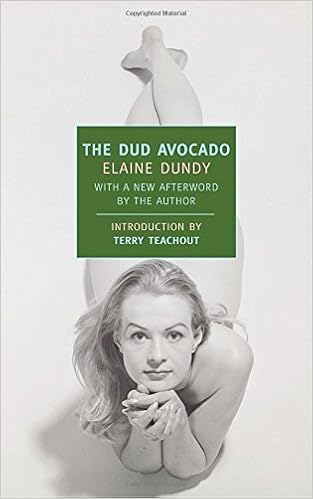
The Dud Avocado by Elaine Dundy

We looked at the menu.  "Hah!  Avocados," he said, brightening.  "How I love them.  Cheer up, my little avocado," he said to me, pinching my hand.  "You know, these American girls are just like avocados.  What do you think, am I right, Max?  Who ever even heard of an avocado sixty years ago?  Yes, that's what we're growing nowadays."  His avocado arrived and he looked at it lovingly.  "The Typical American Girl," he said, addressing it.  "A hard center with the tender meat all wrapped up in a shiny casing."  He began eating it.  "How I love them," he murmured greedily.  "So green--so eternally green."

"Stefan, please..."

"No, it's true.  And I will tell you something really extraordinary, mes enfants.  Do you know that you can just take the stones of these luscious fruits, put them in water--just plain water, mind you--anywhere, any place in the world, and in three months up comes a sturdy little plant full of green leaves?  That is their sturdy little souls bursting into bloom," he finished off, well satisfied with his analogy."

"Well, this one isn't going to burst into bloom," I said morosely, putting my nose in my drink.  "What you've got here is a dead one."

"A what?  A dud one?"

I took my face out of the glass.  "No, dead.  Dead.  Oh, forget it."

Max raised his glass and smiled at me.  "The dud avocado," he said, proposing the toast.

Sally Jay Gorce walks down the Boulevard St. Michel in the morning in an evening dress--it's laundry day--on the way to meet her Italian lover.  Instead, she's waylaid by an old American friend, Larry, with whom she has a drink, and falls instantly in love.  This sets off a variation on the old innocents abroad story, in which Gorce is introduced to a bunch of bohemian types, drinks and sleeps around a lot, spends a disastrous month at a cottage in the French Riviera, and becomes, eventually, inevitably, disillusioned of her initial wonder:

And then one day, one memorable day in the early evening, I stumbled across the Champs Elysees.  I know it seems crazy to say, but before I actually stepped onto it (at what turned out to be the Etoile) I had not even been aware of its existence.  No, I swear it.  I'd heard the words "Champs Elysees," of course, but I thought it was a park or something.  I mean that's what it sounds like, doesn't it?  All at once I found myself standing there gazing down that enchanted boulevard in the blue, blue evening.  Everything seemed to fall into place.  Here was all the gaiety and glory and sparkle I knew was going to be life if I could just grasp it.

It's kind of familiar story that has an expected resolution: Gorce has to find out that she doesn't need to travel to experience life.  To emphasize this point, her Uncle Roger--who's footing the bill for this two-year jaunt in Paris--writes her that he's given up the study of astronomy and started studying microscopic animals.  The big for the small--the sky for the earth.

It's a kind of familiar story, but Gorce is such a strong presence, and Dundy has such a confident way with the voice of a young, clever woman who is quickly growing up, that that doesn't matter.  ("[A]ll the impulsive, outrageous things my heroine did, I did," Dundy writes in the post-script.  "All the sensible things she did, I made up.")  And the book is peopled with vivid, specific comic characters: the snobbish Italian Contessa; the Ancient, a kind of Hemingway figure that the bohemian sat gather around like royalty; the sickly friend Judy who lives vicariously through Gorce's exploits; a man named Hugo who hangs around great authors offering his services as a model for characters; and various blue-bloods, rakes, and buffoons.  And there's Larry, who's Bohemian charisma turns out to mask something much more sinister:

The mat of auburn hair curling to his skull, the gray-green eyes now so blank and far away, the delicate scar running down the pale skin of his forehead, the well-shaped nose covered with a faint spray of freckles, with his large mouth, gently curved, all contributed to give his face, especially in repose, a look of sappy sweetness that was sharply at odds with--and yet at the same time enhanced--his tough, wise-guy manner.  Maybe because I had been out very late the night before and was not able to put up my usual resistance, but it seemed to me, sitting there with the sound of his voice dying in my ears, that I could fall in love with him.

And then, as unexpected as a hidden step, I felt myself actually stumble and fall.  And there it was, I was in love with him!  As simple as that.

I want to quote pages and pages of this book because of the wonderfulness of the voice.  It reminds me--and I hate myself for saying this--of a female Holden Caulfield.  Gorce is not bitter, but rather a little naive, but the breezy casualness that belies a profound thoughtfulness is straight out of the Salinger playbook.  I fear that it might sound a little Bridget Jones from these excerpts--Terry Southern makes that comparison in the introduction--but there's too much real humor and too much real tragedy in The Dud Avocado.  I'll just quote the end; I won't ruin it by telling you what she's talking about but it's too perfect not to quote:

It's so chic.  It's so suave and so sleek and exotic.  It's the end, it's the end... It's the last word.

It's zymotic.

Saturday, November 19, 2016

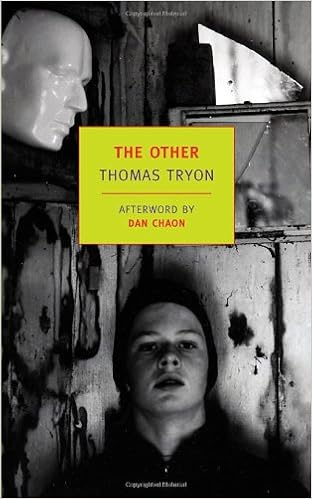
The Other by Thomas Tryon

Do you know about the well?  That dark and secret place where the accident happened--one of the accidents, I should say.  The hanging.  No, not that kind, but in its way nearly as horrible.  Can oyu hear it, the noisy grating of the pulley as the rope travels through, spinning the rusty wheel, dropping its burden down, down into the blackness?  The savage cries; terrible, shocked, outraged cries of fury, of horror.  No.  I said it was not that sort of hanging, not one of those state executions--well, yes, execution of sorts, but only because Holland didn't like cats.  Hated them, in fact.  Yes, it was a cat; didn't I mention that?  Trouble, the old woman's animal, her pet.  Got this rope around Trouble's neck--he could make a noose with ease--dragged it through the drive and hanged the cat in the well.  For spite.  The trouble was--excuse the pun--he darn near hanged himself.  Poor Holland.

Holland and Niles Perry are twins, living in the quiet Connecticut town of Pequot Landing.  Niles is the quiet one, the sensitive one.  Holland is the one that murders cats.  Early on in Tom Tryon's The Other, Holland moves from petty cruelties toward animals to straight-up murderousness, leaving a sharp pitchfork hidden in the hayloft where his annoying cousin, Russell, likes to dive into the hay.  Niles struggles to understand his brother with the compulsive attachment of the twin, but Holland is increasingly distant and prone toward evil.

The beginning of The Other is intriguing and mysterious, and the end--spoiler alert--is terrific.  It's not so much the realization that Holland has really been dead for nearly a year (he drowned himself killing the cat), and that Niles has been trying to keep his brother alive by committing horrible deeds in his stead, but the power of a single, final image: Niles' sister's infant child, having disappeared, found finally floating in a cask of wine.  A certain kind of book (or film, which The Other became--Tryon was a middlingly successful actor and turning it into a movie was probably always the goal) might have shied away from that last bit, saving the child at the last minute, but The Other doesn't want to pull that punch.

The middle of The Other, though, is quite a slog.  It's over-stuffed with symbols: a ring, a severed finger, the wine cask, a mysterious cellar, a Chinese magic trick, a pin shaped like a moon, a lamp, a hat, a doll--all of them imported from the tropes and vocabulary of the small town with a dark secret.  It's over-stuffed, too, with characters: a neverending troupe of aunts and uncles and townspeople who are meant to give the novel a sense of life but mostly provide tedium.  Tryon's method is to write long interstitial scenes of Niles' life at home, and to forecast moments of horror, only to pull away at the last minute and let the truly interesting parts happen "off-screen."  In a film, a sense of foreboding might make these scenes work, but I was too frustrated with The Other to really appreciate the pulpy nastiness of the way it ended.