Showing posts with label Mavis Gallant. Show all posts

Sunday, March 9, 2025

A Fairly Good Time by Mavis Gallant

All her private dialogues were furnished with scraps of prose recited out of context, like the disparate chairs, carpets and lamps adrift in her apartment. She carried her notions of conversation into active life and felt as if she had been invited to act in a play without having been told the name of it. No one had ever mentioned who the author was or if the action was supposed to be sad or hilarious. She came on stage wondering whether the plot was gently falling apart or rushing onward toward a solution. Cues went unheeded and unrecognized, and she annoyed the other players by bringing in lines from any other piece she happened to recall.

Shirley Perrigny--formerly Shirley Norrington, then Shirley Higgins--is a Canadian living in Paris. Her first husband, Peter, died on their honeymoon in Italy, leaving her to drift toward France, where she married a journalist named Philippe. Philippe has left her, it seems, or half-left her; he has disappeared. Excuses seem to proliferate from the shadows--he's on assignment, he's visiting his family, he's sick with hepatitis--but each one is buttressed with the caveat that he's not to be contacted. Left adrift, Shirley searches for a sense of identity in the wake of these personal disasters. She makes friends with a desperate young mother named Claudie, and becomes reluctantly ingratiated with her family; Claudie sees in the slightly older Shirley someone who has her life together, which we know is the opposite of the truth. But Shirley's chief personality trait seems to be her need to care for others, which may be, as Philippe and others see it, a kind of self-abnegation that prevents Shirley from really becoming.

A Fairly Good Time is an example of a small but recognizable mid-century micro-genre: the North American girl in Europe. Mostly, as in Elaine Dundy's The Dud Avocado, it's an American girl, but the Canadian Shirley is constantly being taken for an American anyway. Philippe, and many of the other locals, find many reasons to look down on Shirley; they take her personal idiosyncrasies to be examples of North American uncouthness, and they elevate small differences to the level of barbarism. It's really not a book that makes the French come out very well. But even among these, Shirley finds ways to  connect with people, even despite herself, and perhaps it is her outsider's perspective that makes her so invaluable to an unsettled soul like Claudie. Shirley, too, is adrift, but her adriftness has taken her far away from home, something that the too-young mother Claudie can only see and admire.

I've only read Gallant's short stories, and I love them, but I think that here, in a novel, the strengths that make her such a good short story writer work against her. Gallant's stories are rich and overfilled; they effortlessly give a sense of whole worlds that exist outside of the margins of the page. As a novel, it feels overstuffed; characters who might have made a strong singular impression, like Shirley's malicious landlady Madame Roux, end up overextended and obscure. Interestingly, I recognized the story of Shirley's first husband's death as being cribbed from one of her stories that, if I recall correctly, is anthologized in two of the collections I read. In that story, too, the young window drifts into the first harbor she can find, a lover and his family who turn out to be somewhat sinister.

This NYRB edition of A Fairly Good Time includes another of Gallant's novels (maybe the only other one, but I'm not looking it up; don't quote me), Green Water, Green Sky. This novel--really, a novella--is about Flor, another Canadian in Europe (as Gallant herself was), undergoing the slow dissolution of her mental health. Flor's story is told mostly through the eyes of the people at the edges of her life, some intimate and others quite incidental: her mother, her Jewish husband Bob Harris, her cousin George, an artist and hanger-on named Wishart. This method is strange, and it felt to me like the novel keeps us from looking directly at Flor. It's too disparate, too imbalanced, to work with any kind of wholeness or singleness, though perhaps the fragmentation is much the point. And yet, a long scene where Flor, abandoned by her mother and others, cloisters herself within her flat and begins to break down completely, shows Gallant, like nothing else in either novel does, at the height of her talents.

Wednesday, July 27, 2022

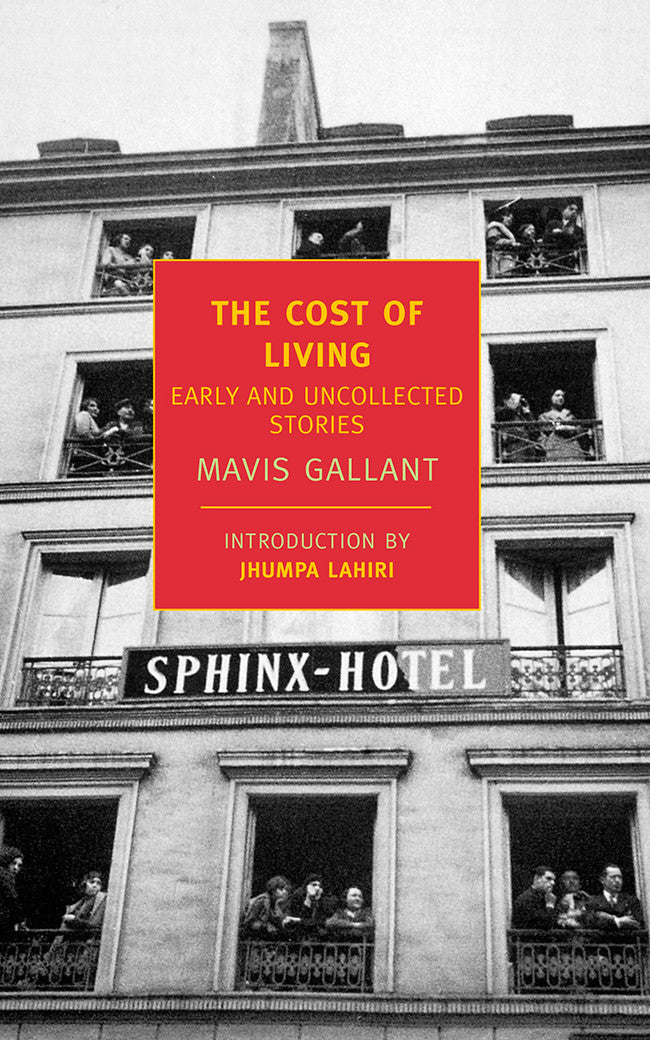
The Cost of Living by Mavis Gallant

Malcolm is convinced he will never have an idea about Bea until he understands her idea of herself. Of course Bea has an idea; what woman hasn't? In her mind's eye she is always advancing, she is walking between lanes of trees on a June day. She is small and slight in her dreams, as she is in life. She advances toward herself, as if half of her were a mirror. In the vision she carries Ruth, her prettiest baby, newly born, or a glass goblet, or a bunch of roses. Whatever she holds must be untouched, fresh, scarcely breathed on.

There's something nice about odds-and-sods collections like this one, which is that the hand of the author is totally absent. There's no thematic arrangement, no meddling in the order of the stories, nor do they capture a particular moment in the author's life: what you get in a collection like The Cost of Living is a snapshot of an author's career from beginning to finish. The collection opens with "Madeline's Birthday," which became, in 1951, Gallant's first published story. Madeline is a New York teenager abandoned by a selfish mother at the home of her sister in Connecticut, where she languishes alongside a German boarder named Paul and her aunt's little girl Allie. Paul wants Madeline to read over his English homework; Allie wants her to braid her hair. For her own part, Madeline is miserable, and dreams of getting away from the cloistered house, where she feels stifled and unwanted. It's not a very good story. Nothing really happens, the larger and deeper conflicts are only gestured at. A careful existence is constructed for the characters beyond the snapshot of the story, but it's hard to believe in that existence. You read "Madeline's Birthday" and think, "Is that it?"

But much of the things that make Gallant's fiction so beguiling are already there, in nascent form. Compare "Madeline's Birthday" to a later masterwork like "Malcolm and Bea" or "The Burgundy Weekend." Both are stories about marriages between people of varying degrees of social toxicity. Practical Malcolm has married Bea, maniacal and headstrong. In "The Burgundy Weekend," Lucie has married Jerome: clever, lazy, proud, flirting shamelessly with the young daughter of his old flame, who they are visiting in the French countryside. But the characters are remarkably rich, so rich, in fact, that the adjectives I've used to describe them hardly seem to capture who they are. Who they are, actually, is a mystery that keeps unfolding, and which may seem different the next time I read the story; not in the sense that they are underdeveloped or vague, but in the way that your initial impressions of real people never tend to be permanent.

What these stories do is have people collide. Some of them, like the married couples, have been colliding for years, sanding each other's edges until neither is fit for any other kind of society, but there are always outsiders, too, whose vantage points make it impossible for them to see inside the relationship. This is especially true in "The Burgundy Weekend," as Lucie's cousin Gilles--a rigid and professionally satisfied doctor who drops them off and picks them up in Burgundy--strains to see what Lucie sees in Jerome, unable to comprehend that Jerome's rudeness is, in Lucie's eyes, a victory for Jerome, who is often too withdrawn to bother. In the stories themselves, nothing much happens: Jerome doesn't sleep with Nadine; the old flame barely registers on the page; there are no murders or flat tires or moments that change everything. But unlike "Madeline's Birthday," you get the sense of whole lives coming to bear on single moments; they are scenes of great pressure in which nothing, in the end, bursts or breaks.

"Every marriage is about something," Malcolm thinks in "Malcom and Bea." "It must have a plot. Sometimes it has a puzzling or incoherent plot. If you saw it acted out, it would bore you. 'Turn it off,' you would say. 'No one I know lives that way.' It has a mood, a setting, a vocabulary, bone structure, a climate.'" Malcolm thinks his way into something true, but the original thought ("Every marriage is about something") is surely incorrect. I don't think you can properly say that any of Gallant's mature stories are about anything. Themes lurk under the surface, including the social inferiority complex of Canadians abroad (one fun detail in "The Burgundy Weekend" is that Lucie is a firm believer in the coming sovereignty of a free Quebec) but the stories aren't really about these things, partially because none of the characters, like most people, can barely agree on what matters at any given moment. This distinguishes Gallant's stories from Alice Munro, her fellow Canadian. While Munro's stories, like Gallant's, are small moments that reveal entire human histories, things happen in them, they are undeniably about something.

All of this makes Gallant's later work sort of spiky and unsatisfying. They resist the kind of pleasing roundness, the sense of a whole story told in short order, for which we often look to short stories. But The Cost of Living is interesting because you can see this quality of Gallant's grow and develop. Halfway between "Madeline's Birthday" and "The Burgundy Weekend" is a story like "Going Ashore," about a young girl on a Mediterranean cruise who yearns to see the fascinating new world she's being offered, but who must deal with her depressive mother, who only booked their passage to meet men. It's "Going Ashore" that might be the most pleasing story in the collection, because it features Gallant at a point where her talent has matured but the story has remained more conventional. By contrast, it's hard to figure out what to do with a story like "The Rejection," a strange, strange conversation between a father and his six year old (who talks like an adult), who decide they don't like each other and don't want to live together. Halfway through the conversation, which takes place in car, we're told that the girl has made a pet of some unidentified reptile, which is sitting at her feet. The story, actually, reminds me of the protagonist of the story "The Cost of Living," who is forced to listen to her actor roommates practicing Beckett plays on the other side of her bedroom wall. "The Rejection" is like Beckett, heard through a wall.

I don't think the stories collected here are as strong as the ones in the actual collections of Gallant's I've read. These kinds of "early and uncollected" compilations rarely are. A few of the later stories probably stand with her best, but a lot of them seem slight, like experiments that got halted halfway through for unsatisfactory results. But I loved getting to see the way one of the most original short fiction writers of the 20th century developed and grew over the course of her career.

Friday, August 13, 2021

Paris Stories by Mavis Gallant

The dark, the ghosts, the candlelight, her tears on the scarred bar--they were real. And still, whether she wanted to see it or not, the light of imagination danced all over the square. She did not dare to turn again to the mirror, lest she confuse the two and forget which light was real. A pure white awning on a cross street seemed to her to be of indestructible beauty. The window it sheltered was hollowed with sadness and shadow. She said with the same deep sadness, "I believe you." The wave of revulsion ceded, sucked back under another wave--a powerful adolescent craving for something simple, such as true love.

Mavis Gallant's Paris Stories are not all set in Paris, although as the editor of this collection, Michael Ondaatje points out, they were all likely written in Paris, where the Canadian ex-pat Gallant lived much of her life. Yet the title refers to a kind of Parisienne spirit: a city hollowed out by war, then filled with the cast-offs of Europe--the war-wounded, refugees from Eastern Europe where the war in a way never disappeared, the profiteers looking for a scheme by which to keep profiting, the writers and drifters. More than the other two collections of Gallant's I have read (all of which have overlapping contents), Paris Stories is about the aftermath of World War II, and the new Europe that unfolds itself over five decades. (The last of these stories was written, I think, in the 1990's, or perhaps even later, though Gallant's rich, dense style seems perpetually frozen in the 1950's, not unlike some of her protagonists.) The story that deals with the war most immediately is the striking "The Latehomecomer," about a German veteran belatedly released from captivity years after the war's end, trying to determine how he fits into the life of his mother, who has remarried:

Here, where it would not be necessary to wear a label, because "latehomecomer" was written all over me, I sensed that I was an embarraassment, too; my appearance, my survival, my bleeding gums and loose teeth, my chronic dysentery and anemia, my cravings for sweets, my reticence with strangers, the cast-off rags I had worn on arrival, all said "war" when everyone wanted peace, "captivity" when the word was "freedom," and "dry bread" when everyone was thinking "jam and butter."

"The Latehomecomer," with its powerful sense of an existence wrenched slightly and forever out of place, is one of the masterpieces of Paris Stories. I think I was most taken by the sumptuousness of "The Moslem Wife," a story about a hotelier and her husband who are driven together despite their essential differences, and then separated by the war. He goes to America--and even marries an American wife--while she remains behind as the hotel is turned into a bivouac for Italians. Like the title latehomecomer, husband and wife, meeting at last in the precarious safety of the post-war era, must determine what they once were to each other, how much was real and how much imagined, and how much of what they had believed has changed or simply been exposed and discredited. Looking back at that description, it seems essentially correct to me, but it fails to capture the wonderful ambiguity of the story, an ambiguity that, like in all of Gallant's stories, hides among richly drawn portraits of material landscapes: chintz curtains, silk flowers in ormolu vases, prized and profitable view of the sea.

In "Baum, Gabriel (1945- )," Gallant describes a veteran of the French wars in Algeria who makes a meager living acting in television shows about the war and occupation. He and his friend--who actually has lines in these programs--bum around the same cafe as the other actors, until it closes suddenly and reopens with a plaque that reads: "PUB LA MEDUSE: THE OLDEST AND MOST CELEBRATED MEETING-PLACE FOR TELEVISION STARS IN PARIS." I just loved the clever humor at the heart of this story: Gabriel lives first as a real soldier in Algeria--already a kind of ersatz version of the French heroes of the World War--and then becomes a fake soldier. Then even being an actor becomes a kind of performance, an actor acting at acting, making set dressing for the cafe. This theme is repeated in "The Remission" when the soon-to-be-widow of an Englishman who has come to the French Riviera to die begins an affair with an actor whose whole talent is to look and sound very English. These stories describe a Europe always renewing itself as a facsimile of itself, always becoming a blurrier, less reliable copy.

One of the most well-known stories in the collection, "Speck's Idea," describes an art gallery collector who seeks to make a name for himself by rehabilitating the career of an overlooked artist, but settles on a dead painter whose collection is jealously guarded by an unsentimental Canadian wife. Speck is convinced that the exhibition will be a smash, and quickly rationalizes his discovery that the artist was a right-wing sympathizer during the war. Ondaatje's foreword describes it as a story about how people lurch into Fascism for non-ideological reasons; the essential performativeness of the exhibition--the carefully written biography in the catalog--resonates, to me, with the actors of "Baum, Gabriel (1945- )" and "The Remission," showing that Fascism, too, can become an act. Xenophobia and viciousness haunt the edges of these stories, like in the quietly effective "Mlle. Dias De Corta," written from the perspective of an aging Frenchwoman to the indeterminately foreign former boarder she has just seen acting in a commercial. The narrator vacillates between adding up all the rent--with interest!--the boarder ran out on, and begging her to come back to stay with them again.

Some of the later stories--I believe the collection is chronologically ordered--struck me as a little too dense, like a thicket, to penetrate. I think I liked this collection a little bit less, on the whole, than the two other Gallant collections I have read. But the best stories, like "The Latehomecomer" and "The Moslem Wife," are some of her very best.

Sunday, April 5, 2020

Home Truths by Mavis Gallant

Now, of course there is much to be said on the other side; people who do not display what they feel have practical advantages.  They can go away to be killed as if they didn't min; they can see their sons off to war without a blink.  Their upbringing is intended for a crisis.  When it comes, they behave themselves.  But it is murder in everyday life--truly murder.  The dead of heart and spirit litter the landscape.  Still, keeping a straight face makes life tolerable under stress.  It makes public life tolerable--that is all I am saying; because in private people still got drunk, went after each other with bottles and knives, rang the police to complain that neighbors were sending poison gas over the transom, abandoned infant children and aged parents, wrote letters to newspapers in favor of corporal punishment, with inventive suggestions.  When I came back to Canada that June, at least one thing had been settled; I knew that it was all right for people to laugh and cry and even to make asses of themselves.  I had actually known people like that, had lived with them, and they were fine, mostly--not crazy at all.  That was where a lot of my confidence came from when I began my journey into a new life and a dream past.

It's hard not to be amazed by the short fiction of Mavis Gallant.  I leave every story floored by the clarity of her vision and the persuasiveness of life in them, the richness of detail; nothing ever seems faked or planned.  But that's only part of what makes them so terrific, and it's difficult to find the words to describe what exactly makes them so terrific.  They seem to waver between Edwardian traditionalism and jagged postmodernism.  Sometimes they seem so straightforwardly social-realist in the way they capture, for example, Montreal during World War II; other times they seem like impenetrable knots of consciousness.  (In fact, if these stories didn't hover so reliably around the war I don't know if I'd be able to place them in time at all.)  There always seems to be one character too many, and the themes are entirely elusive.

These stories explore what it means to be Canadian.  Home Truths is split into three sections: "Canadians at Home," "Canadians Abroad," and a cycle of stories about Linnet Muir, a young woman who returns home to Montreal after living in New York for a few years, and which seem like they must be at least partially autobiographical.  Gallant's characters often find themselves stationed at the battle lines of the war of language in Quebec, but in ways that are so understated they seem wholly irrelevant to the stories themselves, like the servant and mistress in "Jorinda and Jorindel" who sit for hours not talking to each other because they refuse to learn English, in the case of one, or French, in the other.  Canadians abroad are always anxious about their French and about not being seen as American.  In one terrific story, "Virus X," a young Canadian woman comes to Alsace to study, and looks anxiously over the border about Germany because her own German heritage is something that, at the time of the war, has always seemed hush-hush.  In these characters you can see, in real time, the Canadian identity emerging from Britishness during the war.

But like I said, this theme is never heavy-handed, and it would be hard to say that's what the stories are about, exactly.  But that must be what it's like to experience a changing cultural identity: it's folded so deeply into the fabric of life that changes fail to announce themselves with much fanfare.  They are also about women--Linnet's stories are all about what happens when, during the war, women come to occupy the jobs once held by men--and even children.  In her most modernist mode, Gallant has a great skill at describing the weird interior world of children, like the little girl who describes her parents this way: "But large, and old, and powerful, they have greater powers: they see through walls, and hear whispered conversations miles away."

Gallant can also be extremely funny, as in this passage from one of the Linnet stories:

"Well, Bolshie," he said to me.  This was a long joke: it had to do with my political views, as he saw them, and it was also a reference to a character in an English comic called "Pip and Squeak" that he and I had both read as children--we'd discussed it once.  Pip and Squeak were a dog and a penguin.  They had a son called Wilfred, who was a rabbit.  Bolshie seemed to be a sort of acquaintance.  He went around carrying one of those round black bombs with a sputtering fuse.  He had a dog, I think--a dog with whiskers.  I had told Mr. Tracy how modern educators were opposed to "Pip and Squeak."  The thought that more than one generation of us had been badly misled by the unusual family unit of dog, penguin, and rabbit.  It was argued that millions of children had grown up believing that if a dog made advances to a female penguin she would produce a rabbit.  "Not a rabbit," said Mr. Tracy reasonably.  "Wilfred."

Some of Home Truths was rereading for me; but I welcomed seeing stories like "The Prodigal Parent" and "In the Tunnel," which I think is sort of a masterpiece, again.  They're just so rich and multifarious, and while I don't think I could explain what seems different this time around, the experience of reading these stories again still had a kind of freshness.  I'm still trying to put my finger on what's so great about them, but I think that impulse--wanting to get inside these stories and figure out what makes them tick--speaks for itself.

Monday, July 16, 2018

The End of the World and Other Stories by Mavis Gallant

She lugged her suitcase as far as the road and sat down beside it.  Overnight a pocket of liquid the size of a lemon had formed near the anklebone.  Her father would say it was all her own fault again.  Why  Was it Sarah's fault that she had all this loving capital to invest?  What was she supposed to do with it?  Even if she always ended up sitting outside a gate somewhere, was she any the worse for it?  The only thing wrong now was the pain she felt, not of her ankle but in her stomach.  her stomach felt as if it was filled up with old oyster shells.  Yes, a load of old, ugly, used-up shells was what she had for stuffing.  She had to take care not to breathe too deeply, because the shells scratched.  In her research for Professor Downcast she had learned that one could be alcoholic, crippled, afraid of dying and of being poor, and she knew these things waited for everyone, even Sarah; but nothing had warned her that one day she would not be loved.  That was the meaning of "less privileged."  There was no other.

Walter, the protagonist of "An Unmarried Man's Summer" lives rent-free in a bungalow in Nice with his manservant Angelo.  He knows that one day, when the owners of the house retire, he'll be forced to move somewhere, do something else, but that day is fifteen years down the road.  His sister visits and forces him to see how deeply happy Angelo is--that, despite the poverty from which he comes, the life of endless vacation he shares with Walter comes at the cost of separation from his family, from human companionship.

In "The Accident," a woman is on a long honeymoon on the Italian Riviera with her husband when he is killed in a freak accident, hit on a bicycle by a car door.  Before his death, she reflects on the nature of their vacation:  "So real life, the grey noon with no limits, had not yet begun.  I distrusted real life, for I knew nothing about it.  It was the middle-aged world without feeling, where no one was loved."  After the accident, she stays in Italy, getting a job as a translator for a pharmacy.  You can't exactly say that she's on an infinite vacation--there's that job, after all--but like Walter, she's stuck in some kind of world that is eternally foreign and exotic to her, using it to fend of the "grey noon with no limits" that is life at home in Canada.

Gallant presents, over and over again, a kind of arrested development incarnated in the vacation that won't end.  Her characters are typically Canadians in Europe, as Gallant herself was, living as an ex-pat in Paris.  I picked the book up at a bookstore in Edmonton on my most recent vacation, and let me tell you, that feeling of the "grey noon," captured perfectly the feeling of letdown after vacation was over.  In "In the Tunnel," a young woman impulsively agrees to move in with a dashing English ex-officer for a month, again on the Riviera.  He and his neighbors prove to be churlish, prickly, difficult to understand; their conversation vacillates between accommodation and hostility that seem very real.  But the lesson for Sarah is not that the experience might have been better if the officer had been kinder, but that enacting our fantasies means inevitably rupturing them.

Almost every one of these stories offers a variation on  these themes, sometimes an inversion.  In "New Year's Eve," the Riviera is traded for the Bolshoi theater in Moscow, and follows the lines of thought of three people who are incapable of really communicating with or understanding each other.  In "The Other Paris," it's a woman who gets engaged to a fellow Canadian in Paris in a misguided attempt to force the romantic Paris of her dreams to become reality.  In "About Geneva," it's a pair of children who return to their mother after having visited their estranged father, and whose scattered impressions fail to tell the mother what she really wants to know "about Geneva":

But how can they be trusted, the children's mother thought.  Which of them can one believe?  "Perhaps," she said to Colin, "one day, you can tell me more about Geneva?"

"Yes," he said perplexed.

But, really, she doubted it; nothing had come back form the trip but her own feelings of longing and envy, the longing and envy she felt at night, seeing, at a crossroad or over a bridge, the lighted windows of a train sweep by.  Her children had nothing to tell her.  Perhaps, as she said, one day Colin would say something, produce the image of Geneva, tell her about the lake, the boats, the swans, and why her husband had left her.  Perhaps he could tell her, but, really, she doubted it.  And, already, so did he.

Even the story least like these, "My Heart is Broken," has something in common with them.  In a remote road-construction camp in northern Quebec, an older woman is talking with a younger woman, both of whose husbands work for the camp.  Over the course of the conversation, we come to understand that the younger woman has been raped by a worker at the camp.  But the rape is less a threat to the cohesion of the small, faraway community than the knowledge of the rape:

"Don't say who it was," said Mrs. Thompson.  "We don't any of us need to know."

"We were just talking, and he got sore all of a sudden and grabbed my arm."

"Don't say the name!" Mrs. Thompson cried.

As an image of rape culture, it's sharp and black-hearted.  But even this Quebec camp, like Nice, like the Riviera, seems like a collective illusion that is precariously balanced, and must constantly be defended against the forces of the "grey noon" of the real world.

Gallant's stories are strange; they seem to violate some of the traditional practices of short story writing.  They're circuitous, choked with detail, and refuse to present logical progressions of character.  Conversations are knotty and difficult to follow.  Comparisons to Gallant's fellow Canadian Alice Munro seem natural, but though I think Munro is many times more complex than she gets credit for, her stories have a satisfying completeness that Gallant rejects.  They resemble more than anything ten pages plucked randomly from the middle of a novel.  I found myself wondering what next? when each was over, but that's part of the endless vacation, I guess: there are no resolutions.