Showing posts with label France. Show all posts

Sunday, May 3, 2026

Crazy Genie by Ines Cagnati

I told her about her, of what the grandfather had told me, that before she had me she would laugh and sing day and night, and that later, once she was expecting me, she never wanted to say who my father was, and the grandmother, who is a bad woman, had gone into a fury because she didn't wand bad things like that to happen in her family, which was the most respectable in the village. Then she had moved into the shack under the crazy willows that talk at night, and she had never gone back to her home, and she worked at people's houses to be fed, and they called her Crazy Genie because she never talked, but she wasn't crazy, she simply didn't talk and didn't laugh.

Marie's mother is known in her village as "Crazy Genie." Despite coming from a respected family, she takes on odd jobs to survive: milking cows, threshing wheat, husking corn. She's not really crazy--the word is a tool that the people of the village use to place her beyond their sympathy and understanding. If Genie has fallen in the world, it must be her own fault--as Marie's grandmother, still incensed about Genie's becoming pregnant out of wedlock, believes--or, more likely, there's just something wrong with her that can't be helped. Marie spends much of her childhood trying to make sense of this dynamic, while trying without success to become closer to her mother, whose material sacrifices we can see clearly are meant to protect and care for Marie, but who is extremely sparing with words or gestures of maternal love. The only things that Genie says to Marie for much of the book are commands: "Go home," "Don't bother me," etc., etc.

It's a dangerous world out there for girls, as Marie finds when the town mason, Ernest, is lying in wait for her en route from a job back to her home under the "crazy willows that talk at night." We learn later--spoiler alert--that this Ernest is Marie's father, and that he has raped his own daughter just as he raped Genie many years before. In this way, Crazy Genie becomes a book about the way that male cruelty can have resounding effects well past the moment of violence: Ernest's deeds ripple throughout Genie's life as well as Marie's, and his rape of her, which is presented rather elliptically in the text, is perhaps only a more severe manifestation of the general ruin he has brought upon her. And yet, Ernest is a distant figure from the narrative, appearing only a few times in the shadows. Men, of course, get to walk away. But there are others who collaborate in this violence and ruining: the grandmother, of course, and the townspeople, whose incurious nature prevents them from seeing the injustice that lies behind Genie's tough exterior.

It's easy to see what Crazy Genie has in common with Free Day, the Ines Cagnati book that NYRB translated and published a few years ago. Both are about young girls living in difficult circumstances in the French countryside, trying to scrabble out an existence in the face of disadvantageous circumstances. But they're incredibly different stylistically. Marie's language is much simpler, more systematic, as might fit a more rational and less emotional child who is trying to make sense of the world around her. The simplicity of the language emphasizes, too, the repetitiveness and routine of the life that Marie lives with Genie. It's a style that works, but it's not as good as Free Day, a book where anxiety and dread leak through the language in a much more interesting way. That said, Crazy Genie moves toward a climactic ending that is as difficult and tragic as anything in Free Day, and which elevated the book for me--because I always appreciate a real bummer.

Saturday, February 7, 2026

The War by Marguerite Duras

I couldn't stop my self--I started to run downstairs, to escape into the street. Beauchamp and D. were supporting him under the arms. They'd stopped on the first-floor landing. He was looking up.

I can't remember exactly what happened. He must have looked at me and recognized me and smiled. I shrieked no, that I didn't want to see. I started to run again, up the stairs this time. I was shrieking, I remember that. The war emerged in my shrieks. Six years without uttering a cry. I found myself in some neighbors' apartment. They forced me to drink some rum, they poured it into my mouth. Into the shrieks.

The first section of The War, Marguerite Duras' collection of memoir pieces about her World War II experiences, depicts the author in the war's waning days, waiting to hear news of her husband, who had been captured by the Nazis and taken to Bergen-Belsen. News is difficult to come by; it's all private whispers and hearsay. In her mind, he is already dead; and the death follows her around like another husband, always with her, even as it is not yet known. Miraculously, he's discovered alive by her friends in the Resistance, but in a deeply weakened state. By the time he makes it back to Paris, he's too weak to even eat--many returnees die, we're told, because their shriveled stomachs burst as soon as something solid is put into them. It's no happy homecoming, but something out of a horror movie: "The war emerged in my shrieks." What follows is a long and arduous process of getting him back to strength. At the end of it, when he's well enough, Duras tells him--and us--that she is, as she has always intended, divorcing him to marry her fellow Resistance fighter D. (presumably, "Duras").

What's funny about The War, which seems to have been cobbled together from several disparate pieces, is that it really isn't interested in the war's progression, but by its end. The war only becomes real, and most horrible, for Duras, when its most ravaged victims, like her husband, begin to return. The other two pieces deal more directly with Duras' experiences in the resistance, but they, too, take place toward the war's end, when Germany is already losing its hold on its possessions in Europe, and this gives the pieces a kind of bitter irrelevancy. One tells about an agent of the Gestapo with romantic designs on Duras; she goes out with him for months as a prelude to identifying him to the Resistance to be killed. The third is about literal torture: the bloody beating of a man expected of collaboration with the Nazis. There's a black humor to the single question he keeps refusing to answer: What is the color of the ID that let you into the Nazi administrative building? Finally, after beating him so badly he's likely to die, he admits that it was green--Gestapo green. Both of these figures, marked for death by the Resistance, have a kind of innocence and naivete that makes them strangely sympathetic, and the fact that the war is in both cases practically over makes their token stubbornness seem mean, vain, and sad.

Boy, Duras could write. The first section, about her husband's return, is some of the most effective and chilling writing I've ever read about World War II--which is maybe the most written-about event in all of world history, you know? I enjoyed all three parts, which I sense were never really intended to be grouped together when they were written, but it's that first section--the war emerging with the shrieks, the rum being poured into the shrieks--that I think will stay with me.

Saturday, November 15, 2025

Lili is Crying by Helene Bessette

He is dragging his wife along the hot road in the shadowless evening.
He is shouting:
--You'll have to choose, it's me or her.
--She's my mother, sobs Lili, I choose my mother.
--Naturally, Lili, she is your mother, and its a great shame, but if you want to see her again, you'll have to do it without me there. A separation, Lili. This evening, I broke up with my mother-in-law.
He cracks a match. He lights a cigarette, leaning forward, cupping his hands around his mouth.
He's a man.
And this evening he's fighting.
This troubled evening.
This tormented evening.
This tearful evening.
This cigarettes evening.
Lily is crying.
He hates to see Lili cry.
And so he gets angry.

Lili is Crying takes place in Provence during the early 20th century. Lili is a young woman living with her domineering and possessive mother, Charlotte, who runs a small boarding house. Charlotte is suspicious and resentful of any suitor of Lili's, regarding them as thieves who want to take her daughter away from her. To Charlotte, a mother should enough for Lili--a patently ridiculous thing to believe about the life of a young woman, but a belief with long-reaching consequences. Eventually, Lili marries a man who has no idea the trap he's walking into, how Charlotte will rage against him simply because she took her daughter away, and much of the novel is a back-and-forth between Charlotte and Lili's husband in which one demands that Lili choose them over the other. No wonder Lili is crying. "There are so many ways to love a daughter," Bessette writes, "And how well she could have loved her daughter, that mother Charlotte. There are thirty-six right ways. (But she chose the thirty-seventh.)"

This impossible dynamic is solved, in a way, when the man is taken away by the Nazis and sent to Dachau. In his absence, Lili and her mother become entangled again, and though the man eventually comes back, he struggles to realize that he has lost Lili's affections entirely in his absence. He's rich, in a way, having filled his pockets with the jewels and other affects that the dead of Dachau will no longer need, but Charlotte threatens to turn him into the authorities for this--all of which is a particularly bitter image of the life that those who managed to come back from the Nazi camps might have found. There's no place for Lili's husband; his absence was like a vacuum that has been filled. This culminates in a dalliance between Lili--who is now in her 40's--and a simple-minded shepherd who is thirteen years younger. Life at Charlotte's side has made Lili stunted, and an ordinary life seems to have passed her by; she has aged without ever really having the normal married life she dreamed of.

Helene Bessette was a member of Oulipo, the French school of "potential literature" founded by Raymond Queneau that prized wordplay and "constrained" writing. Lili is Crying is not so playful or experimental as some of what the Oulipians produced, but you can see the influence in her language. The novel unfolds almost like a poem of strung dialogue, sometimes demarcated by dashes when a speaker changes. The line between what characters think and what they say is not always clear. Its simple, staccato phrasing provides a grounding of the strangeness and tragedy of the story, which i found very affecting.

Sunday, March 3, 2024

Young Once by Patrick Modiano

She went into the Sinfonia. At that time of day, there were lots of customers. She slipped to the back of the store. She chose a record and gave it to the salesman so he could let her listen to it. She waited for one of the booths to be free and sat down, putting the little headphones over her ears. A silence like cotton wool. She forgot the hustle and bustle around her. She dreams that one day she will no longer walk around in this crowd, in this suffocating racket. One day, she will burst through this screen of noise and indifference and be nothing but a voice, a clear voice, set free, like the one she is listening to at the moment.

Louis and Odile are married, living a charmed life in the Swiss Alps with their children. They're comfortable, if a little bored, and their boredom gives them plenty of time to look back on the beginning of their relationship, when things were quite different: Odile, trying to make it as a new wave singer, suffering under the abuses of predatory men--record label owners, night club owners, cops--who would control her; Louis, penniless in Paris, taking up a mysterious job working for a petty criminal. Together, they are two young people navigating a world in which they are essentially powerless against the forces of wealth and stature. When Louis first meets Odile, she is at her lowest point, with her head laid against the table of a Paris cafe--but together, the poverty and powerlessness become something that forges their love.

I can't take credit for this observation, because I read something like it somewhere (can't remember), but Young Again deflates popular myths about the golden age of 1960's French culture. The older people that Louis and Odile get involved with--Louis's friend Brossier, Odile's mentor Bellune, the criminal operative Bejardy, all these "B" names as if we're supposed to forget who is who, exactly--have their own heyday in the Paris of thirty years prior; they're always talking about those days, or sharing photographs. A golden age, it seems, is always out of reach, somewhere back in the past. But it's interesting how Modiano frames the story with the older Louis and Odile, who are more successful and comfortable by any metric, and yet it's easy to see how they look back on these difficult years as a kind of prime: "Later, when the two of them talked about the past--btu they only did so on very rare occasions, mostly after the birth of their children--they were surprised to realize that the most decisive time in their lives had lasted barely seven months."

I found Modiano's style very strange to acclimate to. I'm not sure if "minimalist" is the right word, or "Hemingwavian" or something else, but it seems stripped down to some kind of essence that shears it completely of sentimentality. The language is plainspoken in the extreme, and limited to the bare facts of what happens. I happen to like this kind of writing, but I struggled with the smoothness of it; I wondered whether that smoothness belied a great depth, or whether it was only the surface. Louis and Odile are never quite real as characters, but perhaps they have the kind of unfinished quality that young people often have before they come into themselves.

Wednesday, February 28, 2024

The Immoralist by Andre Gide

What words had I been reading that night?... Oh yes; Christ's words to Peter: "Now thou girdest thyself and goest where thou wouldst..." Where was I going now? Where did I want to go?... I didn't tell you that from Naples that last time, I had gone to Paestum one day, alone... Oh, I could have sobbed before those stones! The ancient beauty appeared: simple, perfect, smiling--abandoned. Art is leaving me, I feel it. To make room for... what? No longer, as before, a smiling harmony... I no longer know, now, the dark god I serve. O new God! Grant that I may yet know new races, unforeseen kinds of beauty.

The Immoralist... it sounds to my ear like a CBS procedural. But in fact, it's an early 20th century novel by Andre Gide about Michel, a man who struggles between his attachment to his beautiful and caring wife Marceline and his desire to shake off bourgeois moral conventions in order to live a life free of restraints. It might be best remembered today--this is certainly my greatest association with it--as a focus of Edward Said, who wrote about the way that Michel's journey in North Africa exemplifies the colonizer's narrative control over the colonized. In Tunisia and Algeria, Michel finds a landscape and culture free of European pretension, but, interestingly to me, it's not this trip exactly that causes him to seek this new life, but a long bout of tuberculosis that leaves him stranded there.

Sickness as a transformation that is physical, mental, spiritual. How does it work? Perhaps it is that, alone, Michel is cut off from the niceties of civilization and must descend alone into himself--sickness always feels a little like that, like you are inside yourself. But of course, Michel is not alone in his sickness, he has Marceline with him always; it's her tender care for him that makes him fall in love with her--previously, he had married her only to satisfy her father. But more than this, there are young boys in Africa, and Michel is drawn to their beauty and their grace. Are we meant to understand that, between the lines of the book, Michel is abusing them? Gide himself was a self-described "pederast," although The Immoralist felt much more ambivalent about such behavior than a proud pederast might project. Marceline even procures some of these boys for him; it makes one wonder how much she knew about her husband even then, and whether she, too, knows to take advantage when European civilization's back is turned. (OK, probably not.)

I found the parts of The Immoralist in North Africa engrossing, richly written. Once Michel returns to Europe, I found the novel a rather dreary affair: the settling into the grand estate, the conversations with Menalque, another "immoralist" who encourages Michel down the path of profligacy, the crush on his estate manager's son and his dalliance into poaching. (The poaching, among other things, reveals something of the pointlessness of Michel's freedom from the bourgeois--in the end, he's stealing from his own estate!) The novel picks up once again when Marceline herself takes ill and Michel ferries her back to Africa, dreaming, perhaps, that the environment there will cure her, too; and yet, once they arrive, he increasingly abandons her to pursue his own hedonistic pleasures. "The capacity to be free is nothing," he writes; "the capacity to be free, that is the task." But can one be free without being cruel? Is Michel a sick man, or an inspired one? These are the questions I think The Immoralist, in the end, is unable to asnwer.

Friday, January 12, 2024

The Heartsong of Charging Elk by James Welch

Then, looking down into the hand mirror on the box of drawers, he lifted the brush to his hair, then stopped, shocked to see that his hair had been cut off to just around his ears. Of course, he had touched the short hair in disbelief many times since yesterday morning, but to see it now filled him with fear. How would Wakan Tanka know him? Charging Elk suddenly felt ashamed of himself. He had gone from being a wild Indian to this creature in the mirror. He glanced down at his new clothes, his new rough shoes. What had happened to him? Just a few sleeps ago, he had possessed his father's hairpipe breastplate, his own badger-claw necklace, his skin clothing--above all, the long hair that had never been cut. Even when he put on the washichu's blouses and pants, he wore brass armbands, earrings, and the two eagle feathers in his hair. He wore moccasins and wrapped his braids in ermine and red yarn. Now, this creature that looked back at him in the mirror didn't look like the Oglala from the Stronghold. The face had grown thin, the eyes seemed unsure, and the mouth looked weak. How would Wakan Tanka know that it was Charging Elk? How would Charging Elk again become the man he once was?

 A man wakes up in a sick ward in Marseille. He doesn't understand where he is, and no one can tell him, because he doesn't speak their language. He is Charging Elk, a young Lakota man who has traveled to Europe with Buffalo Bill and the famous Wild West Show, pretending to hunt buffalo--and Custer--for admiring audiences. But he takes ill, the Wild West Show leaves Charging Elk behind, and through a series of legal mishaps and a great deal of mutual misunderstanding, it seems no one can figure out how to get him back to America, or even Rome, where Buffalo Bill is. It's the beginning of a long exile for Charging Elk, who will spend at least the next sixteen years of his life in France.

The Heartsong of Charging Elk reminded me a great deal of Caroline Dodds Pennock's book On Savage Shores, which I read last year, and which is about the experiences of Indigenous people from the Americas visiting Europe. In a way, it turns colonial narratives on their head: here, it is Marseille that is the strange and exotic place and the Indigenous man the traveler. But no, not quite, because the prejudice that Charging Elk experiences in Marseille is colonial to its core; even those who seek to help him are convinced that he is a "savage" who will never be able to adjust to civilized European life. And they are right insofar as life in Europe is bewildering for Charging Elk, one to which he has much trouble adjusting, especially because he knows no French (and of course there is no one in France who speaks Lakota). He ends up in the home of a kindly fishmonger, who adopts him as a kind of second son, and little by little Charging Elk finds himself adopting French ways--chiefly, drinking wine.

When he arrives in Europe, Charging Elk is young, and has little experience with women, even back home in America. As many of the Lakota in the Wild West Show, he has a profound interest in European women. Out of both deep lust and deep loneliness, he begins patronizing a prostitute named Marie, even falling in love with her, but she is blackmailed by an unscrupulous restaurateur into drugging Charging Elk so that he might rape him. During the act, Charging Elk wakes up and stabs the man to death. At his trial, he struggles to explain himself: though a sympathetic jury looks to him to explain the mitigating circumstances, he is only able to say that he killed a siyoko, an evilness, as any Lakota might have done. This, of course, is taken as more proof of savagery, of an incompatibility with the civilized world. Ironically, Charging Elk becomes a cause celebre in the papers; most of the French seem to believe that he has been unfairly charged, and yet this is only enough to save him from the guillotine, not a sentence of life imprisonment. The French may sympathize with him, or pity him, but there is no one who truly understands him.

Welch passes over the many years that Charging Elk spends in prison with relative swiftness. Eventually, he's released on a grimly ironic technicality--something about him not being an American citizen and thus not able to be tried. (I forget.) Life improves for him after prison: he is placed with a farmer, and eventually falls in love with the farmer's daughter, and marries her. It is a bittersweet development; Charging Elk finds love at last, and someone in this immense and frightening continent who understands him, but he knows all too well that to marry a French woman means to give up the dream of return. It means to become, irrevocably, French--to live between two worlds. The novel treats this with a touching ambiguity, which suggest perhaps that there is much to be gained by becoming "civilized," though much, too, is lost. The novel's most affecting moment comes at the end, when the Wild West Show returns after sixteen years and Charging Elk finds himself among a new generation of Lakota. The story they tell is a horrible one, of boarding schools and forced assimilation, of the desperation of the Ghost Dance and the death of both Charging Elk's father and the great Sitting Bull. The bitter irony is that the home Charging Elk left is rapidly being Europeanized, and that there's no guarantee that, had he stayed in the Badlands, he might not have been forced to cut his hair and adapt to European ways anyhow. Here, in Marseille, at least, he has his wife and child-to-be waiting.

Friday, August 11, 2023

The Sun Also Rises by Ernest Hemingway

I thought I had paid for everything. Not like the woman pays and pays and pays. No idea of retribution or punishment. Just exchange of values. You gave up something and got something else. Or you worked for something. You paid some way for everything that was any good. I paid my way into enough things that I liked, so that I had a good time. Either you paid by learning about them, or by experience, or taking chances, or by money. Enjoying living was learning to get your money's worth and knowing when you had it. You could get your money's worth. The world was a good place to buy in. It seemed like a fine philosophy. In five years, I thought, it will seem just as silly as all the other fine philosophies I've had.

Jake Barnes is an American, a Catholic, an expatriate living in Paris, a working man but a hard partier, living with a war injury that's left him unable to have sex. He's deeply in love with Lady Brett Ashley, a sexually emancipated, very droll "new woman" of the 1920s, but Jake's injury--maybe--has made their relationship an impossible one. Jake's friend Robert Cohn, a Jewish boxer, has also fallen in love with Brett--people tend to do that. When Jake, Brett, Robert, and Brett's fiancé Mike head down to Pamplona for the festival of San Fermin and the Running of the Bulls, the passions and resentments that they share boil over into conflict, especially when Brett goes off with a dashing young bullfighter.

The Sun Also Rises was the first Hemingway I ever read, way back in college, or maybe high school. I remember liking it, but I also remember feeling like I didn't get it, like there was something just beyond the page that I was missing. Reading it now, I think that my first impression was fairly dead on. There really is something subtle about The Sun Also Rises, even moreso when compared to the other Hemingways I've read, that seems inaccessible, just past the veil of the plainspoken language. You can see it emerge volcanically, when one of the characters--Mike, or Brett, or even Jake--blows up at poor pathetic Robert Cohn, the hanger-on that nobody really wants around, and who manages to puncture the smooth irony of their conversation and bring out the real anger and despair that's just beneath the surface.

I was just saying to Brent the other day that, to hear people on Twitter talk about Hemingway, I sometimes worry that we're at risk of losing or diminishing the real legacy of these novels. The objections you hear are rarely artistic ones, but moral ones: old Papa, nasty macho chauvinist. You know the ones. Without a doubt there's a ring of truth to them. There's a whiff of conservatism around the character of Brett, whose sexual emancipation seems to lead only to desperation. That conservatism is echoed by a sense that cultural revolution, like in Fitzgerald's novels, has not served the "Lost Generation" well, who spend their idle days in Pamplona pickling themselves and resenting each other. And Jake--and Hemingway--really do have an aficion, a passion, for the bloody, violent sport of bullfighting. You can call that machismo, if you like. And the antisemitism charges around the character of Cohn, an unwanted Jewish outsider called "k-ke" by Mike, certainly stick.

But I think the other side of each of those impressions is more powerful: First of all, it's not Brett's fault that men pounce on her like she's some kind of meal. There's a whiff of Daisy Buchanan in her, a woman who has learned to develop irony as armor to deal with the way that men attach themselves to her because of her physical attractiveness. (Though Brett is always in more control than Daisy, and never lets that irony curdle into put-on helplessness.) The bullfighting is violent, but the language that Hemingway uses to describe it rarely seems taken from the vocabulary of macho domination and power: the gifted matador Pedro Romero succeeds through self-control, precision, and even grace. Compare Pedro's skill to Robert, the boxer: when a jealous Robert socks Pedro in the face, Pedro defeats him just as he does the bull--not by hitting back with a powerful jab, but by outlasting the short-lived burst of masculine anger and violence--until Robert leaves the room crying. There's more to the antisemitism, maybe, but the way Mike, seizes on Robert's Jewishness to affirm his status as an unwanted outsider doesn't do Mike, a mean son of a bitch and a "bad drunk," any favors.

Frankly, Hemingway's best defense against the haters is just how talented he is. You could never reduce The Sun Also Rises to machismo because you can't reduce it to anything. The characters are simply too rich and too real, they contain multitudes, like real people do. I loved Brett's cleverness, and the way it conceals a deep vulnerability, and I really enjoyed the convivial wit of Bill Gorton, the final friend on the Pamplona trip. I even liked Robert Cohn, who's so persuasively pathetic. But the heart of the book is Jake Barnes. Unlike Mike, who lives on credit up and down the Mediterranean, or Brett, who lives off of what she's been able to get from the nobleman she's divorcing, and the other idle expatriates, Jake has a job. His sense that things must be "paid for" might be seen as the book's moral sense: the beauty of the bullfights are paid for by cruelty, and the freedom someone like Brett enjoys is paid for by loneliness. Hemingway thought it was a hopeful novel, and I think that's right; the lifestyle the friends enjoy really may be worth the price paid in money, labor, and loss. It really isn't The Great Gatsby, where you get fleeced and the world is a rotten bargain.

In the end, Brett runs off with the matador, but telegrams Jake at the last minute begging him to come to Madrid, where she's been abandoned: once again, the men in her life have wanted something she can't provide them. Except for Jake, that is--the only man, it seems, who Brett has wanted, and who hasn't been able to provide. Jake's impotency is a crushing blow to the Hemingway machismo theory, I think, because The Sun Also Rises doesn't really depict him as diminished by it. Rather, it enables him to be a friend to Brett when she needs it most, and novel's moral center. He pays dearly for the intimacy he enjoys, and the integrity he's developed, but perhaps that's worth it in the end, too.

Sunday, March 5, 2023

Free Day by Ines Cagnati

Me, I've never been able to love anything, because nobody wanted me. I know that my mother didn't have time to look after me, what with the field work, the livestock, my father, Maria and the other babies that never stopped coming, and after that, Aunt Gina's romance novels. I don't miss the caresses I never had. They horrify me. Even right now, if someone brought a damp mouth to me for a kiss I would slap them hard, I'd be so horrified. Except for my mother. She's my mother. And Fanny. She has smooth, freckled cheeks, like warm bread. She's so pretty. If I'd been loved, I'd be pretty, too. It would have been enough for me to be a puppy or any kind of domestic animal. My father and mother take good care of animals. As for me, when I was little, I would have liked to be a little calf. I would have been loved, like everybody.

Galla, the protagonist of Ines Cagnati's Free Day, takes an extra holiday off from boarding school to travel home on her loyal bicycle. But when she arrives, her father takes one look at her and tells her to go away. So begins the titular "free day": one in which Galla wanders around the outskirts of her home, waiting for her mother to come out, cuddling with her dog, Daisy, and exploring the familiar--but loathed--marshes around her house.

Galla's free day is an opportunity to reflect on her place in the world: the favorite of her always-pregnant mother, she is the oldest of her many sisters. Their land is poor, and they live in deep poverty, yet Galla has managed to convince her mother to send her to the high school in the city. She is despised by the other students, who look down on her for wearing the wrong color smock--she can't afford any other--and by her teachers, who consider her rude and a troublemaker. (Only Fanny, of the warm bread cheeks, is a beacon among them.) And though Galla seems to despise the inanity of school, and her mother deeply needs her at home to help look after the smallest children, including tiny blind Antonella, Galla insists on doing to school because she senses, it seems, that school is the way to get out of the foggy and noxious marshes, and the cycle of poverty in which her family is trapped.

Galla is ambitious, then, but she is also cynical and full of self-loathing. She spends much of her free day thinking about how she'd prefer to die: lost at sea, so that she might sink to the bottom and never be found. Violent fantasies are informed by a life punctuated with violence: at successive steps along the marsh, Galla is reminded of her how her father hangs their dogs, or the car crash she caused which caused a little girl to lose half her face, or the death of her beloved younger sister Cendrine, who was hooked by a cow and launched into a field (!). Does such violence ever touch the other girls at the high school? Or is it only the property of the poor? In her foreword, translator Liesl Schillinger describes how Free Day is inspired by Cagnati's experiences as the child of Italian immigrants brought into France for poor labor. It's a book about the experience--troubling, even dangerous--of being an outsider.

Galla's voice is what really makes Free Day so engaging from the very beginning. Simple, like a young girl's voice, but full of weary wisdom, and a strange mix of self-hatred and bold defiance. It works so well, is so endearing and so chilling, that it propels the book foreword even though, properly speaking, hardly anything happens: just a girl wandering around the marshes, thinking about her life.

Saturday, February 25, 2023

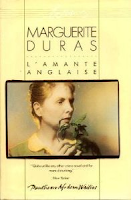
L'Amante Anglaise by Marguerite Duras

Do you know that murder doesn't happen all of a sudden? No. It creeps up slowly, like a tank. And then it stops. And there it is. A murder has just been committed in Vine. By Claire Lannes. There's no going back on it. Murder has descended on Viorne. It was hovering high in the air above, and it's there where Viorne is that it fell, in that house, in the kitchen of that house, and the one who did it--oh... the one who did it is Claire Lannes. She knew that the murder was there, and that only a thread kept it from falling on Viorne.

A policeman arrives at a bar in the French town of Viorne searching for information about a gruesome murder that has captivated the national press: a series of dismembered body parts, discovered on trains all around the country, which have been traced back to the rail junction at Viorne. As he discusses theories with the patrons there, a woman, Claire Lannes, comes up and confesses: she is the one who committed the murder. The victim is Marie-Therese, a deaf and mute woman who was Claire's cousin and housekeeper. L'Amante Anglaise tells this story as a series of interviews between an unnamed writer, who wants to write a book about Claire, and three figures: Robert, the bar owner; Pierre, Claire's husband; and Claire herself.

I think it's only when you read an author's second book that you really begin to understand who they are as a writer. L'Amante Anglaise shares with Duras' incredible book The Lover a sense that the real story is not being told, that it lies somewhere below the surface, inaccessible to both the reader and the characters themselves. Claire--whose section is by far the novel's most interesting--seems to have no idea why she killed her cousin. Murder, as she describes it, is a force that descends from outside, taking a place or a person as its vessel or host. And yet, she thinks that she might have answers for the writer, if only the writer would pose the right questions. But of course, she doesn't know the right questions any more than the writer does.

Truth, where it exists, is hidden; the novel's title, L'Amante Anglaise is written in French to retain the pun between la menthe anglaise, or English mint, Claire's favorite plant in her beloved garden, and l'amante en glaise, a "lover in sand" or "clay," which is her Freudian-slip pronunciation. Does Claire murder her cousin because of some inexpressible jealousy toward her dalliances with their friend Alfonso, or her sexual jealousy more broadly? What does it mean when the writer suggests that Claire has acted out not her own desire, but Pierre's, a desire to be free of both wife and housekeeper? Is Marie-Therese's still-missing head buried in the garden among the English mint?

I'm unsure what to think about L'Amante Anglaise. Its brief and oblique nature make it seem somehow incomplete--missing, like Marie-Therese, the identifying feature that will make it all make sense. Does L'Amante Anglaise conceal a buried secret, or does it only point toward the idea of secrets? Is there a truth at the heart of it, or only a gesture toward the possibility of truth? What's most interesting about it is, I think, the way it turns familiar stories of investigation and detective work on their head. The writer who seems so incisive with Robert and Pierre, working doggedly and shrewdly toward truth, seems suddenly stymied by Claire. So stymied, in fact, that the writer actually begins to lose interest in the conversation. It's a detective story that ends with a shrug.

Saturday, February 11, 2023

Giovanni's Room by James Baldwin

I remember that life in that room seemed to be occurring beneath the sea. Time flowed past indifferently above us; hours and days had no meaning. In the beginning, our life together held a joy and amazement which was newborn every day. Beneath the joy, of course, was anguish and beneath the amazement was fear; but they did not work themselves to the beginning until our high beginning was aloes on our tongues. By then anguish and ear had become the surface on which we slipped and slid, losing balance, dignity, and pride.

David is an American in Paris: not rich, perhaps, but of the kind of class where it's typical to take the Grand Tour before returning to the States to begin a real life. He has a girlfriend, Hella, who's off in Spain thinking things over, leaving David to his friends, which consist mostly of older gay libertines. David himself once had an affair with a boy, but it left him so confused and ashamed he cut his then-friend from his life, and though he insists to men like Jacques and Guillaume that he is straight, a young bartender named Giovanni catches his eye, and their instant attraction puts the lie to all of David's claims. David begins a passionate affair with tempestuous Giovanni, even moving into his room, a dirty closet on the edge of Paris. The room becomes the novel's controlling symbol, a space of intense intimacy, beset by chaos, cut off from the world.

When Giovanni's Room begins, the affair has already ended, and David is waiting in the south of France to hear about Giovanni's execution by guillotine. Until the novel's end, we don't know what it is Giovanni has done to deserve this fate, but we understand it has something to do with David's ultimate rejection and abandonment of him. Of course, Giovanni's room is not the world, and David has a life, and a girlfriend, then fiancee, outside of it. But it's only in Giovanni's room that David can truly be real, that "real world" outside is really a falsehood, whether David is able to admit it to himself or not. Giovanni's Room is a novel about repression, and the power the social world has even over our most inner lives. Yes, David betrays Giovanni--but what world is possible where David does not? Jacques, David's older gay friend, and even sinister bar-owner Guillaume, give a glimpse of David's future, one in which he's not able to accept his sexuality until it's soured and curdled inside of him.

It took me a long time to get to Giovanni's Room. I read Go Tell It On the Mountain, which I didn't like: too abstract, too melodramatic, too internal. I thought, well, he must be one of those guys that's an amazing essayist who doesn't write fiction very well. So I was surprised by how much I enjoyed Giovanni's Room. Baldwin's long, stacked sentences bring out a lyric beauty in David's devastation, and the characters, Giovanni especially, are lively and vivid. There's a slightly antiquated quality to it that reminds me of an author I can't quite identify. At times I thought it was Fitzgerald, and at other times Forster--not even because of the gay-love-across-class-lines plot that resembles that of Forster's own doomed Maurice.

To have published a book like Giovanni's Room in 1956 seems like an act of suicide, or madness. Perhaps we've come some way since then. But it's hard not to wonder, in 2023, how many Davids are out there, how many Giovannis, gay or perhaps trans women and men, whose lives are contained in their little rooms because there's no place for them.

Saturday, January 21, 2023

The Years by Annie Ernaux

The year 2000 was on the horizon. We could not believe our luck in being there to see it alive. What a shame, we thought, when someone died in the weeks before. There were rumors of a Y2K computer bug, a planetary malfunction, some kind of black hole portending the end of the world and a return to the savagery of instinct. The twentieth century closed behind us in a pitiless succession of end-of-millennium reviews. Everything was listed, classified, and assessed, from works of art and literature to wars and ideologies, as if the twenty-first century could only be entered with our memories wiped clean. It was a solemn and accusatory time (we had everything to answer for). It hung darkly overhead and removed personal memories of what for us had never been an entity called "the century" but only a slipping-by of years that stood out (or didn't) depending on the changes they had brought to our lives. In the coming century, parents, grandparents, and people we'd known in childhood would be dead for good.

The Nobel Prize Committee, in awarding its 2022 prize to French writer Annie Ernaux, described "the courage and clinical acuity with which she uncovers the roots, estrangements and collective restraints of personal memory." The Years is a book that highlights the tension between the "collective" and "personal" aspects of that sentence: it's a memoir, ostensibly, of Ernaux's life, but one in which the personal is subsumed in the collective. It begins in the post-war boom of France in the late 1940's and ends after the arrival of the new millennium and, shortly after, September 11th. It covers these seven-odd decades, vacillating between two modes. The first is a first person collective "we" that is a kind of memoir of an entire generation ("The speeches said we represented the future"). The second is an estranged third person linked to photos of Ernaux herself, minutely described and imagined ("The raked-back hair, drooping shoulders, and shapeless dress, in spite of her smile, indicate fatigue and the absence of a desire to please").

The effect is one of estrangement, estrangement from one's self, estrangement from the specific, and a flight toward notions of a collective experience. This experience, the collective experience of Ernaux's generation, is defined by political attitudes and rituals of consumption; Ernaux compiles lists of novels, magazines, television shows, films, cosmetics and consumables; these things have as much weight as the protests of 1968 or an increasing disillusionment toward Mitterand. History, such as it's defined, barely touches them; events in Algeria or Vietnam have no reality, or as little reality as anything else. And all of these things, once they become memory, are at risk of total loss: "Everything will be lost in a second," Ernaux writes at the memoir's beginning. As the memoir goes on, details pile up, but so does an increasing awareness of those details' ephemeral nature. What will be left, Ernaux wonders, when the person is gone, and their memory gone with them?

I think The Years might have been more effective for me if I had been French, and had a better idea of what the cultural touchstones of the memoir are. I have a passing familiarity with Charlie Hebdo and "ye-ye" music, but I don't know who Coluche is, or les Guignols. Still, I was fascinated by the general arc of social history The Years presents, beginning with the affluence of the post-war years, moving through the furor of the 1960's, into a late 20th century in which attitudes become soured and ripe for the kind of reactionary politics of Le Pen. The "we" of The Years acts as a reminder, at times, that one is never entirely apart from society's churning; it doesn't matter much whether the Ernaux of the photographs is taken in by Le Pen or not, if her generation is. I got the sense, reading The Years, of history as a kind of ocean that carries one along on its tides

Wednesday, November 30, 2022

The Scapegoat by Daphne du Maurier

This person who walked around wearing another's clothes, parading his features, colouring and manners, was guiltless, he was merely a covering, a facade, as remote from its original as a violin case from the instrument it protects. Emotion should have no part in this. I had never for one moment been so blind as to imagine that any show of warmth coming from these people was due to qualities of my own, springing suddenly to the surface and finding a response: they came alight for him and him only, however misplaced hte glow. What was happening, then, was that I wanted to preserve Jean de Gue from degradation. I could not bear to see him shamed. This man, who was not worth the saving, must be spared. Why? Because he looked like me?

John is an Englishman, a professor of French history, who longs for a life of human connection. He has no wife, no family or friends; he spends most of the time he's not teaching wandering through French towns and gazing wistfully at lighted windows there, yearning to be a part of what he passes. In Le Mans one day he encounters a shocking site: a man who looks exactly like himself. John's doppelganger, a Frenchman named Jean de Gue, draws him into a night of debauchery, and when John awakes from it he finds that de Gue has swapped all of their clothes and possessions. Well, what is he to do but to follow the address he finds on de Gue's effects, and take up residence with his family, pretending to be his own double?

The life John/Jean takes up is a troubled one: de Gue, it turns out, is a provincial Comte who owns a struggling glass foundry, which is managed by his envious brother, Paul. The Comte de Gue has been having an affair with Paul's wife, Renee, while his own wife Francoise suffers from a difficult pregnancy. His mother, Maman, is addicted to morphine, and his daughter Marie-Noel is obsessed with the idea of becoming a saint, and suffering for the satisfaction of God. In this pursuit she is tutored by the Comte's religious sister, Blanche, who has not spoken to him in many years. As John insinuates himself into the family, he begins to piece together the Comte de Gue's dark secrets, including his part in the murder of the foundry's former manager, who may or may not have collaborated during the Nazi occupation of France. Except they aren't secrets: everyone knows all about the Comte's past, it seems, though it isn't spoken about openly. John, in the role of the Comte, is the only one who doesn't know the truth about himself.

The elegant concept of The Scapegoat really seems like something only du Maurier could invent. There's no big secret here a la Rebecca, but John's inherent ignorance, and the impenetrability of his disguise, make for gripping reading. Like John, you long to find out the truth about the de Gue family. Why are they so resentful toward one another, so recriminating? It doesn't matter how scandalous the answer is, because the knowledge seems just beyond the limit of investigation: there's no one, and no way, to ask. But the interest of The Scapegoat lies in the characters as well as the premise, characters who, like in other du Maurier books, seem to have been lifted from the Gothic novels of a hundred years prior: bitter Blanche, imperious Maman, pious Marie-Noel. John, too, becomes drawn into their lives. What seems at first like a lark, a chance to live another man's life without consequences, without being touched, becomes a tangle, like a trap. John finds himself caring for the broken family, eager to fix what the Comte--by all accounts a selfish person--has led to ruin.

Rebecca is du Maurier's masterpiece, but I think The Scapegoat might be my new personal favorite. I really couldn't put it down. Like all good novels about doubling and imitation, the lines become quickly blurred. When John inserts himself into the Comte's life, looking and acting like the Comte, who's to say he is not the Comte? If Marie-Noel breaks her mother's porcelain figurine, what does it matter if she receives a replacement, rather than the original, mended? Is it possible to borrow a man's identity, but not his history? These are interesting questions the novel asks, that give it heft and weight, but they're almost beside the point when it's so gripping.

Saturday, August 6, 2022

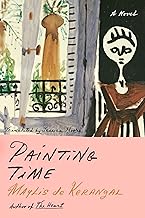
Painting Time by Maylis de Kerangal

She learns to see. Her eyes burn. Fried, worked like never before, open eighteen hours a day; an average that will soon include the sleepless nights spent slogging, and other night of partying. In the morning, her eyes blink incessantly as though she'd been plopped down in full sun, lashes vibrating, butterfly wings, but at sunset she feels them weakening, her left eye limps, it slips to the side like someone sinking onto a bank of fresh grass at the edge of the path. She rinses her lids with blueberry water, places frozen teabags on them, tries gels and eyewashes, but nothing eases the sensation of tired, dry eyes, rigid pupils, nothing can stop the formation of persistent dark circles under them--her face has been branded, the stigmata of this rite of passage, of metamorphosis. Because to see, under the glass roof of the studio on the rue de Metal, high on fumes from paint and solvents, muscles sore and forehead burning, doesn't just mean keeping your eyes open to the world--to see is to engage in a pure action, create an image on a sheet of paper, an image that resembles the one the eyes have created in the brain.

Paula Karst, a young woman from Paris, whose parents once though she was bound for art school, enrolls in a Belgian school for decorative painters. Decorative painting is not like painting-painting; Painting Time is not a novel about the creative process or the ineffable genius of painters. Decorative painting is a craft, a laborious process in which the painter tries to reproduce the look and texture of marble, wood, stone. If it is done right, the painter, far from having made a statement of self-expression, finds themselves erased in the work. To reproduce the world, to make a simulacrum of it, one must know it thoroughly, as when the brilliantly talented painter and Paula's lover Jonas takes her to the quarry where the valuable marble she must copy for her school assignment has been mined for many years. To duplicate it, Paula must follow exactly the methods outlined by her instructors (there is no creative license here), but also, she has to consider the long and fantastical history of the marble itself, laid by the passing of a great ocean and its plants, then laying hidden for millennia until broken apart by Renaissance-era merchants. This is what is meant by the title Painting Time.

Painting Time is split into three parts: first, Paula's experiences at the decorative painting school, where she lives with Jonas and comes to know her friend Kate. The second outlines Paula's initial career as a set designer for the historic Italian movie studio Cinecitta, and the third a job she takes on reproducing the famous Lascaux cave paintings. The middle part, the movie studio part, layers new and interesting questions over the first section: what does it mean to reproduce the fantasy world of movies, rather than something real? But this section is meandering, I thought, especially with de Kerangal's winding sentences, that routinely go on so long that you lose track of the grammar of the sentence's beginning, and a little saggy. It's the final section that really brings the novel together. The famous Lascaux caves are no longer open to the public, but Paula's project is the last in a series of replicas that are even more popular than the original. And yet Paula must copy them without having seen them. She immerses herself in the World War II-era story of the caves' discovery, in a way trying to collapse many layers of time--prehistoric, historic, present--but the imagination required makes one wonder about the distinction between artistic genius and the workmanlike labor of craft.

Paula has heterochromia and strabismus: her eyes are two different colors, and pointed in slightly different directions. This condition is part of her unique appeal to some, including Jonas and Kate, and a romantic liaison with a man who is provocatively only called "the charlatan." In a novel about a painter-painter you might see it as a symbol of genius, a unique way of looking at the world. It might be that, here, too, and an illustration of Paula's split self, discarding more bourgeois dreams of "artistic" painting for this different path. But thinking of that title again, it seems to me an image of eyes that cross time, that point toward the present and the past, which fold, but perhaps not completely, into a single image. One eye on the real and one eye on the reproduction, but with a blurred line between that complicates one's notions of what is real and what is fake.

Wednesday, July 27, 2022

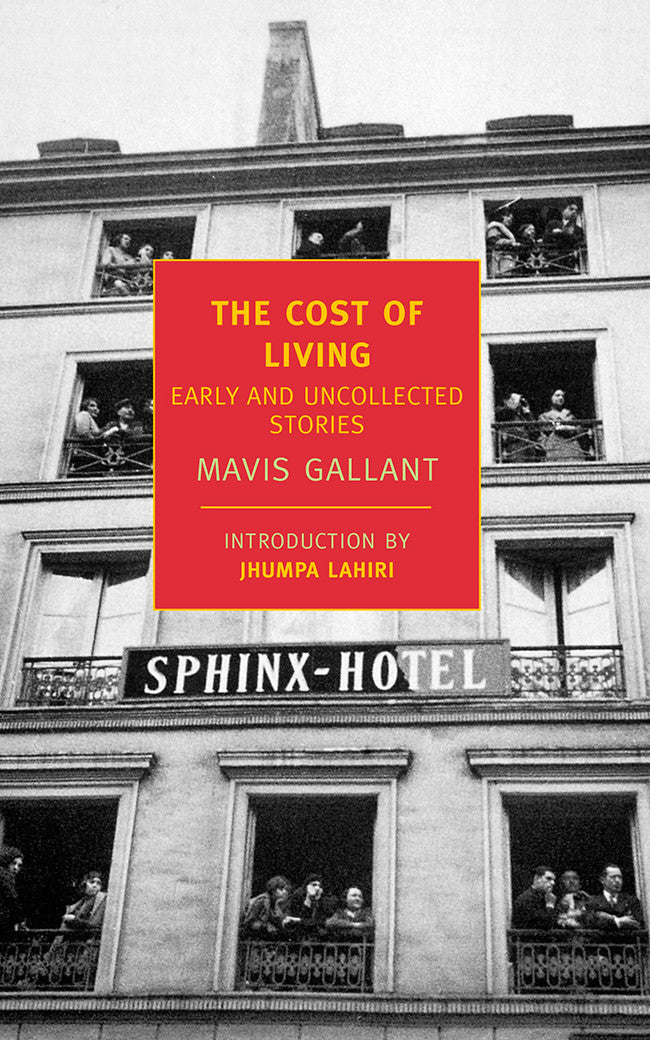
The Cost of Living by Mavis Gallant

Malcolm is convinced he will never have an idea about Bea until he understands her idea of herself. Of course Bea has an idea; what woman hasn't? In her mind's eye she is always advancing, she is walking between lanes of trees on a June day. She is small and slight in her dreams, as she is in life. She advances toward herself, as if half of her were a mirror. In the vision she carries Ruth, her prettiest baby, newly born, or a glass goblet, or a bunch of roses. Whatever she holds must be untouched, fresh, scarcely breathed on.

There's something nice about odds-and-sods collections like this one, which is that the hand of the author is totally absent. There's no thematic arrangement, no meddling in the order of the stories, nor do they capture a particular moment in the author's life: what you get in a collection like The Cost of Living is a snapshot of an author's career from beginning to finish. The collection opens with "Madeline's Birthday," which became, in 1951, Gallant's first published story. Madeline is a New York teenager abandoned by a selfish mother at the home of her sister in Connecticut, where she languishes alongside a German boarder named Paul and her aunt's little girl Allie. Paul wants Madeline to read over his English homework; Allie wants her to braid her hair. For her own part, Madeline is miserable, and dreams of getting away from the cloistered house, where she feels stifled and unwanted. It's not a very good story. Nothing really happens, the larger and deeper conflicts are only gestured at. A careful existence is constructed for the characters beyond the snapshot of the story, but it's hard to believe in that existence. You read "Madeline's Birthday" and think, "Is that it?"

But much of the things that make Gallant's fiction so beguiling are already there, in nascent form. Compare "Madeline's Birthday" to a later masterwork like "Malcolm and Bea" or "The Burgundy Weekend." Both are stories about marriages between people of varying degrees of social toxicity. Practical Malcolm has married Bea, maniacal and headstrong. In "The Burgundy Weekend," Lucie has married Jerome: clever, lazy, proud, flirting shamelessly with the young daughter of his old flame, who they are visiting in the French countryside. But the characters are remarkably rich, so rich, in fact, that the adjectives I've used to describe them hardly seem to capture who they are. Who they are, actually, is a mystery that keeps unfolding, and which may seem different the next time I read the story; not in the sense that they are underdeveloped or vague, but in the way that your initial impressions of real people never tend to be permanent.

What these stories do is have people collide. Some of them, like the married couples, have been colliding for years, sanding each other's edges until neither is fit for any other kind of society, but there are always outsiders, too, whose vantage points make it impossible for them to see inside the relationship. This is especially true in "The Burgundy Weekend," as Lucie's cousin Gilles--a rigid and professionally satisfied doctor who drops them off and picks them up in Burgundy--strains to see what Lucie sees in Jerome, unable to comprehend that Jerome's rudeness is, in Lucie's eyes, a victory for Jerome, who is often too withdrawn to bother. In the stories themselves, nothing much happens: Jerome doesn't sleep with Nadine; the old flame barely registers on the page; there are no murders or flat tires or moments that change everything. But unlike "Madeline's Birthday," you get the sense of whole lives coming to bear on single moments; they are scenes of great pressure in which nothing, in the end, bursts or breaks.

"Every marriage is about something," Malcolm thinks in "Malcom and Bea." "It must have a plot. Sometimes it has a puzzling or incoherent plot. If you saw it acted out, it would bore you. 'Turn it off,' you would say. 'No one I know lives that way.' It has a mood, a setting, a vocabulary, bone structure, a climate.'" Malcolm thinks his way into something true, but the original thought ("Every marriage is about something") is surely incorrect. I don't think you can properly say that any of Gallant's mature stories are about anything. Themes lurk under the surface, including the social inferiority complex of Canadians abroad (one fun detail in "The Burgundy Weekend" is that Lucie is a firm believer in the coming sovereignty of a free Quebec) but the stories aren't really about these things, partially because none of the characters, like most people, can barely agree on what matters at any given moment. This distinguishes Gallant's stories from Alice Munro, her fellow Canadian. While Munro's stories, like Gallant's, are small moments that reveal entire human histories, things happen in them, they are undeniably about something.

All of this makes Gallant's later work sort of spiky and unsatisfying. They resist the kind of pleasing roundness, the sense of a whole story told in short order, for which we often look to short stories. But The Cost of Living is interesting because you can see this quality of Gallant's grow and develop. Halfway between "Madeline's Birthday" and "The Burgundy Weekend" is a story like "Going Ashore," about a young girl on a Mediterranean cruise who yearns to see the fascinating new world she's being offered, but who must deal with her depressive mother, who only booked their passage to meet men. It's "Going Ashore" that might be the most pleasing story in the collection, because it features Gallant at a point where her talent has matured but the story has remained more conventional. By contrast, it's hard to figure out what to do with a story like "The Rejection," a strange, strange conversation between a father and his six year old (who talks like an adult), who decide they don't like each other and don't want to live together. Halfway through the conversation, which takes place in car, we're told that the girl has made a pet of some unidentified reptile, which is sitting at her feet. The story, actually, reminds me of the protagonist of the story "The Cost of Living," who is forced to listen to her actor roommates practicing Beckett plays on the other side of her bedroom wall. "The Rejection" is like Beckett, heard through a wall.

I don't think the stories collected here are as strong as the ones in the actual collections of Gallant's I've read. These kinds of "early and uncollected" compilations rarely are. A few of the later stories probably stand with her best, but a lot of them seem slight, like experiments that got halted halfway through for unsatisfactory results. But I loved getting to see the way one of the most original short fiction writers of the 20th century developed and grew over the course of her career.

Monday, July 11, 2022

Explosion in a Cathedral by Alejandro Carpentier

Esteban suddenly stopped, stirred to the very depths, in front of the "Explosion in a Cathedral" by the anonymous Neapolitan master. In it were prefigured, so to speak, so many of the events he had experienced that he felt bewildered by the multiplicity of interpretations to which this prophetic, anti-plastic, un-painterly canvas, brought to the house by some mysterious chance, lent itself. If, in accordance with the doctrines he had once been taught, the cathedral was a symbol--the ark and the tabernacle--for his own being, then an explosion had certainly occurred there, which, although tardy and slow, had destroyed altars, images, and objects of veneration. If the cathedral was the Age, then a formidable explosion had indeed overthrown its most solid walls, and perhaps buried the very men who had built the infernal machine beneath an avalanche of debris. If the cathedral was the Church, then Esteban noticed a row of sturdy pillars remained intact, opposite those which were shattering and falling in this apocalyptic painting, as if to prophesy resilience, endurance and a reconstruction, after the days of destruction and of stars foretelling disasters had passed.

Esteban and Sofia are cousins, living in the great Havana hacienda Sofia's father left them. Essentially, they are orphans, passing their time playing games among the clutter of the dead man's life, until a French businessman arrives looking for the dead man. This man, Victor Hugues, is drawn into the children's games, their costumes and science experiments and adventure books, and for a time, he lives with them, until his warehouse in Haiti is burned. From there he returns to France, embarking upon a political career under the aegis of the Jacobins of the French Revolution, who task him with bringing the revolution to the Americas. Hugues captures the island of Guadeloupe from the British, turning it into a center of wealthy privateers, but he brings with him the first guillotine in the New World. Esteban, then Sofia, are caught up in the tumult of Hugues' revolution, its idealism, its bloodiness, and its ultimate failure.

Hugues, the central figure of Carpentiers' historical novel, was a real figure, a kind of Robespierre of the Caribbean. Guadeloupe, Surinam, French Guiana, and many other places still bear the marks of his regime. Historical novels about the French Revolution are not so hard to come by, but Explosion in a Cathedral highlights a theater of the world no less transformed than Europe, one upon which many of the same moral question and struggles played out. I was struck how both Esteban and Sofia, one after the other, become disenchanted with Hugues, one after the other, and for different reasons. The life of Esteban, arguably the book's main character, is intricately bound up with Hugues': Esteban travels to France and works for the Jacobins to spread the revolution in the Basque country before being sent to Hugues' Guadeloupe, where he's later shunted off into the service of one of the tyrant's famous privateers. Along the way he becomes disillusioned with Hugues' bloody methods. In one memorable passage, Esteban observes how Hugues condemns so many to the guillotine that only a small fraction can be killed in a night, and the rest must be summarily dispatched by pistol.

When Esteban returns, he's frustrated to find that Sofia and her brother Carlos remain enamored with the Revolution, believing wholeheartedly in its potential to transform the world, not having seen any of the blood or the back-dealing among its various Girondins and Jacobins and Thermidoreans. When Sofia's husband dies, she rushes off to Guiana to be with Hugues--for whom she has hidden a sexual ardor for years--but finds not even the bloodthirsty ideologue, but an apparatchik who doesn't even bat an eye when the Directory under an ascendant Napoleon reinstitutes slavery in France's colonies. Hugues might be the Revolution's quintessential man: he transforms himself entirely, as the world is transformed, but his transformation is from a man of cleverness and imagination to one without any scruple at all. Hugues survives the many purges and exiles of his peers because he is man of action, disinterested in the larger principles for which such action is performed. "A revolution is done," he insists, not discussed.

I thought this book was incredibly rich. I was impressed by the wonderfully detailed depictions of Havana and Guadeloupe and Cayenne, and the many other places of the Caribbean that were touched by the Revolution. (In his afterword, Carpentier claims to be one of the only people in the world to visit nearly all of the islands in the Antilles, though clearly much research was involved in making the particular colonial iterations of these places come alive.) He's especially interested in the way these places smelled, their mixtures of tar and tobacco and salted fish and leather and all sorts of other things. And Esteban's long meditation upon the strange life and environments of the Caribbean Sea seems to have echoes of the magical realism for which, in earlier works, Carpentier was known.

Explosion in a Cathedral asks: Are men like Hugues necessary for the world to grow? Without Hugues, there is no end to slavery in Guadeloupe, but then again, it's Hugues who brings it back, too. I found myself thinking about Sembene Ousmane's God Bits of Wood, another book that wonders if, for the world to change, it requires men that would otherwise be intolerable, because revolution requires intolerable things. Ousmane's Bakayoko is a man who is all ideals, and nothing else, a far cry from Hugues' man of action. But both books are meditations on the price we place on change.

Since Carpentier is Cuban, my "countries read" list is up to 66!

Monday, June 13, 2022

The Lover by Marguerite Duras

In the books I've written about my childhood I can't remember, suddenly, what I left out, what I said. I think I wrote about our love for our mother, but I don't know if I wrote about how we hated her too, or about or love for one another, and our terrible hatred too, in that common family history of ruin and death which was ours whatever happened, in love or in hate, and which I still can't understand however hard I try, which is still beyond my reach, hidden in teh very depths of my flesh, blind as a newborn child. It's the area on whose brink silence begins. What happens there is silence, the slow travail of my whole life. I'm still there, watching those possessed children, as far away from the mystery now as I was then. I've never written, thought I thought I wrote, never loved, though I thought I loved, never done anything but wait outside the closed door.

A fifteen year old French girl, traveling by ferry from her home in Sadec, Vietnam, to her boarding school in Saigon, meets a Chinese man being driven in a black town car. She is wearing a man's fedora and gold high-heeled shoes. Instead of returning to the school, she goes with him to his home, where she has sex for the first time. The affair they have hastens the mental and physical deterioration of her recently widowed mother, and somewhere in China, in the city of Cholon, the Chinese man's father isn't too happy, either. Their relationship, both troublesome and doomed, emerges from a deep sadness they share, and the adult writer--a narrator, perhaps, but one that seems very close to the real life Duras, writing in her 70's--imagines the whole of her troubled childhood balanced on the pinhead of these moments.

I thought The Lover was a remarkable book. Remarkable in one sense, because you couldn't write it today. I know hack writers and comedians say stuff like that all the time, because they can't handle any kind social progress, but in this case it strikes me as being true. You couldn't write about a relationship between a 27-year old man and a 15-year old girl without making certain ethical prefaces, and you certainly couldn't explore the extent to which she desired the relationship, or how it develops in tandem with a desire for self-annihilation. Nor could you see him, as Duras does, as inherently pathetic, as squashed and bruised by a suffocating family life as the teenager he seduces. It has the benefit of likely being true, and being published after Duras was a known quantity (she was nominated for an Oscar!) and the things that make such a book unlikely are worth the price, in my opinion, but still, such a book seems to speak from a different era.

But remarkable, more importantly, for the quality of the writing, which possesses a superficial simplicity that's quickly complicated by a deeper intricacy that unfolds as the novel unfolds. Duras writes as one remembering a story from long ago, one in which what remains is not the narrative but the images. She lingers on these images--the man's hat, the gold high-heeled shoes, the black town car--layered over one another like transparencies, still moments that come forward and recede, but don't really move. At times I felt like the titular "lover" is really a distraction, only a moment to look through and see what Duras is really interested in, the tortured relationship she had with her mother and two brothers after their father's death, stranded in a strange and foreign country.

In her brothers, Duras describes a Manichaean division of good and evil. You know, like Goofus and Gallant, but with psychic and violent stakes. Her elder brother is a gambler, an amoral thief and destroyer. She describes him as a murderer, though it wasn't ever clear to me if she meant this in a literal or metaphorical sense. She blames the death of her younger brother, the pure and guileless one, on this older brother, even many years after they went their separate ways in life. It's this relationship, really, which hovers just beyond the scene of The Lover, and somehow the relationship between the young Marguerite and the Chinese millionaire's son is a way of looking past it, or not looking at it, or looking at it obliquely. Her younger brother's death, the image held till the end of the book, like something kept at the edge of the mind, gives Duras the chance to write some of the book's finest prose:

It was a mistake, and that momentary error filled the universe. The outrage was on the scale of God. My younger brother was immortal and they hadn't noticed. Immortality had been concealed in my brother's body when he was alive, and we hadn't noticed that it dwelt there. Now my brother's body was dead, and immortality with it. And the world went on without that visited body, and without its visitation. It was a complete mistake. And the error, the outrage, filled the whole universe.

There's a wonderful universality to that, the feeling of grief as an immortality being stolen from the world. One of those feelings that good writing reveals to exist, when you hadn't realized it existed before. But it has a specificity, too, a sense of truth, that reveals the writer behind the images, and which seems like it can hardly be invented. The Lover sits in that uncomfortable space, perhaps, between novel and memoir, and it's not like anything else I've ever read.

Tuesday, May 10, 2022

The Diary of a Country Priest by George Bernanos

Yes, indeed, how foolish! I hoped that this diary might help me concentrate my thoughts, which will go wandering on the few occasions I have some chance to think a little. I had thought it might become a kind of communion between God and myself, an extension of prayer, a way of easing the difficulties of verbal expression which always seem insurmountable to me, due no doubt to the twinges of pain in my inside. Instead I have been made to realize what a huge inordinate part of my life is taken up with the hundred and one little daily worries which at times I used to think I had shaken off for good. Of course Our Lord takes His share of all our troubles, even the paltriest, and scorns nothing. But why record in black and white matters which should be dismissed as fast as they happen? The worst of it is I find in these outpourings such solace that this alone should suffice to put me on my guard. As I sit here scribbling in the lamplight, pages no one will ever read, I get the feeling of an invisible presence which surely could not be God--rather a friend made in my image, although distinct from me, a separate entity.

A young priest is assigned to a small village in the north of France whose residents he describes as "spiritually bored." His servant is a drunkard and thief, and the smartest teen in his catechism class tries scandalously to flirt with him in order to stir up trouble. He dedicates himself to prying into the spiritual life of the town's local nobility, the Comte, and the Comte's wife and daughter, both of whom have foresworn a spiritual life because of the immense suffering they carry within them: le Comtesse, because of the loss of her infant son many years ago, and the Comtesse's daughter because of the alienation of her mother's affections. The priest is plagued by feelings of inadequacy, as well as intensifying stomach pains, which the townsfolk attribute to a drinking problem, though they may signify a much graver physical--and spiritual--crisis.

I'd bet any amount of money that Marilynne Robinson has read The Diary of a Country Priest. Though the Reverend Ames from Gilead is old, not young, he suffers from many of the same spiritual problems: a belief in his own insufficiency when compared with God's aims, and a compulsion toward spiritual intervention that seems directed by God. And of course there's the whole "country" part of it. But whereas Ames is, in some respect, nagged by the suspicion that the love and esteem afforded him are unjustified, Bernanos' Cure is truly despised. The Comte hates his meddling, the Comte's daughter his rectitude; the people of the village believe he's a lush; Serephita mocks his probity with her sexual teasing, and spreads rumors behind his back; his superiors are suspicious of his unwillingness to get along. Once, he has a bit of spiritual success, convincing the Comtesse to embrace God's love for the first time since her son's death, but she dies hours later, taking any account of his aid to the grave.

The language of The Diary of a Country Priest is elevated, Gothic, at times even hyperbolic; the spiritual crises are as severe and intensely wrought as the stomach pains. The whole thing is one very very long dark night of the soul. And truth be told, though I found the priest himself, and the hate he inspires, compelling, half the time I didn't know what he or anyone else was talking about. The book is all disputations--priest and mentor, priest and superior, priest and doctor, priest and soldier--but the disputations are so crowded with metaphorical language it left me unsure about what some of the ideological or theological stakes of the book are. I do know that the book is interested in questions like, "Is there a spiritual honor in being poor?" and, "Is suicide truly unforgiveable?" but I am much less certain how the priest, much less Bernanos, would answer them.

Saturday, April 30, 2022

One of Ours by Willa Cather

When Ernest left, Claude walked as far as the Yoeders' place with him, and came back across the snow-drifted fields, under the frosty brilliance of the winter stars. As he looked up at them, he felt more than ever that they must have something to do with the fate of nations, and with the incomprehensible things that were happening in the world. In the ordered universe there must be some mind that read the riddle of this one unhappy planet, that knew what was forming in the dark eclipse of this hour. A question hung in the air; over all this quiet land about him, over him, over his mother, even. He was afraid for his country, as he had been that night on the State House steps in Denver, when this war had been undreamed of, hidden in the womb of time.

Claude Wheeler is a desperate man. He takes over his father's Nebraska farm, but day-to-day existence seems intolerable to him. He's an idealist, but no ideal seems worth his devotion; he wants badly to admire someone, but the grand scope of the Nebraska plains no longer seems to admit any real greatness. He thinks momentarily that he has found a purpose in life by marrying his sweetheart Enid, but her kind of idealism doesn't match his own. She leaves him at home while she goes to temperance marches; eventually, after several bitter disputes, she leaves him to go take care of her missionary sister in China, an environment for which she has been training all her life. Only when the United States enters World War I does Claude find a stage commensurate with the moral and aesthetic greatness he desires, and he becomes a lieutenant on the French front.

This is the, what--fifth?--book of Cather's I've read. For the first time I think I'm coming to understand that Cather is a deeply conservative writer, perhaps the greatest conservative writer that the United States has ever produced. In The Death of the Archbishop, it's the bolstering of the national mythmaking of the frontier--for example, the whitewashing of an anti-indigenous marauder like Kit Carson. In A Lost Lady, it's the inherently conservative sense of a despoiled golden age, and the diminished state of modern life. Those elements are here, too, but alongside the glorification of war as a way of self-actualization:

The sound of the guns had from the first been pleasant to him, had given him a feeling of confidence and safety; tonight he knew why. What they said was, that men could still die for an idea; and would burn all they had made to keep their dreams. He knew the future of the world was safe; the careful planners would never be able to put it into a strait-jacket,--cunning and prudence would never have it to themselves.

It's almost stunning to read the phrase "men could still die for an idea" and realize it's meant to be a good thing! I suspect that World War II supplanted World War I in our public memory, and allowed the notion that World War I was largely a bloody and pointless waste to find purchase. But of course Cather is writing in 1922, well before World War II and when World War I was simply known as "The Great War," and so the scale of the war becomes a magnet for those conservative ideals. Claude, living after the age of the great frontier, inherits a West full of bankers and clerks; the European front becomes for him a new frontier, on which he can becomes his best self, a leader of men and a self-sacrificer. When--spoiler alert--Claude is killed in the trenches at the novel's end, while leading his men in a desperate and doomed hold on an important position, we are asked to read it not as a waste of a life that might have blossomed in other ways, but as the proper culmination of a life that has finally found a reason for being.

All this is to say: the ethics of this book are kind of fucked up? And maybe the ethics all of Cather's books? But she's such a great writer that it's easy to forget all of that, and the prose so pointedly blonde that when she turns out one of her evocative phrases ("this war had been undreamed of, hidden in the womb of time") it's enough to take your breath away. One of Ours proves that Cather is as good at describing the French countryside as she is the Nebraska plains. One of the most subtly powerful moments comes when the Nebraska soldiers, riding in a train across the north of France, spot the familiar cottonwoods that dot the riversides of their farmland homes, which allows them both to see a new value in those things they have taken for granted, and to cement a kind of kinship with the foreign world they have been enlisted, like a noble dream, to protect.

Wednesday, March 9, 2022

The Wondrous and Tragic Life of Ivan and Ivana by Maryse Conde

She looked Ivan straight in the eye. All the love and desire they had for each other was revealed in this look. They relived their entire life like those who have come close to death might. Ivan and Ivana therefore relived every moment from when they emerged from Simone's womb on a warm, fragrant September night right up to this gray frosty  autumn morning. Some memories lingered more than others. When they had begun to stand on their own two feet Simone would measure them against one of the house walls. For a long time they stayed the same height as each other. Then one year Ivan began to grow and within a few months he had grown taller than his sister. At the time Ivana admired in bemusement his body that stretched out beside her. What a magnificent package of muscles.

Everything goes well for Ivana Nemele. She is hard working, charming, and intelligent, well-loved by everyone, whether in her birthplace of Guadeloupe, or in Mali, where she is sent to live with her father, or in France where she eventually settles, joining the police academy. But for her twin brother Ivan, the world is not so kind: a series of stultifying jobs and run-ins with various authorities leave him marginalized and defeated. Whereas Ivana grows up to have a gentle faith in the world and those around her, Ivan becomes radicalized, first by his socialist teacher in Guadeloupe, then a radical Muslim sect in Mali. His involvement in a local militia is what pushes both him and his sister to France, where he moves farther and farther down the ranks of society, and deeper and deeper into the world of radical Islamic terrorism, toward an act of stunning violence that will pit him irrevocably against his sister.

The Wondrous and Tragic Life of Ivan and Ivana is what you might call a yarn. It skips from the Caribbean to Africa to Europe at a blistering pace, collecting and casting off minor characters in the space of paragraphs, dragging Ivan from humiliation to humiliation and catastrophe to catastrophe. How is that Ivan's experience in the world is so horrible, and Ivana's so good? Ivan and Ivana is a kind of fictional twin study, examining how social differences emerge under identical conditions. What leads one person to become radicalized, and another to join the police academy? One answer, given the precipitating conditions, must be masculinity: degrading physical labor, toxic ideas about manhood, homosexual panic, these are all part of Ivan's story. But Ivan and Ivana seems to me to suggest that much the answer is pure chance, that the geopolitical world is large and chaotic, and that it breeds unintended consequences in people, especially those at the lowest social rungs.

Through it all, Ivan and Ivana remain close, too close: they burn with a physical and romantic desire for each other. Practical Ivana sees the need to date and marry, and pushes Ivan to do the same, believing it will give him social stability, but Ivan is so caught up with his admiration and lust for Ivana that he has no eyes for anyone else. His increasing social alienation from his sister is a cycle of positive reinforcement: as he grows farther from her, he becomes more bitter, leading him into the arms of the radical imam who tells him he must have admiration only for God. Weird as it is, Ivan and Ivana's attachment works as a representation of the ways in which our most intense and treasured attachments can be undone by insidious social forces. At the end of the novel--spoiler alert--Conde makes this painfully, literally clear, when Ivana becomes the first victim of Ivan's bloody Bataclan-style shooting rampage.

My project this month is to fill out the ranks of the countries from which I have never read a book, so imagine my dismay when I discovered that Guadeloupe is not an independent nation but an overseas department of France. ("A French overseas department!" one of Ivan's associates laughs--"what is that?") No doubt the diminishment of Guadeloupean national identity--Guadeloupeans' subordination to France and their alienation from their historical and cultural kinsmen in Africa--are part of Ivan's story. So I declare this book read according to the spirit of the project, if not the letter.

Wednesday, February 23, 2022

On Lighthouses by Jazmina Barrera

Almost all general histories of the lighthouse begin with Alexandria, or before--from the times of the beacons of the Celts--passing through the Tower of Hercules and the earliest medieval lighthouses in France, England, Italy, Spain, and China to the proliferation of lighthouses brought about by Fresnel in nineteenth-century France, and then the most modern ones of the twentieth century. In a few years, this history might include references to the last lighthouses, when GPS and computers have put an end to the need for them. I wonder if one day they will all be decommissioned, and if they will then return to being temples of fire dedicated to the sea, fetishes of the superstitious and seekers of esoteric knowledge, who will keep alive the legends of shipwrecks, lighthouse keepers, and the ghosts that surround them. Or if they will be (as seems their destiny) turned into hotels, museums, relics, for the amusement of millionaires, retired folk, archaeologists, historians, and the curious. Divested of their function, they are collectible objects. They now also have that attractive quality of ruins and decay. For melancholics, they are all the more beautiful.

When will the last boat arrive safely to port thanks to the beams of a lighthouse? Who will be the last lighthouse keeper in the world? Or could it be that the relationship between humans and the sea is so primordial that there will always be someone to switch on--using a button or some other future technology--a light for ships in distress or fishermen? Or perhaps they will shine out as temples or memorials to the thousands of people who lie at the bottom of the sea.

What does it mean to "collect" lighthouses? "Obsession," Mexican writer Jazmina Barrera writes, "is a form of mental collection." Traveling around to see lighthouses, and add them to one's mental collection, is "an attempt to satisfy the vain desire to possess with an immaterial, intangible form of possession, not unlike what one might feel toward a loved one." For Barrera, the attractions of lighthouses are many: they are stolid, impregnable, unchanging when compared with the changeable sea; they represent a kind of immutability of emotion or identity that is, for an anxious or adrift person, something to aspire to. Visiting the Blackwell Light on Manhattan's Roosevelt Island, Barrera imagines that she is "slowly transforming into a sealed tower." "I feel so sane," she writes, "that I must be losing my sanity."

On Lighthouses is arranged as a series of vignettes, each titled for a different lighthouse Barrera has visited: Yaquina Light in Oregon, Tapia Lighthouse in Spain, Goury Lighthouse in Normandy, Jeffrey's Hook--otherwise known as the Little Red Lighthouse--and Blackwell Light in Manhattan, Montauk Point at the end of Long Island. Each vignette mixes memoir, history, literature, and reflection in a way that reminded me of Helen Macdonald's H is for Hawk, though that book has the careful organization of an academic, and of someone who's come through the existential crisis explored in the book with a kind of resolution. On Lighthouses, by contrast, offers little change, much less resolution: whatever it is that Barrera grapples with, the limits are endemic to her methods--she writes eloquently, for example, about coming to terms with the many lighthouses she'll never "collect."

This book struck a chord with me because I'm a lighthouse-collector, too. I'm writing this from Ocracoke Island in North Carolina's Outer Banks, a short bike ride from a 200-year old lighthouse, a squat brick tower painted bright white, that is the second oldest in operation in the country. When I drive back to New York later this week, several other lighthouses will mark the stations of the journey: the barber-pole light at Cape Hatteras, the country's tallest, the striped light on Bodie Island, the distant tip of Cape Henry across Chesapeake Bay. Barrera's exploration of why she travels to these lighthouses seems right to me: they are discrete and countable, but inexhaustible; their verticality and commanding presence makes them visibly striking, even comforting; and their age makes one feel connected to history, to others. In reading about the New York-area lights, I felt the comforting presence of a fellow traveler, though what Barrera writes about the isolation of lighthouses, and the separation from the world one achieves by identification with them, struck me, too. (I can only assume that Barrera has yet to visit the lighthouses of the Outer Banks, and that once she makes the road trip a second volume is forthcoming.)

"When I visit lighthouses," Barrera writes, "when I read or write about lighthouses, I leave myself behind." This hardly seems true; it isn't true, only an expression of an attempted self-negation. But it's also true, I think, in the sense that the lighthouses, as with many places of great historical importance, invite us to enter into another understanding of time and place, one less shackled by the here and now. It leads Barrera to communion with Robert Louis Stevenson, whose grandfather built the first lighthouses along the dangerous Scottish coast, to Poe, Meville, Verne, and obviously Woolf, and to the lives of the many keepers who sacrificed their selves and sanity to protect the coasts. Even to the first lighthouse-builders, who kept towers of fire to propitiate the gods. As technology progresses and the need for lighthouses diminish, these layers of history become ever more important. Lighthouses become less utilitarian but more meaningful, landmarks on a geography of time and spirit.