Showing posts with label Marguerite Duras. Show all posts

Saturday, February 7, 2026

The War by Marguerite Duras

I couldn't stop my self--I started to run downstairs, to escape into the street. Beauchamp and D. were supporting him under the arms. They'd stopped on the first-floor landing. He was looking up.

I can't remember exactly what happened. He must have looked at me and recognized me and smiled. I shrieked no, that I didn't want to see. I started to run again, up the stairs this time. I was shrieking, I remember that. The war emerged in my shrieks. Six years without uttering a cry. I found myself in some neighbors' apartment. They forced me to drink some rum, they poured it into my mouth. Into the shrieks.

The first section of The War, Marguerite Duras' collection of memoir pieces about her World War II experiences, depicts the author in the war's waning days, waiting to hear news of her husband, who had been captured by the Nazis and taken to Bergen-Belsen. News is difficult to come by; it's all private whispers and hearsay. In her mind, he is already dead; and the death follows her around like another husband, always with her, even as it is not yet known. Miraculously, he's discovered alive by her friends in the Resistance, but in a deeply weakened state. By the time he makes it back to Paris, he's too weak to even eat--many returnees die, we're told, because their shriveled stomachs burst as soon as something solid is put into them. It's no happy homecoming, but something out of a horror movie: "The war emerged in my shrieks." What follows is a long and arduous process of getting him back to strength. At the end of it, when he's well enough, Duras tells him--and us--that she is, as she has always intended, divorcing him to marry her fellow Resistance fighter D. (presumably, "Duras").

What's funny about The War, which seems to have been cobbled together from several disparate pieces, is that it really isn't interested in the war's progression, but by its end. The war only becomes real, and most horrible, for Duras, when its most ravaged victims, like her husband, begin to return. The other two pieces deal more directly with Duras' experiences in the resistance, but they, too, take place toward the war's end, when Germany is already losing its hold on its possessions in Europe, and this gives the pieces a kind of bitter irrelevancy. One tells about an agent of the Gestapo with romantic designs on Duras; she goes out with him for months as a prelude to identifying him to the Resistance to be killed. The third is about literal torture: the bloody beating of a man expected of collaboration with the Nazis. There's a black humor to the single question he keeps refusing to answer: What is the color of the ID that let you into the Nazi administrative building? Finally, after beating him so badly he's likely to die, he admits that it was green--Gestapo green. Both of these figures, marked for death by the Resistance, have a kind of innocence and naivete that makes them strangely sympathetic, and the fact that the war is in both cases practically over makes their token stubbornness seem mean, vain, and sad.

Boy, Duras could write. The first section, about her husband's return, is some of the most effective and chilling writing I've ever read about World War II--which is maybe the most written-about event in all of world history, you know? I enjoyed all three parts, which I sense were never really intended to be grouped together when they were written, but it's that first section--the war emerging with the shrieks, the rum being poured into the shrieks--that I think will stay with me.

Thursday, February 6, 2025

Destroy, She Said by Marguerite Duras

"Total destruction will come first through Alissa," Stein says. "Don't you agree?"

"Yes. And do you agree she isn't altogether safe?"

"Yes," Stein says. "Alissa isn't altogether safe."

A man, whose name we will learn is Max Thor, spends all his time at a luxurious resort staring at a woman, whose name we will learn is Elisabeth Alione. Another man, Stein, makes Thor's acquaintance. When Thor's much younger wife, Alissa, arrives, the three of them--Thor, Stein, and Alissa--begin to attach themselves to Elisabeth. What do they want with her? Is it sexual? Stein becomes obsessed, in turn, with Alissa, and is frequently found fondling her, while Thor happily looks on. The three of them try to beckon Alione into the mysterious forest at the edge of the resort, of which she is quite afraid. Do they mean to rape her there? Or is the forest only meaningful for its symbolism, its wildness, and the way it sits on the other side of civilization's clear boundary? When Alissa says, simply, "Destroy," we know she means Elisabeth. But whether she means this quite literally, or, perhaps, whether she means she is out to destroy Elisabeth's petit bourgeois sense of herself, is not quite clear.

Destroy, She Said is a very cryptic book. It was too cryptic for me. It's hard to believe that this is the same writer who could produce such a funny, satirical novel as The Sea Wall, which must have represented a much different early career path. Destroy, She Said also seems less like a novel and more like a treatment for the film version that Duras herself directed; appended to the novel is a long interview with French director Jacques Rivette about both novel and film. Perhaps in the film, the crypticness of it works alongside a more cinematic kind of mood; where the sound of the unseen tennis balls caroming off of the courts works more effectively than the peripatetic attentions of the main characters upon the tennis players. 

So, I don't know about this one. With that said, you often here--and I have often said--that writers today are too monopolized by film, and that much of what is dead in modern prose comes from writers trying to write "scenes" of film upon the page. What Duras, who was also a very acclaimed filmmaker, does here, and perhaps elsewhere in her body of work, is to provide a model for a synthesis between film and literature that is much more successful. Perhaps--I'm spitballing here, not having seen the movie--the surface qualities of a film make it rather suited to evoking the mysteriousness of other people and their intentions; the novel certainly seems to put up a kind of image or scene as a barrier to prevent real psychological investigation.

We never really know what it is that the trio are up to with Elisabeth, but what comes through quite clearly is their strangeness, their unspoken abandonment of bourgeois morals. There's a really interesting scene where Elisabeth's husband shows up and meets them, and only halfway through the meal stops and realizes he's the only one eating. The rest are alien, as if in no need of nourishment, and we see that their attempts to sway Elisabeth to their side, whatever that might mean, have been successful. What also comes through clearly is the sense of some kind of revolution or violation; Alissa especially picks and borrows from revolutionary language. Does destruction promise release and renewal? Or is it only destruction?

Monday, March 11, 2024

The Sea Wall by Marguerite Duras

The dikes built by Ma in the plain, her "barriers against the Ocean," the whole thing was either a huge misfortune or a huge joke, depending upon the way you looked at it. It was a huge joke and a huge misfortune. It was terrible and it was screamingly funny. It depended on which side you took: the side of the Ocean which had knocked down everything, every stick and stone of the sea wall, at one blow, one single blow; the side of the crabs, which had made sieves of them; or, on the contrary, the side of the people who had taken six months to build that sea wall, in total forgetfulness of the certain damage that would be wrought by the crabs and the Ocean.

The title sea wall of The Sea Wall is, at the beginning of the novel, already no more. Constructed at great expense by the Frenchwoman known only as "Ma" on her concession land along the coast of Vietnam, it has crumbled away and the saltwater tide has ruined all hope of a successful crop. The misfortune defines Ma's life, and it comes to define the lives of her two children: Joseph, a brash young man whose passions are his jalopy and hunting dangerous panthers, and Suzanne, whose beauty and resentment both are incandescent. Neither Joseph nor Suzanne have ever been to France, where Ma was born; they are second-generation Colonials who must live in universe of ruin that Ma has created for herself, and they occupy a kind of degenerate middle ground between the "Natives" in the jungle and the pampered elite who live in the colony's principal city.

It's one of these, Monsieur Jo, who happens upon Suzanne at a canteen one day and falls madly in love with her. Monsieur Jo is a pathetic figure, both ugly and oblivious, who is utterly wrecked against Suzanne's beauty. He visits everyday, offering his attention as well as lavish gifts, enduring the condescension of all the members of the house, who accurately assess that he will endure all the resentment they bear against their lot simply to be near Suzanne. "He was not a person," Suzanne remarks about him inwardly, "he was only a misfortune." Monsieur Jo offers Suzanne a diamond ring if she'll go away with him and then, when she refuses, gives it to her anyway; Ma's farcical attempts to sell the ring in the colonial capital are the driving force of the book's middle section. Even when she does manage to sell it, the money goes to pay the debt on the construction of the sea walls. The money flows out like the tide, and leaves the family no better off; even their fortunes are misfortunes.

The Sea Wall is just the kind of book I really love: mean-spirited, funny, and deeply sad. It is, in Duras' words, "terrible" and "screamingly funny." I didn't know that Duras could be funny. The other two books of hers I've read, The Lover and L'Amante Anglais, are also quite sad, but they are not funny. Ma is a great comic creation, emblematic of the bourgeois failures of a certain kind of colonial, for whom the promise of new land is a kind of cruel grift. Whether it reflects Duras' own upbringing in French Indochina I have no idea. One of the best sections of the book comes when Ma is allowed to speak for herself, in a long letter written to the cadastral agents who enforce the mortgage on her concession:

And for the savings I put aside every day for fifteen years of my life, of my youth, what did you give me? A desert of salt and water. And you let me give you my money. That money I religiously carried to you one morning, seven years ago, in an envelope. It was all I had. I gave you all I had that morning, all, as if I brought you my own body as a sacrifice, as if from my sacrificed body would blossom an entire future of happiness for my children.

When Ma writes off-handedly about killing the agents, we half-believe her. Or we believe, perhaps, that she has the will but not the power. But Joseph, the walls of his room laden with guns, might have both, might be exactly the kind of avenging spirit that Ma requires. And yet, we know that whatever happens, there is no hope for Ma, because hopelessness is written into her character. The diamond will sold, but the money will not satisfy; the sea walls will be built but they will only crumble again, and the sea will take what is theirs. In a way, Duras suggests, it may be better to be like the "Natives" whose children die at alarming rates, killed by Frenchmen's cars or lice or starvation, and who are quickly buried and replaced. But the colonial's fate is to never be at home, to have every hope dashed, and in that sense Ma is colonialism's perfect image.

Saturday, February 25, 2023

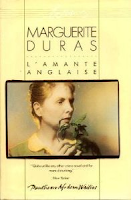
L'Amante Anglaise by Marguerite Duras

Do you know that murder doesn't happen all of a sudden? No. It creeps up slowly, like a tank. And then it stops. And there it is. A murder has just been committed in Vine. By Claire Lannes. There's no going back on it. Murder has descended on Viorne. It was hovering high in the air above, and it's there where Viorne is that it fell, in that house, in the kitchen of that house, and the one who did it--oh... the one who did it is Claire Lannes. She knew that the murder was there, and that only a thread kept it from falling on Viorne.

A policeman arrives at a bar in the French town of Viorne searching for information about a gruesome murder that has captivated the national press: a series of dismembered body parts, discovered on trains all around the country, which have been traced back to the rail junction at Viorne. As he discusses theories with the patrons there, a woman, Claire Lannes, comes up and confesses: she is the one who committed the murder. The victim is Marie-Therese, a deaf and mute woman who was Claire's cousin and housekeeper. L'Amante Anglaise tells this story as a series of interviews between an unnamed writer, who wants to write a book about Claire, and three figures: Robert, the bar owner; Pierre, Claire's husband; and Claire herself.

I think it's only when you read an author's second book that you really begin to understand who they are as a writer. L'Amante Anglaise shares with Duras' incredible book The Lover a sense that the real story is not being told, that it lies somewhere below the surface, inaccessible to both the reader and the characters themselves. Claire--whose section is by far the novel's most interesting--seems to have no idea why she killed her cousin. Murder, as she describes it, is a force that descends from outside, taking a place or a person as its vessel or host. And yet, she thinks that she might have answers for the writer, if only the writer would pose the right questions. But of course, she doesn't know the right questions any more than the writer does.

Truth, where it exists, is hidden; the novel's title, L'Amante Anglaise is written in French to retain the pun between la menthe anglaise, or English mint, Claire's favorite plant in her beloved garden, and l'amante en glaise, a "lover in sand" or "clay," which is her Freudian-slip pronunciation. Does Claire murder her cousin because of some inexpressible jealousy toward her dalliances with their friend Alfonso, or her sexual jealousy more broadly? What does it mean when the writer suggests that Claire has acted out not her own desire, but Pierre's, a desire to be free of both wife and housekeeper? Is Marie-Therese's still-missing head buried in the garden among the English mint?

I'm unsure what to think about L'Amante Anglaise. Its brief and oblique nature make it seem somehow incomplete--missing, like Marie-Therese, the identifying feature that will make it all make sense. Does L'Amante Anglaise conceal a buried secret, or does it only point toward the idea of secrets? Is there a truth at the heart of it, or only a gesture toward the possibility of truth? What's most interesting about it is, I think, the way it turns familiar stories of investigation and detective work on their head. The writer who seems so incisive with Robert and Pierre, working doggedly and shrewdly toward truth, seems suddenly stymied by Claire. So stymied, in fact, that the writer actually begins to lose interest in the conversation. It's a detective story that ends with a shrug.

Monday, June 13, 2022

The Lover by Marguerite Duras

In the books I've written about my childhood I can't remember, suddenly, what I left out, what I said. I think I wrote about our love for our mother, but I don't know if I wrote about how we hated her too, or about or love for one another, and our terrible hatred too, in that common family history of ruin and death which was ours whatever happened, in love or in hate, and which I still can't understand however hard I try, which is still beyond my reach, hidden in teh very depths of my flesh, blind as a newborn child. It's the area on whose brink silence begins. What happens there is silence, the slow travail of my whole life. I'm still there, watching those possessed children, as far away from the mystery now as I was then. I've never written, thought I thought I wrote, never loved, though I thought I loved, never done anything but wait outside the closed door.

A fifteen year old French girl, traveling by ferry from her home in Sadec, Vietnam, to her boarding school in Saigon, meets a Chinese man being driven in a black town car. She is wearing a man's fedora and gold high-heeled shoes. Instead of returning to the school, she goes with him to his home, where she has sex for the first time. The affair they have hastens the mental and physical deterioration of her recently widowed mother, and somewhere in China, in the city of Cholon, the Chinese man's father isn't too happy, either. Their relationship, both troublesome and doomed, emerges from a deep sadness they share, and the adult writer--a narrator, perhaps, but one that seems very close to the real life Duras, writing in her 70's--imagines the whole of her troubled childhood balanced on the pinhead of these moments.

I thought The Lover was a remarkable book. Remarkable in one sense, because you couldn't write it today. I know hack writers and comedians say stuff like that all the time, because they can't handle any kind social progress, but in this case it strikes me as being true. You couldn't write about a relationship between a 27-year old man and a 15-year old girl without making certain ethical prefaces, and you certainly couldn't explore the extent to which she desired the relationship, or how it develops in tandem with a desire for self-annihilation. Nor could you see him, as Duras does, as inherently pathetic, as squashed and bruised by a suffocating family life as the teenager he seduces. It has the benefit of likely being true, and being published after Duras was a known quantity (she was nominated for an Oscar!) and the things that make such a book unlikely are worth the price, in my opinion, but still, such a book seems to speak from a different era.

But remarkable, more importantly, for the quality of the writing, which possesses a superficial simplicity that's quickly complicated by a deeper intricacy that unfolds as the novel unfolds. Duras writes as one remembering a story from long ago, one in which what remains is not the narrative but the images. She lingers on these images--the man's hat, the gold high-heeled shoes, the black town car--layered over one another like transparencies, still moments that come forward and recede, but don't really move. At times I felt like the titular "lover" is really a distraction, only a moment to look through and see what Duras is really interested in, the tortured relationship she had with her mother and two brothers after their father's death, stranded in a strange and foreign country.

In her brothers, Duras describes a Manichaean division of good and evil. You know, like Goofus and Gallant, but with psychic and violent stakes. Her elder brother is a gambler, an amoral thief and destroyer. She describes him as a murderer, though it wasn't ever clear to me if she meant this in a literal or metaphorical sense. She blames the death of her younger brother, the pure and guileless one, on this older brother, even many years after they went their separate ways in life. It's this relationship, really, which hovers just beyond the scene of The Lover, and somehow the relationship between the young Marguerite and the Chinese millionaire's son is a way of looking past it, or not looking at it, or looking at it obliquely. Her younger brother's death, the image held till the end of the book, like something kept at the edge of the mind, gives Duras the chance to write some of the book's finest prose:

It was a mistake, and that momentary error filled the universe. The outrage was on the scale of God. My younger brother was immortal and they hadn't noticed. Immortality had been concealed in my brother's body when he was alive, and we hadn't noticed that it dwelt there. Now my brother's body was dead, and immortality with it. And the world went on without that visited body, and without its visitation. It was a complete mistake. And the error, the outrage, filled the whole universe.

There's a wonderful universality to that, the feeling of grief as an immortality being stolen from the world. One of those feelings that good writing reveals to exist, when you hadn't realized it existed before. But it has a specificity, too, a sense of truth, that reveals the writer behind the images, and which seems like it can hardly be invented. The Lover sits in that uncomfortable space, perhaps, between novel and memoir, and it's not like anything else I've ever read.