Showing posts with label Spain. Show all posts

Thursday, July 30, 2026

Carnality by Lina Wolff

We knew what kind of show it was, my wife and I, so we've got no grounds to play the innocent. It's just you'd think with a nun behind it there'd be limits, some kind of safety net. Not because I'm a believer. I don't believe in any religious communion or system. But an institution has always got something to lose, if only its self-image, which is why there are things you never believe it capable of doing. What we'd both heard about Lucia was that she could work miracles. I don't believe in miracles, but Soledad insisted that a miracle was exactly what we needed at that point: some vast, unbelievable miracle that transformed everything.

Bennedith is a Swedish travel writer on a month-long paid trip to Madrid. Looking for meaning, she takes on another role caring for a man who suffers from severe Alzheimer's--gratis. At a bar, she meets a man named Mercuro who inveigles his way into her life, and her furnished flat, telling her a strange story of woe: having cheated on his wife Soledad, he turned to a television series called Carnality, helmed by the mysterious Miss Pink and Mister Blue and their unseen patroness, a nun named Sor Lucia, to help him fix the rift between them. Sor Lucia's solution is simple: because Soledad needs a heart transplant, Mercuro can fix what he has done by offering her his own heart. In fact, by signing the waivers for the show he has already made the agreement to do so, and it is in fleeing the pursuing transplanters that Mercuro has ended up in Bennedith's arms. Bennedith is at first repulsed by Mercuro, then compelled. His own story of irrevocably fucking up has some resonances with her own, not least of which the way she shamefully loses her job with the Alzheimer's patient. So it's no surprise that they end up in each other's arms, literally.

The title Carnality takes in all kinds of fleshy meaning. There's Mercuro's carnal lust, of course, but there's the carnality, too, in the sense of carne, meat, as in the heart that Mercuro is compelled to cut out and give away. The last half of the book is a long series of letters from Sor Lucia, the patroness of Carnality, explaining to Bennedith (who is in jail after a series of complicated events involving a reckless Swedish party boater--go figure) her childhood as the stepdaughter of a cruel butcher during the Spanish Civil War. Sor Lucia's missing thumb is rumored to be from a pig's bite, but she explains that it was actually cut off by a man seeking vengeance for her stepfather's crimes. It's this experience--butchering, being butchered--that makes Lucia an asset at the convent, and gives her a kind of necessarily mercilessness. The story of the TV show Carnality is a story of that mercilessness, although one can see in Lucia's letters to Bennedith that cracks have begun to appear in the nun's moral certitude. Moral questions, Carnality, suggest, are tied up with the body as well as the soul.

What I liked most about Carnality was how unsettled it was. It constantly seemed to be transforming from one kind of book into another one, and I never really knew where it was going to go next: from Bennedith's listlessness and ennui to Mercuro's bizarre tale to their adventure with the evil boater, then to Lucia's letters and history. So I was a little bit disappointed, as I suppose would be inevitable, at the way the various threads were tied together at the end. I actually found that I wanted Carnality to remain mysterious, perhaps a fiction of Mercuro's head--Bennedith has never heard of it--rather than getting the detailed history of how Lucia came to be at the head of the mysterious television show. To Wolff's credit, she ties everything together skillfully, and the end brings the various themes of mercy and violence together really well--but I wonder if there was another version of the novel that stayed as unsettled and weird as it was at the beginning.

Saturday, May 31, 2025

After the Death of Don Juan by Sylvia Townsend Warner

The wheel went round. The thread snapped, but was re-knit again. In hell the limbs of sinners are broken and mended, broken and mended. Men and women lie pell-mell together, naked as in the marriage-bed .There is a promise of water, but no water. There is no light and yet they see new torments approaching, and the stony looks of devils standing by. The tears dried on her cheeks as she sat spinning, and thinking of hell. In hell, too, as in heaven, the tears are dried. For all the anguish, for all the despair, no tears can break out over the burning eye-balls. Now Don Juan had come back from damnation to tell of it.

The story goes: the lecher Don Juan, caught in flagrante delicto with Doña Ana, kills Ana's father, the Commander. Later, he visits the Commander's tomb, where the statue of the man invites him to a fine dinner. Instead of a fine dinner, Don Juan receives his just desserts: the earth opens up and demons drag him down to hell. It's a difficult story to believe, but that's what Don Juan's servant, Leporello, insists, and so Doña Ana goes with her reluctant new husband, Don Ottavio, to Don Juan's village, Tenorio Viejo, to inform the lecher's family that he has died. She discovers few friends of Don Juan among the villagers there; even his father, Don Saturno, seems to understand that his son was a rather nasty piece of work. And yet the death--if indeed he really has died--of the don only promises to throw the village into turmoil.

After the Death of Don Juan is, like Townsend Warner's The Corner That Held Them, more interested in capturing a wide view of a place than it is an individual character. We may think, briefly, that it is Doña Ana's book, or perhaps Don Ottavio's, but when the nobleman and noblewoman arrive at Tenorio, the novel's perspective expands to take in all of the villagers who have long battled for safety and dignity under the rule of Don Saturno and his family: the miller, the sacristan, the seamstress, the many olive farmers. The villagers immediately set to discourse, first over whether they truly believe that Don Juan is dead, and then over what it means. They talk themselves into believing that the death of the don means that the money that went to support his drinking and whoring will be returned to the village, and that now they will be able to implement a scheme of irrigation that will increase the yield of their olive trees.

The back of my copy of After the Death of Don Juan describes the book as Townsend Warner's response to the Spanish Civil War. I wondered about that; obviously, it's set in Spain, but I couldn't easily make out any particular analogs of various people or factions, as far as I know them. And yet, it's a book that captures something interesting about class, and class warfare. The villagers find that Don Saturno, an intellectual and dilettante, is as enthusiastic about the irrigation plan as they are, and already has plans drawn up. But this detente between the feudal lord and his subjects is interrupted by the return of--spoiler, you guessed it--Don Juan, who, as it turns out, has not been dragged to hell at all. Talking with his estranged son, Don Saturno finds that all his noblesse oblige will amount to nothing; when he inherits the estate, Don Juan intends to cancel the leases and trap the villagers in cruel bondage. There's something here, I think, about the way that class interests win out over personal kindness; Don Juan understands that his position as lord is an essentially cruel one and has no delusions about whether it is possible for the lord and his workers to be on friendly terms. The villagers only dimly sense this, but they understand that Don Juan's return means them no good, and the novel ends with a bloody and doomed assault by the villagers on the castle.

Though it's set in 18th century Spain, After the Death of Don Juan struck me as Sylvia Townsend Warner at her most Dickensian--the large cast of characters, the broad (and funny) humor, the attempt at circumscribing the whole social relations that define the town. In this way it's very different than the books that made me fall in love with her as a writer, like Mr. Fortune. Yet, I love how she, as a writer, can commit that eloquent, sardonic voice to such different places and times: colonial Polynesia, a 14th century convent, Victorian England. In each instance, she captures something both funny and dark about human nature, and After the Death of Don Juan is no exception.

Saturday, May 10, 2025

Death in the Afternoon by Ernest Hemingway

 A great killer must love to kill; unless he feels it is the best thing he can do, unless he is conscious of its dignity and feels that it is its own reward, he will be incapable of the abegnation that is necessary in a real killing. The truly great killer must have a sense of honor and a sense of glory far beyond that of the ordinary bullfighter. In other words he must be a simpler man. Also he must take pleasure in it, not simply as a trick of the wrist, eye, and managing of his left hand that he does better than other men, which is the simplest form of that pride and which he will naturally have as a simple man, but he must have a spiritual enjoyment of the moment of killing. Killing cleanly and in a way which gives you aesthetic pleasure has always been one of the greatest enjoyments of a part of the human race. Because the other part, which does not enjoy killing, has always been the more articulate and has furnished most of the good writers we have had a very few statements of the true enjoyment of killing.

"The bullfight is not a sport in the Anglo-Saxon sense of the word," Ernest Hemingway writes at the beginning to Death in the Afternoon, "It is not an equal contest between a bull and a man. Rather it is a tragedy..." For the bull, obviously, he explains, but for the bullfighter, too, whose life is at risk. Even the greatest bullfighters in the long list of those Hemingway names over the course of the book, like the infamous Joselito, eventually die at the horns of the bull. And those who don't die from being gored, from having their lungs and groins punctured and their intestines drawn out, die from the mental strain of this demanding profession, or from their own crippling cowardice. The bullfighter gives up his life to an exercise of pure aesthetics, of delivering a death so beautiful people flock to the ring to see it.

Popular opinion has moved against bullfighting, even in Spain, where it's outlawed in several provinces that Hemingway once traipsed around, seeing fight after fight, but even in Hemingway's time it was controversial. The thing most people object to, Hemingway says, is the death of the horses, who are so often gored and killed in the efforts of the picadores. Hemingway describes the appreciation of bullfighting as something that belongs to a discerning few; he's under no pretense that most people will be able to look past the inherent cruelty of it to see what makes it beautiful. He compares it, even, to the appreciation of wine: even those who do see its beauty must develop their "eye." Hemingway, of course, has that eye, and much of Death in the Afternoon is a description of the various movements and methods, the bandilleras and volapies and muletas and faenas that make up bullfighting's technical vocabulary, and describing who did them best and who did them worst. He even conjures up an interlocutor in a fictitious old lady, who is that one-in-a-thousand member of the crowd who lacks a natural revulsion to the scene and is willing to be taught. (The old lady's impatience with Hemingway's literary digressions is a funny recurring bit.)

Hemingway is Hemingway, and at times Death in the Afternoon swerves into great literature. In the center of the book is an essay called "The Natural History of the Dead," which is a kind of presentation of the various forms of death and dying that Hemingway witnessed during World War I. Toward the end, a loving evocation of the life of the Spanish countryside makes one of the book's chief rewards. (How little Hemingway might have known that the Spanish Civil War was a few short years away, and that much-loved countryside would provide many more examples for his "natural history of the dead.") Elsewhere the book is doggedly instructive and practical; it really is intended as a guide for those interested in getting into early 20th century bullfighting. I laughed when the book turned, at times, into a kind of fanboying over Hemingway's favorite fighters; it was like listening to Bill Simmons rank NBA all-timers on his podcast. I'm one of the haters--I'll never see a bullfight. But I feel like I understand a little better from Death in the Afternoon what Hemingway and others found to be worth their attention.

Tuesday, February 25, 2025

A Heart So White by Javier Marias

("Listening is the most dangerous thing of all," I thought, "listening means knowing, finding out, knowing everything there is to know, ears don't have lids that can close against the words uttered, they can't hide from what they sense they're about to hear, it's always too late. Now we know and it may well stain our hearts so white, or are our hearts merely pale or fearful or cowardly?")

Juan is a contemporaneous translator, working to facilitate communication between politicians and government officials. But he knows, too, that communication, the revelation of the inner thought, is no simple matter, and that the difficulty of translation is predicated on the difficulty of ever successfully saying what is true: "Sometimes," Marias writes, "I have the feeling that nothing that happens happens, because nothing happens without interruption, nothing lasts or endures or is ceaselessly remembered." On his wedding day to another translator, Luisa, Juan's father Ranz--a rakish art dealer with connections to known forgers--give him a piece of advice: never tell your wife your secrets. Of course, no one says this if they don't have secrets themselves, and Juan goes on to uncover, somewhat reluctantly and with Luisa's help, the secrets of his father. These secrets have to do with his three marriages, and the suicide of his second wife--shockingly depicted in the novel's foreword--who was the sister to his third, Juan's mother. 

This secret, and its unveiling, form the spine of the novel. You can see the influence of detective fiction on Marias; there's scenes of following and watching from afar, though unlike detective fiction, it's never clear what these stakeouts accomplish. In a detective novel, the revelation of the killer results in their arrest and conviction, but here, the only victory is the truth being known, and as Marias writes, that's a more equivocal victory than it may seem. But what interested me most about the novel were the various scenes and mysteries that crowd around this "central" mystery, ones that are never really resolved. On their honeymoon, Juan and Luisa overhear a man in an adjoining Havana hotel room agree with his lover to kill his wife. In New York, Juan helps a fellow translator and friend arrange a tryst with a mysterious video-date who makes increasingly lurid demands. Juan even has an inkling that this man and the one in Havana may be the same--which would be a shocking coincidence, but not one that's unheard of in the cheap paperbacks the novel is riffing on--but this inkling goes nowhere. The date happens, and Juan's friend clams up; she's gotten what she wants, and nothing is left to be revealed. Nor do we ever find out if the man from Havana ever really killed his wife, or intended to.

It's these scenes that give the novel its satisfyingly unsettled nature. Oddly, the central mystery is revealed quite clearly in due time, but we leave the novel with a sense that we have learned very little, that the "whole story" is not out there to be found. I also really liked all the material about the father's life as a dealer in art forgeries, which you think is going to be part of the grand mystery, but which isn't. I loved the story about Ranz, walking through the Prado, seeing a security guard about to take a lighter to a Renaissance painting. He's grown sick seeing the scene every day, how it never changes, how the characters in the margins never seem to reveal themselves. It's an image, maybe, of that hope that things will be revealed, and that revelation will put things right; it's also just a great scene on its own, and something that I myself was thinking about--oddly enough--as I toured the Prado on my trip to Spain. How crazy it must drive those guards to sit there every day and stare at the same art, even the most celebrated art in the world! Oh, or maybe, it's an image that shows us that even normal people, driven to extremes by the most ordinary mechanisms of time and life, will from time to time give into their most violent impulses.

Monday, February 24, 2025

Ornament of the World by Rosa Maria Menocal

The old Arabic word for palace, al-qasr, was what the Castilians called their splendid new royal homes. The elaborate plasterwork that decorated nearly every inch of the Alcazar's interior walls was barely dry, and the Muslim emissary from Granada found himself in rooms that in every way echoed the freshly finished palaces of this Islamic city he had just left. Peter, a son of Alfonso XI and the heir to his great-great-grandfather Alfonso X (the Learned), who had died in this city, was justifiably proud of this example of his wealth, taste, and vision. All three were on display in this Sevillian tribute to the very latest architectural style of Spain. Ibn Khaldun could hardly have avoided the realization that Peter's new palaces, with their multilobed latticework arches and their pure-white arabesque ornamentation on every spare surface, were an unstinting homage to the style of the Nasrids, whose envoy he was. There, on the open and sunny plain, sitting next to the giant old Almohad mosque in Seville--the mosque had been reconsecrated more than a hundred years before and was the cathedral of the Christian capital--was an unabashed evocation of the fortlike palaces at the top of the rocky mountain retreat of Granada, the last and lonely Islamic state on the Iberian peninsula.

I had the great fortune last week to visit two of Spain's most striking and important landmarks: the Alcazar of Spain, a royal palace that is still the sometime home of the King and his family, and the Alhambra, an enormous palace complex built by the Muslim Nasrids of Granada. The Alcazar is a Christian edifice, done in what's known as the "Mudejar" style, meaning Christian architecture with Muslim edifices. It really does look a lot like the Alhambra, and visiting the two, someone who didn't know exactly what to look for might get the impression that they were built by the same people for the same purposes. The two structures are, to author Maria Rosa Menocal, powerful symbols of one of history's true golden eras: medieval Spain, when Muslims, Christians, and Jews existed side by side in a culture of tolerance and cultural exchange. A Christian ruler might, even after the reconquest of much of the Iberian peninsula, in which Muslim rule in Spain was shrunken down to just the city-state of Granada, recognize Islamic art and culture as part of his own powerful patrimony, and built a palace worthy of such creative and intellectual forebears.

Menocal frames her book as a series of biographical sketches of figures who typified the 750-year-ish era that constituted the golden age of al-Andalus. Among them are Samuel the Nagid, an influential Jewish poet and leader who served as a general in Muslim Granada; prolific Islamic writers like Ibn Hazm and Averroes; the Christian warrior known as El Cid; even apostates who rejected the world of philosophical tolerance like Jewish thinker Judah Halevi. This format made it a little hard to grasp some of the overarching historical narratives at play, but I think I more or less got the gist: survivors of the fall of the Umayyad dynasty in Baghdad arrived in al-Andalus around 750 CE, where they created a Muslim state centered on Cordoba that incorporated Christians and Jews but also cemented Arabic as the primary language of both knowledge and art. These Umayyads were eventually conquered by a pair of strict invading Islamic states, the Almohads and Almoravids, who were supplanted by a system of individual city-states known as taifas. The taifas lasted until the reconquest, ending with the loss of Granada and the edict of Isabella and Ferdinand--a pair of history's great villains, no doubt--expelling the Jews from Spain, cementing the entire peninsula as a Christian polity.

I had a vague idea, of course, that Muslim thinkers protected and progressed the traditions of Greek philosophy during the time that much of these sources were lost to Christian Europe. What I didn't know is just how much of that happened in Spain. It was Averroes, the Latinized name of Ibn Rushd, for example, whose commentaries on Aristotle kept the Greek philosopher's legacy alive, later to be integrated into the Christian philosophy of Thomas Aquinas. Nor did I realize that Chaucer's The Canterbury Tales has its roots in the writings of Petrus Alfonsi, a Spanish convert from Judaism to Christianity, whose "Priestly Tales" held little interest for his own countrymen but which Englishmen had never seen. Nor had I ever really thought about the fact that, as must be true, even the Jewish and Christian thinkers of the time period wrote in Arabic, a language that had come to supplant Latin as a lingua franca. Even the great Jewish writer Maimonides, for example, wrote his commentaries on the Mishna in Arabic. One of the great, perhaps even tragic, turning points for Menocal, is when King Alfonso the Wise chooses to elevate the vernacular romance language of Castile to official status.

It's clear that Menocal sees the story, or perhaps stories, of medieval al-Andalus as not just history, but a model for the way society could be. A postscript notes that she finished the book shortly after 9/11, when the book's pleas for tolerance--especially in relation to the contributions of Muslim and Arabic thinkers--became especially ignored, and especially needed. As Menocal shows, much of the great philosophy, poetry, art, and architecture--the Alcazar of Seville and Alhambra of Grenada among them--were only able to exist because a culture of tolerance and free exchange allowed them to exist. 25 years later, it's hard to see that a society like this remains a probability for us, though the book shows quite effectively that such worlds are possible.

Sunday, February 23, 2025

The Hive by Camilo Jose Cela

The morning arrives, step by step, crawling like a worm over the hearts of the men and women in the city; it beats, almost tenderly, against eyes that have just opened, eyes that will never see new horizons, new landscapes, new environments.

The morning, the same morning over and over again, plays its little games, of course, changes the face of the city: that tomb, that greasy pole, that hive...

Lord, have mercy!

Camilo Jose Cela's novel The Hive begins with Doña Rosa, the proprietress of a cafe in Madrid after the end of the Spanish Civil War. Doña Rosa is a tyrant, abusing her workers and her patrons alike, but her brutishness seems to have no effect on the success of her cafe, which is constantly filled with the lonely, the miserable, and the poor, using what change they've been able to scrounge to buy a coffee (but not, to Doña Rosa's dismay and anger, any of the available pastries). From there, the story moves outward, into the lives of the patrons, and branching off of them in patterns that resemble a network of nerves as much as it does the insect hive of the title. The Hive has, it is said, over three hundred characters, some of whom have the same or similar names, and some of whom have no names at all; it's impossible to tell, at first glance, who will be really important to the novel, and who is shuffled onto the stage to provide a single and singular image--like the young suicide who throws himself out the window because the room smells too strongly of onions--and who will end up as a recurring character.

I'd be lying if I said I followed the novel all too well. It's the first book I read on my new Kindle, which I got for traveling, and which I feel like puts up a kind of mental-physical barrier--I could not easily, for instance, riffle through the page to find a character's first appearance. But it did allow me the ease of reading the novel in Madrid, who you might say--imagine!--is the real protagonist of The Hive, a city of the poor and beleaguered having just emerged from Civil War, and not into liberation, but an oppression that will last decades. (No surprise that Doña Rosa, unlike many of her Bohemian clients, is an ardent Francoist.) More appropriately, it might be said that the protagonist is one Martin Marco, a penniless leftist poet who is unable to pay his tab at the cafe, who lives on the equivalent of a friend's couch, and who spends his days wandering the city doing nothing but feeling deeply.

Perhaps in the wake of Franco's victory there were many who felt like Marco, whose passion and sensitivity had no outlet for action, while the brutality and the tyranny of someone like Doña Rosa turned out to be the order of the day. (It's a stretch, but there's something in the the parallel between the proprietress' Francoism and her cruelty that reminds of the way certain people are reveling in the permission now granted them by political circumstance to treat others cruelly.) But Marco is only one character, and the position of the novel seems to be that life goes on no matter what the circumstances, that different days, different political orders, have little effect on the sum totality of human activity, which adds up to something rather tedious and sordid. There's Elvira, the sad, aging prostitute; there's the young girl who goes into prostitution to earn money for her boyfriend's tuberculosis medicine; there's blackmail and cross-blackmail; there's the murder of a local woman with a terrycloth towel that turns out to be--though who has any way of knowing this?--instrumental to the conclusion of the novel's plot, such as it is. I've not mentioned several hundred characters, and those that I have I probably haven't got quite right; but I'm not sure that The Hive is a novel to be diagrammed. It's something you're supposed to hold up to your ear, and listen to the buzz.

Sunday, June 9, 2024

For Whom the Bell Tolls by Ernest Hemingway

What a business. You go along your whole life and they seem as though they mean something and they always end up not meaning anything. There was never any of what this is. You think that is one thing you will never have. And then, on a lousy show like this, co-ordinating two chicken-crut guerilla bands to help you blow a bridge under impossible conditions, to abort a counter-offensive that will probably already be started, you run into a girl like this Maria. Sure. That is what you would do. You ran into her rather late, that was all.

So a woman like that Pilar practically pushed this girl into your sleeping back and what happens? Yes, what happens? What happens? You tell me what happens, please. Yes. That is just what happens. That is exactly what happens.

Robert Jordan is a Spanish professor from Montana who has joined with Republican forces in Spain to fight in the Civil War. He's earned the reputation as an excellent dynamiter, and is tasked with blowing up a bridge to help keep fascist reinforcements from arriving during a Republican ambush. The process involves reconnoitering with small bands of guerillas in the mountains around Segovia, and among these bands are a collection of indelible characters with whom Robert becomes intricately involved: Pablo, the disgraced guerrilla leader who opposes the blowing of the bridge; Pilar, his headstrong "woman" and the band's true captain; the loyal old man Anselmo; and Maria, a girl with whom--despite all his warnings to himself--Robert falls deeply in love. There is a cinematic aspect to their love, coming as it is too late, and on the evening of a mission whose chances of success are slight, and for which the odds of a gruesome death are high.

Killing and dying are the subject of For Whom the Bell Tolls. When is it permissible to kill? When is dying a noble sacrifice? The characters all carry the burden of past killing, past dyings: for Robert, it is the bullet he put through the skull of a dying comrade. For Maria, it is the death of her parents in a gruesome fashion at the hands of the fascist, and her own repeated rape at the same hands. (Her short hair, shaved by the fascists and described as unbecoming to her face, is a symbol of the still-recent torture.) For Pablo and the other guerillas, it is the massacre of those same fascists; Pilar describes in long and gruesome detail the way the band laid siege to a group of local dons, slaughtering each one in turn, and the deep ambivalence of hindsight. The Spaniards are keenly aware that, in this conflict, the people they kill are their countrymen, and yet they know that they must continue on; the principle by which they live demands it. And they know that they, too, will likely be killed in turn, and thus live in a fashion close to their own deaths.

For Whom the Bell Tolls has superficial associations, perhaps, with his other great war novel, A Farewell to Arms. Among other things, there is a keen sense of the ways that the people at the bottom of the chain of hierarchy are abused and ignored by the people at the top. A subplot involves a messenger, sent by Robert to inform the Republican brass that they've been spotted by fascists and the ambush is foiled, who gets repeatedly waylaid by checkpoint guards and even thrown in prison by a petty French general who resents the ambush's commanding officer. It's not just that war involves death on a mass scale, it's that so many of the deaths are so pointless. For every heroic death that helps obtain a strategic advantage, there are a hundred others that are the result of poor judgment or sheer accident, and which result in no strategic advantage whatever. When, in the book's final moments, the destruction of the bridge finally takes place, the advantage of surprise has been lost, and the characters know they face death for little reason other than the need to follow orders--and for the broader principle of the war in which they fight.

Despite this, For Whom the Bell Tolls reminded me more of The Sun Also Rises, another story about a small group of people, set over a few days. Its scope and scale are so reduced, save for a few memories, stories, and gestures toward the wider war, that it feels almost like a closet drama. It's within this space that Maria and Robert live an entire romance, which they do with the special intensity of those for whom life seems very short. Hemingway haters, no doubt, may find much to despise in Maria, who attaches herself to Robert in a way that might seem naive. But you can't ignore the image of Maria with her shorn hair, taking up a machine gun and expressing her keenest desire to kill the fascists who murdered her parents, either. Nor do the haters have a response, I think, to Pilar, a battle-hardened badass whose resolve is the anchor of the small band of guerillas--whereas her husband, Pablo, represents the fickle Judas.

As I understand it, the novel's dialogue has come in for a lot of criticism over the years: Hemingway puts a lot of high-flown anachronisms in the mouth of the Spaniards, like "thees" and "thous." But I thought this worked. Partly, it's a way of elevating the guerillas, who are largely poor, rural people cast into world-significant circumstances they have not chosen, to the dignity of epic heroism. Partly it's an interesting way of transliterating the Spanish usted for an English audience. The novel--whose central character, if not sole viewpoint character, is a professor of Spanish--makes some really interesting decisions about how to present Spanish as English, relying on several false cognates and overly literal translations that I read as quite purposeful, and far more effective than trying to colloquialize everything they say. Among other things, it emphasizes the way in which Robert, though fluent in their language, is not quite of them, a stranger.

Friday, August 11, 2023

The Sun Also Rises by Ernest Hemingway

I thought I had paid for everything. Not like the woman pays and pays and pays. No idea of retribution or punishment. Just exchange of values. You gave up something and got something else. Or you worked for something. You paid some way for everything that was any good. I paid my way into enough things that I liked, so that I had a good time. Either you paid by learning about them, or by experience, or taking chances, or by money. Enjoying living was learning to get your money's worth and knowing when you had it. You could get your money's worth. The world was a good place to buy in. It seemed like a fine philosophy. In five years, I thought, it will seem just as silly as all the other fine philosophies I've had.

Jake Barnes is an American, a Catholic, an expatriate living in Paris, a working man but a hard partier, living with a war injury that's left him unable to have sex. He's deeply in love with Lady Brett Ashley, a sexually emancipated, very droll "new woman" of the 1920s, but Jake's injury--maybe--has made their relationship an impossible one. Jake's friend Robert Cohn, a Jewish boxer, has also fallen in love with Brett--people tend to do that. When Jake, Brett, Robert, and Brett's fiancé Mike head down to Pamplona for the festival of San Fermin and the Running of the Bulls, the passions and resentments that they share boil over into conflict, especially when Brett goes off with a dashing young bullfighter.

The Sun Also Rises was the first Hemingway I ever read, way back in college, or maybe high school. I remember liking it, but I also remember feeling like I didn't get it, like there was something just beyond the page that I was missing. Reading it now, I think that my first impression was fairly dead on. There really is something subtle about The Sun Also Rises, even moreso when compared to the other Hemingways I've read, that seems inaccessible, just past the veil of the plainspoken language. You can see it emerge volcanically, when one of the characters--Mike, or Brett, or even Jake--blows up at poor pathetic Robert Cohn, the hanger-on that nobody really wants around, and who manages to puncture the smooth irony of their conversation and bring out the real anger and despair that's just beneath the surface.

I was just saying to Brent the other day that, to hear people on Twitter talk about Hemingway, I sometimes worry that we're at risk of losing or diminishing the real legacy of these novels. The objections you hear are rarely artistic ones, but moral ones: old Papa, nasty macho chauvinist. You know the ones. Without a doubt there's a ring of truth to them. There's a whiff of conservatism around the character of Brett, whose sexual emancipation seems to lead only to desperation. That conservatism is echoed by a sense that cultural revolution, like in Fitzgerald's novels, has not served the "Lost Generation" well, who spend their idle days in Pamplona pickling themselves and resenting each other. And Jake--and Hemingway--really do have an aficion, a passion, for the bloody, violent sport of bullfighting. You can call that machismo, if you like. And the antisemitism charges around the character of Cohn, an unwanted Jewish outsider called "k-ke" by Mike, certainly stick.

But I think the other side of each of those impressions is more powerful: First of all, it's not Brett's fault that men pounce on her like she's some kind of meal. There's a whiff of Daisy Buchanan in her, a woman who has learned to develop irony as armor to deal with the way that men attach themselves to her because of her physical attractiveness. (Though Brett is always in more control than Daisy, and never lets that irony curdle into put-on helplessness.) The bullfighting is violent, but the language that Hemingway uses to describe it rarely seems taken from the vocabulary of macho domination and power: the gifted matador Pedro Romero succeeds through self-control, precision, and even grace. Compare Pedro's skill to Robert, the boxer: when a jealous Robert socks Pedro in the face, Pedro defeats him just as he does the bull--not by hitting back with a powerful jab, but by outlasting the short-lived burst of masculine anger and violence--until Robert leaves the room crying. There's more to the antisemitism, maybe, but the way Mike, seizes on Robert's Jewishness to affirm his status as an unwanted outsider doesn't do Mike, a mean son of a bitch and a "bad drunk," any favors.

Frankly, Hemingway's best defense against the haters is just how talented he is. You could never reduce The Sun Also Rises to machismo because you can't reduce it to anything. The characters are simply too rich and too real, they contain multitudes, like real people do. I loved Brett's cleverness, and the way it conceals a deep vulnerability, and I really enjoyed the convivial wit of Bill Gorton, the final friend on the Pamplona trip. I even liked Robert Cohn, who's so persuasively pathetic. But the heart of the book is Jake Barnes. Unlike Mike, who lives on credit up and down the Mediterranean, or Brett, who lives off of what she's been able to get from the nobleman she's divorcing, and the other idle expatriates, Jake has a job. His sense that things must be "paid for" might be seen as the book's moral sense: the beauty of the bullfights are paid for by cruelty, and the freedom someone like Brett enjoys is paid for by loneliness. Hemingway thought it was a hopeful novel, and I think that's right; the lifestyle the friends enjoy really may be worth the price paid in money, labor, and loss. It really isn't The Great Gatsby, where you get fleeced and the world is a rotten bargain.

In the end, Brett runs off with the matador, but telegrams Jake at the last minute begging him to come to Madrid, where she's been abandoned: once again, the men in her life have wanted something she can't provide them. Except for Jake, that is--the only man, it seems, who Brett has wanted, and who hasn't been able to provide. Jake's impotency is a crushing blow to the Hemingway machismo theory, I think, because The Sun Also Rises doesn't really depict him as diminished by it. Rather, it enables him to be a friend to Brett when she needs it most, and novel's moral center. He pays dearly for the intimacy he enjoys, and the integrity he's developed, but perhaps that's worth it in the end, too.

Monday, July 11, 2022

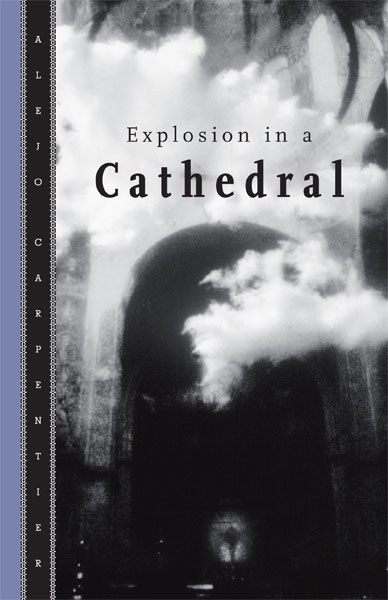
Explosion in a Cathedral by Alejandro Carpentier

Esteban suddenly stopped, stirred to the very depths, in front of the "Explosion in a Cathedral" by the anonymous Neapolitan master. In it were prefigured, so to speak, so many of the events he had experienced that he felt bewildered by the multiplicity of interpretations to which this prophetic, anti-plastic, un-painterly canvas, brought to the house by some mysterious chance, lent itself. If, in accordance with the doctrines he had once been taught, the cathedral was a symbol--the ark and the tabernacle--for his own being, then an explosion had certainly occurred there, which, although tardy and slow, had destroyed altars, images, and objects of veneration. If the cathedral was the Age, then a formidable explosion had indeed overthrown its most solid walls, and perhaps buried the very men who had built the infernal machine beneath an avalanche of debris. If the cathedral was the Church, then Esteban noticed a row of sturdy pillars remained intact, opposite those which were shattering and falling in this apocalyptic painting, as if to prophesy resilience, endurance and a reconstruction, after the days of destruction and of stars foretelling disasters had passed.

Esteban and Sofia are cousins, living in the great Havana hacienda Sofia's father left them. Essentially, they are orphans, passing their time playing games among the clutter of the dead man's life, until a French businessman arrives looking for the dead man. This man, Victor Hugues, is drawn into the children's games, their costumes and science experiments and adventure books, and for a time, he lives with them, until his warehouse in Haiti is burned. From there he returns to France, embarking upon a political career under the aegis of the Jacobins of the French Revolution, who task him with bringing the revolution to the Americas. Hugues captures the island of Guadeloupe from the British, turning it into a center of wealthy privateers, but he brings with him the first guillotine in the New World. Esteban, then Sofia, are caught up in the tumult of Hugues' revolution, its idealism, its bloodiness, and its ultimate failure.

Hugues, the central figure of Carpentiers' historical novel, was a real figure, a kind of Robespierre of the Caribbean. Guadeloupe, Surinam, French Guiana, and many other places still bear the marks of his regime. Historical novels about the French Revolution are not so hard to come by, but Explosion in a Cathedral highlights a theater of the world no less transformed than Europe, one upon which many of the same moral question and struggles played out. I was struck how both Esteban and Sofia, one after the other, become disenchanted with Hugues, one after the other, and for different reasons. The life of Esteban, arguably the book's main character, is intricately bound up with Hugues': Esteban travels to France and works for the Jacobins to spread the revolution in the Basque country before being sent to Hugues' Guadeloupe, where he's later shunted off into the service of one of the tyrant's famous privateers. Along the way he becomes disillusioned with Hugues' bloody methods. In one memorable passage, Esteban observes how Hugues condemns so many to the guillotine that only a small fraction can be killed in a night, and the rest must be summarily dispatched by pistol.

When Esteban returns, he's frustrated to find that Sofia and her brother Carlos remain enamored with the Revolution, believing wholeheartedly in its potential to transform the world, not having seen any of the blood or the back-dealing among its various Girondins and Jacobins and Thermidoreans. When Sofia's husband dies, she rushes off to Guiana to be with Hugues--for whom she has hidden a sexual ardor for years--but finds not even the bloodthirsty ideologue, but an apparatchik who doesn't even bat an eye when the Directory under an ascendant Napoleon reinstitutes slavery in France's colonies. Hugues might be the Revolution's quintessential man: he transforms himself entirely, as the world is transformed, but his transformation is from a man of cleverness and imagination to one without any scruple at all. Hugues survives the many purges and exiles of his peers because he is man of action, disinterested in the larger principles for which such action is performed. "A revolution is done," he insists, not discussed.

I thought this book was incredibly rich. I was impressed by the wonderfully detailed depictions of Havana and Guadeloupe and Cayenne, and the many other places of the Caribbean that were touched by the Revolution. (In his afterword, Carpentier claims to be one of the only people in the world to visit nearly all of the islands in the Antilles, though clearly much research was involved in making the particular colonial iterations of these places come alive.) He's especially interested in the way these places smelled, their mixtures of tar and tobacco and salted fish and leather and all sorts of other things. And Esteban's long meditation upon the strange life and environments of the Caribbean Sea seems to have echoes of the magical realism for which, in earlier works, Carpentier was known.

Explosion in a Cathedral asks: Are men like Hugues necessary for the world to grow? Without Hugues, there is no end to slavery in Guadeloupe, but then again, it's Hugues who brings it back, too. I found myself thinking about Sembene Ousmane's God Bits of Wood, another book that wonders if, for the world to change, it requires men that would otherwise be intolerable, because revolution requires intolerable things. Ousmane's Bakayoko is a man who is all ideals, and nothing else, a far cry from Hugues' man of action. But both books are meditations on the price we place on change.

Since Carpentier is Cuban, my "countries read" list is up to 66!

Wednesday, February 23, 2022

On Lighthouses by Jazmina Barrera

Almost all general histories of the lighthouse begin with Alexandria, or before--from the times of the beacons of the Celts--passing through the Tower of Hercules and the earliest medieval lighthouses in France, England, Italy, Spain, and China to the proliferation of lighthouses brought about by Fresnel in nineteenth-century France, and then the most modern ones of the twentieth century. In a few years, this history might include references to the last lighthouses, when GPS and computers have put an end to the need for them. I wonder if one day they will all be decommissioned, and if they will then return to being temples of fire dedicated to the sea, fetishes of the superstitious and seekers of esoteric knowledge, who will keep alive the legends of shipwrecks, lighthouse keepers, and the ghosts that surround them. Or if they will be (as seems their destiny) turned into hotels, museums, relics, for the amusement of millionaires, retired folk, archaeologists, historians, and the curious. Divested of their function, they are collectible objects. They now also have that attractive quality of ruins and decay. For melancholics, they are all the more beautiful.

When will the last boat arrive safely to port thanks to the beams of a lighthouse? Who will be the last lighthouse keeper in the world? Or could it be that the relationship between humans and the sea is so primordial that there will always be someone to switch on--using a button or some other future technology--a light for ships in distress or fishermen? Or perhaps they will shine out as temples or memorials to the thousands of people who lie at the bottom of the sea.

What does it mean to "collect" lighthouses? "Obsession," Mexican writer Jazmina Barrera writes, "is a form of mental collection." Traveling around to see lighthouses, and add them to one's mental collection, is "an attempt to satisfy the vain desire to possess with an immaterial, intangible form of possession, not unlike what one might feel toward a loved one." For Barrera, the attractions of lighthouses are many: they are stolid, impregnable, unchanging when compared with the changeable sea; they represent a kind of immutability of emotion or identity that is, for an anxious or adrift person, something to aspire to. Visiting the Blackwell Light on Manhattan's Roosevelt Island, Barrera imagines that she is "slowly transforming into a sealed tower." "I feel so sane," she writes, "that I must be losing my sanity."

On Lighthouses is arranged as a series of vignettes, each titled for a different lighthouse Barrera has visited: Yaquina Light in Oregon, Tapia Lighthouse in Spain, Goury Lighthouse in Normandy, Jeffrey's Hook--otherwise known as the Little Red Lighthouse--and Blackwell Light in Manhattan, Montauk Point at the end of Long Island. Each vignette mixes memoir, history, literature, and reflection in a way that reminded me of Helen Macdonald's H is for Hawk, though that book has the careful organization of an academic, and of someone who's come through the existential crisis explored in the book with a kind of resolution. On Lighthouses, by contrast, offers little change, much less resolution: whatever it is that Barrera grapples with, the limits are endemic to her methods--she writes eloquently, for example, about coming to terms with the many lighthouses she'll never "collect."

This book struck a chord with me because I'm a lighthouse-collector, too. I'm writing this from Ocracoke Island in North Carolina's Outer Banks, a short bike ride from a 200-year old lighthouse, a squat brick tower painted bright white, that is the second oldest in operation in the country. When I drive back to New York later this week, several other lighthouses will mark the stations of the journey: the barber-pole light at Cape Hatteras, the country's tallest, the striped light on Bodie Island, the distant tip of Cape Henry across Chesapeake Bay. Barrera's exploration of why she travels to these lighthouses seems right to me: they are discrete and countable, but inexhaustible; their verticality and commanding presence makes them visibly striking, even comforting; and their age makes one feel connected to history, to others. In reading about the New York-area lights, I felt the comforting presence of a fellow traveler, though what Barrera writes about the isolation of lighthouses, and the separation from the world one achieves by identification with them, struck me, too. (I can only assume that Barrera has yet to visit the lighthouses of the Outer Banks, and that once she makes the road trip a second volume is forthcoming.)

"When I visit lighthouses," Barrera writes, "when I read or write about lighthouses, I leave myself behind." This hardly seems true; it isn't true, only an expression of an attempted self-negation. But it's also true, I think, in the sense that the lighthouses, as with many places of great historical importance, invite us to enter into another understanding of time and place, one less shackled by the here and now. It leads Barrera to communion with Robert Louis Stevenson, whose grandfather built the first lighthouses along the dangerous Scottish coast, to Poe, Meville, Verne, and obviously Woolf, and to the lives of the many keepers who sacrificed their selves and sanity to protect the coasts. Even to the first lighthouse-builders, who kept towers of fire to propitiate the gods. As technology progresses and the need for lighthouses diminish, these layers of history become ever more important. Lighthouses become less utilitarian but more meaningful, landmarks on a geography of time and spirit.

Tuesday, June 1, 2021

Obabakoak by Bernardo Atxaga

But I couldn't find that last word. I would look out of the window, I would watch the waves of the sea rising and breaking and I would ask the waves for an answer, but it was no use. Then I asked the stars in the sky and it was the same. I asked other people and that was even worse. I mean they were no help at all, they always ended up leaving me alone again in front of the blank page. And then I would think to myself: Why don't you tell the story of the journey you made to Obaba? Maybe in recounting the events of the weekend you'll find the wretched word.

"For a man already in the autumn of his life," writes Esteban Werfell, the title character of the first story in Bernardo Atxaga's Obabakoak, "a few short hours may not seem a matter of much significance, but it is all I have to tell, indeed it is the only thing worth telling." The story he tells goes like this: one day, compelled by his friends, he visits church for the first time, much to the chagrin of his father, an atheist who longs for the cultured atmosphere of his home city of Hamburg. At church Esteban faints and has a vision of a beautiful young girl, who also lives in Hamburg, and tells him her name and address there. For years, Esteban and the girl maintain a correspondence, and Esteban grows estranged from his rustic Basque friends, choosing instead to spend his time studying the subjects which will make worthy of his foreign love. Years later, after the correspondence has long since ceased, he visits the house in Hamburg, where he discovers an old friend of his father: as it turns out, it was his father who wrote the letters all along.

Obabakoak, whose name means something like "The stories of the people from Obaba," is, according to its prologue, one of less than a hundred books published in the Basque language. "Esteban Werfell" records the pride and anxiety of such a project, the specter of a more cultivated Europe, behind which the Basque country badly lags. And yet, Esteban, as far as we can tell, writes his story from his home in Obaba, where he remains, looking out the window at the swans.

Obabakoak collects several stories, most of which--but not all--center on this fictional Basque town. In "An exposition of Canon Lizardi's letter," a white boar that rampages through Obaba is suspected of being the spirit of a poor and hated child, who has returned to wreak his revenge on those who hurt him. In "Post tenebras spero lucem," one of my favorites, a young Spanish teacher stationed in Obaba's most remote corner--what must feel like the ends of the earth--becomes scandalously close to the young orphan who lights the furnace for the schoolroom each morning. These stories offer a vision of the Basque country as a kind of Brigadoon, a place that is so hard to reach most people don't know it's there, and where myths and superstitions remain, thriving in isolation from the wider world. A long story called "Nine Words in Honour of the Village of Villamediana" substitutes for Obaba the title village, but the place is recognizable with whatever name: in this story, a traveler looking for isolation strikes up an unlikely friendship with a poet-dwarf claiming to be the last descendant of the region's former Count.

The full second half of Obabakoak is taken by a wonderfully rambling collection called "In Search of the Last Word." The unnamed narrator of this story, having discovered an old photograph of his grade school class, suspects that the class troublemaker is responsible for making another student go deaf and mad by sticking a lizard in his ear. He and a friend set out to uncover the truth on their way to a storytelling party thrown in Obaba by the narrator's uncle; the resolution of the lizard question is waylaid again and again by stories and storytellers who appear to break up the narrative. In one sense, "In Search of the Last Word" seems like a clever framework in which to fit several fun but unrelated stories, but in another, the stories--and their dilatory nature--warn us that the resolution the narrator seeks will be elusive, that our expectations for how a story should unfold, or end, will be thwarted.

Sunday, June 21, 2020

Leaving the Atocha Station by Ben Lerner

Reading poetry, if reading is even the word, was something else entirely. Poetry actively repelled my attention, it was opaque and thingly and refused to absorb me; its articles and conjunctions and prepositions failed to dissolve into a feeling and a speed; you could fall into the spaces between words as you tried to link them up; and yet by refusing to absorb me the poem held out the possibility of a higher form of absorption of which I was unworthy, a profound experience unavailable from within the damaged life, and so the poem became a figure for the outside. It was much easier for me to read a poem in Spanish than Spanish prose because all the unknowing and hesitation and failure involved in the attempt to experience the poem was familiar, it was what invested any poem with a negative power, its failure to move me moved me, at least a little; my inability to grasp or be grasped by the poem in Spanish so resembled my inability to grasp or be grasped by the poem in English that I felt, in this respect, like a native speaker. So after I'd dismissed the Quixote, eaten, jacked off, read some Tolstoy, I carried what was left of the wine and an anthology of contemporary Spanish poetry onto the roof and read a few poems by what was left of the light.

Adam Gordon is an American poet on fellowship in Madrid. He tells people that he's there to study, and write poetry about, the effects of the Spanish Civil War. His Spanish is a little rusty, and he's addicted to what he calls "little white pills"; a combination which can have unfortunate consequences, as when he's unable to stop smiling as a woman tells a clearly upsetting story he does not comprehend, which leads to someone punching him in the face. The punch itself is not so bad, honestly; it has an immediacy and a recognizable quality of experience that is different from what really torments Adam, which is the anguish of his own interiority: the distance from experience, the inability to communicate, and the uselessness of words.

Why not stay at home, someone asks him, and write about the United States of Bush? Why come to Spain and write poetry about their fascists? But Adam's fellowship in Spain, we come to understand, is not actually an attempt to face history and experience but to flee from them. His bad Spanish is not actually a problem to be overcome but a safety net. He can utter half-formed sentences and others--especially women--will supply the missing meaning, allowing him to seem in profound or mystical. When he fails to understand the motivations or needs of others, he can blame it on the difficulty of translation; when he is frightened of being understood himself he can retreat into it. Translation in Leaving the Atocha Station becomes a kind of metaphor for the whole experience of postmodern life, and its difficulties legitimize alienation and loneliness.

Adam speaks in the language of critical theory:

But my research had taught me that the tissue of contradictions that was my personality was itself, at best, a poem, where "poem" is understood as referring to a failure of language to be equal to the possibilities it figures; only then could my fraudulence be a project and not merely a pathology; only then could my distance from myself be redescribed as critical, aesthetic, as opposed to a side effect of what experts might call my substance problem, felicitous phrase, the origins of which lay not in my desire to evade reality, but in my desire to have a chemical excuse for reality's unavailability.

I had a hard time with Atocha at first because I couldn't figure out of this was wholly sincere or if it was parody. Who talks like that? Ultimately, I decided that the answer was both: Adam's alienation and general sad-sackery are real, and the language is both an attempt to make sense of it and to push it away. It wouldn't work at all if it weren't combined with a narrative heavy on farce: Adam, for example, courts sympathy by telling women his mother has died, and then when he accidentally brings her up in conversation, invents a half-dozen other pointless lies instead of coming clean. Language won't really allow us to come clean, Adam seems to tell himself, and while that may be true it doesn't explain why he's such a piece of shit half the time.

The book clicked for me about a third of the way through when Adam hears a story from a friend, by way of text, about an accidental drowning in Mexico. It's somehow both shocking and funny: Lerner's rendition of the text chain is one of the most accurate uses of modern technology I've ever seen in a novel, and it's incredibly pathetic. (How can you tell a story like that when each party has to stop every few lines to say "you still there?") And of course later on Adam steals the horrible story and tells it like it's his own to impress a girl. But the drowning, even filtered through technological hearsay, is the interruption of postmodern alienation by the real.

The same thing happens in the book's late stages when Adam finds himself in the middle of the Madrid train bombings of 2004. What can a poet do to affect history? Probably nothing, Adam admits on a panel, half gleefully because it absolves him of the attempt--but history, reality, experience, violence, these things keep appearing in your life whether your critical apparatus is prepared for them or not. A novel about terrorism and critical theory seems like it ought to be a real drag. It's a credit to Lerner, who is clearly only separated from Adam by the thinnest shade, that Leaving the Atocha Station is both funny and affecting.

Wednesday, January 1, 2014

Monsignor Quixote by Graham Greene

"Perhaps we are all fictions, father, in the mind of God."

I have had this book on my shelf for a long time, waiting to read it until I had finished Don QuixoteAs I have said before, I think that the compulsion to model or remake canonical texts is risky; most often the result is a constant reminder of how far short modern literature falls of our greatest forebears.  Graham Greene's Monsignor Quixote is no exception, I think.  While it is often touching and thoughtful, I thought that its attempts to reimagine the journey of Don Quixote and Sancho in post- Franco Spain were the least effective aspects of it.

Greene's Quixote is a priest, supposedly the descendent of Cervantes' hero.  He does not get on well with his superior, but his hospitality toward a bishop passing through La Mancha results in his nomination as a monsignor, which mortifies his sense of humility.  His friend Sancho, a Communist and former mayor of their town of Toboso, compels him to take a leave of absence and a brief trip to Madrid to purchase the purple socks and pechera of his new station.  In Greenesque fashion, the journey is complicated when the pair inadvertantly invite the attention of the Fascist police and end up on the run.

Monsignor Quixote and Sancho often pause to acknowledge, with a smirk, the parallels between their "journey" and Don Quixote's.  This approach works as well as it does because Greene wisely foregrounds it, keeping the protagonists aware of the allusions, and thus keeping Monsignor Quixote squarely in the metafictional tradition that started with Don Quixote's second part.  And the differences are just different enough--Sancho, for example, is no fool, but a cagey, thoughtful man.  Like Cervantes' heroes, the friendship between the two is unbreakable, even in the face of their philosophical differences.  I particularly liked a scene where Sancho takes the unknowing Monsignor to a whorehouse, where he tries to blow up a condom like a balloon.

Greene has a couple different goals here, I think.  He wants to draw a parallel between the two Quixotes, who are both committed to supposedly outmoded literary traditions.  Just as the Knight of the Sorrowful Face has his books of chivalry, the Monsignor has his Bible, and I think Greene is elegizing a Catholicism that he sees passing away in the conflicts of the mid-twentieth century.  At one point Sancho tells Monsignor Quixote that, were he to read the letters of Saint Paul, "I would find your taste as absurd as Cervantes found your ancestor's."  Yet that doesn't seem right; even while he pokes fun at Don Quixote, Cervantes always seems to hint that his outmoded moral code makes him a better and nobler man than the people he meets.

But also I think Greene is trying to envision a union of Catholicism and Communism that preserves the Church's commitments to the poor and the spiritual life in the face of venal capitalism.  I know Brent's favorite scene from this novel occurs at the end, where a feverish Monsignor performs a kind of "phantom" mass without the elements--an assertion of the power of even imaginary sacraments, though probably not theologically sound, with the Catholic insistence on Christ's immanence in the wafers and wine.  But my favorite scene is the one that occurs just before, when the Monsignor comes upon a small-town parade that includes an effigy of Mary papered in bank notes:

Father Quixote could not understand what he saw.  He was not offended by the customary image, with the plaster face, and the expressionless blue eyes, but the statue seemed to be clothed entirely in paper.  A man pushed him to one side, waving a hundred-peseta note, and reached the statue.  The carriers paused and gave him time to pin his note on the robes of the statue.  It was impossible to see the robes for all the paper money--hundred-peseta notes, thousand-peseta notes, a five-hundred-franc note, and right over the heart a hundred-dollar bill.  Between him and the statue there were only the priest and the fumes of the incense from his censer.  Father Quixote gazed up at the crowned head and the glassy eyes which were like those of a woman dead and neglected--no one had bothered even to lower her lids.  He thought: Was it for this she saw her son die in agony?  To collect money?  To make the priest rich?

Now, this scene wins no points for subtlety.  But it seems timely, like a lesson that we have yet to learn, one that is certainly as true in 21st century United States of America as it was in mid-century Spain.  Monsignor Quixote is far from my favorite Greene novel--I'm not sure it is measurably improved by the often-goofy references to Cervantes, which may even distract from what a strong and sympthetic character the Monsignor is.  But scenes like the one above continue to resonate--and perhaps even chasten me.

Monday, February 21, 2011

05 Bad Nature, Or With Elvis in Mexico-Javier Marías

I’m finding ways to cheat in this quest to 50. This may be a novella of 57 pages but it is a thing of beauty. Marías is an elaborator, with sentences of largess that somehow seem tight. Maybe the length of the book allows for this feeling.

“…vengeance is extremely wearying and hatred tends to evaporate, it’s a fragile ephemeral feeling, impermanent, fleeting, so difficult to maintain that it quickly gives way to rancor or resentment which are more bearable, easier to retrieve, much less virulent and somehow less pressing, while hatred is always in a tearing hurry, always urgent: I want him dead, bring me the son of bitch’s head, I want to see him flayed and his body smeared with tar and feathers, a carcass, skinned and butchered, and then he will be no one and this hatred that is exhausting me will end.”

Poetic right? And this is only the second half of the first paragraph, a paragraph with two sentences (I’ll stop with the sentence talk in subsequent posts, please forgive me, and fuck you Stanley Fish).

The short version: An old man reflects on his life of running from murderers, and it all started with Elvis’s hubris.

The long version: this story is of a Spaniard who has been hired to travel through Mexico in the 60’s as Elvis Presley’s translator during the production of Fun in Acapulco. I love that this book was translated from Spanish, yet it's about a Spanish translator. Dizzying. The narrator is Ruibérriz, but the Elvis entourage calls him Roy Berry since we Americans can’t get shit right. Brilliant.

Since Elvis can’t sit still for a second, he goes out every night with his translator and at least 3 others. If they fly to Mexico City only five people can fit in the plane and come along with him. If he parties in Acapulco he is followed by packs of EP monogrammed shirts and jackets. Ultimately they end up in the wrong bar in Mexico City and one among the Elvis crew starts dancing and insults a mean crew of Mexicans with his terrible moves and subsequent theft of a green silk handkerchief.

Then the party goes sour. While Roy is translating what the gauchos in the bar say, Elvis gets pissed and has Roy say some not so nice things in return. The Gauchos only know Spanish, but they don’t want to kill Elvis, so now Roy is the object of their ire, because, you know, the words came out of Roy’s mouth.

Marías does a lot well. The observations of Elvis as a person are unique and heartwarming. I can only imagine how cool Elvis really was, but Marías makes me believe that Elvis sings his way through each moment of the day, like an Elvis sing-a-long, but Elvis is really there singing your favorites.

Marías packs so much into this short work that I’m on the prowl for more from Spain’s greatest living author. Any suggestions?

Monday, March 10, 2008

The Alchemist by Paulo Coelho

I was sitting in Reagan National Airport, on the phone with Brent, talking about this book. I told him that I didn't really like it. It wasn't all that bad, but it was kind of boring and simple. At that point I was a little under 100 pages into The Alchemist. I took a break from reading, got some coffee, boarded my plane, and settled into the well-worn, faux-leather seat. In no time we were in the air. I am not all that sure if the book actually got better, or if some combination of the recycled air, the perfume of the woman beside me, and the high altitude made me less discerning. But I kind of started to like it...or at least not dislike it so much.

The book follows Santiago, a shepherd boy who has a dream about treasure at the pyramids in Egypt. At the behest of a crazy gypsy woman and a king, the boy sets out on a quest for this treasure -- something Coelho refers to as the boy's "Personal Legend" (he does it just like that...capitalizing both words). It didn't take me very long to realize that this book was meant to be personally uplifting and motivating. A strong undercurrent of positive realism flows through the book. I told Brent that it was like The Secret in novelized form. (Admittedly, I have not read The Secret, but I think I have the gist of what it is all about.) The book was rife with quasi-religious statements. These sentiments fell somewhere between spirituality and religion, for example, "The camel driver understood what the boy was saying. He knew that any given thing on the face of the earth could reveal the history of all things." or "Remember that wherever your heart is, there you will find your treasure." or "The world is only the visible aspect of God."

The basic storyline of the book was exceedingly simple and there wasn't much character development. As I was reading it, I couldn't help thinking of Aesop's Fables, Candide, Vision Quest... The Alchemist bears many similarities to these works. The second half of the book was appreciably better than the first, and it had a strong ending.

This is the book that put Coelho, a Brazilian novelist, on the international map. It was originally published in 1988, and was translated into English in the early 1990s, at which point it enjoyed quite a lot of buzz. President Clinton was photographed reading the book. Julia Roberts said that she absolutely loved The Alchemist. Laurence Fishburne negotiated the rights to produce a movie of Coelho's little book. But based on my personal experience, I wouldn't recommend reading this book unless you were 30,000 feet in the air.

Wednesday, December 19, 2007

The Sun Also Rises by Ernest Hemingway

A group of ex-patriots go out drinking in Paris and San Sebastian sometime after WWI but before the Great Depression. Jake, a journalist and classic Hemingway bad-ass tough guy catch-fish-with-his-bare-hands character, once had/still secretly does have a thing for Bret Ashley, a somewhat shallow yet entirely human British aristocrat who is basically a tease to every man she meets. All they and their cohorts seem to do is get drunk in cafés, an activity that culminates in a week-long bull fighting fiesta in Northern Spain.

The novel, like every other Hemingway, is written in a really simple, natural style, but is never lacking in depth or characterization or description or anything else that makes a great novel great. I personally liked The Old Man and the Sea better, but that's probably because I just don't understand this generation at all. They don't really do anything. It actually reminds me of some of my friends who just go to the same bars with the same people week after week after week and never do anything exciting or unique. Except in this novel the people were doing stuff... fishing, bull fighting, traveling, but they were still incredibly jaded.

I'd read The Sun Also Rises over The Great Gatsby for sure. Plus, Hemingway could kick Fitzgerald's ass if it came down to it. Solid B+