Showing posts with label Catholicism. Show all posts

Monday, April 1, 2019

Future Home of the Living God by Louise Erdrich

The next morning, I travel the highway north to my Potts reservation home.  I'm having flashes of poignancy.  Everything that I am seeing--the pines, the maples, the roadside malls, insurance companies and tattoo joints, the ditch weeds and the people in the houses--is all physically balanced on the cusp between the now of things and the big, incomprehensible change to come.  And yet nothing seems terribly unusual.  A bit quiet, perhaps, and some sermons advertised on church billboards are more alarming than usual.  Endtime at Last!  Are You Ready to Rapture?  In one enormous, empty field a sign is planted that reads Future Home of the Living God.

It's just a bare field, fallow and weedy, stretching to the pale horizon.


Cedar Songmaker has always known that she was adopted from an Ojibwe family living on a northern Minnesota reservation.  The name, ironically, is not Native at all: it's given to her by her hippieish liberal Minneapolis parents, Sera and Glen.  When we see her for the first time, she's headed to meet her birth mother for the first time, and her birth name turns out to be the much more anodyne "Mary Potts."

It's one of Erdrich's little ironies in a book that has too few of them.  The situation she's set up for herself doesn't lend itself much to irony: evolution, we are told, has begun running backwards.  Sabertooth tigers and archeopteryxes can be found in the yard, chickens are turning back into lizards, human reproduction has become a fraught, dwindling affair.  Cedar, who is pregnant, travels to the reservation to ask about her genetics, not anticipating that her genetics, and her pregnancy, are about to become matters of state interest.  Uncertainty begets violence and violence begets political change; soon an autocratic fundamentalist state is tracking down pregnant women and incarcerating them to maintain control over the precious resource that is the uterus.  Cedar spends the novel evading capture, getting captured, and trying to break free with the help of both her white and Ojibwe families.

The setup sounds so similar to The Handmaid's Tale it makes you wonder what Erdrich felt that Atwood didn't get right the first time around.  Part of the answer might be found in faith: while both novels feature fundamentalist states, Erdrich's protagonist is a committed Catholic convert who even serves as editor of a religious magazine called Zeal.  Visions of Kateri Tekakwitha, the first and only Native American saint, serve as a significant motif, and the novel is scattered with passages from Hildegard of Bingen and Thomas Merton.  It seems strange, actually, next to the lampooned Catholic sourpusses of Erdrich's novels, but the sincerity of Cedar's religion is clearly meant as a counterweight to the shallow opportunism of the state.  Cedar's Ojibwe family, too, turn out to be Catholics.

Of course, there's the Native element too, elbowing in on Atwood.  Such themes seem less present here than in Erdrich's other novels.  But I am considering including this novel in a class I am preparing about contemporary Native literature, and I think it would be a real masterstroke to pair Erdrich's Native future with a novel about the Native past, like James Welch's Fools CrowSo let me talk myself into it a little: David Treuer's long background chapter in his history Heartbeat of Wounded Knee, which covers thousands of years of Native history before 1890, is titled "Narrating the Apocalypse."  Erdrich is keenly aware that the fantasies of dispossession, death, and diminution that keep our eyes on dystopian fiction have already been visited on the Native people of America.  "Indians have been adapting since before 1492," Cedar's newfound stepfather Eddy tells her, "so I guess we'll keep adapting":

"But the world is going to pieces."

"It is always going to pieces."

"This is different."

"It is always different.  We'll adapt."

The crisis of genetics and reproduction, too, has special implications for Native people.  There are laws, Cedar reminds us (because her parents seem to have flouted them), preventing white families from adopting Native children.  What Cedar is asked to imagine is the end of a bloodline that goes back in this country much, much longer than other folks', but for which the end is a much more conceivable possibility.  When Cedar reflects on the way that time, through pregnancy, becomes incarnate in her, it resonates with a different and deeper frequency.  And as it turns out, the apocalypse turns out to be a kind of opportunity for the Ojibwe, who find themselves able to reclaim the land, recently evacuated, that was lost to them in the process of allotment.  What might a collapse of American institutions, American history, and a return to the past, mean for Native America?

Eddy is a really delightful character.  He shares with Cedar pages from his 3,000-plus page book, still being composed, in which he enumerates reasons not to commit suicide.  These pages are often the best part of Future Home, because they seem borrowed from the Erdrich of Love Medicine, who loved holy fools.  He alone has a kind of loving satire that the book sorely needs.  It contains flashes of lovely weirdness: the archeopteryx, the intrusive face of a Big Brother-type on Cedar's computer screen who calls herself "Mother," her Ojibwe grandmother's story about having sex, in dreams, with the devil.  But those moments are too few and far between.  (Supposedly Erdrich cut nearly 200 pages from the manuscript--it makes you wonder if these flashes were once lightning storms.)  Instead, too much is given to the rote plodding of capture and escape, the recycled Atwoodisms.  It has the sort of dispiriting air of Erdrich, tired after three decades of being so uniquely herself, trying to be someone else, and being perhaps a little too successful.

Monday, April 9, 2018

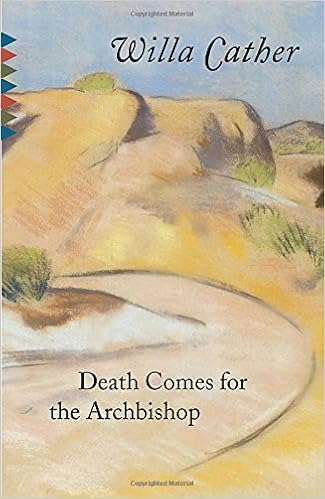
Death Comes for the Archbishop by Willa Cather

The Bishop sat a long time by the spring, while the declining sun poured its beautifying light over those low, rose-tinted houses and bright gardens.  The old grandfather had shown him arrow-heads and corroded medals, and a sword hilt, evidently Spanish, that he had found in the earth near the water-head.  This spot had been a refuge for humanity long before these Mexicans had come upon it.  It was older than history, like those well-heads in his own country where the Roman settlers had set up the image of a river goddess, and later the Christian priests had planted a cross.  This settlement was his Bishopric in miniature; hundreds of square miles of thirsty desert, then a spring, a village, old men trying to remember their catechism to teach their grandchildren.  Their Faith planted by the Spanish friars and watered with their blood was not dead; it awaited only the toil of the husbandman.

It was really interesting to re-read Death Comes for the Archbishop on the heels of CeremonyIn the latter Silko adds the white missionaries who came to the indigenous populations of New Mexico to the forces of witchery, the colonialist evil that Tayo must expunge through a traditional Pueblo ceremony.  Willa Cather's account of Bishop Jean Latour--a fictionalized version of the real Bishop Lamy--quite obviously does not feel the same way.  But it's also not that far off as you might suppose.  Cather has a keen appreciation for the indigenous people Latour ministers to that seems respectful without being patronizing, and though Latour himself is a paragon of gentleness, he arrives to a church in disarray, represented by men who use the wild remoteness of the land to abuse others.  At the mesa-top community of Acoma, Latour muses that the beautiful church, constructed of giant wood beams that must have been carried for hundreds of miles by workers who were little more than slaves, represents a great cruelty.  (For this crime and others we learn that the former priest of Acoma was unceremoniously tossed off the mesa.)

In fact, Death Comes for the Archbishop is full of cruelty, from the Mexican priests who refuse to give up their fiefdoms to the new French Archbishop to the poor whites who murder supplicant travelers.  Or the protestant family that refuses to let their Mexican servant see a priest or attend the Catholic church of her upbringing.  It's easy to miss these things because Cather's style is as gentle as Latour himself.  My memory was of a novel where nothing much happens, but that's not true.  A lot happens, but it plods by episodically with the easy grace of a man whose eyes are set on higher things.

I liked the novel more on this re-reading for several reasons.  I knew that the novel isn't really about the Arcbishop's death, but rather his life--a surprise which, subtle as it is, threw me the first time.  Or perhaps it's more correct to say it's about a friendship, that of Latour and his vicar Father Joseph Vaillant, boyhood friends from France who have come together to serve God in the desert.  One way of reading Death Comes for the Archbishop is as a study of goodness; both Latour and Vaillant are scrupulously kind and pious men, but in wildly different ways.  Whereas Vaillant is an outgoing populist who serves passionately among the most deprived, Latour is a quieter, more contemplative man whose passion for his people comes perhaps from a deeper understanding.  Latour says that Vaillant "must always have the miracle very direct and spectacular, not with Nature but against it.  He would almost be able to tell the colour of the mantle Our Lady wore when She took the mare by the bridle back yonder among the junipers and led her out of the pathless sand-hills, as the angel led the ass on the Flight into Egypt."  Another reason I liked it more this time is that a friend pointed out to me the way in which Archbishop is a model for Marilynne Robinson's Gilead, a study of a good and quiet man of the cloth.  Both novels are remarkable because they believe that good can be as interesting, and as multiform, as evil.

Not far from his humble church in Santa Fe, Latour finds a single golden hill whose rock he decides will form his cathedral.  In contrast to the priest at Acoma, extracting it will be no unnecessary burden.  In contrast to the priest at the heart of William Golding's The Spire, he desires the cathedral not in vanity but in hope that it will make a permanent thing of beauty.  He tells Vaillant, "the Cathedral is not for us, Father Joseph.  We build for the future--better not lay a stone unless we can do that."  Doubtless Silko would read the cathedral's symbolism differently.  For me, it was wonderful to walk out of our rented apartment in Santa Fe and walk a few short blocks down to the plaza, four hundred years old, and see the thing itself, still gold, framed by a red mountain.  It allowed me to really understand both the reason and the beauty in Latour's words.

They frame also the final chapter of the book, which shares its title.  Though the book isn't really about Latour's death, like I said, the final chapter does contain its most compelling language, and its most beautiful observations about human life.  It's the kind of stuff that makes you want to quote without comment:

In New Mexico he always awoke a young man; not until he rose and began to shave did he realize that he was growing older.  His first consciousness was a sense of the light dry wind blowing in through the windows, with the fragrance of hot sun and sage-brush and sweet clover; a wind that made one's body feel light and one's heart cry "Today-today," like a child's.

How about:

The air would disappear from the whole earth in time, perhaps; but long after this day.  He did not know just when it had become so necessary to him, but he had come back to die in exile for the sake of it.  Something soft and wild and free, something that whispered to the ear on the pillow, lightened the heart, softly, softly picked the lock, slid the bolts, and released the prisoned spirit of the man into the wind, into the blue and gold, into the morning, into the morning!

How remarkable that that passage isn't about the Archbishop's death, but rather the experience of his life!  When Latour does begin to die, Cather writes about it as an experience not of diminution but of enlargement and expansion:

He observed also that there was no longer any perspective in his memories.  He remembered his winters with his cousins on the Mediterranean when he was a little boy, his student days in the Holy City, as clearly as he remembered the arrival of M. Molny and the building of his Cathedral.  He was soon to have done with the calendared time, and it had already ceased to count for him.  He sat in the middle of his own consciousness; none of his former states of mind were lost or outgrown.  They were all within reach of his hand, and all comprehensible.

Does one have to be as good a man as Latour to have as good a death?  I don't know.  I hope not.  But I do know that Cather is one of the only authors who can make death seem not only not frightening but perhaps even pleasant.

In the midst of the Archbishop's dying Cather stops to recount the story of the Navajos who, after being expelled to the other side of the Rio Grande, were allowed to return to their ancestral lands after a campaign of rebellion against the U.S. government.  It's a story I didn't know, and a rare reprieve in the long and sorry history of U.S.-Native relations.  It might seem like a strange digression from the Archbishop, but I think that Cather tells it because it represents a kind of reconciliation that parallels the reconciliation at the heart of Christian religion, the reconciliation that is promised to the Archbishop, who lies on his deathbed thinking about his boyhood in France with his friend Vaillant, himself long since dead.  If God has the power to return life to the dead, friend to friend, perhaps He can also return the Native peoples of America to the full vitality that was stolen from them.

Wednesday, January 1, 2014

Monsignor Quixote by Graham Greene

"Perhaps we are all fictions, father, in the mind of God."

I have had this book on my shelf for a long time, waiting to read it until I had finished Don QuixoteAs I have said before, I think that the compulsion to model or remake canonical texts is risky; most often the result is a constant reminder of how far short modern literature falls of our greatest forebears.  Graham Greene's Monsignor Quixote is no exception, I think.  While it is often touching and thoughtful, I thought that its attempts to reimagine the journey of Don Quixote and Sancho in post- Franco Spain were the least effective aspects of it.

Greene's Quixote is a priest, supposedly the descendent of Cervantes' hero.  He does not get on well with his superior, but his hospitality toward a bishop passing through La Mancha results in his nomination as a monsignor, which mortifies his sense of humility.  His friend Sancho, a Communist and former mayor of their town of Toboso, compels him to take a leave of absence and a brief trip to Madrid to purchase the purple socks and pechera of his new station.  In Greenesque fashion, the journey is complicated when the pair inadvertantly invite the attention of the Fascist police and end up on the run.

Monsignor Quixote and Sancho often pause to acknowledge, with a smirk, the parallels between their "journey" and Don Quixote's.  This approach works as well as it does because Greene wisely foregrounds it, keeping the protagonists aware of the allusions, and thus keeping Monsignor Quixote squarely in the metafictional tradition that started with Don Quixote's second part.  And the differences are just different enough--Sancho, for example, is no fool, but a cagey, thoughtful man.  Like Cervantes' heroes, the friendship between the two is unbreakable, even in the face of their philosophical differences.  I particularly liked a scene where Sancho takes the unknowing Monsignor to a whorehouse, where he tries to blow up a condom like a balloon.

Greene has a couple different goals here, I think.  He wants to draw a parallel between the two Quixotes, who are both committed to supposedly outmoded literary traditions.  Just as the Knight of the Sorrowful Face has his books of chivalry, the Monsignor has his Bible, and I think Greene is elegizing a Catholicism that he sees passing away in the conflicts of the mid-twentieth century.  At one point Sancho tells Monsignor Quixote that, were he to read the letters of Saint Paul, "I would find your taste as absurd as Cervantes found your ancestor's."  Yet that doesn't seem right; even while he pokes fun at Don Quixote, Cervantes always seems to hint that his outmoded moral code makes him a better and nobler man than the people he meets.

But also I think Greene is trying to envision a union of Catholicism and Communism that preserves the Church's commitments to the poor and the spiritual life in the face of venal capitalism.  I know Brent's favorite scene from this novel occurs at the end, where a feverish Monsignor performs a kind of "phantom" mass without the elements--an assertion of the power of even imaginary sacraments, though probably not theologically sound, with the Catholic insistence on Christ's immanence in the wafers and wine.  But my favorite scene is the one that occurs just before, when the Monsignor comes upon a small-town parade that includes an effigy of Mary papered in bank notes:

Father Quixote could not understand what he saw.  He was not offended by the customary image, with the plaster face, and the expressionless blue eyes, but the statue seemed to be clothed entirely in paper.  A man pushed him to one side, waving a hundred-peseta note, and reached the statue.  The carriers paused and gave him time to pin his note on the robes of the statue.  It was impossible to see the robes for all the paper money--hundred-peseta notes, thousand-peseta notes, a five-hundred-franc note, and right over the heart a hundred-dollar bill.  Between him and the statue there were only the priest and the fumes of the incense from his censer.  Father Quixote gazed up at the crowned head and the glassy eyes which were like those of a woman dead and neglected--no one had bothered even to lower her lids.  He thought: Was it for this she saw her son die in agony?  To collect money?  To make the priest rich?

Now, this scene wins no points for subtlety.  But it seems timely, like a lesson that we have yet to learn, one that is certainly as true in 21st century United States of America as it was in mid-century Spain.  Monsignor Quixote is far from my favorite Greene novel--I'm not sure it is measurably improved by the often-goofy references to Cervantes, which may even distract from what a strong and sympthetic character the Monsignor is.  But scenes like the one above continue to resonate--and perhaps even chasten me.

Sunday, March 10, 2013

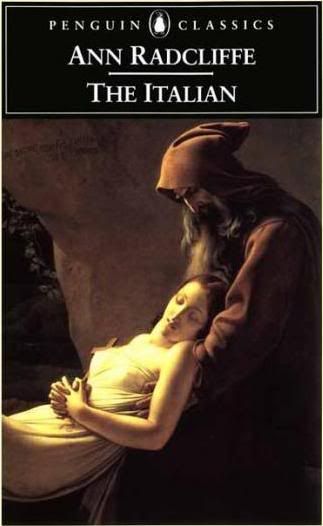
The Italian by Ann Radcliffe

I want to get this out of the way now: The Italian is a dumb title.  The whole damn book takes place in Italy, and there's not a single character who isn't Italian, so who is this supposed to refer to?  The young protagonist, Vivaldi?  His beautiful but common love interest, Ellena?  Or the sinister monk Schedoni, who secretly plots on behalf of Vivaldi's mother to prevent an unfavorable marriage by kidnapping Ellena and hiding her in a nunnery?

Now that I've gotten that off my chest, I can focus on the book itself.  You know, I had two basic impressions of Radcliffe from Austen's parody of her work in Northanger Abbey: Her books were pulpy and engaging, but overall she was a poor writer--the Dan Brown or Stephenie Meyer of her day.  Both of these impressions are wrong.  The Italian continuously impressed me by the quality of its language, but it fails to be engaging after the first few chapters.

Coming as I was from the rather stilted and laborious prose of Caleb Williams and Maria, Radcliffe's quick, capable prose was really refreshing.  She has a particular knack for scene-setting--descriptions of towering mountain vistas, or obscure ruins, or shadowy dungeons--that supports her interest in 19th century ideas of the sublime, the idea that the soul can be enlarged and developed by the majesty of nature.  Ellena, trapped in the nunnery with the help of the cruel Prioress (Catholics don't come off too well in this genre), is secretly given access by a friendly nun to a tower overlooking the tremendous beauty of the Italian landscape, which gives her the strength to go on.  The passage I want to share here, however, is the one where Vivaldi is being carted off to Rome to face the Inquisition:

After quitting the Corso, it proceeded for some miles through dark and deserted streets, where only here and there a lamp, hung on high before the image of a saint, shed it's glimmering light, and where a melancholy and universal silence prevailed.  At intervals, indeed, the moon, as the clouds passed away, shewed, for a moment, some of those mighty monuments of Rome's eternal name, those sacred ruins, those gigantic skeletons, which once enclosed a soul, whose energies governed a world!


I love this because 1.) I'm really fascinated by the fact that Rome, once the center of the Western world, had become nearly a ghost town for centuries, vacant except for the Holy See, and 2.) It's a good example of the kind of suspense and terror that Radcliffe tries, and only infrequently manages, to achieve.

Radcliffe believed that terror was also an agent of the sublime, and could enlarge the soul, but she contrasted it against horror, which was more explicit.  Terror is only beneficial when it is ambiguous, predicated on the fear of the possible and not the shock or disgust of real violence.  But this philosophy, at the extremes to which she takes it, is untenable.  First of all, when there is no payoff for our apprehension, the threat diminishes.  Like a 19th century Velma, Radcliffe loves to go back and explain away the sources of fear.  We must know, for example, that the bloody surplice discovered in the ruined palace belonged to a character who had been shot with a stray bullet fired by a character we had forgotten about, and who was inserted just so that such an explanation can be dredged up later.

Secondly, Radcliffe has no conception that there are diminishing returns to this stuff.  As if one scheming, shadowy monk wasn't enough, Radcliffe introduces a second one, and then in the final scenes where Vivaldi must go in front of the Inquisition, suddenly we're in a dark room filled with like twenty scheming, shadowy monks and it all seems a little ridiculous.  Was it really necessary for Austen to parody this, when it does such a good job of parodying itself?

There are elements to The Italian that really work.  The love story between Vivaldi and Ellena, devoted to each other across class barriers, is wonderfully compelling even though the characters themselves are thinly drawn.  But I think that it's not a book one can love in the 21st century, when our bogeymen are made by Industrial Light and Magic.

Friday, February 22, 2013

Not Less Than Everything, edited by Catherine Wolff

The concept of discipleship is helpful here: obedience to external commands is never enough. Our behavior, our motivation, our identity should reflect the teachings and the example of the one we are following.

Heresy is a tricky thing. Do it right, and you end up Martin Luther, lionized for throwing off the shackles of a legalistic and ungodly institution. Do it wrong, and you end up ostracized, forgotten or, worse, mocked by history, a cautionary tale.

The original blurb for Not Less Than Everything was something along the lines of, “Catholic writers write about their favorite heretics,” and, of course, how could I pass that up? Having read the book, I don’t think the description does it justice, but it was helpful in keeping me in the right mindset--namely that striking out, passively or actively, against the Catholic Church was a big deal. As a Protestant, I can just find a new church. A devout Catholic may believe, like the Whiskey Priest in The Power and the Glory, that excommunicated from the church he's damned. It adds weight to the decisions faced by the various “saints” in the book, not all of which have been--or, in the case of a few, ever will be--beatified. What they have in common, however, is their willingness to put their fate in God’s hands, trusting that following Christ’s example takes precedence over strict adherence to every papal edict.

As in most essay collections, the quality of the writing in Not Less Than Everything varies a fair amount. Some of the essays, such as the one on Max Scheler, are a bit esoteric; others, such as the scintillatingly titled, “A Pastoral, Person-Oriented Theology Worthy of Vatican II”, are just dry. Most, however, take an interesting approach to their subjects without lapsing into hagiography or strict biography. The best essays, in fact, tend to be the ones that treat their subjects as a jumping-off point, like Tom Beaudoin’s essay on Ignatius of Loyola, which he uses to make a larger point about the unstable relationship between critically thinking about one’s religion and blindly accepting it, and Ann Patchett’s The Worthless Servant, which tells a simple but powerful story of a priest who goes out to the highways and byways, giving cold glasses of water in Jesus’ name.

My favorite essay in the collection is the most different. “I Pray I May Be Ready With My Witness” tells of the conversion and struggles of troubled poet John Berryman. Berryman is one of my favorites, and reading about his childhood, his conversion, and his eventual suicide was heartbreaking. It is written by Paul Mariani, who I’d never heard of, and I’d like to close the review with an excerpt:

Protesters were being tried, imprisoned and fined, while others--college students--were being gunned down for refusing to participate any longer in the madness of Vietnam. The homeless were still homeless and the hungry went on being hungry. And, yes, his own body was failing and, yes, he had made mistakes and, yes, he was a human wreck, but he would bear witness in a terrible time as best he could. He hoped and prayed the heretic Origen was right after all and that Hell was “empty / Or will be at apocatastasis,” that is, at the end of time. Human failure--sin--seemed inevitable, given who and what we were. And, yes, no doubt we would suffer for it “now & later / but not forever, dear friends & brothers!”

I like to think of John Berryman as the patron saint of purgatory, shoulders hunched, still climbing on all fours the steep inclines of those mountains toward that distant summit shimmering in light, relieved to know he can sin no more.

Sunday, September 23, 2012

The Good Pope by Greg Tobin


Giuseppe Roncalli. Pope John XXIII. Il Buono Papa. Whatever name he is called by, he is an emblem of the modern Catholic church, the initiator of Vatican II, which brought about massive and controversial changes to the Catholic church. I knew nothing about John XXIII when I received this book, and I was impressed reading his story.

Unlike many popes throughout church history, John XXIII didn’t come from an aristocratic or high church background. He was the son of a poor farmer who rose to prominence on, essentially, his good reputation and seemingly inexhaustible compassion and willingness to work for the poor. This led to his promotion through the Catholic ranks and his eventual election—by electors who probably expected him to be a placeholder pope—to the highest office in the Catholic church.

I am not Catholic or exceptionally well-versed in Catholic history, so I can’t speak for the accuracy of Tobin’s book. Based on the material presented here, John XXII comes off extremely well—devout without being a scold, committed to his work without neglecting his friends and family, able to lead without being haughty. My favorite anecdote in the book concerns Paul XXIII’s modifications to the papal gardens: he had a sprinkler installed with a remote control so he could soak cardinals as they walked through the garden. It’s a funny story, but also serves as a fitting metaphor for John’s entire papacy, as he attempted to puncture some of the unnecessary pretentions of the church, such as the Latin mass, without losing what he saw as truly important. Tobin does a good job through this short biography of making John XXIII an interesting character in spite of the fact that he seems to have very few dramatic flaws. The Good Pope is, then, primarily the story of a good man who does great things within his sphere of influence. There’s very little in the way of scandalous secrets or backroom dealings—with Rocalli, according to Tobin, what you see is what you get. 

Although I’m not Catholic, I am a Christian and found portions of John XXIII’s life inspiring. I wonder, however, how interesting a non-religious person would find this bio. I found the political aspects surrounding Vatican II extremely interesting, but John XXIII’s spiritual journey is undeniably the core of the book (Vatican II has hardly begun when John passes away). I suppose that, religious or not, we can all find something inspiring in a man who put feet to his beliefs so effectively and consistently. I’ll be interested to see what Carlton has to say about the book when he reviews it later this month.

Tuesday, March 27, 2012

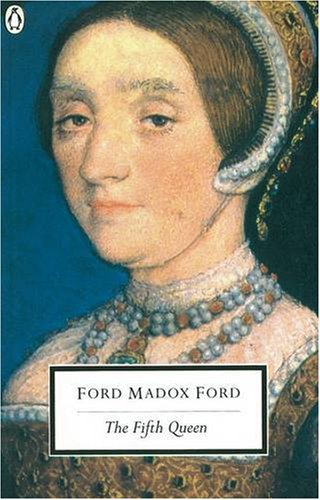
The Fifth Queen by Ford Madox Ford

During the time that had ensued between January and that month of March, it had been proved to Katharine Howard how well Throckmorton, the spy, voiced the men folk of their day. He had left her alone, but she seemed to feel his presence in all the air. He passed her in corridors, and she knew from his very silence that he was carrying on a fumbling game with her uncle Norfolk, and with Gardiner of Winchester. He had not induced her to play his game--but he seemed to have made her see that every man else in the world was playing a game like his. It was not, precisely, any more a world of black and white that she saw, but a world of men who did one thing in order that something very different might happen a long time afterwards.

Ford Madox Ford is always good for a misleading title, so it may surprise no one that in The Fifth Queen Kataerine Howard, who will succeed Anne of Cleves as the wife of Henry VIII, never quite makes it to the throne in this, the first in Ford's trilogy. Instead it depicts something not unlike the beginning of the historical Katharine's relationship with Henry. It is true that she was first a lady-in-waiting in the King's court, but in the service of Queen Anne, not the King's daughter, Mary, and it isn't likely to be true that Henry chanced upon her on the palace grounds riding a mule and, dazzled by her beauty and wit, impressed her into that service. Nor was the historical Katharine a virulent Catholic bitterly opposed to Thomas Cromwell, the Protestant standard-bearer and Lord of the Privy Seal:

The face of a queen looked down just above his head with her eyes wide open as if she were amazed, thrusting her head from a cloud.

'Why, I have outlived three queens,' he said to himself, and his round face resignedly despised his world and his times. He had forgotten what anxiety felt like because the world was so people with blunderers and timid fools full of hatred.


Cromwell sees in Katharine an opportunity to plant a spy in the Catholic Mary's service. Katharine refuses, but quickly finds herself embroiled in the shadowy sectarian conflict that rages beyond the King's notice. She withstands the threats and manipulations not only of Cromwell and his spies but Bishop Gardiner, the country's leading Catholic, who she had idolized. She struggles to maintain her honor and honesty against the moralizing of men like Throckmorton, who may or may not be double dealing against Cromwell:

'How shall you decide what is vileness, or where will you find a virtuous man?' he asked. 'Maybe you will find some among the bones of your old Romans. Yet your Seneca, in his day, did play the villain. Or maybe some at the Court of Mahound, I know not, for I was never there. But here is a goodly world, with prizes for them that can take them...'


Katharine soon learns that everyone is after these "prizes"--that is, except the King, who seeks only the prize of her company. Henry is the most intriguing and magnetic character here: impulsive and irascible, yet truly interested in the pursuit of "right doctrine," a notion lost on men like Cromwell and Gardiner, whose beliefs seem to serve only their ambitions. Perhaps his position as king affords him that right, but it is also a position he uses to lift Katharine out of harm's way at the book's finale, realizing keenly that she is a kindred soul.

But The Fifth Queen seems ultimately like a chronicle of lost opportunities. One wonders why Ford saw the need to transmogrify the historical Katharine into a Catholic stalwart if the religious issues were going to be glossed over. The idea of a Renaissance spy novel sounds great, but the intrigue is a muddle. Everything is a muddle, actually; as an early attempt by Ford to achieve an "impressionist" style, which reproduces the world as it is experienced and seen, The Fifth Queen succeeds mostly in making the particulars of action and location very unclear. Its greatest successes are in its population of minor characters, like the womanizing teacher Magister Udal, or the aged but infamous knight Sir Rochford.

On the other hand, as the first book in a trilogy, this can only amount to a half-finished opinion. I have faith in the abilities of Ford, who is capable of sneaking up on you unawares in a way that few authors are, so I hope for more from The Privy Seal and The Fifth Queen Crowned.

Tuesday, January 17, 2012

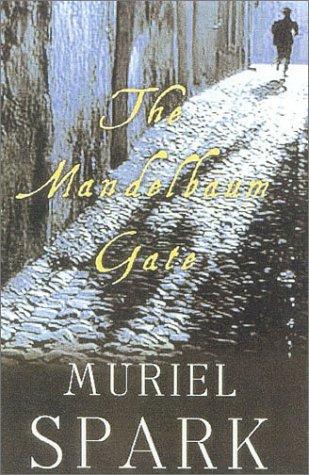
The Mandelbaum Gate by Muriel Spark

Arabs lived in the shelter of the eighteenth-century ruined fortresses, and even now in the years of the establishment of Israel, burning with its mixture of religion, hygiene, and applied sociology, the poor Arabs still hung their washing on the battlements, so that it fluttered all along the antique sea-front, innocent of the offence it was committing in the eyes of the seekers of beautiful sights and spiritual sensations, who had come all the way from the twentieth century, due west of Acre. Indeed, the washing draped out on the historic walls was a sign or progress, enlightenment, and industry, as it had been from time immemorial; it betokened a settlement and a society with a sense of tomorrow, even if it was only tomorrow's clean shirt, as against the shifty tent-dwelling communities of the wilderness; and however murky the cave-like homes along the shore, nad however indolent the occupants, they were one up on the Bedouin, at least in their own eyes if not in the sight of the tourist cameras which photographed the Bedouin shepherds continually but deplored the hung-out washing at Acre.

The Mandelbaum Gate is Muriel Spark's longest book (at a whopping 320+ pages), and bears few of her trademarks. It is surprisingly compassionate toward its protagonists, short on death and tragedy, though the subject matter might have easily invoked Spark's more violent tendencies, and at times borders on florid (the above passage is two sentences!).

But then again, its protagonist, Barbara Vaughan, is the most like Spark of all heroines, so perhaps it's unsurprising that Spark felt kindly disposed toward her, and her attention captured for longer. Like Spark, Vaughan is a half-Jewish, half-Protestant convert to Catholicism. The setting is Jerusalem, 1961, a city separated into an Arab and a Jewish half by the title gate, which is closely guarded and travel restricted. Barbara's fiance, an archaeologist, is working on the Arab side of the border, and Barbara undertakes to pass through, knowing that her Jewish blood puts her at danger even though she is a British citizen.

Such a premise threatens to devolve into a very Graham Greene-like spy caper, but Spark slyly buries the most espionage-like elements into b-plots and isolated moments. Instead, Barbara lingers at the Christian shrines in Jordan, disguised as an Arab woman, catches scarlet fever, and lingers in a sick bed--in short, there is simply too much lingering for The Mandelbaum Gate to qualify as a caper of any kind.

Instead, what Spark delivers is an uncharacteristically deft exploration of the multifarious perspectives on the Holy Land. One of my favorite passages is the one above, which describes the way that the residents of Acre struggle to maintain a present existence against the expectation of tourists and pilgrims, whose in their faith paradoxically seek to deaden and ossify the shrines they visit. In another passage, a collection of friars at the Church of the Holy Sepulchre look on in horror as a visiting priest cautions his congregation against trusting the claims of every shrine:

The three friars gazed at the priest as with one gaze. They had known it. The incipient defroque was undermining the Holy Land, as he went on to enumerate for practical purposes the shrines which his pilgrimage might well skip and the dubiety of their origins, their thoughts went to their brethren, the custodians of the Holy Land to whom these places were their whole heart and life; tears came to the eyes of the eldest friar as he thought of the venerable Franciscan, well past ninety, who kept the house where Our Lady was conceived by St. Joachim and St. Anne, and who had wanted nothing for himself all his life but to show it to the pilgrims and pray with them as they came, and collect alms for the poor of the place, and die there on that spot.


Again we are faced with the essential oxymoron created when the word Holy collides with Land; without a doubt the priest is the more literally correct, but his neatly ordered faith leaves no room for the lives of those that still live in Israel--or, as the Arabs in the book call it, Occupied Palestine.

In a broad sense, the Mandelbaum Gate itself provides a symbol of this conundrum, illustrating the difficulty of moving from one's own perspective into another's:

He followed the ancient walls of the city and Temple, past the gates of historic meaning, sealed and barred against Israel--the Zion Gate, Dung Gate, Jaffa Gate, New Gate. Then St. Stephen's Gate opened within the Old City to another medieval maze of streets--Damascus Gate, that gate of the Lord's triumphal entry into Jerusalem on Palm Sunday, and HErod's Gate. He walked round the city until at last, fumbling in his pocket for his diplomatic pass, he came to the Mandelbaum Gate, hardly a gate at all, but a piece of street between Jerusalem and Jerusalem, flanked by two huts, and called by that name because a house at the other end once belonged to a Mr. Mandelbaum.


But then again, the Mandelbaum Gate carries a different symbolic charge for each character. For the Arab Abdul Ramdez, the gate is the division of his family, as it separates him from his beloved sister, Suzi. For the normally staid English diplomat, Freddy Hamilton, who helps Barbara pass through into Jordan against his character, it is the inaccessible wall that prevents him from recovering his memories of the pilgrimage, through which he seems to inhabit some sort of fugue state. For Barbara, it is the artificial barrier between her Jewish self and Gentile self, that if only it were opened, may provide a total sense of identity:

She had thought then, but who am I?
I am who I am.
Yes, but who am I?


Spark is both canny and blasphemous enough to note the echo of Jehovah's words in Exodus, "I am that I am." If Barbara, made in God's image, cannot get a picture of herself, what then of God? The Holy Land is fractured, Spark maintains, because our view of God is fractured. Just as uncharacteristically, Spark ends the book optimistically, in the passage just above, as Freddy wanders through Jerusalem looking at the gates. Most are shuttered, but the Mandelbaum remains--the only entry way from one side of Jerusalem to the other--and it seems very small and mean, "flanked by two huts," and perhaps even comic. Can such a barrier really be insuperable?

Tuesday, January 18, 2011

Death Comes for the Archbishop by Willa Cather

James Wood calls the final chapters of Willa Cather's Death Comes for the Archbishop some of the most beautiful in the English language. To be sure, the final chapters are where the most striking moments lie:

In New Mexico he always awoke a young man; not until he rose and began to shave did he realize that he was growing older. His first consciousness was a sense of the light dry wind blowing in through the windows, with the fragrance of the hot sun and sage-brush and sweet clover; a wind that made one's body feel like and one's heart cry "To-day, to-day," like a child's.


Cather paints death in the bright, pastel colors of the Southwest; for Jean Marie Latour, the Archbishop of New Mexico, death seems to hold little anxiety. Latour tells us that he will "soon be done with calendared time," a phrase that reduces death--and life--to little more than a material object. Death Comes for the Archbishop is mostly free of individual conflict; Bishop Latour's battles are on the larger scale that determines whether the church will thrive or wither in the distant Southwest. It is no wonder, then, that when the final conflict comes, Latour has his mind on greater things.

But Wood's claim reminds me of the Misfit from Flannery O'Connor's "A Good Man is Hard to Find," who says of his latest victim, "She would of been a good woman... if it had been somebody there to shoot her every minute of her life." Death Comes for the Archbishop is best when it faces last things, but Cather has the Bishop's entire story to tell. More typical are passages like this:

The streams were full of fish, the mountain was full of game. The pueblo, indeed, seemed to lie upon the knees of these verdant mountains, like a favoured child. Out yonder, on the juniper-spotted plateau in front of the village, the Spaniards had camped, exacting a heavy tribute of corn and furs and cotton garments from their hapless hosts. It was from here, the story went, that they set forth in the spring on their ill-fated search for the seven golden cities of Quivera, taking with them slaves and concubines ravished from the Pecos people.


There's nothing wrong with this, per se. It has a breezy plainness that seems appropriate to the arid setting. Take out the "u" in "favoured" and it could have been written in 1997 as much as in 1927. But it seems to me to work against the story itself: Latour is a French-born priest who served until his thirties in an Ohio diocese; the land he has been chosen to preside over stretches across thousands of miles, many of them desolate and sparsely populated. Yet we know the name of every cactus and shrub in New Mexico. Cather takes frequent breaks from Latour's story to tell us ones about Spanish explorers and native Americans like the one above. This surfeit of knowledge, combined with the dry style, veers to the tedium of mediocre travelogues. Does this reflect the mystery, the strangeness, the wonder of what someone like Bishop Latour must experience in this unknown wilderness?

But death is a wilderness about which neither Latour or Cather can overwhelm us with details. It is the quintessential "undiscovered country." In spite of his dismissal of it, death makes Latour more interesting and elevates the novel. If you believe your life is boring, you may want to think of that inevitability with some comfort.

Saturday, November 27, 2010

Memento Mori by Muriel Spark

They were assembled once more in the dining-room where a fire sparkled weakly in the sunlight.

Henry Mortimer said: "If I had my life over again I should form the habit of nightly composing myself to thoughts of death. I would practise, as it were, the remembrance of death. There is no other practise which so intensifies life. Without an ever-present sense of death life is insipid. You might as well live on the whites of eggs."

Memento Mori, if it had not been for The Prime of Miss Jean Brodie, would probably be now remembered as Muriel Spark's most significant novel. It continues to make itself available to contrarians who would call it, contra Brodie, her masterpiece, and indeed it possesses a kind of fullness, or richness, that her non-Brodie books often seem to lack.

The cast is unwieldy, a panoply of eldlerly figures coming to terms with the end of their lives. All are curmudgeonly, and some downright senile:

"I have quite decided to be cremated when my time comes," said Godfrey. "It is the cleanest way. The cemeteries only pollute our water supplies. Cremation is best."

"I do so agree with you," said Charmian sleepily.

"No, you do not agree with me," he said. "R.C.'s are not allowed to be cremated."

"I mean, I'm sure you are right, Eric dear."

"I am not Eric," said Godfrey.


One by one, each of them begin to receive anonymous phone calls that tell them, "Remember that you must die." This is the memento mori of the title--an allusion to the lone figure that, when a Roman emperor or general would receive a triumph, or victory parade, through the heart of the city, would lag behind him whispering a humbling reminder of his mortality. In Rome it was a check against the ambitions of the powerful, but these characters have only delusions of power, and age and death--by means of spurious wills--threaten to bring masters on equal footing with their servants. No emperors can be found here.

Instead, these phone calls ought to be a warning against pettiness and unscrupulousness: Your last days are a time to make things right. But the old folks of Memento Mori are obstinate, and cling to old jealousies, ancient affairs, bizarre sexual perversions, and insidious blackmail. They obsess over the identity of the caller--who, it is suggested, may have supernatural origins--but only rarely do they ever stop and consider the implications of the caller's message.

Spark was 41 when she wrote Memento Mori, which you might call novelist-young. She persisted, according to Stannard's biography, quite crankily into her late eighties. One wonders, when faced especially with the character of Eric--the spoiled, untrustworthy son of Charmian, a once-successful novelist--whether the novel is something of a vision of Spark's own convalescence. As it is, Spark never mended her own broken relationship with her son Robin, and in the late stage of her life they came very much to resemble Eric and Charmian.

Is the title of the book, in Spark's case, advice unheeded? The characters that deal most positively with the anonymous calls are the ones who are most religious (like Charmian, when her senility wanes), and as such Memento Mori is presented as a defense of Spark's mid-life conversion. But if we can grant Spark some measure of clairvoyance--or perhaps, acknowledging her persistent obsession with control both in life and literature, a considerable measure of self-determinism--it comes also to a recognition of the difficulty of truly setting one's mind on last things.

Saturday, October 9, 2010

Wise Blood by Flannery O'Conner

The boy didn't need to hear it. There was already a deep and black wordless conviction in him that the way to avoid Jesus was to avoid sin. He knew by the time he was twelve years old that he was going to be a preacher. Later he saw Jesus move from tree to tree in the back of his mind, a wild ragged figure motioning him to turn around and come off into the dark where he was not sure of his footing, where he might be walking on the water and not know it and then suddenly know it and drown.

Spoilers abound.

Chris read Wise Blood last year, and it stumped him, to use his words. He talks about it at length in his review, and I can’t disagree with him—this is a difficult book that seems completely packed with ideas, many of which seem strong enough to carry a novel themselves. Tying them all together is quite a challenge.

A summary of the plot: We begin following Hazel Motes, a disillusioned former Christian who would now probably be considered a nihilist. He doesn’t believe in Christ, or redemption, or sin. We meet him on the way to a new town, where he meets the novel’s other central characters: Enoch Emery, an 18-year-old looking for a father figure and some direction, Asa Hawkes, a street preacher pretending to be blind, and his daughter, a teenage girl named Sabbath Lily Hawkes. Hazel hears Asa preaching and, offended by his message of Jesus, decides to begin preaching himself, founding a movement he calls the Church of Without Christ. He also decides to seduce Asa’s daughter to prove his commitment to his new beliefs. After preaching for several weeks without a single convert, Hazel’s ministry is co-opted by The Holy Church of Christ Without Christ, which employs a Hazel lookalike. Angered by their cynical co-option of his belief system—they don’t actually believe it and are charging members to join—Hazel attempts to sabotage their work, escalating his attacks until he commits homicide. There’s more to the story, but I’m going to halt the summary there.

Enoch has what the novel calls “wise blood”, a sort of mild psychic ability that shows him the tiniest bit of the future and guides his life. There is no particularly straightforward way to tie this to the rest of the narrative, but here’s what I’ve come up with. Early on in their relationship, Enoch tells Hazel that he doesn’t believe in Jesus much, but that he does have his father’s “wise blood” which guides him. I see parallels between the “wise blood” and Christ—that is, as full of Christ figures as Wise Blood is, the titular blood may be one itself.

There are similarities between Enoch’s “wise blood” and Asa’s “spirits” in that both are nearly irresistible and both give seemingly poor guidance: Asa feels led to blind himself, and upon being unable to do so forsakes his faith entirely; Enoch is compelled to steal a mummy from a museum to be a “new Jesus”, which he does, indirectly leading to Hazel’s shift in belief, which seems to be the point on which the novel turns. Looking at Enoch v. Asa in this way brings up an interesting question. That is, Asa’s decision, which seems reasonable, has only negative consequences, while Enoch’s, which seems stupid, may in fact have led to Hazel’s awakening, if not quite his redemption.

There’s a lot here about identity and honesty. No one in Wise Blood is particularly honest. Hazel at first seems to be telling the truth, but there are hints that he’s deceiving himself when he says he doesn’t believe in Christ. His initial reasoning for rejecting Christ is that without Christ, there is no need for belief. Consequently, there is no way he can commit any sin—there’s no sin without an ultimate moral authority, after all—and, as a result, he doesn’t need redemption from Christ or anyone. This is oddly circular and seemingly sincere until, in the closing pages of the novel, Hazel tells his landlady, who is also not what she seems, that he is “not clean”. Additionally, throughout the novel, characters mistake him for a preacher—perhaps ironically since he later becomes one, however untraditional—and both Enoch and Sabbath are convinced that Hazel rejects them because he “only wants Jesus”.

Then there’s the weird stuff, like Hazel blinding himself, in an inverse parallel with Asa, which I guess proves that Hazel’s late-period belief in Jesus was more sincere than Asa’s earlier ministerial zeal. There’s also Enoch dressing up in a gorilla suit, a fairly brutal murder, and Hazel’s landlady, seeming important but not introduced until the last 20 pages of the novel. I feel like there are some nice thematic parallels in some of these storylines, but this review is plenty long already.

The characters all end up in situations that seem fairly ambiguous: Sabbath ends up in an orphanage, Enoch ends up in a gorilla costume, which Chris discusses in depth in his review, Asa disappears to who-knows-where, and Hazel, the protagonist, dies searching—or does he? In some ways, the end of Hazel’s story recalls the ending of The Power and the Glory, because both deal with a protagonist seeking redemption he cannot find, and both end somewhat unresolved. We cannot know if Greene’s whiskey priest will be received into Heaven in spite of his inability to make confession, and we are not told the meaning of Hazel’s ultimate fate.

His final scene is bleak—spoiler, he dies—but there’s a bit of light, both literally and figuratively. The last line in the book pictures Hazel as a “pinpoint of light”, and “the beginning of something [that we] cannot begin”. O’Conner seems to foreshadow Hazel’s eventual redemption—a character states near the beginning of the novel that redemption, once received, cannot be rejected—but then holds the reality of that redemption at arm’s length, where we, like the landlady at Hazel’s deathbed, can see it only as a possible beginning we cannot begin. Hazel cannot escape Christ, the real thing or the flawed substitutes, and O’Conner’s God, as inscrutable as He might be, never stops pursuing. It’s sort of a beautiful picture in such a bleak landscape.

Tuesday, September 14, 2010

A Portrait of the Artist as a Young Man by James Joyce

Stephen, following his own thought, was silent for an instant.

-The soul is born, he said vaguely, first in those moments I told you of. It has a slow and dark birth, more mysterious than the birth of the body. When the soul of a man is born in this country there are nets flung at it to hold it back from flight. You talk to me of nationality, language, religion. I shall try to fly by those nets.

Brent once called me the only student of Modernism to have never read Portrait or Ulysses. I thought of not ever reading them just to stick it to that smarmy jerk, but I think instead I'll just refuse to link to his review.

I will be honest and say that at times it was tough going. The length of Portrait--as opposed to the stories of Dubliners, my only previous experience with Joyce--gives the author ample space to show his versatility, but while the very first chapters recount Stephen Dedalus' childhood in the breezy, chopped style that seems germane to the very young, the adult chapters are written in an elongated prose that forces the reader to slow down and follow the snaky paths of Joyce's language. To appreciate it you must get up close, like tracing subtle patterns in design of great size, when trying to behold its entirety your eyes glaze over.

Despite that, the story is simple: Dedalus, Joyce's stand-in, is born into a family of Catholic Irish Nationalists. He briefly flirts with a religious career before deciding that to follow his impulse toward being an artist he must shed the burden of his family, country, and religion. Randy and Brent have both observed that this process is very difficult to appreciate, and I'll concur. I think the problem with Dedalus is that he is so clearly Joyce that there is no larger claim; it is impossible to imagine oneself as Dedalus because the author and character form a closed loop we cannot enter: Dedalus is Joyce is Dedalus and so on.

There is a self-referentiality in this that proves why Joyce is considered the cornerstone of Modernism. Joyce has nothing to say that is not about himself, and Portrait is about Portrait. Dedalus admits as much during a long conversation about the nature of art with a friend:

Is a chair finely made tragic or comic? Is the portrait of Mona Lisa good if I desire to see it? Is the bust of Sir Philip Crampton lyrical, epical or dramatic? Can excrement or a child or a louse be a work of art? If not, why not?


I marked this passage before returning to Randy's review and realizing that he also had chosen it, not because I think that he is fond of it. I'd like to unpack it a little, in response to some of Randy's criticisms.

There is a sublime humor to that first question. Comedy and tragedy were, for Aristotle, the two principle modes of literature and here Dedalus presumes that a chair is, if not literary, then artistic. A chair, like a novel or a play, is something that man creates and so is creative; Dedalus carries this thought to absurdity by wondering if you can say the same thing about poop, children, and lice, all of which are also man's creations. (Supposing, along medieval lines, that lice are products of spontaneous generation.) The unpopular bust of Crampton gets sandwiched between them to suggest bad art veers much closer to the excrement side of things than it does to classic works.

Earlier in the discussion Dedalus says that a thing of beauty has the quality that makes it "that thing which it is and no other thing." He calls it its quidditas, or whatness, but perhaps not intentionally I think this is the wrong word. Quidditas is the quality of a thing that makes it of a type, what you might say to the question "what is it?" The quidditas of a book is something that it shares with other books, by virtue of being books. What he should say, I think, is haecceitas, or thisness, that quality that makes it only itself. Haecceitas is a godly word, and suggests the way that each thing functions according to the design of God. The haecceitas of the finely made chair is that it, as its craftsman intended, it provides the perfect seat. But there is no perfect chair, because the craftsman is not God, and there is no perfect novel because the novelist isn't either. For that matter, what is the haecceitas of a novel?

So the question isn't about the chair, but about the book itself. One reason Dedalus may seem trite to Randy is that for someone who claims to possess inspiration he produces no art besides one thoroughly mediocre poem. This is frustrating, but we're meant to understand that Portrait is in some way the story of its own creation, the product of that inspiration that Joyce calls "pure as the purest water, sweet as dew, moving as music." To buy into Dedalus' sense of inspiration you must buy into the novel, and to do that you must return to Dedalus' sense of inspiration. No wonder then, that for Randy the whole enterprise falls flat--Portrait's greatness is predicated on an assumption of its greatness!

This is essentially what we have been doing in literature for the past century. You might uncharitably call it navel-gazing. The term Dedalus prefers is "lyrical"--"the form wherein the artist presents his image in immediate relation to himself." Randy says that Dedalus' discourse on art offers no new insight and he's right, but what it offers is the peculiarity of a novel talking about itself.

Dedalus must be selfish, because this is literary selfishness. He yearns to express his innermost self, his haecceitas, but he must abandon the quidditas of nationality and religion. I have always found religious comfort in novels, and Portrait makes me uneasy because Dedalus expresses a near encyclopedic knowledge of Catholic history and theology but rejects it anyway. I question how fully he is able to do this, because Portrait, with its long middle section recalling Dedalus' religious frenzy, stands as a testament to how much of his Catholic upbringing he has absorbed.

In my mind one of Modernism's abiding principles is the embrace of traditional forms as a defense against the crippling emptiness of the modern world, expressed perfectly in the novel's last lines:

Old father, old artificer, stand me now and ever in good stead.


The "old artificer" is his namesake, Daedalus, the mythical craftsman who fashioned both the wings of Icarus and the labyrinth of the Minotaur. (And how did both of those stories end?) The line between ancient myth and Catholicism is not straight, but I choose to think of this ending as an affirmation that the old forms are difficult to kill. I know that this line is also a particular favorite of Nathan's, and I'd like to hear his perspective on it.

I am saddened by our collective distaste for this book--not just Randy's virulent kind, but the milder version shared by Brent and myself. It seems that it is the kind of book you could live in, and consider at serious length, but I do not know that it is inviting enough for that.

Sunday, August 22, 2010

The Complete Short Stories of Graham Greene

If you are familiar with any of Graham Greene's short stories, it's probably "The Destructors," the story that Drew Barrymore discusses with Jake Gyllenhaal's English class in the film Donnie Darko. Gyllenhaal uses the story, which is about a gang of teenagers destroying an old man's house from inside, to find inspiration for his own acts of vandalism. Gyllenhaal is led to do these things by visions, but they ultimately exhibit a sense of purpose (though convoluted). In Greene's story, there is no purpose, no why; the Destructors are goaded into their actions by a sadist named T who pursues the destruction of the house with a single-mindedness that only the teenage psyche can possess. The story is a brief, bitter pill, a meditation on the nature of evil, suggesting it exists as a means to perpetuate itself. It's wonderful and Greene-like--Brighton Rock compressed to a diamond.

Greene has never been well known for his stories, except perhaps this one. And rightly so, as far as I can tell. Few of these stories really live up to the spiritual agony that characterize his novels, and some are downright bad. Conspicuously, the earliest and latest stories seem to be the worse offenders, and Greene seems to have had the habit of using the shorter form to tinker with various one-note and half-baked ideas, some of them quite stupid, like "Alas, Poor Maling," which is about a civil servant whose stomach rumblings imitate real-world noises. Really.

But there are a few, like "The Destructors," that can safely be placed among his best work:

The End of the Party -- One thing that Greene exhibits in these stories that he doesn't in his novels is a fair ability to write from the perspective of children. I might also have mentioned "The Basement Room" here, which is from the perspective of a child trying to understand the bitter marriage of his caretaker, but there is something grimly absurd about "The End of the Party": Two identical twins are invited to a birthday party, which fills one of them with fear because at this girl's party every year they are forced to play hide-and-seek, and he is deathly afraid of the dark. His cooler-headed brother tries to figure out a way to get out of it, but the other descends slowly into a hysteria that seems like it might afflict one of Greene's adult characters.

A Visit to Morin -- This one isn't quite as good as the others here--too much of it is a single, long conversation--but I think that it provides a key to understanding something of Greene's own mind that few of his novels permit. M. Morin is, like Greene, a writer well-known for being a Catholic, though an idiosyncratic one. When the narrator meets him, he is a recluse who has turned away from belief, his spirit destroyed by his fellow believers:

He said, 'A man can accept anything to do with God until scholars begin to go into the details and the implications. A man can accept the Trinity, but the arguments that follow...' He gave a gesture of rejection. 'I would never try to determine some point in differential calculus with a two-times-two table. You end by disbelieving the calculus.


English Catholics are a minority, unlike their Continental counterparts, and Greene tended to compound that outsider identity by focusing on characters who were non-believers. I think that M. Morin gives us a glimpse into what I would call a cherished loneliness, Greene's unwillingness to identify with the faith that his work obsesses over.

May We Borrow Your Husband? -- This one might have left Greene open to charges of homophobia--as rightly it would have in a lesser author--but Greene is a deft creator of characters and the story succeeds because the predatory homosexual couple in it are so strongly themselves, and not of a type. The narrator is a loner staying at a seaside resort in Antibes who falls in love with a beautiful woman honeymooning there. The couple, Tony and Stephen, discern that the woman's new husband harbors a repressed homosexuality, and hatch a plan to seduce him. This is an act of unparalleled awfulness, but the story is really about the narrator's inability to do anything to stop it or help the woman. He can't prevent it without dragging the unspoken into the open air, and unable to do anything constructive he most choose the least destructive of destructive paths: Stay silent.

Under the Garden -- I have left this one for last because it is the best. It is one of the finest short stories I have ever read, and to be honest it is not much in Greene's mode at all. This makes it a greater achievement still, because Greene really has a very narrow set of hallmarks that he rarely steps outside of in his longer fiction.

It is a flashback story, nested in a frame in which the protagonist, Wilditch, is informed that he is dying of cancer. He wants to go back and see his childhood home, where his brother now lives. It's a difficult decision, but it is predicated on one of those transcendent sentences that Greene keeps in his back pocket to remind you that he is capable of them:

Why then go back now and see it in other hands? Was it that at the approach of death one must get rid of everything? ...He had the will to possess at that absolute moment nothing but his wound.


There he discovers a story that he had written as a child called "The Treasure on the Island." The island is a small one in a small lake which is part of the old estate; in the story it is much bigger and a young boy there finds a secret treasure.

The story is poor and Wilditch dislikes having written it, not because it is childish but because it bears no likeness to his memory of what actually happened on the island. In the actual story, as he now recounts, Wilditch discovered a cave upon the island that led to a massive underground captain. An old one-legged man named Javitt resides there with his wife Maria. Javitt claims to be hundreds of years old and possess a great treasure; Maria can only say, "kwahk." Javitt attempts to keep Wilditch in the cavern as some sort of heir, instructing him in all sorts of complex nonsense:

'You are a bit scared still of Maria and me because you've never seen anyone like us before. And you'd be scared to see our daughter too, there's no other like her in whatever country she's in now, and what good would a scared man be to her? Do you know what a rogue-plant is? And do you know that white cats with blue eyes are deaf? People who keep nursery-gardens look around all the time at the seedlings and they throw away any oddities like weeds. They call them rogues. You won't find many white cats with blue eyes and that's the reason. But sometimes you find someone who wants things different, who's tired of all the plus signs and wants to find zero, and he starts breeding away with the differences. Maria and I are both rogues and we are born of generations of rogues. Do you think I lost this leg in an accident? I was born that way just like Maria with her squawk. Generations of us uglier and uglier, and suddenly out of Maria comes our daughter, who's Miss Ramsgate to you. I don't speak her name even when I'm asleep. We're unique like the Red Grouse. You ask anybody if they can tell you where the Red Grouse came from.'


This is sustained absurdism, and I wouldn't have thought Greene capable of it. Like the best nonsense, it expresses somethings amid the nothings but provides few clues to determine which is which. Is it madness to be "tired of all the plus signs and want... to find zero," or is it wisdom?

Surely this story cannot be true, so why is it so embarrassing to the adult Wilditch that he wrote down a different story entirely? We are asked to differentiate between false fictions and true fictions, to understand that "The Treasure on the Island" is an outright lie and the story of Javitt something near to truth. The child Wilditch reduced his experience in Javitt's cave to something he could understand, but in understanding it he deprived himself of its most immediate qualities. Is the story of Javitt a religious one, a truth beyond truths? Have we reduced God to a poor story because we have been too frightened of truth's strangeness, its refusal to bend to reason and understanding? In the end, what seems irrefutable is that Wilditch has found something to hold on to, to possess at that absolute moment other than his wound.

These are just a few; I have left out probably a half-dozen great stories and another handful of very good ones. Also compiled here are the first twenty pages of an abandoned novel and a brief treatment of a musical Greene wanted to write about criminals who kidnap a bunch of bishops and take their places. You could argue that it's a shame that Greene never really got the chance to show his versatility, or you could argue that he was a man who knew what he was best at. In either case, this is worth picking up for "Under the Garden" alone.