Showing posts with label long review. Show all posts

Sunday, August 22, 2010

The Complete Short Stories of Graham Greene

If you are familiar with any of Graham Greene's short stories, it's probably "The Destructors," the story that Drew Barrymore discusses with Jake Gyllenhaal's English class in the film Donnie Darko. Gyllenhaal uses the story, which is about a gang of teenagers destroying an old man's house from inside, to find inspiration for his own acts of vandalism. Gyllenhaal is led to do these things by visions, but they ultimately exhibit a sense of purpose (though convoluted). In Greene's story, there is no purpose, no why; the Destructors are goaded into their actions by a sadist named T who pursues the destruction of the house with a single-mindedness that only the teenage psyche can possess. The story is a brief, bitter pill, a meditation on the nature of evil, suggesting it exists as a means to perpetuate itself. It's wonderful and Greene-like--Brighton Rock compressed to a diamond.

Greene has never been well known for his stories, except perhaps this one. And rightly so, as far as I can tell. Few of these stories really live up to the spiritual agony that characterize his novels, and some are downright bad. Conspicuously, the earliest and latest stories seem to be the worse offenders, and Greene seems to have had the habit of using the shorter form to tinker with various one-note and half-baked ideas, some of them quite stupid, like "Alas, Poor Maling," which is about a civil servant whose stomach rumblings imitate real-world noises. Really.

But there are a few, like "The Destructors," that can safely be placed among his best work:

The End of the Party -- One thing that Greene exhibits in these stories that he doesn't in his novels is a fair ability to write from the perspective of children. I might also have mentioned "The Basement Room" here, which is from the perspective of a child trying to understand the bitter marriage of his caretaker, but there is something grimly absurd about "The End of the Party": Two identical twins are invited to a birthday party, which fills one of them with fear because at this girl's party every year they are forced to play hide-and-seek, and he is deathly afraid of the dark. His cooler-headed brother tries to figure out a way to get out of it, but the other descends slowly into a hysteria that seems like it might afflict one of Greene's adult characters.

A Visit to Morin -- This one isn't quite as good as the others here--too much of it is a single, long conversation--but I think that it provides a key to understanding something of Greene's own mind that few of his novels permit. M. Morin is, like Greene, a writer well-known for being a Catholic, though an idiosyncratic one. When the narrator meets him, he is a recluse who has turned away from belief, his spirit destroyed by his fellow believers:

He said, 'A man can accept anything to do with God until scholars begin to go into the details and the implications. A man can accept the Trinity, but the arguments that follow...' He gave a gesture of rejection. 'I would never try to determine some point in differential calculus with a two-times-two table. You end by disbelieving the calculus.


English Catholics are a minority, unlike their Continental counterparts, and Greene tended to compound that outsider identity by focusing on characters who were non-believers. I think that M. Morin gives us a glimpse into what I would call a cherished loneliness, Greene's unwillingness to identify with the faith that his work obsesses over.

May We Borrow Your Husband? -- This one might have left Greene open to charges of homophobia--as rightly it would have in a lesser author--but Greene is a deft creator of characters and the story succeeds because the predatory homosexual couple in it are so strongly themselves, and not of a type. The narrator is a loner staying at a seaside resort in Antibes who falls in love with a beautiful woman honeymooning there. The couple, Tony and Stephen, discern that the woman's new husband harbors a repressed homosexuality, and hatch a plan to seduce him. This is an act of unparalleled awfulness, but the story is really about the narrator's inability to do anything to stop it or help the woman. He can't prevent it without dragging the unspoken into the open air, and unable to do anything constructive he most choose the least destructive of destructive paths: Stay silent.

Under the Garden -- I have left this one for last because it is the best. It is one of the finest short stories I have ever read, and to be honest it is not much in Greene's mode at all. This makes it a greater achievement still, because Greene really has a very narrow set of hallmarks that he rarely steps outside of in his longer fiction.

It is a flashback story, nested in a frame in which the protagonist, Wilditch, is informed that he is dying of cancer. He wants to go back and see his childhood home, where his brother now lives. It's a difficult decision, but it is predicated on one of those transcendent sentences that Greene keeps in his back pocket to remind you that he is capable of them:

Why then go back now and see it in other hands? Was it that at the approach of death one must get rid of everything? ...He had the will to possess at that absolute moment nothing but his wound.


There he discovers a story that he had written as a child called "The Treasure on the Island." The island is a small one in a small lake which is part of the old estate; in the story it is much bigger and a young boy there finds a secret treasure.

The story is poor and Wilditch dislikes having written it, not because it is childish but because it bears no likeness to his memory of what actually happened on the island. In the actual story, as he now recounts, Wilditch discovered a cave upon the island that led to a massive underground captain. An old one-legged man named Javitt resides there with his wife Maria. Javitt claims to be hundreds of years old and possess a great treasure; Maria can only say, "kwahk." Javitt attempts to keep Wilditch in the cavern as some sort of heir, instructing him in all sorts of complex nonsense:

'You are a bit scared still of Maria and me because you've never seen anyone like us before. And you'd be scared to see our daughter too, there's no other like her in whatever country she's in now, and what good would a scared man be to her? Do you know what a rogue-plant is? And do you know that white cats with blue eyes are deaf? People who keep nursery-gardens look around all the time at the seedlings and they throw away any oddities like weeds. They call them rogues. You won't find many white cats with blue eyes and that's the reason. But sometimes you find someone who wants things different, who's tired of all the plus signs and wants to find zero, and he starts breeding away with the differences. Maria and I are both rogues and we are born of generations of rogues. Do you think I lost this leg in an accident? I was born that way just like Maria with her squawk. Generations of us uglier and uglier, and suddenly out of Maria comes our daughter, who's Miss Ramsgate to you. I don't speak her name even when I'm asleep. We're unique like the Red Grouse. You ask anybody if they can tell you where the Red Grouse came from.'


This is sustained absurdism, and I wouldn't have thought Greene capable of it. Like the best nonsense, it expresses somethings amid the nothings but provides few clues to determine which is which. Is it madness to be "tired of all the plus signs and want... to find zero," or is it wisdom?

Surely this story cannot be true, so why is it so embarrassing to the adult Wilditch that he wrote down a different story entirely? We are asked to differentiate between false fictions and true fictions, to understand that "The Treasure on the Island" is an outright lie and the story of Javitt something near to truth. The child Wilditch reduced his experience in Javitt's cave to something he could understand, but in understanding it he deprived himself of its most immediate qualities. Is the story of Javitt a religious one, a truth beyond truths? Have we reduced God to a poor story because we have been too frightened of truth's strangeness, its refusal to bend to reason and understanding? In the end, what seems irrefutable is that Wilditch has found something to hold on to, to possess at that absolute moment other than his wound.

These are just a few; I have left out probably a half-dozen great stories and another handful of very good ones. Also compiled here are the first twenty pages of an abandoned novel and a brief treatment of a musical Greene wanted to write about criminals who kidnap a bunch of bishops and take their places. You could argue that it's a shame that Greene never really got the chance to show his versatility, or you could argue that he was a man who knew what he was best at. In either case, this is worth picking up for "Under the Garden" alone.

Monday, April 5, 2010

The White Goddess by Robert Graves

It would be unfair to call the heretical poets 'apostates'. They were interested in poetic values and relations rather than in prose dogma. It must have been irksome for them to be restricted in their poem-making by ecclesiastical conventions. 'Is it reasonable?' they may have exclaimed. 'The Pope, though he permits our typifying Jesus as a Fish, as the Sun, Bread, as the Vine, as a Lamb, as a Shepherd, as a Rock, as a Conquering Hero, even as a Winged Serpent, yet threatens us with Hell Fire if we ever dare to celebrate him in terms of the venerable gods whom He has superseded and from whose ritual every one of these symbols hasbeen derived... So at his prophesied Second Coming we reserve the right to call him Belin or Apollo or even King Arthur.

I blame my long absence squarely on this book, which occupied for pretty much the entirety of March. It isn't particularly long, but I could only read about twenty pages before I needed to stop and defrost my brain.

The White Goddess is subtitled "A Historical Grammar of Poetic Myth"--which, unless you have read it, means either absolutely nothing or something quite different than Graves intends. The term "poetic myth" in the subtitle is particularly duplicitous; for Graves true poetry and myth are one and the same. The thesis of The White Goddess is that all true religion and poetry expressing what Graves calls the capital-T "Theme":

The Theme, briefly, is the antique story, which falls into thirteen chapters and an epilogue, of the birth, life, death and resurrection of the God of the Waxing Year; the central chapters concern the God's losing battle with the God of the Waning Year for love of the capricious an all-powerful Threefold Goddess, their mother, bride, and layer-out. The poet identifies himself with the God of the Waxing Year and his Muse with the Goddess; the rival is his blood-brother, his other self, his weird.


Graves then proceeds to spend 400-odd pages detailing the various ways the Theme shows up in world myth, skipping vicariously from culture to culture drawing parallels in their religious systems. In a single paragraph he may begin in Wales, jump to Egypt, hop over to Palestine, run back through Greece, and perhaps take a stroll into Viking myth as well. Nor does he stick solely to Western religion, though excursions into places such as Mesoamerica and Japan are rare. Much of The White Goddess is an exercise in conflation, as Graves attempts to show how various deities are variations of the same archetype. For example, here Graves identifies just some of the various forms of Apollo:

Apollo himself had reputedly been born on Ortygia ('Quail Island'), the islet off Delos; so Canopic Hercules is Apollo, too, in a sense--is Apollo, Aesculapius (alias Cronos, Saturn or Bran), Thoth, Hermes (whom the Greeks identified with Thoth), Dionysus (who in the early legends is an alias of Hermes), and Melkarth, to whom King Solomon, as son-in-law to King Hiram, was priest, and who immolated himself on a pyre, like Hercules of Oeta. Hercules Melkarth was also worshipped at Corinth under the name of Melicertes, the son of the Pelasgian White Goddess Ino of Pelion.


It's mind-boggling, but it makes sense in respect to Graves' championing of the Theme; by collapsing these religious stories like paper boxes he intends to show that there is only one story. So, put simplistically, the trio of Zeus, Cronos, and Hera become an analogue of Osiris, Horus, and Set, or Odin, Loki, and Freya, or Christ, Satan, and Mary. In turn, these myths--in which the principal male figures engage in ritual, cyclical periods of dominance and submission--map the yearly calendar.

Graves' methodology here is seductive, but not quite overwhelming. In his foreword, he notes that "this remains a very difficult book, as well as a very queer one, to be avoided by anyone with a distracted, tired, or rigidly scientific mind." If you suspect that this an avoidance technique that allows Graves to get away with dodgy scholarship, then, well, this simply wasn't written for you.

The foundation of the book is built on two Welsh minstrel poems, which Graves spends the first third of the book dissembling, reassembling, and interpreting as alphabetic codes beset in riddles, which perhaps conceal a secret name of God. Elsewhere, his methodology is based almost purely upon poetic inspiration, and to reinforce a point Graves on rare occasions offers up an original poem. One chapter takes the form of a discussion between a Greek historian and a Roman governor. While fascinating, these methods do little to allay fears that the premise of the book is absurdly far-fetched. The argument fits together neatly, but circuitously; it is difficult to tell at the end of the book if Graves has presented a proof or merely a semblance of one.

Whatever of The White Goddess is based in reason and not pure nonsense, there are certain politically distasteful conclusions to be made. One such conclusion is that women cannot be "true" poets:

However, woman is not a poet: she is either a Muse or she is nothing. This is not to say that a woman should refrain from writing poems; only, that she should write as a woman, and not as if she were an honorary man.


This is a bit of semantic trickery. Graves suggests that because women cannot be the surrogate of the God of the Waxing Year they cannot write "true" poetry about the Theme. It is kind of him to permit them to write poetry at all, but her poems are relegated to some, less true variety. Homosexuality, naturally, has no place in poetry.

Another conclusion is that many of the world's ills can be traced to a perversion or a denial of the true Theme. Catholicism, which installs Mary as the White Goddess figure, is preferable though it mistakes her character. Protestantism, which devalues Mary, is more insidious:

The Puritan Revolution was a reaction against Virgin-worship, which in many districts of Great Britain had taken on a mad-merry orgiastic character. Though committed to the mystical doctrine of the Virgin Birth, the Puritans regarded Mary as a wholly human character, whose religious importance ended at the birth-stool; and anathematized any Church ritual or doctrine that was borrowed from paganism rather than from Judaism. The iconoclastic wantonness, the sin-laden gloom and Sabbatarian misery that Puritanism brought with it shocked the Catholics beyond expression.


And Judaism, which rejects the female divinity completely, is worse:

Yet neither Frazer nor Hitler were far from the truth, which was that the early Gentile Christian borrowed from the Hebrew prophets the two religious concepts, hitherto unknown in the West, which have become the prime causes of our unrest: that of a a patriarchal God, who refuses to have any truck with Goddesses and claims to be self-sufficient and all-wise; and that of a theocratic society, disdainful of the pomps and glories of the world, in which everyone who rightly performs his civic duties is a 'son of God' and entitled to salvation, whatever his rank or fortune, by virtue of direct communion with the Father.


Those who know me even slightly will know that I think this is bunk. I find Graves lacking justification here; it escapes me what is meant to be so evil about this "theocratic society" which values God's equanimity and intimacy. But this highlights a larger flaw in Graves' thesis: He never deigns to tell us what make this Theme "true" while admitting that there are variations, impurities, and digressions. By what rationale does Graves separate the heretics from the orthodox? What value is there in the White Goddess' viciousness and capriciousness? In many of her forms she is wholly unappealing; one wonders why the Jewish God's rejection of her is such a bad thing.

I am unprepared to tell you how much of this book is brilliant and how much is pure, unadulterated horseshit. Perhaps my mind is too rigidly scientific. But I will be the first to admit that it is completely fascinating.

Monday, January 11, 2010

White Teeth by Zadie Smith

It's a funny thing about the modern world. You hear girls in the toilets of clubs saying, "Yeah, he fucked off and left me. He didn't love me. He just couldn't deal with love. He was too fucked up to know how to love me." Now, how did that happen? What was it about this unlovable century that convinced us we were, despite everything, eminently lovable as people, as a species? What made us think that anyone who fails to love us is damaged, lacking, malfunctioning in some way? And particularly if they replace us with a god, or a weeping madonna, or the face of Christ in a ciabatta roll--then we call them crazy. Deluded. Regressive. We are so convinced of the goodness of ourselves, and the goodness of our love, we cannot bear to believe that there might be something more worthy of love than us, more worthy of worship. Greeting cards routinely tell us everybody deserves love. No. Everybody deserves clean water. Not everybody deserves love all the time.

I love this passage, for several reasons. First of all, there's the sheer brutality of it--nothing like Love to give a swift, cynical kick in the crotch. Secondly, Smith lets a key phrase slip in unnoticed through the verbal detritus: "This unlovable century." White Teeth was published in 2000, as that unlovable century came to a close, and packed tightly within her choice of words is a sense of hope that the next century will in some sense be worthy of our love, and by extension the people in it. How odd to think, then, that White Teeth, as concerned as it is with the origins of domestic terror movements, was published a year before September 11th--perhaps the surest sign that modern times had not yet reached the nadir of their lovability.

And thirdly, there is something afoot here that I don't even think Smith realizes, that her words are betrayed by how much she loves the characters in this book--often to a grating extent--and how much control she exhibits over their lives. White Teeth begs to be loved, and its most significant asset--and its most significant drawback--is that the author has crafted it as an object of love, that Smith smothers it with her love, and though she endows it with great vitality and passion, that may be the reason that she cannot see its flaws. Simply speaking, White Teeth might have been improved with a step backward and a pair of pruning shears.

It is the story of an "unlovable century." It spans roughly four generations in two English families: The Joneses and the Iqbals. Of the former, we begin with white Archie who marries a younger Jamaican girl named Clara; together they have a daughter named Irie. But we also go back in time to hear the story of Clara's mother and grandmother, the Bowdens. Of the Iqbals there is Samad, Archie's best friend, war buddy, and devout Muslim, as well as his wife Alsana and twins Magid and Millat. On top of that, the story is peopled with minor and semi-minor characters, some of whom are interesting, many of whom are not. There is also a subplot which becomes more significant in the book's latter act in which a scientist, known to these families through a number of contrivances too exhausting to explain here, strives to create a mouse with tailor-made genes that predict the exact date which he will die: FutureMouse.

As a turn-of-the-century investigation into racial and religious strife, White Teeth is unparalleled. Samad struggles to be a devout Muslim, and yet cheats on his wife. This conflict between piety and worldliness is played out in the life of this twins: Magid, who goes to India and becomes a secular scholar, and Millat, who stays in England and dabbles with Islamic extremism. This is, in my mind, the most interesting and significant plot thread in the book, so I won't go into detail about the others, which all have the same basic thrust: the Sophie's choice of the immigrant, who must lose what defines him or risk becoming alien.

And yet, if White Teeth is meant to be the quintessential turn-of-the-century book, perhaps it is appropriate that it is deeply flawed. First of all, it's incessantly tongue-in-cheek and not nearly as funny as it thinks that it is:

It is better to marry than to burn, says Corinthians I, chapter seven, verse nine.

Good advice. Of course, Corinthians also informs us that we should not muzzle the ox while it is treading out the grain--so, go figure.


Yawn. I will add to that that the Islamic extremist group in this book is called KEVIN. ("We acknowledge we have an acronym problem." Yawn.) And for every fascinating turn of phrase:

Then every nerve in his body would be alive... Then his head would open out like a deckchair... Tonight, after just more than enough [morphine], Samad felt particularly lucid. Like his tongue was buttered and the world was a polished marble egg.


...Smith puts her foot in it:

The morphine had sharpened his mind to a knife edge and cut it open.


Yes, because knives are so frequently cut open.

But more than that, White Teeth is simply too cumbersome. It's a respectable 450 pp., but it's so crammed full of characters and story lines that it becomes exhausting. If Smith can't keep her attention, why should we? The tragedy is that for every interesting character or plotline, like Samad's struggle with his piety, there is a fatuous clunker like the story of Irie and Millat's friend Josh, who takes up with an extreme animal rights group. Smith means this to parallel Millat's venture into Islamic extremism--and it does, a bit too neatly--but it detracts from Millat's story by its vapidity. I understand what Smith wants to do, but I wonder if she had to sacrifice focus and clarity to do it.

Lastly, as I said, White Teeth is too much a labor of love. It is easy to see that Smith agonized over the creation of this novel, but she put too much of herself in it. Let me give you an example, from a section in which Samad is pondering the reputation of his ancestor:

The story still clung, like a gigantic misquote, to the Iqbal reputation, as solid and seemingly irremovable as the misconception that Hamlet ever said he knew Yorick "well."


Here is a character who is deeply suspicious of England, and disparaging of the English influence on his family. And yet, he's pondering Shakespeare? These words don't belong to Samad, of course, they belong to Smith, but that's the point: They should belong to Samad and they don't. The best metaphors adhere to their element; they match the mindset of the character. In this way they belong to both the character and the author, and to neither. White Teeth is criss-crossed by authorial trespassing, by Smith commandeering her characters' voices, like a mother who only wants best for her children but won't let them speak for themselves. If you're uncharitable, you might even call it a form of egotism.

And despite that, Smith's great passion for this novel is enough to make it enjoyable to read. As for the novel of the next, more lovable century, well--she's got time.

Wednesday, November 11, 2009

The Age of Innocence by Edith Wharton

"Is it your idea, then, that I should live with you as your mistress--since I can't be your wife?" she asked.

The crudeness of the question startled him: the word was one that women of his class fought shy of, even when their talk flitted closest about the topic. He noticed that Madame Olenska pronounced it as if it had a recognised place in her vocabulary, and he wondered if it had been used familiarly in her presence in the horrible life she had fled from. Her question pulled him up with a jerk, and he floundered.

"I want--I want somehow to get away with you into a world where words like that--categories like that--won't exist. Where we shall be simply two beings who love each other, who are the whole of life to each other; and nothing else on earth will matter."

She drew a deep sigh that ended in another laugh. "Oh, my dear--where is that country? Have you ever been there?" she asked; and as he remained sullenly dumb she went on: "I know so many who've tried to find it, and ,believe me, they all got out by mistake at wayside stations: at places like Boulogne, or Pisa, or Monte Carlo--and it wasn't at all different from the old world they'd left, but only rather smaller and dingier and more promiscuous."


When I began The Age of Innocence, I was surprised by how different it seemed than Ethan Frome, a book which I loved (and is reviewed here by Brent, Liz, and Carlton). That book was set among the working classes of Starkfield, Massachussetts, and I recalled it as rustic and plain, while this is a quintessential "novel of manners", set among the socialites of nineteenth-century New York City. As different as New York must seem from Starkfield, so the prevailing tone of The Age of Innocence seems as if it belongs to a different place completely.

And so I had to laugh a little when I realized that Wharton had essentially recycled the plot for Ethan Frome--just as Ethan Frome falls in love with his wife's cousin, so Newland Archer, the protagonist of The Age of Innocence, falls in love with the Countess Olenska, the cousin of his fiancee/wife May.

But Olenska is not like the young and naive Mattie, and May is nothing like Frome's domineering wife Zeena. May is a beautiful and genial, and above all else she is highly regarded by New York society, a tightly knit cabal of the independently wealthy who live by a rigid and unspoken set of rules. It is this social code that provides the conflict for the novel; when the Countess Olenska returns to New York to escape an abusive relationship with her husband, a Polish nobleman, the luridness of her situation and her ignorance of society's intricate directives cause something of a scandal. Archer begins the book as aghast as anyone, but as he befriends Olenska at May's behest, her idiosyncrasies--like her fondness for artists and writers, and others who exist outside of society's boundaries--begin to endear her to him, and the two fall deeply in love.

There is no way for me to judge the accuracy of Wharton's depiction of New York society, but I've read that it reflects the realities of the time intricately. Beneath her carefully mannered prose is a subtle but effective satire--for instance, note the way that the socialites name their children after other "great families." Archer is named after the Newlands, but has a cousin named Vandie Newland; there are Thorley Chiverses and Rushworth Thorleys and Sillerton Jacksons and Emerson Sillertons, and more, ad nauseam. All these families are intermarried, and the combined effect is of something strangely incestual, a context reaffirmed by the bond between Archer and Olenska, who upon Archer's marriage becomes his cousin.

All this shows how pathetically small New York society is, and how isolated; when a doubly-named socialite chastises another for visiting the home of a figure on society's fringe, this cabal shows itself to be tightly, laughably isolated. The social strictures provide a sort of insulation, a comforting straitjacket, and turn human interaction into something of a perverse show:

In reality they all lived in a kind of heiroglyphic world, where the real thing was never said or done or even thought, but only represented by a set of arbitrary signs...


Though Countess Olenska is in many ways characterized by her naivete with regards to society, she expresses a paradoxical incisiveness that provides a strong contrast:

"The van der Luydens," said Archer, feeling himself pompous as he spoke, "are the most powerful influence in New York society. Unfortunately--owing to their health--they receive very seldom."

She unclasped her hand from behind her head, and looked at him meditatively.

"Isn't that perhaps the reason?"

"The reason--?"

"For their great influence; that they make themselves so rare."

He coloured a little, stared at her--and suddenly felt the penetration of the remark. At a stroke she had pricked the van der Luydens and they collapsed. He laughed, and sacrificed them.


Wharton's writing is highly constructed, subordinate, and ornate, and when she stops to write a sentence simply, it often has tremendous power, as it does here: "He laughed, and sacrificed them." Reading it over, I think perhaps this is the moment when Archer, though he fails to realize its significance, falls in love with the Countess Olenska. In a single fell swoop, she has analyzed the van der Luydens, chieftains of the social rigeur, and deflated them. This is the sort of insight that only an outside observer can bring, and Olenska remains eternally on the outside. With a laugh, as if it were nothing but a trifle, Archer follows her beyond society's boundaries.

And yet we see what she says in the first passage about that country where they can love without labeling: It is a fiction, and those who seek to find it end up only at--what a beautiful turn of phrase--"wayside stations." New York, she seems to say, is one preposterous social apparatus in a world of them, and though she and Archer love each other profoundly, where can they find freedom?

As with Ethan Frome, The Age of Innocence is a novel of frustrated love. Archer proceeds to marry May in the middle of the book, and though he continues to see Olenska every now and then, the consummation of their relationship never seems to be any more possible. In this way, The Age of Innocence is heartbreakingly cynical, as it seems to suggest that society, no matter how pointlessly constructed or cruelly arbitrary it is, remains an eternal victor over one man or woman's heart. There is a scene toward the book's end, where Archer and Olenska escape for a moment's respite into the Metropolitan Museum of Art:

His mind, as always when they first met ,was wholly absorbed in the delicious details that made her herself and no other. Presently he rose and approached the case before which she stood. Its glass shelves were crowded with small broken objects--hardly recognisable domestic utensils, ornaments and personal trifles--made of glass, of clay, of discoloured bronze and other time-blurred substances.

"It seems cruel," she said, "that after a while nothing matters... any more than these little things, that used to be necessary and important to forgotten people, and now have to be guess at under a magnifying glass and labelled: 'Use unknown'."

"Yes; but meanwhile--"

"Ah, meanwhile--"


Even in the way that it affirms the here-and-now as precious, this absolutely broke my heart. In fifty years, what will it matter that you wore the right dress at the right party thrown by the right host, when the woman you love remains forever inaccessible?

As strangely similar as this plot is to that of Ethan Frome, it seems that the parallels end there. Frome is a hen-pecked weakling with the heart of a child who falls in love with a child; we pity him from a distance. Archer and Olenska are adults who love with great foresight and consciousness; it is easy to put ourselves in their place and despair. For that, I think, it is the better novel.

Saturday, April 4, 2009

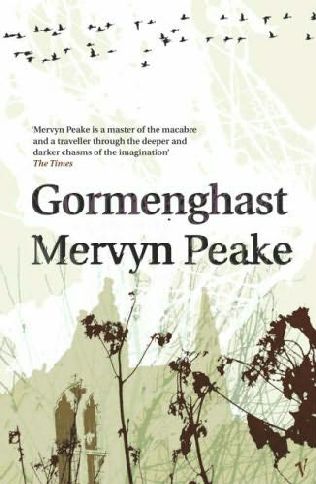
Gormenghast by Mervyn Peake

Titus the seventy-seventh. Heir to a crumbling summit: to a sea of nettles: to an empire of red rust: to rituals' footprints ankle-deep in stone.

Gormenghast.

Withdrawn and ruinous it broods in umbra: the immemorial masonry: the towers, the tracts. Is all corroding? No. Through an avenue of spires a zephyr floats; a bird whistles; a freshet bears away from a choked river. Deep in a fist of stone a doll's hand wriggles, warm rebellious on the frozen palm. A shadow shifts its length. A spider stirs...

And darkness winds between the characters.


It occurred to me upon re-reading my review of the first book in this trilogy, Titus Groan, that either my review seems more negative than I truly felt or I have warmed up to the book considerably since I read it. In retrospect my complaints seem a little pedantic, and I would argue to myself that the series' flaws are well compensated by its virtues: an endless exhibition of creativity and ingenuity, and an obliquely poetic sense of description. Comparing Peake's books to Harry Potter, I remarked that they lack Rowling's "affability"; now I wonder why a book as unique as this would need to be affable.

So let's consider this a fresh slate, and let me explain what I do enjoy about these books:

In the first book, Titus Groan, Titus is recently born to the Earl and Countess of Gormenghast, a vast castle at the foot of Gormenghast mountain. As a baby, he doesn't do much, but there is no doubt that he will be an important figure for the castle; as the only heir to the Earl he will inherit all of the castle and its ancient system of ritual. Ironically, it is Titus who is the main character of Gormenghast, but the castle fills the central role in Titus Groan. It is many miles across, and houses untold thousands; there are parts of it that haven't been seen by human eyes in decades. Titus, aged 11 and feeling a bit of wanderlust, strolls into one such part of the castle in Gormenghast that is overrun by nature:

There had once been a great casement facing upon this terrace. It was gone. Neither broken glass nor iron nor rotten wood was anywhere to be seen. Beneath the moss and ground creepers it may be that there were other and deeper layers, rotten with antiquity; but where the long window had stood the hollow darkness of a hall remained. It opened its unprotected mouth midway along the pavement's inner verge. On either side of this cavernous opening, widely separated, were the raw holes in the stonework that were once the supporting windows. The hall itself was solemn with herons. It was there they bred and tended their young. Preponderately a heronry, yet there were recesses a nd niches in which by sacredness of custom the egrets and bitterns congregated.


I have complained that Rowling doesn't have the chops to provide the sense of awe and wonder that Hogwarts deserves; in fact she wastes very little ink on describing it at all. Peake succeeds in that, and the various rooms and hallways of Gormenghast provide some of the books' most captivating passages. Like Hogwarts, it is riddled with secret passageways and bizarre corners; one of my favorites is the tallest part of the castle, the Tower of Flints, where the Death Owls live who pick into oblivion anyone condemnded to death. Elsewhere it is a labyrinth of chambers, attics, roofs, and quadrangles.

The passage about the herons provides subtle commentary on the state of the castle, which, like its inhabitants, has a troubled soul: the egrets and bitterns gather "by sacredness of custom," as the castle itself is guided by thousands of pages of rituals which determine the operation of every event in the castle. All these rituals are kept by an old man named Barquentine, the Master of Ritual; and Peake suggests that this is where the real power in the castle lies. Many of these rituals involve Titus, who, as a baby at the end of the first book, unceremoniously drops the symbols of ritual into a lake, foreshadowing his rejection of the castle's antiquated laws as a teenager. But the castle is crumbling in places, and has let the herons in with nature. Ritual cannot keep it alive forever.

The most interesting character, however, is Steerpike, who in Titus Groan is depicted as a handsome and serious youth who, through a campaign of deceit, manages to work his way up from kitchen boy to Barquentine's assistant, making him heir to the position of Master of Ritual. Steerpike lusts after power, but it is a cold lust; he has infinite patience and works cleverly over the progressing years to procure positions of increasing power. We find out at the beginning of Gormenghast that he has faked the deaths of Cora and Clarice, the deceased Earl's moron sisters, and shut them up in an unfrequented part of the castle telling them that he is protecting them from a rash of "Weasel Plague," but we know that when they become too complicated to keep alive he will murder them without pity. He has no remorse, and indeed no emotions beyond a determined and robotic drive for power.

He is, in a word, badass. Here is a passage I liked that I think does his character justice:

The sun was blocked away. For a few minutes the shadow disappeared like the evil dream of some sleeper who on waking finds the substance of his nightmare standing beside his bed -- for Steerpike was there, turning the corners, threading the mazes, gliding down slopes of stone or flights of rotten wood. And yet it was strange that with all the vibrancy that lay packed within the margins of his frame, yet his shadow when it reappeared reaffirmed its self-sufficiency and richness as a scabbard for malignity. Why should this be -- why with certain slender proportions and certain tricks of movement should a sense of darkness be evoked? Shadows more terrible and grotesque than Steerpike's gave no such feeling. They moved across their walls bloated or spidery with a comparative innocence. It was as though a shadow had a heart -- a heart where blood was drawn from the margins of a world of less substance than air. A world of darkness whose very existence depended upon its enemy, the light.


Peake's writing has such richness, such evocativeness that really brings out the strangeness of the world he has created. There is no magic, and no races other than humans, but this must be fantasy because it feels so very fantastic; there is no mistaking Gormenghast for a castle of medieval Europe. In fact, I think it makes "real" fantasy books look rather bland by comparison.

The BBC did a miniseries called Gormenghast that conflated both books; Jonathan Rhys-Meyers played Steerpike, which I think is a perfect casting choice. But I can't decide if I'd like to see it, because I think that it might ruin a lot of the images in my head. What it really needs is a big, multi-film Peter Jackson epic. I'd totally watch that.

Friday, October 17, 2008

The Yiddish Policemen's Union by Michael Chabon

I recall that once my favorite English teacher from high school noticed that I was reading Tom Wolfe's A Man in Full, a book he admitted to having read but didn't seem to care for. "Well," he said, "I'll say this--the man knows how to spin a good yarn." It wasn't really a compliment, but I think that his sarcasm betrayed a certain notion that plot is somehow subordinate to Big Ideas. Is that notion misguided or justified? I'm not certain--but surely to dismiss Wolfe's plot-making ability as little more than quality weaving is to slight a literary skill too rare in modern literature.

Such is the recorded opinion of Michael Chabon, who admits to missing the "ripping yarns" of the genre fiction of yore. It's in that vein that he delivers The Yiddish Policemen's Union, a hulking Frankenstein's monster cobbled from bits of alternative history, Philip Marlowe novels, and Rothian postmodernism. Though YPU provides enough material philosophical and spiritual for the reader to ruminate upon, it is first and foremost a novel of things happening, meant to be marveled at. Though it may be a fruitless task, I will attempt to synopsize:

The divergence point of Chabon's alt-history is the 1948 death by car crash of Anthony Dimond, representative of the territory of Alaska to Washington. Apparently in our world it was Dimond who squashed Harold Ickes' proposal to create a protected Federal district for the temporary residence of Jews in Sitka, Alaska. In Chabon's world, the proposal passes with Dimond out of the way, and soon millions of Jews are seeking refuge in the Sitka District: The "Frozen Chosen."

Fast forward to 2008, the 60-year anniversary of the settlement, and the expiration date of the agreement, which means that "Reversion" is imminent for the Jewish district and soon most of Alaska's three million Jews will be refugees once again. If that wasn't story enough for you, Chabon layers on top of this the story of Meyer Landsman, a detective investigating a gunshot homicide perpetrated in his own building that seems to have ties to the Verbovers, a powerful and mafia-like Orthodox sect of Jews that live on a nearby island.

If that isn't enough for you, wait! I haven't even mentioned that Landsman's partner is also his cousin and half Tlingit Indian, or that his father was a chess prodigy and his uncle a former police chief disgraced by accusations of embezzlement, or that Landsman left his ex-wife because he couldn't bear dealing with the pain of having convinced her to have an abortion, or that the homicide victim is reputed to have been the Tzaddik Ha-Dor, the once-in-a-generation would-be Messiah, or that the victim's death is somehow related to Landsman's sister's death in a plane crash, or that all of this seems to be tied into a shadowy conspiracy cooked up between Alaskan Hasidim and the evangelical United States president to return Israel to Jewish control. Whew. Breathe.

Clearly, The Big Sleep, this is not--Raymond Chandler's tight and careful plotting produced books under 200 pages; Chabon doubles that but stuffs in enough that it would have felt more comfortable at twice that again. But while Chabon hasn't quite got the noir genre's laconicness down pat, he does a good job with Landsman, into whom he funnels as much of Philip Marlowe's personality as is possible. The genius of this lies in the dialogue--I had never made the connection between the kind of rapid-fire quips that characterize noir and the brusque recursiveness of Jewish humor, but there it is. I am reminded of Mastrionotti and Deutsch* from the Coen Brothers' Barton Fink; it is no surprise that it is the Coens who are slated to begin filming YPU early next year.

But back to the book. Reading it feels like traveling through the legendary and labyrinthine Warsaw tunnels which run beneath Sitka, but when you emerge on the other side, what are you left with? For one, you are left with a mess. It's hard not to feel that YPU has a few ideas too many, and some of them could have been left on the cutting-room floor. For another, you are left with the unfortunate conclusion that while you weep for the fate of the Jews, for whom the Disapora comes with a countdown this time around, it is much more difficult to feel pity for the individual characters of this novel, who are drawn a little too broadly and rely a little too heavily on their archetypes.

Thirdly, you may be left with the opinion of Richard Johnson of the New York Post, who titles his Page Six piece "Novelist's Ugly Views of Jews." This is, of course, the Post, which could sensationalize a ham sandwich, but I wish to briefly unpack the criticism here: Mainly Johnson takes issue with the fact that YPU "depicts Jews as constantly in conflict with one another, and its villains are a ruthless, ultra-Orthodox sect that resembles the Lubavitchers." What exactly is Johnson's understanding of Judaism today, that its various sects are friendly in a way that the splinter denominations of Islam and Christianity have failed to be since their inception? In fact, I think that Chabon's depiction of internecine conflict among the Sitka Jews is one of the novel's great successes; in a population of three million Jews with no Palestinians to brush against (though the native Indians serve this position to some extent), isn't it natural that such issues would arise along sectarian and secular lines? Johnson's criticism is pure silliness, and I have not seen it repeated by any respectable source.

And yet, let me bring up something that Johnson does not: One of the most poisonous and absurd claims made about Jews today is that they have extensive control over world institutions like the media and the United States Government. This idea is particularly pervasive in Islamic communities and the controversial specter of it taints even serious academic work, like Mearsheimer and Walt's claims about the undue influence of the Israel Lobby. By presenting a "ripping yarn" in which a cabal of Orthodox Jews plot to undermine the stability of world events, isn't Chabon playing into the hands of such absurdity? And even if the Post is too dim to pick up on it, doesn't that in a way back up their claims that YPU reinforces an ugly stereotype?

That question is more rhetorical than it sounds; I bring up the issue only to bring it up and would probably argue against it in the end. But I do think that it contributes to one aspect that did leave a bad taste in my mouth: YPU, for all its concern with religious issues, seems at times to have a rather uncomplex attitude toward religion in general. Though we might argue about the significance of it, the villains of the novel are conspiratorial Jews--and its heroes are humorous, self-effacing, Woody Allen-like ones--and what's more, they're aided by an amoral and evangelical president who wants to bring on the End Times. Though I understand this is the perception many have of our sitting president, it seems to me to evidence a certain lack of nuance on Chabon's part. There is no worth, I believe, in fiction that does not subvert our expectations, and while Chabon distracts us with the aurora borealis of conceit and plot, the cast lacks the capability to surprise us.

Don't think that I'm not recommending the book, I am--sometimes a good story is good enough. Let us not forget that one of the most powerful people in Jewish Sitka is Itzak Zimbalist, the boundary maven. It is against Jewish law to carry anything across boundaries on the Sabbath, a law circumvented by creating makeshift boundaries with rope, cable or wire around entire communities, and it is the boundary maven who is in charge of keeping this border, the eruv, intact. So do not doubt the power of string, the effectiveness of a "good yarn."