Showing posts with label islam. Show all posts

Monday, February 24, 2025

Ornament of the World by Rosa Maria Menocal

The old Arabic word for palace, al-qasr, was what the Castilians called their splendid new royal homes. The elaborate plasterwork that decorated nearly every inch of the Alcazar's interior walls was barely dry, and the Muslim emissary from Granada found himself in rooms that in every way echoed the freshly finished palaces of this Islamic city he had just left. Peter, a son of Alfonso XI and the heir to his great-great-grandfather Alfonso X (the Learned), who had died in this city, was justifiably proud of this example of his wealth, taste, and vision. All three were on display in this Sevillian tribute to the very latest architectural style of Spain. Ibn Khaldun could hardly have avoided the realization that Peter's new palaces, with their multilobed latticework arches and their pure-white arabesque ornamentation on every spare surface, were an unstinting homage to the style of the Nasrids, whose envoy he was. There, on the open and sunny plain, sitting next to the giant old Almohad mosque in Seville--the mosque had been reconsecrated more than a hundred years before and was the cathedral of the Christian capital--was an unabashed evocation of the fortlike palaces at the top of the rocky mountain retreat of Granada, the last and lonely Islamic state on the Iberian peninsula.

I had the great fortune last week to visit two of Spain's most striking and important landmarks: the Alcazar of Spain, a royal palace that is still the sometime home of the King and his family, and the Alhambra, an enormous palace complex built by the Muslim Nasrids of Granada. The Alcazar is a Christian edifice, done in what's known as the "Mudejar" style, meaning Christian architecture with Muslim edifices. It really does look a lot like the Alhambra, and visiting the two, someone who didn't know exactly what to look for might get the impression that they were built by the same people for the same purposes. The two structures are, to author Maria Rosa Menocal, powerful symbols of one of history's true golden eras: medieval Spain, when Muslims, Christians, and Jews existed side by side in a culture of tolerance and cultural exchange. A Christian ruler might, even after the reconquest of much of the Iberian peninsula, in which Muslim rule in Spain was shrunken down to just the city-state of Granada, recognize Islamic art and culture as part of his own powerful patrimony, and built a palace worthy of such creative and intellectual forebears.

Menocal frames her book as a series of biographical sketches of figures who typified the 750-year-ish era that constituted the golden age of al-Andalus. Among them are Samuel the Nagid, an influential Jewish poet and leader who served as a general in Muslim Granada; prolific Islamic writers like Ibn Hazm and Averroes; the Christian warrior known as El Cid; even apostates who rejected the world of philosophical tolerance like Jewish thinker Judah Halevi. This format made it a little hard to grasp some of the overarching historical narratives at play, but I think I more or less got the gist: survivors of the fall of the Umayyad dynasty in Baghdad arrived in al-Andalus around 750 CE, where they created a Muslim state centered on Cordoba that incorporated Christians and Jews but also cemented Arabic as the primary language of both knowledge and art. These Umayyads were eventually conquered by a pair of strict invading Islamic states, the Almohads and Almoravids, who were supplanted by a system of individual city-states known as taifas. The taifas lasted until the reconquest, ending with the loss of Granada and the edict of Isabella and Ferdinand--a pair of history's great villains, no doubt--expelling the Jews from Spain, cementing the entire peninsula as a Christian polity.

I had a vague idea, of course, that Muslim thinkers protected and progressed the traditions of Greek philosophy during the time that much of these sources were lost to Christian Europe. What I didn't know is just how much of that happened in Spain. It was Averroes, the Latinized name of Ibn Rushd, for example, whose commentaries on Aristotle kept the Greek philosopher's legacy alive, later to be integrated into the Christian philosophy of Thomas Aquinas. Nor did I realize that Chaucer's The Canterbury Tales has its roots in the writings of Petrus Alfonsi, a Spanish convert from Judaism to Christianity, whose "Priestly Tales" held little interest for his own countrymen but which Englishmen had never seen. Nor had I ever really thought about the fact that, as must be true, even the Jewish and Christian thinkers of the time period wrote in Arabic, a language that had come to supplant Latin as a lingua franca. Even the great Jewish writer Maimonides, for example, wrote his commentaries on the Mishna in Arabic. One of the great, perhaps even tragic, turning points for Menocal, is when King Alfonso the Wise chooses to elevate the vernacular romance language of Castile to official status.

It's clear that Menocal sees the story, or perhaps stories, of medieval al-Andalus as not just history, but a model for the way society could be. A postscript notes that she finished the book shortly after 9/11, when the book's pleas for tolerance--especially in relation to the contributions of Muslim and Arabic thinkers--became especially ignored, and especially needed. As Menocal shows, much of the great philosophy, poetry, art, and architecture--the Alcazar of Seville and Alhambra of Grenada among them--were only able to exist because a culture of tolerance and free exchange allowed them to exist. 25 years later, it's hard to see that a society like this remains a probability for us, though the book shows quite effectively that such worlds are possible.

Sunday, May 26, 2024

Shame by Taslima Nasrin

As Suranjan came up the road, a group of boys standing nearby shouted, "There goes a Hindu, catch him and kill him." The boys belonged to this locality. Many faces had become familiar to him during his seven-year stay here. There was a boy called Alam, who would turn up every now and then and ask for a donation. they had a club here. Suranjan used to sing at their cultural functions. He thought of teaching some of the boys the songs of D. L. Roy and Hemanga Biswas. Off and on, they would father at his house asking for some favor or another. Sudhamay had given them medical assistance free of charge for their being residents of the locality. And it was the same chaps who were now mockingly threatening to kill him. Suranjan walked rapidly in the opposite direction, not driven by fear, but by shame. He felt shame not for himself but for his supposed attackers. Shame gained a new dimension not for the tortured people, but for those rogues inflicting the torture.

In 1992, a group of Hindu nationalists destroyed the Babri Mosque in India, igniting violence throughout India and the Indian subcontinent. In neighboring Bangladesh, the Muslim majority took their revenge for the destruction of the mosque from the Hindu minority, destroying temples, killing and torturing, and raping women. Taslima Nasrin's Shame tells the story of this reprisal from the perspective of Suranjan, a young socialist who has fought for years against the tide of what he calls "communalism," the factionalism of separate Hindu and Muslim communities at the expense of a larger Bengal or Bangladeshi identity. Suranjan reacts to the violence with apathy and despair, and only later, as the violence increases and his own sister Maya is kidnapped by Muslim gangs--does he feel himself getting swept up in the bitterness of the very "communalism" he has abhorred.

As I understand it, Shame caused a great deal of controversy within Bangladesh, and resulted in a Rushdie-style fatwa against Nasrin that drove her first to India, and then to the United States, where she lives in exile. Forgive me for saying so, but it's amazing to think that such profound consequences could emerge from a book that is so astonishingly bad. Shame is a baffling book, a novel whose small capacity for imagination is overwhelmed by a obsessiveness with recording the violence of 1992 in the most extensive detail. Everywhere Suranjan goes, he meets people who have an encyclopedic knowledge of what's happening throughout Bangladesh, from the names of the temples that have been attacked and destroyed...

...to the specific percentages of fluctuating Hindu and Muslim populations in the country:


I can't emphasize enough that most of the book is like this; statistics and names take up more than half of the novel's page count. It gives the effect, you might say, of Suranjan wandering in blindness while everyone else knows exactly what the stakes of the violence are. But mostly it just seems comically inept, an obsession with recounting every injustice that even a historian would know to avoid, much less a novelist.

When the novel returns to the story of Suranjan, there are flashes of interest: the stroke suffered by Suranjan's father who can't leave the house for medical attention for fear of being attacked; the disappearance of Maya; and most of all Suranjan's descent into anger and bitterness over the course of a week's violence. In one shocking scene, he engages a Muslim prostitute, whom he essentially rapes, biting and beating her during the sexual act. There's a powerful statement here about how difficult it is to escape cycles of violence and factionalism--but it's totally undercut by this insane mode of hyper-scrutiny. I never abandon books, but I nearly abandoned this one. The only reason I didn't is because I've never read an author from Bangladesh before, so my "Countries Read" list is up to 92!

Tuesday, September 12, 2023

A Journey to the End of the Millennium by A. B. Yehoshua

Seventy days and upward had passed since the ancient guardship had set sail from Tangier to ride the wild ocean waves so bravely toward a distant town named Paris, yet amid all the hardships that had visited the expedition, by sea and by land, Ben Attar had not known a single moment when he stood so alone, without rabbi or fellow worshipers, without business partner or nephew, without servant or sea captain, without horses or congregation, without even a house of prayer. Placed under a ban in the heart of an alien land, with his cargo-laden ship far away, pent up in the harbor of Paris. And all this a few hours before the start of the Day of Atonement, behind a little church built of grayish timbers, staring brokenheartedly at the wife of his youth wrestling with a fire like a servant while his second wife lay in pain in the house of an apostate physician. Although he wished with all his being that he could blame himself for what was befalling them all, because of his obstinate urge to demonstrate to the world the depth of his love not only for his two wives but for his nephew, he felt that he did not have the right, whether in defeat or in victory, to detract from the force of the destiny that had guided him, for good or for ill, since the day of his birth.

Ben Attar, a Jewish merchant living in North Africa, sets sail for Paris. Until now, he has done his business by sailing to Spain, where he would meet his nephew Abulafia. But Abulafia has recently married, and the new wife, a beautiful widow named Mistress Esther-Minna, has declared a repudiation--which, though I'm not totally sure what it is, carries a legal and religious force--on Ben Attar for having two wives. Incensed and eager to reestablish his business, Ben Attar intends to confront Abulafia's new wife, and has brought along both of his wives, along with a learned Spanish rabbi whose arguments will persuade her to drop the repudiation, the rabbi's young son, his Muslim business partner Abu Lufti, and an enslaved black boy--and a couple of camels.

All this happens against the backdrop of the coming millennium: not the millennium for Ben Attar, for whom it's the year four thousand-and-something, but for the Christians of Europe, who have been worked up into a fever in the anticipation of Christ's return. The Europe that Ben Attar moves through is a strange and foreign place, where he has trouble communicating even with the Jews, and where many of his former coreligionists have converted for fear of being slaughtered at the coming of the millennium. Israeli writer A. B. Yehoshua treats this background with a light touch; it's never really at the forefront of the story, and yet it hangs menacingly over the merchant's journey. When his younger wife sickens, Ben Attar stops at the house of a converted physician in Verdun, and when he asks whether she'll survive, the physician says, She will live, but them--referring to a gathering of German Jews who have gathered to make a minyan for Rosh Hashanah prayers--they will not live.

There's much to admire about A Journey to the End of the Millennium: For one, I loved a glimpse of a a wide medieval world separate from the courtly hall or monasteries that you might expect to find in a book set in the Middle Ages. Yehoshua depicts a medieval Europe characterized by diversity and free movement; how fascinating to see Ben Attar work contentedly alongside his Muslim partner, at the same time he feuds with the northern Jews he cannot understand. In Ben Attar's slave child there are intimations of modern atrocity, but toward the book's end, we learn that Abu Lufti has restocked the cargo hold with blond, blue-eyed slaves from Eastern Europe, and we are reminded that this world is not one we can take for granted as familiar. I was also struck by the prose, with its long sentences and concentrically nestled clauses, which, if not medieval in style, seem charmingly antiquated. It's remarkably engaging for having a kind of intended stodginess, even more remarkably for containing, when rounding down, zero dialogue.

But more than this I was touched by the novel's picture of human desire and grief. Ben Attar is shrewd and businesslike, but deep down he loves both of his wives intensely, and the repudiation of his nephew has wounded him sharply. Abulafia, in turn, has married Esther-Minna in the wake of the suicide of his own wife, who has left behind their mute and troubled daughter. The uncle and nephew share both intense love and intense grief, and these qualities simultaneously drive them toward each other and keep them from being able to reconcile. Even Esther-Minna, whose repudiation is driven by the fear that her husband will leave her--for business, perhaps, or by taking on a second wife, like his uncle--is touchingly recognizable. While the Christians of Europe wait for the grand drama of the apocalypse to unfold, the North African merchant and his compatriots live smaller lives, more sweet and more painful because they are lived on a human scale.

Final note: with the addition of Israel, my "countries read" list is up to 82!

Saturday, September 11, 2021

Pillars of Salt by Fadia Faqir

Why couldn't I touch the passing days, smell them, or even sense them? I would have tried to prevent the days treading over the plains of my face. You look in the mirror and see the gray hair, the lines running down the face like permanent tears, and the dimming eyes. Once, I was young and attractive. Everything around me was getting loose: my skin, my clothes, my world. A creature inside me kept shrinking and shrinking, tired of life and its treasury, it sought peace and quiet. Even the palm and orange trees were becoming harder to see. I spun and spun like a silkworm; I dug and dug the soil like an earthworm; and at night I curled my spine like a hedgehog and went to sleep under the solitary sky.

Two women meet in a Jordanian mental hospital: Maha, a bedouin woman from the Jordan Valley, and Um Saad, from the Jordanian capital of Amman. Over many days Um Saad tells Maha the story of how she came to this place: her youthful love for the Circassian Mohammed, her tragic marriage to the cruel Abu Saad, the younger wife he brings into their home, and how he shuffled her off her to get rid of her. Maha has a story of her own, one that is told to us but not to Um Saad, the story of how her husband Harb was killed by the British, and how her sadistic brother and collaborator with the British, Daffash, had her committed in order to take from her the orchard left to her by their father. Though they are from very different families and cultures, both Maha and Um Saad have been shut away in the mental hospital by the cruelties of the men in their lives.

Fadia Faqir's Pillars of Salt is told in three woven strands: first, the sections titled "Maha," more or less the novel's main narrative. These follow young Maha's shy love for Harb, their marriage and difficulty conceiving, and Harb's murder, as well as the posthumous birth of their son Mubarak, whom Maha considers the last remaining piece of Harb himself. Though Maha cannot read or write and understands little of the political situation, the creation of the British Mandate has tragic consequences for her and her Bedouin village. She and her fellow Bedouin women talk about the British planes as "metal eagles" that drop exploding eggs, and yet Maha and these women understand much better than Daffash, who sucks up to the British and sleeps with a white Englishwoman, what British occupation means. As the men who protect Maha disappear one by one--first Harb, then her father--she is increasingly menaced by the greedy and short-sighted men who launder their lust and greed through the patriarchal values of their religion.

A second strand, the sections titled "Um Saad," is not, as you might suspect, told from Um Saad's point-of-view, but Maha's, listening later to Um Saad's story of woe in the hospital. Um Saad's story acts as a kind of echo to Maha's, a troubling reminder that the cruelties done to Maha are the norm, not an exception. The third strand is told by a "Storyteller" passing through the Bedouin village, who witnesses the travails of Maha. The Storyteller's strand operates on a wholly different logic, borrowed from the fantastical stories of the Arabian Nights, with its djinns and demons and quests. But the Storyteller takes the side of Daffash and the men, retelling Maha's story as that of a "black widow" who seduces men with dark powers, opposed by her virtuous brother. It's the Storyteller's strand that elevates Pillars of Salt into something rather extraordinary: the spikily ironic way that the woman's story is retold by a man, and through the language of Islam. Daffash says, She is mad, and the Storyteller, She is Evil, and yet no one--not even her "sister" Um Saad--seems willing to hear Maha's version.

Pillars of Salt is part of my ongoing project to read a book from every country. With the addition of Jordan, I've read 48 countries so far!

Thursday, December 31, 2015

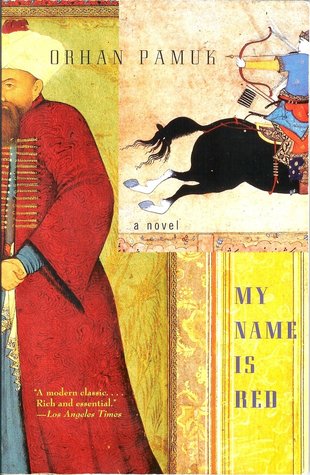
My Name is Red by Orhan Pamuk

"...Allah created this earthly realm so that, above all, it might be seen.  Afterward, He provided us with words so we might share and discuss with one another what we've seen.  We mistakenly assumed that these stories arose out of words and that illustrations were painted in service of these stories.  Quite to the contrary, painting is the act of seeking out Allah's memories and seeing the world as he sees the world."

Orhan Pamuk's My Name is Red is, at its simplest, a murder-mystery: someone has murdered Elegant Effendi, one of the miniaturist illustrators tasked by the Ottoman Sultan to illustrate a great book which will be given as a present to the Venetian Doge.  Pamuk puts us in the point of view of the murdered miniaturist, who narrates the unpleasantness of his death, and then, in the next chapter, the point of view of the murderer.  (Cannily, of course, not telling us who he is.)

There are chapters from the point of view of the protagonist, Black, charged by his Uncle with finding the murderer; there are  chapters from the point of view of his beloved, the beautiful Shekure; there are chapters from the point of view of multiple ancillary characters, and even a few of the illustrations themselves.  ("I don't want to be a tree," a drawing of a tree tells us, "I want to be its meaning.")  There are even, as the title suggests, chapters from the point of view of colors.

Both the murderer and his victim tell us that the murder was sparked by an anxiety about the propriety, under Islamic law and theology, of the book, and perhaps of illustration itself.  My Name is Red grapples with the relationship between God and art, under the often iconoclastic framework of Islam.  Is it a sin to depict the world realistically, as the Frankish painters do?  Is it hubris to paint, as the old masters do, through memory and repetition, trying to reproduce the world as it is seen in the eyes of Allah?  There is much talk about what it means to draw a horse, and whether to draw a horse that one sees, or the horse that Allah has imagined.

I love that kind of stuff, and, for me, what was most interesting about My Name is Red was being forced to think about in a religious context that is ultimately foreign to me.  There are iconoclastic traditions in Christianity, too, and plenty of books that deal with them, but only Islam could provide the framework for this book.  Pamuk mines from Islamic tradition innumerable stories which are told in the illuminated manuscripts the miniaturists create, new to me, but certainly as familiar to his own audience as Abraham and Isaac, or Jacob and Esau are to me.  I liked being pushed outside of my comfort zone in that way.

Tuesday, March 20, 2012

The Place of Tolerance in Islam by Khaled Abou El Fadl

This is a collection of essays by various religious scholars and thinkers. It was published in 2002, shortly after the 9/11 attacks. The title of the book comes from the title of the first essay, written by Khaled Abou El Fadl.

In his essay, El Fadl addresses the history of extremism in Islam, arguing that it is pushed to the periphery, sidelined by the majority, which rejects these extreme elements. However, he argues that in the last half of the 20th century, there has been a vacuum in religious authority. This vacuum has allowed Islamic puritans--as El Fadl calls them--to rise in prominence. El Fadl concludes his essay by making the case for tolerance in Islam. He argues that the views of Islamic puritans hinge on isolated verses from the Qur'an, when "it is impossible to analyze these and other verses except in light of the overall moral thrust of the Qur'anic message." The last paragraph of his essay is a call for Muslim scholars to "sustain the moral trajectory" of Islam by rejecting intolerant interpretations.

The next section of the books contains thirteen essays by a variety of intellectuals.* Their essays are written in response to El Fadl's, and range from slightly refocusing El Fadl's argument to attacking it on a fundamental level. Abid Ullah Jan was by far the harshest critic of El Fadl's essay, arguing that the problem is not a lack of tolerance on the part of Islam, but of the Western World. Some of Jan's argument was very compelling.

The final essay of the book is El Fadl's chance to respond, to refine his argument. He addresses the salient points of each essay, incorporating some aspects and explaining why he rejects others. His final thought: "It is in the power and is in fact the duty of Muslims of every generation to answer the question: What Islam? The response must not be left in the hands of the bin Ladens of the world."

While topics brought up in this collection of essays are complex and multifaceted, the essays themselves are refined, brief even. It was an interesting and insightful read.
____
* Tariq Ali, R. Scott Appleby, Akeel Bilgrami, Joshua Cohen, John L. Esposito, Sohail Hashmi, Qamar-ul Huda, Abid Ullah Jan, Stanley Kurtz, Ian Lague, Mashwood Rizvi, Milton Viorst, Amina Wadud

Friday, January 27, 2012

Malcolm X: A Life of Reinvention by Manning Marable


There are two basic approaches to biographies. The first is the "Great Man," the tome, the multi-volume approach. The idea behind this approach is that readers will be better suited to understand the life of a person if they have all the facts--all the facts. The second model is a more focused approach. Gone are the superfluous details. Gone are the tangents that often lead readers into the proverbial weeds. What remains is a carefully crafted story of a life.

Both of these models serve a purpose. And it is true that the streamlined biographies frequently rely on the tomes that have come before them. They also often highlight a certain aspect--albeit usually rather broad--of a person's life. This is the case with Manning Marable's excellent Malcolm X: A Life of Reinvention.

In 1988, Marable was teaching a course in African-American politics that included The Autobiography of Malcolm X. He states, "A close reading of the text revealed numerous inconsistencies, errors, and fictive characters at odds with Malcolm's actual life." Marable didn't begin working on this book in earnest until the early 2000s. According to Marable, his initial breakthrough came when he "finally realized that critical deconstruction of the Autobiography held the key to reinterpreting Malcolm's life." The Malcolm X Project began in 2001 at Columbia University. At one point, more than twenty graduate and undergraduate students were employed by the Malcolm X Project, writing hundreds of profiles and abstracts of important individuals, institutions, and groups that were mentioned in the Autobiography. Much of their work is available at http://ccnmtl.columbia.edu/projects/mmt/malcolmx and the subsequent more multimedia-rich website http://mxp.manningmarable.com.

The next major element in the writing of this biography was the construction of a detailed chronological grid of Malcolm X's life. Each entry on this grid would indicate the source or sources of the information. It took Marable and his team of historians six years to construct the massive chronology that would form the foundation for this biography.

Marable's writing is clear, straightforward and very readable. He includes a great amount of detail about Malcolm's life without getting in to the aforementioned weeds. The parts I enjoyed the most were those that dealt with the periods in Malcolm's life that the Autobiography glossed over or skipped altogether. I found particularly interesting the odd beliefs and historical traditions of the Nation of Islam and the extremely complicated relationship between Malcolm X and Elijah Muhammad. Marable handles the convoluted events surrounding Malcolm's death exceptionally well.

I would recommend this book to anyone. Marable and his team of researchers do an excellent job reconstructing and portraying the life of one of America's most enigmatic political and cultural figures. If you don't think you want to commit the time to reading this book, I seriously recommend the nine-page epilogue "Reflections on a Revolutionary Vision."

For further reading on the relationship between Malcom X, Elijah Muhammad, Muhammad Ali, I recommend Gerald Early's "Muhammad Ali as Third World Hero" in his book This is Where I Came In.

Tuesday, January 17, 2012

The Mandelbaum Gate by Muriel Spark

Arabs lived in the shelter of the eighteenth-century ruined fortresses, and even now in the years of the establishment of Israel, burning with its mixture of religion, hygiene, and applied sociology, the poor Arabs still hung their washing on the battlements, so that it fluttered all along the antique sea-front, innocent of the offence it was committing in the eyes of the seekers of beautiful sights and spiritual sensations, who had come all the way from the twentieth century, due west of Acre. Indeed, the washing draped out on the historic walls was a sign or progress, enlightenment, and industry, as it had been from time immemorial; it betokened a settlement and a society with a sense of tomorrow, even if it was only tomorrow's clean shirt, as against the shifty tent-dwelling communities of the wilderness; and however murky the cave-like homes along the shore, nad however indolent the occupants, they were one up on the Bedouin, at least in their own eyes if not in the sight of the tourist cameras which photographed the Bedouin shepherds continually but deplored the hung-out washing at Acre.

The Mandelbaum Gate is Muriel Spark's longest book (at a whopping 320+ pages), and bears few of her trademarks. It is surprisingly compassionate toward its protagonists, short on death and tragedy, though the subject matter might have easily invoked Spark's more violent tendencies, and at times borders on florid (the above passage is two sentences!).

But then again, its protagonist, Barbara Vaughan, is the most like Spark of all heroines, so perhaps it's unsurprising that Spark felt kindly disposed toward her, and her attention captured for longer. Like Spark, Vaughan is a half-Jewish, half-Protestant convert to Catholicism. The setting is Jerusalem, 1961, a city separated into an Arab and a Jewish half by the title gate, which is closely guarded and travel restricted. Barbara's fiance, an archaeologist, is working on the Arab side of the border, and Barbara undertakes to pass through, knowing that her Jewish blood puts her at danger even though she is a British citizen.

Such a premise threatens to devolve into a very Graham Greene-like spy caper, but Spark slyly buries the most espionage-like elements into b-plots and isolated moments. Instead, Barbara lingers at the Christian shrines in Jordan, disguised as an Arab woman, catches scarlet fever, and lingers in a sick bed--in short, there is simply too much lingering for The Mandelbaum Gate to qualify as a caper of any kind.

Instead, what Spark delivers is an uncharacteristically deft exploration of the multifarious perspectives on the Holy Land. One of my favorite passages is the one above, which describes the way that the residents of Acre struggle to maintain a present existence against the expectation of tourists and pilgrims, whose in their faith paradoxically seek to deaden and ossify the shrines they visit. In another passage, a collection of friars at the Church of the Holy Sepulchre look on in horror as a visiting priest cautions his congregation against trusting the claims of every shrine:

The three friars gazed at the priest as with one gaze. They had known it. The incipient defroque was undermining the Holy Land, as he went on to enumerate for practical purposes the shrines which his pilgrimage might well skip and the dubiety of their origins, their thoughts went to their brethren, the custodians of the Holy Land to whom these places were their whole heart and life; tears came to the eyes of the eldest friar as he thought of the venerable Franciscan, well past ninety, who kept the house where Our Lady was conceived by St. Joachim and St. Anne, and who had wanted nothing for himself all his life but to show it to the pilgrims and pray with them as they came, and collect alms for the poor of the place, and die there on that spot.


Again we are faced with the essential oxymoron created when the word Holy collides with Land; without a doubt the priest is the more literally correct, but his neatly ordered faith leaves no room for the lives of those that still live in Israel--or, as the Arabs in the book call it, Occupied Palestine.

In a broad sense, the Mandelbaum Gate itself provides a symbol of this conundrum, illustrating the difficulty of moving from one's own perspective into another's:

He followed the ancient walls of the city and Temple, past the gates of historic meaning, sealed and barred against Israel--the Zion Gate, Dung Gate, Jaffa Gate, New Gate. Then St. Stephen's Gate opened within the Old City to another medieval maze of streets--Damascus Gate, that gate of the Lord's triumphal entry into Jerusalem on Palm Sunday, and HErod's Gate. He walked round the city until at last, fumbling in his pocket for his diplomatic pass, he came to the Mandelbaum Gate, hardly a gate at all, but a piece of street between Jerusalem and Jerusalem, flanked by two huts, and called by that name because a house at the other end once belonged to a Mr. Mandelbaum.


But then again, the Mandelbaum Gate carries a different symbolic charge for each character. For the Arab Abdul Ramdez, the gate is the division of his family, as it separates him from his beloved sister, Suzi. For the normally staid English diplomat, Freddy Hamilton, who helps Barbara pass through into Jordan against his character, it is the inaccessible wall that prevents him from recovering his memories of the pilgrimage, through which he seems to inhabit some sort of fugue state. For Barbara, it is the artificial barrier between her Jewish self and Gentile self, that if only it were opened, may provide a total sense of identity:

She had thought then, but who am I?
I am who I am.
Yes, but who am I?


Spark is both canny and blasphemous enough to note the echo of Jehovah's words in Exodus, "I am that I am." If Barbara, made in God's image, cannot get a picture of herself, what then of God? The Holy Land is fractured, Spark maintains, because our view of God is fractured. Just as uncharacteristically, Spark ends the book optimistically, in the passage just above, as Freddy wanders through Jerusalem looking at the gates. Most are shuttered, but the Mandelbaum remains--the only entry way from one side of Jerusalem to the other--and it seems very small and mean, "flanked by two huts," and perhaps even comic. Can such a barrier really be insuperable?

Wednesday, November 16, 2011

A Passage to India by E. M. Forster

No, she did not wish to repeat that experience. The more she thought over it, the more disagreeable and frightening it became. She minded it much more now than at the time. The crush and the smells s he could forget, but the echo began in some indescribable way to undermine her hold on life. Coming at a moment when she chanced to be fatigued, it had managed to murmur, "Pathos, piety, courage--they exist, but are identical, and so is filth. Everything exists, nothing has value." If one had spoken vileness in that place, or quoted lofty poetry, the comment would have been the same--"ou-boum."

A Passage to India is a strange book. One can rifle off the details--in British-controlled India, a Muslim is accused of assaulting an English girl in a mysterious cave--but a summary seems beside the point. As Mrs. Moore decides about her memory of the accused, Dr. Aziz--"Yes, it was all true, but how false a summary of the man; the essential life of the him had been slain"--there is something crucial missing, something ineffable.

The novel begins and ends as a story about the difficulty of friendship and intimacy between the Indian and the English. Dr. Aziz is the great centerpiece of these sections, a stubborn, fickle, but gregarious man who wishes to make friends of Mrs. Moore and her companion, the young Adela Quested, and resolves to take them to the nearby Marabar Caves:

His friends thought him most unwise to mix himself up with English ladies, and warned him to take every precaution against unpunctuality. Consequently he spent the previous night at the train station.


But the middle section--the book is split into three unequal parts called Mosque, Caves and Temple--is something else all together. The Marabar Caves are annihilators of meaning. The echo that attaches itself to Mrs. Moore proves unshakable, and follows her as she leaves, promising a kind of anti-transcendence:

The unspeakable attempt presented itself to her as love: in a cave, in a church--Boum, it amounts to the same. Visions are supposed to entail profundity, but--Wait till you get one, dear reader! The abyss also may be petty, the serpent of eternity made of maggots..


And so the Caves themselves seem to be responsible for Ms. Quested's experience of a violent attack, which is never explained in a "proper" sense. Unpredictably, the English rally around Ms. Quested and use her story to validate their most brutish prejudices ("Why, the kindest thing one can do to a native is to let him die," one says) and the Indians rally around Aziz and riot. But though this makes for some great scenes of satire (my favorite is when the trial magistrate permits Ms. Quested to sit on the platform to escape the heat of the gallery, and she's joined by every white person in the court save one) Forster's interests lie mainly elsewhere. Ironically, what nearly destroys Dr. Aziz, Mrs. Moore, and Ms. Quested is just what they had been seeking: a sense of unity, a sense of intimacy and oneness with the other. But when difference is annihilated, nothing remains; when man succeeds in finding infinity he has lost himself:

Devils are of the North, and poems can be written about them, but no one could romanticize the Marabar because it robbed infinity and eternity of their vastness, the only quality that accommodates them to mankind.


In what must be the most striking prose Forster ever wrote, he symbolizes the problem with a flame:

They are dark caves. Even when they open towards the sun, very little light penetrates down the entrance tunnel into the circular chamber. There is little to see, and no eye to see it, until the visitor arrives for his five minutes, and strikes a match. Immediately another flame rises in the depths of the rock and moves towards the surface like an imprisoned spirit: the walls of the circular chamber have been most marvellously polished. The two flames approach and strive to unite, but cannot, because one of them breathes air, the other stone.


At first this seems a symbol of the relationship between the Indians and the English--two mirrored flames, unable to connect--but soon becomes a symbol of the inability to touch, to interact, to communicate with anything beyond oneself. Mrs. Moore and Ms. Quested are given brief glimpses of the flame beyond the wall, and perhaps finding only an image of themselves, are traumatized by them. The other conflicts of the novel--Ms. Quested's only-half-wanted marriage to the City Magistrate, the relations between the Indians and their occupiers, the inability to describe or create a unified Indian nation--become slivers of this whole, and the solution promises to be worse than the conflict.

By contrast, the Temple section begins with an extended description of a Hindu ceremony that brings a more beneficial unity:

When the villagers broke cordon for a glimpse of the silver image, a most beautiful and radiant expression came into their faces, a beauty in which there was nothing personal,l for it caused them all to resemble one another during the moment of its indwelling, and only when it was withdrawn did they revert to individual clods.


What is it about the Hindu ceremony that makes it a joy, rather than a terror? Can Prof. Godbole, Aziz's Hindu friend, be right or wise when he remarks of the charges,

I am informed that an evil action was performed in the Marabar Hills, and that a highly esteemed English lady is now seriously ill in consequence. My answer to that is this: that action was performed by Dr. Aziz... It was performed by the guide... It was performed by you... It was performed by me... And by my students. It was even performed by the lady herself. When evil occurs, it expresses the whole of the universe. Similarly when good occurs.


Godbole goes on to say that good and evil "are both of them aspects of my Lord. He is present in the one, absent in the other, and the difference between presence and absence is great, as great as my feeble mind can grasp. Yet absence implies presence, absence is not non-existence, and we are therefore entitled to repeat, 'Come, come, come, come.'" Is this what differentiates these unities, an eye to the presence, and not the absence, of God? Or the hopefulness that one is coming to make the unity meaningful?

These questions fade into the background of A Passage to India. By the end we are left with a little tableau of an Englishman and and Indian promising friendship, but their horses rearing away from one another. We are left, if we wish, to return to thinking about England and India, but also, if we wish, to see that there are more encompassing concerns at hand, and that there is unity in disunity, and also with a thin echo of Godbole's "Come, come, come, come":

But the horses didn't want it--they swerved apart; the earth didn't want it, sending up rocks through which riders must pass single file; the temples, the tank, the jail, the palace, the birds, the carrion, the Guest House, that came into view as they issued from the gap and saw Mau beneath: they didn't want it, they said in their hundred voices, "No, not yet," and the sky said, "No, not there."

Monday, January 11, 2010

White Teeth by Zadie Smith

It's a funny thing about the modern world. You hear girls in the toilets of clubs saying, "Yeah, he fucked off and left me. He didn't love me. He just couldn't deal with love. He was too fucked up to know how to love me." Now, how did that happen? What was it about this unlovable century that convinced us we were, despite everything, eminently lovable as people, as a species? What made us think that anyone who fails to love us is damaged, lacking, malfunctioning in some way? And particularly if they replace us with a god, or a weeping madonna, or the face of Christ in a ciabatta roll--then we call them crazy. Deluded. Regressive. We are so convinced of the goodness of ourselves, and the goodness of our love, we cannot bear to believe that there might be something more worthy of love than us, more worthy of worship. Greeting cards routinely tell us everybody deserves love. No. Everybody deserves clean water. Not everybody deserves love all the time.

I love this passage, for several reasons. First of all, there's the sheer brutality of it--nothing like Love to give a swift, cynical kick in the crotch. Secondly, Smith lets a key phrase slip in unnoticed through the verbal detritus: "This unlovable century." White Teeth was published in 2000, as that unlovable century came to a close, and packed tightly within her choice of words is a sense of hope that the next century will in some sense be worthy of our love, and by extension the people in it. How odd to think, then, that White Teeth, as concerned as it is with the origins of domestic terror movements, was published a year before September 11th--perhaps the surest sign that modern times had not yet reached the nadir of their lovability.

And thirdly, there is something afoot here that I don't even think Smith realizes, that her words are betrayed by how much she loves the characters in this book--often to a grating extent--and how much control she exhibits over their lives. White Teeth begs to be loved, and its most significant asset--and its most significant drawback--is that the author has crafted it as an object of love, that Smith smothers it with her love, and though she endows it with great vitality and passion, that may be the reason that she cannot see its flaws. Simply speaking, White Teeth might have been improved with a step backward and a pair of pruning shears.

It is the story of an "unlovable century." It spans roughly four generations in two English families: The Joneses and the Iqbals. Of the former, we begin with white Archie who marries a younger Jamaican girl named Clara; together they have a daughter named Irie. But we also go back in time to hear the story of Clara's mother and grandmother, the Bowdens. Of the Iqbals there is Samad, Archie's best friend, war buddy, and devout Muslim, as well as his wife Alsana and twins Magid and Millat. On top of that, the story is peopled with minor and semi-minor characters, some of whom are interesting, many of whom are not. There is also a subplot which becomes more significant in the book's latter act in which a scientist, known to these families through a number of contrivances too exhausting to explain here, strives to create a mouse with tailor-made genes that predict the exact date which he will die: FutureMouse.

As a turn-of-the-century investigation into racial and religious strife, White Teeth is unparalleled. Samad struggles to be a devout Muslim, and yet cheats on his wife. This conflict between piety and worldliness is played out in the life of this twins: Magid, who goes to India and becomes a secular scholar, and Millat, who stays in England and dabbles with Islamic extremism. This is, in my mind, the most interesting and significant plot thread in the book, so I won't go into detail about the others, which all have the same basic thrust: the Sophie's choice of the immigrant, who must lose what defines him or risk becoming alien.

And yet, if White Teeth is meant to be the quintessential turn-of-the-century book, perhaps it is appropriate that it is deeply flawed. First of all, it's incessantly tongue-in-cheek and not nearly as funny as it thinks that it is:

It is better to marry than to burn, says Corinthians I, chapter seven, verse nine.

Good advice. Of course, Corinthians also informs us that we should not muzzle the ox while it is treading out the grain--so, go figure.


Yawn. I will add to that that the Islamic extremist group in this book is called KEVIN. ("We acknowledge we have an acronym problem." Yawn.) And for every fascinating turn of phrase:

Then every nerve in his body would be alive... Then his head would open out like a deckchair... Tonight, after just more than enough [morphine], Samad felt particularly lucid. Like his tongue was buttered and the world was a polished marble egg.


...Smith puts her foot in it:

The morphine had sharpened his mind to a knife edge and cut it open.


Yes, because knives are so frequently cut open.

But more than that, White Teeth is simply too cumbersome. It's a respectable 450 pp., but it's so crammed full of characters and story lines that it becomes exhausting. If Smith can't keep her attention, why should we? The tragedy is that for every interesting character or plotline, like Samad's struggle with his piety, there is a fatuous clunker like the story of Irie and Millat's friend Josh, who takes up with an extreme animal rights group. Smith means this to parallel Millat's venture into Islamic extremism--and it does, a bit too neatly--but it detracts from Millat's story by its vapidity. I understand what Smith wants to do, but I wonder if she had to sacrifice focus and clarity to do it.

Lastly, as I said, White Teeth is too much a labor of love. It is easy to see that Smith agonized over the creation of this novel, but she put too much of herself in it. Let me give you an example, from a section in which Samad is pondering the reputation of his ancestor:

The story still clung, like a gigantic misquote, to the Iqbal reputation, as solid and seemingly irremovable as the misconception that Hamlet ever said he knew Yorick "well."


Here is a character who is deeply suspicious of England, and disparaging of the English influence on his family. And yet, he's pondering Shakespeare? These words don't belong to Samad, of course, they belong to Smith, but that's the point: They should belong to Samad and they don't. The best metaphors adhere to their element; they match the mindset of the character. In this way they belong to both the character and the author, and to neither. White Teeth is criss-crossed by authorial trespassing, by Smith commandeering her characters' voices, like a mother who only wants best for her children but won't let them speak for themselves. If you're uncharitable, you might even call it a form of egotism.

And despite that, Smith's great passion for this novel is enough to make it enjoyable to read. As for the novel of the next, more lovable century, well--she's got time.

Thursday, July 30, 2009

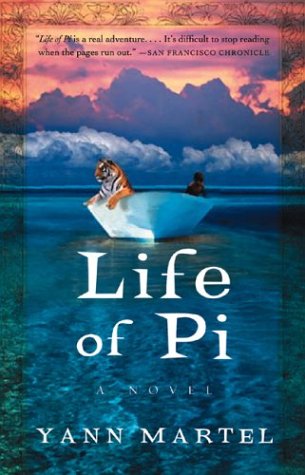
Life of Pi by Yann Martel

Sometimes my heart was sinking so fast with anger, desolation and weariness, I was afraid it would sink to the very bottom of the Pacific and I would not be able to lift it back up.

At such moments I tried to elevate myself. I would touch the turban I had made with the remnants of my shirt and I would say aloud, "THIS IS GOD'S HAT!"

I would pat my pants and say aloud, "THIS IS GOD'S ATTIRE!"

I would point to Richard Parker and say aloud, "THIS IS GOD'S CAT!"

I would point to the lifeboat and say aloud, "THIS IS GOD'S ARK!"

I would spread my hands wide and say aloud, "THESE ARE GOD'S WIDE ACRES!"

I would point at the sky and say aloud, "THIS IS GOD'S EAR!"

And in this way I would remind myself of creation and of my place in it.

But God's hat was always unraveling. God's pants were falling apart. God's cat was a constant danger. God's ark was a jail. God's wide acres were slowly killing me. God's ear didn't seem to be listening.


Here is one of those books I had sort of resisted reading just because they're so popular. I'm more cynical than I care to admit, I suppose, and I usually assume the worst about super-popular things simply because they're so popular, especially when there is a vocal minority who say that thing is awful (and isn't there always?). But I won this copy from Amanda (thanks Amanda!) who didn't care for the book, and so I decided to give it a chance. As is usually the case, I found that neither is the book as awesome as its supporters would say, but neither is it horrible. Life of Pi is a good book with some substantial flaws.

On one hand, it's a survival story that makes Hatchet look like a camping trip. Briefly (because I know you know about it), it's about young Pi Patel, who is on the way to Canada from India with his zookeeping family and a bunch of animals when the boat sinks, leaving him, a zebra, an orangutan, a hyena, and a Bengal tiger named Richard Parker in a lifeboat together. The zebra, orangutan, and hyena are quickly dispatched but Pi spends months at sea trying to train Richard Parker to respect him as the alpha male on the boat and ensure the survival of them both.

This section of the book is really quite gripping; it's no small task to make being stuck in a lifeboat for months a good tale, tiger or no tiger. The thing about being stuck at sea is that very little happens. Martel does a great job of getting us to really inhabit Patel's skin, dealing with the incredible burden of survival while struggling with the notion that, in all likelihood, none of his family survived.

Unfortunately, I think this is one of the rare species of book that works better as an adventurous yarn than a spiritual statement. The problem is that the parts of the book that speak to Pi's spirituality are the thinnest parts of the book. Martel paints him as a lover of God who, back home in India, tries to become simultaneously a Hindu, a Christian, and a Muslim. This leads to some pretty out-of-place comedy when his three spiritual teachers meet and realize what's been going on, like in a sitcom when the main character's three girlfriends accidentally end up in the same place at the same time.

But the worst part is the end--and here I'll add the SPOILER ALERT for those who haven't read it--which disappointed me, though Jim loved it. In fact, he loved exactly what I disliked about it: in the book's final chapters, Pi is pressed by interrogators from the shipping company to tell what "really happened." Pi changes his story to one where he and his mother were trapped in the lifeboat with a murderous Frenchman and others. The interrogators quickly discover that all the characters in this second story correspond with the animals from the first (and Pi with Richard Parker, which is admittedly a nice touch), and ask Pi why he lied. Pi's excuse is that the first story is better, and yet retains the truth of the second. The idea here is that Pi's story is like the three different stories of God in the three religions he follows; none are quite truthful but they all represent the fundamental truth of God's benevolence.

I have several issues with this. The first is that, really, is this much better than the old film trope where the character wakes up to find out it was all a dream? Honestly, I think I'm right to feel a little cheated. Secondly, the second story that Pi tells is pretty horrifying, and would have made a good story in his own right. I don't think the interrogators' agreement that the first story is "better" makes sense. Better how? And why? Because it has animals?

Thirdly, there is nothing particularly reflective about this kind of spirituality. I run the risk of offending here, so I'll tread lightly. In her post, Amanda remarks that she didn't like what Pi has to say about agnostics. I honestly don't recall what Pi says about them, so I reserve judgement--but isn't what Pi is espousing to us a sort of agnosticism? The assertion that we understand fundamental truths about God through a number of colorful stories leaves what we know, by nature, very vague. Nor does it address the parts of those religions which directly contradict each other (how, for instance, do we reconcile a monotheistic and a polytheistic religion?). This is exactly the reason that Pi's words about God come across so thin--they are generally lacking in substance. One might respond that one thing we learn about God is He is (They are?) fundamentally mysterious, yet there is nothing mysterious about the supposed "true" story about Pi's journey. We are supposed to accept that the story with the tiger is better, because it is more whimsical perhaps, and less cruel, but I think that perhaps this raises parallels that Martel does not want to raise.

I feel as if I am in the minority in this, when you average in Carlton and Brent, so I'd love to hear your thoughts. However, I will restate that I did like the book, though I feel like this flaw prevented me from really thinking highly of it.

Friday, December 12, 2008

The Life of Pi by Yann Martel

I have a story that will make you believe in God.

To choose doubt as a philosophy of life is akin to choosing immobility as a means of transportation.


The Life of Pi is narrated by young Piscine (“Pi”) Patel. His family flees India and its unstable politics, and heads for Canada, taking with them all the animals from their zoo. En route, a storm hits their bot and it sinks, leaving only Pi, a hyena, a zebra, an orangutan, and a huge Bengal tiger afloat on a lifeboat.


The first third of the story covers the time before Pi's family leaves, and introduces us to his interest in world religions. Although raised as a Hindu, he meets with both a Muslim Cleric and a Catholic priest and finds value in those religions as well. When confronted about the contradictions of subscribing to the three widely variant faiths, he replies, simply, “I just want to love God.”


The second third of the story covers the shipwreck and the time following, during which Pi's adventures read like some modernized version of the Odyssey, complete with his own monsters and cursed islands. These episodes are entertaining, and sometimes quite touching, but the book's real payoff (and literary aspect) comes in the last section, when Pi is rescued. He tells his story to the men, the same story that we have been reading ourselves, but his questioners do not believe him, and press him to tell them what really happened. While claiming that his original story accurately reflected events, he bows to their questioning and tells them another, far darker but more believable story and asks them to choose the one they prefer.


That, I guess, is the central question of the book, which story to choose. Rather than making the reader believe in God, The Life of Pi seeks to give a framework under which belief is reasonable. Pi's fantastical explanations of the events (if one chooses believe the second story is the more literal truth) serve as a method for him to cope with the awful things that have happened. In the same way stories about tigers and living islands allow him to look objectively at subjects like the deaths of his parents, God and religion provide a way to look at life's most elemental tragedies—mortality, illness, sadness—and see more than a series of random happenings. Whether or not such a story will really make you believe in God probably depends on how much you can buy into such an amorphous, inconcrete version of a higher power, but it's still food for thought.

Monday, January 7, 2008

Pilgermann by Russell Hoban

Pilgermann here. I call myself Pilgermann, it's a convenience. What my name was when I was walking around in the shape of a man I don't know, I simply can't remember. What I am now is waves and particles, I don't need to walk around, I just go.

Pilgermann
is the story of a wandering Jew on a pilgrimage to Jerusalem in the late 11th Century. His name isn't Pilgermann, but that's the name that his ghost--or consciousness, or whatever it is that's narrating this novel from beyond the grave--adopts for himself, because his real one is lost to time. What he narrates is the story of his life, beginning with his castration by a Christian mob in his hometown, following with a vision he has of Christ, who tells him to go to Jerusalem. He never actually makes it there, but instead is captured by pirates and ends up in Antioch where he befriends a local Muslim and is eventually killed in a Frankish crusade.

The first half of the book takes its cues from Bosch and Vermeer paintings: European landscapes ravaged by death, haunted by strange and ghastly figures. He is followed by those whose deaths are connected to him: The headless tax-collector who both sicced the mob of Christians on him and saved his life by stopping them short and the highwayman who murdered him (and whom Pilgermann kills), a man named Konrad and his lover Bodwild, who is a sow, and, oh, why not, a bear. There's also the personification of death as Bruder Pfortner, for whom killing is a sexual experience, and the vision of Pilgermann's own death as a child which grows into a man by the novel's end.

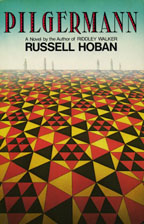
The second half is much better; it follows Pilgermann and his new friend, Bembel Redzuk, as they conceive of a massive tiled court they call "Hidden Lion" (see cover), which they erect to study the point at which "stillness becomes movement" and "movement becomes consciousness." If you can't tell, Pilgermann is a book mostly of ideas and not plot; for every page of action there are probably ten pages of Pilgermann's complex thoughts on the nature of religion and death. Some are quite beautiful and profound--for example, I like the way that Pilgermann never gets to Jerusalem, but finds solace in the words of a traveling group of child pilgrims who say, in the face of their own death, "Jerusalem is wherever we will be when we get to the end"--but much is dense, obtuse, and not quite worth the effort it takes to decipher. It is a book full of references from all three of the Abrahamic religions, and one of its chief themes is their interaction. That the Muslim world comes off much better than the Christian (and even the Jewish) is no surprise; Hoban's depiction of the Frankish crusaders as being socially underdeveloped in relation to their Turkish counterpoints is historically accurate.

I picked up this book because Hoban penned one of my favorite novels, Riddley Walker, a post-apocalyptic novel written completely in the strange pidgin English of the future. I'm sad to say that Pilgermann isn't nearly as enjoyable, though serious religious scholars may find it interesting. As disappointed as I am, I still may read another of his books, Turtle Diary, about a pair of strangers who come together to free a couple of sea turtles from the zoo. This guy seriously never writes the same book twice.