Showing posts with label life of pi. Show all posts

Thursday, April 4, 2013

"To produce a novel that was entirely and deliberately bad — not merely bad at the beginning as part of a plan to tease readers about their desire for naive realism — would be a truly daring artistic move."

The danger, of course, is that people will assume you are simply a bad writer, a risk all the more pronounced when this is your first novel. It’s true, the narrator of “The Unchangeable Spots of Leopards” is exactly the sort of writer who would produce a self-involved meta-narrative, but Jansma could be, as well. And surely if Jansma were so fiendishly clever as to devise such a plan, he would have done so in service of a more interesting theme than that most tiresome of authorial assertions, that fiction writers tell “lies.”


From Laura Miller's interesting take on postmodern "sneaky author tricks" in Salon, a critical view that inspired Flavorwire to post their top ten "phenomenally tricky books."

Miller goes after two different, but often related, gimmicks: The reveal that everything you've been reading is a fictionalized account all along, and the gimmick of writing poorly on purpose because your story represents someone else's work.  Miller relies on Ian McEwan and Kristopher Jansma's The Unchangeable Spots of Leopards (which I've never heard of), but each of those made me think of a different book: First, Life of Pi (link to Kunal's recent review), which I thought was far more patronizing than Atonement in the exact same fashion that Miller it is criticizing.  Second, The Iron Dream, which asks the question: What if Hitler was a science fiction author?  The Iron Dream is the best example I can think of what Miller's talking about above, a bizarre achievement that's either a total success or a complete failure--and absolutely excruciating to read.

Sunday, June 10, 2012

Beatrice and Virgil by Yann Martel

“Fiction and nonfiction are not so easily divided. Fiction may not be real, but it's true; it goes beyond the garland of facts to get to emotional and psychological truths. As for nonfiction, for history, it may be real, but its truth is slippery, hard to access, with no fixed meaning bolted to it. If history doesn't become story, it dies to everyone except the historian.”

I take no joy in saying this, but Beatrice and Virgil, Yann Martel’s follow-up to his international bestseller The Life of Pi, is a really bad book. It’s not bad in the way that, say, the latest ghostwritten Clancy novel is, or a cheap science fiction paperback. It’s bad in the way that Rand’s Anthem is, bad in a way that patronizes and insults the reader. It’s pretensions without being able to follow through on its pretensions. The pacing feels like an author that didn’t want to kill his beauties, and finally had the power to save them. 

But lest this sound like a stream of misplaced invective, let’s examine the book itself. It opens on what is essentially the first of two(!) framing stories, following its protagonist, Henry, as he attempts to finish a follow-up to a massively successful first novel, one that used animals to tell a story that was not about animals—sound familiar? Henry’s second novel, as it is described, sounds insufferable. It is envisioned, Henry tells us, as a flip-book, where one side is a novel about the Holocaust and the other is a non-fiction essay about the same. His editors understandably reject this conceit, and, after railing against them for several pages, Henry decides to take his wife and journey to France, where he settles. This is, notably, about the first 3rd of an already short book, and boy, is it a ham-fisted slog. It’s entirely unnecessary, for one thing, and it serves only to emphasize how one note Martel’s themes are. Like the message about stories reflecting truth in Pi? You’ll love hearing it spelled out here (and throughout the book) over and over and over.

Well, Henry moves to France and, long-seeming story short, meets a taxidermist, also named Henry, after receiving several pages of a play he’s written. The pages concern a monkey, named Virgil, and a donkey, named Beatrice, discussing a pear. The excerpt is interesting—and the writing in the play is consistently better than the writing in the rest of the novel—but it also introduces the book’s first big snag; namely, that the taxidermist is an entirely unpleasant person who causes stress in Henry’s marriage and upsets the fine life he’s made for himself, and we, as readers, are intended to understand that Henry pursues this relationship so he can read the rest of a play that, frankly, is structured so much like Waiting for Godot that I half-expected Beatrice to enter scene eating a boot. Most people aren’t going to upset their life for second-rate Beckett. After an interminable period of Henry coaxing the play out of the taxidermist one scene at a time, we’re treated to the big reveal, which must be SPOILED BELOW so I can discuss what really bugged me about the book.

It turns out that the taxidermist was a Nazi sympathizer, and Beatrice and Virgil is his attempt at absolving himself of the guilt he feels for doing nothing to stop (or, possibly, actively aiding) the Nazis. So, surprise, Henry’s real life turns out to be the perfect story to tell the Holocaust story he wanted to tell with his crazy flip-book idea, and it turns out that’s the book you’ve been reading. Also, the taxidermist goes crazy really abruptly and stabs Henry and drama, but whatever. Putting aside the banality of the “this is the book” ending (the movie Hugo uses the exact same conceit to greater effect, and that’s for kids), the whole thing is insulting. It’s insulting to me as a reader, because the twist ending is telegraphed about once every 10 pages. It’s insulting a larger scale because this is a book about the Holocaust, as seen by a world-famous author who thinks a masturbatory talking-animal meta-textual novella that barely makes sense communicates the truth of the Holocaust in a more meaningful way than actual history, or the fictional works that attempt to share the horror in a realistic fictional framework. It’s extremely hard to read Beatrice and Virgil and not come away with the idea that Martel is using the Holocaust to add emotional weight to his story about writer’s block, and that’s just wrong. It’s also consistent with the rest of the book’s MO, which uses the pretty disturbing deaths of two animals near the midpoint to score cheap emotional points, even though those deaths don’t add anything to the story aside from that melodramatic button-pushing.

This is a bad book. There’s really nothing to redeem it, aside from a few passages that read nicely and a section involving Beatrice being tortured that, in spite of being just as manipulative as everything else, at least works. I don’t recommend reading it, and it’s probably turned me off Martel for good.

Everyone has read Life of Pi: Brent Carlton Christopher Jim

Thursday, July 30, 2009

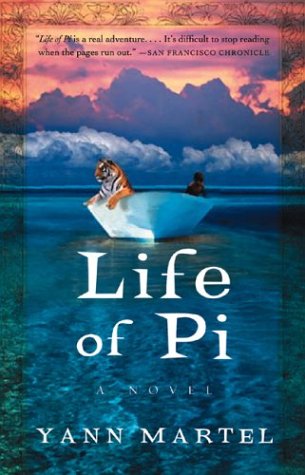
Life of Pi by Yann Martel

Sometimes my heart was sinking so fast with anger, desolation and weariness, I was afraid it would sink to the very bottom of the Pacific and I would not be able to lift it back up.

At such moments I tried to elevate myself. I would touch the turban I had made with the remnants of my shirt and I would say aloud, "THIS IS GOD'S HAT!"

I would pat my pants and say aloud, "THIS IS GOD'S ATTIRE!"

I would point to Richard Parker and say aloud, "THIS IS GOD'S CAT!"

I would point to the lifeboat and say aloud, "THIS IS GOD'S ARK!"

I would spread my hands wide and say aloud, "THESE ARE GOD'S WIDE ACRES!"

I would point at the sky and say aloud, "THIS IS GOD'S EAR!"

And in this way I would remind myself of creation and of my place in it.

But God's hat was always unraveling. God's pants were falling apart. God's cat was a constant danger. God's ark was a jail. God's wide acres were slowly killing me. God's ear didn't seem to be listening.


Here is one of those books I had sort of resisted reading just because they're so popular. I'm more cynical than I care to admit, I suppose, and I usually assume the worst about super-popular things simply because they're so popular, especially when there is a vocal minority who say that thing is awful (and isn't there always?). But I won this copy from Amanda (thanks Amanda!) who didn't care for the book, and so I decided to give it a chance. As is usually the case, I found that neither is the book as awesome as its supporters would say, but neither is it horrible. Life of Pi is a good book with some substantial flaws.

On one hand, it's a survival story that makes Hatchet look like a camping trip. Briefly (because I know you know about it), it's about young Pi Patel, who is on the way to Canada from India with his zookeeping family and a bunch of animals when the boat sinks, leaving him, a zebra, an orangutan, a hyena, and a Bengal tiger named Richard Parker in a lifeboat together. The zebra, orangutan, and hyena are quickly dispatched but Pi spends months at sea trying to train Richard Parker to respect him as the alpha male on the boat and ensure the survival of them both.

This section of the book is really quite gripping; it's no small task to make being stuck in a lifeboat for months a good tale, tiger or no tiger. The thing about being stuck at sea is that very little happens. Martel does a great job of getting us to really inhabit Patel's skin, dealing with the incredible burden of survival while struggling with the notion that, in all likelihood, none of his family survived.

Unfortunately, I think this is one of the rare species of book that works better as an adventurous yarn than a spiritual statement. The problem is that the parts of the book that speak to Pi's spirituality are the thinnest parts of the book. Martel paints him as a lover of God who, back home in India, tries to become simultaneously a Hindu, a Christian, and a Muslim. This leads to some pretty out-of-place comedy when his three spiritual teachers meet and realize what's been going on, like in a sitcom when the main character's three girlfriends accidentally end up in the same place at the same time.

But the worst part is the end--and here I'll add the SPOILER ALERT for those who haven't read it--which disappointed me, though Jim loved it. In fact, he loved exactly what I disliked about it: in the book's final chapters, Pi is pressed by interrogators from the shipping company to tell what "really happened." Pi changes his story to one where he and his mother were trapped in the lifeboat with a murderous Frenchman and others. The interrogators quickly discover that all the characters in this second story correspond with the animals from the first (and Pi with Richard Parker, which is admittedly a nice touch), and ask Pi why he lied. Pi's excuse is that the first story is better, and yet retains the truth of the second. The idea here is that Pi's story is like the three different stories of God in the three religions he follows; none are quite truthful but they all represent the fundamental truth of God's benevolence.

I have several issues with this. The first is that, really, is this much better than the old film trope where the character wakes up to find out it was all a dream? Honestly, I think I'm right to feel a little cheated. Secondly, the second story that Pi tells is pretty horrifying, and would have made a good story in his own right. I don't think the interrogators' agreement that the first story is "better" makes sense. Better how? And why? Because it has animals?

Thirdly, there is nothing particularly reflective about this kind of spirituality. I run the risk of offending here, so I'll tread lightly. In her post, Amanda remarks that she didn't like what Pi has to say about agnostics. I honestly don't recall what Pi says about them, so I reserve judgement--but isn't what Pi is espousing to us a sort of agnosticism? The assertion that we understand fundamental truths about God through a number of colorful stories leaves what we know, by nature, very vague. Nor does it address the parts of those religions which directly contradict each other (how, for instance, do we reconcile a monotheistic and a polytheistic religion?). This is exactly the reason that Pi's words about God come across so thin--they are generally lacking in substance. One might respond that one thing we learn about God is He is (They are?) fundamentally mysterious, yet there is nothing mysterious about the supposed "true" story about Pi's journey. We are supposed to accept that the story with the tiger is better, because it is more whimsical perhaps, and less cruel, but I think that perhaps this raises parallels that Martel does not want to raise.

I feel as if I am in the minority in this, when you average in Carlton and Brent, so I'd love to hear your thoughts. However, I will restate that I did like the book, though I feel like this flaw prevented me from really thinking highly of it.