Showing posts with label judaism. Show all posts

Monday, February 24, 2025

Ornament of the World by Rosa Maria Menocal

The old Arabic word for palace, al-qasr, was what the Castilians called their splendid new royal homes. The elaborate plasterwork that decorated nearly every inch of the Alcazar's interior walls was barely dry, and the Muslim emissary from Granada found himself in rooms that in every way echoed the freshly finished palaces of this Islamic city he had just left. Peter, a son of Alfonso XI and the heir to his great-great-grandfather Alfonso X (the Learned), who had died in this city, was justifiably proud of this example of his wealth, taste, and vision. All three were on display in this Sevillian tribute to the very latest architectural style of Spain. Ibn Khaldun could hardly have avoided the realization that Peter's new palaces, with their multilobed latticework arches and their pure-white arabesque ornamentation on every spare surface, were an unstinting homage to the style of the Nasrids, whose envoy he was. There, on the open and sunny plain, sitting next to the giant old Almohad mosque in Seville--the mosque had been reconsecrated more than a hundred years before and was the cathedral of the Christian capital--was an unabashed evocation of the fortlike palaces at the top of the rocky mountain retreat of Granada, the last and lonely Islamic state on the Iberian peninsula.

I had the great fortune last week to visit two of Spain's most striking and important landmarks: the Alcazar of Spain, a royal palace that is still the sometime home of the King and his family, and the Alhambra, an enormous palace complex built by the Muslim Nasrids of Granada. The Alcazar is a Christian edifice, done in what's known as the "Mudejar" style, meaning Christian architecture with Muslim edifices. It really does look a lot like the Alhambra, and visiting the two, someone who didn't know exactly what to look for might get the impression that they were built by the same people for the same purposes. The two structures are, to author Maria Rosa Menocal, powerful symbols of one of history's true golden eras: medieval Spain, when Muslims, Christians, and Jews existed side by side in a culture of tolerance and cultural exchange. A Christian ruler might, even after the reconquest of much of the Iberian peninsula, in which Muslim rule in Spain was shrunken down to just the city-state of Granada, recognize Islamic art and culture as part of his own powerful patrimony, and built a palace worthy of such creative and intellectual forebears.

Menocal frames her book as a series of biographical sketches of figures who typified the 750-year-ish era that constituted the golden age of al-Andalus. Among them are Samuel the Nagid, an influential Jewish poet and leader who served as a general in Muslim Granada; prolific Islamic writers like Ibn Hazm and Averroes; the Christian warrior known as El Cid; even apostates who rejected the world of philosophical tolerance like Jewish thinker Judah Halevi. This format made it a little hard to grasp some of the overarching historical narratives at play, but I think I more or less got the gist: survivors of the fall of the Umayyad dynasty in Baghdad arrived in al-Andalus around 750 CE, where they created a Muslim state centered on Cordoba that incorporated Christians and Jews but also cemented Arabic as the primary language of both knowledge and art. These Umayyads were eventually conquered by a pair of strict invading Islamic states, the Almohads and Almoravids, who were supplanted by a system of individual city-states known as taifas. The taifas lasted until the reconquest, ending with the loss of Granada and the edict of Isabella and Ferdinand--a pair of history's great villains, no doubt--expelling the Jews from Spain, cementing the entire peninsula as a Christian polity.

I had a vague idea, of course, that Muslim thinkers protected and progressed the traditions of Greek philosophy during the time that much of these sources were lost to Christian Europe. What I didn't know is just how much of that happened in Spain. It was Averroes, the Latinized name of Ibn Rushd, for example, whose commentaries on Aristotle kept the Greek philosopher's legacy alive, later to be integrated into the Christian philosophy of Thomas Aquinas. Nor did I realize that Chaucer's The Canterbury Tales has its roots in the writings of Petrus Alfonsi, a Spanish convert from Judaism to Christianity, whose "Priestly Tales" held little interest for his own countrymen but which Englishmen had never seen. Nor had I ever really thought about the fact that, as must be true, even the Jewish and Christian thinkers of the time period wrote in Arabic, a language that had come to supplant Latin as a lingua franca. Even the great Jewish writer Maimonides, for example, wrote his commentaries on the Mishna in Arabic. One of the great, perhaps even tragic, turning points for Menocal, is when King Alfonso the Wise chooses to elevate the vernacular romance language of Castile to official status.

It's clear that Menocal sees the story, or perhaps stories, of medieval al-Andalus as not just history, but a model for the way society could be. A postscript notes that she finished the book shortly after 9/11, when the book's pleas for tolerance--especially in relation to the contributions of Muslim and Arabic thinkers--became especially ignored, and especially needed. As Menocal shows, much of the great philosophy, poetry, art, and architecture--the Alcazar of Seville and Alhambra of Grenada among them--were only able to exist because a culture of tolerance and free exchange allowed them to exist. 25 years later, it's hard to see that a society like this remains a probability for us, though the book shows quite effectively that such worlds are possible.

Tuesday, September 12, 2023

A Journey to the End of the Millennium by A. B. Yehoshua

Seventy days and upward had passed since the ancient guardship had set sail from Tangier to ride the wild ocean waves so bravely toward a distant town named Paris, yet amid all the hardships that had visited the expedition, by sea and by land, Ben Attar had not known a single moment when he stood so alone, without rabbi or fellow worshipers, without business partner or nephew, without servant or sea captain, without horses or congregation, without even a house of prayer. Placed under a ban in the heart of an alien land, with his cargo-laden ship far away, pent up in the harbor of Paris. And all this a few hours before the start of the Day of Atonement, behind a little church built of grayish timbers, staring brokenheartedly at the wife of his youth wrestling with a fire like a servant while his second wife lay in pain in the house of an apostate physician. Although he wished with all his being that he could blame himself for what was befalling them all, because of his obstinate urge to demonstrate to the world the depth of his love not only for his two wives but for his nephew, he felt that he did not have the right, whether in defeat or in victory, to detract from the force of the destiny that had guided him, for good or for ill, since the day of his birth.

Ben Attar, a Jewish merchant living in North Africa, sets sail for Paris. Until now, he has done his business by sailing to Spain, where he would meet his nephew Abulafia. But Abulafia has recently married, and the new wife, a beautiful widow named Mistress Esther-Minna, has declared a repudiation--which, though I'm not totally sure what it is, carries a legal and religious force--on Ben Attar for having two wives. Incensed and eager to reestablish his business, Ben Attar intends to confront Abulafia's new wife, and has brought along both of his wives, along with a learned Spanish rabbi whose arguments will persuade her to drop the repudiation, the rabbi's young son, his Muslim business partner Abu Lufti, and an enslaved black boy--and a couple of camels.

All this happens against the backdrop of the coming millennium: not the millennium for Ben Attar, for whom it's the year four thousand-and-something, but for the Christians of Europe, who have been worked up into a fever in the anticipation of Christ's return. The Europe that Ben Attar moves through is a strange and foreign place, where he has trouble communicating even with the Jews, and where many of his former coreligionists have converted for fear of being slaughtered at the coming of the millennium. Israeli writer A. B. Yehoshua treats this background with a light touch; it's never really at the forefront of the story, and yet it hangs menacingly over the merchant's journey. When his younger wife sickens, Ben Attar stops at the house of a converted physician in Verdun, and when he asks whether she'll survive, the physician says, She will live, but them--referring to a gathering of German Jews who have gathered to make a minyan for Rosh Hashanah prayers--they will not live.

There's much to admire about A Journey to the End of the Millennium: For one, I loved a glimpse of a a wide medieval world separate from the courtly hall or monasteries that you might expect to find in a book set in the Middle Ages. Yehoshua depicts a medieval Europe characterized by diversity and free movement; how fascinating to see Ben Attar work contentedly alongside his Muslim partner, at the same time he feuds with the northern Jews he cannot understand. In Ben Attar's slave child there are intimations of modern atrocity, but toward the book's end, we learn that Abu Lufti has restocked the cargo hold with blond, blue-eyed slaves from Eastern Europe, and we are reminded that this world is not one we can take for granted as familiar. I was also struck by the prose, with its long sentences and concentrically nestled clauses, which, if not medieval in style, seem charmingly antiquated. It's remarkably engaging for having a kind of intended stodginess, even more remarkably for containing, when rounding down, zero dialogue.

But more than this I was touched by the novel's picture of human desire and grief. Ben Attar is shrewd and businesslike, but deep down he loves both of his wives intensely, and the repudiation of his nephew has wounded him sharply. Abulafia, in turn, has married Esther-Minna in the wake of the suicide of his own wife, who has left behind their mute and troubled daughter. The uncle and nephew share both intense love and intense grief, and these qualities simultaneously drive them toward each other and keep them from being able to reconcile. Even Esther-Minna, whose repudiation is driven by the fear that her husband will leave her--for business, perhaps, or by taking on a second wife, like his uncle--is touchingly recognizable. While the Christians of Europe wait for the grand drama of the apocalypse to unfold, the North African merchant and his compatriots live smaller lives, more sweet and more painful because they are lived on a human scale.

Final note: with the addition of Israel, my "countries read" list is up to 82!

Tuesday, May 12, 2020

The Secret Chord by Geraldine Brooks

I had seen myself as a man in the hand of the Name--serving the king chosen to lead his people in this Land. But what kind of god could will this baseness, this treachery? What kind of nation could rise under such a leader? If David was a man after this god's own heart, as my inner voice had told me often and again, what kind of black-hearted deity held me in his grip?

King David is one of the Biblical era's most interesting characters. As Geraldine Brooks notes in her afterword to The Secret Chord, her novel of David's life, he's the first person in history for whom we have a recorded life from birth to death. Speaking from my own Christian perspective, David is remembered as the Psalmist--the composer of the beautiful songs that make up the book of Psalms. The other side of David--the warrior king, the rebel against Saul, the rebelled-against by his own son Absalom, the seducer of Bathsheba and killer of her husband Uriah--I remember mostly from Sunday School stories that never seemed as important or worth remembering as an adult.

But Brooks, whose reputation is one of the premier modern fiction writers of Jewish themes, brings back that complicated picture of David. Her David is not only complex, most of the time he just seems like a big piece of shit. The novel is told by the prophet Natan (an un-Anglicized version, as most of the names here are, of "Nathan"), one of David's closest advisors and the mouthpiece of the Jewish God, or "the Name," who has put David on the throne, and whom David has tasked with writing his autobiography. As Nathan tells it, David begins as a Jewish hero (the slayer of the Plishtim Goliath) beloved, then suspected, by King Shaul, who chases him into the desert and forces bloody conflict. David becomes a hero and a king by defeating Shaul, but the choices needed to bring the tribes of Israel together are bloody ones.

It seems like an old story: what is the barrier between our desire for power and our desire to use power for justice? How far is too far in the service of what we call a greater good? These are, if you'll allow me to say so, Game of Thrones questions, and if you squint, a lot of the head-rolling and sword-stabbing of The Secret Chord recalls those books. But David's iniquities don't stop with the necessary, as symbolized by his actions toward Batsheva, whom he lusts for after seeing her bathing on her roof, and her husband Uriah, whom David sends to his death to cover up his misdeed. There is no greater good in this scenario, only David's lust, weakness, and cruelty. This horrible act is repeated among David's sons, like Amnon, who rapes his own sister Tamar, and Avshalom, who rebels against David through his own desire for power--gruesome sins that serve only the most base human instincts.

OK, that's a little Game of Thrones-y too. But the interesting thing here is that, while David is punished sorely by the Name for what he does to Batsheva, God never removes his anointing, or his favor, from David. There's a familiarity to this for me; I had always heard the story of David and Bathsheba as an illustration of how God uses flawed people. But David isn't just flawed; Brooks' account reminds us that David can actually be monstrous, and yet the Name works through him even still, with the result that David's wise son Shlomo (Solomon) becomes the King of Israel.

One thing I liked about The Secret Chord is that much of its focus is on the women whose voices are largely absent in the Bible's account of David's life. Batsheva is one of these, who tells Natan pointedly that what David did to her was a rape. But in writing David's biography, Natan uncovers woman after woman who has been misused not just by David, but by the patriarchal demands of the Jewish political state. There's David's first wife Mikahl, forgotten, remarried, and then reclaimed from her loving husband to wither and suffer in a remote room of the palace. There's Tamar, raped and disfigured by Amnon. Even when not subject to physical abuse, women here find themselves little more than pawns in bloody male games. Combined with the novel's insistence on David's anointing, there's a forebidding and difficult tension here.

A shallow reading might be something like, yes, abuse is bad, but we must ignore it so that our political ends are met. (You can come to your own conclusions about whether that's an ideology on the table in this, the Year of Our Lord 2020.) A better reading might say something about the reality of sin and its violent consequences, and to force us to recognize what a radical thing we say when we say that God forgives, or absolves, or that God has a "plan for us."

Thursday, June 13, 2019

St. Urbain's Horseman by Mordecai Richler

Sitting with the Hershes, day and night, a bottle of Remy parked between his feet, such was Jake's astonishment, commingled with pleasure, in their responses, that he could not properly mourn for his father.  He felt cradled, not deprived.  He also felt like Rip Van Winkle returned to an innocent and ordered world he had mistakenly believed long extinct.  Where God watched over all, doing His sums.  Where everything fit.  Even the holocaust, which, after all, had yielded the state of Israel.  Where to say, "Gentleman, the Queen," was to offer an obligatory toast to Elizabeth II at an affair, not to begin a discussion on Andy Warhol.  Where smack was not habit-forming, but what a disrespectful child deserved; pot was what you simmered the chicken soup in; and camp was where you sent the boys for the summer.  It was astounding, Jake was incredulous, that after so many years and fevers, after Dachau, after Hiroshima, revolution, rockets in space, DNA, bestiality in the streets, assassinations in and out of season, there were still brides with shining faces who married in white gowns, posing in the Star social pages with their prizes, pear-shaped boys in evening clothes.  There were aunts who sold raffles and uncles who swore by the Reader's Digest.  French Canadians, like overflying airplanes distorting the TV picture, were only tolerated.  DO NOT ADJUST YOUR SET, THE TROUBLE IS TEMPORARY... They were ignorant of the arts, they were overdressed, they were overstuffed, and their taste was appallingly bad.  But within their self-contained world, there was order.  It worked.

Jake Hersh is a successful television director living in London.  He's an outsider twice over, as a Canadian and a Jew, both a colonial and a stranger, but despite that, he's risen to wealth and comfort.  He has a tony house, a beautiful shiksa wife, several children.  In fact, if he hasn't achieved more, it's because he has an irritable streak and a chip on his shoulder, and often looks at his comfortable life with a kind of suspicion.  That is, until he finds himself accused of raping a young woman while his wife is out of town.  His co-defendant in the case is Harry Stein, an accountant from London's lower classes, who is like Jake's shoulder-chip personified, and mirrored by Mother England.  He's crass and perverse; he makes prank calls to starlets because he seethes with incel-ish anger that they reject, or would reject, him.  What attracts Jake to Harry may be that familiar resentment, write comically large, or perhaps there's something sobering about the way that Harry looks with jealous rage at Jake's life.  Either way, Richler implies that it's this attraction that has caused Jake's legal and marital troubles.

Harry's not the only foil that Jake has in the novel.  Jake spends much of his spare time trying to track down his cousin Joey, a charismatic ne'er-do-well who disappeared from Montreal's St. Urbain Street Jake was very young.  In Jake's memory, Joey is the only one who stood up to the escalating racial hatred of the French Canadians who boxed them in.  In his search, he's always narrowly missing him, in Israel, in Germany.  Reports of Joey differ--is he a gambler and a criminal, or the avenger of Jake's memory?  Jake believes he's tracked him to the jungles of Paraguay, where he believes that Joey--St. Urbain's horseman, tracking through the banks of the Parana River--is searching for the Nazi doctor Josef Mengele in order to exact revenge on behalf of the Jews of the world.  Like Harry, the Horseman is a foil for Jake: he is the thing Jake wishes he could be, the alternative to his pampered life of ordinary compromises.  He is another manifestation of resentment, channeled into righteous anger--the opposite of Harry's bootless pranks.

St. Urbain's Horseman has something sophisticated to say about the position of Jewish folks in the 20th century.  Clearly they have a lot to be resentful about, but is there a way to channel that resentment and make it useful?  If it is to be released, how is that done?  When a person from an oppressed group achieves success, or even bourgeois satisfaction, should they feel joy?  Guilt?  Is his father right to rage about his marriage to the gentile Nancy?  Jake has difficulty with these questions: he largely separates himself from his Jewish Canadian family, and invents another kind of family--the Horseman--in his head.

On the other hand, I cringed a little reading about the trumped-up accusations against Jake.  The "victim," a would-be starlet named Ingrid, is a character vacuum, briefly seen through a drunken haze and then sequestered behind the dais of a courtroom.  In the novel, it works, but I always feel squeamish about the way false rape narratives bolster, in even small ways, real-world suspicions about rape.  Put it alongside the joky anti-feminism of Barney's Version, and the Borscht Belt-comedian schtick of Richler's novels begins to seem hoary.

That said, St. Urbain's Horseman is very funny.  It is the most frenetic of the three Richler novels I have read, to the point of dizziness.  I was amazed by the relentlessness of the satire; I feel like most "funny" novels get credit for getting around to a joke every few pages, but in St. Urbain's Horseman, every paragraph has some incisive cutting remark or character beat.  (One of my favorite characters is a recurring cousin who's in the toilet business, and spends his whole visit to London examining, and praising, the commodes at places like Harrod's.)  I didn't think it had quite the same human element as Duddy Kravitz or Barney's Version, possibly because at heart those novels are tragedies, and St. Urbain's Horseman is about the ways in which a good tragedy can end up spoiled.  In the end, Jake gets off, his marriage a little dented, but his happy home intact--and that's something he'll have to learn to live with.

Saturday, July 14, 2018

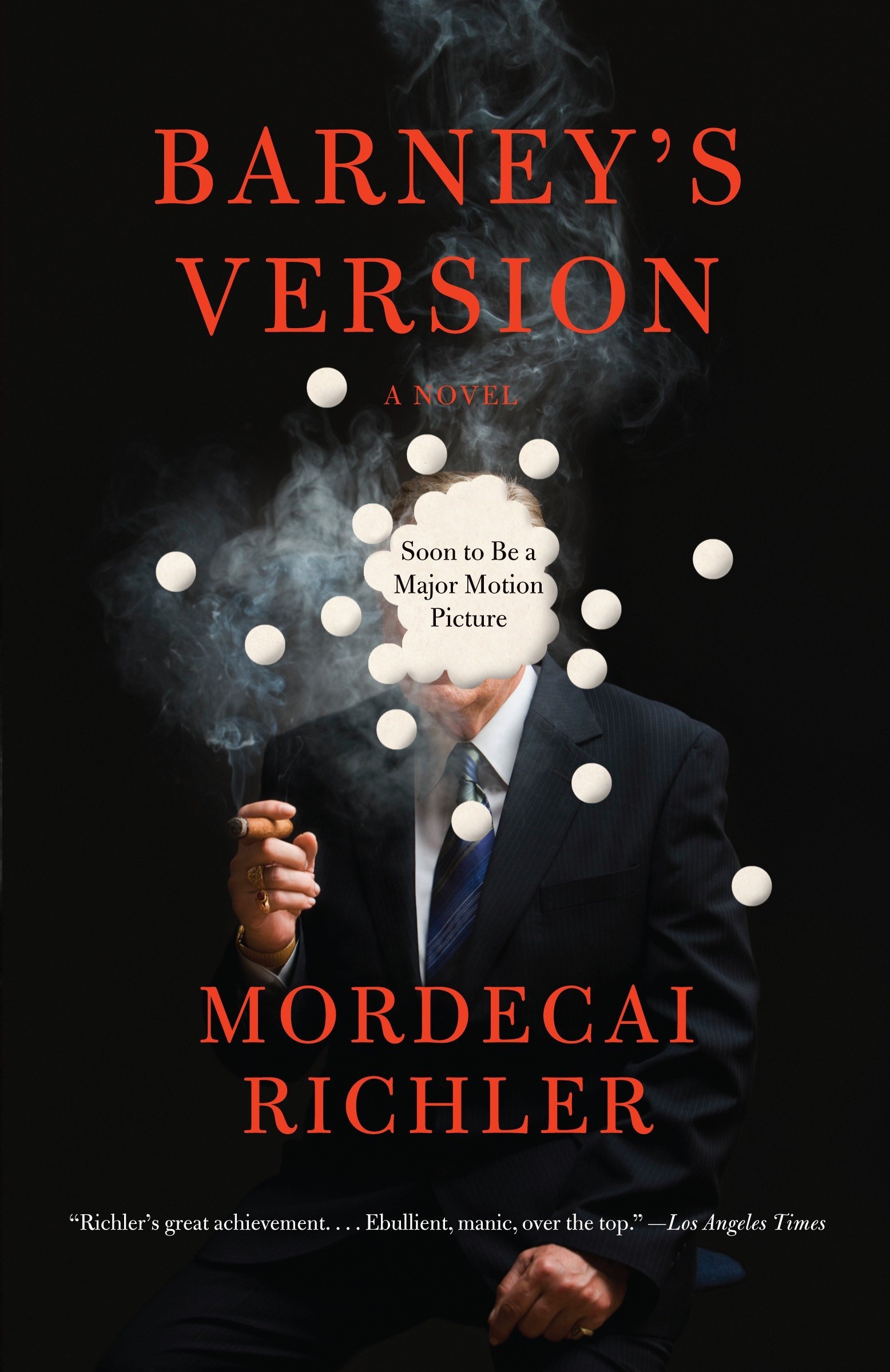
Barney's Version by Mordecai Richler

In a nutshell, I am not unaware of my failings.  Neither am I a stranger to irony.  I realize that I -- who took the Second Mrs. Panofsky's rambling conversation to be an abomination -- have consumed hundreds of pages, piling digression upon digression, to avoid getting to that seminal weekend in the Laurentians that all but destroyed my life, rendering unto me my reputation as a murderer, which is believed by some to this day.  Enter Sergeant-Detective Sean O'Hearne.  And I'm willing to swear that what follows is the truth.  I am innocent.  Honestly.  So help me God, as they say.

Okay, let's stick with the Canadians for a bit.

Barney's Version was the last novel of Montreal writer Mordecai Richler, and it reads like the novel a man writes as he faces down his own obsolescence.  Barney Panofsky, a successful television producer, wants to write and publish a firsthand account of his own life.  When he has been in the public eye, it's always been as part of someone else's sordid account: his first wife, Clara, who committed suicide before her poetry and art could make her a feminist icon; the memoir of Canadian novelist Terry McIver, who knew and despised Barney during their youth in Paris; and especially the lurid newspaper accounts of Barney's trial for killing his best friend Boogie after finding him in bed with his wife.  What Barney wants to do is not so much "set the record straight"--there's a lot of admitted culpability here--but to provide the human context that makes every story seem a little bit more deserving of empathy.  Barney's tendency to forget basic facts and details in his advanced age tends to complicate this project.

The novel is a riot, in many senses: it's extremely funny; it's propelled along by a kind of manic energy; it manages to capture the spirit of the political tension in Quebec in the latter half of the twentieth century.  At times it reads like a much funnier Philip Roth novel, preoccupied as it is with the place of the aging male in the world of sex.  The cast of characters is immense, and borrows from several of other Richler books, which make a kind of Montreal Cinematic Universe (MCU).  I was particularly happy to see Duddy Kravitz, all grown up and having finally struck it rich, needling a doctor for an underheralded disease he might become a patron of, admitting him at last into high-toned Westmount society:

"Crohn's disease."

"Never heard of it.  Is it big?"

"Maybe two hundred thousand Canadians suffer from it."

"Good.  Now you're talking.  So tell me about it."

"It's also known as ileitis or ulcerative colitis."

"Explain it to me in laymen's terms, please."

"It leads to gas, diarrhoea, rectal bleeding, fever, weight loss.  You suffer from it you could have fifteen bowel movements a day."

"Oh, great!  Wonderful!  I phone Wayne Gretzky, I say, how would you like to be a patron for a charity for farters?  Mr. Trudeau, this is D.K. speaking, and I've got just the thing to improve your image.  How would you like to join the board of a charity my wife is organizing for people who shit day and night?  Hey there, everybody, you are invited to my wife's annual Diarrhoea Ball."

Juxtaposed against colorful characters like Duddy, Barney himself pales a little.  That's by design, I think: part of Barney's deal is that he has always been adjacent to famous and outsized personalities, writers and artists, without ever becoming one himself.  Even Boogie, on the fateful day when Barney did or did not murder him, cruelly accuses Barney of being a kind of sponge on the more talented.  But Barney has his talents, including a razor sharp wit, amplified by a hot temper.  He spends much of his life writing and sending fake letters designed to get people in trouble, a bit I'm confident is borrowed at least in part from that other Canadian Jew, Saul Bellow.

One thing that troubled me a little about Barney's Version is its depiction of feminists and other liberal activists.  Barney's involvement, and supposed cruelty toward, his first wife Clara sends feminist writers his way, talking about "penis-power."  At times Barney's version seems to paint him as the victim of a kind of liberal orthodoxy that echoes a lot of modern right-wing meme culture.  These tensions are inextricably tied up with liberal support for Quebecois independence and French language laws, which Richler saw as inseparable from Francophone anti-Semitism.  But even when you think you have Richler's politics pegged, he comes into undercut them, as when Clara's father, a Canadian Jew who has recently been tossed off the board of his daughter's foundation by two black women, admits that "These women forced me to take a good look at myself."  It's a relatively minor moment in the book, but the novel's whole ethos demands that kind of criticism.  If Barney deserves his own account of his life, doesn't Clara, who never got to tell her own?  Who is it in this world whose stories aren't being told?

Barney's Version exists on shifting ground.  Barney's incipient Alzheimer's makes every detail suspect, and his account is supplemented by a series of corrective footnotes by his son, Michael.  The effect is to make Barney seem more or less trustworthy, but to inject the slightest doubt into his narrative, and to emphasize the subjectivity of our own versions of ourselves.  What do we do with a man who can remember "Velazquez's portrait of that royal family" but not that it's called Las Meninas?  Barney talks about the moment where his friend Boogie disappears as that "seminal weekend in the Laurentians that all but destroyed my life," but that's not true.  The trial succeeds in alienating Barney from his wife, whom he hates, and allowing him to marry the true love of his life, Miriam.  (In a nice comic touch, they meet for the first time on the night of Barney's wedding to the woman he calls only "The Second Mrs. Panofsky.")  It's a smaller, tawdrier moment, a night of drunken cheating, that separates him from Miriam thirty years later and really marks the ruin of his life.  It lacks the high drama of the murder charge, but it is enough to make you wonder how much Barney really understands about himself.

Richler's not really a postmodernist.  The mystery of what happened to Boogie is resolved in a way that's as satisfying as any Agatha Christie novel.  But he understands, with a comic realist's eye, just how much of what we tell ourselves about own lives is fiction, or at least fictionalized.  He understands, too, the idea that Barney's Alzheimer's, diagnosed at the very end of the narrative, represents the loss of that fiction, and it's tragic: the loss of "Barney's Version" of himself, no less meaningful because it's not entirely true.

Friday, July 14, 2017

The Apprenticeship of Duddy Kravitz by Mordecai Richler

Duddy trudged up and down through the snow with an owner's sharp eye for fire hazards and signs of mischief.  He tried the ice on the lake with his foot.  It cracked.  He urinated into a snowbank, writing his name.  It's my land, he thought.  But the wind began to cut quicker across the fields, suddenly the sun went out like a light, it was dark, and Duddy began to shiver.  Jeez, he thought, why didn't I leave the car lights on?  He buttoned up the collar and began to strike matches.  Duddy was able to trace his footsteps until the snow began to fall again, and then he was in bad trouble.  He circled round and round, his teeth chattered, and twice he began to run.  He ran and ran to no purpose until he collapsed panting in the snow.  His feet burned from the cold, his eyes felt as if they were stuffed with sand, and he began to think what in the hell am I doing lost in a blizzard, a Jewish boy?  Moses, he recalled from Bible Comics, died without ever reaching the Promised Land, but I've got my future to think of.

Duddel Kravitz is what you might call an "operator": a man with his hand in many money-making schemes, from selling pinball machines to filming bar mitzvahs.  He has his eyes set on a pristine tract of land surrounding a lake in Quebec's Laurentian Mountains, because as his grandfather tells him, "a man without land is nothing."  He buys up the parcels of land, one by one, using his older girlfriend Yvette's name because he's still too young to buy property legally--somewhere, over the course of the book, between sixteen and twenty.

I picked up this book because it's set in Montreal, where I was about to spend a couple of days.  Richler is well-known in Montreal, but his legacy is controversial because he was a longtime critic of the Quebec language policies that are designed to affirm the city's Francophone character.  As an Anglophone Jew who grew up in Montreal's Mile End neighborhood (now, like the Lower East Side, a trendy neighborhood), Richler was highly attuned to the way that the language laws enshrined Quebecker Jews as Other.  The Apprenticeship of Duddy Kravitz is steeped in Jewish culture and mannerisms, like a Malamud novel or a Woody Allen film.  It has the kind of self-deprecating humor that seems so characteristic of Jewish writing: observe how Duddy, having made friends with a goyische millionaire, can't understand why soliciting his new friend for the contract collecting scrap at his factories would be considered gauche, or that the millionaire has never heard of a Jewish criminal magnate known in Duddy's community as "the Boy Wonder."

The book is often wildly funny; at one point Duddy hires a blacklisted filmmaker to help him make his bar miztvah movies.  The filmmaker insists on total artistic control, and the film ends up a cut-rate Un Chien Andalou:

NARRATOR: Today you are a man, Bernard son of Moses.

18.  (Montage) Lightning.  Close shot of Michelangelo's statue of David.  Cartoon of a Thurber husband.  African tribal dance.  Close shot of a venereal disease warning in a public urinal.

Duddy's lust for money could, in the hands of a non-Jew or a less capable writer, make him seem like a walking stereotype.  But Duddy's greed is counterbalanced by a boyish simplicity and a sensitivity for others that even he seems not aware of.  When an epileptic he employs as a driver--a great, absurdly earnest character who considers Duddy the "Branch Rickey of epileptics" for giving him a chance--is paralyzed in an accident, he is crushed with guilt and lets his business empire go to ruin--at least temporarily.  But these qualities are often in direct competition with his greed, and his obsessive need for the land.  As his uncle writes him, "A boy can be two, three, four potential people, but a man is only one.  He murders the others."  The Apprenticeship of Duddy Kravitz, for all its excellent humor, gets is pathos from the overriding question of what man Duddy will choose to be, and which of his two selves he'll murder.

Tuesday, May 1, 2012

The Chosen by Chaim Potok

He paused for a moment, as if considering his next words carefully, then continued.  "Human beings do not live forever, Reuven.  We live less than the time it takes to blink an eye, if we measure our lives against eternity.  So it may be asked what value is there to a human life.  There is so much pain in the world.  What does it mean to have to suffer so much if our lives are nothing more than the blink of an eye?"  He paused again, his eyes misty now, then went on.  "I learned a long time ago, Reuven, that a blink of an eye in itself is nothing.  But the eye that blinks, that is something.  A span of a life is nothing.  But the man who lives that span, he is something."

I live not far from an Hasidic Jewish neighborhood in Brooklyn.  I'm there a lot, but I'm always passing through--connecting from a below ground train to an above ground one, or on a run--and so it seems both familiar and unfamiliar to me.  Parts of it seem as if they were carted in wholesale from Eastern Europe: signs in Yiddish, men with beards and ear locks, women in demure black from head to toe, with really great hair.  (I learned some time ago that the married women wear wigs.)  I always get the sense--perhaps justified, probably not--that my presence there is not particularly welcome.  But despite that, or perhaps because of it, I have always been fascinated with the Hasidic community that lives there, so close but seemingly unknowable.

But how to investigate a society that is, or seems, so insular?  I turned to Chaim Potok's The Chosen, which is what came up first when I googled "Hasidic Jewish novel."

At first, I thought that The Chosen was a young adult novel.  Its style is simple and restrained, and not particularly thoughtful, and it starts out with a baseball game.  Both teams are from Jewish schools in Williamsburg, Brooklyn, but one is Hasidic and one is not.  The star of the Hasidic team, Danny Saunders, whispers to his opponent, the narrator Reuven Malter: "[W]e're going to kill you apikorsim this afternoon."  Apikorsim is a word that means, more or less, Jews who are Jews in name only.  And for a moment, it seems as if he's going to make good on his threat, propelling a ball into Reuven's eye with such force that a piece of glass becomes embedded in his eye, nearly blinding him.

And in typical young adult fashion, this leads to a visit in hospital from a contrite Danny, and a lifelong friendship.  But from there it becomes more sophisticated, if never more sophisticatedly written, using Danny and Reuven's relationship to explore the tension between different conceptions of God, and the relationship between Jews and the wider world.  Danny is a tortured figure, a young genius who yearns to study Freud but is pegged as the tzaddik, the "chosen one" who will follow in the footsteps of his notorious father, Reb (Rabbi) Saunders.  Reuven, on the other hand, wants to be a rabbi, though his father wants him to be a mathematician.

Though Danny's agony is the stuff of great fiction, Potok doesn't seem to know what to do with it.  There are moments of powerful resonance.  One comes to mind, when Danny is forbidden from speaking to Reuven because their fathers are on opposite sides on the question of a Jewish Homeland, and for a moment in the hallway of their school their hands meet in an unspoken gesture of friendship.  But Potok is more interested in devoting long pages to discourses on Jewish history and Fruedian psychology.  Taking the form of discussions between the two ultra-bright boys, they manage not to feel false or flat, but neither do they make gripping narrative, and they made me wish for another baseball game.  And yet, I cannot say that I did not get what I wanted: a detailed exploration into the lives of Hasidic Jews.

Tuesday, January 17, 2012

The Mandelbaum Gate by Muriel Spark

Arabs lived in the shelter of the eighteenth-century ruined fortresses, and even now in the years of the establishment of Israel, burning with its mixture of religion, hygiene, and applied sociology, the poor Arabs still hung their washing on the battlements, so that it fluttered all along the antique sea-front, innocent of the offence it was committing in the eyes of the seekers of beautiful sights and spiritual sensations, who had come all the way from the twentieth century, due west of Acre. Indeed, the washing draped out on the historic walls was a sign or progress, enlightenment, and industry, as it had been from time immemorial; it betokened a settlement and a society with a sense of tomorrow, even if it was only tomorrow's clean shirt, as against the shifty tent-dwelling communities of the wilderness; and however murky the cave-like homes along the shore, nad however indolent the occupants, they were one up on the Bedouin, at least in their own eyes if not in the sight of the tourist cameras which photographed the Bedouin shepherds continually but deplored the hung-out washing at Acre.

The Mandelbaum Gate is Muriel Spark's longest book (at a whopping 320+ pages), and bears few of her trademarks. It is surprisingly compassionate toward its protagonists, short on death and tragedy, though the subject matter might have easily invoked Spark's more violent tendencies, and at times borders on florid (the above passage is two sentences!).

But then again, its protagonist, Barbara Vaughan, is the most like Spark of all heroines, so perhaps it's unsurprising that Spark felt kindly disposed toward her, and her attention captured for longer. Like Spark, Vaughan is a half-Jewish, half-Protestant convert to Catholicism. The setting is Jerusalem, 1961, a city separated into an Arab and a Jewish half by the title gate, which is closely guarded and travel restricted. Barbara's fiance, an archaeologist, is working on the Arab side of the border, and Barbara undertakes to pass through, knowing that her Jewish blood puts her at danger even though she is a British citizen.

Such a premise threatens to devolve into a very Graham Greene-like spy caper, but Spark slyly buries the most espionage-like elements into b-plots and isolated moments. Instead, Barbara lingers at the Christian shrines in Jordan, disguised as an Arab woman, catches scarlet fever, and lingers in a sick bed--in short, there is simply too much lingering for The Mandelbaum Gate to qualify as a caper of any kind.

Instead, what Spark delivers is an uncharacteristically deft exploration of the multifarious perspectives on the Holy Land. One of my favorite passages is the one above, which describes the way that the residents of Acre struggle to maintain a present existence against the expectation of tourists and pilgrims, whose in their faith paradoxically seek to deaden and ossify the shrines they visit. In another passage, a collection of friars at the Church of the Holy Sepulchre look on in horror as a visiting priest cautions his congregation against trusting the claims of every shrine:

The three friars gazed at the priest as with one gaze. They had known it. The incipient defroque was undermining the Holy Land, as he went on to enumerate for practical purposes the shrines which his pilgrimage might well skip and the dubiety of their origins, their thoughts went to their brethren, the custodians of the Holy Land to whom these places were their whole heart and life; tears came to the eyes of the eldest friar as he thought of the venerable Franciscan, well past ninety, who kept the house where Our Lady was conceived by St. Joachim and St. Anne, and who had wanted nothing for himself all his life but to show it to the pilgrims and pray with them as they came, and collect alms for the poor of the place, and die there on that spot.


Again we are faced with the essential oxymoron created when the word Holy collides with Land; without a doubt the priest is the more literally correct, but his neatly ordered faith leaves no room for the lives of those that still live in Israel--or, as the Arabs in the book call it, Occupied Palestine.

In a broad sense, the Mandelbaum Gate itself provides a symbol of this conundrum, illustrating the difficulty of moving from one's own perspective into another's:

He followed the ancient walls of the city and Temple, past the gates of historic meaning, sealed and barred against Israel--the Zion Gate, Dung Gate, Jaffa Gate, New Gate. Then St. Stephen's Gate opened within the Old City to another medieval maze of streets--Damascus Gate, that gate of the Lord's triumphal entry into Jerusalem on Palm Sunday, and HErod's Gate. He walked round the city until at last, fumbling in his pocket for his diplomatic pass, he came to the Mandelbaum Gate, hardly a gate at all, but a piece of street between Jerusalem and Jerusalem, flanked by two huts, and called by that name because a house at the other end once belonged to a Mr. Mandelbaum.


But then again, the Mandelbaum Gate carries a different symbolic charge for each character. For the Arab Abdul Ramdez, the gate is the division of his family, as it separates him from his beloved sister, Suzi. For the normally staid English diplomat, Freddy Hamilton, who helps Barbara pass through into Jordan against his character, it is the inaccessible wall that prevents him from recovering his memories of the pilgrimage, through which he seems to inhabit some sort of fugue state. For Barbara, it is the artificial barrier between her Jewish self and Gentile self, that if only it were opened, may provide a total sense of identity:

She had thought then, but who am I?
I am who I am.
Yes, but who am I?


Spark is both canny and blasphemous enough to note the echo of Jehovah's words in Exodus, "I am that I am." If Barbara, made in God's image, cannot get a picture of herself, what then of God? The Holy Land is fractured, Spark maintains, because our view of God is fractured. Just as uncharacteristically, Spark ends the book optimistically, in the passage just above, as Freddy wanders through Jerusalem looking at the gates. Most are shuttered, but the Mandelbaum remains--the only entry way from one side of Jerusalem to the other--and it seems very small and mean, "flanked by two huts," and perhaps even comic. Can such a barrier really be insuperable?

Tuesday, October 19, 2010

Night by Elie Wiesel

Never shall I forget that night, the first night in camp, which has turned my life into one long night, seven times cursed and seven times sealed. Never shall I forget that smoke. Never shall I forget the little faces of the children whose bodies I saw turned into wreaths of smoke beneath a silent blue sky. Never shall I forget those flames which consumed my faith forever.

In my mind the saddest moment of Elie Wiesel's Night--though perhaps it cannot rival the horror of the account a man gives of putting his own father's body into the furnace, or the pristine melancholy of the dying violinist's last concerto before he collapses in the suffocating traincar--comes at the very end, when Wiesel sees his own reflection for the first time in moths: "From the depths of the mirror, a corpse gazed back at me... The look in his eyes, as they stared into mine, has never left me."

Those words were published in 1958, and only Wiesel, now 82, can tell us if the corpse still peers back at him. Like all living Holocaust survivors, his longevity has become a sort of triumphant irony; doubly so, since in a way he is frozen in that awful moment. He spent a scant eight months in various concentration camps, yet the night, he tells us, is life-long. His work affirms it, from his various novels and memoirs about the Holocaust and novels about Holocaust survivors to his tireless work promoting international peace and genocide awareness. Night is a story about survival, but it is also a story about the formation of an identity: The Wiesel that is liberated from the camps is not the Wiesel who entered them, and for him it seems the Holocaust is inescapable because--like all of us--he is condemned to follow himself around.

Most significantly, the man who is liberated has lost his faith, though once he was eager to study the Torah and Kabbalah. The terms of this loss are never quite clear; though Wiesel seems not to believe that God does not exist--or, in the Nietzschean way, that God is dead--but can he can no longer believe in God's goodness:

For the first time, I felt revolt rise up in me. Why should I bless his name? The Eternal, Lord of the Universe, the All-Powerful and Terrible, was silent. What had I to thank him for?


So goes Wiesel's earthly father, too: Though early in the book he sought above all to stay at his father's side--even teaching him how to march in step so that he might not be whipped by the Kapos, and sharing his rations when his father falls ill--when his father finally dies, Wiesel feels more relief than regret. In the last scene it becomes clear that he has lost everyone but himself, and it is a self that he struggles to recognize.

This is how I think Night ought to be read: Not as a blood-letting, but an anti-catharsis, Wiesel's attempt to come to terms with himself. It seems that he didn't speak about his experience in the concentration camps for over a decade after they ended, and when he was finally convinced to write them down, the first draft, published in Yiddish, covered nearly 900 pages.

Better to have it out of the way and to try again; as Brent pointed out to me the other day, the strength of Night lies in its brevity. It doesn't seem quite reliable as a historical document, and as a literary object it is frequently inartful--he says things like an SS officer's hands are "like wolf's paws"--but it is swift, brutal, and numbing. If it were any longer, we might merely wince and turn away.

He reminds me--and perhaps this is a stretch for you--of the Ancient Mariner, who was claimed by the Nightmare Life-in-Death and sentenced to walk the earth and warn others of his experience. The Mariner, however, did so to atone for his own sins and Wiesel seems to be eternally toning for the sins of others. I pity Wiesel--the real one, and not the one of the book, who never seems to ask for sympathy--because it seems to me that the author of Night seeks to find himself and can only discover that which is most loathsome to him. It isn't so much a story that expresses "never forget," but one that tells us why he cannot, though perhaps he may wish to.

Saturday, May 15, 2010

God's Grace by Bernard Malamud

What might please God would be some sensible arrangement of the lives of the apes on the island into a functioning social community, interacting lives; and with Cohn as advisor and protector to help them understand themselves and fulfill the social contract. Maybe start with a sort of small family and extend into community? You are not the chimps your fathers were -- you can talk. Yours, therefore, is the obligation to communicate, speak as equals, work and together build, evolve into concerned, altruistic living beings. Not bad if it worked. How could Cohn know unless and until he tried? On this island more seemed possible than one might imagine.

My then-girlfriend Liz gave me this book to read, cautioning me that it wasn't necessarily a good book, but had a very interesting concept. Malamud, I said--interesting? I can't think of many books that I would describe as less inherently interesting than The Assistant, which is the only Malamud book I had read.

But Liz was right on both counts. God's Grace is just the kind of bizarre nugget I love: Its protagonist, Calvin Cohn, is the last man on Earth, having survived a nuclear holocaust by being in a pressurized chamber at the bottom of the sea when the nuclear bombs destroyed everyone else. God is dismayed:

...[T]hat you, Mr Cohn, happen to exist when no one else does, though embarrassing to me, has nothing to do with your once having studied for the rabbinate, or for that matter, having given it up.

That was your concern, but I don't want you to conceive any false expectations. Inevitably, my purpose is to rectify the error I have conceived.


But God does not say where he will strike Cohn down, or when. Fearing his imminent end, Cohn prays for mercy and heads off to a vacant island with a chimpanzee previously owned by a fellow scientist. He names the chimp Buz; serendipitously, Buz's former owner has surgically bestowed upon him the gift of speech. There Cohn and Buz try to recreate some measure of civilization.

Liz was right also that it is not a well-written book; Malamud's style can be graciously described as inelegant:

One day when the sun shone golden, and a summer breeze blew an armada of long white clouds through the cerulean ocean-sky...


But I found my affection for the book growing. The broad strokes that Malamud begins with become slowly finer: Buz discovers another group of chimps living on the island and teaches them--almost miraculously--how to speak. Cohn tries to build a society among the chimps, but his efforts are less obviously parable-like than the book's early chapters, though certain elements of strife within the group neatly mirror broader social issues. One source of tension is that Cohn, having once studied to be a rabbi, tries to instruct the chimps in Judaism, but Buz was raised a Christian by his former owner.

Is God's Grace an allegory for the relationship between Judaism and Christianity? A chimp named Mary Madelyn expresses a romantic interest in Cohn, and although at first--ahem--"Cohn observed her flabby, wilted flower, and the sight of it made him slightly ill"--he begins to wonder if a human-chimp offspring might not represent the redemption of the world and the cornerstone of a new, more altruistic society. They name their child Rebekah, after the ship from which they came.

(I will issue a spoiler alert here.) The associations seem clear: As father, teacher, and provider, Cohn emulates God in his relationship with Buz. When Cohn and Mary Madelyn (simultaneously Mary the virgin and Mary Magdalene, the prostitute) engender Rebekah, it is the Jewish god ushering in the Christian era. If Rebekah is Christ, then her sacrificial death should be no surprise. Esau, a violent chimpanzee resentful of Cohn's authority, sparks a mutiny among the group, some of whom take the child by force and drop her from a great height. Buz plays Judas.

All of which leads to three conclusions about the nature of Christ and Christianity in God's Grace. First, Rebekah's existence is purposeless; though Cohn expects her to found a new race and redeem the old, there is nothing redemptive about her birth or death. Second, the passage from the Jewish era to the Christian era is the cause of the violence of the book's final chapters, since it is Cohn's intimacy with Mary Madelyn that incenses the jealous Esau and Buz to murder. Finally, though Christ is the offspring of God so he represents the death of God; in return for his actions the chimpanzees slit Cohn's throat.

It seems to me that God's Grace is a lament of the way that Christianity both springs from and threatens Judaism, the son that devours the father. It is no mistake that Buz is depicted as a Christian; Christianity is given to the Judases. After the murder of Rebekah, the chimpanzees revert and can no longer speak. Wisdom is forsaken.

Is this too strong a reading? Perhaps, but it is the one that makes most sense to me. I would love to hear others, if I ever encounter someone else who has read this book.

Monday, April 5, 2010

The White Goddess by Robert Graves

It would be unfair to call the heretical poets 'apostates'. They were interested in poetic values and relations rather than in prose dogma. It must have been irksome for them to be restricted in their poem-making by ecclesiastical conventions. 'Is it reasonable?' they may have exclaimed. 'The Pope, though he permits our typifying Jesus as a Fish, as the Sun, Bread, as the Vine, as a Lamb, as a Shepherd, as a Rock, as a Conquering Hero, even as a Winged Serpent, yet threatens us with Hell Fire if we ever dare to celebrate him in terms of the venerable gods whom He has superseded and from whose ritual every one of these symbols hasbeen derived... So at his prophesied Second Coming we reserve the right to call him Belin or Apollo or even King Arthur.

I blame my long absence squarely on this book, which occupied for pretty much the entirety of March. It isn't particularly long, but I could only read about twenty pages before I needed to stop and defrost my brain.

The White Goddess is subtitled "A Historical Grammar of Poetic Myth"--which, unless you have read it, means either absolutely nothing or something quite different than Graves intends. The term "poetic myth" in the subtitle is particularly duplicitous; for Graves true poetry and myth are one and the same. The thesis of The White Goddess is that all true religion and poetry expressing what Graves calls the capital-T "Theme":

The Theme, briefly, is the antique story, which falls into thirteen chapters and an epilogue, of the birth, life, death and resurrection of the God of the Waxing Year; the central chapters concern the God's losing battle with the God of the Waning Year for love of the capricious an all-powerful Threefold Goddess, their mother, bride, and layer-out. The poet identifies himself with the God of the Waxing Year and his Muse with the Goddess; the rival is his blood-brother, his other self, his weird.


Graves then proceeds to spend 400-odd pages detailing the various ways the Theme shows up in world myth, skipping vicariously from culture to culture drawing parallels in their religious systems. In a single paragraph he may begin in Wales, jump to Egypt, hop over to Palestine, run back through Greece, and perhaps take a stroll into Viking myth as well. Nor does he stick solely to Western religion, though excursions into places such as Mesoamerica and Japan are rare. Much of The White Goddess is an exercise in conflation, as Graves attempts to show how various deities are variations of the same archetype. For example, here Graves identifies just some of the various forms of Apollo:

Apollo himself had reputedly been born on Ortygia ('Quail Island'), the islet off Delos; so Canopic Hercules is Apollo, too, in a sense--is Apollo, Aesculapius (alias Cronos, Saturn or Bran), Thoth, Hermes (whom the Greeks identified with Thoth), Dionysus (who in the early legends is an alias of Hermes), and Melkarth, to whom King Solomon, as son-in-law to King Hiram, was priest, and who immolated himself on a pyre, like Hercules of Oeta. Hercules Melkarth was also worshipped at Corinth under the name of Melicertes, the son of the Pelasgian White Goddess Ino of Pelion.


It's mind-boggling, but it makes sense in respect to Graves' championing of the Theme; by collapsing these religious stories like paper boxes he intends to show that there is only one story. So, put simplistically, the trio of Zeus, Cronos, and Hera become an analogue of Osiris, Horus, and Set, or Odin, Loki, and Freya, or Christ, Satan, and Mary. In turn, these myths--in which the principal male figures engage in ritual, cyclical periods of dominance and submission--map the yearly calendar.

Graves' methodology here is seductive, but not quite overwhelming. In his foreword, he notes that "this remains a very difficult book, as well as a very queer one, to be avoided by anyone with a distracted, tired, or rigidly scientific mind." If you suspect that this an avoidance technique that allows Graves to get away with dodgy scholarship, then, well, this simply wasn't written for you.

The foundation of the book is built on two Welsh minstrel poems, which Graves spends the first third of the book dissembling, reassembling, and interpreting as alphabetic codes beset in riddles, which perhaps conceal a secret name of God. Elsewhere, his methodology is based almost purely upon poetic inspiration, and to reinforce a point Graves on rare occasions offers up an original poem. One chapter takes the form of a discussion between a Greek historian and a Roman governor. While fascinating, these methods do little to allay fears that the premise of the book is absurdly far-fetched. The argument fits together neatly, but circuitously; it is difficult to tell at the end of the book if Graves has presented a proof or merely a semblance of one.

Whatever of The White Goddess is based in reason and not pure nonsense, there are certain politically distasteful conclusions to be made. One such conclusion is that women cannot be "true" poets:

However, woman is not a poet: she is either a Muse or she is nothing. This is not to say that a woman should refrain from writing poems; only, that she should write as a woman, and not as if she were an honorary man.


This is a bit of semantic trickery. Graves suggests that because women cannot be the surrogate of the God of the Waxing Year they cannot write "true" poetry about the Theme. It is kind of him to permit them to write poetry at all, but her poems are relegated to some, less true variety. Homosexuality, naturally, has no place in poetry.

Another conclusion is that many of the world's ills can be traced to a perversion or a denial of the true Theme. Catholicism, which installs Mary as the White Goddess figure, is preferable though it mistakes her character. Protestantism, which devalues Mary, is more insidious:

The Puritan Revolution was a reaction against Virgin-worship, which in many districts of Great Britain had taken on a mad-merry orgiastic character. Though committed to the mystical doctrine of the Virgin Birth, the Puritans regarded Mary as a wholly human character, whose religious importance ended at the birth-stool; and anathematized any Church ritual or doctrine that was borrowed from paganism rather than from Judaism. The iconoclastic wantonness, the sin-laden gloom and Sabbatarian misery that Puritanism brought with it shocked the Catholics beyond expression.


And Judaism, which rejects the female divinity completely, is worse:

Yet neither Frazer nor Hitler were far from the truth, which was that the early Gentile Christian borrowed from the Hebrew prophets the two religious concepts, hitherto unknown in the West, which have become the prime causes of our unrest: that of a a patriarchal God, who refuses to have any truck with Goddesses and claims to be self-sufficient and all-wise; and that of a theocratic society, disdainful of the pomps and glories of the world, in which everyone who rightly performs his civic duties is a 'son of God' and entitled to salvation, whatever his rank or fortune, by virtue of direct communion with the Father.


Those who know me even slightly will know that I think this is bunk. I find Graves lacking justification here; it escapes me what is meant to be so evil about this "theocratic society" which values God's equanimity and intimacy. But this highlights a larger flaw in Graves' thesis: He never deigns to tell us what make this Theme "true" while admitting that there are variations, impurities, and digressions. By what rationale does Graves separate the heretics from the orthodox? What value is there in the White Goddess' viciousness and capriciousness? In many of her forms she is wholly unappealing; one wonders why the Jewish God's rejection of her is such a bad thing.

I am unprepared to tell you how much of this book is brilliant and how much is pure, unadulterated horseshit. Perhaps my mind is too rigidly scientific. But I will be the first to admit that it is completely fascinating.

Friday, November 7, 2008

The Year of Living Biblically by A. J. Jacobs

I remember hearing a couple of years ago about A. J. Jacobs, the guy who spent a year reading through the entire Encyclopedia Britannica and then wrote a book about it. I always sort of planned on reading that book, but I never got around to it. Then a couple of months back, I stumbled across this video teaser for Jacobs' The Year of Living Biblically. For this book, Jacobs read through the Bible (various versions) and wrote down every rule or guideline that he came across. He then spent the next year trying to adhere to this list of rules. Intriguing.

I grew up in a family of religious conservatives who interpreted the Bible literally -- as far as I know they still do. Actually, it wasn't just my family, but many of the people I was in contact with on a day to day basis. Friends. Teachers. Neighbors. Even as a kid, I remember reading specific verses in the Bible and thinking, Okay, this doesn't make sense. If one simply takes the Bible at face value many books pose a lot of problems. For example, just try to follow all the rules laid down in Leviticus. Now some people say that Jesus wiped out many of the Old Testament laws, especially the ones regarding animal sacrifice. But there are a lot of other laws that don't have to do with sacrifices, such as the one is the teaser video, or Deuteronomy 21 which permits the stoning of a son or daughter that is rebellious or a glutton. Hmmm...things like this don't seem to jive with New Testament message of love and peace.

Jacobs comes to much the same conclusion. He prefers "Cafeteria Christianity." This is a derisive name that biblical literalists use to describe Christians that pick and choose from the Bible. I like the term too. There are some good things about the Bible, but you can't delude yourself into thinking that you can follow it in all of its precepts.

I was surprised at the level of respect that Jacobs maintains throughout the book. There are no "David Sedaris" descriptions of the people he encounters, no matter how crazy there beliefs may seem. In fact, Jacobs seems to find the silver lining in most of these beliefs. Not only that, but he does an alarming amount of research, both reading and talking with various religious people. This is not to say that the book is not funny. Jacobs has a good feel for what is funny, and his writing it witty. He just refuses to get his laughs from simply poking fun. Obviously, some of the situations were inherently funny. I particularly enjoyed his description of his trip to the Creation Museum, which is about twenty minutes from where I live.

At times this book reminded me of why I distanced myself from the way I was raised, but most of the time it was just a fun read.

Incidentally, Jacobs contributed an essay to Things I've Learned from Women Who've Dumped Me.

Friday, October 17, 2008

The Yiddish Policemen's Union by Michael Chabon

I recall that once my favorite English teacher from high school noticed that I was reading Tom Wolfe's A Man in Full, a book he admitted to having read but didn't seem to care for. "Well," he said, "I'll say this--the man knows how to spin a good yarn." It wasn't really a compliment, but I think that his sarcasm betrayed a certain notion that plot is somehow subordinate to Big Ideas. Is that notion misguided or justified? I'm not certain--but surely to dismiss Wolfe's plot-making ability as little more than quality weaving is to slight a literary skill too rare in modern literature.

Such is the recorded opinion of Michael Chabon, who admits to missing the "ripping yarns" of the genre fiction of yore. It's in that vein that he delivers The Yiddish Policemen's Union, a hulking Frankenstein's monster cobbled from bits of alternative history, Philip Marlowe novels, and Rothian postmodernism. Though YPU provides enough material philosophical and spiritual for the reader to ruminate upon, it is first and foremost a novel of things happening, meant to be marveled at. Though it may be a fruitless task, I will attempt to synopsize:

The divergence point of Chabon's alt-history is the 1948 death by car crash of Anthony Dimond, representative of the territory of Alaska to Washington. Apparently in our world it was Dimond who squashed Harold Ickes' proposal to create a protected Federal district for the temporary residence of Jews in Sitka, Alaska. In Chabon's world, the proposal passes with Dimond out of the way, and soon millions of Jews are seeking refuge in the Sitka District: The "Frozen Chosen."

Fast forward to 2008, the 60-year anniversary of the settlement, and the expiration date of the agreement, which means that "Reversion" is imminent for the Jewish district and soon most of Alaska's three million Jews will be refugees once again. If that wasn't story enough for you, Chabon layers on top of this the story of Meyer Landsman, a detective investigating a gunshot homicide perpetrated in his own building that seems to have ties to the Verbovers, a powerful and mafia-like Orthodox sect of Jews that live on a nearby island.

If that isn't enough for you, wait! I haven't even mentioned that Landsman's partner is also his cousin and half Tlingit Indian, or that his father was a chess prodigy and his uncle a former police chief disgraced by accusations of embezzlement, or that Landsman left his ex-wife because he couldn't bear dealing with the pain of having convinced her to have an abortion, or that the homicide victim is reputed to have been the Tzaddik Ha-Dor, the once-in-a-generation would-be Messiah, or that the victim's death is somehow related to Landsman's sister's death in a plane crash, or that all of this seems to be tied into a shadowy conspiracy cooked up between Alaskan Hasidim and the evangelical United States president to return Israel to Jewish control. Whew. Breathe.

Clearly, The Big Sleep, this is not--Raymond Chandler's tight and careful plotting produced books under 200 pages; Chabon doubles that but stuffs in enough that it would have felt more comfortable at twice that again. But while Chabon hasn't quite got the noir genre's laconicness down pat, he does a good job with Landsman, into whom he funnels as much of Philip Marlowe's personality as is possible. The genius of this lies in the dialogue--I had never made the connection between the kind of rapid-fire quips that characterize noir and the brusque recursiveness of Jewish humor, but there it is. I am reminded of Mastrionotti and Deutsch* from the Coen Brothers' Barton Fink; it is no surprise that it is the Coens who are slated to begin filming YPU early next year.

But back to the book. Reading it feels like traveling through the legendary and labyrinthine Warsaw tunnels which run beneath Sitka, but when you emerge on the other side, what are you left with? For one, you are left with a mess. It's hard not to feel that YPU has a few ideas too many, and some of them could have been left on the cutting-room floor. For another, you are left with the unfortunate conclusion that while you weep for the fate of the Jews, for whom the Disapora comes with a countdown this time around, it is much more difficult to feel pity for the individual characters of this novel, who are drawn a little too broadly and rely a little too heavily on their archetypes.

Thirdly, you may be left with the opinion of Richard Johnson of the New York Post, who titles his Page Six piece "Novelist's Ugly Views of Jews." This is, of course, the Post, which could sensationalize a ham sandwich, but I wish to briefly unpack the criticism here: Mainly Johnson takes issue with the fact that YPU "depicts Jews as constantly in conflict with one another, and its villains are a ruthless, ultra-Orthodox sect that resembles the Lubavitchers." What exactly is Johnson's understanding of Judaism today, that its various sects are friendly in a way that the splinter denominations of Islam and Christianity have failed to be since their inception? In fact, I think that Chabon's depiction of internecine conflict among the Sitka Jews is one of the novel's great successes; in a population of three million Jews with no Palestinians to brush against (though the native Indians serve this position to some extent), isn't it natural that such issues would arise along sectarian and secular lines? Johnson's criticism is pure silliness, and I have not seen it repeated by any respectable source.

And yet, let me bring up something that Johnson does not: One of the most poisonous and absurd claims made about Jews today is that they have extensive control over world institutions like the media and the United States Government. This idea is particularly pervasive in Islamic communities and the controversial specter of it taints even serious academic work, like Mearsheimer and Walt's claims about the undue influence of the Israel Lobby. By presenting a "ripping yarn" in which a cabal of Orthodox Jews plot to undermine the stability of world events, isn't Chabon playing into the hands of such absurdity? And even if the Post is too dim to pick up on it, doesn't that in a way back up their claims that YPU reinforces an ugly stereotype?

That question is more rhetorical than it sounds; I bring up the issue only to bring it up and would probably argue against it in the end. But I do think that it contributes to one aspect that did leave a bad taste in my mouth: YPU, for all its concern with religious issues, seems at times to have a rather uncomplex attitude toward religion in general. Though we might argue about the significance of it, the villains of the novel are conspiratorial Jews--and its heroes are humorous, self-effacing, Woody Allen-like ones--and what's more, they're aided by an amoral and evangelical president who wants to bring on the End Times. Though I understand this is the perception many have of our sitting president, it seems to me to evidence a certain lack of nuance on Chabon's part. There is no worth, I believe, in fiction that does not subvert our expectations, and while Chabon distracts us with the aurora borealis of conceit and plot, the cast lacks the capability to surprise us.

Don't think that I'm not recommending the book, I am--sometimes a good story is good enough. Let us not forget that one of the most powerful people in Jewish Sitka is Itzak Zimbalist, the boundary maven. It is against Jewish law to carry anything across boundaries on the Sabbath, a law circumvented by creating makeshift boundaries with rope, cable or wire around entire communities, and it is the boundary maven who is in charge of keeping this border, the eruv, intact. So do not doubt the power of string, the effectiveness of a "good yarn."

Monday, January 7, 2008

Pilgermann by Russell Hoban

Pilgermann here. I call myself Pilgermann, it's a convenience. What my name was when I was walking around in the shape of a man I don't know, I simply can't remember. What I am now is waves and particles, I don't need to walk around, I just go.

Pilgermann
is the story of a wandering Jew on a pilgrimage to Jerusalem in the late 11th Century. His name isn't Pilgermann, but that's the name that his ghost--or consciousness, or whatever it is that's narrating this novel from beyond the grave--adopts for himself, because his real one is lost to time. What he narrates is the story of his life, beginning with his castration by a Christian mob in his hometown, following with a vision he has of Christ, who tells him to go to Jerusalem. He never actually makes it there, but instead is captured by pirates and ends up in Antioch where he befriends a local Muslim and is eventually killed in a Frankish crusade.

The first half of the book takes its cues from Bosch and Vermeer paintings: European landscapes ravaged by death, haunted by strange and ghastly figures. He is followed by those whose deaths are connected to him: The headless tax-collector who both sicced the mob of Christians on him and saved his life by stopping them short and the highwayman who murdered him (and whom Pilgermann kills), a man named Konrad and his lover Bodwild, who is a sow, and, oh, why not, a bear. There's also the personification of death as Bruder Pfortner, for whom killing is a sexual experience, and the vision of Pilgermann's own death as a child which grows into a man by the novel's end.

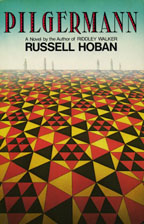
The second half is much better; it follows Pilgermann and his new friend, Bembel Redzuk, as they conceive of a massive tiled court they call "Hidden Lion" (see cover), which they erect to study the point at which "stillness becomes movement" and "movement becomes consciousness." If you can't tell, Pilgermann is a book mostly of ideas and not plot; for every page of action there are probably ten pages of Pilgermann's complex thoughts on the nature of religion and death. Some are quite beautiful and profound--for example, I like the way that Pilgermann never gets to Jerusalem, but finds solace in the words of a traveling group of child pilgrims who say, in the face of their own death, "Jerusalem is wherever we will be when we get to the end"--but much is dense, obtuse, and not quite worth the effort it takes to decipher. It is a book full of references from all three of the Abrahamic religions, and one of its chief themes is their interaction. That the Muslim world comes off much better than the Christian (and even the Jewish) is no surprise; Hoban's depiction of the Frankish crusaders as being socially underdeveloped in relation to their Turkish counterpoints is historically accurate.

I picked up this book because Hoban penned one of my favorite novels, Riddley Walker, a post-apocalyptic novel written completely in the strange pidgin English of the future. I'm sad to say that Pilgermann isn't nearly as enjoyable, though serious religious scholars may find it interesting. As disappointed as I am, I still may read another of his books, Turtle Diary, about a pair of strangers who come together to free a couple of sea turtles from the zoo. This guy seriously never writes the same book twice.