Showing posts with label Graham Greene. Show all posts

Wednesday, May 27, 2026

The Captain and the Enemy by Graham Greene

I cannot pretend that all these details which I am trying so hard to reconstruct from my memory are necessarily true, but I feel myself today driven by a compulsive passion now that we are separated to make these two people live before my eyes again, to bring them back out of the shadows and set them to play their sad parts as closely as possible to the truth. I want above anything else to make the two of them clear to myself, so that they will continue to live as visibly as two photographs might seem to do propped up on a shelf beside my bed, but I don't own a single photograph of either of them. Why am I so possessed by them? Of the Captain I have heard nothing for years, and Liza, whom I left of my own accord, I see only from time to time, always with a sense of guilt. It's not because of any love I feel for them. It is as though I had taken them quite coldbloodedly as fictional characters to satisfy this passionate desire of mine.

As a boy, Jim finds himself taken out of his boarding school by a mysterious figure who calls himself "The Captain." Jim doesn't mind going--he's one of those boys who seems to always be on the outside of the group, a victim for bullies. The Captain, it turns out, has "won" Jim in a backgammon game from his true father, a dissolute gambler known to Jim only as "The Devil." The Captain is Jim's liberator in many ways, but he makes it clear that he has no plans to be a substitute father for the boy, except in the sense that he changes his name immediately, from Victor. He quickly instructs Jim in a series of confidence games and petty tricks that reveal his true nature as a con artist and thief--the name change, in fact, is more in the way of a guise than a fatherly act. Ultimately, the Captain drops Jim off with his girlfriend Liza, who seems to have made a stray remark about wanting a child, a remark the Captain has gone above and beyond to fill. Jim ekes out a strange life with Liza, who never quite rises to the level of a mother, a strange and peripheral existence punctuated by the Captain's abandonments and returns.

I was immediately captivated by the beginning of The Captain and the Enemy. Greene thrusts us into the position of young Jim, trying to figure out the strange figure who has dropped into his life and transformed it, perhaps for the better, perhaps not. "The Captain" is a Greenian figure par excellence, a con artist and trickster native to the English underworld. If he's hard to figure out, it's because he doesn't want to be figured out. Never do we really understand what the Captain's grift is: is he a big-time criminal, or a petty one? The only thing that Jim seems to be able to say for sure is that Liza, his not-quite mother, is head over heels in love with him. Later, as Jim tries to make sense of the strange childhood he has had, this fact hits him with depressing clarity: in that household or any other, no one loved him as much as these two loved each other.

I was disappointed, then, by the second half of The Captain and the Enemy, which transforms something unstable and weird into much more common Greene fare. As an adult, Jim travels to Panama, where the Captain has been living, to inform him of Liza's death, but when he arrives, he finds that he's unable to do it--not out of tenderness but what seems to be a willful rejection of the shape of the life that the Captain forced upon him as a child. The choice of Panama seems to be inspired by Greene's friendship with leader Omar Torrijos, which he wrote about in Getting to Know the General. The intrigue that embroils Jim is obscurely related to the revolution in Nicaragua and Panama's peculiar importance to the United States, as well as the agitation over the return of the Canal Zone. The Captain is implicated now in some kind of international espionage, and his enemy is an English journalist--who may be a secret American--named Quigley. Is Quigley the enemy, or is it Jim, who is offered the opportunity to betray his father figure? It's all very Oedipal, but the intrigue is too blurry and the story too familiar; it made me long for the strangeness of the opening chapter.

Saturday, September 6, 2025

Getting to Know the General by Graham Greene

The novel On the Way Back nagged at me night and day on my return to France. Those characters which I had so mistakenly drawn from life wouldn't let me rest. I would constantly remember Chuchu's boast, "I'm never going to die"; is complex theology--"I believe in the Devil. I don't believe in God," and the way that he would prove the existence of the Devil by pushing at a swing door in the wrong direction. The General and Chuchu went on living, far away in Panama, and they refused to become characters in my novel. And Panama--so much of the little country had still been left unseen and it seemed highly unlikely that I would ever be able to return for a second visit.

In the 1970's, Graham Greene received a call inviting him to the small Central American nation of Panama. The request came from no other than General Omar Torrijos, Panama's recently installed leader. Torrijos, it seems, was sort of an odd duck: not explicitly Marxist but having come to power in a coup against Panama's right-wing regime, a passionate believer in social democracy but not in partisan or sectarian politics. His core issue is the return of the Panama Canal to Panamanian control. Arriving in Panama City, Greene finds himself immersed in a world of intriguing figures: Sandinistas and Somozans working against each other in nearby Nicaragua, right-wing journalists, scheming viziers. But at the heart of it all is Torrijos, who turns out, in Greene's telling, to be a simple and humble person who only wants to spend a little time with what he sees, through Greene's novels, as a kindred spirit.

I'm reaching a bittersweet age where I'm exhausting all my favorite novelists, so it was heartening to calculate recently that, at the rate of one book a year, I can be reading Graham Greene into my fifties, even if I have likely read all of his best works. I was drawn to Getting to Know the General because I'd never read one of Greene's non-fiction books, and I was interested to see what it was like for Greene becoming, in a way, a character from his own books. In fact, for the length of his time in Panama, which includes sporadic journeys over a period of five or six years, Greene is writing a book in his head based on the General and his right-hand man Chuchu. (Despite his expressions of admiration for Torrijos, it seems like most of Greene's time in Panama is spent with Chuchu.) The book, called On the Way Back, is doomed to never be written. Perhaps the real people crowded out the fiction, or perhaps Greene simply got too deeply integrated with his Panamanian friends to cultivate the necessary distance to write his novel.

The subtitle of the book, after all, is "The Story of an Involvement," and Greene did get involved: several times he describes, with offhand diffidence, lending his efforts to negotiating for the liberation of hostages taken by Central American guerilla groups. Greene is there in the room when the treaty between Torrijos and the Carter administration that provides for the return of Panamanian sovereignty to the Canal Zone; it's fascinating to see him look witheringly at some of the assembled slaughterers, like Pinochet and Henry Kissinger. Novel, too, to read about his friendship with "Gabo," Gabriel Garcia Marquez, who ends up as a kind of Latin-American counterpart in the light intrigues that Torrijos extracts from Greene.

So, as much as anything, Getting to Know the General is a fascinating document that captures a little-remembered slice of 20th century history. But it's a pleasure, too, in the way that Greene lends his cosmopolitan eye and ear to the natural and cultural landscapes of Panama: its islands, its mountains--like the one that will ultimately take the General's life in a suspicious plane crash--its towns, its rundown hotels and haunted houses, its terrible food and vile rum punches.  

Sunday, May 11, 2025

The Last Thing He Wanted by Joan Didion

There are people who understand this kind of transaction and there are people who do not. Those who understand it are at heart storytellers, weavers of conspiracy just to make the day come alive, and they see it in a flash, comprehend all its turns, get its possibilities. For anyone who could look at a storefront in Honduras or Costa Rica and see an opportunity to tap into the United States Treasury for $25,870, this was a period during which no information could be without interest. Every moment could be seen to connect to every other moment, every act to have logical if obscure consequences, an unbroken narrative of vivid complexity. That Elena McMahon walked into this heightened life and for a brief period lived it is what interests me about her, because she was not one of those who saw in a flash how every moment could connect.

In 1984, a middle-aged journalist and mother named Elena McMahon walks off a job covering a presidential campaign and disappears. Her father, formerly one of those people in the world of intelligence with spurious credentials and obscured duties, has fallen in the grips of dementia. He mentions to her what he probably shouldn't talk about: an arms deal he's organizing for the federal government to fund the Contras in Central America. Elena, disillusioned with her life and job, walks into the job her father can longer do, and soon she finds herself speeding toward Costa Rica (or maybe not?) on a secret flight. Her father's contacts reassure that the job is simple, but she doesn't know that there is another game being played: her father was actually being set up to take the fall for the assassination of an American embassy official, and now Elena has taken his place.

The nature of these events unfold slowly and in non-chronological pieces as they are unveiled and processed by the nameless author, an obvious Didion stand-in. The events of the book, such as they are, have already happened (though of course narrative demands that the climax of Elena's misadventures in Central America and the Caribbean be withheld until the very end), they only need to be ordered and understood. In that way, the job of the journalist-writer is to employ intuition in drawing the connections that are buried and hidden. It's not so different, perhaps, from the job of someone like Treat Morrison, the agency fixer that identifies Elena on the Caribbean island where she's arrived as a potential security threat. Elena, we're told, is not someone who sees the connections immediately; it's what made her a bad journalist, it seems, and it makes her a bad choice for government espionage, though perhaps it makes her a good mark. But in typical Didion mode, the postmodern journalist asserts at every opportunity her inability to understand what happened in this case, not just because the spyworld players cover their tracks, but because of the fundamental unknowability of human beings. Everything can be ordered and the connections made, but the question at the heart of the event--why did Elena McMahon chuck up her entire life to walk into danger?--is unanswerable.

The Last Thing He Wanted was the final novel that Didion wrote in her life. It shares a lot of DNA with her previous novel, Democracy, written twelve years prior, so much so that The Last Thing He Wanted seems at times like a retread of that novel. The complicated task of the journalist, existing somewhere within and without of the text, is better and more interestingly explored there. The way that the political and personal intersect, too. But The Last Thing He Wanted also finds Didion in a mode that reveals just how powerfully and thoroughly she was influenced by the intrigue novels of Graham Greene. The journalist-narrator is a layer of Didion wrapped around the story, but everything else is pure Greene: the busted play, the layered agendas, the sweaty tropical locale. Ultimately, I found that The Last Thing He Wanted doesn't quite succeed because it plays the story so at arm's length that the reader ends up standing outside the story as much as the journalist does. But it's as pure a distillation of Didion's influences and interests, as far as fiction goes at least, as perhaps we ever got.

Sunday, September 22, 2024

The Tenth Man by Graham Greene

Charlot stared back at him with horror. The fleshy and porky figure of the actor momentarily was transformed into his own ideal--the carnal and the proud, leaning negligently there on the axis of the globe offering him all the kingdoms of the world in the form of six freehold acres and a house. He could have everything--or his three hundred francs miraculously renewed. It was as if all that morning he had moved close to the supernatural: an old woman was dying and the supernatural closed in. God came to the house in an attaché case, and when God came the Enemy was always present. He was God's shadow: he was the bitter proof of God. The actor's silly laugh tinkled again, but he heard the ideal laughter swinging behind, a proud and comradely sound, welcoming him to the company of the Devil.

A German prison camp in France. The prisoners are told that one out of ten of them will be liquidated in the morning, and they may choose among themselves. Thinking it fairest, they draw lots; among those marked to die is Chavel, a wealthy man. Chavel desperately offers all his fortune and estate to anyone who will take his place. Janvier, a man dying of tuberculosis, takes him up on the offer, which will provide for his mother and sister. Later, when Chavel is released, he travels back to his country estate. Under the name Charlot, he takes a job as a servant in the household and falls in love with Janvier's beautiful and bitter sister, who waits for the "real" Chavel every day so that she may spit in his face, and then shoot him. 

In many ways, The Tenth Man reminded me of Daphne du Maurier's incredible novel The Scapegoat, but reversed: in Du Maurier's novel, the protagonist is mistaken for a rich man who may have been a Nazi collaborationist, and must play the part in order to be accepted by his "family." Greene's Chavel/Charlot must deny his identity and his connection to the estate; of course, it's no surprise that the subterfuge transforms him into a real servant, a humbler and more generous man. It's a great premise--Greene wrote it as a treatment for a film that was never released, although after its publication as a novella, they did make a movie of it with Anthony Hopkins--but to Greene's credit, he recognizes that the premise needs a wrinkle, a turn. He introduces the character of Carosse, a malicious professional actor who recognizes that, in the wake of the war's end, he can use his actorly skills to transform himself into whoever he wants. Hearing second-hand the story of Chavel, he shows up at the estate claiming to be Chavel, and even schemes to "re"-possess it using a law that invalidates property transfers during the war. Carosse is Chavel's true doppelganger, a man who delights in subterfuge instead of living by it by necessity, and who takes up the identity that Chavel has cowardly forsaken. It's Carosse who, of course, will provide Chavel the opportunity to make good on his cowardice in the prison yard, and offer himself up for sacrifice for a greater good.

The Tenth Man is subtitled "a novel," but it's really a novella, unmistakably a minor work, though it has all the hallmarks of a great Greene story. The prose is so effortless and smooth that it reads to me like a man in the self-assured late stages of his career. (Certainly it is more classically "Greene" than his other late works, like Doctor Fischer of Geneva or Monsignor Quixote, which have a kind of strangeness that reads like boredom with his familiar topics.) It's packaged with a couple other treatments for movies that were never made, one of which, "Jim Braddon and the War Criminal," sounds like a kind of twin to The Tenth Man: Braddon, who bears a striking resemblance to an escaped Nazi, crash lands in the South American jungle where said Nazi is said to be on the lam. Having contracted amnesia, Braddon is captured and must face his "identity" as the Nazi, until the look of self-sacrifice and remorse on his face convinces a court psychologist of the mix-up. It's a fun little idea, over the top even for Greene, but it resonates in an interesting way with the doppelgangers and identity swaps of The Tenth Man.

Sunday, November 19, 2023

The Human Factor by Graham Greene

"You haven't said a word of blame, Sarah."

"What sort of word?"

"Well, I'm what's generally called a traitor."

"Who care?" she said. She put her hand in his: it was an act more intimate than a kiss--one can kiss a stranger. She said, "We have our own country. You and I and Sam. You've never betrayed that country, Maurice."

Maurice Castle is an agent with the MI-6 working on African intelligence. He's an ordinary sort of guy, aging but comfortable. When his superiors suspect that his unit has been leaking information to the Russians, suspicion naturally falls on his subordinate Davis, a desperate and hard-drinking man. These superiors decide it would be best to get rid of Davis, poisoning him in a way that will look like the effects of cirrhosis, but--stop me if you didn't see this coming--it's actually Castle that's the leak. He's no Communist, but he owes a debt to the Russians for assisting in his extraction from South Africa years ago with the Black South African woman who is now his wife. The discovery of the leak puts him in a tough position. Getting out would be the only prudent move, but an old South African enemy he's been charged with meeting reveals that the apartheid regime is considering using "tactical" nuclear bombs on the Bantustans, and Maurice finds himself torn between saving himself and his family, and doing what's right.

The Human Factor is maybe the bleakest and most cynical of all of Greene's books. Maurice is, as he describes himself to Sarah, technically a "traitor." But is his country something worth being loyal to? The chummy ease with which his superiors discuss dispatching poor Davis, between kidney pies and pheasant shoots, expose a British intelligence that has no interest in "the human factor" of the title, only saving themselves from scandal at any cost. They collaborate happily with the apartheid regime in South Africa, whose callousness toward Black South Africans is depicted with shocking clarity. When Castle asks his former South African contact Muller about his attitude toward the innocents who would die from these "tactical nukes," Muller replies that he expects they'll have their own segregated heaven. And to be honest, the Russians are no better--it's revealed late in the book that they, too, are happy to use Maurice more or less for their own purposes. The Human Factor makes it clear that you can as loyal as you wish to your country, but your country will never be loyal to you.

Greene could write about Africa well; he did in The Heart of the Matter. But if The Human Factor has a flaw, it's that the life of Maurice's wife Sarah and her (much darker) son Sam, a pair of Black South Africans living in the homogenous London exurbs, isn't really well imagined. There's a telling moment late in the book where Sarah, stoic but bereft at Maurice's sudden exodus to Moscow, finds herself being called "Topsy" by a stranger--the young enslaved girl from Uncle Tom's Cabin. But in habit, in temperament, Sarah might be another Anglo housewife. Still, the final act, in which Maurice is separated from Sarah and Sam, is among the most bitterly tragic moments in Greene's fiction. The novel ends with sad sourness: the Russians' promise to extract Sarah and Sam has been abandoned, and for the first time Maurice and Sarah are able to talk on the phone for a few seconds before the line goes dead. We don't expect that the two will ever be reunited; they are loyal to each other--the country of themselves--but it's the other, bigger countries that will always have their way.

Tuesday, November 8, 2022

The Ministry of Fear by Graham Greene

To walk from Paddington to Battersea gives time for thought. He knew what he had to do long before he climbed the stairs. A phrase of Johns's came back to mind about a Ministry of Fear. He felt now that he had joined its permanent staff. But it wasn't the small Ministry to which Johns had referred, with limited aims like winning a war or changing a constitution. It was a Ministry as large as life to which all who loved belonged. If one loved one feared. That was something Digby had forgotten, full of hope among the flowers and the Tatlers.

It's a classic noir set-up, the wrong man: Arthur Rowe has his fortune read at a local festival. The fortune teller, one member of a spy network working in service of the Axis, tells him the winning number for a guess-the-weight game, and he goes home with the prize cake. But inside the cake somewhere is a bit of microfilm for which England's enemies are willing to intimidate, even kill. A German raid saves Arthur from his pursuers, but they're dogged: first, they try to pin a murder on him, then they try to explode him. Neither of these works, but the bomb gives him a spell of amnesia, and Arthur finds himself committed to a sinister mental ward, under a false name he doesn't know is not his.

It's a shaggy dog story, all right. On top of all this, Arthur carries around with him a horrible guilt: he really is a murderer. Years before, Arthur poisoned his ailing wife in an act of mercy. It's this act, actually, that makes Arthur difficult to blackmail or chase underground. Having done the most horrible thing he can imagine, Arthur has little to lose, and no conception of himself as either too good or too vulnerable. At the same time, Arthur's deed lies in contrast to the murders and machinations of the spy network that make up the title "Ministry of Fear." "You think you are so bad," an Austrian refugee named Anna tells him--not exactly a femme fatale, but a recognizable noir figure just the same--"But they can bear pain--other people's pain--endlessly. They are the people who don't care."

The amnesia thing is very silly. Perhaps in 1943, when Greene wrote the novel, it seemed a little less hoary. But it works here because, while Arthur slowly regains his memories, the memory of his wife's murder is the one thing he fails to recover. By forgetting the deed, he is renewed, equally determined as before, but with a fresh and much-needed conscience. The "new" Arthur is no murderer, but an avenger.

The Ministry of Fear actually struck me as one of the stronger of Greene's espionage books. It's more complex, less tawdry, than This Gun for Hire, more interesting that Stamboul Train, two of the books packaged with it in my four-book omnibus. The fourth, Our Man in Havana, illustrates how Greene's later books, even as they kept their spy themes, moved outward into the "Greeneland" of MI6; but The Ministry of Fear alone captures something worthwhile about the homefront. The constant air raids of the Blitz are a physical analog of the "Ministry of Fear," who look like ordinary doctors and tailors but who whose mission, whether by coercion or bribery, is to batter at the integrity of British domestic life. One way to read Arthur is as a symbol for the United Kingdom: no innocent, but one whose crimes cannot compare to the true evil that wages war against him.

Sunday, November 21, 2021

This Gun for Hire by Graham Greene

She never knew, he thought, that he had meant to kill her; she had been as innocent of his attention as a cat he had once been forced to drown; and he remembered with astonishment that she had not betrayed him, although he had told her that the police were after him. It was even possible that she had believed him.

These thoughts were colder and more uncomfortable than hail. He wasn't used to any taste that wasn't bitter on the tongue. He had been made by hatred; it had constructed him into this thin smoky murderous figure in the rain, hunted and ugly. His mother had borne him when his father was in gaol, and six years later when his father was hanged for another crime, she had cut her own throat with a kitchen knife; afterward there had been the home. He had never felt the least tenderness for anyone; he was made in this image and had his own pride in the result; he didn't want to be unmade. He had a sudden terrified conviction that he must be himself now as never before if he was to escape. It was not tenderness that made you quick on the draw.

Raven is a poor Londoner who has made an effective but fragile career out of contract killing: he has recently been tasked to travel to a foreign country and shoot an old minister. When he returns for his payment, he discovers he's been double-crossed: the bills he's paid with are reported stolen, and as soon as he uses them the police are on the trail. He pursues his double-crosser, a sensuous glutton named Cholmondeley, onto a train headed to a small town in the English Midlands. He evades capture by insinuating himself in with Anne, a young woman having left London to join a theater production, but he doesn't know that her fiance is the officer in charge of apprehending Raven.

This Gun for Hire is the most straightforwardly noirish novel of Greene's I've ever read. In fact, the UK title of A Gun for Sale was, if I remember correctly, changed in the US to match the title of the American film noir adaptation. Raven himself is a kind of anti-hero, a man whose harelip identifies him as lower class: he blames, with some good reason, all the frustrations of his life on it; he finds in his physical ugliness proof of his own moral ugliness. Anne surprises him with her failure to be shocked or disgusted by it, and in the face of her diffidence his carefully constructed ideas of himself begin to break down: is he really the person who he has said he is?

All of this takes place against a backdrop of mounting international tensions: the killing of the minister that Raven committed has been blamed on foreign agitators, and the world is ramping up for war. Everywhere Raven, Anne, and her fiance Mathis go, people are talking about the war to come, some with trepidation, and some with glee. When Raven finally tracks Cholmondeley to his employer, a shriveled old steel magnate named Sir Marcus, he discovers the truth: Sir Marcus has engineered the killing, and the incipient war, to increase the demand for steel. In this way Greene makes a shrewd illustration of the way petty crimes are punished in place of great ones. In one of the novel's most shocking moments, we learn that it was Sir Marcus who demanded the bills used to pay Raven be stole ones, saying, "[A] murderer should not be able to benefit from his own crime." The irony of this might be too strong or too obvious, if it weren't possible to think of a million ways this ideology remains a part of our political and moral culture.

As always, Greene talked a lot of guff about how his "entertainments" are distinguished from his more serious novels, but This Gun for Hire--surely one of the most "entertaining" in the sense he meant of of all his books--is full of the ethical, political, and religious complexities that animate all of his work. The scene where Raven takes a long tortured look at a creche--the novel is set at Christmas--is Greene at his Greene-iest.

Monday, November 16, 2020

Orient Express by Graham Greene

Because his future had an almost certain limit, he began to dwell, as he was not accustomed to do, on the past. There had been a time when a clear conscience could be bought at the price of a moment's shame "since my last confession I have done this or that." If, he thought with longing and a little bitterness, I could get back my purity of motive so easily, I should be a fool not to take the chance of forgiveness; I have no conviction that there is anyone to forgive. He came near to sneering at his last belief: Shall I go and confess my sins to the treasurer of the Social-Democratic party, to the third-class passengers? The priest's face turned away, the raised fingers, the whisper of a dead tongue, seemed to him suddenly as beautiful, as infinitely desirable and as hopelessly lost as youth and first love in the corner of the viaduct wall.

Orient Express was Graham Greene's first big success, a popular novel about political intrigue on the famed train running from Ostend to Istanbul. Funny, though, how its success must have been dwarfed by Agatha Christie's Murder on the Orient Express, which came out two years later and at the same time as the film adaptation of Greene's novel. Greene originally titled his book Stamboul Train; I'm not sure about the timing but it's hard not to wonder if the filmmakers, and those who subsequently titled the novel's American edition, were hoping to piggyback off Christie's success. A comparison between the two might be instructive: though Greene considered Orient Express an "entertainment," without the weightiness of some of his later, more serious novels, I think you'd be hard pressed to say that it is quite as "entertaining" as Christie. There's murder and bloodshed on this train, but they don't quite lend themselves to the cathartic crime-and-solution two-step of a satisfying mystery novel. In Greene's version, only a few--and not necessarily the reader--are privileged enough to arrive at their intended destination.

As you might expect, Orient Express is about people from all walks of life, gathered on a train. There's Carleton Myatt, a Jewish businessman, dealing in currants, who is preoccupied with the possibility that he is being cheated by his agent in Istanbul. There's Coral Musker, who is traveling to Istanbul to join a chorus line; Myatt gifts her his own first-class berth when she faints suddenly in the corridor. There's Josef Grunlich, who has just shot and killed a man during a robbery when he boards in secret at Vienna--one of the sensible things about the way Greene structures the novel is that people are always getting on and off the train, you know, as people do, instead of being "stuck" on it in the classic mystery setup. There's Dr. Richard John, who is really a Serbian Communist named Dr. Richard Czinner, who is headed secretly back to Belgrade to stand trial for a past attempt at revolution. Czinner's return is spoiled by a journalist named Mabel Warren, a really ugly sort of character: not only are her journalistic methods unscrupulous, but she's also a drunk and a predatory lesbian who's enraged by the desertion of her beautiful "partner." (This character is not Greene's finest moment, I think.)

"Entertainment" or not, the politics of Orient Express are subtly radical. Czinner forms the novel's moral spine: he knows he is returning to face certain death in Belgrade, and his thoughts are the thoughts of a dying man, reckoning up the sum of his successes and failures. Czinner's revolution has been twice scuttled, but he goes to affirming his own convictions by suffering at the hand of the despised state. It's Czinner, too, who occupies the role of the lapsed Catholic that appears in nearly all of Greene's novels. Greene writes that Czinner had "blown that candle out with his own breath, telling himself that God was a fiction invented by the rich to keep the poor content," but when faced with failure and death, he longs for the return of a belief that will shape his sacrifice into a meaning that still eludes it.

It's Myatt who is Czinner's foil: although he is dogged throughout the novel by casual anti-Semitism, Myatt's life is organized around capital. He gives his bunk, and eventually his first-class ticket, to Coral, who is inwardly ravaged by the question of what she owes him in return. Myatt and Coral seem to genuinely like each other, but their budding relationship is troubled by Myatt's gift. When Coral says "I love you," after giving herself--and her virginity!--to Myatt, how much of that is genuine love, and how much is predicated on his promise to give her a place to live in Istanbul? She doesn't know, and neither does Myatt: capital and capitalism, Greene suggests, present an insurmountable barrier to human connection.

I've never read Murder on the Orient Express. I assume Christie, for the sake of narrative unity, keeps the action pretty focused on the train itself, and doesn't let anyone off. But the climax of Orient Express comes in the Serbian border town of Subotica, where military officials--thanks to Mabel's morning article, which reaches Belgrade before the train can--have orders to seize Czinner. Their dragnet scrapes up Josef and Coral, too, separating her from Myatt, and providing the dramatic setup for the novel's final push. Coral gets an opportunity to absorb Czinner's moral clarity, freed from the complications of capital; Myatt gets a chance--though not necessarily a successful one--to perform an act of heroism that will be a gift to Coral of more than monetary value.

It's clear to me that Greene's work got better than age, and if anything, even more cynical about the operations of European capitalism and imperialism. Czinner stands out as a character here, but stands out also as a prototype for more interesting and complicated apostates, fewer good men trying to understand their own goodness and more bad men who do good things despite all their best efforts. Still, Orient Express is a much deeper and more thoughtful book than Greene seemed to believe it was.

Sunday, September 24, 2017

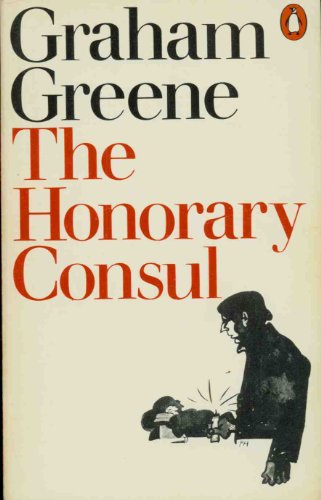
The Honorary Consul by Graham Greene

"I believe in the evil of God," Father Rivas said, "but I believe in His goodness too.  He made us in His image--that is the old legend.  Eduardo, you know well how many truths in medicine lay in old legends.  It was not a modern laboratory which first discovered the use of a snake's venom.  And old women used the mold on overripe oranges long before penicillin.  So I too believe in an old legend which is almost forgotten.  He made us in His image--and so our evil is His evil too.  How could I love God if he were not like me?"

Sometimes reading a Graham Greene novel is like ordering the newest item at Taco Bell.  It's new all right, but it's mostly the same raw materials--beans, cheese, tortilla, meat--combined in a new shape.  In The Honorary Consul, it's easy to recognize some of Greene's hallmarks, his beans and cheese.  The protagonist is once again a world-weary cynic and agnostic.  Like in The Quiet American, his foil is a bumbling civil servant.  This time it's Charley Fortnum, the alcoholic honorary consul for the UK in a small Argentinian town, who gets kidnapped by Paraguayan revolutionaries thinking they've nabbed the American ambassador.  And then of course there's the ex-priest, the conflicted man of God, who over the course of the book moves backwards into his own past and rediscovers his religion.

The priest is a man named Father Rivas, who left the cloth to marry and join up with the revolutionaries.  The cynic in The Honorary Consul is Eduardo Plarr, an Anglo-Argentinian doctor whose relationship with Fortnum and the kidnappers both puts him in the middle of the botched kidnapping.  He's also, of course, sleeping with Fortnum's wife, an ex-prostitute:

In a real love affair, he thought, you are interested in a woman because she is someone distinct from yourself; then bit by bit she adapts herself to you, she picks up your habits, your ideas, even your turns of phrase, she becomes part of you, and then what interest remains?  One cannot love oneself, one cannot live for long close to oneself--everyone has need of a stranger in the bed, and a whore remains a stranger.

I don't mean to disparage Greene's books, which often get a lot of mileage out of a very narrow set of themes and situations.  There's something comforting about their familiarity.  (Of course, it's when he breaks those molds that his books are most valuable, like The Power and the Glory and Brighton Rock.)  But The Honorary Consul never finds a way to rise above that narrow set, like The Quiet American does.  It has much to say on the nature of God and the religious life--like the whiskey priest in The Power and the Glory, we get to watch the hapless Rivas dragged back into the life of the priest he thought he'd left behind.  And the character of Fortnum is a good and vivid one, a man who's alcoholism is self-destructive and whose life is small, but who is ennobled by the love he bears his wife.

Like those other books, it's a thriller as much as it is a religious meditation.  The kidnappers try to do their best with the honorary consul, whom they want to ransom in exchange for the release of political prisoners in Paraguay, but the Paraguayans can't understand the vast difference between the office of consul and the honorary title, which makes Fortnum such a small fish that no one--the US, the UK, or Argentina--is willing to do anything to save his life.  Everyone ends up trapped: the kidnappers, who never thought they'd have to kill anyone; Plarr, who's caught between trying to save Fortnum and bedding his wife; and of course Fortnum, who's literally trapped.  The final section of the novel, where all parties are sitting in their hut in the barrio waiting nervously for the deadline to come, is talky and slow, but manages to capture something essential to Greene's worldview: the ineluctable cruelness of international politics, and the heavy hand exerted by God.

Monday, May 4, 2015

The Quiet American by Graham Greene

Wouldn't we all do better not trying to understand, accepting the fact that no human being will ever understand another, not a wife a husband, a lover a mistress, nor a parent a child?  Perhaps that's why men have invented God -- a being capable of understanding.  Perhaps if I wanted to be understood or to understand I would bamboozle myself into belief, but I am a reporter; God only exists for leader-writers.

It seems now that Graham Greene's The Quiet American had a kind of prescience.  I'm told it wasn't very popular in America, because it made us seem like meddlers and dilettantes in world affairs, but if Aldon Pyle, the "Quiet American" of the title is meant as a stand-in for the nation as a whole, it couldn't be much more accurate.  Pyle is an American in Vietnam before the war, when it was a French problem, and he arrives with no more knowledge than his textbooks have given him, but with an unwavering certainty that the way to solve the "Vietnam problem" is to fund a third force of rebels who will destabilize the conflict between French colonialists and Communists.  Greene wrote about Pyle in 1955, and a decade later, there we were, meddling and dilettanting on a much more tragic scale.

The narrator of the novel, Thomas Fowler, is classically Greene: a cynic, a realist, and an atheist.  He and Pyle become fond of each other, but Fowler sees Pyle for what he is, a man who has "punted down into Phat Diem in a kind of schoolboy dream."  Fowler, a journalist, holds to a fierce neutrality:

'You can rule me out,' I said.  'I'm not involved,' I repeated.  It had been an article of my creed.  The human condition being what it was, let them fight, let them love, let them murder, I would not be involved.  My fellow journalists called themselves correspondents; I preferred the title of reporter.  I wrote what I saw.  I took no action--even an opinion is a kind of action.

Fowler suffers from the same delusion as Nick Carraway, a delusion that Heisenberg destroyed in the twenties, the belief that you can be a mere observer, and not affect what happens around you.  Greene's books are always true to their novelistic staging, and when Fowler insists that he is "not involved," we can be assured that by the end of the novel he will be very involved indeed.  In this case, what drags Fowler into involvement is Phuong, a beautiful Vietnamese woman who has been Fowler's lover for a long time, and with whom Pyle falls deeply in love.  Like a boy scout, Pyle insists on taking Phuong from Fowler in the honorable way, even going so far as being air-dropped into a battle zone to find Fowler and ask his permission.  Fowler, older and married, knows that he cannot compete with Pyle, who will bring Phuong to the United States, and yet his fondness for Pyle never wavers.


Like Fowler, we like Pyle, though he is kind of a genial monster.  To his surprise but not our own, the rebels he has armed kill dozens of innocent civilians.  On a political level, he ought to have served as a stark warning against mucking around in world affairs where our idealism counts for very little--a lesson you might argue we seem not to have learned.  On a literary level, he's a powerful portrait of misguided rectitude, and a sour criticism of modern virtue.  The Quiet American is Greene at his most cynical and least redemptive, but perhaps his most troubling.

Wednesday, January 1, 2014

Monsignor Quixote by Graham Greene

"Perhaps we are all fictions, father, in the mind of God."

I have had this book on my shelf for a long time, waiting to read it until I had finished Don Quixote.  As I have said before, I think that the compulsion to model or remake canonical texts is risky; most often the result is a constant reminder of how far short modern literature falls of our greatest forebears.  Graham Greene's Monsignor Quixote is no exception, I think.  While it is often touching and thoughtful, I thought that its attempts to reimagine the journey of Don Quixote and Sancho in post- Franco Spain were the least effective aspects of it.

Greene's Quixote is a priest, supposedly the descendent of Cervantes' hero.  He does not get on well with his superior, but his hospitality toward a bishop passing through La Mancha results in his nomination as a monsignor, which mortifies his sense of humility.  His friend Sancho, a Communist and former mayor of their town of Toboso, compels him to take a leave of absence and a brief trip to Madrid to purchase the purple socks and pechera of his new station.  In Greenesque fashion, the journey is complicated when the pair inadvertantly invite the attention of the Fascist police and end up on the run.

Monsignor Quixote and Sancho often pause to acknowledge, with a smirk, the parallels between their "journey" and Don Quixote's.  This approach works as well as it does because Greene wisely foregrounds it, keeping the protagonists aware of the allusions, and thus keeping Monsignor Quixote squarely in the metafictional tradition that started with Don Quixote's second part.  And the differences are just different enough--Sancho, for example, is no fool, but a cagey, thoughtful man.  Like Cervantes' heroes, the friendship between the two is unbreakable, even in the face of their philosophical differences.  I particularly liked a scene where Sancho takes the unknowing Monsignor to a whorehouse, where he tries to blow up a condom like a balloon.

Greene has a couple different goals here, I think.  He wants to draw a parallel between the two Quixotes, who are both committed to supposedly outmoded literary traditions.  Just as the Knight of the Sorrowful Face has his books of chivalry, the Monsignor has his Bible, and I think Greene is elegizing a Catholicism that he sees passing away in the conflicts of the mid-twentieth century.  At one point Sancho tells Monsignor Quixote that, were he to read the letters of Saint Paul, "I would find your taste as absurd as Cervantes found your ancestor's."  Yet that doesn't seem right; even while he pokes fun at Don Quixote, Cervantes always seems to hint that his outmoded moral code makes him a better and nobler man than the people he meets.

But also I think Greene is trying to envision a union of Catholicism and Communism that preserves the Church's commitments to the poor and the spiritual life in the face of venal capitalism.  I know Brent's favorite scene from this novel occurs at the end, where a feverish Monsignor performs a kind of "phantom" mass without the elements--an assertion of the power of even imaginary sacraments, though probably not theologically sound, with the Catholic insistence on Christ's immanence in the wafers and wine.  But my favorite scene is the one that occurs just before, when the Monsignor comes upon a small-town parade that includes an effigy of Mary papered in bank notes:

Father Quixote could not understand what he saw.  He was not offended by the customary image, with the plaster face, and the expressionless blue eyes, but the statue seemed to be clothed entirely in paper.  A man pushed him to one side, waving a hundred-peseta note, and reached the statue.  The carriers paused and gave him time to pin his note on the robes of the statue.  It was impossible to see the robes for all the paper money--hundred-peseta notes, thousand-peseta notes, a five-hundred-franc note, and right over the heart a hundred-dollar bill.  Between him and the statue there were only the priest and the fumes of the incense from his censer.  Father Quixote gazed up at the crowned head and the glassy eyes which were like those of a woman dead and neglected--no one had bothered even to lower her lids.  He thought: Was it for this she saw her son die in agony?  To collect money?  To make the priest rich?

Now, this scene wins no points for subtlety.  But it seems timely, like a lesson that we have yet to learn, one that is certainly as true in 21st century United States of America as it was in mid-century Spain.  Monsignor Quixote is far from my favorite Greene novel--I'm not sure it is measurably improved by the often-goofy references to Cervantes, which may even distract from what a strong and sympthetic character the Monsignor is.  But scenes like the one above continue to resonate--and perhaps even chasten me.

Sunday, August 14, 2011

Doctor Fischer of Geneva, or The Bomb Party by Graham Greene

I think I used to detest Doctor Fischer more than any other man I have known just as I loved his daughter more than any other woman. What a strange thing that she and I ever came to meet, leave alone to marry.

Both James Wood and Gabriel Josipovici have invoked Graham Greene as a sort of bogeyman of realism, terrorizing the modern consciousness with his inert prose. Waugh accused him of lacking a "specifically literary style at all." It is true that Greene is no great experimentalist, but I have always thought these charges were trumped up, and inadequately appreciative of some of the more startling bits of The Power and the Glory or The Heart of the Matter, among others. But Greene put out a lot of work in his life, and I think it might be fair to say that much of it is inconsistent, and it may be accurate even to say that some of it is lazy.

Doctor Fischer of Geneva, or The Bomb Party is a remarkably weak Greene novel, mostly because it relies, crutchlike, on a rather brilliant premise. The protagonist, Alf Jones, marries a wonderful woman many years his junior, and comes to find out that her father, Doctor Fischer, is a wealthy psychopath who likes to throw parties where he humiliates a set of cronies. These cronies--his daughter, Anna-Luise, calls them the Toads--put up with the Doctor's savagery because at the end of each party they receive a ridiculously extravagant present. Fischer channels all of his genius until these humiliations:

"Of course you don't know what Mr. Kips looks like."

"I do. I saw him when I tried to see your father the first time."

"Then you know he's bent almost double. Something wrong with his spine."

"Yes. I thought he looked like the number seven."

"He hired a well-known writer for children and a very good cartoonist and between them they produced a kind of strip-cartoon book called The Adventures of Mr. Kips in Search of a Dollar. He gave me an advance copy. I didn't know there was a real Mr. Kips and I found the book very funny and very cruel. Mr. Kips in the book was always bent double and always seeing coins people had dropped on the pavement... The book--I suppose most children are cruel--became a popular success. There were many reprints."


And yet, Mr. Kips comes faithfully to every one of Doctor Fischer's party, in the promise of receiving an eighteen-karat gold lighter or a piece of expensive jewelry. Doctor Fischer's wealth gives him great power, and Greene's narrator is always pausing to note that Fischer is, in his own way, like God. In what should be a really striking moment, Jones is waiting for his wife at a ski lodge when he discovers that she has been in an accident. The waiter at the lodge, not knowing what has happened, is angry at Jones for reserving and abandoning his table:

The waiter was more surly than ever. He told me, "You reserved this table for lunch. I have had to turn away customers.

"There's one customer you'll never see again," I told him back, and I threw a fifty-centime piece on the table which fell on the floor. Then I waited by the door to see if he would pick it up. He did and I felt ashamed. But if it had been in my power I would have revenged myself for what had happened on all the world--like Doctor Fischer, I thought, just like Doctor Fischer. I heard the scream of the ambulance and I returned to the ski lift.


Yes, there is a nice symmetry here when Jones--having just parted the side of his dying wife!--waits to see if the waiter will endure the humiliation that Jones, in his despair, wants to inflict. But must we have it explained to us so plainly? Do we need awkward little bon mots like these?:

"He didn't invite your to a party?"

"No."

"Thank God for that."

"Thank Doctor Fischer," I said, "or is it the same thing?"


Many of the book's flaws are redeemed by the last scene, in which Doctor Fischer throws one last party. Each guest gets to pick out a Christmas cracker, all of which save one contain a check for two million francs. The last contains a bomb. Fischer's cynicism tells him that his guests will endure the enormous personal risk for the money, and he is right, except in the case of Jones, who, ravaged by his wife's death, seeks out the cracker with the bomb in it.

This is rich stuff, but it is only a small part of a short book that seems wrought with too little care. The most interesting part about it may be the way that it ends, on a note that is uncharacteristic in that it is both rather upbeat and insistently agnostic:

Evil was as dead as a dog, and why should goodness have more immortality than evil? There was no longer any reason to follow Anna-Luise if it was only into nothingness. As long as I lived, I could at least remember her. I had two snapshots of her and a note in her hand written to make an appointment before we lived together; there was the chair which she used to sit in, and the kitchen where she had jangled the plates before we bought the machine. All those were like the relics of bone they keep in Roman Catholic churches. Once as I boiled myself an egg for my supper, I heard myself repeating a line which I had heard spoken by a priest at the midnight Mass at Saint Maurice: "As often as your do these things you shall do them in memory of me." Death was no longer an answer--it was an irrelevance.


Doctor Fischer was one of Greene's final novels. Are these words an insight into a man whose long attachment to his faith had waned, or lost power, for whom death and what comes after had become an irrelevance? And is it possible that the weakness of the novel is not unrelated?

Perhaps not. More likely it is Greene's long tendency to slip into pulpiness that, in his best works, is overcrowded by his talents. Greene himself made the distinction between his more literary works and "entertainments," though it is unclear which Doctor Fischer is meant to be. If you're looking for a masterpiece lurking in Greene's minor works, though, I'd suggest skipping Doctor Fischer and going for A Burnt-Out Case.

Saturday, July 9, 2011

The Last Post by Ford Madox Ford

It had been obvious to her for a long time that God would one day step in and intervene for the protection of Christopher. After all Christopher was a good man -- a rather sickeningly good man. It is, in the end, she reluctantly admitted, the function of God and the invisible Powers to see that a good man shall eventually be permitted to settle down to a stuffy domestic life... even to chaffering over old furniture. It was a comic affair -- but it was the sort of affair that you had to admit. God is probably -- and very rightly -- on the side of the stuffy domesticities.

Graham Greene called The Last Post a mistake and omitted from his collected edition of the Parade's End novels (1 2 3), operating according to what seem to have been Ford's express wishes. I am not sure I agree with Ford and his protege, but the purpose of this novel does remain unclear. The last time we saw Christopher Tietjens, he was celebrating Armistice Day, having decided once and for all to abandon the income of Groby, his ancestral home, and to take up with his would-be mistress, Valentine Wannop. It was an awfully sweet ending for a series about a perpetually tortured man, and it's hard to shake the feeling that Ford couldn't resist adding a dash of bitters:

It had come through to Marie Leonie partly then and partly subsequently that Christopher's wife had turned up at Christopher's empty house that was in the Square only a few yards away. They had gone back late at night probably for purposes of love and had found her there. She had come for the purpose of telling them that she was going to be operated on for cancer so that with their sensitive natures they could hardly contemplate going to bed together at that moment.


In the first novel, Father Consett, the confessor of Tietjens' vindictive wife Sylvia, warns that if Christopher ever leaves her for another woman, "[t]he world will echo with her wrongs." In this way, Ford's impulse to write a fourth novel makes sense; Sylvia Tietjens would never consent to simply let Tietjens and Valentine live together apart from her torments. And true to form, on Armistice Day she invents a lie about cancer to keep them apart.

The most perplexing thing about The Last Post, however, is that it's barely about Tietjens at all. The strongest character is his brother, Mark, who has had some sort of seizure brought on by the news that England has refused to follow the Germans into their own territory. Mark maintains that his paralysis is voluntary--he echoes Iago's insistence that "from this time forth I never will speak word"--but whether that is true is never clear. The narrative perspective bounces from Mark to his recently married mistress, Marie Leonie, to Valentine, but Christopher is away on an aeroplane, gone to Groby to convince Sylvia's tenants there not to tear down the symbolic Great Groby Tree.

But Sylvia of course, is at Christopher's house, in order to "torture that girl out of her mind. That was why she was there now. She imagined Valentine under the high roof suffering tortures because she, Sylvia, was looking down over the hedge." She brings with her (for reasons that are never all that clear to me) a murderers' row of the series' villains: General Campion, Tietjens' godfather who sends him to the front because of Sylvia's mud-slinging; Ruggles, who does much of Sylvia's dirt-digging; Edith Ethel Duchemin, who hates Tietjens because her husband owes him money; Mrs. de Bray Pape, the uncouth American who is renting Groby (and believes herself the spiritual descendant of Louis XIV's consort); even Michael Mark, Tietjens' son, whose dubious parentage tortures Tietjens. All this leads to a very tense climax in which Sylvia, at the head of her phalanx of scoundrels, confronts a defenseless Valentine. But, because this is Ford, things do not turn out as they seem that they will:

[Sylvia said, "]They can all, soon, call you Mrs. Tietjens. Before God, I came to drive those people out... But I wanted to see how it was you kept him..."

Sylvia Tietjens was keeping her head turned aside, drooping. Hiding a tendency to tears, no doubt. She said to the floor.

"I say again, as God hears me, I never thought to harm your child. His child... But any woman's... Not harm a child... I have a fine one, but I wanted another... with its littleness... It's the riding has done it..." Someone sobbed!


Sylvia, having come intent to destroy Valentine psychologically, discovers that Valentine is pregnant with Tietjens' child and cannot do it. Perhaps the corruption of an innocent thing is too far; perhaps it is the realization that Valentine has succeeded where she could not, not just in keeping him, but in giving him a child that is doubtlessly his, and a family. I wish that I knew what that last phrase--it's the riding has done it--meant, but I have not been able to figure it out.

Is The Last Post a failure? On one hand, it ties up the loose end of Sylvia, who broods over the happy ending of A Man Could Stand Up--, and I think it does so appropriately. On the other hand, there's something discordant about packaging Christopher Tietjens away in an aeroplane to finish the tetralogy which is expressly his. I am reminded of Rabbit Remembered, but in that case Rabbit was dead, and the novella was written in the spirit of mourning. The Last Post is a novel of mourning too, but for an English culture that has perished with the war (like Groby Great Tree, which takes out half Groby wall with it).

Tietjens' absence, however, provides us--with what, exactly? More space for someone like Marie Leonie, Mark Tietjens' wife, who gives us the French perspective on the end of World War I, I suppose. Marie Leonie is a well-developed, intriguing character, and so is the "paralyzed" Mark, but they aren't Tietjens, and so the experience of reading The Last Post is like ordering the steak and being served the beef consomme.

But--then again--these books are wonderful and it's wonderful to have more of them. I am a little sad to have done with them, but I have the upcoming BBC adaptation to look forward to, scripted by none other than Tom Stoppard. It will probably be the best five hours of television that anyone has ever seen, ever.

Saturday, March 5, 2011

Travels with My Aunt by Graham Greene

I was sunk deep in my middle age. All the same I laid my head against her breast. 'I have been happy,' I said, 'but I have been bored for so long.'

One of Graham Greene's most consistent peculiarities is that his heroes and heroines are irreligious types, or at best believers impoverished in their faith, confined to religious novels. Something in him seems to harbor a great sympathy for the unbelieving, and I have long thought his books were written in part of exorcise the demons of his own conflicted faithfulness.

Henry Pulling, the protagonist of Travels with My Aunt, is an interesting variation on this archetype, Greene's anti-Greene: a homebody. Greene's obsession with travel seems almost colonialist, and his books, like his life, flit back and forth between continents. Henry, on the other hand, is a creature of habit, confined to his home and his routine, whose only interests are in cultivating dahlias. His experiences are hand-me-downs:

One's life is more formed, I sometimes think, by books than by human beings: it is out of books one learns about love and pain at second hand. Even if we have the happy chance to fall in love, it is because we have been conditioned by what we have read, and if I had never known love at all, perhaps it was because my father's library had not contained the right books.


That sounds like something straight out of the Fifty Books Project Manifesto, but here it only serves to make Henry seem more like a naif. His routines are shaken when he meets his Aunt Augusta for the first time at his mother's funeral. They strike up a friendship, and soon Augusta convinces Henry to accompany her on her travels, stretching from France to Istanbul to Paraguay.

Unsurprisingly, Augusta opens Henry's eyes to the virtues of the adventurous life. This is less sentimental than it sounds, and less so in that it quickly becomes a typical Greene novel, wherein Augusta is endeavoring to find her old lover who just happens to be wanted by Interpol for collaborating with the Nazis. Travels makes no bones about the danger of international living--Henry is savagely beaten and imprisoned for thoughtlessly wiping his nose on a red handkerchief on Paraguay's national day--but also extols the value of danger and the hollowness of suburban living. One of my favorite passages follows Henry's train of thought on the train to Istanbul with a young girl:

She leant against me in the carriage. I liked the smell of her hair. I suppose if I had known more about women I could have identified the shampoo she must have had in Paris. Her hand was on my knee, and the enormous wrist-watch stared up at me with its great blank white face and its four figures in scarlet, 12 3 6 9, as if those were the only important ones to remember - the hours when you had to take your medicine. I remembered Miss Keene's minute gold wrist-watch like a doll's witch Sir Alfred had given her on her twenty-first birthday. In its tiny ring it contained all the figures of the hours as though none were unimportant or without its special duty. Most of the hours of my life had been eliminated from Tooley's watch. There were no hours marked for sitting quietly and watching a woman tat. I felt as though one night in Southwood I had turned my back on any possibility of home, so that here I was shaken up and down between two segments of Bulgarian darkness.


This is the orderly, conservative Greene's idea of stream-of-consciousness. It doesn't quite work as a whole, but I love the pieces themselves: Henry's need to cling to things as trivial and domestic as the brand of Tooley's shampoo; the missing hours from Tooley's watch, as Henry becomes aware of the dwindling of his own short life; the contrast between the ordered and the unordered life; the wonderful phrasing of "shaken up and down between two segments of Bulgarian darkness." What makes the darkness Bulgarian? Even without the ability to see what lies beyond the train window, Henry perceives the newness of his experiences: this darkness is different from English darkness.

In the end, Henry has to decide between following his aunt and returning home. Even if he embraces the new life, it confirms Greene's self-abnegation, forcing us to ponder the value of books as a substitute for experience, and risks the legitimacy of his own works. After all, aren't we indicted for living out Henry's experiences "second hand?"

Other Reviews:

Brent
Stuck in a Book

Sunday, August 22, 2010

The Complete Short Stories of Graham Greene

If you are familiar with any of Graham Greene's short stories, it's probably "The Destructors," the story that Drew Barrymore discusses with Jake Gyllenhaal's English class in the film Donnie Darko. Gyllenhaal uses the story, which is about a gang of teenagers destroying an old man's house from inside, to find inspiration for his own acts of vandalism. Gyllenhaal is led to do these things by visions, but they ultimately exhibit a sense of purpose (though convoluted). In Greene's story, there is no purpose, no why; the Destructors are goaded into their actions by a sadist named T who pursues the destruction of the house with a single-mindedness that only the teenage psyche can possess. The story is a brief, bitter pill, a meditation on the nature of evil, suggesting it exists as a means to perpetuate itself. It's wonderful and Greene-like--Brighton Rock compressed to a diamond.

Greene has never been well known for his stories, except perhaps this one. And rightly so, as far as I can tell. Few of these stories really live up to the spiritual agony that characterize his novels, and some are downright bad. Conspicuously, the earliest and latest stories seem to be the worse offenders, and Greene seems to have had the habit of using the shorter form to tinker with various one-note and half-baked ideas, some of them quite stupid, like "Alas, Poor Maling," which is about a civil servant whose stomach rumblings imitate real-world noises. Really.

But there are a few, like "The Destructors," that can safely be placed among his best work:

The End of the Party -- One thing that Greene exhibits in these stories that he doesn't in his novels is a fair ability to write from the perspective of children. I might also have mentioned "The Basement Room" here, which is from the perspective of a child trying to understand the bitter marriage of his caretaker, but there is something grimly absurd about "The End of the Party": Two identical twins are invited to a birthday party, which fills one of them with fear because at this girl's party every year they are forced to play hide-and-seek, and he is deathly afraid of the dark. His cooler-headed brother tries to figure out a way to get out of it, but the other descends slowly into a hysteria that seems like it might afflict one of Greene's adult characters.

A Visit to Morin -- This one isn't quite as good as the others here--too much of it is a single, long conversation--but I think that it provides a key to understanding something of Greene's own mind that few of his novels permit. M. Morin is, like Greene, a writer well-known for being a Catholic, though an idiosyncratic one. When the narrator meets him, he is a recluse who has turned away from belief, his spirit destroyed by his fellow believers:

He said, 'A man can accept anything to do with God until scholars begin to go into the details and the implications. A man can accept the Trinity, but the arguments that follow...' He gave a gesture of rejection. 'I would never try to determine some point in differential calculus with a two-times-two table. You end by disbelieving the calculus.


English Catholics are a minority, unlike their Continental counterparts, and Greene tended to compound that outsider identity by focusing on characters who were non-believers. I think that M. Morin gives us a glimpse into what I would call a cherished loneliness, Greene's unwillingness to identify with the faith that his work obsesses over.

May We Borrow Your Husband? -- This one might have left Greene open to charges of homophobia--as rightly it would have in a lesser author--but Greene is a deft creator of characters and the story succeeds because the predatory homosexual couple in it are so strongly themselves, and not of a type. The narrator is a loner staying at a seaside resort in Antibes who falls in love with a beautiful woman honeymooning there. The couple, Tony and Stephen, discern that the woman's new husband harbors a repressed homosexuality, and hatch a plan to seduce him. This is an act of unparalleled awfulness, but the story is really about the narrator's inability to do anything to stop it or help the woman. He can't prevent it without dragging the unspoken into the open air, and unable to do anything constructive he most choose the least destructive of destructive paths: Stay silent.

Under the Garden -- I have left this one for last because it is the best. It is one of the finest short stories I have ever read, and to be honest it is not much in Greene's mode at all. This makes it a greater achievement still, because Greene really has a very narrow set of hallmarks that he rarely steps outside of in his longer fiction.

It is a flashback story, nested in a frame in which the protagonist, Wilditch, is informed that he is dying of cancer. He wants to go back and see his childhood home, where his brother now lives. It's a difficult decision, but it is predicated on one of those transcendent sentences that Greene keeps in his back pocket to remind you that he is capable of them:

Why then go back now and see it in other hands? Was it that at the approach of death one must get rid of everything? ...He had the will to possess at that absolute moment nothing but his wound.


There he discovers a story that he had written as a child called "The Treasure on the Island." The island is a small one in a small lake which is part of the old estate; in the story it is much bigger and a young boy there finds a secret treasure.

The story is poor and Wilditch dislikes having written it, not because it is childish but because it bears no likeness to his memory of what actually happened on the island. In the actual story, as he now recounts, Wilditch discovered a cave upon the island that led to a massive underground captain. An old one-legged man named Javitt resides there with his wife Maria. Javitt claims to be hundreds of years old and possess a great treasure; Maria can only say, "kwahk." Javitt attempts to keep Wilditch in the cavern as some sort of heir, instructing him in all sorts of complex nonsense:

'You are a bit scared still of Maria and me because you've never seen anyone like us before. And you'd be scared to see our daughter too, there's no other like her in whatever country she's in now, and what good would a scared man be to her? Do you know what a rogue-plant is? And do you know that white cats with blue eyes are deaf? People who keep nursery-gardens look around all the time at the seedlings and they throw away any oddities like weeds. They call them rogues. You won't find many white cats with blue eyes and that's the reason. But sometimes you find someone who wants things different, who's tired of all the plus signs and wants to find zero, and he starts breeding away with the differences. Maria and I are both rogues and we are born of generations of rogues. Do you think I lost this leg in an accident? I was born that way just like Maria with her squawk. Generations of us uglier and uglier, and suddenly out of Maria comes our daughter, who's Miss Ramsgate to you. I don't speak her name even when I'm asleep. We're unique like the Red Grouse. You ask anybody if they can tell you where the Red Grouse came from.'


This is sustained absurdism, and I wouldn't have thought Greene capable of it. Like the best nonsense, it expresses somethings amid the nothings but provides few clues to determine which is which. Is it madness to be "tired of all the plus signs and want... to find zero," or is it wisdom?

Surely this story cannot be true, so why is it so embarrassing to the adult Wilditch that he wrote down a different story entirely? We are asked to differentiate between false fictions and true fictions, to understand that "The Treasure on the Island" is an outright lie and the story of Javitt something near to truth. The child Wilditch reduced his experience in Javitt's cave to something he could understand, but in understanding it he deprived himself of its most immediate qualities. Is the story of Javitt a religious one, a truth beyond truths? Have we reduced God to a poor story because we have been too frightened of truth's strangeness, its refusal to bend to reason and understanding? In the end, what seems irrefutable is that Wilditch has found something to hold on to, to possess at that absolute moment other than his wound.

These are just a few; I have left out probably a half-dozen great stories and another handful of very good ones. Also compiled here are the first twenty pages of an abandoned novel and a brief treatment of a musical Greene wanted to write about criminals who kidnap a bunch of bishops and take their places. You could argue that it's a shame that Greene never really got the chance to show his versatility, or you could argue that he was a man who knew what he was best at. In either case, this is worth picking up for "Under the Garden" alone.

Sunday, July 18, 2010

The Good Soldier by Ford Madox Ford

And yet I swear by the sacred name of my creator that it was true. It was true sunshine; the true music; the true splash of the fountains from the mouth of stone dolphins. For, if for me we were four people with the same tastes, with the same desires, acting--or no, not acting--sitting here and there unanimously, isn't that the truth? If for nine years I have possessed a goodly apple that is rotten at the core and discover its rottenness only in nine years and six months less four days, isn't it true to say that for nine years I possessed a goodly apple? So it may well be with Edward Ashburnham, with Leonora his wife and with poor dear Florence. And, if you come to think of it, isn't it a little odd that the physical rottenness of at least two pillars of our four-square house never presented itself to my minds as a menace to its security? It doesn't so present itself now though the two of them are actually dead. I don't know...


The Good Soldier is about two couples: John and Florence Dowell and Edward and Leonora Ashburnham. John, who narrates the story, and his wife are an American couple who meet the British Ashburnhams at a German resort for those with ailing hearts. Edward is the "good soldier" of the title, idolized by Dowell to the point of fawning, but he also conducts a years-long affair with Dowell's wife.

As it turns out, neither Florence nor Edward truly has a heart condition--not a physical one, at least. Edward is a serial philanderer, incapable of avoiding petty, sentimental affairs with beautiful young women, and comes to the resort in pursuit of a girl with a real "heart." Florence is a fake and an opportunist with designs on Branshaw Teleragh, Edward's estate and the ancestral home of Florence's family. Leonora seeks to endear herself to Edward by managing his love affairs, but throughout all of it Dowell is either painfully, idiotically unawares or represses his understanding, perhaps out of a powerful homosexual attraction for Edward. When, as above, Dowell says "I don't know..." it is a universal expression, as the full realization of the situation--which has caused the suicide both of Florence and Edward--causes him not only to doubt the genuineness of his friendships but his ability to understand any human being.

Dowell begins his tale by saying, "This is the saddest story I've ever heard." The Saddest Story was Ford's original title (and seems still to be Dowell's), but he changed it due to the outbreak of a story arguably sadder--World War I. As such, The Good Soldier is decidedly pre-modernist, as WWI is generally considered the origin of modernity, yet it prefigures so well the modernist model: Dowell's unreliability, the immense gap between the author and his narrator, the disjointed, out-of-sequence narrative. Yet, Graham Greene, an acquaintance and admirer of Ford, thought that he could see underneath it all a great amount of pain and anguish suffered by Ford himself.

I think that this is probably one of the greatest books of the twentieth century--I absolutely love it. It is peopled by generally loathsome characters, who nevertheless manage to make themselves exquisite in pity. Edward is a monster of sympathy, brimming over with such love for the sad young maidens of the world that he cannot help but give himself to them, compelled to be an eternal Christ figure. Leonora is a devout Catholic determined to salvage the wreckage of her marriage. Dowell is an utter fool, ravaged by a misery he does not understand, pursuing an unspoken love through a method that can only be described as self-deletion. Florence is unmistakably the cruelest of the lot, yet she is also the one who keeps with her a vial of prussic acid that she might kill herself should her malignancy be discovered. It is hard not to think of these people as Dowell himself thinks of the Ashburnhams:

But what were they? The just? The unjust? God knows! I think that the pair of them were only poor wretches, creeping over this earth in the shadow of an eternal wrath. It is very terrible....


Poor wretches, creeping over this earth in the shadow of an eternal wrath. I think perhaps much of the novel's power has to do with the fact that we are meant to wonder if we are not a little bit like the narrator, unable to see the things in ourselves that an audience, reading the story of our lives, may intuit immediately and pity us for them, and that, as Dowell says, "the record of humanity is a record of sorrows."

Monday, May 31, 2010

Travels with My Aunt by Graham Greene

“Do you know what you’ll think about when you can’t get to sleep in your double bed? Not of women… You will think of how every day, you are getting a little closer to death. It will stand there as close as the bedroom wall. And you’ll become more and more afraid of the wall because nothing can prevent you from coming closer and closer to it every night while you try to sleep.”

Travels with My Aunt
could have been renamed Graham Greene’s Carpe Diem without doing injury to its themes and ideas. It opens at a funeral, where Henry Puller meets his long lost Aunt Augusta. Her first words to him are, “I was once present at a premature cremation.” After the funeral, they get together for a cup of tea and she convinces him to travel with her. The rest of the novel is concerned with their movement from one place to the other, as Henry tries to figure out exactly what kind of man he is.

Aside from a fairly obvious twist near the end, Travels with My Aunt isn’t terribly concerned with plot. It is, however, populated with some of Greene’s most memorable characters: the irascible Aunt Augusta, seventy-five and not ready to slow down yet; Visconti, the Italian lover who sounds like Al Pacino but looks like Danny DeVito; Wordsworth, Augusta’s black lover; the two Tooleys, father and daughter; and dozens more, some appearing in the main narrative, some existing only in the stories told to Henry by his aunt.

The real emphasis of the novel is the inner life of the protagonist, Henry. When the novel opens, Henry is a recently retired banker whose only hobby is raising Dahlias and whose only romantic interest is a somewhat dull, matronly woman named Ms. Keene. During his time with his aunt, Henry’s attitude turns from disbelief and disdain of his aunt’s dissolute and somewhat illegal lifestyle to admiration and, finally, embracing it. As he says near the end, “I have been happy, but I have been bored for so long.”

It’s interesting, then, to look at Travels with My Aunt in comparison with Greene’s other novels. In his most famous works, the Catholic books, his protagonists are driven by something higher than themselves. Whether they believe in God or not, their lives revolve around the bigger questions in life. In Travels, God hardly makes an appearance—though Aunt Augusta claims to be a Roman Catholic, she says, “I just don’t believe the things they believe”—and big picture issues are hardly considered at all. On the one hand, Travels is clearly a comic novel, and such themes might not work in context; on the other, Aunt Augusta and Henry are well-developed characters and share poignant moments. It seems somewhat disappointing then that the ultimate theme of the book seems to be the ephemeral “live for the moment”, when the themes of Greene’s best works could be characterized as “live for the world to come.” However, it’s these contradictions that make Greene such a fascinating man and author, and I’d recommend Travels with My Aunt to anyone wanting a lighter-hearted visit to Greeneland.

Tuesday, April 6, 2010

The Comedians by Graham Greene

The ambassador said, 'We mustn't complain too much of being comedians--it's an honourable profession. If only we could be good ones the world might gain at least a sense of style. We have failed--that's all. We are bad comedians, we aren't bad men.'

'For Christ's sake,' Martha said in English, as though she were addressing me directly, 'I'm no comedian.' We had forgotten her. She beat with her hands on the back of the sofa and cried to them in French now, 'You talk so much. Such rubbish. My child vomited just now. You can smell it still on my hands. He was crying with pain. You talk about acting parts. I'm not acting any part. I do something. I fetch a basin. I wipe his mouth. I take him into my bed.'

Greene's books always have something both of the religious and the political, though they are not always balanced. The Power and the Glory wasn't as concerned with the totalitarianism that had seized Mexico as it was the trial of one man's soul within it; The Comedians, as seems to be the case with Greene's later work, is more concerned with earthly things.

It opens on a ship bound for Haiti. On board is the narrator, Brown, returning to the hotel he owns in Port-au-Prince left empty by the dearth of tourists at the height of Papa Doc Duvalier's regime. Also present are Mr. Smith, a committed political activist hoping to start a vegetarian center in Haiti, and Major Jones, an affable man of dubious military connection. The blandness of their names is not lost on Brown, who sees in the three of them a sort of interchangeability that symbolizes their disconnect from the Haitian political climate.

They are the Comedians--not serious actors, not real players in this political drama. Brown himself is a citizen of Monaco, which is almost like being a citizen of nowhere at all, and had inherited his hotel from a mother he had known only in the few hours before her death. Like Smith and Jones, he does not belong to Haiti, but neither does he belong to anywhere:

The first colours touched the garden, deep green and deep red--transience was my pigmentation; my roots would never go deep enough anywhere to make me a home or make me secure with love.


But Brown is mistaken--the three of them are not as detached as they believe themselves to be. As soon as Brown arrives at his hotel, he finds the body of the Minister of Health in his pool, which sets off a chain of events that leave him and the others at odds with the Tontons Macoutes, Papa Doc's not-so-secret police. Brown fails to see that his roots have grown deep enough to be regarded as weeds and pruned away.

The Comedians is not my favorite of Greene's novels. There is something of it that seems a little "Greene-by-the-numbers." The facelessness suggested by Brown's name only underscores how neatly he parallels almost all of Greene's heroes: wry, disillusioned, and most importantly, a lapsed Catholic.

There is also something of the heightened political element that seems to bring out Greene at his bitterest. Greeneland is a tortured place, whether it be a bitterly oppressed Mexico, a war-ravaged Sierra Leone, or an isolated leper colony. Yet, when Greene focuses on matters of faith he seems to find hope even in the darkest places and in the most crippled hearts. The political Greene, by contrast, seems to be more of a cynic. Though the scurrilous Jones has his redemption in the end, the smallness of his efforts compare unfavorably to the persistence of the Haitian regime.

Though Greene's lapsed Catholics never seem to resume their faith, they end each novel inches closer to God than they were before. But The Comedians seems fonder of Communism than of Catholicism, and without a hint of religious awakening Greene's Haiti seems, like Brown's soul, irredeemably desolate.

Monday, January 18, 2010

A Burnt-Out Case by Graham Greene

In an unfamiliar region it is always necessary for the stranger to begin at once to construct the familiar, with a photograph perhaps, or a row of books if they are all that he has brought with him from the past. Querry had no photographs and no books except his diary. The first morning when he was awakened at six by the sound of prayers from the chapel next door, he felt the panic of complete abandonment. He lay on his back listening to the pious chant, and if there had been some magic power in his signet ring, he would have twisted it and asked whatever djinn answered him to be transferred again to that place which for want of a better name he called his home. But magic, if such a thing existed at all, was more likely to lie in the rhythmical and magical chant next door. It reminded him, like the smell of medicine, of an illness from which he had long recovered. He blamed himself for not realizing that the area of leprosy was also the area of this other sickness. He had expected doctors and nurses; he had forgotten that he would find priests and nuns.


A Burnt-Out Case shares certain superficial similarities with Greene's The Heart of the Matter; both are concerned with British men living in Africa, suffering from the kind of alienation that Greene's exotic settings typically symbolize. To my mind it is also a sort of mirror image of another of his books, Brighton Rock. While that one is concerned chiefly with the conundrum of the special propensity for evil that religious men exhibit, A Burnt-Out Case is about the capability of non-religious men for acts of good.

Querry is searching--note the uncharacteristic appropriateness of his name--for an escape. Once a famous architect of churches, he has lost the ability to love, to feel, or to suffer, and before these has long ago lost his faith. He comes to Africa to run from even himself, and ends up in a leper colony run by priests. He wishes to be of use, but eventually is pressed into designing a new hospital for the order. Soon, his presence in the leper colony is discovered by an enterprising reporter, and Querry, contrary to his wishes and his own self-image, is being hailed in Europe as a sort of living saint.

Querry insists that he cannot be a saint; saints suffer, saints love, and above all saints believe in God. He, on the other hand, is a "burnt-out case"--like those lepers who must lose limbs and become horribly mutilated before the disease will run its course and disappear. Despite all his protests to the contrary, it becomes clear that Querry, for whatever his past transgressions in Europe, has a good heart. The question then is, if Querry does not claim God, can God claim Querry? The Superior of the order opines in a sermon:

"But Yezu [Jesus] is not just a holy man. Yezu is God and God made the world. When you make a song you are in the song, when you bake bread you are in the bread, when you make a baby you are in the baby, and because Yezu made you, he is in you. When you love, it is Yezu who loves, when you are merciful it is Yezu who is merciful. But when you hate or envy it is not Yezu, for everything that Yezu made is good. Bad things are not tehre--they are nothing. Hate means no love. Envy means no justice. They are just empty spaces, where Yezu ought to be."


This puts into my mind Gerard Manley Hopkins' poem, As Kingfishers Catch Fire:

I say more: the just man justices;
Keeps grace: that all his goings graces;
Acts in God's eye what in God's eye he is--
Christ--for Christ plays in ten thousand places,
Lovely in limbs, and lovely in eyes not his
To the Father through the feature of men's faces.


The essential thrust of A Burnt-Out Case is that Querry desperately wants to run from himself but, as the saying goes, wherever he goes, there he is. Querry considers himself lost and faithless, but God follows even when He is not wanted because God is in Querry. As Hopkins puts it, he "[a]cts in God's eye what in God's eye he is."

And this is precisely why I love reading Greene so much--though his books are dark and the people in them generally miserable (as it seems Greene himself was) they are built around affirmations like this one, that good and God cannot be rubbed out, erased, or run away from.