Showing posts with label suicide. Show all posts

Saturday, December 10, 2016

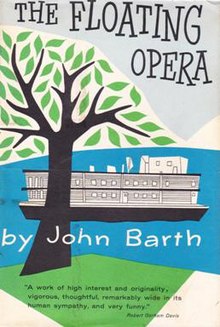
The Floating Opera by John Barth

Why The Floating Opera?  I could explain until Judgment Day, and still not explain completely.  I think that to understand any one thing entirely, no matter how minute, requires the understanding of every other thing in the world... Well, The Floating Opera.  That's part of the name of a showboat that used to travel around the Virginia and Maryland tidewater areas: Adam's Original and Unparalleled Floating Opera; Jacob R. Adam, owner and captain; admissions 20, 35, and 50 cents.  The Floating Opera was tied up at Long Wharf on the day I changed my mind, in 1937, and some of this book happens aboard it.  That's reason enough to use it as a title.  But there's a better reason.  It always seemed a fine idea to me to build a showboat with just one big flat open deck on it, and to keep a play going continuously.  The boat wouldn't be moored, but would drift up and down the river on the tide, and the audience would sit along both banks.  They could catch whatever part of the plot happened to unfold as the boat floated past, and then they'd have to wait until the tide ran back to catch another snatch of it, if they still happened to be sitting there.  To fill in the gaps they'd have to use their imaginations, or ask more attentive neighbors, or hear the word passed along from upriver or downriver.  Most times they wouldn't understand what was going on at all, or they'd think they knew, when actually they didn't... I needn't explain that that's how much of life works: our friend float past; we become involved with them; they float on, and we must rely on hearsay or lose track of them completely; they float back again, and we either renew our friendship--catch up to date--or find that they and we don't comprehend each other anymore.  And that's how this book will work, I'm sure.

John Barth's The Floating Opera is about the day that the narrator, Todd Andrews, decides not to kill himself.  That intriguing detail is laid out at the very beginning of the text, and then returned to after a number of long, digressive interludes about Todd's life.  We learn that his father committed suicide, and that he long had an affair with the wife of his friend, the pickle magnate Harrison Mack.  We learn about a long legal case he adjudicated that involved, among other things, the proper possession of hundreds of jars of human urine.  But the question laid out at the beginning of the novel--why did Todd consider killing himself, and why did he change his mind--hangs over the shaggy, humorous narrative:

So.  Todd Andrews is my name.  You can spell it with one or two d's; I get letters addressed either way.  I fear you'd say, "Tod is German for death: perhaps the name is symbolic."  I myself use two d's, partly in order to avoid that symbolism.  But you see, I ended by not warning you at all, and that is because it just occurred to me that the double-d Todd is symbolic, too, and accurately so.  Tod is death, and this book hasn't much to do with death; Todd is almost Tod--that is, almost death--and this book, if it gets written, has very much to do with almost-death.

The central image of the novel is the Floating Opera, a Vaudeville-esque show that takes place off shore in the town where Todd lives.  (Weird aside: this is the second novel I've read this year that takes place on Maryland's eastern shore.)  The Opera is central to Todd's existential pondering: he decides that suicide is the logical extension of the absurdity of life:

III. There is, therefore, no ultimate "reason" for valuing anything.

Now I added including life, and at once the next proposition was clear:

IV. Living is action.  There's no final reason for action.
V. There's no final reason for living.

But--and here goes the spoiler alert--what the reader has not realized is that when Todd decides to kill himself, he decides to sabotage the ventilation system of the Floating Opera and blow up hundreds of people along with him, including his friends, and a girl who his possibly his own daughter.  This decision is so starkly at odds with the light-hearted silliness of the narrative, that it comes as an explosive surprise.  Todd's decision to not kill himself, in the end, is linked to the failure of this attempt to blow up the Opera.

The ultimate message of The Floating Opera is this: if life is meaningless, you might as well live it as do anything else.  As a moral statement, it's not quite profound, but it matches the absurd and digressive nature of the novel, which is clearly modeled on the proto-modernist excess of Tristram Shandy.  Everyone lives on, but at the dark center of the novel is the awareness that it might have been otherwise.

Sunday, August 4, 2013

The Bell Jar by Sylvia Plath

I thought the most beautiful thing in the world must be shadow, the million moving shapes and cul-de-sacs of shadow.  There was shadow in bureau drawers and closets and suitcases, and shadow under houses and trees and stones, and shadow at the back of people's eyes and smiles, and shadow, miles and miles of it, on the night side of the earth.

I totally forgot that I had read The Bell Jar.  Well, no, I didn't forget that I'd read it, I forgot to review it, and for whatever reason, as I went back over the books I needed to write about after I got back from my trip, it dropped out of my mental list.  That's a shame, because The Bell Jar is really fantastic.  I'm sorry, The Bell Jar.

As Meagan pointed out in her review from a couple years ago, The Bell Jar is almost an autobiographical work.  Its heroine, Esther Greenwood, is a stand-in for Plath herself, who also spent a time working for a magazine (Mademoiselle, in Plath's case) and who fretted over her career and romantic prospects, and then had a nervous breakdown and had to be briefly committed to an institution.  Keeping this in mind makes reading The Bell Jar a grim exercise, since shortly after it was published Plath committed suicide.  Such knowledge blunts the sharp humor of Esther's bungled attempts to kill herself, which seem as if they are detailed with the light touch of someone with a greater sense of distance from their previous feelings.

One of the really terrific things about The Bell Jar is the way in which Plath is able to blur the line between the everyday neuroticism of the first part, which seems very familiar to anyone trying to "make it" in academia, or the creative professions, or New York City, and the kind of mental illness that strikes Plath when she returns to her New England home in the second part.  In a famous passage from the first part, Esther compares her future to a fig tree:

From the tip of every branch, like a fat purple fig, a wonderful future beckoned and winked.  One fig was a husband and a happy home and children, and another fig was a famous poet and another fig was a brilliant professor, and another fig was Ee Gee, the amazing editor, and another fig was Europe and Africa and South America, and another fig was Constantin and Socrates and Attila and a pack of other lovers with queer names and offbeat professions, and another fig was an Olympic lady crew champion, and beyond and above these figs were many more figs I couldn't quite make out.

I saw myself sitting in the crotch of this fig tree, starving to death, just because I couldn't make up my mind which of the figs I would choose.  I wanted each and every one of them, but choosing one meant losing all the rest, and, as I sat there, unable to decide, the figs began to wrinkle and go black, and, one by one, they plopped to the ground at my feet.

I love this image, and it's easy to see the stamp of Plath's poetry on it.  I was impressed by the way that Plath manages to employ the distinct, stark imagery and detail of her poems without sacrificing a strong narrative voice.  The list of writers who are equally great poets and novelists is not very long, and I wouldn't hesitate to put her on it.  (Hardy, Lawrence, Plath... ?)  But look how easily the ennui and indecision of that passage transforms into a kind of paralysis:

The reason I hadn't washed my clothes or my hair was because it seemed so silly.

I saw the days of the year stretching ahead like a series of bright, white boxes, and separating one box from another was sleep, like black shade.  Only for me, the long perspective of shades that set off one box from the next had suddenly snapped up, and I could see day after day glaring ahead of me like a white, broad, infinitely desolate avenue.

It seemed silly to wash one day when I would only have to wash again the next.

It made me tired just to think of it.

I wanted to do everything once and for all and be through with it.

We read this passage with a sense of irony, thinking that the author recognizes the strange horror of these thoughts, shares an outsider's perspective with us.  And that may be true.  It may be true that Plath, like Esther sometimes can, can see these images with an outsider's perspective, and yet they doubtlessly became unbearable for Plath in the end.  What she left behind is a great, horribly frank and terrifying novel, perhaps the greatest record we have of mental illness.

Sunday, May 1, 2011

The Adults by Alison Espach


All of my favorite novels go a little like this: A young woman (usually but not always high school aged) meets a man that is enough older than her that he is significantly older. The (usually inappropriate) relationship starts. Some seemingly world-ending (or ever day) event happens and they are torn apart. The separation continues for years until, one day, fate or sex bring them together again. But there’s more conflict! The conflict is always followed by a second drift. New lives be damned, though, inevitably—like it’s nothing—there they are again, together. They were put on this earth to torture one another and live in the squalid remnants of a basement-level-sorrow-inducing love. The book ends and you want to wail and gnash your teeth and beat your chest or listen to REM in the dark.


This probably means something is wrong with me.


Anyway, this is one of those novels. I discovered it when I was on my MFA-school-success-story-authors-only kick. (If you are wondering, though you probably aren’t, I didn’t get into McNeese and I did get into George Mason and I’ll be studying something else entirely at neither of those schools.) Espach studied at Washington University in St. Louis, where she learned how to write some incredibly clever dialogue. (Or maybe she went in writing incredibly clever dialogue. I don’t know.) Sometimes it’s so incredibly clever that I want to put her characters in time out for being so witty all the time because it’s just positively exhausting. I keep starting to type out examples, but they’re just lost out of context. So are all the lines that made me feel like Espach was sucker punching me.

There’s more than just the relationship between the girl and her English teacher, of course. In the beginning, there’s the uncomfortable and cringe-worthy stretch of passages that accompany all coming of age tales that make you feel like you need to scrub your face or you’ll turn into an awkward fourteen year old again. There’s suicide and the breakdown of the nuclear family unit in upper class America and a whole exciting section about studying interior design in Prague (that’s not sarcasm) and passages that will make you roll your eyes about how college boys try to seem sensitive by listening to Portishead while they screw you. Etc.


Finally, the cover. I am covetous of this cover art. I like to picture the jackets of the books that I imagine writing (but haven’t written because I’m lazy) and I am a little upset that I know this is a jacket that will never be mine.

I leave you with a passage… but first, an explanation. Emily, the main character, discovers that there’s a church in Prague made entirely out of human bones. When her younger sister’s dog dies, the sister requests Emily get the dog out of the house before she goes to sleep and bury it because she doesn’t want to dream in the same space as something dead. Emily puts the dead dog in a suitcase, calls up her ex-lover who happens to be in Prague on business, and has him meet her so that they can go to the bone museum to bury the dog because that’s what seems sensible at the time. On the way, however, they stop at a club to smoke pot and he decides to tell her that he’s married, which ruins this chapter of their reunion. The dead dog suitcase never makes it to the bone yard. He walks her back to her place and doesn't kiss her goodnight because he feels like he's cheating now that she knows about his wife whereas somehow he didn't before. Everything is miserable. Now, the passage:

"No matter where we went, we always ended up back where we started. I laid my head down on the pillow and when I tried to dream of some other life, Jonathon was right—there was no bell that tolled at midnight. But there was a garland of arms lining the entrance of the church. There were elbows flanking the altar. There were strings of skulls draped over windows like curtains, like, welcome, like, hey, like, Why don’t you kneel down and make yourself at home? Why don’t you prepare your bones to be something more elaborate than yourself"?

Sunday, July 18, 2010

The Good Soldier by Ford Madox Ford

And yet I swear by the sacred name of my creator that it was true. It was true sunshine; the true music; the true splash of the fountains from the mouth of stone dolphins. For, if for me we were four people with the same tastes, with the same desires, acting--or no, not acting--sitting here and there unanimously, isn't that the truth? If for nine years I have possessed a goodly apple that is rotten at the core and discover its rottenness only in nine years and six months less four days, isn't it true to say that for nine years I possessed a goodly apple? So it may well be with Edward Ashburnham, with Leonora his wife and with poor dear Florence. And, if you come to think of it, isn't it a little odd that the physical rottenness of at least two pillars of our four-square house never presented itself to my minds as a menace to its security? It doesn't so present itself now though the two of them are actually dead. I don't know...


The Good Soldier is about two couples: John and Florence Dowell and Edward and Leonora Ashburnham. John, who narrates the story, and his wife are an American couple who meet the British Ashburnhams at a German resort for those with ailing hearts. Edward is the "good soldier" of the title, idolized by Dowell to the point of fawning, but he also conducts a years-long affair with Dowell's wife.

As it turns out, neither Florence nor Edward truly has a heart condition--not a physical one, at least. Edward is a serial philanderer, incapable of avoiding petty, sentimental affairs with beautiful young women, and comes to the resort in pursuit of a girl with a real "heart." Florence is a fake and an opportunist with designs on Branshaw Teleragh, Edward's estate and the ancestral home of Florence's family. Leonora seeks to endear herself to Edward by managing his love affairs, but throughout all of it Dowell is either painfully, idiotically unawares or represses his understanding, perhaps out of a powerful homosexual attraction for Edward. When, as above, Dowell says "I don't know..." it is a universal expression, as the full realization of the situation--which has caused the suicide both of Florence and Edward--causes him not only to doubt the genuineness of his friendships but his ability to understand any human being.

Dowell begins his tale by saying, "This is the saddest story I've ever heard." The Saddest Story was Ford's original title (and seems still to be Dowell's), but he changed it due to the outbreak of a story arguably sadder--World War I. As such, The Good Soldier is decidedly pre-modernist, as WWI is generally considered the origin of modernity, yet it prefigures so well the modernist model: Dowell's unreliability, the immense gap between the author and his narrator, the disjointed, out-of-sequence narrative. Yet, Graham Greene, an acquaintance and admirer of Ford, thought that he could see underneath it all a great amount of pain and anguish suffered by Ford himself.

I think that this is probably one of the greatest books of the twentieth century--I absolutely love it. It is peopled by generally loathsome characters, who nevertheless manage to make themselves exquisite in pity. Edward is a monster of sympathy, brimming over with such love for the sad young maidens of the world that he cannot help but give himself to them, compelled to be an eternal Christ figure. Leonora is a devout Catholic determined to salvage the wreckage of her marriage. Dowell is an utter fool, ravaged by a misery he does not understand, pursuing an unspoken love through a method that can only be described as self-deletion. Florence is unmistakably the cruelest of the lot, yet she is also the one who keeps with her a vial of prussic acid that she might kill herself should her malignancy be discovered. It is hard not to think of these people as Dowell himself thinks of the Ashburnhams:

But what were they? The just? The unjust? God knows! I think that the pair of them were only poor wretches, creeping over this earth in the shadow of an eternal wrath. It is very terrible....


Poor wretches, creeping over this earth in the shadow of an eternal wrath. I think perhaps much of the novel's power has to do with the fact that we are meant to wonder if we are not a little bit like the narrator, unable to see the things in ourselves that an audience, reading the story of our lives, may intuit immediately and pity us for them, and that, as Dowell says, "the record of humanity is a record of sorrows."

Sunday, October 25, 2009

Tears of a Tiger by Sharon M. Draper

Teacher A: The first book we have to teach for the freshmen is Tears of a Tiger.
Teacher B: Okay, what do we do the second week?

--actual conversation between two teachers at my school

--Hey Rob! Live game, man. You be flyin' with the hoops, man! Swoosh! Ain't nobody better, 'cept maybe me.
--Yo, Andy, my main man! I see you been eatin' bull crap for dinner again! You only
wish you was as good as me! I, Robert Orlando Washington, will be makin' billions of dollars playin' for the N.B.A.! Want me to save you a ticket to one of my games?

--actual opening lines of Tears of a Tiger


Apparently, years ago, when my school first opened, none of the English teacher positions were actually filled by English teachers and so when it came time to choose books to teach someone decided on something called Tears of a Tiger, which may actually be the worst book I have ever read all the way through.

The story is this: Andy Jackson and Rob Washington are best friends and basketball teammates at Hazelwood High. One night, after a win, they go out and celebrate a little too much and Andy, who is driving drunk, crashes into a retaining wall, killing Rob. (From the locker room to the hospital, according to the time-stamp before each chapter, is an hour-and-a-half. Beer bong, anyone?) The rest of the story details Andy's grief, the deterioration of his relationships with his family and friends, and his eventual suicide.

The entire book is written without any sort of action or description, trading off between chapters of confusing, unattributed dialogue, and some sort of epistolary sections cobbled together from letters, homework assignments, and diary entries. Which would be fine, if it made any sense and weren't completely tone-deaf as to the way young people talk, even back, I'm sure, in the mid-90's when it was published.

I also have two much larger, moral issues with the book (Oscar Wilde be damned)--first of all, as if it weren't enough to chronicle Andy's internal struggle, Draper goes to great lengths to describe the kind of social ills that young black students face, like the teacher who predicts that Andy will be fine because "black kids are tough" and the conflict that Andy has with his father about what Andy feels is his dad's toadyism with regards to his white bosses. The book boasts an ensemble cast of Andy's friends and classmates, so we frequently are privy to their racial sensitivities as well, including the character who would get rid of band-aids because they're not the color of his skin, and Andy's little brother, whom he chastises for preferring dolls with blonde hair. Thematically, it's oddly out of place and serves only to minimize Andy's grief by placing it on the same level. Furthermore, Draper's tone-deafness in the way that she airs these greivances had many of my students convinced that the book as a whole was quite racist.

Secondly, and worse, is the treatment that Andy's suicide receives. The event is clumsily foreshadowed multiple times, including an instance in which Andy runs out of the classroom when one of his classmates observed that Lady Macbeth probably deserved her death at her own hands (cue bewildered white and clueless teacher). Yet, when after the act the school counselor recommends that Andy's friends and family write letters to him, not a single one offers any pity or sympathy toward him, but all show some variation on this sort of condescension:

You know what really pisses me off? You! You're a coward and a sellout! You decided to end your life, without saying good-bye to anybody, without asking anyone for help. You deserted your friends and family--the people who love you the most. Suicide is the coward's way out. Brave men face their problems. So what does that make you?

..I hate you for leaving me here. I hate you for making me feel like this. I hate you for making me cry. And I hate you for making me face death again so soon.


Does anyone really think this kind of intimidation is effective in keeping kids from suicide? Andy maintains that no one understands his grief and his guilt, and in the end he's right; no one does. The book is, at the very least, emotionally manipulative, and ultimately comes off as an anti-suicide screed that lacks any sort of insight into what might make a young man kill himself. It is clearly also written by a person that has never considered suicide and has no sympathy for anyone who has.

Worse even still, the book is almost devoid of anything that ought to be taught in English class--there is no figurative language, no deeper meaning, and the characters are paper thin. But I taught the damn thing--where's my Teacher of the Year award, Obama?

Sunday, July 19, 2009

Raise High the Roof Beam, Carpenters and Seymour: An Introduction by JD Salinger

The first night, just this last week, that I felt quite hale and bullish enough to go back to work on this Introduction, I found that I'd lost not my afflatus but but my wherewithal to continue to write about Seymour. He'd grown too much while I was away. It was hardly credible. From the manageable giant he had been before I got sick, he had shot up, in nine short weeks, into the most familiar human being of my life, the one person who was always much, much too large to fit on ordinary typewriter paper--any typewriter paper of mine, anyway.

Leave it to Salinger to put these two works together--works that, like Franny and Zooey, form two halves of something much more cohesive--and leave the one called "Introduction" for last. There is a great irony to that title, not only because this is the last book-length piece Salinger published, but by the time the narrator of Seymour: An Introduction sits down and begins to write, Seymour has already been deceased for decades.

Both of these novellas are about Seymour from the perspective of his brother, Buddy, and both are marked by Seymour's absence. In Raise High the Roof Beam, Carpenters, Buddy recalls taking leave from the army to attend Seymour's wedding in New York, but Seymour never arrives and somehow Buddy gets trapped in a car with the Matron of Honor and other members of the bride's wedding party, most of whom have a very poor opinion of the absent Seymour. Seymour: An Introduction is a more comprehensive treatise on Seymour, covering only the early parts of his life and written well after Seymour's suicide.

In a manner of speaking, Seymour's presence and absence define much of Salinger's works about the Glass family: He appears in two works, "A Perfect Day for Bananafish," which recounts his suicide, and "Hapworth 16, 1924," a late Salinger novella written from a young Seymour's perspective. And yet, he is the subject of these two novellas, and casts a long shadow in death over the events of Franny and Zooey; in Introduction, it is suggested that Buddy is the author of Catcher in the Rye, which casts the relationship between Holden Caulfield and his dead brother Allie in a new light.

These two novellas make it clear that Buddy is somewhat in awe of his brother. Though all the Glass siblings are invariably intelligent--one recurring references in the books is to a radio roundtable show, "It's a Wise Child," in which they all took part as children--Seymour occupies a singular place. Buddy describes him as a poet, sometimes literally, but often simply possessing of a poet's soul, deeply wise in the manner of Zen Buddhists. The title of the first novella comes from a line in Sappho, which Buddy's sister Boo Boo leaves in a note for Seymour on his wedding day:

Raise high the roof beam, carpenters. Like Ares comes the bridegroom, taller far than a tall man.


Taller than a tall man--this describes Seymour perfectly, not just on his wedding day, but as the figure which towers over all of the other Glass siblings as the pinnacle of wisdom, kindness, and self-sacrifice. In Introduction Buddy is continuously apologizing for his efforts, as a writer, to place himself in the same spotlight, as his brother, but there are conflicting desires here: One, to step out of the way and let the world see Seymour for the genius that Buddy believes he is, and two, to be recognized in the same way. Buddy reprints a letter Seymour wrote to him in which Seymour affirms their connectedness:

The membrane is so thin between us. Is it so important for us to keep in mind which is whose? That time two summers ago when I was out so long, I was able to trace that you and Z[ooey] and I have been brothers for no fewer than four incarnations, maybe more. Is there no beauty in that? For us, doesn't each of our individualities begin right at the point where we own up to our extremely close connections and accept the inevitability of borrowing one another's jokes, talents, idiocies? You notice I don't include neckties. I think Buddy's neckties are Buddy's neckties, but they are a pleasure to borrow without permission.


There is a valid temptation here, I think, to see Seymour and Buddy as facets of Salinger himself--on one side, the transcendent philosopher, and on the other, the very human writer. Perhaps there is a Buddhist-like attempt here to separate the lofty from the ordinary, and throw the ordinary away, but the very nature of these novellas affirms that the two are inextricably connected. The question that remains is why Seymour, whom Salinger paints as brimming over with joy, wisdom, and kindness, chose to commit suicide. I often think that the answer to that question, if we could find it, might provide some sort of answer to the question of why Salinger has silenced himself for the past fifty years.

In any case, I think that Seymour: An Introduction might be the best thing that Salinger ever put out. It's written in a sort of stream-of-consciousness fashion, not like Joyce, but as close to stream-of-consciousness as a writer as mannered and minimalist as Salinger could achieve. I recommend it highly.

Sunday, January 25, 2009

The Bell Jar by Sylvia Plath


"And I knew in that spite of all the roses and kisses and restaurant dinners a man showered on a woman before he married her, what he secretly wanted when the wedding service ended was for her to flatten out underneath his feet like Mrs. Willard's kitchen mat."

She's quite blunt, that Esther Greenwood.

The Bell Jar is Sylvia Plath's thinly veiled autobiographical account of her first nervous breakdown and the events leading up to it. Looking back, it is easy to imagine that Esther Greenwood's views on marriage were unconventional for a 1950s college girl. And that was probably somewhat true.

The Bell Jar begins during Esther Greenwood's summer as a Junior Editor to a women's magazine in New York City, before her senior year of college. Esther has been told her whole life what a brilliant and talented writer she is. She, perhaps rightly, feels that all doors are open to her until she meets with an influential female editor at the magazine, who paints a picture of the difficulty young women have breaking into the literary world. Despite this, Esther mostly still feels secure that she will be able to make her career as a writer.

Throughout the summer, Esther maintains a superficial countenance of interest in her job and the other girls. Her mental break is only mildly foreshadowed by Esther's growing sense of hopelessness about her future. She is "practically engaged" to a boring and unfaithful medical student, but any pessimism is still tempered by the plans for her writing career. It is only when she returns home from New York to find that she has been rejected from a writing class due to the quality of her work that the darker parts of her mind begin to best her.

After returning home, Esther does not wash or change her clothes for weeks. She suffers insomnia and cannot eat, think or write clearly. She has not slept for two weeks straight when her mother brings her to a psychiatrist for shock treatments, which hurt and terrify Esther. She plots to kill herself, imagining a variety of ways and discarding them one by one: too bloody, too uncertain, too difficult. Finally, Esther disappears, only to be found huddled in a crawlspace in her mother's basement, barely alive after an overdose of sleeping pills. Only when checked into an asylum, the setting for the book's final chapters, does Esther begin to heal. She finds that the electroshock therapy, administered correctly by the gentle Dr. Nolan, delivers an antidepressant effect, lifting the mental "bell jar" she feels trapped inside.

The Bell Jar is mostly autobiographical. Plath attended Smith College on scholarship, graduating in 1954. The summer before, she served as a junior editor to Mademoiselle magazine. That same summer, Plath was rejected from Frank O'Connor's Harvard writing class, an event which is thought to have precipitated her first suicide attempt.

This book's immediate success likely had a lot to do with the fact that it was first published over a decade after the book's events took place, in January 1963. The early 1960s had a very different feel than the early 1950s, a difference felt acutely by British and American women. 1963 was a watershed year for the feminist movement. The publication of Betty Friedan's The Feminine Mystique that year is popularly credited with ushering in the "Second Wave" of feminism. 1963 was also the year that Plath committed suicide, one month after the novel's publication.

It was in this historical context that Plath's only novel was first read by a generation of women, who applauded it and fought for it's U.S. release. In reading it for the first time now, in 2009 at the age of 24, I can relate to many of Esther/Sylvia's fears. Esther imagines her life as a fig tree, with dozens of figs, each representing a different life choice: marriage and children, becoming a poet or an editor, traveling; as Esther frets about which fig to choose, they begin to blacken and die and fall off the tree, one by one, her choices narrowing as she struggles to decide. I know that I've felt overwhelmed at times imagining the way my life might unfold. I would probably regard anyone my age that didn't feel that way as suspect.

I really enjoyed this book. If my perception weren't clouded by the fact that Sylvia Plath did eventually succeed in taking her life, I'd probably see the ending as hopeful and the period covered in the book as an anomaly in an otherwise charmed life. I think that Esther's feelings of confusion as she confronts her future are felt today by both men and women. I don't see The Bell Jar as a purely feminist treatise, although it is sometimes lumped in that genre.

Tuesday, January 6, 2009

Norwegian Wood by Haruki Murakami

This is the third book by Haruki Murakami that I've read (the others being Kafka on the Shore and Pinball, 1973). I've noticed a positive correlation between how recently one of his books was published and how strange it is. While I prefer his more bizarre works - those that include old men who can speak cat and Colonel Sanders as a spirit guide - this was still an engaging and powerful book, and fits in perfectly on his upward trend of oddness.

Like Kafka on the Shore, Norwegian Wood is a coming of age story, set in Japan in 1970. Toru Watanabe is an eighteen year-old, apathetic college student in Tokyo. A lot of Murakami's own passions are reflected in the character (jazz and classical music, American Literature). Slightly semi-autobiographical, the story is wrought with a series of tragic events that almost seem absurd in their regularity and predictability. Each one feels like another crushing blow to Toru Watanabe, whose broody musings can really be chilling at times.

Death exists - in a paperweight, in four red and white billiard balls on a table - and we go on living and breathing it into our lungs like fine dust.

I lived through the following spring, at eighteen, with that knot of air in my chest, but I struggled all the while against becoming serious. Becoming serious was not the same thing as approaching truth, I sensed, however vaguely. But death was a fact, a serious fact, no matter how you looked at it. Stuck inside this suffocating contradiction, I went on endlessly spinning in circles. Those were strange days, now that I look back at them. In the midst of life, everything revolved around death.
It's a gripping, nostalgic story that left me feeling miserable. Poor Toru Watanabe is a brilliant kid whose hit with one horrible mishap after another, and left alone and floundering for anything of meaning and substance. This book is dark, at times depressing, and plenty erotic (though not as wildly or strangely erotic as Kafka on the Shore). Kafka on the Shore still stands as my favorite Murakami book, but I'd recommend this one too if you're not that into otherworldly stones or disappearing isolated mountain towns.

Sunday, September 14, 2008

RIP David Foster Wallace

.....learning how to think really means learning how to exercise some control over how and what you think. It means being conscious and aware enough to choose what you pay attention to and to choose how you construct meaning from experience. Because if you cannot exercise this kind of choice in adult life, you will be totally hosed. Think of the old cliché about quote the mind being an excellent servant but a terrible master.

This, like many clichés, so lame and unexciting on the surface, actually expresses a great and terrible truth. It is not the least bit coincidental that adults who commit suicide with firearms almost always shoot themselves in: the head. They shoot the terrible master. And the truth is that most of these suicides are actually dead long before they pull the trigger.


Is there some significance to the fact that David Foster Wallace did not commit suicide by firearm, but instead hanged himself?

Tuesday, October 9, 2007

The Sound and the Fury by William Faulkner

This is the second time I've tried to make it through The Sound and the Fury; the first time I made it halfway through and just told everyone I finished it. Well, I didn't finish it. I'm sorry. I never meant to betray your trust. I've finished it now.

The Sound and the Fury is the story of a once proud Southern family, the Compsons, and their downfall. It is split into four parts: The first is narrated by Benjy, the family's youngest son and a mentally retarded person. His account jumps through time with little warning or help to figure out what's going on. The second is narrated by the neurotic son Quentin, who is sent off to Harvard and has trouble dealing with his childhood incestual feelings toward his sister Caddy. The third is narrated by Jason, who is an asshole and controls his mother and Caddy's daughter Quentin (confusing) with an iron fist. The fourth is a third person narrator. The plot itself is difficult to describe, but the central character seems to be Caddy, and how she's depicted throughout the book. She's presented as a tragic figure, who becomes sexually active at a young age and is ultimately the cause of her brother's suicide (guess which one), and is then kept from seeing her teenage daughter.

Faulkner, in fact, found the story so powerful that he said The Sound and the Fury caused him the most grief to write of all his books. But to me it seems that, like most Faulkner, The Sound and the Fury is best enjoyed at an intellectual level and not an emotional one. Faulkner is surely a genius, and the four-part narration (similar to As I Lay Dying) is an amazing thing to behold, but the book for me lacks emotional heft. The Benjy section in particular is too confusing to really be affecting, though Quentin's and Jason's sections fare a little better.

So, I've finished it. Between this and As I Lay Dying, I'll take the latter: it has a dude who can read minds.