Showing posts with label ford madox ford. Show all posts

Sunday, December 27, 2020

No Enemy by Ford Madox Ford

The writer's friend Gringoire, originally a poet and Gallophile, went to the war. Long, gray, lean, unreasonably boastful as a man and unreasonably modest as a poet, he was probably not too disciplined as an infantry officer, but he has survived to inhabit in tranquillity with the most charming of companions a rural habitation so ancient, frail and unreal that it is impossible to think of it otherwise than as the Gingerbread Cottage you may have read of in the tale of "Hansel and Gretel."

This book, then, is the story of Gringoire just after... Armageddon. For it struck the writer that you hear of men that went, and you hear of what they did when they went There. But you never hear how It left them. You hear how things were destroyed, but seldom of the painful processes of Reconstruction.

At first, when I read that last sentence, I imagined that Ford Madox Ford's war novel No Enemy would be about "reconstruction" in the sense of a man piecing his life back together after serving in World War I, reconstructing, that is, himself. And it is that, absolutely: the story of a man named Gringoire, who seems to be (?) an Englishman with a very French name, who came back from the war desiring only to keep a small home in the countryside, where he can tend to his garden, Candide-like, and make simple but delicious meals.

But it is a "reconstruction" too in the sense that an experience is "reconstructed" by memory, and throughout No Enemy, the narrator, calling himself "the Compiler," seeks to "reconstruct" Gringoire's memories of war, assembling them into a sensible whole. But Gringoire, a poet, tends to impressionism, and what the Compiler compiles seems less like a narrative than a collection of shifting images, which more often than not are entirely imagined by Gringoire. The "Four Landscapes" of the first section are sometimes real, for example, and sometimes not: chief among them is an image that Gringoire has during the war of a green "nook" in the countryside, a sanctuary away from the ravages of war. Gringoire steels himself to fight, it seems, by imagining that he is fighting for a sanctuary like this, and for every man's right to have one. The very landscape is at stake, not just the land over which the great armies move and fight, but the landscape that is imagined.

You can see in this, I think, echoes of Ford's other writings, where the experience of mind always supersedes the real or the physical. In The Good Soldier, John Dowling's impressions of comity and friendship overpower the truth (his wife and his best friend are having an affair), but perhaps it is these impressions that really matter (it was real music, Dowling says, rejecting the possibility that his experience has been a lie). In the Parade's End novels, which are also war novels, I'm reminded of Christopher Tietjens staring at a spot on the wall, which he relates with the scrupulous detail of a map of the Rhineland, or his brother Mark, who reports the entire final novel from a state of unspeaking paralysis.

No Enemy was written between The Good Soldier and Parade's End, as I understand it, which makes sense. The Good Soldier very pointedly ignores the war (Dowling calls his story "the saddest story ever told," ironically), and No Enemy reads like a man trying to put his impressions of the war into words for the first time. Mostly, these impressions fail to land. They're too ambiguous, too unrooted, and filtered twice over through Gringoire's memory and the Compiler's reporting. It's somehow both too specific to Ford's experience--how clear it is that Gringoire is semi-autobiographical, and the Compiler an attempt to give his own experience a measure of distance--and not specific enough. The war only comes alive, I think, in Parade's End, where Ford's imagination really starts to work.

I got bored by this book. For a war novel, the shelling and the artillery are always surprisingly muted, as if happening on the other side of the valley. Gringoire's little green nook might have been very real to him while he was sitting in the trenches, but it never really felt real to me. One thing that did interest me is this: Gringoire insists that "the next war" will be a war over food, predicting that European population growth would soon outstrip the ability of the land to sustain it. That didn't turn out to be true. But, given the current prognosis of climate change, it seems like Ford may be right after all--though a little delayed.

Saturday, March 8, 2014

Ladies Whose Bright Eyes by Ford Madox Ford

"Surely it is pleasant," Mr Sorrell said, "but I cannot see that it is well, and pleasantness is not the whole of life."

"Is it not?" the Lady Dionissia asked wonderingly.

"No, surely not," Mr Sorrell answered.  Are there not such things as duties, ambitions, and responsibilities?"

"I do not know what those things are," she answered.  "In the spring the moles come out of the woods and the little birds sing, and we walk in the gardens and take what pleasure we can.  And then comes the winter, and shuts us up in our castles so that it is not so pleasant; but with jongleurs and ballad-singers we pass the time as well as we may.  And what is there to do?"

Ford Madox Ford wrote Ladies Whose Bright Eyes as a sort of response to Mark Twain's A Connecticut Yankee in King Arthur's Court.  Twain's time-traveling protagonist becomes a hero in the Middle Ages because he comes to it with a wealth of modern scientific knowledge that is seen as magic.  Ford's Henry Sorrell, sent back to fourteenth century England in a horrific train wreck, also has fantasies that his modernity will make him a powerful man:

"Why, good Lord," he said, "if it's the fourteenth century I can do anything.  Just think of the things I can invent!  Why, we can begin right bang off with aeroplanes.  There's no need to go through any intermediary stages.  How would you like to go flying through the air, my lady?  I've done it, and there's no reason why you shouldn't.  Why, we can terrorise every city in the world.  We could burn Paris down in a night.  They couldn't do anything--anything at all."

Of course, Sorrell, like most people in his day and ours, has no idea where to begin building an airplane.  Ford's out to mock Twain's notion that a man is wiser or more knowledgeable simply because he was born later in time, and repeatedly stresses how little Sorrell knows about the world he finds himself in.  He has no scientific knowledge to amaze with, and no historical knowledge to help him navigate his surroundings, as he shows in a long and funny riff where he tries to figure out if the fourteenth century had eggs:

He did not know much about history.  He thought eggs had been introduced into England by Sir Walter Raleigh, along with potatoes and brandy.  He did remember--the fact had somehow impressed itself on his mind because it was philological, and he had always taken an interest in the study of languages, which was a sound commercial pursuit--he remembered distinctly having read somewhere that Chaucer or Caxton, taking a voyage from the coast of Kent to Suffolk, had landed in search of eggs.

And yet, despite Ford's send-up of Sorrell as out of his league, he does somehow manage to become widely known as a worker of miracles.  This has nothing to do with his modern knowledge, as in Twain, and everything to do with his mysterious combined with dumb luck, and centers around a valuable golden cross given to him by a woman in the 20th century for transport that he refuses to let go of.  The cross--as much for its monetary value as its religious symbolism--puts Sorrell in the middle of a conflict between the mistresses of two quarreling castles, the conniving Lady Blanche and the beautiful and patient Lady Dionissia.  He pledges his fealty to one, and then, realizing his mistake, to the other.  At the same time, he becomes known as a mystic and religious healer.

Ford has Sorrell receive wisdom from his time-traveling experiences, rather than impart it.  It strains credulity a little to see the Sorrell who once thought eggs came from the Americas suddenly say this to an old knight who asks him for healing:

"Ah, gentle knight, we are in the hands of God and His little angels.  Of how much I may cure or of how little, that I cannot tell you, but I think that surely the cure under God lies more in you than in me.  For your faith will make you whole, or more, or less, according as it is great or little.  This I believe to be the truth of the very truth.  And in this way only, and in no other that I know of, do I think that you could find the fountain of youth.  But for the cross, surely take it into your hand and feel what it is like."

Sorrell's newfound appreciation of Providence is in stark contrast to modern--Ford's modern, and our own--pride about our ability to exert control over the natural world and even over ourselves.  Even though Ford's medieval denizens are particularly gullible when it comes to Sorrell's powers, Ladies Whose Bright Eyes is a serviceable rebuttal to the prevailing idea of the Middle Ages as "Dark Ages" bereft of knowledge.  

Monday, July 29, 2013

"None of the merry-go-rounds seem to work anymore."

A line by John Gregory Dunne, chosen by author S. J. Rozan as his favorite opening line ever written.  The Atlantic has a list, including choices by Margaret Atwood and Jonathan Franzen.

Most of them don't impress me much, though I like that one, and the Hemingway.  But I guess that the success of a first line is tied pretty closely to what comes after.  Mine is the opening line of The Good Soldier: "This is the saddest story I've ever heard."  But if you haven't read the book, you can't fully grasp the sad irony of that line, can you?

What about you guys?  What's your favorite opening line?

Monday, October 15, 2012

The Fifth Queen Crowned by Ford Madox Ford

'But to make the King,' Cranmer uttered, as if he were aghast and amazed, 'to make the King--this King who knoweth that his wife hath done no wrong--who knoweth it so well as to-night he hath proven--to make him, him, to put her away... why, the tiger is not so fall, nor the Egyptian worm preyeth not on its kind.  This is an imagination so horrible--'

'Please it be your Grace,' Lascelles said softly, 'what beast or brute hath your Grace ever seen to betray its kind as man will betray brother, son, father, or consort?'

The last book in Ford Madox Ford's Katharine Howard series (1 2), as the name suggests, opens on a scene of victory: Katharine is crowned Henry's queen, and the return of her cherished Catholicism is nigh.  How you read this development hinges probably on your religious affiliation; for me there is something unseemly about Henry's playful needling of the Archbishop Cranmer early in the book about the church's return, especially now that Thomas Cromwell, the Protestant villain of the first two books, has been put to death.  I read in the second book a more ambivalent stance than I was able to find in this one.  What are we to make of a Henry VIII who is only good to the extent that he is Catholic?

Katharine remains the series' moral center, which bodes poorly for Henry's soul, since we know that by the series' end she must be executed.  (Spoiler alert.)  I found the machinations by which Katharine is brought down to be pretty disappointing, although the intrigue was the best part of the first two books.  The death of Cromwell leaves a pretty immense gap that the ambitious knight Lascelles, a pale Cromwell substitute, fails to fill.  In The Fifth Queen Crowned, subterfuge gives way to slander: The courtiers, peeved by the Queen's power and at Lascelles' urging, gin up a lie about Katharine's infidelity with her cousin Culpepper and force Henry's hand.  In the end, she gets a pretty nice speech at the King's expense:

If I have wounded you with these my words, I do ask your pardon... I would have you wounded by the things as they are, and by what conscience you have, in your passions and your prides.  And this, I will add, that I die a Queen, but I would rather have died the wife of my cousin Culpepper or of any other simple lout that loved me as he did, without regard, without thought, and without falter.  He sold farms to buy me bread.  You would not imperil a little alliance with a little  King o' Scots to save my life.


But the book as a whole was neither as fun or nuanced as the previous two.  In the end, I stand by my judgment of the first book: that The Fifth Queen books are Ford still struggling with both what he wanted to say and how.

Tuesday, June 26, 2012

Privy Seal by Ford Madox Ford

"Why, you do love him," the Queen said.   "I have no cause so to do."

Katharine caught at one of her hands.

"Your grace," she said, "Queen and high potentate, this realm calleth out that some one person do lead the king aright.  Before God, I think I do not seek powers or temporal crowns.  Maybe it is sweet to sit in a painted gallery and be queen, but I have very little considered it; only, here is a King that crieth for the peace of God, a people that clamoureth aloud to be led back to the ways of God, a land parched for rain, swept by gales of wind and pestilences, bewailing the lost favour of God, and the Holy Church devastated that standeth between God and the realm."

I enjoyed Privy Seal more than The Fifth Queen, the first book in Ford's Katharine Howard trilogy, though it's not very different.  Probably it was simply easier to read, its characters familiar and not needing to be established, its central conflict--between the Catholic Kat and Thomas Cromwell, Lord of the Privy Seal and Protestant scion--being reproduced wholesale from the first novel.

But I think that I was looking at the entire series with unjust expectations.  I was hoping for a serious account of the Catholic-Protestant divide, which Ford delivers in The Good Soldier, but the Fifth Queen books have more modest aims.  Privy Seal, like The Fifth Queen, is primarily an adventure-and-espionage tale, pulp intrigue pasted over a 16th-Century map.  Sitting down to write a review, I even had trouble remembering--as one does with a "beach read"--what plotline was.

As best I can recall, Privy Seal opens on an England where the King's affection for Kat is an open secret.  Cromwell's worst nightmare is the dissolution of the pact between the King and the Protestant Duchy of Cleves in the Holy Roman Empire.  If the Duchy decides to throw its lot back in with the Emperor, the King's rocky marriage to Anne of Cleves becomes politically useless, and he may divorce her and marry the fiercely Catholic Kat.  Cromwell schemes to have Kat's cousin Thomas Culpepper returned from France, knowing that the impetuous Culpepper would be too stupid to conceal his amorous feelings for Kat at court, exposing her to accusations of carnal immorality.  At the same time, Kat's allies, like the double agent Throckmorton and the lusty professor Udal, scheme to keep Culpepper in France and feed misinformation about Cleves to Cromwell

For her part, Kat tries earnestly, and only partially successfully, to stay out of the fray.  She refuses to take part in the lies, and instead chooses to be straightforward with Cromwell, saying to his face, "Sir, my lord, your servants go up and down this land; sir, my lord, they ride rich men with boots of steel and do strangle the poor with gloves of iron."  And yet at times, Kat's righteousness seems like unflexibility, and perhaps an ingratitude for those that, through their subterfuge, help keep her honor intact and her head on her shoulder.  The question asked by Privy Seal and The Fifth Queen, I think, it not any thorny religious one, but purely political: Is Kat's idealism a form of wisdom, or foolishness?  These novels cannot be praised for their historical accuracy, but those of us who know what ended up happening to Kat Howard may be more clued in to the answer.

Kat's righteousness leads her to visit the Queen, Anne of Cleves, sequestered in her lonesome palace, so that Anne might relinquish her marital rights over Henry.  Ford's Anne--lonely, trapped in a foreign land, hated by an entire nation without knowing why--is the most striking in an otherwise modest novel.  "Men have handled me as they would, as if I had been a doll," she says.  It's a stark reminder that though Kat wishes to rise above the game, there is a deeper sadness in having no game to play or not, or in being a piece and not a player.

Tuesday, March 27, 2012

The Fifth Queen by Ford Madox Ford

During the time that had ensued between January and that month of March, it had been proved to Katharine Howard how well Throckmorton, the spy, voiced the men folk of their day. He had left her alone, but she seemed to feel his presence in all the air. He passed her in corridors, and she knew from his very silence that he was carrying on a fumbling game with her uncle Norfolk, and with Gardiner of Winchester. He had not induced her to play his game--but he seemed to have made her see that every man else in the world was playing a game like his. It was not, precisely, any more a world of black and white that she saw, but a world of men who did one thing in order that something very different might happen a long time afterwards.

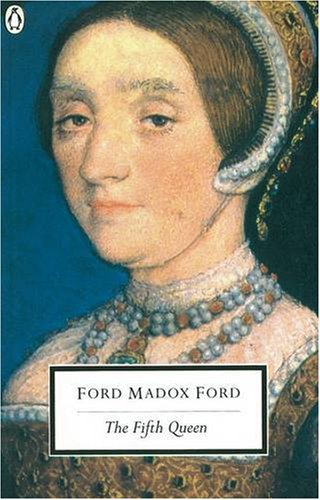
Ford Madox Ford is always good for a misleading title, so it may surprise no one that in The Fifth Queen Kataerine Howard, who will succeed Anne of Cleves as the wife of Henry VIII, never quite makes it to the throne in this, the first in Ford's trilogy. Instead it depicts something not unlike the beginning of the historical Katharine's relationship with Henry. It is true that she was first a lady-in-waiting in the King's court, but in the service of Queen Anne, not the King's daughter, Mary, and it isn't likely to be true that Henry chanced upon her on the palace grounds riding a mule and, dazzled by her beauty and wit, impressed her into that service. Nor was the historical Katharine a virulent Catholic bitterly opposed to Thomas Cromwell, the Protestant standard-bearer and Lord of the Privy Seal:

The face of a queen looked down just above his head with her eyes wide open as if she were amazed, thrusting her head from a cloud.

'Why, I have outlived three queens,' he said to himself, and his round face resignedly despised his world and his times. He had forgotten what anxiety felt like because the world was so people with blunderers and timid fools full of hatred.


Cromwell sees in Katharine an opportunity to plant a spy in the Catholic Mary's service. Katharine refuses, but quickly finds herself embroiled in the shadowy sectarian conflict that rages beyond the King's notice. She withstands the threats and manipulations not only of Cromwell and his spies but Bishop Gardiner, the country's leading Catholic, who she had idolized. She struggles to maintain her honor and honesty against the moralizing of men like Throckmorton, who may or may not be double dealing against Cromwell:

'How shall you decide what is vileness, or where will you find a virtuous man?' he asked. 'Maybe you will find some among the bones of your old Romans. Yet your Seneca, in his day, did play the villain. Or maybe some at the Court of Mahound, I know not, for I was never there. But here is a goodly world, with prizes for them that can take them...'


Katharine soon learns that everyone is after these "prizes"--that is, except the King, who seeks only the prize of her company. Henry is the most intriguing and magnetic character here: impulsive and irascible, yet truly interested in the pursuit of "right doctrine," a notion lost on men like Cromwell and Gardiner, whose beliefs seem to serve only their ambitions. Perhaps his position as king affords him that right, but it is also a position he uses to lift Katharine out of harm's way at the book's finale, realizing keenly that she is a kindred soul.

But The Fifth Queen seems ultimately like a chronicle of lost opportunities. One wonders why Ford saw the need to transmogrify the historical Katharine into a Catholic stalwart if the religious issues were going to be glossed over. The idea of a Renaissance spy novel sounds great, but the intrigue is a muddle. Everything is a muddle, actually; as an early attempt by Ford to achieve an "impressionist" style, which reproduces the world as it is experienced and seen, The Fifth Queen succeeds mostly in making the particulars of action and location very unclear. Its greatest successes are in its population of minor characters, like the womanizing teacher Magister Udal, or the aged but infamous knight Sir Rochford.

On the other hand, as the first book in a trilogy, this can only amount to a half-finished opinion. I have faith in the abilities of Ford, who is capable of sneaking up on you unawares in a way that few authors are, so I hope for more from The Privy Seal and The Fifth Queen Crowned.

Saturday, July 9, 2011

The Last Post by Ford Madox Ford

It had been obvious to her for a long time that God would one day step in and intervene for the protection of Christopher. After all Christopher was a good man -- a rather sickeningly good man. It is, in the end, she reluctantly admitted, the function of God and the invisible Powers to see that a good man shall eventually be permitted to settle down to a stuffy domestic life... even to chaffering over old furniture. It was a comic affair -- but it was the sort of affair that you had to admit. God is probably -- and very rightly -- on the side of the stuffy domesticities.

Graham Greene called The Last Post a mistake and omitted from his collected edition of the Parade's End novels (1 2 3), operating according to what seem to have been Ford's express wishes. I am not sure I agree with Ford and his protege, but the purpose of this novel does remain unclear. The last time we saw Christopher Tietjens, he was celebrating Armistice Day, having decided once and for all to abandon the income of Groby, his ancestral home, and to take up with his would-be mistress, Valentine Wannop. It was an awfully sweet ending for a series about a perpetually tortured man, and it's hard to shake the feeling that Ford couldn't resist adding a dash of bitters:

It had come through to Marie Leonie partly then and partly subsequently that Christopher's wife had turned up at Christopher's empty house that was in the Square only a few yards away. They had gone back late at night probably for purposes of love and had found her there. She had come for the purpose of telling them that she was going to be operated on for cancer so that with their sensitive natures they could hardly contemplate going to bed together at that moment.


In the first novel, Father Consett, the confessor of Tietjens' vindictive wife Sylvia, warns that if Christopher ever leaves her for another woman, "[t]he world will echo with her wrongs." In this way, Ford's impulse to write a fourth novel makes sense; Sylvia Tietjens would never consent to simply let Tietjens and Valentine live together apart from her torments. And true to form, on Armistice Day she invents a lie about cancer to keep them apart.

The most perplexing thing about The Last Post, however, is that it's barely about Tietjens at all. The strongest character is his brother, Mark, who has had some sort of seizure brought on by the news that England has refused to follow the Germans into their own territory. Mark maintains that his paralysis is voluntary--he echoes Iago's insistence that "from this time forth I never will speak word"--but whether that is true is never clear. The narrative perspective bounces from Mark to his recently married mistress, Marie Leonie, to Valentine, but Christopher is away on an aeroplane, gone to Groby to convince Sylvia's tenants there not to tear down the symbolic Great Groby Tree.

But Sylvia of course, is at Christopher's house, in order to "torture that girl out of her mind. That was why she was there now. She imagined Valentine under the high roof suffering tortures because she, Sylvia, was looking down over the hedge." She brings with her (for reasons that are never all that clear to me) a murderers' row of the series' villains: General Campion, Tietjens' godfather who sends him to the front because of Sylvia's mud-slinging; Ruggles, who does much of Sylvia's dirt-digging; Edith Ethel Duchemin, who hates Tietjens because her husband owes him money; Mrs. de Bray Pape, the uncouth American who is renting Groby (and believes herself the spiritual descendant of Louis XIV's consort); even Michael Mark, Tietjens' son, whose dubious parentage tortures Tietjens. All this leads to a very tense climax in which Sylvia, at the head of her phalanx of scoundrels, confronts a defenseless Valentine. But, because this is Ford, things do not turn out as they seem that they will:

[Sylvia said, "]They can all, soon, call you Mrs. Tietjens. Before God, I came to drive those people out... But I wanted to see how it was you kept him..."

Sylvia Tietjens was keeping her head turned aside, drooping. Hiding a tendency to tears, no doubt. She said to the floor.

"I say again, as God hears me, I never thought to harm your child. His child... But any woman's... Not harm a child... I have a fine one, but I wanted another... with its littleness... It's the riding has done it..." Someone sobbed!


Sylvia, having come intent to destroy Valentine psychologically, discovers that Valentine is pregnant with Tietjens' child and cannot do it. Perhaps the corruption of an innocent thing is too far; perhaps it is the realization that Valentine has succeeded where she could not, not just in keeping him, but in giving him a child that is doubtlessly his, and a family. I wish that I knew what that last phrase--it's the riding has done it--meant, but I have not been able to figure it out.

Is The Last Post a failure? On one hand, it ties up the loose end of Sylvia, who broods over the happy ending of A Man Could Stand Up--, and I think it does so appropriately. On the other hand, there's something discordant about packaging Christopher Tietjens away in an aeroplane to finish the tetralogy which is expressly his. I am reminded of Rabbit Remembered, but in that case Rabbit was dead, and the novella was written in the spirit of mourning. The Last Post is a novel of mourning too, but for an English culture that has perished with the war (like Groby Great Tree, which takes out half Groby wall with it).

Tietjens' absence, however, provides us--with what, exactly? More space for someone like Marie Leonie, Mark Tietjens' wife, who gives us the French perspective on the end of World War I, I suppose. Marie Leonie is a well-developed, intriguing character, and so is the "paralyzed" Mark, but they aren't Tietjens, and so the experience of reading The Last Post is like ordering the steak and being served the beef consomme.

But--then again--these books are wonderful and it's wonderful to have more of them. I am a little sad to have done with them, but I have the upcoming BBC adaptation to look forward to, scripted by none other than Tom Stoppard. It will probably be the best five hours of television that anyone has ever seen, ever.

Tuesday, May 31, 2011

A Man Could Stand Up-- by Ford Madox Ford

Coming into the square was like being suddenly dead, it was so silent and so still to one so lately jostled by the innumerable crowd and deafened by unceasing shouts. The shouting had continued for so long that it had assumed the appearance of being a solid and unvarying thing, like life. So the silence appeared like Death; and now she had death in her heart. She was going to confront a madman in a stripped house. And the empty house stood in an empty square all of whose houses were so eighteenth-century and silver grey and rigid and serene that they ought all to be empty too and contain dead, mad men. And was this the errand? For to-day when all the world was mad with joy? To become bear-ward to a man who had got rid of all his furniture and did not know the porter--mad without joy!

Three books and over 500 pages into the Parade's End (1 2) novels, we get out first glimpse of real combat. For Christopher Tietjens, it has been a steady spiral to the bottom, from a high-ranking government position to quartermaster to the front lines, rejected at each step of the way because those around him cannot bear his stoic goodness, which is increasingly an anachronism. At the front, Tietjens is mentally unraveling:

It was like being a dwarf at a conversation, a conflict--of mastodons. There was so much noise it seemed to grow dark. It was a mental darkness. You could not think. A Dark Age! The earth moved.


Ford's dexterity as a novelist continues to amaze me. There is so much packed in here--the literal darkness of the world, which is at that moment being bombed, the "mental darkness" which is also the darkness, like the Dark Age, of human civilization. The cunning em-dash, which somehow expresses perfectly the stumbling gait of Tietjens' (once nimble) mind. The absurd matter-of-fact statement, "The earth moved."

Tietjens' middle portion is bookended by two sections dominated by his unspoken love object, Valentine Wannop, on Armistice Day. Valentine's excitement over the end of the war is tempered by the return of Tietjens, whom she loves, but has reportedly gone mad:

What was the coming together that was offered her? Nothing, on the face of it, but being dragged again into that man's intolerable worries as unfortunate machinists are dragged into wheels by belts -- and all the flesh torn off their bones! Upon her word that had been her first thought. She was afraid, afraid, afraid! She suddenly appreciated the advantages of nunlike seclusion. Besides she wanted to be bashing policemen with bladders in celebration of Eleven Eleven!


What is it, I found myself wondering, that makes the Tietjens and Valentine of A Man Could Stand Up-- different from those of Some Do Not...? I think we are rightly meant to respect their decision not to become lovers in that first novel, a decision which they reverse toward the end of this book. It is partly excused, I think, by the sense that Sylvia has abandoned Tietjens (though this is not explicit, her absence is peculiar). And also that both have simply earned their rest and companionship; Tietjens for his suffering, and Valentine for her willingness to become Tietjens' nursemaid if he turns out to truly be mad. (As John Dowell does for Nancy Rufford in The Good Soldier.)

Happily, this is not the case. I am struck by the strange optimism of A Man Could Stand Up--. There is the strong suggestion that Tietjens and Valentine come out on the other side of WWI better than they entered; not that something irrevocable has been lost or the world has been disfigured, as Modernist literature commonly regards the war, but that life can be instead rebuilt. I think Ford draws a sharp line between social consequences and personal ones, and notes that the couple's happiness can really only be found apart from the culture of war and spiritual emptiness:

A man could now stand up on a hill, so he and she could surely get into some hole together!


This is the third of the four Parade's End novels; I know that the fourth is a horse of a different color. A Man Could Stand Up-- carries a sense of closure, and so I feel comfortable calling it--gasp--a "happy ending."

Sunday, May 1, 2011

No More Parades by Ford Madox Ford

The whole of the affair, the more she saw of it, overwhelmed her with a sense of hatred.... And of depression! She saw Christopher buried in this welter of fools, playing a schoolboy's game of make-believe. But of a make0believe that was infinitely formidable and infinitely sinister.... The crashings of the gun and of all the instruments for making noise seemed to her so atrocious and odious because they were, for her, the silly pomp of a schoolboy-man's game.... Campion, or some similar schoolboy, said: "Hullo! Some Germain airplanes about... That lets us out on the air-gun! Let's have some pops!".... As they fire guns in the park on the King's birthday. It was sheer insolence to have a gun in the garden of an hotel where people of quality might be sleeping or wishing to converse!

No More Parades follows Christopher Tietjens to the theater of World War I, which we did not get to see in Some Do Not..., though it lurked in the background. Tietjens is a quartermaster now, in charge of supplying a draft of troops and preparing them to march, a job at which, with his organizational brilliance, he excels. But the two days that make up No More Parades are ones in which Tietjens is unraveling: Not only must he cope with the stress of getting the draft off, but he has been shaken by the unexpected death of one of his soldiers by a German bomb (this is, we are told, supposed to be far from the conflict). What is worse is that his wife Sylvia has "dropped in" on the camp to turn the screws into him.

No More Parades continues many of the same themes from Some Do Not.... Christopher lives by an outdated code, radiating a propriety and goodness that for some reason makes people despise him. Every single character in this book and the last at some point either suspects Christopher of vice or accuses him of it directly, and yet Christopher continues to be upstanding. The worst of these is Sylvia, who--for no other reason than to torture him--spreads the rumor that Christopher is a communist, a rumor which ultimately, at the end of the book, gets Christopher sent to the front line.

It seems to me that Ford is commenting on the decay of the moral compass' Western world. Here is a passage that will fit quite neatly in my paper on Ford's The Good Soldier, which is about the way that modernity ruins religious sentiment:

Tietjens had walked in the sunlight down the lines, past the hut with the evergreen climbing rose, in the sunlight, thinking in an interval, good-humouredly about his official religion: about the Almighty as, on a colossal scale, a great English Landowner, benevolently awful, a colossal duke who never left his study and was thus invisible, but knowing all about the estate down to the last hind at the home farm and the last oak; Christ, and almost too benevolent Land-Steward, son of the Owner, knowing all about the estate down to the last child at the porter's lodge, apt to be got round by the more detrimental tenants; the Third Person of the Trinity, the spirit of the estate, the Game as it were, as distinct from the players of the game; the atmosphere of the estate, that of the interior of Winchester Cathedral just after a Handel anthem has been finished, a perpetual Sunday, with, probably, a little cricket for the young men...

He laughed good-humouredly at his projection of a hereafter. It was probably done with. Along with cricket. There would be no more parades of that sort. Probably they would play some beastly yelping game... Like baseball or Association football... And heaven?... Oh it would be a revival meeting on a Welsh hillside. Or Chatauqua, wherever that was... And God? A Real Estate Agent, with Marxist views... He hoped to be out of it before the cessation of the hostilities, in which case he might be just in time for the last train to the old heaven.


Of course, Tietjens is engaged in the "yelping game" right now, the one that gives his wife Sylvia such a headache with its perpetual noise. War is the new religion of the world.

Poor Tietjens. It is some comfort to watch his commanding officer and family friend General Campion slowly unravel the threads that have led to his poor reputation, and come to accurate conclusions, but in the end it is too late: public perception is all, and Tietjens is off to the trenches. Ford uses this passage from Proverbs as his epigram:

For two things my heart is grieved:
A man of war that suffereth from poverty
and men of intelligence
that are counted as refuse.


But the book brought to my mind this passage by Lady Macduff, from Macbeth:

But I remember
I am in this earthly world; where to do harm
Is often laudable, to do good sometime
Accounted dangerous folly...


I am finding these books immensely rich. They are not at all like The Good Soldier, which is often starved of detail and psychology (by design), but I would wager that three quarters of No More Parades takes place "inside" someone's head. This one suffers compared to Some Do Not... because it is missing Valentine Wannop, Christopher's would-be mistress, who was my favorite character from the first novel, but I know from flipping through the next book that she will be back.

Thursday, April 21, 2011

Buckshee by Ford Madox Ford

I think God must have been a stupid man
To have sent a spirit, chivalrous and loyal,
Cruel and tender, arrogant and so meek,
Gallant and timorous, halting and as swift
As a hawk descending -- to have sent such a spirit,
Certain in all its attributes, into this age
Of our banal world.
He had infinity
Which must embrace infinities of worlds,
And had Eternity
And could have chosen any other age,
He had Omnipotence
And could have framed a fitting world and time.

But, bruised and bruising, wounded, contumacious,
An eagle pinioned, an eagle on the wing;
A leopard maimed, a leopard in its spring,
A swallow caged, a swallow in the spacious
And amethystine, palpating blue:

A night-bird of the heath, shut off from the heath,
A deathless being daubed with the mud of death,
A moth all white, draggled with blood and dew,
'Haitchka, the undaunted, loyal spirit of you
Came to our world of cozening and pimping,
Our globe compact of virtues all half virtue
Of vices scarce half-vices; made of truth
Blurred in the edges and of lies so limping
They will not stir the pulse in the utterance...
From a New World that's new and knows not youth
Unto our France that's France but knows not France,
Where charity and every virtue hurt you,
Oh coin of gold dropped into leaden palms,
Manna and frankincense and myrrh and blams
And bitter herbs and spices of the South...

Because God was a stupid man and threw
Into our outstretched palms, 'Haitchka, you.


Ford Madox Ford is one of my favorite writers, but he is not particularly renowned as a poet. That's too bad, I think, because "Buckshee" is one hell of a romantic poem. Ford explains the title this way:

Buckshee, derived from the universal Oriental backschisch, has no English equivalent. It is a British Army word and signifies something unexpected, undeserved and gratifying. If the cook at dinner time slips three extra potatoes into your meat-can those are buckshee potatoes; if for something you are paid in guineas instead of pounds, the odd shillings are buckshee; if you are a little Arab boy alongside a liner and a passenger throws half a crown instead of a florin into the shark-infested water for you to dive after, the odd sixpence is buckshee backschisch. Or if you have given up the practice of writing verse and suddenly find yourself writing it -- those verses will be buckshee.


The implication is, of course, that Ford's lover 'Haitchka (and I'm not sure who this is, except that it is someone that Ford lived with in France) is buckshee--that he does not deserve her, and yet he is elated to have her anyway.

Not only is Ford not deserving of her, but the world is too. She is a being out of time, cast by an idiot God "into this age / Of our banal world." She is "a night-bird of the heath, shut off from the heath," or "a coin of gold dropped into leaden palms."

What strikes me also about this poem is that Ford's characterization of 'Haitchka does not come off as universally positive: She is "bruised" but also "bruising," "tender" but "cruel," "meek" but "arrogant." Though she is a "spirit / Certain in all its attributes" those attributes are paradoxical, but I think that the poem strongly implies that Ford values her for her apparent contradictions. The world that might have been created by God's omnipotence would have accommodated those contradictions; if they seem irreconcilable in our world it is not her fault but ours.

I love "Buckshee" because it is a different side of Ford from the one we read in The Good Soldier and Parade's End, in which love is so poisonous and adultery reigns. It is nearly impossible to imagine any character from those novels saying these things about any other, but it's nice to know that Ford himself could write them.

Wednesday, March 23, 2011

Some Do Not... by Ford Madox Ford

The gods to each ascribe a differing lot:
Some enter at the portal. Some do not!

It is the eve of World War I, and Christopher Tietjens is the "last English Tory"--a title with all sorts of political connotations that are mostly lost on me. But, apparently, it means that he holds sentiments like this:

This, Tietjens thought, is England! A man and a maid walk through Kentish grass fields: the grass ripe for the scythe. The man honourable, clean, upright; the maid virtuous, clean, vigorous; he of good birth; she of birth quite as good; each filled with a too good breakfast that each could yet capably digest.


Among other things he is a mathematical genius, working for the British government, and a cuckold. When the novel opens, Tietjens has been abandoned by his wife, Sylvia, who has run off to a German health resort with her lover. (In Ford, it seems, German health resorts are where you go to commit adultery.) Tietjens will not divorce Sylvia, because "no one but a blackguard would ever submit a woman to the ordeal of divorce," though he has cause, and she tortures him incessantly:

He felt a great deal of pain, over which there presided the tall, eel-skin, blonde figure of his wife...


Sylvia claims to hate her husband; calls him "the Ox;" at one point she yells "I'm bored!" and throws her breakfast at him. Theirs is a marriage of convenience, and Tietjens is savaged by the probability that their child together is probably not his own. And yet his sense of honor and duty prevails over his own misery.

His true affections lie with Valentine Wannop--the maid walking through Kentish grass above--a young suffragette and household servant who is devoted to her mother, a famous but impoverished novelist. Valentine is the opposite of Sylvia: deeply principled, humble in poverty, despising of cruelty. Tietjens muses himself on the difference between them:

If you wanted something killed you'd go to Sylvia Tietjens in the sure faith that she would kill it: emotion, hope, ideal; kill it quick and sure. If you wanted something kept alive you'd go to Valentine: she'd find something to do for it... The two types of mind: remorseless enemy, sure screen, dagger... sheath!


Tietjens and Valentine become close after he rescues her from an abortive (and very strange) demonstration for women's suffrage at a golf course. Though they have never met before that moment, insinuations that she is Tietjens' mistress are generated on the spot. These accusations dog Tietjens and Valentine throughout the novel, though the relationship is never consummated. In fact, this is is a reoccurring irony: though Tietjens acts with the utmost integrity, his reputation is ruined by accusations of adultery with multiple women, of fathering children out of wedlock, even of being a French spy! His sense of honor, however, limits his willingness to defend himself. In a way, he is the mirror image of The Good Soldier's Edward Ashburnham, whose uprightness masks deep character flaws.

The epigram "Some do... some do not..." appears throughout the novel, in differing contexts. Tietjens and Valentine, by their self-denial, are those who "do not," and as such are set apart from the rest of the characters, all of whom "do": commit character assassination, make moral compromise, and generally pursue self-aggrandizement. Their love resounds in a lower, quieter register:

On the surface the story of her love for Tietjens had been static enough. It had begun in nothing and in nothing it had ended. But, deep down in her being--ah! it had progressed enough.


I love this; it is the appeal of those who "do not": Tietjens and Valentine's romance is a communion of spirits, not a summary of actions or appearances, and needs no outward expression to be validated. Wouldn't it be wonderful to say that, when you meet the one you love, that:

Words passed, but words could no more prove an established innocence than words can enhance a love that exists. He might as well have recited the names of railway stations.


I loved The Good Soldier, but what minimal amount of true love exists in that novel is the source of endless anguish. Mostly, it is bereft of love. Some Do Not... shares similarities of time, place, and theme, but in it, true love is unassailable.

If it is a love story, it is also a war story--split in two, the second half takes place after Tietjens has returned from the front lines of World War I, where he has experienced a shell shock that has blunted his brilliance and clouded his thoughts. The novel ends just before (and the next in the series picks up, I think, just after) Tietjens is about to ship out again. But the war somehow always seems secondary, either to the love story or the sexual warfare between Tietjens and Sylvia. We are not permitted, in this novel at least, to see Tietjens at war; far more important are the effects of the war back home. In fact, the novel comprises only a handful of long set pieces, through which Ford carefully weaves flashbacks and a surprising amount of stream-of-consciousness.

If one of the measures of a great book is that it seems impossible to do justice to in a review like this one, then Some Do Not... is a masterpiece. Like The Good Soldier, its simple structure belies endless complexities, and it constantly forces the reader to reconsider earlier events and characterizations. And there are three more books to go!

Monday, August 9, 2010

Brideshead Revisited by Evelyn Waugh

"It's frightening," Julia once said, "to think of how completely you have forgotten Sebastian."

"He was the forerunner."

"That's what you said in the storm. I've thought since: Perhaps I am only a forerunner, too."

Perhaps, I thought, while her words still hung in the air between us like a wisp of tobacco smoke--a thought to fade and diminish like smoke without a trace--perhaps all our loves are merely hints and symbols; a hill of many invisible crests; doors that open as in a dream to reveal only a further stretch of carpet and another door; perhaps you and I are types and this sadness that sometimes falls between us springs from disappointment in our search, each straining through and beyond the other, snatching a glimpse now and then of the shadow which turns the corner always a pace or two ahead of us.


In 1944 a British military officer and his troop are moved to new quarters in the English countryside, quarters that he remembers from another lifetime ago, a manor house called Brideshead. Once, during the summer between semesters at Oxford, he visited Brideshead when it was the home of his closest friend.

The officer is Charles Ryder and the friend is Sebastian Flyte, and my very vague conception of Brideshead Revisited was that it was about their friendship. It certainly starts out that way: Ryder and Flyte meet at Oxford and become instant chums, Ryder playing a sort of straight-man to Flyte's urbane, playful dandy. It is even suggested--though this is a somewhat controversial reading--that they become lovers. But Sebastian disappears from the narrative fairly quickly, oppressed by his Catholic upbringing, descending into alcoholism, absconded into the North African desert. His very name suggests not only that he is "flighty," in the sense of caprice or frivolity, but that, as James Wood notes, he flees and then falls--like Icarus.

Brideshead gives the unique sense that things are always changing, as in life they tend to do. It struck me as giving the uncomfortable feeling of reading a sequel to a favorite book, in which things are not quite as you are accustomed to them being, only in cycles, on repeat. Ryder's connection to Brideshead is continued in his friend's absence through his love for Sebastian's sister, Julia. But as many times as he visits it, and though he very nearly inherits it through marriage to Julia, it never seems as a home to Ryder. In fact, it never really seems a home to anyone. The frame narrative leads us to expect a nostalgic reverie, but it does not prepare us for the way in which Brideshead, almost immediately, belongs to a long vision of the past.

What Brideshead is really about is Ryder's conversion to Catholicism. Throughout the novel, Ryder is as antagonistic to religion as he could possibly be, and with good reason: It is part of what causes Sebastian so much suffering, and ultimately it drives a wedge between him and Julia. But there is Godliness in Sebastian's suffering, as Julia's sister Cordelia tells Ryder:

I thought of the joyful youth with the Teddy-bear under the flowering chestnuts. "It's not what what one would have foretold," I said. "I suppose he doesn't suffer?"

"Oh yes, I think he does. One can have no idea what the suffering may be, to be as maimed as he is--no dignity, no power of will. No one is ever holy without suffering..."


Ryder's true conversion happens off-stage, between his leaving Brideshead and Julia and his return there with the army, but we are made to understand that the seeds of it lay in his friendship with Sebastian, his love for Julia, his experience watching a priest try to coax an acknowledgment of the last rites from Julia's apostate father. Waugh buries his theme in a tossed-off reference to Chesterton's Father Brown series, in which Father Brown says, apprehending a criminal, "I caught him, with an unseen hook and an invisible line which is long enough to let him wander to the ends of the world, and still to bring him back with a twitch upon the thread"--so Ryder turns to God.

So it happens that, when Ryder returns to Brideshead, he ends with a visit to the ugly little art-nouveau chapel, which had barely seemed part of the house before:

Something quite remote from anything the builders intended has come out of their work, and out of the fierce little human tragedy in which I played; something none of us thought about at the time: a small red flame--a beaten-copper lamp of deplorable design, relit before the beaten-copper doors of a tabernacle; the flame which the old knights saw from their tombs, which they saw put out; that flame burns again for other soldiers, far from home, farther, in heart, than Acre or Jerusalem. It could not have been lit but for the builders and the tragedians, and there I found it his morning, burning new among the old stones.


How much you like Brideshead is probably directly affected by your religious sentiment; certainly a great many of his contemporaries abhorred it for its conservatism. There is something of it that makes me deeply uncomfortable, as well: Waugh is too eager to conflate Catholicism with the dying manor house, which itself is a symbol of English gentility. It reminded me of The Good Soldier, but what Ford speaks about half-satirically, Waugh (ironically, the greater satirist) holds in great sincerity. It is a self-annihilating sort of religion that turns Christ into an antique, or a fossil. But in spite of that, Brideshead is a novel that deserves its acclaim; besides being genuinely moving it is deeply funny.

Saturday, August 7, 2010

The English Novel by Ford Madox Ford

I am not sure what the point of Ford Madox Ford's The English Novel is, because I am not quite sure that he himself knew what the point of it was. To some extent, it is a history of the English novel from its earliest stages to Ford's day, but as a historical text it makes no claims to exhaustiveness or objectivity. It is not "a technical work," but it does contain some of Ford's most significant ideas concerning what works in a novel and what doesn't. You'd be better off reading How Fiction Works, though, because I think that Wood covers all of the best ones.

What it is really is a vanity project, honestly, the spectacle of a senior man of letters writing a book because no one would refuse to publish it, no matter how solipsistic. In that way it is much like How to Read and Why; both have no other guiding principle than their author's predilections, but you'll read it anyway because they are, after all, experts. This is a begrudging criticism; I suppose they've both earned it.

Ford spends a lot of time in this book criticizing what he calls the nuvvle, a humorous word he invented to describe the kind of commercially popular book of the 19th and 20th centuries. Brent, you will be displeased to know that he included The Woman in White among these. Also, he really hated Vanity Fair.

But I thought his most interesting idea was buried all the way at the end of the book:

That this is not the final stage of the Novel is obvious; there will be developments that we cannot foresee, strain our visions, how we may. There are probably--humanity being stable, change the world how it may--there are probably eternal principles for all the arts, but the applications of those principles are eternally changing, or eternally revolving. It is, for instance, an obvious and unchanging fact that if an author intrudes his comments into the middle of his story he will endanger the illusion conveyed by that story--but a generation of readers may come along who would prefer witnessing the capers of the author to being carried away by stories and that generation of readers may coincide with a generation of writers tired of self-obliteration. So you might have a world of Oscar Wildes or of Lylys. Or you might, again, have a world tired of the really well constructed novel every word of which carries its story forward: then you will have a movement towards diffuseness, backboneless sentences, digressions, and inchoateness.


This made me laugh, because it sounds a lot like postmodernism, which Ford didn't really live to see. The bit about "the capers of the author" (this is his problem with Vanity Fair) sounds a lot like the sort of self-conscious egoism that comes with being Martin Amis, or Gary Shteyngart, or Jonathan Safran Foer. What do you think? Are we living in Ford's age of "digressions, and inchoateness"?

Sunday, July 18, 2010

The Good Soldier by Ford Madox Ford

And yet I swear by the sacred name of my creator that it was true. It was true sunshine; the true music; the true splash of the fountains from the mouth of stone dolphins. For, if for me we were four people with the same tastes, with the same desires, acting--or no, not acting--sitting here and there unanimously, isn't that the truth? If for nine years I have possessed a goodly apple that is rotten at the core and discover its rottenness only in nine years and six months less four days, isn't it true to say that for nine years I possessed a goodly apple? So it may well be with Edward Ashburnham, with Leonora his wife and with poor dear Florence. And, if you come to think of it, isn't it a little odd that the physical rottenness of at least two pillars of our four-square house never presented itself to my minds as a menace to its security? It doesn't so present itself now though the two of them are actually dead. I don't know...


The Good Soldier is about two couples: John and Florence Dowell and Edward and Leonora Ashburnham. John, who narrates the story, and his wife are an American couple who meet the British Ashburnhams at a German resort for those with ailing hearts. Edward is the "good soldier" of the title, idolized by Dowell to the point of fawning, but he also conducts a years-long affair with Dowell's wife.

As it turns out, neither Florence nor Edward truly has a heart condition--not a physical one, at least. Edward is a serial philanderer, incapable of avoiding petty, sentimental affairs with beautiful young women, and comes to the resort in pursuit of a girl with a real "heart." Florence is a fake and an opportunist with designs on Branshaw Teleragh, Edward's estate and the ancestral home of Florence's family. Leonora seeks to endear herself to Edward by managing his love affairs, but throughout all of it Dowell is either painfully, idiotically unawares or represses his understanding, perhaps out of a powerful homosexual attraction for Edward. When, as above, Dowell says "I don't know..." it is a universal expression, as the full realization of the situation--which has caused the suicide both of Florence and Edward--causes him not only to doubt the genuineness of his friendships but his ability to understand any human being.

Dowell begins his tale by saying, "This is the saddest story I've ever heard." The Saddest Story was Ford's original title (and seems still to be Dowell's), but he changed it due to the outbreak of a story arguably sadder--World War I. As such, The Good Soldier is decidedly pre-modernist, as WWI is generally considered the origin of modernity, yet it prefigures so well the modernist model: Dowell's unreliability, the immense gap between the author and his narrator, the disjointed, out-of-sequence narrative. Yet, Graham Greene, an acquaintance and admirer of Ford, thought that he could see underneath it all a great amount of pain and anguish suffered by Ford himself.

I think that this is probably one of the greatest books of the twentieth century--I absolutely love it. It is peopled by generally loathsome characters, who nevertheless manage to make themselves exquisite in pity. Edward is a monster of sympathy, brimming over with such love for the sad young maidens of the world that he cannot help but give himself to them, compelled to be an eternal Christ figure. Leonora is a devout Catholic determined to salvage the wreckage of her marriage. Dowell is an utter fool, ravaged by a misery he does not understand, pursuing an unspoken love through a method that can only be described as self-deletion. Florence is unmistakably the cruelest of the lot, yet she is also the one who keeps with her a vial of prussic acid that she might kill herself should her malignancy be discovered. It is hard not to think of these people as Dowell himself thinks of the Ashburnhams:

But what were they? The just? The unjust? God knows! I think that the pair of them were only poor wretches, creeping over this earth in the shadow of an eternal wrath. It is very terrible....


Poor wretches, creeping over this earth in the shadow of an eternal wrath. I think perhaps much of the novel's power has to do with the fact that we are meant to wonder if we are not a little bit like the narrator, unable to see the things in ourselves that an audience, reading the story of our lives, may intuit immediately and pity us for them, and that, as Dowell says, "the record of humanity is a record of sorrows."