Showing posts with label G. K. Chesterton. Show all posts

Sunday, March 20, 2016

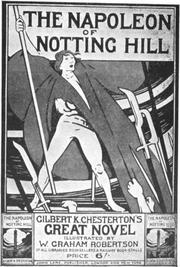
The Napoleon of Notting Hill by G. K. Chesterton

"Only feeling, sire," answered the Provost.  "I was born, like other men, in a spot of the earth which I loved because I had played boys' games there, and fallen in love, and talked with my friends through nights that were the nights of the gods.  And I feel the riddle.  These little gardens where we told our loves.  These streets where we brought out our dead.  Why should they be commonplace?  Why should they be absurd?  Why should it be grotesque to say that a pillar-box is poetic when for a year I could not see a red pillar-box against the yellow evening in a certain street without being wracked with something of which God keeps the secret, but which is stronger than sorrow or joy?  Why should any one be able to raise a laugh by saying ' the Cause of Notting Hill'?--Notting Hill where thousands of immortal spirits blaze with alternate hope and fear."

In the distant future of 1984 (lol), things are pretty much the same as they were in 1904.  Men still wear their topcoats, and politics has become so humdrum and bureaucratic that the king is chosen at random, because he might as well be.  Chesterton's vision of the future is a wry takedown of the predictors and prognosticators popular in his time who "took something or other that was certainly going on in their time, and then said it would go on more and more until something extraordinary happened."  But it also anticipates the theory of Francis Fukuyama's The End of History, which imagines the universal acceptance of liberal government and the end of nationalist squabbling.  That sounds nice, maybe, but one of the most provocative ideas in The Napoleon of Notting Hill is that there's something to be said for nationalist squabbles.

The stability of this England is upended when Auberon Quin, one of those career bureaucrats, is chosen as king.  Quin uses his new position as an excuse to inject humor into the drab English system of government, and decrees that several London neighborhoods--Notting Hill, Bayswater, South, North, and West Kensington--must build city walls and operate as medieval city-states, with halberdiers, banners, and Arthurian pomp.  No one appreciates the joke, but they begrudgingly go along with the joke.

Years later, the provost of Notting Hill, Adam Wayne, begs for an audience with King Auberon.  The provosts of Bayswater and South Kensington, you see, want to demolish Notting Hill's Pump Street, and its dingy handful of shops, to build a highway.  Wayne is younger than the King, and the other provosts, and in fact he has grown up in the system which the King imposed as a joke.  Which means he doesn't see it as a joke.  He is a living, breathing medieval man, who speaks earnestly in the Arthurian manner which the King speaks ironically, and he believes in the sanctity of Notting Hill.  What follows is a protracted "war" in which the forces of Notting Hill heroically withstand the onslaughts of the halberdiers of the other neighborhoods,  and wins its own sovereignty.

Some of Chesterton's objectives in this novel are political.  He looked at the world of 1904 and saw the massive British Empire systematically squashing smaller states.  Notting Hill, like Nicaragua (whose king makes a brief and baffling appearance in the beginning of the novel), stakes its right to its own sovereignty on the depth of attachment of its own citizens.  Patriotism, for Chesterton, matters because it is subjective, and subjective feeling matters more than the unfeeling interests of the state.  Martin Gardner, in the foreword, argues that we are meant to reject Wayne's assertion that "[t]here were never any just wars but the religious wars," but I think that's Chesterton's point precisely.  Chesterton, of course, died in 1936, just as the dangers of sentimental patriotism were really starting to become apparent.

On another level, The Napoleon of Notting Hill, like The Man Who Was Thursday, political intrigue transforms into religious allegory.  In a final meeting, Quin and Wayne consider themselves as representations of God and man.  God, like Quin, may have made the world in jest and scorn, but man endows it with an inviolate value:

"...Suppose I do not laugh back at you, do not blaspheme you, do not curse you.  But suppose, standing up straight up under the sky, with every power of my being, I thank you for the fools' paradise you have made.  Suppose I praise you, with a literal pain of ecstasy, for the jest that has brought me so terrible a joy.  If we have taken the child's games, and given them the seriousness of a Crusade, if we have drenched your grotesque Dutch garden with the blood of martyrs, we have turned a nursery into a temple.  I ask you, in the name of Heaven, who wins?" 

This doesn't work as well as it does in Thursday, I think, where seems both natural and remarkably profound.  In many ways Notting Hill seems like Chesterton feeling out the mode which he perfects in Thursday: he mines the mundanity of politics for its absurdity and humor, and finds meaning in the absurd.  And unlike Thursday, Chesterton isn't really able to graft this mix of comedy and profundity to a workable plot--the battle scenes, which ought to be funny, are really mostly a slog.  Maybe a Londoner, who knows these places and for whom the absurdity of treating them like medieval Florence or Brittany or something would better land, might have gotten more out of it.


Friday, January 6, 2012

The Man Who Knew Too Much by G. K. Chesterton

"I am too tangled up in the whole thing, you see, and I was certainly never born to set it right."

I pulled this book off a bookshelf at my girlfriend's parents house, thinking that it might have been the basis for the Alfred Hitchcock movie with the same title. The author's name was not displayed on the side. I was delightfully surprised to see that it was a Chesterton book, and one that I had not heard of. I quickly stuffed it down the back of my pants.

As I suspected upon discovering its author, this book has no connection to the Alfred Hitchcock movie, other than the title. It is a collection of 8 detective stories set in the early 20th century. The title refers to Horne Fisher, a man who is burdened with private knowledge of public figures in England, due to the fact that he is so well connected. Fisher's intimate knowledge of the lives and motivations of members of Britain's upper class allows him to understand what is really going on, and what it ultimately kept from the public.

Accompanying Fisher in these stories is his friend Harold March--they meet in the first story. March is a journalist whose focus appears to be matters of politics. March does not figure heavily into the stories. However, his presence provides the opportunity for Fisher to voice some of the paradoxes he is facing as a result of what he know. Fisher knows who is guilty, but he also knows the motives behind their actions. And there are reasons why these persons cannot be brought to justice--at least in the traditional sense. Inherent to these stories, is a lack of justice. This is the fundamental difference between these stories and Chesterton's Father Brown mysteries.

While there is not a strict chronology to these stories, there is an overall arc to the collection, beginning with Fisher meeting March in the first story. They should definitely be read in the order.

Friday, September 24, 2010

The Everlasting Man by G.K. Chesterton

I didn't really know what I was getting into when I opened this book except that apparently it had a significant impact on C.S. Lewis and it is by Chesterton so it was guaranteed to contain multitudinous nuggets of truth.

That being said, I did not enjoy it as much as Orthodoxy, but I think that the demands of a more controlled focus meant that he didn't have quite the free rein to say so many ridiculously profound things. And as it stands alone, without comparison to his other works, it is a pretty solid book. Chesterton manages to roughly tell the story of man in a bigger picture perspective that challenges those who would tell us that cave men were violent brutes or that all myths were created equal or that philosophy can go anywhere besides back into itself.  It does still contain those pithy truths that only Chesterton can manage to pull out of life in quite the way that he does, and if you really get into the line of thought that he follows, even the less sharply pungent sentences have a depth of revelation that makes it worth the read.

Saturday, September 4, 2010

St. Thomas Aquinas by G.K. Chesterton

I enjoy the occasional well-written biography and I am devoted to Chesterton, so when my roommate's father handed me this book, I was pretty excited to read it. Perhaps the biography of Paul Revere that I read earlier this year is not fairly to be compared because Revere was a different sort of man than Thomas Aquinas, but I still found the latter to be a far more interesting character.

Chesterton admits in the beginning that there is not much known about the life of one of the greatest Christian philosophers (I draw no distinction between Catholic or Protestant here), so there alone is my complaint with the book. He mentions at one point that Aquinas was a man who "strangely" reserved his poetry for poems and at all other points strove for clarity and the laboriously exacting presentation of his philosophy, avoiding the sacrifice of accuracy for the sake of art. However, there were times when Chesterton himself waxed poetic in the description of events in Aquinas's life which did not deserve the additional and unknown information. In Chesterton's defense, they were significant events, and if his intention was only to highlight that significance, well, I suppose that's acceptable. It was more of an impression anyway (I have apparently bought into the late Augustinian and Lutheran emphasis on suggestion over Aquinian reason).

As for the rest, because so little was or is known about Aquinas's life, Chesterton elaborates on his philosophy, both the origins and the lowest levels of his assault on what Chesterton calls the "House of Man." However, his intention was to write a short book that gave little more than a foretaste of all that is St. Thomas, perhaps so that we may know the man and so better comprehend his philosophy. As such, the nuances of the lower echelons and the great majority of the higher of both St. Thomas's philosophy and his theology are not even hinted at in Chesterton's brief biography.

Monday, August 9, 2010

Brideshead Revisited by Evelyn Waugh

"It's frightening," Julia once said, "to think of how completely you have forgotten Sebastian."

"He was the forerunner."

"That's what you said in the storm. I've thought since: Perhaps I am only a forerunner, too."

Perhaps, I thought, while her words still hung in the air between us like a wisp of tobacco smoke--a thought to fade and diminish like smoke without a trace--perhaps all our loves are merely hints and symbols; a hill of many invisible crests; doors that open as in a dream to reveal only a further stretch of carpet and another door; perhaps you and I are types and this sadness that sometimes falls between us springs from disappointment in our search, each straining through and beyond the other, snatching a glimpse now and then of the shadow which turns the corner always a pace or two ahead of us.


In 1944 a British military officer and his troop are moved to new quarters in the English countryside, quarters that he remembers from another lifetime ago, a manor house called Brideshead. Once, during the summer between semesters at Oxford, he visited Brideshead when it was the home of his closest friend.

The officer is Charles Ryder and the friend is Sebastian Flyte, and my very vague conception of Brideshead Revisited was that it was about their friendship. It certainly starts out that way: Ryder and Flyte meet at Oxford and become instant chums, Ryder playing a sort of straight-man to Flyte's urbane, playful dandy. It is even suggested--though this is a somewhat controversial reading--that they become lovers. But Sebastian disappears from the narrative fairly quickly, oppressed by his Catholic upbringing, descending into alcoholism, absconded into the North African desert. His very name suggests not only that he is "flighty," in the sense of caprice or frivolity, but that, as James Wood notes, he flees and then falls--like Icarus.

Brideshead gives the unique sense that things are always changing, as in life they tend to do. It struck me as giving the uncomfortable feeling of reading a sequel to a favorite book, in which things are not quite as you are accustomed to them being, only in cycles, on repeat. Ryder's connection to Brideshead is continued in his friend's absence through his love for Sebastian's sister, Julia. But as many times as he visits it, and though he very nearly inherits it through marriage to Julia, it never seems as a home to Ryder. In fact, it never really seems a home to anyone. The frame narrative leads us to expect a nostalgic reverie, but it does not prepare us for the way in which Brideshead, almost immediately, belongs to a long vision of the past.

What Brideshead is really about is Ryder's conversion to Catholicism. Throughout the novel, Ryder is as antagonistic to religion as he could possibly be, and with good reason: It is part of what causes Sebastian so much suffering, and ultimately it drives a wedge between him and Julia. But there is Godliness in Sebastian's suffering, as Julia's sister Cordelia tells Ryder:

I thought of the joyful youth with the Teddy-bear under the flowering chestnuts. "It's not what what one would have foretold," I said. "I suppose he doesn't suffer?"

"Oh yes, I think he does. One can have no idea what the suffering may be, to be as maimed as he is--no dignity, no power of will. No one is ever holy without suffering..."


Ryder's true conversion happens off-stage, between his leaving Brideshead and Julia and his return there with the army, but we are made to understand that the seeds of it lay in his friendship with Sebastian, his love for Julia, his experience watching a priest try to coax an acknowledgment of the last rites from Julia's apostate father. Waugh buries his theme in a tossed-off reference to Chesterton's Father Brown series, in which Father Brown says, apprehending a criminal, "I caught him, with an unseen hook and an invisible line which is long enough to let him wander to the ends of the world, and still to bring him back with a twitch upon the thread"--so Ryder turns to God.

So it happens that, when Ryder returns to Brideshead, he ends with a visit to the ugly little art-nouveau chapel, which had barely seemed part of the house before:

Something quite remote from anything the builders intended has come out of their work, and out of the fierce little human tragedy in which I played; something none of us thought about at the time: a small red flame--a beaten-copper lamp of deplorable design, relit before the beaten-copper doors of a tabernacle; the flame which the old knights saw from their tombs, which they saw put out; that flame burns again for other soldiers, far from home, farther, in heart, than Acre or Jerusalem. It could not have been lit but for the builders and the tragedians, and there I found it his morning, burning new among the old stones.


How much you like Brideshead is probably directly affected by your religious sentiment; certainly a great many of his contemporaries abhorred it for its conservatism. There is something of it that makes me deeply uncomfortable, as well: Waugh is too eager to conflate Catholicism with the dying manor house, which itself is a symbol of English gentility. It reminded me of The Good Soldier, but what Ford speaks about half-satirically, Waugh (ironically, the greater satirist) holds in great sincerity. It is a self-annihilating sort of religion that turns Christ into an antique, or a fossil. But in spite of that, Brideshead is a novel that deserves its acclaim; besides being genuinely moving it is deeply funny.

Friday, June 18, 2010

The Winter's Tale by William Shakespeare

Exit, pursued by a bear.

While The Winter's Tale hardly does justice to the brilliance of Shakespeare, it still bears the distinction of its playwright. I confess, I am more a fan of the tragedies with their seemingly endless profundities than the comedies which, in their lightheartedness, struck me as being shallow. This particular play combines some of both worlds, with unfortunate events leading to joyful circumstances, all spiced with the usual madcap whirl of disguises, mix-ups, ravishing beauties, lovelorn (and rather silly) boys, whimsical songs, and sadly-the-wiser men.

(Begin spoiling here...)
The plot recalled to mind Sophocles' Oedipus the King, beginning as it does with the tragic blindness and (rather like Chesterton's purely rational madman) small-minded logic of King Leontes of Sicilia. He accuses his pregnant wife Hermione of adultery, the other party being his dear friend King Polixenes of Bohemia. In his rage, he cannot bear even to look at the child when it is born, and condemns it to the Oedipal fate of being cast out in the wilderness to whatever terrors or delights the gods might have for it. Baby Perdita ends up with shepherds (again...), King Leontes' heir dies, and Hermione basically turns into a statue. The oracle at Delphi says Leontes can't expect an heir unless he reclaims his daughter, who has been completely lost. There you have the tragedy.

Comedy turned out to be shades of The Tempest, with lots of disgustingly sweet love language exchanged between Polixenes' son, Florizel (whose name predisposes him to his speech; "flor-" is the Latin root for "flower"), and the shepherdess maiden, Perdita. Of course they're crossed in their love because that makes the plot more interesting, and from that, drama ensues, leading to happily ever after for practically everyone. Not Antigonus though. He got eaten by a bear. But that eventually freed dearest Paulina to marry Camillo, so all's well that ends well.

This play was an interesting stretch for me because I have only ever read one other Shakespeare play without the handy definitions page opposite, but the more I read, the more understandable his English becomes. That's neither here nor there, although I do recommend trying it at least once for the sake of the experience.

In terms of Shakespeare, it's not the first play I would recommend to anyone who hasn't read any of his work. In fact, it's rather far down the list. That being said, it is still miles ahead of the work of most playwrights, so in relative terms, it still ends up near the top. And there's always the satisfaction of knowing that you've read one of his more obscure works, so you can impress people that you meet at dinner parties. If you're the sort of person who goes to those sorts of events and wants to impress that sort of people, of course.

Thursday, February 4, 2010

The Man Who Was Thursday: A Nightmare by G. K. Chesterton

Syme had for a flash the sensation that the cosmos had turned exactly upside down, that all trees were growing downwards and that all stars were under his feet. Then came slowly the opposite conviction. For the last twenty-four hours the cosmos had really been upside down, but now the capsized universe had come right side up again.

G. K. Chesterton is one of those writers I'd always meant to read but somehow never got around to. There's not much excuse for it--he's very accessible, has written dozens of books, most of which are now in the public domain, and The Man Who Was Thursday received rave reviews from both Chris and Carlton, which finally pushed me over the edge.

Thursday starts out like a philosophical novel, with a confrontation between two poets in a park. One of them, Gregory, is an anarchist; the other, Syme, is not. After a verbal battle in which Syme accuses Gregory of not being a true anarchist, Gregory takes Syme on a bizarre tour of the London underground to prove his commitment to his ideology, culminating in an anarchist election, where Syme becomes the titular Thuursday. What happens at the election and afterwards is complex and full of spoilers, but without giving anything too important away, Syme eventually meets the head anarchist, Sunday, and his board of weekday-monikered directors.

It's hard to say much about the plot of Thursday without spoiling it, which wouldn't be as big of a deal if the book weren't so well-plotted. There are compelling philosophical questions at the heart of the novel, but it plays out like an absurd comedy until a surprisingly touching final act. The questions of chaos vs order and good vs evil are present but the ultimate question the novel poses is less obvious and, again, too much of a spoiler to mention here.

I'd love to do more in-depth analysis but a) I'm not sure I have any great insights and b) it would only decrease the enjoyment that anyone reading this review would get from the book. It's free, it's short, it's funny. Read it.

Thursday, December 25, 2008

The Napoleon of Notting Hill by G. K. Chesterton

So ends of the Empire of Notting Hill. As it began in blood, so it ended in blood, and all things are always the same.

Chesterton begins The Napoleon of Notting Hill with some remarks on the art of prophecy. He states that there are always people who try to predict what will happen in the future. Their standard practice is to take some facet of the era that they live in and extrapolate it into the future. Chesterton writes, "There were Mr. H. G. Wells and others, who thought that science would take charge of the future; and just as the motor-car was quicker than the coach, so some lovely thing would be quicker than the motor-car, and so on forever." Chesterton does not put much stock in these 20th century soothsayers, saying that people seem dead set on proving the prophets wrong. No matter how much "progress" the world has experienced, people resist change, seemingly determined to repeat history's mistakes. In the last line of this opening section, Chesterton states, "When the curtain goes up on this story, eighty years after the present date, London is almost exactly like what it is now." So after Chesterton spends fifteen pages describing why these prophecies never come true, he turns around and writes his own little prophecy. Chesterton loves a good paradox.

The Napoleon of Notting Hill was published in 1904 and was Chesterton's first novel. While he set his story eighty years in the future, Chesterton's 1984 is not a society in which are held under the thumb of government, rather it is a society in which people simply don't care. As Chesterton puts it, "The people had absolutely lost faith in revolutions." Kings are indiscriminately selected from the populace. They are surrounded by others and wield very little power. However, when Auberon Quinn is selected as the next King of England he starts implementing bizarre rules and regulations that change the face of England. He drafts the Charter of the Cities, which not only respects, but also bolsters the autonomy of each city, returning England to a more romantic time. Auberon creates all sorts of pomp and circumstance to make his days more enjoyable. Indeed, the purpose behind nearly all of these decrees is merely to amuse the king.

Ten years of this "lark" go by and the various provost have grown accustomed to all the strange rituals and customs they have to observe in order to get things accomplished. However, they still find them -- and the king -- absolutely ridiculous. All the provosts, that is, except one: Adam Wayne. A young man who has grown up under this ridiculous rule and has completely bought into it. Chesterton describes him thusly: "Out of the long procession of the silent poets, who have been passing since the beginning of the world, this one man found himself in the midst of an heraldic vision, in which he could act and speak and live lyrically."

There is to be a new road run through Pump Street in Notting Hill. According to the provosts from the communities it was to run through, it would benefit everyone greatly. They are all in support of it, save one. Wayne, armed with the power that the Charter of the Cities gave him, takes a stand against the construction of this new road, stating, "That which is large enough for the rich to covet, is large enough for the poor to defend."

Wayne's rigid stance on the issue of the road leads to the rest of the provosts mustering troops and marching them into Notting Hill to force the rogue provost to comply. But in a hilarious turn of events, Wayne crushes their forces, which are much larger in number and turns them out of Notting Hill. Eventually, Wayne is at war with the rest of England. As the fighting continues, the plot gets more and more abstract -- just as the plot of The Man Who Was Thursday did -- it also gets all the more intriguing and funny.

The Napoleon of Notting Hill ends with a truly epic battle in which much of Notting Hill is destroyed. Although Wayne is right in the thick of the fighting, and his forces are defeated, he somehow manages to survive. The last few pages of the book find him and Auberon, who is still king, trading deep philosophical statement's in the dark. Initially, each man is not sure who he is talking to -- it is not made clear to the reader either -- and it is hinted that each of the men may think they are speaking directly with God. Upon realizing whom he is speaking with, Auberon admits that the Charter of the Cities was simply a lark, that Wayne had devoted his life to a big joke. The king states, "Suppose I am God, and having made things, laugh at them." Wayne responds, "But suppose, standing up straight under the sky, with every power of my being, I thank you for the fools' paradise you have made." The book ends with these two men walking off together into the night, one man laughing at the world that surrounds him, the other adoring it.

As with the other works of Chesterton that I have read, this relatively short book packs a mean philosophical/literary "one two" punch. There are many things that I took away from this book, but the two main points as I see them are: a single strong-willed person can have a profound -- and often unexpected -- effect on the world around him; and that while people are prone to repeat the same mistakes that they have made all throughout history they are simply trying to live in a world that they had no part in creating.

Wednesday, February 20, 2008

Father Brown: The Essential Tales by G. K. Chesterton

Last summer I read The Man Who Was Thursday, and loved it. It was probably the best thing I read that year. It was also my introduction to Chesterton. Supposedly, many people know of Chesterton because of his Father Brown stories. I had never heard of these stories until I read Jonathan Lethem's introduction to Thursday. So when I recently spotted this on a shelf in the bookstore, I snatched it up and ran out. I went back and paid for it a few days later. Damn this conscience of mine.

I always find it hard to review collections of short stories. For one thing, I started this at the very first of the year, reading a story or two in between other books that I read. As a result, some of the stories are a bit fuzzy to me. But some I remember quite vividly, such as 'The Secret Garden', 'The Sins of Prince Saradine' (which reminded me of portions of Thursday), 'The Head of Caesar', and 'The Man in the Passage'. While the stories in this collection were all mostly good, these few were a cut above the rest.

Chesterton's mysteries are not of the two-minute variety. The reader is not intended to solve the mystery on their own, although often the facts are all right there in plain view. As with Thursday, the writing is excellent. Sometimes I would write down passages that jumped out at me, often I would not. Here is one that I noted: "The mind of the little priest was always a rabbit-warren of wild thoughts that jumped too quickly for him to catch them." Another that caught my eye: "I could see the librarian's great legs wavering under him like the shadows of stems in a pool; and I could not banish from my own brain the fancy that the trees all around us were filling softly in the silence with devils instead of birds."

Interestingly enough, Father Brown is really not the main character in any of these stories. In fact, in many of them, he doesn't even show up until over halfway through. Father Brown is normally seen through the eyes of others, and even then, Chesterton does not provide extensive details of his appearance. He is short, has a round face, wears glasses, and of course dresses in the attire of a Catholic priest, but that's about all Chesterton gives by way of description. This is intentional. For, it is not the look of the priest that is important, but his knowledge of the human condition. After all, who better to look into the hearts of men than a priest, to whom men routinely bare their souls?

So far, Chesterton is batting 1.000

Saturday, June 30, 2007

The Man Who Was Thursday by G. K. Chesterton

I have started three different reviews for this book in the last hour, and ended up scrapping each one of them. I can't figure out what I want to say about this book. More importantly I can't figure out how to say much about the book without giving away key plot points.

The Man Who Was Thursday follows detective Gabriel Syme, part of a special corps that tracks anarchists in London, as he gets deeper and deeper into a sinister plot to kill a foreign dignitary. Crap, I am really having trouble with this.

I give up. I really enjoyed this book, although I think some of it was over my head. For a much better synopsis, check out Christopher's review of Thursday.

Wednesday, January 24, 2007

The Man Who Was Thursday by G.K. Chesterton

I am going to give away the big sort-of secret in this book, because I believe that it is a.) crucial to explaining the plot, and b.) quite obvious, quite early.

The Man Who Was Thursday is about a man named Gabriel Syme, who is a poet recruited by the London police into an undercover unit designed to combat intellectual threats to the government, specifically "anarchists," by which Chesterton means not quite what we would mean, but a wide-ranging group of intellectuals whose ideologies are closest to nihilism. Through Syme's cleverness, he successfully masquerades as an anarchist and is elected to the worldwide council of anarchists, of which there are seven, each named after a day of the week. Syme is Thursday, and the group is led by the intimidating and mysterious Sunday. If you think the fact that anarchists have an organization is funny, well, that's the sort of humor you're getting with this book.

Thing is, as the book develops, you find out one by one that all six of the "Sabbatarians," excluding Sunday, are policemen in the same unit tracking each other. I think that's a really funny twist, and it's certainly a funny book. When Syme's fellow anarchists explain why the former Thursday must be replaced, this is what they say:

As you know, his death was as self-denying as his life, for he died through his faith in a hygenic mixture of chalk and water as a substitute for milk, which beverage he regarded as barbaric, and involving cruelty to the cow.

These sorts of nihilistic and existentialist philosophies are the butt of Thursday's extended joke. Chesterton "claimed afterwards that he wrote this book as an unusual affirmation that goodness and right were at the heart of every aspect of the world," according to Wikipedia--at the heart of the book is an affirmation of the great order of God that rules over chaos. "Chaos is dull," Syme says, trying to argue with an anarchist and fellow poet that order and lawfulness are the most poetic things in the universe.

This book is only around 150 pages, but it's packed very tightly with a lot of ideas. Despite its philosophizing, its humor makes much of it a very light book, and some of the more "adventurous" scenes would make an awfully good film--there's even a car chase. But the book's final chapters, in which Syme seems to exit the reality of London and enter the fantastic and surreal world of Sunday's grand estate, and where the book's overt Christian themes are the most evident, that are the most impressive.

I would like to film this book, casting Cary Elwes as Gabriel Syme. If you are a movie producer, please e-mail me.