Showing posts with label mystery. Show all posts

Thursday, January 9, 2020

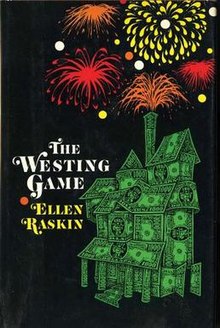
The Westing Game by Ellen Raskin

Senseless, you say?  Death is senseless yet makes way for the living.  Life, too, is senseless unless you know who you are, what you want, and which way the wind blows.

So on with the game.  The solution is simple if you know whom you are looking for.  But heirs, beware!  Be aware!

Some are not who they say they are, and some are not who they seem to be.  Whoever you are, it's time to go home.

God bless you all and remember this:

Buy Westing Paper Products!

I swear, when I saw the first trailer for Rian Johnson's movie Knives Out, I thought: Somebody made a movie of The Westing Game!  The cast of colorful characters, gathered in a single place, to solve the mystery of a murder--I know those aren't exactly original tropes but something about the color and tone of the film made me think of Ellen Raskin's young adult mystery, which I haven't thought about in years.  And so I had to go reread it to see if it was as fun and well-plotted as I remember.

The story is this: several strangers are sold apartments in a brand new building overlooking Lake Michigan.  They include impetuous pre-teen Turtle Wexler, her beautiful sister Angela, their selfish parents Jake and Grace; Shin Hoo, who runs a Chinese restaurant on the top floor, his wife and teenage son; the Theotorakis brothers, one of whom is whipsmart but has a debilitating palsy; J. J. Ford, a black woman judge; a pious old woman named Crow.  In addition to these, the apartment building is staffed by a vulgar doorman named Sandy McSouthers and serviced by a genial, slightly idiotic deliveryman named Otis Amber.  When the mysterious paper magnate Samuel Westing, whom everyone thought absconded overseas, is murdered in his nearby mansion, the denizens of the apartment building are invited to a will reading and compelled to put together a devious puzzle in hopes of inheriting Westing's fortune.

In my memory, the mystery is extremely satisfying, a multi-layered marvel of clockwork plotting.  Rereading, I didn't really find that to be the case.  The "puzzle" that Westing leaves is mostly very simple: the residents are paired, seemingly at random, and given an envelope containing words.  The words (as an adult reader will quickly find obvious) are the lyrics to "America the Beautiful," and the secret at the heart of the mystery is found in the words that are missing.

What is really satisfying is the myriad ways in which all the teams wrongly approach the mystery.  the team with the word "Amber" focuses on Otis Amber, of course; Turtle and her partner, a kindly old woman named Flora, actually believe their words are stock symbols and make investments.  What sets The Westing Game apart from similar mysteries is the elegance not of the right solution but of the wrong ones.  The one right strategy, which is of course impossible, given the residents' greed and petty divisions, is to pool the clues.  If they can only bring themselves to pool the clues and the reward the mystery would be revealed instantly.

The Westing Game is an allegory.  The residents of the Westing Towers are America, in miniature.  It's no coincidence that the song in the clues is "America the Beautiful," or that Westing is dressed up like Uncle Sam in his coffin.  The divisions between them are divisions of race and class made miniature; if only, like America, they could put aside their differences, they'd reap a rich reward.  (A more jaundiced take might be this: The Westing Game asks us to believe in a both-sides ideology, in which a struggling immigrant like Shin Hoo is equally culpable for the nation's problems as rich, vain Grace Wexler, and for a solution it gives us a condescending Bloomberg-type billionaire who promises to bring us all together!)  It's cringey at times (I'm not a huge fan of J. J. Ford showing up for the climax in "African robes"), but on a PBS level, it pretty much works.

Monday, January 9, 2017

#2 - Peril at End House, by Agatha Christie

For me, comfort reading gets no better than Agatha Christie. I first fell in love with her books in ninth grade, and went through such a prolonged spurt of reading them that a not-particularly-close friend called my house one time, and when my mom answered, my caller said, "What, is he off reading some Agatha Christie book again?" The fact that her books are old-fashioned bothers me not a whit (heck, they were old-fashioned for half of the time she was writing them), except for when the casual racism and antisemitism of pre-war Britain pops up (it does seems to have largely been extinguished in her post-war work). My love of Agatha Christie is so great that in my second year of teaching, I forced four classes of Brooklyn teenagers circa 2009 to read the Murder of Roger Ackroyd - and they liked it. A few years back, I decided I might as well keep track of all the Christies I have and haven't read, with an eventual aim of meandering my way through the trails of upperclass British corpses and completing her oeuvre. 

My most recent foray into Christie reunited me with everyone's favorite Belgian with an egg-shaped head, Hercule Poirot. Poirot, in turn, is reunited with Captain Hastings, his sounding board and the stand-in for the confused reader whenever Poirot finally solves the crime. (I think I'm up to about 40 Christies read at this point and I have never - not once - figured one of these things out.) 

Reviewing the particulars of any individual Christie is really beside the point, but this falls soundly into the category of Very Good Christie for me. (Christie books come in three varieties for me: Stone Cold Classics, Very Good, and Very Meh.) The imperiled character is a young woman named Nick Buckley, proprietress of the titular End House. She is a thoroughly modern young woman of the 1930s (Christie did write modern characters for a time!), and, in another very nice touch, is engaged to a young man who is trying to complete a Charles Lindbergh-esque feat of aviation before he is lost at sea. There's even an attempt made on someone's life involving chocolates filled with an overdose-inducing quantity of cocaine!

As I said, it's not a Stone Cold Classic, but as far as Very Good Christie goes, I'd put it up there with A Murder Is Announced. Sometimes, the best parts of a Christie novel are nothing to do with the crime, but are the parts that reflect the massively changing British society that they take place in. A Murder is Announced was one of Christie's first post-war books, when the entire idea of a servant class was basically thrown out the window once and for all. Similarly, Peril at End House features independent women, aviators when that actually meant something, and a not-really divorced woman with a new lover. For having a reputation of being old-fashioned, I have a feeling this was not the typical stuff of large circulation books in England in 1932.


Wednesday, July 27, 2016

The Golden Child by Penelope Fitzgerald

'The object of the museum is to acquire and preserve representative specimens, in the interests of the public,' he said.

'You say that,' returned Sir William, with another winning smile, 'and I say balls.  The object of the Museum is to acquire power, not only at the expense of other museums, but absolutely.  The art and treasures of the earth are gathered together so that the curators may crouch over them like the dynasts of old, showing now this, now that, as the fancy strikes them.  Who knows what wealth exists in our own reserves, hidden far more securely than in the tombs of the Garamantes?  There are acres of corridors in this Museum that no foot has ever trod, pigeons nesting in the cornices, wild cats, the descendants of the pets of Victorian curators, breeding unchecked in the basements, exhibits that are only looked at once a year, acquisitions of great value stacked away and forgotten.  The wills of kings and merchant princes, who bequeathed their collections on condition they should always be on show to the public, are disregarded in death, and those sufferers trudging like peasants to the temporary canteen, to be filled with coconut cakes and lift plastic containers to their lips--they pay for all, queue for all, are the excuse for all; I say, poor creatures!'

This is a sad moment for me.  I was blown away by Penelope Fitzgerald's The Blue Flower when I read it in 2012; it was one of those times when you say, "I know I'm going to read everything this person ever wrote."  And now, four years later, I have.  Nothing was ever quite as good as The Blue Flower, which is one of my favorite books ever, but I enjoyed them all immensely.  At least two others, to my mind, are unquestionably great: Innocence and At Freddie's.  I would go so far as to say that Fitzgerald is one of the most underappreciated writers of the 20th century.

The Golden Child is Fitzgerald's first novel.  She was sixty years old (!!!!) when she wrote it.  It bears the hallmarks of Muriel Spark more clearly, I think, than anything else Fitzgerald wrote.  It's a book where Fitzgerald is still finding her voice, but at moments, the Fitzgerald of The Blue Flower shines through quite clearly.

The story is a murder-mystery inspired by the exhibition of King Tut in the 1970's.  (Doesn't that sound awesome?)  A museum, clearly modeled after the British Museum, is exhibiting a set of golden treasures from the made-up civilization of Garamantia.  The heart of the exhibit is the tomb of the Golden Child, a Tut-like mummy in a golden casket who is said, like Tut, to carry a curse.  Waring Smith, a junior-level officer at the museum, is alone in the museum one night when a phantom figure tries to strangle him with the Golden Twine, a relic meant to guide the Golden Child back to the land of the living--but also one that should have crumbled when touched because of its advanced age.  Later, the archaeologist who discovered the treasures, Sir William, is discovered dead, caught between the sliding steel bookcases of the musem library.

The Golden Child fails to offer the kind of highly individuated, interesting characters that make Fitzgerald's other books standouts.  The irreverent Sir William, who openly disdains the exhibition he made possible, comes close, but Waring is archetypically hapless and henpecked.  He's the kind of guy that Martin Freeman would play in a movie, and not much more than that.

It stops short also of developing really interesting observations on the nature of a museum, whose internecine power squabbles mirror the historical clashes the museum seeks to document.  (Sir William's monologue on power above is as close as the novel comes.)  Nor does it really pause to consider the question of what it means to be real or authentic, which are questions of huge import to the exhibition.  But it does capture a kind of lyrical sadness in the image of the British public, waiting in four-hour long queues for an exhibit for reasons that are obscure even to them.  And the middle of the book, in which Waring is sent to Moscow to authenticate a piece of the treasure only to find out that the entire exhibit is a fake and the Russians have managed to gather the real thing, is funny and frenetic in a way that shows just what a gripping author Fitzgerald would become.

Tuesday, September 9, 2014

Blade of the Samurai by Susan Spann

I pretty much never read straight-up mystery novels, but when I was contacted about Blade of the Samurai, I was intrigued by the setup: an undercover samurai, Hiro Hattori, solves mysteries with Father Mateo , the Catholic priest he's been commissioned to protect. Sounded like an interesting spin on the detective story, and I figured I'd at least enjoy the setting, so I picked it up.

The mystery this time is as follows: Saburo, a cousin of the shogun, has been stabbed to death in his quarters, and the apparent perpetrator is Kazu, a longtime friend of Hiro's. Because of their connection, he's called to investigate the case, which must--will--be closed before an important diplomatic attache arrives, even if it means executing a man who may not be guilty.

I'm happy to say that, on the samurai detective front, it delivered. Blade of the Samurai tells a pleasantly diverting little yarn with bursts of good humor and some fairly sharp characterization. I enjoyed the interactions between Hiro and Father Mateo, but moreso, I enjoyed the reactions of the Japanese with whom Father Mateo came into contact with. While many authors might have played the cultural differences for fish-out-of-water japery, Spann takes them seriously for the most part, culminating in a scene where Father Mateo is scolded and subsequently repentant for treating peasants the same way he treats the hoi-poi.

This scene encapsulates the other thing I wanted from the book and didn't quite get: a more thorough examination of the relationship between Father Mateo's faith and Hiro's ancestral religion. I'm a sucker for Catholic novels, but besides the fact that Father Mateo spends about 25% of the novel offscreen, Spann mostly doesn't focus too much on his inner life--and, to be fair, that's my own baggage coming into the book. Still, I would have liked a little more.

Overall, however, the mystery moved quickly, especially when supporting characters start biting it in the back half, and the killer wasn't obvious to me--I can't speak for more experienced mystery fans. It was fun, and if you like mysteries or find the setting of feudal Japan interesting, check it out.

Sunday, June 23, 2013

The Geneva Option by Adam Lebor

Yael Azoulay is a fixer for the UN Secretary General. She is not the kind of fixer whose primary tool is a gun. She relies on her wits, her intuition, and her ability to negotiate with anyone, whether warlords, genocidal dictators, and unscrupulous businessmen. When she is sent to the eastern Congo to negotiate with a Hutu warlord, something goes wrong, and she realizes that she's in serious danger, a danger with roots that snake there way back to the United Nations Headquarters.

Lebor writes action as well as just about any author I have read, and he sets scene quickly and vividly, sometimes with little more than a sentence or a phrase. One such sentence read, "Yael was drenched in seconds as the wet gusts hit her." This came in the middle of a fist-and-foot-fight between Yael and her captor in a car, shortly after the passenger-side windows shattered. At its core, the sentence is pretty basic, but it provides readers with a vivid setting for this scene in a mere eleven words. Brevity is hard to do.

Lebor includes a near perfect amount of detail in his writing, enough to immerse readers in a city, in a culture, or in an ornate 19th century building, but still well short of the overly-detailed writing of authors like Tom Clancy.

Although the preponderance of characters in The Geneva Option are fictitious, Lebor lends some verisimilitude to his international thriller, by referencing real-life events, situations, and in some instances even political figures. This, no doubt, stems from Lebor's investigative journalism background.

Although I really enjoyed The Geneva Option, I have one slight caveat. While I liked Lebor's Yael Azoulay character, there were a number of instances where it was obvious that this strong female lead was the creation of a male mind.

Friday, January 6, 2012

The Man Who Knew Too Much by G. K. Chesterton

"I am too tangled up in the whole thing, you see, and I was certainly never born to set it right."

I pulled this book off a bookshelf at my girlfriend's parents house, thinking that it might have been the basis for the Alfred Hitchcock movie with the same title. The author's name was not displayed on the side. I was delightfully surprised to see that it was a Chesterton book, and one that I had not heard of. I quickly stuffed it down the back of my pants.

As I suspected upon discovering its author, this book has no connection to the Alfred Hitchcock movie, other than the title. It is a collection of 8 detective stories set in the early 20th century. The title refers to Horne Fisher, a man who is burdened with private knowledge of public figures in England, due to the fact that he is so well connected. Fisher's intimate knowledge of the lives and motivations of members of Britain's upper class allows him to understand what is really going on, and what it ultimately kept from the public.

Accompanying Fisher in these stories is his friend Harold March--they meet in the first story. March is a journalist whose focus appears to be matters of politics. March does not figure heavily into the stories. However, his presence provides the opportunity for Fisher to voice some of the paradoxes he is facing as a result of what he know. Fisher knows who is guilty, but he also knows the motives behind their actions. And there are reasons why these persons cannot be brought to justice--at least in the traditional sense. Inherent to these stories, is a lack of justice. This is the fundamental difference between these stories and Chesterton's Father Brown mysteries.

While there is not a strict chronology to these stories, there is an overall arc to the collection, beginning with Fisher meeting March in the first story. They should definitely be read in the order.

Saturday, January 22, 2011

The Girl with the Dragon Tattoo by Stieg Larsson

Lisbeth Salander is the girl and she steals private information, she’s a 90-pound anorexic looking hacker. One of many descriptions of this loony lady:

"A black T-shirt with a picture on it of E.T. with fangs, and the words I AM ALSO AN ALIEN. She had on a black skirt that was frayed at the hem, a worn-out black, mid-length leather jacket, rivet belt, heavy Doc Marten boots, and horizontally striped, green-and-red knee socks. She had put on make-up in a colour scheme that indicated she might be colour blind. In other words, she was exceptionally decked out."

The main story is of an investigative financial reporter that has been convicted of libel (I hate that word). His goal is revenge and understanding, but he can’t get that until he solves a 40 year-old murder/disappearance mystery. Salander helps him in last half, but she has her own story to tell.

She is really fucking nuts, but a sympathetic character that you love and wish you could pick her up, put her in your pocket, and take care of her. But she doesn’t need or want you. Which makes you want to help her more.

I read this for my Mom. It’s a page-turner after about 65 pages of set up. I’m surprised it is so popular considering the slow start. I loved the Swedish towns and supreme frigidness of the climate and characters. The proper nouns are fun to fumble through pronouncing. I’m not really saying you should go out and read this though. It’s pulp, with intrigue. Mystery novels are a hard sell for me, the last mystery I read was Motherless Brooklyn and as much as I suggest you read Lethem, Larsson is Swedish and I’m not. I hate being monolingual more and more with each translated book I read.

Saturday, April 10, 2010

The Shadow of the Wind by Carlos Ruiz Zafón

Bea says that the art of reading is slowly dying, that it's an intimate ritual, that a book is a mirror that offers us only what we already carry inside us, that when we read, we do it with all our heart and mind, and great readers are becoming more scarce by the day.

This was an excellent book that came highly recommended from a number of people. A couple of people described it as the best story they had read in a while. I am inclined to agree with them. Not only does Zafón tell a great story, but he does so with excellent writing.

The Shadow of the Wind is a book about a book. The main character is a boy named Daniel, whose father runs a used book store in mid-20th-century Barcelona. Daniel comes across a book called The Shadow of the Wind by Julian Carax, which he falls in love with. But as he tries to find more books by the author, Daniel discovers that Carax is shrouded in mystery. What starts off as simply an interest in finding more works by Carax turns dangerous as Daniel uncovers a mystery decades old.

This is a slow-burn mystery. By that I mean that while there is a strong undercurrent of mystery, the other elements of the story are strong enough, that at times they become the driving force of the story. Zafón deftly weaves the history of Barcelona with an intriguing story of mystery and romance. The end product in an ode to storytelling. A love letter to reading.

Sunday, January 3, 2010

A Dog at Sea by J. F. Englert

Randolph is unusually smart. He is not just an intelligent dog, but is, in fact, smarter than many humans, including his owner Harry. The book begins with Harry and Randolph aboard the Nordic Bliss, a canine-friendly cruise headed to Curacao. Ostensibly, Harry and Randolph are on the cruise ship for some relaxation, but the real reason is that they think Curacao is where they will find Imogen. A few years back, Harry and Randolph watched Imogen leave the apartment for some bread, an errand from which she never returned. For a while Harry thought that she was dead, but Randolph had some lingering doubts. In A Dog About Town, Harry becomes convinced that Imogen is still alive, but in hiding for some reason. We find out that reason in A Dog Among Diplomats. In this third book, Randolph hopes to reunite with his mistress and put more of the mystery to rest. But before that can happen, he has to help get the bottom of a murder on board the ship.

The tale is told from Randolph's perspective. His murder-solving skills come from the ability to decipher complex human emotions through scent. In this way, Randolph can get a sense if someone is sad, if they are lying, or if they feel guilty. Randolph has to lead Harry along the way. All the while, Randolph never loses his canine attributes. Englert has a great grasp of canine behavior and a good understanding of what makes a good mystery. I absolutely love the Randolph series, and if you love dogs, mysteries, or good books, then you will too.

Monday, November 16, 2009

Murder on the Orient Express

A number of years back, I read And Then There Were None. I really enjoyed the book and, seeing how it was my first Christie novel, I figured I should probably read some of her other books. Murder on the Orient Express was my introduction to M. Hercule Poirot, an eccentric Belgian detective. The quirky detective character made an otherwise average mystery into something more. While I didn't like it nearly as well as And Then There Were None, I found this book well paced, with interesting characters.

Saturday, July 11, 2009

The Woman in White by Wilkie Collins

My first glance round me, as the man opened the door, disclosed a well-furnished breakfast-table, standing in the middle of a long room, with many windows in it. I looked from the table to the window farthest from me, and saw a lady standing at it, with her back turned towards me. The instant my eyes rested on her, I was struck by the rare beauty of her form, and by the unaffected grace of her attitude. Her figure was tall, yet not too tall; comely and well-developed, yet not fat; her head set on her shoulders with an easy, pliant firmness; her waist, perfection in the eyes of a man, for it occupied its natural place, it filled out its natural circle, it was visibly and delightfully undeformed by stays. She had not heard my entrance into the room; and I allowed myself the luxury of admiring her for a few moments, before I moved one of the chairs near me, as the least embarrassing means of attracting her attention. She turned towards me immediately. The easy elegance of every movement of her limbs and body as soon as she began to advance from the far end of the room, set me in a flutter of expectation to see her face clearly. She left the window—and I said to myself, The lady is dark. She moved forward a few steps—and I said to myself, The lady is young. She approached nearer—and I said to myself (with a sense of surprise which words fail me to express), The lady is ugly!

The hardest types of books to write reviews for are not the complex, thematically deep ones where the biggest problem is how to reduce the book into 500 words and do it justice. Nor are they the godawful disappointments, which at least lend themselves to kvetching, always a treat for the vitriolic reviewer. No, the most difficult is the excellent book damned with the faint praise of "Good for what is is"; the well-charactered, well-plotted page turner, worthy of ink and praise but doesn't lend itself to much analysis. For me, The Woman in White was exactly that sort of book.


Mild Spoilers Follow.


The story, told in a bastardized epistolatory format by way of the diaries, letters, etc. of several different narrators, is complex and intricately plotted. Walter Hartright, a young art teacher, is commissioned to teach two sisters, Marian and Laura Halcombe, on the secluded Cumberland estate. On his way to the estate, he unwittingly aids the titular Woman, Anne Cathrick, who has recently escaped a mental institution. Upon finally arriving at Cumberland, he falls in love with Laura, and becomes close friends with Marian, her older and less attractive older sister. He leaves the position and the estate after learning that Laura is engaged to the clearly skeevy landowner, Sir Percival Glide. Laura is married and then the real story begins, as Glide and his mysterious friend Count Fosco set into motion a complicated plan to steal Laura's money and end the threat posed to them by the enigmatic Anne Catherick.


Spoilers End Here.


From my opening paragraph and the plot summary, I don't want to give the idea that The Woman in White isn't a good book. It is, in fact, one of the best mystery/suspense novels I have ever read. James Patterson could learn something about crafting complex, believable plots, and almost anyone could benefit from Collins' tight, frequently witty prose. The characters are also well-formed, two in particular. Marian Halcombe may be one of the earliest feminist characters in literature, consistently besting the men in the story in both emotional control and logical thinking. Count Fosco is also very well drawn, a gentleman control-freak who seems to know everything that happens around him and has an almost romantic attachment to Marian.


Like I said, I don't really know what to say about this book. There's not a lot of food for thought her besides trying to suss out the expertly-paced twists and turns, and it' probably not goig to change your life. But it's enjoyable, it tells a good story, and I'm glad I read it. Sometimes, that's more than enough.

Saturday, February 28, 2009

The Hound of the Baskervilles by Sir Arthur Conan Doyle

Perhaps no fictional character has been as diluted by their own popularity as Sherlock Holmes. Fictional detectives of all stripes--OCD Monk, Shawn Spencer from Psych, Lieutenant Columbo, Hercule Pirot--crib from Holmes's bag of tricks. Even the deerstalker cap and pipe, rarely mentioned in the stories themselves, have become iconic, indicating mystery when they appear in silhouette on the spine of a book.


With that in mind, why even read The Hound of the Baskervilles? Not only is it a story about Sherlock Holmes, familiar to everyone from your grandmother to your niece, it may be the defining story. The title at least has passed into popular parlance, just like the name of its protagonist. That's why those reading it for the first time might be a little surprised at what they find.


Holmes, as written by Sir Arthur Conan Doyle, is no do-gooder saint. He's an egotistical, arrogant, cocaine-abusing, opium-smoking, lying misanthrope, far from the good-hearted detectives built ostensibly in his mold. He treats his partner and only friend, Dr. Watson, with a mixture of condescension and concern, has no problem with breaking the law to solve his cases, and, really, just doesn't think of the children. However, it's not in spite of his flaws but because of them that Holmes is such an enjoyable creation. He is completely without superstition and without the slightest doubt in his abilities.


The Hound of the Baskervilles is one of only four Sherlock Holmes novels written by Doyle. Holmes is called into the case by a doctor drawn into a strange case. Charles Baskerville, wealthy landowner, is found dead without a mark on his body, thought to have been felled by a giant black Hell hound who haunts the family. Holmes takes the case, but, unable to go himself, he sends Watson to investigate and report back. Hound stands out from the short stories because Holmes himself is absent from large parts the novel, and the reader is given unfiltered information from Watson's letters back to Holmes. The end of the story, where Holmes captures the criminal and explains his methods is satisfying on a visceral level. Almost nothing is left unanswered, and the plotlines fit like a puzzle. It just works.


That, ultimately, is why reading Sherlock Holmes is still worthwhile. In spite of the doppelgangers, Holmes himself still stands alone, an idiosyncratic literary creation that is often imitated but never duplicated. This year sees the release of two movies based on Sherlock Holmes, one a comedy and one a complete reinvention, starring a gay, karate-kid Sherlock, but for those interested in Sherlock Holmes, the original stories are the place to start.


Bonus: Word Cloud!

Saturday, January 24, 2009

Motherless Brooklyn by Jonathan Lethem

"Ziggedy zendoodah," I said aloud. My erection dimmed, energy venting elsewhere. "Pierogi Monster Zen master zealous neighbor. Zazen zaftig Zsa Zsa go-bare." I rapped the scalp of the sitter in front of me. "Zippity go figure."

The roomful of gurus and acolytes came to agitated life but not one of them spoke a word, so my burst of verbiage sang in the silence. The lecturing monk glared at me and shook his head. Another of his posse rose from his cushion and lifted a wooden paddle I hadn't previously notice from a hook in the wall...

"Pierogi kumquat sushiphone! Domestic marshmallow ghost! Insatiable Mallomar!
Smothered pierogiphone!" The flood came with such force, I twisted my neck and nearly barked the words.


Lionel Essrog is an orphan, raised practically from youth by a low-level mobster named Frank Minna in the Cobble Hill/Carroll Gardens neighborhoods of Brooklyn, and along with three other orphans forms the nucleus of Minna's detective-service-cum-crime-operation-cum-fake-car-service. As you can see from the passage above, he also has Tourette's.

Which, when your line of work revolves around subtly discovering and keeping information, can be quite the drawback. Lionel is a sort of anti-Philip Marlowe, a detective who exudes anything but cool and goes undercover very poorly. But in the opening chapters of the novel Minna is murdered, and since one of the other orphans is incarcerated and the other two locked in a battle for supremacy of Minna's mini-empire, the lot of finding Minna's killer falls to Lionel.

The mystery here is slight--it involves Minna's long lost brother and a cadre of Zen Buddhist monks operating out of the Upper East Side. The revelations that aren't telegraphed to the reader early on remain murky at the story's end, and the whole goofiness barely elevates the novel above the level of a Monk episode.

But Lionel is an intriguing character to follow; a captive of his own tics who doesn't seem capable of connecting with any other human being except his dead boss. The Zen angle seems inspired by a lot of silly prime-time detective dramas, but at the same time it provides an interesting balance to Lionel's troubled psyche--the Zen monks have what Lionel can only dream of possessing: control over the tumultous waters of the spirit. In fact, Lionel--endlessly complicated, and tangled up within his own mind--matches the mystery genre a lot better than the orderly, logic-driven detectives that seem to dominate it.

As an aside, I have to say I enjoyed this a lot more than The Brooklyn Follies--among other things, The Brooklyn Follies seemed to have a big hard-on for the Park Slope life but never really provides the reader with local color to sink his or her teeth into. It could have been any reasonably sized blue city. But Motherless Brooklyn's Court Street is unmistakable, and to my delight includes a few locales well-known to me. It even makes a stop in my neighborhood, Greenpoint, where Minna is murdered and stuffed in a dumpster. I feel certified.

P.S: I think that Brent, Carlton, Nathan and Jim would all enjoy this--plus, Edward Norton is supposed to be directing/starring in a film adaptation released next year.

Monday, October 27, 2008

I Am the Messenger by Markus Zusak


"Before I even mention me, I should tell you some other facts: 1. At nineteen, Bob Dylan was a seasoned performer in Greenwich Village, New York. 2. Salvador Dali had already produced several outstanding artworks of paint and rebellion by the time he was nineteen. 3. Joan of Arc was the most wanted woman in the world at nineteen, having created a revolution. Then there's Ed Kennedy, also nineteen... No real career. No respect in the community. Nothing."

I enjoyed the actual process of reading this book but once it was over and I discussed it with some people in my Young Adult Lit class, I realized how sloppy the novel actually was. Despite some problems that I had with a few major plot points, the novel was still redeemable up until the final chapter where everything came together in a way that was far too neatly packaged and a bit too didactic for my likings. I will give Zusak this, though-- the novel plays out in a way that made me see each event unfold as it happened, and it was a lot more like I was watching a movie than it was like I was reading a book. Maybe that's common for other people and my imagination is lacking, but that doesn't happen for me very often.

The main character, Ed, is in a bank depositing his paycheck from the cab company he works for when a bank robbery goes down. Although he is an unlikely hero, Ed still manages to save the day. After his short fifteen minutes of fame end, he goes back to his normal life sharing his shack with his dog the Doorman, chasing his best friend Audrey who is too busy being a tart to acknowledge his affinity for her, and playing cards with his underachiever friends when he's not carting people around town in his cab. Everything is fine until the cards start coming in the mail, where he must "protect the diamonds, survive the clubs, dig deep through the spades, and feel the hearts." He becomes The Messenger, delivering people what they need and not knowing who is sending him or why. Without giving the plot away, I'll just say this-- I Am the Messenger reminded me a lot of a toned down version of The Boondock Saints without any of the murder. Sometimes he's helping lonely old women and priests, but other times he's beating the snot out of young punks and pistol whipping abusive men. You never really know what he is or isn't capable of or what he's going to have to do next. Since the instructions on the cards sent to him are vague, he has to assess situations himself and find out how to make life better for the people he has to protect. If he doesn't take care of a situation in an appropriate or timely matter, he knows his life is at stake.

Zusak has a YA bestseller set during the Holocaust called The Book Thief that I want to read, but I think I'll wait a while before picking one of his books up again.

Sunday, July 20, 2008

The A.B.C. Murders by Agatha Christie

The A.B.C Murders was recommended to me by a friend, and it did not disappoint. It was my introduction to Hercule Poirot. For some reason it took me a very long time to get through this relatively short novel. I don't think that is a reflection on the book as much as it a reflection on my mental state at the time. I hit a little bit of a reading lull for a week or two. I think I am through it now. But please keep me in your thoughts.

Tuesday, June 24, 2008

A Dog Among Diplomats by J. F. Englert

Randolph and his owner (Harry) become embroiled in an international plot that involves Imogen, Randolph's real owner, and Harry's missing fiance. The story is told from the perspective of Randolph, which adds to the novel's charm. J. F. Englert has a good grasp on canine behavior. His weird little insights into doggy world are enjoyable. Englert is also a good writer with a good sense of humor. Also, this book has a chapter titled, "Liverwurst Is Discovered to Be a Glorious Food."

Read my review of A Dog about Town, to which this book is a sequel if you want to find out more about the characters and the overarching storyline. I enjoyed the first book a lot. This one was just okay. The plot was a little sloppy at points. But it was still an enjoyable read.

I have been trying to come up with alliterative ways to describe Randolph, a murder-solving black Labrador. All I could come up with is:
Doggy Detective
Murder-solving Mutt (although he is not technically a mutt)
Querying Quadruped

Sunday, June 22, 2008

The New York Trilogy by Paul Auster

The garish cover of the recent Penguin Classics edition of Paul Auster's New York Trilogy, drawn by comics veteran Art Spiegel, harkens back to the pulps of the mid-20th century, the ones in which dames are always popping into the darkened offices of private eyes, and the detectives themselves are boiled as hard as anyone can be boiled. And indeed The New York Trilogy is a trio of detective stories in a way, as tightly written as a Raymond Chandler novel, but the searches that occupy the protagonists of these three novellas are circuitous, without solution, circling back on themselves until the possibility of solution has disappeared and the search is all that is left.

The first of these, City of Glass, opens with Quinn, a part-time writer who gets a call for Paul Auster (that's the author's name!), a private eye, begging him to take a case. Eventually, Quinn takes the case despite the case of mistaken identity. His client, Peter Stillman, who gives a long speech that sounds something like the word salad of a schizophrenic, hires Quinn to track down his father, who has just been released from prison and who Stillman thinks is going to try to kill him. The crime for which he was convicted? Locking Peter in a room for nine years as a child in an attempt to discover in isolation man's natural language, the language of God, which will reverse the curse of the Tower of Babel and present the key to understanding all. Here is a passage from City of Glass, where Stillman's father is speaking to Quinn:

"My work is very simple. I have come to New York because it is the most forlorn of places, the most abject. The brokenness is everywhere, the disarray is universal. You have only to open your eyes to see it. The broken people, the broken things, the broken thoughts. The whole city is a junk heap. It suits my purpose admirably. I find the streets an endless source of material, an inexhaustible storehouse of shattered things. Each day I g o out with my bag and collect objects that seem worthy of investigation. My samples now number in the hundreds--from the chipped to the smashed, from the dented to the squashed, from the pulverized to the putrid."

"What do you do with these things?"

"I give them names."


If there is an overarching theme to The New York Trilogy, it is the insufficiency of words to describe the world. Stillman's father combs the streets looking for broken things because he claims that our language is insufficient to describe what happens to an object when it is destroyed beyond use; is an umbrella with no cloth between the spokes still an umbrella? I do not know if Auster is aware of this, but there are cultures all around the world who think in exactly this manner. When this sort of thinking is applied to the detective novel, we come to understand that there is no way for a detective to find what he is looking for if he hasn't the words to describe it. All three of the protagonists in this book are following someone, and they all keep copious notes, but in the end, what good comes from writing it down? Truth remains elusive.

The second and third novellas play like a variation on a theme. Ghosts follows a man named Blue hired by a man named White to watch a man named Black--and all the peripheral characters on down the line are named after colors. This is a wink from Auster, a clue that we are not reading fact but fiction, and that he can create as he sees fit. The suggestion here is that a detective's work is as much to create as it is to discover. In a complicated bit of self-reflexivity, we begin to wonder who is watching whom--and for that matter, who is who. But Ghosts, for the most part, treads too nearly to the same ground as City of Glass while lacking the human connection that Quinn provides.

Much better is the final novella, The Locked Room, a name that mystery enthusiasts will immediately recognize as a type of book or story in which the detective must figure out how a crime was perpetrated in a room that usually would be impossible to enter. But again Auster subverts our expectations; the novella does not begin with a locked room but ends with it; it does not ask how one gets in to the locked room but how to get another man out. (And of course, it must be noted that by ending in a locked room, we have come full circle from the mad experiments of Stillman's father in City of Glass).

In the room is a man named Fanshawe, a brilliant man who disappears and burdens his wife with the task of contacting his childhood friend, the narrator, to read his unpublished novels and judge whether or not they are worthy of publication. The books become a minor hit among critics, but the presence of Fanshawe in the narrator's life begins to complicate his new marriage to Fanshawe's wife. Under the guise of writing a biography, the narrator sets out to find Fanshawe and perhaps take him out of the equation permanently.

Like all the protagonists of The New York Trilogy, he becomes obsessed to the point where the search is all that he can focus on, and it brings him near the brink of destruction. In Auster's world, the detective is forever being forced into a double-bind: by the very nature of knowledge he cannot find what he is looking for, but he cannot simply quit the search. Like Stillman's father picking garbage off of New York streets, we are forced to wonder if you can call a detective who has no ability to detect a detective at all.

Sunday, March 23, 2008

A Wild Sheep Chase by Haruki Murakami


This is the stragest piece of fiction literature I've read in a long time. If you have ever read anything by Murakami, you will know what I mean when I tell you it's a bit too quirky for me to summarize without the novel sounding as though it's too far fetched to be enjoyable. If you're in the other camp and haven't read anything by him, I strongly recommend you check him out.

The narrator is a mediocre, nameless man living in Japan as a co-owner of an advertising company that he started originally as a translating service with his alcoholic best friend. At the opening of the novel, the narrator is dealing with a recent divorce to a woman we know little about except that she kept detailed records of her sex life. He begins a relationship with a call girl who has "the most bewitching, perfectly formed ears." When her ears are covered, she's a plain looking woman with no intrigue. When her ears are uncovered, she's more or less an insta-sex goddess with psychic abilities. It only gets weirder from here.

The narrator is contacted by a man working for dying government leader because of a picture he used in an ad that contains the physical manifestation of a mythological sheep. The narrator did not take the picture himself. It was sent to him by an old friend he calls the Rat who has more or less disappeared. The narrator is given an ultimatum: Find the sheep or else. This prompts him and his lady friend to run all over Japan on a wild sheep chase. I don't want to go into anything that happens after this because I don't want to spoil it for you.

Other notes:
-For a novel translated into English from Japanese, the language flows very well. I would have thought that this was written in English to begin with if I had not noticed the note at the beginning of the book saying otherwise.
-Murakami doesn't seem to like giving his characters names. Only two characters are given names that aren't simply descriptions like "my girlfriend" or "the Strange Man." Those characters are J, the bar owner, and their friend Rat, which are both nicknames rather than given names. I found this a little odd.
-The book opens with a little story about a woman the narrator had a casual sexual relationship with during his college years that seems to have no relation to the rest of the text and that this was never tied in bothered me.
-If you visit the author's website, there's a section that tells you what he ate, drank, and listened to while he was writing various different books, and I found that interesting. He also has a play list that includes all the songs referenced to in his novels. For a Japanese man, he includes a lot of American music from the sixties and seventies in his writing.
-This book is a part of a trilogy that for some reason has four books instead of three. As Nathan noted in his review of Pinball, some of the books in the trilogy are now out of print in the US.
-Sometimes I think Murakami is trying to be weird on purpose. (Think Tom Robbins.) It's one thing to have an unusual plot (refreshing) but when you throw in things like a gigantic whale penis and a possessed, homeless man in a sheep outfit, one has to wonder.

Sunday, March 2, 2008

The Drowning Pool by Ross Macdonald


The Drowning Pool is a hard-boiled murder mystery set in California during the 1940s, but at the opening we think the mystery is one of much less gravity than that. Maude Slocum pays a visit to our smart mouthed private detective Lew Archer because someone has sent her a menacing letter, threatening to expose her affair to her husband. The problem with Mrs. Slocum is that she won't assist the slueth by giving him any helpful information about her life or tips on who she think that it may be. Just the next day, her mother-in-law is found dead, which is when things start to get serious.


While the answer does not expose itself right away to Archer, the characters do. Mr. Slocum, though married, is a homosexual. He doesn't have a job that turns out enough money to support his family even though he's well educated and equipped to do it, so he lives in his mother's house with his family and lives off his mother's money, a monthly 300 dollar allowance. He's an actor at a local theater company, and his affair is with the man who wrote the play he's performing in. His daughter's adoration of him borderlines an Electra complex. His daughter's love interest, Reavis, is a freshly fired driver for the family, a compulsive liar, and has his hands in all kind of trouble. His wife shouldn't be trying to hide the affair from her husband because he already knows about the affair and she's lying to the detective she hired for the job. Everyone has a motive, everyone could have done it, and no one has all the information.


I thought I had the murder figured out three or four different times during the course of the book and never even came close. I wasn't quite satisfied with the ending, but everything that lead up to it was a hell of a ride. There was also a passage that seemed like a dream sequence towards the end that wasn't one. It seemed completely out of place for one thing, and the events that unfurled during all of this seemed improbable to me. Maybe that's a plot problem or maybe that's just a Brooke lacking imagination problem. I don't know.


This was made into a movie where Paul Newman plays Lew Archer.

Monday, February 25, 2008

The Adventures of Sherlock Holmes by Sir Arthur Conan Doyle


I like a good detective story and that is exactly what Doyle delivers in The Adventures of Sherlock Holmes. Holmes is nothing like the bespectacled man I remember from Wishbone Classics as a child. He's actually a rather seedy character with an addiction to cocaine and an aversion to law enforcement officers who is described as being "bohemian". In order to do his detective work, he's often breaking just as many laws as the people he's trying to track down. The narrator is Holmes' friend Dr. Watson, an amiable family man who spends his free time helping the detective and sometimes chronicaling their mishaps. (I would like to point out here that prior to writing, Doyle was a doctor.) Watson seems to be a foil for Holmes more than anything else, as he's portrayed as being more stable over all. It's Watson that does the gun toting when things get serious, though-- the only weapon that we see Holmes use at all is a whip. One last character note about our daring detective is that he seems to be another Victorian asexual male hero. The only woman he's interested in at all is Irene Adler-- the one person to ever outsmart him in a case invovling the King of Prussia.

The stories are rather neatly tied together with a neat beginning, middle, and end... the kind of formulaic writing we learn to abide by in our early schooling. The beginnings of each short story are the only really painful things to read, however. You are introduced to Holmes' new client who is in need of his help because their fiance has vanished into thin air, someone is blackmailing them with a photograph, ect. Then Holmes uses his keen observational skills to point out things about the client that only a psychic could know-- for instance, he can tell a woman is a typist because of wear on a certain part of her sleeves. Every time Watson is just shocked at Holmes' attention to detail while I was just yawning.

These stories reminded me quite a bit of Poe's detective fiction, for example "The Murders at Rue Morgue" and "The Purloined Letter". I found Doyle's writing to be more interesting and over all superior by far. Doyle gave the reader a better chance at figuring out the story's quirk along with Holmes, though in some cases, such as "A Case of Identity", he gave a little bit too much away from the start. As today's detective fiction is filled with too many technological gadgets and CSI nonsense, Poe is the only thing I know to compare with this.

I wouldn't recommend the whole book, but I'd at least check out one or two to see what Doyle has to offer. You can do this without buying the book if you go to the website readprint.com, which also has a lot of other classic works that are past the copywrite date now.