Showing posts with label young adult. Show all posts

Friday, January 27, 2023

Wings of Fire: The Dragonet Prophecy by Tui T. Sutherland

“No prophecy decides what happens to me. I‘m not letting a bunch of words or baby dragons choose when I die or what I bow to.”


Since we started this blog 15(!) years ago, a lot has changed. I’ve gotten married, moved from Indiana to South Carolina, bought a house, been through several pets and I have three kids. I don’t get much opportunity to talk about them here, since book blogging is serious business, but the oldest, ten, loves to read and burns through series like there’s no tomorrow. She’s currently working her way through everything Percy Jackson-adjacent, but a year ago she was just finishing up her first real literary obsession, Wings of Fire.

Wings of Fire is a little like Game of Thrones, pitched to preteens and starring (mostly) dragons. Humans--”scavengers”--pop up once in a while, usually as prey, but the dragons and their power struggle is the real draw here. The overarching narrative focuses on a power vacuum that’s been created between the seven dragon kingdoms: SkyWings, SandWings, NightWings, SeaWings, RainWings,  IceWings and the MudWings. A war has been raging for years, driven largely by a quartet of power hungry and sadistic dragon queens. The antagonist of the first arc is Queen Scarlet, of the SkyWings, and we’re introduced to her when she bites a scavenger’s head off and kidnaps five young dragons, called dragonets, who have been raised since egghood by a shadowy group called Talons of Peace, who ostensibly want them to fulfill a prophecy and end the war but whose actions raise questions about their real motives. The dragonets--Tsunami, Sunny, Starflight, Glory, and our protagonist, Clay--are taken to Queen Scarlet’s kingdom where they’re imprisoned and forced to fight in gladiatorial deathmatches with other prisoners for the amusement of Queen Scarlet and her subjects. Here they meet some other dragons, including the somewhat antiheroic Peril, initially Queen Scarlet’s champion fighter and enforcer, who befriends Clay and sets into motion a dragonet love triangle that actually works pretty well.

I was surprised by the intensity Sutherland brings to the story. If the summary above sounds violent, the books themselves are even moreso. While they eschew graphic descriptions, there are face-meltings, bone shatterings, disembowelments, decapitations, and, lest you think the Game of Thrones comparison above was a joke, abrupt and brutal deaths of important characters. The story both opens and closes with a murder atop a seaside cliff, the second of which also serves to cast the Talons of Peace in a sinister light. Other plot points caught me by surprise as well. For example, the dragonets were taken as eggs and raised by members of the Talons of Peace, and one of the running plots is Clay’s sense of aloneness and his desire to return to the MudWings and find his mother and father. Near the end of the book, he succeeds in doing so, only to have his mother treat him with disdain--she hurries along his story of how he got there so she can go back to sleep--and tells him that she doesn’t know who his father is because MudWings are conceived during a giant annual orgy. Really.

I don’t want to overstate the grittiness--this is a preteen series all the way language-wise--but it does deal with some complex themes rather forthrightly, and I was surprised and happy to learn that it also features several queer dragons/relationships. The plot is satisfying, the characters, especially Peril and Glory, are compelling and well fleshed-out, and there are, like, 15 of these. So I could conceivably be reading them until this blog turns 30.

Thursday, January 9, 2020

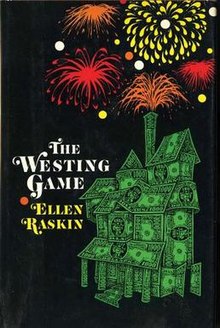
The Westing Game by Ellen Raskin

Senseless, you say?  Death is senseless yet makes way for the living.  Life, too, is senseless unless you know who you are, what you want, and which way the wind blows.

So on with the game.  The solution is simple if you know whom you are looking for.  But heirs, beware!  Be aware!

Some are not who they say they are, and some are not who they seem to be.  Whoever you are, it's time to go home.

God bless you all and remember this:

Buy Westing Paper Products!

I swear, when I saw the first trailer for Rian Johnson's movie Knives Out, I thought: Somebody made a movie of The Westing Game!  The cast of colorful characters, gathered in a single place, to solve the mystery of a murder--I know those aren't exactly original tropes but something about the color and tone of the film made me think of Ellen Raskin's young adult mystery, which I haven't thought about in years.  And so I had to go reread it to see if it was as fun and well-plotted as I remember.

The story is this: several strangers are sold apartments in a brand new building overlooking Lake Michigan.  They include impetuous pre-teen Turtle Wexler, her beautiful sister Angela, their selfish parents Jake and Grace; Shin Hoo, who runs a Chinese restaurant on the top floor, his wife and teenage son; the Theotorakis brothers, one of whom is whipsmart but has a debilitating palsy; J. J. Ford, a black woman judge; a pious old woman named Crow.  In addition to these, the apartment building is staffed by a vulgar doorman named Sandy McSouthers and serviced by a genial, slightly idiotic deliveryman named Otis Amber.  When the mysterious paper magnate Samuel Westing, whom everyone thought absconded overseas, is murdered in his nearby mansion, the denizens of the apartment building are invited to a will reading and compelled to put together a devious puzzle in hopes of inheriting Westing's fortune.

In my memory, the mystery is extremely satisfying, a multi-layered marvel of clockwork plotting.  Rereading, I didn't really find that to be the case.  The "puzzle" that Westing leaves is mostly very simple: the residents are paired, seemingly at random, and given an envelope containing words.  The words (as an adult reader will quickly find obvious) are the lyrics to "America the Beautiful," and the secret at the heart of the mystery is found in the words that are missing.

What is really satisfying is the myriad ways in which all the teams wrongly approach the mystery.  the team with the word "Amber" focuses on Otis Amber, of course; Turtle and her partner, a kindly old woman named Flora, actually believe their words are stock symbols and make investments.  What sets The Westing Game apart from similar mysteries is the elegance not of the right solution but of the wrong ones.  The one right strategy, which is of course impossible, given the residents' greed and petty divisions, is to pool the clues.  If they can only bring themselves to pool the clues and the reward the mystery would be revealed instantly.

The Westing Game is an allegory.  The residents of the Westing Towers are America, in miniature.  It's no coincidence that the song in the clues is "America the Beautiful," or that Westing is dressed up like Uncle Sam in his coffin.  The divisions between them are divisions of race and class made miniature; if only, like America, they could put aside their differences, they'd reap a rich reward.  (A more jaundiced take might be this: The Westing Game asks us to believe in a both-sides ideology, in which a struggling immigrant like Shin Hoo is equally culpable for the nation's problems as rich, vain Grace Wexler, and for a solution it gives us a condescending Bloomberg-type billionaire who promises to bring us all together!)  It's cringey at times (I'm not a huge fan of J. J. Ford showing up for the climax in "African robes"), but on a PBS level, it pretty much works.

Thursday, May 5, 2016

Anne of Green Gables by Lucy Maud Montgomery

Anne of Green Gables of Green Gables
"Yes, it's red," she said resignedly.  "Now you see why I can't be perfectly happy.  Nobody could who had red hair.  I don't mind the other things so much--the freckles and the green eyes and my skinniness.  I can imagine them away.  I can imagine that I have a beautiful rose leaf complexion and lovely starry violet eyes.  But I cannot imagine that red hair away.  I do my best.  I think to myself, 'Now my hair is a glorious black, black as the raven's wing.'  But all the time I know it is plain red, and it breaks my heart.  It will be my lifelong sorrow.  I read of a girl once in a novel who had a lifelong sorrow, but it wasn't red hair.  Her hair was pure gold rippling back from her alabaster brow.  What is an alabaster brow?  I never could find out.  Can you tell me?"

"Well, now, I'm afraid I can't," said Matthew, who was getting a little dizzy.  He felt as he had once felt in his rash youth when another boy had enticed him on the merry-go-round at a picnic.

There's nothing I love more than reading books about the places I go when I travel.  When I took a recent spring break trip to Canada (where it was way too cold for right-thinking people take spring break trips) I decided I had to read Anne of Green Gables, the literary pride of Prince Edward Island.

First of all, Prince Edward Island is awesome.  It's easy to see why Anne, the novel's impulsive, imaginative hero, would be so captivated by her new home: it's pleasant and bucolic, but the abundance of red clay at the farms and red sand on the beaches gives it an otherworldly kind of feeling.  It certainly doesn't look or feel like anywhere else.  Green Gables, the house where Anne is taken by accident to the elderly couple Matthew and Marilla Cuthbert (who wanted to adopt a boy), is a real place, and you can tour it--or you could, if you were smart enough not to visit it in what is essentially Canadian winter.

Matthew and Marilla are charmed by Anne, who talks a mile a minute about the things she imagines.  And to be fair, Anne is pretty charming.  Her overactive imagination is the optimism of someone who's had a hard life as an orphan, a way of shaping the world into something more palatable.  Green Gables, though she sets about immediately renaming local landmarks to suit her sense of whimsy (a local pond becomes, for instance, the Lake of Shining Waters), is the first place commensurate with Anne's capacity for wonder.  The no-nonsense Marilla, while secretly enamored by Anne, endeavors to rein in her impulses, which result in some reliably amusing scrapes.  One of my favorites involves the twelve-year old Anne, permitted to throw a tea party, accidentally substitutes wine for cherry cordial and gets her best friend roaringly drunk.

Eventually, Anne becomes a young woman.  At sixteen, she graduates from high school and--oh, Canada--immediately becomes a schoolteacher herself.  Over the course of the novel, she becomes a part of the Cuthbert household, and ingratiates herself into the society of her small P.E.I. town, and becomes generally loved by everyone.  There are few very high stakes--although Montgomery manages to wring a great deal of unexpected pathos out of a bittersweet ending--but the small niceties of domestic Canadian life prove to be surprisingly compelling, because Anne is a compelling character.

Many women--only women, honestly, but only a few of them Canadian--have told me that these books meant a great deal to them as a child.  Why is that?  I enjoyed the book a lot, but something about Anne, even a hundred years and fifteen hundred miles removed, continues to resound for young girls.

Wednesday, January 2, 2013

A Series of Unfortunate Events by Lemony Snicket

I confess, I started reading A Series of Unfortunate Events last year because I was extremely busy and my book count was extremely low. My only exposure to the series previously had been the decent but not particularly good movie adaptation--which actually combines the first three books—and being impressed by the very nicely designed little volumes I saw in the store. I also read a couple interviews with Daniel Handler, the man behind Lemony Snicket, and was intrigued by his description of the series.

Reading the first few Snicket books, I was struck by the willful similarity between them—the plots were identical. The Baudelaire orphans, Violent, Klaus, and Sunny, whose parents died in a fire, are taken by their caretaker, Mr. Poe, to a new guardian, who eventually turns out to be evil, incompetent, or both. At the end of each book, their living situation has fallen apart, the guardian is frequently dead or MIA, and they’re on the way to the next event in the unfortunate series. The guardian in the first book is Count Olaf, the series’ primary villain, who hatches a plot to steal their family fortune. In each subsequent book, up until The Carnivorous Carnival, #9, Olaf disguises himself—as a detective, scientist, receptionist, auctioneer, et al, and the adults around the Baudelaires have no idea anything out of the ordinary is going on. It’s a little like a series of horror films, where the teenagers being hunted down have no recourse but themselves. At the end of The Vile Village, #7, the Baudelaires finally break from Mr. Poe and strike out on their own, seeking the mysterious organization V.F.D., which may hold information about their parents’ death. The rest of the books, from #8, The Hostile Hospital onward, mix things up structurally, as the orphans try to find old friends, solve the V.F.D. mystery, and find someplace they belong.

The real constant in the books, however, is Lemony Snicket, who is retracing the orphans’ steps and writing their history. He’s an engaging narrator, opening every book by warning the reader that the story to follow is quite miserable, and that they might be better off to read something else. As the series goes on, a meta-story begins to develop, one that is connected to the Baudelaire’s own. It involves Count Olaf, a woman named Beatrice, Lemony himself, and lots of daring escapades. Although this story is extremely interesting, and is revealed very well in snatches throughout the series, the full narrative is never given. Blank spots abound, plot points are missing, ambiguity is everywhere. While Snicket is an engaging narrator, he’s not a very direct one. The meta-story really pulled me through the slow spots in the series, and while it’s not entirely satisfying, it is thematically appropriate, which leads naturally into the next section of this review.

There’s really no way to discuss the series without discussing the end—which, conveniently, happens in #13, The End, so spoilers follow.

In The End, the Baudelaires seem to have found a safe place, a desert island inhabited by a group of people—many of whom are given names from Shakespeare’s The Tempest—and Ishmael, their benevolent-or-is-he leader. The villagers see right through Olaf’s disguise, the first people in the entire series to do so, and banish him. This leads to several weeks of peaceful living for the Baudelaires, but, unsurprisingly, the island is not as utopian as it first appears. Ishmael exercises, through force of peer pressure, an iron control over the populace, “suggesting” to them that any item that washes up on the shore would be better stored in the “arboretum” to prevent rocking the boat. The Baudelaires, however, are unsatisfied with this arrangement and sneak into the arboretum, only find a huge book called, of course, A Series of Unfortunate Events. It’s here that the series shows its hand. It doesn’t explain, or even attempt to explain all the mysteries that have cropped up throughout the narrative. Although it is implied that many answers reside in the book—which is not the same as the Unfortunate Event books themselves—the reader is only able to read one short excerpt. Instead, the book serves as reminder that stories never really begin or end, that every story starts and stops arbitrarily and all life—and fiction—really happens in media res.

One of Ishmael’s favorite sayings is, “It depends on how you look at it”, and that turns out to be the watchword for the entire series—of course we don’t get all the answers, because we’ve seen everything through the Baudelaires’ eyes. Snicket makes the point that simply by shifting perspective, another 13 book series could be written on Olaf, or Ishmael, or any of the guardians, or, as in the case of the Snicket meta-story, someone not directly connected to the Baudelaire orphans at all. I’ve never seen a young adult series—or many adult ones, for that matter—so comfortable with ambiguity. It’s to Handler’s credit that the ending doesn’t feel like a cop-out. There’s a very real sense that he knows exactly what’s going on, and could pull back the curtain if he wished, but that’s not the story he’s chosen to tell. The exact relationship between the Snickets and the Baudelaires is never made explicit; the possible wrongdoings of the Baudelaire parents are never enumerated; things are left up in the air in many ways, but that only makes sense—we’ve only followed one series of unfortunate events, and the world is made up of nothing else.