Showing posts with label fantasy. Show all posts

Saturday, October 3, 2026

Nightside the Long Sun by Gene Wolfe

Enlightenment came to Patera Silk on the ball court; nothing could ever be the same after that. When he talked about it afterward, whispering to himself in the silent hours of the night as was his custom--and once when he told Maytera Marble, who was also Maytera Rose--he said that it was as though someone who had always been behind him and standing (as it were) at both his shoulders had, after so many years of pregnant silence, begun to whisper into both his ears.

Patera Silk is a young priest in charge of a manteion, that is, a religious school, in the city of Viron. Like all manteions, it has a sacred window where the pateras and materas pray each day one of the gods will show their faces, but such a thing has not happened in living memory. So when Silk receives "enlightenment" while playing a ballgame with the students of the manteion, it's a big deal--though perhaps not as easily believed as the god showing up at the window. The god that appears to Silk is not one of the "Nine," a pantheon with discrete purviews like the Greek or Norse pantheons, but a minor god known as "the Outsider." What does it want with Silk? Perhaps it has something to do with the terrible news that Silk receives later in the day, that the manteion has been sold by the state to a vicious criminal named Blood. With the help of members of the criminal underworld, Silk breaks into Blood's estate, considering going so far as even killing him, if it might save the manteion--a moral choice that the pious Silk makes with shocking coldness. What actually happens, of course, is that Silk becomes drawn deeper into the criminal world of Viron.

Compared to Wolfe's Book of the New Sun, the Book of the Long Sun series, or this first volume at least, is much more ordinary. It felt much closer to me to typical fantasy fare, though much smarter and better written, and with a few of Wolfe's customary bolts of strangeness. (The pantheon of "the Nine" seems shockingly similar to the mythos of the Game of Thrones series, which I will point out came out three years after this book was published.) The two series are set in the same world, but this one is much earlier; the sun that is dying in the time of the torturer Severian is burning white-hot here, so that night never truly falls anywhere on Earth. It feels smaller in scope: there is no quest here, and the action is all contained within the city of Viron. The stakes--the future of the manteion--seem small, though the intervention of the gods presages perhaps that they will get bigger as the books go forward.

What I thought was most interesting about Nightside the Long Sun is how Wolfe's reputation as a Catholic writer shows up here. I knew that about him, but I think you're hard-pressed to find evidence of Wolfe's religious beliefs in the Book of the New Sun. Nightside the Long Sun is explicitly religious in theme. Silk's piety actually puts him outside the bounds of most of Vironese society; much like our world today, most people pay a kind of lip service to religion but don't really believe. That means that the moral choice that Silk makes--that he will do almost anything, including murder, to save the manteion--is inscrutable to most people, criminal or otherwise. "The Outsider," a sensitive reader quickly understands, is actually the Catholic God, who has been pushed out into a marginal place outside the pantheon. No wonder, then, that Silk's mission takes him to a whorehouse--maybe in the next volume he'll visit a tax collector.

Ultimately, Nightside the Long Sun is hardly comparable to the Book of the New Sun stuff, but then again, The Shadow of the Torturer, the first book in that series, doesn't really capture the heights the series eventually achieves. And I will say that I wanted to keep reading when it was over; so much so that I am thinking of breaking my rule and reading the next one before 2027.

Friday, January 27, 2023

Wings of Fire: The Dragonet Prophecy by Tui T. Sutherland

“No prophecy decides what happens to me. I‘m not letting a bunch of words or baby dragons choose when I die or what I bow to.”


Since we started this blog 15(!) years ago, a lot has changed. I’ve gotten married, moved from Indiana to South Carolina, bought a house, been through several pets and I have three kids. I don’t get much opportunity to talk about them here, since book blogging is serious business, but the oldest, ten, loves to read and burns through series like there’s no tomorrow. She’s currently working her way through everything Percy Jackson-adjacent, but a year ago she was just finishing up her first real literary obsession, Wings of Fire.

Wings of Fire is a little like Game of Thrones, pitched to preteens and starring (mostly) dragons. Humans--”scavengers”--pop up once in a while, usually as prey, but the dragons and their power struggle is the real draw here. The overarching narrative focuses on a power vacuum that’s been created between the seven dragon kingdoms: SkyWings, SandWings, NightWings, SeaWings, RainWings,  IceWings and the MudWings. A war has been raging for years, driven largely by a quartet of power hungry and sadistic dragon queens. The antagonist of the first arc is Queen Scarlet, of the SkyWings, and we’re introduced to her when she bites a scavenger’s head off and kidnaps five young dragons, called dragonets, who have been raised since egghood by a shadowy group called Talons of Peace, who ostensibly want them to fulfill a prophecy and end the war but whose actions raise questions about their real motives. The dragonets--Tsunami, Sunny, Starflight, Glory, and our protagonist, Clay--are taken to Queen Scarlet’s kingdom where they’re imprisoned and forced to fight in gladiatorial deathmatches with other prisoners for the amusement of Queen Scarlet and her subjects. Here they meet some other dragons, including the somewhat antiheroic Peril, initially Queen Scarlet’s champion fighter and enforcer, who befriends Clay and sets into motion a dragonet love triangle that actually works pretty well.

I was surprised by the intensity Sutherland brings to the story. If the summary above sounds violent, the books themselves are even moreso. While they eschew graphic descriptions, there are face-meltings, bone shatterings, disembowelments, decapitations, and, lest you think the Game of Thrones comparison above was a joke, abrupt and brutal deaths of important characters. The story both opens and closes with a murder atop a seaside cliff, the second of which also serves to cast the Talons of Peace in a sinister light. Other plot points caught me by surprise as well. For example, the dragonets were taken as eggs and raised by members of the Talons of Peace, and one of the running plots is Clay’s sense of aloneness and his desire to return to the MudWings and find his mother and father. Near the end of the book, he succeeds in doing so, only to have his mother treat him with disdain--she hurries along his story of how he got there so she can go back to sleep--and tells him that she doesn’t know who his father is because MudWings are conceived during a giant annual orgy. Really.

I don’t want to overstate the grittiness--this is a preteen series all the way language-wise--but it does deal with some complex themes rather forthrightly, and I was surprised and happy to learn that it also features several queer dragons/relationships. The plot is satisfying, the characters, especially Peril and Glory, are compelling and well fleshed-out, and there are, like, 15 of these. So I could conceivably be reading them until this blog turns 30.

Saturday, June 25, 2022

The Citadel of the Autarch by Gene Wolfe

You that read this, who have never, perhaps, possessed more than a single consciousness, cannot know what it is to have two or three, much less hundreds. They lived in me and were joyful, each in his own way, to find they had new life. The dead Autarch, whose face I had seen in scarlet ruin a few moments before, now lived again. My eyes and hands were his, I knew the work of the hives of the bees of the House Absolute and the sacredness of them, who steer by the sun and fetch gold of Urth's fertility. I knew his course to the Phoenix Throne, and to the stars, and back. His mind was mine and filled mine with lore whose existence I had never suspected and with the knowledge other minds had brought to this. The phenomenal world seemed dim and vague as a picture sketched in sand over which an errant wind veered and moaned. I could not have concentrated on it if I had wished to, and I had no such wish.

The Citadel of the Autarch is the final book in Gene Wolf's Book of the New Sun series, about the torturer Severian living in a distant future in which the sun is dying. We know, from the first book, that Severian has somehow risen to the office of the Autarch, the leader of the immense leader of the southern part of the world; Citadel tells this final part of the story, though a reader expecting a more traditional story of sword-and-shield conquest, or even of recognizable cause-and-effect logic, might find themselves disappointed. At the end of the third book, The Sword of the Lictor, Severian has discovered that a race of hideous aliens called hierodules has a vested interest in raising him to the office, and that the office holds more than earthly power: by raising him to the level of Autarch, they hope that Severian will be the one who brings the New Sun to the world, reversing the planet's inevitable decline and death.

I felt, a little, that The Sword of the Lictor was strangely ordinary among the Book of the New Sun novels; and speculated that the final book would be stranger and quicker in pace. It was strange to see, then, that most of the first third of The Citadel of the Autarch, finds Severian languishing in a field hospital among the soldiers fighting the Autarch's war against the northern Ascians. Severian passes the time hear listening to stories by several of the prisoners, who have asked him to judge their quality--Wolfe seems to really love a story-within-a-story. The most memorable of these is by a captured Ascian, whose race has been taught only to speak in a combination of a few thousand stock phrases extolling the virtues of their ruling leadership. And yet, the Ascian tells a whole story this way, relying on interpretation by a woman who has learned to understand what lies behind what is said. As Severian notes, most of us only speak with a limited number of phrases and sentences we have picked up from somewhere else; but the paucity of our language conceals a great depth of feeling and experience.

After leaving the hospital, the novel picks up pace, sending Severian off into the battlefield. One of the most memorable moments is Severian's mission to the Last House, a difficult-to-find place where every floor exists at a different point in time. As Severian looks out from the top floor over a sheet of ice--one possible future for his world--the resident, Ash, explains that he has been sent to monitor the past. Time travelers are a big motif in these novels; Severian's android friend Jonas is one, and so are the 20th-century tourists who appear as if ghosts in the Botanic Gardens of the series' first novel. The alien hierodules, and the mysterious figures they represent, can do it, too. And yet all this time travel has not dimmed the urgency of the mission of bringing forth the New Sun; still the common destiny of humanity, and the promise of rebirth, governs the whole logic of the series.

The final sections of the novel are about Severian's ascent to the office of Autarch. The old Autarch, whom Severian met in an earlier novel disguised as a lower official in his own great house, rescues Severian from the war and is badly wounded in the process. Before he dies, he insists that Severian drink from a vial around his neck and drink a little of his blood, which will incorporate his own consciousness into Severian's. This process is reminiscent of the ritual of the alzabo from the second book, by which Severian eats the flesh of his former love Thecla and takes her consciousness in him. But the Autarch, as Severian will be, is the end point of such a process repeated thousands of times, and contains thousands of consciousnesses. Part of Severian's role as Autarch and hero of the New Sun is to take on all these consciousnesses, the literal embodiment of his burden.

The Catholic Wolfe called Severian a "Christian" figure, pointedly distinct from a "Christian figure." It's interesting to think about the way that Severian's role as the Autarch is a kind of Christian story in spirit. As the novel closes, Severian is planning on attempting a vague test administered by the alien hierodules that will either end with the coming of the New Sun or Severian's castration; these images of rebirth and renewal seem deeply rooted in Christian mysteries. And Severian's accretion of consciousness seems to me not so different from Christian ideas of the Holy Spirit, or the language inherent in the term "Son of Man." And of course, you can't forget that in a literal sense, all these people are dead, and Severian offers them an incarnation and rebirth. For Severian to succeed is for the multitude to succeed. In this way, The Book of the New Sun subverts the kind of "chosen one" narratives familiar from fantasy novels, that raise one special figure above the others. One might wonder: "Why Severian?" But in some sense this question becomes moot as Severian becomes a vessel for many people.

I'm sad for this series to be over for me. It has the kind of intense imaginativeness and creativity that I'm always hoping to find in a science fiction book, and which I feel like I rarely find. I'm more convinced now than I was when I started it that these books are true classics, works that expand the notion of what not only genre literature can be, but literature full stop. And I have a greater appreciation for the prose, which touches on the parodic, but is capable of great subtlety and power. (I remember seeing on Twitter that someone said they stopped reading the first book after ten pages because the writing was so bad; I really think that person Did Not Get It.) And though it's a shame to think this story is over, I'm looking forward to checking out some of the other novels that Wolfe wrote set in the same universe.

Saturday, February 27, 2021

The Sword of the Lictor by Gene Wolfe

I had not thought, when I began this record of my life, to reveal any of the secrets of our guild that were imparted to me by Master Palaemon and Master Gurloes just before I was elevated, at the feast of Holy Katharine, to the rank of journeyman. But I will tell one now, because what I did that night on Lake Diuturna cannot be understood without understanding it. And the secret is only that we torturers obey. In all the lofty order of the body politic, the pyramid of lives that is immensely taller than any material tower, taller than the Bell Keep, taller than the Wall of Nessus, taller than Mount Typhon, a pyramid that stretches from the Autarch on the Phoenix Throne to the most humble clerk grubbing for the most dishonorable trader--a creature lower than the lowest beggar--we are the only sound stone. No one truly obeys unless he will do the unthinkable in obedience; no one will do the unthinkable save we.

Gene Wolfe's Book of the New Sun series isn't one of those fantasy series that has a map on the first page. There are many strange places, but there is no orienting yourself in it, or dispelling the mystery of these places with a name and icon. Severian, the torturer protagonist, keeps moving north, but north into a land that is increasingly unfamiliar, and as he moves he sometimes seems to move in time as well as space. That is how the Claw of the Conciliator, the magical gem he picks up in the first book, seems to work, after all, raising the dead by bending time to the point of their life. And if the prophecies are true, the arrival of the messianic figure known as the "New Sun"--the sun on this version of Earth is dim and dying--will bring the past and future together. The New Sun, it seems, might be Severian itself, and how can that kind of journey be placed on a map?

At the beginning of The Sword of the Lictor, the third novel in the series, Severian is stationed at the city of Thrax. He's been more or less exiled here after illegally providing clemency to a woman in the first book, and yet he has great authority. As the head of the Vincula (the "House of Chains") he presides over an immense fortress of criminals in need of torture and execution, and applies himself with cleverness and industry to the task. His beloved companion Dorcas is in town as well, and though Severian tells her he will break his oath to the guild and marry her, seeing his work up close has left her disgusted and disconsolate. To make matters worse, there is a creature stalking the town, burning people alive, a creature called the Salamander, and it may be looking for Severian himself. But old habits die hard and when Severian once again frees a woman he has been commanded to kill, he must escape Thrax and go on the run again.

The goal of Severian's journey is, as it has been, to return the Claw to the Pelerines, the nomadic order of women who are its keepers. Once again he encounters many strange monsters and obstacles on the way, all of which show the terrific range of Wolfe's imagination--and which, if I may so myself, really make most fantasy novels look stodgy and dull. He fights the alzabo, a creature who speaks with the voice of those it has eaten, begging their family members to join it in the alzabo's jaws. He climbs an enormous mountain shaped like an ancient ruler of Urth, only to find that the Claw has, unbeknownst to him, resurrected the ruler, now with two heads instead of one, who intends to reconquer what he has lost. He is rescued from captors by a band of people who live on islands that float in a lake and battles an army of phantasms made of fog.

And yet, compared to the second novel, The Claw of the Conciliator, The Sword of the Lictor seems almost conventional at times. There's nothing so weirdly genre-bending as the script of the play that forms the climax of that novel, for example. There are few strange visions of our own time, as occurs in the first novel. And the eerie suggestions that perhaps Severian has made the whole story up in his head are few and far between here. The story is weird, but the novel itself is recognizable as fantasy; it hits the same climactic and emotional notes. It is, at heart, an adventure. I read somewhere that Wolfe intended the series to last for three novels and then had to split the final book into two; my guess is the fourth novel increases the strangeness factor considerably.

One thing that sets The Sword of the Lictor apart from the first two novels is that Severian goes through his adventure almost entirely alone. He leaves Dorcas behind, who can't bear to be with him. His loyal friend Jonas (who turned out to be a robot, if I'm remembering correctly) is long since gone. Several new companions seem to pop up, but each only lasts a short while in Severian's company: Typhon, the former ruler, for one, and a little boy whose name is also Severian, who Severian the elder nearly adopts as his own son. But at the end of the novel, Severian is once again alone; and not only that, he is forced to fight his old companions Baldanders and Dr. Talos. Before this final battle he meets with a group of "cacogens," terribly mythical many-eyed figures, who turn out to be aliens of some kind, who take a concerted interest in him. These aliens know, it seems, that Severian is on a path to become the New Sun and reenergize the dying world, but The Sword of the Lictor shows convincingly that it's a path Severian will have to walk alone.

Sunday, July 12, 2020

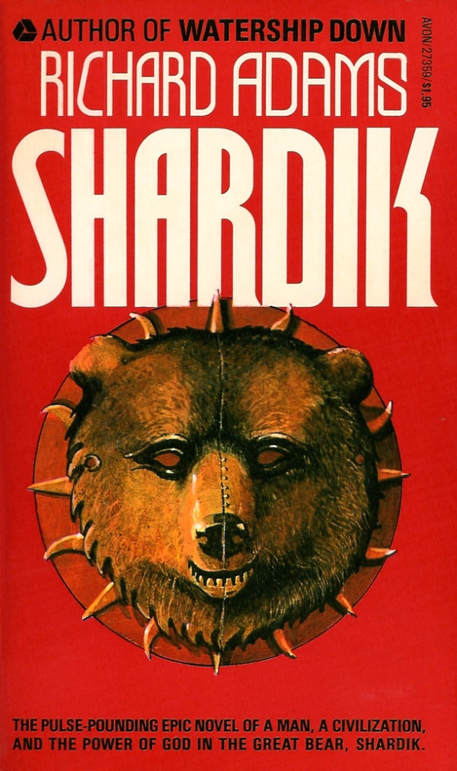
Shardik by Richard Adams

Ah, Lord Shardik: supreme, divine, sent by God out of fire and water: Lord Shardik of the Ledges! Thou who dist wake among the trepsis in the woods of Ortelga, to fall pray to the greed and evil in the heart of Man! Shardik the victor, the prisoner of Bekla, lord of bloody wounds: thou who didst cross the plain, who didst come alive from the Streel, Lord Shardik of forest and mountain, Shardik of the Telthearna! Hast thou, too, suffered unto death, like a child helpless in the hands of cruel men, and will death not come? Lord Shardik, save us! By thy fiery and putrescent wounds, by thy swimming of the deep river, by the drugged trance and savage victory, by thy long imprisonment and weary journey in vain, by thy misery, pain and loss and the bitterness of thy sacred death; save thy children, who fear and know thee not! By the fern and rock and river, by the beauty of the kynat and the wisdom of the Ledges, O hear us, defiled and lost, we who wasted thy life and call upon thee! Let us die, Lord Shardik, let us die with thee, only save thy children from this wicked man!

Kelderek is a lonely hunter, considered by the other Ortelgans to be something of a simpleton because of his habit of playing games with children. That all changes when a fire on the other side of the Telthearna, the great river in which Ortelga is an island, drives an enormous bear into the woods. The bear saves Kelderek's life from a marauding leopard, then disappears, but the priestesses on the outpost of Quiso are certain that what Kelderek has seen is the reappearance of Lord Shardik, the legendary bear who is the Power of God.

Honestly, I expected Shardik to be about bears the way that Watership Down, also by Richard Adams, is about rabbits. In Watership, Adams humanizes the rabbits, not by forcing them into human behavior but interpolating the behavior of rabbits into human frameworks of emotion and cognition. But the great bear, Lord Shardik, cannot be understood through human paradigms. Shardik is a bear, and he does what bears do; he is as likely  to reach out a claw and maim or kill his worshippers as anyone else. Like Aslan from C. S. Lewis' Narnia novels, he is a representation of Christ, as well as other notions of the divine, but more convincing in that, like both God and wild animals, he remains outside human understanding.

What Shardik does have in common with Watership Down is the thoughtfulness and attention with which it constructs a fictional religion. In Watership, the rabbit's religion focuses on the legendary rabbit El-ahrairah, who is a trickster figure like you might find in traditional North American or African religions. Shardik, by contrast, is Abrahamic in his immense power and his moral imprimatur; the conflict of the novel, at least at first, is between those who believe they can use Shardik's power and those who believe they must follow the lead of Shardik. Kelderek, refusing the wisdom of the priestess known as the Tuginda, falls in with a nationalist baron named Ta-Kominion who believes that Shardik has come to free them from the imperial rule of the city of Bekla.

For a while, Ta-Kominion's beliefs are validated: Shardik helps the Ortelgans to rout the superior Beklan forces in battle, and Kelderek, as the priest of the bear, becomes the king of Bekla. (Adams smartly avoids all the Game of Thrones-style political machinations, jumping five years from the victory of Shardik over the Beklans to the height of Kelderek's power.) But Shardik wastes listlessly away in a cage in the Beklan palace, and Kelderek, we learn, has let the child slave trade prosper as an expedient to defeat the remaining Beklan rebels. It's as good an image as I've ever seen of the bankruptcy of religious nationalism, which uses and abuses the divine as a pretext for earthly power.

Eventually the rebels siege the palace and free Shardik, whom Kelderek follows into the vast wilderness. Following Shardik depletes him mentally, spiritually, and physically, and then he finds himself captured by one of the very slavers who has prospered under his rule. He comes face to face with the cruelty he has allowed, and it leads him to the point of death until Shardik returns to wreak a final judgment of divine wrath. In the end of the novel, the cult of Shardik has transformed into an ideology that believes children must be protected at all costs. Though the shape of the novel makes sense, I was less interested in this widescale transformation than in the specific journey of Kelderek, who must be broken in order to fully realize what it means to be a follower of Shardik. Whether this is a Christian allegory only, I'm not sure, but I do know that Kelderek's refrain, "I offer you my life, Lord Shardik," sounds a lot like "Whoever loses his life for my sake will save it."

I'm not a huge fantasy reader, but I think religion in fantasy novels often tends to be silly. Shardik is a fun novel, that ought to please readers who want adventure above all, or skillful world building. But I appreciated the seriousness and the thoughtfulness behind the book's ideas about religion, which, like El-Ahrairah in Watership Down, are both strange and familiar.

Thursday, March 26, 2020

The Claw of the Conciliator by Gene Wolfe

Here I pause again, having taken you, reader, from town to town--from the little mining village of Saltus to the desolate stone town whose very name had long ago been lost among the whirling years.  Saltus was for me the gateway to the world beyond the City Imperishable.  So too, the stone town was a gateway, a gateway to the mountains I had glimpsed through its ruined arches.  For a long way thereafter, I was to journey among their gorges and fastnesses, their blind eyes and brooding faces.

Here I pause.  If you wish to walk no farther with me, reader, I do not blame you.  It is no easy road.

The Claw of the Conciliator is the second book in Gene Wolfe's Book of the New Sun tetralogy, following the torturer Severian as he continues his journey away from the Citadel of his upbringing toward--well, what exactly?  At one point he tells us of his various missions, each of which seems to be of vital importance, but which strain against each other not just for him, but the reader, making it difficult to read the book as a quest narrative like you expect: he wants to make his way to Thrax, the city where he's supposedly posted as a torturer after having been exiled from the Citadel; he wants to find and protect Dorcas, the waif-like girl who appeared in a lake; he wants to serve the rebel Vodalus, who fights the ruling Autarch; he wants to return the all-powerful healing crystal known as the Claw of the Conciliator to the religious order who guards it.  Along the way, here are some of the things he encounters:

A cave full of aggressive glowing aps-people.  An ancient giant who seeks to control Urth, and wants to seduce Severian to live at the bottom of the sea.  Flying bat-like creatures made of night that burrow into your body for warmth, and that separate into two creatures when you cut them with your sword.  A robot who's been grafted with flesh and organs.  (Not, significantly, a person who's been grafted with robotics.)  The House Absolute, seat of the Autarch, which turns out to be build entirely underground.  The Second House, a--well--second house built in secret around the House Absolute, full of mysterious and hidden passageways.  Hideous cacogens, disguised as human beings, but who really have thousands of eyes laid out like a pinecone.  A secret ceremony in which he is invited to ingest the flesh of his dead love Thecla, after which her memories continue to live on him.

...And a lot of other stuff, besides.  Looking at the list, you get the impression that The Book of the New Sun is a particularly inventive but also fairly formulaic fantasy series.  But what makes Claw of the Conciliator, like The Shadow of the Torturer, so engaging is the sense I get that it's not really interested in being a fantasy or science fiction book at all, and that the whole thing is a kind of papier mache facade that's concealing another kind of book entirely, or perhaps nothing at all.  More than once, Wolfe pauses the narrative to include another kind of genre entirely: first a book of legends, then a script for a play that Severian performs, which is so mind-boggling that it reminded me of nothing more than Faust.

Everything comes at you whip-fast, introducing new characters and ideas and then undoing or recontextualizing them in a way that makes the reader's footing supremely unsure.  No sooner does Severian meet the rebel Vodalus in the woods and agree to carry a message to a spy in the House Absolute than the spy turns out to be the Autarch himself.  Is the rebellion just a red herring?  If so, what's the "real story" here?  Is it about the giants that live in the sea who want to exert dominion on the land, or are they a red herring, too?  Maybe every herring here is red.

Again, Wolfe suggests that the world of Urth may be a figment: in The Shadow of the Torturer, interlopers from our own time appear on a kind of safari.  Here, Severian's friend Jonas suggests that he comes from a different place and time, and is perhaps thousands of years old.  In a room of mirrors in the House Absolute he disappears--presumably, having known how to return to our own era, perhaps slipping through time, but perhaps because Urth itself is a fiction or a metafiction.

I feel like I haven't entirely captured just how strange these books are.  Talking about them makes them seem ordinary, but they outstrip the capacity of my language to really capture, and that's part of what makes them so uneasy and unsettling.  The quest continues, but it's almost like the book, and the very nature of its book-ness, is falling apart, and I have a hard time imagining these qualities intensifying for two more novels.

Saturday, April 13, 2019

The Shadow of the Torturer by Gene Wolfe

Justice is a high thing, and that night, when I lay beside Dorcas listening to the rain, I was young, so that I desired high things only.  That, I think, was why I so desired that our guild regain the position and regard it had once possessed.  (And I still desired that, even then, when I had been cast out of it.)  Perhaps it was for the same reason that the love of living things, which I had felt so strongly as a child, had declined until it was hardly more than a memory, when I found poor Triskele bleeding outside the Bear Tower.  Life, after all, is not a high thing, and in many ways is the reverse of purity.  I am wise now, if not much older, and I know it is better to have all things, high and low, than to have the high only.

Severian is a journeyman in the Guild of the Torturers in the Citadel of Nessus.  His guild is widely loathed; torturers rarely leave the Matachin Tower where they are stationed because they are suspected, spit upon, distrusted.  But still, they are a necessary part of the fabric of life in Nessus, the executives of justice who carry out the will of the mysterious Autarch who rules somewhere from his house in the northern wilderness.  For that reason, Severian is committed to the torturer's life, even as a raid early in his life by the rebel Vodalus suggests that justice has other forms and functionaries.  That is, until he shows mercy to a high-born, beautiful, and intelligent captive named Thecla who is caught up somehow in the Autarch's campaign against Vodalus, and is expelled from the tower.  He's not quite stripped of his membership in the guild--like bureaucrats in our world, they shy away from controversy and disrepute--but he is sent to serve as an executioner in a remote town.

The torture that is prescribed for Thecla is a machine called "the revolutionary."  After a painful shock, it turns Thecla's body against her.  She tells Severian that she cannot stop her own fingers from clawing at her eyelids, and he tells her she will eventually tear her own eyelids from her sockets.  That kind of grotesque ingenuity is characteristic of The Shadow of the Torturer, which is as imaginative at worldbuilding as any fantasy or science fiction novel I've ever read.  The citadel, with its innumerable towers and lost rooms, reminds me most of the castle in the Gormenghast novels.  But it's halfway through the book, when Severian begins his journey away from the Citadel, that Wolfe's imagination really launches into high gear.  Severian doesn't get far, not even out of the city: he gets challenged to a strange kind of duel in which the weapons are poisonous flowers.  Along the way, a woman appears mysteriously out of a lake where corpses are buried and becomes his companion.  Shit gets weird.  Wolfe never seems to stop worldbuilding; each new chapter brings some kind of strange new element to be accommodated into our understanding of the world.  Since Severian hasn't traveled much outside his tower, however, it allows us to experience these things for the first time with him also.

We intuit, eventually, that Severian's Earth ("Urth") is a far-future version of our own in which the sun has begun to die and the world seems to be expiring.  Attempts to bring back the older world have filled it with prehistoric animals--smilodons and ancient horses--but it's still dying.  In a gallery of paintings, he sees a picture of the moon landing:

The picture he was cleaning showed an armored figure standing in a desolate landscape.  It had no weapon, but held a staff bearing a strange, stiff banner.  The visor of this figure's helmet was entirely of gold, without eye slits or ventilation; in its polished surface the deathly desert could be seen in reflection, and nothing more.

Later on, however, deep in the city's botanic gardens (he's there to collect his deadly flower) he encounters a pair named Robert and Marie who clearly have come from our world, or our era, and who see him as a kind of demonic spirit that they've summoned by accident.  It's a weird moment that's barely explored, but it throws our understanding of Severian's Urth off balance: is it the future?  Or perhaps another dimension?  On top of all of that, Severian has a number of visions that may be real or may be signs of increasing mental instability.  The Shadow of the Torturer is a book that loves the worldbuilding impulse of fantasy fiction, but looks on what it's made with a suspicious eye.

The novel ends with Severian at last, in the company of a flimflam doctor and an idiot giant, leaving the gates of the city.  It seems to end in the middle of Severian's journey, without resolution, but what kind of resolution can you expect?  The novel is gripping (despite what Brent felt), but it's also shaggy, and its weirdness and ambiguities make Severian's arc uncertain.  There is no quest, no sense that, Frodo-like, Severian must learn to find courage and defeat some evil.  It is entirely possible that Severian himself is the evil that must be vanquished.  But it's the novel's refusal to adhere to traditional fantasy narratives and archetypes that make it so appealing, and I had to exert a lot of willpower not to immediately crack open the next novel in the quartet.

Monday, June 12, 2017

The Chess Garden by Brooks Hansen

Dear Sonja,

How is one to know, I wonder, if a backgammon counter is sleeping, or if its only resting?  If it is dreaming or daydreaming, and what of its dreams--what must they contain?  Beside me lies the answer--polished, red, round, and perfectly still--a young counter and my newest friend.  Still, I haven't the faintest idea if it is napping now, or listening in as I compose my thoughts for you.

Once every few weeks, the adults and children of Dayton, Ohio gather in the Chess Garden of Mrs. Sonja Uyterhoeven--so called because it has long been a place where people of all ages have gathered to play chess and other games, using the many sets that the Uyterhoevens have collected over the years--to listen to the latest letter from Sonja's husband Gustav, who has set off to visit a mysterious land called the Antipodes.  The Antipodes, he writes, are inhabited by sentient game pieces.  Most of those he meets are chess figures, but also checkers, dice, and backgammon counters.  And from time to time, as if heralding a letter about to arrive, mysterious chess pieces appear in the garden, too.

The letters themselves are terrific fantasy, borrowing equally from Tolkien and Lewis Carroll.  Dr. Uyterhoeven's letters contain no end of arresting images: a dripping tree of candles, making wax stalacites; a chasm of rolling, colliding dice that forces the hands of chance; a group of monks piecing together fallen leaves like a puzzle.  Uyterhoeven's letters tell how he meets Eugene, the keeper of "goods"--that is, objects that embody the essence of their type.  Break the "good" ladder, and everyone in the Antipodes might forget what a ladder is and what it is for.  Uyterhoeven becomes caught between two forces in the Antipodes, one who wants to protect these goods, and a cabal of shadowy figures who wants to collect and break them all, sending the Antipodes into a kind of forgetful infancy.

These letters take up about half the novel; the rest is the story of Dr. Uyterhoeven's life.  We learn that he is a famous Dutch physician who comes under fire for supporting homeopathic medicine.  In a world of rationalism, Uyterhoeven is a vitalist, one who believes that life is an animating force separate from biology or phyiscs.  He objects not only to the prevailing medical ideas of pathology but the very idea of cause itself.  The letters from the Antipodes are a kind of expression of these ideals, exploring the possibility of bridging reason and the spirit, which is apart from words.  Could destroying the words, and getting down to the spirit of things, be an invigorating moment, rather than a terrifying one?

Dr. Uyterhoeven isn't in the Antipodes, of course; he's in South Africa, treating those ravaged by the onset of the Boer Wars.  He's old enough to know that he won't return from such a trip, and the letters are a last link to his community, and his wife, the mother of a son who died in childhood.  This loss informs everything about the letters, which are in the idiom of children, those who the Doctor has devoted his late life to teaching chess.  But the message is really to Sonja, and their message of linking the reasoning to the spiritual world is meant to preserve their connection to each other, and to their lost son.

A while back I asked my friends a question: What's the best book you've read that no one else you know has read?  This is the first response I got--from my friend Greg--that I've gotten around to reading, and I'm glad I did.  The Chess Garden manages a fine balance of whimsy, pathos, and deep intelligence that is rare.

Monday, January 9, 2017

#3 - An Ember in the Ashes by Sabaa Tahir


For the Book Riot Read Harder 2017 Challenge, I needed to read a fantasy book. Fantasy isn't a genre I normally pick up (I'm assuming the Game of Thrones books are the last fantasy books that I read), but I love a Hobbit as much as the next guy. An Ember in the Ashes, by Sabaa Tahir came out a few years ago and was evidently a Times bestseller, but I hadn't heard of the series until book 2 made someone's year-end list on the AV Club recently.

The story alternates perspectives between Laia, a slave girl of the Scholar people, and Elias, a gladiator-like warrior from the Martial empire. In the opening chapters, Laia's family is murdered, she finds the Resistance, and infiltrates Blackcliff, the military academy that Elias is about to graduate from. Elias, in the meantime, has a super-hot and super-awesome best friend gladiator-ess named Helene, attends Blackcliff, and is thinking of deserting the empire. (I wouldn't make a point of the super-hot, but it's brought up more than twice in the book.) Elias quickly finds himself involved in the Tri-wizard Tournament to see who gets to be the new Emperor, while Queen Cersei tries to rig the outcome to make sure he doesn't win.

That paragraph sounds much more negative than the book actually deserves. It's hard to establish a wholly creative and new fantasy word, and Tahir writes a gripping yarn that makes the 450 pages go really really quickly. Whether this is because of or in spite of the well-worn template that Ashes follows, it was definitely an interesting read. The first-person narration of a slave trying to just stay alive instead of purposefully overthrow an Empire was new; the first-person narration of Elias brings to mind the Kingslayer in some regards, but because he's also still essentially a college student, there is a nice amount of self-doubt and confusion that freshens things up. In the meantime, I wish Tahir had come up with better names for the Empire and its member ethnicities than "the Martials," "the Scholars," and "the Mariners," etc. That may sound like a small nit to pick, but world-building in fantasy novels is important, and an entire race being known as "the Scholars" is just, well, goofy. The AV Club article I mentioned earlier said that the series really gets going in book 2, where the characters get a lot more attention, and I do plan on reading A Torch Against the Night, because there was a lot to like in this book - probably why I'm so critical of what I feel needed another reworking.


Thursday, June 11, 2015

The Buried Giant by Kazuo Ishiguro

Some of you will have fine monuments by which the living may remember the evil done to you.  Some of you will have only crude wooden crosses or painted rocks, while yet others of you must remain hidden in the shadows of history.  You are in any case part of an ancient procession, and so i is always possible the giant's cairn was erected to make the site of some such tragedy long ago when young innocents were slaughtered in war.  This aside, it is not easy to think of reasons for its standing.  One can see why on lower ground our ancestors might have wished to commemorate a victory or a king.  But why stack heavy stones to above a man's height in so high and remote a place as this?

Axl and Beatrice are old, at the end of what seems to have been a long and happy marriage.  But they are not happy in their village, so they set out to find the village where their son lives, having left long ago for reasons neither Axl or Beatrice can remember.  You see, there is a mist that hangs over Britain, a fog of forgetfulness, which separate Axl and Beatrice from much of their history.  At the fringes of their marital bliss are a number of disquieting questions: without their past, how can they be sure they really love each other?  And what is it, exactly, that everyone is trying to forget?

Ishiguro has always been interested in repression.  In Never Let Me Go, it's the way that the clones participate in their own murder and exploitation by repressing the question of whether things might be otherwise.  In The Remains of the Day, it's Stevens' refusal to recognize many truths about his life: his boss' Nazi sympathies, his father's frailty, his own deep love for Miss Kenton.  In each of those cases, Ishiguro is never glib enough to suggest that things would be better if everyone were honest with themselves; both the clones and Stevens seem to desperately need their delusions.  The truth, for Ishiguro, may set you free, but it seems just as likely to destroy you.

The same is true for Axl and Beatrice, and all the inhabitants of post-Arthurian Britain.  As their memories return, piece by piece, filled in with the help of those they meet along their journey, it becomes clear that the country was recently ravaged by war between the Saxons and the Britons.  Though Axl and Beatrice long for their memories to return so they might fully understand themselves, the lifting of the fog threatens to rekindle an old enmity:

"How right to fear it, sir," Wistan said.  "The giant, once well buried, now stirs.  When soon he rises,as surely he will, the friendly bonds between us will prove as knots young girls make with the stems of small flowers.  Men will burn their neighbours' houses by night.  Hang children from trees at dawn.  The rivers will stink with corpses bloated from their days of voyaging.  And even as they move on, our armies will grow larger, swollen by anger and thirst for vengeance.  For you Britons, it'll be as a ball of fire rolls towards you.  You'll flee or perish.  And country by country, this will become a new land, a Saxon land, with no more trace o your people's time here than a flock or two of sheep wandering the hills untended."

Would we be better of, Ishiguro wonders, if we were to rid ourselves of history?  Does peace require the eradication of what we remember?

These are rich and complex ideas.  But Never Let Me Go and The Remains of the Day succeed insofar as they rely on the accumulation of everyday detail; we believe those stories because we see reflected in them the way the minutiae of our lives can serve as a distraction from larger, deeper problems.  Ishiguro's plain prose is suited to those stories.  The Buried Giant, on the other hand, feels painted with much broader strokes.  Its characters only rarely seem like real people; rather, they read as the fantasy archetypes they are.  It is difficult to care about what Axl and Beatrice, much less all of Britain, may have repressed because The Buried Giant is not a story about repression but an allegory of repression.

Ishiguro recently got into a tiff with Ursula K. LeGuin, who accused him of not sufficiently respecting the fantasy genre.  LeGuin's charge goes too far, but it has a kernel of truth: Ishiguro seems to have no real idea of how to harness the possibilities of fantasy, or how to build a world which is specific and real.  The Buried Giant, I'm sad to say, reads exactly like what it is: a fantasy novel written by someone who never really reads fantasy novels.

And that's a shame, because it's clear that Ishiguro is developing ideas here that are part of an entire life's work.  The small, private repressions of his other novels are transformed into a national crisis, and you can see him thinking in a new way about the social, political, and historical aspects of repression.  But if he wanted to write a novel that comments on the way that repression works in the world, I'd rather have had a novel about the world as it is.

For what it's worth, Randy liked it better than I did.

Friday, July 19, 2013

A Wizard of Earthsea by Ursula K. LeGuin

On the sea he wished to meet it, if meet it he must.  He was not sure why this was, yet he had a terror of meeting the thing again on dry land.  Out of the sea there rise storms and monsters, but no evil powers: evil is of earth.  and there is no sea, no running of river or spring, in the dark land where once Ged had gone.  Death is the dry place.

A young boy is sent to wizard school, where he learns to control his great natural skill at wizardry.  In time, he becomes known as the most gifted wizard of them all--which is good, because he'll need all his talents to defeat an evil, shadowy force connected intimately to him for mysterious reasons.

Sound familiar?  Yes, of course it does: It's Ursula K. LeGuin's A Wizard of Earthsea, which tells the story of Ged, who accidentally creates a rip between the land of the living and the dead, allowing a horrible "shadow creature" to enter the world.  (How great can this guy be if he's the one that caused the problem in the first place, though?)  The extent to which Ged's story of self-discovery mirrors another, later story reveals how well-worn some of these fantasy tropes are, I suppose.

What sets A Wizard of Earthsea apart?  Not much, if you ask me--I find most fantasy pretty underwhelming, and Earthsea felt very much limited by the confines of its genre.  A couple elements did stand out, though: First, the setting of Earthsea, a massive island chain, provided a unique bit of atmosphere.  Second, magic in Earthsea operates in a very interesting way.  To have power over something, a wizard must know its name in the original and natural "true language."  Every animal, thing, place, and person has a "true name," many of which are kept hidden.  What is so threatening about the shadow creature that Ged looses is that it lacks a name, and cannot be controlled or defended against, and so becomes a chilling image of the ineffability of death, which refuses to be sufficiently described in human language.

The last few chapters of Earthsea go far in elevating it above similar books.  In them, Ged chases the shadow to the limits of Earthsea, an unknown part of the ocean that slowly thickens into land.  The final meeting with the shadow creature is fairly cryptic for what is ostensibly a young adult book:

Aloud and clearly, breaking the old silence, Ged spoke the shadow's name and in the same moment the shadow spoke without lips or tongue, saying the same word: 'Ged."  And the two voices were one voice.

Ged reached out his hands, dropping his staff, and took hold of his shadow, of the black self that reached out to him.  Light and darkness met, and joined, and were one.

What's going on here?  Is this an illustration of the reality principle, the need for man to confront his own death and comes to terms with it?  Does LeGuin suggest that what we battle in our fear of death is not death itself, but us?  That's pretty heady stuff, and a lot more interesting than the wizard-school and dragon-fighting that make up most of the book.

Saturday, February 2, 2013

Shardik by Richard Adams

"Ah, Lord Shardik," he prayed silently, "the empire was pride and folly. I am sorry for my blindness, and sorry, too, for all that you suffered at my hands. Yet for others' sake, not mine, I entreat you not to leave us forever without the truth that you came to reveal. Not for our deserving, but of your own grace and pity for Man's helplessness."  

Richard Adams has a knack for creating immersive fantasy worlds. He draws you in with created languages, detailed maps, and elaborate traditions. Watership Down, his first novel, is an excellent example of this cultivated veracity. The story centers around a group of rabbits, with their own culture, language, and mythology. These details help to root the reader within Adams' fantasy world.

Two years after Adams published Watership Down, he published Shardik, his follow-up to the international bestseller. He relied on many of the same elements that made Watership Down work so well: a fantasy world rooted in a real-world epoch (in this case, early Medieval), different groups of people with detailed mythologies and traditions, and animals.

While the book is titled after Shardik, an enormous bear, the main character is a man, a hunter from a small, island village. While out hunting, Kelderek comes across a bear larger than any he has ever seen, prompting him to report back to the head of the Ortelgans that he has seen their bear god Shardik in the flesh. This sets off a series of events, culminating with the Ortelgans, emboldened by the power of Shardik, making their way into the mainland, and overthrowing cities and villages. Kelderek, thought of as a simpleton prior to his encounter with Shardik, see his standing rise among his fellow Ortelgans. Before too long, things begin to unravel for Kelderek and the Ortelgans.

Perhaps the main theme of Shardik is the creation and power of myths and religious beliefs. The myth of Shardik evolves and adapts throughout the story. The myth of Shardik at the close of the novel is quite different from Ortelgan beliefs at the novel's opening. But the cult of Shardik remains.

This is the third novel by Richard Adams that I have read. While I enjoyed it much more than The Girl in a Swing, it did not come close to rivaling Watership Down. Shardik opened well and kept my attention for the first 400 pages, but it started to drag around two-thirds of the way through and did not really pick back up until the last 50 pages. Unlike Kelderek, many of the supporting characters lacked definition and because of this were rather easy to confuse. I did not dislike Shardik, but would hesitate to recommend it to anyone who had not yet read other works by Adams.

Sunday, January 29, 2012

The Light Fantastic by Terry Pratchett

“Rincewind, all the shops have been smashed open. There were a whole bunch of people across the street helping themselves to musical instruments, can you believe that?”

“Yeah,” said Rincewind, picking up a knife and testing its blade thoughtfully, “Luters, I suspect.”

It’s always a challenge to write decent reviews of light literature. It's easy to think of something to write about Ulysses, Othello, or Malcolm X, but what can be said about fluff, the sort of books that aren’t guilty pleasures, exactly, but which occupy a place in between real literature (Hamlet) and trash (Twilight)? I tend to read Discworld or John Grisham as palette cleansers after something particularly challenging, but it’s not exactly fair to demote such books to being simply trifles. After all, reading is a pleasurable, as well as mentally stimulating activity, and these books offer their own pleasures. If you enjoy reading high literature at all times, by all means, do it; I’ll take to occasional potboiler or adventure to mix things up.

Of course, low literature has enjoyed something of a renaissance in recent years, with authors like David Foster Wallace, Michael Chabon, Neil Gaiman, and even Thomas Pynchon taking cues from less lofty genres, but, while these and many other authors have genuine affection for the material they homage and reference, it’s hard not to read a little postmodern irony into their genre exercises—after all, something like Pynchon’s Inherent Vice might nod toward Carl Hiassen and Donald Westlake, but could hardly be mistaken for one of their books.

So, that said, The Light Fantastic is a Discworld book, the second, and it’s worlds better than the first, The Colour of Magic, in that it actually a) has a plot, rather than feeling like a series of comical vignettes strung together and b) feels like a Discworld book tonally, in spite of still being embryonic in the bigger scheme of things. It’s fast-moving, short, and introduces many of the characters that populate the later books. Aside from that, I don’t have a lot to say about it. It’s not particularly satirical, except when satirizing fantasy literature itself, and it’s not as funny or as well-plotted as the later books, but I enjoyed reading it, as I always enjoy Pratchett’s novels. It may be pulp, but it’s my pulp.

Sunday, April 3, 2011

Through the Looking Glass by Lewis Carroll

'Crawling at your feet,' said the Gnat (Alice drew her feet back in some alarm), 'you may observe a Bread-and-Butterfly. Its wings are thin slices of Bread-and-butter, its body is a crust, and its head is a lump of sugar.'
'And what does IT live on?'
'Weak tea with cream in it.'
A new difficulty came into Alice's head. 'Supposing it couldn't find any?' she suggested.
'Then it would die, of course.'
'But that must happen very often,' Alice remarked thoughtfully.
'It always happens,' said the Gnat.

In 2009, I read Alice in Wonderland. It was in a double book with Through the Looking Glass, which I intended to read but never got around to. I did notice upon reading Alice that some of the most famous episodes from the Alice stories weren't in Alice in Wonderland, primarily the Jabberwocky and Tweedledee and Tweedledum.

That's remedied in Through the Looking Glass, which is just as absurd but somehow more difficult than its predecessor. When Alice in Wonderland is preoccupied with playing cards and the contrast of size, Through the Looking Glass is structured around an elaborate chess problem, one I could barely even identify, let alone solve, and issues of time and place. Throughout the story, Alice tries to move from place to the next, usually ending up somewhere--or some time--completely different than she intended. Here she is, trying vainly to get an expanation from the Queen:
[T]he Queen cried 'Faster! Faster!' and dragged her along. 'Are we nearly there?' Alice managed to pant out at last.
'Nearly there!' the Queen repeated. 'Why, we passed it ten minutes ago! Faster!'
Every step Alice takes seems to land her in a new, bizarre situation, until the little girl who bravely endured giant caterpillars, the cheshire cat, and the mad hatter in Alice in Wonderland is nearly overcome. I've heard that Through the Looking Glass is a darker work than Alice, and although the storyline doesn't seem darker to me (and has no single scene as disturbing as the pig-baby), it is more disorienting. Differences of size are comprehensible, but differences of time, of spatial distance, of movement, these are more direct, more personal, and more overwhelming.

Alice, of course, eventually figures out what to do, and returns to her own time and place, but not without some lingering doubts about the nature of reality. No doubt her thoughts echo some of Carroll's own: the twisted logic of Wonderland looks on the surface like that of a child, but upon closer inspection reveals depth that only comes with time and experience. Through the Looking Glass closes with this haunting tercet:
Ever drifting down the stream—
Lingering in the golden gleam—
Life, what is it but a dream?
In Carroll's work, life seems as nonsensical and unreal as Wonderland. Who's to say what is, and what is not? These books don't provide any answers, but they do raise some interesting questions.

Monday, January 24, 2011

Mistborn by Brandon Sanderson

I was interested in reading this series because I have read the Wheel of Time series (so far) and was really curious about why Robert Jordan chose this particular author to finish his series. In case you didn't know, Robert Jordan died before he could finish the Wheel of Time series and basically asked Brandon Sanderson if he would write the final books in his stead. Keep in mind, this was a series he started writing in 1977 and has about 1.8 billion characters (I wish this was an exaggeration). Pretty huge undertaking, if you ask me. Plus, there is a certain level of trust required to have someone finish the thing you've been working on your whole life. However, after having read the Mistborn series I can better understand why Brandon Sanderson was selected.

The events in Mistborn are seen through the eyes of 16 year old Vin (sometimes the narrator does change, but for the most part it is Vin). She's a thief that has grown up in a cutthroat underground. Her brother initially got her involved in this lifestyle. She has a very complicated relationship with him. He saved her from their mentally unstable mother, who killed their younger sister, and has kept her alive; however, he also occasionally beat her and eventually abandoned her. Understandably, Vin has huge trust and abandonment issues. On the bright side, we learn that Vin is also very crafty and a skilled thief. At least she has something going for her. Her best attribute, however, is her Luck. Her thieving crew leader Camon has discovered that whenever she's around the crew's jobs tend to go well. She seems to have an innate ability to get people to react how she wants them to. This is very handy as the crew is often trying to scam people.

Unfortunately, Vin's Luck has garnered the attention of an obligator. Vin lives in the Final Empire, governed by an emperor god known as the Lord Ruler. The Lord Ruler has minions that make sure everything goes as he wants it to. The obligators are his human underlings. They act as priests of the Lord Ruler's religion and bureaucrats. Inquisitors serve as the muscle of the government. They are impaled with various metal spikes that imbue them with various powers. They are considered unkillable by most people. Not many of them exist. Lastly, the Lord Ruler controls a race called the koloss. They serve as a part of his vast armies. They're grotesque blue-skinned creatures ranging in size from 5 feet tall to 13 feet tall. They've been made for the sole purpose of killing. Though they are not anywhere near as deadly as an Inquisitor they are still rather formidable because of their strength and size. Getting back to Vin, the obligator sends an Inquisitor after her because of her Luck.

Fortunately, Kelsier is also interested in Vin because of her Luck. He and one of his friends distract the Inquisitor enough so that Vin can escape, unbeknownst to her. However, in the time that Kelsier has been distracting the Inquisitor, Camon has decided to beat Vin. Just when things are about to get really uncomfortable for Vin, Kelsier shows up again to save her. He removes her from her thief crew and asks her to join his. She obviously agrees. Later, Kelsier explains to Vin that her Luck is really the mystical power of Allomancy. Allomancy is basically magic derived from metals. When Vin and Kelsier consume specific metals they can use them to do certain things. There are 8 basic metals and 2 special metals:
1. Iron - Pulls on nearby sources of metal
2. Steel - Pushes on nearby sources of metal
3. Tin - Increases human senses
4. Pewter - Increase physical abilities
5. Brass - Soothes emotions
6. Zinc - Riots emotions
7. Copper - Hides the use of Allomancy
8. Brass - Allows one to sense Allomancy
9. Gold - Allows one to see into one's past
10. Atium - Allows one to see slightly into the future
People that can use all of the metals are called Mistborn. People that can only use one of the metals are called Mistings.

The reason the Kelsier has acquired Vin is that he is gathering a crew for a very important purpose. He plans to overthrow the Lord Ruler. He wants to do this on behalf of the skaa people. The skaa people are the slaves of the Final Empire. They are used by the nobility to work in factories, mills, fields, etc. They are abused and killed indiscriminately. Kelsier also has a more personal reason for wanting to unseat the Lord Ruler. Years before, Kelsier and his wife were caught breaking into the Lord Ruler's palace. They were sent to work in the Pits of Hathsin. It was universally known that no one ever lived through this. Kelsier's wife did not. This caused Kelsier to "Snap". Mistborns are not born with their powers, ironically. They have to experience some traumatic event that causes them to Snap and gain their powers. Kelsier's newfound abilities allowed him to escape the Pits of Hathsin. Because of this he has become known as the Survivor. He plans not just to overthrow the Lord Ruler, but to kill him as well. He claims to have found an eleventh metal that will give him the power to do so.

Mistborn follows the crew's activities throughout the year that they've given themselves to accomplish this rather large task. Vin is in charge of impersonating a noblewoman and acting as a spy among the nobility. Sazed is charged with training her in the proper ways of court manners and customs. Sazed is a Keeper of the Terris people. The Terris people are highly valued by the nobility because they are considered perfect servants; however, they have more skills than the nobility knows. Like humans with Allomancy, Terrismen have Feruchemy. Feruchemy allows Terrismen to store up certain attributes in different metals which they can use at later times. Feruchemy follows along similar lines as Allomancy:
1. Iron - Stores physical weight
2. Steel - Stores physical speed
3. Tin - Stores the ability to use the five sense
4. Pewter - Stores physical strength
5. Brass - Stores warmth
6. Zinc - Stores mental speed
7. Copper - Stores memories
8. Bronze - Stores wakefulness
9. Gold - Stores health
10. Atium - Stores age
The Lord Ruler has attempted to remove the power of Feruchemy from the Terris people through a program of selective breeding. He has been unsuccessful so far due to the activities of the leaders of the Terris people called the Synod. Terrismen with the ability to use Feruchemy are hidden from the Lord Ruler. They are called Keepers because they are charged with keeping certain knowledge alive through the use of copper. Each Keeper has a certain specialty. Sazed's specialty is religion. He retains knowledge of all the religions that were present before the Lord Ruler eradicated them.

Other members of Kelsier's crew include:
1. Dockson - Kelsier's righthand man. He is a gifted bureaucrat. He is charged with overseeing the crew's finances and making sure everyone gets whatever they need.
2. Breeze - He is a brass Misting. He is in charge of recruiting for the skaa army that Kelsier intends to build.
3. Yeden - He is in charge of the skaa rebellion currently. He ostensibly hired Kelsier's crew to overthrow the Lord Ruler.
4. Ham - He is a pewter Misting. He is in charge of training the skaa army.
5. Clubs - He is a copper Misting. He is in charge of hiding the crew's Allomantic activities.
6. Lord Renoux - His real identity is known only to Kelsier. He was hired to impersonate the real Lord Renoux in order to use his business as a front for the purchases of the skaa rebellion and as a method of getting a spy among the nobility. Vin is acting as his niece Vallette.
7. Lestibournes (aka Spook) - He is Clubs' nephew and a tin Misting. He helps by serving on the watch to keep the crew safe.

After reading the whole Mistborn series I can understand some of the reasons Robert Jordan chose Brandon Sanderson to continue his legacy. Sanderson is adept at making seemingly minor details of the first book important later in the series. His characters are also very complex and sometimes funny. He also has a very good grasp on how religion and politics work. His system of magic was also thoroughly thought out. In fact, it reminded me bizarrely of physics sometimes. All in all, it was a pretty good read. I'd recommend it to people who enjoyed other fantasy novels.

Wednesday, November 24, 2010

Harry Potter and the Deathly Hallows by J. K. Rowling

So, with the release of Harry Potter and the Deathly Hallows: Part 1 last week, I decided it was time for me to finish up the Harry Potter series. I was a fairly early reader, picking up the first book right after the second came out, and, up until Order of the Phoenix released, I read them more or less as soon as they came out. Unfortunately, OotP really didn’t do it for me, and I didn’t read The Half-Blood Prince for a year or so after I finished that tome. I started Deathly Hallows soon after it came out, got bored after about 100pp, and told myself I’d get back to it eventually. I finally did.

I share the above to share this: I feel like how much one enjoys Deathly Hallows, especially the first half, is directly proportional to how seriously one takes the story; that is, I always enjoyed Harry Potter as a fun little lark with some dark edges. As the books got more serious, diminishing returns set it—although I enjoyed Half-Blood Prince, it wasn’t nearly as fun as the earlier books for me, especially Goblet of Fire, which is probably my favorite. So, now that I’ve rambled, let me address the actual book.

First, the negatives: The first half of this book was really, deathly (haha) slow. There were huge sections that felt like they could have been seriously condensed, especially the interminable setup for Harry’s escape from Death Eaters early on. Also, this book is SERIOUS. There’s little of the lighthearted humor that characterized the first few books—which makes sense thematically—but I found that it created a distance for me because, as I mentioned earlier, I never thought of Harry Potter as inherently serious. Lastly, there’s a lot of exposition. Most of this takes the form of newspaper articles, excerpts from Dumbledore’s biography, and word of mouth from other characters. There are also conversations that are basically info-dumps—in other words, a lot of telling instead of showing.

Now for the positives: by the end, I’d been won over. I underestimated connection to the characters, and when it all went down in the end, I found the various fallout, including deaths of some important characters, surprisingly effective. A couple long-standing characters get a shot at redemption, and Rowling does a good job at avoiding the various attendant clichés. The final confrontation(s) between Harry and Voldemort and well-drawn, and the entire last half of the book moves very quickly and seamlessly. I was surprised how little navel-gazing there was, pleasantly surprised since that’s basically what turned me off of the series to begin with. I was also impressed with the complexity of the plot—there were a couple times that hewed close to dues ex machine, one of the series’ most consistent problems, but for the most part the story played out organically, using characters and touchstones from throughout the seven books to draw everything to a mostly satisfactory conclusion. I even liked the Epilogue, which, although it was a little cheesy, read to me more like Rowling trying to limit the amount of post-series fanfic and mostly succeeding.

It may sound like I’m damning Deathly Hallows with faint praise, but it was probably the 3rd best book, after Half-Blood Price and Goblet of Fire. It was satisfying in a way that long-running series rarely are, and it hit the right notes when it counted.

Friday, September 17, 2010

The Book of Imaginary Beings by Jorge Luis Borges

The plot of this allegory... is curious: One of the splendid feathers of the distant King of the Birds, the Simurgh, falls into the center of China; other birds, weary with the present state of anarchy, resolve to find this king. They know the name of their king means "thirty birds"; they know that his palace is in the Mountains of Kaf, the mountains that encircle the earth. At the beginning, some of the birds reconsider their rashness, and grow cowardly: the nightingale excuses itself from the journey-quest because of its love for the rose; the parrot, because of its beauty, which is the reason it lives within a a cage; the partridge says it cannot live without the high mountains, while the heron pleads its need for marshes, the owl, for ruins. But at last the birds undertake the desperate quest. They cross seven wadis or seven seas. The penultimate of these is called Vertigo; the last, Annihilation. Many pilgrims abandon the quest; others perish on the journey. At the end, thirty birds, purified by their travails, come to the mountain on which the Simurgh lives, and they contemplate their king at last: they see that they are the Simurgh, and that the Simurgh is each of them, and all of them.

--"Simurgh"


I am writing this review on July 6th, 2010. God knows when you'll read it, since I actually bought Borges' Book of Imaginary Beings as a late birthday present for Nathan. Since he lives in another state, who knows when I'll be able to give it to him (I don't trust the postal system), and since it's going to be in my possession for a while, well, I figured I'd just go ahead and read it.

Borges is perhaps the most notable Spanish-language author since Cervantes, and in a book I'm reading concurrently (sure to be reviewed before this one), How to Read and Why, Harold Bloom identifies him as the purest example of a line of short fiction writers preoccupied with phantasmogoria and the fantastic, including Kafka. A bestiary of imaginary creatures, then, seems as if it would appeal to Borges, both in the brevity of its format and the whimsicality of its subject. Some, like the dragon and the unicorn are common enough; others, like the Lamed Wufniks or A Bao A Qu, less recognizable. Some belong to ancient religion, others to modern authors like Lewis, Flaubert, and Kafka himself. Though no entry is more than a few pages, some are mystifyingly laconic:

Hochigan

Descartes tells us that monkeys could talk if they wanted to, but they have decided to keep silent so that humans will not force them to work. The Bushmen of South Africa believe that there was a time when all animals could talk. Hochigan hated animals; one day it disappeared, taking the gift of speech with it.


Who is Hochigan? What is Hochigan? Does it belong to the tradition of the Bushmen, or does it appear in the works of Descartes?

Typified in this very short entry is Borges' synthetic power, which is his most significant contribution to his source material. By bringing Descartes and the Bushmen together, he is suggesting the existence of a larger human tradition of cryptozoology; these traditions, likely not mentioned simultaneously until their inclusion here, speak to a common need to create new life and augment the natural world.

We expect much of Borges, but he is strangely reticent to show his face; often, he provides no comment on his sources at all, including wholesale selections from other works as complete entries. Elsewhere, Andrew Hurley tells us in his translator's note, Borges hews almost exactly to unattributed sources. But Borges' genius is not absent: there is near-heresy in placing "An Animal Dreamed by Kafka" in the same volume as the great dragons of Chinese tradition. I do not think that Borges is suggesting that religion is a fiction, but quite the opposite: these creatures have a considerable impact on human existence. To have seen the great unicorn tapestries of the Metropolitan Museum's collection is to understand that the unicorn, through its powerful symbolism and command over the human imagination, has a certain kind of realness of its own. In his preface, Borges explains:

We do not know that the dragon means, just as we do not know the meaning of the universe, but there is something in the image of the dragon that is congenial to man's imagination, and thus the dragon arises in many latitudes and ages. It is, one might say, a necessary monster, not some ephemeral and casual creature like the chimaera or the catoblepas.


Yet Borges seeks to categorize both the necessary monsters and the casual, because they all speak to the human in ways that a bestiary of tangible beasts would certainly not. In this way it is a very anti-academic exercise masquerading as an academic one, as if to classify and collect these animals were to bring them a little bit closer to being flesh-and-blood. In the end, it is an exploration of ourselves, who, as the birds in the story of the Simurgh above, seek endlessly to understand the Other but are faced with only our own image.

Tuesday, May 25, 2010

Something Wicked This Way Comes by Ray Bradbury

“Beware the autumn people...For some, autumn comes early, stays late, through life, where October follows September and November touches October and then instead of December and Christ’s birth there is no Bethlehem Star, no rejoicing, but September comes again and old October and so on down the years, with no winter, spring or revivifying summer. For these beings, fall is the only normal season, the only weather, there be no choice beyond.”

Somehow, I missed Something Wicked This Way Comes while I was scouring the children’s section of the library, and it’s probably a good thing. It’s hard to imagine how an avid Goosebumps reader would have dealt with a scary book that’s actually scary and substantial, not just for the grotesque images or the shocking twists, but for the themes it carries. There are spoilers in this review, mostly from the first third of the book.

The book opens on its dual protagonists, Jim Nightshade and Will Holloway. Both thirteen years old, they are inseparable sides of the same coin. Jim is rash and impetuous, always on the lookout for a thrill or an adventure; Will is more careful, although, as he says in the book, is often dragged into adventure by Jim whether he wants to be or not. The books opens in Autumn with the arrival of a mysterious carnival, populated by a diverse array of freaks and run by the Illustrated Man, Mr. Dark, a mysterious entity who exercises control over his freaks with his vast array of tattoos. The centerpiece of the carnival is broken down Carousel that nevertheless comes alive at night. It can spin either way, making its riders either older or younger. Soon after the carnival opens, Jim and Will see the carousel in action and make an enemy of Mr. Dark who, of course, spends the rest of the book trying to turn them into a couple of his freaks.

In addition to the boys, there’s a third, equally important character: Charles Holloway, Will’s 54 year old father. Married to a beautiful woman 20 years his junior, he struggles with feeling too old for her and too old to properly relate to his son.

Something Wicked
is surprisingly dense, and there are a lot of things I could talk about, but I’d like to focus on what seemed like the overriding themes: the elders’ fear of aging and death and the youth’s desire to speed the process along. The Carousel stands at the center of the novel, towering over even Mr. Dark in its sway over the protagonists. So let’s start with a laundry list: Will fears that, with time, he and Jim will grow apart. Jim fears that he will never grow up at all, and Charles fears that he’s already too old to relate to the people he cares most about. The thing is aging or de-aging on the carousel is no good. It rushes things, so young men end up with old men’s minds and old men are still children inside. It is the ultimate relationship breaker, because it makes relation with other people of your own age impossible—who wants to hang out with the 30 year old who still wants to play marbles, or the 16 year old who has all the worries in the world?

I don’t want to talk much more about the plot, but I will say that there are some very disturbing images, not so much because they’re graphic, but because being turned into a wax dummy is kind of terrifying. Anyway, this review is all over the place, but if you missed this as a child, it’s well worth reading. And I hear the film is pretty scary.

Saturday, April 4, 2009

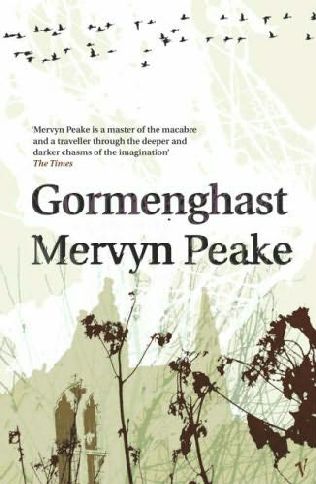
Gormenghast by Mervyn Peake

Titus the seventy-seventh. Heir to a crumbling summit: to a sea of nettles: to an empire of red rust: to rituals' footprints ankle-deep in stone.

Gormenghast.

Withdrawn and ruinous it broods in umbra: the immemorial masonry: the towers, the tracts. Is all corroding? No. Through an avenue of spires a zephyr floats; a bird whistles; a freshet bears away from a choked river. Deep in a fist of stone a doll's hand wriggles, warm rebellious on the frozen palm. A shadow shifts its length. A spider stirs...

And darkness winds between the characters.


It occurred to me upon re-reading my review of the first book in this trilogy, Titus Groan, that either my review seems more negative than I truly felt or I have warmed up to the book considerably since I read it. In retrospect my complaints seem a little pedantic, and I would argue to myself that the series' flaws are well compensated by its virtues: an endless exhibition of creativity and ingenuity, and an obliquely poetic sense of description. Comparing Peake's books to Harry Potter, I remarked that they lack Rowling's "affability"; now I wonder why a book as unique as this would need to be affable.

So let's consider this a fresh slate, and let me explain what I do enjoy about these books:

In the first book, Titus Groan, Titus is recently born to the Earl and Countess of Gormenghast, a vast castle at the foot of Gormenghast mountain. As a baby, he doesn't do much, but there is no doubt that he will be an important figure for the castle; as the only heir to the Earl he will inherit all of the castle and its ancient system of ritual. Ironically, it is Titus who is the main character of Gormenghast, but the castle fills the central role in Titus Groan. It is many miles across, and houses untold thousands; there are parts of it that haven't been seen by human eyes in decades. Titus, aged 11 and feeling a bit of wanderlust, strolls into one such part of the castle in Gormenghast that is overrun by nature:

There had once been a great casement facing upon this terrace. It was gone. Neither broken glass nor iron nor rotten wood was anywhere to be seen. Beneath the moss and ground creepers it may be that there were other and deeper layers, rotten with antiquity; but where the long window had stood the hollow darkness of a hall remained. It opened its unprotected mouth midway along the pavement's inner verge. On either side of this cavernous opening, widely separated, were the raw holes in the stonework that were once the supporting windows. The hall itself was solemn with herons. It was there they bred and tended their young. Preponderately a heronry, yet there were recesses a nd niches in which by sacredness of custom the egrets and bitterns congregated.


I have complained that Rowling doesn't have the chops to provide the sense of awe and wonder that Hogwarts deserves; in fact she wastes very little ink on describing it at all. Peake succeeds in that, and the various rooms and hallways of Gormenghast provide some of the books' most captivating passages. Like Hogwarts, it is riddled with secret passageways and bizarre corners; one of my favorites is the tallest part of the castle, the Tower of Flints, where the Death Owls live who pick into oblivion anyone condemnded to death. Elsewhere it is a labyrinth of chambers, attics, roofs, and quadrangles.

The passage about the herons provides subtle commentary on the state of the castle, which, like its inhabitants, has a troubled soul: the egrets and bitterns gather "by sacredness of custom," as the castle itself is guided by thousands of pages of rituals which determine the operation of every event in the castle. All these rituals are kept by an old man named Barquentine, the Master of Ritual; and Peake suggests that this is where the real power in the castle lies. Many of these rituals involve Titus, who, as a baby at the end of the first book, unceremoniously drops the symbols of ritual into a lake, foreshadowing his rejection of the castle's antiquated laws as a teenager. But the castle is crumbling in places, and has let the herons in with nature. Ritual cannot keep it alive forever.

The most interesting character, however, is Steerpike, who in Titus Groan is depicted as a handsome and serious youth who, through a campaign of deceit, manages to work his way up from kitchen boy to Barquentine's assistant, making him heir to the position of Master of Ritual. Steerpike lusts after power, but it is a cold lust; he has infinite patience and works cleverly over the progressing years to procure positions of increasing power. We find out at the beginning of Gormenghast that he has faked the deaths of Cora and Clarice, the deceased Earl's moron sisters, and shut them up in an unfrequented part of the castle telling them that he is protecting them from a rash of "Weasel Plague," but we know that when they become too complicated to keep alive he will murder them without pity. He has no remorse, and indeed no emotions beyond a determined and robotic drive for power.

He is, in a word, badass. Here is a passage I liked that I think does his character justice:

The sun was blocked away. For a few minutes the shadow disappeared like the evil dream of some sleeper who on waking finds the substance of his nightmare standing beside his bed -- for Steerpike was there, turning the corners, threading the mazes, gliding down slopes of stone or flights of rotten wood. And yet it was strange that with all the vibrancy that lay packed within the margins of his frame, yet his shadow when it reappeared reaffirmed its self-sufficiency and richness as a scabbard for malignity. Why should this be -- why with certain slender proportions and certain tricks of movement should a sense of darkness be evoked? Shadows more terrible and grotesque than Steerpike's gave no such feeling. They moved across their walls bloated or spidery with a comparative innocence. It was as though a shadow had a heart -- a heart where blood was drawn from the margins of a world of less substance than air. A world of darkness whose very existence depended upon its enemy, the light.


Peake's writing has such richness, such evocativeness that really brings out the strangeness of the world he has created. There is no magic, and no races other than humans, but this must be fantasy because it feels so very fantastic; there is no mistaking Gormenghast for a castle of medieval Europe. In fact, I think it makes "real" fantasy books look rather bland by comparison.

The BBC did a miniseries called Gormenghast that conflated both books; Jonathan Rhys-Meyers played Steerpike, which I think is a perfect casting choice. But I can't decide if I'd like to see it, because I think that it might ruin a lot of the images in my head. What it really needs is a big, multi-film Peter Jackson epic. I'd totally watch that.