Showing posts with label fiction. Show all posts

Sunday, July 12, 2020

Kitchen by Banana Yoshimoto

As we decided where to meet, I looked up at the window. The sky outside was a dull gray. Waves of clouds were being pushed around by the wind with amazing force. In this world there is no place for sadness. No place; not one.

Two years ago, at 11:00am, I got a phone call from my dad, telling me that my Aunt Rhonda and her husband, Ted, had been in a car crash and died instantly. I'll never forget that moment, but I often feel like I can't remember that day at all. How did I feel? Shocked. What did I do? Collapse into a chair and not move. What happened the next day? The next? How did I grieve? Slowly and awkwardly and in unexpected ways. In some ways, Banana Yoshimoto's Kitchen is about the long walk in the days and weeks after unexpected loss, the ambiguity of grief, the difficulty and desirability of moving on.

The novel is really made up of two novellas, the titular Kitchen and the shorter Moonlight Shadow. Both are told from the perspective of a young Japanese girl, both are in a (mostly) realist mode, and both are about death and the aftermath. These books aren't really plotty but I'm going to fully spoil them below.

In Kitchen, Mikage's grandmother has died, and she moves in with the Tanabes, son Yuichi and mother Eriko. Eriko is what we'd now call trans, I think, or at least non-binary:

After my real mother died, Eriko quit her job, gathered me up, and asked herself, ‘What do I want to do now?’ What she decided was, ‘Become a woman.’ She knew she’d never love anybody else. She says that before she became a woman she was very shy. Because she hates to do things halfway, she had everything ‘done,’ from her face to her whatever, and with the money she had left over she bought that nightclub. She raised me a woman alone, as it were.” He smiled.

She's a loving, kind presence in the household and when she's killed by a stalker at the nightclub where she works, Mikage is forced to deal with both her grandmother and surrogate mother's deaths. 

In Moonlight Shadow, Satsuki, a college-aged girl, is reeling after the death of her boyfriend Hitoshi, who died along with his brother Hiiragi's girlfriend, in, yeah, an automobile accident. She meets a mysterious woman named Uraru while staring out at the river, and at the end of the novella, has a vision of her boyfriend waving goodbye before he fades away.

The writing throughout is simple but moving. A couple excerpts I really loved:

I understood what she was trying to say, and I remember thinking, listlessly, is this what it means to be happy? But now I feel it in my gut. Why is it we have so little choice? We live like the lowliest worms. Always defeated—defeated we make dinner, we eat, we sleep. Everyone we love is dying. Still, to cease living is unacceptable.

And this, about greatness:

Truly great people emit a light that warms the hearts of those around them. When that light has been put out, a heavy shadow of despair descends. Perhaps Eriko’s was only a minor kind of greatness, but her light was sorely missed.

6 months ago, on the 18 month anniversary of my Aunt's death, I had a dream where I met her and told her how much I missed her. She got to say hello to my youngest, Samuel, who never had a chance to meet and I was hugging her and sobbing when I woke up. So many sections of Kitchen resonated so perfectly with my experience, I could hardly help but love it. As David Foster Wallace said, good fiction makes us feel less alone. Maybe experiencing death, sadness, and progression through the eyes of others is the only way we can really lay claim to our own lives.

For waving goodbye, I thank you.


Tuesday, February 21, 2017

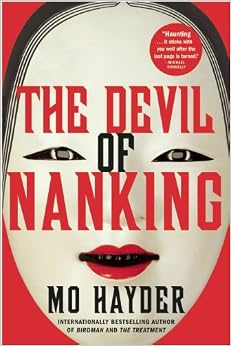
Book 12: The Devil of Nanking, by Mo Hayder

I don't even know where to begin with this one. The onus might be on me for expecting a thriller to be more than it ever meant to be, itself. But maybe not - the author's note at the end of the book indicates that Hayder does honestly care about getting the word about the rape of Nanking out there into the world.

I'm ahead of myself. The Devil of Nanking, as one can presume, is about the Japanese atrocities committed during its invasion of China in World War II, atrocities that Japan has never officially recognized. Indeed, to my understanding, most Japanese citizens either downplay the extent of the atrocities, or deny that they happened at all. As these events pass out of living memory, this is denial strategy will allow Japan to completely sweep the rape of Nanking under the rug of history within its borders.

Serious stuff. Which is why it's so freaking bizarre that Hayder only spends perhaps a third of her novel following the narrator telling the story of the rape of Nanking. By far the bulk of the novel is dedicated to Grey, a British woman seeking film footage from Nanking, and who finds work at a hostess club frequented by the yakuza, and who has some sexual trauma in her past and present. Grey's story involves cannibalism as a route to eternal life, and a weird backstory that comes across as an anti-abortion parable. Needless to say, it is not nearly as interesting at the rape of Nanking material, and is so frivolous as to be offensive (Grey often comes across as a more-tormented-than-usual manic pixie dream girl) in its pairing with the real-world atrocities Hayder claims to be interested in spreading the knowledge of.

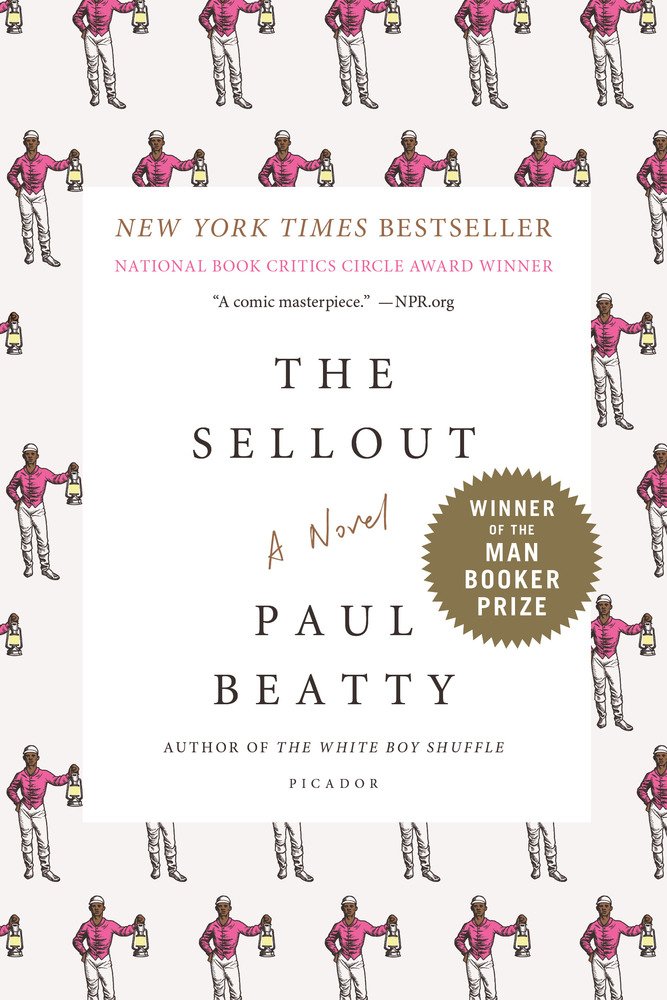
Book 11: The Sellout by Paul Beatty

Good Lord, was I ever not expecting this book. Despite winning the Man Booker prize, the Sellout was not on my radar at all. (I say this as if I can recite the last twenty Man Booker prize winners.) My uncle's brother was reading it over Thanksgiving, and then my mother-in-law gave it to me for Christmas. I was like, eh, ok, well, I guess I'll get to this sometime when the library is slow to fulfill one of my holds.

The Sellout is the most biting, most open-eyed, and funniest critique of racism in America that I have ever run across.

There is no way for me to adequately review this book. It is so incredibly dense, so layered in its writing, that anything I say will just take up time you should spend getting a copy of this book. The narrator - never properly named, in what I assume is a nod to the Invisible Man, which I should probably re-read at some point in my life - re-segregates his hometown in an attempt to get his town back on the map, and owns a slave. It's just the weirdest set-up. Here, stop reading me and read some of the Sellout.

In all its years of existence, Dum Dum Donuts has never been robbed, burglarized, egged, or vandalized. And to this day, the franchise's art deco facade remains graffiti and piss-stain free. Customers don't park in the handicapped spot. Bicyclists leave their vehicles unlocked and unattended, stuffed neatly into the rack like Dutch cruisers parked at an Amsterdam train station. There's something tranquil, almost monastic, about the inner-city donut shop. It's clean. Spotless. The employees are always sane and respectful. Maybe it's the muted lighting or the bright decor, whose color scheme is designed to be emblematic of a maple frosted with rainbow sprinkles. Whatever it is, my father recognized the donut shop was the one place in Dickers where niggers knew how to act.

(My apologies - in my classroom, I always sub in the word "gentleman" for the n-word, but vulgarity is so central to Beatty's novel that I'd be doing a disservice by editing here.)

[My father] sat at the table nearest to the ATM and said aloud, to no one in particular, "Do you know that the average household net worth for whites is $113,149 per year, Hispanics $6,325, and black folks $5,677?"

"For real?"

"What's your source material, nigger?"

"The Pew Research Center."

Motherfuckers from Harvard to Harlem respect the Pew Research Center, and, hearing this, the concerned patrons turned around in their squeaky plastic seats as best they could, given that donut shop swivel chairs swivel only six degrees in either direction. 

Beatty sustains this tone and pace for nearly 300 pages. I can imagine reading this book over and over again and never discovering - or truly appreciating - every joke, reference and pointed observation in it. And, of course, jokes are nothing without an actual meaning behind them; and no one escapes blame in the Sellout. Race relations are everyone's problem in this country, and everyone is accountable in Beatty's reckoning.

The Sellout is currently one of the five books you can vote for in the One Book, One New York event that the NYC government is promoting right now. I actually cast my vote for Between the World and Me (maybe I'm wary of satire being misinterpreted? maybe I just really appreciate Coates's reasoned approach to the world?) but the more people that read the Sellout, the better the world will be.

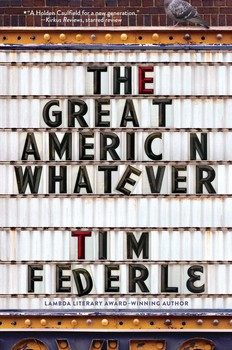
Book 10: The Great American Whatever, by Tim Federle

When I think of my teenage years, the word shame comes to mind almost immediately. I had braces, glasses, a dorky haircut, a love for comics back when that was not something you were allowed to love, my voice cracked for something like five straight years, I was five two until the tenth grade; I could go on.

The beautiful thing in so many recent YA novels is that the characters are seldom crippled by their shame. I've noticed that the books aimed at even younger readers follow suit - my son will be four in less than two months, and so many of the books I've read him have the underlying message, "It's totally OK to be a weirdo." (Odd Duck is one of the best of the bunch in this regard, and the Tacky the Penguin series, while repetitive, is likewise charming.) I don't remember this being the case in the books I read as a kid. Sure, Encyclopedia Brown was a weirdo, but in a super-human way; Gom Gobblechuck was an outcast but it's OK because he was a magician.

The Great American Whatever centers on Quinn Roberts, a gay teenager who hasn't left the house in months and has never even kissed a boy and whose mother is morbidly obese and on disability and there isn't a lick of shame in his character. As close as Quinn comes is crippling guilt about the death of his sister - the inciting incident in why he hasn't left the house in months - and that eventually gets burned off in the course of the novel.

The Great American Whatever is a great little read, with quirky characters who never get to Juno-burger-phone levels of precious. Quinn inhabits a flawed world, but it's one that he's created for himself through his own neuroses. He hasn't gotten into a summer film camp because he's too lazy to write the application, not because the spot went to a kid from a privileged background. After being paralyzed by the idea of coming out to his best friend, the response is, "Duh." It's a nice alternate reality from Trump's America, but one that, thanks to books like this for the YA audience, doesn't feel completely unlikely.

Tuesday, February 7, 2017

Paper Girls

Brian K. Vaughn is one of the more revered names in comics today (not that I'm an expert). His sci-fi series Saga is pretty much universally beloved, Runaways was a massive hit in its day, and I'll just assume people like his X-Men stuff. This latest series, Paper Girls, is up there with any of those. If you liked Stranger Things this past summer, Paper Girls is going to be right up your alley. It's November 1st, 1988, and four barrier-breaking twelve-year old girls are delivering their paper routes in the pre-dawn hours. Erin has nightmares with Ronald Reagan in them; George Bush for president signs are visible on lawns; Tiffany is mortified to realize how much time she wasted playing Arkanoid; Mac smokes and calls people faggots because, as a time-traveling character says, "You guys live in a fucked-up time." Basically, Vaughn nails the 80s.

As does artist Cliff Chiang, whose work here is fantastic. The detail he throws into relatively one-off gags like the aforementioned Bush campaign sign, the character that pops in the faces of each of the four girls, hell - the fact the guy has to draw so many damned bicycles. It's book 1 of an ongoing series, so I will say, don't go into it expecting resolution. But this does end on an interesting cliffhanger, and there are certainly enough questions abounding to propel the series for another couple of collected volumes, easily (oh, right, the plot, mention the plot - time traveling warlords with dinosaurs? I'm not really sure, actually). Paper Girls is a rare series where I have no qualms recommending it for people who don't even particularly like comics. It's really a great read.

Book 9: Homegoing by Yaa Gyasi

This has already been reviewed (at least) twice on this blog, so I feel like I can get away with a shorter review here. There's also precious little left to say; Homegoing is an amazing achievement. The structure, the scope, the maturity, the fact that Gyasi is a first-time novelist. Homegoing will be remembered, and taught, for decades to come, and she's 26. My mind reels.

I'll touch on just a few of my personal highlights. The machinations of imperialism are treated as well here as anywhere I've ever seen. The early chapters recall Things Fall Apart, but Gyasi's focus on the experience of women opens new horrors that have rarely been mentioned as explicitly in other accounts. The omnipresence of rape, for instance, made me think of the banality of evil, again and again. As the story shifts to America, the absence of the Civil War is fascinating. One of my favorite podcasts is Backstory, which focuses on American history in order to explain the America we live in today. The Civil War is constantly held as the major changing point in American history; in Homegoing, it is a passing reference at best, because, honestly, what is the difference between chattel slavery and the mass incarceration that puts H in the mines of Alabama for what is, at best, a misdemeanor offense?

The H chapter moved me more than any other. As a teacher, Homegoing just constantly thrilled me with its classroom possibilities. It could - and very likely will be - a semester-long class. There is just so much room to bring in other readings, other concepts, sprouting off of every single chapter. Honestly, there just aren't enough good things to say about this book.

So I'll end with a really pedestrian note: Gyasi's ability to create such fully realized characters, each in the space of about 20 pages (seriously, the chapters are super consistent in length), is incredible.

I will also brag that I read the physical book, and, yes, the family tree was super-useful.

Monday, January 9, 2017

#3 - An Ember in the Ashes by Sabaa Tahir


For the Book Riot Read Harder 2017 Challenge, I needed to read a fantasy book. Fantasy isn't a genre I normally pick up (I'm assuming the Game of Thrones books are the last fantasy books that I read), but I love a Hobbit as much as the next guy. An Ember in the Ashes, by Sabaa Tahir came out a few years ago and was evidently a Times bestseller, but I hadn't heard of the series until book 2 made someone's year-end list on the AV Club recently.

The story alternates perspectives between Laia, a slave girl of the Scholar people, and Elias, a gladiator-like warrior from the Martial empire. In the opening chapters, Laia's family is murdered, she finds the Resistance, and infiltrates Blackcliff, the military academy that Elias is about to graduate from. Elias, in the meantime, has a super-hot and super-awesome best friend gladiator-ess named Helene, attends Blackcliff, and is thinking of deserting the empire. (I wouldn't make a point of the super-hot, but it's brought up more than twice in the book.) Elias quickly finds himself involved in the Tri-wizard Tournament to see who gets to be the new Emperor, while Queen Cersei tries to rig the outcome to make sure he doesn't win.

That paragraph sounds much more negative than the book actually deserves. It's hard to establish a wholly creative and new fantasy word, and Tahir writes a gripping yarn that makes the 450 pages go really really quickly. Whether this is because of or in spite of the well-worn template that Ashes follows, it was definitely an interesting read. The first-person narration of a slave trying to just stay alive instead of purposefully overthrow an Empire was new; the first-person narration of Elias brings to mind the Kingslayer in some regards, but because he's also still essentially a college student, there is a nice amount of self-doubt and confusion that freshens things up. In the meantime, I wish Tahir had come up with better names for the Empire and its member ethnicities than "the Martials," "the Scholars," and "the Mariners," etc. That may sound like a small nit to pick, but world-building in fantasy novels is important, and an entire race being known as "the Scholars" is just, well, goofy. The AV Club article I mentioned earlier said that the series really gets going in book 2, where the characters get a lot more attention, and I do plan on reading A Torch Against the Night, because there was a lot to like in this book - probably why I'm so critical of what I feel needed another reworking.


#2 - Peril at End House, by Agatha Christie

For me, comfort reading gets no better than Agatha Christie. I first fell in love with her books in ninth grade, and went through such a prolonged spurt of reading them that a not-particularly-close friend called my house one time, and when my mom answered, my caller said, "What, is he off reading some Agatha Christie book again?" The fact that her books are old-fashioned bothers me not a whit (heck, they were old-fashioned for half of the time she was writing them), except for when the casual racism and antisemitism of pre-war Britain pops up (it does seems to have largely been extinguished in her post-war work). My love of Agatha Christie is so great that in my second year of teaching, I forced four classes of Brooklyn teenagers circa 2009 to read the Murder of Roger Ackroyd - and they liked it. A few years back, I decided I might as well keep track of all the Christies I have and haven't read, with an eventual aim of meandering my way through the trails of upperclass British corpses and completing her oeuvre. 

My most recent foray into Christie reunited me with everyone's favorite Belgian with an egg-shaped head, Hercule Poirot. Poirot, in turn, is reunited with Captain Hastings, his sounding board and the stand-in for the confused reader whenever Poirot finally solves the crime. (I think I'm up to about 40 Christies read at this point and I have never - not once - figured one of these things out.) 

Reviewing the particulars of any individual Christie is really beside the point, but this falls soundly into the category of Very Good Christie for me. (Christie books come in three varieties for me: Stone Cold Classics, Very Good, and Very Meh.) The imperiled character is a young woman named Nick Buckley, proprietress of the titular End House. She is a thoroughly modern young woman of the 1930s (Christie did write modern characters for a time!), and, in another very nice touch, is engaged to a young man who is trying to complete a Charles Lindbergh-esque feat of aviation before he is lost at sea. There's even an attempt made on someone's life involving chocolates filled with an overdose-inducing quantity of cocaine!

As I said, it's not a Stone Cold Classic, but as far as Very Good Christie goes, I'd put it up there with A Murder Is Announced. Sometimes, the best parts of a Christie novel are nothing to do with the crime, but are the parts that reflect the massively changing British society that they take place in. A Murder is Announced was one of Christie's first post-war books, when the entire idea of a servant class was basically thrown out the window once and for all. Similarly, Peril at End House features independent women, aviators when that actually meant something, and a not-really divorced woman with a new lover. For having a reputation of being old-fashioned, I have a feeling this was not the typical stuff of large circulation books in England in 1932.


Thursday, July 18, 2013

The Executioner's Song by Norman Mailer

Over 1,300 posts on Fifty Books Project, and not one mention of one of the luminaries of American literature, Norman Mailer. Maybe he falls a little outside our purview, or maybe he’s overlooked nowdays as one of the “great male narcissists [who] dominated postwar American fiction”1, as David Foster Wallace called them, for their supposed misogyny and nearsightedness... or maybe it’s just because there’s a lot of reading to do and only so much time in which to do it.

I had never read Mailer either, in spite of having a copy of The Naked and the Dead sitting on my bookshelf for a few years, but The Executioner’s Song caught my attention in the bookstore for two reasons--it was huge, and the premise--a man, Gary Gilmore, is given the death penalty and executed--didn’t seem like enough to support the length. Not to mention that it was a true story and I’d never heard of Gary Gilmore. So my interest was piqued.

In some ways, the single-sentence summary above does the book justice--it is single-minded in the sense that it keeps the execution front and center throughout--but, of course, further explication is necessary. Gilmore spent over half of his life behind bars, beginning as a juvenile. In 1976, he was paroled and sent to live with his cousin Brenda in Provo, Utah, the heart of Mormon country. During this time he struck up a tempestuous, intense relationship with a young single mother named Nicole Baker, and, after an unusually severe fight and breakup, killed two men, execution style, over a two night period. He was caught and sentenced to death, notable because, at the time, the U.S. was currently in the midst of a moratorium on the death penalty, imposed by Furman vs Georgia in 1972.

The death sentence happens less than halfway through the book. The rest is the story of Gilmore’s fight to be allowed to die and the media circus that surrounded him. Because of the moratorium, numerous civil rights groups, including the ACLU, were fighting Gilmore’s execution, even though he wished for his sentence to be carried out, because they feared, correctly, that if Gilmore was executed, many others would be executed in short order.

Normally, in a story like this, there are clearly defined heroes and villains, and, in true stories, if the facts don’t point to a clear dichotomy, the author usually chooses sides and, inadvertently or not, paints one side more sympathetically. Not so Mailer in The Executioner’s Song. As long as it is, the novel is a picture of restraint, with Mailer refusing to cast Gilmore as a misguided saint or his antagonists, such as they are, as anything other than complicated people with (generally) legitimate reasons for the things they do. It would have been far easier as a reader if I could have seen Gilmore as a monster or the ACLU lawyers as hypocrites, but Mailer’s thoroughness doesn’t really allow for such simplistic line-drawing. Even Gilmore’s motivations for the murders are in question: were they emotional responses to his problems with Nicole? Inevitable behaviors for a bad seed like Gary? Indicators of some deeper mental issue? Results of repressed pedophilic impulses? Deus Ex Machinas handed down from unfeeling gods? We’re never told, and the length of The Executioner’s Song serves as a challenge. Mailer seems to be saying, “Here’s all the information. Figure it out.”

There are moments in The Executioner’s Song that cut deep, like Mailer’s sensitive portraits of the two men Gilmore killed, but even here, he resists the urge to beatify, communicating the facts in flat, affectless prose that works even better than cloying melodrama. Gilmore’s letters to Nicole are the same way--of course, love letters from a man on death row are going to contain some pathos, but Mailer doesn’t edit, and their contents reveal Gilmore’s duality as well as his humanity, his intense longing beside his almost feral brutality. Finally, after Gilmore’s execution, the one spot where a little bit of punch-pulling might be in order, Mailer refuses look away from the grislier aspects of Gilmore’s death--including his autopsy, described in some detail--and the unresolved grief of his victims’ families and Nicole, who Mailer even dares to suggest may someday forget Gilmore, ostensibly her soulmate throughout his time on death row. At risk of hitting the point too many times, Mailer refuses to espouse one simple answer to the questions he raises. It’s what makes The Executioner’s Song worthwhile, what justifies its length, and it’s a good argument for why Mailer, great male narcissist or not, deserves to be part of the “great authors” conversation.

1The others being John Updike and Philip Roth, who we at 50B apparently love.

Monday, March 17, 2008

The Lion, the Witch and the Wardrobe by C.S. Lewis

Wrong will be right, when Aslan comes in sight,
At the sound of his roar, sorrows will be no more,
When he bares his teeth, winter meets its death
And when he shakes his mane, we shall have spring again.


I read The Chronicles of Narnia when I was about ten, and felt that they really were very grown up books. It was surprising to go back and see how simple this book is. It was also great to see that while the reading level hasn't advanced with me, the story is still charming and the allegory still stirring.

The story of Peter, Susan, Edmund and Lucy is pretty straightforward, but I think that is as it should be with children's tales. Children don't catch twists the same way adults do, and an interesting story doesn't mean complicated.

Well, the book is still most excellent. Lewis is a great writer. He does a good job going from his in depth writings for adults to his beautiful stories for children without losing any truth. He still gives you the same sense of wonder at the power and awesomeness of God whether you are a child or all grown up.