Showing posts sorted by relevance for query john updike. Sort by date Show all posts

Sunday, February 22, 2009

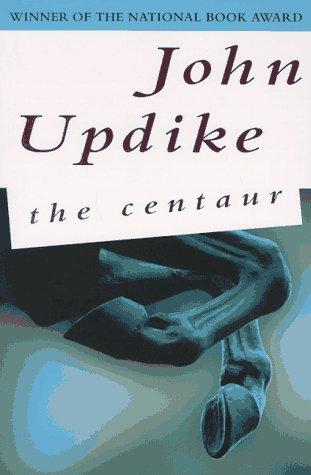
The Centaur by John Updike

As my father and I strode along the pavement that divided the school side lawn from Hummel's alley, a little whirlwind sprang up before us and led us along. Leaves long dead and brittle as old butterfly wings, an aqua candy wrapper, flecks and dust and seed-sized snips of gutter chaff all hurried in a rustling revolution to our eyes; a distinctly circular invisible presence outlined itself on the walk. It danced from one margin of grass to another and sighed its senseless word; my instinct was to halt but my father kept striding. His pants flapped, something sucked my ankles. I closed my eyes. When I looked behind us, the whirlwind was nowhere to be seen.

In the school we parted. A student, I was held by regulations to this side of the wire-reinforced doors. He pushed through and walked down the long hall, his head held high, his hair fluffed from the removal of his blue knit cap, his heels pounding the varnished boards. Smaller and smaller he grew along their perspective; at the far door he became a shadow, a moth, impaled on the light he pressed against. The door yielded; he disappeared. With a grip of sweat, terror seized me.


John Updike passed away a month ago; though I could try I do not think I would be able to make a better encomium than any of the hundreds that have already been published. Slate published a slew of them, including what I thought was a pretty incoherent one by John Irving, and a tangential one by Christopher Hitchens. The best are a series of shorter obituaries that Slate published together; among my favorites is editor Anne Fadiman's, whose piece ends simply, "Can it really be that John Updike will never write another sentence?" Should one of my favorite authors die tomorrow, I might lament that they will never write a book, but true to Fadiman's sentiment, it's Updike's sentences that seem to leave the deepest hollow: miniature masterpieces like Rabbit Angstrom moving along the street like a shark, or dreaming of his own immortality, or Peter Caldwell watching his father disappear, shrinking to a "moth... impaled on the light he pressed against."

In his obituary on Slate, Steely Dan founder Donald Fagen notes David Foster Wallace's protest that Updike's characters are all veiled portraits of himself, ""incorrigibly narcissistic, philandering, self-contemptuous," and chauvinistic. But The Centaur ought to put that notion to rest, because its protagonist, George Caldwell, is defined by a selflessness that is almost nauseating. Caldwell is modeled after Chiron, the centaur and great teacher of myth who was accidentally hit by a poisoned arrow. Plagued by the wound, he begged Zeus to die, and that by doing so he might redeem the sin of Prometheus, who had long ago stolen fire from the gods. Frequently in the narrative Updike switches from Caldwell to Chiron without warning, at one point depicting him as a modern-day schoolteacher and the next an ancient demigod.

In fact, everyone in the book has a mythological counterpart: Peter, George's son, is Prometheus, who is deeply embarrassed by his father's selflessness, though he doesn't realize the depth and sincerity of his father's sacrifice. A drunk is Dionysius, the principal is Zeus--and so on and so on, all cross-indexed in the back.

A classicist might have fun trying to identify the second identity of each character, but I think that the book ultimately suffers by this gimmick, which would have been less muddled without the mythological veneer Updike imposes on it. As in the Rabbit Angstrom novels, Updike dots The Centaur with moments of unparalleled prose, but here I am left wondering to what they all add up. The novelty of this kind of modernism was really exhausted with Joyce; here, where he would imbue the myth with heart and pathos, Updike too often creates a distraction from the novel.

Of course, much is required from greatness and Updike's less successful books are still better than most, and when the guessing-game is ignored, a pithy and powerful book remains: The plot is thin, following Caldwell and his son over a stretch of three days where they are prevented from returning home by car trouble and snow. Caldwell would do anything for Peter, but it is unclear what there is to be done, and Peter is increasingly resentful of what he sees as his father's weak nature. Caldwell is Chiron, who wants nothing more to give himself for others, and by extension is also a commentary on the nature of Christ.

At any rate, perhaps it would be fitting to say that Caldwell has as much of Updike, who gave of himself in scores and scores of books, in him as Rabbit Angstrom, whose selfishness and audacity are secondary only to his humanity.

Also: This is the 600th post on this blog! Hooray!

Saturday, December 30, 2006

Christopher's Books 2008

46. Bridge to Terabithia
by Katherine Paterson
45. Holes
by Louis Sachar
44. Ender's Game
by Orson Scott Card
43. The Brief Wondrous Life of Oscar Wao
by Junot Diaz
42. I Am the Cheese
by Robert Cormier
41. The Joy Luck Club
by Amy Tan
40. Cosmopolis
by Don DeLillo
39. The Yiddish Policemen's Union
by Michael Chabon
38. The Magus
by John Fowles
37. The Giver
by Lois Lowry
36. A Wrinkle in Time
by Madeleine L'Engle
35. Tuck Everlasting
by Natalie Babbitt
34. Brighton Rock
by Graham Greene
33. London Fields
by Martin Amis
32. Darkness at Noon
by Arthur Koestler
31. The Day of the Locust
by Nathanael West
30. Pale Fire
by Vladimir Nabokov
29. The Echo Maker
by Richard Powers
28. The New York Trilogy
by Paul Auster
27. Black Swan Green
by David Mitchell
26. Titus Groan
by Mervyn Peake
25. Teacher Man
by Frank McCourt
24. The Moviegoer
by Walker Percy
23. Rabbit Remembered
by John Updike
22. House of Leaves
by Mark Z. Danielewski
21. Lost Boy
by Thomas Wolfe
20. Harry Potter and the Deathly Hallows
by JK Rowling
19. Blood Meridian
by Cormac McCarthy
18. Watchmen
by Alan Moore and Dave Gibbons
17. Lame Deer, Seeker of Visions
by John Lame Deer and Richard Erdoes
16. Harry Potter and the Half-Blood Prince
by JK Rowling
15. Nine Stories
by JD Salinger
14. Of Mice and Men
by John Steinbeck
13. Harry Potter and the Order of the Phoenix
by JK Rowling
12. Rabbit at Rest
by John Updike
11. Clear Springs
by Bobbie Ann Mason
10. Bird by Bird
by Anne Lamott
9. Catch-22
by Joseph Heller
8. Harry Potter and the Goblet of Fire
by JK Rowling
7. Rabbit is Rich
by John Updike
6. Tobacco Road
by Erskine Caldwell
5. Harry Potter and the Prisoner of Azkaban
by JK Rowling
4. Rabbit Redux
by John Updike
3. Pilgermann
by Russell Hoban
2. Harry Potter and the Chamber of Secrets
by JK Rowling
1. Rabbit, Run
by John Updike

Saturday, January 12, 2008

Rabbit Redux by John Updike

When Updike published Rabbit, Run, his protagonist Harry "Rabbit" Angstrom was only two years his junior; at intervals of almost exactly ten years he wrote the next three Rabbit books, wherein Rabbit ages at exactly the same rate. This is, I think, an achievement of unparalleled ambition. Rabbit is Updike's everyman, and it seems as if Updike spends each of his ten years gathering material for Rabbit; for this reason Updike's legacy is tied to his character just as Updike's life is. The effect is like meeting an old friend--ten years have passed since you've last seen each other, but life has not stalled since then, and Rabbit grew with the rest of his generation in real time.

Rabbit Redux finds Rabbit back with his wife Janice, living in a small starter home in the suburbs of Brewer, Pa. with their now 12-year old son Nelson. Harry's infidelity and the tragedies of the first book (which I will not recount because Brent is going to read it) have been pushed to the corners of the Angstroms' consciousness, but not forgotten; they inform much of what the characters do or think. When Janice leaves Rabbit to stay with her lover, Greek car salesman Charlie Stavros, Rabbit, through a strange series of plot turns, takes in a rich young runaway from Connecticut named Jill, who pays her rent in nookie. It isn't long before a friend of hers, a young black radical named Skeeter, ends up at Rabbit's house on the lam from the cops.

What this sets up is a strange chunk of the novel in which Rabbit, Nelson, Jill, and Skeeter live in Rabbit's house in a peculiar commune-type situation: Skeeter, who styles himself as a "Black Jesus," spreads his dogma to the other three during nightly discussions. I looked for a passage from these discussions to quote, but I got lost and exhausted really quick; they're dense and full of odd anger and mishmash radicalism. It is this section that didn't feel quite right to me--Rabbit, despite his frequent escapes from domesticity, is a conservative man who believes strongly in the Vietnam war and is suspicious of blacks. In some way I think that Rabbit clings to this life because it is peculiar and perverse, and refreshing after a stagnant and not particularly satisfying twelve years of marriage, but I find some scenes (especially those in which Rabbit does not rebuke Skeeter for his savageness toward Jill or Nelson) to not quite jibe with Rabbit's character. The culmination of this is a scene in which Rabbit and Skeeter very nearly double-team Jill in the living room--what the fuck? It's Updike's prose that is the saving grace here, turning the ridiculous into the believable.

The other thing I didn't like quite so much about Rabbit Redux is that Updike seems to keen to turn Rabbit into a reflection of the American psyche. In Rabbit, Run, Rabbit was just Rabbit, and didn't need to be anymore--we could identify in him the human desires to be loved and to be free, and all the mess and complications that result from them. But in making Rabbit the prototypical American--and not the prototypical human being--Updike actually narrows his focus and Rabbit's relevance. Updike places Rabbit Redux squarely against a backdrop of social and political change and upheaval: the moon landing, Vietnam, race riots. At one point, Rabbit has a lengthy argument about Vietnam with his Stavros, his wife's paramour (who is a dove). And then, of course, the Skeeter sections. These all have their charms and their positives, but forty years later, I find this aspect of the book to be the least appealing.

Of course, I still recommend this book strongly, if only not quite as strongly as I do Rabbit, Run. Up next: Rabbit is Rich!

Tuesday, November 30, 2010

Gertrude and Claudius by John Updike

She felt this would happen but once, this unfolding of herself, and so she was luxuriously attentive to it, as if she were both storyteller and heroine, physician and invalid. In their hours of stolen intimacy, Fengon disclosed to her in the white mirror of his own body, furred and pronged, a self laid up within her inner crevices and for forty-seven years merely latent, asleep. All her unclean places came alive, and came clean. Did she not carry in her veins the warrior blood of Rodericke and of his father, Hother, the vanquisher of Guimon, who had betrayed Gevare and whose live body Hother burned in revenge? Protest had been lurking in her, and recklessness, and treachery, and these emerged in the sweat and contention of adulterous coupling.

John Updike's Gertrude and Claudius is predicated on a major miscalculation: That the story of Hamlet can be told without Hamlet. Or, rather, that a prequel to Hamlet can be written in which Hamlet himself is forced to the periphery, barely mentioned (I don't believe he has any quoted dialogue in Gertrude and Claudius), perpetually away at Wittenberg. The problem with this is not merely that Hamlet is a superior work--which it is, to everything--but that Hamlet is too large to be contained this way. He is too expansive; he commands our attention even when he is not on stage. Hell, he commands our attention when we're reading things that have nothing to do with Hamlet.

Gertrude and Claudius'
neatest trick is that Updike, borrowing from Shakespeare's original sources, Saxo Grammaticus and Francois de Belleforest, splits his prequel into three sections in which the characters are first called by the names Grammaticus gives them, and then Belleforest's, and finally Shakespeare's. So Gerutha in Grammaticus becomes Geruthe in Belleforest and finally Gertrude in Shakespeare; Feng becomes Fengon becomes Claudius; Amleth becomes Hamblet becomes Hamlet; Hamlet's father Horwendil becomes Horvendile becomes--as Hamlet himself subsumes all others--Hamlet senior.

I was first inclined to think that this was a sort of pedantry, but I decided that it has an appealing thematic thrust: The story's progress toward Hamlet is inexorable, and by extension, our principals' progress toward death. Updike's Hamlet is an apocalypse, though a hastily sketched one; the crimes of Gertrude and Claudius are by comparison are minor stuff. Gertrude is a noble, clever woman trapped in a marriage of political convenience. Claudius is a wise, cosmopolitan adventurer unfairly overshadowed by his older brother, and is incited to murder only when his brother threatens to dispatch Gertrude as punishment for their adultery. Here are people whose yearning ought to make them more relatable than Hamlet, whose vengeance looms larger than its cause.

But Updike has too much to overcome to make Gertrude and Claudius work. First of all, he doesn't help himself with flabby discourses on Danish history and geography like this one:

Geruthe and Horvendile paid a patriotic visit to the battlefield of Fotevig, where over a century ago Erik the Memorable had decisively defeated Niels and his son Magnus, who had treacherously murdered Duke Knud the Breadgiver, conqueror of the Wends, in Haraldsted Wood. Magnus fell at Fotevig together with no fewer than five bishops. Erik's victory had been aided by three hundred German armored knights hired for the occasion, a technological innovation which at blow rendered popular levies upon the peasantry obsolete.


Or pointed references to the original, like this one from Corambis, known in Shakespeare as Polonius:

"Without forgetfulness, milady, life would be intolerable. All that we have ever felt or known would come crowding in upon us, like rags stuffed into a bag, as they say happens to unfortunates in the moment of drowning. It is averred that it is a painless death, but only the drowned could tell us with assurance, and they are silent, being so. That is, drowned."


Because his daughter Ophelia drowns in the play. Get it?

But the real issue is that Gertrude and Claudius is incapable of surprising us. We know exactly what will happen: Gertrude will fall in love with Claudius and Claudius will kill the King and usurp the throne. This is, save for a few minor details, the entire plot of Gertrude and Claudius. Gertrude's feelings about her marriage can be surmised without reading them, and there is little about their affair that might capture our interest, especially from an author who might reasonably be called our foremost literary expert on adultery. The novel's most powerful effect is to make us impatient for Hamlet and then to interrupt the narrative before he does or says anything of interest. It may drive us back to the original play--a result of no small worth--but there we find that Updike has little to illuminate.

Tuesday, February 10, 2009

Rabbit, Run by John Updike

As a shark nudges silent creases of water ahead of it, the green fender makes ripples of air that break against the back of Rabbit's knees. The faster he walks the harder these ripples break. Behind his ear a childishly twanging voice pipes, "I beg your pardon. Are you Harry Angstrom?"
With a falling sensation of telling a lie Rabbit turns and half-whispers, "Yes."
I don't even know where to begin. Chris swore this book was amazing, and it delivered. It was a little eerie, too, that I picked this up just one day before John Updike died. Now I can say that I truly appreciate the greatness that we've lost.

Harry "Rabbit" Angstrom is 26, married with one child and another on the way, and living in the suburbs of a small city in Pennsylvania. Rabbit was a regional basketball star in high school, something that he clings to as validation of his self now that he sells vegetable peelers to housewives. He also has one of the best names ever, and earned himself a place on my list ("Nathan's Favorite Names of Northeastern American Literature 2009"). Harry's frustration with his life, small in comparison to his brief fame, is omnipresent throughout the book, and stifling at times. His tendency to flee an uncomfortable, or less than ideal, situation results in darker consequences than I'd expected. This is a person totally absorbed in pursuing his desires completely, however much they change moment by moment. His train of thought flits from love to hate to remembering wondering as a child if pine trees would cushion your fall from a great height. Rabbit seems incapable of empathy, which must be nice, to some degree, to feel guiltless in following your every whim to the letter. But for being so flighty, Rabbit has some moments of surprising clarity.
"I'll tell you," he says. "When I ran from Janice I made an interesting discovery. If you have the guts to be yourself, other people'll pay your price."
So sad and true, that sometimes to really be true to your self, you'll have to break someone else's heart. Fortunately for the sake of the story, Rabbit doesn't compromise. His heart leads him from his wife and back again several times, never showing much remorse, and justifying his actions with the thinnest excuses (such as "if she had said the right thing right before I left I definitely would have stayed").

What's most amazing is Updike's incredible insight into the human mind. His invented observance of every character's tics and motivations and inner thoughts are so believable as to be chilling, and definitely gripping. Following Rabbit's own inner-workings somehow manages to make such a despicable, thoughtless person seem sympathetic, like he doesn't know any better. And his prose is fuller and richer than I felt after downing a dozen donuts on Saturday. I was nervous writing this review, because there's no hope of me doing Updike and his writing any justice. Without a doubt, read this book.

Has anyone read Rabbit Redux or Rabbit is Rich? I want more Updike.

Tuesday, June 1, 2021


Rabbit at Rest by John Updike


It took me almost as long to read the Rabbit sequence as it took Updike to write it.  Beginning with Rabbit, Run in 1960, the books come about once a decade and narrate the life of Harry “Rabbit” Angstrom at the dawn of the 60s, 70s, 80s and 90s.  I read Rabbit Run in about 1990, read Rabbit Redux shortly after, waited a good ten or twelve years before Rabbit is Rich and only finished the series (today) because I owned a copy of Rabbit at Rest and thought I might as well.


A short reaction to each novel:

Rabbit, Run is the best of the four and is pretty brilliant.  The opening sequence, with Harry travelling home from work to a young family that feels like a boring trap then stopping to play basketball with some high school age boys on the street, remembering his own youth and the power and freedom he felt on the court, was worth the price of the entire sequence.  It is a kind of perfect male portrait of how the promise of youth is not kept by later life, how the American Dream never quite lives up to its billing.  There are other sections of the novel that compete with this opening in my memory – the long drive with the DJ’s catalogue of love songs as he leaves his wife, the golf game for his soul with the minister, the drowning of his daughter – but in each case the descriptions go on a little too long and while we see an artist enjoying his medium, we also see him showing off his own talent in ways that distract from the emotional power of the scene.


Rabbit Redux is the worst of the four.  It feels generally unnecessary and I remember feeling that Updike wrote it because the 60s did not go as he and Harry had imagined ten years earlier.  Harry’s inability to see real humanity in other people – especially women, but now also Blacks and radicals, starts to feel like it is Updike’s problem.  Certainly, his portrait of the activist/drug dealer Skeeter and the hippy Jill give the impression that Updike’s understanding of those parts of America came from Time Magazine.


Rabbit is Rich was a good comeback.  Admittedly, my feelings for it may be colored by the fact that I was close to adult in the years it chronicles, and so remembered the news items Harry obsesses over as part of my own life.  Updike’s continued examination of the economic decline of Harry’s home town, Harry’s new career at Toyota, and his later dealing with gold krugerrands captured something about America’s splitting into two countries – the constant refrain that we are getting soft and losing to the Japanese is complicated by Harry’s own prosperity.  His more settled and believable extra-marital affairs temper his increasingly scummy character, and while he is unlikeable, he is relatable and sympathetic.


I found Rabbit at Rest to combine the best and worst of the previous novels.  I grew bored with some of Updike’s undeniable talent.  He has a tremendous visual imagination and calls up the world around his characters in a constant stream of realistic and highly specific detail.  However, this often meant reading lists of fast food places along the highways of Florida, or Harry’s remembrance of what used to exist in the streets of his Pennsylvania hometown.   There are brilliant moments here – in his last visit with his mistress Thelma, now dying of lupus, in his own heart attack while sailing with his granddaughter, in the amazing sequence when he dresses as Uncle Sam for the Memorial Day parade and finds people still remember him as “Rabbit” the star basketball player, and in the brilliant way he ends the entire sequence, with a final, fatal heart attack during another pickup basketball game that gives him a last moment of liberation into his own skills.  The problem is that there is not one such final game, but two, so that the death comes some thirty pages after the reader has recognized the completed circle and the connection to that opening 1500 pages earlier.  Even the second game is not the end, as we get another few pages of doctors opining on his condition and his family discussing whether to forgive his final trespasses.


In the end, I found the creation of Harry’s adult life– the way he is so firmly embedded in history, the way he rises above individuality towards something like an American Everyman – a truly remarkable achievement.  At the same time, I got sick of Harry.  He is complex and conflicted in the beginning, but hardens into something simply unlikeable at the end.  He has few good qualities – he is a terrible husband, a terrible father, makes no social contribution and never really attempts to achieve more than his bases desires dictate.  At times I relate to him in a frightening way – Updike does get me to think of my own limitations and I find myself fearing that I am in some ways like Rabbit.  But then he will do something so simply reprehensible that I am let off the hook.  For the same reason, he does not become an American Everyman, and so we are all let off the hook.

Wednesday, January 2, 2008

Rabbit, Run by John Updike

I love this book for reasons I don't think that I can fully explain. I first read it some years ago solely because I had picked it up at a used bookstore--I don't think that it's something I would have sought ought if I hadn't simply stumbled across it. The plot is mind-numbingly simple: Harry "Rabbit" Angstrom, former basketball star and current twenty-something nobody, leaves his pregnant wife. That's it. Sounds like a page turner, right?

I didn't think so either, but now it's one of my favorite books. Updike really seems to capture the experience of being human--the fickle, unconnected nature of our emotions and the petty meanderings of our thought. One of the reasons creating believable characters is so difficult is that we spend so much of our lives doing menial and insignificant things, thinking obtuse thoughts and wasting time. Characters are too often constructed around plot; they do concrete, planned-out things, but that isn't what life is like. It's a hard thing to explain, I think, but the point is that Updike makes Rabbit seem like a living, breathing, eating, shitting, fucking thing. Someone you could meet on the street. When tragedy befalls Rabbit, most of which is the result of his own negligence and monstrosity, it feels frighteningly real. (I would talk more about what exactly happens to Rabbit--two particularly heartbreaking scenes come to mind--but I don't want to ruin it for anyone who might read this book. Which you should.)

But also I love this book because of Updike's style. He has a real sense of verbal economy--no word is extraneous or out of place--but still remains versatile and adapts his style to each scene. I was reading this at the same time as The Corrections, and the simplicity and starkness of Updike's style made Franzen sour to the taste, in a way. Here's a phrase I particularly liked:

With women, you keep bumping against them, because they want different things, they're a different race. Either they give, like a plant, or scrape, like a stone.


Either they give, like a plant, or scrape, like a stone. Maybe no one else feels this way, but that's the sort of sentence that makes reading rewarding for me. Updike takes a concept that informs just about every one of Rabbit, Run's 284 pages and distills it into eleven words: Either they give, like a plant, or scrape, like a stone. Jonathan Franzen would have turned that into a sentence with eighteen distinct clauses that took up half a page. But there simply is no way to make Updike's sentence any more succinct, and I think that makes it beautiful. But again, maybe that's just me. I repeat this sentence over and over in my head.

So, I try not to re-read books (because there are so many left to read), but I want to read the sequels to this book: Rabbit Redux, Rabbit is Rich, and Rabbit at Rest, which detail the rest of Rabbit's life from his twenties to his death. I doubt the novels where Rabbit is older will speak to me as strongly, but I've heard that the books themselves actually get better.

Sidenote: The cover above says "Rabbit, Run, by the author of Rabbit Redux." The cover of mine, which is otherwise similar, says, "Rabbit, Run, by the author of Rabbit is Rich." What book have you ever seen where the cover namechecks the sequel?

Sunday, January 27, 2008

Rabbit is Rich by John Updike

Running out of gas, Rabbit Angstrom thinks as he stands behind the summer-dusty windows of the Springer Motors display room watching the traffic go by on Route 111, traffic somehow thin and scared compared to what it used to be. The fucking world is running out of gas.

John Updike's third Rabbit Angstrom novel, Rabbit is Rich, opens up to find Rabbit in an unaccustomed state: He is satisfied. In the ten years that have passed since Rabbit Redux, Rabbit has started working at his father-in-law's Toyota dealership and, ultimately, upon Springer's passing, found himself in charge of it. It is a cushy job and provides him with financial success. His relationship with his wife, while never quite what one might call affectionate, has become stable and intimate, and he no longer feels the pull to run. Rabbit has even made peace with Charlie Stavros, the man who cuckolded him in Rabbit Redux, working with him side-by-side at Springer Motors and going so far as to call him one of his best friends.

But satisfaction causes a few problems of its own, of course--the backdrop is spelled out in the opening paragraph above: During the 1979 gas crisis, Rabbit himself feels his life--and his country--"running out of gas," losing spirit and movement to gravity, torpor, and "satisfaction." No longer are we in a world where Rabbit Angstrom can run off and find a girl to fuck--he seems to stumble upon them without looking in the first two novels--because he's far too old and it seems far less appealing. When his son Nelson brings home two girls in succession, his friend Melanie and his knocked-up fiancee Pru, he marvels at his own disinterest in having sex with him. Unlike in Rabbit Redux, in which we find Rabbit in a "devil's threesome" with Jill and Skeeter, there are no opportunities for strange trysts and absurd drug-addled affairs. Once, Rabbit sleeps with his friend's wife (they pee on each other, no joke) as part of a wife-swapping scheme, but even that happens on a holiday to the Caribbean, an otherworld far removed from the real time and space of Rabbit's Pennsylvania.

External conflicts frame Rabbit's internal struggles: Foremost is the return of his son Nelson from Kent State, shiftless and angry, looking for a job at Rabbit's Toyota dealership so that he can both support his pregnant fiancee and avoid going back to college, which he feels is phony. Nelson and Rabbit do not understand each other: Rabbit refuses to give Nelson a job and resents his alienation from his son; Nelson seethes with anger and hatred for his father over the tragedies of the first two books (which I will not enumerate for Brent's sake). But unlike Nelson and Rabbit we have the benefit of Rabbit's very youth documented in Rabbit, Run, and we see how much Nelson is like his father, in his frequent nastiness toward Pru, in his stubborn avoidance of his problems, of the way he finally leaves his wife as she is about to give birth and escapes back to Ohio. What Rabbit only knows in a halfway fashion is that much of his resentment toward Nelson stems from how closely Nelson's life is coming to mirror his own. When he insists that Nelson is a "Springer, through and through," we recognize his willful ignorance. And then there is the girl who comes into the dealership one day in whom Rabbit also sees something from himself, and who he believes might be the child his ex-lover from Rabbit Run claims to have aborted.

And then there are the ghosts of the dead, whom Rabbit faces because in the downswing of his own life he faces his own death as well. Rabbit thinks of them while running near his vacation home in the Poconos:

Becky, a mere seed laid to rest, and Jill, a pale seedling held from the sun, hang in the earth, he imagines, like stars, and beyond them there are myriads, whole races like Cambodians, that have drifted into death. He is treading on them all, they are resilient, they are cheering him on, his lungs are burning, his heart hurts, he is a membrane removed from the hosts below, their filaments caress his ankles, he loves the earth, he will never make their mistake and die.

When Updike is really on, I can't think of anything I've ever read more affecting. Though I doubt any of the Rabbit books could be as powerful as the first, I liked this one much more than Rabbit Redux, because it is more full with moments like that one. Updike wisely tones down some of the period details, resisting the impulse to make Rabbit the "prototypical American," as I wrote about that book. Rabbit isn't a metaphor; he's his own man, unique, individual, lonely, and that's why we identify with him.

Up next: Rabbit at Rest.

Wednesday, January 6, 2010

Top 10 of 2009 - Brent

Top 10 of 2009

I don't have much of an intro, but 2009 was a good year for reading. No trouble reaching 50 and I discovered a couple authors I loved, in addition to a couple to avoid. And who knows, maybe next year, I'll review them all too. So, without further fanfare:

10. Miracleman by Alan Moore and Neil Gaiman
I read quite a few comics this year, the majority of which were written by Alan Moore. Miracleman isn't actually the best--that would be Watchmen--but it functions as a deconstruction of the superhero mythos, a religious treatise, and a meditation on humanity. Plus, head-smashing.
Alternate title: What If God Were One of Us?

9. The Counterlife by Philip Roth
My second-longest review of the year belonged to one of the most perplexing books I read. The Counterlife tells four parallel stories of the same man in different circumstances, ties them together in the most pretentious way imaginable, and somehow makes it work.
Alternate Title: Paperback Writer

8. Blood Meridian by Cormac McCarthy
Blood Meridian is a cold, uninviting piece of literature. Dense with allegory, symbolism, and description, it was a tough read that tripped me up on my reviews simply because I didn't know what to say about it. The Old West will never look the same again.
Alternate Title: I Like Westerns

7. Rabbit, Run by John Updike
John Updike's reputation as a master prose stylist is well-justified by this, his most famous novel. Following perhaps the least sympathetic protagonist I read about this year, Updike manages to make the story of a misanthropic, washed-up small-town boy resonant and heartbreaking.
Alternate Title: Jack and Diane Redux

6. Libra by Don DeLillo
Digging into the psyche of Lee Harvey Oswald and the men in orbit around him, DeLillo turns one of America's villains into a pawn of forces beyond his control.
Alternate Title: Sympathy for the Devil

5. Kilbrack by Jamie O'Neill
Maybe the most enjoyable read of the year, Kilbrack's amnesiac author protagonist tours the tiny town of Kilbrack in search of his past, armed with only a memoir and some sort of mental disorder. Along the way he meets colorful characters and learns some lessons. But mostly, it's hilarious.
Alternate Title: That laughing version of Jingle Bells

4. Ulysses by James Joyce
Ulysses lives up to its reputation: dense, complicated, sometimes boring, but Joyce kept my interest with his writing and wordplay. I even enjoyed The Oxen of the Sun. Also notable: one of the best twists of all time in one of the most beautiful pieces of prose ever written.
Alternate Title: Baby, What a Big Surprise

3. The Sound and the Fury by William Faulkner
Nothing I read this year gave me same visceral thrill as the first section of The Sound and the Fury, where Benjy narrates without regard for time or place, for nearly 100 pages. A perfect example of how brilliant writing can carry even the most complex conceits.
Alternate Title: I Am a Man of Constant Sorrow

2. Raise High the Roof Beam, Carpenter by J. D. Salinger
Blurbing Raise High without the other Salingers I read this year seems strange. Just know that if you haven't read any Salinger besides Catcher in the Rye, you're missing out. Learn about Seymour, the real man without a country.
Alternate Title: I Guess I Just Wasn't Made for These Times

1. Infinite Jest by David Foster Wallace
I wrote plenty about this when I reviewed it, but this was one of the most hilarious, brilliant, touching books I've ever read. Don't let its size intimidate you. It's not a difficult read, and you'll like it, even you don't do drugs or like tennis.

Honorable Mentions:
The Woman in White - The gothic mystery novel, perfected.
Watchmen - The graphic novel, perfected.

Awful:
Neuromancer - Lots of ideas, terrible writing, and what plot?
Go Ask Alice - Drugs will make you stupid.

Saturday, February 14, 2009

Cannery Row by John Steinbeck

There is no golden afternoon next to the cliff. When the sun went over it at about two o'clock a whispering shade came to the beach. The sycamores rustled in the afternoon breeze. Little water snakes slipped down to the rocks and then gently entered the water and swam along through the pool, their heads held up like little periscopes and a tiny wake spreading behind them. A big trout jumped in the pool. The gnats and mosquitoes which avoid the sun came out and buzzed over the water. All of the sun bugs, the flies, the dragonflies, the wasps, the hornets, went home. And as the shadow came to the beach, as the first quail began to call, Mack and the boys awakened. The smell of the chicken stew was heartbreaking. Hazel had picked a fresh bay leaf from a tree by the river and he had dropped it in. The carrots were in now. Coffee in its own can was simmering on its own rock, far enough from the flame so that it did not boil too hard. Mack awakened, started up, stretched, staggered to the pool, washed his face with cupped hands, hacked, spat, washed his mouth, broke wind, tightened his belt, scratched his legs, combed his wet hair with his fingers, drank from the jug, belched and sat down by the fire. "By God that smells good," he said.
I should've read this in high school, back when living out that scene was my daydream and greatest aspiration. That outdoor beatnik lifestyle, the zen-like indifference to materialism, poverty and public image, that's what I got from Cannery Row. This is a street (like, for real) in Monterey, California lined with sardine canneries and, by Steinbeck's telling, a very respectable whorehouse, Lee Chong's grocery, and a marine biology lab, populated by a close-knit community of starving artists, care-free bums, and assorted destitute but kind-hearted individuals.

Much of the book is based on Steinbeck's own experience in Monterey, and I know that at least one character, Doc, the marine biologist, is based on a close friend of his. Doc, a man after my own heart, has a passion for beer, octopi, Gregorian chanting, and women, and is a well-loved and well-known figure in the small neighborhood. Mack and the boys are a kindly gang of bums whose MO is to obtain and imbibe whiskey, or anything they can get. Mack is brilliant, and through his shrewd dealings they manage to get a house (The Palace Flophouse and Grill), and spend most of the novel trying to do something nice to repay Doc for all of his kindness. But most of their good intentions go awry for the same reasons that they became bums in the first place: inability or disinterest in worrying over anything other than pleasure and friendship.

The novel is really a collection of short stories centered around Cannery Row, telling the individual dramas and comedies of its residents. Doc and Mack and the boys are the most recurring and pivotal characters, and really the only drawn-out plotline. Just the stories on their own are wonderful for their humor and the quirks and tics of each resident. Collected, they're all a testament to the vibrance and ingenuity that thrives in a place familiar with poverty. The closest the book comes to philosophizing is Doc's revelation that Mack and the boys are better off than most:
Doc said, "Look at them. There are your true philosophers, I think," he went on, "that Mack and the boys know everything that has ever happened in the world and possibly everything that ever will happen. I think they survive in this particular world better than other people. In a time when people tear themselves to pieces with ambition and nervousness and covetousness, they are relaxed. All of our so-called successful men are sick men, with bad stomachs, and bad souls, but Mack and the boys are healthy and curiously clean. They can do what they want. They can satisfy their appetites without calling them something else." This speech so dried out Doc's throat that he drained his beer glass. He waved two fingers in the air and smiled. "There's nothing like that first taste of beer," he said.
I don't think that could ever not be relevant. It fit in the 1940's, and it fits now. It was kind of a shock to go from John Updike's overwhelmingly complex, strikingly human Rabbit to Steinbeck's whimsical Doc and Mack, who are mostly simple and straightforward, sort of fleshed out personality traits and desires. I've been reading that Steinbeck's other works are much more serious, and not nearly as lighthearted, so I'm glad to have stared with this one. I found absolutely nothing to dislike about this book. It might not be a symbol-ridden, broad-reaching metaphor for the human condition, but it's beautifully nostalgic and simple, and makes me wish I lived in Monterey.

John Updike worked for The New Yorker at 25 and was a successful author by 27. John Steinbeck was first a chemist, an apprentice painter, hod-carrier (had to Wikipedia that one), estate caretaker, Big Sur surveyor, and itinerant fruit picker. Keep hope alive!

EDIT: I forgot to mention how much I love paperbacks that were printed before I was born. This one is about eight months older than me.

Monday, February 23, 2009

The Counterlife by Philip Roth

Standing singly at the Wall, some rapidly swaying and rhythmically bobbing as they recited their prayers, others motionless but for the lightning flutter of their mouths, were seventeen of the world’s twelve million Jewish communing with the King of the Universe. To me it looked as though they were communing solely with the stones in whose crevices pigeons were roosting some twenty feet above their heads. I thought (as I am predisposed to think), “If there is a God who plays a role in our world, I will eat every hat in this town”

Nonetheless, I couldn’t help but be gripped by the sight of this rock-worship, exemplifying as it did to me the most awesomely retarded aspect of the human mind. Rock is just right, I thought: what on earth could be less responsive? Even the cloud drifting by overhead. . . appeared less indifferent to our encompassed and uncertain existence. I think that I would have felt less detached from seventeen Jews who openly admitted that they were talking to rock than from these seventeen who imagined themselves telexing the Creator directly; had I known for sure it was rock and rock alone that they knew they were addressing, I might even have joined in.

While reading The Counterlife, I was reminded of David Foster Wallace's overview of John Updike's career where he says, as Chris mentions in his review of Updike's The Centaur, that all of Updike's protagonists are just portraits of himself. While that may or may not be true (I haven't read any Updike yet, so I can't say), I think that criticism applies more fully to Philip Roth.

Anyone who is even passingly familiar with Roth's body of work knows that Nathan Zuckerman is Roth's avatar in his fictional universe. Roth has Portnoy's Complaint, Zuckerman, Carnovsky. Both make their living on Jewishness, dissecting and dwelling on it while at the same tie denying its effects on their lives. Both have trouble with marriage and family, both are obsessed with sex—it is fitting that The Counterlife showcases Roth and Zuckerman in equal measures.

Roth doesn't show up in person, as in some of hi other works. Rather, the author becomes a character through proxy as a result of the books semi-biographical content and its metafictional structure. Split up into five connected but non-sequential sections, The Counterlife is a literary puzzle disguised as a realistic novel, an experimental cipher with no ultimate solution. Roth himself becomes a character because, as the story goes on, it becomes clear that the author is the only character who truly exists. Characters die in one section and are resurrected in the next. In “Basel”, Henry Zuckerman, Nathan's younger brother, dies during a heart operation. In “Gloucestershire”, it's Nathan who's dead. In “Christendom”, Nathan is healthy and free; “Judea” and “Aloft” are the only two sections which seem to be chronologically connected, “Judea” ending with Nathan leaving Israel after visiting Henry who, now alive after dying in “Basel”, has become a radical Zionist, and ending with Nathan caught up in the middle of a hijacking.

If all this sounds confusing, it sometimes is, but only until the conceit becomes clear. When read as standalone variations of the same basic plot, the search for a “Counterlife”, an alternate path, the structure makes sense. How else to have the same characters make different decisions? It is impossible that Zuckerman (both Henry and Nathan) die and live, but the strength of fiction is that nothing is truly impossible, that if a decision leads to arrest on a jet, well, we can start over again, back in England, no worse for wear.

Roth's Jewish fixation takes center stage, exhibiting both as Henry's radical Zionism and Nathan's response to it in “Judea/Aloft”, as Nathan's previously untapped wells of racial sensitivity in “Christendom”, and in the idea that Nathan (and Roth himself) still feels a deep-seated compulsion to defend his Jewishness, to stay in touch with a deep Zionist urge that Roth indicates lies at the bottom of all Jewish conflict. The Counterlife sometimes seems like a Roth apologia, his explanation for why a secular Jew who considers religion childish would spend his writing career sifting through through the strata some Semetic identity he can believe in.

No conclusion could hope to be completely satisfying, but then, what conclusions does The Counterlife actually draw? Roth uses the multiple narrative structure as a way to pull the ground out from under the reader, never letting us know what is real and what is not. While reading, I decided “Gloucestershire” had the best chance of being true, since it didn't seem invalidated in other parts of the work. Knowing now, however, that Nathan has appeared in later novels by Roth (and also that Zuckerman himself may be a construction of another fictional author of Roth's, forming a Russian doll writer's bloc), it seems most likely that nothing in the book is true at all. On the other hand, Roth takes great pains, both in the narrative itself and in interviews discussing the work, to point out that The Counterlife is only a story, regardless of the parallels to his own life, and in a story, anything can be true. In a sense, The Counterlife forces us to do that same thing its inhabitants do: to make a choice, any choice, even if we aren't sure it's the right one.

Thursday, April 7, 2011

A Rabbit as King of the Ghosts by Wallace Stevens

The difficulty to think at the end of day,
When the shapeless shadow covers the sun
And nothing is left except light on your fur—

There was the cat slopping its milk all day,
Fat cat, red tongue, green mind, white milk
And August the most peaceful month.

To be, in the grass, in the peacefullest time,
Without that monument of cat,
The cat forgotten on the moon;

And to feel that the light is a rabbit-light
In which everything is meant for you
And nothing need be explained;

Then there is nothing to think of. It comes of itself;
And east rushes west and west rushes down,
No matter. The grass is full

And full of yourself. The trees around are for you,
The whole of the wideness of night is for you,
A self that touches all edges,

You become a self that fills the four corners of night.
The red cat hides away in the fur-light
And there you are humped high, humped up,

You are humped higher and higher, black as stone—
You sit with your head like a carving in space
And the little green cat is a bug in the grass.


I am, generally speaking, a prose man. Though I love poetry, novels are my preferred reading materials, and so my strongest connection to Wallace Stevens' incredible "A Rabbit as King of the Ghosts" is to John Updike's Rabbit, Run tetralogy, to one of which it provides an epigram. I don't remember which book, and I don't remember which stanza of the poem, because the two complement each other so well. Updike's Rabbit Angstrom is an egoist, whose sense of self is so strong it overpowers his concern for those around him; Stevens' rabbit is experiencing a Rabbit-like moment in which its self has become the supreme thing in the universe. I don't believe that Updike wrote the first book with this poem in mind, but the connection is uncanny.

Stevens was, with Frost, probably the eminent American poet of the 20th century*, and gains a slight edge as his poetry is more typical of that century than Frost's. He deserves such eminence. Has anyone ever made eight common words sound as emphatic or transcendent as "Fat cat, red tongue, green mind, white milk?" How subtly Stevens slips "green mind" in between two ordinary descriptors ("red tongue," "white milk"), as if it were nothing more than the rabbit's observation of colors. But the rabbit is more observant than that; it knows that the enemy cat has a "green mind" fertile with schemes, among them, making the rabbit his dinner.

Really there is no conflict between the two; they never actually interact. It isn't clear whether the cat even knows the rabbit exists. But one of these is certainly triumphant, its triumph an inner triumph: For whatever reason, in this moment the rabbit's sense of self becomes so strong that it seems to expand, obliterating the cat, sending it to the moon. The words are unusual but the feeling, I think, is familiar--that once-in-a-blue-sensation that you are invincible, can do no wrong, nothing can stop you, even death, whether you are actually challenged or not. Rabbit Angstrom has this feeling:

Becky, a mere seed laid to rest, and Jill, a pale seedling held from the sun, hang in the earth, he imagines, like stars, and beyond them there are myriads, whole races like Cambodians, that have drifted into death. He is treading on them all, they are resilient, they are cheering him on, his lungs are burning, his heart hurts, he is a membrane removed from the hosts below, their filaments caress his ankles, he loves the earth, he will never make their mistake and die.


The feeling may be, as it is in Rabbit's case, erroneous, but that doesn't make it less powerful. Who doesn't long to "feel that the light is a rabbit-light / In which everything is meant for you / And nothing need be explained?"

I love "A Rabbit as King of the Ghosts" because it provides a strong counterpoint to Frost's "Desert Places." Frost looks inward and sees a wasteland, but Stevens' rabbit finds glory and strength. You may argue which is the better poem, and which is truer, but not which gives more personal satisfaction.


*If you call Eliot British.

Sunday, November 14, 2010

Rabbit Redux by John Updike

Three classes behind his, Peggy Gring had gone to high school with Rabbit and had seen him when he was good, had say in those hot bleachers screaming, when he was a hero, naked and swift and lean. She has seen him come to nothing.

I read, but didn’t review, Rabbit, Run, last year. It follows Rabbit Angstrom, aged 26, as he lives his post-high school life, tries, and fails, to make his marriage to his high school sweetheart work, and suffers some pretty heavy-duty heartbreak. It’s a tragic book, and Rabbit is a tragic character, both unique and universal—he’s his own man, but the narrative of Rabbit, Run is a universal chronicle of one man’s failure to live up to whatever potential he has. It’s also an exercise in both character and reader debasement, disturbing and moving in equal part.

Rabbit Redux takes place 10 years later, with much of the cast returning, picking up where Run left off, with Rabbit, in the aftermath of the tragic event that closes Run, trying—and once again, failing—to shape his life into something that makes him less miserable. After discovering his wife is having an affair with a co-worker, George Stavros, Rabbit’s life again goes off the rails. His wife leaves him, and he takes in a young female runaway, Jill, and her “friend”, a black drug dealer named Skeeter. Things don’t go well.

The title. Rabbit Redux, speaks to a restoration, and, in the end, there is a restoration of sorts. It comes at a cost, of course, and most of Redux doesn’t seem redemptive at all. If anything, Rabbit is a bigger jerk than in Run, more confused, volatile, misogynist, and, adding a new wrinkle, racist. He descends into drug use and, regarding Jill, what could easily be construed as sexual abuse, and, frankly, is pretty reprehensible. It speaks to Updike’s skill that Rabbit still feels human and, in the end, pitiful, if not exactly sympathetic.

Parts of Redux are hard reading—the bleakness rarely lets up, and there’s a dearth of reader surrogates. Updike dares us to sympathize with Rabbit, the cruel screw-up, as he watches those around him collapse. And watch, he does; Rabbit’s defining characteristic is his passivity, his impotence. He is acted upon and around. Even in his seductions, which in Run were at least initiated by Angstrom himself, are thrust upon him by others. He allows terrible things to happen under his roof, allows his wife to leave when she all but tells him she wants him to fight for her, lets his son do as he pleases. In the end, even Rabbit’s redemption, such as it is, is a sad, passive affair, as he is restored, not by his own actions, but by the actions of a woman he has wronged.

In the end, the title ends up being a cruel irony: Rabbit’s restoration at the end of the novel only restores him to less than the state he was in at the beginning. He is renewed only in the sense that his situation has changed, for the worse—the man in the middle is the same as always, growing older as the world revolves around him. Rabbit stifles every attempt at epiphany, never striving to be a better man, drowning in his own confusion and pity, kept from the deepest depths by the outstretched hands of the people he hurts.

One more thing: I don’t know if it comes through in this review, but Rabbit Redux is a very strange, very adult book. It’s disturbing, creepy, and can be kind of disgusting. Let the buyer beware.

Wednesday, May 14, 2008

Rabbit Remembered by John Updike

This novella finds Rabbit's family in the early 2000's, ten years or so after Rabbit's death. Rabbit's wife Janice is now married to Rabbit's longtime friend/archrival Ronnie Harrison, with whose late wife Rabbit had an extended affair dating back to Rabbit is Rich. Rabbit's son Nelson, now approaching forty, is still living at home, separated from his wife Pru (also with whom Rabbit had sex--the man got around, basically). But the main plot thrust here is the appearance of Annabelle, Rabbit's illegitimate daughter by Ruth, the girl he shacked up with in the first book, Rabbit, Run. When the book opens, Ruth has died and on her deathbed told Annabelle the truth about her father, recommending--quite in the contrary to the way she acted when Rabbit visited her in the previous two books--that Annabelle look up the family she never knew so that she might be alone in the world.

This book really belongs to Rabbit's son Nelson, who welcomes Annabelle into the family with open arms despite resistance by Janice, Ronnie, and basically everyone else in the book. I'm not sure the novella was necessary, but it's nice to see that ten years on Nelson has cleaned up his drug habit and become a good person instead of the little shit he was in Rabbit is Rich and Rabbit at Rest; in his eagerness to make everything right he reflects his father's finest qualities and creates not only a welcome post-mortem assessment of his father's life but a sense of reprieve for Nelson, who throughout the first four books had not yet come into his own.

One of the strangest things about this one is that I am old enough to actually remember events and pop culture references that appear in this book--for example, the denouement of the story takes place as Nelson, Pru, Annabelle, and another character I haven't mentioned named Billy go to see American Beauty. Weird! But this is one of the reasons I am grateful for this epilogue; while Updike labors dutifully to encapsulate the America that exists in each decade, until now I have been unable to connect to the books by experience.

Carlton asked for my final thoughts on the whole series, and I told him I'd wait until I'd read this novella, so here they are, though not quite to the extent of my final thoughts on Harry Potter: I love these books. Much of it has to do with aspects I cannot describe to you, but I think that the crux of it is this: I have never read a book in which the life of one man is described in such intricate detail as the Rabbit series; no character is as real to me in the entire corpus of world literature. Updike gives us not only the great crisis moments of Rabbit's life, though they are there, but the mundane details, the songs on the radio, the changing of the movie marquee like the changing of the seasons, the small things that make up a human life. When beautiful moments appear--and in each book I can think of two or three passages which simply awe me every time I read them--it as if they are a validation of the infrequent but real moments of beauty that occur in my own life. The Rabbit novels are proof positive that beauty and insight are the realm of the common man as much as the romantic hero. The worst part of Rabbit Remembered is that it lacks a single moment as vivid and arresting as Rabbit's dream about death.

I wouldn't recommend reading the whole series to everyone; it's simply too detailed and, well, dull for everyone to appreciate. But I think that everyone here ought to read Rabbit, Run.

Monday, January 1, 2007

Brent's Books 2014

50. The Awakening
Kate Chopin

49. The Blue Flower
Penelope Fitzgerald

48. The Illustrated Man
Ray Bradbury

47. We All Fall Down
Robert Cormier

46. The Bookshop
Penelope Fitzgerald

45. The Finishing School
Muriel Spark

44. Super Revenge-Powered Christmas
Bill Corbett and Len Peralta

43. Mouse Guard: Fall 1152
David Petersen

42. Firestop
Richard Stark

41. The Crack in Space
Philip K. Dick

40. What I Did
Jason

39. Black Like Me
John Howard Griffen

38. Seize the Day
Saul Bellow

37. The Only Problem
Muriel Spark

36. Notes From a Native Son
James Baldwin

35. All the Wrong Questions
Lemony Snicket

34. Asterios Polyp
David Mazzachulli

33. Pnin
Vladimir Nabokov

32. A Contract with God
Will Eisner

31. Someone Might Get Hurt
Drew Magary

30. Demian
Herman Hesse

29. The Crucible
Arthur Miller

28. The Lost Tribe of Coney Island
Claire Prentice

27. The New Men
John Enfield

26. Blade of the Samurai
Susan Spann

25. The New York Trilogy
Paul Auster

24. Money
Martin Amis

23. Pilgrims in Their Own Land
Martin E. Marty

22. Armenian Theology
Roger Olson

21. Decline and Fall
Evelyn Waugh

20. Lost Cat
Jason

19. The Innocence of Father Brown
G. K. Chesterton

18. Rabbit Is Rich
John Updike

17. The Life You've Always Wanted
John Ortberg

16. The Underwater Welder
Jeff Lemire

15. In Cold Blood
Truman Capote

14. The Jungle Book
Rudyard Kipling

13. The Black Pearl
Scott O'Dell

12. Crime and Punishment
Fyodor Dostoyevsky

11. Inciendiary Girls
Kodi Scheer

10. The Dawkins Delusion
Alistair McGrath 

9. The Frangipani Hotel
Violet Kupersmith

8. My Life and Hard Times
James Thurber

7. The Moon and Sixpence
Somerset Maugham

6. Things Fall Apart
Chinua Achebe

5. The Scarlet Letter
Nathaniel Hawthorne

4. No Applause - Just Throw Money: The Book That Made Vaudeville Famous
Trav S. D.

3. Astonishing X-Men
Joss Whedon

2. Perfect
Rachel Joyce

1. Three Views on Hell
Steve Gregg

Sunday, December 31, 2006

Christopher's Books 2010

50. Macbeth
by William Shakespeare
49. Heart of Darkness
by Joseph Conrad
48. Rosencrantz and Guildenstern are Dead
by Tom Stoppard
47. Persuasion
by Jane Austen
46. Gertrude and Claudius
by John Updike
45. Memento Mori
by Muriel Spark
44. A Room with a View
by E. M. Forster
43. The Ambassadors
by Henry James
42. The French Lieutenant's Woman
by John Fowles
41. Night
by Elie Wiesel
40. Jane Eyre
by Charlotte Bronte
39. Twelve Angry Men
by Sherman L. Sergei
38. A Way in the World
by VS Naipaul
37. A Portrait of the Artist as a Young Man
by James Joyce
36. Emma
by Jane Austen
35. The Only Problem
by Muriel Spark
34. The Complete Short Stories
by Graham Greene
33. The Perks of Being a Wallflower
by Stephen Chbosky
32. Frankenstein
by Mary Shelley
31. Brideshead Revisited
by Evelyn Waugh
30. The English Novel
by Ford Madox Ford
29. The Good Soldier
by Ford Madox Ford
28. How to Read and Why
by Harold Bloom
27. The Book of Imaginary Beings
by Jorge Luis Borges
26. A Fringe of Leaves
by Patrick White
25. The Talented Mr. Ripley
by Patricia Highsmith
24. Muriel Spark: The Biography
by Martin Stannard
23. The Martian Chronicles
by Ray Bradbury
22. The Death of Bunny Munro
by Nick Cave
21. The Driver's Seat
by Muriel Spark
20. Lady Chatterley's Lover
by DH Lawrence
19. God's Grace
by Bernard Malamud
18. Lord of the Flies
by William Golding
17. Of Mice and Men
by John Steinbeck
16. Pride and Prejudice
by Jane Austen
15. Riddley Walker
by Russell Hoban
14. Black Boy
by Richard Wright
13. The Comedians
by Graham Greene
12. The White Goddess
by Robert Graves
11. The Girls of Slender Means
by Muriel Spark
10. The Name of the Rose
by Umberto Eco
9. Against Nature
by J.K. Huysmans
8. The Master and Margarita
by Mikhail Bulgakov
7. The Neon Bible
by John Kennedy Toole
6. The Finishing School
by Muriel Spark
5. Madame Bovary
by Gustave Flaubert
4. Romeo and Juliet
by William Shakespeare
3. A Burnt-Out Case
by Graham Greene
2. White Teeth
by Zadie Smith
1. King Lear
by William Shakespeare

Thursday, February 17, 2011

How to Read a Sentence by Stanley Fish

"Some people are bird watchers," Stanley Fish tells us in the introduction to How to Read a Sentence, "others are celebrity watchers; still others are flora and fauna watchers. I belong to the tribe of sentence watchers." He is a sentence fetishist, determined not only to make us aware of the sublimity of the well-written sentence, but to deconstruct it for us so we might make our own. Fish, as a professor of law, has faculties finely tuned for this business.

Grammar and sentence-making, Fish says, are being taught in entirely the wrong way in our schools. Rote memorization of parts of speech (What the hell is a gerund, an English teacher at my school asked today) is ineffective and confusing. Instead, we must come to understand sentences as logical constructions made of forms, commonsense relationships between words and phrases that we more or less know intuitively. The key is imitation. For example, he takes this sentence by John Updike, about Ted Williams' home run in his last at bat in Fenway:

It was in the books while it was still in the sky.

...and dissects the way that "while" provides the "fulcrum of the sentence," and that on either side of that fulcrum are different registers (one literal, one less so) that must be reconciled, and then notes that we too can imitate this:

Here is my (relatively feeble) attempt: "It was in my stomach before it was off the shelf."

...and that by this imitation we may not create a masterpiece, but we expand our own ability to express the thoughts which are most vital to us.

It is unclear to me exactly who this book is written for--it seems most appealing to other sentence fetishists, who probably don't need Fish to explain much to them, though it offers some appeal in the way a trainspotter might be fascinated by watching a locomotive being repaired. It seems unlikely that anyone will go through the kind of exercises that Fish recommends, unless, of course, he or she happens to be a student in Fish's freshman comp class at Florida International. Probably its most appropriate audience is folks like me, sentence fetishists charged with the grammatical tutelage of America's future. (I would say also you, Danny, were it not true that you hate sentences.)

All told, the most fascinating aspect of How to Read a Sentence is the catalogue of great sentences that Fish marshals for his tinkering. I am pleased to say that Fish includes quite a bit from The Good Soldier, "nearly every sentence of which merits a place in this book." In a recent contest on Slate, Fish judged the best of reader-submitted sentences, of which I am pretty fond of this one, from the Bible:

Then Amnon hated her with very great hatred; so that the hatred with which he hated her was greater than the love with which he had loved her. (2 Samuel 13:15, RSV)

And without further ado, here is, while not My List of Greatest Sentences, perhaps My List of Greatest Sentences That I Chanced Upon While Leafing Through my Bookshelf for This Review:

Updike, describing the way men “bump” into women in Rabbit, Run:

Either they give, like a plant, or scrape, like a stone.

Ford, in The Good Soldier:

But still, she listened to you and took in what you said, which, since the record of humanity is a record of sorrows, was, as a rule, something sad.

Forster, talking about newlyweds in A Room with a View:

Ah! it was worth while; it was the great joy that they had expected, and countless little joys of which they had never dreamt.

Austen, being snarky in Persuasion:

The real circumstances of this pathetic piece of family history were, that the Musgroves had had the ill fortune to lose him before he reached his twentieth year; that he had been sent to sea, because he was stupid and unmanageable on shore; that he had been very little cared for at any time by his family, though quite as much as he deserved; seldom heard of, and scarcely at all regretted, when the intelligence of his death abroad had worked its way to Uppercross, two years before.

What are your favorites?

Thursday, January 1, 2009

Top Ten 2008 (plus 2009 notes)

Well, here it is, the first day of 2009 and I have officially missed the mark. I will finish 50B 2008 in a distant third, having read only 46 books. I started a new job this year teaching middle and high school English in Brooklyn and I blame that for the drop-off from last year--I thought about making a finish-line dash toward the end, but I've just been too busy and will have to settle. It's okay, though, I'm still beasting the two-year rate at 108 books (to 100 each for Carlton and Brent).

Looking forward: At some point we should be transferring to Wordpress and maybe putting a little effort into a redesign. But for right now I've changed the color scheme--I'm open to criticism, but personally I think it looks sharp. And after all, 2009 is a good year for Carolina blue.

As of right now, we have nine participants for 2009. Five are from 2008: Myself, Brent, Carlton, Liz, and Brooke. Nathan will be rejoining us, plus three more of my friends, Helen, Jim and Pieter. Awesome. Everyone has administrator capabilities as far as I know, so if you know anybody who wants to get in on the book madness, go ahead and invite them!

My top ten: I'm missing three reviews, I know. My computer's been on the fritz lately. I promise, they're coming. But here are the top ten books I read this year, beginning with number 10:

10. House of Leaves by Mark Z. Danielewski: Danielewski's House of Leaves is the kind of book that really ought to annoy me--it's a gimmicky quasi-horror story wrapped in several layers of frame story, and often is written in strange shapes or directions like a concrete poem or a Jonathan Safran Foer novel. Not all of it works, but the central story--about a man who discovers that a corridor in his house may contain an infinite labyrinth--kept me up at night. No Stephen King book could possibly be this scary.

9. The New York Trilogy by Paul Auster: You might call The New York Trilogy a collection of three detective stories, but that's only glancing at what they're about. The detectives of Auster's book often begin in earnest detective fashion, keeping an eye on their targets, but by the end they are all in some fashion spying on themselves, searching for clues about the nature of self and identity.

8. The Day of the Locust by Nathanael West: I still think that this may be too low for West's angry little book, but I'm not sure if any of the books above it deserve to be any lower. The novel is about Hollywood, but not the Hollywood populated by movie stars but the one populated by extras, set painters, and various has-beens and wannabes who do very little but fuck, drink, and fight. It may be a lot less glamorous, but I bet it's a lot closer to the common experience, even today.

7. Pale Fire by Vladimir Nabokov: Nabokov makes the most complex concepts seem effortless. This book is half poem, half crazed commentary by a man who believes himself to be a deposed king of a fictional country. A lot of people argue about what truly is going on in this work of fiction--an irony that Nabokov surely meant to engineer.

6. Blood Meridian by Cormac McCarthy: If House of Leaves is about the scariest place ever, McCarthy's Blood Meridian is about the scariest man ever--a hulking, Gnostic murderer and child rapist known only as the Judge. What's even scarier is to think that he's based on a historical figure.

5. The Magus by John Fowles: One day I will re-read The Magus and the bizarre machinations of its antagonist, millionaire hermit Maurice Conchis will make complete sense. Or maybe I won't, because the utter strangeness and surreality of it are what make it such a thing to behold. Like House of Leaves and Blood Meridian, here is a book that thrives on suspense without R.L. Stine-style cliffhangers.

4. Catch-22 by Joseph Heller: Maybe one of the quintessential novels about death and man's obsession with avoiding it. Strangely enough, probably also the funniest book I have ever read, along with A Confederacy of Dunces. I wish I could read this in my class, but I think the strange sequence--which jumps around time as if at random--would confuse my students. Oh well.

3. Nine Stories by J.D. Salinger: Salinger turned ninety years old this week, refusing to die and bestow upon the world whatever he's been ferreting away in his New Hampshire filing cabinet. Until then, we'll have to make do with a pair of novels and a handful of stories like these, which are unmatched in their representation of real dialogue and their incisiveness as character studies.

2. The Moviegoer by Walker Percy: I started to read The Moviegoer in high school, but it bored me; the second time around I couldn't put it down. I think that perhaps it's a novel meant for those who have reached their twenties (and most definitely for those shuffling into their thirties), putting onto paper all those inexpressible feelings of confusion and angst that elude description by most writers. This book simply blew me away.

1. The Rabbit Series by John Updike (2 3 4): Okay, I'm cheating a little--but I didn't want to make my top ten all Rabbit novels. I'm not sure how to describe what exactly it is I love about these books, which follow Harry "Rabbit" Angstrom from his thirties into his sixties--they're not page-turners, like House of Leaves or The Magus; they're not as singularly unique as Pale Fire or Blood Meridian, or as transcendent as The Moviegoer--but there's something so real about Rabbit that makes them so engaging. I think that I have never read about another character who seemed so alive, so similar to a living, breathing human being and I doubt that I ever will. I understand that many people would probably find them boring, but hey--life is boring. I think that the level of hyperrealism achieved by Updike probably takes more skill and imagination than anything written by Tolkien or Lewis.

Also:

Fifty Booker most likely to have a crush on me: Carlton Farmer


Happy New Year, everyone!