Showing posts with label philip roth. Show all posts

Wednesday, June 1, 2016

The Human Stain by Philip Roth

At Howard he'd discovered that he wasn't just a nigger to Washington, D.C.--as if that shock weren't strong enough, he discovered at Howard that he was a Negro as well.  A Howard Negro at that.  Overnight the raw I was part of a we with all of the we's overbearing solidity, and he didn't want anything to do with it or the next oppressive we that came along either.  You finally leave home, the Ur of we, and you find another we?  Another place that's just like that, the substitute for that?  Growing up in East Orange, he was of course a Negro, very much of their small community of five thousand or so, but boxing, running, studying, at everything he did concentrating and succeeding, roaming around on his own all over the Oranges and, with or without Doc Chizner, down across the Newark line, he was, without thinking about it, everything else as well.  He was Coleman, the greatest of the great pioneers of the I.

I took a disliking to Philip Roth's The Human Stain immediately.  I had been excited to read it; the synopsis sounded intriguing: a respected professor is hounded out of his job because he uses the word "spooks" to refer to two absent students he has never met, students who turn out to be black and take his wording as a slur.  Despite his public flaying, the professor, Coleman Silk, is secretly a black man passing as white.

What I didn't like was the way that Roth, writing in the 90's, began by situating Coleman's story in the context of the Clinton impeachment trial:

...in America the summer of an enormous piety binge, a purity binge, when terrorism--which had replaced communism as the prevailing threat to the country's security--was succeeded by cocksucking, and a virile, youthful middle-aged president and a brash, smitten twenty-one-year-old employee carrying on in the Oval Office like two teenage kids in a parking lot revived America's oldest communal passion, historically perhaps its most treacherous and subversive pleasure: the ecstasy of sanctimony.

Maybe it looked different then, but Roth's account of the impeachment seems tediously facile today--the same old smug line about Puritanism.  Coleman, too, becomes embroiled in a sex scandal, with an illiterate janitor named Faunia, which heaps more scandal upon him, though the affair is consensual and satisfying for both parties.  Ham-handedly, Roth wants us to draw a parallel between the Clinton-Lewinsky and Coleman-Faunia.  Furthermore, he wants to set the novel in the larger context of American shaming, with its bogeymen: nosy parkers and buttinskis, armed with pitchforks.  If that's the way you remember Bill Clinton, then The Human Stain is here to validate your feelings.

Luckily, it's not only that.  At its best, The Human Stain is a book about the difficult process of self-making in the public eye.  As a young man--Coleman tells his story to Nathan Zuckerman, Roth's erstwhile stand-in--Coleman is smart, athletic, and popular, but bristles under the yoke of blackness.  He doesn't reject being black, per se, but rather the claims that blackness lays on him; the adoption of a community and an identity in which he has no choice.  Passing as white is a way of liberating himself from these claims.  In some ways, it's successful; certainly being a white man allows him more freedom to create himself, even though it costs him his relationship with his family.  But in others, it's futile; all identities are a negotiation between an individual and the world at large, and the twin scandals Coleman faces late in life show that even he, "the great pioneer of the I," can't run from that kind of negotiation. 

When The Human Stain is that novel, it's terrific.  But Roth loves getting distracted by petty details and minor characters.  We get the story of Coleman's entire life, with all its minutiae, and the life stories of several other people to boot.  Its hard to shake the impression that Roth throws up all this indiscriminate detail to create the illusion of life, as if we won't buy Coleman or any of the other characters unless they're fleshed out as fully as possible.  But this seems like the most novelistic, and the least modernist, thing about Roth's books.  Among the bewildering detail there's some pretty bad writing, too--clunky sentences and bad cliches.  Roth devotes huge swaths to Faunia's violent, Vietnam-vet ex-husband, Lester, and when they're not useless or boring, they're ludicrious.  Here's how Roth ends one of Lester's flashbacks:

The fear intense, the anger intense, no helicopter willing to land and the terrible smell of Drago's blood there in his own fucking house.  He did not know how bad it could smell.  EVERYTHING SO INTENSE AND EVERYBODY FAR FROM HOME AND ANGRY ANGRY ANGRY ANGRY RAGE!

That is possibly the worst thing I have ever read.

But like I said, sometimes The Human Stain is terrific.  Coleman is magnetic, and the tortured relationship he has with his own background is compelling, rich, and infinitely more thoughtful than Roth's bad opinions about Bill Clinton or cartoonish ideas of Vietnam Veterans.

Tuesday, August 14, 2012

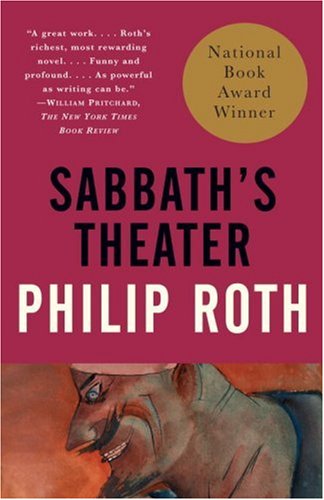
Sabbath's Theater by Philip Roth

This book is dirty.  It is, outside of freakishness-for-freakishness' sake books like Naked Lunch and Crash, the dirtiest book I have ever read.  My girlfriend gave it to me for my birthday, but I don't think she knew that at the time.

Mickey Sabbath is a retired puppeteer living in New England.  Although "retired" may be the wrong word for someone who was hounded into joblessness for "taking advantage" of a younger student.  Which is basically the story of his life--where Sabbath finds sex liberating, and wears his fetishes and licentiousness on his sleeve, few others share his openness, like the cop who arrested him for exposing a woman's breast (with her tacit consent) during an adult puppet show near Columbia University in the 60's.

But all that is mostly flashback.  When the novel opens, Sabbath is forced to deal with the sudden death by cancer of his longtime mistress Drenka, his most committed and adventurous sexual partner.  Drenka's death forces Sabbath to force his own mortality, but also to masturbate on her grave:

Even dead, Drenka gave him a hard-on; alive or dead, Drenka made him twenty again.  Even with temperatures below zero, he would grow hard whenever, from her coffin, she enticed him like this.  He had learned to stand with his back  to the north so that the icy wind did not blow directly on his dick but he still had to remove one of his gloves to jerk off successfully, and sometimes the gloveless hand would get so cold that he would have to put that glove back on and switch to the other hand.  He came on her grave many nights.


I wanted to read Sabbath's Theater because of a passage in James Wood's How Fiction Works where he talks about how successfully Philip Roth combines low registers ("cunt," "tits," etc.) with high registers ("even the toilet bowl cleaners appeared to have been designed by Brancusi"), which Wood considers the mark of sophisticated prose.  More than that, Roth's variegated style turns Sabbath into a proponent of the intellectual and moral joy of sexual transgression, rather than a simple hedonist.  (I was expecting someone like John Self from Money, but that's not Sabbath at all).  It's no surprise that Sabbath compares himself to Falstaff, who also justifies his appetites by rhetorical flourishes.

And yet part of Sabbath's reckoning with his past requires facing the harm his proclivities can cause; for every encounter with a puritanical cop there is a time in which he buys liquor for a girl in rehab in exchange for oral sex.  Sabbath wavers between extreme guilt and extreme defiance, unable to differentiate until the end, I think.  Throughout the book he describes the agony of his first wife's abrupt disappearance, and takes to telling people, "I killed my wife"--but is it an admission of wrongdoing, or just another farce, another puppet show?

I read Portnoy's Complaint years ago and didn't care for it, yet I really enjoyed Sabbath's Theater.  Portnoy, to the best of my recollection, was a chronicle of sexual repression and frustration; Sabbath's Theater represents something like a release from that, and I think it succeeds on that sheer, liberated audacity.

Wednesday, May 30, 2012

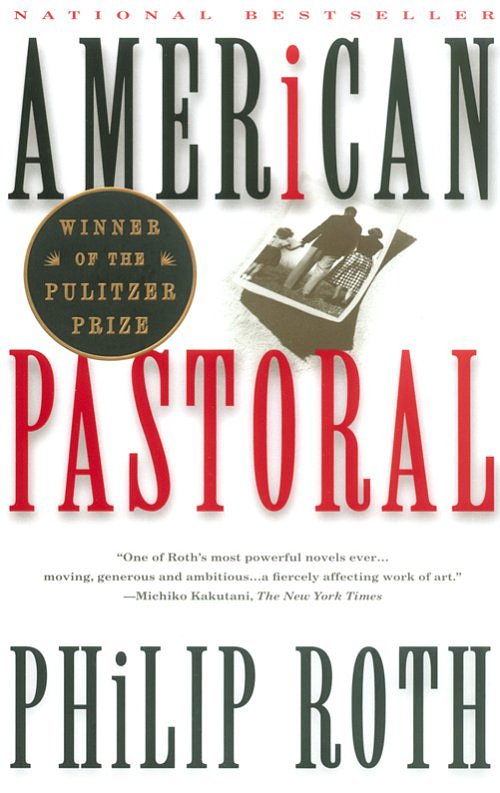
American Pastoral by Philip Roth


“You fight your superficiality, your shallowness, so as to try to come at people without unreal expectations, without an overload of bias or hope or arrogance, as untanklike as you can be, sans cannon and machine guns and steel plating half a foot thick; you come at them unmenacingly on your own ten toes instead of tearing up the turf with your caterpillar treads, take them on with an open mind, as equals, man to man, as we used to say, and yet you never fail to get them wrong. You might as well have the brain of a tank. You get them wrong before you meet them, while you're anticipating meeting them; you get them wrong while you're with them; and then you go home to tell somebody else about the meeting and you get them all wrong again. Since the same generally goes for them with you, the whole thing is really a dazzling illusion. ... The fact remains that getting people right is not what living is all about anyway. It's getting them wrong that is living, getting them wrong and wrong and wrong and then, on careful reconsideration, getting them wrong again. That's how we know we're alive: we're wrong. Maybe the best thing would be to forget being right or wrong about people and just go along for the ride. But if you can do that -- well, lucky you.”
 

A couple years ago, I went a Roth micro-binge and read The Counterlife and Everyman. I wasn’t extremely impressed, and, although I thought The Counterlife had some interesting ideas, I mostly wrote Roth off as an author who was clearly very talented, but maybe not for me. Fast forward a few years, and, married with a newborn daughter, I picked up American Pastoral to kill some time and  found myself completely sucked in.


The novel follows Seymour Levov, “The Swede”, a Jewish man who was once the godlike star of his high school. Handsome, athletic, friendly, the Swede was a hero to all he met, including Roth’s frequent stand-in, Zuckerman, who, at his request, agrees to write about the Swede’s father only days before the Swede dies of prostate cancer. At the meeting, Zuckerman is convinced that the Swede has led a charmed, unchallenging life, but finds that he is wrong when he learns (SPOILER) that Merry Levov, the Swede’s only child, bombed a post office as a teenager, and destroyed her family in the process.


I’m glad I waited until now to read American Pastoral, because it, like much of Roth’s later work, doesn’t really seem oriented toward the twenty-something crowd. It takes its time to get moving, spending the first third at a high school reunion after a short open paean to the Swede, and then following Zuckerman’s extrapolation of how the Swede’s life may have played out after high school. Interestingly, Roth never reveals what actually happened, never drops any hints as to the veracity of Zuckerman’s narrative, but it ultimately doesn’t matter: Zuckerman’s slow motion replay of the Swede’s life is a complete gut punch. At one point, I even did something I never do, skipping several pages detailing Merry’s debasement because it was too difficult to read in my situation. The entire second half of the novel is pretty heavy, as the Swede attempts to make sense of his daughter’s actions. His mental inventory of all his mistakes as a father bring him no closer to a sense of understanding or closure; indeed, Merry’s fate seems to have been set in motion before she was even born, pushing the nearly beatific Swede to the edge and just past.


Reading review of Pastoral is illuminating, because many readers took issue with the long digressions on glovemaking--the source of the Levov’s considerable wealth--or beauty pageants, but to me, these all served to underline the novel’s themes: no matter how hard you work or how good you are, your world is only one rash action from being turned to rubble. Or, as Roth puts it, “He had learned the worst lesson that life can teach - that it makes no sense.”  It’s easy to read the novel another way as well, with the Swede representing the 50s ideal and Merry and her friends as the whirlwind 60s, but in my mind, what really sticks out is not the fine prose or the clever parallels, but the truly terrifying portrait of a family falling to pieces, and the good man who can do nothing about it, and maybe never could.

Tuesday, February 24, 2009

Everyman by Philip Roth

'The pitiful middle-aged wife, embittered by rejection, consumed by rotten jealousy! Raging! Repugnant! Oh, I hate you for that more than anything. Go away, leave this house. I can't bear the sight of you with that satyr-on-his-good-behavior look on your face! You'll get no absolution from me--never! I will not be trifled with any longer! Go, please! Leave me alone!'"

Lest you think for a moment that I've mistyped the author's name, the preceding excerpt was indeed written by Philip Roth, not Tom Wolfe (pause for nervous book-nerd laughter). Everyman is the second book I've read by Roth, and, in addition to not being particularly compelling in general, it suffered especially following the very interesting The Counterlife.

Everyman, in spite of its inclusive title, is the story of one very specific man, the son of a Jewish jeweler from Newark. The protagonist, never given a name and heretofore referred to as Philip, has an generous and loving older brother whom he resents for his sterling health, a string of jilted wives and lovers, each one sacrificed upon the altar of youth and sexual desire, a daughter who is forgiving to a fault, and a laundry list of medical conditions and hospital visits that take up the bulk of Everyman's already slim 180 pages.

Roth is aging, and, since many of his protagonists are doppelgangers of himself, his avatars are aging as well. Roth's preoccupation with death and the capital-E End are the centerpieces of the work, the themes completely overpowering any overarching storyline. Instead, the story starts at Philip's funeral and then jumps back to his childhood, recounting a series of vignettes interspersed with the aforementioned hospital visits. The interesting thing about these glimpses into the past is that most of them don't do much to round out the character of Philip. In a book so tightly-focused, I expected a character study, some deep insight into the everyman of the story, but instead, Roth's chosen episodes don't do much more than illustrate Philip's selfish attitude and his willingness to betray and injure anyone or anything that would prevent his carnal pleasures.

In the closing pages, Philip calls friends he's known, each one sicker than the last, and talks to them about their lives, but he never achieves any sort of profundity. On the subject of religion, Roth deigns to say nothing more than that it is childish. Friends are disposable, there to talk to if situations grow too bleak, but can be used as stepping stones with no remorse. Women are challenges, puzzles that become nothing but yesterday's static image when completed. Philip regrets that he can no longer sleep with 25-year-old girls and that he will never match his brother's success. The lives he's wrecked, the things he's sacrificed, not a thought for them. That's the problem with Roth's everyman: He doesn't want to die, but, seeing his life in panorama, it's hard for me to care. Not all stories need a likable protagonist; everything is not a tale of redemption, but with Everyman, I can't help but wonder what Roth was shooting for. His themes are writ large: DEATH, OLD AGE, SICKNESS, but the themes are ends in themselves, and are barely explored in the narrative itself, which essentially concludes that death is to be avoided and old age sucks. Philip himself is nothing special either. His character fails to illustrate anything unique. In that sense, he is the everyman promised in the title. At the same time, he fails as a prototype because he's either a strawman made up of a repulsive stew of attributes no average man would exhibit, or a terrible person whose death doesn't seem terribly tragic to anyone but him.

In the end, when Philip goes in for his final operation, we are told:

He went under feeling far from felled, anything but doomed, eager yet again to be fulfilled, but nonetheless, he never woke up. Cardiac arrest. He was no more, freed from being, entering into nowhere without knowing it. Just as he'd feared from the start.

As a nihilist tract, Everyman succeeds admirably. As a piece of literature, I confess, the message eludes me.

Monday, February 23, 2009

The Counterlife by Philip Roth

Standing singly at the Wall, some rapidly swaying and rhythmically bobbing as they recited their prayers, others motionless but for the lightning flutter of their mouths, were seventeen of the world’s twelve million Jewish communing with the King of the Universe. To me it looked as though they were communing solely with the stones in whose crevices pigeons were roosting some twenty feet above their heads. I thought (as I am predisposed to think), “If there is a God who plays a role in our world, I will eat every hat in this town”

Nonetheless, I couldn’t help but be gripped by the sight of this rock-worship, exemplifying as it did to me the most awesomely retarded aspect of the human mind. Rock is just right, I thought: what on earth could be less responsive? Even the cloud drifting by overhead. . . appeared less indifferent to our encompassed and uncertain existence. I think that I would have felt less detached from seventeen Jews who openly admitted that they were talking to rock than from these seventeen who imagined themselves telexing the Creator directly; had I known for sure it was rock and rock alone that they knew they were addressing, I might even have joined in.

While reading The Counterlife, I was reminded of David Foster Wallace's overview of John Updike's career where he says, as Chris mentions in his review of Updike's The Centaur, that all of Updike's protagonists are just portraits of himself. While that may or may not be true (I haven't read any Updike yet, so I can't say), I think that criticism applies more fully to Philip Roth.

Anyone who is even passingly familiar with Roth's body of work knows that Nathan Zuckerman is Roth's avatar in his fictional universe. Roth has Portnoy's Complaint, Zuckerman, Carnovsky. Both make their living on Jewishness, dissecting and dwelling on it while at the same tie denying its effects on their lives. Both have trouble with marriage and family, both are obsessed with sex—it is fitting that The Counterlife showcases Roth and Zuckerman in equal measures.

Roth doesn't show up in person, as in some of hi other works. Rather, the author becomes a character through proxy as a result of the books semi-biographical content and its metafictional structure. Split up into five connected but non-sequential sections, The Counterlife is a literary puzzle disguised as a realistic novel, an experimental cipher with no ultimate solution. Roth himself becomes a character because, as the story goes on, it becomes clear that the author is the only character who truly exists. Characters die in one section and are resurrected in the next. In “Basel”, Henry Zuckerman, Nathan's younger brother, dies during a heart operation. In “Gloucestershire”, it's Nathan who's dead. In “Christendom”, Nathan is healthy and free; “Judea” and “Aloft” are the only two sections which seem to be chronologically connected, “Judea” ending with Nathan leaving Israel after visiting Henry who, now alive after dying in “Basel”, has become a radical Zionist, and ending with Nathan caught up in the middle of a hijacking.

If all this sounds confusing, it sometimes is, but only until the conceit becomes clear. When read as standalone variations of the same basic plot, the search for a “Counterlife”, an alternate path, the structure makes sense. How else to have the same characters make different decisions? It is impossible that Zuckerman (both Henry and Nathan) die and live, but the strength of fiction is that nothing is truly impossible, that if a decision leads to arrest on a jet, well, we can start over again, back in England, no worse for wear.

Roth's Jewish fixation takes center stage, exhibiting both as Henry's radical Zionism and Nathan's response to it in “Judea/Aloft”, as Nathan's previously untapped wells of racial sensitivity in “Christendom”, and in the idea that Nathan (and Roth himself) still feels a deep-seated compulsion to defend his Jewishness, to stay in touch with a deep Zionist urge that Roth indicates lies at the bottom of all Jewish conflict. The Counterlife sometimes seems like a Roth apologia, his explanation for why a secular Jew who considers religion childish would spend his writing career sifting through through the strata some Semetic identity he can believe in.

No conclusion could hope to be completely satisfying, but then, what conclusions does The Counterlife actually draw? Roth uses the multiple narrative structure as a way to pull the ground out from under the reader, never letting us know what is real and what is not. While reading, I decided “Gloucestershire” had the best chance of being true, since it didn't seem invalidated in other parts of the work. Knowing now, however, that Nathan has appeared in later novels by Roth (and also that Zuckerman himself may be a construction of another fictional author of Roth's, forming a Russian doll writer's bloc), it seems most likely that nothing in the book is true at all. On the other hand, Roth takes great pains, both in the narrative itself and in interviews discussing the work, to point out that The Counterlife is only a story, regardless of the parallels to his own life, and in a story, anything can be true. In a sense, The Counterlife forces us to do that same thing its inhabitants do: to make a choice, any choice, even if we aren't sure it's the right one.

Wednesday, July 18, 2007

Portnoy's Complaint by Philip Roth

Jews and sex. Sex and Jews. Sexy Jews. Jewy Sex.

Thus can Philip Roth's book Portnoy's Complaint be described. In it, Alexander Portnoy, a successful thirty-something civil rights lawyer monologues to his shrink, Dr. Spielvogel, about the travails of his childhood and his many unsuccessful sexual affairs. Portnoy's problem (his "complaint") is that while he has a monstrous and somewhat deviant sexual appetite, his ethics will not let him engage in sexual diversion without much inner struggle. This is connected to his childhood and to his strict Jewish parents, who seem to be a lot like Fran Drescher's mom on The Nanny. When Portnoy isn't thinking about sex (at one point, he masturbates into a cored apple), he's thinking about Jews, and how as a self-described atheist he finds it difficult to relate to his family and surroundings, which are uber-Jewish.

This book is dark, funny, and extremely crude (it uses the word "cunt" more often than any book I have read, or any pornography I have seen), but for all that it's a little disappointing. Portnoy's monologue jumps around so considerably that it lacks any real narrative or forward structure, and it just doesn't have a lot of emotional heft. I have a feeling that this book may be enjoyed more by a Jewish person, but as a goy it left me sort of unimpressed. It certainly didn't leave me feeling that Roth is, as many have described him, the greatest living American author.