Showing posts with label Time 100 Books List. Show all posts

Tuesday, October 5, 2021

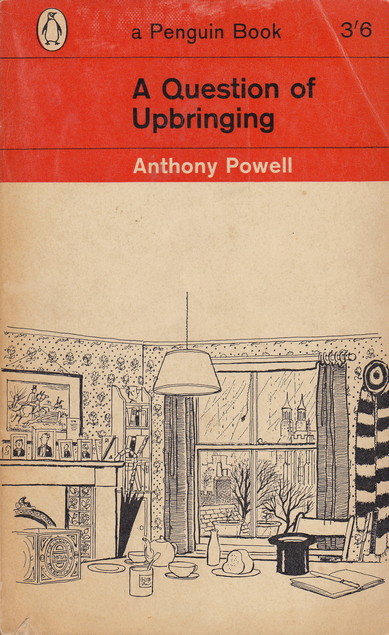
A Question of Upbringing by Anthony Powell

The image of Time brought thoughts of mortality: of human beings, facing outward like the Seasons, moving hand in hand in intricate measure: stepping slowly, methodically, sometimes a trifle awkwardly, in evolutions that take recognisable shape: or breaking into seemingly meaningless gyrations, while partners disappear only to reappear again, once more giving pattern to the spectacle: unable to control the melody, unable, perhaps, to control the steps of the dance. Classical associations made me think, too, of days at school, where so many forces, hitherto unfamiliar, had become in due course uncompromisingly clear.

When A Question of Upbringing, the first book in Anthony Powell's monumental series A Dance to the Music of Time, begins, the narrator, Nicholas Jenkins, is a green young student at a tony secondary school in England. Like a lot of people at sixteen or so, his life takes the form of a preoccupation with other people, whose habits and values he yearns to know better so that he might fashion himself after them. There's his roommate, Stringham, wealthy and mercurial, and Templer, a brash womanizer. Rounding out this group is Widmerpool, an aloof, buffoonish student whom nobody likes. Widmerpool's ambition is comic, and the more popular students either rag on him or do their best to ignore him; on the other hand, even if you didn't know a little about Widmerpool's rise to power and fortune over the course of the series, you might recognize it as something more formidable than the young students are able to.

Mostly, A Question of Upbringing feels like an elliptical take on the familiar campus novel, something a step removed from Lucky Jim or the first part of Brideshead Revisited. The lynchpin scene of the friendship between Jenkins, Stringham, and Templer comes when Stringham sees a wanted poster that bears an uncanny resemblance to their overbearing house master Le Bas and calls the cops to report him. But the friendship quickly fades--Powell cannily reveals how brief the relationships we consider formative in our youth really can be--and the scene moves outward through slight variations: a finishing program in the French countryside, the first year of college. What Jenkins learns at these institutions is really the shifting and subtle nature of human beings: the subtle changes in Stringham and Templer, for instance, that makes their friendship no longer viable.

There's a curiously unfinished quality to A Question of Upbringing: characters are ushered onto the stage to make very light impressions, and then ushered off again, as if being earmarked for later use, which they probably are. Powell makes much of the way that people leave one's life and then suddenly appear again, revitalized and seen anew in new contexts; though the novel feels preoccupied with its preparatory motions, you have to admit this quality captures something of the anticipatory nature of youth. I sort of expect the first book in the series is like a TV pilot; something with rough edges you have to sit through to get to the good stuff. I will probably read one of these a year until I finish: it will take twelve years, at which point I'll be 46. That seems to me perhaps to be the right way to absorb a series with a scale like this one.

Thursday, March 2, 2017

Loving by Henry Green

'Oho so that's the old game,' he laughed.  'Keeping me on a string is it, to leave me to picture this and that and the other to do with you and him?'

'If you can bring your imagination to such a level you're to be pitied,' she answered tart.

'All I did was to ask,' he objected.

'You're free to picture what you please,' she replied.  I've got no hold on your old imagination, not yet I haven't.'

'What d'you mean not yet?'

'I mean after we're married,' she whispered, her voice gone husky.  'After we're married I'll see to it that you don't have no imagination.  I'll make everything you want of me now so much more than you ever dreamed that you'll be quit imaginin' for the rest of your life.'

The natural comparison point for Loving is obviously Downton Abbey: like the show, Green's novel is about the contrast in the lives of the residents of an old castle and the lives of their servants.  But whereas Downton Abbey is all melodrama, made for people with the attention spans of lizards, Green's novel demands the utmost patience, and its drama is wrought from the finer details of human life.  It's set during the war, but the war is distant, threatening--the servants at the Irish castle fretfully wonder whether they should return to their homes in England, to their loved ones, before the "Jerries" use the island as a stepping stone.  (Not like on Downton Abbey, where they have to show the pressures of war by turning the castle into a flipping soldiers' hospital.)

The novel begins with the death of the longtime head butler, Eldon.  His replacement, Charley Raunce, is by turns irascible and jovial, but the other servants (and his employer, Mrs Tennant) can see how green he is.  He's anxious to assert his new authority, but also to skim a little off the top of what he charges the household for supplies, something his predecessor did expertly for decades but which he hasn't yet learned to handle with tact or grace.  Meanwhile, he falls in love with a younger maid named Edith.  The romance between Charley and Edith proceeds sweetly but prosaically, with the happy fatalism of two people who realize, seemingly simultaneously, that they are meant to be together.  It's convincing, and somehow more affecting than it would have been with what you might call more fireworks.

Fireworks aren't Green's style.  The drama in Loving involves a missing ring, a pet peacock strangled by a bitter child, a glove full of eggs, a mouse caught in the wheels of a mechanical weathervane, a finely captured game of Blind Man's Bluff.  The house is full of characters who Green refuses to introduce with any fullness; if most people are unknowable, especially when we meet them, why should he bother?  As if to underscore this point, he names two separate young men Albert.

The result is a masterpiece of minimalism.  It seems like hardly a word is spared in Loving, nothing is extraneous.  And yet Green's sentences, often shorn of punctuation, take you on surprising, miniature journeys:

Albert laid himself under a hedge all over which red fuchsia bells swung without a noise in the wind the sure travelling sea brought with its low heavy swell.  He could watch the light blue heave between their donkey Peter's legs and his ears were crowded with the thunder of the ocean.

How can something made of such simple parts demand such attention to be understood?  That first sentence is so simple, but I swear I had to read it three times to follow it.  Not because it's a sloppy sentence, but because of its impeccable design.  Green doesn't break into these prose moments often, but often enough to seem like showing off, as if saying, I can do this, if I choose to.  Mostly the book is in dialogue, which is Green's most renowned skill.  James Wood, in How Fiction Works, praises Green for refusing to stuff his dialogue with adverbs to tell us how the characters are feeling; as with real people, our words are not as clear as we would want them to be.  In Loving, characters speak to each other like people, which is rare.

This is one of those books that I feel I haven't done justice.  Not just in this review, but in reading it; I feel like I wasn't up to its demands.  (I read this book on vacation in North Carolina; last year on the same trip I zipped through all 700 pages of Argall in the same time it took me to plod through the 200 pages of Loving.)  It's not complex, but it is exacting, and often surprising--blink and you'll miss something valuable, or extraordinary.  It's a book that ends just when you feel like you're learning how to read it.

Saturday, January 21, 2017

Herzog by Saul Bellow

If I am out of my mind, it's all right with me, thought Moses Herzog.

Some people thought he was cracked and for a time he himself had doubted that he was all there.  But now, though he still behaved oddly, he felt confident, cheerful, clairvoyant, and strong.  He had fallen under a spell and was writing letters to everyone under the sun.  He was so stirred by these letters that from the end of June he moved from place to place with a valise full of papers.  He had carried this valise from New York to Martha's Vineyard, but returned from the Vineyard immediately; two days later he flew to Chicago, and from Chicago he went to a village in western Massachusetts.  Hidden in the country, he wrote endlessly, fanatically, to the newspapers, to people in public life, to friends and relatives and at last to the dead, his own obscure dead, and finally the famous dead.

Moses Herzog is in crisis.  His wife, cold, beautiful, and shrewd, has left him for his best friend, a boisterous, redheaded man with a wooden leg named Valentine Gersbach.  Together they have evicted him from his own house, and given his picture to the local police.  His lawyer advises him not to sue for custody of his daughter, June--the mother, he says, always wins.  So he bounces aimlessly around New York, Chicago, Western Massachusetts, writing letters to people, some to friends, some to family, some to people he's never met.

The letters Moses writes are frenetic, neurotic, and filled with the heady intellectual musing of an academic.  They are as dense as the book he's written on Romanticism, but they don't help:

All the while his heart is contemptibly aching.  He would like to give this heart a shaking, or put it out of his breast.  Evict it.  Moses hated the humiliating comedy of heartache.  But can thought wake you from the dream of existence?  Not if it becomes a second realm of confusion, another more complicated dream, the dream of intellect, the delusion of total explanations.

In some sense Herzog is a satire of intellectualism, which fails to address Herzog's traumas.  In its place Bellow advocates what he calls, in a tremendous turn of phrase, "potato love"--the sub-verbal kind of love which Herzog has for his daughter, June, and which his wife has denied him.  It's a simple idea, really, dressed up in the incendiary volleys of Bellow's prose.

Nobody writes with the vitality of Bellow.  Herzog is low on plot, but it absolutely bursts with energy.  But Bellow--one of the very best prose stylists in the history of the English language--is never out of control, and the high-octane style of the book never gets tedious.  It helps that Bellow populates the book with a cast of vivid characters, almost all of whom exist only to be vivid.  And Bellow's eye for detail is tremendous:

He remembered that late one afternoon she led him to the front-room window because he asked a question about the Bible: how Adam was created from the dust of the ground.  I was six or seven.  And she was about to give me the proof.  Her dress was brown and gray--thrush-colored.  Her hair was thick and black, the gray already streaming through it.  She had something to show me at the window.  The light came up from the snow in the street, otherwise the day was dark.  Each of the windows had colored borders--yellow, amber, red--and flows and whorls in the cold panes.  At the curbs were the thick brown poles of that time, many-barred at the top, with green glass insulators, and brown sparrows clustered on the crossbars that held up the iced, bowed wires.  Sarah Herzog opened her hand and said, "Look carefully, now, and you'll see what Adam was made of."  She rubbed the palm of her hand with a finger, rubbed until something dark appeared on the deep-lined skin, a particle of what certainly looked to him like earth.  "You see?  It's true."

What a lovely story, I think, but it really lives because of the specificity and particularity of the description of the windows, and the snow in the street, and the light poles.  It's the kind of thing that lesser writers try, and can never seem to do right; for Bellow it never seems extraneous.

Bellow makes Herzog's story a moving reflection on suffering, and on the necessity of love amid great pain.  But the best thing about it is just getting caught in the torrential music of Bellow's writing.

Wednesday, October 12, 2016

Appointment in Samarra by John O'Hara

Julian English sat there watching him, through eyes that he permitted to appear sleepier than they felt.  Why, he wondered, did he hate Harry Reilly?  Why couldn't he stand him?  What was there about Reilly that caused him to say to himself: "If he starts one more of those moth-eaten stories I'll throw this drink in his face."  But he knew he would not throw this drink or any other drink in Harry Reilly's face.  Still, it was fun to think about... Yes, it would be fun to watch.  The whole drink, including the three round-cornered lumps of ice.  At least one lump would hit Reilly in the eye, and the liquid would splash all over his shirt, slowly wilting it as the Scotch and soda trickled down the bosom to the crevice at the waistcoat.  The other people would stand up in amazed confusion.  "Why, Ju!" they would say.  Caroline would say, "Julian!"

Appointment in Samarra begins with Julian English, a member of the social elite in the medium-sized town of Gibbsville, PA, drunkenly throws a drink in the face of a man he dislikes.  This relatively minor crime sets into motion a series of events that leads to Julian becoming a social and professional pariah, the dissolution of his marriage, and eventually--spoiler alert--his own suicide.

I knew that about the novel going in, and expected it to be something like the short-lived NBC series The Slap--about how the repercussions of a small misdeed snowball into something dramatic and chaotic.  But that's not really the way that it plays out in Appointment in Samarra.  O'Hara teases us with the possibility that the social world will collapse around Julian.  Julian worries, for instance, that his assault on Harry means that the Catholic bloc in Gibbsville has turned against him, customers he needs as a Cadillac dealer.  O'Hara introduces a minor mobster, and gives him immense "screen time" to suggest that somehow Julian will end up in trouble with the mob--and he does, but it blows over quickly.  No, it's not the actual collapse but the threat of collapse that causes Julian, a hard drinker and a weaker man than he would confess to, to get drunk, and climb into his own car, running in the driveway.

Fran Lebowitz called O'Hara "the real F. Scott Fitzgerald."  You can see what she's talking about: the corruption of the social scene, the burden of wealth, it's all there.  But The Great Gatsby, for all its essential sadness, takes place on a grand stage.  It's a tragedy in the Greek sense; the downfall of a great man.  The sadness of Appointment in Samarra is of a different kind.  Julian's suicide is affecting because it seems so pointless.  His marriage would have survived.  His social standing would have too, but if it hadn't, what then?  Gibbsville is hardly New York City--it's more like the small, snow-covered Midwestern towns that Nick Carraway dreams of returning to.  In his intoxication, Julian wants his suicide to be what a lot of suicides want--a grand gesture that will alter the landscape of those around him.  In the end, the smallness of the landscape makes the gesture small.  When it's all over, there's no catharsis to be had here; just a bitter taste in your mouth.

Friday, August 19, 2016

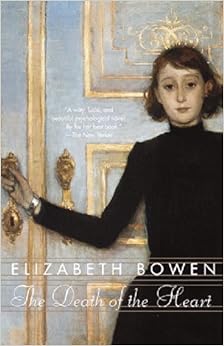
The Death of the Heart by Elizabeth Bowen

She had watched life, since she came to London, with a sort of despair--motivated and busy always, always progressing: even people pausing on bridges seem to pause with a purpose; no bird seemed to pursue a quite aimless flight.  The spring of the works seemed unfound only by her: she could not doubt people knew what they were doing--everywhere she met alert cognisant eyes.  She could not believe there was not a plan of the whole set-up in every head but her own.  Accordingly, so anxious was her research that every look, every movement, every object had a quite political seriousness for her: nothing was not weighed down by significance.

Portia, sixteen, comes from quite a checkered history: Her father impregnated her mother, with whom he was having an affair, and was summarily exiled from what he had considered a happy marriage.  In fact, he always taught Portia that the home which he had to leave was a kind of cozy family paradise.  After her father's death, Portia and her mother live in a series of French hotels for years, until her mother dies, and Portia finds herself returned to that mythic, paradisaical home, to live with her half-brother Thomas and his wife Anna.

This situation, of course, is a recipe for disappointment.  The title says as much: The Death of the Heart is a novel about the disillusionment of young idealism.  Portia takes up with Eddie, a young "bounder" (as the kids say, in 1938) who is tempestuous, selfish, and unreliable.  The adults in Portia's life know that Eddie is no good, but Bowen asks us to find something valuable in Portia's unwavering love for Eddie, which is strong and noble compared to the dissipated, conflicted love that Thomas and Anna have for each other, or their parents did.  The Death of the Heart is a novel about what the reality of the world does to young people; it starts, like an episode of Gossip Girl, when Anna illicitly reads Portia's diary.

A scrap of praise on the back of my copy insists that Bowen is "the link that connects Virginia Woolf with Iris Murdoch and Muriel Spark."  To my disappointment, there's very little of any of those three authors in The Death of the Heart.  It's much closer to those writers who came before Woolf and Modernism, like Henry James and Edith Wharton, whose subject was the human psyche as it appears when filtered through the strictures of social mores.  When Bowen has something profound or incisive to say, she launches into a kind of authorial lecturing:  "We really have no absent friends," she says.  "The friend becomes a traitor by breaking, however unwillingly or sadly, out of our own zone: a hard judgement is passed on him, for all the pleas of the heart."  An insightful thought, but sort of Victorian in its style and certitude.

The Death of the Heart appears on Time's 100 Books of the 20th Century List, which has been a great source of discoveries for me in the past.  Though I enjoyed it, I'm not sure this one quite deserved the honor.

Sunday, July 10, 2016

The Man Who Loved Children by Christina Stead

He himself, Sam, had had the pleasure of being a father, five times already, and imagine the joy when he found that at one birth he had twins!  He could never have it enough.  Each time, he explained to Naden, he felt an immense pride, a belief in a limitless future, in an unfolding universe, a hope for the proliferating human race in that shadow of dust, and infinitesimal corner of dimensionless space, even so.

Oh, man.  Some books are just sui generis--completely in their own category, impossible to ever reproduce, even by the same author.  I can't imagine even Christina Stead writing another book like The Man Who Loved Children.  How could she?  The family that she writes about--a fictionalized version of her own, you're horrified to find out--is so unique and irreproducible that it can only exist once.  It's like Tolstoy's thesis that "every unhappy family is unhappy in its own way," expounded on for 500 pages.

The title character is Sam Pollitt, a low-level bureaucrat in the Fisheries Department of some division of the federal government.  Sam is a classic early-20th century Progressive Rationalist, full of far-flung ideas about the future and mankind, a patronizing attitude toward foreign races and a keenness for eugenics.  Sam loves children, especially his own, and sees them as an extension of his own fine feelings about humanity.  He has a private language with them, a mish-mash of pet names and baby-talk:

'Bring up your tea, Looloo-girl: I'm sick, hot head, nedache [headache]; dot pagans in my stumjack [got pains in my stomach]: want my little fambly around me this morning.  We'll have a corroboree afterwards when I get better.  Mother will make the porridge.'  He was begging her, yearning after her.

This stuff is hard to read, even when Stead gives bracketed translations; but it seems true to life.  All books teach you how to read them, but The Man Who Loved Children requires you to study really hard.  ("Corroboree," by the way, gives away the Australian Stead's scrupulous Americanizing of her own father.)  Sam's child-language, and his childish behavior--indifference toward money, even when it's short, his selfishness and laziness--drive his wife Henrietta to madness.  He calls hims "Sam-the-Bold," she calls him "The Great-I-Am."  For most of the book, they are not on speaking terms, except to shout and claw at each other violently:

As Henny sat before her teacup and the steam rose from it and the treacherous foam gathered, uncollectible round its edge, the thousand storms of her confined life would rise up before here, thinner illusions on the steam.  She did not laugh at the words 'a storm in a teacup.'  Some raucous, cruel words about five cents misspent were as serious in a woman's life as a debate on war appropriations in Congress: all the civil war of ten years roared into their smoky words when they shrieked, maddened, at each other; all the snakes of hate hissed.

And if these two powerful characters weren't enough, Stead adds a third in the child Louisa, or Louie, Sam's daughter from a previous marriage.  Louie is a dark and troubled genius, literary where her father is scientific, gloomy where her father is sanguine, and sensitive to the dismay of others, like Henrietta, when Sam blithely ignores them.

Sam's love for his children is really a kind of narcissism.  He loves them to the extent that they are reflections of himself, and when they fail to live up to his fantastic ideals his fine feeling turn to cruelty.  This happens over and over, in scenes that are funny, grotesque, and vivid.  Louie writes a play in a made-up language called Tragos: Herpes Rom (Tragedy: The Snake-Man) and has the children perform it for her father, with the aid of a translation.  ("Did Euripides write in English?" she asks).  The play is about a father who wants to hug his daughter, but she feels threatened by his constrictor-like embrace, and refuses.  Louie wants desperately to show her father how he mistreats her, and with the play Stead shows cannily how we crave the approval of our parents even as we want to overthrow them.  But Sam cannot hear this, he only sees feminine silliness: "I did not expect you to be so silly," he says, "you were the child of a great love... I never heard so much idiotic drivel in my born days.  Go and put your fat head under the shower."  When another of his sons complains that the smell of the fish they have been boiling for oil is making him sick, Sam forces him to carry the fish's rotting remains to the shed piece-by-piece while he vomits over and over again.

The novel has the downward-hurtling trajectory of a great tragedy.  Halfway through the book, scandal forces Sam out of his job at the Fisheries Department, and he refuses to recognize evil by responding to the accusations.  His idealism forces them into a rundown shack in Annapolis, where they live in increasing squalor and tension.  Henrietta is forced to steal money from her own children to make ends meet, while Sam prattles about the nobility of poverty, until his own petty wants are not addressed:

Sam flushed with anger.  'Why aren't there any bananas?  I don't ask for much.  I work to make the Home Beautiful for one and all, and I don't even get bananas.  Everyone knows I like bananas.  If your mother won't get them, why don't some of you?  Why doesn't anyone think of poor little Dad?'  He continued, looking in a most pathetic way round, at the abashed children, 'It isn't much.  I give you kids a house and a wonderful playground of nature and fish and marlin and everything, and I can't even get a little banana.  And bananas are very healthy.  Who here likes bananas?'

Such selfishness is hard to believe.  And yet, Stead makes us believe it: Sam, Henny, and Louisa are each in their own way fully bizarre, but they are believable in every respect.  Making the absurd seem plausible is one of a writer's great achievements, I think.  At the same time, Sam is not wholly unsympathetic: perhaps he cannot help his ignorance, can never see that his daughter hates him and his household is falling apart; maybe his own private idealistic universe is just too powerful.

When the novel comes to its expected tragic and and grisly end, it seems almost too commonplace.  The Man Who Loved Children is so bizarre, so awful, so fantastical, that there is a double sadness in the ordinariness of its tragic climax.

The Man Who Loved Children is one of those books that was a financial and critical failure when it came out, only to have its reputation resurrected by a single fan, in this case, the poet Randall Jarrell, although Jonathan Franzen has also written about his love for the novel.  In his introduction, Jarrell compares it to Moby Dick, another novel that was unloved at its publication.  And there's something Moby Dick-esque in the fullness and variability of Stead's prose, though that's not the way that Jarrell meant it.  In truth, I can think of very few people that I would recommend this to.  It requires a lot of patience and thick nerves.  The kind of reader who complains about characters not being "relatable" should steer clear.  But for a certain kind of person, this is an unforgettable book.

Thursday, July 23, 2015

Play It as It Lays by Joan Didion

She began to feel the pressure of Hoover Dam, there on the desert, began to feel the pressure and pull of the water.  When the pressure got great enough she drove out there.  All that day she felt the power surging through her own body.  All day she was faint with vertigo, sunk in a world where great power grids converged, throbbing lines plunged finally into the shallow canyon below the dam's face, elevators like coffins dropped into the bowels of the earth itself.  With a guide and a handful of children Maria walked through the chambers, stared at the turbines in the vast glittering valley, at the deep still water with the hidden intakes sucking all the while, even as she watched; clung to the railings, leaned out, stood finally on a platform over the pipe that carried the river beneath the dam.  The platform quivered.  Her ears roared.  She wanted to stay in the dam, lie on the great pipe itself, but reticence saved her from asking.

Maria (Ma-RYE-a) Wyeth is a starlet, the kind who never really drops the diminutive to become a "star."  (Kind of like Tuesday Weld, who plays Maria in the film version of Play It as It Lays?)  In a brief first-person narrative that opens the book, she gives us her life story: growing up in tiny Silver Wells, Nevada, a town that doesn't exist anymore, moving to New York where she becomes involved with a manipulative abuser named Ivan, coming to Los Angeles and marrying the producer Carter Lang, who puts her in a couple small pictures, having a daughter, Kate, who is confined to a mental institution.  But most of the book occurs in the third person, as a disembodied observer watching Maria tumble slowly into a nervous breakdown.

The most obvious comparison point for Play It as It Lays is The Bell Jar: both are about young women undergoing protracted mental episodes.  Both Maria and Esther Greenwood cling around the lower rungs of a industry dominated by male figures.  Play It as It Lays is populated with cruel men: the psychopathic Ivan, the dismissive Carter, a womanizing Russian mobster named Larry Kulik.  None of these men understand Maria, nor do they care to; Maria's instability and suffering threaten the kind of freewheeling party atmosphere they laboriously occupy.

But the other comparison point is Nathanael West's L.A. phantasmagoria The Day of the Locust, another book that paints Hollywood as a moral black hole.  Los Angeles may not be to blame for Maria's breakdown, but it is somehow the perfect backdrop for it: shallow, superficial, misogynistic, destructively hedonistic.  Much of the novel is taken up by Maria driving around Greater Los Angeles with no clear destination or purpose, which is most of what I imagine happens on L.A. freeways:

In the aftermath of the wind the air was dry, burning, so clear that she could see the ploughed furrows of firebreaks on distant mountains.  Not even the highest palms moved.  The stillness and clarity of the air seemed to rob everything of its perspective, seemed to alter all perception of depth, and Maria drove as carefully as if she were reconnoitering an atmosphere without gravity.  Taco Bells jumped out at her.  Oil rockers creaked ominously.  For miles before she reached the Thriftimart she could see the big red T, a forty-foot  cutout letter which seemed peculiarly illuminated against the harsh unclouded light of the afternoon sky.

I'm putting that one in my great-sentence scrapbook: "Taco Bells jumped out at her."

The book ends by forcing a moral choice upon Maria (spoiler alert): she does nothing while her friend, BZ, commits suicide by overdose.  This single act redefines the entire novel.  It is the only moment in which Carter and her friends take her mental breakdown seriously, since as we know from the first-person chapter, it's what finally drives her into a mental institution.  But it also repurposes Maria's persistent lack of agency.  BZ asks her to do nothing, and though she is drugged out, her compliance with his wishes transform her lack of agency into a positive moral choice which honors her friend's distress in a way that the other characters in the novel refuse to recognize Maria's.  Is it an act of kindness?  Or, as BZ's wife believes, an act of deep selfishness?

Maria tells us at the novel's beginning that such questions have no value:

What makes Iago evil? some people ask.  I never ask.

Another example, one which springs to mind because Mrs. Burstein saw a pygmy rattler in the artichoke garden this morning and has been intractable since: I never ask about snakes.  Why should Shalimar attract kraits.  Why should a coral snake need two glands of neurotoxic poison to survive while a king snake, so similarly marked, needs none.  Where is the Darwinian logic there.  You might ask that.  I never would not any more.  I recall an incident reported not too long ago in the Los Angeles Herald-Examiner: two honeymooners, natives of Detroit, found dead in their scout camper near Boca Raton, a coral snake still coiled in the thermal blanket.  Why?  Unless you are prepared to take the long view, there is no satisfactory "answer" to such questions.

Just so.  I am what I am.  To look for "reasons" is beside the point.
But doesn't this attitude let all the monsters of the novel--Ivan, Carter, Larry Kulik--off the hook?  Is it merely the only way that Maria can cope with the world in which she finds itself, to embrace its cynical amorality in order to keep "playing it as it lays?"  And is it Los Angeles' problem, or all of ours?

Friday, July 17, 2015

Under the Net by Iris Murdoch

We got onto an eighty-eight bus.  Mars provoked a flood of remarks from the conductor.  We sat in the front seat on top, the seat in which I had sat not so very long ago thinking about Anna until I had to get off the bus and go looking for her.  And as I looked down now on the crowds in Oxford Street and stroked Mars's head I felt neither happy nor sad, only rather unreal, like a man shut in a glass.  Events stream past us like these crowds and the face of each is seen only for a minute.  All work and all love, the search for wealth and fame, the search for truth, life itself, are made up of moments which pass and become nothing.  Yet through this shaft of nothings we drive onward with that miraculous vitality that creates our precarious habitations in the past and the future.  So we live; a spirit that broods and hovers over the continual death of time, the lost meaning, the unrecaptured moment, the unremembered face, until the final chop chop that ends all our moments and plunges that spirit back into the void from which it came.

Iris Murdoch's excellent Under the Net is literally a shaggy-dog story: a key element of the plot is the kidnapping of the Marvellous Mister Mars, who stars in movies.  The narrator, Jake, nabs Mars from a shady bookie who has designs on Jake's translation of a French novel, which he wants to turn into a film.  It isn't really quite clear what Jake wants to do with Mars, but the goals of the characters in Under the Net are never really clear, much like real people, and there's never a sense in which the adventures are headed toward a definite and sensible climax.  Under the Net is really a kind of picaresque, enjoyable because it zooms from one improbable scene to another: a mysterious mime production, a Communist riot on the set of a film designed to look like ancient Rome, an apartment overrun by pigeons.

But the fun of Under the Net belies the seriousness of its subject matter.  The "net" of the title refers to language, which Jake describes as something we are constantly trapped under, and which refuses to release us.  Murdoch was a devout follower of Wittgenstein, the 20th century philosopher who wrote and thought the most about language.  In Under the Net, Wittgenstein's ideas appear under an unsuccessful novel written by Jake called The Silencer, a kind of Platonic dialogue adapted from conversations Jake once had with a friend named Hugo, who was his roommate during a cold medicine study.  Jake is so impressed with Hugo's ideas that he turns them into The Silencer, but seeing them transformed by his own language, he's so embarrassed by them that he can't face Hugo again.  (What Jake learns is what Nietszche said: you can only find words for what's already dead in your heart.)

What drives the action of Under the Net is Jake's discover that Hugo has fallen in love with, and been harrassing, an actress friend of his named Sadie.  Jake is in love with Sadie's sister, Anna, but Anna--we find out later--is in love with Hugo.  Sadie, in turn, is in love with Jake.  Somehow this love square results in the theft of Mr. Mars, and Jake helping Hugo escape a hospital, and all sorts of other ridiculous stuff.  But despite being very high in hijinks, Under the Net proves to be one of the more thoughtful and intellectually interesting books I've read this year.

Tuesday, August 21, 2012

Call it Sleep by Henry Roth

She shrugged, not at him, but at herself.  "This is the way of the years, my son.  Each new one shows you both hands this way--" She held out her two closed hands before her.  "Here, choose!"  And opening them.  "And they're both empty.  We do what we can.  But the bitter thing is to strive--and save none but yourself."  She rose, went to the stove, lifted the lid and peered down into the glow that stained the wide brow, the flat cheek.  "Eat we must though."

Few books capture the feel of city life as aptly as Call it Sleep.  Frequently, clogged by the torturous transcription of various dialects, scattered, schizophrenic imagery, and long stretches of stream-of-consciousness, it can be a mess.  Too much of a mess, sometimes, especially when those aspects collide.  But as an impressionistic reproduction of how the slum tenements of early 20th century New York would seem to the nine-year old protagonist, Davy Schearl, it succeeds tremendously.  And sometimes, moments of stark lucidity shine out:

And suddenly there was space even between the hedges of stone and suddenly there was quiet even in the fret of cities.  And there was time, inviolable even to terror, time to watch the smudged and cluttered russet in the west beckon to the night to cover it.  A moment, but a moment only, then he whimpered and ran.


But where it exceeds the most is as a depiction of Davy's psychology, and the terror wrought on it by the wildness of city life and his antagonistic relationship with his father.  I have a soft spot for books that portray childhood as something horrible, because I think that it often is, and our modern conception of childhood as a pastel-colored idyll is misleading.  Besides being basically loathed by his father, who suspects him (probably accurately) of being another man's child, city life for Davy is a series of disasters: His first sexual experience, at the command of a crippled girl:

"Yuh know w'ea babies comm from?"

"N-no."

"From de knish."

-Knish?

"Between de leg.  Who puts id in is de poppa.  De poppa's god de petzel.  Yaw de poppa."  She giggled stealthily and took his hand.


Or getting lost, and ending up in a police station fearing a complete separation from home.  Or later on, when a Polish boy whom he admires tricks him into helping him sexually assault Davy's own cousin in exchange for a set of broken rosary beads.

The rosary beads are characteristic of Davy's response to his existence, a yearning for a religious vision beyond the ugliness and the "fret of cities."  To Davy, the rosary beads are as mystical as the vision of Isaiah described in his cheder classes.  Call it Sleep reminds me of Equus, in that they both depict the syncretic, idiosyncratic religious impulse of a boy who blurs the line between mysticism and his personal existence.  For Davy, he finally gets his vision--after touching the third rail of a railroad track--but it involves seeing his own father lifted on a cross.

I wish I liked that section.  But Roth chooses to break Davy's vision into fragments, cutting in at the middle of words, to splice in the dialogue of those around him and the onomatopoetic sounds of machinery.  Roth wants us to see how Davy is both in and out of consciousness, but it doesn't work; it's too confusing.  What should be an affecting end to a powerful novel just made me wish for it to end.

Tuesday, April 17, 2012

Housekeeping by Marilynne Robinson

Cain murdered Abel, and blood cried out from the earth; the house fell on Job's children, and a voice was induced or provoked into speaking from a whirlwind; and Rachel mourned for her children; and David for Absalom. The force behind the movement of time is a mourning that will not be comforted. That is why the first event is known to have been an expulsion, and the last is hoped to be a reconciliation and return. So memory pulls us forward, so prophecy is only brilliant memory--there will be a garden where all of us as one child will sleep in our mother Eve, hooped in her ribs and staved by her spine.

Marilynne Robinson's Housekeeping is revelatory--both in the sense that it was, for me, a revelation to discover a novel of such clear, confident prose, and in the sense that it communicates an apocalyptic vision of the world, one which promises a final unification of all things.

Ruth, the novel's heroine, lives in a life of constant abandonment in the remote far West town of Fingerbone. Her grandfather (in a train) and her mother (in an automobile) plunged into the same lake. Her guardian great-aunts, Lily and Nona, foist Ruth and her sister Lucille off on their aunt Sylvie, who returns from a drifter's life to take care of them.

Sylvie is peculiar. Like a transient, she sleeps on the top of her sheets, in her shoes. She seems not to care that Ruth and Lucille do not attend school. She keeps the light off in the parlor to hide the mounting collections of tin cans and old newspapers. Lucille, understandably, does not like her. But Sylvie acts the prophet for Ruth, communicating through her actions the possibility that time will bring all things back together:

Who would think of dusting or sweeping the cobwebs down in a room used for the storage of cans and newspapers--things utterly without value? Sylvie only kept them, I think, because she considered accumulation to be the essence of housekeeping, and because she considered the hoarding of worthless things to be proof of a particularly scrupulous thrift.


It seems to me that Housekeeping is the kind of book that could only be written in America, where we struggle with the consequences of fierce individualism and expansionism, and even then only in the West, which is the frontier also of that struggle. Isolated and "chastened... by an awareness that the whole of human history had occurred elsewhere," the town of Fingerbone longs to be knit back into that whole. Not only with the rest of the world, but with the lake it surrounds, which Ruth frequently imagines as a parallel world where the dead live, inaccessible. Even the name "Fingerbone" suggests the limitations of flesh and bone, which prevent us from joining the spiritual realm.

Sylvie's haphazard care threatens to have Ruth taken away, because like all prophets, she is misunderstood:

Imagine that Noah knocked his house apart and used the planks to build an ark, while his neighbors looked on, full of doubt. A house, he must have told them, should be daubed with pitch and built to float cloud high, if need be. A lettuce patch was of no use at all, and a good foundation was worse than useless. A house should have a compass and a keel. The neighbors would have put their hands in their pockets and chewed their lips and strolled home to houses they now found wanting in ways they could not understand.


This really striking parable becomes truth twice--once literally, when the town floods, and once figuratively, when Sylvie finally impresses Ruth into a life of drifting. Houses and homes, perhaps, are doomed attempts to connect with one's environment. I also love the bold, sharply American way that Robinson rewrites these Biblical tales, which she does even with the Gospel:

And when He did die it was sad--such a young man, so full of promise, and His mother wept and His friends could not believe the loss, and the story spread everywhere and the mourning would not be comforted, until He was so sharply lacked and so powerfully remembered that his friends felt Him beside them as they walked along the road, and saw someone cooking fish on the shore and knew it to be Him, and sat down to supper with Him, all wounded as He was. There is so little to remember of anyone--an anecdote, a conversation at table. But every memory is turned over and over again, every word, however chance, written in the hear in the hope that memory will fulfill itself, and become flesh, and that the wanderers will find a way home, and the perished, whose lack we always feel, will step through the door finally and stroke our hair with dreaming, habitual fondness, not meant to keep us waiting so long.


I find that piece of prose incredibly difficult to respond to in writing. Beyond its simple beauty, it is incredibly, outrageously bold, and yet, its spirit seems to me to be in keeping with the Gospel. And its hope is boundless! As Robinson tells us, "That most moments were substantially the same did not detract at all from the possibility that the next moment might be utterly different." Life can be such a patched-up, threadbare affair, but fear not:

For why do our thoughts turn to some gesture of a hand, the fall of a sleeve, some corner of a room on a particular anonymous afternoon, even when we are a sleep, and even when we are so old that our thoughts have abandoned other business? What are all these fragments for, if not to be knit up finally?

Tuesday, April 3, 2012

Never Let Me Go by Kazuo Ishiguro

In a way, Never Let Me Go was written to be read twice. It maps the transition from childhood to adulthood--in particular, the childhoods of friends Kathy, Ruth, and Tommy at Hailsham, a kind of English boarding school--and if reading it once is like living through one's youth, compulsively guessing at what comes next, reading it a second time is like the process of memory, which recognizes the great ironies and sadnesses of such naivete. Ishiguro chooses to write in this second mode, as a series of reflections by a Kathy in her late twenties. Though it may seem silly, my sympathy for her increased since we were both, in a sense, going through the events of the book for the second time. And while knowing its "big secrets" deprived me of the satisfying shock of learning them, it rendered the characters' limited understanding of their own fate even more tragic.

For that reason, I think it's impossible to talk about this book without revealing its central mystery, so consider your self alerted for spoilers. At the time of her writing, Kathy is a "carer" who looks after "donors," and at first all we know is that she will become one herself, as Ruth and Tommy have. It's possible to unknot the scenario from that sentence alone, I think, but not its full limitations, and Ishiguro brilliantly metes out details in coffee spoons. At Hailsham, one teacher, Ms. Lucy, eventually drops the bombshell:

"If you're going to have a decent lives, then you've got to know and know properly. None of you will go to America, none of you will be film stars. And none of you will be working in supermarkets as I heard some of you planning the other day. Your lives are set out for you. You'll become adults, then before you're old, before you're even middle-aged, you'll star to donate your vital organs. That's what each of you was created to do..."


But, as Ms. Lucy says, the students have been "told and not told." We, too, have been "told and not told," and by the time Ms. Lucy spells it out, we're not sure whether we knew it all along or not. This uncertainty is, on the level of pure craftsmanship, Ishiguro's greatest achievement.

But this realization only brings more questions: What, for instance, is the purpose of the "Gallery," where Hailsham's mysterious director "Madame" takes the best of the students' artwork? Later, when Kathy cares for Tommy during his donation period, bringing out a long-gestating romance, they decide to act on rumors that former Hailsham students can receive a deferral from their donations if they can prove they're in love. The Gallery, they posit, allows the powers-that-be to look into their souls and determine if their love is genuine.

But, as the old headmaster tells them, the purpose of the Gallery was to prove that they "had souls at all." They were proof that, like "normal" people, the donors could be creative, and served in a long publicity war to establish humane homes--like Hailsham--for future donors. This floors Kathy and Tommy, and us, for whom the uncertainty seems absurd. They do what other humans do: They fall in love; they have squabbles petty and serious; they have sex; they desire independence; they create; they sell; they buy; they betray each other; they try vainly to make sense of the order of their own lives--how could they be less than human, and not have souls? I said in my previous review that Never Let Me Go asks what it means to be human, but now I see that simply to ask the question is devastatingly offensive. Kathy and Tommy are put somewhat in Shylock's position. Though they want desperately to establish human rights to love and independence, they find themselves having to earn the simple right to be human at all.

I think now that Never Let Me Go asks other questions. One is, Is it better to know or to not know? Part of Hailsham's "humane" task is to shield its students from the essential bleakness of their futures, and to give them a childhood. Ishiguro strongly suggests that denying the students' full knowledge of their own lives is a contradiction, in that it denies them also the human right to face life with their own faculties. But there is also the campfire story of the girl whose ghost roams the Hailsham woods, yearning to get back in, as Kathy yearns to recapture a more idyllic childhood.

Another is What is the proper response to injustice? In the hands of a hack writer, Kathy and Tommy would be Katniss Everdeens, raging against the machine that confines them. The sequel (Still Never Letting Go) would be all about the rebellion they lead. But they choose instead to live quiet lives, making the best of the raw deal they have been given, and confirm their humanity once again by doing so. Kathy's lack of a sense of injustice is frustrating, but it is also familiar: who among us expends any real effort to correct the (admittedly slighter) cruelties of our own social order, when it takes so much effort simply to be human?

And, in turn, does that reticence support the mission of Hailsham, which says that if we cannot eliminate injustice, we should at least approach it in comfort and dignity? Though I am still unsure if the ministers of Hailsham take the right task, at least they engage in the right questions.

Okay. I'm tired of re-reading books. Half of them I've read this year have been re-reads--mostly because of teaching them in class--but I'm done with all that. The next review, I promise, will be something new.

Wednesday, November 16, 2011

A Passage to India by E. M. Forster

No, she did not wish to repeat that experience. The more she thought over it, the more disagreeable and frightening it became. She minded it much more now than at the time. The crush and the smells s he could forget, but the echo began in some indescribable way to undermine her hold on life. Coming at a moment when she chanced to be fatigued, it had managed to murmur, "Pathos, piety, courage--they exist, but are identical, and so is filth. Everything exists, nothing has value." If one had spoken vileness in that place, or quoted lofty poetry, the comment would have been the same--"ou-boum."

A Passage to India is a strange book. One can rifle off the details--in British-controlled India, a Muslim is accused of assaulting an English girl in a mysterious cave--but a summary seems beside the point. As Mrs. Moore decides about her memory of the accused, Dr. Aziz--"Yes, it was all true, but how false a summary of the man; the essential life of the him had been slain"--there is something crucial missing, something ineffable.

The novel begins and ends as a story about the difficulty of friendship and intimacy between the Indian and the English. Dr. Aziz is the great centerpiece of these sections, a stubborn, fickle, but gregarious man who wishes to make friends of Mrs. Moore and her companion, the young Adela Quested, and resolves to take them to the nearby Marabar Caves:

His friends thought him most unwise to mix himself up with English ladies, and warned him to take every precaution against unpunctuality. Consequently he spent the previous night at the train station.


But the middle section--the book is split into three unequal parts called Mosque, Caves and Temple--is something else all together. The Marabar Caves are annihilators of meaning. The echo that attaches itself to Mrs. Moore proves unshakable, and follows her as she leaves, promising a kind of anti-transcendence:

The unspeakable attempt presented itself to her as love: in a cave, in a church--Boum, it amounts to the same. Visions are supposed to entail profundity, but--Wait till you get one, dear reader! The abyss also may be petty, the serpent of eternity made of maggots..


And so the Caves themselves seem to be responsible for Ms. Quested's experience of a violent attack, which is never explained in a "proper" sense. Unpredictably, the English rally around Ms. Quested and use her story to validate their most brutish prejudices ("Why, the kindest thing one can do to a native is to let him die," one says) and the Indians rally around Aziz and riot. But though this makes for some great scenes of satire (my favorite is when the trial magistrate permits Ms. Quested to sit on the platform to escape the heat of the gallery, and she's joined by every white person in the court save one) Forster's interests lie mainly elsewhere. Ironically, what nearly destroys Dr. Aziz, Mrs. Moore, and Ms. Quested is just what they had been seeking: a sense of unity, a sense of intimacy and oneness with the other. But when difference is annihilated, nothing remains; when man succeeds in finding infinity he has lost himself:

Devils are of the North, and poems can be written about them, but no one could romanticize the Marabar because it robbed infinity and eternity of their vastness, the only quality that accommodates them to mankind.


In what must be the most striking prose Forster ever wrote, he symbolizes the problem with a flame:

They are dark caves. Even when they open towards the sun, very little light penetrates down the entrance tunnel into the circular chamber. There is little to see, and no eye to see it, until the visitor arrives for his five minutes, and strikes a match. Immediately another flame rises in the depths of the rock and moves towards the surface like an imprisoned spirit: the walls of the circular chamber have been most marvellously polished. The two flames approach and strive to unite, but cannot, because one of them breathes air, the other stone.


At first this seems a symbol of the relationship between the Indians and the English--two mirrored flames, unable to connect--but soon becomes a symbol of the inability to touch, to interact, to communicate with anything beyond oneself. Mrs. Moore and Ms. Quested are given brief glimpses of the flame beyond the wall, and perhaps finding only an image of themselves, are traumatized by them. The other conflicts of the novel--Ms. Quested's only-half-wanted marriage to the City Magistrate, the relations between the Indians and their occupiers, the inability to describe or create a unified Indian nation--become slivers of this whole, and the solution promises to be worse than the conflict.

By contrast, the Temple section begins with an extended description of a Hindu ceremony that brings a more beneficial unity:

When the villagers broke cordon for a glimpse of the silver image, a most beautiful and radiant expression came into their faces, a beauty in which there was nothing personal,l for it caused them all to resemble one another during the moment of its indwelling, and only when it was withdrawn did they revert to individual clods.


What is it about the Hindu ceremony that makes it a joy, rather than a terror? Can Prof. Godbole, Aziz's Hindu friend, be right or wise when he remarks of the charges,

I am informed that an evil action was performed in the Marabar Hills, and that a highly esteemed English lady is now seriously ill in consequence. My answer to that is this: that action was performed by Dr. Aziz... It was performed by the guide... It was performed by you... It was performed by me... And by my students. It was even performed by the lady herself. When evil occurs, it expresses the whole of the universe. Similarly when good occurs.


Godbole goes on to say that good and evil "are both of them aspects of my Lord. He is present in the one, absent in the other, and the difference between presence and absence is great, as great as my feeble mind can grasp. Yet absence implies presence, absence is not non-existence, and we are therefore entitled to repeat, 'Come, come, come, come.'" Is this what differentiates these unities, an eye to the presence, and not the absence, of God? Or the hopefulness that one is coming to make the unity meaningful?

These questions fade into the background of A Passage to India. By the end we are left with a little tableau of an Englishman and and Indian promising friendship, but their horses rearing away from one another. We are left, if we wish, to return to thinking about England and India, but also, if we wish, to see that there are more encompassing concerns at hand, and that there is unity in disunity, and also with a thin echo of Godbole's "Come, come, come, come":

But the horses didn't want it--they swerved apart; the earth didn't want it, sending up rocks through which riders must pass single file; the temples, the tank, the jail, the palace, the birds, the carrion, the Guest House, that came into view as they issued from the gap and saw Mau beneath: they didn't want it, they said in their hundred voices, "No, not yet," and the sky said, "No, not there."

Friday, June 24, 2011

Snow Crash by Neil Stephenson

"Wait a minute--this snow crash thing, is it a virus, a drug, or a religion?" Juanita shrugs. "What's the difference?"

Snow Crash is not a good book. It somehow made it onto the Time Top 100 novels list, it’s widely considered one of the best of the science fiction genre, but it’s so full of missteps, poorly thought out ideas, and convoluted writing that I’m at a loss to explain why.

First, the good: Snow Crash, in the early going, serves as a pretty funny satire of cyberpunk in the style of William Gibson. It follows a samurai pizza delivery guy, Hiro Protagonist (haha), who’s a slacker in the real world but a hero in the “Metaverse”, a virtual world that seems Stephenson’s answer to Gibson’s Sprawl. It’s silly, but for the first half of the book, the silliness at least seems intentional. However, when the titular “snow crash”, a drug that is chemical, physical, and digital, is introduced, the book strives for a more serious tone that fits it very poorly.

Introducing elements of linguistics, Christianity, and microbiology through reams and reams of dialog-based exposition, Stephenson lays out the science behind the ideas which is ultimately far too far-fetched (and, for anyone with a passing knowledge of the history of Christianity, factually inaccurate) for me to buy into. It reads like Stephenson had a lot of ideas, but rather than organically integrate them into the narrative, they are shared in endless dialogs between Hiro and a computerized librarian. I was also fairly skeeved by the sexualization of the 15 year old co-protagonist, Y.T., which includes a fairly explicit maybe not-quite-consensual sex scene.

On a more personal note, I was somewhat offended by Stephenson’s dismissal of Christianity. The following exchange, between Hiro and Juanita, a self-described devout Catholic, is so condescending that it makes my condescending organ ache:
"Do you believe in Jesus?"

"Definitely, but not in the physical, bodily resurrection of Jesus.", said Juanita.

"How can you be a Christian without believing it?"

"I would say, how can you be a Christian with it? Anybody who takes the time to study the gospels can see that the bodily resurrection is a myth that was tacked onto a real story several years after it was written. It's so National Enquirer-esque, don't you think?"

Snow Crash climaxes with a battle between two characters that are introduced in the last 70 pages of the novel, but it somehow seemed fitting: after a book full of characters with no real humanity, it's appropriate that the ending should feel like it doesn’t mean much at all.

Monday, August 9, 2010

Brideshead Revisited by Evelyn Waugh

"It's frightening," Julia once said, "to think of how completely you have forgotten Sebastian."

"He was the forerunner."

"That's what you said in the storm. I've thought since: Perhaps I am only a forerunner, too."

Perhaps, I thought, while her words still hung in the air between us like a wisp of tobacco smoke--a thought to fade and diminish like smoke without a trace--perhaps all our loves are merely hints and symbols; a hill of many invisible crests; doors that open as in a dream to reveal only a further stretch of carpet and another door; perhaps you and I are types and this sadness that sometimes falls between us springs from disappointment in our search, each straining through and beyond the other, snatching a glimpse now and then of the shadow which turns the corner always a pace or two ahead of us.


In 1944 a British military officer and his troop are moved to new quarters in the English countryside, quarters that he remembers from another lifetime ago, a manor house called Brideshead. Once, during the summer between semesters at Oxford, he visited Brideshead when it was the home of his closest friend.

The officer is Charles Ryder and the friend is Sebastian Flyte, and my very vague conception of Brideshead Revisited was that it was about their friendship. It certainly starts out that way: Ryder and Flyte meet at Oxford and become instant chums, Ryder playing a sort of straight-man to Flyte's urbane, playful dandy. It is even suggested--though this is a somewhat controversial reading--that they become lovers. But Sebastian disappears from the narrative fairly quickly, oppressed by his Catholic upbringing, descending into alcoholism, absconded into the North African desert. His very name suggests not only that he is "flighty," in the sense of caprice or frivolity, but that, as James Wood notes, he flees and then falls--like Icarus.

Brideshead gives the unique sense that things are always changing, as in life they tend to do. It struck me as giving the uncomfortable feeling of reading a sequel to a favorite book, in which things are not quite as you are accustomed to them being, only in cycles, on repeat. Ryder's connection to Brideshead is continued in his friend's absence through his love for Sebastian's sister, Julia. But as many times as he visits it, and though he very nearly inherits it through marriage to Julia, it never seems as a home to Ryder. In fact, it never really seems a home to anyone. The frame narrative leads us to expect a nostalgic reverie, but it does not prepare us for the way in which Brideshead, almost immediately, belongs to a long vision of the past.

What Brideshead is really about is Ryder's conversion to Catholicism. Throughout the novel, Ryder is as antagonistic to religion as he could possibly be, and with good reason: It is part of what causes Sebastian so much suffering, and ultimately it drives a wedge between him and Julia. But there is Godliness in Sebastian's suffering, as Julia's sister Cordelia tells Ryder:

I thought of the joyful youth with the Teddy-bear under the flowering chestnuts. "It's not what what one would have foretold," I said. "I suppose he doesn't suffer?"

"Oh yes, I think he does. One can have no idea what the suffering may be, to be as maimed as he is--no dignity, no power of will. No one is ever holy without suffering..."


Ryder's true conversion happens off-stage, between his leaving Brideshead and Julia and his return there with the army, but we are made to understand that the seeds of it lay in his friendship with Sebastian, his love for Julia, his experience watching a priest try to coax an acknowledgment of the last rites from Julia's apostate father. Waugh buries his theme in a tossed-off reference to Chesterton's Father Brown series, in which Father Brown says, apprehending a criminal, "I caught him, with an unseen hook and an invisible line which is long enough to let him wander to the ends of the world, and still to bring him back with a twitch upon the thread"--so Ryder turns to God.

So it happens that, when Ryder returns to Brideshead, he ends with a visit to the ugly little art-nouveau chapel, which had barely seemed part of the house before:

Something quite remote from anything the builders intended has come out of their work, and out of the fierce little human tragedy in which I played; something none of us thought about at the time: a small red flame--a beaten-copper lamp of deplorable design, relit before the beaten-copper doors of a tabernacle; the flame which the old knights saw from their tombs, which they saw put out; that flame burns again for other soldiers, far from home, farther, in heart, than Acre or Jerusalem. It could not have been lit but for the builders and the tragedians, and there I found it his morning, burning new among the old stones.


How much you like Brideshead is probably directly affected by your religious sentiment; certainly a great many of his contemporaries abhorred it for its conservatism. There is something of it that makes me deeply uncomfortable, as well: Waugh is too eager to conflate Catholicism with the dying manor house, which itself is a symbol of English gentility. It reminded me of The Good Soldier, but what Ford speaks about half-satirically, Waugh (ironically, the greater satirist) holds in great sincerity. It is a self-annihilating sort of religion that turns Christ into an antique, or a fossil. But in spite of that, Brideshead is a novel that deserves its acclaim; besides being genuinely moving it is deeply funny.

Tuesday, May 18, 2010

Lord of the Flies by William Golding

I am unsure of what to write. I read Lord of the Flies for the second time because I thought I had to; I thought that there would be a four-week space at the end of the freshman year with nothing to be read. As it turns out, that space is three weeks, which is not long enough to read anything like Lord of the Flies, or just about anything at all, except for Of Mice and Men, which, of course, they just read. No help there.

But enough about my issues. I liked this book only slightly more than I did when I read it last. I still agree with much of what I wrote in the review, especially about the characters. Ralph is nuanced, but he's boring; Jack and Piggie, the other two main characters seem awfully one-note. There is a fourth character I forgot to mention: Simon. Simon is caught in the conflict between Ralph and Jack for the allegiance of the marooned boys, and becomes the island's second casualty when Jack and his followers' bloodthirsty pantomime of hunting overtakes their senses and they rip Simon apart like a wild pig. (The first casualty is a boy caught in an unchecked fire in the book's first chapters. Metaphor ahoy!)

What I appreciate a bit more this time around is the way that Golding balances the political with the psychological. I said that "the symbols are hit too hard," but that's uncharitable. Yes, Jack might represent fascism, but that's reductive; this isn't Animal Farm with its clear analogue for the proletariat, and its Trotsky-pig and Stalin-pig. Instead, Jack, Ralph, and Piggie represent psychological and behavioral impulses that pull at the strictures of society. Lord of the Flies isn't an identifiable political allegory--it doesn't become a history lesson when you read it in class, like Animal Farm does so easily--but an investigation into the way that society is strengthened and dissembled by our inmost natures. (In fact, if those three fit any symbols too neatly, it is that Jack is the id, Ralph the ego, and Piggie the superego! I am embarrassed that this escaped me the last time around).

So, that's all that I have to say about Lord of the Flies. Though it's not my favorite, I will admit that it is better than every single book I have to teach my freshmen this year. That's me--instilling a distaste for literature, one student at a time.

Thursday, November 26, 2009

Infinite Jest by David Foster Wallace

I think today’s irony ends up saying: "How totally banal of you to ask what I really mean."

---


The so-called ‘psychotically depressed’ person who tries to kill herself doesn't do so out of quote ‘hopelessness’ or any abstract conviction that life's assets and debits do not square. And surely not because death seems suddenly appealing. The person in whom Its invisible agony reaches a certain unendurable level person will kill herself the same way a trapped person will eventually jump from the window of a burning high-rise. Make no mistake about people who leap from burning windows. Their terror of falling from a great height is still just as great as it would be for you or me standing speculatively at the same window just checking out the view; i.e. the fear of falling remains a constant. The variable here is the other terror, the fire's flames: when the flames get close enough, falling to death becomes the slightly less terrible of two terrors. It's not desiring the fall; it's terror of the flame yet nobody down on the sidewalk, looking up and yelling ‘Don‘t!’ and ‘Hang on!’, can understand the jump. Not really. You'd have to have personally been trapped and felt flames to really understand a terror way beyond falling.

I read Infinite Jest mostly because it was a big, long literary novel I'd never read. At the time, I knew nothing about David Foster Wallace at all. His death last year didn't impact me at all. In my mind, I think I'd linked him together with authors like Don DeLillo and Thomas Pynchon, great authors who write substantial books that nevertheless tend to eschew genuine emotional impact and human characters for satire, impeccably-structured prose, and witty bon mots just dripping with irony and self-awareness. I'm a fan of this style of writing (Underworld is one of my favorite books of all time), but undertaking a novel the size of Infinite Jest, 100pp of which are taken up with just endnotes, was intimidating.

Now that I've actually finished it, my perspective is different. Infinite Jest isn't really much like Pynchon or DeLillo at all. In spite of its postmodern trappings--the extensive footnotes not being the least of which--IJ isn't a particularly difficult read. The length is intimidating, but it's a truly human book. It is at turns hilarious, heartbreaking, psychologically penetrating. Now, in retrospect, I feel a sense of loss at DFW's death.

The plot is all over the place, winding, taking detours in weird, unexpected places, combining ultra-realistic setpieces with vaguely sci-fi trappings. The time is the near future, where years are named after products, i.e. Year of the Depend Adult Undergarment, and North America has become a unified entity known as O.N.A.N., at least, the sections of North America that weren't made uninhabitable by massive toxic waste dumps in the midwest. The principles of the cast are pretty numerous, but the bulk of the narrative revolves around the following:

- Hal Incandenza, a tennis prodigy living and breathing the sport at the prestigious Enfield Tennis Academy, athletically-skilled, socially awkward, and confused by his father's inexplicable suicide.

- Don Gately, a hulking, former small-time burglar now working at Ennet House Drug and Recovery House (sic), who barely remembers certain drug-fueled episodes from his past and is ultra-sensitive to be such a big, nearly-indestructible guy.

- Madame Psychosis, a former rado talk show host, now possibly deformed and always wearing a veil, who's time at Ennet House began after a suicide attempt of unknown motivation

- Les Assassins des Fauteuils Roulants (The Wheelchair Assassins) - A Quebecois seperatist faction made up of, obviously enough, assassins who are incapacitated.

- Various other drug addicts, cross-dressers, tennis students, Incandenza family members, Enfield staff, etc. Honestly, the cast is large, although it expands and contracts somewhat depending on how you identify some of the more ambiguous characters.

The actual storylines are more divergent than the cast of characters. The unifying object in the narrative is The Entertainment, possibly the eponymous Infinite Jest, a video so fulfilling that anyone who watches it once becomes a drooling moron who only wants to see it again. It serves as a metaphor for the whole novel, which, as you might guess, focuses at least partially on addiction in all of its various forms. Drugs, sex, power, entertainment, athletic pursuits, etc. There are so many weird intersections of the various characters that I won't even attempt to explain them all here, but I will say that nothing comes together the way you'd expect and--fair warning--there's a fairly large coningent of internet critics who absolutely hate Infinite Jest because of its ending, which I won't spoil, but which you should know does not exactly tie up the loose ends.

To be honest, I don't even know how to begin to deconstruct IJ thematically or even narratively, which is probably obvious from this review. Addiction is a major theme, but to say that it's what the book is about is doing it a grave disservice. It could be read as a political or social satire, a high-comedy, a tragedy in the Greek mold, a commentary of sorts on society and the lengths to which it will go to entertain itself. I'd like to postulate though that while all these interpretations (and many, many more) hold water, I don't see how you could read IJ without getting the feeling that all this stuff is peripheral to the characters, the people and their relationships. Wallace himself said “Fiction’s about what it is to be a fucking human being, [Good writing should help readers to] become less alone inside.” It is on this count that I think IJ succeeds most brilliantly. In spite of any conflicted feelings I may have about the narrative itself, the characters are so richly drawn, so completely and unironically human, that I couldn't help but get wrapped up in them.

This is an uncharacteristically personal ending to one of my reviews, but Infinite Jest did something for me that maybe no piece of fiction has ever done to me before: It made me feel like I was a better person for having read it, and it accomplished Wallace's stated goal: it made me feel less alone. It's just too bad it couldn't do the same for Wallace himself.

Monday, August 24, 2009

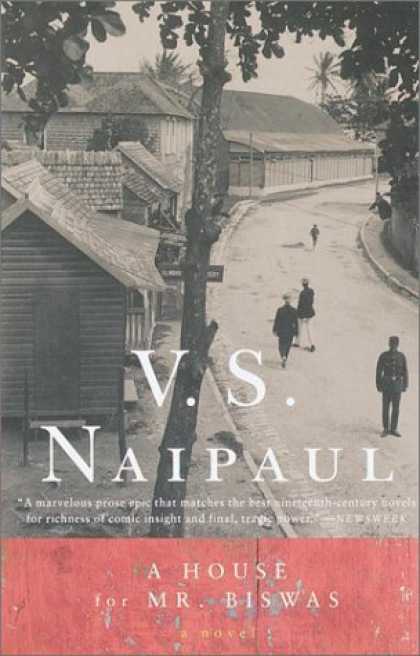
A House for Mr. Biswas by VS Naipaul

He had lived in many houses. And how easy it was to think of those houses without him! At this moment Pundit Jairam would be at a meeting or he would be eating at home, looking forward to an evening with his books. Soanie stood in the doorway, darkening the room, waiting for the least gesture of command. In Tara's back verandah Ajodha sat relaxed in his rockingchair, his eyes closed, listening perhaps to That Body of Yours being read by Rabidat, who sat at an awkward angle, trying to hide the smell of drink and tobacco on his breath. Tara was about, harrying the cowman (it was milking-time) or harrying the yard boy or the servant girl, harrying somebody. In none of those places he was being missed because in none of these places had he ever been more than a visitor, an upsetter of routine. Was Bipti thinking of him in the back trace? But she herself was a derelict. And, even more remote, that house of mud and grass in the swamplands: probably pulled down now and ploughed up. Beyond that, a void. There was nothing to speak of him.

In many ways, A House for Mr. Biswas reads like an ancient epic, or one of Plutarch's Lives. It's scope is certainly massive; it follows its main character, Mohun Biswas, from his birth to his death. But Mr Biswas, as he is called, even in infancy, is hardly an epic character, instead a characteristically weak man who seems to be surrounded by humiliation and misfortune who marries--almost by accident--into a domineering family, the Tulsis, in the Indian community of mid-century Trinidad. They provide him with work, but control his existence with cruel indifference, and his ultimate goal is to buy or build a house of his own so that he might no longer have to depend on them.

The power of A House for Mr. Biswas lies in Naipaul's subtle, reserved style. The book seems rather plain and underwritten, but a single word of Naipaul's can do heavy lifting. In How Fiction Works James Wood cannily points out that that "Mr"--as in Mr Biswas, by which he is always referred, though other characters are called by their first names--is an honorific that once had value but now has become common and meaningless. Mr Biswas reads prodigiously and encourages his children to become learned, and sleeps in a bed always referred to by its brand name, "Slumberking," but his reality, his meekness and insignificance, are always prevalent.

In awarding him the Nobel Prize in 2001, the Nobel Committee compared Naipaul to Joseph Conrad; the irony not being lost, I'm sure, that Conrad would probably have regarded Trinidad as unfavorably as he did the Congo. But A House for Mr Biswas is a quintessentially postcolonialist novel, in which the strangely convoluted ethnic history of Trinidad is a significant factor--colonized by the Spanish, British and Dutch, replete with ethnic Africans and Indians. In another one of those subtle twists of vocabulary, Naipaul describes how the schoolchildren of Trinidad consciously choose to call their parents "Mommy and Daddy" instead of "Bap and Mai" as a reflection of their English education. But I admit I wasn't thinking of Conrad when I read it; instead I was thinking that something about it struck me as similar to Russian authors like Pushkin, Chekhov, and Tolstoy, the latter especially in the way Naipaul fills the narrative with about a billion characters.

I am happy to report that the novel, though I was sure it wouldn't, has a relatively happy ending. It isn't perfect by any means, but in the end it is a great pleasure to see Naipaul vindicate Mr Biswas in some way.

Monday, July 6, 2009

Ubik by Philip K. Dick

Finally--I feel like I've been reading nothing but disappointing books for months. Ubik is like a big-budget sci-fi blockbuster condensed to 200 pages: Full of action, intrigue, and a lot of confusing twists. I will try, without giving anything away, to explain the plot:

Sometime in the future, portions of mankind have developed psychological powers. These people are called psis, and come in various flavors, the two most important of which are telepaths and precogs. Precogs--you may recall from the Dick adaptation Minority Report--can predict the future. In the future, the psis represent a significant threat to business interests, as a rival organization may plant telepaths in your organization or use precogs to see what you're going to do, so "prudence organizations" use the talents of antis, who block psis' powers, to protect themselves. Glen Runciter is the head of one of these organizations, which he manages with help from his dead wife who is kept in "half-life"--a cryogenic stasis where communication with the dead can be maintained, although the more you speak with them, the closer they get to true death.

Runciter and his team, including his right-hand man Joe Chip, accept a job on the moon where they believe many of the world's greatest psis have gone to cause havoc. The job turns out to be a trap, and Runciter is killed--or so Chip and the others think. When the team returns to Earth to bury Runciter, they find that somehow every thing is reverting to its earlier incarnation--for example, automated pay elevators (you have to pay for everything in the future, even doors) have become old-fashioned elevators with steel grates and elevator operators. Cars are reverting to 1920's era-Model T's, etc., etc. At the same time, they seem to be receiving, on the backs of matchbooks and in newspapers, strange, cryptic messages from the dead Runciter, advising them to find a mysterious substance called Ubik, which is the only thing that can protect them when members of the team start dying off one-by-one. Luckily, it is available in convenient spray-can form. Whew.

I loved Ubik because it's unbelievably fun and quickly paced, as well as deeply funny. But it doesn't come off as hollow entertainment; Dick manages to weave some very interesting thoughts about God and death in as well. Ubik itself seems to be an analogue for God--after all, it comes from the Latin word ubique, meaning "everywhere." It is a protective force, preventing decay and staving off entropy, preserving the forward motion of time when all else is tumbling backward. A series of epigrams that begin each chapter tout Ubik as a commercial product (Can't make the frug contest, Helen; stomach's upset. I'll fix you Ubik! It takes more than a bag to seal in food flavor; it takes Ubik plastic wrap, etc., etc.), perhaps going so far as suggesting the commodification of God in this future society, perhaps suggesting that order can be found in the universe in strange places.

In any case, I highly recommend Ubik. Safe when taken as directed.

Monday, June 15, 2009

Catch-22 by Joseph Heller

I fully expected to enjoy this book, especially after reading Christopher's positive review of it a while back. But for the most part, I did not enjoy reading Catch-22. Every time I put it down, I had to force myself to pick it back up. It has been a couple of weeks since I finished this book, and in that time I have been unable to figure out what I disliked about it. "Dislike" may actually be a little strong. I just was rather uninterested in Catch-22. I was told by a number of people that the book got better toward the end. That, and the fact that I don't like not finishing a book once I have started it, kept me reading til the end.

I think my problems may have been with Heller's writing style. I found his style a little clunky and difficult to read easily, but not in a this-guy-is-a-genius way, like Nabokov or Dostoevsky. I don't want to paint too negative of a picture here. Catch-22 definitely had its absurdly comical moments. I laughed out loud at some of the dialogue.

While there are a large number of integral characters in the book, the story really focuses on Captain Yossarian, an American bombardier stationed someone in the Mediterranean Sea during World War II. The very basic plot of the book is that Yossarian wants to go home. Every time he gets close to his quota of missions, Colonel Cathcart raises the number of missions his men must fly. Yossarian tries to get himself grounded in increasingly crazier ways. Through Yossarian and the litany of supporting characters, Heller satirizes the military and war, highlighting the general absurdity of both.

As I was told, the last 50 or so pages did manage to improve on what came before them. The ending recast earlier parts and brought some of the more disparate pieces of the story together in sharper focus.

Sunday, June 14, 2009

Watchmen by Alan Moore and Dave Gibbons

Dog carcass in alley this morning, tire tread on burst stomach. This city is afraid of me. I have seen its true face. The streets are extended gutters and the gutters are full of blood and when the drains finally scab over, all the vermin will drown. The accumulated filth of all their sex and murder will foam up about their waists and all the whores and politicians will look up and shout "Save Us!" and I'll look down, and whisper, "No" - Roschach

A live body and a dead body contain the same number of particles. Structurally, there's no discernible difference. Life and death are unquantifiable abstracts. Why should I be concerned? - Dr. Manhattan

I read Watchmen just in time. I finished it about a week before the movie came out. I wanted to read it first partially because I wanted to be able to compare the book and the movie, but, more importantly, it's a little embarrassing to be the last comic book fan who hasn't read Watchmen.

With all the hype surrounding Watchmen—only graphic novel in Time Magazine's 100 Best List, widely acclaimed as the best graphic novel of all time, praised and damned for helping bring about the darkening of comic books in general—I had my doubts that it would live it up to its reputation. After all, The Dark Knight Returns, another, similarly acclaimed graphic novel, was a huge disappointment when I finally read it. But, after putting it off for so long (and rambling about it for nearly as long) I've reached a conclusion: Watchmen deserves the praise.

It follows the lives of several “superheroes,” regular Joes and Janes who have no superpowers but want to help make the world a better place, at least ostensibly. In reality, they all have their own reasons, complex, human reasons that don't often show up in the pages of mainstream comics. The only truly super-powered being is Dr. Manhattan, a being with literally godlike powers, able to do everything from the standard flying and making things explode to creating entire universes out of nothing.

To me, the most interesting character in the book was Dr. Manhattan. A soft-spoken, humanitarian scientist who receives his powers through the Silver Age standby of gamma radiation, his progression throughout the book is an interesting case. When the extent of his powers is discovered, the government sends him to Vietnam as a soldier and also uses him as the ultimate failsafe against a steadily more aggressive Russia. Dr. Manhattan, on the other hand, grows more and more disconnected from the human race, gradually dissolving all ties except to the woman he loves. When he loses her, he completely severs all connections to earth and moves to the moon, preferring the solace and the undemanding company of the rocks and stars to that of humans, who think themselves something special but who, to Dr. Manhattan, are no more interesting or unique than anything else in the universe. It's a deconstruction not only of the omnipotent superhero (of whom Superman is the prime example), but also of the idea of God. Why would a being whose powers allow him ultimate freedom of action choose to spend his time interacting with a populace who largely don't appreciate him and see him only as a means to an end?

Every character in the book, from the borderline-sociopath Rorschach to the twisted humanitarian Ozymandias, could be given an extensive treatment, but I'm not going to do that. If' you haven't read Watchmen, check it out.