Showing posts with label hinduism. Show all posts

Sunday, May 26, 2024

Shame by Taslima Nasrin

As Suranjan came up the road, a group of boys standing nearby shouted, "There goes a Hindu, catch him and kill him." The boys belonged to this locality. Many faces had become familiar to him during his seven-year stay here. There was a boy called Alam, who would turn up every now and then and ask for a donation. they had a club here. Suranjan used to sing at their cultural functions. He thought of teaching some of the boys the songs of D. L. Roy and Hemanga Biswas. Off and on, they would father at his house asking for some favor or another. Sudhamay had given them medical assistance free of charge for their being residents of the locality. And it was the same chaps who were now mockingly threatening to kill him. Suranjan walked rapidly in the opposite direction, not driven by fear, but by shame. He felt shame not for himself but for his supposed attackers. Shame gained a new dimension not for the tortured people, but for those rogues inflicting the torture.

In 1992, a group of Hindu nationalists destroyed the Babri Mosque in India, igniting violence throughout India and the Indian subcontinent. In neighboring Bangladesh, the Muslim majority took their revenge for the destruction of the mosque from the Hindu minority, destroying temples, killing and torturing, and raping women. Taslima Nasrin's Shame tells the story of this reprisal from the perspective of Suranjan, a young socialist who has fought for years against the tide of what he calls "communalism," the factionalism of separate Hindu and Muslim communities at the expense of a larger Bengal or Bangladeshi identity. Suranjan reacts to the violence with apathy and despair, and only later, as the violence increases and his own sister Maya is kidnapped by Muslim gangs--does he feel himself getting swept up in the bitterness of the very "communalism" he has abhorred.

As I understand it, Shame caused a great deal of controversy within Bangladesh, and resulted in a Rushdie-style fatwa against Nasrin that drove her first to India, and then to the United States, where she lives in exile. Forgive me for saying so, but it's amazing to think that such profound consequences could emerge from a book that is so astonishingly bad. Shame is a baffling book, a novel whose small capacity for imagination is overwhelmed by a obsessiveness with recording the violence of 1992 in the most extensive detail. Everywhere Suranjan goes, he meets people who have an encyclopedic knowledge of what's happening throughout Bangladesh, from the names of the temples that have been attacked and destroyed...

...to the specific percentages of fluctuating Hindu and Muslim populations in the country:


I can't emphasize enough that most of the book is like this; statistics and names take up more than half of the novel's page count. It gives the effect, you might say, of Suranjan wandering in blindness while everyone else knows exactly what the stakes of the violence are. But mostly it just seems comically inept, an obsession with recounting every injustice that even a historian would know to avoid, much less a novelist.

When the novel returns to the story of Suranjan, there are flashes of interest: the stroke suffered by Suranjan's father who can't leave the house for medical attention for fear of being attacked; the disappearance of Maya; and most of all Suranjan's descent into anger and bitterness over the course of a week's violence. In one shocking scene, he engages a Muslim prostitute, whom he essentially rapes, biting and beating her during the sexual act. There's a powerful statement here about how difficult it is to escape cycles of violence and factionalism--but it's totally undercut by this insane mode of hyper-scrutiny. I never abandon books, but I nearly abandoned this one. The only reason I didn't is because I've never read an author from Bangladesh before, so my "Countries Read" list is up to 92!

Wednesday, November 16, 2011

A Passage to India by E. M. Forster

No, she did not wish to repeat that experience. The more she thought over it, the more disagreeable and frightening it became. She minded it much more now than at the time. The crush and the smells s he could forget, but the echo began in some indescribable way to undermine her hold on life. Coming at a moment when she chanced to be fatigued, it had managed to murmur, "Pathos, piety, courage--they exist, but are identical, and so is filth. Everything exists, nothing has value." If one had spoken vileness in that place, or quoted lofty poetry, the comment would have been the same--"ou-boum."

A Passage to India is a strange book. One can rifle off the details--in British-controlled India, a Muslim is accused of assaulting an English girl in a mysterious cave--but a summary seems beside the point. As Mrs. Moore decides about her memory of the accused, Dr. Aziz--"Yes, it was all true, but how false a summary of the man; the essential life of the him had been slain"--there is something crucial missing, something ineffable.

The novel begins and ends as a story about the difficulty of friendship and intimacy between the Indian and the English. Dr. Aziz is the great centerpiece of these sections, a stubborn, fickle, but gregarious man who wishes to make friends of Mrs. Moore and her companion, the young Adela Quested, and resolves to take them to the nearby Marabar Caves:

His friends thought him most unwise to mix himself up with English ladies, and warned him to take every precaution against unpunctuality. Consequently he spent the previous night at the train station.


But the middle section--the book is split into three unequal parts called Mosque, Caves and Temple--is something else all together. The Marabar Caves are annihilators of meaning. The echo that attaches itself to Mrs. Moore proves unshakable, and follows her as she leaves, promising a kind of anti-transcendence:

The unspeakable attempt presented itself to her as love: in a cave, in a church--Boum, it amounts to the same. Visions are supposed to entail profundity, but--Wait till you get one, dear reader! The abyss also may be petty, the serpent of eternity made of maggots..


And so the Caves themselves seem to be responsible for Ms. Quested's experience of a violent attack, which is never explained in a "proper" sense. Unpredictably, the English rally around Ms. Quested and use her story to validate their most brutish prejudices ("Why, the kindest thing one can do to a native is to let him die," one says) and the Indians rally around Aziz and riot. But though this makes for some great scenes of satire (my favorite is when the trial magistrate permits Ms. Quested to sit on the platform to escape the heat of the gallery, and she's joined by every white person in the court save one) Forster's interests lie mainly elsewhere. Ironically, what nearly destroys Dr. Aziz, Mrs. Moore, and Ms. Quested is just what they had been seeking: a sense of unity, a sense of intimacy and oneness with the other. But when difference is annihilated, nothing remains; when man succeeds in finding infinity he has lost himself:

Devils are of the North, and poems can be written about them, but no one could romanticize the Marabar because it robbed infinity and eternity of their vastness, the only quality that accommodates them to mankind.


In what must be the most striking prose Forster ever wrote, he symbolizes the problem with a flame:

They are dark caves. Even when they open towards the sun, very little light penetrates down the entrance tunnel into the circular chamber. There is little to see, and no eye to see it, until the visitor arrives for his five minutes, and strikes a match. Immediately another flame rises in the depths of the rock and moves towards the surface like an imprisoned spirit: the walls of the circular chamber have been most marvellously polished. The two flames approach and strive to unite, but cannot, because one of them breathes air, the other stone.


At first this seems a symbol of the relationship between the Indians and the English--two mirrored flames, unable to connect--but soon becomes a symbol of the inability to touch, to interact, to communicate with anything beyond oneself. Mrs. Moore and Ms. Quested are given brief glimpses of the flame beyond the wall, and perhaps finding only an image of themselves, are traumatized by them. The other conflicts of the novel--Ms. Quested's only-half-wanted marriage to the City Magistrate, the relations between the Indians and their occupiers, the inability to describe or create a unified Indian nation--become slivers of this whole, and the solution promises to be worse than the conflict.

By contrast, the Temple section begins with an extended description of a Hindu ceremony that brings a more beneficial unity:

When the villagers broke cordon for a glimpse of the silver image, a most beautiful and radiant expression came into their faces, a beauty in which there was nothing personal,l for it caused them all to resemble one another during the moment of its indwelling, and only when it was withdrawn did they revert to individual clods.


What is it about the Hindu ceremony that makes it a joy, rather than a terror? Can Prof. Godbole, Aziz's Hindu friend, be right or wise when he remarks of the charges,

I am informed that an evil action was performed in the Marabar Hills, and that a highly esteemed English lady is now seriously ill in consequence. My answer to that is this: that action was performed by Dr. Aziz... It was performed by the guide... It was performed by you... It was performed by me... And by my students. It was even performed by the lady herself. When evil occurs, it expresses the whole of the universe. Similarly when good occurs.


Godbole goes on to say that good and evil "are both of them aspects of my Lord. He is present in the one, absent in the other, and the difference between presence and absence is great, as great as my feeble mind can grasp. Yet absence implies presence, absence is not non-existence, and we are therefore entitled to repeat, 'Come, come, come, come.'" Is this what differentiates these unities, an eye to the presence, and not the absence, of God? Or the hopefulness that one is coming to make the unity meaningful?

These questions fade into the background of A Passage to India. By the end we are left with a little tableau of an Englishman and and Indian promising friendship, but their horses rearing away from one another. We are left, if we wish, to return to thinking about England and India, but also, if we wish, to see that there are more encompassing concerns at hand, and that there is unity in disunity, and also with a thin echo of Godbole's "Come, come, come, come":

But the horses didn't want it--they swerved apart; the earth didn't want it, sending up rocks through which riders must pass single file; the temples, the tank, the jail, the palace, the birds, the carrion, the Guest House, that came into view as they issued from the gap and saw Mau beneath: they didn't want it, they said in their hundred voices, "No, not yet," and the sky said, "No, not there."

Thursday, July 30, 2009

Life of Pi by Yann Martel

Sometimes my heart was sinking so fast with anger, desolation and weariness, I was afraid it would sink to the very bottom of the Pacific and I would not be able to lift it back up.

At such moments I tried to elevate myself. I would touch the turban I had made with the remnants of my shirt and I would say aloud, "THIS IS GOD'S HAT!"

I would pat my pants and say aloud, "THIS IS GOD'S ATTIRE!"

I would point to Richard Parker and say aloud, "THIS IS GOD'S CAT!"

I would point to the lifeboat and say aloud, "THIS IS GOD'S ARK!"

I would spread my hands wide and say aloud, "THESE ARE GOD'S WIDE ACRES!"

I would point at the sky and say aloud, "THIS IS GOD'S EAR!"

And in this way I would remind myself of creation and of my place in it.

But God's hat was always unraveling. God's pants were falling apart. God's cat was a constant danger. God's ark was a jail. God's wide acres were slowly killing me. God's ear didn't seem to be listening.


Here is one of those books I had sort of resisted reading just because they're so popular. I'm more cynical than I care to admit, I suppose, and I usually assume the worst about super-popular things simply because they're so popular, especially when there is a vocal minority who say that thing is awful (and isn't there always?). But I won this copy from Amanda (thanks Amanda!) who didn't care for the book, and so I decided to give it a chance. As is usually the case, I found that neither is the book as awesome as its supporters would say, but neither is it horrible. Life of Pi is a good book with some substantial flaws.

On one hand, it's a survival story that makes Hatchet look like a camping trip. Briefly (because I know you know about it), it's about young Pi Patel, who is on the way to Canada from India with his zookeeping family and a bunch of animals when the boat sinks, leaving him, a zebra, an orangutan, a hyena, and a Bengal tiger named Richard Parker in a lifeboat together. The zebra, orangutan, and hyena are quickly dispatched but Pi spends months at sea trying to train Richard Parker to respect him as the alpha male on the boat and ensure the survival of them both.

This section of the book is really quite gripping; it's no small task to make being stuck in a lifeboat for months a good tale, tiger or no tiger. The thing about being stuck at sea is that very little happens. Martel does a great job of getting us to really inhabit Patel's skin, dealing with the incredible burden of survival while struggling with the notion that, in all likelihood, none of his family survived.

Unfortunately, I think this is one of the rare species of book that works better as an adventurous yarn than a spiritual statement. The problem is that the parts of the book that speak to Pi's spirituality are the thinnest parts of the book. Martel paints him as a lover of God who, back home in India, tries to become simultaneously a Hindu, a Christian, and a Muslim. This leads to some pretty out-of-place comedy when his three spiritual teachers meet and realize what's been going on, like in a sitcom when the main character's three girlfriends accidentally end up in the same place at the same time.

But the worst part is the end--and here I'll add the SPOILER ALERT for those who haven't read it--which disappointed me, though Jim loved it. In fact, he loved exactly what I disliked about it: in the book's final chapters, Pi is pressed by interrogators from the shipping company to tell what "really happened." Pi changes his story to one where he and his mother were trapped in the lifeboat with a murderous Frenchman and others. The interrogators quickly discover that all the characters in this second story correspond with the animals from the first (and Pi with Richard Parker, which is admittedly a nice touch), and ask Pi why he lied. Pi's excuse is that the first story is better, and yet retains the truth of the second. The idea here is that Pi's story is like the three different stories of God in the three religions he follows; none are quite truthful but they all represent the fundamental truth of God's benevolence.

I have several issues with this. The first is that, really, is this much better than the old film trope where the character wakes up to find out it was all a dream? Honestly, I think I'm right to feel a little cheated. Secondly, the second story that Pi tells is pretty horrifying, and would have made a good story in his own right. I don't think the interrogators' agreement that the first story is "better" makes sense. Better how? And why? Because it has animals?

Thirdly, there is nothing particularly reflective about this kind of spirituality. I run the risk of offending here, so I'll tread lightly. In her post, Amanda remarks that she didn't like what Pi has to say about agnostics. I honestly don't recall what Pi says about them, so I reserve judgement--but isn't what Pi is espousing to us a sort of agnosticism? The assertion that we understand fundamental truths about God through a number of colorful stories leaves what we know, by nature, very vague. Nor does it address the parts of those religions which directly contradict each other (how, for instance, do we reconcile a monotheistic and a polytheistic religion?). This is exactly the reason that Pi's words about God come across so thin--they are generally lacking in substance. One might respond that one thing we learn about God is He is (They are?) fundamentally mysterious, yet there is nothing mysterious about the supposed "true" story about Pi's journey. We are supposed to accept that the story with the tiger is better, because it is more whimsical perhaps, and less cruel, but I think that perhaps this raises parallels that Martel does not want to raise.

I feel as if I am in the minority in this, when you average in Carlton and Brent, so I'd love to hear your thoughts. However, I will restate that I did like the book, though I feel like this flaw prevented me from really thinking highly of it.

Saturday, May 16, 2009

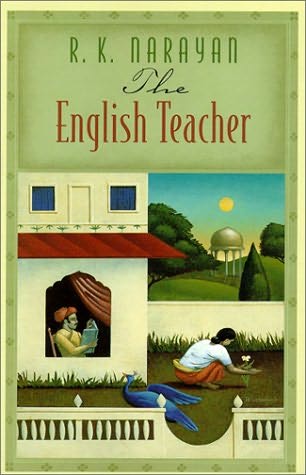
The English Teacher by RK Narayan

"Between thought and fulfilment there is no interval. Thought is fulfilment, motion and everything. That is the main difference between our physical state and yours. In your state a thought to be realized must always be followed by effort directed towards conquering obstructions and inertia--that is the nature of the material world. But in our condition no such obstruction exists. When I think of you or you me I am at your side. Music directly transports us. When I think of a garment, it is on me. In our world there is such a fine response for thought. When I come to you I prepare myself every time as befits the occasion. I come to meet my lord and I dress myself as befits the occasion. I think of the subtlest perfume and it already pervades my being; and I think of the garment that will most please you: the wedding saree, shimmering purple woven with gold, I have it on me at this very moment. You think you saw it in that trunk, how can it be here? What you have seen is its coutnerpart, the real part of the thing is that which is in thought, and it can never be lost or destroyed or put away."

Indian writer RK Narayan once sent the manuscript of his first novel, Swami and Friends, to a friend in England asking that, if he couldn't find a publisher for it, it would be thrown into the Thames, wrapped around a brick. His friend couldn't find one, but he also happened to have a friend in Graham Greene, who read the novel and determined to have it published. That was the 1930's, and Narayan and Greene maintained a long friendship by correspondence that lasted most of their very long lives--Greene died in (wow) 1991.


The eponymous teacher of The English Teacher is Krishna, a college instructor in a town called Malgudi who lives apart from his wife, Susila, and young daughter, Leela. He is not displeased by this, but when Susila decides to bring Leela to Malgudi that they might live as a family, he finds that the small details of marriage and fatherhood are infinitely more pleasing than his bachelor life. This first half of the book, in which Krishna comes to love his family, is unexceptional by design; teasing from the mundane intricacies of normal life a picture of largely untroubled domestic happiness.


And then Susila contracts typhoid, and dies. Supposedly this is based on the death of Narayan's own young wife, who also left a small child behind. Krishna is, of course, heartbroken, and returns quite bitterly to his normal routines as an English teacher until presented with a strange letter from a student, whose father has written to Krishna claiming that he has been contacted by Susila from the spirit world. Krishna visits this man, who conducts a sort of weekly seance between Krishna and Susila, until the time that Krishna learns to communicate with the world of the dead himself. In the passage I have quoted above, Susila tells Krishna how, in the spirit world, to think of a thing means to be with it, and accordingly, Krishna and Susila are never forced apart, even by death. It's simply done but arresting, and all the more touching knowing that such a book must have originated in Narayan's desire to be with his own wife again.


Graham Greene-o-Meter: Seven Greenes out of ten. Not very Greenesque, except maybe in the tightness and economy of the prose. Worth checking out.