Showing posts with label india. Show all posts

Tuesday, September 23, 2025

Half a Life by V. S. Naipaul

Willie Chandran and his sister Sarojini went to the mission school. One day one of the Canadian teachers asked Willie, in a smiling friendly way, "What does your father do?" It was a question he had put at various times to other boys as well, and they had all readily spoken of the degraded callings of their fathers. Willie wondered at their shamelessness. But now when the question  was put to him, Willie found he didn't know what to say about his father's business. He also found he was ashamed. The teacher kept on smiling, waiting for an answer, and at last Willie Chandran said with an irritation, "You all know what my father does." The class laughed. They laughed at his irritation and not at what he had said. From that day Willie Chandran began to despise his father.

Willie Chandran's middle name is Somerset, for the great English writer W. Somerset Maugham. Maugham, it seems, granted no small fame to Willie's father by describing him in a book as a famous ascetic who had taken in a vow of silence. In truth--as we learn from a story told to Willie by his father early in Half a Life--Willie's father took up the ascetic life more or life by accident. As a young man, he had been a follower of the Mahatma, and took up with a girl from an untouchable class in an act of social self-sacrifice. Far from shattering the caste system, the relationship scandalized both sides, and Willie's father was forced to flee to a religious life in order to escape their persecution. Willie is the offspring of this union, which has made his life unstable and uncertain, and for putting him in such a strange and impossible position he has learned to hate his father. Willie's father, fearing that rage and resentment will eat Willie up if he stays in India, writes to Maugham, who pulls a few strings to get him into an English university.

I was really struck by the elegance of Half a Life. Its three-part structure is sort of a marvel: first the first-person story told to Willie by his father, then the third-person section describing Willie's alienating experiences at university in London, and then a final first-person story told by Willie to his sister Sarojini about his fifteen years living in an unnamed African country with a wife he'd met at school. What becomes clear is that Willie has given three different places in the world a fair chance, and yet none of them has provided them with a sense of stability or belonging. This is the state of the colonized subject, and it's Naipaul's big subject, maybe never developed more fully than here in Half a Life. Willie can't thrive in India, caught between old ways and new ones, and he can't thrive in England, where his diminished status as a colonial make him a kind of outcast. In England he develops a budding writing ability that began as a child, and even publishes a book of stories about India, but they are little read and little appreciated, and he gives the passion up. Are we reading, perhaps, a story about the Naipaul that might have been?

In Africa, Willie returns to the colonized world, but not his own colonized world. There's a kind of logic to this--perhaps in Africa, Willie will be freed from the strictures of his own Indian background but also the repressive ideology of the British elite. But he finds himself embroiled again in the eternal tensions between the colonial power and the colonized, suffering through the smallness and pettiness of parochial Africans who can only assert their own value through their similarity to the Portuguese. Violence bubbles at the edge of the African city where he lives, and it's unclear whether, as a non-Portuguese outsider, Willie will be a target or be spared. When, one day, he slips and falls on the marble steps of his home, he wakes up in the hospital and announces to his wife he's leaving her. I can't, he tells her, live your life anymore; I must go and find my own. This leads him to Sarojini, a socialist rabblerouser who has needled Willie for his complacency by letter for years, and it's to her--the symbol of a new, untested, perhaps even more destabilizing approach--that he tells the story of his African life.

Willie Chandran's life is a failure three times over. In the end, he seems little different than the Africans who bounce between Africa and Portugal because neither can provide them a sense of fullness, though because of custom and language they can live nowhere else. It's a bitter book, maybe the most bitter of all Naipaul's books (although Guerillas come to mind) and rarely leavened with the kind of humor that enlivens A House for Mr. Biswas. Unlike Biswas, though, Willie Chandran is all too aware of his own shortcomings, and the impossibility of the kind of life that would provide dignity and belonging. I came away thinking this is one of Naipaul's most effective and effecting books.

Saturday, November 11, 2023

In Search of Love and Beauty by Ruth Prawer Jhabvala

The Point had a double meaning: it was both the point of human life--its goal--and also the point of intersection where its highest attainment, by which he meant its highest experiences, met. And what were these highest experiences? They were two-fold, he explained: one  on the physical plane, the other on the--what do you want to call it? The psychic, the spiritual? Whatever. 'Now what would you call the highest human experience on the physical plane?' he asked his audience on these Saturday nights in the sunken garden. No answer, a hushed stillness except for the incessant splash from the fountain, and the insects shrieking (sometimes a bird woke up and sang by mistake from the depths of some dark tree). 'What, no one knows? You don't even know that? What have I done to deserve this bunch of dummies?' And then he supplied the answer himself: 'The Orgasm, of course--isn't that it? Isn't that the Point of our highest physical experience?' It was, there was no question of it. Yes, Socrates.

Many years ago, Leo Kellerman enter Louise's world like an Adonis. Blonde, striking, and large, he managed to take possession both of Louise's apartment, occupied by her husband Bruno and daughter Marietta, as well as Louise herself. It's from Louise's apartment he began to court followers to his programs of physical and spiritual development. And though neither the sex nor the residency was permanent, Louise has had a kind of hopelessly entangled relationship with Leo all her life, up into old age. In the New York of the 80s, Leo has graduated to a run-down Victorian mansion in the Hudson Valley, where he runs what looks and sounds awfully like a cult. His charisma attracts the young--and young women especially--but those who have known him long can see how fat he's gotten, how shabby, and how desperate.

Ruth Prawer Jhabvala's In Search of Love and Beauty is, on a structural level, something to be admired. The way she interweaves the now and then, providing a holistic sense of Leo and Louise's lives. To these several generations of family are added: Louise's needy, insecure daughter Marietta; Marietta's son Mark, suave, cold, and gay; Natasha, an adopted daughter whose physical ugliness and shy devotion to Mark conceal the fact that, of all the characters, she's the only one who seems rather at peace. (She is the only one, it seems, on whom Leo's vulgar charms have no effect, because she lacks the the tremendous interior longings on which he preys.) Leo, of course, has no family; Louise is "as close to a wife" as he's ever desired, and it's hard not to feel that he has, in some way, parasitized them. But none of them are really fools; they more than anyone see Leo for what he is, and there is a sense that they attend to him--Mark helps finance that run-down Victorian, for example--out of pity as much as awe. It's a vision of the New Age in the 80s that has curdled, but which insists it's always been in on the joke.

One thing that really interested me in In Search of Love and Beauty was the characters' relationship to India. Jhabvala of course, was born Ruth Prawer in Germany, and married a Persian architect in New Delhi. Many of her books are about India, and she's perhaps best remembered today for her work with the Anglo-Indian Merchant and Ivory filmmaking team, including an adaptation of her India-set novel Heat and Dust. In Search of Love and Beauty is a New York novel, but it's a New York tinged by India: Leo's self-help work is pointedly influenced by Indian mysticism; Marietta goes to India yearly, to travel and be with an Indian named Ahmed with whom she carries on a decades-long affair. She learns to play the sarod, which makes In Search of Love and Beauty, somehow, the second book I've read this year in which a woman learns to play the sarod. Jhabvala's interested in the way that India becomes a focus for the Western imagination, a place whose wisdom we imagine we might turn to when our own has become exhausted. In one crucial scene, Marietta sees that Ahmed has aged terribly after a long absence, revealing, perhaps, that Eastern mysticism can't really keep us shielded from the bare facts of human nature.

In Search of Love and Beauty struck me as one of those books you might call a "real yarn," a story whose chief appeal is a plotty intricacy that keeps you engaged. It's often very funny, as with the section above, where Leo posits to his followers that the point of life is to seek a spiritual orgasm. It's written in an omniscient third person that makes it seem sort of antiquated--an 1880s voice for the 1980s. Its chief flaw might be that Leo, the novel's lodestar, never quite seems as magnetic or appealing as the story demands; his pathetic and rather ordinary nature are clear to us from the very beginning. But maybe that's the point--we even flock to gurus we don't believe in, because unlike us, at least they seem to believe in themselves.

Saturday, September 25, 2021

Heat and Dust by Ruth Prawer Jhabvala

I try to find an explanation for him. I tell him that many of us are tired of the materialism of the West, and even if we have no particular attraction towards the spiritual message of the East, we come here in the hope of finding a simpler and more natural way of life. This explanation hurts him. He feels it to be a mockery. He says why should people who have everything--motor cars, refrigerators--come here to such a place where there is nothing?

Heat and Dust is the story of Olivia, the wife of a young English administrator during the Raj, who leaves her husband for the charismatic Nawab, a minor prince. This momentous act serves as the book's climax, but it's explained at the very beginning, so this is one of those books who makes the reader ask the question, How did we get here? For Olivia, her personal motivations intersect with the great forces that push and pull between the British and their Indian subjects. The Nawab is very charming and magnetic, though flighty: he lives with another young British man whose ardor for the Nawab approaches, or simply is, homosexual obsession, and he charms Olivia, too. In fact, the Nawab--powerful but jealous of the more powerful English, sneaky, needy, selfish--is the book's most interesting character; he seduces us, too, though we might flatter ourselves that we have better judgment than Olivia.

But Olivia, too, sees in the Nawab an escape from the stolid, condescending British empire, whose worst qualities soon become apparent in her apparatchik husband, Douglas. As Douglas and the other colonials talk smugly about the Indians as if they were unruly children, Olivia finds herself identifying with the Nawab's rebellious and, to her, exotic spirit. Their first dalliance occurs at a shrine famous for its association with suttees, wives who ritually throw themselves on their husband's funeral parlors. At a party, Olivia unnerves everyone by insisting she would commit this most romantic of acts for Douglas, but soon it becomes clear to her that Douglas neither wants nor deserves this. Yet perhaps the Nawab, and India, are worthy of that kind of passion, which the British have meticulously repressed.

Olivia's story is told by her step-granddaughter who, fifty years after Olivia abandoned her husband, has gone to India to understand why she did what she did. She arrives in a 1970's India that is quite different from Olivia's time; the British have left, and the Nawab's palace is in ruins, as are the palaces of many minor princes who were essentially propped up by the British regime. Westerners no longer come to India for their political ambitions but, like the American Buddhist sage she begins sleeping with, spiritual ones. Somehow, even though the context has changed completely, she finds herself retracing Olivia's steps almost exactly, becoming pregnant--not by a prince but by her landlord--and heading up into the mountains to have her child. Prawer Jhabvala seems to suggest that, even as the world changes, the anxious interdependence of the Western World and India persists, both beguiling and repelling those whites who long for something they believe India can provide.

Heat and Dust has an obvious analog in A Passage to India, but it also reminded me quite a bit of W. Somerset Maugham's novel The Painted Veil, a novel set not in India but in Hong Kong, but whose central character--the wife of a diplomat whose exposure to a foreign culture transforms her--is much like Olivia. I didn't know until reading this that Prawer Jhabvala was not Indian--she took her husband's last name--but I also didn't know that she was a vital third partner in Merchant-Ivory Productions, and wrote nearly all of the director-producer's novels for decades and decades. Heat and Dust, which became a Merchant-Ivory movie in the 1980's, fits really neatly within that universe.

Monday, February 1, 2016

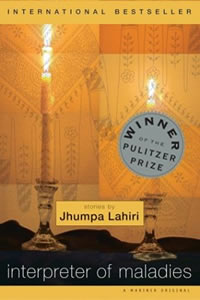
Interpreter of Maladies by Jhumpa Lahiri

In my son's eyes I see the ambition that had first hurled me across the world.  In a few years he will graduate and pave his way, alone and unprotected.  But I remind myself that he has a father who is still living, a mother who is happy and strong.  Whenever he is discouraged, I tell him that if I can survive on three continents, there is no obstacle he cannot conquer.  While the astronauts, heroes forever, spent mere hours on the moon, I have remained in this new world for nearly thirty years.  I know that my achievement is quite ordinary.  I am not the only man to seek his fortune far from home, and certainly I am not the first.  Still, there are times I am bewildered by each mile I have traveled, each meal I have eaten, each person I have known, each room in which I have slept.  As ordinary as it all appears, there are times when it is beyond my imagination.

I did not enjoy Jhumpa Lahiri's novel The Namesake, which seemed to me to obsess over superficial things--meals, houses, knicknacks, lifestyles--without any interest in their deeper implications.  Gogol, the protagonist of that novel, lives a life which is carefully constructed by Lahiri to seem both ordinary and American, and while I stick by that criticism, it's worth conceding that the contrast between Gogol's life and the lives lived by his parents, immigrants from Bengal, is much to the novel's interest.  I think Lahiri's interest in the banal and the ordinary works much better in the stories of Interpreter of Maladies, where the same superficial things can assume a meaningful presence in the more limited confines of short fiction.

As with The Namesake, Lahiri's subject is the intersection of American and Indian identities, and she gives us a host of characters who grapple with that duality: Indian immigrants to America, first-generation American-Indians vacationing in India, white Americans sleeping with Indian-Americans, etc., etc.  She has a special affinity for studying this duality through the eyes of children.  Sometimes this is effective, as in the story "When Mr. Pirzada Came to Dine," in which a young narrator contemplates the plight of the title figure, who visits her parents every night to watch the news about the civil war in Bangladesh, where his wife and children are, thousands of miles away.  Sometimes it does not, as in the story "Sexy," about a white woman having an affair with Indian man.  The narrator of that story has an Indian friend who frets over the adultery of her cousin's husband.  The narrator ends up babysitting this cousin's son, who calls her "sexy"--just like her married lover did--and when the narrator presses the boy to say what he means by that, he defines it as "loving someone you don't know... That's why my father did... He sat next to someone he didn't know, someone sexy, and now he loves her instead of my mother."  From the mouths of babes, I guess.

But the best stories here, I think, are the ones that take place in India.  The title story, about a tour guide who develops something of an obsession with an unhappily married American-Indian woman, mines the cultural divide for a deeper, more universal resonance.  He tells her that he works part time interpreting in Gujarati for a local doctor; she confesses that one of her children is not her husband's.  Western notions of love have failed her, she is unhappy, but he is not a doctor, only an interpreter, and if there is wisdom to be gleaned from her own familial homeland she is unable to access it.  The best story, "The Treatment of Bibi Haldar," ignores the question of American identity all together, focusing instead on a chronically sick woman's yearning for marriage.  It has a touch of irony that seems unique among all of Lahiri's earnestness, and for that reason it really stands out.

Lahiri's style is simple and unadorned, blanched of any kind of excess or ornamentation.  It is as self-consciously unmarked as the narrator of "This Blessed House," whose keen desire to fit in is undermined by his new wife, who keeps finding plaster statues of Jesus around the house.  In the context, that seems like a meaningful choice.  In The Namesake I found it tiring, but here it doesn't wear out its welcome, and instead allows Lahiri to uncover a great deal of meaning.

Wednesday, January 7, 2015

The Lowland by Jhumpa Lahiri

Most people trusted in the future, assuming that their preferred version of it would unfold. Blindly planning for it, envisioning things that weren't the case. This was the working of the will. This was what gave the world purpose and direction. Not what was there but what was not.

My first book for 2015 (and this blog!) is The Lowland by Jhumpa Lahiri. The story begins in 1960’s Calcutta and follows the lives of the two Mitra brothers who are quite different in ways that siblings often are. Subhash Mitra is the older brother by 15-months – academically gifted, cautious, yet ambitious in his own right. Udayan Mitra, the younger brother, is intelligent and extremely passionate – fiery and driven by his political and social ideology to change India. Though different in personality, each brother understands himself better in the company of the other, and as a result, they are inseparable.

As the brothers mature, their futures diverge – Subhash pursues a PhD program in Rhode Island leading him into a career of scientific research in the U.S. Udayan becomes increasingly involved with the Naxalite movement, a radical leftist Communist uprising in support of Maoist politics and thinking in India. During their time apart, Subhash would receive an occasional letter from Udayan with updates on their parents, neighborhood, and the woman he has chosen to marry in a private ceremony without the approval of their parents. Subhash continues to remain in the U.S. pursuing his education until he’s forced to return to India upon the news of Udayan’s death.

Shot by the police in front of his family, Udayan’s death leaves the Mitra family overwhelmed with grief and the depth of his involvement in the controversial guerilla movements of the day is in question. Also in question is the future of Gauri, Udayan’s relatively new wife, now widow, who is ignored by the in-laws who continue to disapprove of their deceased son’s decision to marry her. Things become complicated as Gauri discovers she is pregnant, Udayan unaware of this at the time of his death.

During Subhash’s homecoming, it is his ongoing dutiful nature to his brother and his commitment to his career and life in the U.S. that leads him to marry Gauri. In doing so, he believes he is providing Gauri with an escape from her oppressive living arrangement and the memories affiliated with Calcutta while also taking care of her and the child on the way.

I found that up until this point, the novel’s pace was a bit slow (though I thoroughly enjoyed taking a Wiki Walk starting with the Naxalite movement). The first quarter of the novel was begging for more details and emotions in order to move beyond historical fiction and really bring the story to life. It is not until Gauri is living with Subhash in the U.S. that the characters and story truly take off, urging the reader to empathize with varying levels of frustration, hope and disappointment from several different perspectives.

Though it takes some getting used to, Lahiri’s decision to forgo quotes and conventional dialogue enhances the story. The more we get to know the characters, the more freely the uninterrupted narrative flows. This tactic also lends itself well to the reemergence of the past throughout the novel, illustrating familiar personality traits, decisions, and youthful impulsiveness from the story’s beginnings.

I enjoyed the book for this unique storytelling, but in a strange way it is the incredible connected sadness from one generation of the Mitra family to the next that I found so compelling.  My one critique is that I wish Gauri had been fleshed out more - she is such a seemingly complex character, yet so much about her is still unclear, as if the omnipresent narrator is unable to get through to her any better than Subhash can.  This is not the feel good novel of the year (and it is also not the most depressing), but I found it well-worth the read.  

Wednesday, November 16, 2011

A Passage to India by E. M. Forster

No, she did not wish to repeat that experience. The more she thought over it, the more disagreeable and frightening it became. She minded it much more now than at the time. The crush and the smells s he could forget, but the echo began in some indescribable way to undermine her hold on life. Coming at a moment when she chanced to be fatigued, it had managed to murmur, "Pathos, piety, courage--they exist, but are identical, and so is filth. Everything exists, nothing has value." If one had spoken vileness in that place, or quoted lofty poetry, the comment would have been the same--"ou-boum."

A Passage to India is a strange book. One can rifle off the details--in British-controlled India, a Muslim is accused of assaulting an English girl in a mysterious cave--but a summary seems beside the point. As Mrs. Moore decides about her memory of the accused, Dr. Aziz--"Yes, it was all true, but how false a summary of the man; the essential life of the him had been slain"--there is something crucial missing, something ineffable.

The novel begins and ends as a story about the difficulty of friendship and intimacy between the Indian and the English. Dr. Aziz is the great centerpiece of these sections, a stubborn, fickle, but gregarious man who wishes to make friends of Mrs. Moore and her companion, the young Adela Quested, and resolves to take them to the nearby Marabar Caves:

His friends thought him most unwise to mix himself up with English ladies, and warned him to take every precaution against unpunctuality. Consequently he spent the previous night at the train station.


But the middle section--the book is split into three unequal parts called Mosque, Caves and Temple--is something else all together. The Marabar Caves are annihilators of meaning. The echo that attaches itself to Mrs. Moore proves unshakable, and follows her as she leaves, promising a kind of anti-transcendence:

The unspeakable attempt presented itself to her as love: in a cave, in a church--Boum, it amounts to the same. Visions are supposed to entail profundity, but--Wait till you get one, dear reader! The abyss also may be petty, the serpent of eternity made of maggots..


And so the Caves themselves seem to be responsible for Ms. Quested's experience of a violent attack, which is never explained in a "proper" sense. Unpredictably, the English rally around Ms. Quested and use her story to validate their most brutish prejudices ("Why, the kindest thing one can do to a native is to let him die," one says) and the Indians rally around Aziz and riot. But though this makes for some great scenes of satire (my favorite is when the trial magistrate permits Ms. Quested to sit on the platform to escape the heat of the gallery, and she's joined by every white person in the court save one) Forster's interests lie mainly elsewhere. Ironically, what nearly destroys Dr. Aziz, Mrs. Moore, and Ms. Quested is just what they had been seeking: a sense of unity, a sense of intimacy and oneness with the other. But when difference is annihilated, nothing remains; when man succeeds in finding infinity he has lost himself:

Devils are of the North, and poems can be written about them, but no one could romanticize the Marabar because it robbed infinity and eternity of their vastness, the only quality that accommodates them to mankind.


In what must be the most striking prose Forster ever wrote, he symbolizes the problem with a flame:

They are dark caves. Even when they open towards the sun, very little light penetrates down the entrance tunnel into the circular chamber. There is little to see, and no eye to see it, until the visitor arrives for his five minutes, and strikes a match. Immediately another flame rises in the depths of the rock and moves towards the surface like an imprisoned spirit: the walls of the circular chamber have been most marvellously polished. The two flames approach and strive to unite, but cannot, because one of them breathes air, the other stone.


At first this seems a symbol of the relationship between the Indians and the English--two mirrored flames, unable to connect--but soon becomes a symbol of the inability to touch, to interact, to communicate with anything beyond oneself. Mrs. Moore and Ms. Quested are given brief glimpses of the flame beyond the wall, and perhaps finding only an image of themselves, are traumatized by them. The other conflicts of the novel--Ms. Quested's only-half-wanted marriage to the City Magistrate, the relations between the Indians and their occupiers, the inability to describe or create a unified Indian nation--become slivers of this whole, and the solution promises to be worse than the conflict.

By contrast, the Temple section begins with an extended description of a Hindu ceremony that brings a more beneficial unity:

When the villagers broke cordon for a glimpse of the silver image, a most beautiful and radiant expression came into their faces, a beauty in which there was nothing personal,l for it caused them all to resemble one another during the moment of its indwelling, and only when it was withdrawn did they revert to individual clods.


What is it about the Hindu ceremony that makes it a joy, rather than a terror? Can Prof. Godbole, Aziz's Hindu friend, be right or wise when he remarks of the charges,

I am informed that an evil action was performed in the Marabar Hills, and that a highly esteemed English lady is now seriously ill in consequence. My answer to that is this: that action was performed by Dr. Aziz... It was performed by the guide... It was performed by you... It was performed by me... And by my students. It was even performed by the lady herself. When evil occurs, it expresses the whole of the universe. Similarly when good occurs.


Godbole goes on to say that good and evil "are both of them aspects of my Lord. He is present in the one, absent in the other, and the difference between presence and absence is great, as great as my feeble mind can grasp. Yet absence implies presence, absence is not non-existence, and we are therefore entitled to repeat, 'Come, come, come, come.'" Is this what differentiates these unities, an eye to the presence, and not the absence, of God? Or the hopefulness that one is coming to make the unity meaningful?

These questions fade into the background of A Passage to India. By the end we are left with a little tableau of an Englishman and and Indian promising friendship, but their horses rearing away from one another. We are left, if we wish, to return to thinking about England and India, but also, if we wish, to see that there are more encompassing concerns at hand, and that there is unity in disunity, and also with a thin echo of Godbole's "Come, come, come, come":

But the horses didn't want it--they swerved apart; the earth didn't want it, sending up rocks through which riders must pass single file; the temples, the tank, the jail, the palace, the birds, the carrion, the Guest House, that came into view as they issued from the gap and saw Mau beneath: they didn't want it, they said in their hundred voices, "No, not yet," and the sky said, "No, not there."

Thursday, July 30, 2009

Life of Pi by Yann Martel

Sometimes my heart was sinking so fast with anger, desolation and weariness, I was afraid it would sink to the very bottom of the Pacific and I would not be able to lift it back up.

At such moments I tried to elevate myself. I would touch the turban I had made with the remnants of my shirt and I would say aloud, "THIS IS GOD'S HAT!"

I would pat my pants and say aloud, "THIS IS GOD'S ATTIRE!"

I would point to Richard Parker and say aloud, "THIS IS GOD'S CAT!"

I would point to the lifeboat and say aloud, "THIS IS GOD'S ARK!"

I would spread my hands wide and say aloud, "THESE ARE GOD'S WIDE ACRES!"

I would point at the sky and say aloud, "THIS IS GOD'S EAR!"

And in this way I would remind myself of creation and of my place in it.

But God's hat was always unraveling. God's pants were falling apart. God's cat was a constant danger. God's ark was a jail. God's wide acres were slowly killing me. God's ear didn't seem to be listening.


Here is one of those books I had sort of resisted reading just because they're so popular. I'm more cynical than I care to admit, I suppose, and I usually assume the worst about super-popular things simply because they're so popular, especially when there is a vocal minority who say that thing is awful (and isn't there always?). But I won this copy from Amanda (thanks Amanda!) who didn't care for the book, and so I decided to give it a chance. As is usually the case, I found that neither is the book as awesome as its supporters would say, but neither is it horrible. Life of Pi is a good book with some substantial flaws.

On one hand, it's a survival story that makes Hatchet look like a camping trip. Briefly (because I know you know about it), it's about young Pi Patel, who is on the way to Canada from India with his zookeeping family and a bunch of animals when the boat sinks, leaving him, a zebra, an orangutan, a hyena, and a Bengal tiger named Richard Parker in a lifeboat together. The zebra, orangutan, and hyena are quickly dispatched but Pi spends months at sea trying to train Richard Parker to respect him as the alpha male on the boat and ensure the survival of them both.

This section of the book is really quite gripping; it's no small task to make being stuck in a lifeboat for months a good tale, tiger or no tiger. The thing about being stuck at sea is that very little happens. Martel does a great job of getting us to really inhabit Patel's skin, dealing with the incredible burden of survival while struggling with the notion that, in all likelihood, none of his family survived.

Unfortunately, I think this is one of the rare species of book that works better as an adventurous yarn than a spiritual statement. The problem is that the parts of the book that speak to Pi's spirituality are the thinnest parts of the book. Martel paints him as a lover of God who, back home in India, tries to become simultaneously a Hindu, a Christian, and a Muslim. This leads to some pretty out-of-place comedy when his three spiritual teachers meet and realize what's been going on, like in a sitcom when the main character's three girlfriends accidentally end up in the same place at the same time.

But the worst part is the end--and here I'll add the SPOILER ALERT for those who haven't read it--which disappointed me, though Jim loved it. In fact, he loved exactly what I disliked about it: in the book's final chapters, Pi is pressed by interrogators from the shipping company to tell what "really happened." Pi changes his story to one where he and his mother were trapped in the lifeboat with a murderous Frenchman and others. The interrogators quickly discover that all the characters in this second story correspond with the animals from the first (and Pi with Richard Parker, which is admittedly a nice touch), and ask Pi why he lied. Pi's excuse is that the first story is better, and yet retains the truth of the second. The idea here is that Pi's story is like the three different stories of God in the three religions he follows; none are quite truthful but they all represent the fundamental truth of God's benevolence.

I have several issues with this. The first is that, really, is this much better than the old film trope where the character wakes up to find out it was all a dream? Honestly, I think I'm right to feel a little cheated. Secondly, the second story that Pi tells is pretty horrifying, and would have made a good story in his own right. I don't think the interrogators' agreement that the first story is "better" makes sense. Better how? And why? Because it has animals?

Thirdly, there is nothing particularly reflective about this kind of spirituality. I run the risk of offending here, so I'll tread lightly. In her post, Amanda remarks that she didn't like what Pi has to say about agnostics. I honestly don't recall what Pi says about them, so I reserve judgement--but isn't what Pi is espousing to us a sort of agnosticism? The assertion that we understand fundamental truths about God through a number of colorful stories leaves what we know, by nature, very vague. Nor does it address the parts of those religions which directly contradict each other (how, for instance, do we reconcile a monotheistic and a polytheistic religion?). This is exactly the reason that Pi's words about God come across so thin--they are generally lacking in substance. One might respond that one thing we learn about God is He is (They are?) fundamentally mysterious, yet there is nothing mysterious about the supposed "true" story about Pi's journey. We are supposed to accept that the story with the tiger is better, because it is more whimsical perhaps, and less cruel, but I think that perhaps this raises parallels that Martel does not want to raise.

I feel as if I am in the minority in this, when you average in Carlton and Brent, so I'd love to hear your thoughts. However, I will restate that I did like the book, though I feel like this flaw prevented me from really thinking highly of it.

Saturday, May 16, 2009

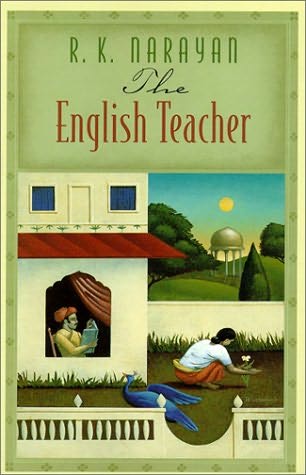
The English Teacher by RK Narayan

"Between thought and fulfilment there is no interval. Thought is fulfilment, motion and everything. That is the main difference between our physical state and yours. In your state a thought to be realized must always be followed by effort directed towards conquering obstructions and inertia--that is the nature of the material world. But in our condition no such obstruction exists. When I think of you or you me I am at your side. Music directly transports us. When I think of a garment, it is on me. In our world there is such a fine response for thought. When I come to you I prepare myself every time as befits the occasion. I come to meet my lord and I dress myself as befits the occasion. I think of the subtlest perfume and it already pervades my being; and I think of the garment that will most please you: the wedding saree, shimmering purple woven with gold, I have it on me at this very moment. You think you saw it in that trunk, how can it be here? What you have seen is its coutnerpart, the real part of the thing is that which is in thought, and it can never be lost or destroyed or put away."

Indian writer RK Narayan once sent the manuscript of his first novel, Swami and Friends, to a friend in England asking that, if he couldn't find a publisher for it, it would be thrown into the Thames, wrapped around a brick. His friend couldn't find one, but he also happened to have a friend in Graham Greene, who read the novel and determined to have it published. That was the 1930's, and Narayan and Greene maintained a long friendship by correspondence that lasted most of their very long lives--Greene died in (wow) 1991.


The eponymous teacher of The English Teacher is Krishna, a college instructor in a town called Malgudi who lives apart from his wife, Susila, and young daughter, Leela. He is not displeased by this, but when Susila decides to bring Leela to Malgudi that they might live as a family, he finds that the small details of marriage and fatherhood are infinitely more pleasing than his bachelor life. This first half of the book, in which Krishna comes to love his family, is unexceptional by design; teasing from the mundane intricacies of normal life a picture of largely untroubled domestic happiness.


And then Susila contracts typhoid, and dies. Supposedly this is based on the death of Narayan's own young wife, who also left a small child behind. Krishna is, of course, heartbroken, and returns quite bitterly to his normal routines as an English teacher until presented with a strange letter from a student, whose father has written to Krishna claiming that he has been contacted by Susila from the spirit world. Krishna visits this man, who conducts a sort of weekly seance between Krishna and Susila, until the time that Krishna learns to communicate with the world of the dead himself. In the passage I have quoted above, Susila tells Krishna how, in the spirit world, to think of a thing means to be with it, and accordingly, Krishna and Susila are never forced apart, even by death. It's simply done but arresting, and all the more touching knowing that such a book must have originated in Narayan's desire to be with his own wife again.


Graham Greene-o-Meter: Seven Greenes out of ten. Not very Greenesque, except maybe in the tightness and economy of the prose. Worth checking out.

Friday, August 22, 2008

Twilight in Delhi by Ahmed Ali

Ahmed Ali was a novelist, social critic, scholar, diplomat, and poet. In 1932 he and a few other Indian writers published Angaray, a collection of short stories in Urdu. This was noteworthy, because at the time, the British Crown was trying to Anglicize the people of India. In the words of one British official, the goal was to produce "a class of persons, Indian in blood and color, but English in taste and character, in morals and intellect." Of course proselytizing Christian zealots were at the forefront of this movement, doing "the work of God." With their help, British practices were promoted, Indian customs were denigrated, and English was made the official language. In this political climate, it is no wonder that the writers of Angaray were labeled dissidents and agitators, and that the book was banned by the British Government in India. That same year, Ali co-founded the All-India Progressive Writers' Movement, a movement which helped to birth many novels by Indian writers. Twilight in Delhi was one such novel.

Ali had a great deal of trouble getting Twilight in Delhi published. The printers found many parts of the book subversive and refused to print these sections. For instance, what Ali called the War of Independence of 1857, the British Crown had labeled a mutiny. Oddly enough, Virginia Woolf came to Ali's aid and helped push the book through publication without any changes being made. Go, Virginia Woolf!

Twilight in Delhi follows one family living in the city during the first decade of the twentieth century. The book is separated into four parts, each about a different period in the life of this family. Through detailed accounts of weddings, funerals, and political protests, you learn about the customs and mores of Indian life during that time.

There is truly an ensemble cast, although the son Asghar plays a larger role than others. However, the seasons play as big a role as any person in the story. Often a description of the weather sets the scene for the upcoming chapter. And as the chapter comes to a close so does the day or season. Here is where the poet in Ali can really be seen. He describes the oppressive loo that blows through Delhi, the sand storms that rush through the city, and the way the city comes alive at night as it gets cooler. His descriptions are so vivid that you almost feel you have sweltered in the heat and tasted the grit of sand between your teeth.

Twilight in Delhi is about things coming to an end. The patriarch of the family in the twilight of his life, as he succumbs to age and ailment. The waning of Indian traditions and customs, slowly replaced by those of the Western world. The twilight of the city that Ali loved. The twilight of Delhi.

Saturday, April 5, 2008

Life of Pi by Yann Martel

Tigers exist, lifeboats exist, oceans exist. Because the three have never come together in your narrow, limited experience, you refuse to believe that they might.

My brother gave me this book two Christmases ago. I was really excited about reading it from the git-go, but for some reason it took me this long to actually get around to it. Boy, am I glad that I did. This is the best novel that I have read so far this year.

The story is told from the perspective of the main character, Piscine Molitor Patel. After being saddled with the nickname Pissing Patel early in his schooling, he started referring to himself as Pi Patel, which caught on. His father runs a zoo in the Indian town of Pondicherry, which made for an interesting childhood for Pi and his older brother Ravi. In 1976, Mr. Patel decided that there was too much political turmoil in India and decided to move his wife and boys to Canada. Halfway across the Pacific, during a storm in the middle of the night, the ship sinks. Pi finds himself on a lifeboat with some of the zoo animals, including a 450 pound Bengal tiger.

As Martel recounts Pi's aimless floating in the Pacific Ocean, he touches on diverse subjects, such as religion, philosophy, and biology. Ultimately, this book is about the art of telling a story. Martel was able to make a completely implausible story believable. His excellent writing skills enabled him to take a story that could easily have been boring in someone else's hands and make it simply enthralling.

Read Brent's review of Life of Pi.