Showing posts with label Idaho. Show all posts

Sunday, August 20, 2023

Train Dreams by Denis Johnson

And three years later still, he lived in his second cabin, precisely where the old one had stood. Now he slept soundly through the nights, and often he dreamed of trains, and often of one particular train: He was on it; he could smell the coal smoke; a world went by. And then he was standing in that world as the sound of the train died away. A frail familiarity in these scenes hinted to him that they came from his childhood. Sometimes he woke to hear the sound of the Spokane International fading up the valley and realized he'd been hearing the locomotive as he dreamed.

Robert Grainier is, for all purposes, born on a train: he arrives at his aunt's home in Idaho on a train as a child from some place he cannot remember. He is a man of the New West, without a birthplace or history, and he aids the railroad in opening up the West by cutting down trees and laying track. When he's not working on the railroad he takes a job as a delivery driver, crossing over the backwoods tracks of Idaho's panhandle and western Montana. But he also has in him that spirit of the Old West, which is not marked by the march toward civilization and industry but a place where one goes to be alone: for much of the year he subsists alone in a cabin he built himself in a deep wooded valley, a cabin situated in the very spot where his wife and newborn died in a wildfire.

To me, Denis Johnson's Train Dreams is about the contradictions of the American west and its opening in the late 19th and early 20th centuries. Grainier, when the whole of his life is laid out, lives through a grand transition, beginning life on a train in the wilderness and, later, seeing Elvis Presley performing on a train. Train Dreams is funnily meandering for a novella, passing from incident to incident, simultaneously grotesque and humorous, like the time he serves as an ambulance for a man who was shot by his dog. (How did it happen? Well, he tried to shoot the dog instead, but the dog got the better of him.) Or the story of Grainier's friend Kootenai Bob, who's given alcohol for the first time in his life and ends up so obliterated by a (heavily symbolic) train it takes his people weeks to find and ritually bury all the pieces.

But the through-line that keeps the novella grounded is the untimely death of Grainier's wife and child, who try fruitlessly to escape the wildfire in Grainier's absence. Their disappearance haunts Grainier, who wants to believe against odds that they might have found safety, but his wife appears to him in a dream, or perhaps as a kind of spirit, and shows him her death, but Grainier stays by the cabin out of a belief that the newborn Kate might somehow have survived. And he's right, in a way: Kate has been transformed into a half-woman half-wolf who visits Grainier's cabin one day with her pack, and though Grainier wishes profoundly that he could recover her, or perhaps domesticate her like his dog, her life can only intersect his at this single and infrequent point. Kate is a symbol, perhaps, of a return to wildness, the dream that people brought with them on the railroads and which was obliterated by the railroads.

Is it crazy to say that I didn't think Train Dreams reaches the heights of Johnson's best books, like Jesus's Son, Angels, and Tree of Smoke? Mostly because those books are so great, and their achievements are hard to equal, especially in a small and minor-seeming novella like this one. There's something intentionally and ironically understated about Train Dreams, I think, that subverts our expectations about the great epics of the West. It's a small book about a small life, but a life haunted, as many of us small people are, by the greatness of the country at our back door.

Saturday, August 14, 2021

The Dying Grass by William T. Vollmann

It must be here that the loneliness of the Indian country of which we have merely commenced to take possession, and at that so nominally that nothing but violence will save our claims from being laughed away, begins to march along with us, very quick and correct in its movements, although uncouth in the gaze and teeth it turns upon us, proposing to nibble us up before we notice, our desire consequently being to ride away from here , but now as long as we continue forward, everywhere we go will be again here in the dying golden grass of what is not yet America even though it will certainly become so, which is why we pursue Joseph as far as we must, our Springfields ready with a round in the chamber and our faces fixed as we seek earth stained by his sign, riding east now toward our dear United States, the general watching us without imparting anything but affable trivialities; we will carry Joseph to the gallows, and if that isn't good enough, we will kick him down to Hell.

The Nez Perce, like so many of the indigenous tribal nations of the 19th century in the land that is now the United States, were "good Indians" until they weren't. They cooperated with the U.S. government and the Army, they were friendly with settlers--even intermarrying with them--and signed a treaty agreeing to a large reservation in the land that now lies at the intersection of Washington, Idaho, and Oregon. But of course there isn't a single Indian treaty that the United States didn't break, and the thief treaty was the same: the Nez Perce saw their reservation chiseled away to a tiny fraction of what it had been. Many Christianized Nez Perce stuck to the reservation, took English names, and began the process of assimilation, but several bands totaling about 750 people decided to refuse the terms of the treaty, touching off a war of attrition that lasted from June to October of 1877. The Nez Perce led the Army on a strategic retreat through Idaho, Wyoming, and Montana, before finally being routed just a few miles south of the Canadian border.

William T. Vollmann's novel The Dying Grass tells the story of the Nez Perce War from beginning to end, from both the perspective of the Nez Perce, and the Department of the Columbia that pursued them. It is the longest of Vollmann's five written Seven Dreams novels about conflict between settlers and Native Americans--at 1200 pages it is almost certainly, by page count at least, the longest book I have ever read--but also the most stylistically adventurous. When a perspective shifts--perhaps from one character to another, or from what someone is saying to what they are really thinking, or just from the action to a description of its natural surroundings--Vollmann indents that section or set of lines. The result looks and often reads like poetry, but it also reminded me of the "stacks" of computer code (sorry Brent that's probably not right). The result is that The Dying Grass seems uniquely polyphonic, woven from hundreds of different voices. More than any of the other Seven Dreams books, The Dying Grass captures the sheer breadth of the conflict and its many actors.

On the white side, Vollmann's main character is the General Oliver Otis Howard, known by his detractors as "Uh Oh Howard" for his defeat at the Battle of Chancellorville. Many of Howard's soldiers also call him "General Prayer Book" because of his piousness, and rankle under his proscription of alcohol and his friendliness toward Indians and blacks. Howard's virtues are indeed very virtuous: his sincere concern for black Americans--something that could not be said for many other Union generals--led him to found Howard University and steer the Freedman's Bureau. His attitude toward the Nez Perce is similar: when he says he had counted them friends and is aggrieved by their rebellion, we believe him, but he is blind to the limits of his own paternalism. He wants for the Nez Perce what he wanted for the Negroes--a little bit of land and assimilation into the social order of the United States--but cannot see how such largesse entails the destruction of the nation's cultural history and way of life. 

Only one of the soldiers, Howard's aide-de-camp Erskine Wood, slowly comes to believe that the Army's pursuit of the Nez Perce is a moral outrage; Vollmann's depiction of him is second only to Howard in its richness and sensitivity. And yet even Wood's protest remains in his heart only; his creeping doubt does not spur him to reject his Army commission or aid the Nez Perce (though we find, in a true and fascinating fact, that later in life Wood sent his son to learn "how to be an Indian" from the captured Nez Perce Chief Joseph). Wood's foil might be Ad Chapman, the volunteer interpreter who knows how to speak Nimipuutimt from his marriage to a Nez Perce woman. Crude, mercenary, and untrustworthy, it might be said that the whole war is Chapman's fault because he fires first on the Nez Perce, and yet his position between two worlds makes him indispensable. In a touch that is both meaningful and historically true, it's Wood and Chapman, dissident and bigot, who pen the famous translation of Chief Joseph's surrender speech: "From where the sun now stands I will fight no more forever."

Howard's counterpart on the Nez Perce side is Chief Joseph himself, called by his true name, Heinmot Tooyalakekt. The Nez Perce's strategic retreat bestows upon Joseph the title of the Red Napoleon, but this relies on a grave misunderstanding: Joseph is the chief of his own small band of Nez Perce, but he's never made war chief, a role given to Looking-Glass (named for the shard of mirror he keeps around his neck) or Lean Elk. Jane Smiley's review of The Dying Grass suggests that Vollmann is so sympathetic to the Nez Perce that it verges on "noble savage" ideology, but not only is this a poor moral judgment--a kind of bothsidesism projected onto the past--I'm not sure how she could have read about the great disagreements between the restrained Joseph and the more militant members of the Nez Perce party, like the "Three Red Blankets" or the bloodthirsty Toohoolhoolsote, and came away with that conclusion. One thing Vollmann, who wrote an 800-page treatise on the nature of violence, does well is to show the way violence cycles out of control, no less among the Nez Perce than the Army: their rebellion against the "Bostons" becomes all too easily an excuse to raid and murder uninvolved white settlers.

For his part, Joseph always advocates for surrender and peace, though his stature is not such that he's often heeded. But among the many disputing chiefs Joseph emerges as the most virtuous because he unerringly thinks of the welfare of his people, and women and children especially, before abstract concerns like honor. The Dying Grass suggests that the American press might have it right when they imagine Joseph to be supreme among the Nez Perce:

now his heart begins too late to understand

--although many other best men dispute this, preferring White Bird, who planned our victory a Sparse-Snowed Place and led us across the Medicine Line--

that our greatest chief was Heinmot Tooyalakekt,
he who never had hope,

desiring only to help our women, children, and old ones:

Yet The Dying Grass echoes an idea that first came to me by way of Dee Brown's history of the Indian Wars, Bury Me at Wounded Knee: in the end, the various responses to removal mattered very little. The Bannocks and Cheyennes who help the "Bluecoats" stomp out the Nez Perce will find themselves at the barrel of their guns within a year, and even the disputation between the various Nez Perce chiefs seems, in the end, meaningless: "The prudent and trusting submission of Looking-Glass," Volmann writes, "the violent resistance of the Three Red Blankets, the flight of White Bird and the restraint of Chief Joseph all produced the same result. So did General Howard's kindheartedness and General Sherman's pitiless fury." It is interesting to think of Howard and Sherman--and Wood and Chapman, perhaps--in the same boat, one which rises on the tide of history but which can barely be guided or steered. Did the rush of settlement in the latter half of the 19th century mean that the cruelty of the Indian Wars and the reservation system were foregone conclusions? In Fathers and Crows, Vollmann wrote of the Jesuit conversion of the Haudenosaunee, "If it had to be done, it could have been done differently." Is that true here, too? Or is Howard right when he tells Wood that there's no other way?

Either way, The Dying Grass is a tremendous panorama of those caught in the rush of history. Beyond Howard, Wood, Chapman, Joseph, Looking-Glass, and Toohoolhoolsote there are dozens and dozens of individual characters whose interior lives are thoughtfully imagined and evoked by the unusual structural choices of the novel. It's a novel as big and breathtaking as the mixed-grass prairie, or the mountain valley, or the camas meadows over which that history moves.

Wednesday, July 29, 2015

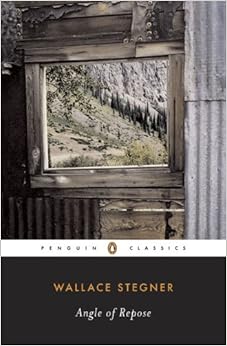
Angle of Repose by Wallace Stegner

Gone, and as painful now as the thought of a stillborn child.  Sentimental?  Of course.  Riddled with the Anglo-American mawkishness about home, quicksandy with assumptions about monogamy and Women's Highest Role, buttery with echoes of the household poets.  All that.  But I find that I don't mind her emotions and her sentiments.  Home is a notion that only the nations of the homeless fully appreciate and only the uprooted comprehend.  What else would one plant in a wilderness or on a frontier?  What loss would hurt more?

I'm a big fan of Idaho.  It's full of some of the most fascinating things I've ever had the luck to see: the towering Bruneau Dunes, the bizarre lavascape of Craters of the Moon National Park, the grand Shoshone Falls overlooking the Snake River Gorge.  Boise--an underrated city.  The isolated buttes on the way east from Wyoming, like stranded ships.

When I was heading out on my road trip to Oregon earlier this month, I wanted a book that took place in one of the places we would be passing through, and this novel came up on a list of "books set in Idaho."  The joke was on me--much as it was last year when we only passed through Iowa for five minutes when I tried to read Marilynne Robinson's Home--because we were well out of Idaho before I got to the part of Angle of Repose that was set there.  (In fact, I was back in New York before the book arrived in Boise Canyon.)

But worse, the Idaho of Angle of Repose isn't the sublime West that I like, but a real wilderness which proves an inescapable burden for Susan Burling Ward, the book's protagonist and the wife of Oliver Ward, an engineer who spends most of his life trying to find a project equal to his grand ambitions.  He and Susan go from New York to New Almaden, CA to Leadville, CO to Michoacan, Mexico, up to Boise Canyon over the course of decades.  Boise seems to finally offer Oliver the chance to build something meaningful--a set of ditches and canals that will irrigate the canyon--but the experience of living on the Western frontier proves difficult for Susan, a genteel New Yorker who is uprooted from any sense of civilization or society, and who worries about how her children will grow up amidst the savagery of Western isolation.  Boise Canyon is where those pressures finally come to break Susan and Oliver's relationship, causing a break that never seems to mend.

Telling this story is Susan's grandson, Lyman Ward, a former college professor suffering from a crippling bone disease which has left him confined to a wheelchair, as well as the dissolution of his marriage.  Lyman is bitter and recalcitrant in his insistence on being independent as possible, and writing about his grandmother is also a kind of self-finding:

Right there, I might say to Rodman, who doesn't believe in time, notice something: I started to establish the present and the present moved on.  What I established is already buried under layers of tape.  Before I can say I am, I was.  Heraclitus and I, prophets of flux, know that the flux is composed of parts that imitate and repeat each other.  Am or was, I am cumulative, too.  I am everything I ever was, whatever you and Leah may think.  I am much of what my parents and especially my grandparents were--inherited stature, coloring, brains, bones (that part unfortunate), plus transmitted prejudices, culture, scruples, likings, moralities, and moral errors that I defend as if they were personal and not familial.

Angle of Repose is in many ways a very conservative text.  Lyman frames his attempt to recover the story of his grandmother Susan as an alternative to the hippy-dippy notions of his caretaker Shelly, who has bought into the 60's counterculture optimism of creating a new society by breaking from what is old.  The strangest temporal experience of Angle of Repose, in fact, is not its demand that we sympathize with the Victorian Susan, but rather treating hippie utopianism as a contemporary idea--it's the latter, not the former, that really seems antiquated.  But the novel is also deeply critical of the way we trivialize or infantilize the past, something which I agree with very much:

What a hangup about bare skin!  What a hypocritical refusal to acknowledge the facts of life!  The Victorians were a race without biology.

Horsefeathers.  Grandmother grew up on a f arm and lived much of her life on crude frontiers.  She knew the animal facts of life as few of us are likely to again.  Without embarrassment she accepted the animal functions of, say, buggy horses that would bring giggles and hooraws from emancipated moderns... Death and life were everyday matters to Grandmother.  The breeding of horses, mules, cattle, the smug and polygamous fornications of chickens, raised no eyebrows.  When animals died, the family had to deal with their bodies; when people died, the family's women laid them out.  In the 1880s you suffered animal pain to a degree no modern would submit to.  You bore your children, more likely than not, without anesthetic.

We have only switched prohibitions and hypocrisies with them. We blink pain and death, they blinked nudity and human sex, or rather, talk about sex. 

Angle of Repose is based, not very loosely, on the life of Mary Hollock Foote, whose family gave Stegner permission to use not only the story but excerpts from Foote's actual letters within the novel.  Stegner, like Ward, fills in much of the blanks with fiction, piecing together what can be pieced with the help of conjecture.  The effort is seamless, though the choice hasn't been without controversy.

I love the American West.  Whenever I go out there, I'm struck by the scale of its landscape, and its vast near-emptiness.  But Angle of Repose reminds me that, in the end, I'm only zooming through on an interstate, and that I'll never love it--or loathe it--as strongly as those who worked on the frontier to make it a habitable place.

Tuesday, April 17, 2012

Housekeeping by Marilynne Robinson

Cain murdered Abel, and blood cried out from the earth; the house fell on Job's children, and a voice was induced or provoked into speaking from a whirlwind; and Rachel mourned for her children; and David for Absalom. The force behind the movement of time is a mourning that will not be comforted. That is why the first event is known to have been an expulsion, and the last is hoped to be a reconciliation and return. So memory pulls us forward, so prophecy is only brilliant memory--there will be a garden where all of us as one child will sleep in our mother Eve, hooped in her ribs and staved by her spine.

Marilynne Robinson's Housekeeping is revelatory--both in the sense that it was, for me, a revelation to discover a novel of such clear, confident prose, and in the sense that it communicates an apocalyptic vision of the world, one which promises a final unification of all things.

Ruth, the novel's heroine, lives in a life of constant abandonment in the remote far West town of Fingerbone. Her grandfather (in a train) and her mother (in an automobile) plunged into the same lake. Her guardian great-aunts, Lily and Nona, foist Ruth and her sister Lucille off on their aunt Sylvie, who returns from a drifter's life to take care of them.

Sylvie is peculiar. Like a transient, she sleeps on the top of her sheets, in her shoes. She seems not to care that Ruth and Lucille do not attend school. She keeps the light off in the parlor to hide the mounting collections of tin cans and old newspapers. Lucille, understandably, does not like her. But Sylvie acts the prophet for Ruth, communicating through her actions the possibility that time will bring all things back together:

Who would think of dusting or sweeping the cobwebs down in a room used for the storage of cans and newspapers--things utterly without value? Sylvie only kept them, I think, because she considered accumulation to be the essence of housekeeping, and because she considered the hoarding of worthless things to be proof of a particularly scrupulous thrift.


It seems to me that Housekeeping is the kind of book that could only be written in America, where we struggle with the consequences of fierce individualism and expansionism, and even then only in the West, which is the frontier also of that struggle. Isolated and "chastened... by an awareness that the whole of human history had occurred elsewhere," the town of Fingerbone longs to be knit back into that whole. Not only with the rest of the world, but with the lake it surrounds, which Ruth frequently imagines as a parallel world where the dead live, inaccessible. Even the name "Fingerbone" suggests the limitations of flesh and bone, which prevent us from joining the spiritual realm.

Sylvie's haphazard care threatens to have Ruth taken away, because like all prophets, she is misunderstood:

Imagine that Noah knocked his house apart and used the planks to build an ark, while his neighbors looked on, full of doubt. A house, he must have told them, should be daubed with pitch and built to float cloud high, if need be. A lettuce patch was of no use at all, and a good foundation was worse than useless. A house should have a compass and a keel. The neighbors would have put their hands in their pockets and chewed their lips and strolled home to houses they now found wanting in ways they could not understand.


This really striking parable becomes truth twice--once literally, when the town floods, and once figuratively, when Sylvie finally impresses Ruth into a life of drifting. Houses and homes, perhaps, are doomed attempts to connect with one's environment. I also love the bold, sharply American way that Robinson rewrites these Biblical tales, which she does even with the Gospel:

And when He did die it was sad--such a young man, so full of promise, and His mother wept and His friends could not believe the loss, and the story spread everywhere and the mourning would not be comforted, until He was so sharply lacked and so powerfully remembered that his friends felt Him beside them as they walked along the road, and saw someone cooking fish on the shore and knew it to be Him, and sat down to supper with Him, all wounded as He was. There is so little to remember of anyone--an anecdote, a conversation at table. But every memory is turned over and over again, every word, however chance, written in the hear in the hope that memory will fulfill itself, and become flesh, and that the wanderers will find a way home, and the perished, whose lack we always feel, will step through the door finally and stroke our hair with dreaming, habitual fondness, not meant to keep us waiting so long.


I find that piece of prose incredibly difficult to respond to in writing. Beyond its simple beauty, it is incredibly, outrageously bold, and yet, its spirit seems to me to be in keeping with the Gospel. And its hope is boundless! As Robinson tells us, "That most moments were substantially the same did not detract at all from the possibility that the next moment might be utterly different." Life can be such a patched-up, threadbare affair, but fear not:

For why do our thoughts turn to some gesture of a hand, the fall of a sleeve, some corner of a room on a particular anonymous afternoon, even when we are a sleep, and even when we are so old that our thoughts have abandoned other business? What are all these fragments for, if not to be knit up finally?