Showing posts with label William T. Vollmann. Show all posts

Monday, June 1, 2026

Butterfly Stories by William T. Vollmann

...Now he became in truth a crazed and greedy butterfly, no longer pretending to know who he was or what he was looking for, dreading the weary moment when he must stick it in, dreading the moment when the lady must leave, but avid to have and have had, his tips becoming smaller as the money went, the girls giving him colds, coughs, sore throats, weird new aches in his balls... What he was doing was systematically dismantling his own reality blurring faces and names (sometimes he couldn't remember te name of the woman he was on top of; of course she couldn't remember his, either), forming mutually exclusive attachments that left hi ma liar and a cheat attached to no one, passing his own reckoning by. When he wanted to eat out a whore, he'd say:   I want to kin kao you,   which means,   I want to eat rice you,   and then he'd point to her pussy --

"The journalist" of Vollmann's Butterfly Stories is on assignment in Thailand, which mostly means spending every cent he has on prostitutes. Unlike his rakish companion "the photographer," the journalist is a real romantic, finding something in these women that feeds some need that lies deeper than sex, although they fulfill that need for him, too. He falls half in love with nearly all of them, until he falls fully in love on a trip deep into the jungles of Cambodia, where the Khmer Rouge have been lately on a killing spree. It's hard to say what makes this prostitute, Vanna, different from the others, except that she becomes a repository for these deep needs; her feelings toward him--as opposed to feelings toward the necklace he buys her or the money he gives--are inscrutable and ambivalent. But his feelings are strong enough that he marries her--despite having a wife back in the U.S.--or perhaps the marriage is in name only, a name given to the strength of those feelings. Naturally, when he's whisked out of Cambodia, he yearns for her, first in Thailand, then back in the United States, where he purposely wrecks his marriage out of jealousy and fear.

It's tempting to read Butterfly Stories as a companion book to Whores for Gloria, another book about a man deeply enmeshed with the local prostitutes. The protagonist of Whores for Gloria trawls San Francisco's Tenderloin District, not Southeast Asia, and though they can be irascible or even hostile, the prostitutes there have a kind of transparency that the journalist searches for in vain. In Gloria, the protagonist rarely even has sex, preferring to listen to the whores' stories, but the language and cultural barrier make it impossible to know if any of the Thai and Cambodian girls are telling the truth, or if they are, whether it gets lost somewhere in translation. Their opacity is at the heart of the book's tragedy; we know that the journalist will never find what he's looking for, because what he's looking for both depends and is stymied by the exotic nature of Vanna and the others. Even in the flesh, she's a dream and a fantasy, and it's for the fantasy that he wrecks his life, upending his marriage and ultimately even contracting AIDS.

It's hard to say where Butterfly Stories might fall in a ranking of Vollmann's works for me. It's more standoffish and at-arm's-length than Whores for Gloria, and perhaps less satisfying by design. It's frustrating read--the guy is such a loser, and I can imagine that someone who picks this one up as their first Vollmann might be put off by the exoticizing and fetishism on display, though I think one more attuned to his work will notice the instability of that quality, if not the critique of it. Most disturbing to me was recognizing a small detail--the journalist, unable to re-reach Vanna, travels to the Arctic and falls for an Inuit girl--that seemed so like The Rifles that I couldn't help but wonder how much of Vollmann really is in here. (That's something he does quite a bit, I think--puts himself in the story in ways that are ambiguous, mixing himself in indeterminate percentages.) There's a nobility to the guy in Whores for Gloria, but what the journalist evokes is more along the lines of pity--a much more discomforting emotion. But it must be said that Vollmann makes it look easy, and if Butterfly Stories does not stand out among his works, taken in isolation it must be astonishing.

Sunday, August 24, 2025

Rainbow Stories by William T. Vollmann

Whether it is a happy life or a sad one the Skinz live is of course unknowable to anyone watching them stride by, turning their bulging skulls greedily upon their bulging necks, trying to pitiless, exclusive; not listening much to one another; but we can consider the question. The lone ones lean up against the restaurant windows, hunching their heads in like turtles at the same time they swivel their gaze in what might be anxiety or might be automatic street wisdom. They spend too much time waiting, but on the whole they are arguably happy, having their fights to look forward to. What more, after all, could anyone yearn for in his guts than the chance to hurt somebody else, jawkicking a soul to screaming subhumanness in order to reiterate that I live?

William T. Vollmann's Rainbow Stories are organized in the order of the visible spectrum, from "White Knights" to "Violet Hair," passing through every color in between. The symbolism there is immediately apparent: I am going to tell you about the full spectrum of human experience, of all the different kinds of people in the world, and though they may seem to one another quiet alien, they are all parts of the same phenomenon. And then, right from the beginning, he challenges you with this easy observation by giving you a story about Nazi Skinheads living in San Francisco's Tenderloin District. In fact, this story (chapter? essay? section?) is classic Vollmann, a dispatch from a margin of the world that most people would prefer to pretend doesn't exist, or if it does, to think of it somehow as below noticing or writing about. Vollmann's depiction of the Skinz is both sympathetic and unsparing; they are racist and violent but also, in some way, childlike. The next story, "Ladies and Red Lights," builds on the depiction of Tenderloin prostitutes that appears in Vollmann's Whores for Gloria, but it was "White Knights" that struck me most as that book's successor and heir.

The other section I really liked was "Yellow Rose," about the Vollmann character's brief and doomed relationship with a young Korean woman named Jenny. Jenny's family will never accept a white boyfriend, something the narrator knows but cannot accept, and his insistence on presenting Jenny with an engagement ring is one of the book's saddest and most powerful moments. But the whole thing is really driven by the power of Jenny's voice, twinged with not-quite-Englishisms and a bubbliness that conceals a deeper desperation. ("Mom would stab me with knives... Mom would fry me alive if she know. I'm become steel faced, as my mother said these days.") I was delighted when these two stories, "White Knights" and "Yellow Rose," came together in the story "Blue Wallet," wherein the Vollmann character invites both Jenny and her friends and his skinhead friends to the same party, with predictably tense results. (The title refers to a wallet that Jenny loses, assuming it was stolen by said skinheads.)

There are other stories here that explore the margins of Bay Area society, notably "The Blue Yonder," a fantastical imagining of the motivations that drive a real-life killer of the homeless who was never identified or caught, and "Indigo Engineers," about a group of scrap metal engineers who attract huge crowds for a kind of proto-Battle Bots exhibition of machines that stab and slice each other. But other stories seemed to me, if not failed experiments exactly, big swings that never quite come together. I didn't really connect with "The Green Dress," about a man who falls in love with his neighbor's green dress--not his neighbor--stealing it and treating it as a lover. And I thought that a pair of mytho-historical stories, one about Shadrach, Meshach, and Abednego in the Fiery Furnace called "Scintillant Orange" and one about the Thugs of ancient India called "The Yellow Sugar," never quite rose to the convincing level that Vollmann perfected in his novels about the colonization of North America. Like The Atlas, this is really an odds-and-sods collection with organizational pretenses. Well, they're all odd, and a couple are sods, but when he's at his best, there's really nothing like him, is there?

Thursday, August 22, 2024

Whores for Gloria by William T. Vollmann

Whenever Jimmy needed the smell of a woman or the soft weight of a woman's embrace, why, he had the whores being themselves for Gloria who partook of them all and lived on them all like some sky-goddess feasting upon the smoke from sacrifices. As for the rest of what he needed, the airy loveliness and happiness, he had that always with him; it floated at his arm like a helium balloon; no one could see it or ask about it or take it from him. So, having the hair, he really only needed the memories. Jimmy sat alone in his room, drinking tequila until his lips went numb. That's right honey babe (he said to Gloria) I have you I'm not lying I never lied to you I haven't told the truth for so long now that I've given up lying.

Jimmy is a Vietnam vet living in San Francisco's Tenderloin District. He lives entirely on the social security checks he gets from the government; these go to rent, to the bar, and to the prostitutes who make the Tenderloin their home. Sometimes he has sex with them (though when he does, he ends up obsessing over whether or not he has contracted a venereal disease), but mostly he only wants to hear their memories, which he appropriates for the woman of his dreams: Gloria. Gloria is Jimmy's one true love, his wife, whom he has known since childhood, and who represents everything good and beautiful--glory--about the world. But she's not real.

Jimmy spends his days "searching" for Gloria. Sometimes this seems to take on a literal aspect, as in searching for a woman who has hidden just behind the next corner, then the next. But mostly it means memorizing the stories told to him by the real prostitutes, sanitizing them and replaying them in his mind as a memory belonging to he and Gloria together, or just to Gloria. It's a difficult process, because the prostitute's stories are often grim ones. It's easy enough to assign to Gloria a lovely childhood memory of going on a road trip or sitting in a dark movie theater, but what can Gloria do with the memory of being nearly killed by a serial killer who targets prostitutes? Or the many stories of torture and rape that feature in these women's lives? Jimmy's quest makes him sort of an odd duck among the johns, and when his methods escalate--because when you chase what cannot be caught, your methods must escalate as a matter of course--it alienates him more and more from the life of the Tenderloin, already characterized by its alienation from the larger world. He begins to ask not just for stories but locks of hair, talismans to make Gloria real, and then it's an easy step from locks to entire wigs.

It seems likely that the stories that make up Gloria's imaginary life are ones told to Vollmann by the prostitutes of the Tenderloin, or fictionalized versions of them. A brief appendix, "A Profile of the Tenderloin Prostitute," is almost certainly taken verbatim from such conversations. No writer throws himself into his subject like Vollmann; after being embedded with the mujahideen, the Tenderloin was probably an easy assignment. Vollmann's engagement with the Tenderloin surpasses what one might call research or journalism; he (later?) famously developed a female alter ego to live among the women described here. (What Vollmann calls, in the language of the time and place, "Transvestites" or "Transformers," are as central to the construction of Gloria's identity as AFAB women.) For this reason, Vollmann's books always have an honesty and authenticity that few other books, especially novels, can match. Whores for Gloria crackles with the real life of the Tenderloin.

Ultimately, Whores for Gloria is a story about the nature of our desires. Jimmy both does and does not believe in Gloria; he consciously and intentionally cobbles an identity and memory for her from those of the Tenderloin women, but after he does so he must forget that he has done this, and in a sense persuade himself that the image he has made is a representation of the world. Of course, this is what all our desires are: images that we have made to persuade ourselves that they are real. In Jimmy I recognize the power of the fantasy life that dwells within, as well as the fear that descending too far into the fantasy can leave one alienated and unfit for the world. Such desires are principally about sex and romance; you might even say that all sexual desire is structured the same way as Gloria. But Vollmann captures the way that even our yearnings for other people are rooted in a deeper yearning for abstractions like beauty and goodness that need images to cling to, but which can only be failed by them.

Thursday, June 8, 2023

The Atlas by William T. Vollmann

This book being a palindrome, and this tale being the central and infinitely regressive metonym thereof, one might hope by now to have established the center of our traveller's world, but the Earth itself is scarcely a sphere, only an asymmetric rotational spheroid--that is, a pear--and so the reference point, the map of magma which lies precisely halfway through our atlas, is not quite where intuition might lead us to expect. Then, too, mass displacements occur beneath our feet and no one knows their laws. But, as I've said, cannot we not make our own planets wherever we go, with even our own idees fixes or lunar satellites to accompany us in orbits of measurable eccentricity?

William T. Vollmann's The Atlas takes the reader, as the title might suggest, all over the globe: from the U.S. to Canada and Mexico, to Germany, India, Australia, Israel, Madagascar, Myanmar, Italy, etc., etc., etc. Place is the guiding theme of the book, and it has places aplenty, each vignetted and listed in the gazetteer that opens the book. The Atlas is arranged chiastically, that is, as a palindrome, though it's not the settings that unite the sections on either side of the fulcrum but themes. (And as such, with some exceptions, only a really patient reader will probably notice most of the correspondences, or take the trouble to count backwards from the center to find where they should lie. I'm not that patient reader.)

At the heart of The Atlas is a long title section that follows the unnamed narrator and Vollmann stand-in on a train journey from Montreal up to the northern Manitoba town of Churchill. On the train, the neatly segregated organization of the atlas begins to fall apart, and the delineation between places falls away through the slippage of memory: one memory of a lost love bleeds into another, and Thailand becomes the United States becomes Australia, and so on, as Canada whistles by in the window. Loneliness and a desire for love is, if anything, the theme that threads the many places together. Over and over again, in disparate locales, we find the same Vollmannian sad sack, yearning for the true love of a prostitute or an ex-wife. They may be the same sad sack (how many places could Vollmann possible have traveled to between 1991 and 1993???) and they may not, but the yearning is the same. For such a heady writer, the yearning is startlingly simply and sweet, even romantic. Perhaps the search for love is like the search for that central place, the heart of everything, but as the traveller of "The Atlas" learns, the center of things is something you carry with you as you go.

Though it's not by any means my favorite, The Atlas might make a good introduction to Vollmann's writing. It's a kind of Vollmann sampler platter, combining scenes and characters from his other books, even sometimes under the same titles: Fathers and Crows is here, and The Rifles, in miniature scenes that seem almost like outtakes, and a long and tremendous version of The Butterfly Stories. It was an interesting introduction to some of the places that I know Vollmann has written about, but which I have not yet read, like Southeast Asia and the war-torn Balkans. (His time with the mujahideen in Afghanistan, oddly, makes no appearance.) For me, it confirmed a lot of what I liked best about Vollmann. My favorites are still his renditions of the Canadian Arctic, which capture their melancholic color so well, and the strange contours of a culture at the limit of the world. (Of course, for those who live there and even for the transient traveller, it's the center of things; on this asymmetric rotational spheroid, there really is no center.) 

Tuesday, August 16, 2022

Europe Central by William T. Vollmann

About this quartet the most fundamental thing which can be said is that it is too sad even to rise from a moan into a wail at death's uncompassed crescendo. To be sure, the danse macabre of the second movement glows sickeningly vivid as a sodium flare at night (so much for flamelessness!); it's as bright as the electric light which illuminates the gas chamber when it's time to ascertain whether all the Jews are dead; while the menace of the third remains more chilling than those screams of terror in Leningrad when the German bombs come down; they'll never stop coming down. Yet on the whole the effect is of somebody drowning, his most desperate convulsions already behind him; he's begun to inhale water; the green water he sees is going black; and he's settling down into the muck. Some listeners who close their eyes during the second movement claim to perceive a whirling red eye-ball or domino, and the more rapidly it speeds, the more balefully it glows. This eidetic image seems to symbolize the approach of something evil. I myself have never seen the red spot, perhaps because Opus 110 already threatens me so perfectly that no kinesthesia is needed to extend or refine the threat. While Shostakovich's music wriggles like the worming of black-gloved fingers behind a policeman's back, the Bronze Horseman sinks down under sandbags and planks. Leningrad strangles in a loop of barbed wire.

It's a time and a place we all know, though perhaps when we Americans think of it, we're more likely to think of the beaches of Normandy, or the Battle of the Bulge, than the enormous front between Germany and Russia that brought millions under conflagration during World War II. Stalingrad, that six month siege that killed two million, doesn't feature very highly in our American memories. William T. Vollmann's epic Europe Central is a book that presents fictionalized versions of some of the Germans and Russians who lived through those years of intensity and destruction. Some are military figures, like generals A. A. Vlasov and Friedrich Paulus, or the SS member Kurt Gerstein; many are creative types: German artist Kathe Kollwitz, Russian poet Anna Akhmatova, and the novel's protagonist, more or less, the Russian composer Shostakovich.

The central image that introduces the book is a black, octopus-like telephone--"Europe Central" evokes not just central Europe but a kind of immense telephone switchboard--that snakes into the lives of its characters, making orders and demands. The same black telephone that rings in Shostakovich's house to summon him to the Stalin's secret police is the same one that rings in the field tent of Field-Marshal Paulus to inform him that he is expected to commit suicide before retreating from where he is encircled by Soviet forces. I was most interested, perhaps, in the twin stories of Vlasov and Paulus, both generals who ended up being captured by the enemy, then recruited against their former masters. Vlasov led a regiment of Russians under the Nazi army; Paulus became a spokesman for an anti-fascist Germany under the auspices of the Soviet Union, though their "betrayals" came for different reasons and they came to--unsurprisingly, given the outcome of the war--very different ends.

I was also really taken by the story of Kurt Gerstein, who "infiltrated" the SS in an attempt to save as many people as he could. Gerstein's story, which I'd never heard, is one of a noble man who tries very hard, with limited results, to stave off a great cruelty. He pretends that shipments of Zyklon-B have gone bad, to give those condemned to death more time; he tries, mostly in vain, to alert authorities outside of Germany to the horrors of the concentration camp system. For these efforts, he is put on trial as a Nazi collaborator by his French captors, ultimately committing suicide. "I consider him a hero," Vollmann writes in the (characteristically compendious) footnotes, but Gerstein's story makes one question what a hero truly is--can one be a hero when what they accomplish is so minimal, because the forces allayed against them are so great? As Vollmann grimly notes, Gerstein's name is not one of those compiled in the "Righteous Among the Nations" for their efforts to save the Jews of Europe. For all that, he's a very Vollmann-like hero, something like the noble but ineffectual Chief Joseph of The Dying Grass.

I was less sure of what to make of the novel's focus on Shostakovich, whose story gives the book its backbone. Vollmann invents, seemingly out of whole cloth, a lovelorn Shostakovich, unable to get over his early lover Elena Konstantinovskaya, who later marries the famous Soviet filmmaker R. L. Karmen. Shostakovich obsesses over Elena, even as he marries a succession of other women. What's this got to do with the political themes of a book like Europe Central? Well, perhaps in one way it's merely an observation that what drives our innermost lives is not always, or even typically, questions of justice and struggle, like those that animate Vlasov, Paulus, Gerstein, Kollwitz, Akhmatova. Shostakovich, for all his genius, is an ordinary man unable to get over the one who got away; all the grand movements of the Soviets and Germans--he lives through the siege of Leningrad--count for less than Elena. But also, there's an interesting parallel in the way that Shostakovich debases himself for Elena and for the Soviet regime. Shostakovich, a "formalist" who loved dissonance and hated the mindless patriotism of Soviet realism, was constantly in trouble with the Soviet censors. But Vollmann depicts him as absolutely spineless, falling over himself to apologize and genuflect to the apparatchiks who want him to be more conformist, though he never seems to be able to actually constrain the shape of his genius in the way they desire. Eventually, Shostakovich does what he said he never would, joining the Communist Party, and alienating all of his more principled associates. Yet clearly Vollmann finds something heroic in him, too, though perhaps it is a kind of heroism that operates at a level beneath the conscious, in the place where creativity works.

The subject matter of Europe Central doesn't resonate with me like the Native American-European culture clashes of Vollmann's Seven Dreams books. And at a subconscious level, I think I had been suspicious of Europe Central because of a vague intuition that the Seven Dreams stuff was never taken all that seriously by critics until the publication of Europe Central, with its more familiar and shopworn settings. (Who needs another World War II novel?) But I am forced to admit that the later sections of Europe Central contain some of Vollmann's most accomplished writing: the strange chapter "Airlift Idylls," narrated by a German assassin targeting Shostakovich, who seems to be more of a metaphor than anything else--have you ever seen a chapter narrated by a metaphor?--and the freewheeling, associative horror-scape of "Opus 110," which details Shostakovich's spiraling instability and debasement with a prose to match. Ultimately, Europe Central struck me as an accomplishment on the level of Vasily Grossman's Life and Fate, a novel from which it clearly takes some inspiration.

Saturday, August 14, 2021

The Dying Grass by William T. Vollmann

It must be here that the loneliness of the Indian country of which we have merely commenced to take possession, and at that so nominally that nothing but violence will save our claims from being laughed away, begins to march along with us, very quick and correct in its movements, although uncouth in the gaze and teeth it turns upon us, proposing to nibble us up before we notice, our desire consequently being to ride away from here , but now as long as we continue forward, everywhere we go will be again here in the dying golden grass of what is not yet America even though it will certainly become so, which is why we pursue Joseph as far as we must, our Springfields ready with a round in the chamber and our faces fixed as we seek earth stained by his sign, riding east now toward our dear United States, the general watching us without imparting anything but affable trivialities; we will carry Joseph to the gallows, and if that isn't good enough, we will kick him down to Hell.

The Nez Perce, like so many of the indigenous tribal nations of the 19th century in the land that is now the United States, were "good Indians" until they weren't. They cooperated with the U.S. government and the Army, they were friendly with settlers--even intermarrying with them--and signed a treaty agreeing to a large reservation in the land that now lies at the intersection of Washington, Idaho, and Oregon. But of course there isn't a single Indian treaty that the United States didn't break, and the thief treaty was the same: the Nez Perce saw their reservation chiseled away to a tiny fraction of what it had been. Many Christianized Nez Perce stuck to the reservation, took English names, and began the process of assimilation, but several bands totaling about 750 people decided to refuse the terms of the treaty, touching off a war of attrition that lasted from June to October of 1877. The Nez Perce led the Army on a strategic retreat through Idaho, Wyoming, and Montana, before finally being routed just a few miles south of the Canadian border.

William T. Vollmann's novel The Dying Grass tells the story of the Nez Perce War from beginning to end, from both the perspective of the Nez Perce, and the Department of the Columbia that pursued them. It is the longest of Vollmann's five written Seven Dreams novels about conflict between settlers and Native Americans--at 1200 pages it is almost certainly, by page count at least, the longest book I have ever read--but also the most stylistically adventurous. When a perspective shifts--perhaps from one character to another, or from what someone is saying to what they are really thinking, or just from the action to a description of its natural surroundings--Vollmann indents that section or set of lines. The result looks and often reads like poetry, but it also reminded me of the "stacks" of computer code (sorry Brent that's probably not right). The result is that The Dying Grass seems uniquely polyphonic, woven from hundreds of different voices. More than any of the other Seven Dreams books, The Dying Grass captures the sheer breadth of the conflict and its many actors.

On the white side, Vollmann's main character is the General Oliver Otis Howard, known by his detractors as "Uh Oh Howard" for his defeat at the Battle of Chancellorville. Many of Howard's soldiers also call him "General Prayer Book" because of his piousness, and rankle under his proscription of alcohol and his friendliness toward Indians and blacks. Howard's virtues are indeed very virtuous: his sincere concern for black Americans--something that could not be said for many other Union generals--led him to found Howard University and steer the Freedman's Bureau. His attitude toward the Nez Perce is similar: when he says he had counted them friends and is aggrieved by their rebellion, we believe him, but he is blind to the limits of his own paternalism. He wants for the Nez Perce what he wanted for the Negroes--a little bit of land and assimilation into the social order of the United States--but cannot see how such largesse entails the destruction of the nation's cultural history and way of life. 

Only one of the soldiers, Howard's aide-de-camp Erskine Wood, slowly comes to believe that the Army's pursuit of the Nez Perce is a moral outrage; Vollmann's depiction of him is second only to Howard in its richness and sensitivity. And yet even Wood's protest remains in his heart only; his creeping doubt does not spur him to reject his Army commission or aid the Nez Perce (though we find, in a true and fascinating fact, that later in life Wood sent his son to learn "how to be an Indian" from the captured Nez Perce Chief Joseph). Wood's foil might be Ad Chapman, the volunteer interpreter who knows how to speak Nimipuutimt from his marriage to a Nez Perce woman. Crude, mercenary, and untrustworthy, it might be said that the whole war is Chapman's fault because he fires first on the Nez Perce, and yet his position between two worlds makes him indispensable. In a touch that is both meaningful and historically true, it's Wood and Chapman, dissident and bigot, who pen the famous translation of Chief Joseph's surrender speech: "From where the sun now stands I will fight no more forever."

Howard's counterpart on the Nez Perce side is Chief Joseph himself, called by his true name, Heinmot Tooyalakekt. The Nez Perce's strategic retreat bestows upon Joseph the title of the Red Napoleon, but this relies on a grave misunderstanding: Joseph is the chief of his own small band of Nez Perce, but he's never made war chief, a role given to Looking-Glass (named for the shard of mirror he keeps around his neck) or Lean Elk. Jane Smiley's review of The Dying Grass suggests that Vollmann is so sympathetic to the Nez Perce that it verges on "noble savage" ideology, but not only is this a poor moral judgment--a kind of bothsidesism projected onto the past--I'm not sure how she could have read about the great disagreements between the restrained Joseph and the more militant members of the Nez Perce party, like the "Three Red Blankets" or the bloodthirsty Toohoolhoolsote, and came away with that conclusion. One thing Vollmann, who wrote an 800-page treatise on the nature of violence, does well is to show the way violence cycles out of control, no less among the Nez Perce than the Army: their rebellion against the "Bostons" becomes all too easily an excuse to raid and murder uninvolved white settlers.

For his part, Joseph always advocates for surrender and peace, though his stature is not such that he's often heeded. But among the many disputing chiefs Joseph emerges as the most virtuous because he unerringly thinks of the welfare of his people, and women and children especially, before abstract concerns like honor. The Dying Grass suggests that the American press might have it right when they imagine Joseph to be supreme among the Nez Perce:

now his heart begins too late to understand

--although many other best men dispute this, preferring White Bird, who planned our victory a Sparse-Snowed Place and led us across the Medicine Line--

that our greatest chief was Heinmot Tooyalakekt,
he who never had hope,

desiring only to help our women, children, and old ones:

Yet The Dying Grass echoes an idea that first came to me by way of Dee Brown's history of the Indian Wars, Bury Me at Wounded Knee: in the end, the various responses to removal mattered very little. The Bannocks and Cheyennes who help the "Bluecoats" stomp out the Nez Perce will find themselves at the barrel of their guns within a year, and even the disputation between the various Nez Perce chiefs seems, in the end, meaningless: "The prudent and trusting submission of Looking-Glass," Volmann writes, "the violent resistance of the Three Red Blankets, the flight of White Bird and the restraint of Chief Joseph all produced the same result. So did General Howard's kindheartedness and General Sherman's pitiless fury." It is interesting to think of Howard and Sherman--and Wood and Chapman, perhaps--in the same boat, one which rises on the tide of history but which can barely be guided or steered. Did the rush of settlement in the latter half of the 19th century mean that the cruelty of the Indian Wars and the reservation system were foregone conclusions? In Fathers and Crows, Vollmann wrote of the Jesuit conversion of the Haudenosaunee, "If it had to be done, it could have been done differently." Is that true here, too? Or is Howard right when he tells Wood that there's no other way?

Either way, The Dying Grass is a tremendous panorama of those caught in the rush of history. Beyond Howard, Wood, Chapman, Joseph, Looking-Glass, and Toohoolhoolsote there are dozens and dozens of individual characters whose interior lives are thoughtfully imagined and evoked by the unusual structural choices of the novel. It's a novel as big and breathtaking as the mixed-grass prairie, or the mountain valley, or the camas meadows over which that history moves.

Friday, March 30, 2018

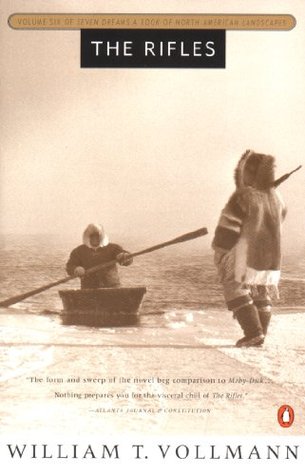
The Rifles by William T. Vollmann

You came to another lake whose shore was paved with white slabs (and the sky was barred yellow, red, and orange).  But that was not the source of the river, either.  You arrived at the shore of a wide, grey, ankle-deep lake, over which a single bird twittered.  Bands of muted color rippled across that lake.  It flowed steadily in the cool breeze you barely felt.  Black rocks stuck up in it like birds.  The water was pure and good to drink.  Two birds chased you, screaming through the sky.  And you went over another little rise and there was a lake whose waters rippled black and blue and orange and silver, and there was a jet-black ridge behind it topped with blue clouds, and the lake went on and on and on and there was another lake behind it and streams ran out of that lake in all directions and at last you understood that the river you had followed had no one source, that these lakes were permafrost melt; the whole island was permafrost; when you were on the island you were on a world of rivers that came from everywhere.

In the 1840's Sir John Franklin made a final attempt to reach the Northwest Passage aboard the HMS Terror and the HMS Erebus.  It was his final attempt because he and his crew got stuck in ice for three years just off of King William Island and died.  It seems to have been a baroque and nightmarish experience: some slowly died of lead poisoning from improperly canned food, others of tuberculosis; some starved on their way trekking across the ice in a last ditch attempt to cross thousands of miles of arctic tundra on foot.

William T. Vollmann's The Rifles tells the story of Franklin's expedition, intertwined with a modern narrative centering around a character called Captain Subzero, a name given to him by some local Inuit children when he first arrives in the Canadian arctic.  Subzero is a stand-in for Vollmann himself, and seems to share a lot of Vollmann's experiences, including accidentally setting his own sleeping bag on fire during an ill-advised attempt to spend a week in the harsh winter in the far north.  Your guess is as good as mine whether, like Subzero, falls in love with an Inuit girl whom he continually returns to visit, impregnates, and abandons to commit suicide.  You'd think the answer is no, but with Vollmann, whose whole schtick is immersing himself in whatever he's writing about, who once joined the mujahideen to fight against the Soviets in Afghanistan, there's no telling.  I'm going to assert that the "Reepah" parts of the story are mainly fictionalized, because otherwise The Rifles would be very difficult to read.

Subzero believes himself to be the reincarnation of Franklin: a European on a doomed arctic voyage.  But that description doesn't really capture what Vollmann does here, skipping from Franklin to Subzero as if they really are the same person, sometimes in the space of a single sentence.  The whole thing induces whiplash:

Then too there was the matter of his own preferences.  A gentleman puts these aside in favor of others whenever he can, of course, but by GOD he did think that he too had some right to complete the Passage! -- A gentleman is a gentleman: he gave way to Sir John, or rather to his wife. -- As for this matter of Reepah, here I must confess to have been indulging in historical reconstruction.  Such thoughts could only have occurred to Sir James if time works both ways -- that is, if simply because Subzero had become the reincarnation of Franklin, Franklin must then have become (to however slight an extent) identified with Subzero in some manner.  Ask yourself: are you behaving differently at this very moment because someone not yet to be born for a century or more will someday think about you?  You cannot prove the contrary.  -- What's the difference anyway whether it's so?  Ice-floes, no matter how white, and water, no matter how blue or grey, eventually reach the same color in the distance.

Vollmann's become a hot commodity lately thanks to the popularity of Europe Central and The Dying Grass, a 1000-page novel about the Nez Perce that's part of the same series as The Rifles investigating European interactions with Native Americans.  But most of what I could find people saying about The Rifles was largely negative.  I understand why people might feel that way: Vollmann's immersive tactics can seem precious, rather than innovative, and the metafictional stuff might seem tedious.  To those voices I add: I wish that we would stop using victimized women as symbols of colonized lands, which is something that The Rifles' Reepah has in common with the Pocahontas of Argall.

But I think there's a remarkable honesty in Vollmann's project.  Subzero mistreats Reepah fabulously, refusing to leave his wife for her or vice versa.  He loves to entertain the radical idea of moving to the Canadian arctic and settling down with an Inuit woman, but when provided the opportunity, he finds that he can't take the other foot out of the old U.S. of A.  In this way, Vollmann aligns himself not with the beleaguered Inuit, but the Europeans who introduced the rifles to them, which ended up devastating their hunting practices.  It's no coincidence that Reepah kills herself with a shotgun.

One reviewer complains that Vollmann has nothing insightful to say about the Inuit, but I think that's the point; it's impossible, Vollmann argues, for the descendants of white Europeans to really understand the First Nations whose historical oppression they have inherited.  By aligning himself with Subzero, Vollmann doesn't shy away from that inheritance or minimize it.  That's one of the reasons that this book, which takes so many weird liberties in other ways, is so scrupulously researched and footnoted: all the knowledge and research that Vollmann/Subzero possesses cannot stop him from reenacting the calamities of colonialism over and over.

Other things I really admired about this book are: the sharp, observant descriptions of the Arctic landscape, which do a great job distinguishing one island from another.  Not all Arctic islands, it seems, are created equally, which is something the Inuit found out who were forcibly removed to the far northern outposts of Grise Fiord and Resolute by the Canadian government.  I loved the description at the top of this review, which emphasized their status as terra incognita, which obviate any attempt at wayfinding, and which echoes just how lost the Franklin expedition becomes.

And though her fate in the book is tragic, I thought the depiction of Reepah was charming and lovingly drawn.  I have no way of telling if her unstudied English is an accurate depiction of how an Inuit woman might talk, but it felt real.  "Someone stole my secrets," she says, poetically, and only several paragraphs later we find that she means that someone stole her cigarettes.  She has a real life on the page that contrasts to the dead-eyed foolishness and selfishness of Subzero, or the obsessive fatalism of Franklin.

Ultimately I really liked the unpredictable seesawing of time in The Rifles, which added an element of novelty to the hyperhistorical slog that is Argall, a book I also really liked.  There are three more of these books, most of them big bricks nearing or passing a thousand pages, and I'm afraid I'm going to have to read those, now, too.