You came to another lake whose shore was paved with white slabs (and the sky was barred yellow, red, and orange). But that
was not the source of the river, either. You arrived at the shore of a wide, grey, ankle-deep lake, over which a single bird twittered. Bands of muted color rippled across that lake. It flowed steadily in the cool breeze you barely felt. Black rocks stuck up in it like birds. The water was pure and good to drink. Two birds chased you, screaming through the sky. And you went over another little rise and there was a lake whose waters rippled black and blue and orange and silver, and there was a jet-black ridge behind it topped with blue clouds, and the lake went on and on and on and there was another lake behind it and streams ran out of that lake in all directions and at last you understood that the river you had followed had no one source, that these lakes were permafrost melt; the whole island was permafrost; when you were on the island you were on a world of rivers that came from everywhere.
In the 1840's Sir John Franklin made a final attempt to reach the Northwest Passage aboard the HMS Terror and the HMS Erebus. It was his final attempt because he and his crew got stuck in ice for three years just off of King William Island and died. It seems to have been a baroque and nightmarish experience: some slowly died of lead poisoning from improperly canned food, others of tuberculosis; some starved on their way trekking across the ice in a last ditch attempt to cross thousands of miles of arctic tundra on foot.
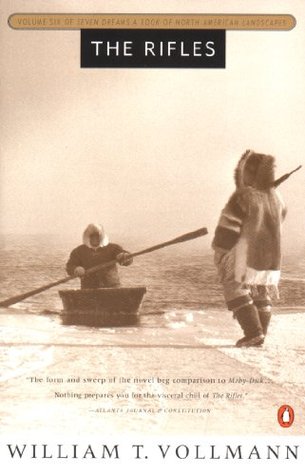
William T. Vollmann's
The Rifles tells the story of Franklin's expedition, intertwined with a modern narrative centering around a character called Captain Subzero, a name given to him by some local Inuit children when he first arrives in the Canadian arctic. Subzero is a stand-in for Vollmann himself, and seems to share a lot of Vollmann's experiences, including accidentally setting his own sleeping bag on fire during an ill-advised attempt to spend a week in the harsh winter in the far north. Your guess is as good as mine whether, like Subzero, falls in love with an Inuit girl whom he continually returns to visit, impregnates, and abandons to commit suicide. You'd think the answer is no, but with Vollmann, whose whole schtick is immersing himself in whatever he's writing about, who once joined the mujahideen to fight against the Soviets in Afghanistan, there's no telling. I'm going to assert that the "Reepah" parts of the story are mainly fictionalized, because otherwise
The Rifles would be very difficult to read.
Subzero believes himself to be the reincarnation of Franklin: a European on a doomed arctic voyage. But that description doesn't really capture what Vollmann does here, skipping from Franklin to Subzero as if they really are the same person, sometimes in the space of a single sentence. The whole thing induces whiplash:
Then too there was the matter of his own preferences. A gentleman puts these aside in favor of others whenever he can, of course, but by GOD he did think that he too had some right to complete the Passage! -- A gentleman is a gentleman: he gave way to Sir John, or rather to his wife. -- As for this matter of Reepah, here I must confess to have been indulging in historical reconstruction. Such thoughts could only have occurred to Sir James if time works both ways -- that is, if simply because Subzero had become the reincarnation of Franklin, Franklin must then have become (to however slight an extent) identified with Subzero in some manner. Ask yourself: are you behaving differently at this very moment because someone not yet to be born for a century or more will someday think about you? You cannot prove the contrary. -- What's the difference anyway whether it's so? Ice-floes, no matter how white, and water, no matter how blue or grey, eventually reach the same color in the distance.
Vollmann's become a hot commodity lately thanks to the popularity of
Europe Central and
The Dying Grass, a 1000-page novel about the Nez Perce that's part of the same series as
The Rifles investigating European interactions with Native Americans. But most of what I could find people saying about
The Rifles was largely negative. I understand why people might feel that way: Vollmann's immersive tactics can seem precious, rather than innovative, and the metafictional stuff might seem tedious. To those voices I add: I wish that we would stop using victimized women as symbols of colonized lands, which is something that
The Rifles' Reepah has in common with the Pocahontas of
Argall.
But I think there's a remarkable honesty in Vollmann's project. Subzero mistreats Reepah fabulously, refusing to leave his wife for her or vice versa. He loves to entertain the radical idea of moving to the Canadian arctic and settling down with an Inuit woman, but when provided the opportunity, he finds that he can't take the other foot out of the old U.S. of A. In this way, Vollmann aligns himself not with the beleaguered Inuit, but the Europeans who introduced the rifles to them, which ended up devastating their hunting practices. It's no coincidence that Reepah kills herself with a shotgun.
One reviewer complains that Vollmann has nothing insightful to say about the Inuit, but I think that's the point; it's impossible, Vollmann argues, for the descendants of white Europeans to really understand the First Nations whose historical oppression they have inherited. By aligning himself with Subzero, Vollmann doesn't shy away from that inheritance or minimize it. That's one of the reasons that this book, which takes so many weird liberties in other ways, is so scrupulously researched and footnoted: all the knowledge and research that Vollmann/Subzero possesses cannot stop him from reenacting the calamities of colonialism over and over.
Other things I really admired about this book are: the sharp, observant descriptions of the Arctic landscape, which do a great job distinguishing one island from another. Not all Arctic islands, it seems, are created equally, which is something the Inuit found out who were forcibly removed to the far northern outposts of Grise Fiord and Resolute by the Canadian government. I loved the description at the top of this review, which emphasized their status as
terra incognita, which obviate any attempt at wayfinding, and which echoes just how lost the Franklin expedition becomes.
And though her fate in the book is tragic, I thought the depiction of Reepah was charming and lovingly drawn. I have no way of telling if her unstudied English is an accurate depiction of how an Inuit woman might talk, but it felt real. "Someone stole my secrets," she says, poetically, and only several paragraphs later we find that she means that someone stole her
cigarettes. She has a real life on the page that contrasts to the dead-eyed foolishness and selfishness of Subzero, or the obsessive fatalism of Franklin.
Ultimately I really liked the unpredictable seesawing of time in
The Rifles, which added an element of novelty to the hyperhistorical slog that is
Argall, a book I also really liked. There are three more of these books, most of them big bricks nearing or passing a thousand pages, and I'm afraid I'm going to have to read those, now, too.