Showing posts with label russia. Show all posts

Thursday, January 1, 2026

War and Peace by Leo Tolstoy

In captivity, in the shed, Pierre had learned, not with his mind, but with his whole being, his life, that man is created for happiness, that happiness is within him, in the satisfying of natural human needs, and that all unhappiness comes not from lack, but from superfluity; but now, in these last three weeks of the march, he had learned a new and more comforting truth--he had learned that there is nothing frightening in the world. He had learned that, as there is no situation in the world in which a man can be happy and perfectly free, so there is no situation in which he can be perfectly unhappy and unfree. He had learned that there is a limit to suffering and a limit to freedom, and those limits are very close; that the man who suffers because one leaf is askew in his bed of roses, suffers as much as he now suffered falling asleep on the bare, damp ground, one side getting cold as the other warmed up; that when he used to put on his tight ballroom shoes, he suffered just as much as now, when he walked quite barefoot (his shoes had long since worn out) and his feet were covered in sores.

Here it is, my first book of 2026: Leo Tolstoy's War and Peace. I'm on track to read 365 books and 730,000 pages. And of course, whatever I try to say about it here will be by rights insufficient to it. It's not just a book that's long, or large in scope, but a book whose capaciousness attempts to take in all of human history; it is, in the end, a treatise on the relationship between history and the illusion of free will. But it's also a pretty good story, so let me start with an attempt at a summary. In early 19th century Russia, Pierre Bezhukov is blessed with the title and fortune of his late father, despite being illegitimate. Being a rich count gives him no sense of purpose or goodness, and so he struggles to find ways to contribute, from the military to Freemasonry to an ill-advised marriage to a selfish and narrow-minded woman. There are others in Pierre's social orbit, like his friend Andrei, a widower who falls for Natasha Rostov, who is the sister of Nikolai, a young man searching for glory in the war against Napoleon. These four--Pierre, Andrei, Natasha, and Nikolai--are, I would say, the core four in a book with an immense cast. As Napoleon enters Russia in the fateful year of 1812, the war goes from being an embarrassment to a threat, and these four all find their lives upended by the arrival of total war to Moscow.

My first impressions of War and Peace were that, unlike Anna Karenina, it all seemed a little slapdash. The various storylines didn't seem to hang together very well, although there's a lot in the book's first half that's really delightful, like Pierre being accidentally successful in a duel with his wife's lover. But it's the book's second half, with the arrival of Napoleon and the war--not the fake war of Austerlitz, which seems almost like a feint by Tolstoy in the book's first section--where the book really gains a sense of purpose and direction. (Maybe, in that sense, it's a lot like Pierre.) The war provides a crucible for the love between Andrei and Natasha, even as we know that it will also (even if we're only familiar with the title of a certain Broadway play based on War and Peace) spell that love's doom. But the real highlights, I think, are the scenes where we follow Pierre during the Napoleonic occupation and burning of Moscow: Pierre convincing himself that numerology suggests he should go out and assassinate Napoleon; Pierre sort of accidentally saving the life of a friendly French nobleman; Pierre being ultimately captured and sent to a French prison camp, where he comes to a deeper and more profound understanding of human nature (the passage above). Pierre is the book's singular creation, a genial but hapless oaf--I loved how often Tolstoy reminds us he's a big fat guy--whose heart goes searching after wisdom, and amazingly, finds it.

You know, I said there's four main characters, but now that I think about it, there's really five, because Napoleon is one, too, right? Not knowing all that much about the Napoleonic wars outside of the basics, I found the "War" stuff interesting but often pretty tedious. But I really was interested in War and Peace's depiction of Napoleon, who Tolstoy describes as an overly proud man who believes in himself as a manifestation of the will of the people. This often verges on the comical, as when Napoleon seems convinced that even a Russian envoy, who just wants to deliver a message, will be charmed enough by his grandeur to kiss his ring. Among the more incisive things said by Tolstoy, whose editorial hand is much heavier here than in Anna Karenina, is that the myth of Napoleon's "greatness" has elided how evil he was, and how many people he wantonly murdered; that's true to some extent even today. I really enjoyed the way that Tolstoy cuts him down to size. Tolstoy manages to make interesting, memorable characters out of a few of the war's other figures, like the Russian military leaders Kutuzov and Rastopchin, though I imagine these depictions might resonate even more with a Russian audience for whom these figures are well-known.

Tolstoy interrupts the narrative time and time again to tell us that his real subject is history and its causes, and their relationship to free will. As insidious as his Napoleon is, Tolstoy informs us that to blame the war on Napoleon is a categorical error. War happens not simply because one man wills it, but because of the wills--such as they are--of millions of men. And in fact, even this is not quite right, because Tolstoy ends the book with a long treatise telling us that there is no such thing as free will. This is the realization that brings Pierre such joy in the prison camp, that happiness emerges from accepting the thought that one's will his limited. Tolstoy's argument is captured best by a dream Pierre has of a friend in the camp holding a globe which is composed of millions of drops; each man is a drop but also a manifestation of the entire sea, into which he ultimately returns. In the end, I wonder if War and Peace might have been an even better book--if it's not sacrilege to say so--if Tolstoy had kept that singular image and dropped the last thirty pages of sermonizing. But perhaps he wrote only the book that the forces of history drove him to write.

Sunday, January 12, 2025

The Idiot by Fyodor Dostoevsky


Over the door to the next room hung a painting rather strange in form, around fix feet wide and no more than ten inches high. It portrayed the Savior just taken down from the cross. The prince glanced fleetingly at it, as if recalling something, not dropping, however, waiting to fo on through the door. He felt very oppressed and wanted to be out of this house quickly. But Rogozhin suddenly stopped in front of the painting.

“I’ve been meaning to ask you something, Lev Nikolaich; do you believe in God or not?”

“How strangely you ask and stare!” the prince observed involuntarily.

“But I like looking at that painting,” Rogozhin muttered after a silence, as if again forgetting his question.

“At that painting!” the prince suddenly cried out, under the impression of an unexpected thought. “At that painting! A man could even lose his faith from that painting!”

“Lose it he does,” Rogozhin suddenly agreed unexpectedly.


The Idiot opens on a train, where the protagonist, Prince Lev Nikolayevich Myshkin, a young man fresh from a years-long treatment of his epilepsy in Switzerland, is returning to Russia to seek family and to restart his life. He is, in Dostoevsky’s words, “a perfect man”, a man uniquely unsuited for life in modern Russia. His fellow passengers include the mercurial and chaotic Parfyon Rogozhin, who has just come into possession of a large fortune, Lukyan Lebedev, a gossipy know-it-all clerk. In conversation with the pair, Myshkin is directed to the household he has come to visit, that of his distant relatives the Epanchins. He also learns of Nastasya Fillipovna, who was orphaned as a child and is now a kept (and “fallen”) woman, with whom Rogozhin is obsessed.


Upon arrival at the house, a long conversation ensues, typical of Dostoevsky, during which most of the additional principles of the novel--disgraced General Ivolgin, his passionate son Gavrily,the Epanchin daughters, including the beautiful Aglaya--appear. By the time the gathering ends, all the crucial conflicts of the novel have been established, and Rogozhin has offered to, well, buy Nastasya Fillipovna from her benefactor, and Myshkin has come, surprisingly and suddenly, into a large inheritance which he tries to use to block Rogozhin from further disgracing Nastasya, which the Prince, in his guileless way, has already fallen deeply in love with. But, in one of the most electrifying scenes in the whole book, Nastasya moves to accept, then suddenly rejects, the Prince’s selfless offer and instead leaves with Rogozhin.


There are MAJOR SPOILERS in the following paragraph.


Like most of the big Russian novels, the ensuing book defines simple description. There’s ample intrigue interspersed with long conversations that are sometimes fascinating and moving, as when the Prince tells about a mentally ill outcast he befriended in Sweden, or his story of trying to understand the feelings of a man who is only moments from being executed, and dull or confusing, as in the two or three conversations where everyone seems to be in hysterics for no clear reason. Which is not really a downside--part of the buy-in with Dostoevsky is the sprawling nature of the stories and, just like I wouldn’t remove Teso Dos Bichos or Space from The X-Files, I wouldn’t remove a single long digression about Russian politics. Suffice to say, the book hurtles (if something can hurtle slowly) towards a number of confrontations. Unexpectedly (or not?), Dostoevsky’s book about a Christlike Prince has what is easily the darkest ending of his major works, ending with (GIANT SPOILERS) Nastasya’s murder by Rogozhin and Myshkin’s subsequent return to Sweden, his mind and spirit seemingly broken beyond repair.


Holbein’s painting The Dead Christ, which is what’s being discussed in the excerpt above, is the connection point between the various characters that populate the novel. The painting, which depicts Christ’s body in the grave, is grotesque, almost gleefully. It asks, what if Christ never rose but is, instead, rotting in the grave? What good is it to follow a dead man who led a good life but died a failure? And of course it is impossible not to ask these same questions of Dostoevsky’s hero, as Myshkin is always upright, always kind, always reaching to “save” the wicked Rogozhin, the unfairly exiled and used Nastasya, the beautiful but machiavellian Aglaya, the vindictive and jealous Ganya, the foolish and dishonest Ivolgin, even the aggressively antagonist young anarchist Ippolit, and in return, is embroiled in their petty conflicts and scandals, used as a pawn, and discarded, broken and seemingly without hope at the end of the story?


Like Dostoevsky’s most famous writings, the “Grand Inquisitor” chapters from The Brothers Karamazov, The Idiot asks the hardest questions; unlike the later novel, The Idiot offers very little as a counterargument, save, perhaps, that everyone in this book is pretty miserable except Myshkin. The most famous line from The Idiot is “Beauty will save the world”; but the phrase isn’t uttered or affirmed by Myshkin, the novel’s moral center, but mockingly by Aglaya Epanchin, whose machinations propel the tragedy that closes the story. 


Maybe beauty will save the world. Or maybe what is beautiful will always be crushed by the ugly and powerful. Maybe Christ is still rotting in that tomb and selfless love is a mug’s game. I closed the book impressed the Dostoevsky, a devout Christian whose life was marked by violence and tragedy, was able to write something so unflinchingly bleak. And I think about all the “Christians” running things now who see following Christ as a guarantee of victory, and not an invitation to love our neighbors more than we love ourselves, even if that means we rot too.


Monday, February 19, 2024

In the Eye of the Wild by Natassja Martin

On that day, August 25, 2015, the event is not: a bear attacks a French anthropologist somewhere in the mountains of Kamchatka. The event is: a bear and a woman meet and the frontiers between two worlds implode. Not just the physical boundaries between the human and the animal in whom the confrontation open fault lines in their bodies and their minds. This is also when mythical time meets reality; past time joins the present moment; dream meets flesh. The scene unfolds in our time, but it could equally have happened a thousand years ago. It is just me and the bear in this contemporary world that's indifferent to our personal trajectories--but this is also the archetypal confrontation, the unsteady man with his erect sex standing face-to-face with the wounded bison in the Lascaux well. And as in the Lascaux well scene, the incredible event depicted is dominated by uncertainty about its outcome, although it is inevitable. But unlike the well scene, what happens to us next is no mystery, for neither of us dies, for we both return from the impossibility that has happened.

In 2015, French anthropologist Natassja Martin was attacked by a bear in the wilds of the Kamchatka peninsula. The bear attacked Martin's face and leg, taking a piece of her jawbone away in his own jaws. Martin's recovery, as recounted in her memoir In the Eye of the Wild, was long, requiring several surgeries, first at a remote Russian army hospital and then back in Paris. But only a fraction of the attack's effects were physical: deeper and more lasting is the transformation within. Ultimately, Martin must return to Kamchatka to--what? Heal? Recover? None of these words quite fit what it is that drives her back to the wild. She returns to Kamchatka to find and face not just the bear, but herself, though these may be the same thing .

To her friends among the Indigenous Evens, Martin has become a medka, someone who is half-person, half-bear. Some avoid her and even her things, because of a belief that, once a person has survived the attack, the bear with which they are entwined will never cease pursuing them, and thus bring danger and ruin to the whole community. And indeed, the experience, in Martin's account, has an air of inevitability to it. Even before the attack, Martin dreamed of bears, and describes the meeting with the bear on the mountain as going out to meet her dream. After the attack, Martin describes the experience as one that has transformed both her and the bear. As the bear walked away with her jaw, so a piece of the bear has been symbolically lodged inside her. The attack is that rare event, a moment when the boundaries between animal and human have broken down. In a way, the attack epitomizes what Martin is looking for among the Evens, who she describes as living closer to land, to danger, and to risk, a refuge from the false protection and promise of the urban world.

I've never read a book quite like In the Eye of the Wild. If it were only a memoir of the experience of a bear attack, it would be worth reading for that alone--though Martin spends little if any time recounting the attack itself. But Martin's mixture of academic anthropological language and the mystical style of her "animist" philosophy are what really sets the book apart as a book. In these Martin finds a language appropriate to what has happened to her, fitting the strangeness and the inscrutability of the wild bear. It is hard, actually, not to walk away thinking that Martin is correct: that the bear is her dream, and that it would have always found her, because no one else could have told the story of the dream the way she has./

Wednesday, January 25, 2023

Travels in Siberia by Ian Frazier

I was becoming numb to scenery. My stock of landscape adjectives was running low. On the road paralleling the Ingoda, the panoramas just kept  coming at us as if they were being brought to the windshield by a conveyor belt somebody had forgotten to turn off. The road was gravel and dusty, the sky blank and bright. From it a hawk flared suddenly right in front of us, its belly feathers white, and then was gone. In every direction the land rolled on--unfenced, untenanted, unvaried, still apparently unused. The idea of "scenery" implies a margin, a frame. What we were seeing had neither, and I couldn't exactly situate it in my mind.

Siberia is a big place. It contains almost 8% of the earth's land. Everyone knows two things about it: it's cold, and it's remote. That remoteness has a special importance: "Siberia" is the place in the restaurant, or classroom, that is farthest from the action, or perhaps closest to the bathroom. It's where the Tsars, and later, the Soviets, sent exiles. It's where no one wants to be. And yet despite that--or perhaps because of it--it has a certain allure. It is untouched, unknowable, and vast. It's these qualities that attract travel writer Ian Frazier, whose book Travels in Siberia covers a half dozen excursions into the Russian outback, some large and some small. On these excursions, Frazier sees firsthand the qualities that make Siberia so daunting, but also so attractive.

Frazier's dalliance with Siberia begins in western Russia, Moscow and St. Petersburg, where Frazier becomes enamored with Russia, and even begins to take courses in the nation's difficult language between excursions. It's from St. Petersburg, the "Window to the West," where he first begins to think about crossing into Siberia, turning his back on Europe and looking the other direction. His first trips to Siberia, however, are actually from the other direction: he enters western Russia from Alaska, hopping over to coastal outpost towns like Providenskaya, and even stopping to look at Russia from land on the tiny island of Little Diomede, a few short miles from Russia's Big Diomede. But it's not until he decides that he must cross Siberia by car that the journey really begins.

The crossing of the Siberian road, or Trakt, is the heart of the book: a seven-week journey over rough roads and difficult conditions. Frazier is ferried by a pair of guides, Sergei and Volodya, who are by turns ingenious and careless, affable and irascible, and as you might expect of strangers thrust together under such stress for nearly two months without ceasing, they begin to hate each other. The van, provided by Sergei, is a piece of junk that breaks down every couple of days, but the guide manages to hold it together, quite literally with wire and tape. They are bedeviled by thick clouds of mosquitoes, and everywhere in Russia seems to be littered with trash. But among the rewards are Siberia's beautiful yet remote cities, like Tobolsk and Irkutsk, and the wonder of Lake Baikal.

One of the nice things about Travels in Siberia is that it's a history book as well: Frazier devotes long sections to the conquest of the Mongols and the Golden Horde, to Russian exploration of the Far East, and to the fate of the unlucky Decembrists, a group of dashing sophisticates who, if they were not put to death, were exiled to Siberia after being foiled in their attempts to assassinate the Tsar. These sections elevate the book above a mere travelogue, and allow us to see, as Frazier does, history unfolding along the Trakt, memorialized in small dusty museums and grand statues all out of proportion with the towns they gaze down on. Siberia, as Frazier sees it, is beautiful and ugly, a testament to human daring and human cruelty. Sergei bristles at Frazier's constant desire to hunt down Soviet-era prisons, and a tense photo stop at an operating prison makes it clear that such places have not completely disappeared. The prisons, and the many bribes needed for safe passage, make Siberia out to be a place of danger. In an unexpected, and ironic, twist, Frazier and his guides arrive at their final stop in Vladivostok on September 11, 2001--real danger, it seems, having struck at home.

A few years later, Frazier makes a final journey to Siberia because he wants to see it in winter. In this final section of the book he visits the Siberian city of Yakutsk, the only major city in the world built on permafrost, and the coldest. He drives on the ice the entire length of frozen Lake Baikal; he visits a traditional village of Even natives. (How many Americans understand that Russia, like North America, has its own indigenous groups? Or that, like the ones here, they have managed to establish long communities in conditions most of us would find absurd?) Frazier feels he hasn't really seen Siberia until he's seen it in the cold, and it's hard not to agree: this final trip, which trades mosquitoes and trash for snow and sable martens, has the bulk of the book's charm.

I enjoyed Frazier's style, which is knowledgeable but loose. He seemed of a type, to me, with Paul Theroux, both aging white guys who come off a little befuddled and out of place on their grand excursions, but not so much that you find yourself wondering, Who let this doofus travel the world and not me? I could do without the constant rib-jabs about how beautiful Siberia's women are, but the contentious relationship between Frazier and his guides provide a humor that makes the book feel human and--especially important, for a book about such a cold place--warm.

Tuesday, August 16, 2022

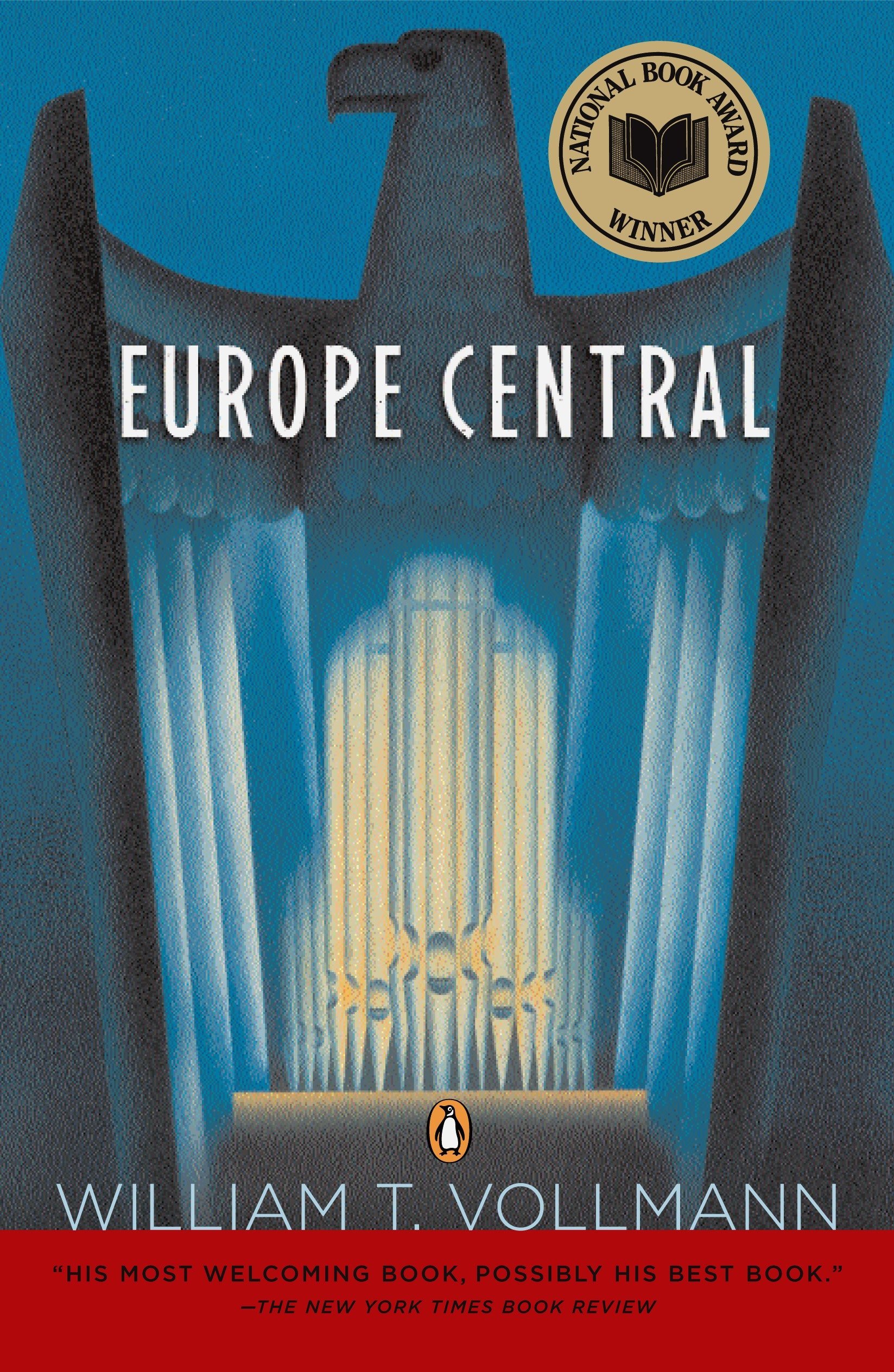
Europe Central by William T. Vollmann

About this quartet the most fundamental thing which can be said is that it is too sad even to rise from a moan into a wail at death's uncompassed crescendo. To be sure, the danse macabre of the second movement glows sickeningly vivid as a sodium flare at night (so much for flamelessness!); it's as bright as the electric light which illuminates the gas chamber when it's time to ascertain whether all the Jews are dead; while the menace of the third remains more chilling than those screams of terror in Leningrad when the German bombs come down; they'll never stop coming down. Yet on the whole the effect is of somebody drowning, his most desperate convulsions already behind him; he's begun to inhale water; the green water he sees is going black; and he's settling down into the muck. Some listeners who close their eyes during the second movement claim to perceive a whirling red eye-ball or domino, and the more rapidly it speeds, the more balefully it glows. This eidetic image seems to symbolize the approach of something evil. I myself have never seen the red spot, perhaps because Opus 110 already threatens me so perfectly that no kinesthesia is needed to extend or refine the threat. While Shostakovich's music wriggles like the worming of black-gloved fingers behind a policeman's back, the Bronze Horseman sinks down under sandbags and planks. Leningrad strangles in a loop of barbed wire.

It's a time and a place we all know, though perhaps when we Americans think of it, we're more likely to think of the beaches of Normandy, or the Battle of the Bulge, than the enormous front between Germany and Russia that brought millions under conflagration during World War II. Stalingrad, that six month siege that killed two million, doesn't feature very highly in our American memories. William T. Vollmann's epic Europe Central is a book that presents fictionalized versions of some of the Germans and Russians who lived through those years of intensity and destruction. Some are military figures, like generals A. A. Vlasov and Friedrich Paulus, or the SS member Kurt Gerstein; many are creative types: German artist Kathe Kollwitz, Russian poet Anna Akhmatova, and the novel's protagonist, more or less, the Russian composer Shostakovich.

The central image that introduces the book is a black, octopus-like telephone--"Europe Central" evokes not just central Europe but a kind of immense telephone switchboard--that snakes into the lives of its characters, making orders and demands. The same black telephone that rings in Shostakovich's house to summon him to the Stalin's secret police is the same one that rings in the field tent of Field-Marshal Paulus to inform him that he is expected to commit suicide before retreating from where he is encircled by Soviet forces. I was most interested, perhaps, in the twin stories of Vlasov and Paulus, both generals who ended up being captured by the enemy, then recruited against their former masters. Vlasov led a regiment of Russians under the Nazi army; Paulus became a spokesman for an anti-fascist Germany under the auspices of the Soviet Union, though their "betrayals" came for different reasons and they came to--unsurprisingly, given the outcome of the war--very different ends.

I was also really taken by the story of Kurt Gerstein, who "infiltrated" the SS in an attempt to save as many people as he could. Gerstein's story, which I'd never heard, is one of a noble man who tries very hard, with limited results, to stave off a great cruelty. He pretends that shipments of Zyklon-B have gone bad, to give those condemned to death more time; he tries, mostly in vain, to alert authorities outside of Germany to the horrors of the concentration camp system. For these efforts, he is put on trial as a Nazi collaborator by his French captors, ultimately committing suicide. "I consider him a hero," Vollmann writes in the (characteristically compendious) footnotes, but Gerstein's story makes one question what a hero truly is--can one be a hero when what they accomplish is so minimal, because the forces allayed against them are so great? As Vollmann grimly notes, Gerstein's name is not one of those compiled in the "Righteous Among the Nations" for their efforts to save the Jews of Europe. For all that, he's a very Vollmann-like hero, something like the noble but ineffectual Chief Joseph of The Dying Grass.

I was less sure of what to make of the novel's focus on Shostakovich, whose story gives the book its backbone. Vollmann invents, seemingly out of whole cloth, a lovelorn Shostakovich, unable to get over his early lover Elena Konstantinovskaya, who later marries the famous Soviet filmmaker R. L. Karmen. Shostakovich obsesses over Elena, even as he marries a succession of other women. What's this got to do with the political themes of a book like Europe Central? Well, perhaps in one way it's merely an observation that what drives our innermost lives is not always, or even typically, questions of justice and struggle, like those that animate Vlasov, Paulus, Gerstein, Kollwitz, Akhmatova. Shostakovich, for all his genius, is an ordinary man unable to get over the one who got away; all the grand movements of the Soviets and Germans--he lives through the siege of Leningrad--count for less than Elena. But also, there's an interesting parallel in the way that Shostakovich debases himself for Elena and for the Soviet regime. Shostakovich, a "formalist" who loved dissonance and hated the mindless patriotism of Soviet realism, was constantly in trouble with the Soviet censors. But Vollmann depicts him as absolutely spineless, falling over himself to apologize and genuflect to the apparatchiks who want him to be more conformist, though he never seems to be able to actually constrain the shape of his genius in the way they desire. Eventually, Shostakovich does what he said he never would, joining the Communist Party, and alienating all of his more principled associates. Yet clearly Vollmann finds something heroic in him, too, though perhaps it is a kind of heroism that operates at a level beneath the conscious, in the place where creativity works.

The subject matter of Europe Central doesn't resonate with me like the Native American-European culture clashes of Vollmann's Seven Dreams books. And at a subconscious level, I think I had been suspicious of Europe Central because of a vague intuition that the Seven Dreams stuff was never taken all that seriously by critics until the publication of Europe Central, with its more familiar and shopworn settings. (Who needs another World War II novel?) But I am forced to admit that the later sections of Europe Central contain some of Vollmann's most accomplished writing: the strange chapter "Airlift Idylls," narrated by a German assassin targeting Shostakovich, who seems to be more of a metaphor than anything else--have you ever seen a chapter narrated by a metaphor?--and the freewheeling, associative horror-scape of "Opus 110," which details Shostakovich's spiraling instability and debasement with a prose to match. Ultimately, Europe Central struck me as an accomplishment on the level of Vasily Grossman's Life and Fate, a novel from which it clearly takes some inspiration.

Saturday, July 3, 2021

Crime and Punishment by Fyodor Dostoevsky

At first--even long before--he had been occupied with one question: why almost all crimes are so easily detected and solved, and why almost all criminals leave such an obviously marked trail. He came gradually to various and curious conclusions, the chief reason lying, in his opinion, not so much in the material impossibility of concealing the crime as in the criminal himself; the criminal himself, almost any criminal, experiences in the moment of the crime a sort of failure of will and reason, which, on the contrary, are replaced by a phenomenal, childish thoughtlessness, just at the moment when reason and prudence are most necessary.  According to his conviction, it turned out that this darkening of reason and failure of will take hold of a man like a disease, develop gradually, and reach their height shortly before the crime is committed; they continue unabated during the moment of the crime itself and for some time after it, depending on the individual; then they pass in the same way as any disease passes.

One thing that surprised me about Crime and Punishment, which I have now read for the first time, is how early the Crime part happens. Raskolnikov's murder of the pawnbroker Alyona Ivanovna and her sister Lizaveta happens very early in the novel. In the first few pages, it's presented as a kind of obsession for Raskolnikov, a foregone conclusion he is steeling himself to make, and only later do we discover his rationalization for the horrible act: by killing the pawnbroker, he believes he can "step over" the bounds of civil society like Napoleon or other great men, who were able to do great things because they did not allow themselves to be straightjacketed by laws and norms. But Raskolnikov is not Napoleon, and he is tortured by his act and its implications. Yet this torment forms a kind of background for much of the novel, which is taken up by a set of other, intersecting plotlines: the death of the drunk Marmeladov, Raskolnikov's love for Marmeladov's prostitute daughter Sonya, the proposed marriage between Raskolnikov's sister and the wealthy Luzhin, and of course, the machinations of the vile Svidrigailov.

Approaching a book like this for the first time is tough, especially when you don't have any special expertise about Russian literature. I have a vague sense that anything I might say has already been said, and developed far better than I'll be able to articulate. But let me make some tentative observations. The first thing I see in Crime and Punishment is a veiled statement on class. Raskolnikov's assumption that great men can get away with murder is essentially correct, but his belief that all it takes is a will to power fails because it lacks class awareness. (I had a dim understanding that Raskolnikov's attempt to "step over" the law is connected to Nietzsche's Ubermensch, but I guess this book was written first, so maybe the influence works the other way? I'll have to look this up.)

Raskolnikov, after all, is not the only criminal in the book. There are two others: Luzhin and Svidrigailov, both of whom want to use their wealth to control Raskolnikov's sister Dunya. (Luzhin wants to marry her; Svidrigailov's desires are more crude.) Luzhin is a clown and a fool who thinks throwing his money around makes him admirable--a type of guy who has not disappeared in a century and a half, you must admit--and who stuffs a thousand rouble-note in Sonya's pocket just so he can accuse her of stealing, thus discrediting her, and by extension, Raskolnikov. If anyone in the novel seems like they could "step over," it's Svidrigailov, whose disinterest in virtue or ethics is nearly sociopathic. And yet in the end, even Svidrigailov isn't Napoleon; which is to say that he hasn't the resources to legitimize his evil. Combine Svidrigailov's viciousness with Luzhin's money and you might start to approach a Napoleon. But how could someone like Raskolnikov, a big sensitive baby without a dime, ever hope to do it?

I think Crime and Punishment has much to tell us still about how to understand human capacities for good and evil. It made me understand how totalizing our cultural conversations about these things can be: "Should X be canceled for doing Y when they've also done Z?" Applying such frameworks to Crime and Punishment seem silly: "Should we cancel Raskolnikov for killing the pawnbroker when he gives his remaining twenty-five roubles to Sonya's family after the death of Marmeladov?" Plotting good and bad deeds, as if on a number line, fails to help us understand anything about Raskolnikov. The end of Crime and Punishment, in which--spoiler alert--Raskolnikov confesses and submits to the suffering of the gulag, suggests that suffering can be ennobling and renewing, and that such suffering is inextricable from the crime that necessitates it. Great criminals, Dostoevsky suggests, are capable of great things because it is they who have the greatest capacity for suffering, and thus the greatest capacity for change. For a book whose religious ethic is buried fairly deep--save perhaps for the moment where Sonya gives Raskolnikov her cross, and exchanges it for the murdered Lizaveta's, a moment layered with symbolic meaning--its attitude toward sin and redemption seems deeply Christian.

Thursday, March 11, 2021

Zuleikha by Yuzel Gakhina

Sometimes it seems she is already dead. The people around her are emaciated, pale, and spend entire days whispering and quietly weeping: so who are they if not the dead? This place--frigid and crowded, the stone walls wet from damp, deep under the ground, without a single ray of sun--what is it if not a burial vault? Only when Zuleikha makes her way to the latrine, a large echoing tin bucket in the corner of the  cell, and feels her cheeks warm with shame is she convinced that, no, she is still alive. The dead do not know shame.

Zuleikha lives with her husband Murtaza and mother-in-law--a domineering woman she thinks of to herself as the Vampire Hag--on a small farm in Tataria, in the south central Soviet Union. She is a devout woman, dedicated to the service of her husband, whom she believes Allah has placed over her, but sometimes she sneaks an offering of candy to the local spirits, to convince them to protect the graves of her daughters, all three of whom died in infancy. Murtaza and the Vampire Hag make her life a hell, but Zuleikha does not know there are darker days to come: when Murtaza is killed by a Red Army officer--because he is a kulak, or peasant landholder, who refuses the collectivization of his farm--Zuleikha, pregnant again, is placed on a train to Siberia, where she will be dekulakized. That is, interned in a distant gulag.

Zuleikha has the scope of a grand historical novel: its subject is not just Zuleikha, whose meekness will be molded into assertiveness and self-determination by the harsh life of the gulag, but the gulag itself, which is a conglomeration of other kulaks and political prisoners from Leningrad, all of whom must come together to form a community in Siberia. The dissident painter, the agronomist, the denounced doctor, each of these takes their role in the gulag, which grows from a clearing in the forest--there aren't even any buildings when they first are dropped off and forced to build shelter to survive the coming winter--to a bustling village in its own right. This happens under the aegis of Ignatov, the officer who killed Zuleikha's husband, and who himself experiences a kind of exile, flung by his superiors to the corner of the country, and who quickly falls in love with the widow of the man he's killed.

Zuleikha has a funny historical perspective on the gulag. On one level, it's clearly a condemnation of the haphazard and zealous way that collectivization and the gulag system tossed thousands into suffering and death, but it's possible to see the ultimate success of the outpost, which becomes a town named Semruk, as a vindication of these systems also: hasn't it turned these people into productive citizens after all? Zuleikha struggles, I think, with the passing of time; seven years pass by in an instant, but when its pace slows it's full of wonderful moments. I liked, for instance, how Murtaza gives Zuleikha a poisoned lump of sugar to feed their livestock if he's taken; the lump sits in her pocket during the long godforsaken train ride like a ticket out of pain. But at the last minute, during a disastrous river crossing, the sugar melts away, showing symbolically that Zuleikha has only one option: to move forward.

Last summer I joined a website called Postcrossing that facilitates the sending of postcards to strangers around the world. I like to ask my would-be pen pals to recommend a book from their country; Zuleikha is the first of these suggestions I've been able to read. I can see why my Russian pen pal was so enamored with it--I don't know if the book is super-popular in Russia, but the fact that it has an English translation is probably a clue--it's the kind of sweeping historical tale that we seem to have mostly forgotten how to write these days. It reminded me of, perhaps, Doctor Zhivago with a little more mass appeal--which is pretty strong praise, I think.

Wednesday, February 10, 2021

Disappearing Earth by Julia Phillips

In the center of the bay, a trawler pushed south, heading for whatever waited out there--Chukotka, Alaska, Japan. The sisters had never left the Kamchatka Peninsula. One day, their mother said, they would visit Moscow, but that was a nine-hour flight away, a whole continent's distance, and would require them to cross above the mountains and the seas and fault lines that isolated Kamchatka. they had never known a big earthquake, but their mother told them what one was like. She described how 1997 felt in their apartment: the kitchen light swinging high enough on its cord to smash against the ceiling, the cabinet doors swinging so jars of preserves could dance out, the eggy smell of leaking gas that made her head ache. On the street afterward, their mother said, she saw cars ground into one another and the asphalt opened up.

The Kamchatka Peninsula is an immense arm hanging off of Russia's easternmost side, between the Sea of Okhotsk and the Pacific. About 300,000 people live there, mostly in the peninsula's southern tip, cut off from the mainland, to which there are no connecting roads. In Kamchatka's largest city, Petropavlovsk-Kamchatky, two little girls disappear on a summer morning. One witness--perhaps unreliable--saw them climbing into a conspicuously shiny black car with a strange man, but neither car and man have been seen since. Julia Phillips' Disappearing Earth takes the form of a series of stories that follow the people of Kamchatka for one year after the girls' disappearance.

The girls touch some of these stories only slightly: the one about the girl whose best friend has been forbidden to see her by her mother, on a flimsy pretext about needing to be surrounded by the "right people"; the one about the lesbian who returns to the small village she left behind. As the stories and months plod forward, the narrative moves away from Petropavlovsk and closer and closer to the heart of Kamchatka, the home of the indigenous Evens. The girls' disappearance inflames many of the most wearyingly familiar anxieties of insider and outsider, suspicion of indigenous people and migrants, and the inequality of settler culture. An Even girl, we are slowly informed, disappeared in similar circumstances years before, her case closed, without much inquiry or evidence, as a runaway.

I had the unsettling feeling, perhaps wrongly, that Disappearing Earth is an American novel wearing Russian clothing. I'm sure the dynamics of racism and xenophobia in Kamchatka are broadly recognizable, but it seemed to me that many of these stories could be air-dropped into Washington state or Indiana with only the names changed--and maybe the food the characters eat. That's part of the point, I suppose: isolated Kamchatka is really no more isolated than anywhere else. We are always trying to make our communities into islands, thinking it will keep us safe.

But if there is a specific perspective or understanding that living in Kamchatka granted to Phillips, I missed it. The closest thing to it--and the best moment in the novel--comes in the final story, when the mother of the two disappeared white girls and the mother of the disappeared indigenous girl meet at an Even cultural festival. The Even mother begs the white one to tell her how much she paid to have the police search for her children as long as they did, even though the search turned up nothing. But of course, the white mother paid nothing--she was merely white. This was, for me, the truest and sharpest moment of the book.

Wednesday, June 24, 2020

White Walls by Tatyana Tolstaya

But the people who sing noisily in the fire and smoke in the invalid's illegal mouth--aren't they also searching for a way out of their own universe, diving, jumping, dancing, glancing from under their hands toward the ocean horizon, seeing off and meeting the ships: Hello, sailors, what have you brought us--rugs? plague? earrings? herring? Tell us quickly, is there another life, and which way should we run to seize its gilded edges?

None of the stories in Russian author Tatyana Tolstaya's collection White Walls is like her post-apocalyptic novel The Slynx because every one of them is set firmly in the mid-to-late 20th century, among the petit bourgeois of the Soviet Union. And yet almost all of them somehow feel like The Slynx, with its palpable odor, its atmosphere of decay, its fairytale-like fantasy. But the fairytales in Tolstaya's stories are confined to the mind, to the nearly inarticulable private experience of the individual.

All of these stories really feature only two kinds of characters: little children, whose fairytales are quite literal and literally taken, and grown-ups, whose fairytales are no less complex or vivid, but who bury them beneath the social modes of the middle classes; while they talk about overcoats and pastries, desires churn within them in the shape of monsters, fairies, princesses, creatures. When it comes to children, Tolstaya's talent reminded me of Mavis Gallant's, whose also able to slip ingeniously between realism and the landscape of a child's mind, but Gallant always seems so controlled, whereas Tolstaya's prose is riotous and overstuffed--more appropriate, perhaps, to the experience of children. Tolstaya is likely to change from past tense to present to subjunctive and from the third to the second person all on the same page, and her sentences are so metaphorical it's hard to dig beneath them to find a sense of realism at all.

It's the adults, though, that stick with me. Tolstaya's adults are the heirs of her children; they're people who were told that growing up is a process toward a blessed life, but who never seem to find it. They are like the insidious Natasha of "The Poet and the Muse," who believes "she'd certainly earned the right to happiness, she was entitled to a place in the line where it was being handed out," or like the main character of "The Circle":

At times Vassily Mikhailovich imagined that he would finish out this life and begin a new one in a new image. He fussily selected his age, an era, his looks: sometimes he wanted to be born a fiery southern youth; or a medieval alchemist; or the daughter of a millionaire; or a widow's beloved cat; or a Persian king.

In one of my favorite passages from this story, Vassily Mikhailovich becomes the owner of a Rubik's cube, that symbol of the possibility of transformation and perfection:

Having stood four hours in the cold along with thousands of grim fellow sect members, Vassily Mikhailovich became the owner of the marvelous cube and spent weeks twisting and twisting its creaking movable facets, until his eyes grew red, waiting in vain for the light to another universe to shine at last through the window. But sensing one night that of the two of them, the real master was the cube, which was doing whatever it wanted to with helpless Vassily Mikhailovich, he got up, went to the kitchen, and chopped up the monster with a cleaver.

Our fantasies control us, Tolstaya says, and not the other way around. I first heard of Tolstaya because the band Okkervil River named themselves after one of her stories; in "Okkervil River" a hermit dreams of meeting an old pop singer whose music he listens to every night. And then he looks her up and really does meet her, but it turns out that he's just one of a dozen admirers who meet at her house as a kind of club, and before he knows it, she's coming over to his apartment regularly to use his bathtub.

After reading the fifteen-odd stories collected here, I don't think I could tell you what half of them are about. It's not that they're so similar--though, like I said, the characters follow familiar patterns--but that any of Tolstaya's stories is liable to erupt at any minute into severe pyschedelic weirdness, like an angel riding a bus, and they sort of blend together in one long phantasmagoria. Is it literal weirdness? Metaphorical weirdness? Is the angel really on the bus? Before you can really consider the question, Tolstaya's already moved on.

Saturday, May 9, 2020

Life and Fate by Vasily Grossman

And here she was, an old woman now, living and hoping, keeping faith, afraid of evil, full of anxiety for the living and an equal concern for the dead; here she was, looking at the ruins of her home, admiring the spring sky without knowing she was admiring it, wondering why the future of those she loved was so obscure and the past so full of mistakes, not realizing that this very obscurity and unhappiness concealed a strange hope and clarity, not realizing that in the depths of her soul she already knew the meaning of both her own life and the lives of her nearest and dearest, not realizing that even though neither she herself nor any of them could tell what was in store, even though they all knew only too well that at times like these no man can forge his own happiness and that fate alone has the power to pardon and chastise, to raise up to glory and to plunge into need, to reduce a man to labour-camp dust, nevertheless neither fate, nor history, nor the anger of the State, nor the glory or infamy of battle has any power to affect those who call themselves human beings. No, whatever life holds in store--hard-won glory, poverty, and despair, or death in a labour camp--they will live as human beings and die as human beings, the same as those who have already perished; and in this alone lies man's eternal and bitter victory over all the grandiose and inhuman forces that ever have been or ever will be...

First of all, I want to point out that Vasily Grossman's Life and Fate is almost 900 pages long. Truly, reading it, meeting its daunting challenge, made me feel a little like the heroes of the Battle of Stalingrad, that five-month siege against Russian forces by the Germans that is the background of Grossman's epic novel. I'm not saying I'm as heroic as they were in tackling this novel; I'm just saying I know a little know what it must have been like.

OK, kidding aside: Life and Fate is one of those novels that really earns the word "epic," and not just for its length, but its scope: Grossman's novel weaves together a couple dozen storylines about Russians during the Battle of Stalingrad, some of which are about the tank commanders, fighter pilots, commissars, and private grunts who are on the front lines of the battle, but also the stories of many other "ordinary" folks whose lives have been caught in the upheaval not just of war but of the process of collectivization and Stalinization that has transformed Russia since the Revolution. At the heart of the novel is the Shaposhnikov family: Zhenya, torn between her love for a general in Stalin's army and her duty to her ex-husband, soon to be denounced and thrown into prison; Lyudmila, whose son Tolya dies early in the fighting, leaving her heartbroken and hopeless; and especially Viktor, Lyudmila's husband and a renowned physicist who finds himself embroiled in political conflicts that batter his pride and his conscience. (And about ten other Shaposhnikovs and relatives, too.)

It's tempting to say that Life and Fate captures the breadth of a historical moment. That's true, one of the novel's great gifts is that it manages to cast a wide net over Stalingrad, and present a convincing portrait of the spirit of the country. But you can easily imagine how a project like this turns into propaganda, or jingoism, and in fact, the introduction by translator Robert Chandlers suggests that Grossman's previous 900-page juggernaut, Stalingrad, was exactly that. But there's something more subversive about Life and Fate, which is as dubious about Stalinization as it is about Nazism. Both Fascism and Totalitarianism are inhuman ideologies, systems which reduce the individual to a function of the State. The method and practice of Life and Fate, by contrast, is humanistic: only by giving a hundred portraits of individual people, rather than a mass representation of the spirit of the people in the Soviet style, can the dignity and importance of the human being be preserved in the face of the 20th century.

The conflict between the individual and the state is exemplified in Viktor, who apparently is something of a self-portrait. In exile from Moscow--everyone has escaped the capital, which has been besieged by fighting--he's made the discovery of his life. (Grossman, knowledgeable about particle physics, manages to make this discovery seem convincing without giving any particulars.) It should be a moment of triumph for Viktor, but his superiors are suddenly seized by the idea that Viktor's theories contradict a socialist understanding of the physical world, and should therefore be verboten. Viktor stubbornly believes that physical reality ought to dictate ideology and not vice versa, but this is not an acceptable belief in Stalinist Russia, and Viktor's inability to play along may have dangerous consequences, as it did for several imprisoned and executed scientists under Stalin.

One thing I liked about Viktor's character is that he's not a very good person: he's irascible, resentful, proud; he's even in love with his best friend's wife. But his inability to say what is expected of him is also a virtue; Viktor is incapable of subjecting his humanity to the whims of the state. In a twist late in the novel, Viktor receives a phone call from Stalin himself, who seems to have decided Viktor's discoveries are worthwhile. (Apparently Stalin, like Bill Murray, was known for these kind of unexpected intrusions into the lives of ordinary people.) But Viktor's ordeal isn't over: later, he's asked to sign a denunciation that he knows will lead to the imprisonment and execution of two other scientists. Even when the State favors you, it still sees you as an extension of itself.

Much of Life and Fate takes place in prisons or prison camps. There's the state prison in Moscow where Zhenya's ex-husband is imprisoned. There is a fenced-in Jewish ghetto in Poland, where Viktor's mother is imprisoned, and the letter she manages to have smuggled out to him is one of the novel's most effective and evocative moments:

They say that children are our own future, but how can one say that of these children? They aren't going to be come musicians, cobblers, or tailors. Last night I saw very clearly how this whole noisy world of bearded, anxious fathers and querulous grandmothers who bake honey-cakes and goose-necks--this whole world of marriage customs, proverbial sayings and Sabbaths will disappear for ever under the earth. After the war life will begin to stir once again, but we won't be here, we will have vanished--just as the Aztecs once vanished.

 There are Siberian gulags and German concentration camps. In true humanist fashion, Grossman gives us the stories of the German soldiers who are tasked to build the gas chambers, and the guards who operate it. The description of Sofya, a Jewish woman, and David, a young unattended boy she "adopts" during their transport to Auschwitz, during their last moments in the gas chamber is one of the most effective Holocaust narratives I've ever encountered in a culture that craves Holocaust narratives. In such a large book, the small details stand out: intuiting something he cannot articulate, David throws away a butterfly chrysalis he has found before being herded into the gas chamber, thinking, "Live!" The great machinery of death is unable to stop this impulse.

What's remarkable about these sections is the clear-eyed way they tackle the similarities and differences between Hitler's regime and that of Stalin, whose assault on Jews in the Soviet Union continued for decades after the fall of Nazi Germany. You couldn't call it equivocating; Life and Fate is clear in its belief that the good guys won at Stalingrad, and that the Nazi concentration camp system was unique in its genocidal fanaticism. But it's also unsparing toward the horrors of Stalinist collectivization, antisemitism, and political oppression, toward the political prison and the gulag. These are the enemy of the individual, and though they are powerful, the individual cannot be stamped out.

There's something in Life and Fate that feels outdated, though much needed and too easily discarded. It's a novel about the human spirit, written before that phrase was coopted and neutered by 21st century forces; it's like a message from a postwar past in which the phrase the "human spirit" actually meant something. It's a reminder to be guarded against forces which are anti-human, which--I regret to inform you--remain sadly in abundance.


Saturday, July 28, 2018

Notes from Underground by Fyodor Dostoevsky

Not just wicked, no, I never even managed to become anything: neither wicked nor good, neither a scoundrel nor an honest man, neither a hero nor an insect.  And now I am living out my life in my corner, taunting myself with the spiteful and utterly futile consolation that it is even impossible for an intelligent man seriously to become anything, and only fools become something.  Yes, sir, an intelligent man on the nineteenth century must be and is morally obliged to be primarily a characterless being; and a man of character, an active figure--primarily a limited being.

Last week I had an infected wisdom tooth, because I, a 32-year old man, never had them removed like I should have.  It was a bad infection, and the worst toothache of my life.  But it's hard to disagree with the narrator of Dostoevsky's Notes from Underground, who tells us there is even pleasure in a toothache.  The pleasure comes from the "moaning" and "craftiness" that continues even after the toothache has abated, a moaning which no one believes but the injured party persists in anyhow.  Our gripes are artificial, Dostoevsky says, but our own knowledge of their artificiality, and our rottenness in persisting in them, is a kind of gripe also.  The moan of the man with the toothache is as much about his spirit as his body.

Notes from Underground is split it into two sections: "Notes," which purports to provide reasons for why the narrator has shut himself up underground--literally--for twenty years, and "Apropos of the Wet Snow," which gives the actual narrative, or at least part of it, for how he ended up there.  Philosophically, both are a reaction to the leading philosophies of the day, which have arrived in Russia from Europe.  The Underground Man rails against the trendy notion that man can be "anatomized" by scientists and his society engineered by utopians to fulfill his every want.  For the Underground Man, free will is the essence of man's existence.  If you could mathematically anticipate and cater to his every want, what he would end up wanting is to be free of the "little table."  Wanting is for wanting's sake, even to the point where it is unfulfillable, and our unfulfillable desires redound to make us sick of our own needy selves.

That's about as much as I can say about the novel's philosophy.  I don't really have enough background in it, and I'd need to read the thing again at least once to really say much more.  The Underground Man's style is frenetic and digressive--as far away from the "little table" or the "crystal palace" as one can get, stylistically.  What interested me more, on this single reading, was his strange character, especially as evidenced in the second section.  His story goes basically like this: he goes to visit an old friend on a whim, whom he discovers is trying to throw a farewell dinner for a man the narrator hates.  The narrator insists on being included, even though he can't pay for the dinner and doesn't like anyone involved, and he ends up making a complete ass of himself.  Later, he wanders into a brothel where his intelligence impresses a prostitute, but when she does what he asks and comes to visit him at home, he's embarrassed of his weakness and his poverty and lashes out at her.

The Underground Man is not nice.  He's not admirable, he's not a hero, though these are things he'd very much like to be.  Before going underground, he lives a life of fantasy, imagining himself standing up to bullies and more successful people and commanding their respect.  When these fantasies peter out, or bump up against the hard wall of reality, he goes on long jags of self-loathing.  He considers himself to be intelligent, but his intelligence is a curse, because he knows how futile and meaningless social success really is, even as he envies those who have it.

The Underground Man is an incel.  That's what I couldn't help thinking the whole time.  His regard for his own intelligence becomes a pretext for removing himself from society.  His hatred for successful civil service officers is not so different from hatred of "Chads."  His ideology doesn't have quite the same contours when it comes to gender, although he does end up projecting his failures with other men onto a woman.  And philosophically, it's all backwards, because it's the utopians who come up with schemes like government-mandated girlfriends.  But the psychology, the way that self-loathing is tied up with hatred of systems, well, that seems not so different to me.

If that comparison seems weak, I think it's because the "incel" is very much a creature of our time.  There are other creatures, no less timely, that share similar traits--4channers, Pepe frogs, god, the whole bunch--but in the end, Notes seems to me to suggest that these beasts are manifestations of a kind of animal that can be seen throughout modern history.  That Dostoevsky is sympathetic toward his Underground Man (he's right about the utopians, and the civil service officers are pretty shallow) is only right; it's an acknowledgement, perhaps, of what our most shameful and pathetic impulses can lead to if unchecked.  The despair that the Underground Man feels in the face of modernity is genuine, but the way that it is enacted--making a scene at the dinner, going out of your way to bump a guy in the shoulder on the street to prove you're there--is pathetic.  And the fact that you know it's pathetic doesn't make it less pathetic.  Our world might be better if the Underground Men retreated into their own holes, and wrote undelivered manifestos, instead of finding each other on Reddit.

Wednesday, May 11, 2011

Dr. Zhivago by Boris Pasternak

Oh, what a love it was, utterly free, unique, like nothing else on earth! Their thoughts were like other people's songs.

Dr. Zhivago is usually remembered as a love story. And it is that, to be sure, but so much more: It is an epic in the Russian style, with a massive cast of characters (who all seem to be running into each other improbably over the course of their lives, as if it were no big deal to stumble across your childhood friend from Moscow in the desolation of Siberia). It is a war novel, about the upheaval in Russia created by the Russian Revolution. Much like Parade's End, it is about the way that the world changed fundamentally in the early part of the 20th century, ravaged by war and forced to find its footing again.

And it is a love story. The titular Yuri Zhivago grows up in Moscow, only occasionally entering the orbit of Lara Guishar, who he will meet later as a field nurse and then will become his lover. By then both are married and have children, but war has separated them from their spouses: Zhivago having been captured and impressed into medical service by a roving band of Bolsheviks; Lara's husband having become the renowned Bolshevik commander Strelnikov. The war brings them together, but ultimately it must also drive them apart.

The ultimate verdict on the Revolution is decidedly mixed. It drives lovers apart; it drives them together. It does away with the poisonous old system, but what does it have to offer but violence and instability instead? Yuri regards it with something near awe:

He realized that he was a pygmy before the monstrous machine of the future; he was anxious about this future, and loved it and was secretly proud of it, and as though for the last time, as if in farewell, he avidly looked at the trees and clouds and the people walking in the streets, the great Russian city struggling through misfortune--and was ready to sacrifice himself for the general good, and could do nothing.


And yet, in the individual moment of human lives, the Revolution proves horrific:

They stood around a bleeding stump of a man lying on the ground. His right arm and left leg had been chopped off. It was inconceivable how, with his remaining arm and leg, he had crawled to the camp. The chopped-off arm and leg were tied in terrible bleeding chunks onto his back with a small wooden board attached to them; a long inscription on it said, with many words of abuse, that the atrocity was in reprisal for similar atrocities perpetrated by such and such a Red unit--a unit that has no connection with the Forest Brotherhood.


No wonder the book was suppressed by the Soviet Union; Dr. Zhivago is a vile account of its national mythology. Yuri and Lara's love prospers in spite of their terror and their grief, and perhaps is even enhanced by it. Yet they live a doomed love, with no future, because they live in a futureless world. The Russia that emerges is utterly foreign to Yuri, and though he is wise, kind, and upright he is unable to deal with the totality of her changes.

There is a moment when Yuri is in the Bolsheviks' service that he sees a young boy with a head wound trying dutifully to keep his hat on straight and exacerbating his wound meanwhile. His comrades try to help him, through their misbegotten and shallow vision of goodness; the only one who has the power to see the deeper goodness is the doctor, Zhivago. He plays this same role as a poet--a sort of physician of the soul--and tries desperately to preserve sanity in an increasingly maddened world. Like Tietjens, he is too good for it. Pasternak himself lived daily with the heritage of that madness, and Dr. Zhivago--like Yuri with his poems--is the record of that struggle.

Wednesday, February 17, 2010

The Master and Margarita by Mikhail Bulgakov

Gods, my gods! How sad the earth is at eventide! How mysterious are the mists over the swamps. Anyone who has wandered in these mists, who has suffered a great deal before death, or flown above the earth, bearing a burden beyond his strength knows this. Someone who is exhausted knows this. And without regret he forsakes the mists of the earth, its swamps and rivers, and sinks into the arms of death with a light heart, knowing that death alone...


The Master and Margarita is one of those books whose fame comes partly from being discovered too late. Bulgakov was a famed playwright in Soviet Russia, and in the twelve years prior to his death he labored over this book, knowing completely that it wouldn't be published in his lifetime. It wasn't published until the 1960s, and today is one of the hallmarks of 20th century Russian literature.

The Master and Margarita is a rich, Faustian satire about the devil appearing in Moscow. He calls himself Woland, and begins by interrupting a conversation between an editor and a poet about the existence of Christ. After the conversation ends, the editor has been beheaded and the poet driven nearly into madness. This is just the first step--the book's first half chronicles the various and sundry ways that Woland causes havoc in Moscow, inducing death, madness, arson, and imprisonment, mostly in the city's literary and dramatic community. Most of these antics are performed by his retinue, which include a naked witch and a talking cat named Behemoth (which is totally what I'm going to name a cat, if I ever get one).

The titular characters don't appear until about halfway through the book: The Master, who has been arrested for writing a novel about Pontius Pilate, and Margarita, who desperately loves the Master. In exchange for returning the Master to her, Margarita agrees to become a witch and serve as the hostess for Satan's grand ball, which is as colorful as you might imagine. Interspersed are chapters of the Master's book about Pilate.

It's clear why the Soviet powers wouldn't have found The Master and Margarita acceptable. For one, religious subjects were taboo in atheistic Russia. Secondly, much of the havoc caused by Woland is a sly jab at the reigning policies of censorship and imprisonment. In this respect, Woland and his crew serve both as a symbol and its opposite. Though it is they who nearly destroy Moscow's literary elite, it is also Woland who saves the Master's manuscript about Pilate. The Master, regretting the trouble it has caused him, tries to burn it, but Woland reproduces it, quipping that "Manuscripts don't burn"--apparently now a rather well-known phrase in Russian. Here is the implication--the hope?--that authors survive in their works, something Bulgakov must have clung to in the face of a terminal disease. The book is largely comic, but also bittersweet, and the paragraph I've quoted above is one of the last that Bulgakov wrote. It expresses his exhaustion and frustration, and though he leaves the paragraph unfinished it is simple enough to imagine that the sentiment is "death alone can calm him." I don't know if death brought Bulgakov calm, but one hopes that he would have felt validated by The Master and Margarita's publication and subsequent popularity.

Monday, August 25, 2008

Darkness at Noon by Arthur Koestler

Darkness at Noon, while highly regarded, never seems to be mentioned along the same lines as 1984 or Brave New World, those two pillars which define the dystopian novel, yet all the same elements are contained within: the shadowy, all-ruling government which speaks publicly through propaganda and iconography while speaking privately by firing squads, the individualist free-thinker whom the regime sets out to squash, the inevitable unhappy ending. Darkness at Noon even has its Big Brother who glowers down at the masses from his ubiquitous poster, here called simply "No. 1."

The difference between those books and this is that while 1984 and Brave New World are set in distant futures where Britain has been subsumed by nascent fascism, the unnamed country of Darkness at Noon is transparently identifiable as the Soviet Union post-World War II. No. 1 is no other than Josef Stalin himself and the protagonist, N. S. Rubashov, an amalgamation of those men like Trotsky and Bukharin who had the misfortune of being on the wrong side of internal strife within the Communist Party. Darkness at Noon is a real-life dystopian novel that bridges the gap between speculative fair, like 1984 and Brave New World, and the semihistorical accounts of men like Solzhenitsyn and Pasternak. It is perhaps precisely this that makes it a more powerful novel than Orwell's or Huxley's; whereas those novels warn of a dark future ahead, this one announces that it is here, as brutal as imagined, having landed not in Britain but across the Iron Curtain.

The narrative is confined for the most part to the close quarters of a political prison in the aftermath of Rubashov's arrest. Once a fundamental player in the Revolution, Rubashov is now on No. 1's blacklist as a counterrevolutionary, collared with the specious accusation of arranging an assassination attempt. The charge is nonsense, of course, but it is only the justification for punishing Rubashov's true crime, a difference in opinion from No. 1 and the Party's current ruling elite. In other words, heresy. As Rubashov is grilled by his interrogators, he recounts his own life as a Party operative through flashback: There is the young German Party member whom Rubashov reprimands for printing material antithetical to the Party line, and whom Rubashov ultimately banishes from the Party. There is the dock worker and Party sympathizer whom Rubashov convinces to break a dock strike that they might receive a supply shipment for the Revolution. Later, we find, the dock worker commits suicide from shame. Most hideous of all, we hear the story of Arlova, the young secretary whom Rubashov loved but let the Party try and execute rather than speak up on her behalf.

And yet Rubashov's flaw isn't selfishness, but something quite the opposite of it: Rubashov seems to believe in that moment that letting Arlova die is the best thing because he is more important to the Party's goals than she. Rubashov talks endlessly of following things to their logical end; here is the logical end of Stalinist Communism: "He who is in the wrong must pay," Rubashov writes in his prison journal, "he who is in the right will be absolved. That is the law of historical credit; it was our law." Such is the law in a world where the good of the movement is always put ahead of the good of the individual, where wrong is the same thing as evil and the ends always, always justify the means.

What results is a cannibalistic society that is, Ourobourous-like, always devouring itself by the tail. Those who once were in the right, like Rubashov, find themselves suddenly in the wrong in the eyes of the new guard, and shuffled off to the firing squads. In the end, Rubashov decides that what is best for the people is what is worst for him, and goes to his death with only minimal objection. Rubashov's death is not the ultimate tragedy of the novel--for it is difficult to read the book without knowing that it will come--but the fact that he goes quietly. Ultimately, Rubashov is a man faced with a choice between the system he has worked all of his life for and his own self-preservation, but the conclusion that there can be no defending a system that asks that choice of anyone seems just beyond his grasp.

Interesting notes: Darkness at Noon was originally written in German, but the original copy has been lost and the existing German copy is translated by Koestler from the English. Also, famous screenwriter and communist Dalton Trumbo (and author of Johnny Got His Gun) once bragged that he had long kept anti-Communist material out of Hollywood, including a film version of Darkness at Noon.

Wednesday, May 28, 2008

The Idiot by Fyodor Dostoevsky

Let us not forget that the reasons for human actions are usually incalculably more complex and diverse than we tend to explain them later, and are seldom clearly manifest. Sometimes it is best for the narrator to limit himself to a simple account of events.

When you really get down to it, the plot of this story amounts to nothing more than a soap opera, full of love triangles, unscrupulous people, and deceit. But the plot is really not what drives this novel. It is driven by its complex characters, lead by Prince Myshkin. The novel, which is written from the perspective of someone who knows about the story but wasn't a part of it -- an omniscient narrator -- opens with Myshkin returning to Russia from a long stay at a Swiss sanitarium. He has epileptic seizures (although this does not become apparent until much later in the novel) and there is a childlike simplicity to his interactions with others. This causes people to view him as a simpleton, thus giving the novel its name.

After he arrives in Petersburg, Myshkin looks up some distant relatives of his who usher him into the social circles of the city. Myshkin meets and falls in love with Natasya Filippovna, who very well may have more problems than the prince. He admits to some of those that he is close to that his feeling for Natasya are closer to pity than to love. In turn, she vacillates between wanting to be betrothed and physically fleeing from Myshkin (a la Runaway Bride). During this time, Myshkin corresponds with Aglaya, another unconventional young woman, who seems to have genuine feelings for the prince, but cannot come to terms with his mental state. More accurately, she is concerned what people will think.

A word about the Myshkin's mental state... Other than epilepsy, Myskin appears to have no extreme mental problems. Unusual candor and a propensity to speak from his heart are his big "problems." He is able to intelligently discuss current events, Russian history, literature, and debate philosophy. He does not abide by the social mores of Petersburg and speaks his mind, regardless of whether or not his opinions are popular. This is shocking to people who are supremely concerned with how they appear to others (most of the people Myshkin interacts with can be described in this way).

Amongst the many characters that surround the prince, there are two who are noteworthy: the nihilist Ippolit and the cad Rogozhin. What makes these characters important is that they bear some similarities to Myshkin. These three men start with the same basic beliefs, but each take a completely different philosophical path. As a result, they approach life in three very different ways. Some readers have asserted that Rogozhin and Ippolit represent the two ends of the spectrum of Myshkin's personality. While this is an interesting idea, I think is a bit of stretch to read this into the novel.

Others have described Myshkin as a Christ figure. I saw this in numerous places throughout the novel. Indeed, he is innocent and good to a fault. Whether the Christ analogy holds water or not, Dostoevsky uses Myshkin to address philosophy, religion, and the nature of Christ. With all these complex themes, The Idiot is firstly a novel of ideas.

Since Tolstoy is the only other Russian writer that I know much about, and since Tolstoy and Dostoevsky wrote during the same time, I feel compelled to compare the two. From what I have read, I like Tolstoy's writing better then Dostoevsky's. There. Comparison done.

Monday, January 7, 2008

The Kreutzer Sonata by Leo Tolstoy

I had to read Anna Karenina for a class on Russian History. Despite the fact that it was assigned to me, and that it is just shy of 900 pages, I really enjoyed the book. I was told by my professor that I should check out some of Tolstoy’s short stories. This was 2003, and I am just now getting around to taking his advice.

The Kreutzer Sonata, named after a piece by Beethoven, begins with the narrator – we never get his name – remembering a train ride that he took not that long ago. A little ways into the trip he became involved in a conversation about men and women, marriage, and love. A number of people were contributing to the lively discussion until an old man, who had kept to himself up to this point, injected himself into the conversation. He asserted that love, as those party to this conversation were defining it, simply did not exist. This brought a rise out of many of the people there. Someone responded that the fact that marriages existed proved that there was such a thing as love. To which the man responded, “[People] enter into marriage without seeing in it anything except copulation, and it usually ends in either infidelity or violence. Infidelity is easier to put up with.” “Yes, there’s no doubt that married life has its critical episodes,” someone responded. The man brought silence with his reply, “Pozdnyshev’s the name. I’m the fellow who had one of those critical episodes you were talking about. So critical was it, in fact, that I ended up murdering my wife.” The narrator of our story later seeks out Pozdnyshev and begins talking with him. The old man opens up and tells his story, which essentially occupies the rest of the novella.

As he did in Anna Karenina, Tolstoy does a good job of creating characters to which the reader can relate. The situations that he puts them in are situations that could essentially happen this day.

The picture that he paints of married life is extremely bleak. The Kreutzer Sonata is really an indictment of marriage, with Tolstoy arguing that most marriages are simply a sham. I found it interesting that Tolstoy drew on his own experiences with marriage when writing this book, much to the shock and dismay of his wife. The Kreutzer Sonata was a quick read and was very interesting.

Saturday, June 30, 2007

Absurdistan by Gary Shteyngart

Absurdistan is the story of Misha Vainberg, the American-educated 325-lb. son of the 1,238th richest man in Russia. His father has murdered a businessman in Oklahoma, an act which prevents Misha from obtaining a visa and leaving the country to return to America and be with his ghetto girlfriend Rouenna. After his father's murder, he is offered a solution: travel to the obscure former Soviet republic of Absurdistan and obtain a Belgian passport from a corrupt official there. While there, Misha gets accidentally tangled up in the conflict between the two ethnic groups in Absurdistan, the Sevo and the Svani, their main difference being whether Christ's footrest, the bottom crossbar on the Slavonic cross should be tilted to the left or right. In particular, he falls in love with a girl who turns out to be the daughter of the leader of the Sevo minority forces, and becomes a part of their circle, only to find out that he's been deceived about the nature of the conflict.

This is a good book, but not as good as it could have been, I think, or good as I expected it to be (Absurdistan was the final competitor to The Road in The Morning News' 2006 Tournament of Books), though it has many virtues. It's quite funny and clever in parts, and part of its charm is the way it satirizes the modern mixing of different cultures--Misha, for instance, considers hip hop to be the voice of his generation. But in many ways it's muddled, and its plot, once it gets off the ground, doesn't quite fit together.

Two observations: 1.) I would put good money on the notion that Shteyngart has read Martin Amis' Money, which I finished just a week or so ago, because as a character Misha bears a lot of similarities to John Self, the rich and fat protagonist of that novel. Similarly to Amis, Shteyngart also writes himself into the novel, but as Jerry Shteynfarb, the duplicitous professor for whom Rouenna leaves Misha. Amis did it with more subtlety, though, like most of this book, which lack's Money's fine sense of detail and structure. 2.) There is much to ponder, I think, about the way Shteyngart ends his book on September 10th, 2001, as Misha seems just about to leave Absurdistan once and for all. What's the purpose of this? To suggest that Misha may be stuck in Absurdistan for just a little longer? To suggest that the world Shteyngart depicts is one that stopped existing on September 11th? For the most part, Shteyngart lets the fact pass without mentioning its significance, and while I couldn't fault the rest of this book for having too little subtlety, it would be nice to understand this choice a little better.