Showing posts with label Fyodor Dostoevsky. Show all posts

Saturday, July 3, 2021

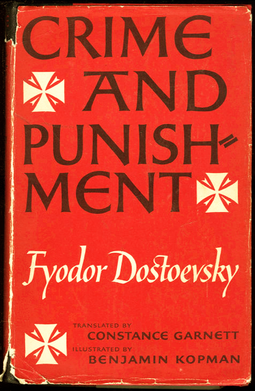
Crime and Punishment by Fyodor Dostoevsky

At first--even long before--he had been occupied with one question: why almost all crimes are so easily detected and solved, and why almost all criminals leave such an obviously marked trail. He came gradually to various and curious conclusions, the chief reason lying, in his opinion, not so much in the material impossibility of concealing the crime as in the criminal himself; the criminal himself, almost any criminal, experiences in the moment of the crime a sort of failure of will and reason, which, on the contrary, are replaced by a phenomenal, childish thoughtlessness, just at the moment when reason and prudence are most necessary.  According to his conviction, it turned out that this darkening of reason and failure of will take hold of a man like a disease, develop gradually, and reach their height shortly before the crime is committed; they continue unabated during the moment of the crime itself and for some time after it, depending on the individual; then they pass in the same way as any disease passes.

One thing that surprised me about Crime and Punishment, which I have now read for the first time, is how early the Crime part happens. Raskolnikov's murder of the pawnbroker Alyona Ivanovna and her sister Lizaveta happens very early in the novel. In the first few pages, it's presented as a kind of obsession for Raskolnikov, a foregone conclusion he is steeling himself to make, and only later do we discover his rationalization for the horrible act: by killing the pawnbroker, he believes he can "step over" the bounds of civil society like Napoleon or other great men, who were able to do great things because they did not allow themselves to be straightjacketed by laws and norms. But Raskolnikov is not Napoleon, and he is tortured by his act and its implications. Yet this torment forms a kind of background for much of the novel, which is taken up by a set of other, intersecting plotlines: the death of the drunk Marmeladov, Raskolnikov's love for Marmeladov's prostitute daughter Sonya, the proposed marriage between Raskolnikov's sister and the wealthy Luzhin, and of course, the machinations of the vile Svidrigailov.

Approaching a book like this for the first time is tough, especially when you don't have any special expertise about Russian literature. I have a vague sense that anything I might say has already been said, and developed far better than I'll be able to articulate. But let me make some tentative observations. The first thing I see in Crime and Punishment is a veiled statement on class. Raskolnikov's assumption that great men can get away with murder is essentially correct, but his belief that all it takes is a will to power fails because it lacks class awareness. (I had a dim understanding that Raskolnikov's attempt to "step over" the law is connected to Nietzsche's Ubermensch, but I guess this book was written first, so maybe the influence works the other way? I'll have to look this up.)

Raskolnikov, after all, is not the only criminal in the book. There are two others: Luzhin and Svidrigailov, both of whom want to use their wealth to control Raskolnikov's sister Dunya. (Luzhin wants to marry her; Svidrigailov's desires are more crude.) Luzhin is a clown and a fool who thinks throwing his money around makes him admirable--a type of guy who has not disappeared in a century and a half, you must admit--and who stuffs a thousand rouble-note in Sonya's pocket just so he can accuse her of stealing, thus discrediting her, and by extension, Raskolnikov. If anyone in the novel seems like they could "step over," it's Svidrigailov, whose disinterest in virtue or ethics is nearly sociopathic. And yet in the end, even Svidrigailov isn't Napoleon; which is to say that he hasn't the resources to legitimize his evil. Combine Svidrigailov's viciousness with Luzhin's money and you might start to approach a Napoleon. But how could someone like Raskolnikov, a big sensitive baby without a dime, ever hope to do it?

I think Crime and Punishment has much to tell us still about how to understand human capacities for good and evil. It made me understand how totalizing our cultural conversations about these things can be: "Should X be canceled for doing Y when they've also done Z?" Applying such frameworks to Crime and Punishment seem silly: "Should we cancel Raskolnikov for killing the pawnbroker when he gives his remaining twenty-five roubles to Sonya's family after the death of Marmeladov?" Plotting good and bad deeds, as if on a number line, fails to help us understand anything about Raskolnikov. The end of Crime and Punishment, in which--spoiler alert--Raskolnikov confesses and submits to the suffering of the gulag, suggests that suffering can be ennobling and renewing, and that such suffering is inextricable from the crime that necessitates it. Great criminals, Dostoevsky suggests, are capable of great things because it is they who have the greatest capacity for suffering, and thus the greatest capacity for change. For a book whose religious ethic is buried fairly deep--save perhaps for the moment where Sonya gives Raskolnikov her cross, and exchanges it for the murdered Lizaveta's, a moment layered with symbolic meaning--its attitude toward sin and redemption seems deeply Christian.

Saturday, July 28, 2018

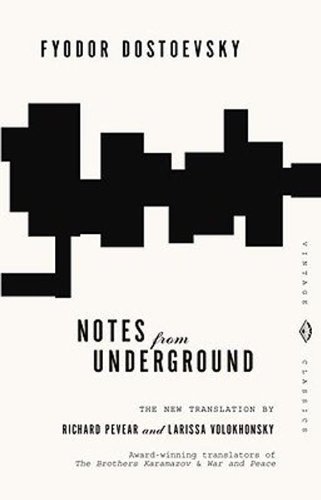
Notes from Underground by Fyodor Dostoevsky

Not just wicked, no, I never even managed to become anything: neither wicked nor good, neither a scoundrel nor an honest man, neither a hero nor an insect.  And now I am living out my life in my corner, taunting myself with the spiteful and utterly futile consolation that it is even impossible for an intelligent man seriously to become anything, and only fools become something.  Yes, sir, an intelligent man on the nineteenth century must be and is morally obliged to be primarily a characterless being; and a man of character, an active figure--primarily a limited being.

Last week I had an infected wisdom tooth, because I, a 32-year old man, never had them removed like I should have.  It was a bad infection, and the worst toothache of my life.  But it's hard to disagree with the narrator of Dostoevsky's Notes from Underground, who tells us there is even pleasure in a toothache.  The pleasure comes from the "moaning" and "craftiness" that continues even after the toothache has abated, a moaning which no one believes but the injured party persists in anyhow.  Our gripes are artificial, Dostoevsky says, but our own knowledge of their artificiality, and our rottenness in persisting in them, is a kind of gripe also.  The moan of the man with the toothache is as much about his spirit as his body.

Notes from Underground is split it into two sections: "Notes," which purports to provide reasons for why the narrator has shut himself up underground--literally--for twenty years, and "Apropos of the Wet Snow," which gives the actual narrative, or at least part of it, for how he ended up there.  Philosophically, both are a reaction to the leading philosophies of the day, which have arrived in Russia from Europe.  The Underground Man rails against the trendy notion that man can be "anatomized" by scientists and his society engineered by utopians to fulfill his every want.  For the Underground Man, free will is the essence of man's existence.  If you could mathematically anticipate and cater to his every want, what he would end up wanting is to be free of the "little table."  Wanting is for wanting's sake, even to the point where it is unfulfillable, and our unfulfillable desires redound to make us sick of our own needy selves.

That's about as much as I can say about the novel's philosophy.  I don't really have enough background in it, and I'd need to read the thing again at least once to really say much more.  The Underground Man's style is frenetic and digressive--as far away from the "little table" or the "crystal palace" as one can get, stylistically.  What interested me more, on this single reading, was his strange character, especially as evidenced in the second section.  His story goes basically like this: he goes to visit an old friend on a whim, whom he discovers is trying to throw a farewell dinner for a man the narrator hates.  The narrator insists on being included, even though he can't pay for the dinner and doesn't like anyone involved, and he ends up making a complete ass of himself.  Later, he wanders into a brothel where his intelligence impresses a prostitute, but when she does what he asks and comes to visit him at home, he's embarrassed of his weakness and his poverty and lashes out at her.

The Underground Man is not nice.  He's not admirable, he's not a hero, though these are things he'd very much like to be.  Before going underground, he lives a life of fantasy, imagining himself standing up to bullies and more successful people and commanding their respect.  When these fantasies peter out, or bump up against the hard wall of reality, he goes on long jags of self-loathing.  He considers himself to be intelligent, but his intelligence is a curse, because he knows how futile and meaningless social success really is, even as he envies those who have it.

The Underground Man is an incel.  That's what I couldn't help thinking the whole time.  His regard for his own intelligence becomes a pretext for removing himself from society.  His hatred for successful civil service officers is not so different from hatred of "Chads."  His ideology doesn't have quite the same contours when it comes to gender, although he does end up projecting his failures with other men onto a woman.  And philosophically, it's all backwards, because it's the utopians who come up with schemes like government-mandated girlfriends.  But the psychology, the way that self-loathing is tied up with hatred of systems, well, that seems not so different to me.

If that comparison seems weak, I think it's because the "incel" is very much a creature of our time.  There are other creatures, no less timely, that share similar traits--4channers, Pepe frogs, god, the whole bunch--but in the end, Notes seems to me to suggest that these beasts are manifestations of a kind of animal that can be seen throughout modern history.  That Dostoevsky is sympathetic toward his Underground Man (he's right about the utopians, and the civil service officers are pretty shallow) is only right; it's an acknowledgement, perhaps, of what our most shameful and pathetic impulses can lead to if unchecked.  The despair that the Underground Man feels in the face of modernity is genuine, but the way that it is enacted--making a scene at the dinner, going out of your way to bump a guy in the shoulder on the street to prove you're there--is pathetic.  And the fact that you know it's pathetic doesn't make it less pathetic.  Our world might be better if the Underground Men retreated into their own holes, and wrote undelivered manifestos, instead of finding each other on Reddit.

Thursday, April 11, 2013

"In a letter written by Dostoevsky to an old friend sixteen years later, the writer of so many great confession scenes depicted Dickens baring his creative soul..."

“...All the good simple people in his novels, Little Nell, even the holy simpletons like Barnaby Rudge, are what he wanted to have been, and his villains were what he was (or rather, what he found in himself), his cruelty, his attacks of causeless enmity toward those who were helpless and looked to him for comfort, his shrinking from those whom he ought to love, being used up in what he wrote. There were two people in him, he told me: one who feels as he ought to feel and one who feels the opposite. From the one who feels the opposite I make my evil characters, from the one who feels as a man ought to feel I try to live my life. ‘Only two people?’ I asked.”


Hell of a story, that--almost too good to be true.  In fact, appeared in several biographies of Dickens before anyone noticed that it was certain to be false.  But who invented it, and why?

In The Times Literary Supplement, Eric Naiman traces the history of this hoax.  The truth is, shockingly, even more fascinating than the lie.  What Naiman uncovers seems to be a single disaffected scholar who has created a labyrinthine network of false identities to give his publications--including not only literary criticism but science-fiction, satirical novels, and nipple-themed erotica--an aura of respectability.  Naiman's account seems at first like a story of runaway hubris, but somewhere toward the end, when he writes about how the culprit, using one of his sock puppet aliases, purchased a small brochure for the British Library about his own novel with "no ISBN and held together by staples," it becomes something deeply tragic and extremely fascinating.

Thursday, December 30, 2010

Demons by Fyodor Dostoevsky

"You are unhappy, aren't you? I see, I see, don't tell, but don't question me either. We are all unhappy, but we must forgive them all. Let us forgive, Liza, and be free forever!"

At the beginning of the year, my goal was to read all of Dostoevsky’s major works that I hadn’t read. As my list attests, it didn’t really work out; Demons is the first of his novels I’ve completed this year, and I didn’t leave much time to spare. In retrospect, though, it’s probably for the best; Demons was dense—and entertaining—enough to fulfill my big Russian book needs for a while.

Demons is different from Dostoevsky’s other major novels in that it is, at least on the surface, a political novel. It follows a fairly large cast of characters through a period of several months of upheaval, as a radical contingent of anarchists and nihilists try their best to overthrow the established government through a combination of civil unrest, labyrinthine schemes, and, eventually, murder. Of course, this is reductive: even if you don’t quite follow all the political machinations, the focus is, as always, on the people caught up in the intrigues, and the ideas and emotions that drive them. Calling Demons a political novel undersells it, and probably would have put me off of it had I not heard that it was also a comedy. It is, incidentally, but engaging it expecting Catch-22 is a mistake. The humor here is of a more vicious sort—brutal satire, bleak jokes, sad (and wicked) clowns; these are the main attractions here.

And the characters here are some of Dostoevsky’s richest: Stepan Trofimovich, a former rabble-rouser, reduced by years and unrequited love to a delusional shell of his former self; his son, Pyotr Stepanovich, a nihilist anarchist who disguises his own malicious ideas beneath the veneer of a clown; Kirillov, whose dedication to his nihilism makes Pyotr look like a poser; Nikolai Stavrogin, the mysterious figure whose messianic bearing is integral to the anarchists’ plot to bring down the government, but who may be interested in other things; and dozens of others.

Demons is, in some ways, a very unsubtle book. Unlike The Brothers Karamazov, wherein Dostoevsky gives Ivan the atheist the stronger case, even though Dostoevsky himself agrees with Alyosha, the saint, there’s never any question who Dostoevsky sides with in Demons. The anarchists are indeed misguided, but in unique ways. Repeatedly, it’s made clear that there is ultimately nothing to the ideology of the anarchists but a desire for upheaval and childish rebellion, but, in spite of this, they never come across as straw men. This is partially because Dostoevsky never spells out what the characters are thinking. Sure, there are long monologues and philosophical conversations, but the characters that people this novel are essentially as unknowable as a real human, in the best possible way. When the denouement arrives, it’s completely unpredictable and strangely inevitable, in the same way real life often is.

There’s no way to really share what this book is like in a short review, but I’d like to note that Demons is, like all of Dostoevsky’s major novels, a religious one. It’s a novel about God where God exists mostly in the margins. Not one of the major characters is religious, and the only one who has any sort of spiritual experience at all is brutally dispatched. It’s a novel of emptiness, and God is conspicuous in his absence. Stepan Trofimovich, in the scene excerpted above, is the only character to receive redemption, but what a glorious moment it is when a single point of light pierces through the darkness, illuminating the entire novel and showing what might have been, before disappearing as more men choose to be controlled by their demons instead.

Wednesday, May 28, 2008

The Idiot by Fyodor Dostoevsky

Let us not forget that the reasons for human actions are usually incalculably more complex and diverse than we tend to explain them later, and are seldom clearly manifest. Sometimes it is best for the narrator to limit himself to a simple account of events.

When you really get down to it, the plot of this story amounts to nothing more than a soap opera, full of love triangles, unscrupulous people, and deceit. But the plot is really not what drives this novel. It is driven by its complex characters, lead by Prince Myshkin. The novel, which is written from the perspective of someone who knows about the story but wasn't a part of it -- an omniscient narrator -- opens with Myshkin returning to Russia from a long stay at a Swiss sanitarium. He has epileptic seizures (although this does not become apparent until much later in the novel) and there is a childlike simplicity to his interactions with others. This causes people to view him as a simpleton, thus giving the novel its name.

After he arrives in Petersburg, Myshkin looks up some distant relatives of his who usher him into the social circles of the city. Myshkin meets and falls in love with Natasya Filippovna, who very well may have more problems than the prince. He admits to some of those that he is close to that his feeling for Natasya are closer to pity than to love. In turn, she vacillates between wanting to be betrothed and physically fleeing from Myshkin (a la Runaway Bride). During this time, Myshkin corresponds with Aglaya, another unconventional young woman, who seems to have genuine feelings for the prince, but cannot come to terms with his mental state. More accurately, she is concerned what people will think.

A word about the Myshkin's mental state... Other than epilepsy, Myskin appears to have no extreme mental problems. Unusual candor and a propensity to speak from his heart are his big "problems." He is able to intelligently discuss current events, Russian history, literature, and debate philosophy. He does not abide by the social mores of Petersburg and speaks his mind, regardless of whether or not his opinions are popular. This is shocking to people who are supremely concerned with how they appear to others (most of the people Myshkin interacts with can be described in this way).

Amongst the many characters that surround the prince, there are two who are noteworthy: the nihilist Ippolit and the cad Rogozhin. What makes these characters important is that they bear some similarities to Myshkin. These three men start with the same basic beliefs, but each take a completely different philosophical path. As a result, they approach life in three very different ways. Some readers have asserted that Rogozhin and Ippolit represent the two ends of the spectrum of Myshkin's personality. While this is an interesting idea, I think is a bit of stretch to read this into the novel.

Others have described Myshkin as a Christ figure. I saw this in numerous places throughout the novel. Indeed, he is innocent and good to a fault. Whether the Christ analogy holds water or not, Dostoevsky uses Myshkin to address philosophy, religion, and the nature of Christ. With all these complex themes, The Idiot is firstly a novel of ideas.

Since Tolstoy is the only other Russian writer that I know much about, and since Tolstoy and Dostoevsky wrote during the same time, I feel compelled to compare the two. From what I have read, I like Tolstoy's writing better then Dostoevsky's. There. Comparison done.