Showing posts with label Communism. Show all posts

Wednesday, May 5, 2021

I'm Dying Laughing by Christina Stead

'Haw-haw-haw.' The house rang with her gigantic laughter. 'Ha-ha-ha, oh-hoho.' She got up and tried to walk about, 'Stephen -- oh-hoho, save me!' She fell on the bed and turned on her side trying to stifle her laughter. 'Haw-haw-haw, oh, my God, oh-ho-ho, I shall die!'

She sobbed, struggled, strangled, shouted, screamed with laughter, strong, immense laughter, it seemed, not hysterical, the great roaring of big lungs and a strong heart.

Stephen turned on the light and sat up. Her face was crimson, tears poured out of her eyes. Her bosom heaved convulsively. He said, 'Stop it! You'll have convulsions. Stop. Stop it!' He slapped her.

She stopped, still heaving, and sat up to glare ferociously at him, 'Don't you dare touch me. I'll kill you.'

Stephen Howard is a walking contradiction: a rich Communist. He has inherited his wealth from his mother, or perhaps only the prestige of wealth, given the tightness of her purse strings, and yet he wears the contradiction on his sleeve. It has made him both an intellectual and a hothead, that is, a writer. On a transatlantic crossing, he meets Emily Wilkes, a spirited young fellow traveler who grew up poor in Arkansas and has scraped her way to a journalistic career. Stephen is a scarecrow, sour and bony, like Cassius; Emily is fat and full of life, yet they complement each other perfectly. They are married immediately.

I'm Dying Laughing is the last book in a small challenge I set for myself to read Australian writers. But unlike those others, Stead seems never to write about Australia; her settings are cosmopolitan. I'm Dying Laughing follows Stephen and Emily from Los Angeles to Connecticut to France, where they run to escape the Puritanical American Communist Party, who cannot stand the way the Howards court heterodoxy whenever they run their mouths. One of the best set-pieces in the novel is an early chapter where the Howards' putative friends host a dinner party as a pretext for reading a soon-to-be-published denunciation of the couple, even going so far as to say they plan on petitioning the court against the Howards' custody of their daughter Olivia. I'm Dying Laughing is about what it was like to be a Communist intellectual in the post-war period, a label riddled with its own contradictions and doubly endangered--first by Party disciplinarians and then by the scourge of McCarthyism.

Most of the novel follows the couple in France, where they settle with their four children. In France Stephen and Emily court the friendship of continental Communists and former members of the French Resistance, and yet are hyper-aware of their own hypocrisy: they are unable to live within their means, spending like capitalists and talking like Communists. They are true believers, but unable to even consider what it might look like to turn talk into action. You never know how you'll react when the crisis hits and the fascists come to power, one Resistant tells them, but such is the dilemma of the post-war American Communists: prosperity means they'll never have to put their values into practice. Stephen goes in and out of favor as a writer of polemics; Emily has far more success as a humorist, writing Mencken- or Thurber-style novels with mutedly radial politics.

Emily longs to write a serious novel, but humor and bombast are her only natural modes. She is a voluminous talker--something like 95% of this novel is dialogue, dialogue, dialogue--and prone to flights of chatter that issue from her before her thoughts are complete, and we get to see her change her mind over and over in real time:

I don't want to live this way in the bright lights, going to the gilded palaces, unable to tolerate a waiter who's been eating sour cabbage, or a waitress who hasn't washed, unable to bear a hotel if the manager doesn't scrape to me, suffering if my girl doesn't change her dress twice a day. I don't want to be like that. I am like that. Why? Because I see the funny side, I'm a wise guy. I've got the angles. I know the score. How despicable! Money's filthy. It is filthy, Stephen. Don't look down your nose. And when you think that my humour, which is me, I admit, is really the way I see things, laugh at everyone, sneer at everyone's troubles -- I really am cruel. I often wake up in the night, Stephen, to think out what I am. I'm like a doll with two faces glued together. They used to have those. I disliked them. One back, one front.

In the three novels of Stead's I've read since since The Man Who Loved Children, Emily strikes me as the closest thing to the outrageous Sam Pollitt in that novel: like Sam, her eccentricities put her beyond reason and beyond accommodation. She is incisive, a skilled wordsmith, but prone to strange and unshakeable beliefs: one of the complaints made by the American Party hacks who ambush her is that she "thinks all birds are snakes." (She does think this, and says so repeatedly, probably misunderstanding the fact that all birds are descended from dinosaurs--while snakes are not.)

Stephen, too, is outrageous, but Emily's outrageousness outpaces and overwhelms him. One of the few moments that get close to the dysfunctional family horror of The Man Who Loved Children comes when Emily, having caused a miserable Stephen to temporarily flee, begins to obsess--romantically and/or sexually, I'm not sure which--over her adopted son, Christy. Only Stead could write a scene like that, where the dream of the nuclear family turns itself inside out, and becomes grotesque melodrama. Other people try, I guess, but nobody really does it like her. Nobody captures the way such horrors emerge, without or noticing, from the commonplaces of love and family.

The Man Who Loved Children is like watching a bunch of people on a train headed toward a crash everyone but the conductor can see coming. I'm Dying Laughing is also a tragedy, ineluctably led toward bloodshed, but it's not quite the same. It's more like a party you can't leave, a party where everyone's just a little too drunk, and you know it's only a matter of time before somebody does something to bring the good feelings to an end.

Wednesday, January 2, 2013

The Appointment by Herta Muller

Now all I hear is the noise; I don't go to the window, and I don't look at the moon.  I remember that it looks like a goose egg, and that it leaves the city on one side of the sky while the sun comes up at the other.  Nothing's changed there; that's how it was even before I knew Paul, when I used to walk to the tram stop on foot.  On the way I thought:  How bizarre that something so beautiful could be up in the sky, with no law down here forbidding people to look at it.

What does it mean to love in authoritarian state?  When life is proscribed by a law that is exacting and absolute yet somehow arbitrary in its application, what areas of life does it not proscribe or threaten?

The Appointment is a novel about a woman living in Romania under Nicolae Ceausescu, supposedly the most repressive of dictators in the fringe of Soviet states.  Ceausescu himself is not mentioned except on the dust jacket; the narrator (who is nameless) battles with smaller authorities.  She is summoned, frequently and randomly, to appear in the office of Albu, a local magistrate.  The appointments are always at ten sharp, that sharp emphasizing the bureaucracy's menace as well as its exactitude.  The crime which Albu grills her about: sewing notes into clothes bound for Italy that read "marry me."  In his interrogations, which Muller only allows us to glimpse, he suggests that he suspects her of more vital communication with the West, but more than anything it seems that the narrator's crime is simply wanting to escape.  For this crime the authorities impress her neighbors into watching her movements; for this crime her husband is nearly run over on his motorcycle.

Albu can gain nothing from these interrogations; the narrator cannot escape them.  Yet the strength of the repression is predicated on this aimless urgency.  But the narrative of The Appointment revolves around one tram ride to Albu's office broken by the narrator's reminiscences, which recount her attempts to carve out a personal and human space:

Instead of these thoughts we're constantly mulling over, it would be better to have the actual things inside your head, so you could reach in and touch them.  People you want, or people you want to be rid of.  Objects you've held on to or lost.  There would be an order to things in my head: in the center would be Paul, but not clutching at him and running away from him and loving him all at the same time.  The sidewalks would run along my temples, as far as they like, and under my cheeks might be the shops with their glass display cases, though not my pointless destinations in the city.  Of course there's no escaping Albu's lackey, who's probably sitting out there in that red car to give me my summons--not deliver, it's never in writing, so that I'm always left to worry whether Paul or I might have misheard the date.  Albu's lackey would be lurking somewhere in the back of my head...


You can see how the narrator is half-resigned to her place in the world; she doesn't seek to banish Albu's lackey, only shuffle him around in the order of things.

The Appointment leaps dizzyingly from the present tram ride to a number of points in the narrator's past, chopped up and reshuffled so that the timeline is difficult to keep straight.  (Maybe this mental reshuffling, too, is an attempt to impose a personal order on a proscribed one?)  But each memory is wonderfully and uniquely realized, and together they form a rich picture of life: The narrator's marriage to Paul, who sells illegal television aerials that reach Western stations.  Her previous marriage to the son of a Communist operative who once lorded over her hometown and its bitter dissolution.  Her young, beautiful friend Lilli, shot dead trying to cross the border with an older soldier she had fallen in love with.

The Appointment, in fact, is full of relationships, prurient and not, between younger women and older men.  Muller makes the Electral connotations of this explicit by having her narrator remember walking in on her father with a girl her own age:

I'm better than that girl with her braid, I thought, why doesn't Papa take me.  She's dirty, her hands are green from all the vegetables.  What does he want with her, she has a good husband.


Lilli begins with her father-in-law, the first in a long string of older men who eventually lead her to a premature grave; the narrator recounts being hit on by her father-in-law, the Communist operative in addition to wishing to take the place of her father's lover.  Albu, with his unwelcome kiss of the hand at each appointment, is a kind of father, too.  Are we meant to read the state as a kind of father figure, demanding sexual satisfaction, prying abhorrently into places that ought to be closed to it?  And--SPOILER ALERT--what are we to make of the end?  In the present, the narrator misses her stop on the tram and is made late for her appointment.  But before she can make it, she sees her husband Paul with an older man she does not know:

Quite by accident, just out of boredom, the old man glances at the bush and bends down to Paul's ear.  Now Paul stands up and sees me.  Why is he buttoning up his shirt.


What am I supposed to make of this?  Is Muller suggesting a homosexual relationship between Paul and the old man, or is that reading too much into it?  Is her ambiguity incredibly bold or am I incredibly dense?  If that's the implication, is it a chilling notification that authority, personified in the watchful old man, pries even into those places you expect it least?

Other reviews of The Appointment:

The Ardent Reader
Erin Reads
Tim Gebhart at Blogcritics

Saturday, June 20, 2009

Animal Farm by George Orwell


Boo Communism. Hooray beer!

Short and to the point. Orwell does a very good job at cutting apart Soviet style Communism while sticking to his plot and not deviating from the story to make his point. The thing I found most interesting about Animal Farm is that even though it was written as a criticism of Communism decades ago, it was still eerily relevant today (or at least a few years ago). Every time they said "If you do/don't do X, Jones will come back. You don't want Jones to come back, do you?" I heard "If you don't let us illegally wiretap your phones/If you vote for the Democrats/etc the terrorists win. You don't want the terrorists to win, do you?" Every time they talked about an impending attack from one of the neighboring farms, I felt like I was reading about Saddam's WMDs. The sheep shouting "four legs good, two legs bad" or whatever reminded me of the way political discourse degenerates into a contest to see who can shout the loudest. Also, the fact that the animals started with a long list of ideals and whittled it down to one short sentence seemed similar to the way politicians take nuanced, complex issues and turn them into a bumper sticker policy. So, take from that what you will. Animal farm = still relevant.

Tuesday, May 12, 2009

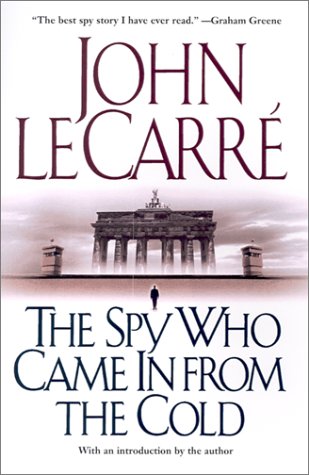
The Spy Who Came in from the Cold by John Le Carre

"But what is the justification then? What is it? For us it is easy, as I said to you last night. The Abteilung and organizations like it are the natural extension of the Party's arm. They are in the vanguard of the fight for Peace and Progress. They are to the Party what the Party is to socialism: they are the vanguard. Stalin said so--" he smiled drily, "it is not fashionable to quote Stalin--but he once said 'Half a million liquidated is a statistic, and one man killed in a traffic accident is a national tragedy.' He was laughing, you see, at the borgeois sensibilities of the mass. He was a great cynic. But what he meant is still true: a movement which protects itself against counterrevolution can hardly stop at the exploitation--or the elimination, Leamas--of a few individuals. It is all one, we have never pretended to be wholly just in the process of nationalizing society. Some Roman said it, didn't he, in the Christian Bible--it is expedient that one man should die for the benefit of many?"

"I expect so," Leamas replied wearily.

"Then what do you think? What is your philosophy?"

"I just think the whole lot of you are bastards," said Leamas savagely.


I have been away too long. But no matter, I am back with a vengeance, and May is--drum roll--Graham Greene month! In which I will review only books which are inspired by, loved by, or just plain written by, British author Graham Greene. Greene wrote a lot of very serious novels that explored the intricacies of his Catholic faith, but he also wrote a preponderance of what he called "entertainments"--spy novels, like Our Man in Havana, The Third Man, and The Orient Express. He called John LeCarre's Cold War novel The Spy Who Came in from the Cold, according to the book jacket, "The best spy story I have ever read." To which the New York Time retorts, "It may be the best spy story anybody has ever read." Zing!

It is decidedly not the best spy story I have ever read. Honestly, I see very little of what Greene finds so fantastic about it--it is taut, and cleverly conceived, but in other ways seems very unremarkable to me. The set up is this: Alec Leamas, a surly British field agent in East Germany, is put "out in the cold"--decommissioned, that is--after failing to prevent the murder of his best informant and the dissolution of his network in the country. Leamas takes up work in a library, shacking up with a pretty Jewish librarian--who just happens to be a communist, not that Leamas really cares--and ends up going to jail for assaulting a grocery clerk.

As an impoverished felon, Leamas is a perfect candidate to be approached by East German spies looking to "turn" British agents, and when they do, Leamas agrees to be taken across the Iron Curtain to tell them what he knows. But, in truth, Leamas has committed to undertake one last mission--using his position as a double agent (triple agent?) to plant evidence that his chief opponent in the East German network, Hans-Dieter Mundt, is actually a British double agent himself. What LeCarre does so well is to muddle things up so that Leamas--and the reader--begin to suspect that perhaps Mundt really is a British agent and Leamas has been sent to commit some act of espionage so secret he doesn't even know what it is.

That all sounds quite a bit more suspenseful than it is in practice. Except for a nice pair of bookended shoot-em-up scenes, the book is little more than a series of dull conversations between Leamas and his superiors, his girlfriends, or his various East German contacts. These conversations contain a few choice philosophical moments like the one I've excerpted above, but also a lot of pretty intricate details that Leamas provides about his work as a spy, which unfortunately seem about as dull and complex as I imagine spy work to actually be.

Graham Greene-o-Meter: I give this book five Greenes out of ten. Meh.

Monday, February 9, 2009

The Last of Mr. Norris by Christopher Isherwood

I had planned on reading all of Isherwood's The Berlin Stories, which is basically two novels sandwiched together: This, The Last of Mr. Norris, and Goodbye to Berlin, which is the basis of the musical Cabaret. I've never seen Cabaret, but I think the idea is pretty intriguing--a bunch of non-German socialites fritter their time away with trivialities while Berlin succumbs to Nazism.

But I needed a break after The Last of Mr. Norris, so I'm reading (and posting) these as two separate novels. While not really bad, or even unpleasant, I found there just wasn't enough in The Last of Mr. Norris to keep me interested; in fact, I'm not totally sure what to say in this review.

Mr. Norris is Arthur Norris, a seemingly well-to-do Englishman (or American? I think he's English) living in Berlin who makes the acquaintance of Bill Bradshaw, the narrator. Bradshaw falls head-over-heels in bromantic love for Arthur, though I admit I don't get the appeal: Isherwood seems to suggest that Arthur is a genteel and affable rapscallion but really he's kind of obnoxious. He seems to abound in wealth and taste; I think perhaps those traits carry less weight with a modern reader than they did in the mid-century.

Arthur is a secret communist and also a petty sham artist; two roles which often seem in conflict with one another. In the plot's climax, Arthur uses the narrator to unwittingly engineer a scam on a mutual friend and Nazi cabinet member. In a plot twist that is a lot more dull than it ought to be, the scam itself turns out to be a ruse and Arthur turns out to be a spy for the French. Congratulations, Isherwood: you made Nazis boring.

What this means, unfortunately, is that I'm stuck at 49 1/2 on the Times 100 Book List, which counts the books as one. One day soon I'll get over that hump.

Tuesday, January 27, 2009

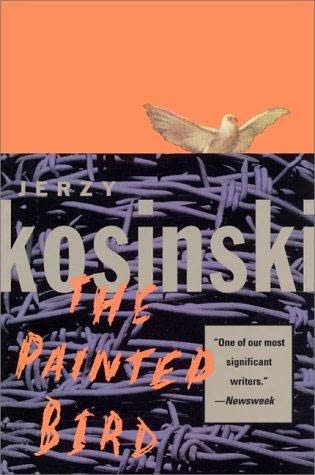
The Painted Bird by Jerzy Kosinski

When a sufficient number of birds gathered above our heads, Lekh would give me a sign to release the prisoner. It would soar, happy and free, a spot of rainbow against the backdrop of clouds, and then plunge into the waiting brown flock. For an instant the birds were confounded. The painted bird circled from one end of the flock to the other, vainly trying to convince its kin that it was one of them. But, dazzled by its brilliant colors, they flew around it unconvinced. The painted bird would be forced farther and farther away as it zealously tried to enter the ranks of the flock. We s aw soon afterwards how one bird after another would peel off in a fierce attack. Shortly the many-hued shape lost its aplce in the sky and dropped to the ground. When we finally found the painted bird it was usually dead.

Here is a rare book: a book about the Holocaust that does not take place in a concentration camp or on the field of battle, and in fact contains very few German characters. The Painted Bird is a parable, rather, of human cruelty, mean to contextualize what we know about the practices of the Nazi regime.

There are two ways to read it, I think: One is a wholly negative view, which states that the sadistic peasants who people the Polish countryside are the foundations of a European culture that allows Nazism to happen. The narrator, a young and unnamed boy has been abandoned by his parents, not out of malice but, we infer, in order to save him from the Nazis who have marked his parents as agitators. Somehow, the boy has ended up in the care of a superstitious peasant woman who regards his dark complexion and eyes as the harbingers of a great curse, and the cruelty that follows the boy around seem to validate this view. The old woman dies early in the book, and the boy wanders from one peasant home to another, witnessing a Bosch-like panorama of evil: savage beatings, men devoured in rat-filled bunkers, Russian mercenaries who castrate husbands and rape their wives, a peasant man who watches as his son and daughter couple with goats. In one protracted stay he is daily made to hang from a pair of hooks for hours on end while a ravenous dog nips at his feet below.

For a moment he stays with a bird-catcher who has a nasty habit of painted a captured bird bright colors and then releasing it to its flock. Unrecognized, the flock always tears the painted bird to pieces--a not-so-subtle metaphor for the severity and ubiquity of bigotry.

The other way to read it is more charitable: Europe, under the control of the Nazis, has become a cruel place. The fish, as they say, rots from the head. But I think Kosinski, who is Polish, includes few German characters for a reason. Instead of pointing his finger at the Third Reich, he turns his criticism on the primitive culture that lets such evil arise. Cruelty is not the domain of Germany here, and maybe not even Europe--perhaps it is a human trait.

Brooke asked me if I was enjoying this book; I told her that I do not think it means to be enjoyed. It gave me a lot to think about, and it made a strong impression on me, but it won't show up on my list of favorite books any time soon and I doubt that there are many people who would truly say they liked it. It was a chore.

Note: In reading about the book, I found some of the controversies surrounding it interesting: For one, Kosinski seems to have maintained privately for some time that it was autobiographical, but his foreword claims that it isn't and was never meant to be. Another, stranger, controversy is that some have claimed that Kosinski didn't write it; and barely knew English at the time. I really wouldn't know, but I think that that would make him a bit like the bird who paints himself.

Monday, December 1, 2008

The Unbearable Lightness of Being by Milan Kundera

Einmal ist keinmal. What happens but once, says the German adage, might as well not have happend at all. If we only have one life to live, we might as well not have lived at all.

I started my review of Lolita by saying that I was really unqualified to talk about the book in any sort of meaningful way. It was dense, complex, often over my head, and completely enjoyable. I feel roughly the same way about The Unbearable Lightness of Being. The difference being that I didn't like it nearly as much as I liked Lolita. And in my way of thinking, the books do share some similarities. Both could be described as a novel of ideas. Both of their stories have a dreamlike quality to them. And both of the books deal with sex. Sex was the underlying theme of Lolita, however, it was Humbert Humbert's lust that was on display, not his acts of sex. But in Lightness, sex is front and center and standing at attention. While the book itself is about something much bigger, sex is the driving force behind much of the storyline.

The novel is set in Prague in the 1960s, around the time of the invasion by the USSR. Tomas is a highly successful Czechoslovakian surgeon who looses his job for not towing the line of the Communist Party. His wife Tereza is a politically active photographer. There are two secondary characters, Tomas's mistress Sabina and Sabina's married lover Franz. The story revolves around the intertwined lives of these four people.

I have been thinking about how to describe this book for a while now, and the best I can do is that it is a like a licentious fairytale. But while the inherent moral of most fairytales is that love conquers all, the moral of Lightness is that life is ephemeral. Take this passage in which Franz is trying to figure out if he should leave his wife for his mistress: "Human life occurs only once, and the reason we cannot determine which of our decisions are good and which bad is that in a given situation we can only make one decision; we are not granted a second, third, or fourth life in which to compare various decisions." If each of us only has only one life to live, then does not that life take on a certain degree of lightness? Kundera's characters have little epiphanic bursts throughout the novel where they seem to grasp -- or at least grasp at -- at this concept. It is when they are most happy, most content with there life. And why not? By its very nature this concept is not burdensome, but liberatingly light.

Monday, October 20, 2008

Sounds of the River by Da Chen

Colors of the mountain will never leave our door
Sounds of the river will linger forever in our ears.

-- a couplet painted on the door of the old Chen house

I read Colors of the Mountain late last year. I liked it so much that I gave the book to my brother for Christmas, knowing that he too would enjoy it. I told him that the book was great but also informed him that when he came to the end, he would feel like the story was not over. (I ended my review of the book by stating much the same thing.) However, my brother is much smarter than I am. After he finished the book, he looked to see if Da Chen wrote another.

Sounds of the River literally picks up right where Colors of the Mountain left off. Da is getting ready to leave Yellow Stone to go to college in Beijing. This a dream come to for Da and his family. Little does he know that corrupt teachers, suicidal roommates, and poor living conditions await his arrival in Beijing. But the same dogged determination that got Da into college helps him to survive and even prevail. He become a voracious student of the English language, going from the bottom of his class to the very top. His knowledge of English lands him a sidejob as an interpreter for the Sports Ministry. A couple of chapters are devoted to the time Da spent as a translator and guide to a group of NBA stars touring China. Da's dealing with the NBA stars is hilarious, especially his interactions with Kareem Abdul Jabbar.

With Sounds of the River, Da Chen strikes the same balance as he did with his first book. He candidly describes his time in Beijing, with both poignance and humor. Da grapples with love, death, and religion, causing this book to strike a more mature tone than Colors of the Mountain. Sounds of the River ends with Da preparing to go to America, leaving me feeling much the same way that I did when I finished the first book. This time I checked, but unfortunately there is no third book. Hopefully Da is working on it.

Monday, August 25, 2008

Darkness at Noon by Arthur Koestler

Darkness at Noon, while highly regarded, never seems to be mentioned along the same lines as 1984 or Brave New World, those two pillars which define the dystopian novel, yet all the same elements are contained within: the shadowy, all-ruling government which speaks publicly through propaganda and iconography while speaking privately by firing squads, the individualist free-thinker whom the regime sets out to squash, the inevitable unhappy ending. Darkness at Noon even has its Big Brother who glowers down at the masses from his ubiquitous poster, here called simply "No. 1."

The difference between those books and this is that while 1984 and Brave New World are set in distant futures where Britain has been subsumed by nascent fascism, the unnamed country of Darkness at Noon is transparently identifiable as the Soviet Union post-World War II. No. 1 is no other than Josef Stalin himself and the protagonist, N. S. Rubashov, an amalgamation of those men like Trotsky and Bukharin who had the misfortune of being on the wrong side of internal strife within the Communist Party. Darkness at Noon is a real-life dystopian novel that bridges the gap between speculative fair, like 1984 and Brave New World, and the semihistorical accounts of men like Solzhenitsyn and Pasternak. It is perhaps precisely this that makes it a more powerful novel than Orwell's or Huxley's; whereas those novels warn of a dark future ahead, this one announces that it is here, as brutal as imagined, having landed not in Britain but across the Iron Curtain.

The narrative is confined for the most part to the close quarters of a political prison in the aftermath of Rubashov's arrest. Once a fundamental player in the Revolution, Rubashov is now on No. 1's blacklist as a counterrevolutionary, collared with the specious accusation of arranging an assassination attempt. The charge is nonsense, of course, but it is only the justification for punishing Rubashov's true crime, a difference in opinion from No. 1 and the Party's current ruling elite. In other words, heresy. As Rubashov is grilled by his interrogators, he recounts his own life as a Party operative through flashback: There is the young German Party member whom Rubashov reprimands for printing material antithetical to the Party line, and whom Rubashov ultimately banishes from the Party. There is the dock worker and Party sympathizer whom Rubashov convinces to break a dock strike that they might receive a supply shipment for the Revolution. Later, we find, the dock worker commits suicide from shame. Most hideous of all, we hear the story of Arlova, the young secretary whom Rubashov loved but let the Party try and execute rather than speak up on her behalf.

And yet Rubashov's flaw isn't selfishness, but something quite the opposite of it: Rubashov seems to believe in that moment that letting Arlova die is the best thing because he is more important to the Party's goals than she. Rubashov talks endlessly of following things to their logical end; here is the logical end of Stalinist Communism: "He who is in the wrong must pay," Rubashov writes in his prison journal, "he who is in the right will be absolved. That is the law of historical credit; it was our law." Such is the law in a world where the good of the movement is always put ahead of the good of the individual, where wrong is the same thing as evil and the ends always, always justify the means.

What results is a cannibalistic society that is, Ourobourous-like, always devouring itself by the tail. Those who once were in the right, like Rubashov, find themselves suddenly in the wrong in the eyes of the new guard, and shuffled off to the firing squads. In the end, Rubashov decides that what is best for the people is what is worst for him, and goes to his death with only minimal objection. Rubashov's death is not the ultimate tragedy of the novel--for it is difficult to read the book without knowing that it will come--but the fact that he goes quietly. Ultimately, Rubashov is a man faced with a choice between the system he has worked all of his life for and his own self-preservation, but the conclusion that there can be no defending a system that asks that choice of anyone seems just beyond his grasp.

Interesting notes: Darkness at Noon was originally written in German, but the original copy has been lost and the existing German copy is translated by Koestler from the English. Also, famous screenwriter and communist Dalton Trumbo (and author of Johnny Got His Gun) once bragged that he had long kept anti-Communist material out of Hollywood, including a film version of Darkness at Noon.

Wednesday, December 12, 2007

Colors of the Mountain by Da Chen

I was in an airport bookstore and decided to purchase this book because it matched the outfit I was wearing, thinking that I would look cool carrying it around Terminal B. I bought it, flipped it open, stuck a bookmark between two random pages, and began strolling through the airport, confident in the look that I had carefully cultivated.

The book is written by Da Chen, who was born during Mao Zedong’s Cultural Revolution. His family was part of the landlord class, a class that was despised under the new communist regime. His father and grandfather were forced to perform strenuous physical labor, were often beaten, and nearly always ridiculed. Here is an excerpt regarding the rules that were to govern Grandpa’s conduct:

“Since the beginning of the Cultural Revolution, the commune cadre in charge of landlord reform had set the following rules: Grandpa could not visit his friends, he could not leave town without advance permission, and he was to write a detailed diary of his life every day. This was to be turned in every week. He wasn’t welcome in any public places, could not engage in any political discussions, and should look away if someone spit in his face. If they missed, he was to wipe the spit off the ground. There were more rules, but Grandpa forgot some when he came home to tell us about them.”

Chen befriends a group of hoodlums in his early teenage years, and he almost completely gives up on school, which was not that much of a surprise since intellectualism was a big “no no” during this time. This part of Chen’s life has elements of Oliver Twist, Huck Finn, and the countless other young, ragamuffin protagonists of English literature, the chief difference being that these “stories” are the real-life experiences of Chen.

Chen describes his early life and his hometown of Yellow Stone with simple prose. He manages to be clear and straight-forward while at the same time interesting and humorous. The book ends with Chen in his late teens, but it really feels like the story is just beginning, that there is still so much more. I wanted to know what transpired that enabled this young man in this small Chinese town to have his memoirs published by Random House. That is obviously not the story that Chen wanted to tell. But I think it too would have been an interesting one.

Monday, April 2, 2007

Brave New World Revisited by Aldous Huxley

First of all...I love the cover art for this book and for Brave New World. Okay, now that that is out of the way, I had a lot of trouble getting through this book. It is not even half as long as Brave New World, but it took me nearly as long to read. There is no doubt that Huxley was a brilliant man. After all, he was 62 years old and blind in one eye when he penned this rumination on his most famous work. However, while I thoroughly enjoyed the writing of Brave New World, I found large portions of Brave New World Revisited to be rather tedious.

The twelve chapters of this book were originally published as a series of articles for Newsday during the height of the Cold War. They varied in topic from, over-population to brainwashing to subconscious persuasion. In the final chapter, by far the most interesting, Huxley discusses what can be done to combat the problems he outlined throughout the rest of the book. Most of the societal threats outlined in the book are described by Huxley as threats to freedom. For this and other reasons, it is painfully obvious that Huxley wrote this during the middle of the Cold War. A fear of communism pervades this work.

Despite these drawbacks, if you have read Brave New World, this may be worth your time. You may find it easier to get through than I did. I did find some parts of the book very interesting and thought-provoking.

Friday, February 16, 2007

Berlin, City of Stones by Jason Lutes


(Yes, Alsyon, I did read another comic book. And there's nothing you can do about it!)

It’s hard not to be moved by something written about the holocaust, or simply about war, especially something very well-written. Jason Lutes' Berlin: City of Stones, however, was something surprisingly powerful. Rather than focusing on the plight of Jewish families in war-torn Germany, Lutes writes (and draws) about the tensions between opposing factions in the years leading up to the Second World War. This is one of probably a very small selection of historical graphic novels, and I would wager that it’s easily the best.

If nothing else, Jason Lutes can certainly draw. His grasp of human anatomy and emotion isn’t the best I’ve seen, but all of his figures are stylistically pleasing, and his attention to detail in faces, dress and gestures does a lot in terms of advancing the plot without a narrator. I was impressed by his ability to draw (as far as I can tell) a completely believable 1920’s German cityscape, down to each stone in the road. His bird’s-eye-view opening or closing scenes alternatively give a strong feeling of the city’s European beauty and then of its decrepitude. I found myself lingering over panorama landscapes, picking out individual faces in Lute’s carefully drawn crowds. But it was his impressive ability to pack so much into an image without making it to busy that I found most pleasing about his style.

The story itself follows the dialogue of a few main characters, internal monologues of complete strangers, and first-person narration through journals. The beauty of Lute’s Berlin was that he didn’t have to explicitly guide the reader to conclusions about public discontent, rising discrimination against the Jews, and tensions between National Socialist and Communist worker parties that all come to the point of erupting by the end of the book. But Lutes doesn’t have to show all of this coming to a head; his reader clearly knows how the story ends. I was surprisingly moved by the personal narratives mixed into the story and was made to view the effects of such a grotesque war from a new, very human perspective. I forget which publication rated this as one of the top 10 graphic novels of all time, but I would suggest it to anyone with an interest in a wide range of subjects from the war itself to European architecture. Overall, an unexpectedly strong book, visually and in its plot; Lutes’ drawing and writing style complement each other perfectly to make a powerful end product. I found myself reading it so quickly that I was worried I wouldn’t fully appreciate it, but I couldn’t slow myself down.