Showing posts with label jews. Show all posts

Monday, January 7, 2008

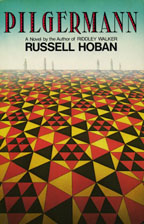
Pilgermann by Russell Hoban

Pilgermann here. I call myself Pilgermann, it's a convenience. What my name was when I was walking around in the shape of a man I don't know, I simply can't remember. What I am now is waves and particles, I don't need to walk around, I just go.

Pilgermann
is the story of a wandering Jew on a pilgrimage to Jerusalem in the late 11th Century. His name isn't Pilgermann, but that's the name that his ghost--or consciousness, or whatever it is that's narrating this novel from beyond the grave--adopts for himself, because his real one is lost to time. What he narrates is the story of his life, beginning with his castration by a Christian mob in his hometown, following with a vision he has of Christ, who tells him to go to Jerusalem. He never actually makes it there, but instead is captured by pirates and ends up in Antioch where he befriends a local Muslim and is eventually killed in a Frankish crusade.

The first half of the book takes its cues from Bosch and Vermeer paintings: European landscapes ravaged by death, haunted by strange and ghastly figures. He is followed by those whose deaths are connected to him: The headless tax-collector who both sicced the mob of Christians on him and saved his life by stopping them short and the highwayman who murdered him (and whom Pilgermann kills), a man named Konrad and his lover Bodwild, who is a sow, and, oh, why not, a bear. There's also the personification of death as Bruder Pfortner, for whom killing is a sexual experience, and the vision of Pilgermann's own death as a child which grows into a man by the novel's end.

The second half is much better; it follows Pilgermann and his new friend, Bembel Redzuk, as they conceive of a massive tiled court they call "Hidden Lion" (see cover), which they erect to study the point at which "stillness becomes movement" and "movement becomes consciousness." If you can't tell, Pilgermann is a book mostly of ideas and not plot; for every page of action there are probably ten pages of Pilgermann's complex thoughts on the nature of religion and death. Some are quite beautiful and profound--for example, I like the way that Pilgermann never gets to Jerusalem, but finds solace in the words of a traveling group of child pilgrims who say, in the face of their own death, "Jerusalem is wherever we will be when we get to the end"--but much is dense, obtuse, and not quite worth the effort it takes to decipher. It is a book full of references from all three of the Abrahamic religions, and one of its chief themes is their interaction. That the Muslim world comes off much better than the Christian (and even the Jewish) is no surprise; Hoban's depiction of the Frankish crusaders as being socially underdeveloped in relation to their Turkish counterpoints is historically accurate.

I picked up this book because Hoban penned one of my favorite novels, Riddley Walker, a post-apocalyptic novel written completely in the strange pidgin English of the future. I'm sad to say that Pilgermann isn't nearly as enjoyable, though serious religious scholars may find it interesting. As disappointed as I am, I still may read another of his books, Turtle Diary, about a pair of strangers who come together to free a couple of sea turtles from the zoo. This guy seriously never writes the same book twice.

Sunday, August 12, 2007

The Assistant by Bernard Malamud

In The Assistant, a hard-working and selfless but unsuccessful grocer named Morris Bober is held up by a pair of masked "holdupniks" late one night in his store who beat him and take all of the money in the cash register. One of these men is Frank Alpine, a young Italian who only joins the hold-up reluctantly and later returns to become an assistant to Bober, without confessing his part in the crime, in order to make up to himself for some of his transgressions. Frank is continually caught between his respect for Bober and his desire to pocket more money from the grocery, and eventually falls in love with Bober's daughter, Helen.

The first thing I thought about this book is that it would make a good indie film. It's subdued, but not so philosophically complicated that it would lose much in the filming, and the characters operate on the slightly superficial but often heartbreaking model of so many indie film characters. My second thought was about Jews--Malamud was one of the century's first and foremost Jewish authors, and his depiction of Bober, a kind and dignified but long-suffering man, seems to be the model for many modern Western depictions of Jewish people. At the end of the book (SPOILER), Frank becomes a Jew, but only after learning the value of suffering, hard work, and selflessness. Isn't it interesting, I think, how Western stereotypes about Jews have developed through Jewish literature and art from the money-hungry, sub-human depictions that characterize much of non-Western depictions of Jews? It fascinates me to think about how Americans understand the concept of Jewishness, and how different it must be from a century ago.

But anyway, this book was kind of boring. It was a lot like the Philip Roth book I read, but without the nasty sex. And what book is complete without nasty sex?

Wednesday, July 18, 2007

Portnoy's Complaint by Philip Roth

Jews and sex. Sex and Jews. Sexy Jews. Jewy Sex.

Thus can Philip Roth's book Portnoy's Complaint be described. In it, Alexander Portnoy, a successful thirty-something civil rights lawyer monologues to his shrink, Dr. Spielvogel, about the travails of his childhood and his many unsuccessful sexual affairs. Portnoy's problem (his "complaint") is that while he has a monstrous and somewhat deviant sexual appetite, his ethics will not let him engage in sexual diversion without much inner struggle. This is connected to his childhood and to his strict Jewish parents, who seem to be a lot like Fran Drescher's mom on The Nanny. When Portnoy isn't thinking about sex (at one point, he masturbates into a cored apple), he's thinking about Jews, and how as a self-described atheist he finds it difficult to relate to his family and surroundings, which are uber-Jewish.

This book is dark, funny, and extremely crude (it uses the word "cunt" more often than any book I have read, or any pornography I have seen), but for all that it's a little disappointing. Portnoy's monologue jumps around so considerably that it lacks any real narrative or forward structure, and it just doesn't have a lot of emotional heft. I have a feeling that this book may be enjoyed more by a Jewish person, but as a goy it left me sort of unimpressed. It certainly didn't leave me feeling that Roth is, as many have described him, the greatest living American author.

Tuesday, June 26, 2007

The Yiddish Policemen's Union by Michael Chabon

I think this is the newest book I've ever read. He published it this May, and the cover is the main reason that I absolutely had to have it. This is the first in a series of reviews I'm doing called "my birthday presents."

This is the second of Chabon's books I've read, so my expectations were set pretty high. Unfortunately, it's hard to measure up to The Amazing Adventures of Kavalier and Clay. Basically the premise for this book is an actual Senate proposal from the 1940s that, should the Jews lose Israel in WWII, the USA would give them a piece of Alaska. In The Yiddish Policemen's Union, Jews from Israel, Germany, Poland, the Ukraine, and other parts of Europe have all migrated to the newly created Sitka District of Alaska. Chabon never actually goes says how the war ended, or what the political situation is in Europe now, he just lets readers guess at that, I suppose. It's set in the early 21st century, and the District is about to be revoked, meaning that the last of the world's Jews will have nowhere to go in two months from the novel's opening. The story follows Sitka District Detective Meyer Landsman, who is one of my new favorite characters (Chabon also wrote another of my favorites, Joe Kavalier). He's basically an embellished stereotype: the washed-up, renegade cop who doesn't play by the rules. But Chabon manages to make him a lot more human than that; he's easy to sympathize with. Landsman sets about solving a murder that shows up in the dingy hotel he's been living in, which turns out to be a case much bigger than he originally thought.

Landsman notices how quiet it is on Verbov Island, in the snow, inside a stone barn, with dark coming on, as the profane week and the world that profaned it prepare to be plunged into the flame of two matched candles.

"That's right," Zimbalist says at last. "Mendel Shpilman. The only son. He had a twin brother who was born dead. Later, that was interpreted as a sign."

The whole book is wildly imaginative, full of Yiddish puns that I really didn't understand (if you know why a Shoyfer should be a name for a cell phone, please tell me), and a few that I did (a restaurant named "Hands of Esau"). It was a great tribute to 1940s noir, with everyone in porkpie hats, smoking like chimneys and solving crimes involving Russian mobsters. The dark and gritty noir feel meshed strangely well with the Yiddish puns and snappy dialogue. Unfortunately, at times, the gimmick got in the way of the story. Having such a far-fetched setting has to be incredibly hard to pull of (David Mitchell managed it with Cloud Atlas unbelievably well). The book lost steam towards the middle, landing in an uncomfortable zone where it was too realistic to be surreal, but too far-fetched to feel believable. It picked back up at the end, and was a great, unique read. I'm still a Chabon fan.

Friday, February 16, 2007

Berlin, City of Stones by Jason Lutes


(Yes, Alsyon, I did read another comic book. And there's nothing you can do about it!)

It’s hard not to be moved by something written about the holocaust, or simply about war, especially something very well-written. Jason Lutes' Berlin: City of Stones, however, was something surprisingly powerful. Rather than focusing on the plight of Jewish families in war-torn Germany, Lutes writes (and draws) about the tensions between opposing factions in the years leading up to the Second World War. This is one of probably a very small selection of historical graphic novels, and I would wager that it’s easily the best.

If nothing else, Jason Lutes can certainly draw. His grasp of human anatomy and emotion isn’t the best I’ve seen, but all of his figures are stylistically pleasing, and his attention to detail in faces, dress and gestures does a lot in terms of advancing the plot without a narrator. I was impressed by his ability to draw (as far as I can tell) a completely believable 1920’s German cityscape, down to each stone in the road. His bird’s-eye-view opening or closing scenes alternatively give a strong feeling of the city’s European beauty and then of its decrepitude. I found myself lingering over panorama landscapes, picking out individual faces in Lute’s carefully drawn crowds. But it was his impressive ability to pack so much into an image without making it to busy that I found most pleasing about his style.

The story itself follows the dialogue of a few main characters, internal monologues of complete strangers, and first-person narration through journals. The beauty of Lute’s Berlin was that he didn’t have to explicitly guide the reader to conclusions about public discontent, rising discrimination against the Jews, and tensions between National Socialist and Communist worker parties that all come to the point of erupting by the end of the book. But Lutes doesn’t have to show all of this coming to a head; his reader clearly knows how the story ends. I was surprisingly moved by the personal narratives mixed into the story and was made to view the effects of such a grotesque war from a new, very human perspective. I forget which publication rated this as one of the top 10 graphic novels of all time, but I would suggest it to anyone with an interest in a wide range of subjects from the war itself to European architecture. Overall, an unexpectedly strong book, visually and in its plot; Lutes’ drawing and writing style complement each other perfectly to make a powerful end product. I found myself reading it so quickly that I was worried I wouldn’t fully appreciate it, but I couldn’t slow myself down.

Brownsville, Brooklyn by Wendell Pritchett

I had never heard of Brownsville prior to reading this book. It is a neighborhood in Brooklyn, probably most famous for producing people such as, Danny Kaye, Aaron Copeland, and Mike Tyson. Now I know what you're thinking, Hey Danny Kaye is a talented guy; I like the music in those beef commercials; and I find most everything Mike Tyson does amusing. However, while the author Wendell Pritchett mentions these famous Brownsville natives, it is only in passing. The book is essentially a community study, beginning with the creation of Brownsville in the late 19th century, and taking the reader up to the present (well 2002 anyway).

Pritchett's intention is to show that a myriad of factors caused the community to decline throughout the 20th century. He spends much of the book describing different social and political institutions, both inside and outside of Brownsville, that affected the community. Pritchett introduces group after group, and before long each page become awash with acronyms that are almost impossible to keep straight. There are large sections of the book in which Pritchett focuses on a specific group that no doubt was important to the community, but not as integral as he makes them seem.

After 270 pages describing the failure, or at best the inability of community groups and institutions, Pritchett chalks most of Brownsville's problems up to racial discrimination. While I think he is essentially correct, this conclusion does not fit the rest of the book. Pritchett describes all types of problems plaguing Brownsville throughout the 20th century, and then in his conclusion racism appears like a deus ex machina.

Brownsville was (and is) a unique community. One would be hard pressed to make comparisons between it and other communities; and for this reason it warrants some attention. But unless you really want to learn about Brownsville, Brooklyn, do not read this book. Much of it can only be described as tedious.

Monday, February 12, 2007

Number the Stars by Lois Lowry

I have fond memories of waking up early nearly every Saturday morning and going downtown to Cincinnati's library with my family. Books were an important part of my childhood early on. Even before we could read, my brother and sister and I would pick out books for my mother to read to us each night before bed. Oddly enough, I had not heard of Number the Stars until this year. I was discussing favorite books over dinner, and Number the Stars was the first book Ann mentioned. Although she had read it as a kid, it wasn't until recently, when she read it again for a class on children's literature that she realized just how good the book was. (I wonder how much her love for the book hinges on the fact that she essentially has the same name as the protagonist.)

I took Ann's recommendation to heart; and it was indeed a great story. The book centers around the Johansen's, a Danish family living in Copenhagen during the Nazi occupation of Denmark. The family becomes involved in smuggling Jewish families over to Sweden, where they would be safe from Nazi aggression. The main character of Number the Stars is ten-year-old Annemarie, a young girl who faces her greatest fears in order to save her best friend's family. While Annemarie and the rest of the characters are fictional, many of their experiences are grounded in personal accounts from that time. In the afterword, Ms. Lowry shares excerpts from some of the documents on which her story is based. Just like the characters in the story, these real-life figures display strength and courage in the face of overwhelming adversity.

While reading the book, I was reminded of a quote by Martin Niemoller, a German Lutheran minister who spoke out against the nazification of the world around him. His powerful statement has stuck with me.
"First they came for the Communists, but I was not a Communist, so I said nothing. Then they came for the Social Democrats, but I was not a Social Democrat, so I did nothing. Then came the trade unionists, but I was not a trade unionist. And then they came for the Jews, but I was not a Jew, so I did little. When they came for me, there was no one left to stand up for anyone."
Number the Stars is a book about standing up--not for yourself, but for others. If you have not read this book, read it. Sure, it's written for children, but don't let that stop you. And who knows, maybe walking through the kid's section of the library will bring back a few good memories.

Monday, February 5, 2007

The History of Love by Nicole Krauss

Just like the last book I read, this book very much resembles Jonathan Safran Foer’s Everything is Illuminated (stylistically, at least), although in the case of Nicole Krauss’ book it’s easy to see why (they’re married). This book was written wonderfully, and at times it’s hard to imagine where she found so much of her creativity. Told mostly from the perspective of two main characters, The History of Love tells the story of a Polish Jewish immigrant who came to the United States to escape the Second World War, and to find the woman he loved who had emigrated before him. Beginning with his first-person narration of his self-described old, empty life, the book then switches to and from the perspective of a 14 year-old girl, of Jewish parents, who describes her attempts to find happiness for her widowed mother.

This book demonstrates Krauss’ incredible versatility; she easily switches gears from an aging Jewish immigrant to a 14 year-old girl narrating through her journal. Krauss even manages to write a book within this book, or at least part of one. Krauss’s book centers around an obscure novel, also called ‘The History of Love,’ which is supposed to act as the sort of key that eventually unites the two distinct narratives. The excerpts from this book that she includes are so well-written, and completely different from the way she writes the rest of the book, that I felt myself wishing I could read it in its non-existent entirety. One of my favorite passages was written about the characteristics of angels:
HOW ANGELS SLEEP. Unsoundly. They toss and turn, trying to understand the mystery of the Living. They know so little about what it’s like to fill a new prescription for glasses and see the world again, with a mixture of disappointment and gratitude. The first time a girl named Alma puts her hand just below your bottom rib: about this feeling, they have only theories, but no solid ideas. If you gave them a snow globe, they might not even know enough to shake it.
This book was captivating and told a moving story, but it ended so unexpectedly that I found myself wondering if it was even Krauss who wrote the last 50 pages. It wasn’t that they were written poorly, just that so much was left unresolved that I felt like she had gotten lazy, and thought she would just write some pseudo-profound conclusion, hoping that the reader might just say “Ahh, how unique,” and be satisfied. As Krauss’s second book, The History of Love was a success, at least through page 200 or so. Personally, I was disappointed.

EDIT: On further reflection, this book was much better than I originally thought. I didn't recognize right away how astutely she deals with love in so many forms, not all of them beautiful. Her alternating narration and intertwining plot lines show each character's own form of love for someone (or something) else. It was a beautiful book, especially if you're quicker than I am and able to realize it.