Showing posts with label russell hoban. Show all posts

Monday, July 24, 2023

Her Name Was Lola by Russell Hoban

'In Hindu mythology,' says Max, 'there's a dwarf demon of Forgetfulness called Apasmara Purusha. If this guy's Lola gets really pissed off she might find a way of putting Apasmara on to him to wipe out the memory of her.'

'That's really nasty,' says his mind. 'I like it. But what would get her that pissed off? Would sleeping with another woman one time do it?'

'I don't know,' says Max. 'It was just a passing thought. I doubt that I'll do anything with it--I'm not sure I like this guy well enough to write about him.'

One day, Max, a semi-successful but oft-blocked writer, sees a strange black demon crawling around on the ground. He lifts it up--or perhaps it jumps on him--and he discovers that he's become burdened by Apasmara, the Hindu demon of forgetfulness. What he has forgotten is Lola: the beautiful, intelligent woman he once felt was his destiny. Max hasn't seen Lola since a brief and unfortunate affair with Lula Mae, a gorgeous Texan, and impregnated both women. The last he saw of Lola, she was crashing her Jaguar--with both of them in it, and the unborn child of course--out of shock and anger at the news. Max doesn't even know if the child he supposedly fathered with Lola is alive, and now it seems that Lola has put the demon on him to make him forget her completely.

Once upon a time I was amazed by how different Russell Hoban's books are: medieval fables, post-apocalyptic epics, wistful and turtle-centric elegies, madcap anthropomorphic frenzies--but somewhere along the way they started to seem similar, even repetitive. The London of Her Name Was Lola is recognizable from Angelica's Grotto and especially The Medusa Frequency; I think it even shares a few minor characters with that book. The tricks are the same: the blurring of lines between reality and hallucination, the dragged-in bits of religion and mythology, and of course, the personification, even down to Max talking to his own mind. Some of them are successful, here, even extremely so, but I couldn't help feeling that something about the book was a little tired.

Some stuff I did find interesting: Max, like Hoban, is a successful writer of children's novels; Hoban wrote about Frances the Badger, and for Max it's Charlotte Prickles the hedgehog. He writes adult books, too, when he can get past "Page One," and as Max struggles with the fallout of his infidelity, he begins writing a story about "Moe Levy" who cheats on "Lulu" with "Laura." The doubling of names, the way the life is worked out on the page, like a fractal you can always keep zooming in on, is simple but effective, and I especially liked how, despite Max's attempts to make "Moe" reenact his own foibles, the rebellious character simply abstains from flirting with "Laura" and redoubles his commitment to the women he truly loves. I also liked Lola's B-plot, in which she spends years learning an Eastern instrument called the sarod in order to write a raga that will make Max forget her, only to find that in her studies she comes to a kind of peace with Max's carelessness toward her. But in the end, when I try to remember Her Name Was Lola, I'll probably only be able to come up with details from The Medusa Frequency instead.

Friday, June 25, 2021

Angelica's Grotto by Russell Hoban

He went to where Pesage Noir hung and stood before it. 'The strangeness of things,' he said to Redon -- 'I know it was always in your mind and it's always with me too; I used to think of it as a question that had no answer but now it seems to me that it's an answer for which no one can imagine the question. The world is full of strange answers and missing questions; each of us is an answer to some unknown question that we have to guess at and get wrong as often as not. Right now I'm the answer to the question, "Who will play Old Fool in a geriatric sex-farce?'"

Harold Klein is a 72-year old art critic, twice widowed, in poor health. Besides bouts of angina he's recently lost his "inner voice"--that unregulated part of ourselves that our conscious brain filters before speaking. He finds himself saying things without thinking, and getting himself punched in the face for it. He's shuffled from one psychiatrist to another, but he finds himself looking elsewhere to soothe his psyche: a porno website called Angelica's Grotto, where not only can you browse photographs of women engaged in sexual acts of all stripes, but chat with Angelica herself. Klein strikes up a relationship with Angelica--who turns out to be a sex researcher with the ridiculous name of Melissa Bottomley--insinuating himself into her life and her research.

I think a novel like Angelica's Grotto would be a hard sell for a lot of contemporary readers. There are few topics I think people are less apt to find interesting in 2021 than the sexual proclivities of old men. When Klein meets Melissa for the first time and she puts her tongue in his mouth, it's hard not to roll your eyes. Oh, you might find yourself saying, as I did, this is just another one of those books by an old writer who wants to bed young women. But what happens after that doesn't fit quite neatly into idea of the novel as wish-fulfillment, or if it does, it does so in an especially candid way: Melissa whips out a strap-on and sodomizes the less-than-willing Klein. In doing so, she compels Klein to undergo what thrilled him so much in the photographs that enthralled him.

Angelica's Grotto is filled with those Hoban-like details: lots of references, perhaps too many, to cultural and artistic artifacts, from Expressionist painter Odilon Redon to Orlando Furioso to the band Garbage. In Hoban's novels, these artifacts, especially paintings, tend to take on a kind of anthropomorphic quality, manifesting as strange physical presences. Klein intends to sell his priceless Redon to fund Melissa's research, hoping perhaps to exchange the representation of the id on the wall for mastery over the real thing. The id, that inner voice, Klein begins to associate with the Sumerian god Oannes, a half-man, half-fish who existed before forms were made but who carries with him the world's wisdom. Angelica's Grotto is an exploration of how the sex drive, too, is an expression of that inner voice, a part of ourselves which we can filter, but neither control nor understand. 

Monday, September 18, 2017

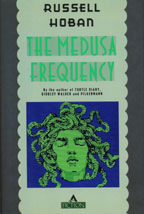
The Medusa Frequency by Russell Hoban

There are two ways to tell a story *.

The first is to come up with a plotline--boy meets, loses, regains, mutates girl--and play it out beat by beat until it reaches its natural endpoint. This is a great method! Most books are like this, in my experience.

The other, of which Hoban seems to be a fan, is to take a concept like, say, the ephemerality of life or the reality of real aloneness or the permenance of loss, and pick a seemingly arbitrary entry point and follow it through to an equally arbitrary endpoint, and make the reader do the hard work of making an end-to-end narrative out of it. In The Medusa Frequency, he cops directly to this tendency, or maybe just to its origin:

Page one? I didn’t think so. Suddenly the idea of turning one’s experience into a story seemed not only bizarre but perverted. Where was the beginning of anything, how could I draw a line through endless cause and effect and say, 'Here is page one?’

And Hoban sometimes seems to fully embrace the quixotic nature of that question in the novel, starting with half-made-up conversation with the mythical Kraken that takes place on the green and black screen of an old Apple II, and ending with a comic book adaptation about a monster who is the plug in the plughole of the universe. Its name is The Great Snyukh. Oh, and the decapitated head of Orpheus, which manifests as any rounded object, probably has more dialog than anyone else in the book.

But in between, and often during, these fantasias, Herman Orff, the epically (lol) named protagonist of the book struggles to come to terms with the loss of Luise, an ex who acts as his own incarnation of the mythical Eurydice. With his act of looking at her too soon, he has lost her--although, as Orpheus informs him, the real crime is looking away. And the cyclical nature of the world means this story will happen again and again, with different details but the same prosaic, banal ending--loss and some form of either death or rebirth. As Herman says:

"The death of a moment's longer than the moment. The goneness is what we're left with. It's very hard to have anything, isn't it?"

In summation, this doesn’t sound like the kind of book that would be much fun to read. But Hoban has a light touch and squeezes a lot of humor--often actual jokes--into less than 150pp. I enjoyed his explanation of why villains in pulp stories never get inappropriately sexual with the heroines:

“For the same reason they can never shoot straight: they’ve got no self-confidence. That’s why they’re the bad guys--repeated failures have made them bitter and antisocial.”

And, of course, as in the equally strange Riddley Walker, Hoban nails the moments of pathos, making real flesh-and-blood out of Herman, Orpheus, and a number of delightfully-named minor characters (surely Pynchon is a fan--Melanie Falsepercy, Gom Yawncher). What could have been a tedious meta exercise in navel gazing instead functions almost like poetry in the end.

When Herman, rapidly falling apart in his confusion and post-breakup malaise, says, "It seemed so little to ask, that the next moment should come." it feels real, even when he’s saying it to a talking cabbage.

*I know there are a lot more than two ways, but this is a rhetorical device, dear reader.

Monday, April 24, 2017

The Medusa Frequency by Russell Hoban

I went down to the kitchen and opened the fridge.  There were three cans of beer, most of a salami, a mouldering of old cheeses, half a tub of margarine, half a pint of milk and the head of Orpheus.

'Loss!' it said.  'That's what she was to me, you know: she was the loss of her even when she was apparently the finding of her, the having of her.  And I was the same to her, I was her the loss of me.  We were the two parts of a complementarity of loss, and that being so the loss was already an actuality in our finding of each other.  From the moment that I first tasted the honey of Eurydice I tasted also the honey of the loss of her.  What am I if not the quintessential, the brute artist?  Is not all art a celebration of loss?  From the very first moment that beauty appears to us it is passing, passing, not to be held.'

Herman Orff makes a living turning classic novels into comic books, and at night he tries to write his third novel.  He has writer's block; he's hung up with the loss of his ex Luise, who left him years ago.  He visits a London shop advertising a solution for his problem, and they give him a brief electrocution, after which he begins to see the severed head of Orpheus in the place of various spherical objects around the city.

Hoban's version of the Orpheus story--if I can try to compress what's so loose and variegated in the novel--is a story of the connection between art and loss.  Orpheus tells the story of his creation of the lyre, which was first made out of a tortoise shell, necessitating the murder of the tortoise:

The tortoise was in my left hand and my knife was in my right; my idea was the tortoise-shell empty and two posts and a yoke and some strings for a kind of little harp with the shell as a soundbox.  The man's eyes were still on me, his wide-open eyes; almost I wanted to use the knife on him to make him stop looking at me.  He let his hands drop to his sides when I cut the plastron loose and dug the body out of the shell, ugh! what a mess and my hands all slippery with blood and gore.  The entrails were mysterious.  I think about it now, how those entrails spilled out so easily when I made an emptiness for my music to sound in.  Impossible to put those entrails back.

The creation of art, then, is inseparable from the experience of loss, the distance we feel from those we have loved.  Not a way of coping, Hoban insists, but very nearly the experience of loss itself.  Into this central conceit Hoban ties a shaggy collection of symbols and motifs--the head of the Medusa, something called the "world child," Vermeer's Lady with a Pearl Earring.  In one memorable sequence, the hero Herman Orff ("her man, Orpheus"--LOL) boards a boat to Holland to see the painting in real life; but it's on loan in America so he's forced to contemplate its absence.  Hoban shares a tendency with Muriel Spark, I think, to overload slim narratives with images and ideas so that you're prevented from really seeing the whole.  But as Hoban writes about writing, "Where was the beginning of anything, how could I draw a line through endless cause and effect and say, 'Here is page one?'"

With all that cramming the fewer than 150 pages of the novel, it's surprising that Hoban is able to make it as funny as it is.  Hoban has a field day with the comic scenarios in which the head of Orpheus appears, in place of a boulder, or a globular street lamp, or half a head on a plate where half a grapefruit ought to be.  (Orff runs home trying to keep in the brains.)  I've been struck by how different Hoban's books are from each other, but here I see common links with the gleeful pantheistic personification of Kleinzeit, and the sad-sack lonely Londoners of Turtle Diary.  (One wonders what Orpheus, the turtle-killer, would think about the couple in that novel releasing their inscrutable turtles into the wild.)  But like those novels, The Medusa Frequency is truly, unforgettably, weirdly unique.

Friday, April 3, 2015

Turtle Diary by Russell Hoban

There are green turtles whose feeding grounds are along the coast of Brazil, and they swim 1,400 miles to breed and lay their eggs on Ascension Island in the South Atlantic, half way to Africa.  Ascension Island is only five miles long.  Nobody knows how they find it.  Two of the turtles at the Aquarium are green turtles, a large one and a small one.  The sign said: 'The Green Turtle, Chelonia mydas, is the source of turtle soup...'  I am the source of William G. soup if it comes to that.  Everyone is the source of his or her kind of soup.  In a town as big as London that's a lot of soup walking about.

Two London strangers encounter each other at the Aquarium on multiple occasions, and they begin to suspect that the other is having the same thought: that the Aquarium's two green sea turtles, confined to their small tank, ought to be set free.  Each of them is lonely, isolated, and the possibility that the other shares those feelings of loneliness and isolation is somehow both thrilling and threatening.

Turtle Diary takes the form of alternating diary entries by these two strangers, William G. and Naeara H.  He is a divorcee working in an independent bookshop; she is a children's book author and illustrator who is moderately famous for writing a series of books about a character named Gillian Vole.  (Of course, Hoban himself first found success writing the Frances the Badger series.)  They are more apprehensive about finding company in each other than they are about finding company in the turtles--and numerous other animals, who seem to live more naturally and comprehensibly than human beings:

I was looking at a book on shamanism at the shop, by Mircea Eliade.  In Siberia and South America, wherever they have shamans, they're always the unstable, the epileptics, the weird ones of the group, people prone to terrors and depression as I am.  But unlike me they get initiated into power and a place of importance, they become seers and healers.  There's something between them and animals, a bond, a connection, channels of power.  Speech with animals, magical transformations.  Could I be a turtle.  Could I through an act of ecstasy swim unafraid and never lost, finding, finding?  Swimming with Pangaea printed on my brain and bones, the ancient continent that was before the land masses drifted apart.  That's part of it, too: there were no seas between, the land was one, there was one thing, unbroken.  Now there are thousands of miles of open water and the strong ones, the swimmers, the unlost, are driven to trace the paths between, maintain the ancient connection.  I don't know whether I can keep going.  A turtle doesn't have to decide every morning whether to keep on bothering, it just carries on.  Maybe that's why man kills everything: envy.

To Hoban's credit, Turtle Diary refuses to follow the paths of expectation.  William and Naeara don't fall in love; they never really rise above the level of strangers, in many ways alike but in others inscrutably different.  They come together to set the turtles free, and with the help of a sympathetic Aquarium employee, they do so, but this act of compassion doesn't come at the end of the novel and it doesn't fix all of their problems.  The turtles remain for them a symbol of possibility:

In them was the place they were swimming to, and at the end of their swimming it would loom up out of the sea, real, solid, no illusion.  They could be stopped of course, they might be killed by sharks or fisherman but they would die on the way to where they wanted to be.  I'd never know if they'd go there or not, for me they would always be swimming.

But the turtles remain turtles, and William G. and Naeara H. remain William G. and Naeara H., the source of their own kinds of soup.  They go on having to decide "whether to bother every morning," and whatever human companionship they find along the way is hard-won.  Hoban refuses to overstate the parallels between the two protagonists and the turtles themselves, and though something is achieved on the turtle's behalf, human nature makes similar achievements elusive for William and Naeara, and perhaps never quite possible or as fulfilling as the return to Ascension Island.  William and Naeara drift away from each other after the turtles are freed, and they probably never see each other again.

Turtle Diary shares some of the mystic habitation in ordinary things that characterizes KleinzeitOf the four Hoban novels I've read, these are the only two that seem in any way like they were written by the same person.  Turtle Diary is a much more muted and subtle work than Kleinzeit, but it possesses a power that comes from the recognition of the quiet desperation that characterizes much of our modern lives.  It reminded me of Georg Lukacs' idea of transcendental homelessness: unlike the turtles, the beetles, and Gillian Vole, we have no ancient instinct that tells us where and how to be.

Monday, September 1, 2014

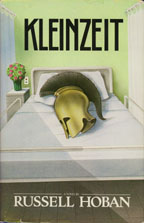
Kleinzeit by Russell Hoban

Kleinzeit leaned on his fear, hobbled into the black sunlight with trembling legs, found an entrance to the Underground, descended.  Underground seemed the country of the dead, not enough trains, not enough people in the trains, not enough noise, too many empty spaces.  Life was like a television screen with the sound turned off.  His train zoomed up in perfect silence, he got in.  In the empty spaces his wife and children spoke, sang, laughed without sound, the tomcat shook his fist, Folger Bashan was smothered with a pillow, his father stood with him at the edge of a grave and watched the burial of trees and grass and blue, blue sky.  The train could take him to the places but not the times.  Kleinzeit didn't want to get out of the train, there was no time here, nothing had to be decided.  He dropped his mind like a bucket into the well of Sister.  There was a hole in the bucket, it came up empty.

Kleinzeit, middle-aged ex-advertising copywriter, is admitted to the hospital with pain in his hypotenuse, which spreads quickly to his diapason, asymptotes, and stretto.  That baffling sentence tells you a lot about the world of Kleinzeit, which is not quite our own.  For one thing, everything talks--anthropomorphism is the principle stylistic tool Hoban employs in Kleinzeit.  See for yourself:

Under the bed Death sat humming to itself while it cleaned its fingernails.  I never do get them really clean, it said.  It's a filthy job I've got but what's the use of complaining.  All the same I think I'd rather have been Youth or Spring or any number of things rather than what I am.  Not Youth, maybe.  That's a little wet and you'd hardly get to know people before they've moved on.  Spring's pretty much the same and it's a lady's job besides.  Action would be nice to be, I should think.

Elsewhere Action lay in his cell smoking and looking up at the ceiling.  What a career ,he said.  I've spent more time in the nick than anywhere else.  Why couldn't I have been Death or something like that.  Steady work, security.

When Kleinzeit is admitted to the hospital, he doesn't merely enter a building; he contacts a rapacious, sadistic anthropomorphic being who wants to devour him:

You understand things, said Hospital.  You're clever.

Ever so, said Kleinzeit, looking for a mousehole small enough for him.

Yes, said Hospital, and became one infinite black mouth.  Didn't even bother with teeth.  Just an infinite black mouth, fetid breath.  Kleinzeit backed into a mousehole.  If the hole is this big the mice must look like oxen here, he thought.

Everything is personified: Death, Action, Hospital, Memory, Underground, the bathroom mirror, the sheets of yellow paper that beckon for Kleinzeit to write on them (and may have some sinister connection to why Kleinzeit is in the hospital in the first place).  That sounds like it might get annoying, but it works because Kleinzeit is a story about a man facing the powers which are outside of his control, and threaten to destroy him.  Giving a voice to "Hospital" allows Hoban to revitalize the conflict between a person and his own bodily health.  Who, being in poor health, has not found the hospital itself to be ominous, even malicious?

While in Hospital, Kleinzeit and his attending nurse, called Sister, fall in love.  I'm not sure I can describe the rest of the plot without sounding a little ridiculous: Kleinzeit and Sister go busking in the London underground; Sister finds an ancient Greek helmet; Kleinzeit struggles to figure out the connection between the yellow paper to his illness and those of the others in his ward; Hospital tells Kleinzeit the true story of Oprheus and Eurydice; other minor characters with names like Flashpoint and Schwarzgang and Dr. Pink come and go.

Kleinzeit is so scatterbrained and strange it seems as if it ought to fall apart like Nathanael West's The Dream Life of Balso Snell or Mervyn Peake's Titus Alone, two books which are nearly unreadable.  But somehow, Hoban manages to unite all these disparate parts into a touching meditation on man's relationship with Death--a creature that turns out, in the end, to be not nearly as hostile as Hospital.

This is the third novel I've read by Hoban, after Riddley Walker, which I loved, and Pilgermann, which I did not.  Each one is weird in its own way, and accomplished in its own way, but none of the three is like the other--so much so that it's hard to believe that they were written by the same person.  If nothing else, Hoban has a range that few other authors can rival, perhaps none.

Saturday, May 22, 2010

Riddley Walker by Russell Hoban

Note: I wrote this review a month ago, and saved it so that I wouldn't spoil anything for Brent. Any similarities between our reviews means that he cribbed off of me, and not the other way around.

On my naming day when I come 12 I gone front spear and kilt a wyld boar he parbly ben the las wyld pig on the Bundel Downs any how there hadnt ben none for a long time befor him nor I aint looking to see none agen. He dint make the groun shake nor nothing like that when he come on to my spear he wernt all that big plus he lookit poorly. He done the reqwyrt he ternt and stood and clattert his teef and made his rush and there we wer then. Him on 1 end of the spear kicking his life out and me on the other end watching him dy. I said, 'Your tern now my tern later.'

Sweet baby Jesus, I love Riddley Walker. I'm not really in the habit of re-reading books, but when I saw that the AV Club was doing their monthly book club on Riddley Walker in April, I encourage Brent to read this with me.

I am happy to report that it is as awesome as I remember. Riddley Walker is set approximately 2700 years in the future, in an England having advanced roughly to the Iron Age after a nuclear war that occurred around present day. England, now called Inland, is ruled by a shadowy government called the Ram, and order is maintained by the Pry Mincer and Wes Mincer (derivatives of prime minister and westminster) who maintain a traveling puppet show that tells and re-tells the culture's central myth, the Eusa Story. The Eusa Story is cobbled together from disparate parts; while it tells a broken version of the nuclear war that ruined society, it is also mixed with the story of St. Eustace, as well as government propaganda. Like most religious texts, various versions of it are told, and it is interpreted in wildly different ways.

When his father dies in a bizarre accident, Riddley becomes his community's conexion man, responsible for interpreting everyday events as well as telling the significance of the traveling Eusa show. Shortly after his initiation into this role, Riddley is drawn into a conflict between those who wish to seek the sort of knowledge that brought civilization to ruin and those who would stop them.

I have been thinking on Riddley Walker for a few days now, and it is a difficult book to characterize simply. It seems to me that it is ultimately a story about knowledge--what it is, how it is gathered, and what it is worth. In 2700 years language would surely have evolved into something much different from English, but the strange, broken idiom that Riddley speaks is representative of the perverse, askew version of Western culture and religion in which he lives. Knowledge, like language, has not been lost, but shifted, changed, twisted. Early in the book, Riddley is told the story of "Why the Dog Wont Show its Eyes," about how man and woman received the "1st knowing":

The man and woman seen the fire shyning in the dogs eyes. The man throwit meat to the dog and the dog come into them by the fire. Brung its eyes in our of the nite and then they all lookit at the nite to gether. The man and the woman seen the nite in the dogs eyes and thats when they got the 1st knowing of it. They knowit the nite the same as the dog knowit.


There seems to be a distinction being made between the "1st knowing," a sort of primal understanding of things represented by their shapes, and more advanced forms of knowledge. To understand the shape of something is to know it instinctively, to be able to feel it in three dimensions. In the legend, the man and woman become more "clevver," gaining the sort of knowledge that is represented by numbers instead of shapes, and they lose the 1st knowing.

Hoban presents this progression of knowledge without judgment. On the one hand, it is easy to lament the way that man has lost this primal knowledge, and it is easy also to sympathize with Riddley when he encounters the remnants of twentieth-century era machinery:

How cud any 1 not want to get that shyning Power back from time to time back way back? How cud any 1 not want to be like them what had boats in the air and picters on the wind? How cud any 1 not want to see them shyning weals turning?


And indeed it seems that progress is inevitable; Riddley is unable to stop the Pry Mincer of Inland in rediscovering the secret ingredients that create gunpowder, and it is unclear as to whether or not he should. Riddley is set deep in this conflict, but he seems to be on different sides at different times, desperate to act but unsure what for or what against.

There is much that I would like to talk about but am unable to touch upon. Riddley Walker is a complex book that rewards revisiting, and I think that it would take many more times re-reading to fully understand it. Even so, I recommend it highly--this is one of my absolute favorite books.

Monday, January 7, 2008

Pilgermann by Russell Hoban

Pilgermann here. I call myself Pilgermann, it's a convenience. What my name was when I was walking around in the shape of a man I don't know, I simply can't remember. What I am now is waves and particles, I don't need to walk around, I just go.

Pilgermann
is the story of a wandering Jew on a pilgrimage to Jerusalem in the late 11th Century. His name isn't Pilgermann, but that's the name that his ghost--or consciousness, or whatever it is that's narrating this novel from beyond the grave--adopts for himself, because his real one is lost to time. What he narrates is the story of his life, beginning with his castration by a Christian mob in his hometown, following with a vision he has of Christ, who tells him to go to Jerusalem. He never actually makes it there, but instead is captured by pirates and ends up in Antioch where he befriends a local Muslim and is eventually killed in a Frankish crusade.

The first half of the book takes its cues from Bosch and Vermeer paintings: European landscapes ravaged by death, haunted by strange and ghastly figures. He is followed by those whose deaths are connected to him: The headless tax-collector who both sicced the mob of Christians on him and saved his life by stopping them short and the highwayman who murdered him (and whom Pilgermann kills), a man named Konrad and his lover Bodwild, who is a sow, and, oh, why not, a bear. There's also the personification of death as Bruder Pfortner, for whom killing is a sexual experience, and the vision of Pilgermann's own death as a child which grows into a man by the novel's end.

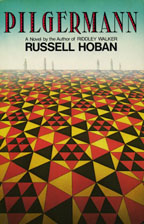
The second half is much better; it follows Pilgermann and his new friend, Bembel Redzuk, as they conceive of a massive tiled court they call "Hidden Lion" (see cover), which they erect to study the point at which "stillness becomes movement" and "movement becomes consciousness." If you can't tell, Pilgermann is a book mostly of ideas and not plot; for every page of action there are probably ten pages of Pilgermann's complex thoughts on the nature of religion and death. Some are quite beautiful and profound--for example, I like the way that Pilgermann never gets to Jerusalem, but finds solace in the words of a traveling group of child pilgrims who say, in the face of their own death, "Jerusalem is wherever we will be when we get to the end"--but much is dense, obtuse, and not quite worth the effort it takes to decipher. It is a book full of references from all three of the Abrahamic religions, and one of its chief themes is their interaction. That the Muslim world comes off much better than the Christian (and even the Jewish) is no surprise; Hoban's depiction of the Frankish crusaders as being socially underdeveloped in relation to their Turkish counterpoints is historically accurate.

I picked up this book because Hoban penned one of my favorite novels, Riddley Walker, a post-apocalyptic novel written completely in the strange pidgin English of the future. I'm sad to say that Pilgermann isn't nearly as enjoyable, though serious religious scholars may find it interesting. As disappointed as I am, I still may read another of his books, Turtle Diary, about a pair of strangers who come together to free a couple of sea turtles from the zoo. This guy seriously never writes the same book twice.